EP0052960B1 - Dispositif pour le contrôle du niveau d'un liquide et procédé pour la détection de fuites à l'aide du dispositif - Google Patents
Dispositif pour le contrôle du niveau d'un liquide et procédé pour la détection de fuites à l'aide du dispositif Download PDFInfo
- Publication number
- EP0052960B1 EP0052960B1 EP81305193A EP81305193A EP0052960B1 EP 0052960 B1 EP0052960 B1 EP 0052960B1 EP 81305193 A EP81305193 A EP 81305193A EP 81305193 A EP81305193 A EP 81305193A EP 0052960 B1 EP0052960 B1 EP 0052960B1
- Authority
- EP
- European Patent Office
- Prior art keywords
- liquid
- float
- float means
- detector
- changes
- Prior art date
- Legal status (The legal status is an assumption and is not a legal conclusion. Google has not performed a legal analysis and makes no representation as to the accuracy of the status listed.)
- Expired
Links
- 238000000034 method Methods 0.000 title claims description 17
- 238000012544 monitoring process Methods 0.000 title claims description 7
- 239000007788 liquid Substances 0.000 claims description 95
- 235000013405 beer Nutrition 0.000 claims description 7
- 230000005855 radiation Effects 0.000 claims description 6
- 229920006395 saturated elastomer Polymers 0.000 claims description 4
- 239000011248 coating agent Substances 0.000 claims description 2
- 238000000576 coating method Methods 0.000 claims description 2
- 230000005670 electromagnetic radiation Effects 0.000 claims description 2
- 238000009738 saturating Methods 0.000 claims 1
- 239000000835 fiber Substances 0.000 description 18
- 238000002474 experimental method Methods 0.000 description 4
- VVQNEPGJFQJSBK-UHFFFAOYSA-N Methyl methacrylate Chemical compound COC(=O)C(C)=C VVQNEPGJFQJSBK-UHFFFAOYSA-N 0.000 description 3
- 229920005372 Plexiglas® Polymers 0.000 description 3
- 230000008020 evaporation Effects 0.000 description 3
- 238000001704 evaporation Methods 0.000 description 3
- 229910001220 stainless steel Inorganic materials 0.000 description 3
- 239000010935 stainless steel Substances 0.000 description 3
- WUPHOULIZUERAE-UHFFFAOYSA-N 3-(oxolan-2-yl)propanoic acid Chemical compound OC(=O)CCC1CCCO1 WUPHOULIZUERAE-UHFFFAOYSA-N 0.000 description 2
- 229910052980 cadmium sulfide Inorganic materials 0.000 description 2
- 238000009795 derivation Methods 0.000 description 2
- 238000010586 diagram Methods 0.000 description 2
- 238000012360 testing method Methods 0.000 description 2
- OKTJSMMVPCPJKN-UHFFFAOYSA-N Carbon Chemical compound [C] OKTJSMMVPCPJKN-UHFFFAOYSA-N 0.000 description 1
- 239000006229 carbon black Substances 0.000 description 1
- 230000003247 decreasing effect Effects 0.000 description 1
- 238000001514 detection method Methods 0.000 description 1
- 230000003292 diminished effect Effects 0.000 description 1
- 239000006185 dispersion Substances 0.000 description 1
- -1 e.g. Substances 0.000 description 1
- 239000002360 explosive Substances 0.000 description 1
- 239000012530 fluid Substances 0.000 description 1
- 239000011521 glass Substances 0.000 description 1
- 229910002804 graphite Inorganic materials 0.000 description 1
- 239000010439 graphite Substances 0.000 description 1
- 238000003780 insertion Methods 0.000 description 1
- 230000037431 insertion Effects 0.000 description 1
- 238000005259 measurement Methods 0.000 description 1
- 238000011326 mechanical measurement Methods 0.000 description 1
- QSHDDOUJBYECFT-UHFFFAOYSA-N mercury Chemical compound [Hg] QSHDDOUJBYECFT-UHFFFAOYSA-N 0.000 description 1
- 229910052753 mercury Inorganic materials 0.000 description 1
- 239000000203 mixture Substances 0.000 description 1
- 238000002834 transmittance Methods 0.000 description 1
Images


Classifications
-
- G—PHYSICS
- G01—MEASURING; TESTING
- G01F—MEASURING VOLUME, VOLUME FLOW, MASS FLOW OR LIQUID LEVEL; METERING BY VOLUME
- G01F23/00—Indicating or measuring liquid level or level of fluent solid material, e.g. indicating in terms of volume or indicating by means of an alarm
- G01F23/22—Indicating or measuring liquid level or level of fluent solid material, e.g. indicating in terms of volume or indicating by means of an alarm by measuring physical variables, other than linear dimensions, pressure or weight, dependent on the level to be measured, e.g. by difference of heat transfer of steam or water
- G01F23/28—Indicating or measuring liquid level or level of fluent solid material, e.g. indicating in terms of volume or indicating by means of an alarm by measuring physical variables, other than linear dimensions, pressure or weight, dependent on the level to be measured, e.g. by difference of heat transfer of steam or water by measuring the variations of parameters of electromagnetic or acoustic waves applied directly to the liquid or fluent solid material
- G01F23/284—Electromagnetic waves
- G01F23/292—Light, e.g. infrared or ultraviolet
-
- G—PHYSICS
- G01—MEASURING; TESTING
- G01F—MEASURING VOLUME, VOLUME FLOW, MASS FLOW OR LIQUID LEVEL; METERING BY VOLUME
- G01F23/00—Indicating or measuring liquid level or level of fluent solid material, e.g. indicating in terms of volume or indicating by means of an alarm
- G01F23/30—Indicating or measuring liquid level or level of fluent solid material, e.g. indicating in terms of volume or indicating by means of an alarm by floats
- G01F23/64—Indicating or measuring liquid level or level of fluent solid material, e.g. indicating in terms of volume or indicating by means of an alarm by floats of the free float type without mechanical transmission elements
- G01F23/68—Indicating or measuring liquid level or level of fluent solid material, e.g. indicating in terms of volume or indicating by means of an alarm by floats of the free float type without mechanical transmission elements using electrically actuated indicating means
- G01F23/70—Indicating or measuring liquid level or level of fluent solid material, e.g. indicating in terms of volume or indicating by means of an alarm by floats of the free float type without mechanical transmission elements using electrically actuated indicating means for sensing changes in level only at discrete points
-
- G—PHYSICS
- G01—MEASURING; TESTING
- G01F—MEASURING VOLUME, VOLUME FLOW, MASS FLOW OR LIQUID LEVEL; METERING BY VOLUME
- G01F23/00—Indicating or measuring liquid level or level of fluent solid material, e.g. indicating in terms of volume or indicating by means of an alarm
- G01F23/30—Indicating or measuring liquid level or level of fluent solid material, e.g. indicating in terms of volume or indicating by means of an alarm by floats
- G01F23/76—Indicating or measuring liquid level or level of fluent solid material, e.g. indicating in terms of volume or indicating by means of an alarm by floats characterised by the construction of the float
Definitions
- This invention relates to the art of detecting a liquid level. More particularly, this invention relates to the art of detecting leaks in liquid storage tanks.
- Sunmark Industries a division of Sun Oil Company of Pennsylvania, sells a leak detecting device which relies on the Principle of Buoyancy, i.e., the principle that a body suspended in a liquid is buoyed up by a force equal to the weight of liquid displaced by such a body.
- a sensor which extends from a sensitive, but rugged balance, and which is partially submerged in the tank fluid detects buoyancy changes corresponding to either an increase or a decrease in the total amount of liquid in a tank.
- the Kent-Moore System (see US-A-3 580 055) is a method and apparatus for determining whether there are any leaks in a liquid storage container. One of the steps necessary in carrying out a determination of leaks is to pressurize and fill to excess a storage zone. Details concerning the experimental procedure are published by Kent-Moore Corporation for Model 1000, Tank System Tightness Tester. There are several problems in the Kent-Moore System which result in readings which are not stable.
- An apparatus or method capable of detecting leaks as easily as that disclosed by Sunmark Industries is both desirable and useful. Further, an apparatus which can detect leaks as well as the method of the Kent-Moore System, but without its draw backs is both desirable and useful.
- the present invention consists in apparatus for detecting small changes in liquid level comprising support means, float means movably connected to the support means and adapted to float in the liquid and means for monitoring changes in location of the float means relative to the support means, characterised in that said monitoring means comprises a reservoir for holding measuring liquid medium and measuring means having a source transmitting electro-magnetic radiation along a path to a detector, the reservoir being connected to the float means and the measuring means being connected to the support means so that the said path includes a modulating amount of the measuring liquid medium which varies with changes in location of the float means relative to the support means and which modulates the intensity of the radiation detected by the detector in a manner which is characteristic of the location of the float means relative to the support means.
- a measuring medium is a liquid having a k value defined in relation to Beer's Law in the range of about 0.1 to 1,000 reciprocal centimeters.
- the k value of the measuring medium has a value in the range of about 50 to about 200 reciprocal centimeters.
- Another embodiment of this invention is a method for detecting a leak in a storage tank containing a liquid.
- the method comprises determining changes in location of the float means discussed hereinabove.
- An improvement to this method further involves locating the float means at a depth approximately equal to VJSL where V L is the volume of the selected liquid in which the float means is located and S L is free surface area of the selected liquid.
- the vapor above the liquid is saturated with the liquid in the storage tank so as to minimize evaporation during a measurement of the location of the float means.
- Several methods readily understood in the art for insuring that the vapor about the liquid is saturated in the liquid include atomizing so as to fill the vapor above the liquid with small droplets of liquid or coating with a thin layer of the liquid surfaces of the container above the liquid so as to hasten saturation of the vapor above the liquid.
- FIG. 1 discloses an underground tank 20 in ground 30.
- Tank 20 comprises a cover support 24, a height adjustment screw 26, cover plate 18 and a supply opening 22.
- a tubular support 28 Connected to height adjustment screw 26 is a tubular support 28.
- Fixedly, attached to tubular support 28 is a signal source 32 and a detector support 34.
- Float means 38 is pivotally attached to tubular support 28 by means of a hinge 49 comprising: a first pivot 40, a second pivot 42, a primary lever 41 and a secondary lever 43.
- Figure 2 shows an enlarged drawing of a portion of the embodiment of the apparatus of this invention which is shown in Figure 1.
- Figure 2 discloses a signal source 32, a reservoir 44, a photo resistor or detector means 36, a detector support 34, a hinge 49, a float means 38, a band clamp 31, electrical leads 23 and 25, an india ink solution or measuring medium 19 and gasoline or a selected liquid 21.
- Signal source 32 comprises a housing 29, a plexiglass window 27, a bulb 33, and a bulb socket 51.
- the electrical connections of signal source 32 are carefully insulated so as to minimize any risks associated with gasoline vapors.
- the housing 29 and plexiglass window 27 form a vapor tight seal 37 to maintain the compartment containing bulb 33 and bulb socket 51 free from any explosive vapors.
- Hince 49 comprises a first pivot 40, a second pivot 42, a primary lever 41 and a secondary lever 43.
- Signal source 32 is fixedly attached to tubular support 28 by means of a band clamp 31.
- a detector support 34 is held in a fixed position relative to tubular support 28. At one end of detector support 34 is located a photo resistor 36 within a sealed compartment 52.
- a curved glass cover 35 fits over photo resistor 36 or detector means 36 and keeps any india ink solution 19 outside sealed compartment 52.
- Electrical leads 23 from photo resistor are attached as shown in an electric circuit schematically shown in Figure 4. One end of leads 23 is directly attached to the mV recorder input 62 and the other end is indirectly connected to the mV recorder input 63 through ground 58.
- Electrical leads 25 are attached at one end to ground 58 and at the other end to a voltage source (not shown) which must maintain a substantially constant voltage to the filament of bulb 33 so that the intensity of light emitted by bulb 33 does not vary significantly.
- the float means 38 which is movably attached to tubular support 28 is capable of moving relative to tubular support 28. Since float means 38 contains weights 57 ( Figure 1), it maintains a substantially vertical orientation within gasoline 21. Because float means 38 remains in a substantially vertical orientation due to natural buoyancy forces, only one hinge 49 is required although others may be used.
- the first pivot 40 comprises a 1/4" (6.35 mm) stainless steel tube 53 which is attached to tubular support 28 and a primary lever 41 which is pivotally mounted within tube 53.
- Second pivot 42 comprises a 1/4" (6.35 mm) stainless steel tube 54 into which primary lever 41 is inserted and pivotally mounted in a manner similar to that of first pivot 40, and a second lever 43 is fixedly attached to 1/4" (6.35 mm) stainless steel tube 54.
- the main purpose of hinge 49 is to permit movement of float means 38 relative to tubular support 28. Other arrangements can be used which fulfill the same purpose as hince 49.
- Reservoir 44 is fixedly attached, e.g., either directly or indirectly, to secondary lever 43.
- float means 38 is fixedly attached, e.g., directly or indirectly, to secondary lever 43.
- float means 38 moves up or down in response to changing buoyancy forces, e.g., due to loss or gain in the amount of gasoline 21 in tank 20, reservoir 44 changes position relative to detector means 36. Since both signal source 32 and detector means 36 are in a fixed position relative tubular support 28, the relative position of signal source 32 to detector means 36 remains constant throughout changes in location of float means 38. For example, as float means 38 moves upward, reservoir 44 ' fixedly attached to float means 38 also will move upward relative to tubular support 28.
- Figure 3 is a top view along line 3-3 of Figure 2.
- Figure 3 discloses tubular support 28, detector support 34, detector means 36, first pivot 40, second pivot 42, primary lever 41, cross bar 46 and reservoir 44 containing a measuring medium 19.
- Cross bar 46 fixedly attached to detector support 34 is useful to aid insertion of the device of this invention by limiting the amount of movement around first and second pivots 40 and 42. Movement around first and second pivots 40 and 42 is limited because primary lever 41 contacts cross bar 46 when the maximum amount of counter-clockwise rotation around first pivot 40 occurs.
- primary lever 41 rotates in a counter-clockwise rotation around first pivot 40. This counter-clockwise rotation continues until primary lever 41 contacts cross bar 46. Since further counter-clockwise rotation is precluded after primary lever 41 contacts cross bar 46, the remaining portion of this invention fixedly attached to secondary lever 43 then begins to move as tubular support 28 moves.
- Figure 4 discloses a schematic measuring circuit 60 which includes electrical leads 23 of detector 36.
- Mesuring circuit 60 comprising a constant voltage source or battery 50 and a resistor 45. Resistor 45 and detector 36 are in series with one another. The voltage differences across detector 36 is measured and recorded by means of millivolt recorder 48 on strip chart 61 (not shown).
- Battery 50 for example, can have a voltage of 1.5 volts when resistor 45 has a resistance of about 100,000 ohms.
- Detector 36 preferably uses cadmium sulfide.
- Measuring circuit 60 converts the resistance across detector 36 into a voltage differential across detector means 36. This voltage differential across detector 36 is measured and recorded by millivolt recorder 48 on a strip chart 61.
- the voltage source 50 must be substantially constant not only to keep the intensity from bulb 33 substantially constant, but also to keep the total voltage drop across both resistor 45 and detector 36 substantially constant.
- the apparent resistance across detector 36 will vary depending upon the intensity of light radiation impinging thereon.
- the amount of transmitted light radiation reaching detector 36 from light source 33 will vary, all other factors to be discussed hereinafter being equal, logarithmically with the height L of liquid 19. ( Figure 2).
- the k is a constant which cancels out as shown in an example. Carbon black or graphite e.g., in an india ink solution of about one percent (1%), has been found particularly suitable in this invention.
- the value of k in reciprocal centemeters is preferably in excess of 50. The larger the value of k, the more sensitive is the instrument. If k becomes too large, e.g., much above 1000, minute vibrations can become a serious problem and/or the intensity of transmitted light can become diminished to a point that makes detection difficult.
- k has a value in the range of about 50 to about 200 reciprocal centimeters.
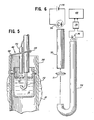
- Figures 5 and 6 disclose an alternative embodiment to the invention shown in Figures 1 and 2.
- a transmitting fiber 70 is used and in place of detector 36 a receiving fiber 72 is used.
- Other elements disclosed in Figure 8 are numbered with those numbers of the same or equivalent elements of Figures 1 and 2.
- fiber 70 is indicated to be a transmitting fiber, it may also be a receiving fiber when receiving fiber 72 is alternatively a transmitting fiber.
- a focusing lens 71 may be inserted between fibers 70 and 72 to provide a collimated beam therebetween.
- Figure 6 is a schematic representation of the alternate embodiment shown in Figure 5. Disclosed in Figure 6 are a battery 75, a light emitting diode 74, a transmitting fiber 70, a collimating lens 71 (in phantom outline), an absorbing fiber 72, a photo diode 76, a means 78 for converting current to voltage and millivolt recorder 48.
- the device schematically disclosed in Figure 6 operates as follows. Power from battery 75 causes light emitting diode 74 to emit light which is transmitted by fiber 70. Optionally, a collimating lens 71 collimates the beam so as to minimize undesirable dispersion. Light received by fiber 72 is transmitted to a photo diode 76. The current produced by photo diode 76 is converted into voltage by a two-step electronic circuit. The first step of the electronic circuit collectively shown as box 78 is to convert current into voltage by ways well recognized and understood in the art. Devices useful as transmitting and receiving fibers with couples to transmitting and receiving photo diodes are sold by Skan-A-Matic corporation, Elbridge, New York.
- a second portion of the circuit 78 converts the voltage produced by the first step of converting current to voltage and amplifies such voltage so as to provide a working voltage capable of driving a millivolt recorder 48.
- the amount of light received by fiber 72 which passes through collimating lens 71 will depend primarily upon the amount of measuring medium or india ink solution 19 which is between transmitting fiber 70 and receiving fiber 72.
- the observed voltage on the millivolt recorder 48 will vary in the same manner as in Figures 1 and 2 to disclose the relative movement of float means 38 with respect to both tubular support 28 and anything fixed relative to tubular support 28.
- the internal resistance, R, of the photo resistor is a constant divided by the intensity of light impinging on the photo sensor. Therefore, the ratio R 2 /R 1 is equal to the ratio I 1 /I 2 .
- Equations (1) and (2) are derived based on Ohm's Law, i.e.,
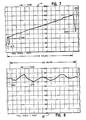
- E 1 is 0.80 volts, as recorded on strip chart 61, and corresponds to some initial intensity 1 1 received by detector 36 at time zero; E 2 is 0.32 volts at some time 15 hours after the start of the experiment.
- E 2 is 0.32 volts at some time 15 hours after the start of the experiment.
- 1 quart of gasoline 19 was removed and the initial and final volts recorded on strip chart 61.
- Initial E 3 and E 4 were recorded as 0.80 and 0.43 volts, respectively.
- the rate of the gasoline loss is about 0.024 gallons/hour (0.0908 I/hr).
- a floating means of this invention When a floating means of this invention is located at a depth approximately equal to the liquid volume divided by the liquid surface area, the float means will remain stationary even during changes in temperature involving the liquid in the tank and float means itself.
Landscapes
- Physics & Mathematics (AREA)
- Fluid Mechanics (AREA)
- General Physics & Mathematics (AREA)
- Electromagnetism (AREA)
- Thermal Sciences (AREA)
- Level Indicators Using A Float (AREA)
- Examining Or Testing Airtightness (AREA)
- Measurement Of Levels Of Liquids Or Fluent Solid Materials (AREA)
Claims (10)
Applications Claiming Priority (2)
| Application Number | Priority Date | Filing Date | Title |
|---|---|---|---|
| US20860880A | 1980-11-20 | 1980-11-20 | |
| US208608 | 1980-11-20 |
Related Child Applications (2)
| Application Number | Title | Priority Date | Filing Date |
|---|---|---|---|
| EP85200108.0 Division-Into | 1981-10-30 | ||
| EP85200108A Division EP0168842A3 (fr) | 1980-11-20 | 1981-10-30 | Appareil flotteur et procédé pour la détection de fuites à l'aide de cet appareil |
Publications (2)
| Publication Number | Publication Date |
|---|---|
| EP0052960A1 EP0052960A1 (fr) | 1982-06-02 |
| EP0052960B1 true EP0052960B1 (fr) | 1986-03-19 |
Family
ID=22775247
Family Applications (2)
| Application Number | Title | Priority Date | Filing Date |
|---|---|---|---|
| EP85200108A Withdrawn EP0168842A3 (fr) | 1980-11-20 | 1981-10-30 | Appareil flotteur et procédé pour la détection de fuites à l'aide de cet appareil |
| EP81305193A Expired EP0052960B1 (fr) | 1980-11-20 | 1981-10-30 | Dispositif pour le contrôle du niveau d'un liquide et procédé pour la détection de fuites à l'aide du dispositif |
Family Applications Before (1)
| Application Number | Title | Priority Date | Filing Date |
|---|---|---|---|
| EP85200108A Withdrawn EP0168842A3 (fr) | 1980-11-20 | 1981-10-30 | Appareil flotteur et procédé pour la détection de fuites à l'aide de cet appareil |
Country Status (10)
| Country | Link |
|---|---|
| EP (2) | EP0168842A3 (fr) |
| JP (1) | JPS57114820A (fr) |
| BR (1) | BR8107472A (fr) |
| CA (1) | CA1174869A (fr) |
| DE (1) | DE3174140D1 (fr) |
| DK (1) | DK513081A (fr) |
| ES (2) | ES507299A0 (fr) |
| MX (1) | MX151798A (fr) |
| NO (1) | NO813907L (fr) |
| SE (1) | SE8106553L (fr) |
Families Citing this family (2)
| Publication number | Priority date | Publication date | Assignee | Title |
|---|---|---|---|---|
| JPS61205032U (fr) * | 1985-06-13 | 1986-12-24 | ||
| FI93396C (fi) * | 1993-08-17 | 1995-03-27 | Petetronic Tmi P Kinnunen | Optinen menetelmä nesteen pinnankorkeuden mittaamiseksi |
Family Cites Families (9)
| Publication number | Priority date | Publication date | Assignee | Title |
|---|---|---|---|---|
| FR934118A (fr) * | 1946-10-02 | 1948-05-12 | Procédé et installation pour le jaugeage des liquides | |
| US3085434A (en) * | 1958-11-19 | 1963-04-16 | Texas Instruments Inc | Floating roof tank gauge |
| FR1236092A (fr) * | 1959-06-04 | 1960-07-15 | Transport Petrol Par Pipeline | Dispositif indicateur de niveau, en particulier pour mélanges de fluides de densités différentes |
| DE1225924B (de) * | 1963-08-24 | 1966-09-29 | Krohne Fa Ludwig | Leckanzeigeeinrichtung fuer Fluessigkeitslager-behaelter |
| US3580055A (en) * | 1968-10-25 | 1971-05-25 | Kent Moore Corp | Tank system tightness tester |
| US3805613A (en) * | 1971-07-29 | 1974-04-23 | L Stone | Liquid level indicator |
| US4186591A (en) * | 1978-11-27 | 1980-02-05 | Mooney Joseph R | Device for and method of detecting leaks in a liquid storage reservoir |
| DE3009549C2 (de) * | 1979-07-18 | 1987-01-15 | Walter 2000 Hamburg Nicolai | Einrichtung zur selbsttätigen Anzeige von Mengenänderungen in Flüssigkeitsbehältern |
| US4300388A (en) * | 1979-10-12 | 1981-11-17 | Sun Oil Company Of Pennsylvania | Method for leakage measurement |
-
1981
- 1981-10-23 CA CA000388612A patent/CA1174869A/fr not_active Expired
- 1981-10-30 EP EP85200108A patent/EP0168842A3/fr not_active Withdrawn
- 1981-10-30 EP EP81305193A patent/EP0052960B1/fr not_active Expired
- 1981-10-30 DE DE8181305193T patent/DE3174140D1/de not_active Expired
- 1981-11-05 SE SE8106553A patent/SE8106553L/ not_active Application Discontinuation
- 1981-11-18 BR BR8107472A patent/BR8107472A/pt unknown
- 1981-11-18 NO NO813907A patent/NO813907L/no unknown
- 1981-11-19 DK DK513081A patent/DK513081A/da not_active Application Discontinuation
- 1981-11-19 MX MX190200A patent/MX151798A/es unknown
- 1981-11-19 ES ES507299A patent/ES507299A0/es active Granted
- 1981-11-20 JP JP56186769A patent/JPS57114820A/ja active Pending
-
1982
- 1982-10-15 ES ES516547A patent/ES8309006A1/es not_active Expired
Also Published As
| Publication number | Publication date |
|---|---|
| EP0168842A3 (fr) | 1986-04-02 |
| ES8304303A1 (es) | 1983-02-16 |
| NO813907L (no) | 1982-05-21 |
| DE3174140D1 (en) | 1986-04-24 |
| CA1174869A (fr) | 1984-09-25 |
| EP0168842A2 (fr) | 1986-01-22 |
| BR8107472A (pt) | 1982-08-10 |
| ES507299A0 (es) | 1983-02-16 |
| ES516547A0 (es) | 1983-10-01 |
| ES8309006A1 (es) | 1983-10-01 |
| JPS57114820A (en) | 1982-07-16 |
| MX151798A (es) | 1985-03-18 |
| DK513081A (da) | 1982-05-21 |
| EP0052960A1 (fr) | 1982-06-02 |
| SE8106553L (sv) | 1982-05-21 |
Similar Documents
| Publication | Publication Date | Title |
|---|---|---|
| US4773265A (en) | Method for detecting leaks | |
| US4281534A (en) | Sensor for measuring leakage | |
| NO811865L (no) | Fremgangsmaate for lekkasjemaaling. | |
| US4604893A (en) | Leak detector | |
| US4453400A (en) | Leak detector | |
| EP0486604B1 (fr) | Systeme de detection de fuite | |
| US4397183A (en) | Apparatus for detecting level changes in distance | |
| US4419893A (en) | Method for determining specific gravity of a liquid | |
| EP0052960A1 (fr) | Dispositif pour le contrôle du niveau d'un liquide et procédé pour la détection de fuites à l'aide du dispositif | |
| USRE31884E (en) | Method for leakage measurement | |
| US3394590A (en) | Hydraulic system and liquid level sensing mechanism therefor | |
| US4630467A (en) | Leak detector | |
| US4299116A (en) | Methods involving differential pressure determinations | |
| GB2089032A (en) | Device for Detecting Specific Gravity of Liquid | |
| FI93396B (fi) | Optinen menetelmä nesteen pinnankorkeuden mittaamiseksi | |
| US2439342A (en) | Pressure measuring apparatus | |
| US2439770A (en) | Electrically indicating liquid filled manometer | |
| CA1193466A (fr) | Temoin de niveau de liquide | |
| SU1423963A1 (ru) | Способ испытани резин в ненапр женном состо нии на стойкость к воздействию жидких агрессивных сред | |
| US4420966A (en) | Method for determining solids or liquids in vapor | |
| US1404062A (en) | Altimeter | |
| CA1286523C (fr) | Dispositif et methode pour determiner le rythme des fuites de liquide d'une citerne, ou de l'infiltration de liquide dans une citerne | |
| JPS5862517A (ja) | 液化ガス用浮力式液面計 | |
| RU2413961C1 (ru) | Гравиметр | |
| SU900138A1 (ru) | Манометр |
Legal Events
| Date | Code | Title | Description |
|---|---|---|---|
| PUAI | Public reference made under article 153(3) epc to a published international application that has entered the european phase |
Free format text: ORIGINAL CODE: 0009012 |
|
| AK | Designated contracting states |
Designated state(s): DE FR GB IT NL |
|
| 17P | Request for examination filed |
Effective date: 19821108 |
|
| GRAA | (expected) grant |
Free format text: ORIGINAL CODE: 0009210 |
|
| AK | Designated contracting states |
Kind code of ref document: B1 Designated state(s): DE FR GB IT NL |
|
| PG25 | Lapsed in a contracting state [announced via postgrant information from national office to epo] |
Ref country code: NL Effective date: 19860319 Ref country code: IT Free format text: LAPSE BECAUSE OF FAILURE TO SUBMIT A TRANSLATION OF THE DESCRIPTION OR TO PAY THE FEE WITHIN THE PRESCRIBED TIME-LIMIT;WARNING: LAPSES OF ITALIAN PATENTS WITH EFFECTIVE DATE BEFORE 2007 MAY HAVE OCCURRED AT ANY TIME BEFORE 2007. THE CORRECT EFFECTIVE DATE MAY BE DIFFERENT FROM THE ONE RECORDED. Effective date: 19860319 Ref country code: FR Free format text: THE PATENT HAS BEEN ANNULLED BY A DECISION OF A NATIONAL AUTHORITY Effective date: 19860319 |
|
| REF | Corresponds to: |
Ref document number: 3174140 Country of ref document: DE Date of ref document: 19860424 |
|
| EN | Fr: translation not filed | ||
| NLV1 | Nl: lapsed or annulled due to failure to fulfill the requirements of art. 29p and 29m of the patents act | ||
| PLBE | No opposition filed within time limit |
Free format text: ORIGINAL CODE: 0009261 |
|
| STAA | Information on the status of an ep patent application or granted ep patent |
Free format text: STATUS: NO OPPOSITION FILED WITHIN TIME LIMIT |
|
| 26N | No opposition filed | ||
| GBPC | Gb: european patent ceased through non-payment of renewal fee | ||
| PG25 | Lapsed in a contracting state [announced via postgrant information from national office to epo] |
Ref country code: DE Effective date: 19870701 |
|
| PG25 | Lapsed in a contracting state [announced via postgrant information from national office to epo] |
Ref country code: GB Effective date: 19881118 |