EP0053040B1 - Lichtempfindliche Elemente, zusammengesetzte Filme zur Bildung von Farbbildern durch Diffusionsübertragung und Farbbilder formende Verbindungen zur Verwendung hierbei - Google Patents
Lichtempfindliche Elemente, zusammengesetzte Filme zur Bildung von Farbbildern durch Diffusionsübertragung und Farbbilder formende Verbindungen zur Verwendung hierbei Download PDFInfo
- Publication number
- EP0053040B1 EP0053040B1 EP81305558A EP81305558A EP0053040B1 EP 0053040 B1 EP0053040 B1 EP 0053040B1 EP 81305558 A EP81305558 A EP 81305558A EP 81305558 A EP81305558 A EP 81305558A EP 0053040 B1 EP0053040 B1 EP 0053040B1
- Authority
- EP
- European Patent Office
- Prior art keywords
- dye
- layer
- alkyl
- silver halide
- image
- Prior art date
- Legal status (The legal status is an assumption and is not a legal conclusion. Google has not performed a legal analysis and makes no representation as to the accuracy of the status listed.)
- Expired
Links
- 150000001875 compounds Chemical class 0.000 title claims description 37
- 238000012546 transfer Methods 0.000 title description 8
- 239000000975 dye Substances 0.000 claims description 110
- -1 silver halide Chemical class 0.000 claims description 84
- 229910052709 silver Inorganic materials 0.000 claims description 60
- 239000004332 silver Substances 0.000 claims description 60
- 239000000839 emulsion Substances 0.000 claims description 51
- 238000012545 processing Methods 0.000 claims description 41
- 239000000463 material Substances 0.000 claims description 34
- 239000000203 mixture Substances 0.000 claims description 33
- 125000000217 alkyl group Chemical group 0.000 claims description 24
- 238000011161 development Methods 0.000 claims description 18
- 125000003118 aryl group Chemical group 0.000 claims description 16
- 125000004429 atom Chemical group 0.000 claims description 11
- 125000000623 heterocyclic group Chemical group 0.000 claims description 11
- 239000003795 chemical substances by application Substances 0.000 claims description 10
- 229910052751 metal Inorganic materials 0.000 claims description 10
- 239000002184 metal Substances 0.000 claims description 10
- UHOVQNZJYSORNB-UHFFFAOYSA-N Benzene Chemical compound C1=CC=CC=C1 UHOVQNZJYSORNB-UHFFFAOYSA-N 0.000 claims description 9
- 150000004696 coordination complex Chemical class 0.000 claims description 9
- 125000004093 cyano group Chemical group *C#N 0.000 claims description 9
- 230000003472 neutralizing effect Effects 0.000 claims description 9
- 125000000547 substituted alkyl group Chemical group 0.000 claims description 8
- 238000009826 distribution Methods 0.000 claims description 7
- 229910052736 halogen Inorganic materials 0.000 claims description 7
- 150000002367 halogens Chemical class 0.000 claims description 7
- 125000000956 methoxy group Chemical group [H]C([H])([H])O* 0.000 claims description 6
- 125000002496 methyl group Chemical group [H]C([H])([H])* 0.000 claims description 6
- 125000000449 nitro group Chemical group [O-][N+](*)=O 0.000 claims description 6
- 125000001424 substituent group Chemical group 0.000 claims description 6
- 125000004435 hydrogen atom Chemical group [H]* 0.000 claims description 5
- 229910021645 metal ion Inorganic materials 0.000 claims description 5
- UFWIBTONFRDIAS-UHFFFAOYSA-N Naphthalene Chemical compound C1=CC=CC2=CC=CC=C21 UFWIBTONFRDIAS-UHFFFAOYSA-N 0.000 claims description 4
- JUJWROOIHBZHMG-UHFFFAOYSA-N Pyridine Chemical compound C1=CC=NC=C1 JUJWROOIHBZHMG-UHFFFAOYSA-N 0.000 claims description 4
- 229910006074 SO2NH2 Inorganic materials 0.000 claims description 4
- 125000003178 carboxy group Chemical group [H]OC(*)=O 0.000 claims description 4
- OKTJSMMVPCPJKN-UHFFFAOYSA-N Carbon Chemical compound [C] OKTJSMMVPCPJKN-UHFFFAOYSA-N 0.000 claims description 3
- WTKZEGDFNFYCGP-UHFFFAOYSA-N Pyrazole Chemical compound C=1C=NNC=1 WTKZEGDFNFYCGP-UHFFFAOYSA-N 0.000 claims description 3
- 229910006069 SO3H Inorganic materials 0.000 claims description 3
- 229910052799 carbon Inorganic materials 0.000 claims description 3
- 229910052757 nitrogen Inorganic materials 0.000 claims description 3
- GRFNBEZIAWKNCO-UHFFFAOYSA-N 3-pyridinol Chemical class OC1=CC=CN=C1 GRFNBEZIAWKNCO-UHFFFAOYSA-N 0.000 claims description 2
- CPHGOBGXZQKCKI-UHFFFAOYSA-N 4,5-diphenyl-1h-imidazole Chemical compound N1C=NC(C=2C=CC=CC=2)=C1C1=CC=CC=C1 CPHGOBGXZQKCKI-UHFFFAOYSA-N 0.000 claims description 2
- QGZKDVFQNNGYKY-UHFFFAOYSA-O Ammonium Chemical compound [NH4+] QGZKDVFQNNGYKY-UHFFFAOYSA-O 0.000 claims description 2
- JPVYNHNXODAKFH-UHFFFAOYSA-N Cu2+ Chemical group [Cu+2] JPVYNHNXODAKFH-UHFFFAOYSA-N 0.000 claims description 2
- VEQPNABPJHWNSG-UHFFFAOYSA-N Nickel(2+) Chemical compound [Ni+2] VEQPNABPJHWNSG-UHFFFAOYSA-N 0.000 claims description 2
- YTPLMLYBLZKORZ-UHFFFAOYSA-N Thiophene Chemical group C=1C=CSC=1 YTPLMLYBLZKORZ-UHFFFAOYSA-N 0.000 claims description 2
- 229910052783 alkali metal Inorganic materials 0.000 claims description 2
- 150000001340 alkali metals Chemical class 0.000 claims description 2
- 125000006615 aromatic heterocyclic group Chemical group 0.000 claims description 2
- BFGKITSFLPAWGI-UHFFFAOYSA-N chromium(3+) Chemical compound [Cr+3] BFGKITSFLPAWGI-UHFFFAOYSA-N 0.000 claims description 2
- XLJKHNWPARRRJB-UHFFFAOYSA-N cobalt(2+) Chemical compound [Co+2] XLJKHNWPARRRJB-UHFFFAOYSA-N 0.000 claims description 2
- JAWGVVJVYSANRY-UHFFFAOYSA-N cobalt(3+) Chemical compound [Co+3] JAWGVVJVYSANRY-UHFFFAOYSA-N 0.000 claims description 2
- 238000007599 discharging Methods 0.000 claims description 2
- 239000012634 fragment Substances 0.000 claims description 2
- 125000004433 nitrogen atom Chemical group N* 0.000 claims description 2
- MUJIDPITZJWBSW-UHFFFAOYSA-N palladium(2+) Chemical compound [Pd+2] MUJIDPITZJWBSW-UHFFFAOYSA-N 0.000 claims description 2
- UMJSCPRVCHMLSP-UHFFFAOYSA-N pyridine Natural products COC1=CC=CN=C1 UMJSCPRVCHMLSP-UHFFFAOYSA-N 0.000 claims description 2
- ZCUJYXPAKHMBAZ-UHFFFAOYSA-N 2-phenyl-1h-imidazole Chemical compound C1=CNC(C=2C=CC=CC=2)=N1 ZCUJYXPAKHMBAZ-UHFFFAOYSA-N 0.000 claims 1
- XHLKOHSAWQPOFO-UHFFFAOYSA-N 5-phenyl-1h-imidazole Chemical compound N1C=NC=C1C1=CC=CC=C1 XHLKOHSAWQPOFO-UHFFFAOYSA-N 0.000 claims 1
- FQVYVBJSPUGSNH-UHFFFAOYSA-N zinc;platinum(2+) Chemical compound [Zn+2].[Pt+2] FQVYVBJSPUGSNH-UHFFFAOYSA-N 0.000 claims 1
- 239000010410 layer Substances 0.000 description 98
- 238000000034 method Methods 0.000 description 18
- 238000011160 research Methods 0.000 description 14
- 125000004432 carbon atom Chemical group C* 0.000 description 13
- 239000000987 azo dye Substances 0.000 description 11
- 238000000576 coating method Methods 0.000 description 11
- 230000006870 function Effects 0.000 description 11
- 239000000243 solution Substances 0.000 description 11
- 108010010803 Gelatin Proteins 0.000 description 10
- 229920000159 gelatin Polymers 0.000 description 10
- 239000008273 gelatin Substances 0.000 description 10
- 235000019322 gelatine Nutrition 0.000 description 10
- 235000011852 gelatine desserts Nutrition 0.000 description 10
- 239000011248 coating agent Substances 0.000 description 9
- 230000008569 process Effects 0.000 description 9
- 238000010521 absorption reaction Methods 0.000 description 7
- 238000009792 diffusion process Methods 0.000 description 7
- 230000000694 effects Effects 0.000 description 7
- 150000003254 radicals Chemical class 0.000 description 7
- KWYUFKZDYYNOTN-UHFFFAOYSA-M Potassium hydroxide Chemical compound [OH-].[K+] KWYUFKZDYYNOTN-UHFFFAOYSA-M 0.000 description 6
- PXHVJJICTQNCMI-UHFFFAOYSA-N nickel Substances [Ni] PXHVJJICTQNCMI-UHFFFAOYSA-N 0.000 description 5
- 239000002243 precursor Substances 0.000 description 5
- QIGBRXMKCJKVMJ-UHFFFAOYSA-N Hydroquinone Chemical class OC1=CC=C(O)C=C1 QIGBRXMKCJKVMJ-UHFFFAOYSA-N 0.000 description 4
- ZMXDDKWLCZADIW-UHFFFAOYSA-N N,N-Dimethylformamide Chemical compound CN(C)C=O ZMXDDKWLCZADIW-UHFFFAOYSA-N 0.000 description 4
- BQCADISMDOOEFD-UHFFFAOYSA-N Silver Chemical compound [Ag] BQCADISMDOOEFD-UHFFFAOYSA-N 0.000 description 4
- 230000015572 biosynthetic process Effects 0.000 description 4
- 238000001465 metallisation Methods 0.000 description 4
- KAMCBFNNGGVPPW-UHFFFAOYSA-N 1-(ethenylsulfonylmethoxymethylsulfonyl)ethene Chemical compound C=CS(=O)(=O)COCS(=O)(=O)C=C KAMCBFNNGGVPPW-UHFFFAOYSA-N 0.000 description 3
- HEMHJVSKTPXQMS-UHFFFAOYSA-M Sodium hydroxide Chemical compound [OH-].[Na+] HEMHJVSKTPXQMS-UHFFFAOYSA-M 0.000 description 3
- GWEVSGVZZGPLCZ-UHFFFAOYSA-N Titan oxide Chemical compound O=[Ti]=O GWEVSGVZZGPLCZ-UHFFFAOYSA-N 0.000 description 3
- 229910052739 hydrogen Inorganic materials 0.000 description 3
- 239000001257 hydrogen Substances 0.000 description 3
- 239000011229 interlayer Substances 0.000 description 3
- 239000003446 ligand Substances 0.000 description 3
- 150000002736 metal compounds Chemical class 0.000 description 3
- 150000002790 naphthalenes Chemical class 0.000 description 3
- 238000007254 oxidation reaction Methods 0.000 description 3
- 239000004848 polyfunctional curative Substances 0.000 description 3
- 239000000047 product Substances 0.000 description 3
- 230000003595 spectral effect Effects 0.000 description 3
- 238000003786 synthesis reaction Methods 0.000 description 3
- 238000012360 testing method Methods 0.000 description 3
- BWVQIBKUGHYXLO-UHFFFAOYSA-N 1-(3-methylphenyl)pyrazolidin-3-one Chemical compound CC1=CC=CC(N2NC(=O)CC2)=C1 BWVQIBKUGHYXLO-UHFFFAOYSA-N 0.000 description 2
- SVJPLZNMCJQWPJ-UHFFFAOYSA-N 1-(4-methylphenyl)pyrazolidin-3-one Chemical compound C1=CC(C)=CC=C1N1NC(=O)CC1 SVJPLZNMCJQWPJ-UHFFFAOYSA-N 0.000 description 2
- LPYUENQFPVNPHY-UHFFFAOYSA-N 3-methoxycatechol Chemical compound COC1=CC=CC(O)=C1O LPYUENQFPVNPHY-UHFFFAOYSA-N 0.000 description 2
- SJSJAWHHGDPBOC-UHFFFAOYSA-N 4,4-dimethyl-1-phenylpyrazolidin-3-one Chemical compound N1C(=O)C(C)(C)CN1C1=CC=CC=C1 SJSJAWHHGDPBOC-UHFFFAOYSA-N 0.000 description 2
- PLIKAWJENQZMHA-UHFFFAOYSA-N 4-aminophenol Chemical compound NC1=CC=C(O)C=C1 PLIKAWJENQZMHA-UHFFFAOYSA-N 0.000 description 2
- HEDRZPFGACZZDS-UHFFFAOYSA-N Chloroform Chemical compound ClC(Cl)Cl HEDRZPFGACZZDS-UHFFFAOYSA-N 0.000 description 2
- 206010070834 Sensitisation Diseases 0.000 description 2
- YRKCREAYFQTBPV-UHFFFAOYSA-N acetylacetone Chemical compound CC(=O)CC(C)=O YRKCREAYFQTBPV-UHFFFAOYSA-N 0.000 description 2
- 239000012190 activator Substances 0.000 description 2
- 239000012670 alkaline solution Substances 0.000 description 2
- 230000008901 benefit Effects 0.000 description 2
- 150000001555 benzenes Chemical class 0.000 description 2
- 239000007844 bleaching agent Substances 0.000 description 2
- 125000000484 butyl group Chemical group [H]C([*])([H])C([H])([H])C([H])([H])C([H])([H])[H] 0.000 description 2
- YCIMNLLNPGFGHC-UHFFFAOYSA-N catechol Chemical compound OC1=CC=CC=C1O YCIMNLLNPGFGHC-UHFFFAOYSA-N 0.000 description 2
- 238000003776 cleavage reaction Methods 0.000 description 2
- 239000000084 colloidal system Substances 0.000 description 2
- 238000003475 lamination Methods 0.000 description 2
- 125000005647 linker group Chemical group 0.000 description 2
- 239000007788 liquid Substances 0.000 description 2
- 239000003605 opacifier Substances 0.000 description 2
- 230000003647 oxidation Effects 0.000 description 2
- CMCWWLVWPDLCRM-UHFFFAOYSA-N phenidone Chemical compound N1C(=O)CCN1C1=CC=CC=C1 CMCWWLVWPDLCRM-UHFFFAOYSA-N 0.000 description 2
- 239000004014 plasticizer Substances 0.000 description 2
- 238000002360 preparation method Methods 0.000 description 2
- 230000009467 reduction Effects 0.000 description 2
- 150000003839 salts Chemical class 0.000 description 2
- 230000007017 scission Effects 0.000 description 2
- 230000008313 sensitization Effects 0.000 description 2
- CDBYLPFSWZWCQE-UHFFFAOYSA-L sodium carbonate Substances [Na+].[Na+].[O-]C([O-])=O CDBYLPFSWZWCQE-UHFFFAOYSA-L 0.000 description 2
- 230000003381 solubilizing effect Effects 0.000 description 2
- 239000002904 solvent Substances 0.000 description 2
- 125000006850 spacer group Chemical group 0.000 description 2
- 239000000126 substance Substances 0.000 description 2
- XLYOFNOQVPJJNP-UHFFFAOYSA-N water Substances O XLYOFNOQVPJJNP-UHFFFAOYSA-N 0.000 description 2
- 239000001043 yellow dye Substances 0.000 description 2
- KKFDJZZADQONDE-UHFFFAOYSA-N (hydridonitrato)hydroxidocarbon(.) Chemical compound O[C]=N KKFDJZZADQONDE-UHFFFAOYSA-N 0.000 description 1
- 150000005206 1,2-dihydroxybenzenes Chemical class 0.000 description 1
- 150000005208 1,4-dihydroxybenzenes Chemical class 0.000 description 1
- FQUIGIBJXTUFCB-UHFFFAOYSA-N 1,4-dimethylpyrazolidin-3-one Chemical compound CC1CN(C)NC1=O FQUIGIBJXTUFCB-UHFFFAOYSA-N 0.000 description 1
- XGNFGPFKRNWFGA-UHFFFAOYSA-N 1-(3,4-dimethylphenyl)-4-(hydroxymethyl)-4-methylpyrazolidin-3-one Chemical compound C1=C(C)C(C)=CC=C1N1NC(=O)C(C)(CO)C1 XGNFGPFKRNWFGA-UHFFFAOYSA-N 0.000 description 1
- STENCEYZPYSPCE-UHFFFAOYSA-N 1-(3-chlorophenyl)-4-methylpyrazolidin-3-one Chemical compound N1C(=O)C(C)CN1C1=CC=CC(Cl)=C1 STENCEYZPYSPCE-UHFFFAOYSA-N 0.000 description 1
- YGAZCASNSMLPKJ-UHFFFAOYSA-N 1-(3-chlorophenyl)pyrazolidin-3-one Chemical compound ClC1=CC=CC(N2NC(=O)CC2)=C1 YGAZCASNSMLPKJ-UHFFFAOYSA-N 0.000 description 1
- PASQTEDKDMHJPQ-UHFFFAOYSA-N 1-(4-chlorophenyl)-4-methylpyrazolidin-3-one Chemical compound N1C(=O)C(C)CN1C1=CC=C(Cl)C=C1 PASQTEDKDMHJPQ-UHFFFAOYSA-N 0.000 description 1
- QEWLOWAUHUOAEK-UHFFFAOYSA-N 1-(4-chlorophenyl)pyrazolidin-3-one Chemical compound C1=CC(Cl)=CC=C1N1NC(=O)CC1 QEWLOWAUHUOAEK-UHFFFAOYSA-N 0.000 description 1
- CJAOGUFAAWZWNI-UHFFFAOYSA-N 1-n,1-n,4-n,4-n-tetramethylbenzene-1,4-diamine Chemical compound CN(C)C1=CC=C(N(C)C)C=C1 CJAOGUFAAWZWNI-UHFFFAOYSA-N 0.000 description 1
- AYNPIRVEWMUJDE-UHFFFAOYSA-N 2,5-dichlorohydroquinone Chemical compound OC1=CC(Cl)=C(O)C=C1Cl AYNPIRVEWMUJDE-UHFFFAOYSA-N 0.000 description 1
- CEZVGLHZVYEJBR-UHFFFAOYSA-N 2,5-didodecylbenzene-1,4-diol Chemical group CCCCCCCCCCCCC1=CC(O)=C(CCCCCCCCCCCC)C=C1O CEZVGLHZVYEJBR-UHFFFAOYSA-N 0.000 description 1
- AUABZJZJXPSZCN-UHFFFAOYSA-N 2-(dimethylamino)phenol Chemical compound CN(C)C1=CC=CC=C1O AUABZJZJXPSZCN-UHFFFAOYSA-N 0.000 description 1
- JHKKTXXMAQLGJB-UHFFFAOYSA-N 2-(methylamino)phenol Chemical compound CNC1=CC=CC=C1O JHKKTXXMAQLGJB-UHFFFAOYSA-N 0.000 description 1
- HPILSDOMLLYBQF-UHFFFAOYSA-N 2-[1-(oxiran-2-ylmethoxy)butoxymethyl]oxirane Chemical compound C1OC1COC(CCC)OCC1CO1 HPILSDOMLLYBQF-UHFFFAOYSA-N 0.000 description 1
- CDAWCLOXVUBKRW-UHFFFAOYSA-N 2-aminophenol Chemical class NC1=CC=CC=C1O CDAWCLOXVUBKRW-UHFFFAOYSA-N 0.000 description 1
- SZIFAVKTNFCBPC-UHFFFAOYSA-N 2-chloroethanol Chemical compound OCCCl SZIFAVKTNFCBPC-UHFFFAOYSA-N 0.000 description 1
- 125000000094 2-phenylethyl group Chemical group [H]C1=C([H])C([H])=C(C([H])=C1[H])C([H])([H])C([H])([H])* 0.000 description 1
- XPIXWKOZBARZHU-UHFFFAOYSA-N 3,5-bis(bromoamino)phenol Chemical compound OC1=CC(NBr)=CC(NBr)=C1 XPIXWKOZBARZHU-UHFFFAOYSA-N 0.000 description 1
- AJKLCDRWGVLVSH-UHFFFAOYSA-N 4,4-bis(hydroxymethyl)-1-phenylpyrazolidin-3-one Chemical compound N1C(=O)C(CO)(CO)CN1C1=CC=CC=C1 AJKLCDRWGVLVSH-UHFFFAOYSA-N 0.000 description 1
- FJWJYHHBUMICTP-UHFFFAOYSA-N 4,4-dimethylpyrazolidin-3-one Chemical compound CC1(C)CNNC1=O FJWJYHHBUMICTP-UHFFFAOYSA-N 0.000 description 1
- UWOZQBARAREECT-UHFFFAOYSA-N 4-(hydroxymethyl)-4-methyl-1-(4-methylphenyl)pyrazolidin-3-one Chemical compound C1=CC(C)=CC=C1N1NC(=O)C(C)(CO)C1 UWOZQBARAREECT-UHFFFAOYSA-N 0.000 description 1
- DSVIHYOAKPVFEH-UHFFFAOYSA-N 4-(hydroxymethyl)-4-methyl-1-phenylpyrazolidin-3-one Chemical compound N1C(=O)C(C)(CO)CN1C1=CC=CC=C1 DSVIHYOAKPVFEH-UHFFFAOYSA-N 0.000 description 1
- MBAGWXXPOYAQSA-UHFFFAOYSA-N 4-(octadecylamino)benzene-1,2-diol Chemical compound CCCCCCCCCCCCCCCCCCNC1=CC=C(O)C(O)=C1 MBAGWXXPOYAQSA-UHFFFAOYSA-N 0.000 description 1
- CHPDWZOITMMWOU-UHFFFAOYSA-N 4-cyclohexylbenzene-1,2-diol Chemical compound C1=C(O)C(O)=CC=C1C1CCCCC1 CHPDWZOITMMWOU-UHFFFAOYSA-N 0.000 description 1
- QGNGOGOOPUYKMC-UHFFFAOYSA-N 4-hydroxy-6-methylaniline Chemical compound CC1=CC(O)=CC=C1N QGNGOGOOPUYKMC-UHFFFAOYSA-N 0.000 description 1
- LBMOENZIAAFQGV-UHFFFAOYSA-N 4-methyl-1-(2-methylphenyl)pyrazolidin-3-one Chemical compound N1C(=O)C(C)CN1C1=CC=CC=C1C LBMOENZIAAFQGV-UHFFFAOYSA-N 0.000 description 1
- VHVBDNDZNOOFQV-UHFFFAOYSA-N 4-methyl-1-(4-methylphenyl)pyrazolidin-3-one Chemical compound N1C(=O)C(C)CN1C1=CC=C(C)C=C1 VHVBDNDZNOOFQV-UHFFFAOYSA-N 0.000 description 1
- ZZEYCGJAYIHIAZ-UHFFFAOYSA-N 4-methyl-1-phenylpyrazolidin-3-one Chemical compound N1C(=O)C(C)CN1C1=CC=CC=C1 ZZEYCGJAYIHIAZ-UHFFFAOYSA-N 0.000 description 1
- XVRRTSAWVKTSSW-UHFFFAOYSA-N 4-methylpyrazolidin-3-one Chemical compound CC1CNNC1=O XVRRTSAWVKTSSW-UHFFFAOYSA-N 0.000 description 1
- 125000002373 5 membered heterocyclic group Chemical group 0.000 description 1
- FIARATPVIIDWJT-UHFFFAOYSA-N 5-methyl-1-phenylpyrazolidin-3-one Chemical compound CC1CC(=O)NN1C1=CC=CC=C1 FIARATPVIIDWJT-UHFFFAOYSA-N 0.000 description 1
- WYVJDRGXWOXCCH-UHFFFAOYSA-N 5-methylpyrazolidin-3-one Chemical compound CC1CC(=O)NN1 WYVJDRGXWOXCCH-UHFFFAOYSA-N 0.000 description 1
- 125000003341 7 membered heterocyclic group Chemical group 0.000 description 1
- GAWIXWVDTYZWAW-UHFFFAOYSA-N C[CH]O Chemical group C[CH]O GAWIXWVDTYZWAW-UHFFFAOYSA-N 0.000 description 1
- RPNUMPOLZDHAAY-UHFFFAOYSA-N Diethylenetriamine Chemical compound NCCNCCN RPNUMPOLZDHAAY-UHFFFAOYSA-N 0.000 description 1
- SNRUBQQJIBEYMU-UHFFFAOYSA-N Dodecane Chemical group CCCCCCCCCCCC SNRUBQQJIBEYMU-UHFFFAOYSA-N 0.000 description 1
- 239000004606 Fillers/Extenders Substances 0.000 description 1
- 229930194542 Keto Natural products 0.000 description 1
- PEEHTFAAVSWFBL-UHFFFAOYSA-N Maleimide Chemical compound O=C1NC(=O)C=C1 PEEHTFAAVSWFBL-UHFFFAOYSA-N 0.000 description 1
- UDFSJHJKINSRFV-UHFFFAOYSA-N N1N=CN2N=CC=C21 Chemical class N1N=CN2N=CC=C21 UDFSJHJKINSRFV-UHFFFAOYSA-N 0.000 description 1
- 239000004372 Polyvinyl alcohol Substances 0.000 description 1
- CZPWVGJYEJSRLH-UHFFFAOYSA-N Pyrimidine Chemical compound C1=CN=CN=C1 CZPWVGJYEJSRLH-UHFFFAOYSA-N 0.000 description 1
- FOIXSVOLVBLSDH-UHFFFAOYSA-N Silver ion Chemical compound [Ag+] FOIXSVOLVBLSDH-UHFFFAOYSA-N 0.000 description 1
- RAHZWNYVWXNFOC-UHFFFAOYSA-N Sulphur dioxide Chemical group O=S=O RAHZWNYVWXNFOC-UHFFFAOYSA-N 0.000 description 1
- 229910052770 Uranium Inorganic materials 0.000 description 1
- PTFCDOFLOPIGGS-UHFFFAOYSA-N Zinc dication Chemical compound [Zn+2] PTFCDOFLOPIGGS-UHFFFAOYSA-N 0.000 description 1
- 125000002777 acetyl group Chemical group [H]C([H])([H])C(*)=O 0.000 description 1
- 125000002015 acyclic group Chemical group 0.000 description 1
- 125000002252 acyl group Chemical group 0.000 description 1
- 239000003513 alkali Substances 0.000 description 1
- 150000008044 alkali metal hydroxides Chemical class 0.000 description 1
- 238000005904 alkaline hydrolysis reaction Methods 0.000 description 1
- 125000003545 alkoxy group Chemical group 0.000 description 1
- 125000005256 alkoxyacyl group Chemical group 0.000 description 1
- 125000004390 alkyl sulfonyl group Chemical group 0.000 description 1
- 150000001412 amines Chemical class 0.000 description 1
- 238000004458 analytical method Methods 0.000 description 1
- 239000007864 aqueous solution Substances 0.000 description 1
- 125000003710 aryl alkyl group Chemical group 0.000 description 1
- 125000001797 benzyl group Chemical group [H]C1=C([H])C([H])=C(C([H])=C1[H])C([H])([H])* 0.000 description 1
- 239000011230 binding agent Substances 0.000 description 1
- 239000007853 buffer solution Substances 0.000 description 1
- 125000002837 carbocyclic group Chemical group 0.000 description 1
- 150000004649 carbonic acid derivatives Chemical class 0.000 description 1
- 238000006555 catalytic reaction Methods 0.000 description 1
- 230000008859 change Effects 0.000 description 1
- 239000013522 chelant Substances 0.000 description 1
- 238000006243 chemical reaction Methods 0.000 description 1
- AJPXTSMULZANCB-UHFFFAOYSA-N chlorohydroquinone Chemical compound OC1=CC=C(O)C(Cl)=C1 AJPXTSMULZANCB-UHFFFAOYSA-N 0.000 description 1
- 239000003086 colorant Substances 0.000 description 1
- 238000001816 cooling Methods 0.000 description 1
- 230000008878 coupling Effects 0.000 description 1
- 238000010168 coupling process Methods 0.000 description 1
- 238000005859 coupling reaction Methods 0.000 description 1
- 125000001995 cyclobutyl group Chemical group [H]C1([H])C([H])([H])C([H])(*)C1([H])[H] 0.000 description 1
- 125000000113 cyclohexyl group Chemical group [H]C1([H])C([H])([H])C([H])([H])C([H])(*)C([H])([H])C1([H])[H] 0.000 description 1
- 125000001559 cyclopropyl group Chemical group [H]C1([H])C([H])([H])C1([H])* 0.000 description 1
- 230000006240 deamidation Effects 0.000 description 1
- 125000002704 decyl group Chemical group [H]C([H])([H])C([H])([H])C([H])([H])C([H])([H])C([H])([H])C([H])([H])C([H])([H])C([H])([H])C([H])([H])C([H])([H])* 0.000 description 1
- 238000000586 desensitisation Methods 0.000 description 1
- HPNMFZURTQLUMO-UHFFFAOYSA-N diethylamine Chemical compound CCNCC HPNMFZURTQLUMO-UHFFFAOYSA-N 0.000 description 1
- 238000007598 dipping method Methods 0.000 description 1
- MYRTYDVEIRVNKP-UHFFFAOYSA-N divinylbenzene Substances C=CC1=CC=CC=C1C=C MYRTYDVEIRVNKP-UHFFFAOYSA-N 0.000 description 1
- 125000003438 dodecyl group Chemical group [H]C([H])([H])C([H])([H])C([H])([H])C([H])([H])C([H])([H])C([H])([H])C([H])([H])C([H])([H])C([H])([H])C([H])([H])C([H])([H])C([H])([H])* 0.000 description 1
- 238000001035 drying Methods 0.000 description 1
- 239000012992 electron transfer agent Substances 0.000 description 1
- 125000001495 ethyl group Chemical group [H]C([H])([H])C([H])([H])* 0.000 description 1
- 238000001914 filtration Methods 0.000 description 1
- 238000007429 general method Methods 0.000 description 1
- 238000007646 gravure printing Methods 0.000 description 1
- 125000004051 hexyl group Chemical group [H]C([H])([H])C([H])([H])C([H])([H])C([H])([H])C([H])([H])C([H])([H])* 0.000 description 1
- 238000005213 imbibition Methods 0.000 description 1
- 238000003402 intramolecular cyclocondensation reaction Methods 0.000 description 1
- 239000000314 lubricant Substances 0.000 description 1
- 238000004519 manufacturing process Methods 0.000 description 1
- 238000005259 measurement Methods 0.000 description 1
- 230000007246 mechanism Effects 0.000 description 1
- 210000004088 microvessel Anatomy 0.000 description 1
- 238000012544 monitoring process Methods 0.000 description 1
- 125000002950 monocyclic group Chemical group 0.000 description 1
- 125000004573 morpholin-4-yl group Chemical group N1(CCOCC1)* 0.000 description 1
- AJDUTMFFZHIJEM-UHFFFAOYSA-N n-(9,10-dioxoanthracen-1-yl)-4-[4-[[4-[4-[(9,10-dioxoanthracen-1-yl)carbamoyl]phenyl]phenyl]diazenyl]phenyl]benzamide Chemical compound O=C1C2=CC=CC=C2C(=O)C2=C1C=CC=C2NC(=O)C(C=C1)=CC=C1C(C=C1)=CC=C1N=NC(C=C1)=CC=C1C(C=C1)=CC=C1C(=O)NC1=CC=CC2=C1C(=O)C1=CC=CC=C1C2=O AJDUTMFFZHIJEM-UHFFFAOYSA-N 0.000 description 1
- LAIZPRYFQUWUBN-UHFFFAOYSA-L nickel chloride hexahydrate Chemical compound O.O.O.O.O.O.[Cl-].[Cl-].[Ni+2] LAIZPRYFQUWUBN-UHFFFAOYSA-L 0.000 description 1
- LGQLOGILCSXPEA-UHFFFAOYSA-L nickel sulfate Chemical compound [Ni+2].[O-]S([O-])(=O)=O LGQLOGILCSXPEA-UHFFFAOYSA-L 0.000 description 1
- KBJMLQFLOWQJNF-UHFFFAOYSA-N nickel(II) nitrate Inorganic materials [Ni+2].[O-][N+]([O-])=O.[O-][N+]([O-])=O KBJMLQFLOWQJNF-UHFFFAOYSA-N 0.000 description 1
- IJGRMHOSHXDMSA-UHFFFAOYSA-N nitrogen Substances N#N IJGRMHOSHXDMSA-UHFFFAOYSA-N 0.000 description 1
- QJGQUHMNIGDVPM-UHFFFAOYSA-N nitrogen group Chemical group [N] QJGQUHMNIGDVPM-UHFFFAOYSA-N 0.000 description 1
- 125000002347 octyl group Chemical group [H]C([*])([H])C([H])([H])C([H])([H])C([H])([H])C([H])([H])C([H])([H])C([H])([H])C([H])([H])[H] 0.000 description 1
- 125000000962 organic group Chemical group 0.000 description 1
- 125000004430 oxygen atom Chemical group O* 0.000 description 1
- 230000020477 pH reduction Effects 0.000 description 1
- 230000035515 penetration Effects 0.000 description 1
- 239000012466 permeate Substances 0.000 description 1
- 150000004986 phenylenediamines Chemical class 0.000 description 1
- HRGDZIGMBDGFTC-UHFFFAOYSA-N platinum(2+) Chemical compound [Pt+2] HRGDZIGMBDGFTC-UHFFFAOYSA-N 0.000 description 1
- 229920002006 poly(N-vinylimidazole) polymer Polymers 0.000 description 1
- 229920000139 polyethylene terephthalate Polymers 0.000 description 1
- 239000005020 polyethylene terephthalate Substances 0.000 description 1
- 229920002451 polyvinyl alcohol Polymers 0.000 description 1
- 239000002244 precipitate Substances 0.000 description 1
- 125000002924 primary amino group Chemical group [H]N([H])* 0.000 description 1
- 125000001436 propyl group Chemical group [H]C([*])([H])C([H])([H])C([H])([H])[H] 0.000 description 1
- JEXVQSWXXUJEMA-UHFFFAOYSA-N pyrazol-3-one Chemical compound O=C1C=CN=N1 JEXVQSWXXUJEMA-UHFFFAOYSA-N 0.000 description 1
- 150000003217 pyrazoles Chemical class 0.000 description 1
- 150000003222 pyridines Chemical class 0.000 description 1
- 150000004053 quinones Chemical class 0.000 description 1
- 230000005855 radiation Effects 0.000 description 1
- 239000000376 reactant Substances 0.000 description 1
- 230000035945 sensitivity Effects 0.000 description 1
- 239000002356 single layer Substances 0.000 description 1
- 238000002791 soaking Methods 0.000 description 1
- 229910000029 sodium carbonate Inorganic materials 0.000 description 1
- RPACBEVZENYWOL-XFULWGLBSA-M sodium;(2r)-2-[6-(4-chlorophenoxy)hexyl]oxirane-2-carboxylate Chemical compound [Na+].C=1C=C(Cl)C=CC=1OCCCCCC[C@]1(C(=O)[O-])CO1 RPACBEVZENYWOL-XFULWGLBSA-M 0.000 description 1
- 238000001228 spectrum Methods 0.000 description 1
- 230000007480 spreading Effects 0.000 description 1
- 238000003892 spreading Methods 0.000 description 1
- 239000003381 stabilizer Substances 0.000 description 1
- 125000004079 stearyl group Chemical group [H]C([*])([H])C([H])([H])C([H])([H])C([H])([H])C([H])([H])C([H])([H])C([H])([H])C([H])([H])C([H])([H])C([H])([H])C([H])([H])C([H])([H])C([H])([H])C([H])([H])C([H])([H])C([H])([H])C([H])([H])C([H])([H])[H] 0.000 description 1
- 238000003756 stirring Methods 0.000 description 1
- 125000003107 substituted aryl group Chemical group 0.000 description 1
- 229920001059 synthetic polymer Polymers 0.000 description 1
- 125000000999 tert-butyl group Chemical group [H]C([H])([H])C(*)(C([H])([H])[H])C([H])([H])[H] 0.000 description 1
- 239000004408 titanium dioxide Substances 0.000 description 1
- 238000001429 visible spectrum Methods 0.000 description 1
Classifications
-
- G—PHYSICS
- G03—PHOTOGRAPHY; CINEMATOGRAPHY; ANALOGOUS TECHNIQUES USING WAVES OTHER THAN OPTICAL WAVES; ELECTROGRAPHY; HOLOGRAPHY
- G03C—PHOTOSENSITIVE MATERIALS FOR PHOTOGRAPHIC PURPOSES; PHOTOGRAPHIC PROCESSES, e.g. CINE, X-RAY, COLOUR, STEREO-PHOTOGRAPHIC PROCESSES; AUXILIARY PROCESSES IN PHOTOGRAPHY
- G03C8/00—Diffusion transfer processes or agents therefor; Photosensitive materials for such processes
- G03C8/02—Photosensitive materials characterised by the image-forming section
- G03C8/08—Photosensitive materials characterised by the image-forming section the substances transferred by diffusion consisting of organic compounds
- G03C8/10—Photosensitive materials characterised by the image-forming section the substances transferred by diffusion consisting of organic compounds of dyes or their precursors
Definitions
- This invention relates to photosensitive photographic elements and colour image transfer film units and to metal complex image dye-providing compounds for use therein.
- image dye-providing materials can be thought of as having the structure CAR-Col wherein Col is a colorant such as a dye or a dye precursor and CAR is an associated carrier or monitoring group which, as a function (positive or negative) of alkaline processing, releases the Col portion in diffusible form. It is the particular carrier group which determines what form the dye release will take.
- the release of diffusible dye can be accomplished by the cleavage of the carrier group from the dye by reaction with oxidised silver halide developing agent, see, for example, the disclosure in U.S. Patent No. 3,698,897, in British Patent Specification 1,405,662 and in "Product Licensing Index", Vol. 92, Item 9255, December 1971.
- the developer moiety of such dye developers is capable of developing any exposed silver halide emulsion layer that it comes into contact with, rather than just developing the adjacent silver halide emulsion with which it is associated. Unwanted wrong-layer development, therefore, can occur in dye developer systems which results in undesirable interimage effects. Accordingly, it is desirable to provide an improved transfer system in which the dye is not attached to a "reactive" moiety, such as a developer moeity, so that such dye can diffuse throughout the photographic film unit without becoming immobilized in undesired areas.
- a "reactive" moiety such as a developer moeity
- the image dyes in each case above have rather broad absorption bands and considerable unwanted absorption and are thus not preferred in photographic colour materials where narrow absorption bands and little unwanted absorption are normally.favoured.
- a photosensitive photographic element which comprises a support having thereon at least one photosensitive silver halide emulsion layer which is permeable to an alkaline processing composition and which has associated therewith a non-diffusible image dye-providing compound characterised in that said compound is a 1:1 dye:metal complex comprising a metal ion and one molecule of a dye of the general formula: or wherein
- CAR is a group which is cleavable under alkaline conditions such that an imagewise distribution of dye in diffusible form, possibly containing a fragment of CAR, is provided on silver halide development, and wherein at least one of the nuclei completed by Z and Z' in dyes of formula I is heterocyclic.
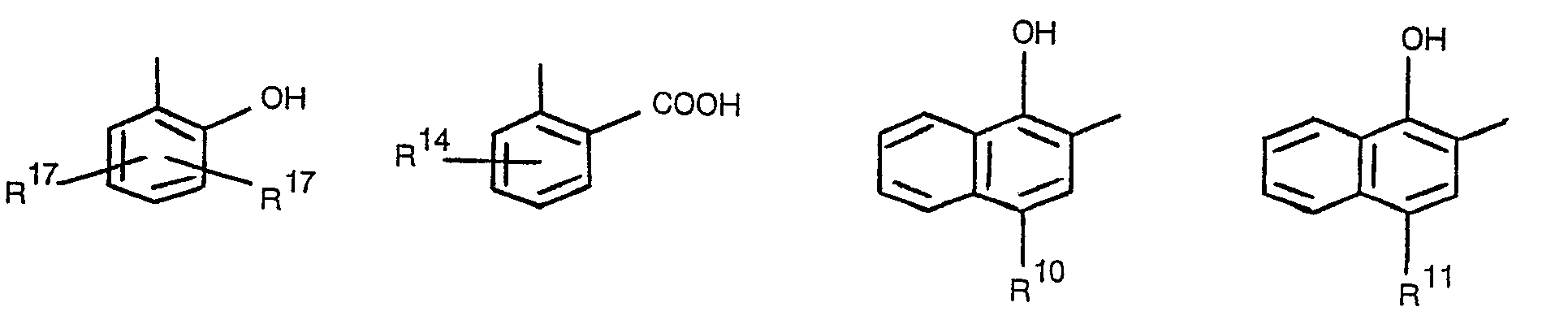
- the chelating group G is ⁇ OH, ⁇ NH 2 , ⁇ SR, ⁇ COOR 1 , sulphonamido, sulphamoyl, ⁇ CH 2 OH, ⁇ CH 2 NH 2 , ⁇ CH 2 NHSO 2 CH 3 or a CAR group, attached to the nucleus via the oxygen atom of a -O-CO- group, wherein R is a 1-4C alkyl, R' is H, a 1-4C alkyl or an alkali metal or ammonium ion.
- Substituents which may be present in the nuclei Z, Z' and Z" above include alkyl of 1 to 6 carbon atoms, acyl, aryl of 6 to 10 carbon atoms, aralkyl, alkylsulphonyl, amino, alkoxy, halogens, solubilizing groups such a sulphonamido, sulphamoyl, phenylsulphamoyl, carboxy, sulpho or hydrolyzable precursors thereof.
- substituents may be present in the nuclei completed by Z, Z' and/or Z" which allow the dye molecules to function as tetra-, penta- or higher dentate ligands.
- nuclei which may be completed by Z' and Z" have the following formulae: in which
- nuclei which Z' and Z" may complete are 1H-pyrazolo[3,2-c]-s-triazoles, 2,4- and 4,5-diphenylimidazoles, pyrazoles, pyridines and pyridine-3-ols, which may be further substituted.
- the nucleus completed by Z is preferably benzene, naphthalene or a heterocyclic group, e.g. a pyrazole or thiophene group, which may bear substituents in addition to G.
- nuclei which Z' and Z" may complete have the formulae: and examples of further nuclei which Z' may complete have the formulae: while examples of nuclei of the formula wherein
- Y 5 and Y 6 each represent the carbon and hydrogen atoms necessary to complete a saturated heterocyclic ring.
- yellow dyes from which compounds of formula I or II above may be derived are: wherein
- magenta dyes from which compounds of formula (I) or (II) above may be derived are: wherein the groups have the meanings given above.
- cyan dyes from which compounds of formula (I) or (II) above may be derived are: wherein all the groups have the meanings given above.
- the compounds of formulae I and II above may be prepared by the general methods set out in British Specification 1,585,178.
- the compounds may then be metallised by dissolving the compound and a metal salt in a mutual solvent, e.g. dimethylformamide, and allowing the metallisation to take place at room temperature.
- a mutual solvent e.g. dimethylformamide
- the metal of the present metal complexes is preferably copper (II), zinc (II), platinum (II), palladium (II), cobalt (II), cobalt (III), chromium (III) or especially nickel (II).
- the metal complexes comprising dyes according to general Formula I may be illustrated as follows: wherein:
- Lig is one or more ligand groups, depending upon the co-ordination number of the metal ion, for example, monodentate H 2 0, CI or pyridine or polydentate acetylacetone, diethylenetriamine.
- Lig which can contain one or more coordinating sites, may be attached to the dye molecule itself, thus making a dye a tetra-, penta- or even higher-dentate ligand. Similar complexes can, of course, be formed using dyes (RDR's) of formula II.
- the present invention further provides the 1:1 dye-metal complexes of compounds of the formulae I and II above per se.
- Whether a 1:1 or a 2:1 dye:metal complex is formed during the metallisation depends upon a number of factors, for example the identity of the metal ion, the identity of the dye, the pH and the concentration of the reactants.
- our copending European Patent Application 0053 037 also based on U.K. Application No. 8037643 describes and claims 2:1 complexes.
- 1:1 complexes of RDR:metal according to the present invention which are coated in a photographic material may form 2:1 complexes under the processing conditions of use.
- a preferred group of the metal complexed dye moieties released from the metallized RDR's of p ur invention would have a rate of diffusion to a mordant layer on a receiver such that one-half of the final maximum dye density on the mordant layer is obtained in less than about ten minutes.
- the 1 ⁇ 21 2 of dye diffusion may be measured according to the test described below. It is noted, however, that released dyes which do not pass this test may still be contained by RDR's which, when tested as an RDR in a photographic material under a particular set of conditions, give useful results.
- CAR moieties useful in the invention are described in U.S. Patents 3,227,550; 3,628,952; 3,227,552 and 3,884,785 (dye released by chromogenic coupling); U.S. Patents 3,443,939 and 3,443,940 (dye released by intramolecular ring closure); U.S. Patents 3,698,897 and 3,725,062 (dye released from hydroquinone derivatives); U.S. Patent 3,728,113 (dye released from a hydroquinonylmethyl quaternary salt); U.S.
- Patents 3,719,489 and 3,443,941 (silver ion induced dye release); British Patent Publication 2,017,950A (dye released by a dye bleach process); U.S. Patents 4,053,312; 4,198,235; 4,179,231; 4,055,428 and 4,149,892 (dye released by oxidation and deamidation); and U.S. Patents 3,245,789 and 3,980,497; Canadian Patent 602,607; British Patent 1,464,104; Research Disclosure 14447, April 1976; U.S. Patent 4,139,379 of Chasman et al, U.S. Patent 4,232,107 and European Patent Publication 12908 (dye released by miscellaneous mechanisms), the disclosures of which are hereby incorporated by reference.
- ballasted carrier moiety or CAR as described above may be represented by the following formula: wherein:
- Ballast group in the above formula is not critical, so long as it confers nondiffusibility to the compound.
- Typical Ballast Groups include long-chain alkyl radicals, as well as aromatic radicals of the benzene and naphthalene series linked to the compound.
- Useful Ballast groups generally have at least 8 carbon atoms, such as substituted or unsubstituted alkyl groups of 8 to 22 carbon atoms; a carbamoyl radical having 8 to 30 carbon atoms, such as ⁇ CONH(CH 2 ) 4 ⁇ O ⁇ C 6 H 3 (C 5 H 11 ) 2 , or ⁇ CON(C 12 H 25 ) 2 ; or a keto radical having 8 to 30 carbon atoms, such as ⁇ CO ⁇ C 17 H 35 or ⁇ CO ⁇ C 6 H 4 (t ⁇ C 12 H 25 ).
- the ballasted carrier moiety or CAR in the above formula is a group having the formula: wherein:
- the ballasted carrier moiety or CAR in the above formula is such that the diffusible azo dye is released as an inverse function of development of the silver halide emulsion layer under alkaline conditions. This is ordinarily referred to as positive-working dye-release chemistry.
- the ballasted carrier moiety or CAR in the above formulas may be a group having the fomula: wherein:
- the ballasted carrier moiety or CAR in the above formulas may be a group having the formula: wherein:
- the ballasted carrier moiety or CAR in the above formulas may be a group having the formula: wherein:
- Examples of the CAR moiety in this formula (IX) include the following:
- the ballasted carrier moiety or CAR in the above formulas may be a group having the formula: wherein:
- Examples of the CAR moiety in this formula (X) include the following:
- a process for producing a photographic transfer image in colour according to the invention comprises:
- a negative-working silver halide emulsion is employed in certain preferred photosensitive elements, described above, then a positive colour image, such as a reflection print, a colour transparency or motion picture film, is produced in this manner. If a direct-positive silver halide emulsion is employed in such photosensitive elements, than a negative colour image is produced.
- the photographic element in the above-described process can be treated in any manner with an alkaline processing composition to effect or initiate development.
- a preferred method for applying processing composition is by use of a rupturable container or pod which contains the composition.
- the processing composition employed in this invention contains the developing agent for development, although the composition could also just be an alkaline solution where the developer is incorporated in the photographic element, image-receiving element or process sheet, in which case the alkaline solution serves to activate the incorporated developer.
- a photographic film unit or assemblage in accordance with this invention is adapted to be processed by an alkaline processing composition, and comprises:
- the assemblage itself contains the alkaline processing composition and means containing same for discharge within the film unit.
- a rupturable container which is adapted to be positioned during processing of the film unit so that a compressive force applied to the container by pressure-applying members, such as would be found in a camera designed for in-camera processing, will effect a discharge of the container's contents within the film unit.
- the dye image-receiving layer in the above-described film assemblage is optionally located on a separate support adapted to be superposed on the photographic element after exposure thereof.
- image-receiving elements are generally disclosed, for example, in U.S. Patent 3,362,819.
- the means for discharging the processing composition is a rupturable container, it is usually positioned in relation to the photographic element and the image-receiving element so that a compressive force applied to the container by pressure-applying members, such as would be found in a typical camera used for in-camera processing, will effect a discharge of the container's contents between the image-receiving element and the outermost layer of the photographic element.
- the dye image-receiving element is separated from the photographic element.
- the dye image-receiving layer in the above-described film assemblage is located integral with the photographic element and is located between the support and the lowermost photosensitive silver halide emulsion layer.
- One useful format for integral receiver-negative photographic elements is disclosed in Belgian Patent 757,960.
- the support for the photographic element is transparent and is coated with an image-receiving layer, a substantially opaque light-reflective layer, e.g., Ti0 2 , and then the photosensitive layer or layers described above. After exposure of the photographic element, a rupturable container containing an alkaline processing composition and an opaque process sheet are brought into superposed position.
- the support for the photographic element is transparent and is coated with the image-receiving layer, a substantially opaque, light-reflective layer and the photosensitive layer or layers described above.
- a rupturable container containing an alkaline processing composition and an opacifier is positioned adjacent the top layer and a transparent top sheet which has thereon a neutralizing layer and a timing layer. The film unit is placed in a camera, exposed through the transparent top sheet and then passed through a pair of pressure-applying members in the camera as it is being removed therefrom.
- the pressure-applying members rupture the container and spread processing composition and opacifier over the negative portion of the film unit to render it light- insensitive.
- the processing composition develops each silver halide layer and dye images are formed as a result of development which diffuse to the image-receiving layer to provide a positive, right-reading image which is viewed through the transparent support on the opaque reflecting layer background.
- Another embodiment of the invention uses the image-reversing technique disclosed in British Patent 904,364, page 19, lines 1 to 41.
- the dye-releasing compounds are used in combination with physical development nuclei in a nuclei layer contiguous to the photosensitive silver halide emulsion layer.
- the film unit contains a silver halide solvent, preferably in a rupturable container with the alkaline processing composition.
- each silver halide emulsion layer of the film assembly will have associated therewith a dye-releasing compound which releases a dye possessing a predominant spectral absorption within the region of the visible spectrum to which said silver halide emulsion is sensitive (initially or after forming the coordination complex), i.e., the blue-sensitive silver halide emulsion layer will have a yellow or yellow-forming dye-releaser associated therewith, the green-sensitive silver halide emulsion layer will have the magenta or magenta-forming dye-releaser of the invention associated therewith, and the red-sensitive silver halide emulsion layer will have a cyan or cyan-forming dye-releaser associated therewith.
- the dye-releaser associated with each silver halide emulsion layer is contained either in the silver halide emulsion layer itself or in a layer contiguous to the silver hal
- the concentration of the dye-releasing compounds that are employed in the present invention may be varied over a wide range, depending upon the particular compound employed and the results which are desired.
- the dye-releasers of the present invention may be coated in layers by using coating solutions containing between about 0.5 and about 8 percent by weight of the dye-releaser distributed in a hydrophilic film-forming natural mnaterial or synthetic polymer, such as gelatin, polyvinyl alcohol, etc, which is adapted to be permeated by aqueous alkaline processing composition.
- ETA silver halide developing agents or electron transfer agents
- any ETA can be employed as long as it cross-oxidizes with the dye-releasers described herein.
- the ETA may also be incorporated in the photosensitive element to be activated by the alkaline processing composition.
- ETA's useful in this invention include hydroquinone compounds, such as hydroquinone, 2,5-dichlorohydroquinone or 2-chlorohydroquinone; aminophenol compounds, such as 4-aminophenol, N-methylaminophenol, N,N-dimethylaminophenol, 3-methyl-4-aminophenol or 3,5-dibromoaminophenol; catechol compounds, such as catechol, 4-cyclohexylcatechol, 3-methoxycatechol or 4-(N-octadecylamino)-catechol; and phenylenediamine compounds, such as N,N,-N',N'-tetramethyl-p-phenylenediamine.
- hydroquinone compounds such as hydroquinone, 2,5-dichlorohydroquinone or 2-chlorohydroquinone
- aminophenol compounds such as 4-aminophenol, N-methylaminophenol, N,N-dimethylaminophenol, 3-methyl-4-a
- the ETA is a 3-pyrazolidinone compound, such as 1-phenyl-3-pyrazolidinone (Phenidone), 1-phenyl-4,4-dimethyl-3-pyrazolidinone (Dimezone), 4-hydroxymethyl-4-methyl-1-phenyl-3-pyrazolidinone, 4-hydroxymethyl-4-methyl-1-p-tolyl-3-pyrazolidinone, 4-hydroxymethyl-4-methyl-1-(3,4-dimethyl-phenyl)-3-pyrazolidinone, 1-m-tolyl-3-pyrazolidinone, 1-p-tolyl-3-pyrazolidinone, 1-phenyl-4-methyl-3-pyrazolidinone, 1-phenyl-5-methyl-3-pyrazolidinone, 1-phenyl-4,4-dihydroxymethyl-3-pyrazolidinone, 1,4-dimethyl-3-pyrazolidinone, 4-methyl-3-pyrazolidinone, 4,4-dimethyl-3-pyrazolidinone, 1-(3-chlorophen
- a combination of different ETA's can also be employed. These ETA's are employed in the liquid processing composition or contained, at least in part, in any layer or layers of the photographic element or film unit to be activated by the alkaline processing composition, such as in the silver halide emulsion layers, the dye image-providing material layers, interlayers, image-receiving layer, etc.
- the silver halide developer or ETA employed in the process becomes oxidized upon development and reduces silver halide to silver metal.
- the oxidized developer than cross-oxidizes the dye-releasing compound.
- the product of cross-oxidation then undergoes alkaline hydrolysis, thus releasing an imagewise distribution of diffusible azo dye which then diffuses to the receiving layer to provide the dye image.
- the diffusible moiety is transferable in alkaline processing composition either by virtue of its self-diffusivity or by its having attached to it one or more solubilizing groups, for example, a carboxy, sulpho, sulphonamido, hydroxy or morpholino group.
- the dye-releasing compounds according to the invention which produce diffusible dye images as a function of development, either conventional negative-working or direct-positive silver halide emulsions are employed.
- the silver halide emulsion employed is a direct-positive silver halide emulsion, such as an internal-image emulsion designed for use in the internal image reversal process or a fogged, direct-positive emulsion such as a solarizing emulsion, which is developable in unexposed areas, a positive image can be obtained in certain embodiments on the dye image-receiving layer.
- the alkaline processing composition permeates the various layers to initiate development of the exposed photosensitive silver halide emulsion layers.
- the developing agent present in the film unit develops each of the silver halide emulsion layers in the unexposed areas (since the silver halide emulsions are direct-positive ones), thus causing the developing agent to become oxidized imagewise corresponding to the unexposed areas of the direct-positive silver halide emulsion layers.
- the oxidized developing agent then cross-oxidizes the dye-releasing compounds and the oxidized form of the compounds then undergoes a base-catalyzed reaction to release the dyes imagewise as a function of the imagewise exposure of each of the silver halide emulsion layers. At least a portion of the imagewise distributions of diffusible dyes diffuse to the image-receiving layer to form a positive image of the original subject.
- a neutralizing layer in the film unit or image-receiving unit lowers the pH of the film unit or image receiver to stabilize the image.
- the various silver halide emulsion layers of a colour film assembly employed in this invention are disposed in the usual order, i.e., the blue-sensitive silver halide emulsion layer first with respect to the exposure side, followed by the green-sensitive and red-sensitive silver halide emulsion layers.
- a yellow dye layer or a yellow colloidal silver layer can be present between the blue-sensitive and green-sensitive silver halide emulsion layers for absorbing or filtering blue radiation that is transmitted through the blue-sensiive layer.
- the selectively sensitized silver halide emulsion layers can be disposed in a different order, e.g., the blue-sensitive layer first with respect to the exposure side, followed by the red-sensitive and green-sensitive layers.
- rupturable container employed in certain embodiments of this invention is disclosed in U.S. Patents 2,543,181; 2,643,886; 3,653,732; 2,723,051; 3,056,492; 3,056,491 and 3,152,515.
- such containers comprise a rectangular sheet of fluid- and air-impervious material folded longitudinally upon itself to form two walls which are sealed to one another along their longitudinal and end margins to form a cavity in which processing solution is contained.
- the silver halide emulsion layers employed in the invention comprise photosensitive silver halide dispersed in gelatin and are about 0.6 to 6 microns in thickness; the dye-releasers are dispersed in an aqueous alkaline solution-permeable polymeric binder, such as gelatin, as a separate layer about 0.2 to 7 microns in thickness; and the alkaline solution-permeable polymeric interlayers, e.g., gelatin, are about 0.2 to 5 microns in thickness.
- these thicknesses are approximate only and can be modified according to the product desired.
- Scavengers for oxidized developing agent can be employed in various interlayers of the photographic elements of the invention. Suitable materials are disclosed on page 83 of the November 1976 edition of Research Disclosure.
- any material is useful as the image-receiving layer in this invention as long as the desired function of mordanting or otherwise fixing the dye images is obtained.
- the particular material chosen will, of course, depend upon the dye to be mordanted. Suitable materials are disclosed on pages 80 to 82 of the November 1976 edition of Research Disclosure.
- a neutralizing material in the film units employed in this invention will usually increase the stability of the transferred image.
- the neutralizing material will effect a reduction in the pH of the image layer from about 13 or 14 to at least 11 and preferably 5 to 8 within a short time after imbibition.
- Suitable materials and their functioning are disclosed on pages 22 and 23 of the July 1974 edition of Research Disclosure, and pages 35 to 37 of the July 1975 edition of Research Disclosure.
- a timing or inert spacer layer can be employed in the practice of this invention over the neutralizing layer which "times" or controls the pH reduction as a function of the rate at which alkali diffuses through the inert spacer layer. Examples of such timing layers and their functioning are disclosed in the Research Disclosure articles mentioned in the paragraph above concerning neutralizing layers.
- the alkaline processing composition employed in this invention is the conventional aqueous solution of an alkaline material, e.g., alkali metal hydroxides or carbonates such as sodium hydroxide, sodium carbonate or an amine such as diethylamine, preferably possessing a pH in excess of 11, and preferably containing a developing agent as described previously. Suitable materials and addenda frequently added to such compositions are disclosed on pages 79 and 80 of the November 1976 edition of Research Disclosure.
- an alkaline material e.g., alkali metal hydroxides or carbonates such as sodium hydroxide, sodium carbonate or an amine such as diethylamine
- alkaline solution-permeable, substantially opaque, light-reflective layer employed in certain embodiments of photographic film units used in this invention is described more fully in the November 1976 edition of Research Disclosure page 82.
- the supports for the photographic elements used in this inventiori can be any material as long as it does not deleteriously affect the photographic properties of the film unit and is dimensionally stable. Typical flexible sheet materials are described on page 85 of the November 1976 edition of Research Disclosure.
- dotwise coating such as would be obtained using a gravure printing technique, could also be employed.
- small dots of blue-, green- and red-sensitive emulsions have associated therewith, respectively, dots of yellow, magenta and cyan colour-providing substances.
- the transferred dyes would tend to fuse together into a continuous tone.
- the emulsions sensitive to each of the three primary regions of the spectrum can be disposed as a single segmented layer, e.g., as by the use of microvessels, as described in European Specification 2,042,753.
- nondiffusing used herein has the meaning commonly applied to the term in photography and denotes materials that, for all practical purposes, doe not migrate or wander through organic colloid layers, such as gelatin, in the photographic elements of the invention in an alkaline medium and preferably when processed in a medium having a pH of 11 or greater. The same meaning is to be attached to the term “immobile”.
- diffusible as applied to the materials of this invention has the converse meaning and denotes materials having the property of diffusing effectively through the colloid layers of the photographic elements in an alkaline medium.
- Mobile has the same meaning as "diffusible”.
- associated therwith is intended to mean that the materials can be in either the same or different layers, so long as the materials are accessible to one another.
- the RDR (1.4 g, 1.2 mmole) and nickel (II) chloride hexahydrate (0.62 g, 2.6 mmole) were heated on a steam bath in DMF (dimethylformamide) (25 ml) for 0.5 hour. After cooling, the solution was allowed to stand at room temperature for 2 hours, then poured into water (300 ml), with stirring. The blue precipitate was filtered, washed well with water, and dried in vacuo at 50°.
- DMF dimethylformamide
- the following scheme describes the multilayer material, receiver sheet and position of activator solution.
- the figures in parentheses are coating weights in g/m 2 .
- Mordant Polyvinylimidazole 5-10% quaternized with 2-chloroethanol.
- the RDR 4:Ni 1:1 complex was tested in a single layer coating and tested, similarly to Example 2 in the following scheme. Coating weights are in g/m- 2 throughout.
- the dyes released by three of the RDR's mentioned in Example 1 were allowed to diffuse to a mordant layer and ⁇ max and half bandwidth measurements were taken. The results are tabulated below.
- the mordant was the same as that used in Example 3.
- the mordant was poly(styrene-co-N-(propyl-dimethyl-benzyl-ammonium chloride)maleimide).
- the mordant was that used in Example 3.
- the mordant was that used in Example 3.
- the mordant used was the same as used with Image Dye I.
Landscapes
- Physics & Mathematics (AREA)
- General Physics & Mathematics (AREA)
- Silver Salt Photography Or Processing Solution Therefor (AREA)
- Plural Heterocyclic Compounds (AREA)
- Non-Silver Salt Photosensitive Materials And Non-Silver Salt Photography (AREA)
Claims (14)





und einer Silberhalogenidentwicklerverbindung.
Applications Claiming Priority (2)
| Application Number | Priority Date | Filing Date | Title |
|---|---|---|---|
| GB8037643 | 1980-11-24 | ||
| GB8037643 | 1980-11-24 |
Publications (3)
| Publication Number | Publication Date |
|---|---|
| EP0053040A2 EP0053040A2 (de) | 1982-06-02 |
| EP0053040A3 EP0053040A3 (en) | 1983-01-05 |
| EP0053040B1 true EP0053040B1 (de) | 1986-02-12 |
Family
ID=10517521
Family Applications (2)
| Application Number | Title | Priority Date | Filing Date |
|---|---|---|---|
| EP81305558A Expired EP0053040B1 (de) | 1980-11-24 | 1981-11-24 | Lichtempfindliche Elemente, zusammengesetzte Filme zur Bildung von Farbbildern durch Diffusionsübertragung und Farbbilder formende Verbindungen zur Verwendung hierbei |
| EP81305546A Expired EP0053037B1 (de) | 1980-11-24 | 1981-11-24 | Lichtempfindliche Elemente, zusammengesetze Filme zur Bildung von Farbbildern durch Diffusionsübertragung und Farbbilder formende Verbindungen zur Verwendung hierbei |
Family Applications After (1)
| Application Number | Title | Priority Date | Filing Date |
|---|---|---|---|
| EP81305546A Expired EP0053037B1 (de) | 1980-11-24 | 1981-11-24 | Lichtempfindliche Elemente, zusammengesetze Filme zur Bildung von Farbbildern durch Diffusionsübertragung und Farbbilder formende Verbindungen zur Verwendung hierbei |
Country Status (5)
| Country | Link |
|---|---|
| US (2) | US4358527A (de) |
| EP (2) | EP0053040B1 (de) |
| JP (1) | JPS57146250A (de) |
| CA (1) | CA1172629A (de) |
| DE (2) | DE3173276D1 (de) |
Cited By (1)
| Publication number | Priority date | Publication date | Assignee | Title |
|---|---|---|---|---|
| WO2025058077A1 (ja) | 2023-09-15 | 2025-03-20 | 富士フイルム株式会社 | 化合物、組成物、機能性材料、ハロゲン化銀写真感光材料、及び、拡散転写型ハロゲン化銀写真感光材料 |
Families Citing this family (22)
| Publication number | Priority date | Publication date | Assignee | Title |
|---|---|---|---|---|
| US4346161A (en) * | 1981-04-29 | 1982-08-24 | Eastman Kodak Company | Photographic products and processes employing novel nondiffusible 6-(2-thienylazo)-3-pyridinol cyan dye-releasing compounds and precursors thereof |
| US4357412A (en) * | 1981-07-13 | 1982-11-02 | Eastman Kodak Company | Photographic products and processes employing novel nondiffusible bridged azoaminophenol magenta dye-releasing compounds and precursors thereof |
| US4357410A (en) * | 1981-07-13 | 1982-11-02 | Eastman Kodak Company | Photographic products and processes employing novel nondiffusible pyridylazo(dialkylamino) phenol magenta dye-releasing compounds and precursors thereof |
| JPS58163938A (ja) * | 1982-03-24 | 1983-09-28 | Fuji Photo Film Co Ltd | カラ−拡散転写用写真要素 |
| US4481141A (en) * | 1982-06-28 | 1984-11-06 | Eastman Kodak Company | Nondiffusible yellow metallized azo dye-releasing compounds |
| US4407931A (en) * | 1982-06-28 | 1983-10-04 | Eastman Kodak Company | Photographic products and processes employing nondiffusible yellow azo metal complexed dye-releasing compounds and precursors thereof |
| US4418131A (en) * | 1982-06-28 | 1983-11-29 | Eastman Kodak Company | Photographic products and processes employing novel nondiffusible yellow dye-releasing compounds and precursors thereof |
| US4563412A (en) * | 1983-12-21 | 1986-01-07 | Polaroid Corporation | Black image dye-providing materials and photographic products and processes utilizing same |
| EP0149260B1 (de) * | 1984-01-12 | 1987-12-23 | Agfa-Gevaert N.V. | Verbindungen zur Verwendung in einem Farbstoff-Diffusionsübertragungsverfahren und diese Verbindungen enthaltende photographische Elemente |
| US4598030A (en) * | 1985-01-02 | 1986-07-01 | Eastman Kodak Company | Photographic products employing novel nondiffusible metal complexes of azo dyes |
| US4562139A (en) * | 1985-01-02 | 1985-12-31 | Eastman Kodak Company | Photographic products employing novel nondiffusible metal complexes of azo dyes |
| JPS62252483A (ja) * | 1986-04-24 | 1987-11-04 | Fuji Photo Film Co Ltd | 記録液 |
| JPH07186547A (ja) * | 1993-10-21 | 1995-07-25 | Eastman Kodak Co | 光学記録層用色素混合物 |
| US6165683A (en) * | 1993-10-21 | 2000-12-26 | Eastman Kodak Company | Metallized azo-ether dyes for optical recording layers |
| US6225023B1 (en) | 1996-11-20 | 2001-05-01 | Mitsubishi Chemical Corporation | Sulfonamide compound and method for its production, metal chelate compound employing the sulfonamide compound, and optical recording medium employing the metal chelate compound |
| US6270943B1 (en) * | 1998-02-20 | 2001-08-07 | Eastman Kodak Company | Optical recording elements comprising novel metallized azo ether dyes |
| US6582881B1 (en) * | 1998-02-20 | 2003-06-24 | Eastman Kodak Company | Optical recording elements containing mixture of metallized azo ether and cyanine dyes |
| US6447981B1 (en) * | 1998-05-26 | 2002-09-10 | Eastman Kodak Company | Metallized azo thioether dyes |
| WO2000055136A1 (en) * | 1999-03-16 | 2000-09-21 | Matsushita Electric Industrial Co., Ltd. | Metal-containing azo compounds and optical recording media |
| JP2001158862A (ja) * | 1999-12-02 | 2001-06-12 | Mitsubishi Chemicals Corp | 金属キレート色素および光学記録媒体 |
| EP1275517B1 (de) * | 2000-04-17 | 2004-10-27 | Mitsubishi Chemical Corporation | Optisches aufzeichnungsmedium |
| GB0305089D0 (en) | 2003-03-06 | 2003-04-09 | Avecia Ltd | Composition, use and process |
Family Cites Families (11)
| Publication number | Priority date | Publication date | Assignee | Title |
|---|---|---|---|---|
| NL247650A (de) * | 1959-01-26 | |||
| US4076529A (en) * | 1972-08-22 | 1978-02-28 | Eastman Kodak Company | Photographic diffusion transfer films, processes and compositions with color moiety releasing compound |
| JPS5931062B2 (ja) * | 1976-03-03 | 1984-07-31 | 富士写真フイルム株式会社 | 拡散転写法用感光要素 |
| GB1585178A (en) | 1976-09-10 | 1981-02-25 | Kodak Ltd | Photographic materials |
| US4207104A (en) * | 1977-09-12 | 1980-06-10 | Eastman Kodak Company | Photographic products and processes employing novel nondiffusible heterocyclylazonaphthol dye-releasing compounds |
| US4165238A (en) * | 1977-09-12 | 1979-08-21 | Eastman Kodak Company | Photographic products and processes employing novel nondiffusible pyridylazonaphthol dye-releasing compounds |
| US4174221A (en) * | 1977-09-23 | 1979-11-13 | Polaroid Corporation | Yellow 2:1 chrome complexed dye developers |
| US4204993A (en) | 1978-07-24 | 1980-05-27 | Eastman Kodak Company | Nondiffusible 6-arylazo-2-amino-3-pyridinol dye-releasing compounds |
| US4204870A (en) | 1978-07-25 | 1980-05-27 | Eastman Kodak Company | Photographic products and processes employing novel nondiffusible heterocyclyazonaphthol dye-releasing compounds |
| US4273706A (en) | 1979-01-09 | 1981-06-16 | Eastman Kodak Company | Nondiffusible heterocyclylazonaphthol dye-releasing compounds |
| US4287292A (en) * | 1980-08-01 | 1981-09-01 | Eastman Kodak Company | Photographic products and processes employing novel nondiffusible 6-arylazo-3-pyridinol magenta dye-releasing compounds and precursors thereof |
-
1981
- 1981-11-18 CA CA000390334A patent/CA1172629A/en not_active Expired
- 1981-11-23 US US06/324,214 patent/US4358527A/en not_active Expired - Fee Related
- 1981-11-24 DE DE8181305546T patent/DE3173276D1/de not_active Expired
- 1981-11-24 EP EP81305558A patent/EP0053040B1/de not_active Expired
- 1981-11-24 DE DE8181305558T patent/DE3173784D1/de not_active Expired
- 1981-11-24 EP EP81305546A patent/EP0053037B1/de not_active Expired
- 1981-11-24 JP JP56187097A patent/JPS57146250A/ja active Pending
-
1982
- 1982-06-28 US US06/392,482 patent/US4426326A/en not_active Expired - Fee Related
Cited By (1)
| Publication number | Priority date | Publication date | Assignee | Title |
|---|---|---|---|---|
| WO2025058077A1 (ja) | 2023-09-15 | 2025-03-20 | 富士フイルム株式会社 | 化合物、組成物、機能性材料、ハロゲン化銀写真感光材料、及び、拡散転写型ハロゲン化銀写真感光材料 |
Also Published As
| Publication number | Publication date |
|---|---|
| DE3173276D1 (en) | 1986-01-30 |
| EP0053037B1 (de) | 1985-12-18 |
| EP0053040A2 (de) | 1982-06-02 |
| US4426326A (en) | 1984-01-17 |
| EP0053040A3 (en) | 1983-01-05 |
| EP0053037A3 (en) | 1982-12-29 |
| US4358527A (en) | 1982-11-09 |
| EP0053037A2 (de) | 1982-06-02 |
| JPS57146250A (en) | 1982-09-09 |
| DE3173784D1 (en) | 1986-03-27 |
| CA1172629A (en) | 1984-08-14 |
Similar Documents
| Publication | Publication Date | Title |
|---|---|---|
| EP0053040B1 (de) | Lichtempfindliche Elemente, zusammengesetzte Filme zur Bildung von Farbbildern durch Diffusionsübertragung und Farbbilder formende Verbindungen zur Verwendung hierbei | |
| US4272434A (en) | Nondiffusible compounds having a releasable azo dye moiety | |
| US4282305A (en) | Receiving elements for image transfer film units | |
| US4273853A (en) | Metal complexes of copolymers comprising vinylimidazole and their use in photographic elements | |
| US4287292A (en) | Photographic products and processes employing novel nondiffusible 6-arylazo-3-pyridinol magenta dye-releasing compounds and precursors thereof | |
| US4148642A (en) | Photographic products and processes employing nondiffusible 1-arylazo-4-isoquinolinol dye-releasing compounds | |
| US4147544A (en) | Photographic products and processes employing novel nondiffusible pyridylazonaphthol dye-releasing compounds | |
| US4148643A (en) | Photographic products and processes employing nondiffusible azo dye-releasing compounds | |
| US4420550A (en) | Photographic products and processes employing novel nondiffusible magenta dye-releasing compounds and precursors thereof | |
| US4407931A (en) | Photographic products and processes employing nondiffusible yellow azo metal complexed dye-releasing compounds and precursors thereof | |
| US4183753A (en) | Photographic products and processes employing metal complexed azo dyes | |
| US4357412A (en) | Photographic products and processes employing novel nondiffusible bridged azoaminophenol magenta dye-releasing compounds and precursors thereof | |
| US4183755A (en) | Photographic products and processes employing metal complexable nondiffusible azo dye-releasing compounds | |
| US4358404A (en) | Nondiffusible 6-arylazo-3-pyridinol | |
| US4148641A (en) | Photographic products and processes employing novel nondiffusible pyridylazopyrazole or pyrimidylazopyrazole dye-releasing compounds | |
| US4193796A (en) | Polymers for use in image receiving elements for metallizable dyes in image transfer film units | |
| US4436799A (en) | Photographic products and processes employing novel nondiffusible magenta dye-releasing compounds and precursors thereof | |
| US4165238A (en) | Photographic products and processes employing novel nondiffusible pyridylazonaphthol dye-releasing compounds | |
| EP0147105B1 (de) | Fotografische Produkte in denen eine diffusionsfeste Verbindung verwendet wird und die Hydrazonefarbstoff freisetzen | |
| US4357411A (en) | Photographic products and processes employing novel nondiffusible 2-(2-pyridylazo)-4,5-bis(tertiary amino)phenol black dye-releasing compounds and precursors thereof | |
| US4165987A (en) | Photographic products and processes employing novel nondiffusible pyridylazopyrazole or pyrimidylazopyrazole dye-releasing compounds | |
| US4228073A (en) | Nondiffusible azo dye-releasing compounds | |
| US4481141A (en) | Nondiffusible yellow metallized azo dye-releasing compounds | |
| US4183754A (en) | Photographic products and processes employing nondiffusible 1-arylazo-4-isoquinolinol dye-releasing compounds | |
| US4346155A (en) | Photographic products and processes employing novel nondiffusible 6-arylazo-3-pyridinol magenta dye-releasing compounds and percursors thereof |
Legal Events
| Date | Code | Title | Description |
|---|---|---|---|
| PUAI | Public reference made under article 153(3) epc to a published international application that has entered the european phase |
Free format text: ORIGINAL CODE: 0009012 |
|
| AK | Designated contracting states |
Designated state(s): BE CH DE FR GB LI NL |
|
| PUAL | Search report despatched |
Free format text: ORIGINAL CODE: 0009013 |
|
| AK | Designated contracting states |
Designated state(s): BE CH DE FR GB LI NL |
|
| 17P | Request for examination filed |
Effective date: 19830623 |
|
| RAP1 | Party data changed (applicant data changed or rights of an application transferred) |
Owner name: KODAK LIMITED Owner name: EASTMAN KODAK COMPANY |
|
| GRAA | (expected) grant |
Free format text: ORIGINAL CODE: 0009210 |
|
| AK | Designated contracting states |
Designated state(s): BE CH DE FR GB LI NL |
|
| REF | Corresponds to: |
Ref document number: 3173784 Country of ref document: DE Date of ref document: 19860327 |
|
| ET | Fr: translation filed | ||
| PLBE | No opposition filed within time limit |
Free format text: ORIGINAL CODE: 0009261 |
|
| STAA | Information on the status of an ep patent application or granted ep patent |
Free format text: STATUS: NO OPPOSITION FILED WITHIN TIME LIMIT |
|
| 26N | No opposition filed | ||
| PGFP | Annual fee paid to national office [announced via postgrant information from national office to epo] |
Ref country code: GB Payment date: 19911025 Year of fee payment: 11 |
|
| PGFP | Annual fee paid to national office [announced via postgrant information from national office to epo] |
Ref country code: DE Payment date: 19911115 Year of fee payment: 11 |
|
| PGFP | Annual fee paid to national office [announced via postgrant information from national office to epo] |
Ref country code: FR Payment date: 19911118 Year of fee payment: 11 |
|
| PGFP | Annual fee paid to national office [announced via postgrant information from national office to epo] |
Ref country code: CH Payment date: 19911127 Year of fee payment: 11 |
|
| PGFP | Annual fee paid to national office [announced via postgrant information from national office to epo] |
Ref country code: BE Payment date: 19911129 Year of fee payment: 11 |
|
| PGFP | Annual fee paid to national office [announced via postgrant information from national office to epo] |
Ref country code: NL Payment date: 19911130 Year of fee payment: 11 |
|
| PG25 | Lapsed in a contracting state [announced via postgrant information from national office to epo] |
Ref country code: GB Effective date: 19921124 |
|
| PG25 | Lapsed in a contracting state [announced via postgrant information from national office to epo] |
Ref country code: LI Effective date: 19921130 Ref country code: CH Effective date: 19921130 Ref country code: BE Effective date: 19921130 |
|
| BERE | Be: lapsed |
Owner name: EASTMAN KODAK CY Effective date: 19921130 |
|
| PG25 | Lapsed in a contracting state [announced via postgrant information from national office to epo] |
Ref country code: NL Effective date: 19930601 |
|
| NLV4 | Nl: lapsed or anulled due to non-payment of the annual fee | ||
| GBPC | Gb: european patent ceased through non-payment of renewal fee |
Effective date: 19921124 |
|
| PG25 | Lapsed in a contracting state [announced via postgrant information from national office to epo] |
Ref country code: FR Effective date: 19930730 |
|
| REG | Reference to a national code |
Ref country code: CH Ref legal event code: PL |
|
| PG25 | Lapsed in a contracting state [announced via postgrant information from national office to epo] |
Ref country code: DE Effective date: 19930803 |
|
| REG | Reference to a national code |
Ref country code: FR Ref legal event code: ST |