EP0053054A1 - Verfahren zum Gewinnen von Uran (VI) aus Phosphorsäure enthaltenden Lösungen - Google Patents
Verfahren zum Gewinnen von Uran (VI) aus Phosphorsäure enthaltenden Lösungen Download PDFInfo
- Publication number
- EP0053054A1 EP0053054A1 EP81401686A EP81401686A EP0053054A1 EP 0053054 A1 EP0053054 A1 EP 0053054A1 EP 81401686 A EP81401686 A EP 81401686A EP 81401686 A EP81401686 A EP 81401686A EP 0053054 A1 EP0053054 A1 EP 0053054A1
- Authority
- EP
- European Patent Office
- Prior art keywords
- uranium
- organic solvent
- extraction
- acid
- formula
- Prior art date
- Legal status (The legal status is an assumption and is not a legal conclusion. Google has not performed a legal analysis and makes no representation as to the accuracy of the status listed.)
- Granted
Links
Images



Classifications
-
- C—CHEMISTRY; METALLURGY
- C22—METALLURGY; FERROUS OR NON-FERROUS ALLOYS; TREATMENT OF ALLOYS OR NON-FERROUS METALS
- C22B—PRODUCTION AND REFINING OF METALS; PRETREATMENT OF RAW MATERIALS
- C22B60/00—Obtaining metals of atomic number 87 or higher, i.e. radioactive metals
- C22B60/02—Obtaining thorium, uranium, or other actinides
- C22B60/0204—Obtaining thorium, uranium, or other actinides obtaining uranium
- C22B60/0217—Obtaining thorium, uranium, or other actinides obtaining uranium by wet processes
- C22B60/0252—Obtaining thorium, uranium, or other actinides obtaining uranium by wet processes treatment or purification of solutions or of liquors or of slurries
- C22B60/026—Obtaining thorium, uranium, or other actinides obtaining uranium by wet processes treatment or purification of solutions or of liquors or of slurries liquid-liquid extraction with or without dissolution in organic solvents
Definitions
- the present invention relates to a process for recovering uranium (VI) present in solutions of phosphoric acid, in particular in solutions of phosphoric acid obtained from phosphate ores.
- the phosphate ores include significant contents of uranium which, during the attack of these ores by a sulfuric solution, pass into the phosphoric acid solution obtained. Also, it is interesting to recover the uranium present in these solutions which constitute an important additional source of uranium.
- the present invention specifically relates to a process for recovering uranium (VI) using an organic solvent which provides better uranium extraction rates than currently known solvents.
- the alkoxyalkyl radical advantageously has from 9 to 23 carbon atoms.
- the acid organophosphorus compound can be constituted by a phosphoric ester of secondary alcohol or by a phosphoric ester of primary alcohol.
- phosphoric esters of primary alcohol these advantageously meet the formula: in which R 6 and R 7 which are identical or different, are alkyl or aryl radicals, and n and n ′ which are identical or different, are numbers equal to 2 or 3.
- n and n ' are preferably equal to 2.
- the alkyl radicals R 6 and R 7 have at least 8 carbon atoms to avoid the formation of a third phase during this re-extraction.
- the acid organophosphorus compound can also consist of a phosphoric ester of secondary alcohol corresponding to formula IV: in which R and R 9 , which are identical or different, represent an alkyl or aryl radical, and p and q which can be identical or different, are equal to 1 or 2.
- p and q are equal to 1, because the extracting power of the system increases when the ether-oxide function of the acid organophosphorus compound is close to the phosphate group.
- the radicals R 8 and R 9 preferably have at least 4 carbon atoms to avoid the formation of a third phase during this re-extraction.
- the acid organophosphorus compounds of formula (III) or of formula (IV) used in the process of the invention can be obtained by transesterification or by esterification of a phosphorus derivative with the corresponding alkoxy alcohol, this reaction being optionally followed by oxidation and / or hydrolysis.
- phosphorus derivatives it is possible to use a dialkyl phosphorous acid, phosphorus oxychloride or also phosphoric anhydride P205.
- the transesterification reaction with the corresponding alkoxy alcohol is followed by an oxidation reaction then by a hydrolysis to give the corresponding acid organophosphorus compound.
- Oxidation can be carried out by the action of sulfuryl chloride SO 2 Cl 2 and hydrolysis by the action of sodium hydroxide and by the action of hydrochloric acid.
- the esterification reaction is carried out with the corresponding alkoxyalcohol in the presence of a base, in part a tertiary organic base, then the product obtained is subjected to hydrolysis, which leads to the production of a mixture of mono and diacids which are then separated.
- the esterification is carried out with the corresponding alkoxyalcohol, away from humidity, a mixture of mono and diacids which may also contain neutral phosphate and impurities such as pyrophosphates and polymers.
- the alkoxy alcohols used as starting materials for the synthesis of acidic organophosphorus compounds can be prepared by reaction of a sodium alcoholate with the dichloro derivative of a secondary alcohol, for example, sodium alcoholate with dichloro-1 , 3-propanol-2, according to the following reaction scheme:
- a sodium alcoholate is reacted with the chlorinated derivative of a primary alcohol.
- the neutral phosphine oxide corresponding to the abovementioned formula I preferably comprises at least one alkoxyalkyl radical, for example, an alkoxymethyl radical having from 4 to 12 carbon atoms.
- alkoxyalkyl radicals for example, an alkoxymethyl radical having from 4 to 12 carbon atoms.
- the other radicals are alkyl radicals, these generally have from 4 to 12 carbon atoms, and they are preferably linear.
- neutral phosphine oxides which may be used, mention may be made of di-isobutyl-octoxymethylphosphine oxide, di-n-butyl-octoxymethylphosphine oxide, di-n- oxide pentyl-octoxymated thylphosphine, and di-n-hexyl-octoxymethylphosphine oxide (POX 11).
- phosphine oxides can be prepared by reacting a halogenated magnesium salt of secondary phosphine oxide with an organic halide of formula RX in which R represents an alkoxyalkyl radical, for example, a chloromethyl n-octyl ether, as described in French patent 2,346,361 filed on 12/13/73.
- trialkylphosphine oxides in which the alkyl radicals have from 4 to 14 carbon atoms, for example tri-n-octylphosphine oxide (TOPO).
- TOPO tri-n-octylphosphine oxide
- the extractant system is generally diluted in an inert organic solvent constituted for example by a saturated hydrocarbon having at least 8 carbon atoms such as dodecane, or by a mixture of hydrocarbons.
- the concentrations of acid organophosphorus compound and of neutral phosphine oxide are such that the molar ratio of the acid organophosphorus compound to the neutral phosphine oxide is between 1 and 9, and preferably from 2 to 4. .
- the method of the invention can be implemented in any conventional extraction device such as batteries of settling mixers, pulsed columns, centrifugal extractors, etc.
- the uranium extracted in the organic solvent can be re-extracted in followed in an aqueous solution of phosphoric acid optionally containing a reducing agent so as to reduce the uranium VI to uranium IV to facilitate its re-extraction.
- the re-extraction of the uranium is carried out in a re-extraction device comprising at least two stages.
- a re-extraction device comprising at least two stages.
- the ammoniated organic solvent leaving the last re-extraction stage is re-acidified by reacting it with an acid to remove the ammonium in the form of the ammonium salt, and the organic solvent thus re-acidified is reused to carry out the extraction of the 'uranium.
- the acid is chosen from the group comprising sulfuric acid, hydrochloric acid and phosphoric acid.
- the ammoniated organic solvent leaving the last re-extraction stage by reacting it with the phosphoric acid recovered at the end of the uranium extraction.
- This preferential mode of uranium re-extraction makes it possible to obtain, at the end of re-extraction, an aqueous uranium solution from which it is easy to recover the uranium directly to the standards defined by the refiners, therefore without additional purification cycle, ie in the form of oxide, either in the form of an alkaline or alkaline-earth uranate, with an overall uranium recovery yield greater than 90%.
- the organic solvent which has been re-acidified by treatment with phosphoric acid can be reused for the extraction of uranium, and the ammonium phosphate obtained during the re-acidification treatment of the organic solvent is a marketable product or recyclable in a fertilizer unit for example.
- the re-extraction of uranium is preferably carried out in three stages.
- the organic solvent containing the uranium is circulated from the first to the third stage and an aqueous solution of ammonium carbonate or a mixture of carbon dioxide and ammonia previously dissolved in the is introduced into the third stage.
- water in the form of carbonate representing 50 to 80% of the stoichiometric quantity necessary to neutralize the acid organophosphorus compound of the organic solvent and to transform the uranium into uranyl ammonium tricarbonate.
- This solution circulates from the third stage to the first stage and ammonia in the form of gas or aqueous solution is added to it before entering the first stage, the amount added being such that the pH of the first stage is maintained at a value between 8 and 8.5.
- the ammonia is added in the form of an aqueous solution having a molar ammonia concentration of 5M to 7.5M.
- the organic solvent charged with uranium and also containing iron is transformed little by little in contact with ammonia into an ammonium salt and the aqueous phase which moves against the current, is enriched in uranium and in iron, the ammonium carbonate forming with uranium the ammonium uranyl tricarbonate which remains in solution and the iron transforming into ferric hydroxide which precipitates and which can be separated by decantation from the aqueous phase.
- the ammoniated organic solvent is preferably re-acidified by treatment with an acid such as sulfuric acid, hydrochloric acid or phosphoric acid, which makes it possible to recover an organic phase which does not contain more ammonium ions and an aqueous phase containing an ammonium salt.
- an acid such as sulfuric acid, hydrochloric acid or phosphoric acid
- a fraction of the phosphoric acid used is used. collected at the end of the uranium extraction stage.
- This example relates to the recovery of uranium present in a 6M phosphoric acid solution containing lg / 1 of uranium (VI) and it illustrates the effect of the temperature and the nature of the extractant system on the uranium extraction rate.
- the various acid organophosphorus compounds in Table 1 are used with trioctylphosphine oxide (TOPO) or with di-n-hexyl-octoxymethylphosphine oxide (POX 11).
- TOPO trioctylphosphine oxide
- POX 11 di-n-hexyl-octoxymethylphosphine oxide
- the two extractants are diluted in hyfrane 120 which is a branched saturated hydrocarbon with an average carbon number equal to 12 and the content of acidic organophosphorus compound in the solvent is 0.5 M and its content of phosphine oxide is 0.125 M .
- the extraction is carried out under the following conditions: one volume of the aqueous phosphoric acid solution with one volume of the organic solvent is brought into contact at 23 ° C or 40 ° C for approximately 15 minutes, the two are mechanically stirred phases present, they are separated by centrifugation, then each phase is sampled and analyzed in order to determine its uranium concentration, the latter being measured by spectrophotometry with dibenzoyl methane, the uranium being previously extracted in an oxide solution trioctylphosphine; the partition coefficient D of the uranium is then determined, which is equal to the ratio of the uranium concentration of the organic phase to the uranium concentration of the aqueous phase.
- the partition coefficient of uranium increases with the number of carbon atoms in the alkoxy chains.
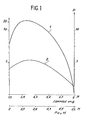
- the organic solvent consists of hyfrane 120 containing a mixture of bis hydrogenphosphate (dibutoxy-1,3-propyl-2), that is to say of compound n ° 8 of table 1 and of oxide of di-n-hexyloctoxymethy .phosphine (POX 11) to recover uranium from a 6N phosphoric acid solution containing 1.1 g per liter of uranium VI.
- a total concentration of 0.5 M in extractants is used and the extraction is carried out under the same conditions as those of Example 1.
- curve (1) of FIG. 1 represents the variations of the partition coefficient D of uranium as a function of the content of acidic organophosphorus compound in the organic solvent.
- curve 2 represents the variations in the partition coefficient D of iron as a function of the content of compound produced extraction under the same conditions from a 6M phosphoric acid solution containing 1.1 g / l of iron III.
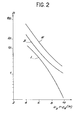
- This example illustrates the influence of the concentration of phosphoric acid in the aqueous solution on the extraction of uranium VI, at 23 ° C., using the extractant systems No. I, II and III in Table 2 diluted in of hydrogen 120.
- the extraction is carried out under the same conditions as those of Example 1.
- FIG. 2 represents the variations in the partition coefficient D of uranium VI as a function of the concentration of phosphoric acid in the aqueous phase.
- curves I, II and III respectively illustrate the results obtained with the extractant systems I, II and III in Table 2.
- the partition coefficient D of uranium decreases as a function of the phosphoric acid concentration, but it de grows less significantly with the extractant systems II and III of the invention.
- This example illustrates the influence of temperature on the extraction of uranium VI.
- the extraction is carried out under the same conditions as those of Examples 2 and 3 by varying the temperature from 10 to 60 ° C. and using the extractant systems I to IV of Table 2 diluted in hyfrane 120.
- the results obtained are represented in FIG. 3 where the curves I, II, III and IV relate respectively to the systems I, II, III and IV.
- the uranium is extracted from a 6M phosphoric acid solution containing 1.06 g / 1 of uranium VI and 4.70 g / 1 of iron III, using the system extractants No. III of Table 2 diluted in hyfrane 120 and operating under the same conditions as those of Example 1. but by determining the partition coefficients of uranium VI and iron III after different durations d 'extraction.
- FIG. 4 represents the evolution of the extraction rate (in%) in the organic phase of uranium (curve 1) and iron (curve 2) as a function of the extraction time. (in seconds).
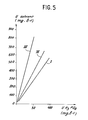
- the uranium is recovered from an industrial phosphoric acid solution titrating 27% P 2 0 5 and 130 m g / 1 uranium, using as extractant systems I, III and IV of Table 2 diluted in the product sold under the brand Escaid 110, which is a dearomatized kerosene, with a concentration of 0.5 M in acidic organophosphorus compound and a concentration of 0.125 M in phosphine oxide.
- FIG. 6 also illustrates the results obtained with regard to the extraction of iron as a function of the number of contacts.
- curve 2 represents the evolution of the iron concentration of the organic solvent as a function of the number of contacts
- curve 1 represents the evolution of the uranium concentration of the organic solvent as a function of the number of contacts, when 'The extractant system III of the invention is used.
- the organic solvent thus obtained which contains 798 mg / 1 of uranium and 775 mg / 1 of iron is brought into contact with a solution of ammonium carbonate at 140 g / 1 and 0.5 M in NH 4 0H for re- milking the uranium in solution and separating the iron as hydroxide.
- the organic phase contains only 0.4 mg / 1 of uranium and 1 mg / 1 of iron.
- the No. III extractant system extracts more than three times better uranium than conventional system of the prior art (system No. I) and more than twice as good as system No. IV of the prior art. Therefore, one can reduce the volume of organic phase and therefore limit the consumption of ammonium carbonate and ammonia during the re-extraction operation.
- the organic solvents used contain the extractant systems I, III, IV or V of Table 2 attached, and a diluent consisting of kerosene known under the trade name ISOPAR L.
- a diluent consisting of kerosene known under the trade name ISOPAR L.
- the phosphine oxide content is 0.125 M and the content of acidic organophosphorus compound is 0.500 M.
- the extraction is carried out by bringing a volume of the aqueous solution into contact at 39 ° C. phosphoric acid with a volume of the organic solvent with stirring for about 5 min; we then separate the two phases then we take them and we analyze them each to obtain their uranium concentration and their iron concentration and then determine the partition coefficient D of uranium and the partition coefficient D of iron.
- the results obtained are given in table 3, attached.
- the organic solvents containing the extractant system of the invention that is to say the organophosphorus acid compound HBIDIBOPP associated with a phosphine oxide such as POX11 or TOPO allow '' obtaining very improved results compared to the extractant systems I and IV of the prior art.
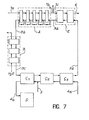
- This example relates to the extraction of uranium contained in industrial phosphoric acid having the same characteristics as that of Example 7, using for the extraction the installation shown in FIG. 7.
- the reference A designates the uranium extraction unit which comprises five extraction stages
- the reference B represents a washing unit for the organic solvent which comprises three stages
- the references C 1 , C 2 and C 3 denote the three stages of uranium re-extraction
- the reference D illustrates the unit for separating uranium
- the reference E denotes the reacidification unit of the organic solvent, which comprises two stages.
- extraction unit A industrial line phosphoric acid is introduced via line la after having flocculated and decanted it. It is specified that this acid was subjected beforehand to an oxidation treatment to bring all of the uranium in the hexavalent form, which also brings the iron to the trivalent state.
- extraction unit A the phosphoric acid is brought into countercurrent contact with an organic solvent introduced via line 3a.
- This organic solvent comprises a system of extractants constituted by an acid organophosphorus compound and by a neutral phosphine oxide diluted in kerosene known under the trade name ISOPAR L, the concentration of acidic organophosphorus compound in the solvent being 0.5 mol.l -1 and the phosphine oxide concentration in the organic solvent being 0.125 mol.l -1 .
- the phosphoric acid solution circulates in the extraction unit at a rate which is maintained at the value of 4 1 / h, and the organic solvent circulates against the current in the extraction unit by being introduced at a flow rate of 1.6 1 / h for extractant system No. I, 1.0 1 / h for extractant system No. IV and 0.54 1 / h for extractant system No. III.
- each extraction stage part of the organic solvent leaving this stage is recycled, which makes it possible to increase the volume of organic phase in contact with phosphoric acid in the extraction unit A, all of the stages of which are maintained at 35 ° C.
- the phosphoric acid containing practically no more uranium is discharged via line 1b and the organic solvent loaded with uranium and iron is discharged via line 3b.
- This solvent then passes into the washing unit comprising three stages where it is washed with water to remove the phosphoric ions entrained by the solvent.
- the water loaded with phosphoric acid which leaves the top floor of the washing unit is recycled in the phosphoric acid manufacturing plant where it is used for washing or rinsing the installations.
- the organic solvent is introduced via line 3c into the first re-extraction stage C 1 , then it circulates in the following stages C 2 and C 3 , stages C 1 , C 2 and C 3 being maintained at 40 ° C.
- stages C 2 and C 3 it is brought into contact against the current with an ammonium carbonate solution at 155 gl -1 introduced in the last stage C 3 by line 4a and in stage C 1 , it is brought into contact against the current with the carbonate solution coming from stage C 2 and with ammonia at 200 g -1 injected by line 5 into the carbonate solution which enters the first stage C 1 .
- the ammonia flow rate is adjusted using a valve controlled by a pH meter so as to maintain the pH of the first stage CI at a value of 8.2.
- the flow rate of the ammonium carbonate solution introduced into the last stage C 3 is regulated by line 4a so that it corresponds to 50 to 80% of the stoichiometric quantity necessary to neutralize, on the one hand , the organo phosphorus acid compound and transform, on the other hand, uranium into uranyl ammonium tri-carbonate.
- the organic solvent loaded with uranium and iron which first comes into contact with ammonia gradually transforms into a hydrated ammonium salt and the aqueous phase which moves against the current is enriched in uranium and iron, the ammonium carbonate reacting with uranium to form uranyl ammonium tricarbonate which remains in solution and the iron being precipitated in the form of hydroxide which is separated by filtration.
- the aqueous phase containing the uranyl ammonium tricarbonate leaves the first stage of re-extraction CI by line 4b and it is then directed to the separation unit D of the uranium.
- the uranium can be separated from the solution, either in the form oxide, either in the form of sodium uranate.
- the solution of ammonium trianyl carbonate uranyl is subjected in an air bubbling reactor, at a temperature between 90 and 100 ° C., for approximately 6 hours, then the precipitate is filtered and washed with water; after drying at 120 ° C and roasting at around 400 ° C, uranium trioxide is thus obtained.
- the ammonium uranyl tricarbonate solution which has been degassed beforehand by bubbling air around 90 ° C.
- the uranium is precipitated by adding sodium hydroxide to the solution, operating at a temperature of 80 ° C for 1 hour. After filtration and washing with water at 50 ° C., the sodium uranate is collected which can be further transformed into ammonium diuranate or uranium trioxide.
- the deuranified organic solvent is removed by line 3d and sent to the reacidification purification unit E comprising two stages in which it is treated with phosphoric acid introduced by line lc, this phosphoric acid constituting a fraction of the phosphoric acid which leaves the extraction unit A via line 1b.
- the reacidification purification unit E comprising two stages in which it is treated with phosphoric acid introduced by line lc, this phosphoric acid constituting a fraction of the phosphoric acid which leaves the extraction unit A via line 1b.
- ammonium phosphate thus recovered can be marketed directly or be used in fertilizer manufacturing units.
Landscapes
- Engineering & Computer Science (AREA)
- General Life Sciences & Earth Sciences (AREA)
- Chemical & Material Sciences (AREA)
- Life Sciences & Earth Sciences (AREA)
- Geology (AREA)
- Manufacturing & Machinery (AREA)
- Environmental & Geological Engineering (AREA)
- Materials Engineering (AREA)
- Mechanical Engineering (AREA)
- Metallurgy (AREA)
- Organic Chemistry (AREA)
- Extraction Or Liquid Replacement (AREA)
- Manufacture And Refinement Of Metals (AREA)
Applications Claiming Priority (2)
| Application Number | Priority Date | Filing Date | Title |
|---|---|---|---|
| FR8024253A FR2494258A1 (fr) | 1980-11-14 | 1980-11-14 | Procede de recuperation de l'uranium present dans des solutions d'acide phosphorique |
| FR8024253 | 1980-11-14 |
Publications (2)
| Publication Number | Publication Date |
|---|---|
| EP0053054A1 true EP0053054A1 (de) | 1982-06-02 |
| EP0053054B1 EP0053054B1 (de) | 1985-01-23 |
Family
ID=9247989
Family Applications (1)
| Application Number | Title | Priority Date | Filing Date |
|---|---|---|---|
| EP81401686A Expired EP0053054B1 (de) | 1980-11-14 | 1981-10-23 | Verfahren zum Gewinnen von Uran (VI) aus Phosphorsäure enthaltenden Lösungen |
Country Status (15)
| Country | Link |
|---|---|
| US (1) | US4432946A (de) |
| EP (1) | EP0053054B1 (de) |
| JP (1) | JPS57110324A (de) |
| AU (1) | AU542919B2 (de) |
| BR (1) | BR8107393A (de) |
| CA (1) | CA1188106A (de) |
| DE (1) | DE3168526D1 (de) |
| EG (1) | EG15457A (de) |
| ES (1) | ES8206387A1 (de) |
| FR (1) | FR2494258A1 (de) |
| JO (1) | JO1166B1 (de) |
| MA (1) | MA19328A1 (de) |
| OA (1) | OA06944A (de) |
| YU (1) | YU42740B (de) |
| ZA (1) | ZA817498B (de) |
Cited By (3)
| Publication number | Priority date | Publication date | Assignee | Title |
|---|---|---|---|---|
| EP0239501A1 (de) * | 1986-03-28 | 1987-09-30 | Compagnie Generale Des Matieres Nucleaires (Cogema) | Verfahren zur Trennung von Eisen aus organischen Uranlösungen |
| WO2017001494A1 (fr) | 2015-06-30 | 2017-01-05 | Areva Mines | Procede de separation du fer d'une phase organique contenant de l'uranium et procede d'extraction de l'uranium d'une solution aqueuse d'acide mineral contenant de l'uranium et du fer |
| WO2019025714A1 (fr) | 2017-07-31 | 2019-02-07 | Orano Mining | Composés bifonctionnels à fonction thiophosphine, utiles comme extractants de l'uranium(vi), leurs procédés de synthèse et leurs utilisations |
Families Citing this family (2)
| Publication number | Priority date | Publication date | Assignee | Title |
|---|---|---|---|---|
| US5188736A (en) * | 1991-08-27 | 1993-02-23 | Institute Of Nuclear Energy Research | Process for the separation and recovery of extractant from spent solvent |
| US20110226694A1 (en) * | 2010-03-22 | 2011-09-22 | Battelle Energy Alliance, Llc | Methods of reducing radiotoxicity in aqueous acidic solutions and a reaction system for same |
Citations (5)
| Publication number | Priority date | Publication date | Assignee | Title |
|---|---|---|---|---|
| FR1193653A (fr) * | 1956-06-29 | 1959-11-04 | Atomic Energy Commission | Agents d'extraction à base d'orthophosphates organiques et leurs procédés d'utilisation |
| FR1303476A (fr) * | 1960-06-03 | 1962-09-14 | Atomic Energy Commission | Procédé d'extraction liquide-liquide pour la récupération de l'uranium |
| FR2364180A1 (fr) * | 1976-09-10 | 1978-04-07 | Westinghouse Electric Corp | Procede de recuperation d'uranium dans le procede de fabrication d'acide phosphorique par voie humide |
| FR2423545A1 (fr) * | 1977-08-25 | 1979-11-16 | Minemet Rech Sa | Procede pour la recuperation de l'uranium contenu dans des solutions phosphatees |
| FR2442796A1 (fr) * | 1978-11-28 | 1980-06-27 | Commissariat Energie Atomique | Procede de recuperation de l'uranium present dans les solutions d'acide phosphorique |
Family Cites Families (2)
| Publication number | Priority date | Publication date | Assignee | Title |
|---|---|---|---|---|
| US4243637A (en) * | 1977-10-11 | 1981-01-06 | Occidental Petroleum Company | Uranium recovery from pre-treated phosphoric acid |
| IL58726A (en) * | 1978-11-28 | 1982-12-31 | Commissariat Energie Atomique | Recovery of uranium from phosphoric acid solutions |
-
1980
- 1980-11-14 FR FR8024253A patent/FR2494258A1/fr active Granted
-
1981
- 1981-10-23 EP EP81401686A patent/EP0053054B1/de not_active Expired
- 1981-10-23 DE DE8181401686T patent/DE3168526D1/de not_active Expired
- 1981-10-27 AU AU76847/81A patent/AU542919B2/en not_active Ceased
- 1981-10-29 ZA ZA817498A patent/ZA817498B/xx unknown
- 1981-10-30 US US06/316,941 patent/US4432946A/en not_active Expired - Fee Related
- 1981-11-05 YU YU2627/81A patent/YU42740B/xx unknown
- 1981-11-11 MA MA19532A patent/MA19328A1/fr unknown
- 1981-11-11 EG EG659/81A patent/EG15457A/xx active
- 1981-11-12 CA CA000389920A patent/CA1188106A/en not_active Expired
- 1981-11-13 JP JP56182163A patent/JPS57110324A/ja active Pending
- 1981-11-13 ES ES507131A patent/ES8206387A1/es not_active Expired
- 1981-11-13 BR BR8107393A patent/BR8107393A/pt unknown
- 1981-11-14 OA OA57540A patent/OA06944A/xx unknown
-
1982
- 1982-02-18 JO JO19821166A patent/JO1166B1/en active
Patent Citations (5)
| Publication number | Priority date | Publication date | Assignee | Title |
|---|---|---|---|---|
| FR1193653A (fr) * | 1956-06-29 | 1959-11-04 | Atomic Energy Commission | Agents d'extraction à base d'orthophosphates organiques et leurs procédés d'utilisation |
| FR1303476A (fr) * | 1960-06-03 | 1962-09-14 | Atomic Energy Commission | Procédé d'extraction liquide-liquide pour la récupération de l'uranium |
| FR2364180A1 (fr) * | 1976-09-10 | 1978-04-07 | Westinghouse Electric Corp | Procede de recuperation d'uranium dans le procede de fabrication d'acide phosphorique par voie humide |
| FR2423545A1 (fr) * | 1977-08-25 | 1979-11-16 | Minemet Rech Sa | Procede pour la recuperation de l'uranium contenu dans des solutions phosphatees |
| FR2442796A1 (fr) * | 1978-11-28 | 1980-06-27 | Commissariat Energie Atomique | Procede de recuperation de l'uranium present dans les solutions d'acide phosphorique |
Cited By (5)
| Publication number | Priority date | Publication date | Assignee | Title |
|---|---|---|---|---|
| EP0239501A1 (de) * | 1986-03-28 | 1987-09-30 | Compagnie Generale Des Matieres Nucleaires (Cogema) | Verfahren zur Trennung von Eisen aus organischen Uranlösungen |
| FR2596383A1 (fr) * | 1986-03-28 | 1987-10-02 | Cogema | Procede de separation du fer a partir d'une solution organique contenant de l'uranium |
| US5017344A (en) * | 1986-03-28 | 1991-05-21 | Compagnie Generale Des Matieres Nucleaires (Cogema) | Process for the separation of iron from an organic solution containing uranium |
| WO2017001494A1 (fr) | 2015-06-30 | 2017-01-05 | Areva Mines | Procede de separation du fer d'une phase organique contenant de l'uranium et procede d'extraction de l'uranium d'une solution aqueuse d'acide mineral contenant de l'uranium et du fer |
| WO2019025714A1 (fr) | 2017-07-31 | 2019-02-07 | Orano Mining | Composés bifonctionnels à fonction thiophosphine, utiles comme extractants de l'uranium(vi), leurs procédés de synthèse et leurs utilisations |
Also Published As
| Publication number | Publication date |
|---|---|
| JPS57110324A (en) | 1982-07-09 |
| YU42740B (en) | 1988-12-31 |
| FR2494258A1 (fr) | 1982-05-21 |
| CA1188106A (en) | 1985-06-04 |
| ES507131A0 (es) | 1982-08-16 |
| ZA817498B (en) | 1982-10-27 |
| YU262781A (en) | 1983-12-31 |
| OA06944A (fr) | 1983-07-31 |
| AU7684781A (en) | 1982-05-20 |
| ES8206387A1 (es) | 1982-08-16 |
| EP0053054B1 (de) | 1985-01-23 |
| FR2494258B1 (de) | 1984-11-02 |
| US4432946A (en) | 1984-02-21 |
| JO1166B1 (en) | 1983-11-30 |
| MA19328A1 (fr) | 1982-07-01 |
| EG15457A (en) | 1988-10-31 |
| AU542919B2 (en) | 1985-03-21 |
| BR8107393A (pt) | 1982-08-10 |
| DE3168526D1 (en) | 1985-03-07 |
Similar Documents
| Publication | Publication Date | Title |
|---|---|---|
| EP0210928B1 (de) | Extraktionsmittel und Propandiamide, i2re Verwendung zur Rückgewinnung von Aktiniden und/oder Lanthaniden und Verfahren zu ihrer Herstellung | |
| US4986742A (en) | Process for the production of high-grade titanium dioxide by sulfate method | |
| FR2562059A1 (fr) | Procede de separation des terres rares par extraction liquide-liquide | |
| FR2990206A1 (fr) | Nouveaux composes bifonctionnels utiles comme ligands de l'uranium(vi), leurs procedes de synthese et leurs utilisations | |
| EP0110789B1 (de) | Verfahren zur Rückgewinnung von dreiwertigen Aktiniden und/oder Lanthaniden aus einer wässerigen Säurelösung | |
| US3067010A (en) | Process for preparation of titanium dioxide | |
| EP0038764A1 (de) | Anwendung zum Kationenaustausch diphosphonischer Derivate, diphosphonische Derivate und ihr Herstellungsverfahren | |
| EP0090692B1 (de) | Verfahren zur Rückgewinnung und Reinigung einer rückständigen Schwefelsäure welche Titansalze enthält | |
| WO2014139869A1 (fr) | Utilisation de composés à fonctions amide et phosphonate pour extraire l'uranium(vi) de solutions aqueuses d'acide sulfurique, issues notamment de la lixiviation sulfurique de minerais uranifères | |
| FR3062128A1 (fr) | N,n-dialkylamides dissymetriques, utiles notamment pour separer l'uranium(vi) du plutonium(iv), leur synthese et leurs utilisations | |
| EP0053054B1 (de) | Verfahren zum Gewinnen von Uran (VI) aus Phosphorsäure enthaltenden Lösungen | |
| CA1187706A (en) | Process for separating germanium from an aqueous solution | |
| WO2019002788A1 (fr) | Carbamides pour la séparation de l'uranium(vi) et du plutonium(iv) sans réduction du plutonium(iv) | |
| CA2981562A1 (fr) | Composes a fonctions oxyde de phosphine et amine, utiles comme ligands de l'uranium(vi), et leurs utilisations, notamment pour extraire l'uranium(vi) de solutions aqueuses d'acide sulfurique | |
| SU858572A3 (ru) | Способ извлечени урана | |
| JP3310728B2 (ja) | 希土類金属のための抽出剤及び希土類金属の分離、精製方法 | |
| US4275038A (en) | Process for treating loaded extractant from purification of phosphoric acid by extraction and recovering nutrients | |
| US4256716A (en) | Process for treating loaded extractant from purification of phosphoric acid by extraction | |
| EP0527685B1 (de) | Verfahren zur Trennung der Aktiniden von Lanthaniden durch selektive Extraktion der Aktinide in einem Propandiamid-enthaltenden organischen Lösungsmittel | |
| US4356153A (en) | Uranium recovery process | |
| EP0129448B1 (de) | Verfahren zur selektiven Entfernung von Kupfer mittels 4-Acyl(3H)-Pyrazol-3-onen | |
| EP0266272B1 (de) | Verfahren zur Rückgewinnung von Organophosphorsäuren und/oder Organophosphorionen aus einer wässerigen Lösung und Verwendung zur Aufbereitung von wässerigen Abfallösungen | |
| FR2459205A2 (fr) | Procede de recuperation de l'uranium present dans une solution d'acide phosphorique | |
| EP0239501B1 (de) | Verfahren zur Trennung von Eisen aus organischen Uranlösungen | |
| FR2460275A1 (fr) | Procede de separation de metaux des terres rares par extraction au solvant |
Legal Events
| Date | Code | Title | Description |
|---|---|---|---|
| PUAI | Public reference made under article 153(3) epc to a published international application that has entered the european phase |
Free format text: ORIGINAL CODE: 0009012 |
|
| AK | Designated contracting states |
Designated state(s): BE DE FR GB IT NL |
|
| 17P | Request for examination filed |
Effective date: 19821109 |
|
| ITF | It: translation for a ep patent filed | ||
| GRAA | (expected) grant |
Free format text: ORIGINAL CODE: 0009210 |
|
| AK | Designated contracting states |
Designated state(s): BE DE FR GB IT NL |
|
| REF | Corresponds to: |
Ref document number: 3168526 Country of ref document: DE Date of ref document: 19850307 |
|
| PLBE | No opposition filed within time limit |
Free format text: ORIGINAL CODE: 0009261 |
|
| STAA | Information on the status of an ep patent application or granted ep patent |
Free format text: STATUS: NO OPPOSITION FILED WITHIN TIME LIMIT |
|
| 26N | No opposition filed | ||
| PG25 | Lapsed in a contracting state [announced via postgrant information from national office to epo] |
Ref country code: BE Effective date: 19861031 |
|
| BERE | Be: lapsed |
Owner name: COMMISSARIAT A L'ENERGIE ATOMIQUE ETABLISSEMENT D Effective date: 19861031 |
|
| PGFP | Annual fee paid to national office [announced via postgrant information from national office to epo] |
Ref country code: NL Payment date: 19871031 Year of fee payment: 7 |
|
| PG25 | Lapsed in a contracting state [announced via postgrant information from national office to epo] |
Ref country code: GB Effective date: 19881023 |
|
| PG25 | Lapsed in a contracting state [announced via postgrant information from national office to epo] |
Ref country code: NL Effective date: 19890501 |
|
| NLV4 | Nl: lapsed or anulled due to non-payment of the annual fee | ||
| GBPC | Gb: european patent ceased through non-payment of renewal fee | ||
| PGFP | Annual fee paid to national office [announced via postgrant information from national office to epo] |
Ref country code: DE Payment date: 19890925 Year of fee payment: 9 |
|
| PG25 | Lapsed in a contracting state [announced via postgrant information from national office to epo] |
Ref country code: DE Effective date: 19910702 |
|
| PGFP | Annual fee paid to national office [announced via postgrant information from national office to epo] |
Ref country code: FR Payment date: 19991027 Year of fee payment: 19 |
|
| PG25 | Lapsed in a contracting state [announced via postgrant information from national office to epo] |
Ref country code: FR Free format text: LAPSE BECAUSE OF NON-PAYMENT OF DUE FEES Effective date: 20010629 |
|
| REG | Reference to a national code |
Ref country code: FR Ref legal event code: ST |