EP0053285A2 - Method and apparatus for the oxidation of an extruded melted polyethylene film - Google Patents
Method and apparatus for the oxidation of an extruded melted polyethylene film Download PDFInfo
- Publication number
- EP0053285A2 EP0053285A2 EP81109115A EP81109115A EP0053285A2 EP 0053285 A2 EP0053285 A2 EP 0053285A2 EP 81109115 A EP81109115 A EP 81109115A EP 81109115 A EP81109115 A EP 81109115A EP 0053285 A2 EP0053285 A2 EP 0053285A2
- Authority
- EP
- European Patent Office
- Prior art keywords
- carrier web
- ozone
- polyethylene film
- pressure roller
- gap
- Prior art date
- Legal status (The legal status is an assumption and is not a legal conclusion. Google has not performed a legal analysis and makes no representation as to the accuracy of the status listed.)
- Granted
Links
- -1 polyethylene Polymers 0.000 title claims abstract description 20
- 239000004698 Polyethylene Substances 0.000 title claims abstract description 19
- 229920000573 polyethylene Polymers 0.000 title claims abstract description 19
- 238000000034 method Methods 0.000 title claims description 13
- 230000003647 oxidation Effects 0.000 title description 4
- 238000007254 oxidation reaction Methods 0.000 title description 4
- CBENFWSGALASAD-UHFFFAOYSA-N Ozone Chemical compound [O-][O+]=O CBENFWSGALASAD-UHFFFAOYSA-N 0.000 claims abstract description 28
- 238000007664 blowing Methods 0.000 claims description 7
- 238000001816 cooling Methods 0.000 claims description 5
- 230000001590 oxidative effect Effects 0.000 claims description 3
- 238000001125 extrusion Methods 0.000 claims description 2
- 230000000694 effects Effects 0.000 abstract description 2
- 239000010410 layer Substances 0.000 description 5
- 229920003023 plastic Polymers 0.000 description 3
- 239000004033 plastic Substances 0.000 description 3
- 239000002344 surface layer Substances 0.000 description 3
- 208000028659 discharge Diseases 0.000 description 2
- 229920000298 Cellophane Polymers 0.000 description 1
- 239000004743 Polypropylene Substances 0.000 description 1
- QVGXLLKOCUKJST-UHFFFAOYSA-N atomic oxygen Chemical compound [O] QVGXLLKOCUKJST-UHFFFAOYSA-N 0.000 description 1
- 239000011248 coating agent Substances 0.000 description 1
- 238000000576 coating method Methods 0.000 description 1
- 238000002474 experimental method Methods 0.000 description 1
- 239000011888 foil Substances 0.000 description 1
- 239000007789 gas Substances 0.000 description 1
- 238000002347 injection Methods 0.000 description 1
- 239000007924 injection Substances 0.000 description 1
- 238000004519 manufacturing process Methods 0.000 description 1
- 238000002844 melting Methods 0.000 description 1
- 230000008018 melting Effects 0.000 description 1
- 239000002184 metal Substances 0.000 description 1
- 239000007800 oxidant agent Substances 0.000 description 1
- 229920001155 polypropylene Polymers 0.000 description 1
- 230000001737 promoting effect Effects 0.000 description 1
- 239000000779 smoke Substances 0.000 description 1
Images
Classifications
-
- B—PERFORMING OPERATIONS; TRANSPORTING
- B05—SPRAYING OR ATOMISING IN GENERAL; APPLYING FLUENT MATERIALS TO SURFACES, IN GENERAL
- B05C—APPARATUS FOR APPLYING FLUENT MATERIALS TO SURFACES, IN GENERAL
- B05C9/00—Apparatus or plant for applying liquid or other fluent material to surfaces by means not covered by any preceding group, or in which the means of applying the liquid or other fluent material is not important
- B05C9/08—Apparatus or plant for applying liquid or other fluent material to surfaces by means not covered by any preceding group, or in which the means of applying the liquid or other fluent material is not important for applying liquid or other fluent material and performing an auxiliary operation
- B05C9/10—Apparatus or plant for applying liquid or other fluent material to surfaces by means not covered by any preceding group, or in which the means of applying the liquid or other fluent material is not important for applying liquid or other fluent material and performing an auxiliary operation the auxiliary operation being performed before the application
-
- B—PERFORMING OPERATIONS; TRANSPORTING
- B32—LAYERED PRODUCTS
- B32B—LAYERED PRODUCTS, i.e. PRODUCTS BUILT-UP OF STRATA OF FLAT OR NON-FLAT, e.g. CELLULAR OR HONEYCOMB, FORM
- B32B27/00—Layered products comprising a layer of synthetic resin
- B32B27/32—Layered products comprising a layer of synthetic resin comprising polyolefins
-
- B—PERFORMING OPERATIONS; TRANSPORTING
- B05—SPRAYING OR ATOMISING IN GENERAL; APPLYING FLUENT MATERIALS TO SURFACES, IN GENERAL
- B05D—PROCESSES FOR APPLYING FLUENT MATERIALS TO SURFACES, IN GENERAL
- B05D1/00—Processes for applying liquids or other fluent materials
- B05D1/26—Processes for applying liquids or other fluent materials performed by applying the liquid or other fluent material from an outlet device in contact with, or almost in contact with, the surface
- B05D1/265—Extrusion coatings
-
- B—PERFORMING OPERATIONS; TRANSPORTING
- B32—LAYERED PRODUCTS
- B32B—LAYERED PRODUCTS, i.e. PRODUCTS BUILT-UP OF STRATA OF FLAT OR NON-FLAT, e.g. CELLULAR OR HONEYCOMB, FORM
- B32B27/00—Layered products comprising a layer of synthetic resin
- B32B27/06—Layered products comprising a layer of synthetic resin as the main or only constituent of a layer, which is next to another layer of the same or of a different material
- B32B27/10—Layered products comprising a layer of synthetic resin as the main or only constituent of a layer, which is next to another layer of the same or of a different material of paper or cardboard
-
- B—PERFORMING OPERATIONS; TRANSPORTING
- B32—LAYERED PRODUCTS
- B32B—LAYERED PRODUCTS, i.e. PRODUCTS BUILT-UP OF STRATA OF FLAT OR NON-FLAT, e.g. CELLULAR OR HONEYCOMB, FORM
- B32B37/00—Methods or apparatus for laminating, e.g. by curing or by ultrasonic bonding
- B32B37/14—Methods or apparatus for laminating, e.g. by curing or by ultrasonic bonding characterised by the properties of the layers
- B32B37/15—Methods or apparatus for laminating, e.g. by curing or by ultrasonic bonding characterised by the properties of the layers with at least one layer being manufactured and immediately laminated before reaching its stable state, e.g. in which a layer is extruded and laminated while in semi-molten state
- B32B37/153—Methods or apparatus for laminating, e.g. by curing or by ultrasonic bonding characterised by the properties of the layers with at least one layer being manufactured and immediately laminated before reaching its stable state, e.g. in which a layer is extruded and laminated while in semi-molten state at least one layer is extruded and immediately laminated while in semi-molten state
-
- B—PERFORMING OPERATIONS; TRANSPORTING
- B32—LAYERED PRODUCTS
- B32B—LAYERED PRODUCTS, i.e. PRODUCTS BUILT-UP OF STRATA OF FLAT OR NON-FLAT, e.g. CELLULAR OR HONEYCOMB, FORM
- B32B38/00—Ancillary operations in connection with laminating processes
- B32B38/0008—Electrical discharge treatment, e.g. corona, plasma treatment; wave energy or particle radiation
-
- B—PERFORMING OPERATIONS; TRANSPORTING
- B05—SPRAYING OR ATOMISING IN GENERAL; APPLYING FLUENT MATERIALS TO SURFACES, IN GENERAL
- B05D—PROCESSES FOR APPLYING FLUENT MATERIALS TO SURFACES, IN GENERAL
- B05D2507/00—Polyolefins
- B05D2507/01—Polyethylene
-
- B—PERFORMING OPERATIONS; TRANSPORTING
- B05—SPRAYING OR ATOMISING IN GENERAL; APPLYING FLUENT MATERIALS TO SURFACES, IN GENERAL
- B05D—PROCESSES FOR APPLYING FLUENT MATERIALS TO SURFACES, IN GENERAL
- B05D3/00—Pretreatment of surfaces to which liquids or other fluent materials are to be applied; After-treatment of applied coatings, e.g. intermediate treating of an applied coating preparatory to subsequent applications of liquids or other fluent materials
- B05D3/04—Pretreatment of surfaces to which liquids or other fluent materials are to be applied; After-treatment of applied coatings, e.g. intermediate treating of an applied coating preparatory to subsequent applications of liquids or other fluent materials by exposure to gases
- B05D3/0433—Pretreatment of surfaces to which liquids or other fluent materials are to be applied; After-treatment of applied coatings, e.g. intermediate treating of an applied coating preparatory to subsequent applications of liquids or other fluent materials by exposure to gases the gas being a reactive gas
- B05D3/044—Pretreatment
- B05D3/0446—Pretreatment of a polymeric substrate
-
- B—PERFORMING OPERATIONS; TRANSPORTING
- B32—LAYERED PRODUCTS
- B32B—LAYERED PRODUCTS, i.e. PRODUCTS BUILT-UP OF STRATA OF FLAT OR NON-FLAT, e.g. CELLULAR OR HONEYCOMB, FORM
- B32B2310/00—Treatment by energy or chemical effects
- B32B2310/04—Treatment by energy or chemical effects using liquids, gas or steam
- B32B2310/0445—Treatment by energy or chemical effects using liquids, gas or steam using gas or flames
-
- B—PERFORMING OPERATIONS; TRANSPORTING
- B32—LAYERED PRODUCTS
- B32B—LAYERED PRODUCTS, i.e. PRODUCTS BUILT-UP OF STRATA OF FLAT OR NON-FLAT, e.g. CELLULAR OR HONEYCOMB, FORM
- B32B2310/00—Treatment by energy or chemical effects
- B32B2310/04—Treatment by energy or chemical effects using liquids, gas or steam
- B32B2310/0445—Treatment by energy or chemical effects using liquids, gas or steam using gas or flames
- B32B2310/0463—Treatment by energy or chemical effects using liquids, gas or steam using gas or flames other than air
- B32B2310/0481—Ozone
-
- B—PERFORMING OPERATIONS; TRANSPORTING
- B32—LAYERED PRODUCTS
- B32B—LAYERED PRODUCTS, i.e. PRODUCTS BUILT-UP OF STRATA OF FLAT OR NON-FLAT, e.g. CELLULAR OR HONEYCOMB, FORM
- B32B2317/00—Animal or vegetable based
- B32B2317/12—Paper, e.g. cardboard
-
- B—PERFORMING OPERATIONS; TRANSPORTING
- B32—LAYERED PRODUCTS
- B32B—LAYERED PRODUCTS, i.e. PRODUCTS BUILT-UP OF STRATA OF FLAT OR NON-FLAT, e.g. CELLULAR OR HONEYCOMB, FORM
- B32B2323/00—Polyalkenes
- B32B2323/04—Polyethylene
-
- B—PERFORMING OPERATIONS; TRANSPORTING
- B32—LAYERED PRODUCTS
- B32B—LAYERED PRODUCTS, i.e. PRODUCTS BUILT-UP OF STRATA OF FLAT OR NON-FLAT, e.g. CELLULAR OR HONEYCOMB, FORM
- B32B2367/00—Polyesters, e.g. PET, i.e. polyethylene terephthalate
Definitions
- the invention relates to a method for oxidizing an extruded molten polyethylene film before it is pressed to a carrier web for the purpose of connecting to it, in which ozone is passed into the gap formed by the carrier web and the polyethylene film, and an apparatus for carrying out this method.
- a disadvantage of these known methods is that the ozone is blown in the manner evident, for example, from DE-GMS 74 23 544, against the just extruded polyethylene film above the gap formed between the pressure roller and the cooling roller, or is blown directly into the gap.
- This type of blowing with ozone presumably does not lead to a good bond because the turbulent currents in and above the gap do not allow the ozone to come into sufficient contact with the surface layers to be oxidized and because the ozone comes from the suction device belonging to each extruder is drawn off unused together with the polyethylene vapors.
- the object of the invention is. therefore to propose a method and a device which allow the injection of ozone in such a way that the surface layers are sufficiently oxidized to achieve a good bonding effect.
- the ozone is blown onto the carrier web essentially in the direction of the running direction thereof in the region entering the gap.
- the good bond adhesion can be achieved by the process according to the invention in that the inflated ozone forms a laminar flow near the surface which is moved along by the carrier web and immerses deep into the gap and then upwards through the suction device arranged on the extruder along the hot polyethylene melting plume is sucked off.
- the ozone is blown into the near-surface laminar air flow of the carrier web or such a laminar near-surface air flow is built, both the surface of the carrier web and the film of polyethylene melt are intensively exposed to highly active ozone.
- Blowing the carrier web with ozone according to the invention is particularly advantageous if it consists of a plastic web, for example of polypropylene or also of cellophane.
- a device for carrying out the method according to the invention with a pressure roller and a cooling roller forming a counter-pressure roller, with a slot extrusion nozzle arranged above the gap formed by the two rollers and with an ozone nozzle provided that the ozone nozzle consists of a tube arranged above the carrier web parallel to the axis of the pressure roller and in the run-up area of the carrier web and contacting or almost contacting the carrier web with blowing nozzles arranged in a row, the blowing direction of which is directed approximately tangentially to the pressure roller.
- the tube can also be provided with one or more slot-shaped blow nozzles.
- a guide web 3 made of paper runs over the pressure roller 1, which is set against a cooling roller 2, via guide and take-off rollers, not shown.
- the slot die of an extruder 4 which is only indicated schematically, is arranged above the gap formed between the pressure roller 1 and the cooling roller 2.
- a molten polyethylene film is extruded from the slot die in the manner shown, which in the. Gap merges with the carrier web 3.
- a blow pipe 6 is provided above the carrier web 3, just in front of the pressure roller 1, and is blown at the same distance from one another by a row of blow nozzles 7.
- the gas stream emerging from the nozzles 7 is directed approximately tangentially onto the pressure roller 1.
- the ozone emerging from the nozzles 7 is formed in the ozone generator 8 and fed to the blow pipe 6 via the line 9.
- the blow pipe 6 is arranged in such a way that the ozone stream emerging from the nozzles 7 reaches the laminar air stream moved by the carrier web 3 or replaced this.
- the arrows shown mark the path of the ozone flow, the course of which has been demonstrated in the experiment by generating smoke threads.
- the ozone stream initially lies tight on the surface of the carrier web 3 and migrates into the gap in the manner shown. In the gap, it reverses its direction and flows against the direction of the extruded polyethylene film 5 over its surface. The ozone stream is then drawn off from the suction devices of the extruder, not shown.
Landscapes
- Physics & Mathematics (AREA)
- Engineering & Computer Science (AREA)
- Plasma & Fusion (AREA)
- Thermal Sciences (AREA)
- Extrusion Moulding Of Plastics Or The Like (AREA)
- Laminated Bodies (AREA)
- Treatments Of Macromolecular Shaped Articles (AREA)
- Ink Jet Recording Methods And Recording Media Thereof (AREA)
- Lining Or Joining Of Plastics Or The Like (AREA)
Abstract
Zum Oxydieren eines extrudierten schmelzflüssigen Polyäthylenfilms vor seinem Verpressen mit einer Trägerbahn zum Zwecke des.Verbindens mit dieser, wird Ozon in den durch die Trägerbahn und den Polyäthylenfilm gebildeten Spalt geleitet. Um zur Erzielung einer guten Verbundwirkung den Oberflächenbereich ausreichend zu oxydieren, wird das Ozon im wesentlichen in Richtung der Laufrichtung derTrägerbahn auf diese in deren in den Spait einlaufenden Bereich geblasen.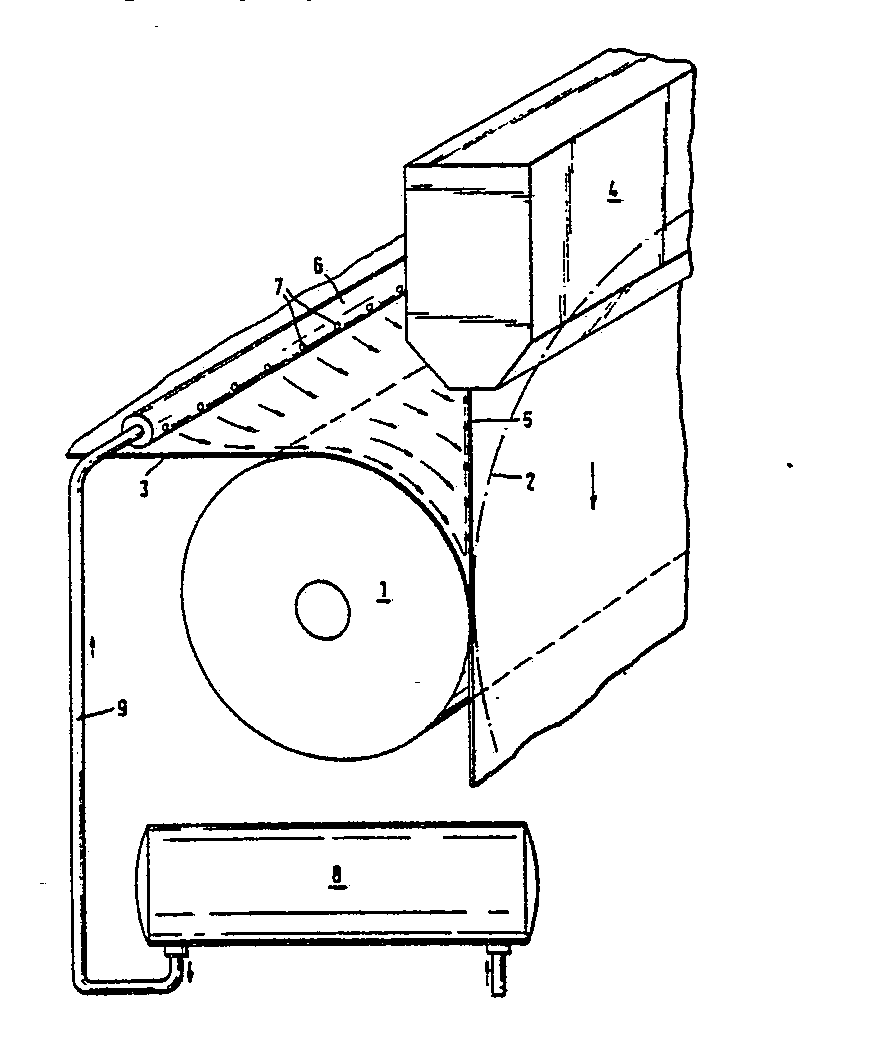
Description
Die Erfindung betrifft ein Verfahren zum Oxydieren eines extrudierten schmelzflüssigen Polyäthylenfilms vor seinem Verpressen mit einer Trägerbahn zum Zwecke des Verbindens mit dieser, bei dem Ozon in den durch die Trägerbahn und den Polyäthylenfilm gebildeten Spalt geleitet wird, sowie eine Vorrichtung zur Durchführung dieses Verfahrens.The invention relates to a method for oxidizing an extruded molten polyethylene film before it is pressed to a carrier web for the purpose of connecting to it, in which ozone is passed into the gap formed by the carrier web and the polyethylene film, and an apparatus for carrying out this method.
Bei der Beschichtung von Papier- und Kunststoffbahnen sowie von Metallfolien mit Polyäthylen ergibt sich das Problem, die extrudierte Polyäthylenschicht sicher mit der Trägerbahn zu verbinden. Um eine gute Haftung des schmelzflüssigen bzw. plastischen Polyäthylenfilms auf der Trägerbahn zu erzielen, ist es bekannt, die Oberfläche der Trägerbahn durch Korona-Funkenentladungen vorzubehandeln oder eine Zwischenschicht auf die Trägerbahn aufzubringen, die sich sowohl gut mit dieser als auch der Polyäthylenschicht verbindet.When coating paper and plastic webs as well as metal foils with polyethylene, the problem arises of securely connecting the extruded polyethylene layer to the carrier web. In order to achieve good adhesion of the molten or plastic polyethylene film to the carrier web, it is known to pretreat the surface of the carrier web by corona spark discharges or an intermediate layer to apply to the carrier web, which connects both well with this and the polyethylene layer.
Die Korona-Funkenentladungsbehandlung vermag nicht in allen Fällen eine befriedigende Verbundhaftung herbeizuführen und das Aufbringen. einer die Verbindung bewirkenden Zwischenschicht bedingt nicht nur einen zusätzlichen Herstellungsaufwand, derartige Zwischenschichten vermögen ihre die Haftung vermittelnden Eigenschaften voll auch erst nach Stunden zu entwickeln.The corona spark discharge treatment cannot bring about a satisfactory bond adhesion and the application in all cases. an intermediate layer which brings about the connection not only requires additional manufacturing outlay, such intermediate layers are able to develop their adhesion-imparting properties fully even after hours.
Es ist bekannt, daß eine Oxydation des extrudierten Polyäthylenfilms unmittelbar vor deren Aufbringen auf die Trägerbahn zu einer guten Haftung führt. Zur Vermeidung der vorstehend angegebenen Nachteile der bekannten Verfahren zur Haftvermittlung ist daher bereits ein Verfahren vorgeschlagen worden, bei dem der extrudierte Polyäthylenfilm mit Ozon angeblasen wird, um diesen zu oxydieren. Ozon stellt eines der stärksten Oxydationsmittel dar, weil dieses insbesondere unter Wärmeeinwirkung leicht zerfällt und dabei hochreaktionsfähiger atomarer Sauerstoff frei wird.It is known that oxidation of the extruded polyethylene film leads to good adhesion immediately before it is applied to the carrier web. To avoid the above-mentioned disadvantages of the known methods for promoting adhesion, a method has therefore already been proposed in which the extruded polyethylene film is blown with ozone in order to oxidize it. Ozone is one of the strongest oxidizing agents because it decomposes easily under the influence of heat and thereby releases highly reactive atomic oxygen.
Nachteilig ist bei diesen bekannten Verfahren jedoch, daß das Ozon in der beispielsweise aus der DE-GMS 74 23 544 ersichtlichen Weise gegen den gerade extrudierten Polyäthylenfilm oberhalb des zwischen der Andrückwalze und der Kühlwalze gebildeten Spalts geblasen oder unmittelbar in den Spalt eingeblasen wird. Diese Art des Anblasens mit Ozon führt vermutlich deshalb zu keiner guten Verbundhaftung, weil aufgrund der in und oberhalb des Spalts herrschenden turbulenten Strömungen das Ozon nicht in ausreichendem Maße mit den zu oxydirenden Oberflächenschichten in Berührung kommt und weil das Ozon durch die zu jedem Extruder gehörende Absauqeinrichtung zusammen mit den Polyäthylendämpfen ungenutzt abgesogen wird.A disadvantage of these known methods, however, is that the ozone is blown in the manner evident, for example, from DE-GMS 74 23 544, against the just extruded polyethylene film above the gap formed between the pressure roller and the cooling roller, or is blown directly into the gap. This type of blowing with ozone presumably does not lead to a good bond because the turbulent currents in and above the gap do not allow the ozone to come into sufficient contact with the surface layers to be oxidized and because the ozone comes from the suction device belonging to each extruder is drawn off unused together with the polyethylene vapors.
Aufgabe der Erfindung ist es. daher, ein Verfahren und eine Vorrichtung vorzuschlagen, die das Einblasen von Ozon in einer Weise ermöglichen, daß die Oberflächenschichten zur Erzielung einer guten Verbundwirkung ausreichend oxydiert werden.The object of the invention is. therefore to propose a method and a device which allow the injection of ozone in such a way that the surface layers are sufficiently oxidized to achieve a good bonding effect.
Erfindungsgemäß wird. diese Aufgabe bei einem Verfahren der eingangs angegebenen Art dadurch gelöst, daß das Ozon im wesentlichen in Richtung der Laufrichtung der Trägerbahn auf diese in deren in den Spalt einlaufenden Bereich eingeblasen wird. Untersuchungen haben bestätigt, daß bei dieser Art der Einleitung des Ozons eine gute Oxydation der Oberflächenschichten und damit eine gute Verbundhaftung erzielt wird. Vermutlich läßt sich nach dem erfindungsgemäßen Verfahren die gute Verbundhaftung dadurch erreichen, daß das aufgeblasene Ozon eine von der Trägerbahn mitbewegte oberflächennahe laminare Strömung bildet, die tief in den Spalt einwandert und anschließend durch die am Extruder angeordnete Absaugeinrichtung entlang der heißen Polyäthylen-Schmelzfahne nach oben hin abgesogen wird. Da nach dem erfindungsgemäßen Verfahren das Ozon in die oberflächennahe laminare Luftströmung der Trägerbahn eingeblasen wird bzw. eine derartige laminare oberflächennahe Luftströmung buildet, wird sowohl die Oberfläche der Trägerbahn als auch der Film aus Polyäthylenschmelze intensiv mit hochaktivem Ozon beaufschlagt. Das erfindungsgemäße Anblasen der Trägerbahn mit Ozon ist insbesondere dann vorteilhaft, wenn diese aus einer Kunststoffbahn, beispielsweise aus Polypropylen oder auch aus Zellglas, besteht.According to the invention. This object is achieved in a method of the type specified in the introduction in that the ozone is blown onto the carrier web essentially in the direction of the running direction thereof in the region entering the gap. Studies have confirmed that with this type of introduction of the ozone a good oxidation of the surface layers and thus a good bond is achieved. Presumably, the good bond adhesion can be achieved by the process according to the invention in that the inflated ozone forms a laminar flow near the surface which is moved along by the carrier web and immerses deep into the gap and then upwards through the suction device arranged on the extruder along the hot polyethylene melting plume is sucked off. Since, according to the method according to the invention, the ozone is blown into the near-surface laminar air flow of the carrier web or such a laminar near-surface air flow is built, both the surface of the carrier web and the film of polyethylene melt are intensively exposed to highly active ozone. Blowing the carrier web with ozone according to the invention is particularly advantageous if it consists of a plastic web, for example of polypropylene or also of cellophane.
Bei einer Vorrichtung zur Durchführung des erfindungsgemäßen Verfahrens mit einer Andrückwalze und einer eine Gegendruckwalze bildenden Kühlwalze, mit einer oberhalb des durch die beiden Walzen gebildeten Spalts angeordneten Breitschlitzextrusionsdüse und mit einer Ozondüse ist erfindungsgemäß vorgesehen, daß die Ozondüse aus einem oberhalb der Trägerbahn parallel zur Achse der Andrückwalze und im Auflaufbereich der Trägerbahn auf diese angeordneten und die Trägerbahn berührenden oder nahezu berührenden Rohr mit in einer Reihe angeordneten Blasdüsen besteht, deren Blasrichtung etwa tangential auf die Andrückwalze gerichtet ist. Statt der Reihe von Blasdüsen kann das Rohr auch mit einer oder mehreren schlitzförmigen Blasdüsen versehen sein.In a device for carrying out the method according to the invention with a pressure roller and a cooling roller forming a counter-pressure roller, with a slot extrusion nozzle arranged above the gap formed by the two rollers and with an ozone nozzle provided that the ozone nozzle consists of a tube arranged above the carrier web parallel to the axis of the pressure roller and in the run-up area of the carrier web and contacting or almost contacting the carrier web with blowing nozzles arranged in a row, the blowing direction of which is directed approximately tangentially to the pressure roller. Instead of the row of blow nozzles, the tube can also be provided with one or more slot-shaped blow nozzles.
Ein AusführungsbeispieL der Erfindung wird nachstehend anhand der Zeichnung, in deren einziger Figur eine Seitenansicht der Vorrichtung zum Oxydieren der miteinander zu verbindenden Bahnen in perspektivischer Darstellung gezeigt ist, näher erläutert.An exemplary embodiment of the invention is explained in more detail below with reference to the drawing, in the single figure of which a side view of the device for oxidizing the webs to be joined is shown in perspective.
Über nicht dargestellte Führungs- und Abzugswalzen läuft eine Trägerbahn 3 aus Papier über die Andrückwalze 1, die gegen eine Kühlwalze 2 angestellt ist. Oberhalb des zwischen der Andrückwalze 1 und der Kühlwalze 2 gebildeten Spalts ist die Breitschlitzdüse eines nur schematisch angedeuteten Extruders 4 angeordnet. Aus der Breitschlitzdüse wird in der dargestellten Weise ein schmelzflüssiger Polyäthylenfilm extrudiert, der in dem. Spalt mit der Trägerbahn 3 zusammenläuft.A
Zur Oxydation der Oberflächen ist oberhalb der Trägerbahn 3 dicht vor der Andrückwalze 1 ein Blasrohr 6 vorgesehen, das im gleichen Abstand voneinander mit einer Reihe von Blasdüsen 7 verschen ist. Der aus den Düsen 7 austretende Gasstrom ist etwa tangential auf die Andrückwalze 1 gerichtet.For the oxidation of the surfaces, a
Das aus den Düsen 7 austretende Ozon wird in dem Ozonerzeuger 8 gebildet und über die Leitung 9 dem Blasrohr 6 zugeführt. Wie aus der Zeichnung ersichtlich ist, ist das Blasrohr 6 so angeordnet, daß der aus dem Düsen 7 austretende Ozonstrom in den von der Trägerbahn 3 mitbewegten laminaren Luftstrom gelangt bzw. diesen ersetzt. Die eingezeichneten Pfeile markieren dabei den Weg des Ozonstromes, dessen eingezeichneter Verlauf durch Erzeugung von Rauchfäden im Versuch nachgewiesen wurde. Der Ozonstrom legt sich also zunächst dicht auf die Oberfläche der Trägerbahn 3 und wandert in der gezeigten Weise in den Spalt ein. In dem Spalt kehrt er seine Richtung um und strömt entgegen der Laufrichtung das extrudierten Polyäthylenfilms 5 über deren Oberfläche. Der Ozonstrom wird sodann von den nicht dargestellten Absaugeinrichtungen des Extruders abgezogen.The ozone emerging from the nozzles 7 is formed in the
Claims (3)
Applications Claiming Priority (2)
| Application Number | Priority Date | Filing Date | Title |
|---|---|---|---|
| DE3045413A DE3045413C2 (en) | 1980-12-02 | 1980-12-02 | Process for oxidizing an extruded molten polyethylene film |
| DE3045413 | 1980-12-02 |
Publications (4)
| Publication Number | Publication Date |
|---|---|
| EP0053285A2 true EP0053285A2 (en) | 1982-06-09 |
| EP0053285A3 EP0053285A3 (en) | 1982-12-08 |
| EP0053285B1 EP0053285B1 (en) | 1986-02-05 |
| EP0053285B2 EP0053285B2 (en) | 1991-03-20 |
Family
ID=6118126
Family Applications (1)
| Application Number | Title | Priority Date | Filing Date |
|---|---|---|---|
| EP81109115A Expired - Lifetime EP0053285B2 (en) | 1980-12-02 | 1981-10-28 | Method and apparatus for the oxidation of an extruded melted polyethylene film |
Country Status (3)
| Country | Link |
|---|---|
| US (1) | US4405404A (en) |
| EP (1) | EP0053285B2 (en) |
| DE (1) | DE3045413C2 (en) |
Families Citing this family (7)
| Publication number | Priority date | Publication date | Assignee | Title |
|---|---|---|---|---|
| IT1195191B (en) * | 1986-10-06 | 1988-10-12 | Sicam Soc Italiana Cuscini A M | PROCEDURE FOR THE MANUFACTURE OF A PADDED ELEMENT IN PARTICULAR A SEAT CUSHION |
| DE3823179C1 (en) * | 1988-07-08 | 1989-10-05 | Georg 5620 Velbert De Krebs | |
| US5776281A (en) * | 1995-03-08 | 1998-07-07 | Evans; Daniel W. | Method of manufacturing a pallet made of composite fiber reinforced polyolefin |
| US5962598A (en) * | 1996-07-26 | 1999-10-05 | Equistar Chemicals, Lp | Polyethlene film composition having broad molecular weight distribution and improved bubble stability |
| DE10163681A1 (en) * | 2001-12-21 | 2003-07-10 | Roehm Gmbh | Process for the production of coatings |
| DE202011001109U1 (en) * | 2011-01-07 | 2011-03-17 | Basf Se | Apparatus for applying liquid reaction mixtures to a cover layer |
| WO2025201835A1 (en) * | 2024-03-28 | 2025-10-02 | Tetra Laval Holdings & Finance S.A. | Lamination system with a gas distribution device |
Family Cites Families (7)
| Publication number | Priority date | Publication date | Assignee | Title |
|---|---|---|---|---|
| US3075868A (en) * | 1957-09-09 | 1963-01-29 | Continental Can Co | Method of bonding polymer plastics to substrate webs of dissimilar materials |
| GB1011624A (en) * | 1962-12-03 | 1965-12-01 | Dow Chemical Co | Improvements in laminating apparatus |
| GB1053173A (en) * | 1964-01-24 | 1900-01-01 | ||
| GB1074663A (en) * | 1964-08-31 | 1967-07-05 | Nat Distillers Chem Corp | Improvements in polyolefin substrate coatings |
| GB1295170A (en) * | 1969-11-07 | 1972-11-01 | ||
| DE2304446B2 (en) * | 1973-01-30 | 1977-05-18 | Tetra Pak Rausing & Co Kg, 6203 Hochheim | METHOD AND APPARATUS FOR THE PRODUCTION OF A LAMINATE FROM A BASE MATERIAL OF PAPER OR FILM AND A PLASTIC LAYER |
| DE7423544U (en) * | 1974-07-11 | 1976-04-01 | Softal Elektronik Erik Blumenfeld Kg, 2000 Hamburg | PRE-TREATMENT STATION CAN BE INSTALLED IN A COATING SYSTEM TO IMPROVE ADHESION, IN PARTICULAR IN THE EXTRUDER COATING OF POLYETHYLENE ON METAL, PLASTIC OR PAPER FILMS |
-
1980
- 1980-12-02 DE DE3045413A patent/DE3045413C2/en not_active Expired
-
1981
- 1981-10-28 EP EP81109115A patent/EP0053285B2/en not_active Expired - Lifetime
- 1981-12-01 US US06/326,212 patent/US4405404A/en not_active Expired - Lifetime
Also Published As
| Publication number | Publication date |
|---|---|
| DE3045413C2 (en) | 1983-09-08 |
| EP0053285B1 (en) | 1986-02-05 |
| EP0053285A3 (en) | 1982-12-08 |
| EP0053285B2 (en) | 1991-03-20 |
| DE3045413A1 (en) | 1982-08-19 |
| US4405404A (en) | 1983-09-20 |
Similar Documents
| Publication | Publication Date | Title |
|---|---|---|
| DE2948820C2 (en) | ||
| EP0115804B1 (en) | Method of producing a flexible plastic sheet | |
| DE2657695C3 (en) | Film hose for irrigation and process for its manufacture | |
| DE556140T1 (en) | Tubular soundproof jacket for electrical cables and manufacturing processes. | |
| DE2718537C3 (en) | Extrusion device for producing a composite pipe made of thermoplastic synthetic material consisting of at least two layers | |
| DE3149181A1 (en) | METHOD AND DEVICE FOR APPLYING AN ADDITIVE TO FIBER MATERIAL | |
| EP0053285B2 (en) | Method and apparatus for the oxidation of an extruded melted polyethylene film | |
| DE1704734A1 (en) | Process and device for the production of coated paper | |
| DE2460432C3 (en) | Process for the continuous production of a flat film web from thermoplastic material or of two- or three-layer, web-shaped composite materials and device for the production of two-layer, web-shaped composite materials | |
| EP1367349B1 (en) | Apparatus for dewatering strand-like material | |
| DE19817237A1 (en) | Velour-surfaced thermoplastic semifinished product manufacture | |
| DE3407255A1 (en) | DEVICE FOR OPTIONALLY SINGLE OR DOUBLE-SIDED COATING OF A RUNNING PAPER, AND METHOD FOR USING THE DEVICE | |
| DE2052381A1 (en) | Process for producing a polymeric film | |
| DE1910743A1 (en) | Method for promoting the adhesion of a plastic film to a carrier | |
| DE2952732C2 (en) | ||
| EP0764521B1 (en) | Method for producing a laminate made of a nonwoven web coated on one face with plastic film | |
| DE2656524A1 (en) | Single-sided hot zinc coating of steel strip - in which strip travels in protective atmos. over the surface of a molten zinc bath | |
| DE1504109A1 (en) | Method and device for applying film-like coatings made of thermoplastic material to sheets or bands made of metal or the like. | |
| DE3109216C2 (en) | Method and device for sheathing a steel pipe | |
| CH426239A (en) | A method of extrusion coating a moving carrier web with a plastic film | |
| EP0006273A1 (en) | Apparatus for continuously applying a polymer coating to the external surface of thin-walled endless profiles | |
| DE1937539A1 (en) | Method and device for the continuous sheathing of wires with plastic | |
| DE2027836B2 (en) | Laminated body made of thermoplastic material, process for its production and device for carrying out the production process | |
| DE3729985A1 (en) | METHOD AND DEVICE FOR APPLYING A FILM FROM A PLASTIC MEL TO A MOVING COOLING SURFACE | |
| DE1904928B2 (en) | Method for coating layer carrier webs and device for carrying out the method |
Legal Events
| Date | Code | Title | Description |
|---|---|---|---|
| PUAI | Public reference made under article 153(3) epc to a published international application that has entered the european phase |
Free format text: ORIGINAL CODE: 0009012 |
|
| AK | Designated contracting states |
Designated state(s): FR GB IT |
|
| PUAL | Search report despatched |
Free format text: ORIGINAL CODE: 0009013 |
|
| AK | Designated contracting states |
Designated state(s): FR GB IT |
|
| 17P | Request for examination filed |
Effective date: 19830128 |
|
| RAP1 | Party data changed (applicant data changed or rights of an application transferred) |
Owner name: TETRA PAK INTERNATIONAL AB |
|
| GRAA | (expected) grant |
Free format text: ORIGINAL CODE: 0009210 |
|
| AK | Designated contracting states |
Designated state(s): FR GB IT |
|
| ITF | It: translation for a ep patent filed | ||
| ET | Fr: translation filed | ||
| PLBI | Opposition filed |
Free format text: ORIGINAL CODE: 0009260 |
|
| 26 | Opposition filed |
Opponent name: SOFTAL ELECTRONIC GMBH Effective date: 19861030 |
|
| PUAH | Patent maintained in amended form |
Free format text: ORIGINAL CODE: 0009272 |
|
| STAA | Information on the status of an ep patent application or granted ep patent |
Free format text: STATUS: PATENT MAINTAINED AS AMENDED |
|
| 27A | Patent maintained in amended form |
Effective date: 19910320 |
|
| AK | Designated contracting states |
Kind code of ref document: B2 Designated state(s): FR GB IT |
|
| ET3 | Fr: translation filed ** decision concerning opposition | ||
| ITF | It: translation for a ep patent filed | ||
| ITPR | It: changes in ownership of a european patent |
Owner name: CAMBIO RAGIONE SOCIALE;TETRA PAK AB |
|
| ITTA | It: last paid annual fee | ||
| REG | Reference to a national code |
Ref country code: FR Ref legal event code: CD Ref country code: FR Ref legal event code: CA |
|
| PGFP | Annual fee paid to national office [announced via postgrant information from national office to epo] |
Ref country code: GB Payment date: 19941010 Year of fee payment: 14 |
|
| PGFP | Annual fee paid to national office [announced via postgrant information from national office to epo] |
Ref country code: FR Payment date: 19941017 Year of fee payment: 14 |
|
| PG25 | Lapsed in a contracting state [announced via postgrant information from national office to epo] |
Ref country code: GB Effective date: 19951028 |
|
| GBPC | Gb: european patent ceased through non-payment of renewal fee |
Effective date: 19951028 |
|
| PG25 | Lapsed in a contracting state [announced via postgrant information from national office to epo] |
Ref country code: FR Effective date: 19960628 |
|
| REG | Reference to a national code |
Ref country code: FR Ref legal event code: ST |
|
| APAH | Appeal reference modified |
Free format text: ORIGINAL CODE: EPIDOSCREFNO |