EP0053477A1 - Méthode et dispositif pour le développement de film - Google Patents
Méthode et dispositif pour le développement de film Download PDFInfo
- Publication number
- EP0053477A1 EP0053477A1 EP81305580A EP81305580A EP0053477A1 EP 0053477 A1 EP0053477 A1 EP 0053477A1 EP 81305580 A EP81305580 A EP 81305580A EP 81305580 A EP81305580 A EP 81305580A EP 0053477 A1 EP0053477 A1 EP 0053477A1
- Authority
- EP
- European Patent Office
- Prior art keywords
- film
- carrier
- ribs
- tank
- indentations
- Prior art date
- Legal status (The legal status is an assumption and is not a legal conclusion. Google has not performed a legal analysis and makes no representation as to the accuracy of the status listed.)
- Withdrawn
Links
- 238000000034 method Methods 0.000 title claims description 18
- 239000007788 liquid Substances 0.000 claims abstract description 14
- 238000007373 indentation Methods 0.000 claims description 18
- XLYOFNOQVPJJNP-UHFFFAOYSA-N water Substances O XLYOFNOQVPJJNP-UHFFFAOYSA-N 0.000 claims description 12
- 239000000463 material Substances 0.000 claims description 6
- 238000004804 winding Methods 0.000 claims description 6
- 230000005484 gravity Effects 0.000 claims description 3
- 239000004677 Nylon Substances 0.000 claims description 2
- 238000010438 heat treatment Methods 0.000 claims description 2
- 229920001778 nylon Polymers 0.000 claims description 2
- 239000000243 solution Substances 0.000 description 21
- OKTJSMMVPCPJKN-UHFFFAOYSA-N Carbon Chemical compound [C] OKTJSMMVPCPJKN-UHFFFAOYSA-N 0.000 description 4
- 229910052799 carbon Inorganic materials 0.000 description 4
- 239000000839 emulsion Substances 0.000 description 4
- 239000002253 acid Substances 0.000 description 3
- 239000002245 particle Substances 0.000 description 3
- 229920000742 Cotton Polymers 0.000 description 2
- LFQSCWFLJHTTHZ-UHFFFAOYSA-N Ethanol Chemical compound CCO LFQSCWFLJHTTHZ-UHFFFAOYSA-N 0.000 description 2
- PMZURENOXWZQFD-UHFFFAOYSA-L Sodium Sulfate Chemical compound [Na+].[Na+].[O-]S([O-])(=O)=O PMZURENOXWZQFD-UHFFFAOYSA-L 0.000 description 2
- 239000000356 contaminant Substances 0.000 description 2
- 238000001035 drying Methods 0.000 description 2
- -1 polyethylene Polymers 0.000 description 2
- 241000005139 Lycium andersonii Species 0.000 description 1
- 239000004698 Polyethylene Substances 0.000 description 1
- 239000004743 Polypropylene Substances 0.000 description 1
- 239000012670 alkaline solution Substances 0.000 description 1
- 239000011230 binding agent Substances 0.000 description 1
- 230000005540 biological transmission Effects 0.000 description 1
- 230000015572 biosynthetic process Effects 0.000 description 1
- 229910021538 borax Inorganic materials 0.000 description 1
- 238000010276 construction Methods 0.000 description 1
- 239000000975 dye Substances 0.000 description 1
- 235000019441 ethanol Nutrition 0.000 description 1
- 150000002500 ions Chemical class 0.000 description 1
- 229910021645 metal ion Inorganic materials 0.000 description 1
- 229920000573 polyethylene Polymers 0.000 description 1
- 229920000642 polymer Polymers 0.000 description 1
- 229920001155 polypropylene Polymers 0.000 description 1
- 229920000915 polyvinyl chloride Polymers 0.000 description 1
- 239000004800 polyvinyl chloride Substances 0.000 description 1
- 229910052938 sodium sulfate Inorganic materials 0.000 description 1
- 235000011152 sodium sulphate Nutrition 0.000 description 1
- 239000004328 sodium tetraborate Substances 0.000 description 1
- 235000010339 sodium tetraborate Nutrition 0.000 description 1
- 230000003019 stabilising effect Effects 0.000 description 1
- 239000000126 substance Substances 0.000 description 1
- 229920001059 synthetic polymer Polymers 0.000 description 1
Images


Classifications
-
- G—PHYSICS
- G03—PHOTOGRAPHY; CINEMATOGRAPHY; ANALOGOUS TECHNIQUES USING WAVES OTHER THAN OPTICAL WAVES; ELECTROGRAPHY; HOLOGRAPHY
- G03D—APPARATUS FOR PROCESSING EXPOSED PHOTOGRAPHIC MATERIALS; ACCESSORIES THEREFOR
- G03D13/00—Processing apparatus or accessories therefor, not covered by groups G11B3/00 - G11B11/00
- G03D13/02—Containers; Holding-devices
- G03D13/04—Trays; Dishes; Tanks ; Drums
- G03D13/046—Drums; Films convolutely fixed on the side of the drum
Definitions
- This invention relates to a method of and apparatus for developing photographic film, and in particular to a method of and apparatus for developing 8 mm cine film.
- motion picture film is processed in automatically operating equipment.
- many people would find it more convenient to process their own film at home rather than sending the film away to be processed.
- a typical colour reversal film process suitable for home use involves passing an exposed film through a first development bath which yields a negative image. This.is then reversed, either by means of a chemical reversal process or by re-exposure to a bright light source. The film is then passed through a second development bath and is subsequently thoroughly washed, bleached and fixed to provide a permanent image. The film is next passed through a stabilising solution which extends the life of the colour dyes. Finally the film is dried. The result obtained is a finished positive.
- colour film usually has a black backing.
- This black backing gives good antistatic and anti-halation properties, and comprises carbon particles applied to the base side of the motion picture film. It appears quite opaque, and is advantageous for films which are used on a camera spool without a leader and a trailer.
- the backing is very difficult to remove in a home-developing process.
- One known method of removing the backing involves a three-stage operation. Firstly, the backing is wetted with an alkaline solution to soften the binder. Secondly, the base side of the film is buffed or rubbed in order to remove the softened backing. Thirdly, the film is rinsed with water to remove any remaining particles of backing from both the emulsion and base sides of the film. This rinsing operation is carried out before the film is placed in an acid stop bath or acid fixer, since either of these would otherwise tend to harden the softened backing.
- a known alkaline prebath has a pH value of 9.3, and can be prepared by dissolving the requisite amount of borax in a solution of sodium sulphate. This level of alkalinity is sufficient to soften the backing but not to initiate development in the emulsion side of the film.
- the base side of the film is buffed or rubbed with a gauze or cotton swab, whilst the film is in the prebath, to remove the backing. The film is then rinsed under water for a short period before transfer to the developer solution.
- the base side of the film can be buffed or rubbed with a gauze or cotton swab, whilst the film is in the developer.
- the base and emulsion sides of the film in this case are rinsed with water before transferring the film to the acid stop bath solution, in order to remove any loose backing particles. Any remaining spots of backing can be removed before the film is dried using a soft swab moistened with, for example, ethyl alcohol. Care is however needed because the emulsion layer is still soft and can easily be damaged.
- the present invention sets out to provide an apparatus and method, usable by the home enthusiast, for developing film which can, moreover, be used to remove carbon backing as necessary.
- the invention provides apparatus for developing a length of exposed but undeveloped photographic film, comprising a carrier around which the length of film can be helically wound, supported, for rotation by suitable drive means, within a light-tight tank having inlet and outlet means for processing solutions and/or rinse liquids; the carrier possessing a plurality of like ribs parallel to and equally spaced from the axis of rotation to define a cylindrical array, the ribs being uniformly spaced around the cylindrical array, each rib having on an outer straight edge a succession of indentations each of a size to hold a standard film width by the edges only.
- the indentations themselves are usually arcs of a circle, e.g. semi-circular and for the 8 mm film developing apparatus will of course be of such a diameter as to hold such 8 mm film by its edges.
- ribs on the carrier, although more or less can also be used. They can be constituted as flat bars secured at each end to an end plate so as to define a cylindrical array.
- the drive means can be coaxial with the axis of rotation. In such a case, it lends itself to provision of both a motor drive and a manual drive, the latter for careful initial loading and the motor for operating the process.
- the drive means can be a friction drive acting on the outer surface of a cylindrical member supporting the ribs.
- the tank walls may define a heating jacket.
- an elongate brush to contact the notional surface of the cylindrical array, whereby it can engage a film wound over the ribs to remove a backing layer during processing.
- a preferred embodiment of the invention provides apparatus for developing a length of exposed but undeveloped photographic film, comprising: a base formed to provide a semi-cylindrical tank surrounded by a waterjacket, both the tank and the jacket having liquid inlet and outlet means; a generally cylindrical carrier journalled for rotation at a suitable clearance in the semi-cylindrical tank; and a light-tight lid fitting over the base and carrier, including drive means engageable with the carrier surface; the carrier possessing a plurality of like equispaced parallel ribs along its surface, each having on an outer straight edge a succession of indentations each of a size to hold a standard film width by the edges only.
- the liquid inlets are depressions formed in an upper portion of the base uncovered by the lid, one depression feeding by gravity the water bath and the other communicating via a light-trap and suitable duct to the base of the semi-cylindrical tank.
- the drive means may be an electric motor housed in an upward extension of the lid, presenting the surface of a drive wheel through a slot in the base of such upward extension to engage with the carrier surface.
- a particularly useful feature of this embodiment resides in the drive to the carrier cylinder.
- the drive means and the contacting portion of the cylindrical carrier are provided with a layer of a friction drive material, such as a nylon hook pile strip e.g. that known under the Registered Trade Mark of VELCRO.
- the invention also extends to a method of developing exposed but undeveloped photographic film on apparatus as described above comprising the steps of: winding the film in dark-room conditions around the ribs so as to lodge in the indentations and be held by the edges only; closing the light-tight tank; introducing a processing solution into the tank; rotating the carrier, so that the solution comes into contact with both sides of the film, for a time sufficient for the processing stage; draining off the processing solution; introducing and draining successive rinse liquid and/or further processing solutions as necessary, while continuing to rotate the carrier, until development is complete; and removing the lid.
- the carrier may be rotated to dry the film after the lid is removed.
- Equipment 1 for developing cine film comprises a tank 2 with end walls 3 and 4 side walls 5 and 6, base 7 and lid 8 which forms a light-proof closure around the top of the walls 3, 4, 5 and 6.
- Carrier 9 possesses generally circular end plates 11 connected by parallel ribs 10 and is journalled for rotation at the end walls 3 and 4 of the tank as described more fully below. There are preferably 12 ribs, but more or less are possible.
- Each rib 10 is a flat bar having indentations 12 punched or moulded along its outer edge, and is received at each end to a crenellation of one of the plates 11. In transverse section the ribs can be seen to be substantially equispaced around the circumference of a notional circle.
- each indentation is part-circular, to give the rib a 'scalloped' appearance.
- the indentations can be semi-circular and of 8.73 mm diameter; a minimum size for use with such film might be 7.94 mm.
- the indentations on adjacent ribs are uniformly staggered in the same sense, so as to define a notional helical path around and along the carrier 9.
- a typical length for the carrier is 305 mm, which combined with the size of indentations given above, spaced along the ribs 10 by an amount less than the width, and combined with a suitable diameter of the notional circle (around which the ribs are spaced) can provide a helical path of total length approximately 15 metres, i.e. fully adequate to accommodate a standard reel of 8 mm film.
- the carrier 9 has a stub axle 14 at one end plate and a slot 15 at the other end plate.
- Axle 14 is held for rotation at support member 16.
- Slot 15 engages with a protruding shaft 18 of drive means 19, connected in turn via pulley 21 and drive belt 22 to motor 20.
- Control of motor 20 is given by switch 23 connected to batteries 24 held in battery holder 25.
- Pulley 21 also has a manual handle 50 so that the carrier can be turned by hand if desired for loading, as described below.
- a liquid inlet 26 for processing solutions is provided with a light-trap (not shown).
- a liquid outlet 27, controlled by rotary valve 28, is provided to drain liquid from the tank between processing stages and at the end of the process.
- Brush 29 is pivotally mounted in end supports 30, around axis 31. The bristles of this brush engage the carrier as this rotates.
- a length of undeveloped cine film 13 is wound in dark room conditions on to carrier 9 with the base carbon layer outwards, using handle 50 so as to control the winding carefully.
- the lid 8 is placed securely over the tank 2.
- the first processing solution is poured into tank 2 through the inlet 26, and past the light-trap, so as to extend approximately halfway up a rib lying at its lowest position, or otherwise as necessary if more or less than 12 ribs are present.
- the processing solution should cover a stretch of film over each turn; since the film is held at its edges only if there is good film/liquid contact.
- the carrier is then rotated by motor 20 operating drive means 19 typically at 6 to 20 r.p.m. until the processing solution has contacted the film 13 for a length of time as known in the photographic art to be suitable for the requisite stage of cine film development. It will be appreciated that this step in itself is not part of the invention, and is therefore not discussed in detail.
- the processing solution is drained, a rinse solution is poured in through inlet 26, and the carrier further rotated. This is then drained, and further processing solutions, and/or rinse solutions are successively added and drained.
- the process is completed in under two hours.
- the lid can be removed and, if desired, the carrier rotated for such length of time as may be necessary to dry the film (possibly at a higher speed of rotation). Drying takes place uniformly without formation of drying marks.
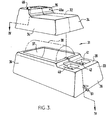
- Figure 3 shows in perspective view developing equipment 31 with the lid 32 lifted from the base 33.
- Lid 32 is a light vacuum-formed tray-like member with slightly sloping downwardly extending walls 34 and a raised housing 35 for batteries and a motor, as described more fully below.
- Base 33 is again a light vacuum formed member, of somewhat similar shape, with surrounding and downwardly extending sloping walls 36.
- a tank 37 of semi-circular cross-section for receiving a carrier member 38, shown only in dotted outline for clarity of illustration.
- the remainder of the tops is formed as a flat portion 39 with two spaced square recesses 40 and 41 for processing solutions and for inlet of temperature-control water respectively, as described below.
- a thermometer 42 shaped so as to dip into one end of the tank 37 and pass upwards and outwards along a recess in flat portion 39.
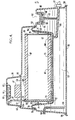
- Figure 4 shows a cross-sectional view along line IV-IV of Figure 3.
- Raised housing 35 of lid 32 has a depression 43 formed in the top, with removable cover 44 fixable thereover. This covered recess thus provides an accessible holder for batteries 45 connectable by switch 46 also operating warning light 46a. (see Figure 3).
- a motor 47 shown only diagrammatically
- base plate 48 This plate is securable around its edges by means not shown for ease of illustration in a surrounding recess 49 around the lower edge of housing 35.
- Housing base plate 48 has a slot 51 through which protrudes a drive wheel 52 of motor 47, having frictional drive surface 52a.
- lid 32 rests on the shaped surround 53 of base 33.
- Raised rim 54 ensures a light-tight seal.
- Base 33 itself has a permanent base plate 55 fitted in a water tight fashion all around in shaped recess 56. It therefore constitutes a water bath 57, with a warm water inlet at 41 (as described above but not shown in the section of Figure 4) and a simple overflow outlet at 58, remote from the inlet 41 and fed from near the base plate at 59 to ensure good mixing and hence a uniform bath temperature.
- Tank portion 37 is provided with inlet/outlet duct 60 passing through but not communicating with water bath 57 to drain tap 61.
- This duct 60 also communicates with vertical duct 62 fed from the inlet 40 via light trap construction 63 consisting essentially of a tray 64, an opaque prate 65 spaced from the base by rods 66 and almost but not quite reaching the walls of tray 64 so as to provide a tortuous liquid path and keeps out stray light.
- Carrier 38 in this embodiment is a rigid polymer cylinder with integral projecting ribs 67 resembling the free ribs 10 in Figure 1 and possessing suitable indentations 68, staggered as before to provide a notional helical path.
- End caps 69 are each provided with a simple stub axle 70 each fitting into an upwardly open slot, not shown, in rotation supports 71.
- a drive region 72 Around one end of the cylindrical carrier 38 there is provided a drive region 72 which when the lid 32 is in place frictionally engages with the surface 52a of protruding drive wheel 52 of the motor.
- Surfaces 72 and 52a in the embodiment shown are each composed of a strip of hook pile material e.g. as known under the Registered Trade Mark of VELCRO. This ensures good frictional contact and accommodates slight differences in dimension or placement of the lid 32 in relation to base 33. It also gives good transmission of motion in either direction, without vibration or back-lash, suitable for low power drives of this nature. Moreover, it is a synthetic polymer not introducing contaminant ions.
- the equipment of Figures 3 and 4 is used in essentially the same way as the equipment of Figures 1 and 2.
- the main additional operating feature is the water bath, fed by gravity through inlet 41 and imparting to the processing solution 73 the required temperature as measured by easily visible thermometer 42
Landscapes
- Physics & Mathematics (AREA)
- General Physics & Mathematics (AREA)
- Photographic Processing Devices Using Wet Methods (AREA)
Applications Claiming Priority (6)
| Application Number | Priority Date | Filing Date | Title |
|---|---|---|---|
| GB8038025 | 1980-11-27 | ||
| GB8038025 | 1980-11-27 | ||
| GB8110752A GB2096730A (en) | 1981-04-06 | 1981-04-06 | Friction gear |
| GB8110752 | 1981-04-06 | ||
| GB8130996 | 1981-10-14 | ||
| GB8130996A GB2090429A (en) | 1980-11-27 | 1981-10-14 | Developing cine film |
Publications (1)
| Publication Number | Publication Date |
|---|---|
| EP0053477A1 true EP0053477A1 (fr) | 1982-06-09 |
Family
ID=27261056
Family Applications (1)
| Application Number | Title | Priority Date | Filing Date |
|---|---|---|---|
| EP81305580A Withdrawn EP0053477A1 (fr) | 1980-11-27 | 1981-11-25 | Méthode et dispositif pour le développement de film |
Country Status (1)
| Country | Link |
|---|---|
| EP (1) | EP0053477A1 (fr) |
Citations (3)
| Publication number | Priority date | Publication date | Assignee | Title |
|---|---|---|---|---|
| FR2131769A5 (fr) * | 1971-03-31 | 1972-11-10 | Huss Heinrich | |
| DE2734688A1 (de) * | 1977-08-02 | 1979-02-15 | Otto Koehler Fa | Vorrichtung zum ausbuersten und -spuelen der beim belichten durch eine aktinische beleuchtungsquelle mit einer wellenlaenge von 300 - 500 nm nicht gehaerteten stellen von druckplatten und walzen mit einer oberflaeche (druckschicht) aus kunststoff, gummi und synthetischem kautschuk |
| US4178088A (en) * | 1978-07-03 | 1979-12-11 | Harding Herbert D | Photographic processor |
-
1981
- 1981-11-25 EP EP81305580A patent/EP0053477A1/fr not_active Withdrawn
Patent Citations (3)
| Publication number | Priority date | Publication date | Assignee | Title |
|---|---|---|---|---|
| FR2131769A5 (fr) * | 1971-03-31 | 1972-11-10 | Huss Heinrich | |
| DE2734688A1 (de) * | 1977-08-02 | 1979-02-15 | Otto Koehler Fa | Vorrichtung zum ausbuersten und -spuelen der beim belichten durch eine aktinische beleuchtungsquelle mit einer wellenlaenge von 300 - 500 nm nicht gehaerteten stellen von druckplatten und walzen mit einer oberflaeche (druckschicht) aus kunststoff, gummi und synthetischem kautschuk |
| US4178088A (en) * | 1978-07-03 | 1979-12-11 | Harding Herbert D | Photographic processor |
Similar Documents
| Publication | Publication Date | Title |
|---|---|---|
| US2947236A (en) | Process and apparatus for the photographic liquid processing of coatings on flexiblesupports | |
| US4112452A (en) | Apparatus for processing photographic film | |
| CA1089691A (fr) | Appareil de developpement photographique par rotation de disques de pellicule dans des bains revelateurs | |
| US4613223A (en) | Method of and apparatus for treating with a liquid a sheet of flexible photographic material having a photographic emulsion on one face thereof | |
| US4410257A (en) | Apparatus for developing films having a pivotable arm | |
| US4178088A (en) | Photographic processor | |
| US4188106A (en) | Apparatus and method for processing film | |
| US4439033A (en) | Drum-containing apparatus for ready processing and handling of photographic material | |
| GB2090429A (en) | Developing cine film | |
| US3677163A (en) | Method and apparatus for processing photographic film | |
| US3528760A (en) | Method and device for the treatment of paper-backed photographic sheet materials | |
| US3443503A (en) | Developing apparatus for photographic film,particularly x-ray film | |
| US3124051A (en) | buechner | |
| US3411424A (en) | Cylindrical carrier for photographic sheet materials | |
| US4508809A (en) | Process for the exposure and development of photo-graphic images and an apparatus for carrying out the process | |
| US3688678A (en) | Photographic roll film processing apparatus | |
| US4492447A (en) | Apparatus for developing photographic material | |
| US4456359A (en) | Flat photographic sheet processing cassette | |
| US4288156A (en) | Carrier for sheet of photographic paper | |
| US4540289A (en) | Automatic stirring system for film developing | |
| US4085415A (en) | Photographic processing apparatus | |
| US5687419A (en) | Method of processing photographic material and photographic processing apparatus | |
| JPH0136190Y2 (fr) | ||
| US6168322B1 (en) | Apparatus for processing exposed photosensitive elements | |
| JPH0447715Y2 (fr) |
Legal Events
| Date | Code | Title | Description |
|---|---|---|---|
| PUAI | Public reference made under article 153(3) epc to a published international application that has entered the european phase |
Free format text: ORIGINAL CODE: 0009012 |
|
| AK | Designated contracting states |
Designated state(s): AT BE CH DE FR GB IT LU NL SE |
|
| 17P | Request for examination filed |
Effective date: 19821209 |
|
| KL | Correction list |
Free format text: 83/02 RECHERCHENBERICHT |
|
| STAA | Information on the status of an ep patent application or granted ep patent |
Free format text: STATUS: THE APPLICATION IS DEEMED TO BE WITHDRAWN |
|
| 18D | Application deemed to be withdrawn |
Effective date: 19850416 |