EP0053497B1 - Système de chauffage à assistance solaire - Google Patents
Système de chauffage à assistance solaire Download PDFInfo
- Publication number
- EP0053497B1 EP0053497B1 EP81305627A EP81305627A EP0053497B1 EP 0053497 B1 EP0053497 B1 EP 0053497B1 EP 81305627 A EP81305627 A EP 81305627A EP 81305627 A EP81305627 A EP 81305627A EP 0053497 B1 EP0053497 B1 EP 0053497B1
- Authority
- EP
- European Patent Office
- Prior art keywords
- heat
- adsorber
- evaporator
- condenser
- adsorbate
- Prior art date
- Legal status (The legal status is an assumption and is not a legal conclusion. Google has not performed a legal analysis and makes no representation as to the accuracy of the status listed.)
- Expired
Links
Images
Classifications
-
- F—MECHANICAL ENGINEERING; LIGHTING; HEATING; WEAPONS; BLASTING
- F25—REFRIGERATION OR COOLING; COMBINED HEATING AND REFRIGERATION SYSTEMS; HEAT PUMP SYSTEMS; MANUFACTURE OR STORAGE OF ICE; LIQUEFACTION SOLIDIFICATION OF GASES
- F25B—REFRIGERATION MACHINES, PLANTS OR SYSTEMS; COMBINED HEATING AND REFRIGERATION SYSTEMS; HEAT PUMP SYSTEMS
- F25B17/00—Sorption machines, plants or systems, operating intermittently, e.g. absorption or adsorption type
- F25B17/08—Sorption machines, plants or systems, operating intermittently, e.g. absorption or adsorption type the absorbent or adsorbent being a solid, e.g. salt
-
- F—MECHANICAL ENGINEERING; LIGHTING; HEATING; WEAPONS; BLASTING
- F24—HEATING; RANGES; VENTILATING
- F24D—DOMESTIC- OR SPACE-HEATING SYSTEMS, e.g. CENTRAL HEATING SYSTEMS; DOMESTIC HOT-WATER SUPPLY SYSTEMS; ELEMENTS OR COMPONENTS THEREFOR
- F24D11/00—Central heating systems using heat accumulated in storage masses
- F24D11/02—Central heating systems using heat accumulated in storage masses using heat pumps
- F24D11/0214—Central heating systems using heat accumulated in storage masses using heat pumps water heating system
- F24D11/0221—Central heating systems using heat accumulated in storage masses using heat pumps water heating system combined with solar energy
-
- Y—GENERAL TAGGING OF NEW TECHNOLOGICAL DEVELOPMENTS; GENERAL TAGGING OF CROSS-SECTIONAL TECHNOLOGIES SPANNING OVER SEVERAL SECTIONS OF THE IPC; TECHNICAL SUBJECTS COVERED BY FORMER USPC CROSS-REFERENCE ART COLLECTIONS [XRACs] AND DIGESTS
- Y02—TECHNOLOGIES OR APPLICATIONS FOR MITIGATION OR ADAPTATION AGAINST CLIMATE CHANGE
- Y02A—TECHNOLOGIES FOR ADAPTATION TO CLIMATE CHANGE
- Y02A30/00—Adapting or protecting infrastructure or their operation
- Y02A30/27—Relating to heating, ventilation or air conditioning [HVAC] technologies
-
- Y—GENERAL TAGGING OF NEW TECHNOLOGICAL DEVELOPMENTS; GENERAL TAGGING OF CROSS-SECTIONAL TECHNOLOGIES SPANNING OVER SEVERAL SECTIONS OF THE IPC; TECHNICAL SUBJECTS COVERED BY FORMER USPC CROSS-REFERENCE ART COLLECTIONS [XRACs] AND DIGESTS
- Y02—TECHNOLOGIES OR APPLICATIONS FOR MITIGATION OR ADAPTATION AGAINST CLIMATE CHANGE
- Y02B—CLIMATE CHANGE MITIGATION TECHNOLOGIES RELATED TO BUILDINGS, e.g. HOUSING, HOUSE APPLIANCES OR RELATED END-USER APPLICATIONS
- Y02B10/00—Integration of renewable energy sources in buildings
- Y02B10/20—Solar thermal
-
- Y—GENERAL TAGGING OF NEW TECHNOLOGICAL DEVELOPMENTS; GENERAL TAGGING OF CROSS-SECTIONAL TECHNOLOGIES SPANNING OVER SEVERAL SECTIONS OF THE IPC; TECHNICAL SUBJECTS COVERED BY FORMER USPC CROSS-REFERENCE ART COLLECTIONS [XRACs] AND DIGESTS
- Y02—TECHNOLOGIES OR APPLICATIONS FOR MITIGATION OR ADAPTATION AGAINST CLIMATE CHANGE
- Y02B—CLIMATE CHANGE MITIGATION TECHNOLOGIES RELATED TO BUILDINGS, e.g. HOUSING, HOUSE APPLIANCES OR RELATED END-USER APPLICATIONS
- Y02B10/00—Integration of renewable energy sources in buildings
- Y02B10/70—Hybrid systems, e.g. uninterruptible or back-up power supplies integrating renewable energies
-
- Y—GENERAL TAGGING OF NEW TECHNOLOGICAL DEVELOPMENTS; GENERAL TAGGING OF CROSS-SECTIONAL TECHNOLOGIES SPANNING OVER SEVERAL SECTIONS OF THE IPC; TECHNICAL SUBJECTS COVERED BY FORMER USPC CROSS-REFERENCE ART COLLECTIONS [XRACs] AND DIGESTS
- Y02—TECHNOLOGIES OR APPLICATIONS FOR MITIGATION OR ADAPTATION AGAINST CLIMATE CHANGE
- Y02B—CLIMATE CHANGE MITIGATION TECHNOLOGIES RELATED TO BUILDINGS, e.g. HOUSING, HOUSE APPLIANCES OR RELATED END-USER APPLICATIONS
- Y02B30/00—Energy efficient heating, ventilation or air conditioning [HVAC]
Definitions
- This invention relates to a heating system assisted by solar energy.
- German Specification 2801895 discloses an adsorption heat pump comprising a source of low temperature heat, means for delivering heat from said source to an evaporator, means for delivering vaporised adsorbate from the evaporator to an adsorber housing adsorbent, means for heating adsorbent and adsorbed adsorbate housed in the adsorber, means for delivering vaporised adsorbate from the adsorber to a condenser, means for delivering condensed adsorbate from the condenser to the evaporator and means for obtaining heat from the condenser and delivering it to the load.
- This specification does not suggest the use of solar energy, let alone as a source of low temperature heat or of the continuous circulation of a carrier gas in the adsorption heat pump system.
- U.S. Patent 1992745 discloses a refrigerating apparatus involving sorption and adsorption.
- An inert gas, hydrogen is used to create a diffusion barrier adjacent to the refrigerant vapour and the apparatus operates on a tidal flow system.
- an inert gas as a carrier gas, the purpose of which is to increase the rate of adsorption, desorption, condensation and evaporation.
- a heating system comprises a solar radiation collector capable of supplying heat to a heat of fusion heat store, means for delivering heat from the heat store to an evaporator, means for delivering vaporised adsorbate from the evaporator to an adsorber housing adsorbent, means for heating adsorbent and adsorbed adsorbate housed in the adsorber, means for delivering vaporised adsorbate from the adsorber to a condenser, means for delivering condensed adsorbate from the condenser to the evaporator and means for obtaining heat from the adsorber and from the condenser and delivering it to the load.
- the solar radiation collector can take various forms and may for example comprise a simple unglazed black receiver in the form of a conduit through which a liquid, e.g. antifreeze (ethylene glycol) solution or salt solution, e.g. calcium chloride, is circulated.
- a liquid e.g. antifreeze (ethylene glycol) solution or salt solution, e.g. calcium chloride.
- the temperature of the liquid extracting heat from the solar radiation collector will be fairly low, e.g. from 5° to 15°C.
- This heat has to be stored in a heat of fusion heat store and the most convenient method is by the use of encapsulated low melting point materials contained in a tank through which the liquid, e.g. antifreeze solution circulates.
- the heat of fusion heat store comprises a container in which there are one or more liquid-tight heat conducting receptacles, for example plastic or elastomeric bags, each of which houses a substance with a relatively high latent heat of fusion i.e. above 120 kJ/kg.
- receptacles are preferably made of flexible material to cope with expansion and contraction of the substance housed therein.
- Suitable substances include benzene (freezing point 5.5°C, latent heat of fusion 126 kJ/kg), formic acid (freezing point 8.4°C, latent heat of fusion 247 kJ/kg), acrylic acid (freezing point 13°C, latent heat of fusion 155 kJ/kg), para- xylene (freezing point 16°C, latent heat of fusion 164 kJ/kg), and glycerol (freezing point 18°C, latent heat of fusion 199 kJ/kg).
- an evaporator for the adsorbate Communicating with the heat store e.g. through a conduit is an evaporator for the adsorbate.
- This is a container provided with a heat exchanger from which heat from the heat store is delivered to the adsorbate housed in the evaporator.
- there are means for extending the surface of the liquid in the evaporator e.g. a large area fabric wick or a pump for pumping the liquid through a spray into the evaporator.
- an adsorber Communicating with the evaporator e.g. by a valved conduit, is an adsorber which houses adsorbent.
- this means for supplying heat shall be by heat exchange from the hot heat transfer fluid in the pipes from a domestic boiler. These pipes should have a coiled section passing through the adsorber, surrounding which is adsorbent and adsorbate. Heat is usually supplied to the adsorbate and adsorbent at about 150°C.
- the adsorber should be able to be recharged at very low vapour pressures and consequently the preferred adsorbent/adsorbate system is 5A-zeolite molecular sieve/water, more preferably Y-zeolite molecular sieve/water.
- the preferred adsorbent/adsorbate system is 5A-zeolite molecular sieve/water, more preferably Y-zeolite molecular sieve/water.
- This will usually be a conduit having a valve, and this valve will preferably be a non-return valve, so that condensed adsorbate cannot pass back into the adsorber.
- This conduit is usually connected to the top of the condenser. In this condenser the adsorbate vapour is condensed and if the adsorbate is water it usually delivers latent heat at a temperature of about 60°C.
- means for obtaining heat from the condenser This is preferably by heat exchange, for example a pipework with a coiled section located in the condenser in which water circulates, the pipework communicating with the load.
- This pipework preferably connects with the means for obtaining heat from the adsorber, there being a valve to control whether heat is obtained from the adsorber or whether it is obtained from the condenser.
- the means for communicating the evaporator with the adsorber be in heat exchange relationship with the means for communicating the condenser with the evaporator.
- the rate of adsorption can be increased by the use of the carrier gas, for example an inert gas such as nitrogen or even air.
- the carrier gas for example an inert gas such as nitrogen or even air.
- One or more conduits and a gas circulating blower are the convenient form of means for circulating carrier gas and the conduit connecting the top of the adsorber with the condenser should have a non-return valve therein preventing passage of adsorbate vapour from the condenser to the adsorber.
- the liquid circulating in the boiler and connecting pipework which supplies heat to the adsorber has a boiling point preferably above 150°C and therefore has the advantage that heat can be supplied at higher temperatures than 100°C without the necessity of subjecting the circulating liquid to high pressures.
- heat transfer fluids may be used for this purpose, for example heat transfer oils, or inorganic substances such as Si Z CI s which boils at 139°C. If Si Z Cl 6 is used then it may be under slight pressure to raise the boiling point to 150°C. Also one could use mineral oilbased fluids capable of operating at temperatures up to 315°C without pressurisation, e.g. fluids used by Wanson Co. Ltd., Boreham Wood, Herts in their thermopsc thermal fluid heaters.
- the system operates as follows.
- the solar radiation collector supplies heat to the latent heat of fusion heat store housing the substance of relatively high heat of fusion surrounded by a liquid such as antifreeze solution.
- Adsorbate is vaporised in the evaporator by circulated liquid, e.g. antifreeze and passes with the carrier gas (preferably in heat exchange relationship with fluid from the condenser) to the adsorber where it is adsorbed giving up heat of adsorption.
- Adsorbent is stripped from the adsorber by the means for heating adsorbent and adsorbate e.g. domestic boiler, and vaporised adsorbate is transferred with carrier gas to the condenser where it condenses giving up latent heat of condensation.
- Condensed adsorbate is returned to the evaporator whence it delivers sensible heat to the liquid, e.g. antifreeze solution, and hence to the heat store.
- latent heat is obtained from the condensation of adsorbate in the condenser.
- the solar radiation collector supplying heat to the heat store during daylight hours causing heat to be stored in the molten substance.
- latent heat of fusion is evolved supplying heat to the circulating liquid, e.g. antifreeze solution, and causing adsorbate vapour to be driven off to the adsorber from the adsorbate housed in the evaporator.
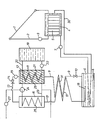
- An array of solar panels diagrammatically indicated at 1 supplies heat to antifreeze solution at a maximum temperature of 18°C.
- the antifreeze solution is circulated by pump 3 through a pipework 2 to a heat store 4.
- This heat store 4 contains several elastomeric bags 5, each containing benzene. These bags 5 are surrounded by antifreeze solution.
- Heat can be transferred from the heat store 4 to an evaporator 6 through a conduit 30 having a circulation pump 7 and connected to heat exchanger 8.
- the top of the evaporator 6 is connected by conduit 9 having valve 10 to the bottom of-an adsorber 11. Part of conduit 9 forms one of the coils of heat exchanger 31.
- the adsorber 11 houses adsorbent 12 which is Y-zeolite molecular sieve.
- conduit 13 Connected to the top of the adsorber 11 is a conduit 13 having a non-return valve 14 and a blower 15. This conduit 13 is connected to the top of a condenser 16. There is a conduit 17 (part of which forms one of the coils of heat exchanger 31) which connects the bottom of the condenser 16 with a sparger 18 which is immersed in adsorbate at the top of the evaporator 6.
- Heat transfer fluid from a domestic boiler 19 circulates in the pipework 20 having heat exchange coil 21 in the adsorber 11.
- This pipework 20 has a circulation pump 22.
- Pipework 23 connects two- way valve 24, heat exchangers 25 and 26 in the condenser 16 and adsorber 11 and through this pipework 23 water circulates by means of pump 27 and leads to the load.
- the adsorber 11 When the boiler 19 is operating, the adsorber 11 is stripped of water vapour (adsorbate) which is condensed in the condenser 16 and delivers its latent heat to the water circulating by pump 27 in coil 25 and piping 23 at about 60°C. From the condenser 16 the water passes through conduit 17 and heat exchanger 31 where it delivers heat, to the evaporator 6 where it delivers some more sensible heat and its temperature drops to the working temperature 5-15°C, of the heat store 4.
- water vapour adsorbate
- the carrier gas used is air and when heat is being delivered to the load either by stripping water vapour from the adsorber 11 or by adsorbing water vapour in the adsorber 11 valve 10 should be open and blower 15 operated. The air will be carried with water vapour from the top of the adsorber 11 to the condenser, through the sparger 18 and back to the adsorber 11. When heat is not being delivered valve 10 should be closed and blower 15 shut off.
Landscapes
- Engineering & Computer Science (AREA)
- Physics & Mathematics (AREA)
- Mechanical Engineering (AREA)
- Thermal Sciences (AREA)
- General Engineering & Computer Science (AREA)
- Life Sciences & Earth Sciences (AREA)
- Sustainable Development (AREA)
- Sustainable Energy (AREA)
- Chemical & Material Sciences (AREA)
- Combustion & Propulsion (AREA)
- Sorption Type Refrigeration Machines (AREA)
Claims (8)
Applications Claiming Priority (2)
| Application Number | Priority Date | Filing Date | Title |
|---|---|---|---|
| GB8038283 | 1980-11-28 | ||
| GB8038283A GB2088546B (en) | 1980-11-28 | 1980-11-28 | Solar assisted heating system |
Publications (2)
| Publication Number | Publication Date |
|---|---|
| EP0053497A1 EP0053497A1 (fr) | 1982-06-09 |
| EP0053497B1 true EP0053497B1 (fr) | 1985-05-08 |
Family
ID=10517639
Family Applications (1)
| Application Number | Title | Priority Date | Filing Date |
|---|---|---|---|
| EP81305627A Expired EP0053497B1 (fr) | 1980-11-28 | 1981-11-27 | Système de chauffage à assistance solaire |
Country Status (3)
| Country | Link |
|---|---|
| EP (1) | EP0053497B1 (fr) |
| DE (1) | DE3170432D1 (fr) |
| GB (1) | GB2088546B (fr) |
Families Citing this family (5)
| Publication number | Priority date | Publication date | Assignee | Title |
|---|---|---|---|---|
| GB2130713B (en) * | 1982-11-23 | 1986-08-20 | Exxon Research Engineering Co | Staged heat pumps |
| FR2540608B1 (fr) * | 1983-02-07 | 1988-05-06 | Tipic | Installation de climatisation d'une construction |
| DE3610332A1 (de) * | 1985-03-30 | 1986-10-09 | Kabushiki Kaisha Toshiba, Kawasaki, Kanagawa | Regenerativheizgeraet |
| GB9013225D0 (en) * | 1990-06-13 | 1990-08-01 | Solmate Inc | Integrated heating,cooling and ventilation system |
| FR2693542B1 (fr) * | 1992-07-10 | 1994-09-09 | Bernier Jacques | Réacteur de machine frigorifique chimique ou à adsorption solide/gaz. |
Citations (1)
| Publication number | Priority date | Publication date | Assignee | Title |
|---|---|---|---|---|
| US1992745A (en) * | 1931-02-09 | 1935-02-26 | Elfving Thore Martin | Absorption refrigerating apparatus |
Family Cites Families (6)
| Publication number | Priority date | Publication date | Assignee | Title |
|---|---|---|---|---|
| US4124018A (en) * | 1976-10-14 | 1978-11-07 | Barry-Wehmiller Company | Solar heat collecting, storing and utilizing apparatus |
| GB1572737A (en) * | 1977-01-17 | 1980-08-06 | Exxon France | Heat pump |
| DE2744468C3 (de) * | 1977-10-03 | 1980-08-21 | Philips Patentverwaltung Gmbh, 2000 Hamburg | Vorrichtung zum Messen und gegebenenfalls Regeln des Ladungsgrades von Latentwärmespeichern |
| DE2758773C2 (de) * | 1977-12-29 | 1981-12-17 | Ask August Schneider Gmbh & Co Kg, 8650 Kulmbach | Bivalente Heizanlage |
| DE2854055A1 (de) * | 1978-12-14 | 1980-07-03 | Linde Ag | Verfahren zum erhitzen eines waermetraegers mit einer absorptionswaermepumpe |
| DE2913066A1 (de) * | 1979-03-23 | 1980-10-02 | Brocks | Absorptions-waermepumpenanlage |
-
1980
- 1980-11-28 GB GB8038283A patent/GB2088546B/en not_active Expired
-
1981
- 1981-11-27 EP EP81305627A patent/EP0053497B1/fr not_active Expired
- 1981-11-27 DE DE8181305627T patent/DE3170432D1/de not_active Expired
Patent Citations (1)
| Publication number | Priority date | Publication date | Assignee | Title |
|---|---|---|---|---|
| US1992745A (en) * | 1931-02-09 | 1935-02-26 | Elfving Thore Martin | Absorption refrigerating apparatus |
Also Published As
| Publication number | Publication date |
|---|---|
| GB2088546B (en) | 1984-10-10 |
| EP0053497A1 (fr) | 1982-06-09 |
| DE3170432D1 (en) | 1985-06-13 |
| GB2088546A (en) | 1982-06-09 |
Similar Documents
| Publication | Publication Date | Title |
|---|---|---|
| US4007776A (en) | Heating and cooling system utilizing solar energy | |
| US8196422B2 (en) | Atmospheric water collection device | |
| CA1146431A (fr) | Chasse thermique pour la circulation de fluides caloporteurs | |
| US4184477A (en) | Solar heating and storage | |
| EP0649985B1 (fr) | Générateur d'énergie thermique | |
| US4787444A (en) | Heating and cooling system | |
| US4708849A (en) | Process for energy storage and recovery | |
| US4220138A (en) | Refrigerant charged solar heating structure and system | |
| US4466478A (en) | Method and apparatus in storing heat | |
| JPH09512332A (ja) | 吸収式冷却装置及び方法 | |
| US4624242A (en) | Solar heat transfer and storage system | |
| AU2961984A (en) | A solar energy powered system for the production of cold | |
| DK154734B (da) | Apparat til udfoerelse af en fremgangsmaade til energisparende udvinding af nyttevarme fra omgivelserne eller fra spildvarme | |
| EP0053497B1 (fr) | Système de chauffage à assistance solaire | |
| US4037579A (en) | Energy storage-boiler tank using salt fusion and heat piping | |
| US4421100A (en) | Thermosyphon heat pipe hot water appliance | |
| GB2088548A (en) | Thermal storage heating system | |
| FR2437579A1 (fr) | Systeme automatique de mise hors gel pour installations de chauffage a circulation d'eau | |
| US4524759A (en) | Process for the reversible transfer of thermal energy and heat transfer system useful therein | |
| US3986955A (en) | Effluent waste treatment process and apparatus | |
| RU194308U1 (ru) | Теплообменник для получения энергии фазового перехода вода-лед | |
| JP2004316958A (ja) | 熱エネルギー供給方法 | |
| GB2081875A (en) | Heat storage system | |
| US3653429A (en) | Water heating system | |
| EP0053496B1 (fr) | Appareil de stockage de chaleur à basse température |
Legal Events
| Date | Code | Title | Description |
|---|---|---|---|
| PUAI | Public reference made under article 153(3) epc to a published international application that has entered the european phase |
Free format text: ORIGINAL CODE: 0009012 |
|
| AK | Designated contracting states |
Designated state(s): DE FR GB IT SE |
|
| 17P | Request for examination filed |
Effective date: 19820825 |
|
| ITF | It: translation for a ep patent filed | ||
| GRAA | (expected) grant |
Free format text: ORIGINAL CODE: 0009210 |
|
| AK | Designated contracting states |
Designated state(s): DE FR GB IT SE |
|
| REF | Corresponds to: |
Ref document number: 3170432 Country of ref document: DE Date of ref document: 19850613 |
|
| ET | Fr: translation filed | ||
| PLBE | No opposition filed within time limit |
Free format text: ORIGINAL CODE: 0009261 |
|
| STAA | Information on the status of an ep patent application or granted ep patent |
Free format text: STATUS: NO OPPOSITION FILED WITHIN TIME LIMIT |
|
| 26N | No opposition filed | ||
| PG25 | Lapsed in a contracting state [announced via postgrant information from national office to epo] |
Ref country code: GB Effective date: 19891127 |
|
| PG25 | Lapsed in a contracting state [announced via postgrant information from national office to epo] |
Ref country code: SE Effective date: 19891128 |
|
| GBPC | Gb: european patent ceased through non-payment of renewal fee | ||
| PG25 | Lapsed in a contracting state [announced via postgrant information from national office to epo] |
Ref country code: FR Effective date: 19900731 |
|
| PG25 | Lapsed in a contracting state [announced via postgrant information from national office to epo] |
Ref country code: DE Effective date: 19900801 |
|
| REG | Reference to a national code |
Ref country code: FR Ref legal event code: ST |
|
| EUG | Se: european patent has lapsed |
Ref document number: 81305627.2 Effective date: 19900705 |