EP0053769A1 - Feldkonzentrator zum elektrischen Widerstandsschweissen von Röhren - Google Patents
Feldkonzentrator zum elektrischen Widerstandsschweissen von Röhren Download PDFInfo
- Publication number
- EP0053769A1 EP0053769A1 EP19810109972 EP81109972A EP0053769A1 EP 0053769 A1 EP0053769 A1 EP 0053769A1 EP 19810109972 EP19810109972 EP 19810109972 EP 81109972 A EP81109972 A EP 81109972A EP 0053769 A1 EP0053769 A1 EP 0053769A1
- Authority
- EP
- European Patent Office
- Prior art keywords
- impeder
- laminated
- core
- electric resistance
- metals
- Prior art date
- Legal status (The legal status is an assumption and is not a legal conclusion. Google has not performed a legal analysis and makes no representation as to the accuracy of the status listed.)
- Granted
Links
Images


Classifications
-
- B—PERFORMING OPERATIONS; TRANSPORTING
- B23—MACHINE TOOLS; METAL-WORKING NOT OTHERWISE PROVIDED FOR
- B23K—SOLDERING OR UNSOLDERING; WELDING; CLADDING OR PLATING BY SOLDERING OR WELDING; CUTTING BY APPLYING HEAT LOCALLY, e.g. FLAME CUTTING; WORKING BY LASER BEAM
- B23K13/00—Welding by high-frequency current heating
- B23K13/01—Welding by high-frequency current heating by induction heating
- B23K13/02—Seam welding
Definitions
- This invention relates to an impeder for an electric resistance tube welding process .for welding by heating opposite edge portions of a strip-skelp continuously formed into a tubular shape or a spirally tubular shape.
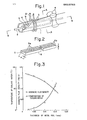
- a skelp 1 formed into a tubular shape (hereinafter, is referred to as tubular skelp) is heated at the opposite edge portions by the action of eddy current induced in the tubular skelp 1 by passing a high frequency electric current through a coil 2 and is welded under pressure by means of squeeze rolls 4.
- An impeder used for improving welding energy efficiency by concentrating the eddy current upon the opposite edge portions is composed of an impeder casing 5 made of an insulating material and a core 6 made of a ferromagnetic material, a mandrel pipe 7 is connected to said impeder casing 5, and the core 6 is continuously cooled by cooling water supplied from said mandrel pipe 7.
- the purpose of using an impeder is to improve a welding energy efficiency of an electric resistance tube welding process, the performance of the impeder is determined by the characteristics of a core, and the core must be of high magnetic permeability and high saturation flux density. That is, for improving the welding energy efficiency in an electric resistance tube welding process, it is necessary to pass a larger amount of magnetic flux through the core of the impeder.
- the amount of magnetic flux density (w) passing through a core is the product of a magnetic flux density (B) and the transverse cross-sectional area (A) of the core, that is, the amount of the magnetic flux is shown by following equation (1)
- the transverse cross-sectional area of the core or the laminated metal means the area of the cross section in the direction perpendicular to the longitudinal direction of the impeder.
- a ferrite core which consists of a magnetic oxide prepared by sintering a powdered oxide has been used.
- the magnetic flux density (B) of the ferrite core is liable to saturate since the welding electric current is a large high frequency electric current and, in particular, if the diameter of the welding tube is small, the transverse cross-sectional area (A) of the ferrite core becomes small and hence the magnetic flux density of the ferrite core approaches saturation by a smaller welding electric current.
- the passing magnetic flux density ( 0 ) approaches saturation and the welding energy efficiency reduces.
- core materials have been improved by ferrite core makers for increasing the saturation flux density (B s ') of ferrite core and the property of B s I of about 0.5 tesla has been obtained but such an improvement is not yet satisfactorily.
- core materials having the saturation flux density higher than that of the ferrite core there are such metallic magnetic materials as silicon steel, low carbon steel, Permalloy (trade name), amorphous metals, etc., and in the case of a commercial frequency (50-60 Hz), a metallic magnetic material rolled to a thickness of 0.3-0.35 mm.and heat- treated has been used as an iron core for transformers, etc.
- the welding electric current used in the process is a large electric current of high frequency of 10-500 KHz
- the impeder is exposed under a high magnetic flux density of the high frequency and thus a large eddy current generates in the core to increase the temperature thereof.
- the generated eddy current is in proportion to the square of the magnetic flux density and the square of the frequency, and hence the heat value of the core in an electric resistance tube welding process is very large as compared to the use at a commercial frequency. Therefore, in the case of a metallic magnetic material generating a large amount of heat by eddy current, it is impossible to keep the temperature of the core of the impeder below the Curie point in a cooling step by passing cooling water, which can be usually industrially performed.
- the core loses the ferromagnetism and cannot be used as the core of an impeder. This is the reason that a ferrite core generating a small amount of heat by eddy current in a high frequency region is used in an electric resistance tube welding process.
- the object of this invention is to provide an impeder for electric resistance tube welding having good welding energy efficiency in electric resistance tube welding process and an excellent durability using laminated metals composed of very thin foils of metallic magnetic material such as silicon steel, low carbon steel, Permalloy, amorphous metal, etc., as a core of the impeder.
- an impeder for electric resistance tube welding comprising plural laminated metals composed of very thin foils of metallic magnetic materials such as silicon steel, low carbon steel, Permalloy, amorphous metal, etc., as the core of the impeder.
- Fig. 2 shows an embodiment of a laminated metal 8 composed of very thin foils of a metallic magnetic material which are used as the core of the impeder of this invention.
- the laminated metal 8 is composed of very thin foils 8a (hereinafter, are referred to as metal foils) of a metallic magnetic material having a higher saturation magnetic flux density than that of a ferrite core, such as silicon steel, etc., which are adhered each other with an insulating electrically insulating and adhering the metal foils.
- the resistance between the layers or metal foils of the laminated metal 8 be higher than about 1 kQ.
- the thickness (t) of the metal foil 8a be thin and the width (w) thereof be narrow.
- the resistance between the layers of the laminated metal 8 be large and the thickness (h) of the laminated metal 8 be thin in a range of reducing the workability.
- the laminated metal 8 be coated with varnish, etc.
- Fig. 3 shows an example of the investigations.
- F ig. 3 is a graph showing the relation between the thickness of the metal foil and the cooling temperature and the reaction of the thickness of the metal foil and the magnetic flux when the frequency is 100 KHz and the amount of cooling water is 18 liters/min. in this invention.
- the thickness (t) of the metal foils 8a With regard to the thickness (t) of the metal foils 8a, if the thickness (t) of the metal foils 8a is increased, the amount of the magnetic flux passing through the laminated metal 8 decreases and the heat value of the laminated metal 8 increases exponentially.
- the magnetic flux density is about 2.7 times the saturation flux density of a conventional ferrite core and the generation of heat in the laminated metal 8 is of an extent that the laminated metal can be sufficiently used as an impeder in an industrially applicable cooling method using water as a coolant.
- the laminated metals 48 With regard to the disposition of the laminated metals in an impeder casing, as shown in Fig. 4, it is preferred to dispose the laminated metals 48 in such a manner that the surfaces of each laminated metal are brought into contact with cooling water as well as possible, that is, cooling water passes through the space between the inside surface of an impeder casing 45 and each laminated metal 48 as well as the spaces between the laminated metals 48.
- the numeral 41 stands for a tubular skelp, 43 opposite edge portions, and 49 an opening.
- the magnetic flux amount (0) passing through an impeder becomes larger as the transverse cross-sectional area (A) of a core is larger. Therefore, under a strong magnetic field, it is advantageous for welding energy efficiency to dispose a larger number of laminated metals in the impeder casing but if the laminated metals are in contact with each other, it sometimes happens that the cooling efficiency is reduced.
- plural apparent laminated metals 58' further constitute one apparent laminated metal.
- the transverse cross-sectional area (S) of the apparent laminated metal 68' is the area of the section of the laminated metal in the direction perpendicular to the longitudinal direction of the impeder casing.
- the transverse cross-sectional area (A") of a metal core necessary for improving the welding energy efficiency using the core (hereinafter, are referred to as "metal core") of this invention, which is the assembly of the laminated metals, over the welding energy efficiency in conventional processes may satisfy the condition shown by equation (2); wherein A' is the transverse cross-sectional area of a ferrite core,
- the laminated metals may be disposed in a manner of sufficiently performing cooling and in a number satisfying the condition of equation (2)-, and even when there is not particular restriction about the disposition of the laminated metals, that is, they may be randomly disposed, the welding energy efficiency is improved.
- the transverse cross-sectional area of the impeder casing is usually small and hence although it is necessary to dispose many laminated metals in the impeder casing in the range of not reducing the cooling efficiency, the number of the laminated metals disposed in the casing is frequently reduced if the laminated metals are randomly disposed. Also, it sometimes happens that rolling of a tubular skelp or twisting of an impeder occurs in an electric resistance welding tube and in such a case the welding energy efficiency changes as the case may be. In particular, if the transverse cross-sectional area of the laminated metal is large, the foregoing tendency takes place.
- laminated metals 78 are so disposed in an impeder casing 75 that the laminated metals 78 are arranged in concentric circles with regard to the impeder casing 75 as shown in Fig. 7 as the transverse cross-sectional.arrangement.
- the laminated metals are disposed in the impeder casing 75 in such a manner that both edge corners of the surface of each laminated metal 78 facing the center of the impeder casing 75 are in contact with the edge corners of the surfaces of other adjacent laminated metals to form apparent concentric cylinders formed by the laminated metals 78.
- the number of the concentric cylinders formed by the laminated metals 78 in the impeder casing 75 shown in Fig. 7 is three but the number may be one or there is no restriction about the number of the apparent concentric .cylinders.
- a is about 0.2-1 mm
- the numeral 85 stands for an impeder casing.
- the cooling efficiency is good and the life of the core is prolonged in the case of disposing the laminated metals 98 constituting concentric cylinders separately from each other as shown in Fig. 9. In this case, it is unnecessary to form a gap between the laminated metals 98 disposed under the opening 99 of the tubular skelp 91.
- Fig. 10 shows a longitudinal sectional view of the impeder of this invention shown in Fig. 1 taken on the line B-B thereof.
- the laminated metals 108 are connected or fixed to supports 10 composed of a non-metallic insulator such as an epoxy resin at the opposite or up stream end 108b of the laminated metals 108 and further the support 10 is fixed to the impeder casing 5 by means of a pin 11.
- the support 10 is fixed to the laminated metals 108 with an insulating adhesive such as an epoxy resin and the support 10 can be utilized as a frame in the case of constituting the apparent concentric cylinders by the use of the laminated metals 108.
- the pin 11 may be made of a metal if the up stream end 108b of the laminated metals 108 is sufficiently separated from the pin 11.
- the laminated metals 108 are constituted in a body without joints in the lengthwise direction of the impeder casing 5 but the laminated metals 108 may be constituted by connecting plural laminated metal units in the lengthwise direction of the impeder casing 5.
- the metal foils constituting the laminated metals are radially distributed from the center of the impeder casing and hence even when rolling of a tubular skelp or twisting of an impeder occurs in the tube welding process, a stably high welding energy efficiency is always obtained.
- the magnetic flux formed by the high frequency electric current passing through the work coil can pass through the laminated metals 88 disposed at the inner portion in the impeder casing without being magnetically shielded by the laminated metals 88 disposed at the outer portion in the impeder casing.
- the hydraulic pressure of cooling water supplied from a mandrel pipe into the electric resistance welding tube does not act as a compressive force to the laminated metal 108. Therefore, the deformation and stripping of the laminated metal 108 can be prevented, thereby the life of the core of the impeder is greatly improved.
- the intensity of magnetic field differs in the direction of the longitudinal axis of the tube. That is, since the intensity of the magnetic field under the work coil is strongest, it sometimes happens that the insulating adhesive of the laminated metal located under the work coil is deteriorated and extraordinarily heated.
- the impeder core is constituted by connecting the laminated metal units in the lengthwise direction of the impeder casing according to an embodiment of this invention, the deteriorated laminated metal unit only may be replaced with a new laminated metal unit and hence the invention is economical.
- the transverse cross-sectional shape of the laminated metal is not limited to the shape illustrated in Fig. 2 but it may be an arc shape or a parallelo- gramic shape as shown by numeral 118 in Fig. 11 and in such cases, the thickness (h), width (w), and the transverse cross-sectional area (S) of the laminated metals are same as those discussed with regard to the embodiment shown in Fig. 2. Also, in the embodiments illustrated in Fig. 7, Fig. 8, and Fig.
- the laminated metals are uniformly disposed on a concentric circle or concentric circles but if a sufficient transverse cross-sectional area of the laminated metals is obtained for the magnetic field formed by a work coil, the laminated metals 128 may be disposed on a part of the concentric circle or circles in an impeder casing 125"as shown in Fig. 12.
- the numeral 121 in the figure stands for a tubular.skelp.
- the laminated metals may be disposed as shown in Fig. 13 and Fig. 14, wherein numerals 131 and 141 stand for a tubular skelp, 135 and 145 an impeder casing, and 138 and 148 laminated metals.
- the welding energy coefficients in the case of using the impeder of this invention and the case of using the conventional impeder in the tube welding process may be compared by the required electric power (the product of the plate voltage and the plate current of the oscillator).
Landscapes
- Engineering & Computer Science (AREA)
- Mechanical Engineering (AREA)
- General Induction Heating (AREA)
Applications Claiming Priority (4)
| Application Number | Priority Date | Filing Date | Title |
|---|---|---|---|
| JP167712/80 | 1980-11-28 | ||
| JP16771280A JPS5790894A (en) | 1980-11-28 | 1980-11-28 | Impeder for high frequency electric sewing tube |
| JP74249/81 | 1981-05-19 | ||
| JP56074249A JPS5952028B2 (ja) | 1981-05-19 | 1981-05-19 | 電縫管製造用インピ−ダ |
Publications (2)
| Publication Number | Publication Date |
|---|---|
| EP0053769A1 true EP0053769A1 (de) | 1982-06-16 |
| EP0053769B1 EP0053769B1 (de) | 1984-11-14 |
Family
ID=26415368
Family Applications (1)
| Application Number | Title | Priority Date | Filing Date |
|---|---|---|---|
| EP19810109972 Expired EP0053769B1 (de) | 1980-11-28 | 1981-11-27 | Feldkonzentrator zum elektrischen Widerstandsschweissen von Röhren |
Country Status (3)
| Country | Link |
|---|---|
| EP (1) | EP0053769B1 (de) |
| CA (1) | CA1174294A (de) |
| DE (1) | DE3167229D1 (de) |
Cited By (1)
| Publication number | Priority date | Publication date | Assignee | Title |
|---|---|---|---|---|
| EP1413383A4 (de) * | 2001-08-02 | 2006-03-29 | Jfe Steel Corp | Impeder zur herstellung von geschweissten rohren |
Citations (5)
| Publication number | Priority date | Publication date | Assignee | Title |
|---|---|---|---|---|
| US1948154A (en) * | 1930-11-11 | 1934-02-20 | Youngstown Sheet And Tube Co | Apparatus for welding |
| DE595038C (de) * | 1931-03-24 | 1934-03-27 | Siemens Schuckertwerke Akt Ges | Elektrische Induktionsheizeinrichtung fuer Rohrschweissmaschinen mit einer die Erregerwicklung ueberdeckenden Hilfswicklung |
| US2059300A (en) * | 1932-09-09 | 1936-11-03 | Youngstown Sheet And Tube Co | Apparatus for the formation of articles by welding |
| DE1157725B (de) * | 1962-07-24 | 1963-11-21 | Aeg | Verfahren und Vorrichtung zum Laengsnahtschweissen von Rohren im fortschreitenden Verfahren unter induktivem Erhitzen |
| EP0004989A1 (de) * | 1978-04-13 | 1979-10-31 | ELPHIAC Société anonyme dite: | Induktionsschweissanordnung für die Herstellung von Rohren |
-
1981
- 1981-11-27 EP EP19810109972 patent/EP0053769B1/de not_active Expired
- 1981-11-27 CA CA000391103A patent/CA1174294A/en not_active Expired
- 1981-11-27 DE DE8181109972T patent/DE3167229D1/de not_active Expired
Patent Citations (5)
| Publication number | Priority date | Publication date | Assignee | Title |
|---|---|---|---|---|
| US1948154A (en) * | 1930-11-11 | 1934-02-20 | Youngstown Sheet And Tube Co | Apparatus for welding |
| DE595038C (de) * | 1931-03-24 | 1934-03-27 | Siemens Schuckertwerke Akt Ges | Elektrische Induktionsheizeinrichtung fuer Rohrschweissmaschinen mit einer die Erregerwicklung ueberdeckenden Hilfswicklung |
| US2059300A (en) * | 1932-09-09 | 1936-11-03 | Youngstown Sheet And Tube Co | Apparatus for the formation of articles by welding |
| DE1157725B (de) * | 1962-07-24 | 1963-11-21 | Aeg | Verfahren und Vorrichtung zum Laengsnahtschweissen von Rohren im fortschreitenden Verfahren unter induktivem Erhitzen |
| EP0004989A1 (de) * | 1978-04-13 | 1979-10-31 | ELPHIAC Société anonyme dite: | Induktionsschweissanordnung für die Herstellung von Rohren |
Cited By (1)
| Publication number | Priority date | Publication date | Assignee | Title |
|---|---|---|---|---|
| EP1413383A4 (de) * | 2001-08-02 | 2006-03-29 | Jfe Steel Corp | Impeder zur herstellung von geschweissten rohren |
Also Published As
| Publication number | Publication date |
|---|---|
| DE3167229D1 (en) | 1984-12-20 |
| EP0053769B1 (de) | 1984-11-14 |
| CA1174294A (en) | 1984-09-11 |
Similar Documents
| Publication | Publication Date | Title |
|---|---|---|
| US4596913A (en) | Impeder for electric resistance tube welding | |
| US5571437A (en) | Induction welding of tubing with multiple induction coils | |
| US5418811A (en) | High performance induction melting coil | |
| US2137909A (en) | Double spot welding | |
| US5587694A (en) | Reactor with core gap spacers | |
| KR100561899B1 (ko) | 용접관 제조용 임피더 | |
| US3612806A (en) | Inductor for internal heating | |
| US4804819A (en) | Structure and method for resistance welding with an inductively coupled power source | |
| EP0053769B1 (de) | Feldkonzentrator zum elektrischen Widerstandsschweissen von Röhren | |
| US4207451A (en) | Multi-layered electrical induction coil subjected to large forces | |
| US3081989A (en) | Induction heating coil | |
| KR101003933B1 (ko) | 자기 차폐를 포함하는 변압기 코어 | |
| KR101175281B1 (ko) | 인덕터 코어와 이를 이용한 인덕터 및 그의 제조방법 | |
| EP0026871B1 (de) | Kern für elektromagnetische Induktionsvorrichtung | |
| US3318127A (en) | Forming apparatus | |
| JPS6131959B2 (de) | ||
| JPS5850186A (ja) | 電縫鋼管の中周波溶接用インピ−ダ | |
| JPH08250272A (ja) | 誘導加熱調理器とその磁気シールド部の製造方法 | |
| JPH019111Y2 (de) | ||
| JP2002194447A (ja) | 円筒状金属コイルの加熱方法 | |
| US20040109975A1 (en) | Core structure | |
| JP2005122986A (ja) | 誘導加熱装置 | |
| JPH0638223U (ja) | 抵抗溶接用変圧器 | |
| JPH033998Y2 (de) | ||
| JPS6137752B2 (de) |
Legal Events
| Date | Code | Title | Description |
|---|---|---|---|
| PUAI | Public reference made under article 153(3) epc to a published international application that has entered the european phase |
Free format text: ORIGINAL CODE: 0009012 |
|
| AK | Designated contracting states |
Designated state(s): DE FR GB IT |
|
| 17P | Request for examination filed |
Effective date: 19820722 |
|
| ITF | It: translation for a ep patent filed | ||
| GRAA | (expected) grant |
Free format text: ORIGINAL CODE: 0009210 |
|
| AK | Designated contracting states |
Designated state(s): DE FR GB IT |
|
| REF | Corresponds to: |
Ref document number: 3167229 Country of ref document: DE Date of ref document: 19841220 |
|
| ET | Fr: translation filed | ||
| PLBE | No opposition filed within time limit |
Free format text: ORIGINAL CODE: 0009261 |
|
| STAA | Information on the status of an ep patent application or granted ep patent |
Free format text: STATUS: NO OPPOSITION FILED WITHIN TIME LIMIT |
|
| 26N | No opposition filed | ||
| ITTA | It: last paid annual fee | ||
| PGFP | Annual fee paid to national office [announced via postgrant information from national office to epo] |
Ref country code: FR Payment date: 19971120 Year of fee payment: 17 |
|
| PGFP | Annual fee paid to national office [announced via postgrant information from national office to epo] |
Ref country code: GB Payment date: 19971121 Year of fee payment: 17 |
|
| PGFP | Annual fee paid to national office [announced via postgrant information from national office to epo] |
Ref country code: DE Payment date: 19971124 Year of fee payment: 17 |
|
| PG25 | Lapsed in a contracting state [announced via postgrant information from national office to epo] |
Ref country code: GB Free format text: LAPSE BECAUSE OF NON-PAYMENT OF DUE FEES Effective date: 19981127 |
|
| GBPC | Gb: european patent ceased through non-payment of renewal fee |
Effective date: 19981127 |
|
| PG25 | Lapsed in a contracting state [announced via postgrant information from national office to epo] |
Ref country code: FR Free format text: LAPSE BECAUSE OF NON-PAYMENT OF DUE FEES Effective date: 19990730 |
|
| REG | Reference to a national code |
Ref country code: FR Ref legal event code: ST |
|
| PG25 | Lapsed in a contracting state [announced via postgrant information from national office to epo] |
Ref country code: DE Free format text: LAPSE BECAUSE OF NON-PAYMENT OF DUE FEES Effective date: 19990901 |