EP0053892B1 - Steuerungsvorrichtung für die Hüllkurve in einem elektronischen Musikinstrument - Google Patents
Steuerungsvorrichtung für die Hüllkurve in einem elektronischen Musikinstrument Download PDFInfo
- Publication number
- EP0053892B1 EP0053892B1 EP81305557A EP81305557A EP0053892B1 EP 0053892 B1 EP0053892 B1 EP 0053892B1 EP 81305557 A EP81305557 A EP 81305557A EP 81305557 A EP81305557 A EP 81305557A EP 0053892 B1 EP0053892 B1 EP 0053892B1
- Authority
- EP
- European Patent Office
- Prior art keywords
- data
- envelope
- waveform
- musical instrument
- electronic musical
- Prior art date
- Legal status (The legal status is an assumption and is not a legal conclusion. Google has not performed a legal analysis and makes no representation as to the accuracy of the status listed.)
- Expired
Links
- 238000005070 sampling Methods 0.000 claims description 37
- 230000015654 memory Effects 0.000 claims description 29
- 238000000034 method Methods 0.000 claims description 19
- 238000005191 phase separation Methods 0.000 claims description 18
- 230000008569 process Effects 0.000 claims description 13
- 238000004519 manufacturing process Methods 0.000 claims description 5
- 230000006870 function Effects 0.000 claims description 4
- 238000009825 accumulation Methods 0.000 description 17
- 238000010276 construction Methods 0.000 description 17
- 238000012546 transfer Methods 0.000 description 14
- 238000006243 chemical reaction Methods 0.000 description 13
- 230000008859 change Effects 0.000 description 9
- 238000004364 calculation method Methods 0.000 description 7
- 102100040751 Casein kinase II subunit alpha Human genes 0.000 description 6
- 101000892026 Homo sapiens Casein kinase II subunit alpha Proteins 0.000 description 6
- 238000010586 diagram Methods 0.000 description 6
- 230000000630 rising effect Effects 0.000 description 6
- 230000000295 complement effect Effects 0.000 description 5
- 101000597925 Caenorhabditis elegans Numb-related protein 1 Proteins 0.000 description 4
- 230000000694 effects Effects 0.000 description 4
- 230000004048 modification Effects 0.000 description 4
- 238000012986 modification Methods 0.000 description 4
- 230000000994 depressogenic effect Effects 0.000 description 3
- 238000001514 detection method Methods 0.000 description 3
- 238000012545 processing Methods 0.000 description 3
- 230000004044 response Effects 0.000 description 3
- 101100385388 Arabidopsis thaliana CKA3 gene Proteins 0.000 description 2
- 239000000654 additive Substances 0.000 description 2
- 230000000996 additive effect Effects 0.000 description 2
- 230000008878 coupling Effects 0.000 description 2
- 238000010168 coupling process Methods 0.000 description 2
- 238000005859 coupling reaction Methods 0.000 description 2
- 230000009467 reduction Effects 0.000 description 2
- 230000009286 beneficial effect Effects 0.000 description 1
- 230000015572 biosynthetic process Effects 0.000 description 1
- 238000012937 correction Methods 0.000 description 1
- 238000013461 design Methods 0.000 description 1
- 238000005516 engineering process Methods 0.000 description 1
- 230000010354 integration Effects 0.000 description 1
- 230000000750 progressive effect Effects 0.000 description 1
- 238000003786 synthesis reaction Methods 0.000 description 1
- 230000002194 synthesizing effect Effects 0.000 description 1
Images









Classifications
-
- G—PHYSICS
- G10—MUSICAL INSTRUMENTS; ACOUSTICS
- G10H—ELECTROPHONIC MUSICAL INSTRUMENTS; INSTRUMENTS IN WHICH THE TONES ARE GENERATED BY ELECTROMECHANICAL MEANS OR ELECTRONIC GENERATORS, OR IN WHICH THE TONES ARE SYNTHESISED FROM A DATA STORE
- G10H1/00—Details of electrophonic musical instruments
- G10H1/02—Means for controlling the tone frequencies, e.g. attack or decay; Means for producing special musical effects, e.g. vibratos or glissandos
- G10H1/04—Means for controlling the tone frequencies, e.g. attack or decay; Means for producing special musical effects, e.g. vibratos or glissandos by additional modulation
- G10H1/053—Means for controlling the tone frequencies, e.g. attack or decay; Means for producing special musical effects, e.g. vibratos or glissandos by additional modulation during execution only
- G10H1/057—Means for controlling the tone frequencies, e.g. attack or decay; Means for producing special musical effects, e.g. vibratos or glissandos by additional modulation during execution only by envelope-forming circuits
-
- G—PHYSICS
- G10—MUSICAL INSTRUMENTS; ACOUSTICS
- G10H—ELECTROPHONIC MUSICAL INSTRUMENTS; INSTRUMENTS IN WHICH THE TONES ARE GENERATED BY ELECTROMECHANICAL MEANS OR ELECTRONIC GENERATORS, OR IN WHICH THE TONES ARE SYNTHESISED FROM A DATA STORE
- G10H7/00—Instruments in which the tones are synthesised from a data store, e.g. computer organs
- G10H7/02—Instruments in which the tones are synthesised from a data store, e.g. computer organs in which amplitudes at successive sample points of a tone waveform are stored in one or more memories
- G10H7/04—Instruments in which the tones are synthesised from a data store, e.g. computer organs in which amplitudes at successive sample points of a tone waveform are stored in one or more memories in which amplitudes are read at varying rates, e.g. according to pitch
Definitions
- This invention relates to envelope control systems for electronic musical instruments in which digital data representing musical sound waveforms is read out from a memory for producing musical sounds with the envelope thereof controlled.
- sampled data of a waveform of a predetermined natural musical instrument for one period is stored.
- data of a waveform of a predetermined function for instance a sinusoidal waveform data, is stored.
- the envelope control of the musical sound is also done. To this end, it is necessary to multiply the digital waveform data and digital data representing the envelope by using a multipler.
- the multiplier of whatever calculation system used to this end renders the overall circuit construction more complex with increasing bit number and constitutes an obstacle when it is intended to integrate the circuit of an electronic musical instrument.
- U.S. Specification 3,740,450 discloses an electronic musical instrument in which a tone signal is produced by reading out from a waveform memory a succession of wave samples of a tone waveform of sinusoidal form at a rate corresponding to the desired tone frequency.
- an electronic musical instrument in which a tone signal is produced by reading out from a waveform memory a succession of wave samples of a tone waveform of sinusoidal form at a rate corresponding to the desired tone frequency characterised by an envelope control system comprising means for reading out a succession of phase-separated pairs of wave value samples of the tone waveform from at least one waveform memory, means for adding the wave value samples of each pair to one another or subtracting one from the other to provide a succession of resultant waveform data samples, and means for altering the phase separation of the wave value samples of successive pairs in accordance with an envelope signal in order to envelope control the waveform data.
- an electronic musical instrument comprising frequency data generating means for generating frequency data corresponding to a given note for each of a plurality of time division basis process channels, fundamental sound address specifying means for specifying the phase address for fundamental sound according to frequency data provided for each channel from said frequency data generating means, harmonic sound address specifying means for specifying the phase address for a harmonic of a given order in a time division basis process for each channel according to the phase address for the fundamental sound specified by said fundamental sound address specifying means, a waveform memory for a sine wave (or cosine wave), envelope data generating means for generating envelope data corresponding to the fundamental sound and harmonic sounds in each of said channels, reading out means for reading pairs of sine wave data (or cosine wave data) at the same frequency and phase separated in opposite directions by the same amount according to said envelope data on a time division basis from said waveform memory for the fundamental sound and harmonic sounds in each of said channels according to the phase address data of said fundamental sound address specifying means and harmonic sound address specifying means, and means for adding
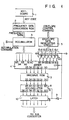
- a keyboard 1 which has a plurality of note keys of a keyboard electronic musical instrument, generates a key code data corresponding to each operated note key.
- the key code data contains information about the octave, i.e., one of the first to fifth octaves, to which the operated note key belongs, and also information about the note, i.e., one of the notes Do, Re, Mi, Fa, So, La, Si, Do, to which the operated note key corresponds.
- This key code data is fed as an address signal to a frequency data conversion ROM 2.
- frequency data of individual key codes are stored, and the frequency data read out according to the input key code data is fed to an accumulator 3.
- a clock signal èj is supplied as an accumulation command, and every time this command is given, the accumulator 3 accumulates the frequency data from the ROM 2.
- the clock signal ⁇ is given at a fixed interval, and if the frequency data from the ROM 2 represents a low frequency, accumulated data obtained in the accumulator 3 also represents a low frequency. Conversely, if the frequency data from the ROM 2 represents a high frequency, the accumulation output data of the accumulator 3 also represents a high frequency.
- 6-bit data for instance, is fed to A input terminals AO to A5 of an adder 4.
- the adder 4 also has B.input terminals 80 to B5, to which 6-bit data from an envelope data generating circuit 5 is supplied through exclusive OR gates 6-0 to 6-5 which are gate controlled by the clock signal 0.
- the adder 4 further has a carry input terminal Cin, to which the clock signal ⁇ is supplied.
- an envelope control command which is ADSR (attack, decay, sustain and release) data preset by on-off data of an operated note key on the keyboard 1 or by a switch.
- ADSR attack, decay, sustain and release
- 6-bit envelope data for the envelope control is formed according to the input data.
- the 6-bit data from the circuit 5 is coupled through the exclusive OR gates 6-0 to 6-5 to the B input terminals BO to B5 of the adder 4.
- the adder 4 adds the two 6-bit data directed to the A and B input terminals AO to A5 and BO to B5, and provides the resultant sum data as 6-bit data from its S output terminals SO to S5.
- the clock signal is at "1" level
- the 6-bit data from the circuit 5 is inverted by the exclusive OR gates 6-0 to 6-5 before it is supplied to the B input terminals BO to B5.
- the 6-bit data provided from the adder 4 is fed to a sine wave ROM 7 for address designation thereof.
- the sine wave ROM 7 provides 6-bit data DO to D5 as amplitude value data.
- the most significant bit D5 is a sign bit
- the second to the least significant bits D4 to D5 are bits which represent a decimal fraction data.
- This data is fed to A input terminals AO to A5 of an accumulator 8 and accumulated.
- the accumulator 8 is reset when it receives at its reset terminal R with the rising of a signal from an inverter 9 inverting the aforementioned clock 0, i.e., the clock ⁇ .
- the accumulator 8 provides 7-bit data from its S output terminals SO to S6. Of these output data, the most significant bit S6 is a sign bit, the second significant bit S5 is a bit for the 2° place, and the third to the least significant bits S4 to SO are bits representing the decimal fraction data.
- the 7-bit data provided from the accumulator 8 is read into a latch 10 with the rising of the clock ⁇ .
- the output data from the latch is fed to a D/A converter (not shown) for conversion to analog signal, which is coupled to a sound producing circuit such as a loudspeaker for producing sound.
- the circuit of Fig. 1 operates on a time division basis with two distinct timings as shown in (c) in Fig. 3. More particularly, every time the accumulation command $ becomes "1" in the timing T0, the accumulator 3 receives frequency data corresponding to an operated note key from the ROM 2 and accumulate it to couple the resultant accumulated data to the adder 4.
- the sine wave ROM 7 is thus address-designated in the two distinct timings, i.e., timings TO and T1, and data read out from the sine wave ROM 7 in each of these timings is accumulated in the accumulator 8. Since the accumulator 8 is reset with every rising of the clock ⁇ , it effects accumulation only during a pair of timings TO and T1. The result of accumulation is latched into the latch 10 at the timing of the rising of the clock' ⁇ .
- the amplitude data read out from the sine wave ROM 7 in the timing T1 is
- the envelope control can be obtained according to the data supplied to the B input terminals of the adder 4.
- the envelope control value in this case is
- the envelope data generating circuit 5 provides data "16". Consequently, in each timing TO data obtained as a result of incrementation of the data supplied to the A input terminals of the adder by "+16", i.e., output data "16" if the data supplied to the A input terminals is "0", is supplied to the sine wave ROM 7 for address designation.
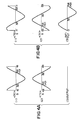
- Fig. 4A shows this relation. More particularly, the data provided from the sine wave ROM 7 in the timing TO is shown in (1), and the data provided from the sine wave ROM 7 in the timing T1 is shown in (2). Since the data shown in (1) and (2) are out of phase from each other by n, the resultant sum data, i.e., output data from the latch 10 amounts to no waveform at all as shown in (3).
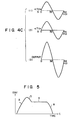
- a state as shown in Fig. 4C results.
- the data read out from the sine wave ROM 7 in the timings TO and T1 are respectively as shown in (1) and (2), being the same in amplitude.
- the output waveform has a maximum amplitude level as shown in (3). More particularly, in the state of Fig. 4C, in which the waveforms shown in (1) and (2) are in phase, the output waveform of Fig. 4C (3) is in phase with but has double the amplitude of the output of (3) in Fig. 4B.
- the data impressed upon the exclusive OR gates 6-0 to 6-5 may be quickly reduced from “16" to "0".
- the data impressed upon the exclusive OR gates 6-0 to 6-5 is progressively increased from "0" to a predetermined value.
- the data impressed upon the exclusive OR gate 6-0 to 6-5 is held at the aforementioned predetermined value. By so doing, the amplitude level is held constant as shown in Fig. 5.
- the data impressed upon the exclusive OR gates 6-0 to 6-5 may be gradually increased from the aforementioned predetermined value to "16". This gives the release portion R of the envelope as shown in Fig. 5.
- the output level becomes zero, and musical sound is no longer produced.
- envelope control may also be obtained for an envelope having three envelope states, i.e., attack, sustain and release states, or any other envelopes including different combinations of envelope states.
- the envelope control value is thus
- the resultant waveform is obtained by adding together the two sine waves, it is also possible to obtain it by subtracting the two from each other.
- the resultant waveform is given as The envelope control value in this case is Further, in a subtracting process version of the case of the equations (8) and (9), the resultant waveform is given as and in this case the envelope control value is
- the envelope control value is and in the case of the equation (19), the envelope control value is
- first and second waveforms are given as and the resultant waveform is given as or as
- the envelope control value is and in the case of the equation (25), the envelope control value is
- the sine wave is stored for one period of the waveform in the sine wave ROM
- the stored waveform data is again read in the similar manner 0 ⁇ ⁇ /2 ⁇ 0 and the read out data is inverted to produce a data of from n to 2n, thereby obtaining data for one period (0 to 2n) of the waveform.
- the sine wave i.e., the fundamental wave
- the output of the frequency data conversion ROM 2 may be subjected to a predetermined bit shift or like process before being coupled to the accumulator 3.
- the harmonic sine wave may be obtained as the waveform read out from the sine wave ROM 7.
- the fundamental wave and harmonic waves may be obtained through a time division basis process with the circuit construction shown in Fig. 1 and also commonly using the sine wave ROM 7, adder 4 and other circuitry, and these waves may be combined to obtain a single musical sound with a complex waveform.
- a plurality of circuits having the circuit construction shown in Fig. 1 may be provided so that the operated note keys may be assigned to respective circuits for producing respective musical sounds independently. Further, a plurality of musical sounds may be obtained by driving the circuit having the construction shown in Fig. 1 and using the sine wave ROM 7, adder 4 and other component circuits as common circuitry.
- a plurality of musical sounds at different note frequencies as harmonics of the fundamental wave may be obtained through a time division basis process with the sine wave ROM 7, adder 4 and other component circuits used as common circuitry.
- a sinusoidal waveform having the same frequency may also be obtained by producing a sampling clock having a frequency of a value equal to the product of the note frequency and number of sampling points, and making access to the sine wave ROM 7 in successive steps under the control of this sampling clock.
- the hardware of the waveform memory is only one half compared to the case of providing two waveform memories, thus permitting further reduction of hardware.
- the envelope waveform mentioned above and shown in Fig. 5 is obtained as the data b in the equation (11) representing the envelope control value is uniformly increased or reduced.
- the attack, decay, and release portions A, D and R mentioned above are expressed by the equation (11).
- the attenuating portions of the envelope waveform of Fig. 5, i.e., the decay and release portions D and R are both upwardly convex curves.
- a suitable attenuating sound characteristic is given as a downwardly convex exponential function, and the attenuating envelope portions shown in Fig. 5 are inadequate.
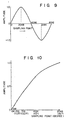
- a sine wave (or cosine wave) contains two straight line portions L1 and L2 as shown in Fig. 6 and convert these linear changes to exponential changes.
- the line L1 is a line segment connecting a point corresponding to the maximum amplitude value of 1.0 of the sine wave (i.e., the phase angle of 0 degree) and a point corresponding to an amplitude value of 1/V2 which is leading in phase from the first-mentioned point by 45 degrees.
- the line L2 is a line segment connecting the aforementioned point with the phase angle of 45 degrees and a point corresponding to a phase angle of 90 degrees (i.e., amplitude value of 0).
- the line segments L1 and L2 may be converted into exponential curves by, for instance, attenuating the amplitude by 1/2 for every basic period T of time.
- an attenuation rate corresponding to one half the basic period T may be set, that is, by setting the attenuation rate of the line segment L1 to twice the attenuation rate of the line segment L2, a substantially smooth downwardly convex exponential curve can be obtained to approximate the line segments L1 and L2.
- the envelope waveform shown in Fig. 5 may be converted into one as shown in Fig. 7.
- the decay and release portions D' and R' are certainly satisfactory attenuation curves.
- the attack portion A' is also converted to a downwardly convex curve b.y the modifying circuit, which is undesired from the musical standpoint. Accordingly, this attack portion A' has to be further modified at least to a straight line. This is possible by making the clock frequency variable during the attack portion A' or, when obtaining the attack waveform by adding a value to a counter output for every predetermined timing, making that value variable.
- Figs. 8 to 16 show another embodiment of the invention, which can overcome the drawback mentioned above
- Fig. 8 shows the main circuit of this embodiment.
- like parts as in Fig. 1 are designated by like reference numerals or symbols.
- accumulator 3a provides, for instance, 13-bit data which is fed to A input terminals A12 to AO of adder 4A. Of these data of 13 bits, only the data of the most significant bit (sign bit) is fed through an exclusive OR gate 6-12 to the A input terminal A12. To B input terminals B11 to BO to the adder 4a, 12-bit data (data Z) from envelope data generating circuit 5a is supplied through exclusive OR gates 6-11 to 6-0. Clock ⁇ is further supplied to the B input terminal B12 (sign bit) and carry input terminal Cin of the adder 4a.
- the envelope data generating circuit 5a generates 12-bit data (i.e., the data Z mentioned above) for the envelope control according to envelope command control data (i.e., attack, decay, sustain and release data) and supplies this data Z to the exclusive OR gates 6-11 to 6-0.
- envelope command control data i.e., attack, decay, sustain and release data
- This 12-bit data is subjected to the modification of the attack portion and also the modification of the attenuation of the decay and release portions, as will be described in detail.
- the clock ⁇ is supplied to one input terminal of each of the exclusive OR gates 6-11 to 6-0 and 6-12.
- the adder 4a adds 13-bit data supplied to the A and B input terminals and provides the result as 12-bit data from its S output terminals S12 to S0.
- the clock ⁇ is at "1" level, it adds the same 13-bit data supplied to the A input terminals except that the level of the sign bit is inverted to data consisting of the same input data to the B input terminal B12 and data obtained by inverting the 12-bit data input to the B input terminals B11 to BO and incrementing the result by "+1”, and provides the 13-bit result data from the S output terminals.
- the 13-bit data provided from the adder 4a is given to sine wave ROM 7a for address designation thereof.
- the sine wave ROM 7a provides 11-bit data D10 to DO as amplitude value data. Of the bits of this data, the most significant bit D10 is a sign bit, and the next to the least significant bits D9 to DO are bits representing the decimal fraction data.
- Fig. 10 shows the details of the waveform (amplitude values) of the sine wave shown in Fig. 9 over a phase angle range from 0 to 90 degrees.
- the waveform for the phase angle range of 90 to 180 degrees (i.e., rr/2 to n in radian scale) is in symmetrical relation to the waveform for the phase angle range of 0 to 90 degrees (0 to ⁇ /2 in the radian scale) with respect to the line corresponding to the phase angle of 90 degrees (n/2), and the waveform for the phase angle range of 180 to 360 degrees (n to 2n) is the same as what is obtained by inverting the sign of the waveform for the phase angle range of 0 to 180 degrees (0 to n).
- the 11-bit data from the sine wave ROM 7a is supplied to A input terminals A10 to AO of accumulator 8a and accumulated.
- the accumulator 8a provides 12-bit data from its output terminals S11 to S0. Of the bits of this 12-bit data, the most significant bit S11 is a sign bit, the next bit S10 is a second significant bit, and the following bits S9 to SO are bits representing the decimal fraction data.
- Figs. 11A and 11 B show a specific construction of the envelope data generating circuit 5a.
- the circuit includes an adder 15, which adds 7-bit data supplied to its A and B input terminals A6 to AO and B6 to BO and provides the result data (7-bit data) from its S output terminals 56 to SO.
- the result data mentioned above is recirculatedly coupled through a buffer 16, which is controlled for its reading operation by the clock ⁇ , while to the B input terminals clocks CKAO to CKA7 to be described later in detail are supplied as "+1" data at the output timing of each of the clocks during the attack period of envelope, 7-bit all "1” data is supplied as "-1" data at the output timing of a clock CKD during the decay period, 7-bit all "0” data is supplied during the sustain period, and the clock CKD is supplied as "-1" data at its own output timing during the release period.
- the upper three bit data S6 to S4 are supplied through the buffer 16 to a decoder 17.
- a signal U/D provided from a control section (not shown) is also supplied.
- the signal U/D is provided as a "1" level signal during the attack period of the envelope, while it is provided as a "0" level signal during the decay, sustain and release periods of envelope, i.e., the attenuating period thereof.
- successive "1" signals are provided from respective output lines 10 to 17 of the decoder 17 as the result data S6 to S4 mentioned above progressively change from "000" to "111".
- These "1" signals enable corresponding gates GO to G7.
- a "1" signal is provided from an output line 18 of the decoder 17 to enable a gate G8.
- the clock CKAO has one half the period (i.e., double the frequency) of the clock CKA1, which has one half the period of the clock CKA2.
- the clocks CKA3 to CKA7 have double the period of their immediately preceding ones.
- the clock CKD although not shown, has the same frequency as one of the clocks CKAO to CKA7 or is in a frequency division relation thereto.
- the result data S6 to SO are coupled through the buffer 16 and respective inverters 19-6 to 19-0 to an AND gate 21. Further, the signal U/D is coupled through an inverter 20 to the AND gate 21. The output signal from the AND gate 21 is sent out as a signal CD to the control section, and is also coupled through an inverter 22 to the AND gate 18.
- the upper four bit data S6 to S3 and the signal U/D are coupled to an AND gate 23, and the output signal therefrom is sent out as a signal CA and also coupled through an inverter 24 to the AND gate 18. Further, a signal CS is sent out from the control section as a "0" level signal during the sustain period and as a "1" level signal during the other period, i.e., the attack, decay and release periods, to the AND gate 18.
- the output of the AND gate 18 on-off controls gates 25-6 to 25-0 provided on the input side of the B input terminals B6 to BO of the adder 15.
- the signal U/D is coupled through an AND gate 26 to the gate 25-0, and a signal U/D is coupled through seven parallel AND gates 27 to the respective gates 25-6 to 25-0.
- the upper four bit data S6 to S3 are fed through the buffer 16 to a decoder 28.
- the decoder 28 provides successive "1" signals from its respective output lines LO to L6 as the result data S6 to S4 progressively changes from “000” to "110”, provides a "1” signal from its output line L7 when the result data S6 to S3 is “1110” and provides a "1" signal from its output line L8 when the result data is "1111".
- the output signals from the output lines LO to L6 drive respective gates 30-0 to 30-6.
- the output signals from the output lines LO to L7 drive respective gates 31-0 to 31-7, 32-0 to 32-7 and 33-0 to 33-7.
- a "1" signal is supplied to the gates 29-1 to 29-8, and the data S3, S2, S1 and SO of the result data of the adder 15 are supplied to the respective gates 30-0 to 30-6, 31-0 to 31-7, 32-0 to 32-7 and 33-0 to 33-7.
- the output signals of the gates 29-1 to 29-8 are supplied to respective output lines Z4 to Z11 which provide the data Z.
- the output signals of the gates 30-0, 30-1 to 30-6 are supplied to the output lines Z3, Z3 to Z8, respectively.
- the output signals of the gate circuits 31-0, 31-0 to 31-7 are also supplied to output lines Z2 and Z2 to Z7 and Z9.
- the output signals of the gates 32-0 to 32-7 are also supplied to the output lines Z1 and Z1 to Z6 and Z8.
- the output signals of the gates 33-0 to 33-7 are also supplied to the output lines ZO and ZO to Z5 and Z7.
- a "0" signal is supplied to the other end of the output lines Z11 to ZO.
- the data y shown in Fig. 13 is modified according to the data Z of the waveform as shown in Fig. 14 to obtain desired attenuating envelope curves.
- the accumulator 3a accumulates the frequency data corresponding to the operated note key and supplies the result data to the adder 4a.
- the adder 4a adds this data Z and the data supplied to the A input terminals.
- the adder 4a adds these inputs supplied to theA and B input terminals.
- the resultant sum data is impressed upon the sine wave ROM 7a in each of the timings TO and T1.
- the sine wave ROM 7a is generally differently addressed as specified in the timings TO and T1 and, as a result, the data read out from the ROM 7a in each of these timings is accumulated in the accumulator 8a. The result of accumulation is latched into the latch 10a at the timing of the rising of the clock $.
- the buffer 16 Before any note key is depressed, the buffer 16 is in the cleared state, and the data y is 7-bit all "0". Also, the signal CS prevails as "1" signal.
- the AND gate 18 is enabled. Meanwhile, the decoder 17 decodes the output data S6 to S4, and since the data S6 to S4 are "000” at this time, a "1" signal is provided from the output line 10 to enable the gate G0. During the "on” state of the gate G0, the clock CKAO is thus passed through the AND gate 18 to the gates 25-0 to 25-6..
- the decoder 17 When 16 pulses of the clock CKAO are provided so that the sum data S6 to SO becomes "0010000" at the instant t1, the decoder 17 provides a "1" signal from the output line 11. As a result, the gate GO is disabled, while the gate G1 alone is enabled. Thus, the clock CKA1 which is of double the period of the clock CKAO (i.e., at one half the frequency thereof) is supplied to the AND gate 18. Thus, the adder 15 is caused to execute the operation of incrementing with "+1" at one half the rate before.
- the waveform during the period between the instants t0 and t1 shown in Fig. 13 shows the changes in data y.
- the decoder 28 provides a "1" signal only from its output line LO to enable only the gates 30-0, 31-0, 32-0 and 33-0.
- the sum data SO to S3 are supplied to the respective output lines ZO to Z3, and a "0" signal is supplied to the output lines Z4 to Z11.
- the output data Z undergoes a change of "00000000S3S2S1S0", and the waveform during the period between the instants t0 and t1 as shown in Fig. 14 is obtained.
- the decoder 28 provides a "1" signal only from the output line L1 to enable only the gates 29-1, 30-1, 31-1, 32-1, and 33-1.
- the sum data SO to S3 of the adder 15 are supplied to the respective output lines ZO to Z3, a "1" signal is supplied to the output line Z4, and a "0" signal is supplied to the output lines Z5 to Z11.
- the output data Z shows a change of "00000001 S3S2S1SO", and a waveform as shown in Fig. 14 during this period is obtained.
- the adder 15 starts to execute the operation of incrementing with "+1" at one half the rate before from each of the instants t3 to t7, whereby the waveforms of the data y during the period between the instants t3 and t4, period between the instants t4 and t5, period between the instants t5 and t6, period between the instants t6 and t7 and the period between the instants t7 and t8 as shown in Fig. 13 are obtained.
- the decoder 28 provides successive "1" signals from the respective output lines L2 to L7.
- the output data Z from the output lines Z11 to ZO is progressively changed to "0000001S3S2S1SO", "000001S3S2S1S000”, “00001S3S2S1SOOOO", "0001S3S2S1S00000”, “001S3S2S2S000000” and "01S251S00000000" as shown in Fig. 14.
- the adder 15 adds the data "1111000” supplied to the A input terminals B6 to BO and the data "1111111” supplied to the B input terminals B6 to B0, and the result is incremented by "-1" to obtain a data "1110111".
- eight pulses of the clock CKD are provided in the above way. During this time, the result data is incremented by "-1” after another and eventually becomes “1110000”. (See Fig. 13).
- the attenuation period of the line segment L1 (corresponding to the portion between the instants t8 and t9) is one half the attenuation period of the line segment L2 (corresponding to the portions between the instants t9 and t10, between the instants t11 and t12,...) as has been described earlier in connection with Fig. 6.
- the sum data S6 to SO is progressively decremented by "-1" and becomes "1100000" at the instant t10.
- the data Z is progressively reduced one by one as "001S3S2S1S000000”.
- the signal CS is changed to "0". That is, the current level is held as the sustain level.
- the AND gate 18 is disabled to inhibit the supply of clock CKD.
- the sum data S6 to SO is thus held at "1100000” to hold the data Z at "001000000000", thus bringing an end to the decay period and starting the sustain period.
- the control section again provides the signal CS of "1" to enable the AND gate 18.
- the clock CKD starts to be provided again, and the adder 15 is caused to execute the decrementing operation progressively for every appearance of the clock CKD. More particularly, during periods between instants t11 and t12, between instants t12 and t13, between instants t13 and t14, between instants t14 and t15, between instants t15 and t16, and between instants t16 and t17 the upper three bit data S6 to S4 of the sum data S6 to SO assume respective values "101", "100", "011", “010", "001” and "000".
- a release waveform of the data y linearly attenuating at a constant rate as shown in Fig. 13, is obtained.
- the decoder 28 provides successive "1" signals from the respective output lines L5 to L0.
- the data Z successively becomes "0001S3S2S1S00000”, “00001S3S2S1S0000”, "000001S3S2S1S00”, “0000001S3S2S1S00", "00000001S3S2S1S0” and "00000000S3S2S1S0", and a waveform as shown in Fig. 14 is obtained.
- the envelope control operation is ended.
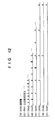
- Fig. 15 shows a classification pattern of the attack portion modifying operation and attenuating envelope portion modifying operation of the envelope data generating circuit 5a for the individual timings.
- the above operation will now be described mathematically.
- the data provided from the accumulator 3a is denoted by "a".
- the output of the adder 4a is a+Z.
- the most significant bit (sign bit) of the data supplied from the accumulator 3a is inverted by the exclusive OR gate 6-12, the individual bits of the data Z supplied from the envelope data generating circuit 5a are inverted by the respective exclusive OR gates 6-0 to 6-11, and a "1" signal is supplied to the carry input terminal Cin of the adder 4a.
- the data accumulated in the accumulator 8a is
- the envelope control can be obtained according to the data Z provided from the envelope data generating circuit 5a (i.e., data supplied through the exclusive OR gates 6-0 to 6-11 to the B input terminals of the adder 4a).
- the envelope control value in this case is
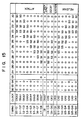
- Fig. 16 shows the values of the equation (32) when incorporated with the data Z shown in Fig. 14. It will be seen that a satisfactory envelope can be obtained with this embodiment.
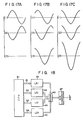
- the envelope control will be described specifically with reference to Figs. 17A to 17C.
- the data Z provided from the envelope data generating circuit 5a is "0".
- the amplitude value read out from the sine wave ROM 7a in each timing TO is as given by the equation (29), while the amplitude value read out from the sine wave ROM 7a in each timing T1 is as given by the equation (30).
- Fig. 17A illustrates this state, with the amplitude read out from the sine wave ROM 7a in the timing TO being shown in (1) and the amplitude value read out from the sine wave ROM 7a in the timing T1 being shown in (2). Since the waveforms shown in (1) and (2) in Fig. 17A are out of phase by n (180°) from each other, the signs of both the amplitude values are opposite, and the sum of them, i.e., the output of the latch 10a represents no waveform at all as shown in (3) in Fig. 17A.
- Fig. 17B shows the state during this time.
- Fig. 17C shows the state when the output data Z is "2048".
- the amplitude data read out from the sine wave ROM 7a in the individual timings TO and T1 are in phase as shown in (1) and (2), and the resultant output waveform has the maximum level (with the amplitude being 2) as shown in (3) in Fig. 17C.
- the output data Z may be quickly increased from “0" to "2048" (see Fig. 14).
- the aforementioned data is progressively reduced from "2048" to a predetermined value (which is "512" in the instant embodiment).
- the data Z is held at the aforementioned predetermined value "512".
- the output level is held constant.
- the release state the data Z is gradually reduced from the instant of detection of the keyoff of the note key until its becomes "0". When the data Z is reduced to "0", the output level is also reduced to zero so that the musical sound is no longer produced.
- envelope control may also be obtained for an envelope having three distinct state, i.e., attack, sustain and release states or any other envelope.
- the envelope control value is
- the envelope value is
- one period of sine wave is stored in and read out from the sine wave ROM 7a, it is possible to read out data for one period of sine wave with a reduced storage capacity by storing, for instance, a quarter or half period sine wave and permitting a round trip access to the memory or inverting the sign of the output waveform.
- the difference between the amplitude values at a certain sampling point and the next sampling point i.e., a point corresponding to the incrementation of the preceding point by "+1"
- the difference between the amplitude values at a certain sampling point and the next sampling point i.e., a point corresponding to the incrementation of the preceding point by "+1”
- the difference between the amplitude values at a certain sampling point and the next sampling point i.e., a point corresponding to the incrementation of the preceding point by "+1”
- the difference between the amplitude values at a certain sampling point and the next sampling point i.e., a point corresponding to the incrementation of the preceding point by "+1”
- a sine wave, i.e., fundamental wave, of a note frequency is obtained in accordance with the operation of a corresponding note key, it is possible to obtain a harmonic wave of a given order as well as the fundamental wave through a time division basis process and subjecting the output of the frequency data conversion ROM 2 to a predetermined bit shift. By so doing, it is possible to obtain a desired waveform containing harmonic components.
- the frequency data corresponding to a given note is obtained according to a corresponding phase angle
- different values may be stored in lieu of amplitude values in the sine wave memory.
- the modification of the attack portion of the envelope is effected through the switching of the clock frequency
- a shifter consisting of the gates 29-1 to 29-8,..., 33-0 to 33-7 is used for obtaining the attenuating envelope curves, it may be replaced with a shift register, or it is possible to adopt other methods such as switching the clock frequency according to the extent of attenuation.
- two straight line segments L1 and L2 are used to approximate a sine wave (or cosine wave) as shown in Fig. 6 and are converted to obtain attenuating curves (exponential curves)
- more than two straight line segments may of course be used to approximate a sine wave (or cosine wave) and converted to obtain exponential curves.
- downwardly convex exponential curves may be obtained through such control as to change the attenuation rate (make it higher for increasing envelope values and lower for reducing values) for each line segment.
- the attenuating envelope waveforms are modified to downwardly convex exponential waveforms under the control of means for making non-uniform the rate of change of the phase difference between the aforementioned two waveforms, thus permitting generation of musical sound with satisfactory attenuating envelope waveforms from the musical standpoint. Also, it will be seen that by providing the above electronic musical instrument with means for correcting the non-uniform rate of change of the phase difference to a uniform rate for the attack portion of the envelope, further superior musical sound can be produced.
- the multiplier that has hitherto been required for the envelope control can be dispensed with, so that the circuit construction can be extremely simplified.
- implementation with LSI can be facilitated, and also accurate envelope control can be obtained.
- a number of chords and harmonics can be readily obtained by adopting a time division basis processing system.
- a plurality of circuits which produce musical sound in a sinusoidal wave synthesizing system, are provided as respective LSI chips, and the orders and number of harmonics and kinds and number of chords a harmonic sound that is desired to be produced are specified to the individual LSI chips. With this arrangement, a number of chords and harmonics can be obtained.
- Fig. 18 shows a schematic of the essential part of this embodiment of electronic musical instrument.
- the system comprises a CPU (central processing unit) 41, which may be a one-chip microprocessor.
- the CPU 41 provides various data to four LSI chips 42, 43, 44 and 45 through respective bus lines B1, B2, B3 and B4 for controlling the operation of producing musical sound. More particularly, the CPU 41 provides frequency data corresponding to the notes of operated note keys on a keyboard (not shown) and control signals corresponding to the outputs of various external operated switches to the bus lines B1 to B4.
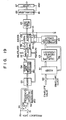
- the LSI chips 42 to 45 each have the same construction including the circuit shown in Fig. 19. These LSI chips 42 to 45 provide waveform data including harmonics of the orders specified by the CPU 41 to an adder 46 where these data are added (i.e., combined). The resultant data is supplied to a D/A converter 47 for conversion into a corresponding analog signal which is coupled through an amplifier and a loudspeaker (not shown) for producing musical sound.
- the LSI chip 42 is capable of a 4-channel time division basis processing operation. More particularly, each channel corresponds to one musical sound, that is, the LSI chip 42 can produce at most four musical sounds, i.e., at most a 4-component chord.
- various shift registers such as frequency data registers to be described later each have four stages corresponding to the respective four channels.
- an envelope data register has 20 shift stages as will be described later.
- the aforementioned frequency data of operated note keys which is provided by the CPU 41 according to the notes of the operated note keys on the keyboard and supplied through the bus line B1 is coupled through a gate 51 to a frequency data register 52.
- This frequency data register 52 is constituted by four cascade-connected 20-bit shift registers and driven by a clock ⁇ 1>10 (as shown in Fig. 21) for shifting operation.
- the frequency data provided from the 4-th stage shift register of the frequency data register 52 is fed to the adder 53 and is also fed back through a gate 54 to the first shift register of the frequency data register 52.
- To the gate 51 a control signal IN from the CPU 41 is directly supplied, and it is also fed through an inverter 55 to the gate 54. This control signal IN effects on-off control of these gates.
- the control signal IN When an operated note key is assigned to a certain channel, the control signal IN is provided as a signal of binary logic level "1" at the timing of that channel.
- the frequency data corresponding to the operated key is coupled through the gate 51, which is enabled at this time, to the first stage of the frequency data register 52. Meanwhile, the gate 54 is “off” at this time, and the feedback data from the 4-th stage of the frequency data register 52 is interrupted.
- the control signal IN is provided as "0" signal with the timing of that channel until a channel release occurs in response to the key-off of the operated key. With the control signal IN of "0", the gate 54 is enabled, whereby the frequency data of the operated key is fed back and circulated in the register 52.
- the adder 53 adds the frequency data from the frequency data register 52 and phase data (phase address) fed back from a phase data register 56 to provide new phase data fed to the phase data register 56.
- the phase data register 56 is constituted by four cascade-connected 20-bit shift registers and driven by the clock 010.
- the phase data provided from the 4-th stage of the phase data register 56 is fed to a multiplier 57.
- the adder 53 and phase data register 56 co-operate to accumulate the aforementioned frequency data for obtaining phase address af.
- signals XSO, XS1, XQ, Y0, YS2 and YQ are supplied under the control of the CPU 41.
- the signals XSO, XS1 and XQ are gate control signals for respectively causing the aforementioned phase address af, data of double the phase address af and the result of the previous calculation to an X input terminal of an adder in the multiplier 57.
- the signals Y0, YS2 and YQ are gate control signals for respectively supplying data "0", data of four times the phase address af and the result of the previous calculation to a Y input terminal of the adder.
- the output data of the multiplier 57 is fed to a first input terminal group of the adder 58.
- the most significant bit is a sign bit and is coupled through an exclusive OR gate 59 to the adder 58.
- envelope data (11-bit data) is coupled through exclusive OR gates 60-10 to 60-0.
- Envelope value data is coupled through a gate 62 to an adder 61.
- the envelope value data is given at the on-off operation of a note key under the control of the CPU 41 according to ADSR (attack, decay, sustain, release) data preset by an external switch, and it is coupled to the adder 61 every time the gate 62 is enabled by an envelope clock.
- ADSR attack, decay, sustain, release
- the envelope data register 63 is constituted by 20 cascade-connected 7-bit registers and driven by a clock 2 (as shown in Fig. 21).
- the adder 61 adds the envelope data and output data of the envelope data register 63 and produces now envelope data (current value of envelope) which is fed to the envelope data register 63.
- the envelope data is also supplied to an exponential conversion circuit 64.
- the exponential conversion circuit 64 converts the input envelope data into exponentially changing data such that an ideal envelope waveform having an upwardly convex curve for the attack portion, a downwardly convex curve for the decay portion and a downwardly convex curve for the release portion, and it may be the circuit in the previous embodiment shown in Figs. 11A and 11 B.
- the envelope data provided from the exponential conversion circuit 64 is coupled through the exclusive OR gates 60-10 to 60-0 to the adder 58.
- the adder 58 adds the input data to the first input terminal of the adder 58 and supplies the result as address data to a sine wave ROM 65.
- the adder 58 adds data obtained by inverting only the level of the sign bit of the data from the multiplier 57 and data given as 2's complement of the envelope data from the exponential conversion circuit and supplies the result data to the sine wave ROM 65.
- the sine wave read out when the signal S is "1” and that read out when the signal S is "0” are at the same frequency and shifted in opposite directions by the same amount. Also, they have opposite signs. Their details will be discussed later using mathematical equations.
- the amplitude data read out from the sine wave ROM 65 is fed to an accumulator 66 and accumulated for every pulse of the system clock 01.
- the accumulation value data of the accumulator 66 is latched in a latch 67 at the output timing of a clock (f40 (as shown in Fig. 21) and then supplied to the adder 46 (Fig. 18).
- the accumulator 66 is cleared at the output timing of the clock 040.
- the accumulation value data latched in the latch 67 is an accumulation of at most 40 sine wave amplitude values.
- multiplier 57 To the multiplier 57 are supplied upper 14 bit data A19 to A6 of the phase address af provided from the phase data register 56.
- the data A19 to A8 are coupled through transfer gates 71-11 to 71-0 to X input terminals X11 to XO of an adder 70.
- the data A18 to A7 (which is obtained by upwardly shifting the data A19 to A8 by one bit and represents data 2af having double the magnitude of the phase address data af) is coupled through transfer gates 72-11 to 72-0 to the X input terminals X11 to X0.
- the sum data provided from S output terminals S11 to SO of the adder 70 is latched in a latch 74 and then coupled therefrom through transfer gates 73-11 to 73-0 to the X input terminals X11 to X0.
- the transfer gates 71-11 to 71-0, 72-11 to 72-0 and 73-11 to 73-0 are gate controlled by the respective signals XSO, XS1 and XQ. Also, the transfer gates 75-11 to 75-0, 76-11 to 76-0 and 77-11 to 77-0 are gate controlled by the respective signals Y0, YS2 and YQ.
- the latch 74 is driven by the clock ⁇ 2 to latch the sum data.
- the multiplier 57 in response to either one of the signals XSO, XS1 and XQ either the phase address af, double phase address 2af or previous sum data is fed to the X input terminals X11 to XO of the adder 70. Meanwhile, either all "0" data, four times the phase address 4af or previous sum data is fed to the Y input terminals Y11 to YO according to either signal Y0, YS2 or YQ.
- the adder 70 adds the input data fed to the X input terminals X11 to XO and Y input terminals Y11 to YO and provides the resultant sum data from the S output terminals S11 to SO.
- the multiplier 57 produces address data for a certain fundamental sound and, for instance, four harmonic sounds with respect to that fundamental sound or address data for five harmonic sounds with respect to a certain fundamental sound.
- LSI for instance the LSI chip 42
- up to four different frequency data may be set in the frequency data register 52.
- four different frequency data representing the notes of the respective operated note keys are provided from the CPU 41 and coupled through the bus line B1 and gate 51 to the frequency data register 52 to be set in respectively assigned channels thereof.
- the individual frequency data are circulated as they are shifted every time a pulse of the clock ⁇ 10 is provided.
- phase address af For the next step (corresponding to data for addressing the next sampling point in the sine wave ROM 65).
- This phase address af gives a phase address for the fundamental sounds of the notes C1, D1, E1 and F1.
- the phase address af is shifted under the control of the clock ⁇ 10 as it is supplied to the adder 53 and multiplier 57.
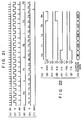
- the signals XSO, XS1 and XO and signals Y0, YS2 and YO are set to desired states. For example, they may be set as shown in Fig. 22.
- labeled P0, P1, P2 and P3 are timings, in which the frequency data register 52 and phase data register 56 operate on a time division basis for the respective channels with the appearance of every pulse of the clock ⁇ 10.
- Labeled T1, T2, T3 and T4 are timings, in which operation for the respective channels is executed for every pulse of the clock ⁇ 2.
- the operation of the multiplier 57 will now be described by taking the case of Fig. 22.
- the signals XSO and YO are at "1" level while the signals XS1, XQ, YS2 and YQ are at "0" level.
- the transfer gates 71-11 to 71-0 and 75-11 to 75-0 are “on” while the other transfer gates 72-11 to 72-0, 73-11 to 73-0 and 77-11 to 77-0 are "off”.
- the phase address af from the phase data register 56 is supplied to the X input terminals X11 to XO of the adder 70, and the all "0" data is supplied to the Y input terminals.
- the adder 70 provides data af as the sum data from the S output terminals S11 to SO, and this data is fed as address data to the adder 58 and latch 74.
- the signals XSO and YQ are at "1" level while the signals XS1, XQ, YO and YS2 are at "0" level.
- the phase address af is supplied to the X input terminals X11 to XO and the transfer gates 77-11 to 77-0 are enabled.
- the sum data in the preceding timing T0 stored in the latch 74, i.e., data af, is supplied, and data 2f is provided as the new sum data from the S output terminals S11 to SO.
- the output states of the signal XSO and other signals is the same as in the timing T1.
- the data af is supplied to the X input terminals of the adder 70 while the preceding sum data 2af is supplied to the Y input terminals Y11 to Y0, and the new sum data is 3af.
- the output state of the signal XSO and other signals is again the same as in the timings T1 and T2.
- the data af is supplied to the X input terminals X11 to XO of the adder while the preceding sum data is supplied to the Y input terminals Y11 to Y0, and the new sum data is 4af.
- the signals XQ and YQ are at "1" level while the signals XSO, XS1, YO and YS2 are at "0" level.
- the sum data 4af in the preceding timing T3 is supplied through the transfer gates 73-11 to 73-0 to the X input terminals X11 to XO and also to the Y input terminals Y11 to Y0, and the new sum data is 8af.
- envelope values for attack, decay, sustain and release are fed through the gate 62 at timings corresponding to the operation of turning on and off individual keys for the notes C1, D1, E1 and F1.
- the adder 61 accumulatively adds the input envelope value and output data of the envelope data register 63 to produce new envelope data supplied to the envelope data register 63.
- the envelope data in the envelope data register 63 is shifted under the control of the clock ⁇ 2, and new exponential conversion envelope data is provided from the exponential conversion circuit 64 in each of the timings TO to T4.
- This envelope data is fed through the exclusive OR gates 60-10 to 60-0 to the adder 58.
- the adder 58 different calculations are performed for the "0" and "1" levels of the signal S in each of the timings TO to T4 in the timing P0. More particularly, in the timing TO the aforementioned data (address data) af is supplied from the multiplier 57 to the first input terminal group of the adder 58. When the signal S is at the "0" level, the sign bit of the data af is directly supplied, while with the "1" level of the signal S the sign bit is inverted before being supplied.
- the envelope data from the exponential conversion circuit 64 is directly supplied when the signal S is at the "0" level, while when the signal S is at the "1" level a 2's complement of the aforementioned envelope data is supplied.
- the adder 58 adds the data af and envelope data to produce the sum data for addressing the sine wave ROM when the signal S is at the "0" level.
- the adder adds data obtained as a result of inversion of the sign of the data af and 2's complement of the envelope data to produce the sum data for addressing the sine wave ROM 65. If the timing PO is assigned as the time division basis process timing for the note key for the note C1, in the timing TO two different sine waves are read out with the note C1 as a fundamental sound. These sine waves are opposite in polarity, have the same frequency and oppositely shifted by the same amount.
- timing T1 in the timing P0 data 2af is supplied to the first input terminal group of the adder 58.
- the input data 2af is processed in the same manner when the signal S is at the "0" and "1" levels as in the timing T0.
- the same envelope data as in the timing TO is supplied to the second input terminal group of the adder 58.
- two different sine waves of twice the note C1 are read out from the sine wave ROM 65.
- timings T2 to T4 in the timing P0 data 3af, 4af and 8af are respectively supplied to the first input terminal group of the adder 58, while similar envelope data are supplied to the second input terminal group.
- data 3af, 4af and 8af are respectively supplied to the first input terminal group of the adder 58, while similar envelope data are supplied to the second input terminal group.
- timings P1, P2 and P3 are assigned as the time division basis process timings for the note keys of the respective notes D1, E1 and F1, in these timings P1 to P3 two different sine waves of the fundamental sounds of the respective notes D1, E1 and F1 and twice, three times and four times these fundamental sounds are respectively read out.
- the sine wave data read out from the sine wave ROM 65 is accumulated in the accumulator 66 for every output timing of the clock cp1. More particularly, in the timing P0, in the timing T1 two pulses of the clock ⁇ 1 are provided two different sine waves of the fundamental sound (of the note C1) are accumulated. In the next timing T1, two different sine waves of twice the accumulated value are accumulated. Likewise, in the timings T2, T3 and T4 two different sine waves of respective three, four and eight times the previously accumulated values are accumulated.
- a total of 40 sine waves (i.e., two different waves times four musical sounds times five harmonics (including the fundamental sound)) accumulated in the accumulator are transferred to the latch 67 at the output timing of the clock cp40 and supplied to the external adder 46 (Fig. 18). It will thus be seen that the sampling clock (p40 of the electronic musical instrument is the clock cp40.
- the accumulator 66 accumulates all the resultant data of the time division basis processes in the timings PO and P3, and transfers the accumulated content to the latch 67 while clearing its own content at the output timing of the clock 040.
- the operation of the other LSI chips 43 to 45 are basically the same as that of the LSI chip 42 described above.
- the LSI chips 42 to 45 each provide four musical sounds each of which consists of five harmonics (including the fundamental sound) simultaneously, that is, one chord consisting of four fundamental sounds and four harmonics of each of these can be simultaneously produced.
- it is possible to produce various combinations of chords by using all the four LSI chips 42 to 45, (A) one chord consisting of four fundamental sounds and 19 harmonics of each of these sounds, (B) two chords of four fundamental sounds and nine harmonics of each of these sounds, (C) four chords of four fundamental sounds and four harmonics of each of these sounds.
- the four different fundamental sounds are assigned to the respective LSI chips 42 to 45.
- the same frequency data corresponding to the same note are set in the individual channels of the frequency data registers 52 in the LSI chips 42 to 45.
- control signals XSO and YO are provided as “1” signals while the other control signals are provided as “0” signals to obtain phase data af in the multiplier 57.
- the signals XSO and YQ are supplied as "1” signals while the other control signals are supplied as "0” signals.
- phase data of 2af, 3af, 4af and 5af are obtained from the multiplier in the respective timings T1 to T4 in P0.
- the phase data af corresponding to the same note is continually supplied from the phase data register 56, and phase data 6af, 7af,... corresponding to the same note are obtained from the multiplier 57.
- phase data af to 20af are obtained for the same note.
- a musical sound containing 20 different harmonics is provided from the LSI chips 42 to 45 respectively, that is, a state of sound production of one chord consisting of four fundamental sounds and 19 harmonics of each of these sounds can be obtained.
- the LSI chips 42 and 44 are paired together, and the LSI chips 43 and 45 are paired.
- the LSI chips 42 and 44 are operated such as to produce a first chord
- the LSI chips 43 and 45 are operated such as to produce a second chord different from the first chord produced by the LSI chips 42 and 44.
- the LSI chips 42 and 43 are set to generate, for instance the fundamental, second, third, fourth and eigth harmonics
- the LSI chips 44 and 45 are set to generate the sixth, tenth, twelfth, sixteenth and twentieth harmonics.
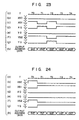
- the control signals in the multiplier 57 may be controlled by the CPU 41 as shown in Fig. 22 for the LSI chips 42 and 43 and as shown in Fig. 23 for the LSI chips 43 and 45.
- eight different sounds (two chords) each consisting of one fundamental sound and nine harmonics are produced from the four LSI chips 42 to 45.
- the operation of the multiplier 57 may be controlled in the manner shown in Fig. 24.
- the LSI chips 42 to 45 may be set such that they each produce different chords each consisting of four fundamental sounds and four harmonics for each of these sounds (as shown in Fig. 22).
- sixteen different sounds each consisting of one fundamental sound and four harmonics may be produced from the four LSI chips 42 to 45.
- the envelope data provided from the exponential conversion circuit 64 is denoted by E. This being done so for the sake of the simplicity harmonic sounds. If the value E is varied, it is possible to select the tone color or to vary the content of the harmonics with respect to time.
- E the envelope data provided from the exponential conversion circuit 64
- the signal S is at the "0" level
- data af is supplied to the first input terminal group of the adder 58 while the envelope data E is supplied to the second input terminals.
- the sum data is af+E, which is fed to the sine wave ROM 65.
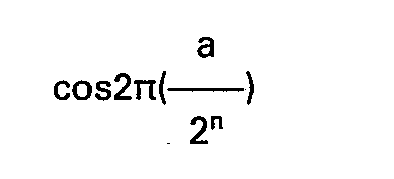
- the data read out for accumulation in the accumulator 66 is where n is the number of sampling points.
- the data 2af, 3af, 4af and 8af are respectively supplied to the first input terminal group of the adder 58.
- the respective accumulation values given by the equation (43) to (46) are progressively accumulated with respect to the accumulation value given by the equation (42).
- the fundamental sound and second, third, fourth and eighth harmonics are envelope controlled by the envelope data E.
- the fundamental sound and individual multiple sounds thus have envelope control values given as
- the envelope data E When no waveform is present in the key-on state, the envelope data E may be made "0". As the envelope data E is gradually increased after the key-on, the attack portion of the envelope with the output level increasing gradually is formed. After the output level becomes maximum, the envelope data E is gradually reduced to form the decay portion. At the end of the decay portion, the envelope data E is held constant to provide the sustain state. After the key-off the envelope data E may be gradually reduced down to zero for forming the release portion.
- envelope control may also be obtained for an envelope having attack, decay, sustain and release states, similar envelope control may also be obtained for an envelope having three envelope states, i.e., attack, sustain and release states or for any other envelope.
- the individual LSI chips are adapted to execute a time division basis process for at most four channels, this number of channels is of course not limitative. Further, while in the above embodiment four LSI chips of the same construction are used, it is possible to provide any desired number of LSI chips according to the numbers of chords and harmonics to be produced. Further, the arrangement of the transfer gates in the adder 70 may be appropriately modified, and thus it is possible to realize any other combination of address data than those shown in Figs. 22 to 24.
- the outputs of the LSI chips 42 to 45 are combined in the external adder 46, it is also possible to provide the adder 46 within the LSI chips and let data be transferred to an adder in one of the LSI chips. By so doing, the external circuitry can be reduced.
- circuit construction can be simplified compared to the prior art electronic musical instrument, and also implementation with LSI can be readily obtained. Further, accurate envelope control can be obtained. Still further, a number of musical sounds containing a number of harmonics can be simultaneously produced, thus facilitating the chord performance and improving the performance effect.
- LSI chips are used to construct a circuit for producing musical sound in the sinusoidal wave synthesis system and it is made possible to specify the number and orders of harmonics and kinds of chords to be produced from the LSI chips, a number of musical sounds containing a number of harmonics can be readily simultaneously produced, so that musical sound closer to the natural sound can be obtained. Further, chord performance can be further facilitated. Further, since it is necessary to fabricate only a number of LSI chips of the same construction, the design can be facilitated, and cost reduction by mass production can be realized.
- Fig. 25 shows the main circuit of a further embodiment of the invention.
- like parts as those in Fig. 1 are designated by like reference numerals or symbols.
- This embodiment is different from the embodiment of Fig. 1 in that the 6-bit data from the envelope data generating circuit 5 is supplied to the B input terminals BO to B5 of the adder not through exclusive OR gates but through AND gates 6-0 to 6-5 and that cIock 0 is not supplied to the adder 4.
- the AND gates 6-0 to 6-5 are "off” and the data supplied to the B input terminals of the adder 4 are all "0".
- the adder 4 provides the data input to the A input terminals as the output from the S output terminals.
- the adder 4 adds the data input to the A and B-input terminals and supplies the resultant sum data from the S output terminals.
- the envelope control is effected according to the data supplied to the B input terminals of the adder 4.
- the envelope control value in this case is
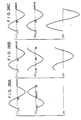
- Fig. 26A shows this state. Shown in (1) is the data provided from the sine wave ROM 7 in the timing T0, and shown in (2) is the data provided from the sine wave ROM 7 in the timing T1. These data shown in (1) and (2) in Fig. 26A are out of phase from each other by n, and thus the sum data, i.e., output data of the latch 10 represents no waveform as shown in (3).
- Fig. 26B shows a state when the data supplied to the B input terminals of the adder 4 is "16". More particularly, shown in (1) and (2) are data output of the sine wave ROM 7 in the respective timings TO and T1, and shown in (3) is the output data of the latch 10.
- Fig. 26C shows a state when the data supplied to the B input terminals of the adder 4 is reduced to "0".
- the data read out from the sine wave ROM 7 in the timing TO as shown in (1) and the data read out from the sine wave ROM 7 in the timing T1 as shown in (2) are the same, and the output waveform amplitude level is maximum as shown in (3).
- the waveforms shown in (1) and (2) are entirely in phase, and double the amplitude level is provided as the output.
- the data supplied to the B input terminals of the adder 4 may be quickly reduced from “32" to "0".
- the data supplied to the B input terminals of the adder 4 is progressively increased from "0" to a predetermined value.
- the data supplied to the B input terminals B of the adder 4 is held at the aforementioned predetermined value. By so doing, the level is held constant.
- the data supplied to the B input terminals of the adder 4 may be gradually increased from the aforementioned predetermined value to "32".
- the output level becomes zero, and the musical sound is terminated.
- the envelope control value in this case is
Landscapes
- Engineering & Computer Science (AREA)
- Physics & Mathematics (AREA)
- Acoustics & Sound (AREA)
- Multimedia (AREA)
- General Engineering & Computer Science (AREA)
- Electrophonic Musical Instruments (AREA)
Claims (17)




Applications Claiming Priority (8)
| Application Number | Priority Date | Filing Date | Title |
|---|---|---|---|
| JP167582/80 | 1980-11-28 | ||
| JP55167583A JPS5792396A (en) | 1980-11-28 | 1980-11-28 | Control system for envelope of electronic musical instrument |
| JP55167582A JPS5792395A (en) | 1980-11-28 | 1980-11-28 | Control system for envelope of electronic musical instrument |
| JP167583/80 | 1980-11-28 | ||
| JP56036595A JPS57151998A (en) | 1981-03-16 | 1981-03-16 | Envelope control system for electronic musical instrument |
| JP36595/81 | 1981-03-16 | ||
| JP130875/81 | 1981-08-21 | ||
| JP56130875A JPS5833298A (ja) | 1981-08-21 | 1981-08-21 | 電子楽器 |
Publications (2)
| Publication Number | Publication Date |
|---|---|
| EP0053892A1 EP0053892A1 (de) | 1982-06-16 |
| EP0053892B1 true EP0053892B1 (de) | 1985-08-28 |
Family
ID=27460286
Family Applications (1)
| Application Number | Title | Priority Date | Filing Date |
|---|---|---|---|
| EP81305557A Expired EP0053892B1 (de) | 1980-11-28 | 1981-11-24 | Steuerungsvorrichtung für die Hüllkurve in einem elektronischen Musikinstrument |
Country Status (3)
| Country | Link |
|---|---|
| US (1) | US4453440A (de) |
| EP (1) | EP0053892B1 (de) |
| DE (1) | DE3172071D1 (de) |
Families Citing this family (6)
| Publication number | Priority date | Publication date | Assignee | Title |
|---|---|---|---|---|
| DE3249738C2 (de) * | 1981-12-22 | 1991-05-23 | Casio Computer Co., Ltd., Tokio/Tokyo, Jp | |
| GB2113447B (en) * | 1981-12-22 | 1986-07-09 | Casio Computer Co Ltd | Tone signal generating apparatus of electronic musical instruments |
| GB2133199B (en) * | 1982-12-30 | 1987-03-18 | Casio Computer Co Ltd | Automatic music playing apparatus |
| GB2493969B (en) * | 2011-08-26 | 2013-08-07 | Siemens Plc | Slag dispersal device and method |
| CN105745031A (zh) * | 2013-12-06 | 2016-07-06 | 富士通株式会社 | 驱动装置、电子设备、驱动控制程序、以及驱动信号的生成方法 |
| EP2905774A1 (de) * | 2014-02-11 | 2015-08-12 | JoboMusic GmbH | Verfahren zur synthetischen Erzeugung eines digitalen Audiosignals |
Family Cites Families (9)
| Publication number | Priority date | Publication date | Assignee | Title |
|---|---|---|---|---|
| US3740450A (en) * | 1971-12-06 | 1973-06-19 | North American Rockwell | Apparatus and method for simulating chiff in a sampled amplitude electronic organ |
| US4085644A (en) * | 1975-08-11 | 1978-04-25 | Deutsch Research Laboratories, Ltd. | Polyphonic tone synthesizer |
| US4079650A (en) * | 1976-01-26 | 1978-03-21 | Deutsch Research Laboratories, Ltd. | ADSR envelope generator |
| JPS597118B2 (ja) * | 1976-03-05 | 1984-02-16 | ヤマハ株式会社 | 電子楽器 |
| JPS53102020A (en) * | 1977-02-17 | 1978-09-06 | Kawai Musical Instr Mfg Co | Electronic musical instrument |
| US4227435A (en) * | 1977-04-28 | 1980-10-14 | Nippon Gakki Seizo Kabushiki Kaisha | Electronic musical instrument |
| US4281574A (en) * | 1978-03-13 | 1981-08-04 | Kawai Musical Instrument Mfg. Co. Ltd. | Signal delay tone synthesizer |
| US4249447A (en) * | 1978-06-30 | 1981-02-10 | Nippon Gakki Seizo Kabushiki Kaisha | Tone production method for an electronic musical instrument |
| DE2936935A1 (de) * | 1978-09-14 | 1980-04-24 | Nippon Musical Instruments Mfg | Elektronisches musikinstrument |
-
1981
- 1981-11-24 DE DE8181305557T patent/DE3172071D1/de not_active Expired
- 1981-11-24 EP EP81305557A patent/EP0053892B1/de not_active Expired
- 1981-11-24 US US06/324,466 patent/US4453440A/en not_active Expired - Lifetime
Also Published As
| Publication number | Publication date |
|---|---|
| EP0053892A1 (de) | 1982-06-16 |
| DE3172071D1 (en) | 1985-10-03 |
| US4453440A (en) | 1984-06-12 |
Similar Documents
| Publication | Publication Date | Title |
|---|---|---|
| EP0311152B1 (de) | Tonerzeugende Vorrichtung für ein elektronisches Musikinstrument | |
| US5340938A (en) | Tone generation apparatus with selective assignment of one of tone generation processing modes to tone generation channels | |
| US4653374A (en) | Electronic musical instrument with a bender provided separately from performance keys | |
| US4835721A (en) | Frequency synthesizer | |
| EP0053892A1 (de) | Steuerungsvorrichtung für die Hüllkurve in einem elektronischen Musikinstrument | |
| US4479411A (en) | Tone signal generating apparatus of electronic musical instruments | |
| US5038661A (en) | Waveform generator for electronic musical instrument | |
| US5900570A (en) | Method and apparatus for synthesizing musical sounds by frequency modulation using a filter | |
| US5117725A (en) | Device for changing and controlling the rate of generating waveform data | |
| US4528884A (en) | Wave reading apparatus | |
| JPH0225515B2 (de) | ||
| US5687105A (en) | Processing device performing plural operations for plural tones in response to readout of one program instruction | |
| US4658691A (en) | Electronic musical instrument | |
| USRE34481E (en) | Electronic musical instrument | |
| JPS6229794B2 (de) | ||
| JPH0310959B2 (de) | ||
| JP2643717B2 (ja) | 楽音合成装置 | |
| JPS6322312B2 (de) | ||
| JPS6224797B2 (de) | ||
| JP2707885B2 (ja) | ビット数変換装置 | |
| JP2950893B2 (ja) | 楽音信号発生装置 | |
| JP2510090Y2 (ja) | 楽音信号発生装置 | |
| JP3235315B2 (ja) | フォルマント方式音源 | |
| JPS585797A (ja) | 電子楽器のビブラ−ト制御方式 | |
| JPS59131994A (ja) | 電子楽器の周波数制御装置 |
Legal Events
| Date | Code | Title | Description |
|---|---|---|---|
| PUAI | Public reference made under article 153(3) epc to a published international application that has entered the european phase |
Free format text: ORIGINAL CODE: 0009012 |
|
| 17P | Request for examination filed |
Effective date: 19811128 |
|
| AK | Designated contracting states |
Designated state(s): DE GB |
|
| GRAA | (expected) grant |
Free format text: ORIGINAL CODE: 0009210 |
|
| AK | Designated contracting states |
Designated state(s): DE GB |
|
| REF | Corresponds to: |
Ref document number: 3172071 Country of ref document: DE Date of ref document: 19851003 |
|
| PLBE | No opposition filed within time limit |
Free format text: ORIGINAL CODE: 0009261 |
|
| STAA | Information on the status of an ep patent application or granted ep patent |
Free format text: STATUS: NO OPPOSITION FILED WITHIN TIME LIMIT |
|
| 26N | No opposition filed | ||
| PGFP | Annual fee paid to national office [announced via postgrant information from national office to epo] |
Ref country code: GB Payment date: 19961115 Year of fee payment: 16 |
|
| PGFP | Annual fee paid to national office [announced via postgrant information from national office to epo] |
Ref country code: DE Payment date: 19961202 Year of fee payment: 16 |
|
| PG25 | Lapsed in a contracting state [announced via postgrant information from national office to epo] |
Ref country code: GB Free format text: LAPSE BECAUSE OF NON-PAYMENT OF DUE FEES Effective date: 19971124 |
|
| GBPC | Gb: european patent ceased through non-payment of renewal fee |
Effective date: 19971124 |
|
| PG25 | Lapsed in a contracting state [announced via postgrant information from national office to epo] |
Ref country code: DE Free format text: LAPSE BECAUSE OF NON-PAYMENT OF DUE FEES Effective date: 19980801 |