EP0053928B1 - Couche fibreuse dans laquelle sont distribuées des particules de substance - Google Patents
Couche fibreuse dans laquelle sont distribuées des particules de substance Download PDFInfo
- Publication number
- EP0053928B1 EP0053928B1 EP81305741A EP81305741A EP0053928B1 EP 0053928 B1 EP0053928 B1 EP 0053928B1 EP 81305741 A EP81305741 A EP 81305741A EP 81305741 A EP81305741 A EP 81305741A EP 0053928 B1 EP0053928 B1 EP 0053928B1
- Authority
- EP
- European Patent Office
- Prior art keywords
- sliver
- web
- low weight
- per unit
- unit area
- Prior art date
- Legal status (The legal status is an assumption and is not a legal conclusion. Google has not performed a legal analysis and makes no representation as to the accuracy of the status listed.)
- Expired
Links
- 239000013618 particulate matter Substances 0.000 title claims abstract description 31
- 239000011236 particulate material Substances 0.000 claims abstract description 25
- 239000002657 fibrous material Substances 0.000 claims abstract description 16
- 239000000463 material Substances 0.000 claims description 23
- 238000000034 method Methods 0.000 claims description 17
- 239000000416 hydrocolloid Substances 0.000 claims description 10
- 238000004519 manufacturing process Methods 0.000 claims description 10
- 229920000642 polymer Polymers 0.000 claims description 8
- 150000004676 glycans Chemical class 0.000 claims description 6
- 238000003490 calendering Methods 0.000 claims description 5
- -1 poly(alkyl phosphonate) Polymers 0.000 claims description 5
- 229920002239 polyacrylonitrile Polymers 0.000 claims description 5
- 229920001282 polysaccharide Polymers 0.000 claims description 5
- 239000005017 polysaccharide Substances 0.000 claims description 5
- 229920002401 polyacrylamide Polymers 0.000 claims description 4
- 229920001059 synthetic polymer Polymers 0.000 claims description 4
- UFHFLCQGNIYNRP-UHFFFAOYSA-N Hydrogen Chemical compound [H][H] UFHFLCQGNIYNRP-UHFFFAOYSA-N 0.000 claims description 3
- 239000004372 Polyvinyl alcohol Substances 0.000 claims description 3
- 229920001577 copolymer Polymers 0.000 claims description 3
- 229920001495 poly(sodium acrylate) polymer Polymers 0.000 claims description 3
- 229920002451 polyvinyl alcohol Polymers 0.000 claims description 3
- 229910052783 alkali metal Inorganic materials 0.000 claims description 2
- 150000001340 alkali metals Chemical class 0.000 claims description 2
- 125000000217 alkyl group Chemical group 0.000 claims description 2
- 125000004432 carbon atom Chemical group C* 0.000 claims description 2
- 229910052739 hydrogen Inorganic materials 0.000 claims description 2
- 239000001257 hydrogen Substances 0.000 claims description 2
- 229920000233 poly(alkylene oxides) Polymers 0.000 claims description 2
- 229920001467 poly(styrenesulfonates) Polymers 0.000 claims description 2
- 229920002635 polyurethane Polymers 0.000 claims description 2
- 239000004814 polyurethane Substances 0.000 claims description 2
- NNMHYFLPFNGQFZ-UHFFFAOYSA-M sodium polyacrylate Chemical compound [Na+].[O-]C(=O)C=C NNMHYFLPFNGQFZ-UHFFFAOYSA-M 0.000 claims description 2
- 125000004181 carboxyalkyl group Chemical group 0.000 claims 1
- LFGREXWGYUGZLY-UHFFFAOYSA-N phosphoryl Chemical group [P]=O LFGREXWGYUGZLY-UHFFFAOYSA-N 0.000 claims 1
- 238000000151 deposition Methods 0.000 abstract description 6
- 239000000835 fiber Substances 0.000 description 40
- 230000002745 absorbent Effects 0.000 description 20
- 239000002250 absorbent Substances 0.000 description 20
- 229920000742 Cotton Polymers 0.000 description 11
- 238000009960 carding Methods 0.000 description 10
- 229920002678 cellulose Polymers 0.000 description 9
- 239000001913 cellulose Substances 0.000 description 9
- 229920000297 Rayon Polymers 0.000 description 8
- 239000002245 particle Substances 0.000 description 8
- 239000002964 rayon Substances 0.000 description 8
- 239000000843 powder Substances 0.000 description 6
- 241000347389 Serranus cabrilla Species 0.000 description 4
- 229910052709 silver Inorganic materials 0.000 description 4
- 239000004332 silver Substances 0.000 description 4
- XLYOFNOQVPJJNP-UHFFFAOYSA-N water Substances O XLYOFNOQVPJJNP-UHFFFAOYSA-N 0.000 description 4
- 210000001124 body fluid Anatomy 0.000 description 3
- 239000010839 body fluid Substances 0.000 description 3
- 238000010276 construction Methods 0.000 description 3
- 238000009826 distribution Methods 0.000 description 3
- 239000004744 fabric Substances 0.000 description 3
- 239000000126 substance Substances 0.000 description 3
- 230000003247 decreasing effect Effects 0.000 description 2
- 230000008021 deposition Effects 0.000 description 2
- 239000000203 mixture Substances 0.000 description 2
- 238000005096 rolling process Methods 0.000 description 2
- PQUXFUBNSYCQAL-UHFFFAOYSA-N 1-(2,3-difluorophenyl)ethanone Chemical compound CC(=O)C1=CC=CC(F)=C1F PQUXFUBNSYCQAL-UHFFFAOYSA-N 0.000 description 1
- JIGUQPWFLRLWPJ-UHFFFAOYSA-N Ethyl acrylate Chemical compound CCOC(=O)C=C JIGUQPWFLRLWPJ-UHFFFAOYSA-N 0.000 description 1
- 229920002472 Starch Polymers 0.000 description 1
- 125000003158 alcohol group Chemical group 0.000 description 1
- 238000004873 anchoring Methods 0.000 description 1
- 239000004599 antimicrobial Substances 0.000 description 1
- 238000005056 compaction Methods 0.000 description 1
- 230000000052 comparative effect Effects 0.000 description 1
- 230000006835 compression Effects 0.000 description 1
- 238000007906 compression Methods 0.000 description 1
- 238000013270 controlled release Methods 0.000 description 1
- 238000007334 copolymerization reaction Methods 0.000 description 1
- 238000004132 cross linking Methods 0.000 description 1
- 239000002781 deodorant agent Substances 0.000 description 1
- 230000003292 diminished effect Effects 0.000 description 1
- 239000000428 dust Substances 0.000 description 1
- 238000010410 dusting Methods 0.000 description 1
- 150000002148 esters Chemical class 0.000 description 1
- 150000002170 ethers Chemical class 0.000 description 1
- 229920000578 graft copolymer Polymers 0.000 description 1
- 239000008240 homogeneous mixture Substances 0.000 description 1
- 230000007062 hydrolysis Effects 0.000 description 1
- 238000006460 hydrolysis reaction Methods 0.000 description 1
- 229920005615 natural polymer Polymers 0.000 description 1
- 238000012858 packaging process Methods 0.000 description 1
- PNJWIWWMYCMZRO-UHFFFAOYSA-N pent‐4‐en‐2‐one Natural products CC(=O)CC=C PNJWIWWMYCMZRO-UHFFFAOYSA-N 0.000 description 1
- 230000000704 physical effect Effects 0.000 description 1
- 229920003057 poly(N-N-dimethylacrylamide) Polymers 0.000 description 1
- 229920000120 polyethyl acrylate Polymers 0.000 description 1
- 150000004804 polysaccharides Polymers 0.000 description 1
- 239000004627 regenerated cellulose Substances 0.000 description 1
- 238000012216 screening Methods 0.000 description 1
- 229940047670 sodium acrylate Drugs 0.000 description 1
- 239000008107 starch Substances 0.000 description 1
- 235000019698 starch Nutrition 0.000 description 1
- 238000011282 treatment Methods 0.000 description 1
- 238000011144 upstream manufacturing Methods 0.000 description 1
Images

Classifications
-
- A—HUMAN NECESSITIES
- A61—MEDICAL OR VETERINARY SCIENCE; HYGIENE
- A61L—METHODS OR APPARATUS FOR STERILISING MATERIALS OR OBJECTS IN GENERAL; DISINFECTION, STERILISATION OR DEODORISATION OF AIR; CHEMICAL ASPECTS OF BANDAGES, DRESSINGS, ABSORBENT PADS OR SURGICAL ARTICLES; MATERIALS FOR BANDAGES, DRESSINGS, ABSORBENT PADS OR SURGICAL ARTICLES
- A61L15/00—Chemical aspects of, or use of materials for, bandages, dressings or absorbent pads
- A61L15/16—Bandages, dressings or absorbent pads for physiological fluids such as urine or blood, e.g. sanitary towels, tampons
- A61L15/42—Use of materials characterised by their function or physical properties
- A61L15/60—Liquid-swellable gel-forming materials, e.g. super-absorbents
-
- A—HUMAN NECESSITIES
- A61—MEDICAL OR VETERINARY SCIENCE; HYGIENE
- A61F—FILTERS IMPLANTABLE INTO BLOOD VESSELS; PROSTHESES; DEVICES PROVIDING PATENCY TO, OR PREVENTING COLLAPSING OF, TUBULAR STRUCTURES OF THE BODY, e.g. STENTS; ORTHOPAEDIC, NURSING OR CONTRACEPTIVE DEVICES; FOMENTATION; TREATMENT OR PROTECTION OF EYES OR EARS; BANDAGES, DRESSINGS OR ABSORBENT PADS; FIRST-AID KITS
- A61F13/00—Bandages or dressings; Absorbent pads
- A61F13/15—Absorbent pads, e.g. sanitary towels, swabs or tampons for external or internal application to the body; Supporting or fastening means therefor; Tampon applicators
- A61F13/15577—Apparatus or processes for manufacturing
- A61F13/15617—Making absorbent pads from fibres or pulverulent material with or without treatment of the fibres
- A61F13/15658—Forming continuous, e.g. composite, fibrous webs, e.g. involving the application of pulverulent material on parts thereof
-
- A—HUMAN NECESSITIES
- A61—MEDICAL OR VETERINARY SCIENCE; HYGIENE
- A61F—FILTERS IMPLANTABLE INTO BLOOD VESSELS; PROSTHESES; DEVICES PROVIDING PATENCY TO, OR PREVENTING COLLAPSING OF, TUBULAR STRUCTURES OF THE BODY, e.g. STENTS; ORTHOPAEDIC, NURSING OR CONTRACEPTIVE DEVICES; FOMENTATION; TREATMENT OR PROTECTION OF EYES OR EARS; BANDAGES, DRESSINGS OR ABSORBENT PADS; FIRST-AID KITS
- A61F13/00—Bandages or dressings; Absorbent pads
- A61F13/15—Absorbent pads, e.g. sanitary towels, swabs or tampons for external or internal application to the body; Supporting or fastening means therefor; Tampon applicators
- A61F13/53—Absorbent pads, e.g. sanitary towels, swabs or tampons for external or internal application to the body; Supporting or fastening means therefor; Tampon applicators characterised by the absorbing medium
- A61F13/531—Absorbent pads, e.g. sanitary towels, swabs or tampons for external or internal application to the body; Supporting or fastening means therefor; Tampon applicators characterised by the absorbing medium having a homogeneous composition through the thickness of the pad
-
- A—HUMAN NECESSITIES
- A61—MEDICAL OR VETERINARY SCIENCE; HYGIENE
- A61F—FILTERS IMPLANTABLE INTO BLOOD VESSELS; PROSTHESES; DEVICES PROVIDING PATENCY TO, OR PREVENTING COLLAPSING OF, TUBULAR STRUCTURES OF THE BODY, e.g. STENTS; ORTHOPAEDIC, NURSING OR CONTRACEPTIVE DEVICES; FOMENTATION; TREATMENT OR PROTECTION OF EYES OR EARS; BANDAGES, DRESSINGS OR ABSORBENT PADS; FIRST-AID KITS
- A61F13/00—Bandages or dressings; Absorbent pads
- A61F13/15—Absorbent pads, e.g. sanitary towels, swabs or tampons for external or internal application to the body; Supporting or fastening means therefor; Tampon applicators
- A61F13/84—Accessories, not otherwise provided for, for absorbent pads
- A61F13/8405—Additives, e.g. for odour, disinfectant or pH control
-
- A—HUMAN NECESSITIES
- A61—MEDICAL OR VETERINARY SCIENCE; HYGIENE
- A61F—FILTERS IMPLANTABLE INTO BLOOD VESSELS; PROSTHESES; DEVICES PROVIDING PATENCY TO, OR PREVENTING COLLAPSING OF, TUBULAR STRUCTURES OF THE BODY, e.g. STENTS; ORTHOPAEDIC, NURSING OR CONTRACEPTIVE DEVICES; FOMENTATION; TREATMENT OR PROTECTION OF EYES OR EARS; BANDAGES, DRESSINGS OR ABSORBENT PADS; FIRST-AID KITS
- A61F13/00—Bandages or dressings; Absorbent pads
- A61F13/15—Absorbent pads, e.g. sanitary towels, swabs or tampons for external or internal application to the body; Supporting or fastening means therefor; Tampon applicators
- A61F13/15577—Apparatus or processes for manufacturing
- A61F2013/15821—Apparatus or processes for manufacturing characterized by the apparatus for manufacturing
-
- A—HUMAN NECESSITIES
- A61—MEDICAL OR VETERINARY SCIENCE; HYGIENE
- A61F—FILTERS IMPLANTABLE INTO BLOOD VESSELS; PROSTHESES; DEVICES PROVIDING PATENCY TO, OR PREVENTING COLLAPSING OF, TUBULAR STRUCTURES OF THE BODY, e.g. STENTS; ORTHOPAEDIC, NURSING OR CONTRACEPTIVE DEVICES; FOMENTATION; TREATMENT OR PROTECTION OF EYES OR EARS; BANDAGES, DRESSINGS OR ABSORBENT PADS; FIRST-AID KITS
- A61F13/00—Bandages or dressings; Absorbent pads
- A61F13/15—Absorbent pads, e.g. sanitary towels, swabs or tampons for external or internal application to the body; Supporting or fastening means therefor; Tampon applicators
- A61F13/53—Absorbent pads, e.g. sanitary towels, swabs or tampons for external or internal application to the body; Supporting or fastening means therefor; Tampon applicators characterised by the absorbing medium
- A61F2013/530131—Absorbent pads, e.g. sanitary towels, swabs or tampons for external or internal application to the body; Supporting or fastening means therefor; Tampon applicators characterised by the absorbing medium being made in fibre but being not pulp
-
- A—HUMAN NECESSITIES
- A61—MEDICAL OR VETERINARY SCIENCE; HYGIENE
- A61F—FILTERS IMPLANTABLE INTO BLOOD VESSELS; PROSTHESES; DEVICES PROVIDING PATENCY TO, OR PREVENTING COLLAPSING OF, TUBULAR STRUCTURES OF THE BODY, e.g. STENTS; ORTHOPAEDIC, NURSING OR CONTRACEPTIVE DEVICES; FOMENTATION; TREATMENT OR PROTECTION OF EYES OR EARS; BANDAGES, DRESSINGS OR ABSORBENT PADS; FIRST-AID KITS
- A61F13/00—Bandages or dressings; Absorbent pads
- A61F13/15—Absorbent pads, e.g. sanitary towels, swabs or tampons for external or internal application to the body; Supporting or fastening means therefor; Tampon applicators
- A61F13/53—Absorbent pads, e.g. sanitary towels, swabs or tampons for external or internal application to the body; Supporting or fastening means therefor; Tampon applicators characterised by the absorbing medium
- A61F2013/530481—Absorbent pads, e.g. sanitary towels, swabs or tampons for external or internal application to the body; Supporting or fastening means therefor; Tampon applicators characterised by the absorbing medium having superabsorbent materials, i.e. highly absorbent polymer gel materials
-
- A—HUMAN NECESSITIES
- A61—MEDICAL OR VETERINARY SCIENCE; HYGIENE
- A61F—FILTERS IMPLANTABLE INTO BLOOD VESSELS; PROSTHESES; DEVICES PROVIDING PATENCY TO, OR PREVENTING COLLAPSING OF, TUBULAR STRUCTURES OF THE BODY, e.g. STENTS; ORTHOPAEDIC, NURSING OR CONTRACEPTIVE DEVICES; FOMENTATION; TREATMENT OR PROTECTION OF EYES OR EARS; BANDAGES, DRESSINGS OR ABSORBENT PADS; FIRST-AID KITS
- A61F13/00—Bandages or dressings; Absorbent pads
- A61F13/15—Absorbent pads, e.g. sanitary towels, swabs or tampons for external or internal application to the body; Supporting or fastening means therefor; Tampon applicators
- A61F13/53—Absorbent pads, e.g. sanitary towels, swabs or tampons for external or internal application to the body; Supporting or fastening means therefor; Tampon applicators characterised by the absorbing medium
- A61F2013/530481—Absorbent pads, e.g. sanitary towels, swabs or tampons for external or internal application to the body; Supporting or fastening means therefor; Tampon applicators characterised by the absorbing medium having superabsorbent materials, i.e. highly absorbent polymer gel materials
- A61F2013/530489—Absorbent pads, e.g. sanitary towels, swabs or tampons for external or internal application to the body; Supporting or fastening means therefor; Tampon applicators characterised by the absorbing medium having superabsorbent materials, i.e. highly absorbent polymer gel materials being randomly mixed in with other material
-
- Y—GENERAL TAGGING OF NEW TECHNOLOGICAL DEVELOPMENTS; GENERAL TAGGING OF CROSS-SECTIONAL TECHNOLOGIES SPANNING OVER SEVERAL SECTIONS OF THE IPC; TECHNICAL SUBJECTS COVERED BY FORMER USPC CROSS-REFERENCE ART COLLECTIONS [XRACs] AND DIGESTS
- Y10—TECHNICAL SUBJECTS COVERED BY FORMER USPC
- Y10S—TECHNICAL SUBJECTS COVERED BY FORMER USPC CROSS-REFERENCE ART COLLECTIONS [XRACs] AND DIGESTS
- Y10S604/00—Surgery
- Y10S604/904—Tampons
Definitions
- This invention relates to fibrous slivers having particulate matter distributed therethrough and, particularly, to absorbent bodies made from such slivers and used in body fluid absorbent products such as catamenial tampons and napkins, diapers, surgical sponges, and wound dressings.
- Products of this type are generally made from carded slivers of such fibrous material as cellulosic fibers, e.g. cotton, or regenerated cellulosic fibers, e.g. rayon, either in their natural chemical state, or more recently, in a chemically modified state which renders the fibers more absorbent.
- cellulosic fibers e.g. cotton
- regenerated cellulosic fibers e.g. rayon
- these added particulate materials best perform their desired functions when they are dispersed as homogeneously as is possible within the absorbent body.
- the absorbent body will exhibit uniform physical properties and the likelihood for the particulate matter to dust out during the manufacturing and packaging process, during handling when storing or shipping, or in use will be minimized.
- US-A-3 063 453 discloses a process for producing a flexible tampon.
- a web of fibrous material is formed and compacted by reducing its width.
- the copacted web is then transversely corrugated and formed into the flexible tampon in conventional manner.
- US-A-3 525 337 discloses an absorbent element for sanitary napkins or the like consisting of an accordion pleated pad formed from a thin layer of absorbent fibers faced on each side with sheets of absorbent cellulose wadding. The pleats are secured in their folded configuration by having the peaks of the folds on one side of the pad attached to an anchoring sheet.
- US-A-2 495 420 (Popper et al.) discloses an apparatus for producing a tampon.
- a pad of absorbent material is transversely pleated and inserted using novel apparatus into a mould to shape the tampon.
- a method for producing a fibrous sliver comprising:
- an elongated sliver comprising:
- fibrous material in the form of a web having pleats having peaks and troughs
- fibrous sliver As used herein the terms “fibrous sliver”, “fibrous web” “web of fibrous material” are all used to denote material made-up of relatively long fibers and are to be contrasted to the terms “particulate matter” or “particulate materials” which are used to denote material in the form of fibers, flakes or powders, the largest dimension of which is relatively small.
- the relative sizes referred to above are in the ratio of at least 1.5 to 1 and generally more than 2 to 1.
- the sliver is produced by first forming a web of fibrous material having a weight per unit area of from 0.015 to 0.100 times that desired in the finished sliver.
- the particulate matter is then deposited on the web and the web is then compacted to the finished sliver weight per unit area by reducing the width of the web by a factor of from 10.0 to 66.7.
- the web is calendered after obtaining the reduced width and increased weight per unit area.
- the resulting product has an almost completely homogeneous distribution of particulate matter and fibers.
- the method of this invention is best suited to slivers formed by carding machines wherein the compacted web is taken from the doffer of the carding machine and is increased in weight per unit area by decreasing its width until it obtains a weight per unit area of 0.015 to 0.10 times that desired for the finished silver. At this point, particulate material is sprinkled or otherwise deposited onto the surface of the web and the web is then reduced further in width until the desired weight per unit area for the finished silver is obtained. The silver is then calendered to produce the finished silver.
- the web is formed having a weight per unit area of from 4.62 to 16.10 g/m 2 13.85 to 13.42 g/yd 2 ). About .05 to about 0.5 g of particulate matter per gram of web is sprinkled onto the surface of the web. The web is then compacted by reducing its width by a factor of from 10.0 to 66.7 to produce a sliver having a weight per unit area of 184.7 to 306.1 g/m 2 (153.9 to 255.1 g/yd 2 ). The thickness and density of the sliver is controlled by calendering the sliver.
- weight per unit area is meant to denote the gross weight of the fabric residing over a surface area measured by a 2.54 cm (one inch length of fabric and bounded by the width of the fabric, said weight being divided by such area. Further, such weight is exclusive of any added particulate materials.
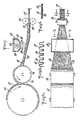
- FIG. 1 Illustrated in Figure 1, in schematic side elevational view, is a production line for making a sliver embodying the teachings of this invention.
- Fibers are carried on the partially illustrated cylinder 10 to a carding machine by the teeth 12 of the card clothing of the cylinder 10.
- Such fibers have been fed into the carding machine, generally in the form of lap rolls and may comprise commonly used cellulosic fibers such as cotton, regenerated cellulosic fibers, such as rayon staple, chemically modified cellulosic fibers, such as ethers and esters of cellulose exemplified by carboxy- methoxy cellulose, or grafted interpolymers of cellulose such as those described in U.S. Patent No.
- the fibers fed to the carding machine are preferably a blend of cotton combers and staple rayon.
- the cotton combers have an arithmetic average fiber length of 5 to 12 mm.
- the rayon fibers have a staple length of from 2.54 to 5.08 cm (1 to 2 inches). While the proportions of rayon to cotton may vary widely, a highly satisfactory product is obtained when the percentage of cotton, based on the weight of the rayon-cotton mixture, varies from 10 to 50%.
- the purpose of the carding process is variously, to reduce the weight per unit area of the feed material, clean the feed material, disentangle the fibers and separate the bunches, tufts, or knots into individual fibers and generally orient the fibers in the machine direction.
- These objectives are accomplished, in alternative forms of carding machines, by transferring the fibers from teeth on the surface of sequentially aligned cylinders while applying various devices to comb and brush the fibers and while providing means for screening out undesirable fractions of the feed material.
- a suitable carding machine is the revolving flat card manufactured by the Saco-Lowell Company of Waltham, Massachusetts, U.S.A.
- the combed and carded fibers are transferred from the teeth 12 of the cylinder clothing 10 to the finer teeth 14 of the clothing of the doffer 16- which rotates in a direction counter to that of the cylinder 10.
- Various means known in the art, may be employed for stripping the now fully carded and combined fibers from the doffer.
- One such system accomplishes this task by use of vacuum stripping and is generally known the art as a Saco-Lowell vacuum stripper.
- the fibers are removed from the doffer in the form of a gossamer-like web 18, generally oriented in the machine direction, and fed onto the surface of a width-reducing pan 20.
- its weight per unit area is extremely low as compared with that of the finished sliver 22 and may be, for example, as little as 0.01 times the weight per unit area of the finished sliver 22.
- the formed web is 0.025 to .075 times the finished weight per unit area.
- the finished sliver for use in catamenial tampons may have a weight per unit area of 240 g/m 3 (200 g/yd 2 ), in which case the web formed immediately upon stripping from the doffer would have a weight per unit area of from 6 to 18 g/m 2 , i.e. about 12 g/m 2 (5 to 15 g/yd 2 , i.e. about 10 g/yd 2 ).
- the desired width of the finished sliver is 5.08 cm (two inches), and the web width from the doffer is 0.91 m (three feet), then a throughput through the carding machine of 12 g/linear meter (11 g/linear yard) will produce the desired weights per unit area.
- the web formed from the doffer is compacted by pulling it through the width reducing pan 20 which may be a trough-like surface of gradually diminished width. As the web is so moved through the reducing pan, it is gathered into a series of pleats extending longitudinally in the machine direction and distributed across its width, and concomitantly the weight per unit area is increased until the web is compacted to the desired weight per unit area of the finished sliver.
- the thickness and density of the finished sliver is controlled by having the web pass through the nip 24 of two cooperating calender rollers 25, 26 which in essence compress the web by collapsing the gathered pleats.
- particulate matter is introduced into the finished sliver by depositing such matter onto the web at a point wherein the web has not yet been compacted into its final weight per unit area but instead is substantially less compacted; e.g. at a point intermediate the doffer and the calender rollers while the web is in the width reducing pan.
- the precise point at which such material is best deposited will vary depending upon the nature of the particulate material being deposited and in particular upon the size of the particulate material.
- Examplary particulate material deposited onto webs ultimately to be used in body absorbent products may be the so-called hydrocolloids which consist of particles, i.e. powders or fibers; of water insoluble but highly water swellable polymeric substances capable of absorbing water in an amount that is at least ten times their own dry weight and is preferably 15 to 70 times their dry weight or more.
- Such material may be described chemically as having a backbone of natural or synthetic polymers with hydrophilic groups, or polymers containing hydrophilic groups, chemically bonded thereto or in intimate admixture therewith.
- modified natural and regenerated polymers such as polysaccharides, including for example cellulose, starch and regenerated cellulose which are modified by being carboxyalkylated, phosphonoalkylated, sulphoalkylated or phosphorylated to render them highly hydrophilic.
- modified polymers may also be cross-linked to enhance their hydrophilicity and render them water insoluble.
- polysachharides may also serve, for example, as the backbone onto which other polymer moieties may be bonded by graft copolymerization techniques.
- Such grafted polysaccharides and their method of manufacture are described in U.S. Patent No. 4,105,033 issued on August 8,1978, to P. K. Chatterjee, et al.
- a and B are selected from -OR 3 , -O (alkali metal), -ONH 4 , -NH 2 , wherein R 1 , R 2 and R 3 are selected from hydrogen and alkyl having 1 to 4 carbon atoms, wherein r is an integer having a value of 0 to 5000, s is an integer having a value of 0 to 5000, r plus s is at least 500, p is an integer having a value of zero or 1 and q is an integer having a value of 1 to 4.
- the preferred hydrophilic chains are hydrolyzed polyacrylonitrile chains and copolymers of polyacrylamide and sodium polyacrylate.
- the hydrocolloid particles may comprise wholly synthetic hydrophilic particles.
- examples of those now known in the art are polyacrylonitrile fibers which may be modified by grafting moieties thereon such as polyvinyl alcohol chains, polyvinyl alcohol itself, hydrophilic polyurethane, poly(alkyl phosphonates) partially hydrolyzed poly acrylamides (e.g., poly (N - N - Dimethyl acrylamide), sulfonated polystyrene, or poly alkylene oxide).
- These highly hydrophilic synthetic polymers may be modified by other chemical treatments such as crosslinking or hydrolysis.
- the hydrocolloid particles may take various physical shapes such as powders, fibers or flakes. Specific examples are fibers of carboxyalkylated cellulose, powders of carboxyalkylated start or ground fibers of the grafted polysaccharides described in the aforementioned U.S. Patent No. 4,105,033.
- the particulate matter is a hydrocolloid having an average particle size range of from .03 to 3.0 mm and desirably in the shape of fibers. In this particle size range, it is desirable to deposit this particulate matter onto the web when the web has a weight per unit of from .015 to 0.1 times that of the finished sliver.
- the particulate material should be deposited on the web at the point wherein the web has a weight of 6.24 to 87.5 g/m 2 (5.2 to 72.9 g/yd 2 ). It has been discovered that by so positioning the point of deposition, the web has sufficient compaction to retain the bulk of the particulate matter. At the same time, the web is capable of being further compacted so as to get the desired homogeneous distribution of particulate matter throughout the finished sliver.
- Any suitable means for depositing the particulate material onto the surface of the web at the prescribed position may be employed.
- One such means, illustrated in Figures 1 and 2 is to provide a hopper or other similar supply container 28 of particulate matter 30.
- the hopper 28 is provided with a perforated bottom, e.g. a screen 32, having apertures of sufficient size to permit the controlled release of the particulate matter onto the web.
- a rotating rake 34 or similar means may be employed to further control the flow of particular material from the hopper, through the screen and onto the web. It will be understood by those skilled in the art that other means for depositing the material onto the web may be employed, including, for example, reciprocating shakers and vibrating screen devices.
- Figure 3 is a cross-sectional view of the web taken along line 3-3 of Fig. 2, i.e. just downstream of the deposition point.
- the fibrous web 18 is loosely gathered into longitudinally extending pleats distributed across the width of the web.
- the particulate matter 30 tends to settle and fill in the troughs of those pleats thus forming, in transverse cross-section, an alternating series of columns of fibrous web and particulate matter.
- the illustrated width reducing pan has a generally flat surface and the pleating of the web 18 is a manifestation of pulling the web through the pan of continuously reduced width.
- the pleated web bearing the deposited particulate matter, proceeds toward the nip 24 of the calender rollers 25 and 26 and becomes more and more compacted owing to the reduced width of the pan.
- the web now has the weight per unit area desired in the finished sliver.
- the nip 24 of the rollers 25, 26 is adjusted to provide the degree of compression needed to compress the sliver to its desired height and density.
- slivers suitable for use in catamenial tampons will have a thickness or height of 5.00 to 10.0 mm and a density of 0.2 to 1.2 g/cc.
- Figure 4 illustrates the finished sliver 22 in cross-sectional view, taken along line 4-4 of Figure 2. As illustrated, the pleats have been compacted by the pan and collapsed by the calender rollers producing, in essence, a sliver having homogeneously distributed particulate matter 30 therethrough.
- a sliver is prepared in accordance with the process described in connection with Figure 1.
- the feed material is a lap of staple rayon and cotton chamber fibers wherein the rayon fibers have a staple length of 3.81 to 4.0 cm (1.5 to 1.56 inches) and the cotton comber fibers are about 9 mm in length.
- the lap comprises approximately 75%, by weight, rayon fibers, the remainder being the cotton comber fibers.
- the feed lap is fed through a Saco-Lowell Card at the throughput rate of approximately 13.5 g per linear meter (11.25 g. per linear yard).
- a gossamer-like web of carded fibers is stripped from the doffer and pulled through a width reducing pan and through the nip of calender rollers.
- the width reducing pan has an upstream width of 96.5 cm (38 inches) and reduces to 5.08 cm (2 inches) within a length of 76.2 (30 inches).
- the web leaving the doffer has a weight of 12.7 g/m 2 (10.6 g/yd 2 ) and the finished 5.08 cm (2-inch) wide sliver has a weight of 294 g/m 2 (203.4 g/yd 2 ).
- a hopper of the type shown in connection with Figure 1 straddles the reducing pan and deposits onto the web a hydrocolloid particulate material.
- This material is that described in U.S. Patent 3,889,678 and, specifically, sample number 4, in Table II, of that patent.
- This material is a cellulose graft copolymer consisting of a cellulose backbone having grafted thereto polymer moieties consisting of copolymers of sodium acrylate and ethylacrylate in a weight ratio of 19.8 parts by weight cellulose to 33.9 parts by weight of poly(ethylacrylate) to 46.3 parts by weight of poly (sodium acrylate).
- This hydrocolloid is in fibrous form with the fibers having an arithmetic average fiber length of approximately 0.8 mm. Approximately 15 g of hydrocolloid material is deposited per 85 g of rayon-cotton web.
- the sliver is pulled through the nip of the rollers which is set at a gap of less than 0.62 cm (1/4 inch) providing a sliver having a density of about 0.029 g/cc.
- the resulting product is one in which the sliver has the particulate hydrocolloid well distributed therethrough.
- a series of catamenial tampons are made from the sliver described in connection with Example I above.
- the long sliver comprising a relatively homogeneous mixture of fibers 18 and particles 30, is divided into rectangular pads measuring 22.9 cm (9 inches) in length (the carding machine direction) and 5.08 cm (2 inches) in width.
- a cylindrical tampon blank 36 is formed by rolling a pad 35 from one end to the other in a direction parallel to the longitudinal sides of the pad. The rolled pad is then compressed in a die to the desired tampon shape 38, as is illustrated in Figure 8.
- the tampon is provided with the usual withdrawal string 40 which may be sewn through the removal end of the tampon. Forthis example, the string is applied by looping the same around the rectangular pad priorto rolling the pad into a blank. For simplicity, this is not shown in Figure 7.
- a second series of tampons are prepared for comparative purposes. Rectangular pads measuring 22.9x10.2 cm (9 inches by 4 inches) are prepared from slivers made essentially in the same manner as described above with the exception that such slivers are, of course, wider and no particulate material is deposited thereon. Particulate matter of the type described above is then added to this pad in the manner described in the aforementioned U.S. Patent No. 4,105,033, i.e. by sprinkling such particulate matter onto the surface of the pad. The pad is then folded along a longitudinal center line 43, as is illustrated in Figure 3, to form a double layer of fibrous webs 42 sandwiching therebetween a layer of particulate matter 44. The pad is then rolled into a cylindrical tampon blank 46 as illustrated and in the manner described in connection with Figure 7.
- the blank 46 is compressed in a die into the final tampon shape 48, as illustrated in Figure 6, with a withdrawal string 50 being provided as is described above.
- the two series of tampons are each tested, non-menstrually, by panels of women to determine the respective resistances to sloughing, i.e. the breaking and dusting of particles from the surface of the tampon.
- the women are instructed to use the tampons for two hours. Thereafter, the tampons are returned and evaluated by a judge who assigns a numeric value to the degree of fiber disturbance observed by comparing each tampon to ranked pictorial standards.
- the numeric ranking system is as follows: The results of the test are recorded below.
Landscapes
- Health & Medical Sciences (AREA)
- Engineering & Computer Science (AREA)
- General Health & Medical Sciences (AREA)
- Veterinary Medicine (AREA)
- Public Health (AREA)
- Chemical & Material Sciences (AREA)
- Epidemiology (AREA)
- Life Sciences & Earth Sciences (AREA)
- Animal Behavior & Ethology (AREA)
- Materials Engineering (AREA)
- Hematology (AREA)
- Dispersion Chemistry (AREA)
- Manufacturing & Machinery (AREA)
- Biomedical Technology (AREA)
- Heart & Thoracic Surgery (AREA)
- Vascular Medicine (AREA)
- Absorbent Articles And Supports Therefor (AREA)
- Filtering Materials (AREA)
- Yarns And Mechanical Finishing Of Yarns Or Ropes (AREA)
- Preliminary Treatment Of Fibers (AREA)
Claims (26)

Priority Applications (1)
| Application Number | Priority Date | Filing Date | Title |
|---|---|---|---|
| AT81305741T ATE19945T1 (de) | 1980-12-05 | 1981-12-04 | Vliesbahn, in dem materialteilchen verteilt sind. |
Applications Claiming Priority (2)
| Application Number | Priority Date | Filing Date | Title |
|---|---|---|---|
| US06/213,439 US4340556A (en) | 1980-12-05 | 1980-12-05 | Production of fibrous sliver having particulate matter distributed therethrough |
| US213439 | 1980-12-05 |
Publications (3)
| Publication Number | Publication Date |
|---|---|
| EP0053928A2 EP0053928A2 (fr) | 1982-06-16 |
| EP0053928A3 EP0053928A3 (en) | 1983-05-04 |
| EP0053928B1 true EP0053928B1 (fr) | 1986-05-28 |
Family
ID=22795139
Family Applications (1)
| Application Number | Title | Priority Date | Filing Date |
|---|---|---|---|
| EP81305741A Expired EP0053928B1 (fr) | 1980-12-05 | 1981-12-04 | Couche fibreuse dans laquelle sont distribuées des particules de substance |
Country Status (9)
| Country | Link |
|---|---|
| US (1) | US4340556A (fr) |
| EP (1) | EP0053928B1 (fr) |
| AT (1) | ATE19945T1 (fr) |
| AU (1) | AU547372B2 (fr) |
| CA (1) | CA1170811A (fr) |
| DE (1) | DE3174742D1 (fr) |
| MX (1) | MX156237A (fr) |
| NZ (1) | NZ199070A (fr) |
| ZA (1) | ZA818451B (fr) |
Cited By (3)
| Publication number | Priority date | Publication date | Assignee | Title |
|---|---|---|---|---|
| US5580418A (en) | 1992-11-06 | 1996-12-03 | Kimberly-Clark Corporation | Apparatus for making film laminated material |
| US5667625A (en) | 1992-11-06 | 1997-09-16 | Kimberly-Clark Worldwide, Inc. | Apparatus for forming a fibrous laminated material |
| US5817394A (en) | 1993-11-08 | 1998-10-06 | Kimberly-Clark Corporation | Fibrous laminated web and method and apparatus for making the same and absorbent articles incorporating the same |
Families Citing this family (40)
| Publication number | Priority date | Publication date | Assignee | Title |
|---|---|---|---|---|
| EP0075791B1 (fr) * | 1981-09-30 | 1986-04-09 | VEB Leipziger Arzneimittelwerk | Pansement vulnéraire absorbant et procédés de sa fabrication |
| US4627849A (en) * | 1982-06-30 | 1986-12-09 | Kimberly-Clark Corporation | Tampon |
| US4610678A (en) * | 1983-06-24 | 1986-09-09 | Weisman Paul T | High-density absorbent structures |
| DE3347649A1 (de) * | 1983-12-30 | 1985-07-11 | Johnson & Johnson GmbH, 4000 Düsseldorf | Tampon fuer die frauenhygiene sowie verfahren und einrichtung zur herstellung desselben |
| US4655757A (en) * | 1984-04-23 | 1987-04-07 | Kimberly-Clark Corporation | Selective layering of superabsorbents in meltblown substrates |
| US4604313A (en) * | 1984-04-23 | 1986-08-05 | Kimberly-Clark Corporation | Selective layering of superabsorbents in meltblown substrates |
| US4551191A (en) * | 1984-06-29 | 1985-11-05 | The Procter & Gamble Company | Method for uniformly distributing discrete particles on a moving porous web |
| GB2175024B (en) * | 1985-04-15 | 1988-07-06 | Procter & Gamble | Absorbent structures |
| GB8512206D0 (en) * | 1985-05-14 | 1985-06-19 | Kimberly Clark Ltd | Non-woven material |
| US4764325A (en) * | 1986-05-28 | 1988-08-16 | The Procter & Gamble Company | Apparatus for and methods of forming airlaid fibrous webs having a multiplicity of components |
| IL82511A (en) * | 1986-05-28 | 1992-09-06 | Procter & Gamble | Apparatus for and methods of airlaying fibrous webs having discrete particles therein |
| US4908175A (en) * | 1986-05-28 | 1990-03-13 | The Procter & Gamble Company | Apparatus for and methods of forming airlaid fibrous webs having a multiplicity of components |
| US5047023A (en) * | 1986-07-18 | 1991-09-10 | The Procter & Gamble Company | Absorbent members having low density and basis weight acquisition zones |
| US5017324A (en) * | 1986-12-08 | 1991-05-21 | Nordson Corporation | Method for depositing particulate material into a pad of fibrous material in a forming chamber |
| NZ222302A (en) * | 1986-12-08 | 1989-09-27 | Nordson Corp | Spraying moisture absorbent particles into a layer of forming non woven wadding |
| US4927346A (en) * | 1986-12-08 | 1990-05-22 | Nordson Corporation | Apparatus for depositing particulate material into a pad of fibrous material in a forming chamber |
| PH25432A (en) * | 1987-01-28 | 1991-07-01 | Kao Corp | Absorbent composite |
| US5061259A (en) * | 1987-08-19 | 1991-10-29 | The Procter & Gamble Company | Absorbent structures with gelling agent and absorbent articles containing such structures |
| JPH0438790Y2 (fr) * | 1988-04-07 | 1992-09-10 | ||
| EP0359615A1 (fr) * | 1988-09-01 | 1990-03-21 | James River Corporation Of Virginia | Fabrication de structures composites superabsorbantes |
| US5156902A (en) * | 1990-01-09 | 1992-10-20 | Kimberly-Clark Corporation | Method and apparatus for intermittently depositing particulate material in a substrate and article made therewith |
| US5102585A (en) * | 1990-01-09 | 1992-04-07 | Kimberly-Clark Corporation | Method for intermittently depositing particulate material in a substrate |
| US5028224A (en) * | 1990-01-09 | 1991-07-02 | Kimberly-Clark Corporation | Apparatus for intermittently depositing particulate material in a substrate |
| US5505718A (en) * | 1990-04-02 | 1996-04-09 | The Procter & Gamble Company | Absorbent structures containing specific particle size distributions of superabsorbent hydrogel-forming materials |
| US5143680A (en) * | 1990-05-17 | 1992-09-01 | Nordson Corporation | Method and apparatus for depositing moisture-absorbent and thermoplastic material in a substrate |
| US5422169A (en) * | 1991-04-12 | 1995-06-06 | The Procter & Gamble Company | Absorbent structures containing specific particle size distributions of superabsorbent hydrogel-forming materials in relatively high concentrations |
| US5419956A (en) * | 1991-04-12 | 1995-05-30 | The Procter & Gamble Company | Absorbent structures containing specific particle size distributions of superabsorbent hydrogel-forming materials mixed with inorganic powders |
| CA2114815C (fr) * | 1993-02-24 | 2005-06-14 | Mark Kevin Melius | Composite absorbant |
| CA2181163C (fr) | 1994-01-21 | 2008-02-19 | Phyllis Leithem | Extraction caustique a froid de pates pour produits absorbants |
| US5766159A (en) * | 1995-07-06 | 1998-06-16 | International Paper Company | Personal hygiene articles for absorbing fluids |
| WO1997004162A2 (fr) * | 1995-07-17 | 1997-02-06 | Rayonier, Inc. | Feuille de pate a papier obtenue par voie humide se pretant a une transformation immediate en produit absorbant |
| US7152761B2 (en) * | 2002-01-04 | 2006-12-26 | Paragon Trade Brands, Inc. | System and method for dry forming zoned absorbent cores |
| US20030135176A1 (en) * | 2002-01-16 | 2003-07-17 | Troy Delzer | System and method for depositing particulate matter in absorbent cores |
| US6992028B2 (en) * | 2002-09-09 | 2006-01-31 | Kimberly-Clark Worldwide, Inc. | Multi-layer nonwoven fabric |
| US7103445B2 (en) | 2002-11-27 | 2006-09-05 | Kimberly-Clark Worldwide, Inc. | System and method for controlling the dispense rate of particulate material |
| JP4134052B2 (ja) * | 2005-01-19 | 2008-08-13 | 株式会社 ハリーズ | 生理用タンポンの製造方法及び製造装置 |
| WO2008057581A1 (fr) * | 2006-11-08 | 2008-05-15 | Playtex Products, Inc. | Compresse de tampon à meilleure prévention des fuites de contournement. |
| US9375507B2 (en) | 2013-04-10 | 2016-06-28 | Evonik Corporation | Particulate superabsorbent polymer composition having improved stability |
| US9302248B2 (en) | 2013-04-10 | 2016-04-05 | Evonik Corporation | Particulate superabsorbent polymer composition having improved stability |
| CN108699747B (zh) * | 2016-01-27 | 2021-03-02 | 株式会社瑞光 | 含颗粒体物品的制造装置以及含颗粒体物品的制造方法 |
Citations (1)
| Publication number | Priority date | Publication date | Assignee | Title |
|---|---|---|---|---|
| US4105033A (en) * | 1974-12-09 | 1978-08-08 | Personal Products Company | Powdered grafted cellulose |
Family Cites Families (12)
| Publication number | Priority date | Publication date | Assignee | Title |
|---|---|---|---|---|
| US2409066A (en) * | 1943-01-23 | 1946-10-08 | Johns Manville | Manufacture of felted products |
| US2483406A (en) * | 1943-11-20 | 1949-10-04 | American Viscose Corp | Process and apparatus for producing fibrous materials |
| US2495420A (en) * | 1944-07-11 | 1950-01-24 | Popper | Apparatus for making intravaginal packs |
| NL189176B (nl) * | 1956-07-13 | 1900-01-01 | Hisamitsu Pharmaceutical Co | Pleister op basis van een synthetische rubber. |
| US3047444A (en) * | 1955-07-15 | 1962-07-31 | Kimberly Clark Co | Non-woven fabric and method of making the same |
| US3063453A (en) * | 1960-04-06 | 1962-11-13 | Personal Products Corp | Absorbent product |
| BE661729A (fr) * | 1965-03-26 | 1965-07-16 | ||
| US3399671A (en) * | 1966-02-01 | 1968-09-03 | Kendall & Co | Spray coated absorbent dressing |
| US3525337A (en) * | 1967-10-30 | 1970-08-25 | Kimberly Clark Co | Absorbent accordion pleated shaped pad with backing sheet |
| US4268340A (en) * | 1973-08-05 | 1981-05-19 | Colgate-Palmolive Company | Method of forming an absorbent article |
| US4053674A (en) * | 1975-09-12 | 1977-10-11 | Fiberlok, Inc. | Glow-resistant batt and process for producing such |
| US4186165A (en) * | 1976-06-14 | 1980-01-29 | Johnson & Johnson | Method of producing an absorbent panel having densified portion with hydrocolloid material fixed therein |
-
1980
- 1980-12-05 US US06/213,439 patent/US4340556A/en not_active Expired - Lifetime
-
1981
- 1981-11-25 NZ NZ199070A patent/NZ199070A/en unknown
- 1981-12-01 AU AU77982/81A patent/AU547372B2/en not_active Expired
- 1981-12-03 MX MX190407A patent/MX156237A/es unknown
- 1981-12-04 EP EP81305741A patent/EP0053928B1/fr not_active Expired
- 1981-12-04 CA CA000391559A patent/CA1170811A/fr not_active Expired
- 1981-12-04 DE DE8181305741T patent/DE3174742D1/de not_active Expired
- 1981-12-04 ZA ZA818451A patent/ZA818451B/xx unknown
- 1981-12-04 AT AT81305741T patent/ATE19945T1/de not_active IP Right Cessation
Patent Citations (1)
| Publication number | Priority date | Publication date | Assignee | Title |
|---|---|---|---|---|
| US4105033A (en) * | 1974-12-09 | 1978-08-08 | Personal Products Company | Powdered grafted cellulose |
Cited By (4)
| Publication number | Priority date | Publication date | Assignee | Title |
|---|---|---|---|---|
| US5580418A (en) | 1992-11-06 | 1996-12-03 | Kimberly-Clark Corporation | Apparatus for making film laminated material |
| US5667625A (en) | 1992-11-06 | 1997-09-16 | Kimberly-Clark Worldwide, Inc. | Apparatus for forming a fibrous laminated material |
| US5667619A (en) | 1992-11-06 | 1997-09-16 | Kimberly-Clark Worldwide, Inc. | Method for making a fibrous laminated web |
| US5817394A (en) | 1993-11-08 | 1998-10-06 | Kimberly-Clark Corporation | Fibrous laminated web and method and apparatus for making the same and absorbent articles incorporating the same |
Also Published As
| Publication number | Publication date |
|---|---|
| AU547372B2 (en) | 1985-10-17 |
| CA1170811A (fr) | 1984-07-17 |
| DE3174742D1 (en) | 1986-07-03 |
| ATE19945T1 (de) | 1986-06-15 |
| US4340556A (en) | 1982-07-20 |
| NZ199070A (en) | 1985-02-28 |
| AU7798281A (en) | 1982-06-10 |
| MX156237A (es) | 1988-07-27 |
| ZA818451B (en) | 1983-07-27 |
| EP0053928A2 (fr) | 1982-06-16 |
| EP0053928A3 (en) | 1983-05-04 |
Similar Documents
| Publication | Publication Date | Title |
|---|---|---|
| EP0053928B1 (fr) | Couche fibreuse dans laquelle sont distribuées des particules de substance | |
| US4429001A (en) | Sheet product containing sorbent particulate material | |
| US5817085A (en) | Method for the manufacturing of an absorbent structure and an absorbent article | |
| US4902559A (en) | Absorbent body of nonwoven material and a method for the production thereof | |
| US5330457A (en) | Enhanced core utilization in absorbent products | |
| US4755178A (en) | Sorbent sheet material | |
| US4354901A (en) | Flexible absorbent boards | |
| US4655757A (en) | Selective layering of superabsorbents in meltblown substrates | |
| US4604313A (en) | Selective layering of superabsorbents in meltblown substrates | |
| US4551142A (en) | Flexible absorbent boards | |
| EP0156649A2 (fr) | Matériau en feuille absorbant | |
| US4915897A (en) | Transverse pocket forming machine and method for use thereof | |
| JPH0116500B2 (fr) | ||
| WO2002049565B1 (fr) | Structure absorbante mince de grande capacite et procede de production de celle-ci | |
| CA2391528A1 (fr) | Parties centrales absorbantes a gradient de densite y | |
| EP0256869A2 (fr) | Procédé d'application de poudre dans une structure absorbante fibreuse | |
| WO2003057104A1 (fr) | Procede et appareil d'ajout de matieres particulaires | |
| JPH0482961A (ja) | 不織布製造用処理剤 | |
| NZ207081A (en) | Fibrous sliver,for body fluid absorbent product,having longitudinally extending pleats | |
| US3225390A (en) | Method of producing filter plugs | |
| EP4628057A1 (fr) | Compression sans courroie de support de mélanges de particules et de fibres avec une seule courroie maîtresse | |
| JP2003509204A (ja) | ろ過媒体およびその製造方法 |
Legal Events
| Date | Code | Title | Description |
|---|---|---|---|
| PUAI | Public reference made under article 153(3) epc to a published international application that has entered the european phase |
Free format text: ORIGINAL CODE: 0009012 |
|
| AK | Designated contracting states |
Designated state(s): AT BE GB |
|
| PUAL | Search report despatched |
Free format text: ORIGINAL CODE: 0009013 |
|
| AK | Designated contracting states |
Designated state(s): AT BE GB |
|
| 17P | Request for examination filed |
Effective date: 19831010 |
|
| RBV | Designated contracting states (corrected) |
Designated state(s): AT GB |
|
| RBV | Designated contracting states (corrected) |
Designated state(s): AT DE GB |
|
| GRAA | (expected) grant |
Free format text: ORIGINAL CODE: 0009210 |
|
| AK | Designated contracting states |
Kind code of ref document: B1 Designated state(s): AT DE GB |
|
| REF | Corresponds to: |
Ref document number: 19945 Country of ref document: AT Date of ref document: 19860615 Kind code of ref document: T |
|
| REF | Corresponds to: |
Ref document number: 3174742 Country of ref document: DE Date of ref document: 19860703 |
|
| PLBE | No opposition filed within time limit |
Free format text: ORIGINAL CODE: 0009261 |
|
| STAA | Information on the status of an ep patent application or granted ep patent |
Free format text: STATUS: NO OPPOSITION FILED WITHIN TIME LIMIT |
|
| 26N | No opposition filed | ||
| PGFP | Annual fee paid to national office [announced via postgrant information from national office to epo] |
Ref country code: GB Payment date: 20001129 Year of fee payment: 20 Ref country code: DE Payment date: 20001129 Year of fee payment: 20 |
|
| PGFP | Annual fee paid to national office [announced via postgrant information from national office to epo] |
Ref country code: AT Payment date: 20001213 Year of fee payment: 20 |
|
| PG25 | Lapsed in a contracting state [announced via postgrant information from national office to epo] |
Ref country code: GB Free format text: LAPSE BECAUSE OF EXPIRATION OF PROTECTION Effective date: 20011203 |
|
| PG25 | Lapsed in a contracting state [announced via postgrant information from national office to epo] |
Ref country code: AT Free format text: LAPSE BECAUSE OF EXPIRATION OF PROTECTION Effective date: 20011204 |
|
| REG | Reference to a national code |
Ref country code: GB Ref legal event code: PE20 Effective date: 20011203 |