EP0054461B1 - Procédé de purification de solutions de gallium - Google Patents
Procédé de purification de solutions de gallium Download PDFInfo
- Publication number
- EP0054461B1 EP0054461B1 EP81401894A EP81401894A EP0054461B1 EP 0054461 B1 EP0054461 B1 EP 0054461B1 EP 81401894 A EP81401894 A EP 81401894A EP 81401894 A EP81401894 A EP 81401894A EP 0054461 B1 EP0054461 B1 EP 0054461B1
- Authority
- EP
- European Patent Office
- Prior art keywords
- gallium
- solution
- organic phase
- chloride
- process according
- Prior art date
- Legal status (The legal status is an assumption and is not a legal conclusion. Google has not performed a legal analysis and makes no representation as to the accuracy of the status listed.)
- Expired
Links
- GYHNNYVSQQEPJS-UHFFFAOYSA-N Gallium Chemical compound [Ga] GYHNNYVSQQEPJS-UHFFFAOYSA-N 0.000 title claims abstract description 90
- 229910052733 gallium Inorganic materials 0.000 title claims abstract description 90
- 238000000034 method Methods 0.000 title claims abstract description 27
- 239000000243 solution Substances 0.000 claims abstract description 85
- UPWPDUACHOATKO-UHFFFAOYSA-K gallium trichloride Chemical compound Cl[Ga](Cl)Cl UPWPDUACHOATKO-UHFFFAOYSA-K 0.000 claims abstract description 18
- 238000000605 extraction Methods 0.000 claims abstract description 17
- 239000007864 aqueous solution Substances 0.000 claims abstract description 16
- 239000003456 ion exchange resin Substances 0.000 claims abstract description 8
- 229920003303 ion-exchange polymer Polymers 0.000 claims abstract description 8
- NWUYHJFMYQTDRP-UHFFFAOYSA-N 1,2-bis(ethenyl)benzene;1-ethenyl-2-ethylbenzene;styrene Chemical compound C=CC1=CC=CC=C1.CCC1=CC=CC=C1C=C.C=CC1=CC=CC=C1C=C NWUYHJFMYQTDRP-UHFFFAOYSA-N 0.000 claims abstract description 7
- MWKFXSUHUHTGQN-UHFFFAOYSA-N decan-1-ol Chemical compound CCCCCCCCCCO MWKFXSUHUHTGQN-UHFFFAOYSA-N 0.000 claims abstract description 6
- 239000012074 organic phase Substances 0.000 claims description 35
- VEXZGXHMUGYJMC-UHFFFAOYSA-N Hydrochloric acid Chemical compound Cl VEXZGXHMUGYJMC-UHFFFAOYSA-N 0.000 claims description 30
- 238000005406 washing Methods 0.000 claims description 21
- YIWUKEYIRIRTPP-UHFFFAOYSA-N 2-ethylhexan-1-ol Chemical compound CCCCC(CC)CO YIWUKEYIRIRTPP-UHFFFAOYSA-N 0.000 claims description 17
- 239000011347 resin Substances 0.000 claims description 17
- 229920005989 resin Polymers 0.000 claims description 17
- 238000000746 purification Methods 0.000 claims description 16
- 239000003795 chemical substances by application Substances 0.000 claims description 15
- VEXZGXHMUGYJMC-UHFFFAOYSA-M Chloride anion Chemical compound [Cl-] VEXZGXHMUGYJMC-UHFFFAOYSA-M 0.000 claims description 13
- 239000012535 impurity Substances 0.000 claims description 12
- XLYOFNOQVPJJNP-UHFFFAOYSA-N water Substances O XLYOFNOQVPJJNP-UHFFFAOYSA-N 0.000 claims description 10
- 239000008346 aqueous phase Substances 0.000 claims description 9
- -1 hydrocarbon radical Chemical class 0.000 claims description 9
- 125000003158 alcohol group Chemical group 0.000 claims description 8
- 239000000203 mixture Substances 0.000 claims description 7
- BBMCTIGTTCKYKF-UHFFFAOYSA-N 1-heptanol Chemical compound CCCCCCCO BBMCTIGTTCKYKF-UHFFFAOYSA-N 0.000 claims description 6
- LRHPLDYGYMQRHN-UHFFFAOYSA-N N-Butanol Chemical compound CCCCO LRHPLDYGYMQRHN-UHFFFAOYSA-N 0.000 claims description 6
- AMQJEAYHLZJPGS-UHFFFAOYSA-N N-Pentanol Chemical compound CCCCCO AMQJEAYHLZJPGS-UHFFFAOYSA-N 0.000 claims description 6
- KBPLFHHGFOOTCA-UHFFFAOYSA-N caprylic alcohol Natural products CCCCCCCCO KBPLFHHGFOOTCA-UHFFFAOYSA-N 0.000 claims description 6
- 125000004432 carbon atom Chemical group C* 0.000 claims description 6
- ZXEKIIBDNHEJCQ-UHFFFAOYSA-N isobutanol Chemical compound CC(C)CO ZXEKIIBDNHEJCQ-UHFFFAOYSA-N 0.000 claims description 6
- 239000004215 Carbon black (E152) Substances 0.000 claims description 5
- 239000002253 acid Substances 0.000 claims description 5
- ZSIAUFGUXNUGDI-UHFFFAOYSA-N hexan-1-ol Chemical compound CCCCCCO ZSIAUFGUXNUGDI-UHFFFAOYSA-N 0.000 claims description 5
- 229930195733 hydrocarbon Natural products 0.000 claims description 5
- 150000001298 alcohols Chemical class 0.000 claims description 4
- 150000003242 quaternary ammonium salts Chemical class 0.000 claims description 4
- BWDBEAQIHAEVLV-UHFFFAOYSA-N 6-methylheptan-1-ol Chemical compound CC(C)CCCCCO BWDBEAQIHAEVLV-UHFFFAOYSA-N 0.000 claims description 3
- HPXRVTGHNJAIIH-UHFFFAOYSA-N cyclohexanol Chemical compound OC1CCCCC1 HPXRVTGHNJAIIH-UHFFFAOYSA-N 0.000 claims description 3
- TVMXDCGIABBOFY-UHFFFAOYSA-N n-Octanol Natural products CCCCCCCC TVMXDCGIABBOFY-UHFFFAOYSA-N 0.000 claims description 3
- CHRJZRDFSQHIFI-UHFFFAOYSA-N 1,2-bis(ethenyl)benzene;styrene Chemical group C=CC1=CC=CC=C1.C=CC1=CC=CC=C1C=C CHRJZRDFSQHIFI-UHFFFAOYSA-N 0.000 claims description 2
- PLLBRTOLHQQAQQ-UHFFFAOYSA-N 8-methylnonan-1-ol Chemical compound CC(C)CCCCCCCO PLLBRTOLHQQAQQ-UHFFFAOYSA-N 0.000 claims description 2
- 125000001931 aliphatic group Chemical group 0.000 claims description 2
- 229920001577 copolymer Polymers 0.000 claims description 2
- MYRTYDVEIRVNKP-UHFFFAOYSA-N divinylbenzene Substances C=CC1=CC=CC=C1C=C MYRTYDVEIRVNKP-UHFFFAOYSA-N 0.000 claims description 2
- 150000002500 ions Chemical class 0.000 abstract description 4
- 229910052782 aluminium Inorganic materials 0.000 abstract description 3
- 229910052791 calcium Inorganic materials 0.000 abstract description 3
- 229910052749 magnesium Inorganic materials 0.000 abstract description 3
- 229910021645 metal ion Inorganic materials 0.000 abstract description 3
- 229910052708 sodium Inorganic materials 0.000 abstract description 3
- 229910052720 vanadium Inorganic materials 0.000 abstract description 3
- 229910052725 zinc Inorganic materials 0.000 abstract description 3
- NLXLAEXVIDQMFP-UHFFFAOYSA-N Ammonia chloride Chemical compound [NH4+].[Cl-] NLXLAEXVIDQMFP-UHFFFAOYSA-N 0.000 abstract description 2
- 229910052804 chromium Inorganic materials 0.000 abstract description 2
- 239000011260 aqueous acid Substances 0.000 abstract 1
- 239000012141 concentrate Substances 0.000 abstract 1
- 229910052745 lead Inorganic materials 0.000 abstract 1
- XEEYBQQBJWHFJM-UHFFFAOYSA-N Iron Chemical compound [Fe] XEEYBQQBJWHFJM-UHFFFAOYSA-N 0.000 description 11
- 239000012071 phase Substances 0.000 description 11
- 238000000638 solvent extraction Methods 0.000 description 6
- 229910052742 iron Inorganic materials 0.000 description 5
- 238000000622 liquid--liquid extraction Methods 0.000 description 5
- XKBGEWXEAPTVCK-UHFFFAOYSA-M methyltrioctylammonium chloride Chemical compound [Cl-].CCCCCCCC[N+](C)(CCCCCCCC)CCCCCCCC XKBGEWXEAPTVCK-UHFFFAOYSA-M 0.000 description 5
- 125000004429 atom Chemical group 0.000 description 4
- 150000003254 radicals Chemical class 0.000 description 4
- QGZKDVFQNNGYKY-UHFFFAOYSA-O Ammonium Chemical compound [NH4+] QGZKDVFQNNGYKY-UHFFFAOYSA-O 0.000 description 3
- UHOVQNZJYSORNB-UHFFFAOYSA-N Benzene Chemical compound C1=CC=CC=C1 UHOVQNZJYSORNB-UHFFFAOYSA-N 0.000 description 3
- 229920002125 Sokalan® Polymers 0.000 description 3
- YXFVVABEGXRONW-UHFFFAOYSA-N Toluene Chemical compound CC1=CC=CC=C1 YXFVVABEGXRONW-UHFFFAOYSA-N 0.000 description 3
- 230000002378 acidificating effect Effects 0.000 description 3
- 239000002585 base Substances 0.000 description 3
- 229920001429 chelating resin Polymers 0.000 description 3
- VLKZOEOYAKHREP-UHFFFAOYSA-N n-Hexane Chemical compound CCCCCC VLKZOEOYAKHREP-UHFFFAOYSA-N 0.000 description 3
- 238000011084 recovery Methods 0.000 description 3
- 238000004131 Bayer process Methods 0.000 description 2
- OYPRJOBELJOOCE-UHFFFAOYSA-N Calcium Chemical compound [Ca] OYPRJOBELJOOCE-UHFFFAOYSA-N 0.000 description 2
- HEDRZPFGACZZDS-UHFFFAOYSA-N Chloroform Chemical compound ClC(Cl)Cl HEDRZPFGACZZDS-UHFFFAOYSA-N 0.000 description 2
- RYGMFSIKBFXOCR-UHFFFAOYSA-N Copper Chemical compound [Cu] RYGMFSIKBFXOCR-UHFFFAOYSA-N 0.000 description 2
- YNQLUTRBYVCPMQ-UHFFFAOYSA-N Ethylbenzene Chemical compound CCC1=CC=CC=C1 YNQLUTRBYVCPMQ-UHFFFAOYSA-N 0.000 description 2
- DGAQECJNVWCQMB-PUAWFVPOSA-M Ilexoside XXIX Chemical compound C[C@@H]1CC[C@@]2(CC[C@@]3(C(=CC[C@H]4[C@]3(CC[C@@H]5[C@@]4(CC[C@@H](C5(C)C)OS(=O)(=O)[O-])C)C)[C@@H]2[C@]1(C)O)C)C(=O)O[C@H]6[C@@H]([C@H]([C@@H]([C@H](O6)CO)O)O)O.[Na+] DGAQECJNVWCQMB-PUAWFVPOSA-M 0.000 description 2
- FYYHWMGAXLPEAU-UHFFFAOYSA-N Magnesium Chemical compound [Mg] FYYHWMGAXLPEAU-UHFFFAOYSA-N 0.000 description 2
- IMNFDUFMRHMDMM-UHFFFAOYSA-N N-Heptane Chemical compound CCCCCCC IMNFDUFMRHMDMM-UHFFFAOYSA-N 0.000 description 2
- PXHVJJICTQNCMI-UHFFFAOYSA-N Nickel Chemical compound [Ni] PXHVJJICTQNCMI-UHFFFAOYSA-N 0.000 description 2
- HCHKCACWOHOZIP-UHFFFAOYSA-N Zinc Chemical compound [Zn] HCHKCACWOHOZIP-UHFFFAOYSA-N 0.000 description 2
- 229910052784 alkaline earth metal Inorganic materials 0.000 description 2
- XAGFODPZIPBFFR-UHFFFAOYSA-N aluminium Chemical compound [Al] XAGFODPZIPBFFR-UHFFFAOYSA-N 0.000 description 2
- ANBBXQWFNXMHLD-UHFFFAOYSA-N aluminum;sodium;oxygen(2-) Chemical compound [O-2].[O-2].[Na+].[Al+3] ANBBXQWFNXMHLD-UHFFFAOYSA-N 0.000 description 2
- 239000011575 calcium Substances 0.000 description 2
- 150000001805 chlorine compounds Chemical class 0.000 description 2
- 229910017052 cobalt Inorganic materials 0.000 description 2
- 239000010941 cobalt Substances 0.000 description 2
- GUTLYIVDDKVIGB-UHFFFAOYSA-N cobalt atom Chemical compound [Co] GUTLYIVDDKVIGB-UHFFFAOYSA-N 0.000 description 2
- 229910052802 copper Inorganic materials 0.000 description 2
- 239000010949 copper Substances 0.000 description 2
- 239000003085 diluting agent Substances 0.000 description 2
- SNRUBQQJIBEYMU-UHFFFAOYSA-N dodecane Chemical compound CCCCCCCCCCCC SNRUBQQJIBEYMU-UHFFFAOYSA-N 0.000 description 2
- 239000011777 magnesium Substances 0.000 description 2
- WPBNNNQJVZRUHP-UHFFFAOYSA-L manganese(2+);methyl n-[[2-(methoxycarbonylcarbamothioylamino)phenyl]carbamothioyl]carbamate;n-[2-(sulfidocarbothioylamino)ethyl]carbamodithioate Chemical compound [Mn+2].[S-]C(=S)NCCNC([S-])=S.COC(=O)NC(=S)NC1=CC=CC=C1NC(=S)NC(=O)OC WPBNNNQJVZRUHP-UHFFFAOYSA-L 0.000 description 2
- 239000011734 sodium Substances 0.000 description 2
- 229910001388 sodium aluminate Inorganic materials 0.000 description 2
- 239000000126 substance Substances 0.000 description 2
- VZGDMQKNWNREIO-UHFFFAOYSA-N tetrachloromethane Chemical compound ClC(Cl)(Cl)Cl VZGDMQKNWNREIO-UHFFFAOYSA-N 0.000 description 2
- GPPXJZIENCGNKB-UHFFFAOYSA-N vanadium Chemical compound [V]#[V] GPPXJZIENCGNKB-UHFFFAOYSA-N 0.000 description 2
- 239000011701 zinc Substances 0.000 description 2
- ZOXJGFHDIHLPTG-UHFFFAOYSA-N Boron Chemical compound [B] ZOXJGFHDIHLPTG-UHFFFAOYSA-N 0.000 description 1
- VYZAMTAEIAYCRO-UHFFFAOYSA-N Chromium Chemical compound [Cr] VYZAMTAEIAYCRO-UHFFFAOYSA-N 0.000 description 1
- CWYNVVGOOAEACU-UHFFFAOYSA-N Fe2+ Chemical compound [Fe+2] CWYNVVGOOAEACU-UHFFFAOYSA-N 0.000 description 1
- OKIZCWYLBDKLSU-UHFFFAOYSA-M N,N,N-Trimethylmethanaminium chloride Chemical compound [Cl-].C[N+](C)(C)C OKIZCWYLBDKLSU-UHFFFAOYSA-M 0.000 description 1
- CTQNGGLPUBDAKN-UHFFFAOYSA-N O-Xylene Chemical compound CC1=CC=CC=C1C CTQNGGLPUBDAKN-UHFFFAOYSA-N 0.000 description 1
- OAICVXFJPJFONN-UHFFFAOYSA-N Phosphorus Chemical compound [P] OAICVXFJPJFONN-UHFFFAOYSA-N 0.000 description 1
- ZLMJMSJWJFRBEC-UHFFFAOYSA-N Potassium Chemical compound [K] ZLMJMSJWJFRBEC-UHFFFAOYSA-N 0.000 description 1
- ATJFFYVFTNAWJD-UHFFFAOYSA-N Tin Chemical compound [Sn] ATJFFYVFTNAWJD-UHFFFAOYSA-N 0.000 description 1
- RTAQQCXQSZGOHL-UHFFFAOYSA-N Titanium Chemical compound [Ti] RTAQQCXQSZGOHL-UHFFFAOYSA-N 0.000 description 1
- 150000007513 acids Chemical class 0.000 description 1
- 150000007824 aliphatic compounds Chemical class 0.000 description 1
- 239000003513 alkali Substances 0.000 description 1
- 150000001342 alkaline earth metals Chemical class 0.000 description 1
- 239000003957 anion exchange resin Substances 0.000 description 1
- 125000000129 anionic group Chemical class 0.000 description 1
- 150000001491 aromatic compounds Chemical class 0.000 description 1
- 229910052785 arsenic Inorganic materials 0.000 description 1
- RQNWIZPPADIBDY-UHFFFAOYSA-N arsenic atom Chemical compound [As] RQNWIZPPADIBDY-UHFFFAOYSA-N 0.000 description 1
- 229910052788 barium Inorganic materials 0.000 description 1
- DSAJWYNOEDNPEQ-UHFFFAOYSA-N barium atom Chemical compound [Ba] DSAJWYNOEDNPEQ-UHFFFAOYSA-N 0.000 description 1
- 229910052796 boron Inorganic materials 0.000 description 1
- 229910052793 cadmium Inorganic materials 0.000 description 1
- BDOSMKKIYDKNTQ-UHFFFAOYSA-N cadmium atom Chemical compound [Cd] BDOSMKKIYDKNTQ-UHFFFAOYSA-N 0.000 description 1
- 239000011651 chromium Substances 0.000 description 1
- 150000001875 compounds Chemical class 0.000 description 1
- AJNVQOSZGJRYEI-UHFFFAOYSA-N digallium;oxygen(2-) Chemical compound [O-2].[O-2].[O-2].[Ga+3].[Ga+3] AJNVQOSZGJRYEI-UHFFFAOYSA-N 0.000 description 1
- IQDGSYLLQPDQDV-UHFFFAOYSA-N dimethylazanium;chloride Chemical compound Cl.CNC IQDGSYLLQPDQDV-UHFFFAOYSA-N 0.000 description 1
- 239000000284 extract Substances 0.000 description 1
- 230000002349 favourable effect Effects 0.000 description 1
- 239000012527 feed solution Substances 0.000 description 1
- 229910001195 gallium oxide Inorganic materials 0.000 description 1
- IXCSERBJSXMMFS-UHFFFAOYSA-N hcl hcl Chemical compound Cl.Cl IXCSERBJSXMMFS-UHFFFAOYSA-N 0.000 description 1
- 229910052738 indium Inorganic materials 0.000 description 1
- APFVFJFRJDLVQX-UHFFFAOYSA-N indium atom Chemical compound [In] APFVFJFRJDLVQX-UHFFFAOYSA-N 0.000 description 1
- 239000003701 inert diluent Substances 0.000 description 1
- 238000009434 installation Methods 0.000 description 1
- 239000003350 kerosene Substances 0.000 description 1
- 229910052747 lanthanoid Inorganic materials 0.000 description 1
- 150000002602 lanthanoids Chemical class 0.000 description 1
- 239000011133 lead Substances 0.000 description 1
- 238000004519 manufacturing process Methods 0.000 description 1
- 229910052759 nickel Inorganic materials 0.000 description 1
- VLTRZXGMWDSKGL-UHFFFAOYSA-N perchloric acid Chemical class OCl(=O)(=O)=O VLTRZXGMWDSKGL-UHFFFAOYSA-N 0.000 description 1
- 230000000737 periodic effect Effects 0.000 description 1
- 239000003208 petroleum Substances 0.000 description 1
- 239000011574 phosphorus Substances 0.000 description 1
- 229910052698 phosphorus Inorganic materials 0.000 description 1
- 229920001467 poly(styrenesulfonates) Polymers 0.000 description 1
- 229910052700 potassium Inorganic materials 0.000 description 1
- 239000011591 potassium Substances 0.000 description 1
- 238000011403 purification operation Methods 0.000 description 1
- 125000001453 quaternary ammonium group Chemical group 0.000 description 1
- 230000000717 retained effect Effects 0.000 description 1
- 229920006395 saturated elastomer Polymers 0.000 description 1
- 238000000926 separation method Methods 0.000 description 1
- 239000002904 solvent Substances 0.000 description 1
- 229910052712 strontium Inorganic materials 0.000 description 1
- CIOAGBVUUVVLOB-UHFFFAOYSA-N strontium atom Chemical compound [Sr] CIOAGBVUUVVLOB-UHFFFAOYSA-N 0.000 description 1
- 229910052718 tin Inorganic materials 0.000 description 1
- 239000010936 titanium Substances 0.000 description 1
- 229910052719 titanium Inorganic materials 0.000 description 1
- 239000008096 xylene Substances 0.000 description 1
- 229910052727 yttrium Inorganic materials 0.000 description 1
- VWQVUPCCIRVNHF-UHFFFAOYSA-N yttrium atom Chemical compound [Y] VWQVUPCCIRVNHF-UHFFFAOYSA-N 0.000 description 1
Images

Classifications
-
- C—CHEMISTRY; METALLURGY
- C01—INORGANIC CHEMISTRY
- C01G—COMPOUNDS CONTAINING METALS NOT COVERED BY SUBCLASSES C01D OR C01F
- C01G15/00—Compounds of gallium, indium or thallium
- C01G15/003—Preparation involving a liquid-liquid extraction, an adsorption or an ion-exchange
-
- C—CHEMISTRY; METALLURGY
- C22—METALLURGY; FERROUS OR NON-FERROUS ALLOYS; TREATMENT OF ALLOYS OR NON-FERROUS METALS
- C22B—PRODUCTION AND REFINING OF METALS; PRETREATMENT OF RAW MATERIALS
- C22B3/00—Extraction of metal compounds from ores or concentrates by wet processes
- C22B3/20—Treatment or purification of solutions, e.g. obtained by leaching
- C22B3/42—Treatment or purification of solutions, e.g. obtained by leaching by ion-exchange extraction
-
- C—CHEMISTRY; METALLURGY
- C22—METALLURGY; FERROUS OR NON-FERROUS ALLOYS; TREATMENT OF ALLOYS OR NON-FERROUS METALS
- C22B—PRODUCTION AND REFINING OF METALS; PRETREATMENT OF RAW MATERIALS
- C22B58/00—Obtaining gallium or indium
-
- Y—GENERAL TAGGING OF NEW TECHNOLOGICAL DEVELOPMENTS; GENERAL TAGGING OF CROSS-SECTIONAL TECHNOLOGIES SPANNING OVER SEVERAL SECTIONS OF THE IPC; TECHNICAL SUBJECTS COVERED BY FORMER USPC CROSS-REFERENCE ART COLLECTIONS [XRACs] AND DIGESTS
- Y02—TECHNOLOGIES OR APPLICATIONS FOR MITIGATION OR ADAPTATION AGAINST CLIMATE CHANGE
- Y02P—CLIMATE CHANGE MITIGATION TECHNOLOGIES IN THE PRODUCTION OR PROCESSING OF GOODS
- Y02P10/00—Technologies related to metal processing
- Y02P10/20—Recycling
Definitions
- the present invention relates to a method for purifying gallium solutions in order to obtain high purity gallium chloride solutions.
- It relates more particularly to a process for the purification of acidic gallium solutions which makes it possible to obtain gallium solutions of purity greater than 99.99%.
- gallium in the field of electronics require that it be obtained at very high degrees of purity. It therefore appears necessary to have methods which make it possible to obtain, from gallium solutions which do not meet the desired purity specifications, gallium solutions of purity greater than 99.99%; solutions from which it is very easy to obtain gallium oxide or metallic gallium at the degrees of purity necessary for their various applications.
- the Applicant has developed a process for the purification of impure gallium solutions which makes it possible to obtain excellent purification in the various elements and in particular in iron.
- This process essentially comprises the combination of a step of fixing the gallium in solution on an ion exchange resin, which performs a first purification, then a concentration of the gallium in the solution for eluting the resin and a step of purification of the solution obtained by liquid-liquid extraction using a solvent which selectively extracts the gallium.
- aqueous gallium acid solutions which can be purified according to the process of the invention, with a view to obtaining solutions of very high purity, can be of very diverse origin. They are preferably solutions of at least one of the acids taken from the group consisting of hydrochloric, sulfuric and perchloric acids.
- the impurities contained in these solutions can be very varied in nature and in quantity, these can be constituted by the various metal ions of the periodic classification of the elements and in particular those of calcium, magnesium, aluminum, vanadium, chromium, copper, manganese , sodium, zinc, cobalt, nickel, lead, cadmium, indium, barium, strontium, potassium, titanium, lanthanides, yttrium, arsenic, iron (especially in the ferric state), phosphorus, tin, boron, etc.
- the concentration of gallium in these solutions can vary within very wide limits; however the method according to the present invention is particularly advantageous for purifying solutions diluted in gallium, the concentration of which is, for example, less than about 10 g / l.
- the process according to the present invention is particularly suitable for the purification of aqueous solutions resulting from the process for recovering gallium from the sodium aluminate solutions of the Bayer process as described in particular in French patents 2 277 897, 2 307 047 and 2,307,882, French patent applications no. 76 29009 and 77 21607 and European patent application 0 002 970 in the name of the applicant.
- the concentration of chloride ions in the gallium solution is adjusted, if necessary, to a value between 3.5 and 8 M and preferably between 4.5 and 6 M.
- This concentration is preferably adjusted by adding hydrochloric acid to the gallium solution.
- the gallium solution is brought into contact with an ion-exchange resin of the strong base type of gel or macrore-ticulated character, which very selectively fixes the gallium, it is believed, essentially in the form of an anionic complex GaC1 4 .
- the resins that can be used are in particular those comprising the patterns of formulas: or in which R represents, for example, a styrene-divinylbenzene or acrylic-divinylbenzene copolymer.
- the products sold under the brands are used: Dowex 1, Duolite A 101 D, Duolite A 42, Lewatit M 500, Amberlite IRA 400, Amberlite IRA 410, Amberlite IRA 900, Amberlite IRA 910, Permutit ESB (A) .
- Their fixing capacity is generally between approximately 80 and 120 g of gallium per liter of resin.
- the resin loaded with gallium is washed with a hydrochloric acid solution, the concentration of which is preferably greater than or equal to 5 M in order to remove the impurities retained with the gallium on the resin.
- gallium is then recovered by eluting the resin with water.
- a concentrated and purified solution of gallium chloride is thus obtained, the concentration of which is generally approximately 40 to 60 g / l of gallium and the free acidity of which is approximately 1 to 2 M.
- the concentration - purification step on resin can be implemented in conventional devices and in particular by placing the resin in columns arranged in series.
- the chloride ion concentration of the solution obtained is adjusted to a value between 4 and 6 M in the same way as described above preferably by adding hydrochloric acid to said solution.
- the concentrated aqueous gallium solution is then brought into contact with an organic phase containing a gallium extracting agent substantially insoluble in water, and optionally an inert diluent, so that the gallium either selectively extracted in the organic phase.
- the proportion of extracting agent in the organic phase is not critical and can vary within wide limits. However, it is generally advantageous that this is as high as possible. Thus, in the case of quaternary ammonium salts, a proportion of between approximately 3% and approximately 30% by volume relative to the organic phase leads to advantageous hydrodynamic purification conditions. In the case of alcohols, their proportion generally varies from 10 to 100% by volume relative to the organic phase; the less viscous can be used pure, that is to say not diluted in the organic phase, which is particularly advantageous since this leads to very high extraction capacities.
- the organic phase may in particular further contain, as is well known to those skilled in the art, a diluent.
- a diluent usually used in the field of liquid-liquid extraction, there may be mentioned aliphatic compounds, such as, for example, heptane, dodecane, hexane, and petroleum cuts of the kerosene type; aromatic compounds such as, for example, benzene, toluene, ethylbenzene, xylene and cuts of the Solvesso type (trademark registered by the company Exxon) and finally the halogenated derivatives of these compounds such as, for example, chloroform or carbon tetrachloride.
- the aqueous phase is separated from the organic phase which contains the gallium and then a selective washing operation is carried out on this organic phase which eliminates the remaining impurities which have been extracted in small quantities with the gallium.
- washing solution a mixture consisting on the one hand, of a hydrochloric acid solution of concentration advantageously between 7 and 12 M and, on the other hand, of a fraction of the final aqueous solution purified from gallium chloride.
- the aqueous washing solution obtained which contains the impurities and a little gallium can optionally be recycled with the initial acidic aqueous solution of gallium to undergo again the purification operations.
- the purified gallium is then transferred from the organic phase to an aqueous solution by bringing the organic phase having undergone the washing operation described above into contact with water.
- the organic phase is separated from the aqueous phase.
- the aqueous phase obtained contains pure gallium in the form of gallium chloride with a purity greater than 99.99%.
- the stages of extraction, selective washing and recovery of gallium can be implemented in conventional devices used in liquid-liquid extraction processes.
- Such devices generally comprise several stages of mixer-settler systems or of packed and / or agitated columns, arranged to carry out the operations of extraction, selective washing and recovery in aqueous phase of the extracted element.
- This solution has the composition and contains the various impurities at the following concentrations:
- the chloride ion concentration of this solution is adjusted to 4.5 M by adding 76 l of 12 M hydrochloric acid.
- the first column When the first column is saturated with gallium, that is to say after having passed the 202 liters of the feed solution, it is isolated and is washed with 10 l of a 6 M hydrochloric acid solution.
- gallium chloride GaCI 3 is obtained, the composition of which is as follows:
- the chloride ion concentration of the solution obtained is adjusted to 5.4 M by adding 2.5 liters of 12 M hydrochloric acid.
- Selective washing is carried out by introduction into stage 40 of a 2M hydrochloric acid (HCl) solution with a flow rate of 90 ml / h.
- HCl hydrochloric acid
- the spent aqueous phase (E) leaving stage 1 contains all the impurities and hands of 100 mg / l of gallium, which corresponds to an extraction rate greater than 99.5%.
- the 2-ethylhexanol (S) charged with gallium leaving the battery A feeds a battery B of 5 stages in which the gallium is recovered in aqueous solution by contacting against the current of (S) with water with a flow rate of 320 ml / h.
- a solution of gallium chloride (GaCl 3 ) is obtained, the composition of which is as follows:
- the gallium in the solution obtained thus has a purity greater than 99.99%.
- the gallium solution obtained according to Example 1 is used after passing through resin. Its composition is:
- the chloride ion concentration is adjusted to 6M by adding 3 liters of 12M HCl, thus obtaining a solution of gallium chloride (G). Then this is brought into contact with an organic phase (S) consisting of tricapryl methyl methyl ammonium chloride (sold under the brand Aliquat 336 in chloride form) in 6% solution in Solvesso 150 (trademark registered by the company Exxon).
- S organic phase
- This operation is carried out in a liquid-liquid extraction battery (A) operating against the current and comprising 12 theoretical stages.
- the organic phase (S) supplies the battery on stage 1 with a flow rate of 2540 ml / h.
- the gallium solution (G) is introduced into the battery on stage 6 with a flow rate of 300 ml / h.
- Selective washing of the charged organic phase is carried out in stages 6 to 12 with a washing solution (L) described below.
- the organic phase leaving A containing the purified gallium then feeds the battery B of 5 theoretical stages on stage 1 in which it is re-extracted by water entering stage 5 with a flow rate of 1270 ml / h in the form of a solution of gallium chloride at 14 g / I of Ga.
- 635 ml / h of this solution are taken and constitute the production while 635 ml / h are joined to 635 ml / h of HCl 12M to constitute the washing solution L which then supplies the battery A on stage 12.
- the exhausted solution E contains all the impurities and less than 50 mg / I of Ga, that is to say that more than 99% of the gallium has been extracted.
- the purified gallium solution has the following composition: which corresponds for gallium to a purity greater than 99.99%.
Landscapes
- Chemical & Material Sciences (AREA)
- Organic Chemistry (AREA)
- Engineering & Computer Science (AREA)
- Metallurgy (AREA)
- Mechanical Engineering (AREA)
- Materials Engineering (AREA)
- Manufacturing & Machinery (AREA)
- Geology (AREA)
- Life Sciences & Earth Sciences (AREA)
- Geochemistry & Mineralogy (AREA)
- General Life Sciences & Earth Sciences (AREA)
- Environmental & Geological Engineering (AREA)
- Inorganic Chemistry (AREA)
- Manufacture And Refinement Of Metals (AREA)
- Extraction Or Liquid Replacement (AREA)
- Organic Low-Molecular-Weight Compounds And Preparation Thereof (AREA)
- Physical Or Chemical Processes And Apparatus (AREA)
Description
- La présente invention concerne un procédé de purification de solutions de gallium en vue d'obtenir des solutions de chlorure de gallium de haute pureté.
- Elle a trait plus particulièrement à un procédé de purification de solutions aqueuses acides de gallium permettant d'obtenir des solutions de gallium de pureté supérieure à 99,99%.
- Les diverses applications du gallium dans le domaine de l'électronique nécessitent d'obtenir celui-ci à des degrés de pureté très grands. Il s'avère ainsi nécessaire de disposer de procédés qui permettent d'obtenir, à partir des solutions de gallium qui ne répondent pas aux spécifications de pureté désirées, des solutions de gallium de pureté supérieure à 99,99%; solutions à partir desquelles on pourra obtenir très aisément l'oxyde de gallium ou le gallium métallique aux degrés de pureté nécessaires à leurs diverses applications.
- Divers procédés ont été proposés pour séparer le gallium des autres impuretés, les plus efficaces jusqu'à ce jour mettent en oeuvre les résines échangeuses d'ions.
- Toutefois, la séparation du gallium de certains ions métalliques comme ceux de calcium, magnésium, aluminium, cobalt, vanadium, cuivre, manganèse, sodium, zinc et en particulier du fer à l'état ferrique s'avère insuffisante par fixation, sélective du gallium de la solution à purifier sur résine échangeuse d'anion (Chemical Abstracts Vol 55 [1961] 21974 IV). Pour résoudre le problème de la purification en fer à l'état ferrique il a été proposé (Chemical Abstracts Vol 55 [1961] 21974 V et Vol 74 [1971] 108688 k) de réduire préalablement celui-ci en fer ferreux avant le passage sur résine. Mais, un tel procédé présente toutefois l'inconvénient essentiel de ne pas permettre une purification suffisante de la solution de gallium.
- La demanderesse a mis au point un procédé de purification de solutions impures de gallium qui permet d'obtenir une excellente purification dans les divers éléments et en particulier en fer. Ce procédé comporte essentiellement la combinaison d'une étape de fixation du gallium en solution sur une résine échangeuse d'ion, qui réalise une première purification, puis une concentration du gallium dans la solution d'élution de la résine et d'une étape de purification de la solution obtenue par extraction liquide-liquide à l'aide d'un solvant qui extrait sélectivement le gallium.
- La présente invention concerne en effet un procédé de purification d'une solution aqueuse acide de gallium en vue d'obtenir une solution de chlorure de gallium de très haute pureté caractérisé en ce que:
- a) On ajuste, la concentration en ions chlorure de la solution aqueuse acide de gallium à une valeur comprise entre 3,5 et 8 M.
- b) Puis on met en contact la solution de gallium avec une résine échangeuse d'ions du type base forte qui fixe le gallium; après lavage de la résine avec une solution d'acide chlorhydrique de concentration supérieure ou égale à 5 M, on élue le gallium de la résine avec de l'eau pour obtenir une solution aqueuse concentrée de chlorure de gallium.
- c) On ajuste la concentration en ions chlorure de la solution obtenue à une valeur comprise entre 4 et 6 M.
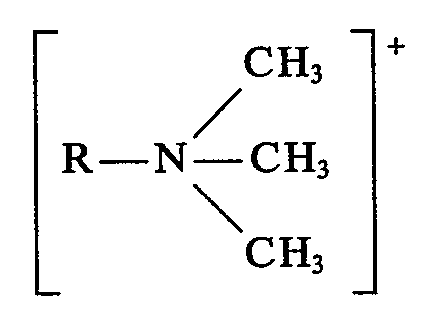
- d) On met en contact la solution aqueuse concentrée de chlorure de gallium avec une phase organique contenant un agent d'extraction du gallium insoluble dans l'eau, choisi parmi les alcools de formule générale ROH dans laquelle R est un radical hydrocarboné aliphatique et/ou cycloaliphatique ayant de préférence un nombre d'atomes de carbone compris entre 4 et 10, ou parmi les sels d'ammonium quaternaires de formule

- e) On réalise un lavage sélectif de cette phase organique qui élimine les impuretés restantes.
- f) Puis on opère le transfert du gallium purifié de la phase organique dans une solution aqueuse et enfin on sépare la phase organique de la phase aqueuse contenant le chlorure de gallium pur.
- Les solutions aqueuses acides de gallium que l'on peut purifier selon le procédé de l'invention, en vue d'obtenir des solutions de très grande pureté, peuvent être d'origine très diverses. Elles sont de préférence des solutions d'au moins un des acides pris dans le groupe constitué par les acides chlorhydrique, sulfurique, perchlorique.
- Les impuretés contenues dans ces solutions peuvent être très variées en nature et en quantité, celles-ci peuvent être constituées par les divers ions métalliques de la classification périodique des éléments et notamment ceux de calcium, magnésium, aluminium, vanadium, chrome, cuivre, manganèse, sodium, zinc, cobalt, nickel, plomb, cadmium, indium, barium, strontium, potassium, titane, lanthanides, yttrium, arsenic, fer (à l'état ferrique en particulier), phosphore, étain, bore, etc. Par ailleurs, la concentration du gallium dans ces solutions peut varier dans de très larges limites; toutefois le procédé selon la présente invention est particulièrement avantageux pour purifier des solutions diluées en gallium dont la concentration est, par exemple, inférieure à 10 g/I environ.
- Le procédé selon la présente invention est particulièrement adapté à la purification des solutions aqueuses issues du procédé de récupération du gallium des solutions d'aluminate de sodium du procédé Bayer tel que décrit notamment dans les brevets français n° 2 277 897, 2 307 047 et 2 307 882, les demandes de brevets français n° 76 29009 et 77 21607 et la demande de brevet européen 0 002 970 au nom de la demanderesse.
- Selon le procédé de l'invention, on ajuste, si cela s'avère nécessaire, la concentration en ions chlorure de la solution de gallium à une valeur comprise entre 3,5 et 8 M et de préférence entre 4,5 et 6 M.
- On ajuste cette concentration de préférence par ajout d'acide chlorhydrique à la solution de gallium. On peut également opérer par ajout de n'importe quel chlorure qui ne sera pas fixé par la résine dans l'étape ultérieure; comme chlorures pouvant convenir, on peut notamment citer les chlorures des métaux alcalins ou alcaline-terreux.
- Après avoir ajusté, éventuellement, la concentration en ions chlorure on met en contact la solution de gallium avec une résine échangeuse d'ion du type base forte de caractère gel ou macroré-ticulé, qui fixe très sélectivement le gallium, croît-on, essentiellement sous forme de complexe anionique GaC14. Les résines que l'on peut mettre en oeuvre sont notamment celles comportant les motifs de formules:


- Leur capacité de fixation est généralement comprise entre environ 80 et 120 g de gallium par litre de résine. Lorsque l'opération de fixation est réalisée, on lave la résine chargée de gallium avec une solution d'acide chlorhydrique dont la concentration est de préférence supérieure ou égale à 5 M afin d'éliminer les impuretés retenues avec le gallium sur la résine.
- On opère ensuite la récupération du gallium par élution de la résine avec de l'eau. On obtient ainsi une solution concentrée et purifiée de chlorure de gallium dont la concentration est généralement d'environ 40 à 60 g/I de gallium et dont l'acidité libre est d'environ 1 à 2 M.
- Outre la purification très importante, on a réalisé une concentration notable en gallium de la solution impure initiale. Cette concentration est particulièrement favorable à la deuxième étape de purification par extraction par solvant tant du point de vue de son efficacité qu'en ce qui concerne la réduction de la taille des installations qu'elle permet.
- L'étape de concentration - purification sur résine peut être mise en oeuvre dans les dispositifs classiques et en particulier en plaçant la résine dans des colonnes disposées en série.
- On ajuste la concentration en ions chlorure de la solution obtenue à une valeur comprise entre 4 et 6 M de la même façon que décrit précédemment de préférence par ajout d'acide chlorhydrique à ladite solution.
- Selon le procédé de l'invention on met ensuite en contact la solution aqueuse concentrée de gallium avec une phase organique contenant un agent d'extraction du gallium substantiellement insoluble dans l'eau, et éventuellement un diluant inerte, de façon à ce que le gallium soit extrait sélectivement dans la phase organique.
- L'agent d'extraction peut notamment être choisi parmi le groupe comportant:
- - les alcools de formule générale ROH dans laquelle R est un radical hydrocarboné aliphatique et/ou cycloaliphatique ayant de préférence un nombre d'atomes de carbone compris entre environ 4 et 10. Parmi ceux-ci, on peut utiliser par exemple le pentanol, le n-butanol, l'isobutanol, le cyclohexanol, le n-hexanol 1, le 2-ethylhexanol, le n-heptanol, le n-octanol, l'isooctanol, le n-décanol, l'isodécanol; on choisira de préférence le 2-éthylhexanol pur,
- - les sels d'ammonium quaternaires de formule

- La proportion en agent d'extraction dans la phase organique n'est pas critique et peut varier dans le larges limites. Toutefois, il est en général avantageux que celle-ci soit la plus élevée possible. Ainsi dans le cas des sels d'ammonium quaternaire, une proportion comprise entre environ 3% et environ 30% en volume rapportée à la phase organique conduit à des conditions hydrodynamiques de purification avantageuses. Dans le cas des alcools, leur proportion varie généralement de 10 à 100% en volume rapportée à la phase organique; les moins visqueux peuvent être utilisés purs, c'est-à-dire non dilués dans la phase organique, ce qui est particulièrement avantageux car cela conduit à des capacités d'extraction très importantes.
- La phase organique peut notamment contenir en outre ainsi qu'il est bien connu de l'homme de l'art, un diluant. Parmi les diluants habituellement mis en oeuvre dans le domaine de l'extraction liquide-liquide, on peut citer les composés aliphatiques, comme par exemple, l'heptane, le dodécane, l'hexane, et les coupes pétrolières du type kérosène; les composés aromatiques comme par exemple, le benzène, le toluène, l'éthylbenzène, le xylène et les coupes du type Solvesso (marque déposée par la Société Exxon) et enfin les dérivés halogénés de ces composés comme, par exemple, le chloroforme ou le tétrachlorure de carbone.
- On sépare la phase aqueuse de la phase organique qui contient le gallium puis on réalise une opération de lavage sélectif de cette phase organique qui élimine les impuretés restantes qui ont été extraites en faible quantité avec le gallium.
- Selon l'agent d'extraction mis en oeuvre, cette opération de lavage sélectif de la phase organique est réalisée de préférence de la façon suivante:
- - lorsque l'agent d'extraction est un alcool, on met en contact la phase organique avec de l'eau ou une solution d'acide chlorhydrique dont la concentration est avantageusement inférieure à 6 M. Les impuretés sont ainsi transférées dans la solution de lavage tandis que la phase organique retient le gallium purifié.
- - Lorsque l'agent d'extraction est un chlorure d'ammonium quaternaire, on met en contact la phase organique avec une solution aqueuse chlorhydrique de lavage présentant une acidité comprise entre 5 et 8 M et contenant entre 1 et 50 g/I de gallium et de préférence entre 3 et 10 g/I.
- On peut par exemple utiliser comme solution de lavage un mélange constitué d'une part, d'une solution d'acide chlorhydrique de concentration avantageusement comprise entre 7 et 12 M et, d'autre part, d'une fraction de la solution aqueuse finale purifiée de chlorure de gallium.
- La solution aqueuse de lavage obtenue qui contient les impuretés et un peu de gallium peut éventuellement être recyclée avec la solution aqueuse acide initiale de gallium pour subir de nouveau les opérations de purification.
- On opère ensuite le transfert du gallium purifié de la phase organique dans une solution aqueuse par mise en contact avec de l'eau de la phase organique ayant subi l'opération de lavage décrite ci-dessus.
- On sépare enfin la phase organique de la phase aqueuse. La phase aqueuse obtenue contient le gallium pur sous forme de chlorure de gallium d'une pureté supérieure à 99,99%.
- Les étapes d'extraction, de lavage sélectif et de récupération du gallium peuvent être mise en oeuvre dans les dispositifs classiques utilisés dans les procédés d'extraction liquide-liquide. De tels dispositifs comprennent généralement plusieurs étages de systèmes mélangeurs-décanteurs ou de colonnes garnies et/ou agitées, agencés pour réaliser les opérations d'extraction, de lavage sélectif et de récupération en phase aqueuse de l'élément extrait.
- Les exemples qui vont suivre illustrent l'invention sans en limiter la portée.
- On opère la purification de 126 litres d'une solution sulfurique de gallium issue du procédé de récupération du gallium des solutions d'aluminate de sodium du procédé Bayer selon le procédé décrit par la demanderesse dans la demande de brevet européen 0 002 970.
- Cette solution a la composition et comporte les diverses impuretés aux concentrations suivantes:

- On ajuste la concentration en ions chlorure de cette solution à la valeur 4,5 M en ajoutant 76 1 d'acide chlorhydrique 12 M.
- Puis on alimente en continu avec la solution obtenu à un débit de 1,2 I/h deux colonnes contenant chacune 2,25 litres de résine ammonium quaternaire vendue par la société Dia-Pro- sim sous la marque Duolite A 101 D.
- Lorsque la première colonne est saturée en gallium, c'est-à-dire après avoir passé les 202 litres de la solution d'alimentation, elle est isolée et est lavée avec 10 1 d'une solution d'acide chlorhydrique 6 M.
- On procède ensuite à l'élution du gallium fixé sur la résine par 3,8 I d'eau à un débit de 11/h, et l'on obtient une solution de chlorure de gallium GaCI3 dont la composition est la suivante:


- On a ainsi réalisé une concentration et une première purification appréciable de la solution de gallium initiale. L'impureté la plus importante restante étant le fer à l'état ferrique (Fe3+).
- On ajuste la concentration en ions chlorure de la solution obtenue à une valeur de 5,4 M par addition de 2,5 litres d'acide chlorhydrique 12 M.
- Puis on met en contact celle-ci avec une phase organique constituée de 2-ethylhexanol. Cette opération est réalisée selon le dispositif décrit à la figure 1 dans une batterie d'extraction liquide-liquide (A) fonctionnant à contre-courant et comprenant 40 étages théoriques. Le 2-éthylhexanol (S) alimente la batterie à l'étage 1 avec un débit de 510 ml/h. La solution de gallium (G) est introduite dans la batterie à l'étage 10 avec un débit de 300 ml/h.
- Le lavage sélectif est réalisé par introduction à l'étage 40 d'une solution d'acide chlorhydrique (HCI)2M avec un débit de 90 ml/h.
- La phase aqueuse épuisée (E) sortant de l'étage 1 contient toutes les impuretés et mains de 100 mg/I de gallium ce qui correspond à un taux d'extraction supérieur à 99,5%.
- Le 2-éthylhexanol (S) chargé en gallium sortant de la batterie A alimente une batterie B de 5 étages dans laquelle on récupère le gallium en solution aqueuse par mise en contact à contre-courant de (S) avec de l'eau avec un débit de 320 ml/h. On obtient une solution de chlorure de gallium (GaCl3) dont la composition est la suivante:

- Le gallium dans la solution obtenue présente ainsi une pureté supérieure à 99,99%.
- On utilise la solution de gallium obtenue selon l'exemple 1 après passage sur résine. Sa comDosition est:

- On se réfère dans ce qui suit à la figure 2.
- On ajuste la concentration en ion chlorure à 6M par addition de 3 litres d'HCI 12M, on obtient ainsi une solution de chlorure de gallium (G). Puis on met en contact celle-ci avec une phase organique (S) constituée de chlorure de tricapry- lyl méthyl ammonium (vendue sous la marque Aliquat 336 sous forme chlorure) en solution à 6% dans le Solvesso 150 (marque déposée par la société Exxon).
- Cette opération est réalisée dans une batterie d'extraction liquide-liquide (A) fonctionnant à contre courant et comportant 12 étages théoriques. La phase organique (S) alimente la batterie à l'étage 1 avec un débit de 2540 ml/h. La solution de gallium (G) est introduite dans la batterie à l'étage 6 avec un débit de 300 ml/h. Le lavage sélectif de la phase organique chargée est réalisé dans les étages 6 à 12 par une solution de lavage (L) décrite ci-après.
- La phase organique sortant de A contenant le gallium purifié alimente alors la batterie B de 5 étages théoriques à l'étage 1 dans laquelle il est réextrait par de l'eau entrant à l'étage 5 avec un débit de 1270 ml/h sous forme d'une solution de chlorure de gallium à 14 g/I de Ga.
- 635 ml/h de cette solution sont prélevés et constituent la production tandis que 635 ml/h sont joints à 635 ml/h d'HCI 12M pour constituer la solution de lavage L qui alimente alors la batterie A à l'étage 12.
- La solution épuisée E contient toutes les impuretés et moins de 50 mg/I de Ga, c'est-à-dire que l'on a extrait plus de 99% du gallium.
- La solution de gallium purifié a la composition suivante:

Claims (9)


Priority Applications (1)
| Application Number | Priority Date | Filing Date | Title |
|---|---|---|---|
| AT81401894T ATE6925T1 (de) | 1980-12-05 | 1981-11-30 | Verfahren zur reinigung von gallium enthaltenden loesungen. |
Applications Claiming Priority (2)
| Application Number | Priority Date | Filing Date | Title |
|---|---|---|---|
| FR8025832A FR2495601A1 (fr) | 1980-12-05 | 1980-12-05 | Procede de purification de solutions de gallium |
| FR8025832 | 1980-12-05 |
Publications (2)
| Publication Number | Publication Date |
|---|---|
| EP0054461A1 EP0054461A1 (fr) | 1982-06-23 |
| EP0054461B1 true EP0054461B1 (fr) | 1984-04-04 |
Family
ID=9248701
Family Applications (1)
| Application Number | Title | Priority Date | Filing Date |
|---|---|---|---|
| EP81401894A Expired EP0054461B1 (fr) | 1980-12-05 | 1981-11-30 | Procédé de purification de solutions de gallium |
Country Status (10)
| Country | Link |
|---|---|
| US (1) | US4404174A (fr) |
| EP (1) | EP0054461B1 (fr) |
| JP (1) | JPS57118026A (fr) |
| AT (1) | ATE6925T1 (fr) |
| CA (1) | CA1165977A (fr) |
| DE (1) | DE3162996D1 (fr) |
| ES (1) | ES507709A0 (fr) |
| FR (1) | FR2495601A1 (fr) |
| GR (1) | GR77300B (fr) |
| YU (1) | YU41800B (fr) |
Families Citing this family (15)
| Publication number | Priority date | Publication date | Assignee | Title |
|---|---|---|---|---|
| AU560201B2 (en) * | 1981-09-17 | 1987-04-02 | Sumitomo Chemical Company, Limited | Gallium recovery |
| JPS59186686A (ja) * | 1983-04-07 | 1984-10-23 | Dowa Mining Co Ltd | 多種の金属イオンを高濃度で含有する液からガリウムまたはインジウムを選択的に分離・濃縮する方法 |
| CH655710A5 (de) * | 1983-11-17 | 1986-05-15 | Sulzer Ag | Verfahren zur fluessig-fluessig-extraktion von gallium aus natriumaluminatloesung mit hilfe eines organischen extraktionsmittels. |
| JPS60166224A (ja) * | 1984-02-03 | 1985-08-29 | Mitsui Alum Kogyo Kk | アルミニウム製錬ダストからのガリウムの回収方法 |
| US4759917A (en) * | 1987-02-24 | 1988-07-26 | Monsanto Company | Oxidative dissolution of gallium arsenide and separation of gallium from arsenic |
| DE3872289T2 (de) * | 1987-04-03 | 1993-02-11 | Sumitomo Chemical Co | Verfahren zur rueckgewinnung von gallium durch chelatharz. |
| FR2614887B1 (fr) * | 1987-05-06 | 1990-11-30 | Rhone Poulenc Chimie | Procede de recuperation de gallium par extraction liquide-liquide |
| FR2616157A1 (fr) * | 1987-06-02 | 1988-12-09 | Pechiney Aluminium | Procede d'extraction et de purification du gallium des liqueurs bayer |
| FR2620695B1 (fr) * | 1987-09-21 | 1990-01-05 | Rhone Poulenc Chimie | Procede de recuperation de gallium par extraction liquide-liquide |
| US4965054A (en) * | 1989-08-01 | 1990-10-23 | Henkel Corporation | Process of extraction of gallium from aqueous solutions thereof |
| FR2654439B1 (fr) * | 1989-11-15 | 1992-02-07 | Rhone Poulenc Chimie | Procede de recuperation de gallium a partir de solutions basiques les contenant. |
| GB0922492D0 (en) * | 2009-12-23 | 2010-02-03 | Hammersmith Imanet Ltd | Method for obtaining 68GA |
| CA2791750C (fr) * | 2010-03-03 | 2017-01-24 | Australian Nuclear Science And Technology Organisation | Purification de gallium-68 |
| JP5894262B2 (ja) * | 2011-05-04 | 2016-03-23 | オーバイト アルミナ インコーポレイテッドOrbite Aluminae Inc. | 種々の鉱石から希土類元素を回収する方法 |
| CN104018012A (zh) * | 2014-06-16 | 2014-09-03 | 中国神华能源股份有限公司 | 一种从氯化铝溶液中提取镓的方法 |
Family Cites Families (5)
| Publication number | Priority date | Publication date | Assignee | Title |
|---|---|---|---|---|
| US3151931A (en) * | 1959-09-02 | 1964-10-06 | Dow Chemical Co | Method of extractively separating mixed metallic species |
| FR1297623A (fr) | 1960-08-27 | 1962-06-29 | Asahi Chemical Ind | Procédé de purification de l'alumine |
| DE2248149A1 (de) * | 1972-09-30 | 1974-04-04 | Bayer Ag | Verfahren zur aufbereitung waessriger kieselfluorwasserstoffsaeuren |
| FR2411894A1 (fr) * | 1977-12-15 | 1979-07-13 | Rhone Poulenc Ind | Procede d'extraction du gallium |
| US4193968A (en) * | 1978-10-03 | 1980-03-18 | The Anaconda Company | Process for recovering gallium |
-
1980
- 1980-12-05 FR FR8025832A patent/FR2495601A1/fr active Granted
-
1981
- 1981-11-30 EP EP81401894A patent/EP0054461B1/fr not_active Expired
- 1981-11-30 US US06/326,166 patent/US4404174A/en not_active Expired - Lifetime
- 1981-11-30 AT AT81401894T patent/ATE6925T1/de not_active IP Right Cessation
- 1981-11-30 DE DE8181401894T patent/DE3162996D1/de not_active Expired
- 1981-12-02 JP JP56193028A patent/JPS57118026A/ja active Granted
- 1981-12-03 YU YU2818/81A patent/YU41800B/xx unknown
- 1981-12-04 GR GR66691A patent/GR77300B/el unknown
- 1981-12-04 CA CA000391520A patent/CA1165977A/fr not_active Expired
- 1981-12-04 ES ES507709A patent/ES507709A0/es active Granted
Also Published As
| Publication number | Publication date |
|---|---|
| ES8207098A1 (es) | 1982-09-01 |
| US4404174A (en) | 1983-09-13 |
| JPS6149249B2 (fr) | 1986-10-28 |
| ES507709A0 (es) | 1982-09-01 |
| GR77300B (fr) | 1984-09-11 |
| FR2495601A1 (fr) | 1982-06-11 |
| FR2495601B1 (fr) | 1985-02-08 |
| CA1165977A (fr) | 1984-04-24 |
| JPS57118026A (en) | 1982-07-22 |
| DE3162996D1 (en) | 1984-05-10 |
| EP0054461A1 (fr) | 1982-06-23 |
| YU41800B (en) | 1987-12-31 |
| YU281881A (en) | 1983-09-30 |
| ATE6925T1 (de) | 1984-04-15 |
Similar Documents
| Publication | Publication Date | Title |
|---|---|---|
| EP0002970B1 (fr) | Procédé d'extraction du gallium et gallium ainsi récupéré | |
| EP0054461A1 (fr) | Procédé de purification de solutions de gallium | |
| EP0102882B1 (fr) | Procédé d'extraction du gallium à l'aide d'hydroxyquinoléines substituées et de composés organophosphorés | |
| EP0021990B1 (fr) | Procédé de traitement de mélange d'oxydes de terres rares et de gallium | |
| EP0388250B1 (fr) | Procédé de traitement de minerais de terres rares | |
| EP0102280B1 (fr) | Procédé d'extraction du gallium à l'aide d'hydroxyquinoléines substituées et de composés organiques comportant un groupement sulfate ou sulfonate | |
| FR2717826A1 (fr) | Procédé pour l'extraction et la séparation du nickel et/ou du cobalt. | |
| EP0418125A1 (fr) | Procédé de traitement de minerais contenant des terres rares | |
| EP0068541B1 (fr) | Procédé pour séparer du germanium d'une solution aqueuse | |
| GB2324791A (en) | Solvent extraction of nickel sulfate | |
| EP0000457B1 (fr) | Procédé de récupération du gallium de solutions très basiques par extraction liquide/liquide. | |
| EP0008992A1 (fr) | Procédé de récupération de l'indium | |
| CA1172426A (fr) | Procede de purification d'une solution de gallium par extraction liquide-liquide a l'aide d'alcools | |
| CA1165534A (fr) | Procede de purification d'une solution de gallium par extraction liquide-liquide a l'aide de sels d'ammonium quaternaires | |
| EP0053971B1 (fr) | Procédé de purification d'une solution de gallium par extraction liquide-liquide | |
| EP0068540A1 (fr) | Procédé pour séparer du germanium d'une solution aqueuse à l'aide d'un alpha-hydroxyoxime | |
| FR2627477A1 (fr) | Procede de traitement de residus contenant des terres rares et du cobalt | |
| US4288413A (en) | Separating molybdenum values from an aqueous solution containing tungsten by solvent extraction | |
| CA1334891C (fr) | Procede de recuperation de gallium par extraction liquide-liquide | |
| FR2583403A1 (fr) | Procede de separation, par precipitation, du molybdene contenu dans des solutions sulfuriques ou nitriques d'uranium. | |
| FI70693B (fi) | Foerfarande foer rening av en galliumloesning | |
| EP0233121A1 (fr) | Procédé d'élimination du plomb de terres rares | |
| FR2660645A1 (fr) | Procede de separation de l'yttrium. | |
| EP0347284B1 (fr) | Procédé de récupération de gallium | |
| KR102529742B1 (ko) | Mo(IV) 및 Re(VII)의 용매 추출 방법 |
Legal Events
| Date | Code | Title | Description |
|---|---|---|---|
| PUAI | Public reference made under article 153(3) epc to a published international application that has entered the european phase |
Free format text: ORIGINAL CODE: 0009012 |
|
| AK | Designated contracting states |
Designated state(s): AT BE CH DE FR GB IT LI LU NL SE |
|
| 17P | Request for examination filed |
Effective date: 19820423 |
|
| RAP1 | Party data changed (applicant data changed or rights of an application transferred) |
Owner name: RHONE-POULENC SPECIALITES CHIMIQUES |
|
| RAP1 | Party data changed (applicant data changed or rights of an application transferred) |
Owner name: RHONE-POULENC SPECIALITES CHIMIQUES |
|
| ITF | It: translation for a ep patent filed | ||
| GRAA | (expected) grant |
Free format text: ORIGINAL CODE: 0009210 |
|
| AK | Designated contracting states |
Designated state(s): AT BE CH DE FR GB IT LI LU NL SE |
|
| REF | Corresponds to: |
Ref document number: 6925 Country of ref document: AT Date of ref document: 19840415 Kind code of ref document: T |
|
| REF | Corresponds to: |
Ref document number: 3162996 Country of ref document: DE Date of ref document: 19840510 |
|
| PG25 | Lapsed in a contracting state [announced via postgrant information from national office to epo] |
Ref country code: LU Free format text: LAPSE BECAUSE OF NON-PAYMENT OF DUE FEES Effective date: 19841130 |
|
| PLBE | No opposition filed within time limit |
Free format text: ORIGINAL CODE: 0009261 |
|
| STAA | Information on the status of an ep patent application or granted ep patent |
Free format text: STATUS: NO OPPOSITION FILED WITHIN TIME LIMIT |
|
| 26N | No opposition filed | ||
| REG | Reference to a national code |
Ref country code: CH Ref legal event code: PUE Owner name: RHONE-POULENC CHIMIE |
|
| PGFP | Annual fee paid to national office [announced via postgrant information from national office to epo] |
Ref country code: SE Payment date: 19901119 Year of fee payment: 10 |
|
| PGFP | Annual fee paid to national office [announced via postgrant information from national office to epo] |
Ref country code: AT Payment date: 19901128 Year of fee payment: 10 |
|
| PGFP | Annual fee paid to national office [announced via postgrant information from national office to epo] |
Ref country code: LU Payment date: 19901130 Year of fee payment: 10 Ref country code: CH Payment date: 19901130 Year of fee payment: 10 |
|
| EPTA | Lu: last paid annual fee | ||
| ITTA | It: last paid annual fee | ||
| PG25 | Lapsed in a contracting state [announced via postgrant information from national office to epo] |
Ref country code: LI Effective date: 19911130 Ref country code: CH Effective date: 19911130 Ref country code: AT Effective date: 19911130 |
|
| PG25 | Lapsed in a contracting state [announced via postgrant information from national office to epo] |
Ref country code: SE Effective date: 19911201 |
|
| REG | Reference to a national code |
Ref country code: CH Ref legal event code: PL |
|
| PGFP | Annual fee paid to national office [announced via postgrant information from national office to epo] |
Ref country code: GB Payment date: 19941122 Year of fee payment: 14 |
|
| PGFP | Annual fee paid to national office [announced via postgrant information from national office to epo] |
Ref country code: BE Payment date: 19941128 Year of fee payment: 14 |
|
| PGFP | Annual fee paid to national office [announced via postgrant information from national office to epo] |
Ref country code: NL Payment date: 19941130 Year of fee payment: 14 |
|
| EUG | Se: european patent has lapsed |
Ref document number: 81401894.1 Effective date: 19920704 |
|
| PG25 | Lapsed in a contracting state [announced via postgrant information from national office to epo] |
Ref country code: GB Effective date: 19951130 Ref country code: BE Effective date: 19951130 |
|
| BERE | Be: lapsed |
Owner name: RHONE-POULENC SPECIALITES CHIMIQUES Effective date: 19951130 |
|
| PG25 | Lapsed in a contracting state [announced via postgrant information from national office to epo] |
Ref country code: NL Effective date: 19960601 |
|
| GBPC | Gb: european patent ceased through non-payment of renewal fee |
Effective date: 19951130 |
|
| NLV4 | Nl: lapsed or anulled due to non-payment of the annual fee |
Effective date: 19960601 |
|
| PGFP | Annual fee paid to national office [announced via postgrant information from national office to epo] |
Ref country code: FR Payment date: 19961122 Year of fee payment: 16 |
|
| PGFP | Annual fee paid to national office [announced via postgrant information from national office to epo] |
Ref country code: DE Payment date: 19961206 Year of fee payment: 16 |
|
| PG25 | Lapsed in a contracting state [announced via postgrant information from national office to epo] |
Ref country code: FR Free format text: THE PATENT HAS BEEN ANNULLED BY A DECISION OF A NATIONAL AUTHORITY Effective date: 19971130 |
|
| PG25 | Lapsed in a contracting state [announced via postgrant information from national office to epo] |
Ref country code: DE Free format text: LAPSE BECAUSE OF NON-PAYMENT OF DUE FEES Effective date: 19980901 |
|
| REG | Reference to a national code |
Ref country code: FR Ref legal event code: ST |