EP0054462A1 - Verfahren zum Losziehen und Abführen einer dünnen, an einer Wand haftenden Materialschicht, Wandstruktur zur Anwendung des Verfahrens und eine solche Wandstruktur umfassende Betontransportvorrichtung - Google Patents
Verfahren zum Losziehen und Abführen einer dünnen, an einer Wand haftenden Materialschicht, Wandstruktur zur Anwendung des Verfahrens und eine solche Wandstruktur umfassende Betontransportvorrichtung Download PDFInfo
- Publication number
- EP0054462A1 EP0054462A1 EP81401897A EP81401897A EP0054462A1 EP 0054462 A1 EP0054462 A1 EP 0054462A1 EP 81401897 A EP81401897 A EP 81401897A EP 81401897 A EP81401897 A EP 81401897A EP 0054462 A1 EP0054462 A1 EP 0054462A1
- Authority
- EP
- European Patent Office
- Prior art keywords
- wall
- aforementioned
- concrete
- layer
- structure according
- Prior art date
- Legal status (The legal status is an assumption and is not a legal conclusion. Google has not performed a legal analysis and makes no representation as to the accuracy of the status listed.)
- Withdrawn
Links
- 239000000463 material Substances 0.000 title claims abstract description 28
- 238000000034 method Methods 0.000 title claims abstract description 22
- 239000012528 membrane Substances 0.000 claims abstract description 24
- 239000012634 fragment Substances 0.000 claims abstract description 5
- 235000019219 chocolate Nutrition 0.000 claims description 6
- 238000013022 venting Methods 0.000 claims description 6
- 229910052500 inorganic mineral Inorganic materials 0.000 claims description 4
- 239000002184 metal Substances 0.000 claims description 4
- 239000011707 mineral Substances 0.000 claims description 4
- 150000003839 salts Chemical class 0.000 claims description 4
- 230000035939 shock Effects 0.000 claims description 4
- 230000005489 elastic deformation Effects 0.000 claims description 2
- 239000004033 plastic Substances 0.000 claims description 2
- 208000006558 Dental Calculus Diseases 0.000 claims 1
- 238000009434 installation Methods 0.000 description 8
- 230000001464 adherent effect Effects 0.000 description 6
- 238000007789 sealing Methods 0.000 description 6
- 238000004519 manufacturing process Methods 0.000 description 5
- 238000006073 displacement reaction Methods 0.000 description 3
- 238000004140 cleaning Methods 0.000 description 2
- 230000000694 effects Effects 0.000 description 2
- 238000013467 fragmentation Methods 0.000 description 2
- 238000006062 fragmentation reaction Methods 0.000 description 2
- 238000000465 moulding Methods 0.000 description 2
- 230000002035 prolonged effect Effects 0.000 description 2
- 238000004064 recycling Methods 0.000 description 2
- 238000000926 separation method Methods 0.000 description 2
- 238000003860 storage Methods 0.000 description 2
- 239000000126 substance Substances 0.000 description 2
- 238000003466 welding Methods 0.000 description 2
- 239000006096 absorbing agent Substances 0.000 description 1
- 238000004026 adhesive bonding Methods 0.000 description 1
- 238000007599 discharging Methods 0.000 description 1
- 238000009826 distribution Methods 0.000 description 1
- 235000013305 food Nutrition 0.000 description 1
- 239000003999 initiator Substances 0.000 description 1
- 230000000977 initiatory effect Effects 0.000 description 1
- 230000003252 repetitive effect Effects 0.000 description 1
- 239000003566 sealing material Substances 0.000 description 1
- 230000001629 suppression Effects 0.000 description 1
- 229920002994 synthetic fiber Polymers 0.000 description 1
- XLYOFNOQVPJJNP-UHFFFAOYSA-N water Substances O XLYOFNOQVPJJNP-UHFFFAOYSA-N 0.000 description 1
Images
Classifications
-
- B—PERFORMING OPERATIONS; TRANSPORTING
- B08—CLEANING
- B08B—CLEANING IN GENERAL; PREVENTION OF FOULING IN GENERAL
- B08B7/00—Cleaning by methods not provided for in a single other subclass or a single group in this subclass
- B08B7/04—Cleaning by methods not provided for in a single other subclass or a single group in this subclass by a combination of operations
-
- B—PERFORMING OPERATIONS; TRANSPORTING
- B65—CONVEYING; PACKING; STORING; HANDLING THIN OR FILAMENTARY MATERIAL
- B65G—TRANSPORT OR STORAGE DEVICES, e.g. CONVEYORS FOR LOADING OR TIPPING, SHOP CONVEYOR SYSTEMS OR PNEUMATIC TUBE CONVEYORS
- B65G27/00—Jigging conveyors
- B65G27/04—Load carriers other than helical or spiral channels or conduits
Definitions
- the subject of the invention is essentially a process for peeling off and discharging a thin layer of material deposited and adhering to a wall, and a wall structure for the implementation of this process.
- the present invention is applicable in many industrial processes, during which a material is liable to deposit and adhere to a surface, which, generally, has the consequence of reducing the productivity of the process.
- the present invention has been more particularly developed to solve the clogging problem of a concrete transfer device, such as a vibrating concrete recycling corridor in a molding press.
- the present invention in particular aims to remedy these drawbacks by proposing a method for peeling and removing a thin layer of adherent material on a wall, making it possible to significantly reduce the downtime of the installation and the work, to cleaning the wall or even removing them completely.
- the aforementioned multiple deformations are formed by suction.
- the invention also relates to a wall structure for example for a boiler or container, or for a material transfer device such as for example a distribution corridor for fresh concrete, chocolate, sugar, or the like, or for membranes or filters. , allowing the take-off and the evacuation of a thin adherent layer of material on said wall, according to the method of the invention.
- the wall structure of the invention comprises a support wall covered by an elastically deformable wall, under which is deposited and / or adhered a material such as for example fresh concrete, chocolate, sugar, salts minerals or the like. Said deformable wall bears locally on support elements interposed and distributed between the two aforementioned walls.
- the wall structure of the invention comprises means for deforming said deformable wall.
- the abovementioned support elements consist of a trellis.
- this trellis is made of expanded metal.
- the aforementioned deformable wall will follow the contours of the lattice, therefore will define a contact surface with the sealing material having numerous cells for example.
- the aforementioned deformable wall is fixed, in the vicinity of its ends, on the aforementioned support wall so as to define a sealed enclosure between its two walls.
- the support wall has at least one orifice for connecting the enclosure to suction means and means for venting to the open air.
- the aforementioned deformable wall is a membrane made of synthetic material.
- this membrane has a high elastic deformation property.
- a vibrator is fixed to the support wall.
- this vibrator is also used to cause the transfer of the material on said wall.
- the present invention also relates to a concrete transfer device, such as a vibrating transport corridor, characterized in that the concrete support wall has a structure according to the invention.
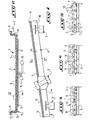
- the vibrating conveyor corridor 1 comprises a metal casing 4 in the shape of a trough and of elongated shape.
- This support wall 4 comprises a plate 4a of elongated shape bordered laterally by two guide edges 4 b and ends 4 c bent outwards.
- a vibrating device 3 known per se.
- the conveyor corridor 1 is mounted on supports or rubber shock absorbers 2 such as silent-blocks.
- the wall 4 of the conveyor passage is covered over its entire surface by an elastically deformable wall 5, such as for example a plastic membrane.
- This membrane is fixed in leaktight manner to the ends 4c of the envelope 4 by gluing, welding, or by clamping means 6.
- a closed enclosure 7 is defined between the membrane 5 and the wall 4.
- support elements 8 of the membrane are interposed between the membrane 5 and the wall 4.
- the support elements consist of a trellis made of expanded metal, and disposed over the entire useful surface of the vibrating corridor 4.
- the vibrating corridor has a flat surface as long as no force is exerted on the elastic membrane 5.
- the wall 4 is provided with orifice 9 distributed over the entire surface of the wall 4, to connect the enclosure 7, to suction means 10, or source of vacuum and to venting means 11, via connection conduits 15.
- the mesh is fixed to the wall 4, for example by spot welding.
- the vibrating conveyor corridor according to the invention operates as follows.
- Concrete is fed in the vicinity of the end 1a a of the vibrating corridor.
- the vibrators 3 subject the vibrating corridor 1 to appropriate vibrations so as to transport the concrete from the end 1 towards the end 1 b of the corridor.
- FIG. 2 illustrates the position of the membrane 5 when the conveyor passage 1 is stopped.
- the pressure in the enclosure 7 is reduced by connecting the various openings 9 to the vacuum source 10. Therefore, and as is clearly illustrated on In FIG. 3, the membrane 5 is attracted towards the wall 4, and enters the meshes of the trellis 8.
- the membrane 5 has multiple deformations, corresponding to the size and the density of the meshes of the lattice 8.
- the concrete is then fed to the end 1a of the conveyor passage and the vibrators 3 cause its transport towards the end 1 b of said passage 1. During this transport a thin layer of concrete 12 adheres to the membrane 5 to form a clogging layer transport corridor 1.
- the thin sealing layer 12 is peeled off when the rigidity of said layer 12 is sufficient to make it brittle, but before its thickness makes it difficult to break.
- the rapidity of the process of the invention makes it possible to detach the sealing layer 12, without it being necessary to stop the manufacturing unit.
- the lattice plays an essential role in the process of the invention because it makes it possible to distribute the deformations of the membrane and of the concrete layer 12 at multiple points to induce a large number of crack initiations during reestablishing the pressure in the enclosure 7. In addition, it allows a substantially uniform pressure in the entire enclosure 7.
- trellis 8 Another essential role of the trellis 8 is to shock the membrane during the fracture phase of the concrete layer 12. However, it is preferable that the trellis remains integral with the support wall.
- the present invention therefore makes it possible to take off and evacuate a layer of material, for example concrete, adhering to a wall, in a short time, making it possible to eliminate prolonged stops of the installation in order to remove the clogging layer from said wall. .
- this method eliminates any manual intervention on the surface, which is important in the case of a boiler or container, where it has hitherto been necessary either to carry out a chemical attack on the sealing layer or to involve one or several workers inside the container.
- the invention is in no way limited to the embodiment described and shown which has been given only by way of example.
- the wall 4 the support elements or trellis can be made of any material and integrated into the support wall, moreover the wall 4 can also be of varied shape, in particular cylindrical, wavy, without leaving the frame. of the invention.
Landscapes
- Engineering & Computer Science (AREA)
- Mechanical Engineering (AREA)
- Finishing Walls (AREA)
- Devices For Post-Treatments, Processing, Supply, Discharge, And Other Processes (AREA)
- On-Site Construction Work That Accompanies The Preparation And Application Of Concrete (AREA)
Applications Claiming Priority (2)
| Application Number | Priority Date | Filing Date | Title |
|---|---|---|---|
| FR8026805A FR2495967A1 (fr) | 1980-12-17 | 1980-12-17 | Procede pour decoller et evacuer une couche fine de materiau, adherente sur une paroi, structure de paroi pour la mise en oeuvre du procede, et dispositif de transport de beton comprenant cette structure de paroi |
| FR8026805 | 1980-12-17 |
Publications (1)
| Publication Number | Publication Date |
|---|---|
| EP0054462A1 true EP0054462A1 (de) | 1982-06-23 |
Family
ID=9249196
Family Applications (1)
| Application Number | Title | Priority Date | Filing Date |
|---|---|---|---|
| EP81401897A Withdrawn EP0054462A1 (de) | 1980-12-17 | 1981-11-30 | Verfahren zum Losziehen und Abführen einer dünnen, an einer Wand haftenden Materialschicht, Wandstruktur zur Anwendung des Verfahrens und eine solche Wandstruktur umfassende Betontransportvorrichtung |
Country Status (3)
| Country | Link |
|---|---|
| EP (1) | EP0054462A1 (de) |
| DE (1) | DE54462T1 (de) |
| FR (1) | FR2495967A1 (de) |
Citations (2)
| Publication number | Priority date | Publication date | Assignee | Title |
|---|---|---|---|---|
| CH534535A (de) * | 1971-07-26 | 1973-03-15 | Mecana S A Schmerikon | Klärfilter |
| US3997446A (en) * | 1976-02-23 | 1976-12-14 | Masatsugu Nagakura | Filter apparatus with an accordion-type filter medium for compaction and removal of sludgy filter cake |
-
1980
- 1980-12-17 FR FR8026805A patent/FR2495967A1/fr active Granted
-
1981
- 1981-11-30 DE DE1981401897 patent/DE54462T1/de active Pending
- 1981-11-30 EP EP81401897A patent/EP0054462A1/de not_active Withdrawn
Patent Citations (2)
| Publication number | Priority date | Publication date | Assignee | Title |
|---|---|---|---|---|
| CH534535A (de) * | 1971-07-26 | 1973-03-15 | Mecana S A Schmerikon | Klärfilter |
| US3997446A (en) * | 1976-02-23 | 1976-12-14 | Masatsugu Nagakura | Filter apparatus with an accordion-type filter medium for compaction and removal of sludgy filter cake |
Also Published As
| Publication number | Publication date |
|---|---|
| FR2495967A1 (fr) | 1982-06-18 |
| DE54462T1 (de) | 1983-01-20 |
| FR2495967B1 (de) | 1984-04-20 |
Similar Documents
| Publication | Publication Date | Title |
|---|---|---|
| JP4880852B2 (ja) | 小板ガラス板の製造方法及び小板ガラス板を製造するための半仕上げ製品としての大板ガラス板 | |
| AU7967094A (en) | Method and apparatus for combining a tensioned elastic garter with a substrate | |
| WO2008047622A1 (en) | Glass cutting apparatus, glass substrate disassembling apparatus, glass substrate disassembling system, glass cutting method and glass substrate disassembling method | |
| EP1055047B1 (de) | Herstellungsverfahren einer evakuierten isolierverglasung | |
| EP3439800A1 (de) | Vorrichtung zum tragen einer glasscheibe, insbesondere in einer wascheinrichtung | |
| CH661718A5 (fr) | Procede de fabrication d'un panneau coupe-feu transparent. | |
| WO2001074568A1 (fr) | Dispositif de soudage par ultrasons, procede et emballage associes | |
| EP0054462A1 (de) | Verfahren zum Losziehen und Abführen einer dünnen, an einer Wand haftenden Materialschicht, Wandstruktur zur Anwendung des Verfahrens und eine solche Wandstruktur umfassende Betontransportvorrichtung | |
| CA3019296A1 (fr) | Dispositif de convoyage et de maintien pour feuille de verre notamment dans une installation de lavage | |
| FR2860178A1 (fr) | Procede de separation de plaques collees entre elles pour constituer une structure empilee. | |
| JP2002301438A (ja) | 基板の搬送方法と装置 | |
| EP0269476A1 (de) | Verfahren und Vorrichtung zum Ultraschallverbinden | |
| CA2877059C (fr) | Dispositif et procede de decoupe de matiere plastique en particulier d'un vitrage feuillete | |
| JP5066348B2 (ja) | ラミネート装置 | |
| EP2705910B1 (de) | Recycling-Verfahren für Flüssigkristallflachbildschirme | |
| FR2895807A1 (fr) | Dispositif de depot de cristaux liquides pour afficheur a cristaux liquides. | |
| JP2006267801A (ja) | ディスプレイパネルのガラス基板分解装置およびシステム、ならびに、ガラス基板分解方法 | |
| FR2604063A1 (fr) | Dispositif pour assurer le demoulage de produits alimentaires industriels. | |
| JP2004354836A (ja) | ガラス基板分断方法及びその装置 | |
| WO2018234035A1 (fr) | Procédé et installation de fabrication de vitrage isolant | |
| FR2576004A1 (fr) | Systeme de prehension par le vide pour recipients large ouverture | |
| EP0110772B1 (de) | Löt- und Dichtungsverfahren zum Zusammensetzen von Aufnehmern | |
| EP1254081B1 (de) | Transportverfahren für scheiben durch eine beschichtungsanlage und ihre transportvorrichtung | |
| EP0549393A1 (de) | Verfahren und Anordnung zum Entfernen von Schutzfilmen von isolierten Platinen mit gedruckten Schaltungen | |
| WO2005121018A1 (fr) | Procede d’obturation d’un event et utilisation d’une machine de soudure par ultrasons pour mettre en oeuvre un tel procede |
Legal Events
| Date | Code | Title | Description |
|---|---|---|---|
| PUAI | Public reference made under article 153(3) epc to a published international application that has entered the european phase |
Free format text: ORIGINAL CODE: 0009012 |
|
| AK | Designated contracting states |
Designated state(s): DE GB IT |
|
| ITCL | It: translation for ep claims filed |
Representative=s name: DE DOMINICIS & PARTNERS |
|
| DET | De: translation of patent claims | ||
| 17P | Request for examination filed |
Effective date: 19821209 |
|
| STAA | Information on the status of an ep patent application or granted ep patent |
Free format text: STATUS: THE APPLICATION IS DEEMED TO BE WITHDRAWN |
|
| 18D | Application deemed to be withdrawn |
Effective date: 19840926 |
|
| RIN1 | Information on inventor provided before grant (corrected) |
Inventor name: VAN DE CAVEYE, YVES |