EP0054573A1 - Verfahren zum Verfestigen von Fasergebilden mit Kunststoffdispersionen - Google Patents
Verfahren zum Verfestigen von Fasergebilden mit Kunststoffdispersionen Download PDFInfo
- Publication number
- EP0054573A1 EP0054573A1 EP80108012A EP80108012A EP0054573A1 EP 0054573 A1 EP0054573 A1 EP 0054573A1 EP 80108012 A EP80108012 A EP 80108012A EP 80108012 A EP80108012 A EP 80108012A EP 0054573 A1 EP0054573 A1 EP 0054573A1
- Authority
- EP
- European Patent Office
- Prior art keywords
- plastic
- weight
- dispersion
- methacrylic acid
- acrylic
- Prior art date
- Legal status (The legal status is an assumption and is not a legal conclusion. Google has not performed a legal analysis and makes no representation as to the accuracy of the status listed.)
- Granted
Links
- 239000006185 dispersion Substances 0.000 title claims abstract description 58
- 238000000034 method Methods 0.000 title claims abstract description 26
- 238000007596 consolidation process Methods 0.000 title claims description 5
- 239000002657 fibrous material Substances 0.000 title description 2
- 229920003002 synthetic resin Polymers 0.000 title 1
- 239000000057 synthetic resin Substances 0.000 title 1
- 239000004033 plastic Substances 0.000 claims abstract description 46
- 229920003023 plastic Polymers 0.000 claims abstract description 46
- WSFSSNUMVMOOMR-UHFFFAOYSA-N Formaldehyde Chemical compound O=C WSFSSNUMVMOOMR-UHFFFAOYSA-N 0.000 claims abstract description 22
- CERQOIWHTDAKMF-UHFFFAOYSA-N Methacrylic acid Chemical compound CC(=C)C(O)=O CERQOIWHTDAKMF-UHFFFAOYSA-N 0.000 claims abstract description 19
- SMZOUWXMTYCWNB-UHFFFAOYSA-N 2-(2-methoxy-5-methylphenyl)ethanamine Chemical compound COC1=CC=C(C)C=C1CCN SMZOUWXMTYCWNB-UHFFFAOYSA-N 0.000 claims abstract description 15
- 239000000178 monomer Substances 0.000 claims abstract description 13
- 238000001035 drying Methods 0.000 claims abstract description 9
- 150000003863 ammonium salts Chemical class 0.000 claims abstract description 5
- 239000000126 substance Substances 0.000 claims abstract description 5
- 229910052783 alkali metal Inorganic materials 0.000 claims abstract description 4
- 125000005907 alkyl ester group Chemical group 0.000 claims abstract description 4
- 150000001875 compounds Chemical class 0.000 claims abstract description 3
- 150000007934 α,β-unsaturated carboxylic acids Chemical class 0.000 claims abstract description 3
- 239000000835 fiber Substances 0.000 claims description 27
- 238000000576 coating method Methods 0.000 claims description 7
- 239000011248 coating agent Substances 0.000 claims description 4
- 239000004745 nonwoven fabric Substances 0.000 claims description 4
- 150000003839 salts Chemical group 0.000 claims description 4
- 150000001340 alkali metals Chemical class 0.000 claims description 2
- 238000005507 spraying Methods 0.000 claims description 2
- 239000002759 woven fabric Substances 0.000 claims description 2
- 239000004753 textile Substances 0.000 claims 1
- 239000000839 emulsion Substances 0.000 abstract description 6
- 239000008346 aqueous phase Substances 0.000 abstract description 4
- 239000000203 mixture Substances 0.000 abstract description 3
- -1 alkali metal salts Chemical class 0.000 abstract description 2
- 238000005728 strengthening Methods 0.000 abstract 1
- 239000011230 binding agent Substances 0.000 description 19
- 238000006116 polymerization reaction Methods 0.000 description 11
- 230000000052 comparative effect Effects 0.000 description 10
- XLYOFNOQVPJJNP-UHFFFAOYSA-N water Substances O XLYOFNOQVPJJNP-UHFFFAOYSA-N 0.000 description 9
- 238000005470 impregnation Methods 0.000 description 8
- 239000004744 fabric Substances 0.000 description 6
- 238000007792 addition Methods 0.000 description 5
- 238000004132 cross linking Methods 0.000 description 5
- 239000003995 emulsifying agent Substances 0.000 description 5
- 239000003960 organic solvent Substances 0.000 description 5
- PPBRXRYQALVLMV-UHFFFAOYSA-N Styrene Chemical compound C=CC1=CC=CC=C1 PPBRXRYQALVLMV-UHFFFAOYSA-N 0.000 description 4
- XSTXAVWGXDQKEL-UHFFFAOYSA-N Trichloroethylene Chemical group ClC=C(Cl)Cl XSTXAVWGXDQKEL-UHFFFAOYSA-N 0.000 description 4
- 150000007942 carboxylates Chemical group 0.000 description 4
- NIXOWILDQLNWCW-UHFFFAOYSA-N acrylic acid group Chemical group C(C=C)(=O)O NIXOWILDQLNWCW-UHFFFAOYSA-N 0.000 description 3
- 239000003513 alkali Substances 0.000 description 3
- 238000006386 neutralization reaction Methods 0.000 description 3
- 239000004014 plasticizer Substances 0.000 description 3
- 229920000728 polyester Polymers 0.000 description 3
- 239000003505 polymerization initiator Substances 0.000 description 3
- 238000002360 preparation method Methods 0.000 description 3
- 230000035945 sensitivity Effects 0.000 description 3
- 239000002904 solvent Substances 0.000 description 3
- 238000005406 washing Methods 0.000 description 3
- HZAXFHJVJLSVMW-UHFFFAOYSA-N 2-Aminoethan-1-ol Chemical compound NCCO HZAXFHJVJLSVMW-UHFFFAOYSA-N 0.000 description 2
- QGZKDVFQNNGYKY-UHFFFAOYSA-N Ammonia Chemical compound N QGZKDVFQNNGYKY-UHFFFAOYSA-N 0.000 description 2
- CERQOIWHTDAKMF-UHFFFAOYSA-M Methacrylate Chemical compound CC(=C)C([O-])=O CERQOIWHTDAKMF-UHFFFAOYSA-M 0.000 description 2
- 239000002253 acid Substances 0.000 description 2
- 150000001447 alkali salts Chemical class 0.000 description 2
- ROOXNKNUYICQNP-UHFFFAOYSA-N ammonium persulfate Chemical compound [NH4+].[NH4+].[O-]S(=O)(=O)OOS([O-])(=O)=O ROOXNKNUYICQNP-UHFFFAOYSA-N 0.000 description 2
- 230000015572 biosynthetic process Effects 0.000 description 2
- 125000004432 carbon atom Chemical group C* 0.000 description 2
- DOIRQSBPFJWKBE-UHFFFAOYSA-N dibutyl phthalate Chemical compound CCCCOC(=O)C1=CC=CC=C1C(=O)OCCCC DOIRQSBPFJWKBE-UHFFFAOYSA-N 0.000 description 2
- 238000004519 manufacturing process Methods 0.000 description 2
- 229910052751 metal Inorganic materials 0.000 description 2
- 239000002184 metal Substances 0.000 description 2
- 239000000123 paper Substances 0.000 description 2
- 239000002245 particle Substances 0.000 description 2
- 239000012071 phase Substances 0.000 description 2
- LLLCSBYSPJHDJX-UHFFFAOYSA-M potassium;2-methylprop-2-enoate Chemical compound [K+].CC(=C)C([O-])=O LLLCSBYSPJHDJX-UHFFFAOYSA-M 0.000 description 2
- 229920005989 resin Polymers 0.000 description 2
- 239000011347 resin Substances 0.000 description 2
- 230000008961 swelling Effects 0.000 description 2
- OEPOKWHJYJXUGD-UHFFFAOYSA-N 2-(3-phenylmethoxyphenyl)-1,3-thiazole-4-carbaldehyde Chemical compound O=CC1=CSC(C=2C=C(OCC=3C=CC=CC=3)C=CC=2)=N1 OEPOKWHJYJXUGD-UHFFFAOYSA-N 0.000 description 1
- 229920000742 Cotton Polymers 0.000 description 1
- 241000219146 Gossypium Species 0.000 description 1
- DGAQECJNVWCQMB-PUAWFVPOSA-M Ilexoside XXIX Chemical compound C[C@@H]1CC[C@@]2(CC[C@@]3(C(=CC[C@H]4[C@]3(CC[C@@H]5[C@@]4(CC[C@@H](C5(C)C)OS(=O)(=O)[O-])C)C)[C@@H]2[C@]1(C)O)C)C(=O)O[C@H]6[C@@H]([C@H]([C@@H]([C@H](O6)CO)O)O)O.[Na+] DGAQECJNVWCQMB-PUAWFVPOSA-M 0.000 description 1
- VVQNEPGJFQJSBK-UHFFFAOYSA-N Methyl methacrylate Chemical compound COC(=O)C(C)=C VVQNEPGJFQJSBK-UHFFFAOYSA-N 0.000 description 1
- ZLMJMSJWJFRBEC-UHFFFAOYSA-N Potassium Chemical compound [K] ZLMJMSJWJFRBEC-UHFFFAOYSA-N 0.000 description 1
- CDBYLPFSWZWCQE-UHFFFAOYSA-L Sodium Carbonate Chemical compound [Na+].[Na+].[O-]C([O-])=O CDBYLPFSWZWCQE-UHFFFAOYSA-L 0.000 description 1
- XTXRWKRVRITETP-UHFFFAOYSA-N Vinyl acetate Chemical compound CC(=O)OC=C XTXRWKRVRITETP-UHFFFAOYSA-N 0.000 description 1
- 230000002745 absorbent Effects 0.000 description 1
- 239000002250 absorbent Substances 0.000 description 1
- 238000010521 absorption reaction Methods 0.000 description 1
- 238000007605 air drying Methods 0.000 description 1
- 150000001412 amines Chemical class 0.000 description 1
- 229920003180 amino resin Polymers 0.000 description 1
- 229910021529 ammonia Inorganic materials 0.000 description 1
- 229910001870 ammonium persulfate Inorganic materials 0.000 description 1
- 235000019395 ammonium persulphate Nutrition 0.000 description 1
- 239000012874 anionic emulsifier Substances 0.000 description 1
- 125000000129 anionic group Chemical group 0.000 description 1
- 239000002585 base Substances 0.000 description 1
- 230000000903 blocking effect Effects 0.000 description 1
- 230000001680 brushing effect Effects 0.000 description 1
- CQEYYJKEWSMYFG-UHFFFAOYSA-N butyl acrylate Chemical compound CCCCOC(=O)C=C CQEYYJKEWSMYFG-UHFFFAOYSA-N 0.000 description 1
- 125000003178 carboxy group Chemical group [H]OC(*)=O 0.000 description 1
- 150000001735 carboxylic acids Chemical class 0.000 description 1
- 239000011111 cardboard Substances 0.000 description 1
- 239000001913 cellulose Substances 0.000 description 1
- 229920002678 cellulose Polymers 0.000 description 1
- 238000006482 condensation reaction Methods 0.000 description 1
- 238000010276 construction Methods 0.000 description 1
- 238000005108 dry cleaning Methods 0.000 description 1
- 238000011049 filling Methods 0.000 description 1
- 239000006260 foam Substances 0.000 description 1
- 239000003365 glass fiber Substances 0.000 description 1
- 239000004816 latex Substances 0.000 description 1
- 229920000126 latex Polymers 0.000 description 1
- 239000007788 liquid Substances 0.000 description 1
- 125000005395 methacrylic acid group Chemical group 0.000 description 1
- 239000000693 micelle Substances 0.000 description 1
- 239000002557 mineral fiber Substances 0.000 description 1
- 239000011490 mineral wool Substances 0.000 description 1
- 230000003472 neutralizing effect Effects 0.000 description 1
- 239000012875 nonionic emulsifier Substances 0.000 description 1
- 229920000642 polymer Polymers 0.000 description 1
- 239000011591 potassium Substances 0.000 description 1
- 235000019394 potassium persulphate Nutrition 0.000 description 1
- 159000000001 potassium salts Chemical class 0.000 description 1
- 238000010992 reflux Methods 0.000 description 1
- 238000003303 reheating Methods 0.000 description 1
- 229920006395 saturated elastomer Polymers 0.000 description 1
- 238000002791 soaking Methods 0.000 description 1
- 239000000344 soap Substances 0.000 description 1
- 229910052708 sodium Inorganic materials 0.000 description 1
- 239000011734 sodium Substances 0.000 description 1
- 239000007787 solid Substances 0.000 description 1
- 238000007711 solidification Methods 0.000 description 1
- 230000008023 solidification Effects 0.000 description 1
- 238000003756 stirring Methods 0.000 description 1
- 238000003860 storage Methods 0.000 description 1
- 229920001169 thermoplastic Polymers 0.000 description 1
- 239000004416 thermosoftening plastic Substances 0.000 description 1
- 239000002562 thickening agent Substances 0.000 description 1
- 229920001567 vinyl ester resin Polymers 0.000 description 1
- 125000000391 vinyl group Chemical group [H]C([*])=C([H])[H] 0.000 description 1
- 229920003170 water-soluble synthetic polymer Polymers 0.000 description 1
- 230000004584 weight gain Effects 0.000 description 1
- 235000019786 weight gain Nutrition 0.000 description 1
- 230000004580 weight loss Effects 0.000 description 1
Classifications
-
- D—TEXTILES; PAPER
- D04—BRAIDING; LACE-MAKING; KNITTING; TRIMMINGS; NON-WOVEN FABRICS
- D04H—MAKING TEXTILE FABRICS, e.g. FROM FIBRES OR FILAMENTARY MATERIAL; FABRICS MADE BY SUCH PROCESSES OR APPARATUS, e.g. FELTS, NON-WOVEN FABRICS; COTTON-WOOL; WADDING ; NON-WOVEN FABRICS FROM STAPLE FIBRES, FILAMENTS OR YARNS, BONDED WITH AT LEAST ONE WEB-LIKE MATERIAL DURING THEIR CONSOLIDATION
- D04H1/00—Non-woven fabrics formed wholly or mainly of staple fibres or like relatively short fibres
- D04H1/40—Non-woven fabrics formed wholly or mainly of staple fibres or like relatively short fibres from fleeces or layers composed of fibres without existing or potential cohesive properties
- D04H1/58—Non-woven fabrics formed wholly or mainly of staple fibres or like relatively short fibres from fleeces or layers composed of fibres without existing or potential cohesive properties by applying, incorporating or activating chemical or thermoplastic bonding agents, e.g. adhesives
- D04H1/587—Non-woven fabrics formed wholly or mainly of staple fibres or like relatively short fibres from fleeces or layers composed of fibres without existing or potential cohesive properties by applying, incorporating or activating chemical or thermoplastic bonding agents, e.g. adhesives characterised by the bonding agents used
-
- D—TEXTILES; PAPER
- D04—BRAIDING; LACE-MAKING; KNITTING; TRIMMINGS; NON-WOVEN FABRICS
- D04H—MAKING TEXTILE FABRICS, e.g. FROM FIBRES OR FILAMENTARY MATERIAL; FABRICS MADE BY SUCH PROCESSES OR APPARATUS, e.g. FELTS, NON-WOVEN FABRICS; COTTON-WOOL; WADDING ; NON-WOVEN FABRICS FROM STAPLE FIBRES, FILAMENTS OR YARNS, BONDED WITH AT LEAST ONE WEB-LIKE MATERIAL DURING THEIR CONSOLIDATION
- D04H1/00—Non-woven fabrics formed wholly or mainly of staple fibres or like relatively short fibres
- D04H1/40—Non-woven fabrics formed wholly or mainly of staple fibres or like relatively short fibres from fleeces or layers composed of fibres without existing or potential cohesive properties
- D04H1/58—Non-woven fabrics formed wholly or mainly of staple fibres or like relatively short fibres from fleeces or layers composed of fibres without existing or potential cohesive properties by applying, incorporating or activating chemical or thermoplastic bonding agents, e.g. adhesives
- D04H1/64—Non-woven fabrics formed wholly or mainly of staple fibres or like relatively short fibres from fleeces or layers composed of fibres without existing or potential cohesive properties by applying, incorporating or activating chemical or thermoplastic bonding agents, e.g. adhesives the bonding agent being applied in wet state, e.g. chemical agents in dispersions or solutions
Definitions
- the invention relates to a method for solidifying fiber structures by treatment with aqueous plastic dispersions.
- the choice of the plastic dispersions to be used depends, among other things, on whether the finished fiber structure should be resistant to organic solvents. If this is not the case, plastic dispersions can be used which are free of formaldehyde-releasing substances and whose plastic content is essentially composed, for example, of alkyl esters of acrylic or methacrylic acid, vinyl esters and / or styrene and small amounts of ⁇ , ⁇ -unsaturated carboxylic acids. If, on the other hand, resistance to organic solvents or plasticizers is required, plastic dispersions are used that can be crosslinked at elevated temperatures after coating or soaking and drying.
- crosslinking is achieved either by adding water-soluble aminoplast resins to the dispersions of the type mentioned above or by using plastic dispersions in the formation of which condensable formaldehyde derivatives, in particular N-methylol-aorylamide or -methacrylamide, are involved.
- the invention has for its object to provide fiber structures with an equipment which is at least limited solvent-resistant or block-free or tack-free, and for this purpose to use an aqueous plastic dispersion which is free of formaldehyde-releasing substances and whose plastic content consists predominantly of alkyl esters of acrylic or methacrylic acid, and small amounts of ⁇ , ß-tm saturated carboxylic acids.
- Stability of the coatings or impregnations produced according to the invention depends on the fact that the acrylic or methacrylic acid in the form of its alkali metal or ammonium salt is dissolved in the template in the preparation of the plastic dispersion to be used by the feed process.
- Equivalent plastic dispersions cannot be prepared by gradually adding the acrylic or methacrylic acid or its salts together with the other monomers during the feed process, or by adding the acrylic or methacrylic acid as such to the initial charge and only neutralizing it after the polymerization.
- plastic dispersions which are free of formaldehyde-releasing substances by the process indicated above are known from OE-PS 236 643 and from FR-PS 1 157 265.
- the plastic dispersions produced in this way have not yet been used to solidify fiber structures.
- the impregnations and coatings obtained in this way would be distinguished by improved resistance to organic solvents.
- Plastic dispersions with a minimum film-forming temperature are particularly advantageous for the process of the invention below 25 ° C and with a T ⁇ max value of the dispersed plastic (according to DIN 53445) below 50 ° C.
- the plastic portion of the dispersion is preferably composed of more than 50% by weight of acrylic acid alkyl esters with 1 to 8 carbon atoms in the alkyl radical and the rest predominantly of methacrylic acid alkyl esters with 1 to 4 carbon atoms in the alkyl radical.
- Other water-insoluble monomers, such as styrene, vinyl acetate or vinylidene chloride can be involved in minor amounts in the construction of the plastic.
- the proportion of acrylic and / or methacrylic acid polymerized in salt form is preferably 2 to 3% by weight, calculated as free acid and. based on the weight of the plastic.
- the alkali salts are preferably the sodium and potassium salts.
- the ammonium salts can be derived from ammonia or from organic amines, such as, for example, ethanolamine.
- the preferred method for producing the plastic dispersion is the emulsion feed method. Part of the amount of water provided as the aqueous phase of the dispersion is placed in the polymerization vessel and the salt of acrylic and / or methacrylic acid is dissolved therein.
- a conventional anionic or nonionic emulsifier and a water-soluble polymerization initiator, such as potassium or ammonium peroxydisulfate, can be dissolved in the initial charge.
- the initial charge is brought to a temperature suitable for carrying out the polymerization, preferably to about 50 to 80 ° C.
- the monomers to be polymerized are emulsified, for which purpose a further amount of an emulsifier is advantageously used.
- the monomer emulsion is gradually let into the Run in template while the polymerization is taking place at the same time.
- Additional polymerization initiators can be added continuously or in individual additions during the polymerization.
- the amount of water and monomers are preferably matched to one another in such a way that a 40-60% dispersion is formed.
- the use of emulsifiers can optionally be dispensed with.
- the monomers, besides the acrylic acid or methacrylic acid salt, can also be added gradually in non-emulsified form. In this case, the entire water phase is added to the template at the beginning of the process.
- the fiber structures that are consolidated according to the invention can consist of natural fibers, man-made fibers or of mixtures of different types of fibers.
- the consolidation of mineral fiber structures e.g. made of glass fibers or rock wool.
- Flat fiber structures are essentially equipped; these include woven fabrics, knitted fabrics, non-woven fabrics, and papers, in particular absorbent base papers and cardboards.
- the plastic dispersion can be applied as a coating on the surface of the fiber structure.
- the fiber structure is preferably treated with the plastic dispersion in such a way that an impregnation which strengthens the entire cross section is achieved.
- Plastic dispersion depends on the intended use of the solidified fiber structure. It can range from a slight consolidation with 5 - 20% dry plastic weight, based on the fiber weight, to a plastic filling with 100% by weight plastic, based on the fiber weight, or more.
- a preferred application of the invention is the consolidation of light nonwovens with a weight per unit area of not more than 60 g / m2.
- the dispersion can be applied to or introduced into the fiber structure by impregnation, spraying, splashing, brushing or printing. Depending on the application method used, the dispersion can be applied as a dilute liquor, for example with a binder content of 15 to 30% by weight, or as a thickened paste or as a foam. Conventional thickeners, such as cellulose derivatives or water-soluble synthetic polymers, can be reacted in the pastes; the binder content is preferably 20 to 40% by weight.
- the coated or impregnated fiber structure is dried. Conventional flat web dryers, cylinder dryers or screen drum dryers can be used for this.
- the treated fiber structure is less prone to sticking to warm metal surfaces than products equipped with purely thermoplastic dispersions.
- the so-called "binder tri wash loss”, abbreviated BTV, is suitable, the determination of which is explained in more detail in the examples under IV.
- BTV binder tri wash loss
- the binder loss in the fiber structures impregnated by the process of the invention is reduced to a fraction of this value.
- an alkali methacrylate content of 1% (calculated as methacrylic acid, based on the plastic weight), a BTV value between 30 and 50% is achieved.
- BKV Binder-Kochwasch-loss
- the BKV value depends to a large extent on the drying temperature. After drying at room temperature, BKV values of up to 70% are observed. After drying or reheating at temperatures between 80 and 120 ° - especially with a low carboxylate content - only binder losses of a few percent can be determined.
- binder losses In the preferred range of 2-3% by weight of carboxylate units, binder losses of between 4 and 10% by weight occur.
- the binder losses depend on the type of fiber material and the plastic dispersion; the values mentioned here apply to a polyester fabric which was equipped with 50% by weight of a plastic dispersion composed of methyl methacrylate and butyl acrylate as the main components.
- Comparative dispersion C prepared in accordance with Example 10, but with the addition of methacrylic acid in the form of the free acid together with the monomer feed.
- Comparative dispersion D prepared like comparative dispersion C, but neutralized the methacrylic acid units with the equivalent amount of KOH after completion of the polymerization.
- Comparative dispersion E prepared as in Example 10, but gradual addition of the potassium methacrylate simultaneously with the addition of the other monomers.
- a polyester fabric with a basis weight of 100 g / m 2 made of polyester staple fibers is soaked with a dispersion at room temperature and by means of a laboratory pad squeezed to a liquor absorption of 80 to 100% (based on the weight of the fabric).
- the moist fabric strip is dried in a tensioned state for 5 minutes at 120 ° C in a forced-air drying cabinet.
- Tri ⁇ sche A sample of 18 x 18 cm size is 80 * moves min at 20 C with 125 ml trichlorethylene, then rinsed with 100 ml trichlorethylene and dried for 30 min at 80th After storage for half an hour at room temperature, the sample is weighed out. The weight loss is determined in percent, based on the weight of the binder in the sample used.
- Cottons A sample of 18 x 18 cm in size is washed for 10 min at 90 ° with 125 ml of an aqueous washing liquor containing 3 g of Marseille soap and 2 g of calc. Soda contains, agitated, then rinsed once with 90 ° C hot and once with cold water and Dried at 90 ° C for 30 min. 30 minutes after drying, the sample is weighed and the binder loss in percent, based on the weight of the binder in the sample used, is determined.
- the comparative dispersions show that without neutralization of the carboxyl groups of the binder polymer (comparative dispersion C) very high binder losses occur during tri-washing. These losses are significantly reduced by neutralization, while the losses in hot water only increase insignificantly despite the increased polarity of the binder. With subsequent neutralization (comparative dispersion D), particularly low binder losses are found, but the tests described under III indicate a high sensitivity of the film to plasticizers. If the methacrylic acid salt (reference dispersion E) is added uniformly, the binder losses are higher than when used in the receiver according to the invention (example 10), but significantly lower than in the case of non-neutralized binder resin. In contrast, the swelling in the plasticizer (see under III) is unfavorably high.
Landscapes
- Engineering & Computer Science (AREA)
- Textile Engineering (AREA)
- Chemical & Material Sciences (AREA)
- Chemical Kinetics & Catalysis (AREA)
- Dispersion Chemistry (AREA)
- General Chemical & Material Sciences (AREA)
- Treatments For Attaching Organic Compounds To Fibrous Goods (AREA)
- Reinforced Plastic Materials (AREA)
Abstract
Description
- Die Erfindung betrifft ein Verfahren zum Verfestigen von Fasergebilden durch Behandeln mit wäßrigen Kunststoffdispersionen. Die Wahl der dafür zu verwendenden Kunststoffdispersionen hängt unter anderem davon ab, ob das ausgerüstete Fasergebilde gegenüber organischen Lösungsmitteln beständig sein soll. Wenn das nicht der Fall ist, können Kunststoffdispersionen eingesetzt werden, die frei von formaldehydabgebenden Substanzen sind und deren Kunststoffanteil beispielsweise im wesentlichen aus Alkylestern der Acryl- oder Methacrylsäure, Vinylestern und/oder Styrol sowie geringen Mengen α,β-imgesättigten Carbonsäuren aufgebaut ist. Wird dagegen Beständigkeit gegen organische Lösungsmittel oder Weichmacher gefordert, so werden Kunststoffdispersionen eingesetzt, die sich nach dem Beschichten oder Tränken und Trocknen bei erhöhten Temperaturen vernetzen lassen. Die Vernetzung wird entweder dadurch erreicht, daß man zu den Dispersionen der oben genannten Art wasserlösliche Aminoplastharze zusetzt oder Kunststoffdispersionen einsetzt, an deren Aufbau kondensationsfähige Formaldehydderivate, insbesondere N-Methylol-aorylamid oder-methacrylamid, beteiligt sind.
- Beim Erhitzen der Imprägnierung oder Beschichtung tritt durch Kondensationsreaktionen Vernetzung ein, wodurch der Kunststoff in Lösungsmitteln unlöslich wird. Gleichzeitig wird Formaldehyd frei, der in die Abluft gelangt, aus der er wegen seines unangenehmen Geruchs herausgefiltert werden muß.
- Eine vollständige Unlöslichkeit des Bindemittels in organischen Lösungsmitteln ist bei vielen Anwendungen von verfestigten Fasergebilden nicht erforderlich. Oft werden Dispersionen von selbstvernetzenden Kunststoffen nur deshalb verwendet, weil die daraus entstehenden Filme weniger dazu neigen, an warmen Metalloberflächen anzukleben, z.B. auf einem Trockenzylinder. Eine schwache Vernetzung ist oft ausreichend um den Blockpunkt von weichen Beschichtungen zu erhöhen. Man war jedoch bisher auch in den Fällen, in denen eine schwache Vernetzung ausreicht, auf die beim Erhitzen formaldehydabgebenden Kunststoffdispersionen angewiesen.
- Der Erfindung liegt die Aufgabe zugrunde, Fasergebilde mit einer Ausrüstung zu versehen, die wenigstens begrenzt lösungsmittelbeständig bzw. blockfrei oder klebfrei ist, und hierzu eine wäßrige Kunststoffdispersion einzusetzen, die frei von formaldehydabgebenden Substanzen ist und deren Kunststoffanteil überwiegend aus Alkylestern der Acryl-oder Methacrylsäure, sowie geringen Mengen α,ß-tmgesättigten Carbonsäuren aufgebaut ist.
- Es wurde gefunden, daß man die genannte Aufgabe mit einer solchen Kunststoffdispersion lösen kann, die nach dem Zulaufverfahren unter Einsatz von 1 - 4 Gew.-% Acryl- oder/und Methacrylsäure, bezogen auf das Gesamtgewicht an polymerisierbaren Verbindungen, in der Vorlage und unter Zugabe der übrigen Monomeren im Zulauf hergestellt worden ist, wobei die Acryl- bzw. Methacrylsäure in Form eines Alkali- oder Ammoniumsalzes eingesetzt worden ist..Beim Zulaufverfahren werden die Monomeren als solche oder in Form einer wäßrigen Emulsion allmählich unter Polymerisationsbedingungen zu einer Vorlage zulaufen gelassen, in der die Polymerisation stattfindet. Die Vorlage besteht aus einer wäßrigen Phase, die in der Regel einen wasserlöslichen Polymerisationsinitiator und ein oder mehrere Emulgiermittel enthält. Uberraschenderweise hängt die verbesserte Lösungsmittelbe- . ständigkeit der erfindungsgemäß erzeugten Beschichtungen oder Imprägnierungen davon ab, daß sich bei der Herstellung der zu verwendenden Kunststoffdispersion nach dem Zulaufverfahren die Acryl- oder Methacrylsäure in Form ihres Alkali-oder Ammoniumsalzes in der Vorlage gelöst befindet. Gleichwertige Kunststoffdispersionen lassen sich nicht dadurch herstellen, daß man die Acryl- oder Methacrylsäure oder ihre Salze zusammen mit den übrigen Monomeren beim Zulaufverfahren allmählich zusetzt oder daß man die Acryl- oder Methacrylsäure als solche in die Vorlage gibt und erst nach der Polymerisation neutralisiert.
- Die Herstellung von Kunststoffdispersionen, die frei von formaldehydabgebenden Substanzen sind, nach dem oben angegebenen Verfahren ist zwar aus der OE-PS 236 643 und aus der FR-PS 1 157 265 bekannt. Die so hergestellten Kunststoffdispersionen sind jedoch noch nicht zum Verfestigen von Fasergebilden eingesetzt worden. Es war auch nicht vorauszusehen, daß die dabei erhaltenen Imprägnierungen und Beschichtungen sich durch eine verbesserte Beständigkeit gegenüber organischen Lösungsmitteln auszeichnen würden.
- Mit besonderem Vorteil werden für das Verfahren der Erfindung Kunststoffdispersionen mit einer Mindest-Filmbildungstemperatur unter 25°C und mit einem Tλmax -Wert des dispergierten Kunststoffes (nach DIN 53445) unter 50°C eingesetzt. Der Kunststoffanteil der Dispersion ist vorzugsweise zu mehr als 50 Gew.-% aus Acrylsäurealkylestern mit 1 - 8 C-Atomen im Alkylrest und zum übrigen Teil überwiegend aus Methacrylsäurealkylestern mit 1 - 4 C-Atomen im Alkylrest aufgebaut. Andere wasserunlösliche Monomere, wie z.B. Styrol, Vinylacetat oder Vinylidenchlorid, können in untergeordneten Mengen am Aufbau des Kunststoffes beteiligt sein. Der Anteil der in Salzform einpolymerisierten Acryl- und/oder Methacrylsäure beträgt vorzugsweise 2 - 3 Gew.-% berechnet als freie Säure und. bezogen auf das Gewicht des Kunststoffes. Als Alkalisalze kommen vorzugsweise die Natrium- und Kaliumsalze in Betracht. Die Ammoniumsalze können sich von Ammoniak oder von organischen Aminen , wie z.B. Äthanolamin, ableiten.
- Das bevorzugte Verfahren zur Herstellung der Kunststoffdispersion ist das Emulsions-Zulaufverfahren. Dabei wird ein Teil der als wäßrige Phase der Dispersion vorgesehenen Wassermenge im Polymerisationsgefäß vorgelegt und das Salz der Acryl- und/oder Methacrylsäure darin gelöst. Außerdem kann in der Vorlage ein üblicher anionischer oder nichtionischer Emulgator und ein wasserlöslicher Polymerisationsinitiator, wie Kalium- oder Ammoniumperoxidisulfat, gelöst werden. Man bringt die Vorlage auf eine zur Durchführung der Polymerisation geeignete Temperatur, vorzugsweise etwa auf 50 bis 80°C. In dem übrigen Teil der Wasserphase werden die zu polymerisierenden Monomeren mit Ausnahme der Acryl- oder Methacrylsäure emulgiert, wozu zweckmäßig eine weitere Menge an einem Emulgiermittel verwendet wird. Im Laufe von mehreren Stunden läßt man die Monomerenemulsion allmählich in die Vorlage einlaufen, während gleichzeitig die Polymerisation stattfindet. Während der Polymerisation kann kontinuierlich oder in einzelnen Zugaben weiterer Polymerisationsinitiator zugefügt werden. Die Wasser- und Monomerenmenge werden vorzugsweise so aufeinander abgestimmt, daß eine 40- bis 60 %ige Dispersion entsteht. Auf die Verwendung von Emulgiermitteln kann gegebenenfalls verzichtet werden. Die Monomeren,außer dem Acrylsäure- oder Methacrylsäuresalz, können auch in nicht emulgierter Form allmählich zugesetzt werden. In diesem Falle wird die gesamte Wasserphase zu Beginn des Verfahrens in die Vorlage gegeben.
- Es empfiehlt sich, zu Beginn der Polymerisation eine Emulgatorkonzentration nahe oder unterhalb der kritischen Mizellbildungskonzentration einzustellen und erforderlichenfalls weiteren Emulgator während oder nach der Polymerisation zuzusetzen. Dadurch läßt sich die Teilchengröße der Latexpartikel und die Viskosität der Dispersion beeinflussen.
- Die Fasergebilde, die erfindungsgemäß verfestigt werden, können aus Naturfasern , Chemiefasern oder aus Gemischen verschiedener Faserarten bestehen. Auch die Verfestigung von mineralischen Fasergebilden, z.B. aus Glasfasern oder Steinwolle, kommt in Betracht. Im wesentlichen werden flächige Fasergebilde ausgerüstet; dazu gehören Gewebe, Gewirke, Faservliese, sowie Papiere, insbesondere saugfähige Rohpapiere und Pappen. Die Kunststoffdispersion kann als Beschichtung auf die Oberfläche des Fasergebildes aufgetragen werden. Vorzugsweise wird das Fasergebilde mit der Kunststoffdispersion so behandelt, daß eine den gesamten Querschnitt verfestigende Imprägnierung erreicht wird. Die Menge der zum Verfestigen verwendeten
- Kunststoffdispersion richtet sich nach dem Verwendungszweck des verfestigten Fasergebildes. Sie kann von einer leichten Verfestigung mit 5 - 20 % Kunststofftrockengewicht, bezogen auf das Fasergewicht, bis zu einer Kunststoff-Füllung mit 100 Gew.-% Kunststoff, bezogen auf das Fasergewicht, oder mehr reichen. Eine bevorzugte Anwendungsform der Erfindung ist die Verfestigung von leichten Faservliesen mit einem Flächengewicht nicht über 60 g/qm. Die Dispersion kann durch Imprägnieren, Besprühen, Pflatschen, Streichen oder Drucken auf das Fasergebilde aufgebracht bzw. in dieses eingebracht werden. Je nach dem angewandten Auftragsverfahren kann die Dispersion als verdünnte Flotte, beispielsweise mit einem Bindergehalt von 15 bis 30 Gew.-%, oder als verdickte Paste oder als Schaum aufgebracht werden. In den Pasten können übliche Verdickungsmittel, wie Cellulosederivate oder wasserlösliche 'synthetische Polymere, umgesetzt werden, der Bindergehalt liegt vorzugsweise bei 20 bis 40 Gew.-%.
- Nach der Behandlung mit der Kunststoffdispersion wird das beschichtete oder getränkte Fasergebilde getrocknet. Hierzu können übliche Flachbahntrockner, Zylindertrockner oder Siebtrommeltrockner verwendet werden. Das behandelte Fasergebilde neigt weniger zum Kleben an warmen Metalloberflächen als mit rein thermoplastischen Dispersionen ausgerüstete Produkte.
- Als Maß für die Beständigkeit gegen organische Lösungsmittel eignet sich der sogenannte "Binder-Tri-Waschverlust", abgekürzt BTV, dessen Bestimmung in den Beispielen unter IV näher erläutert ist. Während die Imprägnierung mit Dispersionen, die keine Carboxylatgruppen enthalten oder in denen der Anteil an Alkalicarboxylatgruppen nicht in der hier beschriebenen Weise eingebaut worden ist,.BTV-Werte von 80 - 100 ergibt, wird der Binderverlust bei den nach dem Verfahren der Erfindung imprägnierten Fasergebilden auf einen Bruchteil dieses Wertes herabgesetzt. Schon bei einem Alkali-Methacrylat-Gehalt von 1 % (berechnet als Methacrylsäure, bezogen auf das Kunststoffgewicht) wird ein BTV-Wert zwischen 30 und 50 % erreicht. Bei einer Steigerung des Alkali-Methacrylatgehaltes auf 2 bis.3 sinkt der Binderverlust auf 20 - 25 % ab. Bei weiterer Erhöhung des Carboxylatgehaltes bleibt der Binderverlust auf niedrigem Niveau, jedoch nimmt die Wasserempfindlichkeit der Imprägnierung zu. Eine geeignete Maßzahl für die Wasserempfindlichkeit ist der sogenannte "Binder-Kochwasch-Verlust", abgekürzt BKV, dessen Bestimmung in den Beispielen unter IV ausführlich beschrieben ist. Der BKV-Wert erweist sich in starkem Maße abhängig von der Trocknungstemperatur. Nach der Trocknung bei Raumtemperatur werden BKV-Werte bis zu 70 % beobachtet. Nach dem Trocknen oder Nacherhitzen bei Temperaturen zwischen 80 und 120° sind - insbesondere bei niedrigem Carboxylatgehalt - nur noch Binderverluste von wenigen Prozent festzustellen. In dem bevorzugten Bereich von 2 - 3 Gew.-% Carboxylateinheiten treten Binderverluste zwischen 4 und 10 Gew.-% auf. Selbstverständlich hängen die Binderverluste von der Art des Fasermaterials und der Kunststoffdispersion ab; die hier genannten Werte gelten für ein Polyestergewebe, das mit 50 Gew.-% einer aus Methylmethacrylat und Butylacrylat als Hauptkomponenten aufgebauten Kunststoffdispersion ausgerüstet war.
- In einem Polymerisationsgefäß mit Rührwerk, Rückflußkühler und Thermometer werden bei 80°C vorgelegt:


- Es wurde die unter I. beschriebene Arbeitsweise angewendet, soweit nicht anders angegeben. Vergleichsdispersionen A und B entsprechend Beispielen 1 und 2, jedoch wurde das Kalium-Methacrylat in der Monomer-Zulaufemulsion gelöst.
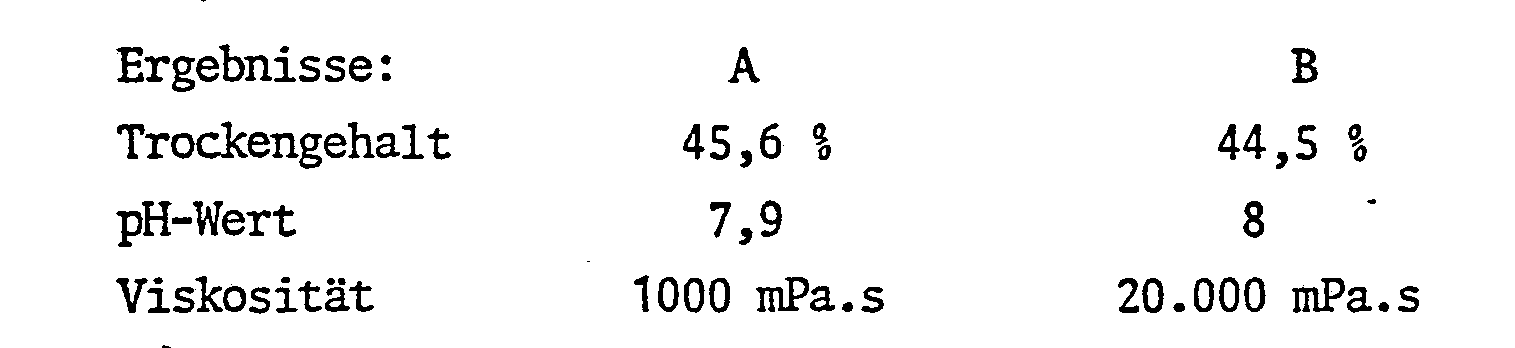
- Vergleichsdispersion C, hergestellt entsprechend Beispiel 10, jedoch unter Zugabe der Methacrylsäure in Form der freien Säure zusammen mit dem Monomerzulauf.
- Vergleichsdispersion D, hergestellt wie Vergleichsdispersion C, jedoch die Methacrylsäureeinheiten nach Abschluß der Polymerisation mit der äquivalenten Menge KOH neutralisiert.
- Vergleichsdispersion E, hergestellt entsprechend Beispiel 10, jedoch allmähliche Zugabe des Kaliummethacrylats gleichzeitig mit dem Zulauf der übrigen Monomeren.

- Etwa 1 mm dicke Schichten der Dispersionen werden im Trockenschrank bei 39°C zu einem 0,5 mm dicken Film eingetrocknet und danach 5 Minuten auf 140°C erhitzt. Zur Prüfung der Quellbarkeit durch Trichloräthylen werden gewogene Teilstücke der Filme bei 20°C 2 Stunden lang quellen gelassen. Andere Teilstücke werden 72 Stunden bei 35°C in Dibutylphthalat quellen gelassen. Dann werden die gequollenen Filme herausgenommen, von anhaftender Flüssigkeit befreit und die Gewichtszunahme in Prozent des Ausgangsgewichts ermittelt:

- Ein Polyestergewebe mit einem Flächengewicht von 100g/m2 aus Polyesterstapelfasern wird mit einer Dispersion bei Zimmertemperatur getränkt und mittels eines Laborfoulards auf eine Flottenaufnahme von 80 bis 100 % (bezogen auf das Gewicht des Gewebes) abgequetscht. Der feuchte Gewebestreifen wird im gespannten Zustand hängend 5 Minuten bei 120°C im Umlufttrockenschrank getrocknet.
- Um die Beständigkeit der Imprägnierung gegenüber den in der Chemischreinigung und in der Kochwäsche herrschenden Bedingungen zu prüfen, werden ausgewogene Probestücke des imprägnierten Gewebes in einer Laborwaschmaschine ("Linitestgerät", eingetr. Warenzeichen) mit Trichloräthylen bzw. einer Waschlauge behandelt.
- Triwäsche: Eine Probe von 18 x 18 cm Größe wird 80 min bei 20*C mit 125 ml Trichloräthylen bewegt, anschließend mit 100 ml Trichloräthylen gespült und 30 min bei 80 getrocknet. Nach halbstündiger Lagerung bei Raumtemperatur wird die Probe ausgewogen. Der Gewichtsverlust wird in Prozent, bezogen auf das Gewicht des Bindemittels in der eingesetzten Probe, bestimmt.
- Kochwäsche: Eine Probe von 18 x 18 cm Größe wird 10 min bei 90° mit 125 ml einer wäßrigen Waschflotte, die je Liter 3 g Marseiller Seife und 2 g calc. Soda enthält, bewegt, anschließend einmal mit 90°C heißem und einmal mit kaltem Wasser gespült und 30 min bei 90°C getrocknet. 30 min nach der Trocknung wird die Probe gewogen und der Binderverlust in Prozent, bezogen auf das Gewicht des Bindemittels in der eingesetzten Probe, bestimmt.
-

Claims (9)
dadurch gekennzeichnet, daß das Verfahren mit einer solchen Kunststoffdispersion durchgeführt wird, die nach dem Zulaufverfahren unter Einsatz von 1 bis 4 Gew.-%, bezogen auf das Gesamtgewicht an polymerisierbaren Verbindungen, Acryl- oder/und Methacrylsäure in Form ihrer Alkali- oder Ammoniumsalze in der Vorlage und Zugabe der übrigen Monomeren im Zulauf hergestellt worden ist.
Priority Applications (3)
| Application Number | Priority Date | Filing Date | Title |
|---|---|---|---|
| DE8080108012T DE3070134D1 (en) | 1980-12-18 | 1980-12-18 | Process for the consolidation of fibrous material with dispersions of synthetic resin |
| AT80108012T ATE11681T1 (de) | 1980-12-18 | 1980-12-18 | Verfahren zum verfestigen von fasergebilden mit kunststoffdispersionen. |
| EP80108012A EP0054573B1 (de) | 1980-12-18 | 1980-12-18 | Verfahren zum Verfestigen von Fasergebilden mit Kunststoffdispersionen |
Applications Claiming Priority (1)
| Application Number | Priority Date | Filing Date | Title |
|---|---|---|---|
| EP80108012A EP0054573B1 (de) | 1980-12-18 | 1980-12-18 | Verfahren zum Verfestigen von Fasergebilden mit Kunststoffdispersionen |
Publications (2)
| Publication Number | Publication Date |
|---|---|
| EP0054573A1 true EP0054573A1 (de) | 1982-06-30 |
| EP0054573B1 EP0054573B1 (de) | 1985-02-06 |
Family
ID=8186934
Family Applications (1)
| Application Number | Title | Priority Date | Filing Date |
|---|---|---|---|
| EP80108012A Expired EP0054573B1 (de) | 1980-12-18 | 1980-12-18 | Verfahren zum Verfestigen von Fasergebilden mit Kunststoffdispersionen |
Country Status (3)
| Country | Link |
|---|---|
| EP (1) | EP0054573B1 (de) |
| AT (1) | ATE11681T1 (de) |
| DE (1) | DE3070134D1 (de) |
Citations (1)
| Publication number | Priority date | Publication date | Assignee | Title |
|---|---|---|---|---|
| EP0012033A1 (de) * | 1978-12-04 | 1980-06-11 | Rohm And Haas Company | Nichtgewebte Gebilde und ihre Herstellung |
-
1980
- 1980-12-18 DE DE8080108012T patent/DE3070134D1/de not_active Expired
- 1980-12-18 EP EP80108012A patent/EP0054573B1/de not_active Expired
- 1980-12-18 AT AT80108012T patent/ATE11681T1/de active
Patent Citations (1)
| Publication number | Priority date | Publication date | Assignee | Title |
|---|---|---|---|---|
| EP0012033A1 (de) * | 1978-12-04 | 1980-06-11 | Rohm And Haas Company | Nichtgewebte Gebilde und ihre Herstellung |
Also Published As
| Publication number | Publication date |
|---|---|
| DE3070134D1 (en) | 1985-03-21 |
| ATE11681T1 (de) | 1985-02-15 |
| EP0054573B1 (de) | 1985-02-06 |
Similar Documents
| Publication | Publication Date | Title |
|---|---|---|
| DE2749386C2 (de) | ||
| EP0084809B1 (de) | Acrylkunststoffdispersion | |
| DE936029C (de) | Verfahren zur Veredlung von aus Cellulose bestehenden Textilien | |
| EP0384125B1 (de) | Filmbildende, selbstvernetzende wässrige Kunststoffdispersion | |
| EP0019169A1 (de) | Verwendung von wässrigen Dispersionen von amidgruppenhaltigen Emulsions-Copolymerisaten zum Verfestigen von Faservliesen | |
| DE1495706A1 (de) | Verfahren zur Herstellung von vernetzten Polymerisaten | |
| EP0765960B1 (de) | Verfahren zur Herstellung wiederverwertbarer Faserverbundwerkstoffe | |
| DE1645227A1 (de) | Verfahren zur Herstellung von kautschukelastischen Blockmischpolymerisaten,insbesondere von solchen auf Acrylharzbasis | |
| CH643280A5 (de) | Wasser- und oelabstossendes mittel fuer textilien mit hoher bestaendigkeit gegen waschen und trockenreinigen. | |
| DE1024481B (de) | Impraegnierung von Blattmaterial mit Kunstharzdispersionen | |
| EP0084810B1 (de) | Verfahren zum Verfestigen von Fasergebilden mittels wässriger Kunststoffdispersionen | |
| DE2643637C2 (de) | Verfahren zur Kunstharzausrüstung von Cellulosefasern enthaltenden Faserprodukten | |
| EP0193107B1 (de) | Gebundenes textiles Flächengebilde und Verfahren zu seiner Herstellung | |
| CH639672A5 (de) | Verfahren zur herstellung eines ein c(1)-c(4)-alkylwasserstoffpolysiloxan als comonomer enthaltenden waessrigen emulsionscopolymers. | |
| DE2536810A1 (de) | Verfahren zur behandlung von geweben | |
| EP0054573B1 (de) | Verfahren zum Verfestigen von Fasergebilden mit Kunststoffdispersionen | |
| DE1419505A1 (de) | Verfahren zum OEl- und Wasserabweisendmachen von Textilien und Mittel zur Durchfuehrung dieses Verfahrens | |
| EP0392353B1 (de) | Wässrige Kunstharzdispersionen | |
| DE1232103B (de) | Verfahren zur Herstellung von Beschichtungen, Impraegnierungen und Verklebungen von Faser-substraten wie Geweben, Vliessen sowie zum Kaschieren von Schaumstoffen mit Geweben unter Verwendung von Pfropfpolymerisaten | |
| DE1444030A1 (de) | Schwer entflammbare,gebundene Faservliese | |
| AT165080B (de) | Verfahren zur Behandlung von cellulosehältigem Textilmaterial | |
| DE2535598A1 (de) | Verfahren zum behandeln von cellulosefasern enthaltenden fasermaterialien | |
| DE2520224C3 (de) | ||
| DE2752444A1 (de) | Masse zur behandlung cellulosischer traeger | |
| EP0392350B1 (de) | Wässrige Kunstharzdispersionen |
Legal Events
| Date | Code | Title | Description |
|---|---|---|---|
| PUAI | Public reference made under article 153(3) epc to a published international application that has entered the european phase |
Free format text: ORIGINAL CODE: 0009012 |
|
| AK | Designated contracting states |
Designated state(s): AT BE DE FR GB IT SE |
|
| 17P | Request for examination filed |
Effective date: 19821204 |
|
| ITF | It: translation for a ep patent filed | ||
| GRAA | (expected) grant |
Free format text: ORIGINAL CODE: 0009210 |
|
| AK | Designated contracting states |
Designated state(s): AT BE DE FR GB IT SE |
|
| REF | Corresponds to: |
Ref document number: 11681 Country of ref document: AT Date of ref document: 19850215 Kind code of ref document: T |
|
| REF | Corresponds to: |
Ref document number: 3070134 Country of ref document: DE Date of ref document: 19850321 |
|
| ET | Fr: translation filed | ||
| PLBE | No opposition filed within time limit |
Free format text: ORIGINAL CODE: 0009261 |
|
| STAA | Information on the status of an ep patent application or granted ep patent |
Free format text: STATUS: NO OPPOSITION FILED WITHIN TIME LIMIT |
|
| 26N | No opposition filed | ||
| ITTA | It: last paid annual fee | ||
| EAL | Se: european patent in force in sweden |
Ref document number: 80108012.8 |
|
| PGFP | Annual fee paid to national office [announced via postgrant information from national office to epo] |
Ref country code: GB Payment date: 19961205 Year of fee payment: 17 |
|
| PGFP | Annual fee paid to national office [announced via postgrant information from national office to epo] |
Ref country code: FR Payment date: 19961217 Year of fee payment: 17 |
|
| PGFP | Annual fee paid to national office [announced via postgrant information from national office to epo] |
Ref country code: SE Payment date: 19961218 Year of fee payment: 17 Ref country code: DE Payment date: 19961218 Year of fee payment: 17 |
|
| PGFP | Annual fee paid to national office [announced via postgrant information from national office to epo] |
Ref country code: AT Payment date: 19961230 Year of fee payment: 17 |
|
| PGFP | Annual fee paid to national office [announced via postgrant information from national office to epo] |
Ref country code: BE Payment date: 19970211 Year of fee payment: 17 |
|
| PG25 | Lapsed in a contracting state [announced via postgrant information from national office to epo] |
Ref country code: GB Free format text: LAPSE BECAUSE OF NON-PAYMENT OF DUE FEES Effective date: 19971218 Ref country code: AT Free format text: LAPSE BECAUSE OF NON-PAYMENT OF DUE FEES Effective date: 19971218 |
|
| PG25 | Lapsed in a contracting state [announced via postgrant information from national office to epo] |
Ref country code: SE Free format text: LAPSE BECAUSE OF NON-PAYMENT OF DUE FEES Effective date: 19971219 |
|
| PG25 | Lapsed in a contracting state [announced via postgrant information from national office to epo] |
Ref country code: FR Free format text: THE PATENT HAS BEEN ANNULLED BY A DECISION OF A NATIONAL AUTHORITY Effective date: 19971231 Ref country code: BE Free format text: LAPSE BECAUSE OF NON-PAYMENT OF DUE FEES Effective date: 19971231 |
|
| BERE | Be: lapsed |
Owner name: ROHM G.M.B.H. Effective date: 19971231 |
|
| GBPC | Gb: european patent ceased through non-payment of renewal fee |
Effective date: 19971218 |
|
| PG25 | Lapsed in a contracting state [announced via postgrant information from national office to epo] |
Ref country code: DE Free format text: LAPSE BECAUSE OF NON-PAYMENT OF DUE FEES Effective date: 19980901 |
|
| EUG | Se: european patent has lapsed |
Ref document number: 80108012.8 |
|
| REG | Reference to a national code |
Ref country code: FR Ref legal event code: ST |