EP0054843B1 - Tour de refroidissement pour refroidir de l'eau - Google Patents
Tour de refroidissement pour refroidir de l'eau Download PDFInfo
- Publication number
- EP0054843B1 EP0054843B1 EP81110291A EP81110291A EP0054843B1 EP 0054843 B1 EP0054843 B1 EP 0054843B1 EP 81110291 A EP81110291 A EP 81110291A EP 81110291 A EP81110291 A EP 81110291A EP 0054843 B1 EP0054843 B1 EP 0054843B1
- Authority
- EP
- European Patent Office
- Prior art keywords
- cooling tower
- water
- fans
- cross
- cooling
- Prior art date
- Legal status (The legal status is an assumption and is not a legal conclusion. Google has not performed a legal analysis and makes no representation as to the accuracy of the status listed.)
- Expired
Links
- 238000001816 cooling Methods 0.000 title claims abstract description 90
- 239000000498 cooling water Substances 0.000 title claims abstract description 22
- XLYOFNOQVPJJNP-UHFFFAOYSA-N water Substances O XLYOFNOQVPJJNP-UHFFFAOYSA-N 0.000 claims abstract description 46
- 230000002093 peripheral effect Effects 0.000 claims abstract description 8
- 230000001174 ascending effect Effects 0.000 claims abstract 2
- 238000005192 partition Methods 0.000 claims description 6
- 230000015572 biosynthetic process Effects 0.000 description 3
- 239000011150 reinforced concrete Substances 0.000 description 3
- 238000001704 evaporation Methods 0.000 description 2
- 230000008020 evaporation Effects 0.000 description 2
- 238000009423 ventilation Methods 0.000 description 2
- 239000004567 concrete Substances 0.000 description 1
- 230000005494 condensation Effects 0.000 description 1
- 238000009833 condensation Methods 0.000 description 1
- 230000001419 dependent effect Effects 0.000 description 1
- 230000000694 effects Effects 0.000 description 1
- 230000005611 electricity Effects 0.000 description 1
- 238000007710 freezing Methods 0.000 description 1
- 230000008014 freezing Effects 0.000 description 1
- 238000009434 installation Methods 0.000 description 1
- 230000001105 regulatory effect Effects 0.000 description 1
- 230000000630 rising effect Effects 0.000 description 1
- 238000000926 separation method Methods 0.000 description 1
- 239000007921 spray Substances 0.000 description 1
Images


Classifications
-
- F—MECHANICAL ENGINEERING; LIGHTING; HEATING; WEAPONS; BLASTING
- F28—HEAT EXCHANGE IN GENERAL
- F28F—DETAILS OF HEAT-EXCHANGE AND HEAT-TRANSFER APPARATUS, OF GENERAL APPLICATION
- F28F25/00—Component parts of trickle coolers
- F28F25/02—Component parts of trickle coolers for distributing, circulating, and accumulating liquid
-
- F—MECHANICAL ENGINEERING; LIGHTING; HEATING; WEAPONS; BLASTING
- F28—HEAT EXCHANGE IN GENERAL
- F28C—HEAT-EXCHANGE APPARATUS, NOT PROVIDED FOR IN ANOTHER SUBCLASS, IN WHICH THE HEAT-EXCHANGE MEDIA COME INTO DIRECT CONTACT WITHOUT CHEMICAL INTERACTION
- F28C1/00—Direct-contact trickle coolers, e.g. cooling towers
- F28C1/12—Arrangements for preventing clogging by frost
-
- Y—GENERAL TAGGING OF NEW TECHNOLOGICAL DEVELOPMENTS; GENERAL TAGGING OF CROSS-SECTIONAL TECHNOLOGIES SPANNING OVER SEVERAL SECTIONS OF THE IPC; TECHNICAL SUBJECTS COVERED BY FORMER USPC CROSS-REFERENCE ART COLLECTIONS [XRACs] AND DIGESTS
- Y02—TECHNOLOGIES OR APPLICATIONS FOR MITIGATION OR ADAPTATION AGAINST CLIMATE CHANGE
- Y02B—CLIMATE CHANGE MITIGATION TECHNOLOGIES RELATED TO BUILDINGS, e.g. HOUSING, HOUSE APPLIANCES OR RELATED END-USER APPLICATIONS
- Y02B30/00—Energy efficient heating, ventilation or air conditioning [HVAC]
- Y02B30/70—Efficient control or regulation technologies, e.g. for control of refrigerant flow, motor or heating
Definitions
- the invention relates to a cooling tower for recooling water according to the preamble of claim 1.
- a cooling tower of the type according to the invention is already known (CH-A-308 094). He will u. a. used for steam power plants.
- the water emerging from the condensers and used to precipitate the exhaust steam is pumped upwards within the cooling tower, which is mostly made of concrete, and distributed to internals housed in the cooling tower, via which it rains downwards, while the air pushed into the tower by the fans is released by flows through below, the water to be cooled releasing its heat mainly through the evaporation of a part of it into the air.
- such cooling towers are operated in such a way that the water to be cooled is always distributed over the usable cross-sectional area of the cooling tower in order to obtain an optimal rain density in the outflowing air, so that u. a. the evaporation required for the cooling effect is promoted.
- This cross-sectional area is enclosed by the outline of a horizontal section through the cooling tower on a level which runs under the distribution channels emanating from a supply line.
- the fans which are usually located directly above the level of impact of the rain consisting of the cooled water on the water level of the cooling water basin in the cooling tower, are protected against splash water so that the running tools do not ice up.
- these baffles have little or no success.
- z. B a built in the race of the respective axial fan heater.
- Such heaters which are preferably operated with steam or electricity, are not very effective, so that it is particularly difficult to immediately restart the iced fans in the event of sudden temperature increases.
- cooling tower While the known type of cooling tower is forced-ventilated with the radially arranged fans and otherwise works according to the countercurrent principle, another type of cooling tower provides for the advantages of these two main types by concentrically arranging an internally ventilated cooling tower cross-section and an outer annular natural draft part and connecting both cooling tower cross-sections in parallel of cooling towers operating according to the countercurrent principle (GB-A-841 089).
- the cooling capacity can be regulated, on the one hand, by distributing the total air flow through the two partial cross sections and, on the other hand, by distributing the water to the natural draft cross section and the fan cross section.
- it is therefore intended to operate either only the natural draft cross section or only the fan cross section, in that the air passed through and the water to be cooled are guided in countercurrent in the cross section selected in each case.
- the invention is based on the finding that the raining water in a cooling the air flowing upwards has a greater resistance than the internals of the cooling tower if these are kept free from raining water.
- the object of the invention is to use this phenomenon and to enable the fans to be started up at all times in a simple manner by avoiding freezing in all temperature ranges in the cooling tower, which is assumed to be known.
- the cooling water is switched at a falling outside temperature and the associated risk of icing such that an edge surface of the cooling tower remains free of raining water around the fan exposed to icing, so that the water can no longer reach the fan.
- an edge surface of the cooling tower remains free of raining water around the fan exposed to icing, so that the water can no longer reach the fan.
- Above this edge surface there is a space in the cooling tower which is free of raining cooling water and which therefore has a lower flow resistance with respect to the core of the cooling tower, so that a higher air velocity than over the irrigated surface arises. This leads to the swaths being accelerated and therefore prevented from entering the area of the fan in order to condense on the wing and in turn form icing.
- the edge area which is given by a corresponding separation of the outside distribution channels for the cooling water, can easily be selected according to the respective conditions so that, on the one hand, no splash water and even in unfavorable heat conditions or operating modes, no swaths can get into the fan area and that on the other hand, the influences of air backflows, which can in any case come about in part due to wind influences, do not carry any water or swaths in the area of the fan blades.
- the invention has the advantage that the fans can also be operated in the minus range of the outside temperature without additional devices. Because, as a rule, the resulting cooling water can be accommodated in the remaining area despite a reduction in the irrigated area of the cooling tower. This ensures operational safety and the availability of the cooling tower system at all outside temperatures.
- the invention also has a particular advantage.
- the cooling water distribution circuit provided for keeping the fans in the cooling tower free of ice can also be used with other purposes. It is thus possible to completely or partially avoid the by-pass operation of the cooling water on the cooling tower, which was previously intended for lower cooling capacities, by concentrating the cooling water on the smaller area in the core of the cooling tower, because there a lower cooling capacity occurs due to the omission of the described peripheral areas.
- the cooling tower according to the invention is preferably realized with the features of claim 2.
- the feature of claim 4 is particularly useful with an increased number of fans, because the shape of the surface acted upon by the cooling water in the cooling tower comes closest to the outline of the circle.
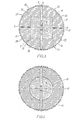
- FIG. 1 and 2 it is a cell cooling tower with an outer shell 1 made of reinforced concrete.
- Several axial fans 2 are installed in the lower part of the cooling tower 1 with their fan housings 3 in such a way that they suck in outside air and press them into the interior of the cooling tower.
- Via risers 4 heated water is pumped up a steam power plant in the cooling tower and reaches, for example, cross-shaped distribution channels 6.
- These channels have partition walls 7, so that the water pumped up in the shaft 4 can get into parallel pipes 8, which it on the cooling tower cross section to distribute.
- the water to be cooled emerges from the pipes 8 and reaches the cooling tower unit, which is schematically represented at 12 and which bring the water into contact with the air, so that it flows in countercurrent to the air pressed by the axial fan 2 into the cooling tower and flowing upwards rains until it reaches the basin 13, which is provided in the lower region of the cooling tower.
- the described water distribution system 4-8 is switched so that the sum of the areas 10 and 11 is acted upon by raining cooling water.
- the outside temperatures drop into the minus range, there is the risk that cooling water impinging on the surface 14 of the sump 13 leads to splashing water in the area of the blade 15 of the axial fan 2, causing icing there. Icing also occurs due to partial return flows of the air in the fan area, since water from the rainy zone 11 then enters the fan race.
- the formation of steam in the area of the cooling tower leads to condensation on the wing, in particular on the hub of the fan, not shown, which sits in the area of the axis 16.
- shut-off devices 5 are switched so that cooling water can only get into the distribution channel through the pipes 8, but not through the pipes 8a which irrigate the surface 11 lying in the edge region of the cooling tower, because they are from the outer region branch off the distribution channels 6 assigned to the cooling tower.
- the water is only rained down over the hatched area 10, while the edge area 11 remains water-free.
- the result of this is a higher water density on the surface 10 and a swath formation in the water-free surface 11, which, however, due to the size of the surface 11, cannot reach the fan 2 wing, but rather can be discharged upwards.
- the formation of splash water under the surface 11 ceases, so that no water can reach the fan blades in this way either, in order to form ice there.
- the partial surface 10 which is acted upon by the water to be cooled at sub-zero temperatures is square, a total of sixteen pressing fans being arranged on the circumference of the cooling tower 1, four fans each in a quadrant of the cooling tower.
- the square surface 10 acted upon by cooling water is arranged within the total surface such that the surface 11 not acted upon by cooling water at sub-zero temperatures is delimited by the cooling tower at the outline 17 of the horizontal cross section.
- the partial area 10 is arranged such that its corners 18-21 each lie on the middle between two adjacent fans 22, 23; 24, 25; 26, 27; 28, 29 lie.
- the shortest distance of the surface 10 exposed to water from the contour line 17 is not between the blades of the fans, but rather the cooling tower wall. In this way, despite the square or rectangular shape of the exposed fliicho 10, the distances to the running tools of the fans are as close as possible.
- radial partitions 9 can be arranged in the cooling tower. These partitions can protrude into the sump 13 of the cooling tower and ensure that the edge surfaces are separated from one another.
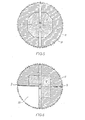
- the outline 30 of the surface 10 exposed to the cooling water at minus temperatures is circular and is concentric with the outline 17 of the cooling tower.
- the outline 31 of the surface 10 acted upon by the cooling water at sub-zero temperatures is octagonal, the corners again being directed towards the cooling tower wall between two adjacent fans, as in the embodiment according to FIG. 3.
- Fig. 6 shows the shutdown of a sector 33, i. H. a whole quadrant of the round cooling tower cross-section with the rest of the square design of the irrigated surface 10 through the partition walls 9 described.
- forced ventilation cooling towers are shown in the figures, the invention can also be applied to natural draft cooling towers, e.g. B. Apply those with a paraboloid shaped reinforced concrete skin.
- FIG. 7 shows a cooling tower in the known form of a paraboloid with an outer shell made of reinforced concrete. Rising shafts 4 are arranged centrally, which lead the heated water of a steam power plant upwards, which then runs into the distribution channels 6. Corresponding parts of FIG. 7 with FIG. 2 have the same reference numerals.
Landscapes
- Engineering & Computer Science (AREA)
- Mechanical Engineering (AREA)
- General Engineering & Computer Science (AREA)
- Physics & Mathematics (AREA)
- Thermal Sciences (AREA)
- Heat-Exchange Devices With Radiators And Conduit Assemblies (AREA)
- Devices That Are Associated With Refrigeration Equipment (AREA)
- Separation By Low-Temperature Treatments (AREA)
- Motor Or Generator Cooling System (AREA)
Claims (6)
Priority Applications (1)
| Application Number | Priority Date | Filing Date | Title |
|---|---|---|---|
| AT81110291T ATE15538T1 (de) | 1980-12-18 | 1981-12-09 | Kuehlturm zum rueckkuehlen von wasser. |
Applications Claiming Priority (2)
| Application Number | Priority Date | Filing Date | Title |
|---|---|---|---|
| DE3047775 | 1980-12-18 | ||
| DE3047775 | 1980-12-18 |
Publications (3)
| Publication Number | Publication Date |
|---|---|
| EP0054843A2 EP0054843A2 (fr) | 1982-06-30 |
| EP0054843A3 EP0054843A3 (en) | 1982-11-03 |
| EP0054843B1 true EP0054843B1 (fr) | 1985-09-11 |
Family
ID=6119536
Family Applications (1)
| Application Number | Title | Priority Date | Filing Date |
|---|---|---|---|
| EP81110291A Expired EP0054843B1 (fr) | 1980-12-18 | 1981-12-09 | Tour de refroidissement pour refroidir de l'eau |
Country Status (3)
| Country | Link |
|---|---|
| EP (1) | EP0054843B1 (fr) |
| AT (1) | ATE15538T1 (fr) |
| DE (1) | DE3172274D1 (fr) |
Families Citing this family (6)
| Publication number | Priority date | Publication date | Assignee | Title |
|---|---|---|---|---|
| FR2519129A1 (fr) * | 1981-12-24 | 1983-07-01 | Aznavorian Gabaret | Perfectionnements apportes aux tours de refrigeration atmospherique |
| DE19754995C2 (de) * | 1997-12-11 | 2001-03-15 | Gea Kuehlturmbau Gmbh | Hybridkühlturm |
| CN102798537A (zh) * | 2012-07-30 | 2012-11-28 | 中国能源建设集团广东省电力设计研究院 | 逆流式自然通风湿式冷却塔雨区阻力模拟试验装置 |
| CN106197060A (zh) * | 2016-08-26 | 2016-12-07 | 广州览讯科技开发有限公司 | 离心式鼓风横流开式冷却塔 |
| CN114577027B (zh) * | 2022-04-12 | 2023-07-25 | 河北华盛节能设备有限公司 | 消白除雾节能型冷却塔 |
| CN116045694B (zh) * | 2022-12-30 | 2023-10-31 | 江苏卓盾传热科技有限公司 | 一种节能喷雾冷却塔 |
Family Cites Families (8)
| Publication number | Priority date | Publication date | Assignee | Title |
|---|---|---|---|---|
| DE140727C (fr) * | ||||
| DE370136C (de) * | 1920-06-18 | 1923-02-27 | Jung Ernst | Vorrichtung nach Art eines Kaminkuehlers zur Rueckgewinnung der in der zu kuehlendenFluessigkeit enthaltenen Waerme |
| FR24300E (fr) * | 1921-01-05 | 1922-05-02 | A & F Hamon Freres Soc | Réfrigérant à cheminée |
| CH308094A (de) * | 1952-04-22 | 1955-06-30 | Marley Company Inc | Verfahren zum Kühlen von Wasser und Kühlturm zur Durchführung des Verfahrens. |
| GB841089A (en) * | 1957-12-03 | 1960-07-13 | Maurice Hamon | Improvements in and relating to the cooling of liquids in cooling towers |
| CH555523A (de) * | 1972-12-27 | 1974-10-31 | Keag Handels Ag | Kuehlturm. |
| FR2266134A1 (en) * | 1974-03-29 | 1975-10-24 | Hamon | Cross flow water cooling tower - has concentric inlet troughs with adjustable flow restrictors on inner troughs |
| DE2636807C3 (de) * | 1976-08-16 | 1979-05-10 | Kraftwerk Union Ag, 4330 Muelheim | Kühlturm mit Zwangsbelüftung und Naturzug |
-
1981
- 1981-12-09 DE DE8181110291T patent/DE3172274D1/de not_active Expired
- 1981-12-09 EP EP81110291A patent/EP0054843B1/fr not_active Expired
- 1981-12-09 AT AT81110291T patent/ATE15538T1/de not_active IP Right Cessation
Also Published As
| Publication number | Publication date |
|---|---|
| ATE15538T1 (de) | 1985-09-15 |
| EP0054843A3 (en) | 1982-11-03 |
| EP0054843A2 (fr) | 1982-06-30 |
| DE3172274D1 (en) | 1985-10-17 |
Similar Documents
| Publication | Publication Date | Title |
|---|---|---|
| EP2141360B1 (fr) | Eolienne pourvue d'un système de refroidissement du générateur | |
| EP0172403B1 (fr) | Tour de refroidissement à évaporation | |
| DE3501278A1 (de) | Rieselwasserauffangeinrichtung | |
| DE2602485B2 (de) | Wasserrückkühlvorrichtung | |
| DE2166477A1 (de) | Vorrichtung fuer die verteilung des zu kuehlenden mediums, insbesondere warmwasser, auf die rieseleinbauten bei nasskuehltuermen | |
| DE2751111A1 (de) | Vom boden beluefteter nass-trocken- wasserkuehlturm | |
| DE1501362A1 (de) | Rinnensystem fuer Verdampfungs-Waermetauscher | |
| DE2443589A1 (de) | Wasserkuehlturm | |
| DE2249844A1 (de) | Vorrichtung und verfahren zum verspruehen von fluessigkeiten | |
| DE3234251A1 (de) | Wasser-kuehlturm mit schichten aus hohlziegeln und distanzstuecken | |
| DE112004001723B4 (de) | Gebläse ohne Einfrierblockierphänomen und Wärmetauschvorrichtung mit dem Gebläse | |
| DE2002056A1 (de) | Zerstaeubungskuehler,insbesondere Kuehlturm zur Abkuehlung von Wasser | |
| DE2828942A1 (de) | Waermetauscher | |
| EP0054843A2 (fr) | Tour de refroidissement pour refroidir de l'eau | |
| EP1530901A1 (fr) | Procédé et appareil pour condenser des substances de l'air d'échappement d'un appareil de cuisson | |
| DE19754995C2 (de) | Hybridkühlturm | |
| DE3143417A1 (de) | "verfahren und vorrichtung zum rueckkuehlen von wasser in kuehltuermen" | |
| DE19602839B4 (de) | Kühlluftzuführung für die Radbremse eines Fahrzeugs | |
| DE29804919U1 (de) | Warmluftventilator | |
| EP4149774B1 (fr) | Système de climatisation | |
| EP0170616B1 (fr) | Disposition pour réduire le panache des tours de refroidissement à ruissellement | |
| EP0848224A2 (fr) | Tour de refroidissement à ventilation forcée et son procédé de fonctionnement | |
| EP0899532B1 (fr) | Elément de garnissage pour tours de refroidissement | |
| CH555523A (de) | Kuehlturm. | |
| EP0953814A2 (fr) | Installation de refroidissement hybride |
Legal Events
| Date | Code | Title | Description |
|---|---|---|---|
| PUAI | Public reference made under article 153(3) epc to a published international application that has entered the european phase |
Free format text: ORIGINAL CODE: 0009012 |
|
| AK | Designated contracting states |
Designated state(s): AT BE CH DE FR GB IT LU NL SE |
|
| 17P | Request for examination filed |
Effective date: 19820601 |
|
| PUAL | Search report despatched |
Free format text: ORIGINAL CODE: 0009013 |
|
| AK | Designated contracting states |
Designated state(s): AT BE CH DE FR GB IT LU NL SE |
|
| ITF | It: translation for a ep patent filed | ||
| GRAA | (expected) grant |
Free format text: ORIGINAL CODE: 0009210 |
|
| STAA | Information on the status of an ep patent application or granted ep patent |
Free format text: STATUS: THE PATENT HAS BEEN GRANTED |
|
| AK | Designated contracting states |
Designated state(s): AT BE CH DE FR GB IT LI LU NL SE |
|
| REF | Corresponds to: |
Ref document number: 15538 Country of ref document: AT Date of ref document: 19850915 Kind code of ref document: T |
|
| REF | Corresponds to: |
Ref document number: 3172274 Country of ref document: DE Date of ref document: 19851017 |
|
| ET | Fr: translation filed | ||
| PG25 | Lapsed in a contracting state [announced via postgrant information from national office to epo] |
Ref country code: LU Free format text: LAPSE BECAUSE OF NON-PAYMENT OF DUE FEES Effective date: 19851231 |
|
| PLBI | Opposition filed |
Free format text: ORIGINAL CODE: 0009260 |
|
| 26 | Opposition filed |
Opponent name: GEA KUEHLTURMBAU UND LUFTKONDENSATION GMBH Effective date: 19860607 |
|
| NLR1 | Nl: opposition has been filed with the epo |
Opponent name: GEA KUEHLTURMBAU UND LUFTKONDENSATION GMBH |
|
| PGFP | Annual fee paid to national office [announced via postgrant information from national office to epo] |
Ref country code: AT Payment date: 19861216 Year of fee payment: 6 |
|
| PGFP | Annual fee paid to national office [announced via postgrant information from national office to epo] |
Ref country code: NL Payment date: 19861231 Year of fee payment: 6 |
|
| PG25 | Lapsed in a contracting state [announced via postgrant information from national office to epo] |
Ref country code: AT Effective date: 19871209 |
|
| PG25 | Lapsed in a contracting state [announced via postgrant information from national office to epo] |
Ref country code: SE Effective date: 19871210 |
|
| PG25 | Lapsed in a contracting state [announced via postgrant information from national office to epo] |
Ref country code: LI Effective date: 19871231 Ref country code: CH Effective date: 19871231 Ref country code: BE Effective date: 19871231 |
|
| BERE | Be: lapsed |
Owner name: HAMON-SOBELCO S.A. Effective date: 19871231 |
|
| PG25 | Lapsed in a contracting state [announced via postgrant information from national office to epo] |
Ref country code: NL Effective date: 19880701 |
|
| NLV4 | Nl: lapsed or anulled due to non-payment of the annual fee | ||
| GBPC | Gb: european patent ceased through non-payment of renewal fee | ||
| PG25 | Lapsed in a contracting state [announced via postgrant information from national office to epo] |
Ref country code: FR Free format text: LAPSE BECAUSE OF NON-PAYMENT OF DUE FEES Effective date: 19880831 |
|
| REG | Reference to a national code |
Ref country code: CH Ref legal event code: PL |
|
| PG25 | Lapsed in a contracting state [announced via postgrant information from national office to epo] |
Ref country code: DE Effective date: 19880901 |
|
| REG | Reference to a national code |
Ref country code: FR Ref legal event code: ST |
|
| PG25 | Lapsed in a contracting state [announced via postgrant information from national office to epo] |
Ref country code: GB Free format text: LAPSE BECAUSE OF NON-PAYMENT OF DUE FEES Effective date: 19881121 |
|
| EUG | Se: european patent has lapsed |
Ref document number: 81110291.2 Effective date: 19880912 |
|
| RIN2 | Information on inventor provided after grant (corrected) |
Inventor name: PFLAUMBAUM, HANS-JUERGEN, ING.-GRAD. |