EP0054917A2 - 6- and 4-Substituted-1-azabicyclo(3.2.0)heptan-3,7-dione-2-carboxylates - Google Patents
6- and 4-Substituted-1-azabicyclo(3.2.0)heptan-3,7-dione-2-carboxylates Download PDFInfo
- Publication number
- EP0054917A2 EP0054917A2 EP81110531A EP81110531A EP0054917A2 EP 0054917 A2 EP0054917 A2 EP 0054917A2 EP 81110531 A EP81110531 A EP 81110531A EP 81110531 A EP81110531 A EP 81110531A EP 0054917 A2 EP0054917 A2 EP 0054917A2
- Authority
- EP
- European Patent Office
- Prior art keywords
- hydrogen
- phenyl
- methyl
- alkyl
- carbon atoms
- Prior art date
- Legal status (The legal status is an assumption and is not a legal conclusion. Google has not performed a legal analysis and makes no representation as to the accuracy of the status listed.)
- Granted
Links
- 0 *CC(C1)C1NC=C Chemical compound *CC(C1)C1NC=C 0.000 description 6
- MTDZXCTWQUWSMA-UHFFFAOYSA-N CC1CC(S)=CCC1 Chemical compound CC1CC(S)=CCC1 MTDZXCTWQUWSMA-UHFFFAOYSA-N 0.000 description 1
Classifications
-
- C—CHEMISTRY; METALLURGY
- C07—ORGANIC CHEMISTRY
- C07F—ACYCLIC, CARBOCYCLIC OR HETEROCYCLIC COMPOUNDS CONTAINING ELEMENTS OTHER THAN CARBON, HYDROGEN, HALOGEN, OXYGEN, NITROGEN, SULFUR, SELENIUM OR TELLURIUM
- C07F7/00—Compounds containing elements of Groups 4 or 14 of the Periodic Table
- C07F7/02—Silicon compounds
- C07F7/08—Compounds having one or more C—Si linkages
- C07F7/10—Compounds having one or more C—Si linkages containing nitrogen having a Si-N linkage
-
- A—HUMAN NECESSITIES
- A61—MEDICAL OR VETERINARY SCIENCE; HYGIENE
- A61P—SPECIFIC THERAPEUTIC ACTIVITY OF CHEMICAL COMPOUNDS OR MEDICINAL PREPARATIONS
- A61P31/00—Antiinfectives, i.e. antibiotics, antiseptics, chemotherapeutics
-
- A—HUMAN NECESSITIES
- A61—MEDICAL OR VETERINARY SCIENCE; HYGIENE
- A61P—SPECIFIC THERAPEUTIC ACTIVITY OF CHEMICAL COMPOUNDS OR MEDICINAL PREPARATIONS
- A61P31/00—Antiinfectives, i.e. antibiotics, antiseptics, chemotherapeutics
- A61P31/04—Antibacterial agents
-
- C—CHEMISTRY; METALLURGY
- C07—ORGANIC CHEMISTRY
- C07C—ACYCLIC OR CARBOCYCLIC COMPOUNDS
- C07C17/00—Preparation of halogenated hydrocarbons
- C07C17/26—Preparation of halogenated hydrocarbons by reactions involving an increase in the number of carbon atoms in the skeleton
- C07C17/272—Preparation of halogenated hydrocarbons by reactions involving an increase in the number of carbon atoms in the skeleton by addition reactions
- C07C17/275—Preparation of halogenated hydrocarbons by reactions involving an increase in the number of carbon atoms in the skeleton by addition reactions of hydrocarbons and halogenated hydrocarbons
-
- C—CHEMISTRY; METALLURGY
- C07—ORGANIC CHEMISTRY
- C07C—ACYCLIC OR CARBOCYCLIC COMPOUNDS
- C07C29/00—Preparation of compounds having hydroxy or O-metal groups bound to a carbon atom not belonging to a six-membered aromatic ring
- C07C29/132—Preparation of compounds having hydroxy or O-metal groups bound to a carbon atom not belonging to a six-membered aromatic ring by reduction of an oxygen containing functional group
- C07C29/136—Preparation of compounds having hydroxy or O-metal groups bound to a carbon atom not belonging to a six-membered aromatic ring by reduction of an oxygen containing functional group of >C=O containing groups, e.g. —COOH
- C07C29/147—Preparation of compounds having hydroxy or O-metal groups bound to a carbon atom not belonging to a six-membered aromatic ring by reduction of an oxygen containing functional group of >C=O containing groups, e.g. —COOH of carboxylic acids or derivatives thereof
-
- C—CHEMISTRY; METALLURGY
- C07—ORGANIC CHEMISTRY
- C07D—HETEROCYCLIC COMPOUNDS
- C07D205/00—Heterocyclic compounds containing four-membered rings with one nitrogen atom as the only ring hetero atom
- C07D205/02—Heterocyclic compounds containing four-membered rings with one nitrogen atom as the only ring hetero atom not condensed with other rings
- C07D205/06—Heterocyclic compounds containing four-membered rings with one nitrogen atom as the only ring hetero atom not condensed with other rings having one double bond between ring members or between a ring member and a non-ring member
- C07D205/08—Heterocyclic compounds containing four-membered rings with one nitrogen atom as the only ring hetero atom not condensed with other rings having one double bond between ring members or between a ring member and a non-ring member with one oxygen atom directly attached in position 2, e.g. beta-lactams
-
- C—CHEMISTRY; METALLURGY
- C07—ORGANIC CHEMISTRY
- C07D—HETEROCYCLIC COMPOUNDS
- C07D477/00—Heterocyclic compounds containing 1-azabicyclo [3.2.0] heptane ring systems, i.e. compounds containing a ring system of the formula:, e.g. carbapenicillins, thienamycins; Such ring systems being further condensed, e.g. 2,3-condensed with an oxygen-, nitrogen- or sulphur-containing hetero ring
- C07D477/10—Heterocyclic compounds containing 1-azabicyclo [3.2.0] heptane ring systems, i.e. compounds containing a ring system of the formula:, e.g. carbapenicillins, thienamycins; Such ring systems being further condensed, e.g. 2,3-condensed with an oxygen-, nitrogen- or sulphur-containing hetero ring with hydrogen atoms, hydrocarbon or substituted hydrocarbon radicals, directly attached in position 4, and with a carbon atom having three bonds to hetero atoms with at the most one bond to halogen, e.g. an ester or nitrile radical, directly attached in position 2
- C07D477/12—Heterocyclic compounds containing 1-azabicyclo [3.2.0] heptane ring systems, i.e. compounds containing a ring system of the formula:, e.g. carbapenicillins, thienamycins; Such ring systems being further condensed, e.g. 2,3-condensed with an oxygen-, nitrogen- or sulphur-containing hetero ring with hydrogen atoms, hydrocarbon or substituted hydrocarbon radicals, directly attached in position 4, and with a carbon atom having three bonds to hetero atoms with at the most one bond to halogen, e.g. an ester or nitrile radical, directly attached in position 2 with hydrogen atoms, hydrocarbon or substituted hydrocarbon radicals, attached in position 6
- C07D477/16—Heterocyclic compounds containing 1-azabicyclo [3.2.0] heptane ring systems, i.e. compounds containing a ring system of the formula:, e.g. carbapenicillins, thienamycins; Such ring systems being further condensed, e.g. 2,3-condensed with an oxygen-, nitrogen- or sulphur-containing hetero ring with hydrogen atoms, hydrocarbon or substituted hydrocarbon radicals, directly attached in position 4, and with a carbon atom having three bonds to hetero atoms with at the most one bond to halogen, e.g. an ester or nitrile radical, directly attached in position 2 with hydrogen atoms, hydrocarbon or substituted hydrocarbon radicals, attached in position 6 with hetero atoms or carbon atoms having three bonds to hetero atoms with at the most one bond to halogen, e.g. an ester or nitrile radical, directly attached in position 3
- C07D477/18—Oxygen atoms
-
- Y—GENERAL TAGGING OF NEW TECHNOLOGICAL DEVELOPMENTS; GENERAL TAGGING OF CROSS-SECTIONAL TECHNOLOGIES SPANNING OVER SEVERAL SECTIONS OF THE IPC; TECHNICAL SUBJECTS COVERED BY FORMER USPC CROSS-REFERENCE ART COLLECTIONS [XRACs] AND DIGESTS
- Y02—TECHNOLOGIES OR APPLICATIONS FOR MITIGATION OR ADAPTATION AGAINST CLIMATE CHANGE
- Y02P—CLIMATE CHANGE MITIGATION TECHNOLOGIES IN THE PRODUCTION OR PROCESSING OF GOODS
- Y02P20/00—Technologies relating to chemical industry
- Y02P20/50—Improvements relating to the production of bulk chemicals
- Y02P20/55—Design of synthesis routes, e.g. reducing the use of auxiliary or protecting groups
Definitions
- This invention relates to certain 6- and 4- substituted-1-azabicyclo[3.2.0]heptan-3,7-dione-2-carboxylates (I) which are useful in the preparation of 6-, 1- and 2-substituted carbapenem antibiotics (II): wherein R 5 is a salt cation such as sodium, potassium, or a removable carboxyl protecting group, or a pharmaceuti- cally acceptable ester moiety; and wherein R 1 , R 2 , R 3 , R and R 8 are independently selected from the group consisting of hydrogen, substituted and unsubstituted: alkyl, alkenyl, and alkynyl, having from 1-10 carbon atoms; cycloalkyl, spirocycloalkyl, cycloalkylalkyl, and alkylcycloalkyl, having 3-6 carbon atoms in the cycloalkyl ring and 1-6 carbon atoms in the alkyl moieties; aryl, such
- This invention also relates to processes for the preparation of such compounds I and II.
- antibiotics II via intermediates I, which are useful in animal and human therapy and in inanimate systems.
- antibiotics are active against a broad range of pathogens which representatively include both gram positive bacteria such as S. aureus, Strep. pyogenes, and B. subtilis, and gram negative bacteria such as E. coli, Pseudomonas, Proteus morganii, Serratia, and Klebsiella.
- the oxidation 2 ⁇ 3 is accomplished by treating 2 in a solvent such as methylenechloride, methanol, chloroform, or the like, with an oxidizing agent such as ozone, or the like, at a temperature of from -100° to 0°C for from 0.1 to 4 hours, followed by treating the crude product with an oxidizing agent such as m-chloroperbenzoic acid, hydrogen peroxide, peracetic acid, or the like, at a temperature of from 0°C to 100°C for from 1 to 100 hours.
- R° is a readily removable protecting group and is defined below.
- the addition 3 ⁇ 4 is accomplished by treating 3 with l,l'-carbonyldiimidazole, or the like, in a solvent such as tetrahydrofuran, dimethoxyethane, acetonitrile or the like, at.a temperature of from 0 to 70°C, followed by the addition of 1..1 to 3.0 equivalent of (R 7 O 2 CCH 2 CO 2 ) 2 Mg, at a temperature of from 0 to 70°C for from 1 to 48 hours.
- R 7 is a pharmaceutically acceptable ester moiety or a readily removable carboxyl protecting groups such as p-nitrobenzyl, benzyl, or the like.
- the diazo species 6 is prepared from 5 by treating 5 in a solvent such as CH 3 CN, CH 2 Cl 2 , THF, or the like with an azide such as p-carboxybenzene- sulfonylazide, toluenesulfonylazide, methanesulfonyl- azide, or the like in the presence of a base such as triethylamine, pyridine, diethylamine or the like for from 1 to 50 hours at 0-50°C.
- a solvent such as CH 3 CN, CH 2 Cl 2 , THF, or the like
- an azide such as p-carboxybenzene- sulfonylazide, toluenesulfonylazide, methanesulfonyl- azide, or the like
- a base such as triethylamine, pyridine, diethylamine or the like for from 1 to 50 hours at 0-50°C.
- Cyclization (6 ⁇ 7) is accomplished by treating 6 in a solvent such as benzene, toluene, THF, cyclohexane, ethylacetate or the like at a temperature of from 25 to 110°C for from 1-5 hours in the presence of a catalyst such as bis (acetylacetonato)Cu(II) [Cu(acac) 2 ], CuSO 4 , Cu powder, Rh(OAc )2 or Pd(OAc) 2 .
- a solvent such as benzene, toluene, THF, cyclohexane, ethylacetate or the like
- a catalyst such as bis (acetylacetonato)Cu(II) [Cu(acac) 2 ], CuSO 4 , Cu powder, Rh(OAc )2 or Pd(OAc) 2 .
- the cyclization may be accomplished by irradiating 6 through a pyrex filter (a wave length greater than 300nm) in a solvent such as benzene, CCl 4 , diethylether, or the like, at a temperature of from 0-25°C for from 0.5 to 2 hours.
- a pyrex filter a wave length greater than 300nm
- a solvent such as benzene, CCl 4 , diethylether, or the like
- Establishment of leaving group X (7 ⁇ 8) is accomplished by acylating the keto ester 7 with an acylating agent RX such as p-toluenesulfonic acid anhydride, p-nitrophenylsulfonic acid anhydride, 2,4,6-triisopropylphenylsuTfonic acid anhydride, methanesulfonic acid anhydride, toluenesulfonyl chloride, p-bromophenylsulfonyl chloride, diphenylchlorophosphate, or the like; wherein X is the corresponding leaving group such as toluene sulfonyloxy, p-nitrophenylsulfonyloxy, methanesulfonyloxy, p-bromophenylsulfonyloxy and other leaving groups which are established by conventional procedures and which are well known in the art.
- RX such as p-toluenesulfonic acid an
- the above acylation to establish leaving groups X is conducted in a solvent such as methylene chloride, acetonitrile or dimethylformamide, in the presence of a base such as diisopropylethylamine, triethylamine, 4-dimethylamino-pyridine or the like at a temperature of from -20 to 40°C for from 0.5 to 5 hours.
- a solvent such as methylene chloride, acetonitrile or dimethylformamide
- a base such as diisopropylethylamine, triethylamine, 4-dimethylamino-pyridine or the like at a temperature of from -20 to 40°C for from 0.5 to 5 hours.
- the leaving group X of intermediate 8 can also be halogen.
- the halogen leaving group is established by treating 7 with a halogenating agent such as ⁇ 3 PCl 2 , ⁇ 3 PBr 2 , ( ⁇ O) 3 PBr 2 , cxalyl chloride, PBr 3 or the like in a solvent such as CH 2 Cl 2 , CH 3 CN, THF, or the like in the presence of a base such as diisopropylethylamine, triethylamine, or 4-dimethylaminopyridine or the like.
- a halogenating agent such as ⁇ 3 PCl 2 , ⁇ 3 PBr 2 , ( ⁇ O) 3 PBr 2 , cxalyl chloride, PBr 3 or the like
- a solvent such as CH 2 Cl 2 , CH 3 CN, THF, or the like
- a base such as diisopropylethylamine, triethylamine, or 4-dimethylaminopyridine or the like.
- reaction 8 ⁇ 9 is accomplished by treating 8 in a solvent such as dioxane, dimethylformamide, dimethylsulfoxide, acetonitrile, hexamethylphosphoramide, or the like in the presence of an approximately equivalent to excess of the mercaptan reagent HSR B wherein R 8 as defined above.
- a solvent such as dioxane, dimethylformamide, dimethylsulfoxide, acetonitrile, hexamethylphosphoramide, or the like in the presence of an approximately equivalent to excess of the mercaptan reagent HSR B wherein R 8 as defined above.
- a representative mercaptan reagent is HSCH 2 CH 2 NHR 8' wherein R 8' is hydrogen or a readily removable N-protecting group such as p-nitrobenzyloxycarbonyl, o-nitrobenzyloxy carbonal, or the like in the presence of a base such as sodium hydrogen carbonate, potassium carbonate, triethylamine, diisopropylethylamine, or the like at a temperature of from -40 to 25°C for from 1 to 72 hours.
- a base such as sodium hydrogen carbonate, potassium carbonate, triethylamine, diisopropylethylamine, or the like at a temperature of from -40 to 25°C for from 1 to 72 hours.
- the mercaptan reagent, HSCH 2 CH 2 NHR 8' is typically prepared by treating aminoethylmercaptan in the presence of the desired acid chloride in the presence of a base such as sodium bicarbonate, sodium hydroxide, or the like in a solvent such as aqueous diethylether, aqueous dioxane, aqueous acetone, or the like at a temperature of from 0 to 25°C for from 0.5 to 4 hours.
- a base such as sodium bicarbonate, sodium hydroxide, or the like
- a solvent such as aqueous diethylether, aqueous dioxane, aqueous acetone, or the like at a temperature of from 0 to 25°C for from 0.5 to 4 hours.
- the final deblocking step 9 ⁇ II is accomplished by conventional procedures such as hydrolysis or hydrogenation.
- a solvent such as dioxane-water-ethanol, tetrahydrofuran-aqueous dipotassium hydrogen phosphate-isopropanol or the like is treated under a hydrogen pressure of from 1 to 4 atmospheres in the presence of a hydrogenation catalyst such as palladium on charcoal, palladium hydroxide, or the like at a temperature of from 0 to 50°C for from 0.5 to 4 hours to provide I I.
- the reaction intermediate 2' is converted to 3' by hydrolysis.
- the reduction of 3' to provide 4-(1-methyl-2-acetoxyethyl)-2-azetidinone (4') is conducted by any convenient means such as hydrogenation in the presence of a catalyst such as platinum, palladium or oxides thereof under a hydrogen pressure of from 1 to 20 atmospheres in a solvent such as ethanol, ethylacetate, or the like at a temperature of from 0° to 25°C for from 5 minutes to 1 hour.
- a catalyst such as platinum, palladium or oxides thereof under a hydrogen pressure of from 1 to 20 atmospheres in a solvent such as ethanol, ethylacetate, or the like at a temperature of from 0° to 25°C for from 5 minutes to 1 hour.
- the 4-(2-hydroxy-l-methyl-ethyl)-2-azetidinone species 5' is obtained from 4' by hydrolysis.
- the 8-oxo-2,2,5-trimethyl-3-oxa-1-azabicyclo[4.2.0]octane species 6' is obtained on treatment of 5' with 2,2-dimethoxypropane in the presence of a catalyst such as boron trifluoride etherate in a solvent such as methylene chloride at a temperature of from 0° to 40°C for from 1 to 40 minutes. Alkylation of 6' provides 7'.
- a catalyst such as boron trifluoride etherate
- solvent such as methylene chloride
- 6' is treated with a strong base such as lithium diisopropylamide, sodium hydride, phenyl lithium or butyl lithium and the like in a solvent such as tetrahydrofuran (THF), ether, dimethoxyethane, and the like at a temperature of from -80° to 0°C., whereupon the alkylating agent of choice, R 6 X is added (R 6 is as described above and X is chloro or bromo; alternatively, the alkylating agent may be R 6 tosylate, R 6- mesylate or an aldehyde or ketone such as acetaldehyde and the like) to provide mono-alkylated species 7'. When the desired dialkylated species may be obtained from 7' by repeating the alkylating procedure, 6' ⁇ 7'.
- a strong base such as lithium diisopropylamide, sodium hydride, phenyl lithium or butyl lithium and the like
- a solvent
- the conversion 8' ⁇ 3 is obtained by oxidation.
- the most preferred oxidation is achieved by suspending 8' in a solvent such as acetone, benzene, hexane, or the like at a temperature of from 0°C to 50°C and treating with an oxidizing agent such as Jones reagent.
- compound 3 may be prepared from 8' by treating 8' with 50% trifluoroacetic acid/water at 0° to 50°C for from 10 min. to 1 hr. to give the intermediate alcohol which is then oxidized with Jones reagent to 3.
- the N-protecting group R° may be established on 3, as originally shown in Diagram 1, by following the procedure 16, ⁇ 17, below; wherein R° is also defined.
- he diester 12 is prepared by treating the diacid 11 with thionyl chloride at reflux for two hours followed by reacting with ethanol at 80°C for 4 hours. Reduction of the diester 12 with lithium alumium hydride in ether at reflux for 4 hours followed by hydrolysis with 10% NaOH gives diol 13 which on further reaction with thionyl chloride gives dichloride 14.
- the dichloride 14 can be alternatively prepared by treating 15 with ethylene in the presence of alumium chloride. Treatment of the dichloride 14 with base such as 2-methylquinoline, DBU or sodium hydroxide in polyethylene glycol gives the expected 3-substituted 1,4-pentadiene 1.
- the substituted azetidinone 16 is prepared by reacting a 3-substituted 1,4-pentadiene 1 with chlorosulfonyl- isocyanate at 25°C to 60°C in a pressure bottle for 3-12 days, then the resulting mixture is hydrolyzed with aqueous sodium sulfite solution between pH 6 5-7.5 at 0°C to 25°C for from 5 min. to 60 min.
- Azetidinone 16 is transformed (16 ⁇ 17) to establish the protecting group R° which may be a triorganosilyl group, such as t-butyldimethylsilyl, t-butyldiphenylsilyl, triphenylsilyl, isopropyldimethylsilyl, for example, or may be 3,4-dimethoxybenzyl, for example.
- R° may be a triorganosilyl group, such as t-butyldimethylsilyl, t-butyldiphenylsilyl, triphenylsilyl, isopropyldimethylsilyl, for example, or may be 3,4-dimethoxybenzyl, for example.
- Silyl protection is preferred, and typically R° is established by treating 16 in a solvent such as dimethylformamide, acetonitrile, hexamethylphosphoramide, tetrahydrofuran and the like with a silylating agent such as t-butyldimethylchlorosilane, t-butyldiphenyl- chlorosilane, triphenylchlorosilane, and the like at a temperature of from -20°C to 25°C for from 0.5 to 24 hours in the presence of a base such as triethylamine, diisopropylethylamine, or imidazole.
- a solvent such as dimethylformamide, acetonitrile, hexamethylphosphoramide, tetrahydrofuran and the like
- a silylating agent such as t-butyldimethylchlorosilane, t-butyldiphenyl- chlorosilane, triphenylchlor
- Alkylation of 17 provides 18.
- 17 is treated with a strong base such as lithium diisopropylamide, sodium hydride, phenyl lithium or butyl lithium and the like in a solvent such as tetrahydrofuran (THF), ether, dimethoxyethane and the like at a temperature of from -80°C to 0°C, whereupon the alkylating agent of choice, R X is added (R 6 is as described above and X is Iodo, chloro or bromo; alternatively the alkylating agent may be R 6- tosylate, R 6 -mesylate or an aldehyde or ketone such as acetaldehyde and the like) to provide mono- alkylated species 18.
- a strong base such as lithium diisopropylamide, sodium hydride, phenyl lithium or butyl lithium and the like
- a solvent such as tetrahydrofuran (THF), ether, dimethoxye
- suitable alkylating agents for establishing R 6 and/or R 7 at ultimate ring position 6 (17 ⁇ 18 ⁇ 2) are:
- R 3 ' is benzyl, p-nitrobenzyl, o-nitrobenzyl, t-butyl, bromo-t-butyl, t-butyldimethylsilyl, trimethylsilyl, trichloroethyl; or R 3 ' represents pharmaceutically acceptable ester moieties such as pivaloyloxymethyl, allyl, methallyl, (2-methylthio)-ethyl, 3-methyl-2-butenyl, p-t-butylbenzyl, 5-indanyl, 3-phthalidyl.
- the final compounds II made available by the present invention are valuable antibiotics active against various gram-positive and gram-negative bacteria and, accordingly, find utility in human and veterinary medicine.
- Such sensitive bacteria representatively include: Staphylococcus aureus, Escherichia coli, Klebsiella pneumoniae, Serratia, Salmonella typhosa, Pseudomonas and Bacterium proteus.
- the resulting compounds may further be utilized as additives to animal feed, for preserving foodstuffs, and as disinfectants.
- compositions may be employed in aqueous compositions in concentrations ranging from 0.1 to 100 parts of antibiotic per million parts of solution in order to destroy and inhibit the growth of harmful bacteria on medical and dental equipment and as bactericides in industrial applications, for example, in waterbased paints and in the white water of paper mills to inhibit the growth of harmful bacteria.
- antibiotics may be used alone or in combination as an active ingredient in any one of a variety of pharmaceutical preparations.
- These antibiotics and their corresponding salts may be employed in capsule form or as tablets, powders or liquid solutions or as suspensions or elixirs. They may be administered orally, intravenously or intramuscularly.
- Tablets and capsules for oral administration may be in unit dose presentation form, and may contain conventional excipients such as binding agents, for example, syrup, acacia, gelatin, sorbitol, tragacanth, or polyvinylpyrrolidone; fillers for example, lactose, sugar, maize-starch, calcium phosphate, sorbitol or glycine; lubricants, for example, magnesium stearate, talc, polyethylene glycol, silica; disintegrants, for example, potato starch or acceptable wetting agents such as sodium lauryl sulphate.
- the tablets may be coated according to methods well known in the art.
- Oral liquid preparations may be in the form of aqueous or oily suspension, solution, emulsions, or syrups; or may be presented as a dry product., for reconstitution with water or other suitable vehicles before use.
- Such liquid preparations may contain conventional additives such as suspending agents, for example, sorbitol, syrup, methyl cellulose, glucose/sugar syrup, gelatin, hydroxyethylcellulose, carboxymethyl cellulose, aluminum stearate gel or hydrogenated edible oils, for example almond oil, fractionated coconut oil, oily esters, propylene glycol, or ethyl alcohol; preservatives, for example methyl or propyl p-hydroxybenzoates or sorbic acid.
- suspending agents for example, sorbitol, syrup, methyl cellulose, glucose/sugar syrup, gelatin, hydroxyethylcellulose, carboxymethyl cellulose, aluminum stearate gel or hydrogenated edible oils, for example almond oil, fractionated coconut oil, oily esters, propylene
- compositions for injection may be presented in unit dose form in ampules, or in multidose container'.
- the compositions may take such forms as suspensions, solutions, or emulsions in oily or aqueous vehicles, and may contain formulatory agents such as suspending, stabilizing and/or dispersing agents.
- the active ingredient may be in powder form for reconstitution with a suitable vehicle, e.g., sterile-, pyrogen-free water, before use.
- compositions may also be prepared in suitable forms for absorption through the mucous membranes of the nose and throat or bronchial tissues and. may conveniently take the form of powder or liquid sprays or inhalants, lozenges, throat paints, etc.
- the preparations may be presented as individual capsules, in liquid or semi-solid form, or may be used as drops etc.
- Topical applications may be formulated in hydrophobic or hydrophilic bases as ointments, creams, or lotions.
- the instant compositions may include other ingredients such as stabilizers, binders, antioxidants, preservatives, lubricators, suspending agents, viscosity agents or flavoring agents and the like.
- other active ingredients such as stabilizers, binders, antioxidants, preservatives, lubricators, suspending agents, viscosity agents or flavoring agents and the like.
- there may also be included in the compositions other active ingredients to provide a broader spectrum of antibiotic activity.
- composition may, for example, be formulated as an intramammary - preparation in either long or quick-release bases.
- a daily oral dosage consists of from about 2 to about 600 mg. of active ingredient per kg. of body weight of the subject in one or more applications per day.
- a preferred daily dosage for adult humans lies in the range of from about 15 to 150 mq. of active ingredient per kg. of body weight.
- compositions may be administered in several unit dosage forms as, for example, in solid or liquid orally inqestible dosage form.
- the compositions per unit dosage, whether liquid or solid may contain from 0.1% to 99% of active material, the preferred range beinq from about 10-60%.
- the composition will generally contain from about 15 mq. to about 1500 mg. of the active ingredient; however, in general, it is preferably to employ a dosage amount in the ranqe of from about 100 mq. to 1000 mg.
- the unit dosage is usually the pure compound- in a slightly acidified sterile water solution or in the form of a soluble powder intended for solution.
- especially preferred salts include sodium, potassium, ammonium, and the like; and especially preferred esters include pivaloxymethyl, p-t-butylbenzyl, 5-indanyl, 3-phthalidyl, 3-methyl-2-butenyl, and the like.
- R 3' is a pharmaceutically acceptable ester moiety, there is no need for the final deblocking step if it is desired to have the final product I in the form of a pharmaceutically acceptable ester.
- Especially preferred embodiments of the present invention are those, as defined above, except that any unsubstituted amino group borne on radical R 8 of Structure I is derivatized according to the teachings of Belgium Patent 848,545 (issued 5-20-77); the resulting amino group being represented thusly (partial structure): wherein X and Y are defined by the publication; species wherein X is H or lower alkyl and Y is NH 2 are especially preferred.
- ⁇ , ⁇ -Dimethylglutaric acid obtained from Aldrich Chemical Company (one mole), is refluxed for 2 hours with thionyl chloride (68% excess). After removal of excess thionyl chloride,. absolute ethanol (109% excess) is added slowly. The mixture is refluxed for 3 hours then distilled to collect the product, diethyl ⁇ , ⁇ -dimethylglutarate (98% yield).
- 3,3-Dimethyl-1.5-dichloropentane (41 g) is added dropwise at 170°C to a mixture of 48 g of sodium hydroxide and 40 g of polyethylene glycol tetramer and the mixture is distilled to give 3,3-dimethyl-1,4-pentadiene (66%).
- 1,3-dichloro-3-methylbutane 50 g is mixed with alumium chloride (5 g). The ethylene is bubbled through the mixture for 4 hours. The mixture is allowed to warm to room temperature and hydrolyzed with water. The mixture is extracted with ethyl acetate to give 3,3-dimethyl-1,5-dichloropentane.
- a mixture of 0.5 mole of 3,3-dimethyl-l,5-dichloropentane, 2-methylquinoline (2 moles), and sodium iodide (0.1 mole) is refluxed in a flask equipped with a Vigreaux column at the top of which is a condenser and take-off.
- the diolefin 1 is collected during 8 hrs reaction.
- the product is dried over anhydrous sodium sulfate.
- t-Butyldimethylchlorosilane (7.51 g) is added in one portion to an ice-cold, stirred solution of 4-(1,1-dimethyl-prop-2-ene)-azetidin-2-one (6.54 g) and triethylamine (12 ml) in anhydrous dimethylformamide (100 ml).
- the reaction mixture is stirred at 0-5°C for 1 hour and then allowed to warm to room temperature. Most of the solvent is removed under vacuum to give a residue which is partitioned between diethyl ether (250 ml) and water.
- n-Butyllithium in hexane (26.25 mmol) is added slowly by syringe to a solution of diisopropylamine (26.25 mmol) in anhydrous tetrahydrofuran (100 ml) at -78°C.
- the resulting solution is stirred for 15 min. prior to the addition of a solution of 5 (25.0 mmol) in anhydrous tetrahydrofuran (25 ml).
- acetaldehyde (75 mmol) is added by syringe and the resulting solution is stirred at -78°C for 5 min.
- Trifluoroacetic anhydride (7.5 mmol) is added dropwise by syringe to a solution of dimethylsulfoxide (10 mmol) in anhydrous methylene chloride (15 ml) at -78°C. The resulting mixture is stirred at -78°C for 20 min. A solution of 6 (5.0 mmol) in methylene chloride (15 ml) is added by syringe and the cooling bath is removed. After an additional 1 hr., the reaction mixture is diluted with methylene chloride (100 ml), washed with water (50 ml) and brine and dried over magnesium sulfate. Removal of solvents in vacuo yields crude product which is chromatographed on silica gel (2:1, petroleum ether: ether) to yield 2.
- reaction mixture is added via a Teflon tube to a mixture of N-acetylimidazole (4.1 mmol) in anhydrous tetrahydrofuran (16 ml) at -78°C.
- the resulting yellow reaction mixture is stirred at -78°C for 15 min., then quenched by addition of saturated aqueous ammonium chloride solution (10 ml)..
- the reaction mixture is diluted with ether (100 ml) and washed with 2.5N hydrochloric acid solution (25 ml) water (25 ml) and brine.
- the organic phase is dried over magnesium sulfate and concentrated in vacuo to yield a crude product. This material is chromatographed on silica gel (2:1 petroleum ether: ether) to yield 7.
- K-Selectride (potassium tri-(sec)-butylborohydride) in tetrahydrofuran (4.8 mmol) is added by syringe to a mixture of potassium iodide (2.0 mol) and 7 (2.0 mmol) in anhydrous ether (20 ml) at room temperature. The resulting mixture is stirred at room temperature for 2.5 hours, then quenched by addition of glacial acetic acid (9.6 mmol). The resulting mixture is diluted with ethylacetate (100 ml) and filtered through celite. Removal of solvents in vacuo gives crude product which is chromatographed on silica gel (1:1 ether: petroleum ether) to yield 1.90 g (95%) of 6.
- the acid 8 (1.0 mmol) is hydrogenated in 30 ml ethyl acetate under 1 atm H 2 in the presence of 0.1 mmol of 10% Pd/C at room temperature for 30 min. The mixture is filtered from catalyst. The filtrate is evaporated in vacuo to give 8a.
- 1,1'-Carbonyldiimidazole(1.10 mmol) is added in one portion to a solution of 8 (1.0 mmol) ii anhydrous tetrahydrofuran (5 ml) at room temperature. The resulting solution is stirred at room temperature for 6 hours.
- magnesium ethoxide (5 mmol) is added in one portion to a solution of the mono-p-nitrobenzyl ester of malonic acid (10 mmol) in anhydrous tetrahydrofuran (25 ml). The resulting mixture is stirred at room temperature for 1 hr., then the tetrahydrofuran is removed at the pump and the residue is triturated with ether to yield the magnesium salt.
- This magnesium salt is then added to the first reaction flask and the resulting mixture is stirred at room temperature for 18 hrs.
- the reaction mixture is then poured into 50 ml of ether, washed with 0.5N hydrochloric acid solution (20 ml), water (20 ml), saturated aqueous sodium bicarbonate solution (20 ml), brine and dried over magnesium sulfate. Removal of solvents in vacuo gives crude product which is chromatographed on silica gel (ether) to yield 9.
- Triethylamine (263 mg) is added by syringe to a mixture of 10 (253 mg) and p-toluehesulfonyl- azide (196 mg) in dry acetonitrile (6 ml at 0°C.
- the cooling bath is removed and the reaction mixture is stirred at room temperature for I hour.
- the mixture is then diluted with ethyl acetate (50 ml) and filtered.
- the filtrate is concentrated in vacuo and the residue is chromatographed on a short silica gel column (ethyl acetate) to yield 11.
- the ether layer is extracted with 150 ml 0.25 N HC1, and then with 200 ml brine. Each aqueous layer is then backwashed successively with 100 ml Et 2 0. The combined Et 2 0 layers are dried over anhydrous MgSO 4 , filtered, and concentrated under a N 2 stream. The crystalline residue is slurried in a small amount of ether, filtered, and the pale yellow crystals are dried under high vacuum to give 4.7 g. p-nitrobenzyloxycarbonylaminoethanethiol (65% yield).
- the starting material 12 (51 mg) is dissolved in acetonitrile (3 ml) and the resulting solution is cooled to 0°C.
- Diisopropylethylamine (22 mg) is added by syringe and the resulting solution is stirred at 0°C for 1 minute prior to the addition of a solution of diphenylchlorophosphate (51 mg) in dry acetonitrile (1 ml). The resulting solution is stirred at 0°C for 1 hour to provide intermediate 12, then cooled to -25°C.
- Diisopropylethylamine (80.5 mg) is added by syringe followed shortly thereafter by a solution of N-p-nitrobenzyloxycarbonylaminocyclopropyl- thiol (40 mg) in 1 ml of dry acetonitrile.
- the reaction mixture is then stored in a refrigerator for 70 hr.
- the mixture is diluted with 25ml of ethyl acetate washed with brine and dried over magnesium sulfate. Solvents are removed in vacuo to yield crude product which is chromatographed on a silica gel plate to yield 1 3.
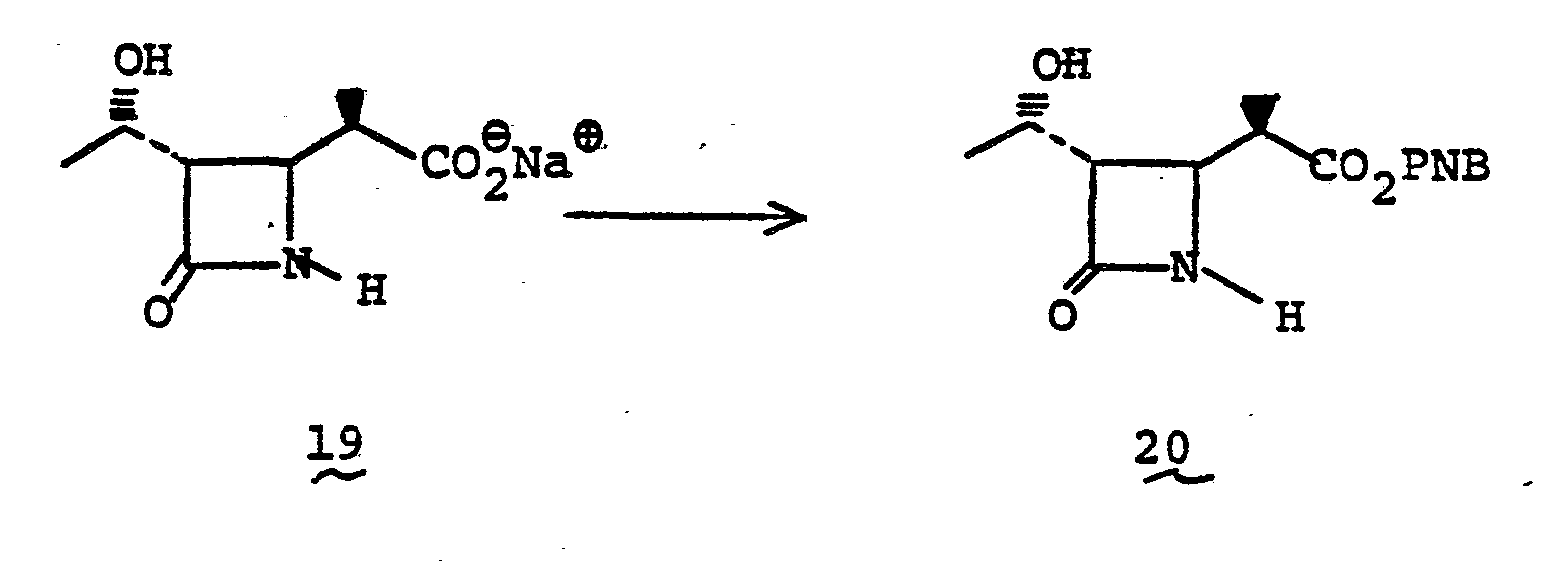
- the azetidinone carboxylic acid (0.37g) is suspended in 5 ml water. The mixture is adjusted and maintained at pH 12.0 with 2.5N NaOH with constant stirring at room temperature for 30 min. The mixture is then neutralized with 2.5N HC1 to pH 7.5, and extracted with 5 ml EtOAc. The aqueous layer is separated, concentrated and lyophilized to give white solid product 19 NMR (60 MHz, D 2 0 ): ⁇ 1.06 (d), 1.25(d), 2.40 (m), 3.02(q), 3.56(q), 4.05(m).
- the azetidinone p-nitrobenzyl ester 20 (2.83 g) is stirred with t-butyldimethylchlorosilane (3.98 g) and triethylamine (7.35 ml) in DMF (26 ml) under nitrogen atmosphere at room temperature for 5 hrs. The mixture is filtered from precipitates and the filtrate is evaporated in vacuo to give crude product. HPLC purification of the product (Porasil, 30% ethyl acetate/cyclohexane solvent system) affords 21 (4.2 g) after evaporation of solvent.
- the azetidinone 21(2.1 g) is dissolved in ethylacetate (40 ml) and hydrogenated under 50 psi of hydrogen in the presence of 10% Pd/C (0.4 g) for.30 min.
- the mixture is filtered through super-cell, and the filtrate is diluted with 100ml EtOAc and washed with 0.1N HCl (100 ml) and brine.
- a 10-ml, two necked round-bottomed flask is equipped with a reflux condenser and a nitrogen inlet tube.
- diazo azetidinone 1 110 mg
- rhodium acetate 0.2 mg
- ethyl acetate 3 ml
- the mixture is heated at reflux for 10 min, then cooled to room temperature and washed with 0.5 ml water.
Landscapes
- Chemical & Material Sciences (AREA)
- Organic Chemistry (AREA)
- Chemical Kinetics & Catalysis (AREA)
- Health & Medical Sciences (AREA)
- Pharmacology & Pharmacy (AREA)
- General Chemical & Material Sciences (AREA)
- Medicinal Chemistry (AREA)
- Nuclear Medicine, Radiotherapy & Molecular Imaging (AREA)
- Communicable Diseases (AREA)
- Oncology (AREA)
- Life Sciences & Earth Sciences (AREA)
- Animal Behavior & Ethology (AREA)
- General Health & Medical Sciences (AREA)
- Public Health (AREA)
- Veterinary Medicine (AREA)
- Pharmaceuticals Containing Other Organic And Inorganic Compounds (AREA)
- Nitrogen Condensed Heterocyclic Rings (AREA)
Abstract
Description
- This invention relates to certain 6- and 4- substituted-1-azabicyclo[3.2.0]heptan-3,7-dione-2-carboxylates (I) which are useful in the preparation of 6-, 1- and 2-substituted carbapenem antibiotics (II):


- This invention also relates to the carboxyl derivatives of I which are antibiotics and which may be represented by the following generic structure (I):

- This invention also relates to processes for the preparation of such compounds I and II.
- There is a continuing need for new antibiotics; for unfortunately, there is no static effectiveness of any given antibiotic because continued wide scale usage selectively gives rise to resistant strains of pathogens. In addition, the known antibiotics suffer from the disadvantage of being effective only against certain types of microorganisms. Accordingly, the search for new antibiotics continues.
- Thus, it is an objection of the present invention to provide antibiotics II, via intermediates I, which are useful in animal and human therapy and in inanimate systems. These antibiotics are active against a broad range of pathogens which representatively include both gram positive bacteria such as S. aureus, Strep. pyogenes, and B. subtilis, and gram negative bacteria such as E. coli, Pseudomonas, Proteus morganii, Serratia, and Klebsiella.
- Such final products II are disclosed in the following European Patent Publications and U.S. Patents.
-
- 1.) U.S. Patent 4,232,036 and European Patent Publication 0 010 317.
- 2.) European Patent Publication 0 030 032.
- 3.) U.S. Patent No. 4,262,010.
- 4.) Patent 4,218,462 and European Patent Publication 0 010 317.
- To the extent that the aforementioned pending applications and issued patents define substituents R 1, R 2, R3, R 4, and R5 and to the extent that they representatively define R8 and-the utility of such final products II, they are hereby incorporated by reference.
- The process of the present invention may conveniently be summarized by the following reaction diagram:


- In words relative to the diagram, the oxidation 2 → 3 is accomplished by treating 2 in a solvent such as methylenechloride, methanol, chloroform, or the like, with an oxidizing agent such as ozone, or the like, at a temperature of from -100° to 0°C for from 0.1 to 4 hours, followed by treating the crude product with an oxidizing agent such as m-chloroperbenzoic acid, hydrogen peroxide, peracetic acid, or the like, at a temperature of from 0°C to 100°C for from 1 to 100 hours. R° is a readily removable protecting group and is defined below.
- The addition 3 → 4 is accomplished by treating 3 with l,l'-carbonyldiimidazole, or the like, in a solvent such as tetrahydrofuran, dimethoxyethane, acetonitrile or the like, at.a temperature of from 0 to 70°C, followed by the addition of 1..1 to 3.0 equivalent of (R7O2CCH2CO2)2Mg, at a temperature of from 0 to 70°C for from 1 to 48 hours. R7 is a pharmaceutically acceptable ester moiety or a readily removable carboxyl protecting groups such as p-nitrobenzyl, benzyl, or the like.
- Removal of protecting group R° (4 → 5) (when R° = t-butyldimethylsilyl) is accomplished by acidic aqueous hydrolysis of 4 in a solvent such as methanol, ethanol, tetrahydrofuran, dioxane, or the like, in the presence of an acid such as hydrochloric, sulfuric, acetic or the like at a temperature of from 0 to 100°C for from 2 to 18 hours.
- The diazo species 6 is prepared from 5 by treating 5 in a solvent such as CH3CN, CH2Cl2, THF, or the like with an azide such as p-carboxybenzene- sulfonylazide, toluenesulfonylazide, methanesulfonyl- azide, or the like in the presence of a base such as triethylamine, pyridine, diethylamine or the like for from 1 to 50 hours at 0-50°C.
- Cyclization (6→7) is accomplished by treating 6 in a solvent such as benzene, toluene, THF, cyclohexane, ethylacetate or the like at a temperature of from 25 to 110°C for from 1-5 hours in the presence of a catalyst such as bis (acetylacetonato)Cu(II) [Cu(acac)2], CuSO4, Cu powder, Rh(OAc)2 or Pd(OAc)2. Alternatively, the cyclization may be accomplished by irradiating 6 through a pyrex filter (a wave length greater than 300nm) in a solvent such as benzene, CCl4, diethylether, or the like, at a temperature of from 0-25°C for from 0.5 to 2 hours. ["OAc" = acetate.]
- Establishment of leaving group X (7→8) is accomplished by acylating the keto ester 7 with an acylating agent RX such as p-toluenesulfonic acid anhydride, p-nitrophenylsulfonic acid anhydride, 2,4,6-triisopropylphenylsuTfonic acid anhydride, methanesulfonic acid anhydride, toluenesulfonyl chloride, p-bromophenylsulfonyl chloride, diphenylchlorophosphate, or the like; wherein X is the corresponding leaving group such as toluene sulfonyloxy, p-nitrophenylsulfonyloxy, methanesulfonyloxy, p-bromophenylsulfonyloxy and other leaving groups which are established by conventional procedures and which are well known in the art. Typically, the above acylation to establish leaving groups X is conducted in a solvent such as methylene chloride, acetonitrile or dimethylformamide, in the presence of a base such as diisopropylethylamine, triethylamine, 4-dimethylamino-pyridine or the like at a temperature of from -20 to 40°C for from 0.5 to 5 hours. The leaving group X of intermediate 8 can also be halogen. The halogen leaving group is established by treating 7 with a halogenating agent such as Ø3PCl2, Ø3PBr2, (ØO)3PBr2, cxalyl chloride, PBr3 or the like in a solvent such as CH2Cl2, CH3CN, THF, or the like in the presence of a base such as diisopropylethylamine, triethylamine, or 4-dimethylaminopyridine or the like. [Ø = phenyl.]
- The reaction 8→9 is accomplished by treating 8 in a solvent such as dioxane, dimethylformamide, dimethylsulfoxide, acetonitrile, hexamethylphosphoramide, or the like in the presence of an approximately equivalent to excess of the mercaptan reagent HSRB wherein R8 as defined above. A representative mercaptan reagent is HSCH2CH2NHR8' wherein R8' is hydrogen or a readily removable N-protecting group such as p-nitrobenzyloxycarbonyl, o-nitrobenzyloxy carbonal, or the like in the presence of a base such as sodium hydrogen carbonate, potassium carbonate, triethylamine, diisopropylethylamine, or the like at a temperature of from -40 to 25°C for from 1 to 72 hours. The mercaptan reagent, HSCH2CH2NHR8', is typically prepared by treating aminoethylmercaptan in the presence of the desired acid chloride in the presence of a base such as sodium bicarbonate, sodium hydroxide, or the like in a solvent such as aqueous diethylether, aqueous dioxane, aqueous acetone, or the like at a temperature of from 0 to 25°C for from 0.5 to 4 hours.
- The final deblocking step 9 → II is accomplished by conventional procedures such as hydrolysis or hydrogenation. Typically 9 in a solvent such as dioxane-water-ethanol, tetrahydrofuran-aqueous dipotassium hydrogen phosphate-isopropanol or the like is treated under a hydrogen pressure of from 1 to 4 atmospheres in the presence of a hydrogenation catalyst such as palladium on charcoal, palladium hydroxide, or the like at a temperature of from 0 to 50°C for from 0.5 to 4 hours to provide II.
- Relative to Diagram I, the following scheme is also employed in preparing mono-substituted intermediate material 3 (where R2 = H).


- In words relative to the above diagram for the preparation of 3 (where R2 = H), the 4-(1-substituted-2-acetoxyvinyl)azetidinone-2-one (3') is prepared by reacting, for example (R1=CH3): chlorosulphonyl isocyanate and acyloxybutadiene (1') such as l-acetoxy-2-methylbuta- diene in a solvent such as anhydrous diethyl ether at a temperature of from about -30°C to 0°C under a nitrogen atmosphere. The reaction intermediate 2' is converted to 3' by hydrolysis. The reduction of 3' to provide 4-(1-methyl-2-acetoxyethyl)-2-azetidinone (4') is conducted by any convenient means such as hydrogenation in the presence of a catalyst such as platinum, palladium or oxides thereof under a hydrogen pressure of from 1 to 20 atmospheres in a solvent such as ethanol, ethylacetate, or the like at a temperature of from 0° to 25°C for from 5 minutes to 1 hour. The 4-(2-hydroxy-l-methyl-ethyl)-2-azetidinone species 5' is obtained from 4' by hydrolysis. The 8-oxo-2,2,5-trimethyl-3-oxa-1-azabicyclo[4.2.0]octane species 6' is obtained on treatment of 5' with 2,2-dimethoxypropane in the presence of a catalyst such as boron trifluoride etherate in a solvent such as methylene chloride at a temperature of from 0° to 40°C for from 1 to 40 minutes. Alkylation of 6' provides 7'. Typically, 6' is treated with a strong base such as lithium diisopropylamide, sodium hydride, phenyl lithium or butyl lithium and the like in a solvent such as tetrahydrofuran (THF), ether, dimethoxyethane, and the like at a temperature of from -80° to 0°C., whereupon the alkylating agent of choice, R 6 X is added (R6 is as described above and X is chloro or bromo; alternatively, the alkylating agent may be R 6 tosylate, R6-mesylate or an aldehyde or ketone such as acetaldehyde and the like) to provide mono-alkylated species 7'. When the desired dialkylated species may be obtained from 7' by repeating the alkylating procedure, 6' → 7'.
- The conversion 8' → 3 is obtained by oxidation. The most preferred oxidation is achieved by suspending 8' in a solvent such as acetone, benzene, hexane, or the like at a temperature of from 0°C to 50°C and treating with an oxidizing agent such as Jones reagent. Alternatively, compound 3 may be prepared from 8' by treating 8' with 50% trifluoroacetic acid/water at 0° to 50°C for from 10 min. to 1 hr. to give the intermediate alcohol which is then oxidized with Jones reagent to 3.
- The N-protecting group R° may be established on 3, as originally shown in Diagram 1, by following the procedure 16, → 17, below; wherein R° is also defined.
- With respect to starting reagent 1, its preparation is generally described in J. Amer. Chem. Soc., 74 ,661 (1952) by E.B. Reid and T.E. Gompf, J. Org. Chem., 23,1063 (1958) by R. Ciola and K.L. Burwell, Jr., and Belgium Patent 632,193 (1963) by R. Polster and E. Scharf. The following scheme summarizes the preparation of 1.

- In words relative to the above scheme, he diester 12 is prepared by treating the diacid 11 with thionyl chloride at reflux for two hours followed by reacting with ethanol at 80°C for 4 hours. Reduction of the diester 12 with lithium alumium hydride in ether at reflux for 4 hours followed by hydrolysis with 10% NaOH gives diol 13 which on further reaction with thionyl chloride gives dichloride 14. The dichloride 14 can be alternatively prepared by treating 15 with ethylene in the presence of alumium chloride. Treatment of the dichloride 14 with base such as 2-methylquinoline, DBU or sodium hydroxide in polyethylene glycol gives the expected 3-substituted 1,4-pentadiene 1.
- Preparation of 2 is summarized in the following scheme:

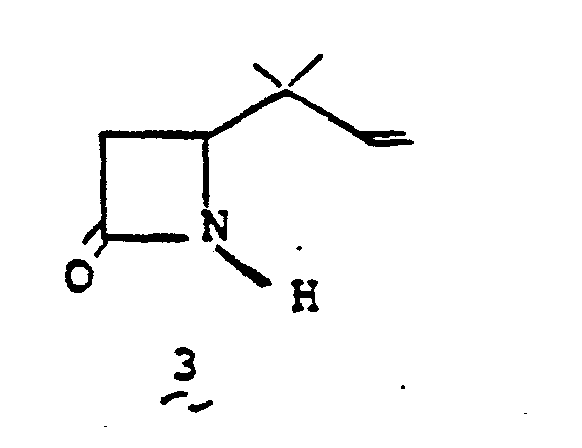
- In words relative to above scheme, the substituted azetidinone 16 is prepared by reacting a 3-substituted 1,4-pentadiene 1 with chlorosulfonyl- isocyanate at 25°C to 60°C in a pressure bottle for 3-12 days, then the resulting mixture is hydrolyzed with aqueous sodium sulfite solution between pH 6 5-7.5 at 0°C to 25°C for from 5 min. to 60 min.
- Azetidinone 16 is transformed (16→17) to establish the protecting group R° which may be a triorganosilyl group, such as t-butyldimethylsilyl, t-butyldiphenylsilyl, triphenylsilyl, isopropyldimethylsilyl, for example, or may be 3,4-dimethoxybenzyl, for example. Silyl protection is preferred, and typically R° is established by treating 16 in a solvent such as dimethylformamide, acetonitrile, hexamethylphosphoramide, tetrahydrofuran and the like with a silylating agent such as t-butyldimethylchlorosilane, t-butyldiphenyl- chlorosilane, triphenylchlorosilane, and the like at a temperature of from -20°C to 25°C for from 0.5 to 24 hours in the presence of a base such as triethylamine, diisopropylethylamine, or imidazole.
- Alkylation of 17 provides 18. Typically, 17 is treated with a strong base such as lithium diisopropylamide, sodium hydride, phenyl lithium or butyl lithium and the like in a solvent such as tetrahydrofuran (THF), ether, dimethoxyethane and the like at a temperature of from -80°C to 0°C, whereupon the alkylating agent of choice, R X is added (R6 is as described above and X is Iodo, chloro or bromo; alternatively the alkylating agent may be R6- tosylate, R 6-mesylate or an aldehyde or ketone such as acetaldehyde and the like) to provide mono- alkylated species 18. When desired dialkylated species 2 may be obtained from 18 by repeating the alkylating procedure, 17→18.
- In the foregoing description of the invention, suitable reagents HSR8 (8→9) are representatively illustrated by the following list:





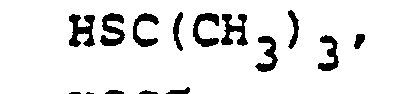





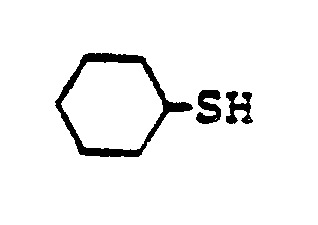










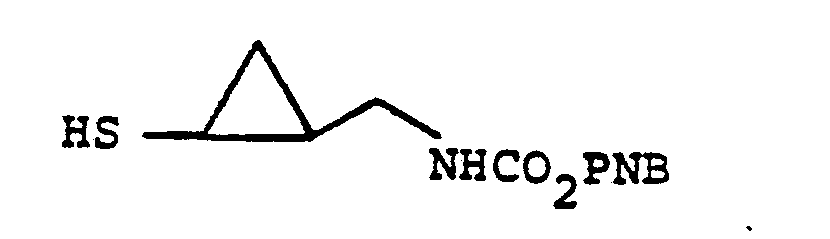


- Similarly, suitable alkylating agents for establishing R6 and/or R7 at ultimate ring position 6 (17→18→2) are:


- Relative to the compounds of the present invention I:

- ethyl, propyl, isopropyl, cyclopropyl, phenyl benzyl spiro-cyclopropyl
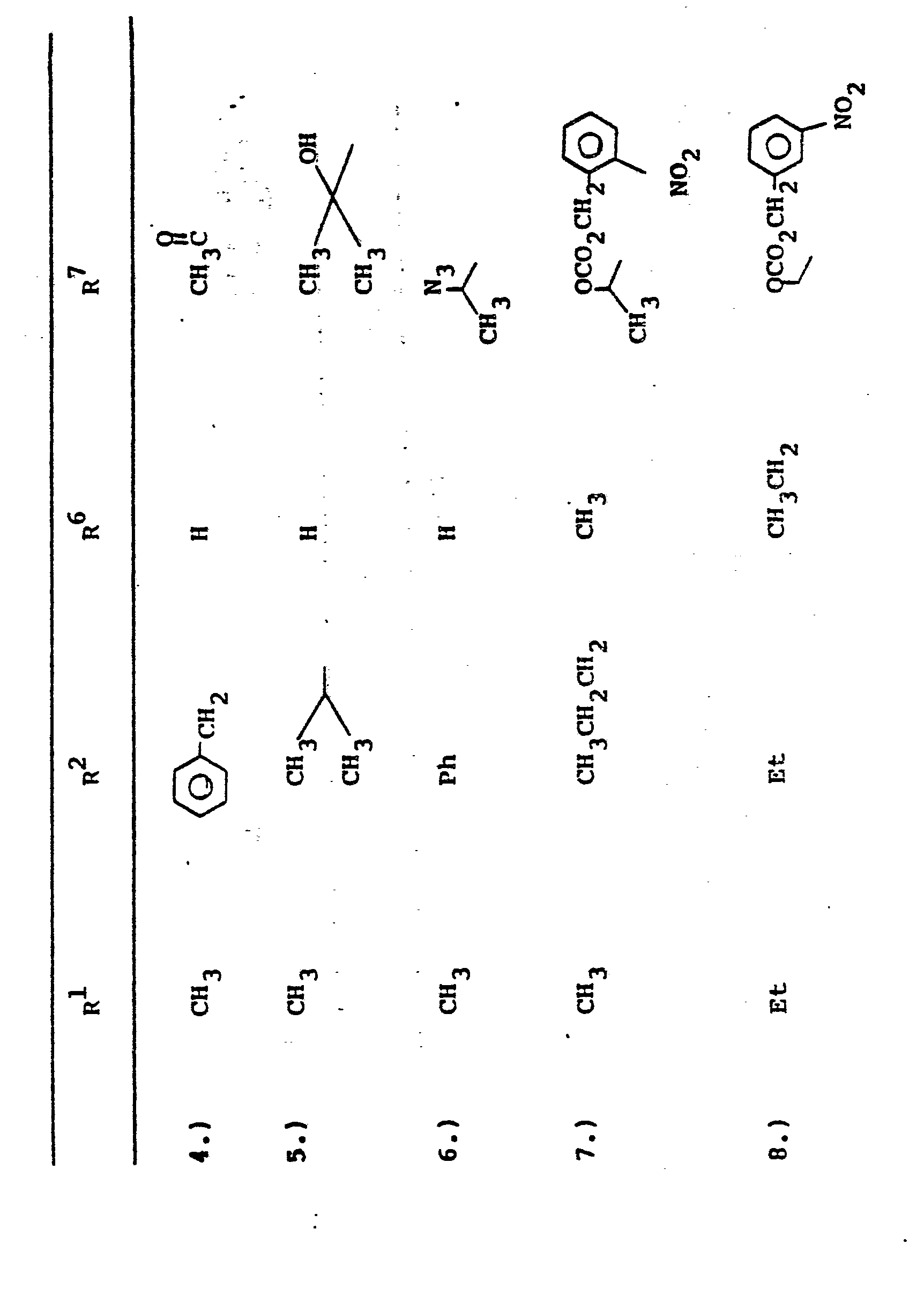
- The most preferred radicals for R6 and R7 are: R6 = H and R7 is selected from hydroxymethyl, 1-hydroxyethyl, 1-hydroxypropyl, 2-hydroxypropyl, 2-hydroxyethyl; the most preferred values for R are: aminoethylthio, aminopropylthio, aminocyclopropylthio, aminoisopropylthio, amidinoisopropylthio, and guanidinoethylthio.
- The preferred esters used as protecting groups are those where R3' is benzyl, p-nitrobenzyl, o-nitrobenzyl, t-butyl, bromo-t-butyl, t-butyldimethylsilyl, trimethylsilyl, trichloroethyl; or R3' represents pharmaceutically acceptable ester moieties such as pivaloyloxymethyl, allyl, methallyl, (2-methylthio)-ethyl, 3-methyl-2-butenyl, p-t-butylbenzyl, 5-indanyl, 3-phthalidyl.
- The final compounds II made available by the present invention are valuable antibiotics active against various gram-positive and gram-negative bacteria and, accordingly, find utility in human and veterinary medicine. Such sensitive bacteria representatively include: Staphylococcus aureus, Escherichia coli, Klebsiella pneumoniae, Serratia, Salmonella typhosa, Pseudomonas and Bacterium proteus. The resulting compounds may further be utilized as additives to animal feed, for preserving foodstuffs, and as disinfectants. For example, they may be employed in aqueous compositions in concentrations ranging from 0.1 to 100 parts of antibiotic per million parts of solution in order to destroy and inhibit the growth of harmful bacteria on medical and dental equipment and as bactericides in industrial applications, for example, in waterbased paints and in the white water of paper mills to inhibit the growth of harmful bacteria.
- These antibiotics may be used alone or in combination as an active ingredient in any one of a variety of pharmaceutical preparations. These antibiotics and their corresponding salts may be employed in capsule form or as tablets, powders or liquid solutions or as suspensions or elixirs. They may be administered orally, intravenously or intramuscularly.
- Tablets and capsules for oral administration may be in unit dose presentation form, and may contain conventional excipients such as binding agents, for example, syrup, acacia, gelatin, sorbitol, tragacanth, or polyvinylpyrrolidone; fillers for example, lactose, sugar, maize-starch, calcium phosphate, sorbitol or glycine; lubricants, for example, magnesium stearate, talc, polyethylene glycol, silica; disintegrants, for example, potato starch or acceptable wetting agents such as sodium lauryl sulphate. The tablets may be coated according to methods well known in the art. Oral liquid preparations may be in the form of aqueous or oily suspension, solution, emulsions, or syrups; or may be presented as a dry product., for reconstitution with water or other suitable vehicles before use. Such liquid preparations may contain conventional additives such as suspending agents, for example, sorbitol, syrup, methyl cellulose, glucose/sugar syrup, gelatin, hydroxyethylcellulose, carboxymethyl cellulose, aluminum stearate gel or hydrogenated edible oils, for example almond oil, fractionated coconut oil, oily esters, propylene glycol, or ethyl alcohol; preservatives, for example methyl or propyl p-hydroxybenzoates or sorbic acid.
- Compositions for injection may be presented in unit dose form in ampules, or in multidose container'. The compositions may take such forms as suspensions, solutions, or emulsions in oily or aqueous vehicles, and may contain formulatory agents such as suspending, stabilizing and/or dispersing agents. Alternatively, the active ingredient may be in powder form for reconstitution with a suitable vehicle, e.g., sterile-, pyrogen-free water, before use.
- The compositions may also be prepared in suitable forms for absorption through the mucous membranes of the nose and throat or bronchial tissues and. may conveniently take the form of powder or liquid sprays or inhalants, lozenges, throat paints, etc. For medication of the eyes or ears, the preparations may be presented as individual capsules, in liquid or semi-solid form, or may be used as drops etc. Topical applications may be formulated in hydrophobic or hydrophilic bases as ointments, creams, or lotions.
- Also, in addition to a carrier, the instant compositions may include other ingredients such as stabilizers, binders, antioxidants, preservatives, lubricators, suspending agents, viscosity agents or flavoring agents and the like. In addition, there may also be included in the compositions other active ingredients to provide a broader spectrum of antibiotic activity.
- For veterinary medicine the composition may, for example, be formulated as an intramammary - preparation in either long or quick-release bases.
- The dosage to be administered depends to a large extent upon the general health and weight of the subject being treated, and the route and frequency of administration -- the parenteral route being preferred for generalized infections and the oral route for intestinal infections. In general, a daily oral dosage consists of from about 2 to about 600 mg. of active ingredient per kg. of body weight of the subject in one or more applications per day. A preferred daily dosage for adult humans lies in the range of from about 15 to 150 mq. of active ingredient per kg. of body weight.
- - The instant compositions may be administered in several unit dosage forms as, for example, in solid or liquid orally inqestible dosage form. The compositions per unit dosage, whether liquid or solid may contain from 0.1% to 99% of active material, the preferred range beinq from about 10-60%. The composition will generally contain from about 15 mq. to about 1500 mg. of the active ingredient; however, in general, it is preferably to employ a dosage amount in the ranqe of from about 100 mq. to 1000 mg. In parenteral administration the unit dosage is usually the pure compound- in a slightly acidified sterile water solution or in the form of a soluble powder intended for solution.
- Especially preferred pharmaceutically acceptable salts and esters involvinq the carboxyl qroup of compounds of the present invention (I) are disclosed and claimed in U.S. Patent Specification Number 4,181,733 which application is directed, inter alia, to pharmaceutically acceptable salts and esters of the carboxyl group of thienamycin. It is precisely these salts and esters which are preferred in the present invention and they are prepared in a manner analogous to that disclosed in U.S. Patent Application Serial Number 861,314, which is incorporated herein by reference. Thus, especially preferred salts include sodium, potassium, ammonium, and the like; and especially preferred esters include pivaloxymethyl, p-t-butylbenzyl, 5-indanyl, 3-phthalidyl, 3-methyl-2-butenyl, and the like. One should note that when, in the total synthesis outlined above, R3' is a pharmaceutically acceptable ester moiety, there is no need for the final deblocking step if it is desired to have the final product I in the form of a pharmaceutically acceptable ester.
- Especially preferred embodiments of the present invention are those, as defined above, except that any unsubstituted amino group borne on radical R8 of Structure I is derivatized according to the teachings of Belgium Patent 848,545 (issued 5-20-77); the resulting amino group being represented thusly (partial structure):

- The following examples, illustrate but do not limit the product, process, compositional or method of treatment aspects of the present invention. All reaction temperatures are in °C.
-

- β,β-Dimethylglutaric acid (obtained from Aldrich Chemical Company) (one mole), is refluxed for 2 hours with thionyl chloride (68% excess). After removal of excess thionyl chloride,. absolute ethanol (109% excess) is added slowly. The mixture is refluxed for 3 hours then distilled to collect the product, diethyl β,β-dimethylglutarate (98% yield).
- To a suspension of lithium alumium hydride (24 g) in ether (860 ml) is added dropwise with rapid stirring a solution of diethyl β,β-dimethylglutarate (124 g in 250 ml ether). The mixture is refluxed for 6 hours, then cooled to room temperature. Water (25 ml) is added slowly. The mixture is then titrated with 10% NaOH until a clear organic layer is obtained. The organic layer is separated, dried over anhydrous sodium sulfate then evaporated in vacuo to give the resulting diol as an oil (90% yield), bp.95° at 1.0 mm. The 3,3-dimethyl-1.5-pentanediol (0.5 mole) is treated with thionyl chloride (1.05 mole) at reflux for 3 hours. After removal of excess thionyl chloride in vacuo, the 3,3-dimethyl-1,5-dichloropentane is obtained (90% yield).
- 3,3-Dimethyl-1.5-dichloropentane (41 g) is added dropwise at 170°C to a mixture of 48 g of sodium hydroxide and 40 g of polyethylene glycol tetramer and the mixture is distilled to give 3,3-dimethyl-1,4-pentadiene (66%).
- At -40°C, 1,3-dichloro-3-methylbutane (50 g) is mixed with alumium chloride (5 g). The ethylene is bubbled through the mixture for 4 hours. The mixture is allowed to warm to room temperature and hydrolyzed with water. The mixture is extracted with ethyl acetate to give 3,3-dimethyl-1,5-dichloropentane.
- A mixture of 0.5 mole of 3,3-dimethyl-l,5-dichloropentane, 2-methylquinoline (2 moles), and sodium iodide (0.1 mole) is refluxed in a flask equipped with a Vigreaux column at the top of which is a condenser and take-off. The diolefin 1 is collected during 8 hrs reaction. The product is dried over anhydrous sodium sulfate.
-

-
-

-

-

-

-

-

-

- Preparation of 8.

-

-

-

-

-

-

-

-

-

-

-

-

-

-
-

-

-

-

-

-




Claims (13)


Applications Claiming Priority (4)
| Application Number | Priority Date | Filing Date | Title |
|---|---|---|---|
| US21793180A | 1980-12-18 | 1980-12-18 | |
| US217931 | 1980-12-18 | ||
| US06/245,005 US4350631A (en) | 1980-12-18 | 1981-03-18 | 6- and 4-Substituted-1-azabicyclo[3.2.0]heptan-3,7-dione-2-carboxylates |
| US245005 | 1981-03-18 |
Publications (3)
| Publication Number | Publication Date |
|---|---|
| EP0054917A2 true EP0054917A2 (en) | 1982-06-30 |
| EP0054917A3 EP0054917A3 (en) | 1982-09-01 |
| EP0054917B1 EP0054917B1 (en) | 1988-03-09 |
Family
ID=26912399
Family Applications (1)
| Application Number | Title | Priority Date | Filing Date |
|---|---|---|---|
| EP81110531A Expired EP0054917B1 (en) | 1980-12-18 | 1981-12-17 | 6- and 4-substituted-1-azabicyclo(3.2.0)heptan-3,7-dione-2-carboxylates |
Country Status (4)
| Country | Link |
|---|---|
| US (1) | US4350631A (en) |
| EP (1) | EP0054917B1 (en) |
| JP (1) | JP2940836B2 (en) |
| DE (1) | DE3176681D1 (en) |
Cited By (2)
| Publication number | Priority date | Publication date | Assignee | Title |
|---|---|---|---|---|
| EP0235823A2 (en) | 1986-03-06 | 1987-09-09 | Bristol-Myers Squibb Company | Carbapenem antibiotics, a process for preparing them and pharmaceutical compositions containing them |
| WO2005033120A1 (en) * | 2003-10-02 | 2005-04-14 | Takasago International Corporation | Method for producing carbapenem derivative |
Families Citing this family (24)
| Publication number | Priority date | Publication date | Assignee | Title |
|---|---|---|---|---|
| US4414155A (en) * | 1980-01-14 | 1983-11-08 | Merck & Co., Inc. | Synthesis of thienamycin via esters of (3SR, 4RS)-3-[(SR)-1-hydroxyethyl]-β,2-dioxo-4-azetidinebutanoic acid |
| US4683301A (en) * | 1982-04-08 | 1987-07-28 | Bristol-Myers Company | Carbapenem antibiotics |
| US4746736A (en) * | 1982-09-28 | 1988-05-24 | Bristol-Myers Company | Carbapenem antibiotics |
| US4732977A (en) * | 1982-09-28 | 1988-03-22 | Bristol Myers Company | Carbapenem antibiotics |
| US5310897A (en) * | 1984-12-27 | 1994-05-10 | Sumitomo Pharmaceuticals Co., Ltd. | Beta-lactams and their production |
| ES2061439T3 (en) * | 1985-12-28 | 1994-12-16 | Sumitomo Pharma | BETA-LACTAMA COMPOUND AND ITS PRODUCTION. |
| US5068232A (en) * | 1990-04-10 | 1991-11-26 | American Cyanamid Company | Novel 2-substituted alkyl-3-carboxy carbapenems as antibiotics and a method of producing them |
| EP0464900A3 (en) | 1990-06-26 | 1992-07-22 | Merck & Co. Inc. | 2-biphenyl-carbapenems |
| CA2052730A1 (en) | 1990-10-11 | 1992-04-12 | Frank P. Dininno | 2-(substituted-dibenzofuranyl and dibenzothienyl) carbapenem antibacterial agents |
| US5189158A (en) * | 1991-03-20 | 1993-02-23 | American Cyanamid Company | 4-substituted azetidinones as precursors to 2-substituted-3-carboxy carbapenem antibiotics and a method of producing them |
| US5371215A (en) * | 1991-03-20 | 1994-12-06 | American Cyanamid Company | 4-substituted azetidinones as precursors to 2-substituted-3-carboxy carbapenem antibiotics and a method of producing them |
| US5382575A (en) * | 1991-10-17 | 1995-01-17 | Merck & Co., Inc. | (N-pyridiniumphenyl)-carbapenems |
| US5631363A (en) * | 1992-11-13 | 1997-05-20 | Tanabe Seiyaku Co., Ltd. | Azetidinone compound and process for preparation thereof |
| US5442055A (en) * | 1992-11-13 | 1995-08-15 | Tanabe Seiyaku Co., Ltd. | Azetidinone compound and process for preparation thereof |
| US6011150A (en) * | 1992-11-13 | 2000-01-04 | Tanabe Seiyaku Co., Ltd. | Azetidinone compound and process for preparation thereof |
| US5350746A (en) * | 1993-04-14 | 1994-09-27 | Merck & Co., Inc. | Triazolyl and tetrazolyl phenyl substituted carbapenems, compositions containing such compounds and methods of use |
| US5496816A (en) * | 1994-03-14 | 1996-03-05 | Merck & Co., Inc. | Carbapenem antibacterial compounds, compositions containing such compounds and methods of treatment |
| US5578722A (en) * | 1994-03-29 | 1996-11-26 | Sumitomo Pharmaceuticals Co., Ltd. | Process for preparing carbapenem compounds |
| US6504027B1 (en) | 1998-03-02 | 2003-01-07 | Merck & Co., Inc. | Decarboxylation process for synthesizing carbapenem antibiotics |
| US6194568B1 (en) * | 1998-07-13 | 2001-02-27 | Merck & Co., Inc. | Process for synthesizing carbapenem intermediates |
| CN101296933B (en) | 2005-11-02 | 2011-10-26 | 日本曹达株式会社 | Carbapenem compound |
| CN102137865A (en) * | 2008-07-30 | 2011-07-27 | 兰贝克赛实验室有限公司 | Process for the preparation of carbapenem compounds |
| DK2326648T3 (en) * | 2008-07-30 | 2012-10-15 | Ranbaxy Lab Ltd | Process for the preparation of carbapenem compounds |
| WO2011048583A1 (en) | 2009-10-23 | 2011-04-28 | Ranbaxy Laboratories Limited | Process for the preparation of carbapenem compounds |
Family Cites Families (11)
| Publication number | Priority date | Publication date | Assignee | Title |
|---|---|---|---|---|
| GB1584762A (en) * | 1977-04-01 | 1981-02-18 | Beecham Group Ltd | Azabicycloheptenes |
| US4260627A (en) * | 1978-10-24 | 1981-04-07 | Merck & Co., Inc. | 1-, 6- And 2-substituted-1-carba-2-penem-3-carboxylic acids |
| US4218462A (en) * | 1978-10-24 | 1980-08-19 | Merck & Co., Inc. | 6-(1-Hydroxyethyl)-2-(2-aminoethylthio)-1-substituted-1-carbade-thiapen-2-em-3-carboxylic acids |
| US4232036A (en) * | 1978-10-24 | 1980-11-04 | Merck & Co., Inc. | 6-, 1- and 2-Substituted-1-carbadethiapen-2-em-3-carboxylic acids |
| US4290947A (en) * | 1979-04-27 | 1981-09-22 | Merck & Co., Inc. | Process for the preparation of thienamycin and intermediates |
| US4273709A (en) * | 1979-07-23 | 1981-06-16 | Merck & Co., Inc. | Process for the preparation of thienamycin and intermediates |
| US4262010A (en) * | 1979-12-03 | 1981-04-14 | Merck & Co., Inc. | 6-(1-Hydroxyethyl)-2-(2-aminoethylthio)-1,1-disubstituted-1-carbadethiapen-2-em-3-carboxylic acids |
| GR72296B (en) * | 1979-12-03 | 1983-10-18 | Merck & Co Inc | |
| US4312871A (en) * | 1979-12-03 | 1982-01-26 | Merck & Co., Inc. | 6-, 1- And 2-substituted-1-carbadethiapen-2-em-3-carboxylic acids |
| US4282148A (en) * | 1980-01-14 | 1981-08-04 | Merck & Co., Inc. | Synthesis of thienamycin via esters of (3SR, 4RS)-3-[(SR)-1-hydroxyethyl]-β,2-dioxo-4-azetidinebutanoic acid |
| US4269772A (en) * | 1980-01-14 | 1981-05-26 | Merck & Co., Inc. | Synthesis of thienamycin via trans-3-carboxymethylene-4-carboxy-5-methyl-Δ2 -isoxazoline |
-
1981
- 1981-03-18 US US06/245,005 patent/US4350631A/en not_active Expired - Lifetime
- 1981-12-17 EP EP81110531A patent/EP0054917B1/en not_active Expired
- 1981-12-17 DE DE8181110531T patent/DE3176681D1/en not_active Expired
-
1991
- 1991-04-16 JP JP3084274A patent/JP2940836B2/en not_active Expired - Lifetime
Cited By (2)
| Publication number | Priority date | Publication date | Assignee | Title |
|---|---|---|---|---|
| EP0235823A2 (en) | 1986-03-06 | 1987-09-09 | Bristol-Myers Squibb Company | Carbapenem antibiotics, a process for preparing them and pharmaceutical compositions containing them |
| WO2005033120A1 (en) * | 2003-10-02 | 2005-04-14 | Takasago International Corporation | Method for producing carbapenem derivative |
Also Published As
| Publication number | Publication date |
|---|---|
| US4350631A (en) | 1982-09-21 |
| JP2940836B2 (en) | 1999-08-25 |
| EP0054917B1 (en) | 1988-03-09 |
| EP0054917A3 (en) | 1982-09-01 |
| DE3176681D1 (en) | 1988-04-14 |
| JPH04217985A (en) | 1992-08-07 |
Similar Documents
| Publication | Publication Date | Title |
|---|---|---|
| US4350631A (en) | 6- and 4-Substituted-1-azabicyclo[3.2.0]heptan-3,7-dione-2-carboxylates | |
| US4312871A (en) | 6-, 1- And 2-substituted-1-carbadethiapen-2-em-3-carboxylic acids | |
| EP0010316B1 (en) | 1-, 6- and 2-substituted-1-carba-2-penem-3-carboxylic acids, process for preparing the same and pharmaceutical compositions containing the same | |
| EP0001628B1 (en) | 3-substituted-6-substituted-7-oxo-1-azabicyclo (3.2.0)-hept-2-ene-2-carboxylic acid, its preparation and pharmaceutical compositions containing it | |
| EP0010317B1 (en) | 6-, 1- and 2-substituted-1-carbapen-2-em-3-carboxylic acids, processes for the preparation of such compounds and pharmaceutical composition comprising such compounds | |
| US4465632A (en) | Process for preparing 1-6-and 2-substituted-1-carba-2-penem-3-carboxylic acids | |
| EP0071908B1 (en) | 1-, and 1,1-disubstituted-6-substituted-2-carbamimidoyl-1-carbadethiapen-2-em-3-carboxylic acids, a process for preparing and an antibiotic composition containing the same | |
| US4206219A (en) | 6- and 1-Substituted-1-carbadethiapen-2-em-3-carboxylic acid | |
| EP0030031B1 (en) | 6-(1-hydroxyethyl)-2-(2-aminoethylthio)-1,1-disubstituted-1-carbadethiapen-2-em-3-carboxylic acids, a process for preparing the same, an antibiotic pharmaceutical composition comprising the same, intermediates useful in a synthesis of that kind and processes for preparing intermediates suitable for the synthesis of that kind | |
| EP0037081A1 (en) | Process for the preparation of 1-carbapenems and intermediates via trithioorthoacetates | |
| EP0037080A1 (en) | 4-(3-carboxy-2-oxopropyl)-azetidino-2-ones and process for their preparation | |
| US4262009A (en) | 6- And 1,1-disubstituted-1-carbadethiapen-2-em-3-carboxylic acid | |
| EP0038869A1 (en) | Process for the preparation of 1-carbapenems, and intermediates for their preparation | |
| EP0037082B1 (en) | Process for the preparation of 1-carbapenems and intermediates via silyl-substituted dithioacetals | |
| US4218459A (en) | 6-Amido-1-carba-2-penem-3-carboxylic acid | |
| EP0030032B1 (en) | 6-, 1- and 2-substituted-1-carbadethiapen-2-em-3-carboxylic acids, processes for preparing the same, pharmaceutical compositions containing the same, and intermediates | |
| EP0074599A1 (en) | 5,6-cis-Carbapenem derivatives, their production and use | |
| EP0113101A1 (en) | 6-(1-Hydroxyethyl)-2-SR8-1-methyl-1-carbadethiapen-2-em-3-carboxylic acid esters | |
| US4310538A (en) | 3-Halo-1-azabicyclo[3.2.0]hept-2-en-7-one-2-carboxylic acid | |
| US4395418A (en) | Penem-3-carboxylic acid derivatives | |
| US4267188A (en) | 5-Substituted-1-carba-pen-2-em-3-carboxylic acid | |
| US4600713A (en) | 1-, 6- and 2-substituted-1-carba-2-penem-3-carboxylic acids | |
| US4994568A (en) | 6- and 4-substituted-1-azabicyclo(3.2.0)heptan-3, 7-dione-2-carboxylates | |
| US4347368A (en) | 3-Substituted-6-substituted-7-oxo-1-azabicyclo[3.2.0]hept-2-ene-2-carboxylic acid | |
| GB2092147A (en) | Azabicycloheptene compounds |
Legal Events
| Date | Code | Title | Description |
|---|---|---|---|
| PUAI | Public reference made under article 153(3) epc to a published international application that has entered the european phase |
Free format text: ORIGINAL CODE: 0009012 |
|
| AK | Designated contracting states |
Designated state(s): CH DE FR GB IT NL |
|
| PUAL | Search report despatched |
Free format text: ORIGINAL CODE: 0009013 |
|
| ITCL | It: translation for ep claims filed |
Representative=s name: SOCIETA' ITALIANA BREVETTI S.P.A. |
|
| AK | Designated contracting states |
Designated state(s): CH DE FR GB IT NL |
|
| 17P | Request for examination filed |
Effective date: 19830301 |
|
| GRAA | (expected) grant |
Free format text: ORIGINAL CODE: 0009210 |
|
| AK | Designated contracting states |
Kind code of ref document: B1 Designated state(s): CH DE FR GB IT LI NL |
|
| REF | Corresponds to: |
Ref document number: 3176681 Country of ref document: DE Date of ref document: 19880414 |
|
| ET | Fr: translation filed | ||
| ITF | It: translation for a ep patent filed | ||
| PLBE | No opposition filed within time limit |
Free format text: ORIGINAL CODE: 0009261 |
|
| STAA | Information on the status of an ep patent application or granted ep patent |
Free format text: STATUS: NO OPPOSITION FILED WITHIN TIME LIMIT |
|
| 26N | No opposition filed | ||
| ITTA | It: last paid annual fee | ||
| PGFP | Annual fee paid to national office [announced via postgrant information from national office to epo] |
Ref country code: GB Payment date: 20000925 Year of fee payment: 20 Ref country code: CH Payment date: 20000925 Year of fee payment: 20 |
|
| PGFP | Annual fee paid to national office [announced via postgrant information from national office to epo] |
Ref country code: FR Payment date: 20000928 Year of fee payment: 20 |
|
| PGFP | Annual fee paid to national office [announced via postgrant information from national office to epo] |
Ref country code: DE Payment date: 20001127 Year of fee payment: 20 |
|
| PGFP | Annual fee paid to national office [announced via postgrant information from national office to epo] |
Ref country code: NL Payment date: 20001231 Year of fee payment: 20 |
|
| PG25 | Lapsed in a contracting state [announced via postgrant information from national office to epo] |
Ref country code: LI Free format text: LAPSE BECAUSE OF EXPIRATION OF PROTECTION Effective date: 20011216 Ref country code: GB Free format text: LAPSE BECAUSE OF EXPIRATION OF PROTECTION Effective date: 20011216 Ref country code: CH Free format text: LAPSE BECAUSE OF EXPIRATION OF PROTECTION Effective date: 20011216 |
|
| PG25 | Lapsed in a contracting state [announced via postgrant information from national office to epo] |
Ref country code: NL Free format text: LAPSE BECAUSE OF EXPIRATION OF PROTECTION Effective date: 20011217 |
|
| REG | Reference to a national code |
Ref country code: GB Ref legal event code: PE20 Effective date: 20011216 |
|
| REG | Reference to a national code |
Ref country code: CH Ref legal event code: PL |
|
| NLV7 | Nl: ceased due to reaching the maximum lifetime of a patent |
Effective date: 20011217 |