EP0055065A2 - Liquide magnétique - Google Patents
Liquide magnétique Download PDFInfo
- Publication number
- EP0055065A2 EP0055065A2 EP81305888A EP81305888A EP0055065A2 EP 0055065 A2 EP0055065 A2 EP 0055065A2 EP 81305888 A EP81305888 A EP 81305888A EP 81305888 A EP81305888 A EP 81305888A EP 0055065 A2 EP0055065 A2 EP 0055065A2
- Authority
- EP
- European Patent Office
- Prior art keywords
- magnetic
- group
- coloring material
- magnetic fluid
- treating agent
- Prior art date
- Legal status (The legal status is an assumption and is not a legal conclusion. Google has not performed a legal analysis and makes no representation as to the accuracy of the status listed.)
- Withdrawn
Links
Images
Classifications
-
- H—ELECTRICITY
- H01—ELECTRIC ELEMENTS
- H01F—MAGNETS; INDUCTANCES; TRANSFORMERS; SELECTION OF MATERIALS FOR THEIR MAGNETIC PROPERTIES
- H01F1/00—Magnets or magnetic bodies characterised by the magnetic materials therefor; Selection of materials for their magnetic properties
- H01F1/44—Magnets or magnetic bodies characterised by the magnetic materials therefor; Selection of materials for their magnetic properties of magnetic liquids, e.g. ferrofluids
-
- H—ELECTRICITY
- H01—ELECTRIC ELEMENTS
- H01F—MAGNETS; INDUCTANCES; TRANSFORMERS; SELECTION OF MATERIALS FOR THEIR MAGNETIC PROPERTIES
- H01F1/00—Magnets or magnetic bodies characterised by the magnetic materials therefor; Selection of materials for their magnetic properties
- H01F1/44—Magnets or magnetic bodies characterised by the magnetic materials therefor; Selection of materials for their magnetic properties of magnetic liquids, e.g. ferrofluids
- H01F1/445—Magnets or magnetic bodies characterised by the magnetic materials therefor; Selection of materials for their magnetic properties of magnetic liquids, e.g. ferrofluids the magnetic component being a compound, e.g. Fe3O4
Definitions
- This invention relates to an improvement of magnetic dispersion. Concretely, it relates to an improvement in the hue of magnetic dispersion.
- magnetic dispersion means a liquid in which magnetic fine particles having a particle size o of about 50-200 A are dispersed in a dispersion medium by the aid of a surfactant. Such a magnetic dispersion has a characteristic property that it keeps stable for a long period of time without precipitation nor agglomeration.
- fine particles of ferrite compounds such as magnetite, manganese ferrite, nickel ferrite, cobalt ferrite, iron zinc ferrite, manganese zinc ferrite, nickel zinc ferrite, barium ferrite and the like are in use.
- surfactant carboxylic acids such as oleic acid, linoleic acid and the like, cationic surfactants, nonionic surfactants or the like are used either alone or in combination.
- hydrocarbon compounds such as kerosene, toluene and the like, ester compounds such as ester oil and the like, ether compounds, fluorinated hydrocarbon compounds and the like are used either alone or in combination.
- the use of the magnetic dispersion there can be referred to wide variety of uses including the uses in mechanical field such as sealant, lubricant and the like; the uses in the field of separation such as the agent for gravity concentration, the agent for oil- water separation and the like; the uses in the field of printing and recording such as developer for magnetic or electrostatic latent image, ink for ink jet and the like; the uses in the field of toy; and so on.
- mechanical field such as sealant, lubricant and the like
- the uses in the field of separation such as the agent for gravity concentration, the agent for oil- water separation and the like
- the uses in the field of printing and recording such as developer for magnetic or electrostatic latent image, ink for ink jet and the like
- the uses in the field of toy and so on.
- the magnetic fluid of this invention can be employed in all the above-mentioned use fields of magnetic dispersion, it exhibits a particular usefulness in the field of printing and recording. Accordingly, in order to promote the understanding of the magnetic fluid of this invention, its application to the magnetic fluid recording process using a magnetic dispersion as an ink will be illustrated below. It is needless to say that the illustration lays down no unnecessary limitation on this invention.
- Magnetic fluid recording process is a process for making records according to which the above-mentioned magnetic dispersion is used as an ink and a record is made by letting the ink fly, migrate or deflect by the action of pressure, magnetic force, Coulomb force or the like.
- the hue of the record image has an increased redness as compared with the magnetic dispersion before recording and looks black-brown or light brown.
- the hitherto known magnetic dispersion has had an additional drawback that, when it is used as an ink, hue of the record made therefrom is limited to the color of the magnetic fine particle per se.
- Magnetic dispersion are roughly classified into magnetic dispersions using an organic dispersion medium which have a relation to this invention (hereinafter, they are referred to as “organic magnetic dispersions”) and magnetic dispersions using water as dispersion medium (hereinafter, they are referred to as “aqueous magnetic dispersions”).
- the hydrophilic group of surfactant is adsorbed on magnetic fine particle so that the hydrophobic group of surfactant is directed towards dispersion medium. That is to say, surfactant forms a monolayer surrounding magnetic fine particle.
- surfactant forms double layer to surround a magnetic fine particle.
- the hydrophobic group of the surfactant of the first layer is adsorbed on magnetic fine particle, and the hydrophobic group of the surfactant of the first layer confronts the hydrophobic group of the surfactant of the second layer, so that the hydrophilic group of the surfactant of the second layer is directed towards dispersion medium.
- this double layer structure is inferior in dispersion stability due to the weak adsorption force between the hydrophobic groups. Accordingly, if a physical, chemical or electrical action of electric field, strong flow, heat or the like is exercised thereupon, the magnetic particle in aqueous magnetic dispersion readily undergoes precipitation or agglomeration. Further, since vapor pressure and viscosity of water are dependent only on temperature and humidity, viscosity of aqueous magnetic dispersion is almost unchangeably fixed only depending upon temperature and the content of magnetic fine particle, so that the viscosity is quite difficult to control.
- the water vaporizes rapidly so that the concentration of magnetic fine particle in the aqueous magnetic dispersion rises owing to the vaporization of the dispersion medium (water) (i.e. concentration) or precipitation of the magnetic fine particles can occur.
- concentration and precipitation of magnetic fine particles cause a change in the properties of the magnetic dispersion such as viscosity, electrical properties, magnetization and the like. Accordingly, if an aqueous magnetic dispersion is used as, for example, the ink for ink jet, clogging of nozzle readily takes place.
- an aqueous magnetic dispersion has a lower electric resistance, so that it is difficult to use in the magnetic fluid recording process wherein.a magnetic dispersion is let fly only by the action of Coulomb force obtained by applying a voltage, because the applied voltage leaks and produces no Coulomb force. Further, an aqueous magnetic dispersion cannot be used as a lubricant because water is used as dispersion medium in it.
- aqueous magnetic dispersion is inferior in dispersion stability and the vaporization speed of dispersion medium and the viscosity are more difficult to control, so that the use of the aqueous magnetic dispersion is quite limited among the above-mentioned use fields of magnetic dispersions. Mainly, the possibility of utilizing it as an ink for ink jet using diflection by magnetic field is being discussed.
- aqueous magnetic dispersion has an advantage that, owing to the use of water as dispersion medium, its hue can be changed easily by mixing a number of coloring materials (particularly dyestuffs) thereinto, it has many drawbacks mentioned above which are a great obstacle to the use of aqueous magnetic dispersions.
- organic magnetic dispersion relating to this invention is excellent in the dispersion stability of magnetic fine particles, as has been mentioned above. Accordingly, it keeps stable against the physical, chemical or electrical actions of electric field, strong flow, heat or the like. Further, with regard to vapor pressure of dispersion medium it still has an advantage that a dispersion medium having a vapor pressure suitable for the environment of use can easily be selected and used. That is, a dispersion medium having a larger number of carbon atoms can be used as a dispersion medium having a lower vapor pressure, and a dispersion medium having a smaller number of carbon atoms can be used as a dispersion medium having a higher vapor pressure.
- an organic magnetic dispersion has a merit that the problems due to vaporization of dispersion medium and thereby caused concentration and precipitation of magnetic fine particles are much less than in the case of aqueous magnetic dispersion.
- organic magnetic dispersion is generally higher than aqueous magnetic dispersion in electric resistance, it can be used in extensive recording processes including the magnetic fluid recording process according to which a voltage is applied and a magnetic dispersion is let fly only by the action of Coulomb force. Further, organic magnetic dispersion can extensively used not only in the fluid of printing and recording but also in all the above-mentioned uses of magnetic dispersions, so that its industrial utilizability is much higher than that of aqueous magnetic dispersion.
- the hitherto well known coloring materials cannot readily dissolve nor disperse into organic magnetic dispersions. Therefore, changing the hue of magnetic dispersion has been possible hitherto only by sufficiently diluting the magnetic dispersion with a dispersion medium and then mixing a coloring materials thereinto.
- the magnetization of magnetic dispersion is approximately proportional to the content of magnetic fine particle in magnetic dispersion.
- pigment particles having a form of colloidal particle are merely mixed into an organic magnetic dispersion, said pigment particles gradually agglomerate then precipitate so that a stable magnetic dispersion capable of retaining its hue for a long period of time cannot be obtained.
- An object of this invention to provide a magnetic fluid excellent in magnetic characteristics, having a color and containing an organic compound as dispersion medium.
- the object of this invention can be achieved by using a magnetic fluid constructed by mixing an organic magnetic dispersion with a colorant prepared by previously treating a coloring material with a solubilizing treating agent or a dispersibilizing treating agent.
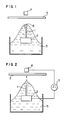
- Figure 1 is a lateral sectional view illustrating the principle of a magnetic fluid recording apparatus using the magnetic fluid of this invention as an ink; and Figure 2 is a lateral sectional view illustrating its recording state.
- the magnetic fluid of this invention is characterized by being constructed of a mixture consisting of an organic magnetic dispersion and a colorant previously treated with a solubilizing treating agent or a dispersibilizing treating agent.
- a solubilizing treating agent or a dispersibilizing treating agent.
- any one member selected from a colofing material, an intermediate of coloring material and a beforehand pretreated coloring material is subjected to a solubilizing treatment or a dispersibilizing treatment (hereinafter, these two treatments will be generically referred to as “treatment”) to obtain a colorant and said colorant is mixed, dissolved or dispersed into a magnetic dispersion and that neither the solubilizing treating agent nor the dispersibilizing treating agent (hereinafter, these two agents will be generically referred to as “treating agent”) exercises any interaction upon the surfactant of the magnetic fine particle.
- treatment a solubilizing treatment or a dispersibilizing treatment
- Said treating agent may be any compound so far as it has a hydrophobic group miscible with the dispersion medium of the magnetic dispersion and a functional group adsorbable or linkable to the coloring material, intermediate of coloring material or beforehand pretreated coloring material.
- the following two methods can be referred to.
- One of them is a method of letting a coloring material adsorb said treating agent, and the other is a method of linking a coloring material to said treating agent.
- Said coloring material may be of any coloring material so far as it has a group adsorbable or linkable to the above-mentioned functional group of treating agent.
- a beforehand pretreated coloring material which has been subjected to a pretreatment to attach said group to the coloring material, as well as an intermediate of coloring material having said group, can also be used for the purpose.
- oil-soluble dyes commercially available as oil-soluble dye generally have a low solubility in the dispersion medium, so that a mere mixing of said oil-soluble dye is not enough to change the hue of magnetic dispersion. Accordingly, it is recommendable, in order to achieve the object of this invention, to solubilize or dispersibilize such oil-soluble dyes by subjecting them to any of the above-mentioned treatments, even if they are usually commercially available oil-soluble dyes.
- the term "solubilizing treatment” means a treatment by which the treated coloring material (i.e. the colorant) becomes dispersible in the form of molecule into the dispersion medium.
- the term “dispersibilizing treatment” means a treatment by which the treated coloring material (i.e. the colorant) becomes dispersible in the form of particle into the dispersion medium. In this case, since a smaller particle size of colorant can enhance the dispersion stability, it is most desirable to disperse the colorant in the colloidal form. Additionally saying, the solubilizing treatment and the dispersibilizing treatment are not clearly distinguishable from each other in some cases.
- the materials used in this invention will be explained, provided that the materials mentioned below are no more than one example thereof and this invention is by no means limited by these examples.
- the dye among the coloring materials there can be referred to basic dyes such as C. I. Basic Red 9, C. I. Basic Blue 24 and the like; acid dyes such as C. I. Acid Blue 43, C. I. Acid Blue 78, C. I. Acid Violet 41 and the like; azoic dyes such as C. I. Azoic Diazo Component 31, C. I. Azoic Diazo Component 34, C. I. Azoic Diazo Component 35 and the like; oil-soluble dyes such as C. I. Solvent Yellow 6, C. I. Solvent Yellow 61, C. I.
- Solvent Yellow 80 C. I. Solvent Orange 2, C. I. Solvent Orange 37 and the like; and so on.
- organic pigment among pigments there can be referred to C. I. Pigment Yellow 5, C. I. Pigment Yellow 11, C. I. Pigment Yellow 15, C. I. Pigment Red 50, C. I. Pigment Red 51, C. I. Pigment Red 53, C. I. Pigment Blue 1, C. I. Pigment Blue 2 and the like; as well as metallo phthalocyanines, non-metallo phthalocyanines and the like.
- inorganic pigment cobalt blue, ultramarine blue, Prussian blue, cerulean blue, manganese blue, tungsten blue, red oxide, red lead oxide, molybdenum red, cobalt red, carbon black and the like can be referred to.
- coloring materials to which a linkage (mentioned later) is to be attached in the subsequent solubilizing or dispersibilizing treatment such as C. I. Acid Red 32, C. I. Acid Red 35, C. I. Acid Red 37 and the like, can also be used.
- coloring materials into which the treating agents mentioned below have been introduced in the oil- solubilizing treatment of oil-soluble dye can also be referred to.
- said treating agent may be any compound so far as it has a hydrophobic group and a functional group adsorbable or linkable to coloring material.
- said hydrophobic group include alkyl groups, cycloalkyl groups, alkenyl groups, aralkyl groups and the like, among which groups having 10-30 carbon atoms are preferable and those having 12-20 carbon atoms in their main chain are particularly preferable.
- the functional group adsorbable or linkable to coloring material there can be referred to carboxyl group, carboxylic acid anhydride group, carbonyl chloride group, carbonyl bromide group, sulfonic acid group, sulfonyl chloride group, primary amino group, secondary amino groups, phenyl group and the like.
- the dispersion medium As the organic dispersion medium relating to the magnetic fluid of this invention, hydrocarbon compounds, ether compounds, ester compounds and fluorinated hydrocarbon compounds can be referred to.
- hydrocarbon compounds are most preferably utilized as the dispersion medium for magnetic dispersion, and such a magnetic dispersion is most readily available.
- the magnetic fluid of this invention is preferably a magnetic fluid in which a hydrocarbon compound is used as dispersion medium.
- Dispersion media consisting of hydrocarbon compound are roughly classified into aromatic hydrocarbon compounds such as toluene and the like and aliphatic hydrocarbons such as kerosene and the like.
- aromatic hydrocarbon compounds are generally superior to aliphatic hydrocarbon compounds in solubility, many of them have toxicity and they are narrow in the range of vapor pressure and viscosity.
- aliphatic hydrocarbon compounds have favorable physical properties to practical use, such as low vapor pressure and low viscosity, and their toxity is generally low. Accordingly, aliphatic hydrocarbon compounds are more industrially advantageous.
- the colorants used in the magnetic fluid of this invention are readily soluble or dispersible into aliphatic hydrocarbon compounds.
- aliphatic hydrocarbon compounds are preferable as dispersion medium for the magnetic fluid of this invention. Further, taking vapor pressure and viscosity into.consideration, the use of aliphatic hydrocarbon compound having 8-20 carbon atoms either alone or in the form of mixture is most preferable and most extensively employable.
- a surfactant forms a monolayer surrounding the magnetic fine particles, as has been mentioned above. If an excessive amount of surfactant is added thereto, the excessive surfactant forms double layer surrounding the magnetic fine particles, so that dispersion stability of the magnetic fine particles is injured and the magnetic fine particles precipitate. Since many of the functional groups adsorbable or linkable to coloring material, present in the treating agent, are polar as mentioned above, mixing of the treating agent into a magnetic dispersion results in an injury to the dispersion stability of magnetic fine particles and a precipitation of magnetic fine particles, as mentioned above. Further, it is said that a chemical adsorption takes place between the magnetic fine particles and the surfactant.
- the magnetic dispersion is heated to a temperature of, for example, about 200°C, the adsorbing force between the magnetic fine particles and the surfactant decreases due to the thermal stimulation and the dispersion stability of the magnetic fine particles is injured.
- a mere mixing of a magnetic dispersion, a treating agent and a coloring material with a treatment such as stirring, heating or the like only causes a meaningless decrease in the dispersion stability of magnetic fine particles, and hue of the magnetic dispersion cannot be changed by such a procedure. Accordingly, a magnetic fluid different from the magnetic dispersion in hue can be obtained without injuring the dispersion stability of magnetic fine particles only by mixing, into the magnetic dispersion, a colorant prepared by beforehand subjecting a coloring material to a treatment.
- the treatment of coloring material can roughly be classified into adsorption and linkage formation, as has been mentioned above.
- said adsorption is considered a chemical or ionic adsorption between the polar group of the coloring material and the functional group of treating agent, it is not yet elucidated.
- linkage formed covalent bond linkages such as amide linkage, sulfonamide linkage, N-alkyl linkage, ester linkage, acyl linkage and the like can be referred to.
- ionic linkages are also considered participating therein, though it is unknown whether the actual state is an ionic adsorption or an ionic linkage.
- the treatment mentioned above is concerned with a case that the coloring material has a polar group.
- a method which comprises beforehand subjecting a coloring material to a pretreatment and then letting a treating agent link or be adsorbed thereto and a method which comprises letting a treating agent link to an intermediate of coloring material.
- amination, hydroxylation and carboxylation of coloring material, conversion of the carboxy group of coloring material to carbonyl chloride or carbonyl bromide, and the like can be referred to.
- intermediate of coloring material means, for examples in the case of a coloring material to be synthesized via a reaction such as amidation or the like, the compound before the above-mentioned reaction. Accordingly, the synthesis can be achieved by linking, to said intermediate of coloring material, a treating agent having a functional group favorable to the synthesis of said coloring material which has been selected from the group consisting of the treating agents of this invention. At this time, the reaction can be carried out under roughly the same conditions as in the synthesis of the coloring material and the reaction itself is a quite usual reaction, so that the treatment can be practised easily.
- a pigment When a pigment is used as the coloring material, it is recommendable to carry out the treatment by introducing the pigment together with a treating agent into ball mill, attritor, sand grinder or the like.
- a treating agent In the case of some inorganic pigments which can be synthesized by the salting out process from a solution state, i.e. by the so-called wet method, it is recommendable to carry out the dispersibilizing treatment by adding a treating agent at the time of producing the pigment.
- the treating agent generally has a polarity. Therefore, the unadsorbed or unlinked treating agent decreases the dispersion stability of the magnetic fine particles. Accordingly, it is preferable to carry out the treatment by using the treating agent in an amount just capable of being adsorbed or linked to the coloring material.
- the method for mixing a colorant into a magnetic dispersion will be explained.
- the colorant of this invention is a coloring material which has been solubilized or dispersibilized beforehand, and it exercises no influence on the dispersion stability of magnetic fine particles. Accordingly, the method for mixing the colorant into the magnetic dispersion may be a very simple conventional means such as stirring, ultrasonic treatment or the like.
- the magnetic fluid of this invention assumes a color which is a mixed color consisting of the color of the magnetic fine particle itself and the color of the colorant itself. Accordingly, the relation between said mixing ratio and the hue is nothing other than the relation between the mixing ratio of magnetic fine particle to colorant and the change in hue. Further, it is natural that a higher mixing ratio of colorant to magnetic fine particle gives a color of magnetic fluid closer to the color of colorant.
- the hue of magnetic fluid is dependent on the kind and size distribution of magnetic fine particle as well as on the kind, solubility or dispersibility, molar absorptivity or hiding power, and size distribution (in the case of dispersibilized colorant) of colorant, it is difficult to mention, as a general rule, the correlation between the mixing ratio of magnetic fine particle to colorant and the hue of magnetic fluid.
- the correlation between the mixing ratio of magnetic fine particle to colorant and the hue of magnetic fluid it is difficult to mention, as a general rule, the correlation between the mixing ratio of magnetic fine particle to colorant and the hue of magnetic fluid.
- the system of magnetic fine particle, colorant and dispersion medium in the magnetic fluid of this invention is not exceptional.
- the maximum content of colorant in this magnetic dispersion is determined depending on the kind, solubility or dispersibility, particle size distribution (in the case of dispersibilized colorant) and the like. That is, in the fixed magnetic dispersion, there exists an upper limit in the effective mixing ratio of colorant to magnetic fine particle.
- this upper limit of mixing ratio is defined as a saturated mixing ratio of colorant. In order to mixing a colorant into a magnetic dispersion in excess to said saturated mixing ratio, it is necessary to dilute the magnetic dispersion and thereby to enhance the mixing ratio of the colorant.
- the magnetization of a magnetic dispersion is roughly proportional to the content of magnetic fine particle. Accordingly, the magnetization of the magnetic fluid of this invention is also roughly proportional to the content of magnetic fine particle. Therefore, the magnetization in a magnetic fluid in which the mixing ratio of colorant exceeds the saturated mixing ratio is lower than the magnetization in a magnetic fluid in which the mixing ratio of colorant is smaller than the saturated mixing ratio. Since said saturated mixing ratio varies depending on the kind or particle size of magnetic fine par particle, solubility or dispersibility and particle size distribution (in the case of dispersibilized colorant) of colorant and the kind of dispersion medium, it cannot be discussed uniformly as a specified value.
- the mixing ratio of colorant can be selected in the range not injuring the magnetic characteristics meeting the aimed use.
- the prior technique has a drawback that an intention to change the color of magnetic dispersion results in an injury to magnetic characteristics and inversely an intention to maintain the magnetic characteristics results in impossibility of changing the color of magnetic dispersion.
- the colorant contained in the magnetic fluid of this invention has an excellent solubility or dispersibility and exercises no influence upon the dispersion stability of magnetic fine particle, so that a magnetic fluid having a high mixing ratio of colorant to magnetic fine particle can be provided without injuring the magnetic characteristics of magnetic fluid.
- magnetic fluids of high magnetization having various hues can be obtained easily.
- the contents of magnetic fine particle and colorant in magnetic fluid can be made high. Therefore, concentration of a magnetic fluid having an effective hue or effective magnetic characteristics can be controlled in a wide range. That is, this invention has an effect that a magnetic fluid having a lower viscosity can easily be obtained by diluting a magnetic fluid with a dispersion medium having a low viscosity or a magnetic fluid having a higher viscosity can easily be obtained by concentrating a magnetic fluid or diluting it with a dispersion medium having a high viscosity, so that the scope of its use can be expanded.
- the magnetic fluid of this invention can be obtained by mixing a magnetic dispersion and a colorant by a simple and conventional method, it can easily be produced by mass-production.
- plural kinds of colorants may be added to the magnetic fluid of this invention. Accordingly, minute control of the hue of the magnetic fluid can be practised easily.
- colorants were prepared by the treatments of A to G.
- treatment it is not known whether the treatment was solubilizing treatment or dispersibilizing treatment.
- Coloring material C. I. Pigment Violet 19
- Dispersibilizing treatment A mixture consisting of 150 g of the Pigment, 55 g of anhydrous stearic acid and 500 ml of kerosene was dispersed for 5 days in a sand grinder at 1,600 rpm.
- Color of the colorant Reddish violet (Colorant D)
- Coloring material C. I. Solvent Blue 11 Treatment: A mixture consisting of 310 g of the dyestuff, 570 g of oleic acid and 500 ml of petroleum ether was stirred at room temperature and then the petroleum ether was removed by distillation.
- Coloring material C. I. Solvent Blue 11 Dispersibilizing treatment: A mixture consisting of 310 g of the dyestuff, 1,100 g of stearoyl chloride and 5,000 cc of toluene was reacted at 80°C for 2 hours and then the toluene was removed by distillation.
- Coloring material C. I. Pigment Violet 1
- Pretreatment 4 Moles of the dyestuff was reacted with 1 mole of thionyl chloride.
- Dispersibilizing treatment A mixture consisting of 50 g of the pretreated dyestuff, 9 g of octa- decylbenzene and 120 ml of nitrobenzene was reacted at 100°C for 6 hours and then the nitrobenzene was removed by distillation.
- Cobalt blue Dispersibilizing treatment Cobalt blue was synthesized by wet method according to the procedure mentioned in an article written by Seishiro Ito, Tadahiro Ohkawa and Toshihide Kuwabara: Shikizai (Coloring material), 54, 339-343 (1981) and its particle o size was adjusted to 200 A, after which an appropriate amount of oleic acid was added and the resulting mixture was extracted into kerosene layer.
- Each of the colorants A to G subjected to the above-mentioned treatment was mixed into magnetic dispersions manufactured by Matsumoto Yushi Seiyaku Co., Ltd. mentioned in Table 1.
- Table 1 the hue of the magnetic dispersions alone are also listed.
- compositions express the analyses of magnetic fine particles at the time of their production.
- the used dispersion media are kerosene.
- colorants A to G were mixed into magnetic dispersions H to J in the proportions shown in Table 2 to obtain magnetic fluids.
- the mixing ratios are expressed by ratio (by weight) of colorant to magnetic fine particle.
- the mixing may be carried out by conventional simple method such as agitating with a stirrer, ultrasonic dispersion for 20-40 minutes, or the like.
- Example No. 1 of Table 2 corresponds to Comparative Example No. 1' of Table 3.
- Example Nos. 2, 6 and 7 in Table 2 correspond to Comparative Example No.s 2', 6' and 7' in Table 3, respectively.
- magnetic dispersion and colorant were mixed, the mixture was allowed to stand for 24 hours and then the filtrate was used as sample.
- the magnetic fluid recording apparatus As shown in Figure 1, its main part is so constructed that one end of stylus 1 is contacted with magnetic 2 and the other end of stylus 1 confronts electrode 4 through intermediation of recording paper 3. Owing to the magnetic field of magnet 2, ink 5 runs along stylus 1 and protrudes at its tip. Then, a voltage 7 (recording voltage) corresponding to image signal is applied between stylus 1 and electrode 4, as shown in Figure 2, and the ink 5 flies from the tip of protrusion 6 owing to Coulomb force. Thus, a record corresponding to the image signal is formed on recording paper 3.
- a voltage 7 recording voltage
- magnetic fluid of this invention can also be used extensively in all the use fields of magnetic dispersion other than printing and recording.
- this invention provides a novel magnetic fluid, namely a magnetic dispersion which has been made richer in hue.
Landscapes
- Engineering & Computer Science (AREA)
- Power Engineering (AREA)
- Soft Magnetic Materials (AREA)
- Inks, Pencil-Leads, Or Crayons (AREA)
- Lubricants (AREA)
- Pigments, Carbon Blacks, Or Wood Stains (AREA)
Applications Claiming Priority (2)
| Application Number | Priority Date | Filing Date | Title |
|---|---|---|---|
| JP55180718A JPS57105469A (en) | 1980-12-19 | 1980-12-19 | Magnetic ink for recording |
| JP180718/80 | 1980-12-19 |
Publications (2)
| Publication Number | Publication Date |
|---|---|
| EP0055065A2 true EP0055065A2 (fr) | 1982-06-30 |
| EP0055065A3 EP0055065A3 (fr) | 1983-10-12 |
Family
ID=16088095
Family Applications (1)
| Application Number | Title | Priority Date | Filing Date |
|---|---|---|---|
| EP81305888A Withdrawn EP0055065A3 (fr) | 1980-12-19 | 1981-12-15 | Liquide magnétique |
Country Status (5)
| Country | Link |
|---|---|
| US (1) | US4758275A (fr) |
| EP (1) | EP0055065A3 (fr) |
| JP (1) | JPS57105469A (fr) |
| AU (1) | AU529287B2 (fr) |
| CA (1) | CA1168855A (fr) |
Cited By (7)
| Publication number | Priority date | Publication date | Assignee | Title |
|---|---|---|---|---|
| EP0067687A3 (en) * | 1981-06-12 | 1983-12-07 | Matsushita Electric Industrial Co., Ltd. | Magnetic fluid |
| EP0073570A3 (en) * | 1981-07-29 | 1983-12-21 | Matsushita Electric Industrial Co., Ltd. | Magnetic fluid |
| US5250207A (en) * | 1991-05-14 | 1993-10-05 | Basf Aktiengesellschaft | Magnetic ink concentrate |
| US5322756A (en) * | 1992-07-09 | 1994-06-21 | Xerox Corporation | Magnetic fluids and method of preparation |
| US5358659A (en) * | 1992-07-09 | 1994-10-25 | Xerox Corporation | Magnetic materials with single-domain and multidomain crystallites and a method of preparation |
| US5362417A (en) * | 1992-07-09 | 1994-11-08 | Xerox Corporation | Method of preparing a stable colloid of submicron particles |
| US5567564A (en) * | 1992-07-09 | 1996-10-22 | Xerox Corporation | Liquid development composition having a colorant comprising a stable dispersion of magnetic particles in an aqueous medium |
Families Citing this family (13)
| Publication number | Priority date | Publication date | Assignee | Title |
|---|---|---|---|---|
| US4604222A (en) * | 1985-05-21 | 1986-08-05 | Ferrofluidics Corporation | Stable ferrofluid composition and method of making and using same |
| JPS6429675U (fr) * | 1987-08-11 | 1989-02-22 | ||
| DE3731804A1 (de) * | 1987-09-22 | 1989-03-30 | Agfa Gevaert Ag | Anordnung zur bestimmung des dispersionsgrades magnetischer pigmente in einer dispersion |
| DE69212780T2 (de) * | 1991-11-14 | 1997-01-30 | Matsushita Electric Ind Co Ltd | Selbstmetabolisierendes funktionelles Material |
| US5457012A (en) * | 1994-04-18 | 1995-10-10 | Eastman Kodak Company | Transparent film-forming aqueous compositions for magnetic recording |
| DE4420644A1 (de) * | 1994-06-14 | 1995-12-21 | Basf Ag | Farbige Metalloxidpigmente enthaltende Kugelschreiberpasten |
| US5633127A (en) * | 1996-03-29 | 1997-05-27 | Eastman Kodak Company | Imaging elements capable of providing in a single layer an image and an independent magnetic record |
| US6031020A (en) * | 1998-08-27 | 2000-02-29 | The Standard Register Company | Cancellation of micr-readable documents by application of an ink containing magnetic particles |
| WO2000047419A1 (fr) | 1999-02-09 | 2000-08-17 | Source Technologies, Inc. | Formulation d'encre a particules aciculaires pour systeme d'imprimante a jet d'encre |
| US7189198B2 (en) * | 2002-07-03 | 2007-03-13 | Stereotaxis, Inc. | Magnetically guidable carriers and methods for the targeted magnetic delivery of substances in the body |
| KR102118724B1 (ko) * | 2018-04-05 | 2020-06-04 | 주식회사 나노브릭 | 자기 색 가변 마이크로 캡슐을 포함하는 조성물 및 이를 이용한 인쇄 장치. |
| JP7454425B2 (ja) * | 2019-05-24 | 2024-03-22 | 日鉄鉱業株式会社 | コバルトフェライト粒子の製造方法とそれにより製造されたコバルトフェライト粒子 |
| US10938292B2 (en) * | 2019-06-05 | 2021-03-02 | Energystics, Ltd. | Magnetic lubricant |
Family Cites Families (12)
| Publication number | Priority date | Publication date | Assignee | Title |
|---|---|---|---|---|
| DE1213864B (de) * | 1958-12-19 | 1966-04-07 | Ibm | Magnetische Druckfarbe |
| FR1252680A (fr) * | 1959-12-15 | 1961-02-03 | Ibm | Encres lithographiques magnétiques |
| DE1592918A1 (de) * | 1967-01-26 | 1971-02-11 | Muhs Dipl Chem Herbert | Verfahren zur Herstellung insbesondere Wasser- und petroleumbestaendiger fluoreseierender Pigmente mit ferro- und/oder paramagnetischen I'igenschaften |
| US3928220A (en) * | 1973-08-27 | 1975-12-23 | Gen Electric | Preparation of hydrocarbon-dispersible magnetic microspheroids in powdered form |
| US4094804A (en) * | 1974-08-19 | 1978-06-13 | Junzo Shimoiizaka | Method for preparing a water base magnetic fluid and product |
| US3990981A (en) * | 1974-08-23 | 1976-11-09 | International Business Machines Corporation | Water based magnetic inks and the manufacture thereof |
| US3981844A (en) * | 1975-06-30 | 1976-09-21 | Ibm | Stable emulsion and method for preparation thereof |
| ZA765807B (en) * | 1975-10-07 | 1977-09-28 | Sublistatic Holding Sa | Developers |
| US4218530A (en) * | 1977-05-02 | 1980-08-19 | Xerox Corporation | Single component magnetic toner |
| US4208294A (en) * | 1979-02-12 | 1980-06-17 | The United States Of America, As Represented By The Secretary Of The Interior | Dilution stable water based magnetic fluids |
| DE2916403A1 (de) * | 1979-04-23 | 1980-11-06 | Basf Ag | Nadelfoermiges magnetisches eisenoxid und verfahren zu seiner herstellung |
| US4256818A (en) * | 1979-11-05 | 1981-03-17 | Xerox Corporation | Magnetic or electrostatographic imaging and high speed fusing method uses polyamide resin in toner |
-
1980
- 1980-12-19 JP JP55180718A patent/JPS57105469A/ja active Granted
-
1981
- 1981-12-15 EP EP81305888A patent/EP0055065A3/fr not_active Withdrawn
- 1981-12-15 US US06/330,851 patent/US4758275A/en not_active Expired - Fee Related
- 1981-12-16 CA CA000392455A patent/CA1168855A/fr not_active Expired
- 1981-12-18 AU AU78657/81A patent/AU529287B2/en not_active Ceased
Cited By (10)
| Publication number | Priority date | Publication date | Assignee | Title |
|---|---|---|---|---|
| EP0067687A3 (en) * | 1981-06-12 | 1983-12-07 | Matsushita Electric Industrial Co., Ltd. | Magnetic fluid |
| EP0073570A3 (en) * | 1981-07-29 | 1983-12-21 | Matsushita Electric Industrial Co., Ltd. | Magnetic fluid |
| US5250207A (en) * | 1991-05-14 | 1993-10-05 | Basf Aktiengesellschaft | Magnetic ink concentrate |
| US5322756A (en) * | 1992-07-09 | 1994-06-21 | Xerox Corporation | Magnetic fluids and method of preparation |
| US5358659A (en) * | 1992-07-09 | 1994-10-25 | Xerox Corporation | Magnetic materials with single-domain and multidomain crystallites and a method of preparation |
| US5362417A (en) * | 1992-07-09 | 1994-11-08 | Xerox Corporation | Method of preparing a stable colloid of submicron particles |
| US5567564A (en) * | 1992-07-09 | 1996-10-22 | Xerox Corporation | Liquid development composition having a colorant comprising a stable dispersion of magnetic particles in an aqueous medium |
| US5578245A (en) * | 1992-07-09 | 1996-11-26 | Xerox Corporation | Method of preparing a stable colloid of submicron particles |
| US5670078A (en) * | 1992-07-09 | 1997-09-23 | Xerox Corporation | Magnetic and nonmagnetic particles and fluid, methods of making and methods of using the same |
| US5858595A (en) * | 1992-07-09 | 1999-01-12 | Xerox Corporation | Magnetic toner and ink jet compositions |
Also Published As
| Publication number | Publication date |
|---|---|
| US4758275A (en) | 1988-07-19 |
| JPS57105469A (en) | 1982-06-30 |
| CA1168855A (fr) | 1984-06-12 |
| AU7865781A (en) | 1982-06-24 |
| EP0055065A3 (fr) | 1983-10-12 |
| JPS6136874B2 (fr) | 1986-08-20 |
| AU529287B2 (en) | 1983-06-02 |
Similar Documents
| Publication | Publication Date | Title |
|---|---|---|
| US4758275A (en) | Magnetic fluid | |
| JP2515279B2 (ja) | カルボン酸エステル―またはアミド鎖を有する化合物およびそれを含有する界面活性剤組成物 | |
| DE60130757T2 (de) | Silizium beschichtete nanopartikel | |
| DE68926871T2 (de) | Tintenstrahl-Tinten und flüssige Entwickler | |
| DE69534009T2 (de) | Wässrige tinten und beschichtungen enthaltend kohlenstoffprodukte | |
| DE3534528C2 (fr) | ||
| DE69717558T2 (de) | Zweikomponenten-Dispergiermittel für Nassvermahlung | |
| EP0084645A2 (fr) | Préparation pigmentaire solide et facilement dispersable, à forte concentration, exempte de poussière et son application | |
| KR20120109479A (ko) | 전자 잉크 | |
| DE10012784A1 (de) | Ruß | |
| EP1072655B1 (fr) | Dispersions aqueuses de noir de carbone | |
| EP2155824A2 (fr) | Préparation de pigments et son procédé de fabrication et d'utilisation | |
| DE60303533T2 (de) | Farbzusammensetzung auf Ölbasis für Tintenstrahldrucker | |
| DE69419900T2 (de) | Flüssigentwickler enthaltend ein ladungssteuerungsmittel für elektrostatographie | |
| EP1134261B1 (fr) | Suie | |
| DE19654864A1 (de) | Magnetofluid mit einer Sättigungsmagnetisierung von 150 bis 450 mT | |
| DE60004731T2 (de) | Tintenstrahldrucktinten enthaltende estermodifizierte makromolekulare Chromophore | |
| US6527843B1 (en) | Fine colored particles and ink jet ink | |
| EP0067687B1 (fr) | Encre magnétique ou jet-ink | |
| US5670088A (en) | Preparation of mixed ultrafine particles from PFPE micro-emulsion | |
| JP2009256595A (ja) | 水不溶性色材分散体、水不溶性色材含有物の製造方法、水不溶性色材の微粒子、水不溶性色材用分散剤、並びにこれらを用いた記録液、インクセット、印画物、画像形成方法、及び画像形成装置 | |
| US4519931A (en) | Magnetic fluid | |
| DE2728357A1 (de) | Verfahren zur herstellung einer stabilen suspension feinverteilter fester partikel in der oelphase in einer oel-in-wasser-emulsion, beispielsweise einer pigmentierten beize | |
| JPS58182803A (ja) | 磁性流体 | |
| DE19514515C2 (de) | Magnetisierbare Dispersionen |
Legal Events
| Date | Code | Title | Description |
|---|---|---|---|
| PUAI | Public reference made under article 153(3) epc to a published international application that has entered the european phase |
Free format text: ORIGINAL CODE: 0009012 |
|
| AK | Designated contracting states |
Designated state(s): DE FR GB IT |
|
| PUAL | Search report despatched |
Free format text: ORIGINAL CODE: 0009013 |
|
| AK | Designated contracting states |
Designated state(s): DE FR GB IT |
|
| 17P | Request for examination filed |
Effective date: 19840308 |
|
| STAA | Information on the status of an ep patent application or granted ep patent |
Free format text: STATUS: THE APPLICATION IS DEEMED TO BE WITHDRAWN |
|
| 18D | Application deemed to be withdrawn |
Effective date: 19850920 |
|
| RIN1 | Information on inventor provided before grant (corrected) |
Inventor name: YUBAKAMI, KEIICHI Inventor name: SOGA, MAMORU Inventor name: SHIMOTSUMA, WATARU Inventor name: SONODA, NOBUO |