EP0055347A2 - Gleichspannungsstabiler Speicher - Google Patents
Gleichspannungsstabiler Speicher Download PDFInfo
- Publication number
- EP0055347A2 EP0055347A2 EP81108554A EP81108554A EP0055347A2 EP 0055347 A2 EP0055347 A2 EP 0055347A2 EP 81108554 A EP81108554 A EP 81108554A EP 81108554 A EP81108554 A EP 81108554A EP 0055347 A2 EP0055347 A2 EP 0055347A2
- Authority
- EP
- European Patent Office
- Prior art keywords
- npn
- memory cell
- bit lines
- type
- static memory
- Prior art date
- Legal status (The legal status is an assumption and is not a legal conclusion. Google has not performed a legal analysis and makes no representation as to the accuracy of the status listed.)
- Granted
Links
Images


Classifications
-
- G—PHYSICS
- G11—INFORMATION STORAGE
- G11C—STATIC STORES
- G11C11/00—Digital stores characterised by the use of particular electric or magnetic storage elements; Storage elements therefor
- G11C11/21—Digital stores characterised by the use of particular electric or magnetic storage elements; Storage elements therefor using electric elements
- G11C11/34—Digital stores characterised by the use of particular electric or magnetic storage elements; Storage elements therefor using electric elements using semiconductor devices
- G11C11/39—Digital stores characterised by the use of particular electric or magnetic storage elements; Storage elements therefor using electric elements using semiconductor devices using thyristors or the avalanche or negative resistance type, e.g. PNPN, SCR, SCS, UJT
-
- H—ELECTRICITY
- H10—SEMICONDUCTOR DEVICES; ELECTRIC SOLID-STATE DEVICES NOT OTHERWISE PROVIDED FOR
- H10B—ELECTRONIC MEMORY DEVICES
- H10B10/00—Static random access memory [SRAM] devices
- H10B10/10—SRAM devices comprising bipolar components
Definitions
- the present invention relates to static bipolar memory cells, and more particularly to improved memory cells which conserve on chip area without unduly complicating reading or writing, and without sacrificing noise margins.
- bipolar memory cells can be conveniently divided into dynamic cells and static cells, the static cells have the advantage of not requiring repeated refreshment or regeneration, whereas this is required for the dynamic cell.
- the present invention is directed to improvements in static cells, therefore the remaining part of this application will address only static cells.
- Patent 3 914 749 assigned to the assignee of this application.
- the single device is an NPN transistor.
- Goser discloses a FET memory cell which is economical in use of area, but requires a relatively complex writing operation.
- Single Device DC Memory Cell appearing in the IBM Technical Disclosure, Volume 20, No. 9 (February, 1978) pages 3492-94 a single device DC stable memory cell is disclosed.
- This cell can be considered equivalent to an SCR latch in that it comprises a PNPN device which can be latched in either of two states.
- the cell is not fully selectable, and the write operation is relatively more complex than otherwise desirable.
- the half cell i.e., the single device DC stable memory cell of the last-mentioned TDB, and variants thereof are particularly advantageous in that the entire cell can be enclosed in a single isolated region or isolation pocket.
- a multi-element device such as that shown in the referred to TDB can occupy an area for the active devices which is relatively small, but the necessary isolation actually occupies an area that is significantly larger than the area occupied by the active devices.
- Prior art complementary or symmetrical memory cells thus paid a significant price by requiring two isolation pockets, as compared to the single isolation pocket for memory cells such as shown in the referred to TDB, and as described herein.
- TDB memory cell in the referred to TDB
- the significant disadvantage of the memory cell in the referred to TDB is the complexity of reading and writing, as well as the fact that the cell is not fully selectable, i.e., as described in the TDB, the cell is cleared before writing, and this of course, requires additional peripheral circuits to maintain the status of the cell prior to rewriting so that, the data the cell initially stored is not lost in the event the particular cell is not to be written.
- an interface comprising additional devices is provided to simplify the reading and writing operations for cells of the type described in the referred to TDB. While a variety of such devices can be added, due attention must be paid to the ability to integrate these added devices into the cell without requiring additional isolation, and minimizing the number of additional process steps required for these additional devices.
- the invention provides a fully selectable static memory cell capable of writing either one of two information states or reading either one of two information states comprising a substrate supporting a P-type'semiconductor, means for isolating a region of said semiconductor, an N sub-collector within said isolated region, a first NPN transistor within said region including said sub-collector, a parasitic PNP transistor within said region, said parasitic PNP transistor including at least two elements in common with said NPN transistor, controllable word and bit lines in said isolated region, and means coupling said word and bit lines to said first and second transistors for operating said transistors as an SCR latch to read the information state of said latch or to write either of said information states regardless of the pre-existing state of said latch in response to read and write signals on said word and bit lines.
- the geometry of the SCR latch within the isolated region includes a buried sub-collector (N + ), and N epitaxial layer, a pair of P-type base regions diffused in said epitaxial layer, said P-type diffused regions having adjacent edges separated by a sufficiently small distance so that the diffused P-type regions and the intervening N epitaxial layer form a lateral PNP transistor, and an N diffused region located within one of the P-type diffused regions, so that the epitaxial layer and sub-collector, said one diffused P-type region and said latter diffused N + region form an NPN transistor.
- the NPN and PNP transistors have at least one P-type region in common, the base of the NPN transistor and the collector of the PNP transistor, as well as the epitaxial region which is the collector of the NPN transistor and the base of the PNP transistor. Accordingly, the above-described device performs the function of a PNPN device or an SCR latch.
- the SCR latch of the inventive cell may have a single emitter NPN transistor as compared to the double emitter of the TDB. Word lines are connected to power the SCR latch and bit lines are connected through additional circuitry to allow ready reading and writing.
- reading and writing is facilitated by the addition of a Schottky diode coupling one of the bit lines to the NPN collector-PNP base, and an additional NPN transistor having a collector in common with the collector of the first NPN transistor and a base connected to a second bit line.
- the added diode and NPN transistor enable relatively easy reading and writing and integrate simply into the geometry;the diode merely requiring a metal in contact with the epitaxial layer, the second NPN transistor requiring an additional diffused P- type region within the epitaxial layer and an N + diffusion in the latter diffused P region.
- the latter NPN transistor can be replaced by a second Schottky diode, although of the P-type.
- the N-type Schottky diode can be replaced by an NPN transistor.
- Another embodiment of the invention adds a second N + emitter to the PNP transistor to thus form a second parasitic NPN transistor having a P base in common with the P-type emitter of the PNP transistor and an N collector in common with the N base of the PNP transistor.
- an N-type Schottky diode is also added as in the first embodiment of the invention.
- the disadvantage of this embodiment is a relatively complicated writing cycle. However, this can be eliminated by the addition of a further Schottky diode coupled between the base of the NPN transistor and the anode of the N-type Schottky diode.
- a similar effect can be achieved by eliminating the N-type Schottky diode (as well as the P-type Schottky diode) and changing the single emitter NPN transistor to be a double emitter NPN transistor.
- the single emitter NPN transistor is replaced by a double emitter NPN transistor.
- two NPN transistors are employed, the second NPN transistor is used in reading and writing by connecting its base to a bit line.
- FIG lA is an end view of a basic component of the memory cell of the various embodiments described hereinafter, and Figure 1B is.a corresponding circuit schematic.
- each semi-conductor chip actually includes an array of memory cells, thus the drawings and schematics herein will illustrate the unit cell which is replicated many times in the array.
- each cell is built up on a common P substrate.
- For each cell a N sub-collector region is diffused, along with spaced P isolation regions.
- the N epitaxial layer is grown over the entire chip. Selected regions at the boundaries of each cell are opened up for the deposition of isolation, shown in Figure 1A as recessed oxide isolation (ROI).
- ROI recessed oxide isolation
- lA is a single isolation region.
- a pair of P-type impurity regions are provided, suitably separated.
- the P-type regions may be adjacent to the cell boundary isolator (ROI).
- the P-type regions may be located directly adjacent the ROI, or a suitable space may be provided for the inclusion of one or more additional elements as will be.described.
- One of the P-type regions has diffused therein a N + region.
- the foregoing geometry provides for first NPN transistor 11, shown dotted in Figure lA, and a lateral PNP transistor 10 (also shown dotted in Figure lA).
- transistors 10 and 11 include a common P region, the base of the NPN transistor and the collector of the PNP transistor, as well as a common N region, the collector of the NPN transistor and the base of the PNP transistor.
- the foregoing circuitry is illustrated schematically in Figure 1B. Note that the terminals labeled A,B,C, and D in Figure lB correspond to the areas carrying the same reference characters in Figure lA, and each of these areas is available for connection.
- While the circuit of Figure ]B will exhibit an SCR latching function, in that, when biased appropriately, and when the transistors 10 and 11 are conducting, they will remain conducting and likewise, this conduction can be terminated by terminating the conduction in the NPN transistor, which will terminate conduction in the PNP transistor, and the later state is also stable.
- the latch is capable of maintaining either of the two information states, "1" and "0".
- the impedence referred to, for improving the noise margin can be connected in series between the points A and C, or it can be connected in series between points D and B.
- One suitable form of such an impedance is a polysilicon resistance.
- an N-type Schottky diode connected between points A and C, or a P-type Schottky diode connected between points D and B can be used.
- Figures 1C through 1F illustrate how this is effected.
- Figure 1C is a detailed end view of a portion of Figure lA, shown within the dot-dashed area labeled Figure 1C in Figure lA.
- the geometry of Figure lA has been altered so that the emitter region of the PNP transistor 10 is separated from the isolator region, allowing the epitaxial N layer to reach the surface.
- a metal contact for example, platinum (which when sintered forms platinum silicide) is deposited on the surface through a window in a passivation layer S.
- the platinum-epitaxial interface will exhibit diode characteristics, i.e., a forward drop of about 0.5v is required to initiate conduction and current flow in the reverse direction will be subjected to a very large resistance. Since a conductor will be required for connection to terminal A, the provision of the Schottky diode reduces to a requirement for the use of a particular metal contact, and the particular geometry as shown in Figure 1C. Thus, the N-Schottky diode is implemented at relatively low cost. Ion implantation of boron in the epitaxial layer can be used to enhance the value of Schottky diode resistance, if desired.
- a P-type Schottky diode can be used as the impedance between terminals D and B. This is effected in the manner as shown in Figure 1D which illustrates an enlarged portion of the end view of Figure lA which is shown dotted in Figure 1A and carries the reference Fig. 1D.
- Figure ID the P-type region which forms the base of NPN transistor 11 is separated from the isolator, allowing the N epitaxial layer to reach the surface.
- a lightly doped P region is provided adjacent the P base of the NPN transistor 11, for example by ion implantation. Thereafter, a metal contact, titanium or hafnium is laid down over the P-type region. The interaction of the metal and the P impurity provides the effect of a diode which is connected to terminal B.
- the schematic is identical to Figure 1B except that, between terminals D and B a Ptype Schottky diode is included with a parasitic resistance R.
- the terminal C or D tends to approach the potential of terminal A or B respectively.
- spurious voltages which would switch the cell from an off to an on state would necessarily raise the base of the NPN transistor 11, but now the Schottky diode limits the excursion.
- the N-type Schottky diode of Figure lE limits the negative excursion of the base of the PNP transistor 10 with respect to its emitter.
- Figure 2A is a schematic of the preferred embodiment of the invention (omitting, as had been referred to above, one of the preferred noise margin improvement techniques shown in Figures 1C-1F).
- the basic SCR latch comprising transistors 10 and 11 is connected between a word line 1 (connected to the emitter of transistor 10) and a word line 2, connected to the emitter of transistor 11.
- An N-type Schottky diode 12 has a cathode connected to the collector of transistor 11 (terminal C) and an anode connected to bit line 1.
- a second NPN transistor 13 also has its emitter connected to word line 2, its collector in common with transistor 11, and its base connected to a second bit line, bit line 2.
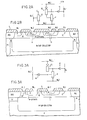
- Figure 2B is an example of how the device of Figure 2A is integrated in one isolation pocket, that is more particularly, the transistor 10 comprises a lateral transistor with a P-type emitter, and N-type base and a P-type collector, shown dotted in Figure 2B.
- the emitter of transistor 10 can connect to a contact labeled WL1 (word line 1) through the hole labeled WLl in the passivation layer S.
- the transistor 11 exists between an N + emitter surrounded by a P-type base (the collector of trnasistor 10) and an N-type collector comprising the N epitaxial layer and the N sub-collector.
- the emitter of transistor 11 can contact WL2 (word line 2) through the hole in the passivation layer S.
- the transistor 13 exists between an adjacent N + region diffused into a P-type region, and includes the N - epitaxial layer, and N sub-collector, as the combined collector.
- the emitter of transistor 13 also can contact WL2.
- Bit line 2 can connect to the base (P-type) region of transistor 13.
- the Schottky diode 12 is formed by a platinum contact overlying the N epitaxial layer in the location designated BL1.
- Table 1 reproduced below shows approximate voltage levels on the word and bit lines for standby, write "1", write “0” and read operations. It should be emphasized that these are exemplary and changes may be made by those skilled in the art to suit various needs.
- Writing into the cell of Figure 2A and 2B can be effected whether or not the cell is latched on or off.
- writing requires reducing the voltage on both word lines (WLl and WL2).
- raising the potential on BL1 will have the effect of draining any current from the base of transistor 10 or the collector of transistor 11, and will result in turning the SCR “off”.
- bit line 2 is raised. This will tend to cause transistor 13 to conducts and its current conduction will cause the SCR to latch on, referred to as writing a "1".
- the word and bit lines can be returned to their quiescent conditions and the latch will remain in the state to which it was written.
- Reading the cell is effected by bringing down the word lines (the difference in word line voltages may be increased simultaneously which has the effect of powering up the cell) and sensing current in bit line 1 which is raised in potential.
- the collector will be at a relatively low potential and thus will sink current from bit line 1. If the cell had been latched off, on the other hand, no or relatively little current would be sinked from bit line 1 under these conditions.
- Figures 3A and 3B illustrate a variation on the cell of Figures 2A and 2B.
- the NPN transistor 13 has been eliminated, and is replaced by a P- type Schottky diode 14; in all other respects this cell is identical.
- the P-type Schottky diode 14 is implemented with a P-type diffusion in the same sub-collector bed as the SCR latch.
- All the cells of a word line are initially turned on to state "1" by increasing the voltage on WLl. Thereafter, returning the word line 1 to its standby potential will leave the latch "on".
- the latch On the other hand, with the word lines up, lowering bit line 2, will cause any conduction in the latch to terminate, thus corresponding to writing a "0".
- the latch With the word lines, or at least word line 2, pulled down below its standby potential, the latch can be "read” by sensing current conduction in bit line 1 when its voltage is increased. Bit line 1 will conduct current only when the latch is “on”, and will not conduct, or conduct only negible current if the latch is "off".
- Figure 4A shows a further variant in which the P-type Schottky diode 14 has been eliminated, and an NPN transistor 16 inserted.
- the NPN transistor of Figure 4A has its emitter coupled to bit line 2, and its base coupled to an emitter of transistor 11.
- the Schottky diode 12 has been replaced by a second emitter on transistor 11 which is coupled to bit line l.
- a plan view of this device is shown as Fig. 4C.
- the connection between the P-type base of transistor 16 and the N-type emitter 32 of transistor 11 is effected by conductor 36 which is part of WL2.
- the transistor 10 with emitter 30 contacting WLl.
- the base of transistor 10 is the N epitaxial layer and the collector is in common with the base 33 of transistor 11.
- the transistor 11 has an emitter 31 connected to BL1 and an emitter 32 connected to WL2.
- the transistor 16 has an emitter 34 connected to BL2 and a base 36 connected to WL2.
- Fig. 4C also shows N-type Schottky diode 25 connected to WLl, as in Figs. 1C and lE. A hole is left in the middle of emitter 30 of PNP transmitter 10 for this purpose.
- Table 2 reproduced below, illustrates approximate voltages on the word and bit lines for standby, reading, writing "1" and writing "0".
- the values given in Table 2, like Table 1 are exemplary only.
- Figure 4B is similar to Figure 2A. However, NPN transistor 13 has been deleted, and its place taken by NPN transistor 17, with an emitter coupled to bit line 2, and base coupled to word line 1. In addition, an impedance, such as a resistance has been inserted between emitter and base of transistor 11. During standby WL1 and BL2 are about l.Ov, while WL2 and BL1 are at Ov.
- Reading is effected by bringing down the word lines and sensing the current in bit line 1 as in the embodiments of Figure 2A and 3A.
- Figures 5A-5E all incorporate the same variation on the basic SCR latch. More particularly, in addition to the latch (transistors 10 and 11) a second NPN transistor 18 is integrated with PNP transistor 10, such that the emitter of PNP transistor 10 is the base of the new NPN transistor 18 and the base of the PNP transistor 10 is the collector of the new NPN transistor. In the sense that common regions are employed for the transistor 10 and the new transistor, the new transistor can be termed at least a quasi-parasitic element in that its integration requires only an additional N emitter region.
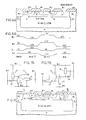
- Figure 6A is a sketch of a cross- section of the geometry of a cell whose schematic is shown in Figure 5A, illustrating how the integration is effected.
- Figure 6A shows the basic latch comprising transistors 10 and 11 as including a sub-collector N and adjacent N epitaxial layer, including a first P-type diffusion in which a second N + diffusion region exists, forming the NPN transistor 11.
- a second P-type diffusion region is provided adjacent the P-type region comprising the base of the NPN transistor 11, so that the two P-type diffusion regions separated by the N epitaxial layer form the PNP transistor 10.
- This latter P-type diffusion region includes an additional N diffusion region such that this latter N diffusion region, the P-type diffusion region in which it exists and the associated epitaxial layer N and sub-collector N form the additional NPN transistor 18.
- the Schottky diode 12 is formed as in the case of Figure 3B via the bit line 1 contact overlying the N epitaxial layer;by selecting the contact material of bit line 1 (platinum) the desired N-type Schottky diode is formed.
- the cell whose schematic is shown in Figure 5A can be operated to read or write, and can reliably store one of two information states, as in the case of the other cells, by latching the SCR on to store a "1" or off to store a "0". More particularly, reading can be effected by lowering the word lines, and raising bit line l;if the cell is latched "on” then bit line 1 will draw current, otherwise it will not, or draw only negible current. Thus, the state of the cell can be determined by the quantum of current sinked by NPN transistor 11 from BLl.
- Writing a "1" is effected by raising the word lines and lowering the bit line 2. In this state, the transistor 18 will initiate conduction and as a result of this, the cell will latch "on", so that when the word and bit lines are returned to their standby condition, the cell will be latched “on”.
- writing a "0" is effected by lowering the word lines and raising bit line 1; this will have the effect of blocking current in the cell, had it been conducting current, to thereby ensure that when the word and bit lines are returned to their standby condition, the cell will not be conducting, i.e., latched "off".
- Figure 6B illustrates the wave forms for the writing operation.
- the write cycle is relatively longer than other write cycles in which a 1 or a 0 can be written by merely selectively operating on the bit lines alone.
- the write cycle of the cell of Figure 5A can be improved, at the expense of adding an additional element, as shown in Figure 5B.
- FIG. 5B shows a cell essentially similar to the sechmatic of Figure 5A except that an additional P- type Schottky diode 19 has been added connected between the base of NPN transistor 11 (its anode) and bit line 1 (its cathode).
- P- type Schottky diode 19 has been added connected between the base of NPN transistor 11 (its anode) and bit line 1 (its cathode).
- WL1 is normally at l.Ov, W12 at Ov, BL1 at 0.4v and BL2 at 1.0v.
- Reading is effected as reading the cell of Fig. 5A namely, the word lines are lowered and bit line 1 is raised, and the current sinked by transistor 11 is sensed in BLl;sinking of significant current indicates the cell is latched "on", sinking no or negible current indicates the cell is latched"off".
- This particular cell has its writing operation simplified in that writing either a 1 or a 0 requires raising the word lines.
- a one is written as in the case of the schematic of Figure 5A namely, by lowering bit line 2, to initiate conduction. Writing a 0, however, can be effected by lowering bit line 1.
- the manner in which the cell of 5C can be integrated should be apparent and therefore an end view of this cell is omitted.
- the cell includes the PNP transistor 10, its parasitic NPN transistor 18 as well as the NPN transistor 11.
- the NPN transistor 11 has been altered so that it now includes a second emitter 20, which second emitter is connected to bit line 1.
- This cell has the same advantage of the cell of Figure 5B in that it is relatively simple to operate. Reading is effected by raising the word lines, lowering BL1 and sensing current in bit line 1. If the cell had been conducting, raising the word lines will transfer current from the first emitter of transistor 11 to the second emitter 20, and thus the current on the bit line will represent the state of the cell.
- the cell can be written also by raising the word lines, writing a "1" is effected again by lowering bit line 2 as in the case of the cell whose schematic is shown in Figure 5B.
- Writing a "0" can be effected with the word lines raised, by raising bit line 1. Raising the word line 2 transfers the cells' current, to the second emitter 20 of the.NPN transistor 11, and raising bit line 1 blocks such current flow ensuring that the cell is latched "off". After current conduction terminates, the word and bit lines can be returned to their standby potentials, and the cell will retain the "off" state.
- WL1 and BL2 are at l.Ov
- Figure 7A illustrates still a further embodiment of the invention.
- the basic cell comprising SCR latch of transistors 10 and 11, and the N-type Schottky diode 12
- NPN transistor 21 with base connected to word line 2, an emitter connected to bit line l
- its collector is common to the collector of transistor ll
- P-type Schottky diode 22 whose anode is the collector of PNP transistor 10, and cathode is connected to the bit line 2).
- the cell requires elements in addition to some of the other embodiments of the invention, it does have a simplified operation, and its integration is relatively straightforward with the exception of the P-type Schottky diode 22, which may require the use of otherwise unnecessary mettalurgy for the bit line 2. Reading this cell is effected by lowering the word lines and raising bit line 1. As in the case of several of the other embodiments, lowering the word line voltage, and raising bit line 1 voltage will have the effect of sinking current via transistor 11 if the cell is latched "on". The cell thus can be read by the current drawn by bit line 1. Raising bit line 1 will not affect transistor 21, since its emitter is connected thereto.
- Writing into the cell is effected by raising the word lines, writing a "0" is effected by lowering bit line 2.
- Lowering bit line 2 with the word lines raised has the effect of sinking current from the PNP transistor 10 through the P-type Schottky diode 22, and this draining of current will latch the cell "off", had it been conducting current. Thereafter, when the word and bit lines are returned to their normal potentials, the cell will be "off".
- a "1" is written by lowering bit line 1, in the presence of a raised potential on the word lines. This will have the effect of initiating conduction in transistor 21, and that current will be transferred to the latch.
- the cell will be conducting, i.e., latched "on".
- WL2 and BL1 are at Ov
- WL1 and BL2 at about l.Ov.
- the transistor 21 can be replaced by the addition of a second emitter on transistor 11 along with a resistor between its base and emitter.
- NPN transistor 25 has its emitter connected to WLl and base to BLl;its collector is common to the collector of NPN transistor 11. Emitter of PNP 10 is connected to WL1, while the emitter of PNP 23 is connected to BL2 and anti-saturation clamp SDl can also be used across the base and collector of NPN transistor 25.
- WL1 is at about l.Ov
- BL1 and WL2 at Ov
- BL2 at 0.5v.
- both word lines are lowered by about 0.5v while B L 1 is raised to 0.5v. If the cell is in the state "1", the collector c will be down and BL1 will draw current through SDl. There will be no or negible current in BL1 if the cell is in state "0".
- WL1 and WL2 are dropped to - 0.5v.
- BL1 and BL2 are at Ov;a "1" is written if BL2 is at Ov but BL1 is raised to o.5v to turn on transistor 25.
- Fig. 7C four P-type regions are used, two of which have N-type regions therein.
- a first of these N-type regions is used for the NPN transistor 11 (in association with the N epitaxial layer and N sub-collector).
- Surrounding this P-type region are two further P-type regions which establish the two lateral PNP transistors,10 and 23 respectively.
- a fourth P-type region with the second N-type region establishes the NPN transistor 25.
- the contact holes for WL1, WL2, BL1 and BL2 are shown, in the passivation layer S along with a contact hole for the anti-saturation clamp SD1.
- the present invention contemplates that a plurality of cells, each identical to a selected one of the embodiments shown herein, will be formed in a substrate and connected in parallel to a pair of word lines, with voltage or current sources at one or another end of the word lines. Because of path resistance, a problem may develop in that the cells closer to the source may tend to "hog" current. A typical solution to this problem is to include a relatively low resistance between the word line and the latch. Such a resistance could be inserted, for example, between word line 1 and the emitter of PNP transistor 10, or between word line 2 and.the emitter of NPN transistor 11.
- This resistor is, of course, in addition to any further additions made to the cell, for purposes of increasing the cell noise margin, such as the additional device which may be connected between the collector of NPN transistor 11 and word line 1, or the collector of PNP transistor 10, and the word line 2, such devices being selected from the group consisting of a resistor, Schottky diode or resistor/Schottky diode combination, in which the resistor can be parasitic.
- the resistance of the resistor associated with the Schottky diode may be increased, if desired, by local ion implant, as is well known.
Landscapes
- Engineering & Computer Science (AREA)
- Computer Hardware Design (AREA)
- Semiconductor Memories (AREA)
- Static Random-Access Memory (AREA)
Applications Claiming Priority (2)
| Application Number | Priority Date | Filing Date | Title |
|---|---|---|---|
| US06/221,651 US4409673A (en) | 1980-12-31 | 1980-12-31 | Single isolation cell for DC stable memory |
| US221651 | 1988-07-20 |
Publications (3)
| Publication Number | Publication Date |
|---|---|
| EP0055347A2 true EP0055347A2 (de) | 1982-07-07 |
| EP0055347A3 EP0055347A3 (en) | 1986-01-22 |
| EP0055347B1 EP0055347B1 (de) | 1990-01-31 |
Family
ID=22828720
Family Applications (1)
| Application Number | Title | Priority Date | Filing Date |
|---|---|---|---|
| EP81108554A Expired EP0055347B1 (de) | 1980-12-31 | 1981-10-20 | Gleichspannungsstabiler Speicher |
Country Status (4)
| Country | Link |
|---|---|
| US (1) | US4409673A (de) |
| EP (1) | EP0055347B1 (de) |
| JP (1) | JPS6034193B2 (de) |
| DE (1) | DE3177157D1 (de) |
Cited By (4)
| Publication number | Priority date | Publication date | Assignee | Title |
|---|---|---|---|---|
| EP0186421A1 (de) * | 1984-12-18 | 1986-07-02 | Advanced Micro Devices, Inc. | ECL-Speicherzellen |
| EP0186422A1 (de) * | 1984-12-18 | 1986-07-02 | Advanced Micro Devices, Inc. | Bipolare ECL-Speicherzellen |
| WO1986007487A1 (en) * | 1985-06-07 | 1986-12-18 | Anamartic Limited | Electrical data storage elements |
| EP0530623A3 (en) * | 1991-08-21 | 1995-05-03 | Sony Corp | Scr type memory apparatus |
Family Cites Families (4)
| Publication number | Priority date | Publication date | Assignee | Title |
|---|---|---|---|---|
| US3697962A (en) * | 1970-11-27 | 1972-10-10 | Ibm | Two device monolithic bipolar memory array |
| US3918033A (en) * | 1974-11-11 | 1975-11-04 | Ibm | SCR memory cell |
| JPS582435B2 (ja) * | 1975-08-09 | 1983-01-17 | 株式会社日立製作所 | キオクカイロ |
| FR2414778A1 (fr) * | 1978-01-13 | 1979-08-10 | Thomson Csf | Element de memoire statique a acces aleatoire |
-
1980
- 1980-12-31 US US06/221,651 patent/US4409673A/en not_active Expired - Lifetime
-
1981
- 1981-10-20 EP EP81108554A patent/EP0055347B1/de not_active Expired
- 1981-10-20 DE DE8181108554T patent/DE3177157D1/de not_active Expired - Lifetime
- 1981-11-18 JP JP56183885A patent/JPS6034193B2/ja not_active Expired
Cited By (5)
| Publication number | Priority date | Publication date | Assignee | Title |
|---|---|---|---|---|
| EP0186421A1 (de) * | 1984-12-18 | 1986-07-02 | Advanced Micro Devices, Inc. | ECL-Speicherzellen |
| EP0186422A1 (de) * | 1984-12-18 | 1986-07-02 | Advanced Micro Devices, Inc. | Bipolare ECL-Speicherzellen |
| WO1986007487A1 (en) * | 1985-06-07 | 1986-12-18 | Anamartic Limited | Electrical data storage elements |
| US4882706A (en) * | 1985-06-07 | 1989-11-21 | Anamartic Limited | Data storage element and memory structures employing same |
| EP0530623A3 (en) * | 1991-08-21 | 1995-05-03 | Sony Corp | Scr type memory apparatus |
Also Published As
| Publication number | Publication date |
|---|---|
| EP0055347B1 (de) | 1990-01-31 |
| EP0055347A3 (en) | 1986-01-22 |
| JPS57113488A (en) | 1982-07-14 |
| JPS6034193B2 (ja) | 1985-08-07 |
| US4409673A (en) | 1983-10-11 |
| DE3177157D1 (de) | 1990-03-08 |
Similar Documents
| Publication | Publication Date | Title |
|---|---|---|
| EP0068164B1 (de) | Speicherzelle mit zwei Schaltzuständen | |
| US3423737A (en) | Nondestructive read transistor memory cell | |
| EP0043004B1 (de) | Speichermatrix mit gleichstromstabilen leitfähigkeitsmodulierten Speicherzellen | |
| GB1571424A (en) | Semiconductor memories | |
| US3697962A (en) | Two device monolithic bipolar memory array | |
| JPS5811105B2 (ja) | 半導体メモリ | |
| US4021786A (en) | Memory cell circuit and semiconductor structure therefore | |
| US5907503A (en) | Vertical bipolar SRAM cell, array and system, and a method for making the cell and the array | |
| US3986178A (en) | Integrated injection logic random access memory | |
| US4769785A (en) | Writing speed of SCR-based memory cells | |
| EP0055347B1 (de) | Gleichspannungsstabiler Speicher | |
| JPS62254463A (ja) | バイポ−ラ及びmosデバイスを有するスタテイツクメモリセル | |
| US3626390A (en) | Minimemory cell with epitaxial layer resistors and diode isolation | |
| EP0058845B1 (de) | Speicherzelle für RAM | |
| GB1292355A (en) | Digital data storage circuits using transistors | |
| US4580244A (en) | Bipolar memory cell | |
| EP0071042A2 (de) | Matrix-Speicher | |
| US3725881A (en) | Two terminal bipolar memory cell | |
| US4170017A (en) | Highly integrated semiconductor structure providing a diode-resistor circuit configuration | |
| US4845674A (en) | Semiconductor memory cell including cross-coupled bipolar transistors and Schottky diodes | |
| EP0023408A2 (de) | Halbleiterspeicher mit integrierten injektionslogischen Speicherzellen | |
| US3999166A (en) | Static semiconductor storage element | |
| US5029129A (en) | High-speed bipolar memory system | |
| US3768081A (en) | Minority carrier storage device having single transistor per cell | |
| US4455625A (en) | Random access memory cell |
Legal Events
| Date | Code | Title | Description |
|---|---|---|---|
| PUAI | Public reference made under article 153(3) epc to a published international application that has entered the european phase |
Free format text: ORIGINAL CODE: 0009012 |
|
| 17P | Request for examination filed |
Effective date: 19811020 |
|
| AK | Designated contracting states |
Designated state(s): DE FR GB IT NL SE |
|
| PUAL | Search report despatched |
Free format text: ORIGINAL CODE: 0009013 |
|
| AK | Designated contracting states |
Designated state(s): DE FR GB IT NL SE |
|
| 17Q | First examination report despatched |
Effective date: 19870324 |
|
| GRAA | (expected) grant |
Free format text: ORIGINAL CODE: 0009210 |
|
| AK | Designated contracting states |
Kind code of ref document: B1 Designated state(s): DE FR GB IT NL SE |
|
| PG25 | Lapsed in a contracting state [announced via postgrant information from national office to epo] |
Ref country code: NL Effective date: 19900131 |
|
| REF | Corresponds to: |
Ref document number: 3177157 Country of ref document: DE Date of ref document: 19900308 |
|
| ET | Fr: translation filed | ||
| ITF | It: translation for a ep patent filed | ||
| NLV1 | Nl: lapsed or annulled due to failure to fulfill the requirements of art. 29p and 29m of the patents act | ||
| PGFP | Annual fee paid to national office [announced via postgrant information from national office to epo] |
Ref country code: SE Payment date: 19901005 Year of fee payment: 10 |
|
| PLBE | No opposition filed within time limit |
Free format text: ORIGINAL CODE: 0009261 |
|
| STAA | Information on the status of an ep patent application or granted ep patent |
Free format text: STATUS: NO OPPOSITION FILED WITHIN TIME LIMIT |
|
| 26N | No opposition filed | ||
| PGFP | Annual fee paid to national office [announced via postgrant information from national office to epo] |
Ref country code: FR Payment date: 19911001 Year of fee payment: 11 |
|
| PG25 | Lapsed in a contracting state [announced via postgrant information from national office to epo] |
Ref country code: SE Effective date: 19911021 |
|
| ITTA | It: last paid annual fee | ||
| PGFP | Annual fee paid to national office [announced via postgrant information from national office to epo] |
Ref country code: DE Payment date: 19911102 Year of fee payment: 11 |
|
| PGFP | Annual fee paid to national office [announced via postgrant information from national office to epo] |
Ref country code: GB Payment date: 19920925 Year of fee payment: 12 |
|
| PG25 | Lapsed in a contracting state [announced via postgrant information from national office to epo] |
Ref country code: FR Effective date: 19930630 |
|
| PG25 | Lapsed in a contracting state [announced via postgrant information from national office to epo] |
Ref country code: DE Effective date: 19930701 |
|
| REG | Reference to a national code |
Ref country code: FR Ref legal event code: ST |
|
| PG25 | Lapsed in a contracting state [announced via postgrant information from national office to epo] |
Ref country code: GB Effective date: 19931020 |
|
| GBPC | Gb: european patent ceased through non-payment of renewal fee |
Effective date: 19931020 |
|
| EUG | Se: european patent has lapsed |
Ref document number: 81108554.7 Effective date: 19920510 |