EP0055380A1 - Disazoverbindungen, Verfahren zu ihrer Herstellung und ihre Verwendung - Google Patents
Disazoverbindungen, Verfahren zu ihrer Herstellung und ihre Verwendung Download PDFInfo
- Publication number
- EP0055380A1 EP0055380A1 EP81109213A EP81109213A EP0055380A1 EP 0055380 A1 EP0055380 A1 EP 0055380A1 EP 81109213 A EP81109213 A EP 81109213A EP 81109213 A EP81109213 A EP 81109213A EP 0055380 A1 EP0055380 A1 EP 0055380A1
- Authority
- EP
- European Patent Office
- Prior art keywords
- compounds
- formula
- parts
- pigments
- water
- Prior art date
- Legal status (The legal status is an assumption and is not a legal conclusion. Google has not performed a legal analysis and makes no representation as to the accuracy of the status listed.)
- Granted
Links
- 238000000034 method Methods 0.000 title claims description 4
- 238000002360 preparation method Methods 0.000 title claims description 3
- 125000000664 diazo group Chemical group [N-]=[N+]=[*] 0.000 title abstract description 5
- 239000000049 pigment Substances 0.000 claims abstract description 17
- 150000001875 compounds Chemical class 0.000 claims abstract description 14
- -1 methoxy, ethoxy Chemical group 0.000 claims abstract description 14
- 150000004985 diamines Chemical class 0.000 claims abstract description 6
- 125000000449 nitro group Chemical group [O-][N+](*)=O 0.000 claims abstract description 6
- WKBOTKDWSSQWDR-UHFFFAOYSA-N Bromine atom Chemical compound [Br] WKBOTKDWSSQWDR-UHFFFAOYSA-N 0.000 claims abstract description 5
- ZAMOUSCENKQFHK-UHFFFAOYSA-N Chlorine atom Chemical compound [Cl] ZAMOUSCENKQFHK-UHFFFAOYSA-N 0.000 claims abstract description 5
- GDTBXPJZTBHREO-UHFFFAOYSA-N bromine Substances BrBr GDTBXPJZTBHREO-UHFFFAOYSA-N 0.000 claims abstract description 5
- 229910052794 bromium Inorganic materials 0.000 claims abstract description 5
- 239000000460 chlorine Substances 0.000 claims abstract description 5
- 229910052801 chlorine Inorganic materials 0.000 claims abstract description 5
- 229910052739 hydrogen Inorganic materials 0.000 claims abstract description 5
- 239000001257 hydrogen Substances 0.000 claims abstract description 5
- 125000004435 hydrogen atom Chemical class [H]* 0.000 claims abstract description 5
- 125000002496 methyl group Chemical group [H]C([H])([H])* 0.000 claims abstract description 5
- 125000001495 ethyl group Chemical group [H]C([H])([H])C([H])([H])* 0.000 claims abstract description 3
- 239000004922 lacquer Substances 0.000 claims description 6
- 238000004043 dyeing Methods 0.000 claims description 4
- 239000004033 plastic Substances 0.000 claims description 4
- 229920003023 plastic Polymers 0.000 claims description 4
- 229920000297 Rayon Polymers 0.000 claims description 3
- 239000000123 paper Substances 0.000 claims description 3
- 229920002678 cellulose Polymers 0.000 claims description 2
- 229920003086 cellulose ether Polymers 0.000 claims description 2
- 229920001971 elastomer Polymers 0.000 claims description 2
- 239000000976 ink Substances 0.000 claims description 2
- 238000004519 manufacturing process Methods 0.000 claims description 2
- 239000000025 natural resin Substances 0.000 claims description 2
- 239000003973 paint Substances 0.000 claims description 2
- 229920002239 polyacrylonitrile Polymers 0.000 claims description 2
- 229920000151 polyglycol Polymers 0.000 claims description 2
- 239000010695 polyglycol Substances 0.000 claims description 2
- 229920000098 polyolefin Polymers 0.000 claims description 2
- 239000005060 rubber Substances 0.000 claims description 2
- 229920003002 synthetic resin Polymers 0.000 claims description 2
- 239000000057 synthetic resin Substances 0.000 claims description 2
- KKEYFWRCBNTPAC-UHFFFAOYSA-N Terephthalic acid Chemical class OC(=O)C1=CC=C(C(O)=O)C=C1 KKEYFWRCBNTPAC-UHFFFAOYSA-N 0.000 claims 1
- 239000000839 emulsion Substances 0.000 claims 1
- 150000002170 ethers Chemical class 0.000 claims 1
- 230000008878 coupling Effects 0.000 abstract description 14
- 238000010168 coupling process Methods 0.000 abstract description 14
- 238000005859 coupling reaction Methods 0.000 abstract description 14
- 230000005012 migration Effects 0.000 abstract description 2
- 238000013508 migration Methods 0.000 abstract description 2
- 239000000126 substance Substances 0.000 abstract description 2
- HEMHJVSKTPXQMS-UHFFFAOYSA-M Sodium hydroxide Chemical compound [OH-].[Na+] HEMHJVSKTPXQMS-UHFFFAOYSA-M 0.000 description 15
- 239000000203 mixture Substances 0.000 description 13
- XLYOFNOQVPJJNP-UHFFFAOYSA-N water Substances O XLYOFNOQVPJJNP-UHFFFAOYSA-N 0.000 description 11
- QTBSBXVTEAMEQO-UHFFFAOYSA-N Acetic acid Chemical compound CC(O)=O QTBSBXVTEAMEQO-UHFFFAOYSA-N 0.000 description 10
- ZMXDDKWLCZADIW-UHFFFAOYSA-N N,N-Dimethylformamide Chemical compound CN(C)C=O ZMXDDKWLCZADIW-UHFFFAOYSA-N 0.000 description 9
- 239000000243 solution Substances 0.000 description 8
- 229960000583 acetic acid Drugs 0.000 description 5
- 239000012362 glacial acetic acid Substances 0.000 description 5
- 239000003960 organic solvent Substances 0.000 description 5
- 239000000725 suspension Substances 0.000 description 5
- IAZDPXIOMUYVGZ-UHFFFAOYSA-N Dimethylsulphoxide Chemical compound CS(C)=O IAZDPXIOMUYVGZ-UHFFFAOYSA-N 0.000 description 4
- LFQSCWFLJHTTHZ-UHFFFAOYSA-N Ethanol Chemical compound CCO LFQSCWFLJHTTHZ-UHFFFAOYSA-N 0.000 description 4
- JUJWROOIHBZHMG-UHFFFAOYSA-N Pyridine Chemical compound C1=CC=NC=C1 JUJWROOIHBZHMG-UHFFFAOYSA-N 0.000 description 4
- 125000003545 alkoxy group Chemical group 0.000 description 4
- ZXEKIIBDNHEJCQ-UHFFFAOYSA-N isobutanol Chemical compound CC(C)CO ZXEKIIBDNHEJCQ-UHFFFAOYSA-N 0.000 description 4
- KQNZKBRSEJLVEO-UHFFFAOYSA-N 3-oxo-n-(2-oxobenzimidazol-5-yl)butanamide Chemical compound C1=C(NC(=O)CC(=O)C)C=CC2=NC(=O)N=C21 KQNZKBRSEJLVEO-UHFFFAOYSA-N 0.000 description 3
- SECXISVLQFMRJM-UHFFFAOYSA-N N-Methylpyrrolidone Chemical compound CN1CCCC1=O SECXISVLQFMRJM-UHFFFAOYSA-N 0.000 description 3
- 125000000217 alkyl group Chemical group 0.000 description 3
- 239000012065 filter cake Substances 0.000 description 3
- 239000012266 salt solution Substances 0.000 description 3
- RFFLAFLAYFXFSW-UHFFFAOYSA-N 1,2-dichlorobenzene Chemical compound ClC1=CC=CC=C1Cl RFFLAFLAYFXFSW-UHFFFAOYSA-N 0.000 description 2
- ZHNUHDYFZUAESO-UHFFFAOYSA-N Formamide Chemical compound NC=O ZHNUHDYFZUAESO-UHFFFAOYSA-N 0.000 description 2
- VEXZGXHMUGYJMC-UHFFFAOYSA-N Hydrochloric acid Chemical compound Cl VEXZGXHMUGYJMC-UHFFFAOYSA-N 0.000 description 2
- 239000005909 Kieselgur Substances 0.000 description 2
- 239000004640 Melamine resin Substances 0.000 description 2
- 229920000877 Melamine resin Polymers 0.000 description 2
- 239000004698 Polyethylene Substances 0.000 description 2
- VYPSYNLAJGMNEJ-UHFFFAOYSA-N Silicium dioxide Chemical compound O=[Si]=O VYPSYNLAJGMNEJ-UHFFFAOYSA-N 0.000 description 2
- 239000002253 acid Substances 0.000 description 2
- 125000005236 alkanoylamino group Chemical group 0.000 description 2
- 229920000180 alkyd Polymers 0.000 description 2
- 239000012736 aqueous medium Substances 0.000 description 2
- QVGXLLKOCUKJST-UHFFFAOYSA-N atomic oxygen Chemical compound [O] QVGXLLKOCUKJST-UHFFFAOYSA-N 0.000 description 2
- 125000004432 carbon atom Chemical group C* 0.000 description 2
- MVPPADPHJFYWMZ-UHFFFAOYSA-N chlorobenzene Chemical compound ClC1=CC=CC=C1 MVPPADPHJFYWMZ-UHFFFAOYSA-N 0.000 description 2
- 238000004040 coloring Methods 0.000 description 2
- 239000000706 filtrate Substances 0.000 description 2
- 238000000227 grinding Methods 0.000 description 2
- LQNUZADURLCDLV-UHFFFAOYSA-N nitrobenzene Chemical compound [O-][N+](=O)C1=CC=CC=C1 LQNUZADURLCDLV-UHFFFAOYSA-N 0.000 description 2
- 229910052760 oxygen Inorganic materials 0.000 description 2
- 239000001301 oxygen Substances 0.000 description 2
- 125000001997 phenyl group Chemical group [H]C1=C([H])C([H])=C(*)C([H])=C1[H] 0.000 description 2
- 229920000573 polyethylene Polymers 0.000 description 2
- 239000000843 powder Substances 0.000 description 2
- 239000000047 product Substances 0.000 description 2
- LPXPTNMVRIOKMN-UHFFFAOYSA-M sodium nitrite Chemical compound [Na+].[O-]N=O LPXPTNMVRIOKMN-UHFFFAOYSA-M 0.000 description 2
- RYHBNJHYFVUHQT-UHFFFAOYSA-N 1,4-Dioxane Chemical compound C1COCCO1 RYHBNJHYFVUHQT-UHFFFAOYSA-N 0.000 description 1
- OCJBOOLMMGQPQU-UHFFFAOYSA-N 1,4-dichlorobenzene Chemical compound ClC1=CC=C(Cl)C=C1 OCJBOOLMMGQPQU-UHFFFAOYSA-N 0.000 description 1
- BWWHTIHDQBHTHP-UHFFFAOYSA-N 2-nitrobenzoyl chloride Chemical class [O-][N+](=O)C1=CC=CC=C1C(Cl)=O BWWHTIHDQBHTHP-UHFFFAOYSA-N 0.000 description 1
- JTGIGXYKSLREAH-UHFFFAOYSA-N 3-amino-n-[2-[(3-amino-4-chlorobenzoyl)amino]ethyl]-4-chlorobenzamide Chemical compound C1=C(Cl)C(N)=CC(C(=O)NCCNC(=O)C=2C=C(N)C(Cl)=CC=2)=C1 JTGIGXYKSLREAH-UHFFFAOYSA-N 0.000 description 1
- HEHVDLORMLHBDW-UHFFFAOYSA-N 3-amino-n-[2-[(3-amino-4-methylbenzoyl)amino]ethyl]-4-methylbenzamide Chemical compound C1=C(N)C(C)=CC=C1C(=O)NCCNC(=O)C1=CC=C(C)C(N)=C1 HEHVDLORMLHBDW-UHFFFAOYSA-N 0.000 description 1
- RXQNKKRGJJRMKD-UHFFFAOYSA-N 5-bromo-2-methylaniline Chemical compound CC1=CC=C(Br)C=C1N RXQNKKRGJJRMKD-UHFFFAOYSA-N 0.000 description 1
- 0 Cc1cc(Cl)c(C=O)cc1NC(C(C(*)=O)II=N[C@]1C(Cl)=CC=C(**)C1)=O Chemical compound Cc1cc(Cl)c(C=O)cc1NC(C(C(*)=O)II=N[C@]1C(Cl)=CC=C(**)C1)=O 0.000 description 1
- PIICEJLVQHRZGT-UHFFFAOYSA-N Ethylenediamine Chemical compound NCCN PIICEJLVQHRZGT-UHFFFAOYSA-N 0.000 description 1
- IOVCWXUNBOPUCH-UHFFFAOYSA-M Nitrite anion Chemical compound [O-]N=O IOVCWXUNBOPUCH-UHFFFAOYSA-M 0.000 description 1
- CTQNGGLPUBDAKN-UHFFFAOYSA-N O-Xylene Chemical compound CC1=CC=CC=C1C CTQNGGLPUBDAKN-UHFFFAOYSA-N 0.000 description 1
- 239000004952 Polyamide Substances 0.000 description 1
- NINIDFKCEFEMDL-UHFFFAOYSA-N Sulfur Chemical compound [S] NINIDFKCEFEMDL-UHFFFAOYSA-N 0.000 description 1
- CIUQDSCDWFSTQR-UHFFFAOYSA-N [C]1=CC=CC=C1 Chemical compound [C]1=CC=CC=C1 CIUQDSCDWFSTQR-UHFFFAOYSA-N 0.000 description 1
- 125000004442 acylamino group Chemical group 0.000 description 1
- 239000000654 additive Substances 0.000 description 1
- 230000000996 additive effect Effects 0.000 description 1
- 150000001298 alcohols Chemical class 0.000 description 1
- 229910052783 alkali metal Inorganic materials 0.000 description 1
- 150000001412 amines Chemical class 0.000 description 1
- 235000019270 ammonium chloride Nutrition 0.000 description 1
- 125000000129 anionic group Chemical group 0.000 description 1
- 239000003849 aromatic solvent Substances 0.000 description 1
- 238000010533 azeotropic distillation Methods 0.000 description 1
- 125000000043 benzamido group Chemical group [H]N([*])C(=O)C1=C([H])C([H])=C([H])C([H])=C1[H] 0.000 description 1
- 125000001589 carboacyl group Chemical group 0.000 description 1
- 239000012876 carrier material Substances 0.000 description 1
- 125000002091 cationic group Chemical group 0.000 description 1
- 125000000068 chlorophenyl group Chemical group 0.000 description 1
- 239000003086 colorant Substances 0.000 description 1
- 238000009833 condensation Methods 0.000 description 1
- 230000005494 condensation Effects 0.000 description 1
- 239000013078 crystal Substances 0.000 description 1
- 238000006193 diazotization reaction Methods 0.000 description 1
- 229940117389 dichlorobenzene Drugs 0.000 description 1
- HPYNZHMRTTWQTB-UHFFFAOYSA-N dimethylpyridine Natural products CC1=CC=CN=C1C HPYNZHMRTTWQTB-UHFFFAOYSA-N 0.000 description 1
- 239000002270 dispersing agent Substances 0.000 description 1
- 239000006185 dispersion Substances 0.000 description 1
- 230000000694 effects Effects 0.000 description 1
- 150000002148 esters Chemical class 0.000 description 1
- 230000002349 favourable effect Effects 0.000 description 1
- 239000002657 fibrous material Substances 0.000 description 1
- 238000001914 filtration Methods 0.000 description 1
- 230000007062 hydrolysis Effects 0.000 description 1
- 238000006460 hydrolysis reaction Methods 0.000 description 1
- 229910052500 inorganic mineral Inorganic materials 0.000 description 1
- 239000011707 mineral Substances 0.000 description 1
- LNOPIUAQISRISI-UHFFFAOYSA-N n'-hydroxy-2-propan-2-ylsulfonylethanimidamide Chemical compound CC(C)S(=O)(=O)CC(N)=NO LNOPIUAQISRISI-UHFFFAOYSA-N 0.000 description 1
- MOUVJGIRLPZEES-UHFFFAOYSA-N n-(4-chloro-2,5-dimethoxyphenyl)-3-oxobutanamide Chemical compound COC1=CC(NC(=O)CC(C)=O)=C(OC)C=C1Cl MOUVJGIRLPZEES-UHFFFAOYSA-N 0.000 description 1
- 239000001053 orange pigment Substances 0.000 description 1
- 229920002647 polyamide Polymers 0.000 description 1
- 229920002635 polyurethane Polymers 0.000 description 1
- 239000004814 polyurethane Substances 0.000 description 1
- 229910052700 potassium Inorganic materials 0.000 description 1
- 238000001556 precipitation Methods 0.000 description 1
- UMJSCPRVCHMLSP-UHFFFAOYSA-N pyridine Natural products COC1=CC=CN=C1 UMJSCPRVCHMLSP-UHFFFAOYSA-N 0.000 description 1
- 239000002964 rayon Substances 0.000 description 1
- 239000011541 reaction mixture Substances 0.000 description 1
- 229920005989 resin Polymers 0.000 description 1
- 239000011347 resin Substances 0.000 description 1
- 150000003839 salts Chemical class 0.000 description 1
- 239000000344 soap Substances 0.000 description 1
- 235000010288 sodium nitrite Nutrition 0.000 description 1
- 230000003381 solubilizing effect Effects 0.000 description 1
- 239000002904 solvent Substances 0.000 description 1
- 239000000758 substrate Substances 0.000 description 1
- 229910052717 sulfur Inorganic materials 0.000 description 1
- 239000011593 sulfur Substances 0.000 description 1
- 239000004094 surface-active agent Substances 0.000 description 1
- KKEYFWRCBNTPAC-UHFFFAOYSA-L terephthalate(2-) Chemical compound [O-]C(=O)C1=CC=C(C([O-])=O)C=C1 KKEYFWRCBNTPAC-UHFFFAOYSA-L 0.000 description 1
- 239000004753 textile Substances 0.000 description 1
- 239000008096 xylene Substances 0.000 description 1
- 239000001052 yellow pigment Substances 0.000 description 1
Classifications
-
- C—CHEMISTRY; METALLURGY
- C09—DYES; PAINTS; POLISHES; NATURAL RESINS; ADHESIVES; COMPOSITIONS NOT OTHERWISE PROVIDED FOR; APPLICATIONS OF MATERIALS NOT OTHERWISE PROVIDED FOR
- C09B—ORGANIC DYES OR CLOSELY-RELATED COMPOUNDS FOR PRODUCING DYES, e.g. PIGMENTS; MORDANTS; LAKES
- C09B35/00—Disazo and polyazo dyes of the type A<-D->B prepared by diazotising and coupling
- C09B35/02—Disazo dyes
- C09B35/021—Disazo dyes characterised by two coupling components of the same type
- C09B35/035—Disazo dyes characterised by two coupling components of the same type in which the coupling component containing an activated methylene group
-
- C—CHEMISTRY; METALLURGY
- C09—DYES; PAINTS; POLISHES; NATURAL RESINS; ADHESIVES; COMPOSITIONS NOT OTHERWISE PROVIDED FOR; APPLICATIONS OF MATERIALS NOT OTHERWISE PROVIDED FOR
- C09B—ORGANIC DYES OR CLOSELY-RELATED COMPOUNDS FOR PRODUCING DYES, e.g. PIGMENTS; MORDANTS; LAKES
- C09B35/00—Disazo and polyazo dyes of the type A<-D->B prepared by diazotising and coupling
- C09B35/38—Trisazo dyes ot the type
Definitions
- the invention relates to disazole compounds of the general formula 1 in which R 1 and R 2 may be the same or different and denote hydrogen, chlorine or bromine, methyl, ethyl, methoxy, ethoxy or nitro.
- K means residues of the same or different coupling components which contain no solubilizing groups.
- K is in particular the remainder of an enolizable ketomethylene compound, such as an acetoessiganilide or N-heterocycle.
- Preferred radicals K of this type correspond to the formulas II-VI, where R is methyl or phenyl and Ar is a radical of the formula in which R 3 , R 4 and R 5 , which are the same or different, denote hydrogen, chlorine, bromine, lower alkyl, lower alkoxy, lower alkanoylamino, benzoylamino or nitro, or Ar is a radical of the formulas (IIb) - ( IIh) in which R 6 is hydrogen, chlorine, bromine, lower alkyl, lower alkoxy, lower carboalkoxy or nitro, R 7 is the phenyl radical, optionally substituted by R 6 , where R 8 is phenyl, Tol y l or chlorophenyl and R 9 is
- alkyl, alkoxy and alkanoyl means residues with 1-4 C atoms and in carbo alkoxy residues with 1-4 C atoms.
- the invention further relates to a process for the preparation of the disazo compounds of the formula I, which is characterized in that one or more compounds of the formula VII in which R 1 and R 2 have the meaning given for formula I, bisdiazotized and coupled with 2 equivalents of a coupling component KH, in which K has the meaning given for formula I.
- the invention further relates to the use of the disazo compounds according to the invention as colorants, in particular as pigments.
- disazo pigments which are derived from coupling components of the formula IIb, since these pigments have a very high thermal stability and are suitable for coloring polyolefins at temperatures up to about 280 ° C.
- the coupling of the bisdiazo compounds of amines of the general formula VII with the coupling components KH proceeds in the usual way, for example by combination in an aqueous medium.
- a single coupling component or a mixture of several coupling components can be used here.
- the diamino compounds of the formula VII can be prepared by known processes, for example by condensation of the appropriately substituted nitrobenzoyl chlorides or acylaminobenzoylamino compounds with ethylenediamine in the presence of organic solvents or in an aqueous medium and subsequent reduction of the nitro groups or hydrolysis of the acylamino groups.
- the diamines of the formula VII can be bisdiazotized, for example, with alkali metal nitrites and a mineral acid, but also with nitrosylsulfuric acid. It may be useful here and in the subsequent coupling to use a surfactant additive, e.g. of nonionic, anionic or cationic dispersants.
- a surfactant additive e.g. of nonionic, anionic or cationic dispersants.
- Diazotization and coupling can also be carried out in the presence of suitable organic solvents, such as glacial acetic acid, lower alkanols, dioxane, formamide, dimethylformamide, dimethyl sulfoxide, pyridine or N-methylpyrrolidone.
- suitable organic solvents such as glacial acetic acid, lower alkanols, dioxane, formamide, dimethylformamide, dimethyl sulfoxide, pyridine or N-methylpyrrolidone.
- suitable organic solvents such as glacial acetic acid, lower alkanols, dioxane, formamide, dimethylformamide, dimethyl sulfoxide, pyridine or N-methylpyrrolidone.
- Particularly pure and strongly colored pigments are obtained with the products according to the invention if, after coupling, the moist presscake or the dried powders are subjected to a thermal aftertreatment with organic solvents such as alcohols, for example lower alkanols, pyridine, glacial acetic acid, dimethylformamide, N-methylpyrrolidone, dimethyl sulfoxide, subject to aromatic solvents such as chlorobenzene, dichlorobenzene, nitrobenzene or xylene or a grinding of the pigments with the addition of grinding aids.
- organic solvents such as alcohols, for example lower alkanols, pyridine, glacial acetic acid, dimethylformamide, N-methylpyrrolidone, dimethyl sulfoxide
- aromatic solvents such as chlorobenzene, dichlorobenzene, nitrobenzene or xylene
- the pigments can also be produced in the presence of a carrier material, for example heavy spar.
- the new pigments are water-insoluble and insoluble in the usual organic solvents and are suitable for the production of printing inks, colored lacquers and dispersion * paints, for coloring rubber, plastics and natural or synthetic resins. They are also suitable for pigment printing on substrates, in particular textile fiber materials or other sheet-like structures such as paper.
- the pigments can also be used for other areas of application, e.g. in finely divided form for dyeing rayon made of viscose or cellulose ethers or esters, polyamides, polyurethanes, polyglycol terephthalate or polyacrylonitriles in the dope or for dyeing paper.
- the pigments can be processed well in the media mentioned.
- the dyeings have clear shades, very good color strength and fastness to migration and good to very good lightfastness. They are resistant to the effects of heat and the influence of chemicals, especially solvents.
- Parts are by weight also to be understood.
- N, N'-bis (4-methyl-3-amino-benzoyl) ethylenediamine are stirred in 200 parts of water with 70 parts of 31% hydrochloric acid for 45 minutes at room temperature, then cooled to 0 ° C. with ice and diazotized by adding a solution of 11 parts of sodium nitrite in 35 parts of water below the surface of the reaction mixture. The mixture is stirred for one hour at 0-5 ° C, then the excess nitrite is destroyed by sulfamic acid and the bisdiazonium salt solution is clarified.
- the clarified bisdiazonium salt solution is then allowed to run under the surface of the suspension over the course of 60 minutes.
- the pigment suspension is then stirred for a further 45 minutes at room temperature, then for a further 60 minutes at 80-85 ° C. and then filtered.
- the presscake washed free of salt is suspended in 400 parts of water, placed in a pressure vessel and, after the addition of 600 parts of isobutanol, stirred at 160 ° C. for 5 hours.
- the aqueous pigment suspension is filtered and the filter cake is dried at 65.degree. 59.7 parts of an orange pigment of the structure are obtained
- yellow-orange colorations result with perfect fastness to overcoating.
- Low-pressure polyethylene colored with the pigment is characterized by very high heat resistance. The lightfastness in both the lacquer and the plastic is also very good.
- the suspension of 2,5-dimethoxy-4-chloroacetoacetanilide is stirred for 20 minutes at 18-20 ° C., then the clarified bisdiazonium salt solution is added under the surface of the suspension over the course of 60 minutes.
- the pH value drops from 6.0 to 4.5 and is then kept at 4.5 by adding 2N sodium hydroxide solution.
- the mixture is stirred for a further 60 minutes at room temperature, then for a further 60 minutes at 80-85 ° C.
- the pigment is then filtered and the filter cake is washed thoroughly with water.
- the moist filter cake is introduced into 1800 parts of glacial acetic acid and, after the addition of 6 parts of a mixture of long-chain alkyl-dimethyl-benzyl-ammonium chlorides, the mixture is stirred at 100 ° C. for 6 hours.
Landscapes
- Chemical & Material Sciences (AREA)
- Organic Chemistry (AREA)
- Inks, Pencil-Leads, Or Crayons (AREA)
- Coloring (AREA)
- Compositions Of Macromolecular Compounds (AREA)
- Paints Or Removers (AREA)
Abstract
Description
- Gegenstand der Erfindung sind Disazöverbindungen der allgemeinen Formel 1

- In der Formel I bedeutet K Reste von gleichen oder verschiedenen Kupplungskomponenten, die keine löslichmachenden Gruppen enthalten. K ist insbesondere der Rest einer enolisierbaren Ketomethylenverbindung, wie beispielsweise eines Acetessiganilids oder N-Heterocyclus. Bevorzugte Reste K dieser Art entsprechen den Formel II-VI,



- Hier und im folgenden bedeutet der Begriff "nieder" bei Alkyl, Alkoxy und Alkanoyl Reste mit 1-4 C-Atomen und bei Carboalkoxy Reste mit 1-4 C-Atomen.
- Die Erfindung betrifft weiterhin ein Verfahren zur Herstellung der Disazoverbindungen gemäß Formel I, das dadurch gekennzeichnet ist, daß eine oder mehrere Verbindungen der Formel VII

- Die Erfindung betrifft weiterhin die Verwendung der erfindungsgemäßen Disazoverbindungen als Farbmittel, insbesondere als Pigmente. Von besonderer technischer Bedeutung sind dabei Disazopigmente, die sich von Kupplungskomponenten der Formel IIb ableiten, da diese Pigmente eine sehr hohe Thermostabilität aufweisen und sich zum Einfärben von Polyolefinen bei Temperaturen bis etwa 280°C eignen.
- Als Diamine der Formel VII können beispielsweise eingesetzt werden:
- N,N'-Bis-(4-aminobenzoyl)-ethylendiamin N,N'-Bis-(4-amino-3- nitrobenzoyl)-ethylendiamin N,N'-Bis-(3-aminobenzoyl)-ethylendiamin N,N'-Bis-(3-amino-4 -methyl-benzoyl)-ethylendiamin N,N'-Bis-(3-amino-4 -methoxy-benzoyl)-ethylendiamin N,N'-Bis-(3-amino-4 -chlor-benzoyl)-ethylendiamin oder Gemische solcher Diamine.
- Die Kupplung der Bisdiazoverbindungen von Aminen der allgemeinen Formel VII mit den Kupplungskomponenten KH verläuft in üblicher Weise, beispielsweise durch Vereinigung im wäßrigen Medium. Hierbei kann eine einzige Kupplungskomponente oder ein Gemisch mehrerer Kupplungskomponenten eingesetzt werden.
- Die Diaminoverbindungen der Formel VII können nach bekannten Verfahren hergestellt werden, beispielsweise durch Kondensation der entsprechend substituierten Nitrobenzoylchloride bzw. Acylaminobenzoylaminoverbindungen mit Ethylendiamin in Gegenwart organischer Lösemittel oder in wäßrigem Medium und anschließende Reduktion der Nitrogruppen bzw. Hydrolyse der Acylaminogruppen.
- Die Bisdiazotierung der Diamine der Formel VII kann beispielsweise mit Alkalinitriten und einer Mineralsäure, aber auch mit Nitrosylschwefelsäure erfolgen. Es kann hierbei und bei der anschließenden Kupplung von Nutzen sein, einen Zusatz von oberflächenaktiven Mitteln zu verwenden, wie z.B. von nichtionogenen, anionaktiven oder kationaktiven Dispergiermitteln.
- Diazotierung und Kupplung können auch in Gegenwart geeigneter organischer Lösemittel durchgeführt werden, wie z.B. Eisessig, niedererAlkanole, Dioxan, Formamid, Dimethylformamid, Dimethylsulfoxid, Pyridin oder N-Methylpyrrolidon. Zur Erzielung der vollen Farbstärke und einer besonders günstigen Kristallstruktur ist es oft zweckmäßig, das Kupplungsgemisch einige Zeit zu erhitzen, beispielsweise zu kochen oder unter Druck über 100°C zu halten, gegebenenfalls in Gegenwart eines organischen Lösemittels wie Ethanol, o-Dichlorbenzol, Dimethylformamid, N-Methylpyrrolidon oder in Gegenwart von Harzseife. Besonders reine und farbstarke Pigmente erhält man mit den erfindungsgemäßen Produkten, wenn man nach der Kupplung die feuchten Preßkuchen oder die getrockneten Pulver einer thermischen Nachbehandlung mit organischen Lösemitteln wie Alkoholen, beispielsweise niederen Alkanolen, Pyridin, Eisessig, Dimethylformamid, N-Methylpyrrolidon, Dimethylsulfoxid, aromatischen Lösemitteln wie Chlorbenzol, Dichlorbenzol, Nitrobenzol oder Xylol unterwirft oder eine Mahlung der Pigmente unter Zusatz von Mahlhilfsmitteln anschließt. Die Herstellung der Pigmente kann auch in Gegenwart eines Trägermaterials, beispielsweise von Schwerspat, erfolgen.
- Die neuen Pigmente sind wasserunlöslich und unlöslich in den üblichen organischen Lösemitteln und eignen sich zur Herstellung von Druckfarben, Farblacken und Dispersions-* anstrichfarben, zum Färben von Kautschuk, Kunststoffen und natürlichen oder synthetischen Harzen. Sie sind ferner geeignet für den Pigmentdruck auf Substraten, insbesondere Textilfasermaterialien oder anderen flächenförmigen Gebilden wie beispielsweise Papier.
- Die Pigmente können auch für andere Anwendungsgebiete, z.B. in fein verteilter Form zum Anfärben von Kunstseide aus Viskose oder Celluloseethern bzw. -estern, Polyamiden, Polyurethanen, Polyglykolterephthalat oder Polyacrylnitrilen in der Spinnmasse oder zum Färben von Papier verwendet werden.
- Die Pigmente lassen sich in den genannten Medien gut verarbeiten. Die Färbungen weisen klare Nuancen, sehr gute Farbstärke und Migrationsechtheit und gute bis sehr gute Lichtechtheit auf. Sie sind gegen Hitzeeinwirkung und den Einfluß von Chemikalien, vor allem Lösemitteln, beständig.
- In den folgenden Beispielen beziehen sich Prozentangaben auf das Gewicht, sofern nichts anderes angegeben ist.
- Ebenso sind unter Teilen Gewichtsteile zu verstehen.
- 24,45 Teile N,N'-Bis-(4-methyl-3-amino-benzoyl)- ethylendiamin werden in 200 Teilen Wasser mit 70 Teilen 31 %iger Salzsäure 45 Minuten bei Raumtemperatur angerührt, dann mit Eis auf 0°C abgekühlt und durch Zugabe einer Lösung von 11 Teilen Natriumnitrit in 35 Teilen Wasser unter die Oberfläche der Reaktionsmischung diazotiert. Man rührt eine Stunde bei 0-5°C, zerstört dann den Überschuß an Nitrit durch Amidosulfonsäure und klärt die Bisdiazoniumsalzlösung.
- Gleichzeitig werden 36 Teile 5-Acetoacetylaminobenzimidazolon-(2) in 300 Teilen Wasser angeschlämmt und bei 18 - 20°C mit 47 Teilen 33 %iger Natronlauge gelöst. Nach Zugabe von 1 Teil Kieselgur wird die Mischung filtriert und das Filtrat in das Kuppelgefäß übergeführt, in dem eine Mischung aus 500 Teilen Wasser, 43 Teilen 33 %iger Natronlauge, 45 Teilen Eisessig sowie eine Lösung von 6 Teilen eines handelsüblichen Gemisches von langkettigen Alkyldimethylbenzyl-ammoniumchloriden in 100 Teilen Wasser gut gerührt wird. 30 Minuten nach der Fällung des 5-Acetoacetylaminobenzimidazolon-(2) läßt man dann die geklärte Bisdiazoniumsalzlösung unter die Oberfläche der Suspension im Verlaufe von 60 Minuten zulaufen. Anschließend wird die Pigmentsuspension noch 45 Minuten bei Raumtemperatur, dann weitere 60 Minuten bei 80 - 85°C gerührt und dann filtriert. Der salzfrei gewaschene Preßkuchen wird in 400 Teilen Wasser suspendiert, in ein Druckgefäß gefüllt und nach Zugabe von 600 Teilen iso-Butanol 5 Stunden bei 160°C gerührt.
- Nach der azeotropen Destillation des iso-Butanols wird die wäßrige Pigmentsuspension filtriert und der Filterkuchen bei 65°C getrocknet. Man erhält 59,7 Teile eines orangen Pigments der Struktur
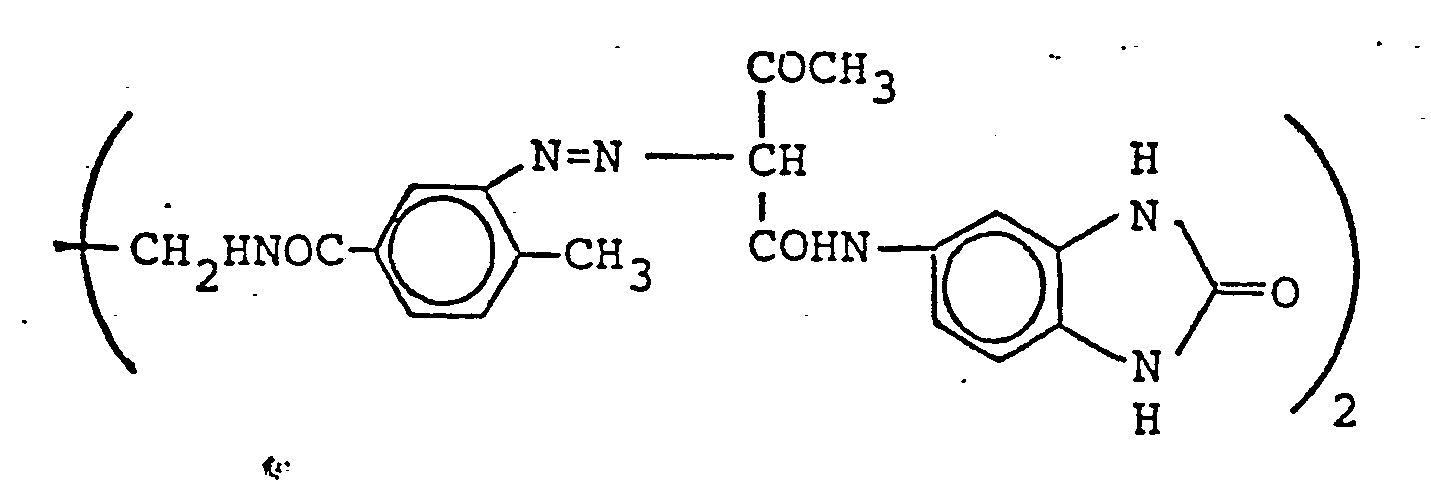
- Gleichzeitig werden 42 Teile 2,5-Dimethoxy-4-chlor-acet- essiganilid in 350 Teilen Wasser angeschlämmt und mit 40 Teilen 33 %iger Natronlauge bei 15 - 18°C gelöst. Nach Zusatz von 1 Teil Kieselgur wird die Mischung filtriert und das Filtrat in das Kuppelgefäß übergeführt, in dem eine Mischung aus 500 Teilen Wasser, 47 Teilen 33 %iger Natronlauge, 42 Teilen Eisessig und eine Lösung von 6 Teilen eines Gemisches von langkettigen Alkyl-dimethyl-benzyl-ammoniumchloriden in 100 Teilen Wasser gut gerührt wird.
- Die Suspension des 2,5-Dimethoxy-4-chlor-acetessiganilids wird 20 Minuten bei 18 - 20°C gerührt, dann erfolgt der Zulauf der geklärten Bisdiazoniumsalzlösung unter die Oberfläche der Suspension im Verlauf von 60 Minuten. Der pH-Wert fällt dabei von 6,0 auf 4,5 und wird dann durch Zugabe von 2N Natronlauge bei 4,5 gehalten. Man rührt zunächst noch 60 Minuten bei Raumtemperatur, dann weitere 60 Minuten bei 80 - 85°C. Dann wird das Pigment filtriert und der Filterkuchen gründlich mit Wasser gewaschen. Der feuchte Filterkuchen wird in 1800 Teile Eisessig eingetragen und nach Zugabe von 6 Teilen eines Gemisches von langkettigen Alkyl-dimethyl-benzyl-ammoniumchloriden 6 Stunden bei 100°C gerührt.
- Nach der Filtration wäscht.man mit Alkohol, dann mit Wasser und trocknet bei 65°C.
- Man erhält 65,6 g eines gelben Pigmentpulvers der Struktur

- Entsprechend Beispiel 1 und 2 können die in der folgenden Tabelle aufgeführten Pigmente hergestellt werden:


Claims (4)


Applications Claiming Priority (2)
| Application Number | Priority Date | Filing Date | Title |
|---|---|---|---|
| DE3048610 | 1980-12-23 | ||
| DE19803048610 DE3048610A1 (de) | 1980-12-23 | 1980-12-23 | "disazoverbindungen, verfahren zu ihrer herstellung und ihre verwendung" |
Publications (2)
| Publication Number | Publication Date |
|---|---|
| EP0055380A1 true EP0055380A1 (de) | 1982-07-07 |
| EP0055380B1 EP0055380B1 (de) | 1984-06-27 |
Family
ID=6120039
Family Applications (1)
| Application Number | Title | Priority Date | Filing Date |
|---|---|---|---|
| EP81109213A Expired EP0055380B1 (de) | 1980-12-23 | 1981-10-29 | Disazoverbindungen, Verfahren zu ihrer Herstellung und ihre Verwendung |
Country Status (5)
| Country | Link |
|---|---|
| US (1) | US4732975A (de) |
| EP (1) | EP0055380B1 (de) |
| JP (1) | JPS57128747A (de) |
| BR (1) | BR8108348A (de) |
| DE (2) | DE3048610A1 (de) |
Families Citing this family (1)
| Publication number | Priority date | Publication date | Assignee | Title |
|---|---|---|---|---|
| US5084575A (en) * | 1987-07-31 | 1992-01-28 | American Home Products Corporation | Quinoline substituted naphthalenepropionic acid derivatives as anti-inflammatory/antiallergic agents |
Citations (4)
| Publication number | Priority date | Publication date | Assignee | Title |
|---|---|---|---|---|
| FR1000008A (fr) * | 1949-09-23 | 1952-02-07 | Rhodiaceta | Nouveaux colorants azoïques et bis-azoïques |
| GB849376A (en) * | 1958-03-14 | 1960-09-28 | Ici Ltd | New disazo pigments |
| FR2187860A1 (de) * | 1972-06-14 | 1974-01-18 | Bayer Ag | |
| FR2370780A1 (fr) * | 1976-11-13 | 1978-06-09 | Hoechst Ag | Composes disazoiques, leur preparation et leur utilisation comme colorants |
Family Cites Families (9)
| Publication number | Priority date | Publication date | Assignee | Title |
|---|---|---|---|---|
| US2164785A (en) * | 1939-07-04 | Azo dyes | ||
| US2286391A (en) * | 1940-06-25 | 1942-06-16 | Du Pont | Azo dye |
| US2741657A (en) * | 1952-10-20 | 1956-04-10 | Ciba Ltd | Acid amide derivatives of azo dyestuffs |
| US2944050A (en) * | 1957-06-07 | 1960-07-05 | Bayer Ag | Water-insoluble azo dyestuffs |
| CH501037A (de) * | 1968-01-10 | 1970-12-31 | Ciba Geigy Ag | Verfahren zur Herstellung neuer wasserunlöslicher Azoverbindungen |
| CH504510A (de) * | 1968-07-16 | 1971-03-15 | Sandoz Ag | Verfahren zur Herstellung von Disazoverbindungen |
| US3963694A (en) * | 1971-03-03 | 1976-06-15 | Ciba-Geigy Corporation | Hydroxyquinolyl- and quinazolonylazoacetoacetylbenzimidazolone pigments |
| BE786778A (fr) * | 1971-07-26 | 1973-01-26 | Acna | Nouveaux pigments disazoiques et leur procede de preparation |
| CH599299A5 (de) * | 1973-10-30 | 1978-05-31 | Ciba Geigy Ag |
-
1980
- 1980-12-23 DE DE19803048610 patent/DE3048610A1/de not_active Withdrawn
-
1981
- 1981-10-29 DE DE8181109213T patent/DE3164462D1/de not_active Expired
- 1981-10-29 EP EP81109213A patent/EP0055380B1/de not_active Expired
- 1981-12-21 US US06/332,818 patent/US4732975A/en not_active Expired - Fee Related
- 1981-12-22 BR BR8108348A patent/BR8108348A/pt not_active IP Right Cessation
- 1981-12-22 JP JP56206276A patent/JPS57128747A/ja active Granted
Patent Citations (4)
| Publication number | Priority date | Publication date | Assignee | Title |
|---|---|---|---|---|
| FR1000008A (fr) * | 1949-09-23 | 1952-02-07 | Rhodiaceta | Nouveaux colorants azoïques et bis-azoïques |
| GB849376A (en) * | 1958-03-14 | 1960-09-28 | Ici Ltd | New disazo pigments |
| FR2187860A1 (de) * | 1972-06-14 | 1974-01-18 | Bayer Ag | |
| FR2370780A1 (fr) * | 1976-11-13 | 1978-06-09 | Hoechst Ag | Composes disazoiques, leur preparation et leur utilisation comme colorants |
Also Published As
| Publication number | Publication date |
|---|---|
| EP0055380B1 (de) | 1984-06-27 |
| US4732975A (en) | 1988-03-22 |
| DE3164462D1 (en) | 1984-08-02 |
| JPS57128747A (en) | 1982-08-10 |
| DE3048610A1 (de) | 1982-07-29 |
| BR8108348A (pt) | 1982-10-13 |
| JPH0312589B2 (de) | 1991-02-20 |
Similar Documents
| Publication | Publication Date | Title |
|---|---|---|
| DE2557555C2 (de) | Disazoverbindungen, Verfahren zu ihrer Herstellung und ihre Verwendung als Pigmente | |
| EP0158888B1 (de) | Disazoverbindungen, Verfahren zu ihrer Herstellung und ihre Verwendung | |
| DE2306673A1 (de) | Bisazofarbstoffe der 2,6-diaminopyridinreihe und verfahren zu ihrer herstellung | |
| EP0021332B1 (de) | Azoverbindungen, Verfahren zu ihrer Herstellung und Verwendung | |
| EP0010273B1 (de) | Monoazoverbindungen der Acetoacetylaminobenzimidazolonreihe, Verfahren zu ihrer Herstellung und ihre Verwendung | |
| EP0025164B1 (de) | Disazoverbindungen, Verfahren zu ihrer Herstellung und ihre Verwendung | |
| DE2244035C3 (de) | Disazopigmente, Verfahren zu deren Herstellung und ihre Verwendung zum Pigmentieren von hochmolekularem organischen Material | |
| DE2236250A1 (de) | Neue diazo-pigmente, deren herstellung und verwendung | |
| EP0055380B1 (de) | Disazoverbindungen, Verfahren zu ihrer Herstellung und ihre Verwendung | |
| DE2336915A1 (de) | Neue disazopigmente und verfahren zur herstellung und verwendung | |
| EP0581245B1 (de) | Wasserunlösliche Azofarbmittel | |
| EP0029558B1 (de) | Azoverbindungen, Verfahren zu ihrer Herstellung und ihre Verwendung | |
| EP0010272B1 (de) | Azoverbindungen, Verfahren zu ihrer Herstellung und ihre Verwendung | |
| DE2651919A1 (de) | Disazoverbindungen, verfahren zu ihrer herstellung und ihre verwendung als farbmittel | |
| DE2130040C3 (de) | Wasserunlösliche Monoazoverbindüngen, Verfahren zu ihrer Herstellung und ihre Verwendung | |
| EP0055850B1 (de) | Disazoverbindungen, Verfahren zu ihrer Herstellung und ihre Verwendung | |
| DE2660263C2 (de) | Disazoverbindungen, Verfahren zu ihrer Herstellung und ihre Verwendung als Pigmente | |
| DE2659706C3 (de) | Disazoverbindungen, Verfahren zu ihrer Herstellung und ihre Verwendung als Pigmente, zum Färben von Kunststoffen, Kautschuk, Papier und zur Herstellung von Druck-, Lack- und Anstrichfarben | |
| DE2302522C3 (de) | Disazoplgmente, Verfahren zu ihrer Herstellung und ihre Verwendung zum Färben | |
| DE2328678C3 (de) | Neue Disazopigmente, Verfahren zu ihrer Herstellung und ihre Verwendung | |
| DE2659708A1 (de) | Disazoverbindungen, verfahren zu ihrer herstellung und ihre verwendung als pigmente | |
| CH630659A5 (en) | Disazo compounds | |
| DE2905937A1 (de) | Neue monoazoverbindungen, verfahren zu ihrer herstellung und ihre verwendung als pigmente | |
| DE2328678B2 (de) | Neue disazopigmente, verfahren zu ihrer herstellung und ihre verwendung | |
| DE1795052B2 (de) | Wasserunloesliche monoazoverbindungen, verfahren zu ihrer herstellung und ihre verwendung als pigmente |
Legal Events
| Date | Code | Title | Description |
|---|---|---|---|
| PUAI | Public reference made under article 153(3) epc to a published international application that has entered the european phase |
Free format text: ORIGINAL CODE: 0009012 |
|
| 17P | Request for examination filed |
Effective date: 19811029 |
|
| AK | Designated contracting states |
Designated state(s): CH DE FR GB |
|
| GRAA | (expected) grant |
Free format text: ORIGINAL CODE: 0009210 |
|
| AK | Designated contracting states |
Designated state(s): CH DE FR GB LI |
|
| REF | Corresponds to: |
Ref document number: 3164462 Country of ref document: DE Date of ref document: 19840802 |
|
| ET | Fr: translation filed | ||
| PLBE | No opposition filed within time limit |
Free format text: ORIGINAL CODE: 0009261 |
|
| STAA | Information on the status of an ep patent application or granted ep patent |
Free format text: STATUS: NO OPPOSITION FILED WITHIN TIME LIMIT |
|
| 26N | No opposition filed | ||
| PGFP | Annual fee paid to national office [announced via postgrant information from national office to epo] |
Ref country code: FR Payment date: 19930915 Year of fee payment: 13 |
|
| PGFP | Annual fee paid to national office [announced via postgrant information from national office to epo] |
Ref country code: CH Payment date: 19930917 Year of fee payment: 13 |
|
| PGFP | Annual fee paid to national office [announced via postgrant information from national office to epo] |
Ref country code: GB Payment date: 19930927 Year of fee payment: 13 |
|
| PGFP | Annual fee paid to national office [announced via postgrant information from national office to epo] |
Ref country code: DE Payment date: 19931221 Year of fee payment: 13 |
|
| PG25 | Lapsed in a contracting state [announced via postgrant information from national office to epo] |
Ref country code: GB Effective date: 19941029 |
|
| PG25 | Lapsed in a contracting state [announced via postgrant information from national office to epo] |
Ref country code: LI Effective date: 19941031 Ref country code: CH Effective date: 19941031 |
|
| GBPC | Gb: european patent ceased through non-payment of renewal fee |
Effective date: 19941029 |
|
| PG25 | Lapsed in a contracting state [announced via postgrant information from national office to epo] |
Ref country code: FR Effective date: 19950630 |
|
| REG | Reference to a national code |
Ref country code: CH Ref legal event code: PL |
|
| PG25 | Lapsed in a contracting state [announced via postgrant information from national office to epo] |
Ref country code: DE Effective date: 19950701 |
|
| REG | Reference to a national code |
Ref country code: FR Ref legal event code: ST |