EP0055382B1 - Verfahren zur Herstellung von Ammoniumlactat enthaltenden Mischungen und Vorrichtung zur Durchführung des Verfahrens - Google Patents
Verfahren zur Herstellung von Ammoniumlactat enthaltenden Mischungen und Vorrichtung zur Durchführung des Verfahrens Download PDFInfo
- Publication number
- EP0055382B1 EP0055382B1 EP81109249A EP81109249A EP0055382B1 EP 0055382 B1 EP0055382 B1 EP 0055382B1 EP 81109249 A EP81109249 A EP 81109249A EP 81109249 A EP81109249 A EP 81109249A EP 0055382 B1 EP0055382 B1 EP 0055382B1
- Authority
- EP
- European Patent Office
- Prior art keywords
- lactic acid
- str
- mixtures
- whey
- ammonia
- Prior art date
- Legal status (The legal status is an assumption and is not a legal conclusion. Google has not performed a legal analysis and makes no representation as to the accuracy of the status listed.)
- Expired
Links
- 238000000034 method Methods 0.000 title claims abstract description 78
- 230000008569 process Effects 0.000 title claims abstract description 57
- 239000004251 Ammonium lactate Substances 0.000 title claims abstract description 19
- 229940059265 ammonium lactate Drugs 0.000 title claims abstract description 19
- 235000019286 ammonium lactate Nutrition 0.000 title claims abstract description 19
- RZOBLYBZQXQGFY-HSHFZTNMSA-N azanium;(2r)-2-hydroxypropanoate Chemical compound [NH4+].C[C@@H](O)C([O-])=O RZOBLYBZQXQGFY-HSHFZTNMSA-N 0.000 title claims abstract description 19
- 239000000203 mixture Substances 0.000 title claims abstract description 19
- 238000002360 preparation method Methods 0.000 title description 3
- JVTAAEKCZFNVCJ-UHFFFAOYSA-N lactic acid Chemical compound CC(O)C(O)=O JVTAAEKCZFNVCJ-UHFFFAOYSA-N 0.000 claims abstract description 60
- QGZKDVFQNNGYKY-UHFFFAOYSA-N Ammonia Chemical compound N QGZKDVFQNNGYKY-UHFFFAOYSA-N 0.000 claims abstract description 57
- 239000004310 lactic acid Substances 0.000 claims abstract description 30
- 235000014655 lactic acid Nutrition 0.000 claims abstract description 30
- 210000004080 milk Anatomy 0.000 claims abstract description 30
- 235000013336 milk Nutrition 0.000 claims abstract description 29
- 239000008267 milk Substances 0.000 claims abstract description 29
- 229910021529 ammonia Inorganic materials 0.000 claims abstract description 28
- GUBGYTABKSRVRQ-QKKXKWKRSA-N Lactose Natural products OC[C@H]1O[C@@H](O[C@H]2[C@H](O)[C@@H](O)C(O)O[C@@H]2CO)[C@H](O)[C@@H](O)[C@H]1O GUBGYTABKSRVRQ-QKKXKWKRSA-N 0.000 claims abstract description 27
- 238000012545 processing Methods 0.000 claims abstract description 20
- 239000008101 lactose Substances 0.000 claims abstract description 19
- 238000004519 manufacturing process Methods 0.000 claims abstract description 18
- 239000011541 reaction mixture Substances 0.000 claims abstract description 4
- 239000007787 solid Substances 0.000 claims abstract description 4
- GUBGYTABKSRVRQ-XLOQQCSPSA-N Alpha-Lactose Chemical compound O[C@@H]1[C@@H](O)[C@@H](O)[C@@H](CO)O[C@H]1O[C@@H]1[C@@H](CO)O[C@H](O)[C@H](O)[C@H]1O GUBGYTABKSRVRQ-XLOQQCSPSA-N 0.000 claims abstract description 3
- 238000013019 agitation Methods 0.000 claims abstract description 3
- 238000001816 cooling Methods 0.000 claims abstract description 3
- 238000010438 heat treatment Methods 0.000 claims abstract description 3
- 108010046377 Whey Proteins Proteins 0.000 claims description 23
- 102000007544 Whey Proteins Human genes 0.000 claims description 23
- 239000005862 Whey Substances 0.000 claims description 22
- 235000013351 cheese Nutrition 0.000 claims description 13
- 238000000909 electrodialysis Methods 0.000 claims description 5
- 238000000926 separation method Methods 0.000 claims description 4
- XLYOFNOQVPJJNP-UHFFFAOYSA-N water Substances O XLYOFNOQVPJJNP-UHFFFAOYSA-N 0.000 claims description 4
- 235000009508 confectionery Nutrition 0.000 claims description 3
- 239000012528 membrane Substances 0.000 claims description 3
- 239000012466 permeate Substances 0.000 claims description 3
- 238000000108 ultra-filtration Methods 0.000 claims description 3
- 241000186000 Bifidobacterium Species 0.000 claims description 2
- 235000015155 buttermilk Nutrition 0.000 claims description 2
- 238000001223 reverse osmosis Methods 0.000 claims description 2
- 241000193830 Bacillus <bacterium> Species 0.000 claims 1
- 241000186660 Lactobacillus Species 0.000 claims 1
- 241000192132 Leuconostoc Species 0.000 claims 1
- 238000000354 decomposition reaction Methods 0.000 claims 1
- 238000007689 inspection Methods 0.000 claims 1
- 239000000047 product Substances 0.000 description 25
- 239000000758 substrate Substances 0.000 description 19
- 238000000855 fermentation Methods 0.000 description 16
- 230000004151 fermentation Effects 0.000 description 16
- VHUUQVKOLVNVRT-UHFFFAOYSA-N Ammonium hydroxide Chemical compound [NH4+].[OH-] VHUUQVKOLVNVRT-UHFFFAOYSA-N 0.000 description 13
- 235000011114 ammonium hydroxide Nutrition 0.000 description 13
- 238000003860 storage Methods 0.000 description 13
- 238000006386 neutralization reaction Methods 0.000 description 9
- 235000018102 proteins Nutrition 0.000 description 9
- 102000004169 proteins and genes Human genes 0.000 description 9
- 108090000623 proteins and genes Proteins 0.000 description 9
- 230000015572 biosynthetic process Effects 0.000 description 8
- 230000008901 benefit Effects 0.000 description 6
- 241000186672 Lactobacillus delbrueckii subsp. bulgaricus Species 0.000 description 5
- 238000009529 body temperature measurement Methods 0.000 description 5
- 238000001139 pH measurement Methods 0.000 description 5
- 238000012360 testing method Methods 0.000 description 5
- 235000013960 Lactobacillus bulgaricus Nutrition 0.000 description 4
- 239000002253 acid Substances 0.000 description 4
- 230000000694 effects Effects 0.000 description 4
- 229940004208 lactobacillus bulgaricus Drugs 0.000 description 4
- QTBSBXVTEAMEQO-UHFFFAOYSA-N Acetic acid Chemical compound CC(O)=O QTBSBXVTEAMEQO-UHFFFAOYSA-N 0.000 description 3
- 241001465754 Metazoa Species 0.000 description 3
- 230000008859 change Effects 0.000 description 3
- KRKNYBCHXYNGOX-UHFFFAOYSA-N citric acid Chemical compound OC(=O)CC(O)(C(O)=O)CC(O)=O KRKNYBCHXYNGOX-UHFFFAOYSA-N 0.000 description 3
- 238000005516 engineering process Methods 0.000 description 3
- 239000011521 glass Substances 0.000 description 3
- 239000007788 liquid Substances 0.000 description 3
- 241000894006 Bacteria Species 0.000 description 2
- 150000007513 acids Chemical class 0.000 description 2
- 150000001413 amino acids Chemical class 0.000 description 2
- 235000014121 butter Nutrition 0.000 description 2
- 239000006227 byproduct Substances 0.000 description 2
- 230000015556 catabolic process Effects 0.000 description 2
- 235000015142 cultured sour cream Nutrition 0.000 description 2
- 235000013365 dairy product Nutrition 0.000 description 2
- XBDQKXXYIPTUBI-UHFFFAOYSA-N dimethylselenoniopropionate Natural products CCC(O)=O XBDQKXXYIPTUBI-UHFFFAOYSA-N 0.000 description 2
- 230000006872 improvement Effects 0.000 description 2
- 239000004615 ingredient Substances 0.000 description 2
- 238000004886 process control Methods 0.000 description 2
- 239000000126 substance Substances 0.000 description 2
- 239000002351 wastewater Substances 0.000 description 2
- QGZKDVFQNNGYKY-UHFFFAOYSA-O Ammonium Chemical compound [NH4+] QGZKDVFQNNGYKY-UHFFFAOYSA-O 0.000 description 1
- NLXLAEXVIDQMFP-UHFFFAOYSA-N Ammonium chloride Substances [NH4+].[Cl-] NLXLAEXVIDQMFP-UHFFFAOYSA-N 0.000 description 1
- QSJXEFYPDANLFS-UHFFFAOYSA-N Diacetyl Chemical group CC(=O)C(C)=O QSJXEFYPDANLFS-UHFFFAOYSA-N 0.000 description 1
- JVTAAEKCZFNVCJ-UHFFFAOYSA-M Lactate Chemical compound CC(O)C([O-])=O JVTAAEKCZFNVCJ-UHFFFAOYSA-M 0.000 description 1
- 102000014171 Milk Proteins Human genes 0.000 description 1
- 108010011756 Milk Proteins Proteins 0.000 description 1
- 230000002378 acidificating effect Effects 0.000 description 1
- 230000006978 adaptation Effects 0.000 description 1
- 150000003863 ammonium salts Chemical class 0.000 description 1
- 235000019728 animal nutrition Nutrition 0.000 description 1
- QVGXLLKOCUKJST-UHFFFAOYSA-N atomic oxygen Chemical compound [O] QVGXLLKOCUKJST-UHFFFAOYSA-N 0.000 description 1
- 230000001580 bacterial effect Effects 0.000 description 1
- 230000003851 biochemical process Effects 0.000 description 1
- 244000309466 calf Species 0.000 description 1
- 238000006243 chemical reaction Methods 0.000 description 1
- 238000011109 contamination Methods 0.000 description 1
- 238000012937 correction Methods 0.000 description 1
- 230000008878 coupling Effects 0.000 description 1
- 238000010168 coupling process Methods 0.000 description 1
- 238000005859 coupling reaction Methods 0.000 description 1
- 239000006071 cream Substances 0.000 description 1
- 235000019621 digestibility Nutrition 0.000 description 1
- 230000008030 elimination Effects 0.000 description 1
- 238000003379 elimination reaction Methods 0.000 description 1
- 230000007613 environmental effect Effects 0.000 description 1
- 238000002474 experimental method Methods 0.000 description 1
- 238000000605 extraction Methods 0.000 description 1
- 239000000706 filtrate Substances 0.000 description 1
- 239000012467 final product Substances 0.000 description 1
- 239000000796 flavoring agent Substances 0.000 description 1
- 235000019634 flavors Nutrition 0.000 description 1
- 239000007789 gas Substances 0.000 description 1
- 235000020256 human milk Nutrition 0.000 description 1
- 210000004251 human milk Anatomy 0.000 description 1
- 239000012535 impurity Substances 0.000 description 1
- 238000009434 installation Methods 0.000 description 1
- 238000009533 lab test Methods 0.000 description 1
- 229940001447 lactate Drugs 0.000 description 1
- 238000009630 liquid culture Methods 0.000 description 1
- 239000000463 material Substances 0.000 description 1
- 238000005259 measurement Methods 0.000 description 1
- 244000005700 microbiome Species 0.000 description 1
- 235000021239 milk protein Nutrition 0.000 description 1
- 230000007935 neutral effect Effects 0.000 description 1
- 150000007524 organic acids Chemical class 0.000 description 1
- 235000005985 organic acids Nutrition 0.000 description 1
- 239000001301 oxygen Substances 0.000 description 1
- 229910052760 oxygen Inorganic materials 0.000 description 1
- 230000001766 physiological effect Effects 0.000 description 1
- 235000019260 propionic acid Nutrition 0.000 description 1
- 238000005086 pumping Methods 0.000 description 1
- IUVKMZGDUIUOCP-BTNSXGMBSA-N quinbolone Chemical compound O([C@H]1CC[C@H]2[C@H]3[C@@H]([C@]4(C=CC(=O)C=C4CC3)C)CC[C@@]21C)C1=CCCC1 IUVKMZGDUIUOCP-BTNSXGMBSA-N 0.000 description 1
- 238000011084 recovery Methods 0.000 description 1
- 238000004064 recycling Methods 0.000 description 1
- 230000009467 reduction Effects 0.000 description 1
- 230000001105 regulatory effect Effects 0.000 description 1
- 229940108461 rennet Drugs 0.000 description 1
- 108010058314 rennet Proteins 0.000 description 1
- 150000003839 salts Chemical class 0.000 description 1
- 230000035943 smell Effects 0.000 description 1
- 239000007858 starting material Substances 0.000 description 1
- 235000021119 whey protein Nutrition 0.000 description 1
Images
Classifications
-
- C—CHEMISTRY; METALLURGY
- C12—BIOCHEMISTRY; BEER; SPIRITS; WINE; VINEGAR; MICROBIOLOGY; ENZYMOLOGY; MUTATION OR GENETIC ENGINEERING
- C12M—APPARATUS FOR ENZYMOLOGY OR MICROBIOLOGY; APPARATUS FOR CULTURING MICROORGANISMS FOR PRODUCING BIOMASS, FOR GROWING CELLS OR FOR OBTAINING FERMENTATION OR METABOLIC PRODUCTS, i.e. BIOREACTORS OR FERMENTERS
- C12M41/00—Means for regulation, monitoring, measurement or control, e.g. flow regulation
- C12M41/26—Means for regulation, monitoring, measurement or control, e.g. flow regulation of pH
-
- A—HUMAN NECESSITIES
- A23—FOODS OR FOODSTUFFS; TREATMENT THEREOF, NOT COVERED BY OTHER CLASSES
- A23K—FODDER
- A23K50/00—Feeding-stuffs specially adapted for particular animals
- A23K50/10—Feeding-stuffs specially adapted for particular animals for ruminants
- A23K50/15—Feeding-stuffs specially adapted for particular animals for ruminants containing substances which are metabolically converted to proteins, e.g. ammonium salts or urea
-
- C—CHEMISTRY; METALLURGY
- C12—BIOCHEMISTRY; BEER; SPIRITS; WINE; VINEGAR; MICROBIOLOGY; ENZYMOLOGY; MUTATION OR GENETIC ENGINEERING
- C12M—APPARATUS FOR ENZYMOLOGY OR MICROBIOLOGY; APPARATUS FOR CULTURING MICROORGANISMS FOR PRODUCING BIOMASS, FOR GROWING CELLS OR FOR OBTAINING FERMENTATION OR METABOLIC PRODUCTS, i.e. BIOREACTORS OR FERMENTERS
- C12M41/00—Means for regulation, monitoring, measurement or control, e.g. flow regulation
- C12M41/12—Means for regulation, monitoring, measurement or control, e.g. flow regulation of temperature
- C12M41/18—Heat exchange systems, e.g. heat jackets or outer envelopes
-
- C—CHEMISTRY; METALLURGY
- C12—BIOCHEMISTRY; BEER; SPIRITS; WINE; VINEGAR; MICROBIOLOGY; ENZYMOLOGY; MUTATION OR GENETIC ENGINEERING
- C12P—FERMENTATION OR ENZYME-USING PROCESSES TO SYNTHESISE A DESIRED CHEMICAL COMPOUND OR COMPOSITION OR TO SEPARATE OPTICAL ISOMERS FROM A RACEMIC MIXTURE
- C12P39/00—Processes involving microorganisms of different genera in the same process, simultaneously
-
- C—CHEMISTRY; METALLURGY
- C12—BIOCHEMISTRY; BEER; SPIRITS; WINE; VINEGAR; MICROBIOLOGY; ENZYMOLOGY; MUTATION OR GENETIC ENGINEERING
- C12P—FERMENTATION OR ENZYME-USING PROCESSES TO SYNTHESISE A DESIRED CHEMICAL COMPOUND OR COMPOSITION OR TO SEPARATE OPTICAL ISOMERS FROM A RACEMIC MIXTURE
- C12P7/00—Preparation of oxygen-containing organic compounds
- C12P7/40—Preparation of oxygen-containing organic compounds containing a carboxyl group including Peroxycarboxylic acids
- C12P7/56—Lactic acid
Definitions
- the present invention relates to an improvement of the method described above and an apparatus for performing the method.
- US Pat. No. 2,904,437 describes a method for treating whey in which the whey is oxidized biochemically with the addition of ammonia, while the pH is kept in the range from 5.6 to 6. After the lactose has been converted to the lactic acid, the oxidized material is concentrated and neutralized to a pH in the range between about 7 and 8 with ammonia. The product obtained is neutral or slightly alkaline and smells of ammonia. Its shelf life is limited because ammonia escapes from the product. In this known method, L.bulgaricus is used as the culture. Only whey from cheese production can be used as a substrate.
- whey from cheese production found economic use.
- more recent findings in animal nutrition, especially in milk replacers have led to the fact that high-quality whey from the milk milk, but also acid whey, can increasingly be used in place of breast milk in calves, piglets and foals and that these substances can be used profitable prices achieved.
- whey has recently been used for the recovery of the high-quality whey protein and the subsequent extraction of milk sugar.
- modern techniques are used, such as hyperfiltration, which can be seen as a collective term for methods of membrane separation in the form of inverse osmosis, ultrafiltration and electrodialysis.
- Lactobacillus bulgaricus is also used as the culture.
- This strain has the disadvantage that the fermentation can only be carried out within a very narrow pH range and within a very narrow temperature range. Furthermore, the strain is easily contaminated and inactivated by ingredients in the starting material. This makes the process very vulnerable. If the preferred temperature range or pH range is left, the fermentation comes to a standstill. This is very disadvantageous for technical operations, especially for ongoing production, since the entire process then has to be terminated and the products either have to be discarded or cleaned. If only one culture is used, the process parameters are very limited and this is disadvantageous for large-scale operation.
- the object of the present application is to provide a method by which products of the milk industry which also have a lactose content of over 7% can be ammoniated.
- the products as partially listed above and which are discarded today are to be put to a useful use.
- products that are highly polluting should be economically put to a useful end use.
- existing technical facilities such as storage tanks, pumps and fittings should be able to be used to a large extent.
- cultures which are customary are to be used, and the personnel are to be relieved to a large extent of the process management.
- ammonization should take place in a form which is easy to handle and does not introduce any extreme neutralization processes, such as the introduction of NH 3 in gas form.
- the need for ancillary investments should be kept to a minimum.
- a process is to be made available in which work can be carried out within a large temperature range and within a large pH range and in which impurities which may be present in the starting product do not bring the process sequence to a standstill.
- the invention thus relates to a process for the preparation of ammonium lactate containing the mixtures of aqueous milk processing residues according to the preamble of claim 1, which is characterized in that mixed cultures are used as lactic acid formers.
- the invention further relates to an apparatus for performing the method.
- the process according to the invention has the advantage that all products obtained in milk processing, including those with a high lactose content and those which are heavily contaminated, can be ammonized and converted into ammonium lactate in an economical and simple manner without contamination being observed and the implementation is interrupted.
- Existing technical equipment such as storage tanks, pumps and fittings can also be used.
- the mixed cultures have different ranges of substrate and include different temperature and pH ranges. They can also adapt flexibly to the respective substrate conditions through shifts in their population.
- mixed cultures are used which are commercially available and are offered for the production of, for example, sour cream butter, cheese and curd cheese. Surprisingly, it has been found that these cultures can also be used advantageously for the specific lactic acid formation for which they are not intended. However, there is a fundamental difference in usage. In the above-mentioned customary applications, the cultures are used in milk and it is waited until the desired final pH is reached after different times. Only the temperature range is checked. A distinction is made in the case of such mixed cultures from mixed cultures which act in the normal temperature range, in the mesophilic or thermophilic range (i.e. at medium temperature or at elevated temperature). This temperature range, which is specified by the manufacturer of the cultures, is used in the production of sour cream butter, cheese or edible curd cheese.
- the mixed cultures commercially available for the abovementioned fields of use are also suitable as mixed cultures in the present invention.
- Some of the commercially available mixed cultures for the abovementioned uses are particularly suitable in the process according to the invention.
- Laboratory tests are carried out to determine whether a commercially available mixed culture can be used according to the invention. Such laboratory preliminary tests are familiar to the person skilled in the art, and therefore they are only to be briefly explained here.
- the mixed cultures which are commercially available select those mixed cultures which act in the temperature range in which the product is obtained in the dairy or in the milk processing plant. In other words, a choice is made as to whether to use a mixed culture operating at normal temperature or whether to use mesophilic or thermophilic mixed cultures. The manufacturers of mixed cultures always give guide values for the cultures.
- the product to be treated is then mixed with different amounts of the cultures in amounts from 0.5 to 1.0, maximum 2% (number of the microorganism population 10 8 9 / g) at different pH ranges between 3.0 and 5 , 5 checked for the fermentation process.
- a test with 1.0% by weight culture is carried out at a pH in the range of 3.5 ⁇ 0.3, a pH in the range of 4.5 ⁇ 0.3 and a pH in the range of 5 , 5 ⁇ 0.3 performed.
- the fermentation process is checked in these different pH ranges.
- the start-up time, the activity with regard to the formation of lactic acid and the NH 3 consumption in the different pH bands are tested and assessed.
- the process arithmetic part of the control unit then corrects the changes in these values in the practice of large-scale application for an optimal effect, if necessary.
- a mixture of cultures which act in the upper pH range and cultures which act in the lower pH range is preferably used in the process according to the invention.
- streptococci such as Str. Lactis, Str. Faecalis, Str. Salivarius, Str. Cremoris, Str. Thermophilus, Str. Diacetylis, Str. Faecium, and in the lower pH range rod and long rod bacteria, like the Lbc quoted. bulgaricus, lbc. lactis, Lbc. helveticus, lbc. acidophilus and Lbc. delblessnessii.
- These mixtures can be Leuconosato cards (mesenteroides, cremoris), Streptobacter, beta bacteria, Lbc. fermentum and viridescens, optionally Bifidobacterium bifidus, contain Propionobacter.
- the cultures differ in terms of their temperature resistance, acid resistance and also in terms of the organic acids they produce, which, in addition to the production of lactic acid, can also lead to acetic acid, diacetyl, propionic acid, citric acid etc. or to the corresponding ammonium salts.
- the process according to the invention can also be carried out at different pH ranges, which can likewise be between pH 3.0 and 6.5.
- the pH values depend on the amount and type of residues. It is a great advantage of the method according to the invention that the pH values can vary.
- the concentration in the substrate can also be different and can be between 5.0 and 15% by weight of dry matter, based on 100 parts by weight of substrate. The method according to the invention thus allows optimal adaptation to all practical conditions, since all critical conditions, such as the temperature. the pH and the composition of the dry matter are variable.
- sweet whey, lactic acid whey from edible quark or cream cheese, whey from thermal quark, de-proteinated whey from membrane separation, de-sugared whey from lactose production, salt water from electrodialysis, permeates, milk sugar water from lactose production, butter milk or residues can be used as milk processing residue with the help of modern processes such as ultrafiltration, reverse osmosis, electrodialysis, or use their mixtures. It is a particular advantage of the process according to the invention that very dilute and partially contaminated products which have been discharged into the waste water in the past can also be used.
- a device For this purpose, a device has been developed that is able to be stationed both outdoors and indoors, regardless of the installation location. This is achieved in that the device is so compact that it combines all control processes and is kept so movable by rollers that it can be brought up to and connected to existing devices such as tanks, pumps, lines and the like.
- the invention thus relates to a device for performing the method, which is characterized by a tank, a control device, lines between the tank and the control unit, pumps, a heat exchanger, an ammonia storage tank, lines for ammonia supply, a network supply and compressed air lines for the heat exchanger.
- the invention further relates to a control device, which is characterized by a housing, a flow pipe for the milk processing residues with a sight glass, two devices for pH measurement, two devices for temperature measurement, a metering pump, a supply line for ammonia with a flow meter, a mains supply, Compressed air control lines for temperature control through the heat exchanger and a computing part.
- a control device which is characterized by a housing, a flow pipe for the milk processing residues with a sight glass, two devices for pH measurement, two devices for temperature measurement, a metering pump, a supply line for ammonia with a flow meter, a mains supply, Compressed air control lines for temperature control through the heat exchanger and a computing part.
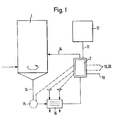
- the device according to the invention consists of a tank 1, which is equipped with inflow lines for supplying and removing the milk processing residue as well as necessary valves, pumps etc.
- the storage tank 1, which is at the same time the fermentation tank, can be any tank as it is present in milk processing plants, in particular dairies. It should be equipped with an agitator that runs slowly, and it can be provided with a jacket and can be heated or cooled.
- the tank is connected via lines 14 to the control device according to the invention. Filters, pumps 15, valves, heat exchangers 16 can be provided in the lines.
- the milk processing product is circulated from the storage tank, possibly through the heat exchanger, back into the storage tank through the control unit.
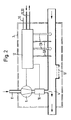
- control device 2 according to the invention is shown schematically in FIG.
- the control device or the control device 2 has a housing 3 (as shown in FIG. 1). It is self-contained, compact and can be attached to rollers so that it is easy to transport.
- a flow tube 4 for the milk processing residues passes through the control device 2 according to the invention, which is provided at its outlets with the usual standardized fittings of the milk industry. These fittings connect the flow pipe at its ends to the lines that are provided between the tank and the control unit. The fittings are not shown in the drawing.
- Two devices for temperature measurement (temperature sensors 7, 8) and two devices for pH measurement (pH sensors 5 and 6) are provided in the flow pipe 4 through which the milk processing product flows. These are devices for measuring pH and temperature connected via the computer 12 to a pump 9, by means of which the ammonia or ammonia water supply is regulated.
- the pump 9 is connected through the line 11 for the ammonia supply to the flow tube for the milk processing residues, and ammonia is specifically added to the milk processing residue depending on the measurement results via this line.
- the line 11 can also be provided with a metering valve 10, which is also controlled by the computing position.
- the control device further comprises an inflow line 11 for the ammonia, which leads to the storage tank 7 for ammonia.
- the flow can have a slight gradient towards the outlet, and it also has a sight glass 13.
- the sight glass is used to check the function.
- the inlet for the supply of ammonia water is dimensioned so that the ratio between the substrate flow (unit L / sec) and the ammonia water supply is not less than 10: 1, whereby a gentle neutralization is achieved.
- the sensors for pH and temperature measurement can be read on the scales in the control section. If both a sensor for pH measurement or temperature measurement fails, the second sensor, which is available as a reserve, can take over the process control, whereby an interruption of the fermentation and a breakdown of the process can be reliably prevented. In principle, it is also possible to use only one sensor for temperature and pH measurement. For safety reasons, however, it is preferred to provide two sensors.
- Appropriate control elements can be used to manually set a pH and temperature range with arbitrary ranges.
- the pH range can be in the range from pH 3.0 to 6.5 and the temperature range in the range from 18 to 60 ° C.
- the respective ranges can also be narrowed to a pH of ⁇ 0.2 and a temperature of ⁇ 0.3 ° C.
- it is a great advantage that the process according to the invention can be used within wide temperature and pH ranges.
- the computing part of the device can be set so that the continuous partial neutralization takes place until any amount of defined ammonia water is consumed. Then a final neutralization to a pH value, which in turn is predetermined, takes place.
- the amount used (ammonia water or NH 3 ) is registered optically and by writing instruments.
- the device also has a computing part that registers the qualitative and quantitative production of lactic acid, compares it with the pH and temperature values and, by correcting the pH and temperature, controls the process in such a way that it runs in the direction of maximum lactic acid production, depending on the fermentation process the culture used.
- the control unit continuously corrects the process, which results in faster lactic acid formation and ammonization, and overall a reduction in time. All values are noted time-coupled by an installed recorder, so that process programs can finally be developed depending on the culture. These can then be saved and called up in the device and used to initiate the process depending on the culture and substrate.
- the accompanying process correction which takes into account the adaptability during the fermentation, can be kept in operation or decoupled.
- the device can be built in a version for a substrate template from 15,000 to 100,000 kg substrate or for a substrate template from 50,000 to 250,000 kg substrate. Devices that are suitable for even larger substrate templates can also be built.
- the control device makes it possible to correctly maintain the method, which normally extends over a working shift, independently of personnel or personnel changes and without manual interference. This is a major advantage for economy and safety.
- a dosing pump or a dosing valve can be used as a special dosing device.
- the metering device supplies ammonia or ammonia water in the range from 1 ml to 3000 ml / min, and this largely avoids strong browning of the substrate. Damage to native amino acids or proteins present in the residues is also avoided. Such amino acids or proteins change when they are exposed to strong pH changes.
- the system can be switched so that the pumping cycle is arbitrary only at certain time intervals between 1 and 20 minutes and then the system for a certain time is turned off.
- the circuit can be designed in such a way that the circuit is immediately switched off again at unchanged pH or unchanged temperature, while in the event of intensive activity, the pH is switched off for as long as it is reduced by pH, which corresponds to the formation of lactic acid and correspondingly increased supply of ammonia or ammonia water until the desired optimal balance has been reached again.
- the final product have a pH of 5.8. This area has proven to be particularly important for the taste and stability during storage. In this range, the weakly acidic pH stabilizes the ammonium lactate against the elimination of NH 3 .
- the fermentation is stopped when the predetermined amount of ammonia or ammonia water has been consumed.
- the control device according to the invention then triggers the final neutralization to pH 5.8 and notes the required but practically different and additional consumption of ammonia or ammonia water up to this final pH value. Both sets are recorded by the device.
- ammonium lactate-containing product is obtained in the process according to the invention.
- This product is particularly suitable as animal feed or animal feed component.
- ammonized milk residues obtained in this way have a dry matter content of up to 80% protein consisting of the remainder of native milk protein and the protein value of ammonium lactate.
- any desired lower protein content can be preprogrammed, created and achieved. This makes it possible to provide an optimal feed for practice.
- the control unit which is transportable, is connected to the stationary storage tank for the milk co-product, possibly via heat exchangers.
- the storage tank for ammonia or ammonia water is still connected to the control unit, and the control unit is connected to the power and the pneumatics.
- the reservoir is filled to such an extent that the process can be kept in motion, that is, about 1/5 of the total amount added.
- 0.5 to a maximum of 1.6% liquid culture, based on 100% fermentation volume in the storage or fermentation tank, is added, and the control unit is programmed depending on the type of culture and the tank content.
- the process is started, after which the volume of incoming by-products can be increased in the running process.
- the process runs, whereby the pH value, the temperature values and the NH 3 consumption are continuously displayed. The process is allowed to continue until the calculated amount of NH 3 or NHs water has been consumed.
- Lactic acid production depends on the amount of NH 3 consumed. This is achieved by automatically influencing the pH and temperature value to be achieved. The results are recorded by the writer.
- the final neutralization to the previously determined pH value (preferably 5.8) takes place.
- the fermentation liquid is then pumped out and concentrated. A remainder of the fermentation liquid can remain in the storage container and be used to inoculate the next batch.
- the fermentation liquid now contains adapted cultures. If necessary, you can freshen up by adding new culture.
- the NH 3 consumption is calculated on the basis of the amount of milk sugar and lactic acid in the dry matter and by conversion to protein.
- the process according to the invention increases the dry matter by almost 10% and increases the protein value as protein to over 70% in the dry matter, the ratio between native protein and protein from ammonium lactate being about 1: 8.
Landscapes
- Chemical & Material Sciences (AREA)
- Organic Chemistry (AREA)
- Life Sciences & Earth Sciences (AREA)
- Engineering & Computer Science (AREA)
- Zoology (AREA)
- Wood Science & Technology (AREA)
- Health & Medical Sciences (AREA)
- Bioinformatics & Cheminformatics (AREA)
- General Health & Medical Sciences (AREA)
- Genetics & Genomics (AREA)
- Microbiology (AREA)
- Biotechnology (AREA)
- Biochemistry (AREA)
- General Engineering & Computer Science (AREA)
- Chemical Kinetics & Catalysis (AREA)
- General Chemical & Material Sciences (AREA)
- Analytical Chemistry (AREA)
- Polymers & Plastics (AREA)
- Biomedical Technology (AREA)
- Sustainable Development (AREA)
- Animal Husbandry (AREA)
- Thermal Sciences (AREA)
- Birds (AREA)
- Physics & Mathematics (AREA)
- Food Science & Technology (AREA)
- Organic Low-Molecular-Weight Compounds And Preparation Thereof (AREA)
- Dairy Products (AREA)
- Acyclic And Carbocyclic Compounds In Medicinal Compositions (AREA)
- Micro-Organisms Or Cultivation Processes Thereof (AREA)
- Apparatus Associated With Microorganisms And Enzymes (AREA)
Description
- In der DE-OS 2 731 877 des gleichen Anmelders wird ein Verfahren zur Herstellung von Ammoniumlactat enthaltenden Mischungen aus wäßrigen Milchverarbeitungsrückständen beschrieben, das dadurch gekennzeichnet ist, daß man zu den Milchverarbeitungsrückständen oder Gemengen, die Milchsäure und/oder Lactose und Milchsäurebildner enthalten oder zu denen man Milchsäurebildner zugeben kann, ohne weitere Vorbehandlung, gegebenenfalls unter Erwärmen oder Kühlen und Bewegen, Ammoniak in solcher Rate zugibt, daß der pH-Wert unter 6,0 gehalten wird; Ammoniak bis zu einem pH-Wert von höchstens 6,5 zugibt, nachdem die gewünschte Menge an Ammoniumlactat gebildet worden ist und gegebenenfalls anschließend das erhaltene Reaktionsgemisch in an sich bekannter Weise bis auf einen Feststoffgehalt von maximal 85% konzentriert.
- Bei dem oben beschriebenen Verfahren wird 1 Molekül Milchzucker (Lactose) in 2 Moleküle Milchsäure gespalten und diese Milchsäure reagiert mit Ammoniak unter Bildung von Ammoniumlactat, wie es in der folgenden Gleichung dargestellt wird:

- Die vorliegende Erfindung betrifft eine Verbesserung des oben beschriebenen Verfahrens sowie eine Vorrichtung zur Durchführung des Verfahrens.
- In der US-PS 2904437 wird ein Verfahren zur Behandlung von Molke beschrieben, bei dem die Molke biochemisch unter Zugabe von Ammoniak oxidiert wird, während der pH-Wert im Bereich von 5,6 bis 6 gehalten wird. Nachdem die Lactose in die Milchsäure überführt worden ist, wird das oxidierte Material konzentriert und auf einen pH-Wert im Bereich zwischen etwa 7 und 8 mit Ammoniak neutralisiert. Das dabei erhaltene Produkt ist neutral oder schwach alkalisch und riecht nach Ammoniak. Seine Haltbarkeit ist nur begrenzt, da aus dem Produkt Ammoniak entweicht. Bei diesem bekannten Verfahren wird als Kultur L.bulgaricus verwendet. Als Substrat kann nur Molke aus der Käseherstellung eingesetzt werden.
- D. Arnott, S. Patton und E. Kesler (Anim. nutr. 78/1973, Seite 931) beschreiben ein Verfahren von der Ammoniierung von Molke aus den Produkten von Cheddarkäse mit Lactobacillus bulgaricus. Bei diesem bekannten Verfahren erfolgt die Ammonisierung kontinuierlich oder diskontinuierlich.
- C. A. Reddy, H. E. Henderson und M. D. Erdman beschreiben in Appl. and environmental Mikrobiol., Dezember 1976, Band 32, Seite 769, ausführliche Ergebnisse über die bakterielle Fermentierung von Käsemolke, wobei ein Tierfutter erhalten wird. Auch hier wird Käsemolke, und zwar Lab- oder Süßmolke, und Molke aus den Produkten von Cottage Cheese ammonisiert. Es werden Reinkulturen von Lactobacillus bulgaricus, Stamm 2217, verwendet, wobei die Fermentation bei einem pH-Wert von 5,5 bei ca. 43°C als bevorzugt und die Endneutralisation bei einem pH-Wert von 6,8 erfolgen. Ferner wurde gefunden, daß im Substrat ein Lactoseanteil bis 7% zu normalem Verlauf führt, während bereits bei 11,5% Lactosegehalt im Substrat Rest von unammonisierter Lactose verbleiben. Bis 7% Lactose im Substrat wird die gesamte Lactose bis auf vernachlässigbare Reste in Ammoniumlactat umgewandelt.
- Die oben beschriebenen Verfahren besitzen besonders für die Großtechnik Bedeutung. Die Großtechnik hat jedoch in den letzten Jahren eine starke Strukturveränderung erfahren, so daß die oben beschriebenen Verfahren nicht mehr zufriedenstellend großtechnisch verwendet werden können.
- In früheren Jahren haben Molken aus der Produktion von Käse eine wirtschaftliche Verwendung gefunden. Inzwischen haben neuere Erkenntnisse in der Tierernährung, insbesondere bei Milchaustauschern, dazu geführt, daß hochwertige Molken aus der Verlabung von Milch, aber auch saure Molken, in zunehmendem Maße anstelle von Muttermilch bei Kälbern, Ferkeln und Fohlen eingesetzt werden können und daß man mit diesen Stoffen auch so profitable Preise erreicht. Weiterhin werden Molken neuerdings zur Rückgewinnung des hochwertigen Molkenproteins und der anschließenden Gewinnung von Milchzucker verwendet. Dazu verwendet man moderne Techniken, wie die Hyperfiltration, welche als Sammelbegriff für Methoden der Membrantrennung in Form der inversen Osmose, der Ultrafiltration und Elektrodialyse angesehen werden kann.
- So fallen heute zahlreiche Restprodukte und Rückstände an, die als Permeat, Restfiltrat oder auch kurz als Koppelprodukte bezeichnet werden und die einen stark verminderten Proteingehalt und teils mehr, teils erhöhte Milchzuckergehalte in der restlichen Trockensubstanz aufweisen.
- In der folgenden Tabelle I sind die Zusammensetzungen der Trockenmassen von Koppelprodukten der Milchzerlegung, insbesondere der Rückstände, aufgeführt.

- Aus dieser Tabelle ist erkennbar, daß der Lactosegehalt dieser Produkte sehr hoch ist, so daß sie nicht mehr gemäß den oben beschriebenen, bekannten Verfahren in Ammoniumlactat überführt werden können.
- Die oben beschriebenen Produkte sind grundsätzlich stark umweltbelastend und haben einen hohen Sauerstoffbedarf bei Einleitung in Abwässer und sind daher in zunehmendem Maße kostenbelastend. Andererseits sind sie in ihren Eigenschaften so, daß eine weitere Verwertung an technischen und wirtschaftlichen Schwierigkeiten scheitert oder zu Produkten führt, die im Markt nicht untergebracht werden können.
- Bei den oben beschriebenen, bekannten Verfahren wird außerdem als Kultur Lactobacillus bulgaricus verwendet. Dieser Stamm besitzt den Nachteil, daß die Fermentation nur innerhalb eines sehr engen pH-Bereiches und innerhalb eines sehr engen Temperaturbereichs durchgeführt werden kann. Weiterhin wird der Stamm leicht durch Inhaltsstoffe im Ausgangsmaterial verunreinigt und inaktiviert. Dadurch ist das Verfahren sehr anfällig. Wird der bevorzugte Temperaturbereich oder pH-Bereich verlassen, kommt die Fermentation zum Erliegen. Dies ist für den technischen Betrieb, insbesondere für die laufende Produktion, sehr nachteilig, da dann das ganze Verfahren abgebrochen und die Produkte entweder verworfen oder gereinigt werden müssen. Verwendet man nur eine einzige Kultur, so sind die Verfahrensparameter sehr beschränkt, und dies ist für den großtechnischen Betrieb nachteilig.
- Der vorliegenden Anmeldung liegt die Aufgabe zugrunde, ein Verfahren zur Verfügung zu stellen, mit dem Produkte der Milchindustrie, die auch einen Lactosegehalt über 7% aufweisen, ammonisiert werden können. Erfindungsgemäß sollen die Produkte, wie sie oben teilweise aufgeführt wurden und die heute verworfen werden einer nützlichen Verwendung zugeführt werden. Insbesondere sollen Produkte, die stark umweltbelastend sind, auf wirtschaftliche Weise einer nutzvollen Endverwendung zugeführt werden. Weiterhin sollen vorhandene technische Einrichtungen, wie Vorratstanks, Pumpen und Armaturen, weitgehend genutzt werden können. Außerdem soll erfindungsgemäß auf Kulturen zurückgegriffen werden, die üblich sind, und das Personal soll von der Prozeßführung weitgehend entlastet werden.
- Die Ammonisierung soll in einer Form erfolgen, die leicht zu handhaben ist und keine krassen Neutralisationvorgänge einführt, wie zum Beispiel das Einleiten von NH3 in Gasform. Der Bedarf an Nebeninvestitionen soll auf einem Minimum gehalten werden.
- Erfindungsgemäß soll ein Verfahren zur Verfügung gestellt werden, gemäß dem innerhalb eines großen Temperaturbereiches und innerhalb eines großen pH-Bereiches gearbeitet werden kann und bei dem Verunreinigungen, die möglicherweise im Ausgangsprodukt enthalten sind, nicht den Verfahrensablauf zum Erliegen bringen.
- Überraschenderweise wurde gefunden, daß diese Aufgabe gelöst werden kann, wenn man anstelle von Reinkulturen Mischkulturen verwendet und eine spezielle Apparatur einsetzt, die dem Verfahren angepaßt ist.
- Gegenstand der Erfindung ist somit ein Verfahren zur Herstellung von Ammoniumlactat enthalten den Mischungen aus wäßrigen Milchverarbeitungsrückständen gemäß dem Oberbegriff von Patent anspruch 1, das dadurch gekennzeichnet ist, daß man als Milchsäurebildner Mischkulturen verwendet.
- Die Erfindung betrifft weiterhin eine Vorrichtung zur Durchführung des Verfahrens.
- Das erfindungsgemäße Verfahren besitzt den Vorteil, daß sämtliche, in der Milchverarbeitung anfallende Produkte, auch solche mit hohem Lactosegehalt und solche, die stark verunreinigt sind, ammonisiert werden können und auf wirtschaftliche und einfache Weise in Ammoniumlactat überführt werden können, ohne daß eine Kontamination beobachtet wird und die Umsetzung unterbrochen wird. Weiterhin können vorhandene technische Einrichtungen, wie Vorratstanks, Pumpen und Armaturen, genutzt werden.
- Man kann auf Kulturen zurückgreifen, die üblich sind, und das Personal ist von der Prozeßführung weitgehend entlastet. Die Ammonisierung erfolgt auf einfache Weise, und der Bedarf an Neuinvestitionen wird auf einem Minimum gehalten.
- Überraschenderweise wurde gefunden, daß man bei Verwendung von Mischkulturen die oben beschriebenen Nachteile von Lactobacillus bulgaricus vermeiden kann, d. h., daß die Ammoniumlactatbildung ohne Störungen abläuft. Die Mischkulturen besitzen je nach Betriebsverhältnissen verschiedene Bandbreiten an Substrat und umfassen verschiedene Temperatur- und pH-Bereiche. Sie können sich auch an die jeweiligen Substratverhältnisse durch Verschiebungen in ihrer Population flexibel anpassen.
- Erfindungsgemäß verwendet man Mischkulturen, die im Handel erhältlich sind und für die Herstellung von beispielsweise Sauerrahmbutter, Käse und Speisequark angeboten werden. Überraschenderweise wurde gefunden, daß diese Kulturen auch vorteilhaft für die spezielle Milchsäurebildung, für die sie nicht gedacht sind, eingesetzt werden können. Es besteht jedoch ein grundsätzlicher Unterschied in der Verwendung. Bei den oben genannten üblichen Anwendungen werden die Kulturen in Milchen eingesetzt, und es wird abgewartet, bis nach unterschiedlichen Zeiten der gewünschte End-pH-Wert erreicht wird. Lediglich der Temperaturbereich wird kontrolliert. Man unterscheidet bei solchen Mischkulturen Mischkulturen, die im normalen Temperaturbereich, im mesophilen oder thermophilen Bereich (d. h. bei mittlerer Temperatur oder bei erhöhter Temperatur) wirken. Bei der Herstellung von Sauerrahmbutter, Käse oder Speisequark wird dieser Temperaturbereich, der vom Hersteller der Kulturen angegeben wird, verwendet.
- Die im Handel erhältlichen Mischkulturen für die oben genannten Anwendungsgebiete eignen sich auch als Mischkulturen bei der vorliegenden Erfindung.
- Von den im Handel erhältlichen Mischkulturen für die oben genannten Verwendungen sind bei dem erfindungsgemäßen Verfahren einige besonders gut geeignet. Um festzustellen, ob eine im Handel erhältliche Mischkultur erfindungsgemäß verwendet werden kann, werden Laborvorversuche durchgeführt. Solche Laborvorversuche sind dem Fachmann geläufig, und daher sollen sie hier nur kurz erläutert werden. In Abhängigkeit von dem zu behandelnden Produkt und der Temeratur, bei der das Produkt anfällt, werden von den im Handel erhältlichen Mischkulturen solche Mischkulturen herausgegriffen, die in dem Temperaturbereich, in dem das Produkt in der Molkerei oder im Milchverarbeitungsbetrieb anfällt, wirken. In anderen Worten, man trifft eine Auswahl, ob man eine bei normaler Temperatur wirkende Mischkultur oder mesophile oder thermophile Mischkulturen verwendet. Die Hersteller von Mischkulturen geben für die Kulturen immer Richtwerte an. In einem Vorversuch wird dann das zu behandelnde Produkt mit unterschiedlichen Mengen der Kulturen in Mengen von 0,5 bis 1,0, maximal 2% Anteil (Anzahl der Mikroorganismenpopulation 108 9/g) bei unterschiedlichen pH-Bereichen zwischen 3,0 bis 5,5 auf den Fermentationsverlauf geprüft. Beispielsweise wird ein Versuch mit 1,0 Gew.-% Kultur bei einem pH-Wert im Bereich von 3.5 ±0,3, einem pH-Wert im Bereich von 4,5 ±0,3 und einem pH-Wert im Bereich von 5,5±0,3 durchgeführt. In diesen unterschiedlichen pH-Bereichen wird der Fermentationsablauf geprüft. Die Anlaufzeit, die Aktivität hinsichtlich der Milchsäurebildung bzw. der NH3-Verbrauch in den unterschiedlichen pH-Bändern werden getestet und beurteilt. Die gewonnenen Erkenntnisse über Kultureinsatzmenge, Aktivität und Milchsäurebildung, bezogen auf den besten pH-Bereich, werden dann verwendet, um die Mischkultur auszuwählen, die am besten geeignet ist. Es ist vom wirtschaftlichen Standpunkt aus wesentlich, daß so wenig wie möglich Kultur eingesetzt werden muß, damit das Verfahren wirtschaftlich durchgeführt werden kann. Die bei den Vorversuchen erhaltenen Ergebnisse werden dann für die Voreinstellung des Steuergeräts verwendet.
- Die in der Praxis der großtechnischen Anwendung erfolgende Veränderung dieser Werte auf optimalen Effekt werden dann vom Prozeßrechenteil des Steuergeräts bei Bedarf nachkorrigiert.
- In der folgenden Tabelle sind einige Bezugsquellen für Mischkulturen aufgeführt. Weiterhin sind die Handelsbezeichnungen von Kulturen angegeben, die für das erfindungsgemäße Verfahren besonders gut geeignet sind. Schließlich ist noch die Art der Kultur angegeben.

- Anhand solcher Vorversuche ist es für den Fachmann einfach, unter den verfügbaren im Handel erhältlichen Mischkulturen solche auszuwählen, die für das erfindungsgemäße Verfahren geeignet sind, d. h. bei denen die Milchzuckerspaltung in Milchsäure innerhalb geeigneter Zeiten abläuft.
- Vorzugsweise verwendet man bei dem erfindungsgemäßen Verfahren ein Gemisch aus Kulturen, die im oberen pH-Bereich wirken, und Kulturen, die im unteren pH-Bereich wirken.
- Grundsätzlich stehen im oberen pH-Bereich die Streptokokken, wie Str. lactis, Str. faecalis, Str. salivarius, Str. cremoris, Str. thermophilus, Str. diacetylis, Str. faecium, und im unteren pH-Bereich Stäbchen- und Langstäbchenbakterien, wie der zitierte Lbc. bulgaricus, Lbc. lactis, Lbc. helveticus, Lbc. acidophilus und Lbc. delbrückii, zur Verfügung. Diese Gemische können als weitere Bakterien Leuconosatocarten (mesenteroides, cremoris), Streptobacter, Betabakterien, Lbc. fermentum und viridescens, gegebenenfalls Bifidobacterium bifidus, Propionobacter enthalten.
- Die Kulturen unterscheiden sich hinsichtlich ihrer Temperaturbeständigkeit, Säurebeständigkeit und auch hinsichtlich der von ihnen erzeugten organischen Säuren, die über die Produktion von Milchsäure hinaus auch zu Essigsäure, Diacetyl, Propionsäure, Zitronensäure usw. bzw. zu den entsprechenden Ammoniumsalzen führen können.
- Die Bildung dieser Säuren ist nicht unerwünscht, da ein breites Spektrum physiologisch positiver, ammonisierbarer Säuren zu einer Verbesserung des Geschmacks und damit der Bekömmlichkeit des Futters über unterschiedliche Aromen und unterschiedliche stützende physiologische Eigenschaften führt.
- Durch die Mischkulturen dieser unterschiedlichen Stämme wird erreicht, daß der Prozeß bei unterschiedlichen Temperaturen, die je nach Betrieb technisch zwischen 25 und 60° für das Substrat liegen können, durchgeführt werden kann. Dies ist von besonderem Vorteil, da bei den bekannten Verfahren immer bestimmte, genaue Temperaturen eingehalten werden mußten. Das erfindungsgemäße Verfahren kann überraschenderweise auch bei unterschiedlichen pH-Bereichen, die ebenfalls zwischen einem pH-Wert von 3,0 bis 6,5 liegen können, durchgeführt werden. Die pH-Werte hängen von der Menge und der Art der Rückstände ab. Es ist ein großer Vorteil des erfindungsgemäßen Verfahrens, daß die pH-Werte variieren können. Bei dem erfindungsgemäßen Verfahren kann weiterhin die Konzentration im Substrat unterschiedlich sein und zwischen 5,0 und 15 Gew.-% Trockenmasse, bezogen auf 100 Gewichtsteile Substrat, liegen. Das erfindungsgemäße Verfahren erlaubt somit eine optimale Anpassung an alle praktischen Bedingungen, da sämtliche kritischen Bedingungen, wie die Temperatur. der pH-Wert und die Zusammensetzung der Trockenmasse, variierbar sind.
- Erfindungsgemäß kann man als Milchverarbeitungsrückstand Süßmolke, milchsaure Molke aus Speisequark oder Frischkäse, Molke aus Thermoquark, enteiweißte Molken aus der Membranabtrennung, entzuckerte Molken aus der Lactoseproduktion, Salzwasser aus der Elektrodialyse, Permeate, Milchzuckerwasser aus der Lactoseproduktion, Buttermilch oder Rückstände, die bei der Milchzerlegung mit Hilfe moderner Verfahren, wie zum Beispiel Ultrafiltration, Umkehrosmose, Elektrodialyse, anfallen, oder ihre Gemische verwenden. Es ist ein besonderer Vorteil des erfindungsgemäßen Ver fahrens, daß man auch sehr verdünnte und teilweise verunreinigte Produkte, die man in der Vergangenheit in das Abwasser eingeleitet hat, verwenden kann.
- Es ist allgemein bekannt, daß biochemische Verfahren sehr empfindlich sind und auf kleinste Schwankungen im pH- und Temperaturbereich reagieren. Es ist daher erforderlich, daß das erfindugnsgemäße Verfahren so geführt wird, daß sämtliche Schwankungen sofort ausgeglichen werden. Es ist einleuchtend, daß das üblicherweise zur Verfügung stehende Personal solche Prozeßschwankungen nicht immer ausreichend verfolgen kann, und daher muß nach einem Weg gesucht werden, unabhängig vom Personal die Steuerung des Verfahrens durchzuführen.
- Eine Vorrichtung für eine solche Prozeßsteuerung muß daher in der Lage sein:
- (1) die Bandbreiten der pH-Steuerung sicher zu regeln und im Optimum zu halten;
- (2) die Bandbreiten derTemperatursicherzu regeln;
- (3) die Dosierung von Ammoniak in das Substrat gezielt vorzunehmen;
- (4) Ausfälle im Prozeß zu registrieren und zu kompensieren;
- (5) die quantitative Ammonisierung zu einem bestimmten Punkt zu führen;
- (6) den Prozeßverlauf umzusetzen in eine optimale Produktion von Milchsäure und nachfolgend von Ammoniumlactat.
- Dabei ist zu berücksichtigen, daß je nach Lage im Betrieb diese Steuerung sowohl im Inneren der Betriebsräume als auch im Freien durchführbar sein muß.
- Zu diesem Zweck wurde ein Gerät entwickelt, das in der Lage ist, unabhängig vom Aufstellungsort, sowohl im Freien als auch im Innenraum stationiert zu werden. Dies wird dadurch erreicht, daß das Gerät so kompakt gebaut ist, daß es alle Steuerungsprozesse in sich vereinigt und durch Rollen so beweglich gehalten wird, daß es an vorhandene Einrichtungen, wie Tanks, Pumpen, Leitungen und dergleichen herangeführt und angeschlossen werden kann.
- Gegenstand der Erfindung ist somit eine Vorrichtung zur Durchführung des Verfahrens, die gekennzeichnet ist durch einen Tank, eine Steuerungseinrichtung, Leitungen zwischen dem Tank und dem Steuergerät, Pumpen, einen Wärmeaustauscher, einen Ammoniakvorratstank, Leitungen zur Ammoniakzufuhr, eine Netzzuführung und Druckluftleitungen für den Wärmeaustauscher.
- Gegenstand der Erfindung ist weiterhin eine Steuerungseinrichtung, die gekennzeichnet ist durch ein Gehäuse, ein Durchlaufrohr für die Milchverarbeitungsrückstände mit einem Schauglas, zwei Einrichtungen zur pH-Messung, zwei Einrichtungen zur Temperaturmessung, eine Dosierpumpe, eine Zufuhrleitung für Ammoniak mit einem Durchflußmeßgerät, eine Netzzuführung, Druckluftsteuerleitungen zurTemperatursteuerung durch den Wärmeaustauscher und ein Rechenteil.
- Anhand der beigefügten Zeichnungen werden beispielhafte erfindungsgemäße Ausführungsformen dargestellt; es zeigt
- Figur 1 eine schematische Darstellung der erfindungsgemäßen Vorrichtung und
- Figur 2 eine schematische Darstellung des erfindungsgemäßen Steuergeräts.
- Die erfindungsgemäße Vorrichtung besteht aus einem Tank 1, der mit Zuflußleitungen zur Zufuhr und Abnahme des Milchverarbeitungsrückstands sowie erforderlichen Ventilen, Pumpen usw. ausgerüstet ist. Der Vorratstank 1, der zugleich der Fermentationstank ist, kann irgendein beliebiger Tank sein, wie er in Milchverarbeitungsbetrieben, insbesondere Molkereien, vorhanden ist. Er soll mit einem Rührwerk ausgerüstet sein, welches langsam läuft, und er kann mit einem Mantel versehen sein und heizbar oder kühlbar sein. Der Tank ist über Leitungen 14 mit dem erfindungsgemäßen Steuergerät verbunden. In den Leitungen können Filter, Pumpen 15, Ventile, Wärmeaustauscher 16 vorgesehen sein.
- Das Milchverarbeitungsprodukt wird im Kreislauf aus dem Vorratstank, gegebenenfalls durch den Wärmeaustauscher, durch das Steuergerät wieder in den Vorratstank geleitet.
- In Figur 2 ist das erfindungsgemäße Steuergerät 2 schematisch dargestellt.
- Das Steuergerät bzw. die Steuerungseinrichtung 2 weist ein Gehäuse 3 auf (wie in Figur 1 dargestellt). Es ist in sich abgeschlossen, kompakt gebaut und kann auf Rollen befestigt sein, so daß es leicht transportierbar ist. Durch das erfindungsgemäße Steuergerät 2 geht ein Durchlaufrohr 4 für die Milchverarbeitungsrückstände hindurch, welches an seinen Auslässen mit den üblichen genormten Armaturen der Milchindustrie versehen ist. Über diese Armaturen wird das Durchlaufrohr an seinen Enden mit den Leitungen, die zwischen dem Tank und dem Steuergerät vorgesehen sind, verbunden. Die Armaturen sind nicht in der Zeichnung dargestellt.
- In dem Durchlaufrohr4, durch das das Milchverarbeitungsprodukt strömt, sind zwei Vorrichtungen zur Temperaturmessung (Temperatursensoren 7, 8) und zwei Einrichtungen zur pH-Messung (pH-Sensoren 5 und 6) vorgesehen. Diese Einrichtungen zur Messung des pH-Werts und der Temperatur sind über den Rechner 12 mit einer Pumpe 9 verbunden, durch die die Ammoniak- bzw. Ammoniakwasserzufuhr geregelt wird. Die Pumpe 9 ist durch die Leitung 11 für die Ammoniakzufuhr mit dem Durchlaufrohr für die Milchverarbeitungsrückstände verbunden, und über diese Leitung wird Ammoniak gezielt zu dem Milchverarbeitungsrückstand in Abhängigkeit von den Meßergebnissen zugegeben. Die Leitung 11 kann weiterhin mit einem Dosierungsventil 10 versehen sein, welches ebenfalls von der Rechenlage gesteuert wird. Die Steuereinrichtung umfaßt weiterhin eine Zuflußleitung 11 für das Ammoniak, die zu dem Vorratstank 7 für Ammoniak führt.
- Der Durchfluß kann ein leichtes Gefälle zum Auslauf hin besitzen, und er weist weiterhin ein Schauglas 13 auf. Das Schauglas dient zur Überprüfung der Funktion. Der Einlauf für die Zufuhr von Ammoniakwasser ist so bemessen, daß ein Verhältnis zwischen Substratstrom (Einheit L/sec) und Ammoniakwasserzufuhr von 10 : 1 nicht unterschritten wird, wodurch eine sanfte Neutralisation erreicht wird.
- Die Sensoren für die pH- und Temperaturmessung sind durch zweifache Skalen in dem Regelteil abzulesen. Bei Ausfall sowohl eines Sensors für die pH-Messung oder die Temperaturmessung kann der als Reserve vorhandene zweite Sensor die Prozeßführung übernehmen, wodurch eine Unterbrechung der Fermentation und ein Zusammenbruch des Verfahrens sicher verhindert werden können. Grundsätzlich ist es auch möglich, nur je einen Sensor für die Temperatur- und pH-Messung zu verwenden. Aus Sicherheitsgründen ist es jedoch bevorzugt, zwei Sensoren vorzusehen.
- Durch entsprechende Steuerungselemente kann ein pH- und Temperaturbereich mit willkürlichen Bandbreiten von Hand eingestellt werden. Der pH-Bereich kann im Bereich von pH 3,0 bis 6,5 und der Temperaturbereich im Bereich von 18 bis 60° C liegen. Die jeweiligen Bereiche können jedoch auch auf einen pH-Wert von ±0,2 und eine Temperatur von ±0,3°C verengt werden. Es ist jedoch ein großer Vorteil, daß man bei dem erfindungsgemäßen Verfahren innerhalb weiter Temperatur- und pH-Bereiche arbeiten kann.
- Der Rechenteil des Geräts kann so eingstellt werden, daß bis zum Verbrauch einer beliebigen Menge definierten Ammoniakwassers die kontinuierliche Teilneutralisation erfolgt. Anschließend erfolgt automatisch eine Endneutralisation auf einen wiederum im voraus festgelegten pH-Wert. Die verbrauchte Menge (Ammoniakwasser bzw. NH3) wird optisch und durch Schreibgeräte registriert.
- Das Gerät besitzt ferner ein Rechenteil, das die qualitative und quantitative Produktion von Milchsäure registriert, mit den pH- und Temperaturwerten vergleicht und durch Korrektur von pH und Temperatur den Prozeß so steuert, daß er in Richtung maximaler Milchsäureproduktion läuft, um den Fermentationsvorgang, abhängig von der eingesetzten Kultur, zu optimieren.
- Durch das Steuergerät wird das Verfahren laufend korrigiert, und dadurch findet eine schnellere Milchsäurebildung und Ammonisierung statt, und insgesamt erhält man eine Zeitverkürzung. Alle Werte werden durch einen installierten Schreiber zeitgekoppelt notiert, so daß schließlich je nach Kultureinsatz Prozeßprogramme erarbeitet werden können. Diese können dann im Gerät gespeichert und abgerufen werden und für die Einleitung des Prozesses je nach Kultur und Substrat verwendet werden. Die mitlaufende Prozeßkorrektur, die dem Adaptionsvermögen im Verlauf der Fermentation Rechnung trägt, kann dabei in Betrieb gehalten oder abgekoppelt werden.
- Das Gerät kann, bedingt durch die Abmessungen seiner Einrichtungen, in einer Ausführung für eine Substratvorlage von 15 000 bis 100 000 kg Substrat oder für eine Substratvorlage von 50000 bis 250 000 kg Substrat gebaut werden. Es können auch Geräte, die für noch größere Substratvorlagen geeignet sind, gebaut werden.
- Durch die erfindungsgemäße Steuereinrichtung ist es möglich, das normalerweise über eine Arbeitsschicht zeitlich hinausreichende Verfahren unabhängig von Personal oder Personalwechsel korrekt und ohne Beeinflussung von Hand aufrechtzuerhalten. Dies ist für die Wirtschaftlichkeit und Sicherheit ein wesentlicher Vorteil.
- Im folgenden sind die Funktionen der einzelnen Einrichtungen der Steuereinrichtung 2 nochmals schematisch dargestellt.


- Erfindungsgemäß ist es möglich, je nach Substrat und praktischer Lage des Betriebs hinsichtlich seiner Technologie, Kulturen in Mischungen im normalen, mesophilen und thermophilen Bereich optimal zu nutzen. Die doppelte Anpassungsfähigkeit, einmal durch die eingesetzten Mischkulturen, zum anderen durch die flexible Einstellungsmöglichkeit des Geräts (hinsichtlich pH und Temperatur), bietet eine umfassende Absicherung des Prozeßverlaufs, wodurch die Produktion ohne zusätzlichen Personaleinsatz wesentlich gesteigert wird.
- Zur Vermeidung von starken pH-Schwankungen ist es wesentlich, daß die Neutralisation langsam erfolgt. Dies wird durch die spezielle Dosiereinrichtung 9, 12 erreicht. Als spezielle Dosiereinrichtung kann man eine Dosierpumpe oder auch ein Dosierventil verwenden. Durch die Dosiereinrichtung erfolgt die Zufuhr von Ammoniak oder Ammoniakwasser im Bereich von 1 ml bis 3000 ml/min, und dadurch wird eine starke Bräunung des Substrats weitgehend vermieden. Ebenso wird eine Schädigung von nativen Aminosäuren oder Proteinen, die in den Rückständen vorhanden sind, vermieden. Solche Aminosäuren oder Proteine ändern sich, wenn sie starken pH-Änderungen ausgesetzt sind.
- Aus Gründen der Energieeinsparung und der Schonung der Kultur durch zu starken mechanischen, thermischen oder chemischen Verschleiß kann die Anlage so geschaltet werden, daß der Kreislauf des Umpumpens willkürlich nur in bestimmten Zeitintervallen zwischen 1 und 20 min erfolgt und daß dann die Anlage für eine bestimmte Zeit abgestellt wird. Die Schaltung kann dabei so ausgelegt werden, daß sich der Kreislauf bei unverändertem pH oder unveränderter Temperatur sofort wieder abstellt, während bei intensiver Tätigkeit durch pH-Erniedrigung, was einer Milchsäurebildung entspricht, und entsprechend verstärkter Zufuhr von Ammoniak oder Ammoniakwasser die Abschaltung so lange ausgesetzt wird, bis das erwünschte optimale Gleichgewicht wieder erreicht worden ist.
- Es ist bevorzugt, daß das Endprodukt einen pH-Wert von 5,8 besitzt. Dieser Bereich hat sich für den Geschmack und die Stabilität bei der Lagerung als besonders wichtig erwiesen. In diesem Bereich stabilisiert der schwach saure pH das Ammoniumlactat gegen Abspaltung von NH3.
- Bei dem erfindungsgemäßen Verfahren wird die Fermentation dann abgebrochen, wenn die vorgegebene Menge an Ammoniak oder Ammoniakwasser verbraucht ist. Das erfindungsgemäße Steuergerät löst dann die abschließende Neutralisation auf pH 5,8 aus und vermerkt die hierbei benötigten, jedoch praktisch unterschiedlichen und zusätzlichen Verbrauch von Ammoniak bzw. Ammoniakwasser bis zu diesem End-pH-Wert. Beide Menge werden vom Gerät aufgezeichnet.
- Bei dem erfindungsgemäßen Verfahren erhält man ein Ammoniumlactat enthaltendes Produkt. Dieses Produkt ist besonders als Tierfutter oder Tierfutterbestandteil geeignet. In durchgeführten Fütterungsversuchen hat sich erwiesen, daß so gewonnene ammonisierte Milchrückstände in ihrer Trockenmasse bis zu 80% Proteinwert aus Rest an nativem Milcheiweiß und Eiweißwert von Ammoniumlactat bestehen. Es kann jedoch ein beliebig zu wählender niedrigerer Eiweißgehalt vorprogrammiert, erstellt und erreicht werden. Damit ist es möglich, für die Praxis ein optimales Futtermittel zur Verfügung zu stellen.
- Die folgenden Beispiele erläutern die Erfindung.
- Das Steuergerät, welches transportabel ist, wird mit dem stationären Vorratstank für das Milchkoppelprodukt, gegebenenfalls über Wärmeaustauscher, verbunden. Mit dem Steuergerät wird weiterhin der Vorratstank für Ammoniak oder Ammoniakwasser verbunden, und das Steuergerät wird an den Strom und die Pneumatik angeschlossen.
- Danach wird der Vorratsbehälter so weit gefüllt, daß der Prozeß in Gang gehalten werden kann, d. h. es wird ca. 1/5 der vollständigen Menge zugegeben. Dann werden 0,5 bis maximal 1,6% flüssige Betriebskultur, bezogen auf 100% Fermentationsvolumen im Vorrats- bzw. Fermentationstank, zugefügt, und das Steuergerät wird in Abhängigkeit von der Art der Kultur und dem Tankinhalt programmiert.
- Es werden folgende Werte eingestellt:
- a) vorausberechnete NHε-Menge für das Gesamtvolumen,
- b) Temperaturbereich,
- c) pH-Bereich,
- d) Intervalleinstellung für die Kreislaufpumpe.
- Das Verfahren wird gestartet, wobei anschließend das Volumen an zulaufenden Koppelprodukten im laufenden Prozeß erhöht werden kann.
- Das Verfahren läuft ab, wobei der pH-Wert, die Temperaturwerte, der NH3-Verbrauch dauernd angezeigt werden. Man läßt das Verfahren ablaufen, bis die vorausberechnete Menge an NH3 bzw. NHs-Wasser verbraucht ist.
- Bei Einstellung der Automatik werden die Werte gespeichert und vom Gerät so ausgewertet, daß in Richtung der schnellsten und quantitativ höchsten Milchsäureproduktion gefahren wird. Die Milchsäureproduktion hängt von der verbrauchten NH3-Menge ab. Dies wird durch eine selbsttätige Beeinflussung des zu erreichenden pH- und Temperaturwerts erreicht. Die Ergebnisse werden jeweils durch den Schreiber aufgezeichnet.
- Nach dem Verbrauch der vorausberechneten Menge an NH3 erfolgt die Endneutralisation auf den zuvor bestimmten pH-Wert (vorzugsweise 5,8).
- Die Fermentationsflüssigkeit wird dann abgepumpt und konzentriert. Ein Rest der Fermentationsflüssigkeit kann im Vorratsbehälter verbleiben und zum Impfen der nächsten Charge dienen. Die Fermentationsflüssigkeit enthält jetzt adaptierte Kulturen. Gegebenenfalls kann man durch neue Kulturzugabe auffrischen.
- In einen Vorratstank werden 100 000 l Milchrückstände eingegeben, welche sich wie folgt zusammensetzen:

-

- Die Berechnung des Verbrauchs an NH3 erfolgt anhand der Menge an Milchzucker und Milchsäure in der Trockenmasse und durch Umrechnung auf Protein.
- Zur Bildung von Ammoniumiactat vorhanden:
-


- Abschätzung der Veränderung in der Gesamtmenge, wenn 882 kg NH3 durch Ammoniaklösung 25%ig mit spez-Gew. 0,910 zugegeben werden

- Durch das erfindungsgemäße Verfahren wird die Trockenmasse um fast 10% erhöht, der Eiweißwert als Protein auf über 70% in der Trockenmasse gesteigert, wobei das Verhältnis zwischen nativem Protein und Protein aus Ammoniumlactat etwa 1 : 8 beträgt.
- Die Endneutralisation auf pH 5,8 benötigt etwa 1/jo der hier berechneten Menge NH3 und verbleibt (als Verlust) unberücksichtigt.
Claims (9)
Priority Applications (1)
| Application Number | Priority Date | Filing Date | Title |
|---|---|---|---|
| AT81109249T ATE14596T1 (de) | 1980-12-29 | 1981-10-29 | Verfahren zur herstellung von ammoniumlactat enthaltenden mischungen und vorrichtung zur durchfuehrung des verfahrens. |
Applications Claiming Priority (2)
| Application Number | Priority Date | Filing Date | Title |
|---|---|---|---|
| DE19803049381 DE3049381A1 (de) | 1980-12-29 | 1980-12-29 | Verfahren zur herstellung von ammoniumlactat enthaltenden mischungen, waessriges ammoniumlactat und vorrichtung zur durchfuehrung des verfahrens |
| DE3049381 | 1980-12-29 |
Publications (3)
| Publication Number | Publication Date |
|---|---|
| EP0055382A2 EP0055382A2 (de) | 1982-07-07 |
| EP0055382A3 EP0055382A3 (en) | 1983-04-20 |
| EP0055382B1 true EP0055382B1 (de) | 1985-07-31 |
Family
ID=6120486
Family Applications (1)
| Application Number | Title | Priority Date | Filing Date |
|---|---|---|---|
| EP81109249A Expired EP0055382B1 (de) | 1980-12-29 | 1981-10-29 | Verfahren zur Herstellung von Ammoniumlactat enthaltenden Mischungen und Vorrichtung zur Durchführung des Verfahrens |
Country Status (4)
| Country | Link |
|---|---|
| EP (1) | EP0055382B1 (de) |
| AT (1) | ATE14596T1 (de) |
| DE (2) | DE3049381A1 (de) |
| IE (1) | IE52189B1 (de) |
Families Citing this family (6)
| Publication number | Priority date | Publication date | Assignee | Title |
|---|---|---|---|---|
| US4798798A (en) * | 1983-08-17 | 1989-01-17 | Kraft, Inc. | Apparatus for monitoring a chemical process |
| FR2555200B1 (fr) * | 1983-11-23 | 1986-07-25 | Centre Nat Rech Scient | Procede de preparation d'acide lactique par fermentation de lactoserum et installation pour la mise en oeuvre en continu de ce procede |
| DE4037325A1 (de) * | 1990-11-23 | 1992-05-27 | Karl Mueller U Co Kg | Verfahren zur erzeugung von zellmasse und/oder fermentierungsprodukten unter sterilen bedingungen sowie vorrichtung zur durchfuehrung des verfahrens |
| DE4420033C2 (de) * | 1994-06-08 | 1997-04-10 | Fraunhofer Ges Forschung | Verfahren zum Reinigen von Molkereiabwasser |
| US5746920A (en) * | 1994-06-08 | 1998-05-05 | Fraunhofer-Gesellschaft Zur Foerder Der Angewandten Forschung E.V. | Process for purifying dairy wastewater |
| EP2280061B1 (de) * | 2009-07-29 | 2011-11-02 | Ars Nova sas di Franca Pipolo & C. | Anlage und Verfahren zur Fermentation von Milchserum zur Herstellung von Milchsäure, Fermenten und Bio-Proteinen |
Family Cites Families (1)
| Publication number | Priority date | Publication date | Assignee | Title |
|---|---|---|---|---|
| DE2731877A1 (de) * | 1977-07-14 | 1979-02-01 | Rudolf Schanze | Verfahren zur herstellung von ammoniumlactat enthaltenden mischungen aus waessrigen milchverarbeitungsrueckstaenden |
-
1980
- 1980-12-29 DE DE19803049381 patent/DE3049381A1/de not_active Withdrawn
-
1981
- 1981-10-29 AT AT81109249T patent/ATE14596T1/de active
- 1981-10-29 EP EP81109249A patent/EP0055382B1/de not_active Expired
- 1981-10-29 DE DE8181109249T patent/DE3171609D1/de not_active Expired
- 1981-12-23 IE IE3074/81A patent/IE52189B1/en unknown
Also Published As
| Publication number | Publication date |
|---|---|
| DE3171609D1 (en) | 1985-09-05 |
| ATE14596T1 (de) | 1985-08-15 |
| EP0055382A3 (en) | 1983-04-20 |
| IE52189B1 (en) | 1987-08-05 |
| DE3049381A1 (de) | 1982-07-29 |
| EP0055382A2 (de) | 1982-07-07 |
| IE813074L (en) | 1982-06-29 |
Similar Documents
| Publication | Publication Date | Title |
|---|---|---|
| DE2734825C2 (de) | Verfahren zur Herstellung von Frischkäse | |
| DE69707706T2 (de) | Behandlung von Klärschlämmen oder ähnlichen Schlämmen | |
| DE819194C (de) | Verfahren zur Herstellung von zum menschlichen Konsum geeigneten eiweisshaltigen Produkten aus Molke | |
| DE2424031C3 (de) | Verfahren zur Herstellung proteinhaltiger Nahrungsmittel, insbesondere von Käse | |
| DE2035534C3 (de) | Verfahren zur Herstellung eines Vorkäses und seine Verwendung zur Herstellung von Käse | |
| CH648347A5 (de) | Verfahren zur verringerung der thermischen stabilitaet von aus mikroben stammenden milchgerinnungsenzymprodukten. | |
| DE2630157A1 (de) | Verfahren zur herstellung eines laktulosehaltigen pulvers | |
| DE2344383C3 (de) | Verfahren zum kontinuierlichen Herstellen von Käsebruch und Vorrichtung zur Durchführung des Verfahrens | |
| DE69003243T2 (de) | Verfahren zur kontinuierlichen herstellung von "cottage cheese" aus ultrafiltrierter milch. | |
| DE2138277C2 (de) | Verfahren zur Herstellung eines Molkeeiweißkonzentrates | |
| EP0055382A2 (de) | Verfahren zur Herstellung von Ammoniumlactat enthaltenden Mischungen und Vorrichtung zur Durchführung des Verfahrens | |
| DE2932767C2 (de) | Verfahren zur Herstellung eines halbharten Käses | |
| DK155704B (da) | Anlaeg til fremstilling af syre- og varmekoagulerede ostetyper | |
| DE2652558C2 (de) | Verfahren zur Herstellung von aromatischer saurer Butter | |
| DE2901542C2 (de) | Verfahren zur Herabsetzung der thermischen Stabilität von mikrobiellem Mucor-Rennin und dessen Verwendung zur Käsebereitung | |
| DE69220947T2 (de) | Verfahren und vorrichtung zur herstellung von käse | |
| DE3822082C2 (de) | Frische, cremige und streichbare Lebensmittelspezialität, enthaltend lebende Milchsäurebildner, und das Verfahren für deren Herstellung | |
| DE1022892B (de) | Verfahren zur Herstellung von Milchprodukten | |
| DE60005028T2 (de) | Verwendung von streptococcus thermophilus stämmen in milchprodukten, die harnstoff nicht hydrolisieren können | |
| CH635229A5 (de) | Verfahren zur herstellung von ammoniumlactat enthaltenden mischungen. | |
| DE69212580T2 (de) | Verfahren zur Herstellung von Rohmilchkäse | |
| DE1692324A1 (de) | Methode der kontinuierlichen Labausscheidung des Kaesekornes aus der Milch und eine Vorrichtung zur Einfuehrung dieser Methode | |
| DE2823339C2 (de) | Verfahren zur Herstellung von Käse | |
| DE941784C (de) | Verfahren zur Zuechtung von Wuchshefen und hefeaehnlichen Mikroorganismen in Melasse | |
| DE102006014669A1 (de) | Verfahren zur Behandlung von Milch |
Legal Events
| Date | Code | Title | Description |
|---|---|---|---|
| PUAI | Public reference made under article 153(3) epc to a published international application that has entered the european phase |
Free format text: ORIGINAL CODE: 0009012 |
|
| AK | Designated contracting states |
Designated state(s): AT CH DE FR GB LI NL |
|
| PUAL | Search report despatched |
Free format text: ORIGINAL CODE: 0009013 |
|
| AK | Designated contracting states |
Designated state(s): AT CH DE FR GB LI NL |
|
| 17P | Request for examination filed |
Effective date: 19830823 |
|
| GRAA | (expected) grant |
Free format text: ORIGINAL CODE: 0009210 |
|
| AK | Designated contracting states |
Designated state(s): AT CH DE FR GB LI NL |
|
| REF | Corresponds to: |
Ref document number: 14596 Country of ref document: AT Date of ref document: 19850815 Kind code of ref document: T |
|
| REF | Corresponds to: |
Ref document number: 3171609 Country of ref document: DE Date of ref document: 19850905 |
|
| ET | Fr: translation filed | ||
| PGFP | Annual fee paid to national office [announced via postgrant information from national office to epo] |
Ref country code: NL Payment date: 19851031 Year of fee payment: 5 |
|
| PLBE | No opposition filed within time limit |
Free format text: ORIGINAL CODE: 0009261 |
|
| STAA | Information on the status of an ep patent application or granted ep patent |
Free format text: STATUS: NO OPPOSITION FILED WITHIN TIME LIMIT |
|
| 26N | No opposition filed | ||
| PG25 | Lapsed in a contracting state [announced via postgrant information from national office to epo] |
Ref country code: NL Effective date: 19870501 |
|
| NLV4 | Nl: lapsed or anulled due to non-payment of the annual fee | ||
| GBPC | Gb: european patent ceased through non-payment of renewal fee | ||
| PG25 | Lapsed in a contracting state [announced via postgrant information from national office to epo] |
Ref country code: GB Effective date: 19881121 |
|
| PG25 | Lapsed in a contracting state [announced via postgrant information from national office to epo] |
Ref country code: LI Effective date: 19891031 Ref country code: CH Effective date: 19891031 |
|
| REG | Reference to a national code |
Ref country code: CH Ref legal event code: PL |
|
| PGFP | Annual fee paid to national office [announced via postgrant information from national office to epo] |
Ref country code: AT Payment date: 19910430 Year of fee payment: 10 |
|
| PG25 | Lapsed in a contracting state [announced via postgrant information from national office to epo] |
Ref country code: AT Effective date: 19911029 |
|
| PGFP | Annual fee paid to national office [announced via postgrant information from national office to epo] |
Ref country code: FR Payment date: 19961029 Year of fee payment: 16 |
|
| PG25 | Lapsed in a contracting state [announced via postgrant information from national office to epo] |
Ref country code: FR Free format text: THE PATENT HAS BEEN ANNULLED BY A DECISION OF A NATIONAL AUTHORITY Effective date: 19971031 |
|
| PGFP | Annual fee paid to national office [announced via postgrant information from national office to epo] |
Ref country code: DE Payment date: 19980602 Year of fee payment: 17 |
|
| REG | Reference to a national code |
Ref country code: FR Ref legal event code: ST |
|
| PG25 | Lapsed in a contracting state [announced via postgrant information from national office to epo] |
Ref country code: DE Free format text: LAPSE BECAUSE OF NON-PAYMENT OF DUE FEES Effective date: 19990803 |