EP0055427A1 - Verfahren zur Herstellung von Monochlormethylketonen - Google Patents
Verfahren zur Herstellung von Monochlormethylketonen Download PDFInfo
- Publication number
- EP0055427A1 EP0055427A1 EP81110565A EP81110565A EP0055427A1 EP 0055427 A1 EP0055427 A1 EP 0055427A1 EP 81110565 A EP81110565 A EP 81110565A EP 81110565 A EP81110565 A EP 81110565A EP 0055427 A1 EP0055427 A1 EP 0055427A1
- Authority
- EP
- European Patent Office
- Prior art keywords
- formula
- dimethyl
- chloro
- dichloro
- mol
- Prior art date
- Legal status (The legal status is an assumption and is not a legal conclusion. Google has not performed a legal analysis and makes no representation as to the accuracy of the status listed.)
- Granted
Links
- 0 *C1CCCC1 Chemical compound *C1CCCC1 0.000 description 3
Classifications
-
- C—CHEMISTRY; METALLURGY
- C07—ORGANIC CHEMISTRY
- C07C—ACYCLIC OR CARBOCYCLIC COMPOUNDS
- C07C49/00—Ketones; Ketenes; Dimeric ketenes; Ketonic chelates
- C07C49/29—Saturated compounds containing keto groups bound to rings
- C07C49/327—Saturated compounds containing keto groups bound to rings containing halogen
-
- C—CHEMISTRY; METALLURGY
- C07—ORGANIC CHEMISTRY
- C07C—ACYCLIC OR CARBOCYCLIC COMPOUNDS
- C07C17/00—Preparation of halogenated hydrocarbons
- C07C17/25—Preparation of halogenated hydrocarbons by splitting-off hydrogen halides from halogenated hydrocarbons
-
- C—CHEMISTRY; METALLURGY
- C07—ORGANIC CHEMISTRY
- C07C—ACYCLIC OR CARBOCYCLIC COMPOUNDS
- C07C17/00—Preparation of halogenated hydrocarbons
- C07C17/26—Preparation of halogenated hydrocarbons by reactions involving an increase in the number of carbon atoms in the skeleton
- C07C17/263—Preparation of halogenated hydrocarbons by reactions involving an increase in the number of carbon atoms in the skeleton by condensation reactions
- C07C17/269—Preparation of halogenated hydrocarbons by reactions involving an increase in the number of carbon atoms in the skeleton by condensation reactions of only halogenated hydrocarbons
-
- C—CHEMISTRY; METALLURGY
- C07—ORGANIC CHEMISTRY
- C07C—ACYCLIC OR CARBOCYCLIC COMPOUNDS
- C07C43/00—Ethers; Compounds having groups, groups or groups
- C07C43/02—Ethers
- C07C43/20—Ethers having an ether-oxygen atom bound to a carbon atom of a six-membered aromatic ring
- C07C43/225—Ethers having an ether-oxygen atom bound to a carbon atom of a six-membered aromatic ring containing halogen
-
- C—CHEMISTRY; METALLURGY
- C07—ORGANIC CHEMISTRY
- C07C—ACYCLIC OR CARBOCYCLIC COMPOUNDS
- C07C45/00—Preparation of compounds having >C = O groups bound only to carbon or hydrogen atoms; Preparation of chelates of such compounds
- C07C45/51—Preparation of compounds having >C = O groups bound only to carbon or hydrogen atoms; Preparation of chelates of such compounds by pyrolysis, rearrangement or decomposition
- C07C45/511—Preparation of compounds having >C = O groups bound only to carbon or hydrogen atoms; Preparation of chelates of such compounds by pyrolysis, rearrangement or decomposition involving transformation of singly bound oxygen functional groups to >C = O groups
- C07C45/513—Preparation of compounds having >C = O groups bound only to carbon or hydrogen atoms; Preparation of chelates of such compounds by pyrolysis, rearrangement or decomposition involving transformation of singly bound oxygen functional groups to >C = O groups the singly bound functional group being an etherified hydroxyl group
-
- C—CHEMISTRY; METALLURGY
- C07—ORGANIC CHEMISTRY
- C07C—ACYCLIC OR CARBOCYCLIC COMPOUNDS
- C07C49/00—Ketones; Ketenes; Dimeric ketenes; Ketonic chelates
- C07C49/04—Saturated compounds containing keto groups bound to acyclic carbon atoms
- C07C49/16—Saturated compounds containing keto groups bound to acyclic carbon atoms containing halogen
-
- C—CHEMISTRY; METALLURGY
- C07—ORGANIC CHEMISTRY
- C07C—ACYCLIC OR CARBOCYCLIC COMPOUNDS
- C07C49/00—Ketones; Ketenes; Dimeric ketenes; Ketonic chelates
- C07C49/20—Unsaturated compounds containing keto groups bound to acyclic carbon atoms
- C07C49/213—Unsaturated compounds containing keto groups bound to acyclic carbon atoms containing six-membered aromatic rings
- C07C49/217—Unsaturated compounds containing keto groups bound to acyclic carbon atoms containing six-membered aromatic rings having unsaturation outside the aromatic rings
- C07C49/223—Unsaturated compounds containing keto groups bound to acyclic carbon atoms containing six-membered aromatic rings having unsaturation outside the aromatic rings polycyclic
-
- C—CHEMISTRY; METALLURGY
- C07—ORGANIC CHEMISTRY
- C07C—ACYCLIC OR CARBOCYCLIC COMPOUNDS
- C07C49/00—Ketones; Ketenes; Dimeric ketenes; Ketonic chelates
- C07C49/20—Unsaturated compounds containing keto groups bound to acyclic carbon atoms
- C07C49/227—Unsaturated compounds containing keto groups bound to acyclic carbon atoms containing halogen
-
- C—CHEMISTRY; METALLURGY
- C07—ORGANIC CHEMISTRY
- C07C—ACYCLIC OR CARBOCYCLIC COMPOUNDS
- C07C49/00—Ketones; Ketenes; Dimeric ketenes; Ketonic chelates
- C07C49/20—Unsaturated compounds containing keto groups bound to acyclic carbon atoms
- C07C49/255—Unsaturated compounds containing keto groups bound to acyclic carbon atoms containing ether groups, groups, groups, or groups
Definitions
- the present invention relates to a new process for the preparation of partially known monochloromethyl ketones which can be used as intermediates for the synthesis of fungicidally active azole derivatives.
- chloromethyl ketones can be obtained by chlorination of methyl ketones (Houben-Weyl, "Methods of Org. Chemistry", Volume 7/2 c, page 2162, Georg Thieme Verlag Stuttgart (1977)).
- this process has the disadvantage that in many cases the products are not uniform because the chlorination to give dichloro- and trichloro-ketones is higher in the 1- and 3-positions of the ketone.
- Other functional groups sensitive to halogen such as e.g. If there is a double bond in the ketone, this method can no longer be used.
- the compounds of the general formula (I) are intermediates for the production of crop protection agents.
- the invented process has a number of advantages. So are the starting materials, the 1,1-dichloroalkenes of the formula (II), easily and easily accessible from the addition of alkyl halides to vinylidene chloride with Lewis acid catalysis (so-called Schmerling reaction, see J. Am. Chem. Soc. 74, 2885 (1952)).
- the reaction of the compounds of the formula (II) with the phenolates of the formula (III) proceeds in good yields and the subsequent acidic hydrolysis selectively yields exclusively monochloromethyl ketones of the general formula (I). In this way, unsaturated monochloromethyl ketones can also be produced.
- the implementation according to the invention thus represents an enrichment of the technology.
- the preparation of the 1,1-dichloroalkenes of the formula (II) is known and is carried out by adding alkyl halides to vinylidene chloride in the presence of acidic catalysts (J. Am. Chem. Soc. 74, 2885 (1952)) with simultaneous splitting off of hydrogen halide .
- Formula (III) provides a general definition of the phenolates which are also required as starting products.
- R 4 preferably represents chlorine and fluorine, alkyl and alkoxy each having 1 to 3 carbon atoms and phenyl.
- the index n preferably has the values 0, 1 and 2.
- the substituents can be in the 2-, 3- and / or 4-position.
- the ions of the alkali metals, in particular sodium and potassium ions, are preferably suitable as metal ions.
- phenates are the sodium and potassium salts of the following phenols: 4-chlorophenol, 2,4-dichlorophenol, 2,4,6-trichlorophenol, 4-methylphenol, 4-phenylphenol, 2,6-dimethylphenol, 3-methylphenol, 4-methoxyphenol, 4-fluorophenol, 4-bromophenol, 2-chlorophenol, 2-fluorophenol, 2-chloro-4-fluorophenol, 2,4- Difluorophenol, 2-methyl-4-chlorophenol, 4- (p-chlorophenyl) phenol.
- the phenolates of the general formula (III) are generally known compounds which are customary in the laboratory.
- Polar solvents in particular dimethylformamide, N-methylpyrrolidone, hexamethylphosphoric triamide, dimethyl sulfoxide, 1,3-dimethyl-2-imidazolidone, tetramethylurea, sulfolane and others, are preferably used.
- the reaction temperature can be varied within a wide range. Generally one works between 50 and 250 ° C, preferably between 100 and 200 ° C.
- the reaction can be carried out both under normal pressure in the open system and under pressure in the autoclave.
- the reaction can be carried out in such a way that the phenyl ether of the general formula obtained from 1,1-dichloroalkene of the formula (II) and phenolate of the formula (III) in which R 1 , R 2 , R 3 , R 4 and n have the meanings given above, isolated and purified - for example by fractional distillation - before they are reacted by acidic hydrolysis to give the compounds of the general formula (I).
- the subsequent hydrolysis is carried out, for example, with mineral acids, preferably sulfuric acid or hydrochloric acid, and / or with organic acids, such as formic acid, trifluoroacetic acid, oxalic acid, p-toluenesulfonic acid or methanesulfonic acid at temperatures from +20 to 150 ° C., preferably at 40 to 100 ° C. executed.
- Suitable solubilizers are alcohols such as ethanol and methanol, ketones such as acetone or ethers such as dioxane.
- the sow Ren are generally used in excess, they can also be in aqueous dilution.
- reaction steps can not only be carried out separately, but also in succession in the so-called “one-pot process” without isolating the phenyl ether of the formula (IV).
- the monochloromethyl ketones of the formula (I) obtainable by the process according to the invention are intermediates for the preparation of fungicidally active azole derivatives. So you can e.g. produce the corresponding phenol ether ketones by reacting these compounds with phenol or phenol derivatives (according to a so-called Williamson synthesis), convert the latter with halogenating agents to the corresponding halogenated phenol ether ketones, and finally obtain the corresponding azolyl compounds by reaction with azoles (cf. DE-PS 27 13 777 / Le A 17 9817). These compounds are known to have good fungicidal activity (cf. DE-PS 22 01 063 / Le A 14 1187).
- the phenol ethers of the formula (IV) initially obtained from 1,1-dichloroalkenes of the formula (II) and phenolates of the formula (III) are denoted by A and the following compound number, e.g. A1 and A2. Connections made differently, but otherwise identical, are distinguished by trailing small letters (in brackets), e.g. Al (a) and A1 (b).
- the monochloromethyl ketones of the formula (I) obtained by hydrolysis of the phenol ethers of the formula (IV) are denoted by B and the following compound number, e.g. B1 and B2. Subsequent small letters in brackets distinguish differently manufactured identical connections as given for the A-connections above.
- Example A1 23.2 g (0.2 mol) of sodium phenolate and 16.5 g (0.1 mol) of 1,1-dichloro-3,3-dimethyl-1,4-pentadiene are dissolved in 100 ml of N-methylpyrrolidone for 10 Heated to 180 ° C for hours.
- Working up corresponding to Example A1 (a) provides 20.5 g (that is 92% of theory) of 1-chloro-3,3-dimethyl-2-phenoxy-1,4-pentadiene.
- Example A1 (a), analogous workup, provides 15.8 g (that is 71% of theory) of 1-chloro-3,3-dimethyl-2-phenoxy-1,4-pentadiene.
- the new compound B1 is of particular interest as an intermediate for the preparation of fungicidally active products; the final products can be prepared in the manner described above.
Landscapes
- Chemical & Material Sciences (AREA)
- Organic Chemistry (AREA)
- Chemical Kinetics & Catalysis (AREA)
- Organic Low-Molecular-Weight Compounds And Preparation Thereof (AREA)
- Pharmaceuticals Containing Other Organic And Inorganic Compounds (AREA)
- Acyclic And Carbocyclic Compounds In Medicinal Compositions (AREA)
Abstract
Description
- Die vorliegende Erfindung betrifft ein neues Verfahren zur Herstellung von teilweise bekannten Monochlormethylketonen, die als Zwischenprodukte für die Synthese von fungizid wirksamen Azol-Derivaten verwendet werden können.
- Es ist bereits bekannt, daß man Chlormethylketone durch Chlorierung von Methylketonen erhält (Houben-Weyl, "Methoden der Org. Chemie", Band 7/2 c, Seite 2162, Georg Thieme Verlag Stuttgart (1977)). Dieses Verfahren hat jedoch den Nachteil, daß in vielen Fällen die Produkte nicht einheitlich sind, weil eine Höherchlorierung zu Dichlor- und Trichlorketonen in 1- und 3-Stellung des Ketons erfolgt. Sind weitere, gegen Halogen sensitive funktionelle Gruppe wie z.B. eine Doppelbindung im Keton vorhanden, so ist diese Methode nicht mehr anwendbar.
- Es wurde nun gefunden, daß man die teilweise bekannten Monochlormethylketone der allgemeinen Formel

- R 1, R2 und R 3 für Wasserstoff, für jeweils gegebenenfalls substituiertes Alkyl, Alkenyl, Alkinyl und/oder Aryl stehen, oder auch
- R1 und R 2 gemeinsam eine Kette bilden können, erhält, wenn man 1,1-Dichloralkene der Formel

- R1, R 2 und R 3 die obige Bedeutung haben, mit Phenolaten der Formel

- R 4 für Halogen, für jeweils gegebenenfalls substituiertes Alkyl, Alkoxy, Aryl und/oder Nitro steht, n für die Zahlen 0, 1, 2 oder 3 steht,
- M für ein Äquivalent eines Alkali- oder Erdalkalimetallions steht, umsetzt, und hernach das dabei erhaltene Reaktionsprodukt einer sauren Hydrolyse unterwirft.
- Die Verbindungen der allgemeinen Formel (I) sind Zwischenprodukte für die Herstellung von Pflanzenschutzmitteln.
- Nach bisherigen Kenntnissen führt die Umsetzung von Vinylidenchlorid mit Alkoholaten zu Ketenacetalen und Orthoessigsäureestern (J. Org. Chem. 29, 2773 (1964) u. J. Org. Chem. 30, 3926 (1965)); außerdem ist bekannt, daß die Umsetzung von 1,1-Dichlor-3,3-dimethyl-1,4-pentadien und Alkoholaten zu 3,3-Dimethyl-4-pentensäu- re führt (Deutsche Patentanmeldung P 30 29 270.7 vom 01.08.1980 /Le A 20 4757). Es ist deshalb als ausgesprochen überraschend zu bezeichnen, daß nach dem erfindungsgemäßen Verfahren aus 1,1-Dichloralkenen der Formel (II) mit Phenolaten der Formel (III) und nachfolgender saurer Hydrolyse der Reaktionsprodukte die Monochlormethylketone der allgemeinen Formel (I) erhalten werden.
- Das erfundene Verfahren weist eine Reihe von Vorteilen auf. So sind die Ausgangsstoffe, die 1,1-Dichloralkene der Formel (II), aus der Addition von Alkylhalogeniden an Vinylidenchlorid unter Lewis-Säure-Katalyse (sogenannte Schmerling-Reaktion, vgl. J. Am. Chem. Soc. 74, 2885 (1952)) gut und einfach zugänglich. Die Umsetzung der Verbindungen'der Formel (II) mit den Phenolaten der Formel (III) verläuft in guten Ausbeuten und die nachfolgende saure Hydrolyse liefert daraus in selektiver Weise ausschließlich Monochlormethylketone der allgemeinen Formel (I). Auf diese Weise können auch ungesättigte Monochlormethylketone hergestellt werden. Die erfindungsgemäße Umsetzung stellt somit eine Bereicherung der Technik dar.
- Verwendet man beispielsweise 1,1-Dichlor-3,3-dimethyl-1,4-pentadien und Natrium-phenolat als Ausgangsstoffe, so kann der Reaktionsablauf durch das folgende Formelschema wiedergegeben werden:

- 1,1-Dichlor-3-methyl-1-buten, 1,1-Dichlor-3,3-dimethyl-1-buten, 1,1-Dichlor-3,3-dimethyl-1-penten, 1,1-Dichlor-3,3-dimethyl-1,4-pentadien, 1,1-Dichlor-3,3,4-trimethyl-1-penten, 1,1-Dichlor-3,3,5,5-tetramethyl-1-hexen, 1,1-Dichlor-3,3-diethyl-1-penten, 1,1-Dichlor-3,3-dimethyl-1-octen, 1,1,4-Trichlor-3,3-dimethyl-1-buten, 1,1,5-Trichlor-3,3-dimethyl-1-penten, 1,1,4-Trichlor-3,3-dimethyl-1-penten, 1,1-Dichlor-3,3-dimethyl-5-fluor-1-penten, 1,1-Dichlor-3,3-dimethyl-5-methoxy-1-penten, 1,1-Dichlor-3,3-dimethyl-5-(p-chlorphenoxy)-1-penten, 1,1-Dichlor-3-methyl-3-(p-chlorphenyl)-1-buten, 1,1-Dichlor-1-buten, 1-(2,2-Dichlorvinyl)-1-methylcyclohexan, 1-(2,2-Dichlorvinyl)-1-ethyl-cyclopentan, 1-(2,2-Dichlorvinyl)-1-methyl-cyclopropan, 1,1,4-Trichlor-3,3-di-(chlormethyl)-1-buten, 1,1-Dichlor-3-methyl-3-(2,4-dichlorphenyl)-1-buten, 1,1-Dichlor-3,3-dimethyl-4-(2,4-dichlorphenyl)-1-buten, 1,1-Dichlor-3,3-dimethyl-pent-1-en-4-on, 1,1-Dichlor-3-(2,4-dichlorphenyl)-1-propen.
- Die Herstellung der 1,1-Dichloralkene der Formel (II) ist bekannt, sie erfolgt durch Addition von Alkylhalogeniden an Vinylidenchlorid in Gegenwart von sauren Katalysatoren (J. Am. Chem. Soc. 74, 2885 (1952)) mit gleichzeitiger Abspaltung von Halogenwasserstoff.
- Die weiterhin als Ausgangsprodukte benötigten Phenolate sind durch die Formel (III) allgemein definiert. In dieser Formel steht R4 vorzugsweise für Chlor und Fluor, für Alkyl und Alkoxy mit jeweils 1 bis 3 Kohlenstoffatomen und für Phenyl. Der Index n hat vorzugsweise die Werte 0, 1 und 2. Die Substituenten können sich in 2-, 3- und/oder 4-Stellung befinden. Als Metallionen kommen vorzugsweise die Ionen der Alkalimetalle, insbesondere Natrium- und Kaliumionen in Frage. Als Beispiele für die Phenolate seien die Natrium- und Kalium-Salze folgender Phenole genannt: 4-Chlorphenol, 2,4-Dichlorphenol, 2,4,6-Trichlorphenol, 4-Methylphenol, 4-Phenylphenol, 2,6-Dimethylphenol, 3-Methylphenol, 4-Methoxyphenol, 4-Fluorphenol, 4-Bromphenol, 2-Chlorphenol, 2-Fluorphenol, 2-Chlor-4-fluorphenol, 2,4-Difluorphenol, 2-Methyl-4-chlorphenol, 4-(p-Chlorphenyl)-phenol.
- Die Phenolate der allgemeinen Formel (III) sind allgemein bekannte und laboratoriumsübliche Verbindungen.
- Als Verdünnungsmittel kommen alle inerten organischen Lösungsmittel in Frage. Vorzugsweise werden polare Lösungsmittel, insbesondere Dimethylformamid, N-Methylpyrrolidon, Hexamethylphosphorsäuretriamid, Dimethylsulfoxid, 1,3-Dimethyl-2-imidazolidon, Tetramethylharnstoff, Sulfolan u.a., verwendet.
- Die Reaktionstemperatur kann in einem größeren Bereich variiert werden. Im allgemeinen arbeitet man zwischen 50 und 250°C, vorzugsweise zwischen 100 und 200°C.
- Die Umsetzung kann sowohl bei Normaldruck im offenen System als auch unter Druck im Autoklaven ausgeführt werden.
- Bei der Durchführung des erfindungsgemäßen Verfahrens setzt man 1 bis 4 Äquivalente Phenolat der Formel (III), vorzugsweise 2 bis 3 Äquivalente wasserfreies Phenolat, mit einem Äquivalent an 1,1-Dichloralken der Formel (II) um.
- Die Umsetzung kann dabei in der Weise vorgenommen werden, daß man den aus 1,1-Dichloralken der Formel (II) und Phenolat der Formel (III) erhaltenen Phenylether der allgemeinen Formel

- Die nachfolgende Hydrolyse wird z.B. mit Mineralsäuren, vorzugsweise Schwefelsäure oder Salzsäure, und/oder mit organischen Säuren, wie Ameisensäure, Trifluoressigsäure, Oxalsäure, p-Toluolsulfonsäure oder Methansulfonsäure bei Temperaturen von +20 bis 150°C, vorzugsweise bei 40 bis 100°C, ausgeführt. Als Lösungsvermittler kommen Alkohole wie Ethanol und Methanol, Ketone wie Aceton, oder Ether wie Dioxan in Betracht. Die Säuren werden im allgemeinen im Überschuß eingesetzt, sie können auch in wäßriger Verdünnung vorliegen.
- Beide Reaktionsschritte können nicht nur getrennt, sondern auch nacheinander im sogenannten "Eintopf-Verfahren" ausgeführt werden, ohne daß der Phenylether der Formel (IV) isoliert wird.
- Wie schon erwähnt, sind die nach dem erfindungsgemäßen Verfahren erhältlichen Monochlormethylketone der Formel (I) Zwischenprodukte zur Herstellung von fungizid wirksamen Azol-Derivaten. So kann man z.B. durch Umsetzung dieser Verbindungen mit Phenol oder Phenol-Derivaten (gemäß einer sogenannten Williamson-Synthese) die entsprechenden Phenoletherketone herstellen, letztere mit Halogenierungsmitteln zu den entsprechenden halogenierten Phenoletherketonen umsetzen, und endlich durch Umsetzung mit Azolen die entsprechenden Azolyl-Verbindungen erhalten (vgl. dazu die DE-PS 27 13 777 /Le A 17 9817). Diese Verbindungen besitzen bekanntlich eine gute fungizide Wirksamkeit (vgl. DE-PS 22 01 063 /Le A 14 1187).
- Die folgenden Beispiele illustrieren das erfindungsgemäße Verfahren.
- Zwecks besserer Übersichtlichkeit werden die zunächst aus 1,1-Dichloralkenen der Formel (II) und Phenolaten der Formel (III) erhaltenen Phenolether der Formel (IV) mit A und nachfolgender Verbindungsnummer bezeichnet, z.B. A1 und A2. Verschiedenartig hergestellte, jedoch ansonsten identische Verbindungen werden durch nachgestellte kleine Buchstaben (in Klammern) unterschieden, z.B. Al(a) und A1(b). Die durch Hydrolyse der Phenolether der Formel (IV) erhaltenen Monochlormethylketone der Formel (I) werden mit B und nachfolgender Verbindungsnummer bezeichnet, z.B. B1 und B2. Nachgestellte kleine Buchstaben in Klammern unterscheiden verschiedenartig hergestellte identische Verbindungen wie bei den A-Verbindungen oben angegeben.
-

- NMR (CDCl3): 6 1,25 (s, 6H), 4,9 - 6,2 (-CH=CH2)' 5,85 (s, 1H), 6,8 - 7,4 (m, 5H).
- 3,3-Dimethyl-1,1,5-trichlor-1-penten
- Unter Rühren und Kühlen auf -10°C werden in 2300 g 1,1-Dichlor-ethen 20 g Aluminiumchlorid gelöst. Darauf werden innerhalb von 3 Stunden 1286 g 1,3-Dichlor-3-methylbutan zugetropft und gleichzeitig in Abständen von 15 Minuten jeweils weitere 3 g Aluminiumchlorid zudosiert, wobei durch Kühlung eine Reaktionstemperatur zwischen 0° und +5°C eingehalten wird. Nach Beendigung der Reaktion werden 60 ml Essigsäure zum Reaktionsgemisch zugetropft. Danach wird das Produktgemisch über Natriumsulfat filtriert und anschließend in eine Destillationsapparatur eindosiert, wobei die Sumpftemperatur auf 120°C gehalten und ein Druck von 1 mbar eingehalten wird; das Destillat wird durch eine Trockeneis/Aceton-Mischung gekühlt und kondensiert. Anschließend wird das Rohdestillat an einer Vigreux-Kolonne im Vakuum fraktioniert. Man erhält 1650 g 3,3-Dimethyl-1,1,5-trichlor-1-penten vom Kp 0,1 mm Hg/59 - 63°C.
- Zu 1 1 Chinolin und 83 g Kaliumcarbonat werden bei 225 bis 230°C langsam 201,5 g (1 Mol) 3,3-Dimethyl-1,1,5-trichlor-1-penten eingetropft und über den Kopf einer Kolonne wird gleichzeitig Destillat abgenommen. Man steigert die Temperatur im Kolben bis zum Sieden des Chinolins und isoliert insgesamt 126 g Destillat, das nochmals fraktioniert wird. Beim Kp 20 mm Hg/59 - 53°C erhält man 121 g (das sind 73 % der Theorie) 1,1-Dichlor-3,3-dimethyl-1,4-pentadien.
-

- NMR (CDCl3: δ 1,3 (s, 6H), 4,35 (s, 2H), 5,0 - 6,2 (-CH=CH 2)
-

-

-

-

-

-
-

-

-

- NMR (CDCl3): δ 1,05 (d, J = 6,5 Hz, 6H), 2,45 (h, J = 6,5 Hz, 1H), 5,75 (s, 1H), 6,8 - 7,4 (m, 5H).
-

- NMR (CDCl3):δ 1,15 (d, H = 6,5 Hz, 6H), 2,9 (h, J = 6,5 Hz, 1H), 4,25 (s, 2H).
-

- NMR (CDCl3): δ 0,85 (t, J = 7 Hz, 3H), 1,05 (s, 6H), 1,5 (q, J = 7 Hz, 2H), 5,9 (s, 1H), 6,7 - 7,3 (m, 5H).
-

- NMR (CDCl3) : δ 0,8 (t, J = 7 Hz, 3H), 1,2 (s, 6H), 1,6 (q, J = 7 Hz, 2H), 4,35 (s, 2H).
-

- NMR (CDCl3) : δ 1,15 (s, 9H), 5,9 (s, 1H), 6,9 - 7,5 (m, 5H).
-

- NMR (CDCl3) : δ 1,2 (s, 9H), 4,45 (s, 2H).
-

- NMR (CDCl3) : δ 1,15 (s, 9H), 5,9 (s, 1H), 6,8 - 7,35 (m, 4H).
-

- NMR (CDCl3) : δ 1,15 (s, 9H), 2,3 (s, 3H) , 5,85 (s, 1H), 6,6 - 7,3 (m, 4H).
-

- NMR (CDC13): δ 1,15 (s, 3H), 1,1 - 2,2 (m, 10H), 5,85 (s, 1H), 6,8 - 7,4 (m, 5H) .
-

- NMR (CDCl3) : δ 1,2 (s, 3H), 1,2 - 2,2 (m, 10H), 4,2 (s, 2H).
- Desweiteren wurden in entsprechender Weise, wie in den obigen Beispielen angegeben, noch die folgenden Verbindungen hergestellt: .


- Die nachfolgend aufgeführten Verbindungen sind neu: Die Verbindungen gemäß Herstellungsbeispielen A1, A2, A3, A4, A8, A10, A11, A12, A13, A14, A15, A16 und
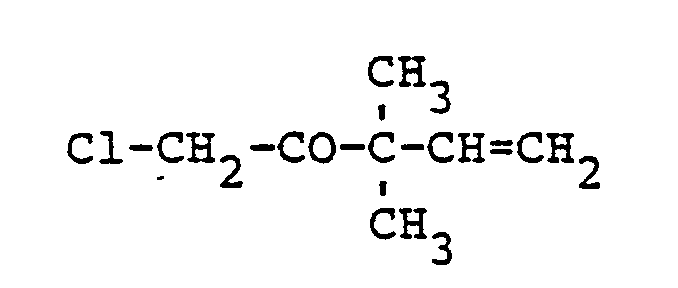
- B1, B3, B5, B7, B8, B9, B10, B11, B12, B13, B14. Von besonderem Interesse ist die neue Verbindung B1 als Zwischenprodukt zur Herstellung von fungizid wirksamen Produkten; die Endprodukte können in der weiter oben beschriebenen Weise hergestellt werden.
Claims (5)


Priority Applications (1)
| Application Number | Priority Date | Filing Date | Title |
|---|---|---|---|
| AT81110565T ATE7292T1 (de) | 1980-12-30 | 1981-12-18 | Verfahren zur herstellung von monochlormethylketonen. |
Applications Claiming Priority (2)
| Application Number | Priority Date | Filing Date | Title |
|---|---|---|---|
| DE19803049461 DE3049461A1 (de) | 1980-12-30 | 1980-12-30 | Verfahren zur herstellung von monochlormethylketonen |
| DE3049461 | 1980-12-30 |
Publications (2)
| Publication Number | Publication Date |
|---|---|
| EP0055427A1 true EP0055427A1 (de) | 1982-07-07 |
| EP0055427B1 EP0055427B1 (de) | 1984-05-02 |
Family
ID=6120530
Family Applications (1)
| Application Number | Title | Priority Date | Filing Date |
|---|---|---|---|
| EP81110565A Expired EP0055427B1 (de) | 1980-12-30 | 1981-12-18 | Verfahren zur Herstellung von Monochlormethylketonen |
Country Status (11)
| Country | Link |
|---|---|
| US (1) | US4460793A (de) |
| EP (1) | EP0055427B1 (de) |
| JP (1) | JPS57134433A (de) |
| AT (1) | ATE7292T1 (de) |
| BR (1) | BR8108490A (de) |
| CA (1) | CA1169434A (de) |
| DE (2) | DE3049461A1 (de) |
| DK (1) | DK154639C (de) |
| HU (1) | HU191236B (de) |
| IL (1) | IL64662A (de) |
| ZA (1) | ZA818995B (de) |
Cited By (2)
| Publication number | Priority date | Publication date | Assignee | Title |
|---|---|---|---|---|
| EP0096813A3 (en) * | 1982-06-12 | 1984-05-09 | Bayer Ag | Process for the preparation of 5-aryloxy-1-chloro-3,3-dimethyl-pentan-2-ones |
| EP0197428A1 (de) * | 1985-04-05 | 1986-10-15 | Sumitomo Chemical Company, Limited | Methode zur Herstellung von Cyclopropancarbonsäurederivaten |
Families Citing this family (4)
| Publication number | Priority date | Publication date | Assignee | Title |
|---|---|---|---|---|
| JPS58144342A (ja) * | 1982-02-22 | 1983-08-27 | Shiyouno Tamie | ハロメチルケトン類の製造法 |
| DE3540523A1 (de) | 1985-11-15 | 1987-05-27 | Bayer Ag | Azolyletherketone und -alkohole |
| US5441713A (en) * | 1988-04-29 | 1995-08-15 | Nalco Fuel Tech | Hardness suppression in urea solutions |
| CN116573995A (zh) * | 2023-05-04 | 2023-08-11 | 上海惠和化德生物科技有限公司 | 一氯频呐酮的制备方法 |
Citations (3)
| Publication number | Priority date | Publication date | Assignee | Title |
|---|---|---|---|---|
| US2988537A (en) * | 1958-10-21 | 1961-06-13 | Du Pont | Art and composition |
| DE2716895A1 (de) * | 1977-04-16 | 1978-10-19 | Bayer Ag | Verfahren zur herstellung von monohalogenierte ketone |
| DE2716896B1 (de) * | 1977-04-16 | 1978-11-02 | Bayer Ag | Verfahren zur Herstellung von 1-Chlor-3,3-dimethyl-butan-2-on |
Family Cites Families (4)
| Publication number | Priority date | Publication date | Assignee | Title |
|---|---|---|---|---|
| US1829869A (en) * | 1930-04-23 | 1931-11-03 | Du Pont | Process of forming cyclic alcohols and ketones |
| US3277068A (en) * | 1962-07-31 | 1966-10-04 | Leo A Wall | Perfluorovinylphenylethers and their polymers |
| US3294820A (en) * | 1963-03-04 | 1966-12-27 | American Cyanamid Co | Process for preparing halomethyl vinyl ketones |
| US4195033A (en) * | 1975-05-16 | 1980-03-25 | Imperial Chemical Industries Limited | 1-Acetyl or 1-cyano-2(2,2-dichlorovinyl)-3,3-dimethyl cyclopropane |
-
1980
- 1980-12-30 DE DE19803049461 patent/DE3049461A1/de not_active Withdrawn
-
1981
- 1981-12-11 US US06/329,959 patent/US4460793A/en not_active Expired - Lifetime
- 1981-12-18 DE DE8181110565T patent/DE3163425D1/de not_active Expired
- 1981-12-18 EP EP81110565A patent/EP0055427B1/de not_active Expired
- 1981-12-18 AT AT81110565T patent/ATE7292T1/de not_active IP Right Cessation
- 1981-12-24 JP JP56208266A patent/JPS57134433A/ja active Granted
- 1981-12-28 IL IL64662A patent/IL64662A/xx unknown
- 1981-12-29 CA CA000393322A patent/CA1169434A/en not_active Expired
- 1981-12-29 BR BR8108490A patent/BR8108490A/pt unknown
- 1981-12-29 DK DK581481A patent/DK154639C/da not_active IP Right Cessation
- 1981-12-29 ZA ZA818995A patent/ZA818995B/xx unknown
- 1981-12-29 HU HU813981A patent/HU191236B/hu not_active IP Right Cessation
Patent Citations (3)
| Publication number | Priority date | Publication date | Assignee | Title |
|---|---|---|---|---|
| US2988537A (en) * | 1958-10-21 | 1961-06-13 | Du Pont | Art and composition |
| DE2716895A1 (de) * | 1977-04-16 | 1978-10-19 | Bayer Ag | Verfahren zur herstellung von monohalogenierte ketone |
| DE2716896B1 (de) * | 1977-04-16 | 1978-11-02 | Bayer Ag | Verfahren zur Herstellung von 1-Chlor-3,3-dimethyl-butan-2-on |
Cited By (2)
| Publication number | Priority date | Publication date | Assignee | Title |
|---|---|---|---|---|
| EP0096813A3 (en) * | 1982-06-12 | 1984-05-09 | Bayer Ag | Process for the preparation of 5-aryloxy-1-chloro-3,3-dimethyl-pentan-2-ones |
| EP0197428A1 (de) * | 1985-04-05 | 1986-10-15 | Sumitomo Chemical Company, Limited | Methode zur Herstellung von Cyclopropancarbonsäurederivaten |
Also Published As
| Publication number | Publication date |
|---|---|
| DK154639B (da) | 1988-12-05 |
| US4460793A (en) | 1984-07-17 |
| DK154639C (da) | 1989-05-08 |
| JPS57134433A (en) | 1982-08-19 |
| IL64662A0 (en) | 1982-03-31 |
| ZA818995B (en) | 1982-12-29 |
| DE3163425D1 (en) | 1984-06-07 |
| HU191236B (en) | 1987-01-28 |
| CA1169434A (en) | 1984-06-19 |
| EP0055427B1 (de) | 1984-05-02 |
| JPH0158171B2 (de) | 1989-12-11 |
| IL64662A (en) | 1985-03-31 |
| BR8108490A (pt) | 1982-10-19 |
| ATE7292T1 (de) | 1984-05-15 |
| DE3049461A1 (de) | 1982-09-09 |
| DK581481A (da) | 1982-07-01 |
Similar Documents
| Publication | Publication Date | Title |
|---|---|---|
| EP0055427B1 (de) | Verfahren zur Herstellung von Monochlormethylketonen | |
| EP0008734A1 (de) | Verfahren zur Herstellung von 4-Fluoro-3-phenoxy-toluol | |
| DE3805534A1 (de) | Verfahren zur herstellung von perfluoralkylverbindungen sowie das pentafluoraethyl-trimethylsilan | |
| EP0035697B1 (de) | 3,3-Dimethyl-1-phenoxy-butan-2-ole, Verfahren zu ihrer Herstellung sowie ihre Verwendung als Zwischenprodukte | |
| EP0056933B1 (de) | Verfahren zur Herstellung von 1-Aryloxy-methylketonen | |
| EP0095047A1 (de) | Verfahren zur Herstellung von 3-vinylsubstituierten 2,2-Dimethylcyclopropan-1-carbonsäuren bzw. ihren Estern und neue Zwischenprodukte dafür | |
| DE2358690C3 (de) | Substituierte Succindialdehydmonoacetale und ein Verfahren zu ihrer Herstellung | |
| EP0046532B1 (de) | 3,3-Dimethyl-1-fluor-1-phenoxy-2-butanone(ole), Verfahren zu ihrer Herstellung und ihre Verwendung | |
| EP0173190A2 (de) | Verfahren zur Herstellung von 5-Acylpyrimidinen | |
| EP0290903B1 (de) | Beta-Fluoracyl-beta-halogenvinylalkylether | |
| DE2802281A1 (de) | Neue phenylen-bis-diketone, ihre herstellung und deren verwendung | |
| EP0080096B1 (de) | Alkylcycloalkyl-imidazolylmethyl-ketone und Verfahren zu ihrer Herstellung | |
| EP0041671A1 (de) | 4-Substituierte 3,3-Dimethyl-butan-2-one, Verfahren zu ihrer Herstellung sowie ihre Verwendung als Zwischenprodukte | |
| DE2658496A1 (de) | Verfahren zur herstellung von diphenylaethern | |
| EP0096813B1 (de) | Verfahren zur Herstellung von 5-Aryloxy-1-chlor-3,3-dimethyl-pentan-2-onen | |
| EP0431450B1 (de) | 1-Brom-3-chlor-1,2-diaryl-2-propanole, Verfahren zur stereoselektiven Herstellung der erythro-1-Brom-3-chlor-1,2-diaryl-2-propanole und deren Umsetzung zu Azolylmethyloxiranen | |
| EP0118082B1 (de) | Phenoxyacetylene und Verfahren zu ihrer Herstellung | |
| EP0010183B1 (de) | 3,3-Bisfluoromethyl-butan-2-on und Verfahren zu dessen Herstellung | |
| DE3725941A1 (de) | Ester von arylperfluoralkylcarbinolen, verfahren zur herstellung dieser verbindungen und der zugrundeliegenden arylbisperfluoralkylcarbinole | |
| DE3836159A1 (de) | Neue fluor enthaltende und an der ch(pfeil abwaerts)3(pfeil abwaerts)-gruppe gegebenenfalls halogenierte acetophenone und deren herstellung aus neuen fluor enthaltenden benzonitrilen | |
| EP0167207B1 (de) | Verfahren zur Herstellung von Keten-0,0-acetalen | |
| EP0096801B1 (de) | Azolylmethyl-ketone, Verfahren zu ihrer Herstellung und ihre Verwendung als Zwischenprodukte | |
| DE2734809A1 (de) | Verfahren zur herstellung von 2,3- dichlor-1-(c tief 1-7 )-alkoxybenzolen | |
| DE3031385A1 (de) | 1-hydroxypyrazol und verfahren zu seiner herstellung | |
| DE3204788A1 (de) | Verfahren zur herstellung von 5-substituierten 1-chlor-3,3-dimethylpentan-2-onen |
Legal Events
| Date | Code | Title | Description |
|---|---|---|---|
| PUAI | Public reference made under article 153(3) epc to a published international application that has entered the european phase |
Free format text: ORIGINAL CODE: 0009012 |
|
| 17P | Request for examination filed |
Effective date: 19811218 |
|
| AK | Designated contracting states |
Designated state(s): AT BE CH DE FR GB IT NL |
|
| ITF | It: translation for a ep patent filed | ||
| GRAA | (expected) grant |
Free format text: ORIGINAL CODE: 0009210 |
|
| AK | Designated contracting states |
Designated state(s): AT BE CH DE FR GB IT LI NL |
|
| REF | Corresponds to: |
Ref document number: 7292 Country of ref document: AT Date of ref document: 19840515 Kind code of ref document: T |
|
| REF | Corresponds to: |
Ref document number: 3163425 Country of ref document: DE Date of ref document: 19840607 |
|
| ET | Fr: translation filed | ||
| PLBE | No opposition filed within time limit |
Free format text: ORIGINAL CODE: 0009261 |
|
| STAA | Information on the status of an ep patent application or granted ep patent |
Free format text: STATUS: NO OPPOSITION FILED WITHIN TIME LIMIT |
|
| 26N | No opposition filed | ||
| ITTA | It: last paid annual fee | ||
| PGFP | Annual fee paid to national office [announced via postgrant information from national office to epo] |
Ref country code: DE Payment date: 19951114 Year of fee payment: 15 |
|
| PGFP | Annual fee paid to national office [announced via postgrant information from national office to epo] |
Ref country code: GB Payment date: 19951211 Year of fee payment: 15 |
|
| PGFP | Annual fee paid to national office [announced via postgrant information from national office to epo] |
Ref country code: BE Payment date: 19951220 Year of fee payment: 15 |
|
| PGFP | Annual fee paid to national office [announced via postgrant information from national office to epo] |
Ref country code: FR Payment date: 19951221 Year of fee payment: 15 Ref country code: AT Payment date: 19951221 Year of fee payment: 15 |
|
| PGFP | Annual fee paid to national office [announced via postgrant information from national office to epo] |
Ref country code: NL Payment date: 19951230 Year of fee payment: 15 |
|
| PGFP | Annual fee paid to national office [announced via postgrant information from national office to epo] |
Ref country code: CH Payment date: 19960103 Year of fee payment: 15 |
|
| PG25 | Lapsed in a contracting state [announced via postgrant information from national office to epo] |
Ref country code: GB Effective date: 19961218 Ref country code: AT Effective date: 19961218 |
|
| PG25 | Lapsed in a contracting state [announced via postgrant information from national office to epo] |
Ref country code: LI Effective date: 19961231 Ref country code: CH Effective date: 19961231 Ref country code: BE Effective date: 19961231 |
|
| BERE | Be: lapsed |
Owner name: BAYER A.G. Effective date: 19961231 |
|
| PG25 | Lapsed in a contracting state [announced via postgrant information from national office to epo] |
Ref country code: NL Effective date: 19970701 |
|
| GBPC | Gb: european patent ceased through non-payment of renewal fee |
Effective date: 19961218 |
|
| REG | Reference to a national code |
Ref country code: CH Ref legal event code: PL |
|
| PG25 | Lapsed in a contracting state [announced via postgrant information from national office to epo] |
Ref country code: FR Effective date: 19970829 |
|
| NLV4 | Nl: lapsed or anulled due to non-payment of the annual fee |
Effective date: 19970701 |
|
| PG25 | Lapsed in a contracting state [announced via postgrant information from national office to epo] |
Ref country code: DE Effective date: 19970902 |
|
| REG | Reference to a national code |
Ref country code: FR Ref legal event code: ST |