EP0055835B1 - Verfahren zur Züchtung von Insektenzellen - Google Patents
Verfahren zur Züchtung von Insektenzellen Download PDFInfo
- Publication number
- EP0055835B1 EP0055835B1 EP81110440A EP81110440A EP0055835B1 EP 0055835 B1 EP0055835 B1 EP 0055835B1 EP 81110440 A EP81110440 A EP 81110440A EP 81110440 A EP81110440 A EP 81110440A EP 0055835 B1 EP0055835 B1 EP 0055835B1
- Authority
- EP
- European Patent Office
- Prior art keywords
- egg yolk
- cells
- insect cells
- cultivation
- nutrient medium
- Prior art date
- Legal status (The legal status is an assumption and is not a legal conclusion. Google has not performed a legal analysis and makes no representation as to the accuracy of the status listed.)
- Expired
Links
- 241000238631 Hexapoda Species 0.000 title claims abstract description 17
- 238000000034 method Methods 0.000 title claims description 11
- 210000004027 cell Anatomy 0.000 claims abstract description 26
- 102000002322 Egg Proteins Human genes 0.000 claims abstract description 24
- 108010000912 Egg Proteins Proteins 0.000 claims abstract description 24
- 210000002969 egg yolk Anatomy 0.000 claims abstract description 23
- 235000013345 egg yolk Nutrition 0.000 claims abstract description 23
- 235000015097 nutrients Nutrition 0.000 claims abstract description 15
- 239000000654 additive Substances 0.000 claims description 3
- 230000000996 additive effect Effects 0.000 claims description 3
- 108091003079 Bovine Serum Albumin Proteins 0.000 abstract description 11
- 239000012894 fetal calf serum Substances 0.000 abstract description 11
- 241000700605 Viruses Species 0.000 description 17
- 241001465754 Metazoa Species 0.000 description 5
- 208000015181 infectious disease Diseases 0.000 description 5
- 238000004519 manufacturing process Methods 0.000 description 5
- 235000013601 eggs Nutrition 0.000 description 4
- 239000000463 material Substances 0.000 description 4
- 239000002609 medium Substances 0.000 description 4
- 230000001717 pathogenic effect Effects 0.000 description 4
- 150000001413 amino acids Chemical class 0.000 description 3
- 238000012258 culturing Methods 0.000 description 3
- 238000002474 experimental method Methods 0.000 description 3
- 239000001963 growth medium Substances 0.000 description 3
- 238000000338 in vitro Methods 0.000 description 3
- 239000000126 substance Substances 0.000 description 3
- 241000701447 unidentified baculovirus Species 0.000 description 3
- 235000013343 vitamin Nutrition 0.000 description 3
- 229940088594 vitamin Drugs 0.000 description 3
- 229930003231 vitamin Natural products 0.000 description 3
- 239000011782 vitamin Substances 0.000 description 3
- 241000256251 Spodoptera frugiperda Species 0.000 description 2
- 241000607479 Yersinia pestis Species 0.000 description 2
- 235000001014 amino acid Nutrition 0.000 description 2
- 230000010261 cell growth Effects 0.000 description 2
- 239000000839 emulsion Substances 0.000 description 2
- 238000002955 isolation Methods 0.000 description 2
- 239000000203 mixture Substances 0.000 description 2
- 150000003839 salts Chemical class 0.000 description 2
- 235000002639 sodium chloride Nutrition 0.000 description 2
- 238000003756 stirring Methods 0.000 description 2
- 235000000346 sugar Nutrition 0.000 description 2
- 238000012360 testing method Methods 0.000 description 2
- QCVGEOXPDFCNHA-UHFFFAOYSA-N 5,5-dimethyl-2,4-dioxo-1,3-oxazolidine-3-carboxamide Chemical compound CC1(C)OC(=O)N(C(N)=O)C1=O QCVGEOXPDFCNHA-UHFFFAOYSA-N 0.000 description 1
- 241000191985 Anas superciliosa Species 0.000 description 1
- 241000272814 Anser sp. Species 0.000 description 1
- 241001367049 Autographa Species 0.000 description 1
- 241000255925 Diptera Species 0.000 description 1
- 241000287828 Gallus gallus Species 0.000 description 1
- WQZGKKKJIJFFOK-GASJEMHNSA-N Glucose Natural products OC[C@H]1OC(O)[C@H](O)[C@@H](O)[C@@H]1O WQZGKKKJIJFFOK-GASJEMHNSA-N 0.000 description 1
- 241001517118 Goose parvovirus Species 0.000 description 1
- 241000255777 Lepidoptera Species 0.000 description 1
- 241000721696 Lymantria Species 0.000 description 1
- 241000721703 Lymantria dispar Species 0.000 description 1
- 241000555303 Mamestra brassicae Species 0.000 description 1
- FAPWRFPIFSIZLT-UHFFFAOYSA-M Sodium chloride Chemical compound [Na+].[Cl-] FAPWRFPIFSIZLT-UHFFFAOYSA-M 0.000 description 1
- 241000256248 Spodoptera Species 0.000 description 1
- 241000255993 Trichoplusia ni Species 0.000 description 1
- 208000036142 Viral infection Diseases 0.000 description 1
- WQZGKKKJIJFFOK-VFUOTHLCSA-N beta-D-glucose Chemical compound OC[C@H]1O[C@@H](O)[C@H](O)[C@@H](O)[C@@H]1O WQZGKKKJIJFFOK-VFUOTHLCSA-N 0.000 description 1
- 230000004071 biological effect Effects 0.000 description 1
- 238000004113 cell culture Methods 0.000 description 1
- 230000036978 cell physiology Effects 0.000 description 1
- 238000004140 cleaning Methods 0.000 description 1
- 230000005584 early death Effects 0.000 description 1
- 235000014103 egg white Nutrition 0.000 description 1
- 210000000969 egg white Anatomy 0.000 description 1
- 230000007613 environmental effect Effects 0.000 description 1
- 239000008103 glucose Substances 0.000 description 1
- 150000002337 glycosamines Chemical class 0.000 description 1
- 238000011835 investigation Methods 0.000 description 1
- 230000007774 longterm Effects 0.000 description 1
- 239000012569 microbial contaminant Substances 0.000 description 1
- 150000002894 organic compounds Chemical class 0.000 description 1
- 230000007170 pathology Effects 0.000 description 1
- 239000000575 pesticide Substances 0.000 description 1
- 238000002360 preparation method Methods 0.000 description 1
- 238000012545 processing Methods 0.000 description 1
- 239000003531 protein hydrolysate Substances 0.000 description 1
- 210000002966 serum Anatomy 0.000 description 1
- 239000002356 single layer Substances 0.000 description 1
- 239000000758 substrate Substances 0.000 description 1
- 150000008163 sugars Chemical class 0.000 description 1
- 239000000725 suspension Substances 0.000 description 1
- 230000009385 viral infection Effects 0.000 description 1
Classifications
-
- C—CHEMISTRY; METALLURGY
- C12—BIOCHEMISTRY; BEER; SPIRITS; WINE; VINEGAR; MICROBIOLOGY; ENZYMOLOGY; MUTATION OR GENETIC ENGINEERING
- C12N—MICROORGANISMS OR ENZYMES; COMPOSITIONS THEREOF; PROPAGATING, PRESERVING, OR MAINTAINING MICROORGANISMS; MUTATION OR GENETIC ENGINEERING; CULTURE MEDIA
- C12N7/00—Viruses; Bacteriophages; Compositions thereof; Preparation or purification thereof
-
- C—CHEMISTRY; METALLURGY
- C12—BIOCHEMISTRY; BEER; SPIRITS; WINE; VINEGAR; MICROBIOLOGY; ENZYMOLOGY; MUTATION OR GENETIC ENGINEERING
- C12N—MICROORGANISMS OR ENZYMES; COMPOSITIONS THEREOF; PROPAGATING, PRESERVING, OR MAINTAINING MICROORGANISMS; MUTATION OR GENETIC ENGINEERING; CULTURE MEDIA
- C12N5/00—Undifferentiated human, animal or plant cells, e.g. cell lines; Tissues; Cultivation or maintenance thereof; Culture media therefor
- C12N5/06—Animal cells or tissues; Human cells or tissues
- C12N5/0601—Invertebrate cells or tissues, e.g. insect cells; Culture media therefor
-
- C—CHEMISTRY; METALLURGY
- C12—BIOCHEMISTRY; BEER; SPIRITS; WINE; VINEGAR; MICROBIOLOGY; ENZYMOLOGY; MUTATION OR GENETIC ENGINEERING
- C12N—MICROORGANISMS OR ENZYMES; COMPOSITIONS THEREOF; PROPAGATING, PRESERVING, OR MAINTAINING MICROORGANISMS; MUTATION OR GENETIC ENGINEERING; CULTURE MEDIA
- C12N2500/00—Specific components of cell culture medium
- C12N2500/70—Undefined extracts
- C12N2500/80—Undefined extracts from animals
-
- C—CHEMISTRY; METALLURGY
- C12—BIOCHEMISTRY; BEER; SPIRITS; WINE; VINEGAR; MICROBIOLOGY; ENZYMOLOGY; MUTATION OR GENETIC ENGINEERING
- C12N—MICROORGANISMS OR ENZYMES; COMPOSITIONS THEREOF; PROPAGATING, PRESERVING, OR MAINTAINING MICROORGANISMS; MUTATION OR GENETIC ENGINEERING; CULTURE MEDIA
- C12N2710/00—MICROORGANISMS OR ENZYMES; COMPOSITIONS THEREOF; PROPAGATING, PRESERVING, OR MAINTAINING MICROORGANISMS; MUTATION OR GENETIC ENGINEERING; CULTURE MEDIA dsDNA viruses
- C12N2710/00011—Details
- C12N2710/14011—Baculoviridae
- C12N2710/14111—Nucleopolyhedrovirus, e.g. autographa californica nucleopolyhedrovirus
- C12N2710/14151—Methods of production or purification of viral material
-
- Y—GENERAL TAGGING OF NEW TECHNOLOGICAL DEVELOPMENTS; GENERAL TAGGING OF CROSS-SECTIONAL TECHNOLOGIES SPANNING OVER SEVERAL SECTIONS OF THE IPC; TECHNICAL SUBJECTS COVERED BY FORMER USPC CROSS-REFERENCE ART COLLECTIONS [XRACs] AND DIGESTS
- Y10—TECHNICAL SUBJECTS COVERED BY FORMER USPC
- Y10S—TECHNICAL SUBJECTS COVERED BY FORMER USPC CROSS-REFERENCE ART COLLECTIONS [XRACs] AND DIGESTS
- Y10S435/00—Chemistry: molecular biology and microbiology
- Y10S435/8215—Microorganisms
- Y10S435/948—Microorganisms using viruses or cell lines
Definitions
- NPV nuclear polyhedron viruses
- GV granulosic viruses
- the method described under 1. supplies large amounts of virus material, but has the disadvantage that the host animals are only available at certain times of the year and the virus material is contaminated with insect residues and microbial contaminants. In principle, cleaning is possible, but would make production very expensive.
- compositions proposed and used for this purpose generally contain inorganic salts, vitamins, amino acids, sugar and a number of other organic compounds which are important for cell physiology; Common to all is also the addition of approx. 5 to 20% fetal calf serum (FCS), which is essential for cell growth.
- FCS fetal calf serum
- FCS Fluorescence Specific Stimulation
- the invention thus relates to a method for culturing and multiplying cells, in particular insect cells, using known inorganic salts, amino acids, sugars, vitamins and other nutrient media containing organic substances, which is characterized in that they contain an addition of egg yolk.
- the egg yolk content is 0.1 to 5, preferably 0.5 to 2 percent by weight of the nutrient solution. It can replace FKS in whole or in part.
- the invention furthermore relates to a nutrient medium for growing and multiplying the cells, in particular insect cells, characterized by a content of egg yolk and the use of egg yolk as an additive to the nutrient medium in the cultivation and multiplication of cells, in particular insect cells.
- FCS of egg yolk To produce a nutrient medium suitable for cell cultivation, only a fraction of the required amount of FCS of egg yolk is required, namely approx. 5-20%. It is not necessary to separate the egg yolk from the egg white; rather, e.g. beaten or whisked eggs. However, commercial egg yolk emulsion is preferably used.
- Egg yolk from chicken eggs is particularly suitable for reasons of easy availability, but other eggs also come, e.g. Duck or goose eggs, considered as a source of egg yolk.
- the method according to the invention is suitable for culturing a large number of insect cell lines, e.g. those from the Diptera and Lepidoptera orders.
- insect cell lines e.g. those from the Diptera and Lepidoptera orders.
- insect pathogenic viruses e.g. Parvoviruses, poxviruses, baculoviruses and rhabdoviruses, of which in particular nuclear polyhedron viruses such as those from Autographa spp., Spodoptera spp. and Lymantria spp. are of interest.
- the addition doubled the cell yield (from 1.4 x 10 6 to 2.8 x 10⁶ cells / ml compared to a control batch with 10% FCS.
- Electron-optical investigations and infection tests in vitro showed that the morphology and the biological activity of the viruses produced were unchanged.
Landscapes
- Health & Medical Sciences (AREA)
- Engineering & Computer Science (AREA)
- Life Sciences & Earth Sciences (AREA)
- Chemical & Material Sciences (AREA)
- Biomedical Technology (AREA)
- Organic Chemistry (AREA)
- Bioinformatics & Cheminformatics (AREA)
- Genetics & Genomics (AREA)
- Wood Science & Technology (AREA)
- Zoology (AREA)
- Biotechnology (AREA)
- General Health & Medical Sciences (AREA)
- Biochemistry (AREA)
- General Engineering & Computer Science (AREA)
- Microbiology (AREA)
- Cell Biology (AREA)
- Immunology (AREA)
- Medicinal Chemistry (AREA)
- Virology (AREA)
- Micro-Organisms Or Cultivation Processes Thereof (AREA)
- Coloring Foods And Improving Nutritive Qualities (AREA)
- Mushroom Cultivation (AREA)
Description
- Im Zusammenhang mit der öffentlichen Diskussion über Umweltbeeinflussung durch chemische Schädlingsbekämpfung haben die Methoden der biologischen Schädlingsbekämpfung an Bedeutung zugenommen. Eine der erfolgversprechendsten Methoden ist die Verwendung von hochspezifischen insektenpathogenen Viren, insbesondere von Kernpolyederviren (NPV) und Granuloseviren (GV) aus der Gruppe der Baculoviren. Diese werden ähnlich wie chemische Pestizide in die Umgebung ausgebracht und von spezifischen Wirtstieren aufgenommen. Nur in diesen Wirtstieren verursachen sie eine Virusinfektion, die zum baldigen Tod führt. Eine Reihe von NPV-und GV-Präparaten befindet sich bereits im Handel bzw. in der praktischen Erprobung (vgl. Shieh u. Bohmfalk, Production and Efficiency of Baculoviruses, Biotechnology and Bioengineering Vol. XXlI,1357 ff. (1980).
- Die Gewinnung ausreichender Mengen an Virusmaterial stösst jedoch auf praktische Probleme, die bisher noch nicht befriedigend gelöst sind. Grundsätzlich stehen zwei Wege zur Verfügung (a.a.O., 1361 ff.):
- 1. Vermehrung einer grossen Mengen von Wirtstieren, künstliche Infektion mit Virus und Isolation des Virus aus den gestorbenen Tieren;
- 2. Züchtung von Einzelzellen der Insekten in vitro in geeigneten Nährmedien, Infektion dieser Zellen und Aufarbeitung des Virusmaterials.
- Das unter 1. beschriebene Verfahren liefert zwar grosse Mengen Virusmaterial, hat jedoch den Nachteil, dass die Wirtstiere nur zu bestimmten Jahreszeiten verfügbar sind und das Virusmaterial mit Insektenrückständen und mikrobiellen Verunreinigungen kontaminiert ist. Eine Reinigung ist prinzipiell zwar möglich, würde aber die Produktion stark verteuern.
- Die unter 2. beschriebene Methode vermeidet diese Schwierigkeiten; sie steht und fällt jedoch mit der Verfügbarkeit eines geeigneten Kulturmediums. Die hierfür vorgeschlagenen und verwendeten Zusammensetzungen enthalten in der Regel anorganische Salze, Vitamine, Aminosäuren, Zucker und eine Reihe anderer organischer Verbindungen, die für die Zellphysiologie von Bedeutung sind; allen gemeinsam ist ausserdem ein Zusatz von ca. 5 bis 20% fötalem Kälberserum (FKS), das für das Zellwachstum unerlässlich ist. Typische Zusammensetzungen sind z.B. in J. Invertebrate Pathology 25, 363-370 (1975) beschrieben.
- Als limitierender Faktor erweist sich dabei das FKS, das sehr teuer ist und nur in begrenzten Mengen zur Verfügung steht. Eine Produktion von Insektenzellen in technischem Massstab, die ihrerseits Voraussetzung ist für die technische Produktion von insektenpathogenen Viren, ist unter diesen Voraussetzungen nicht möglich. Es bestand daher ein erhebliches Bedürfnis, FKS durch eine billigere und ausreichend verfügbare Komponente zu ersetzen.
- Überraschend wurde nun gefunden, dass man an Stelle des FKS vorteilhaft Eidotter verwenden kann.
- Gegenstand der Erfindung ist somit ein Verfahren zur Züchtung und Vermehrung von Zellen, insbesondere Insektenzellen, unter Verwendung bekannter anorganischer Salze, Aminosäuren, Zucker, Vitaminen und andere organische Substanzen enthaltender Nährmedien, das dadurch gekennzeichnet ist, dass diese einen Zusatz von Eidotter enthalten.
- Der Eidottergehalt beträgt 0,1 bis 5, vorzugsweise 0,5 bis 2 Gewichtsprozent der Nährlösung. Er kann FKS ganz oder auch teilweise ersetzen.
- Ferner ist Gegenstand der Erfindung ein Nährmedium zur Züchtung und Vermehrung der Zellen, insbesondere Insektenzellen, gekennzeichnet durch einen Gehalt an Eidotter sowie die Verwendung von Eidotter als Zusatz zum Nährmedium bei der Züchtung und Vermehrung von Zellen, insbesondere Insektenzellen.
- Zur Herstellung eines für die Zellzüchtung geeigneten Nährmediums benötigt man nur einen Bruchteil der erforderlichen FKS-Menge an Eidotter, nämlich ca. 5-20%. Es ist nicht erforderlich, den Eidotter vom Eiweiss zu trennen; geeignet sind vielmehr auch z.B. geschlagene oder gequirlte Eier. Vorzugsweise verwendet man jedoch käufliche Eidotteremulsion.
- Auch die Herkunft des Eidotters ist von untergeordneter Bedeutung. Aus Gründen der leichten Verfügbarkeit eignet sich besonders Eidotter vom Hühnerei, doch kommen auch andere Eier, z.B. Enten- oder Gänseeier, als Eidotterquelle in Betracht.
- Das erfindungsgemässe Verfahren eignet sich zur Züchtung einer Vielzahl von Insekten-Zellinien, z.B. solchen aus den Ordnungen Diptera und Lepidoptera. Genannt seien z.B. Zellinien aus Spodoptera frugiperda, Lymantria dispar, Mamestra brassicae, Trichoplusia ni, Ädes albopictus und Ädes ägypti. Diese wiederum eignen sich zur Vermehrung zahlreicher insektenpathogener Viren, z.B. Parvoviren, Poxviren, Baculoviren und Rhabdoviren, von denen besonders Kernpolyederviren wie diejenigen aus Autographa spp., Spodoptera spp. und Lymantria spp. von Interesse sind.
- Das Verfahren ist nachstehend am Beispiel der Züchtung eines etablierten Zellstamms von Spodoptera frugiperda (Sf) beschrieben:
- Zur Züchtung von den Insektenzellen wurde das käufliche Kulturmedium TC 10 (bestehend aus einer Salzlösung, Glukose, definierten Mengen an Aminosäuren, Vitaminen und einem Proteinhydrolysat [Tryptoseboullion]) in einem Versuch mit 10% FKS versetzt; in einem zweiten Versuch wurde die FKS-Konzentration auf 5% reduziert und eine 0,5%ige Eidotteremulsion (Fa. Oxoid) zugegeben. Die Zellzüchtung erfolgte in Monolayerflaschen (3 ml), Schüttelkulturen (20 ml) und Rührflaschen (500 ml).
- Der Zusatz erhöhte die Zellausbeute auf das Doppelte (von 1,4 x 10⁶ auf 2,8x10⁶ Zellen/ ml, verglichen mit einem Kontrollansatz mit 10% FKS.
- In weiteren Versuchen wurde das Serum ganz weggelassen und unterschiedliche Eidotterkonzentrationen verwendet. Bei einem Zusatz von 1 % Eidotter konnte FKS voll ersetzt werden, die Zellausbeuten bewegten sich in der gleichen Grössenordnung wie bei Verwendung von 10% FKS (Tabelle 1 ).

- Vergleichbare Ergebnisse wurden bei Verwendung von Suspensionszellen in Schüttel- und Rührsystemen erhalten. In Langzeitversuchen wurde festgestellt, dass das Zellwachstum in dem erfindungsgemässen Kulturmedium über 60 Passagen hinaus stabil bleibt.
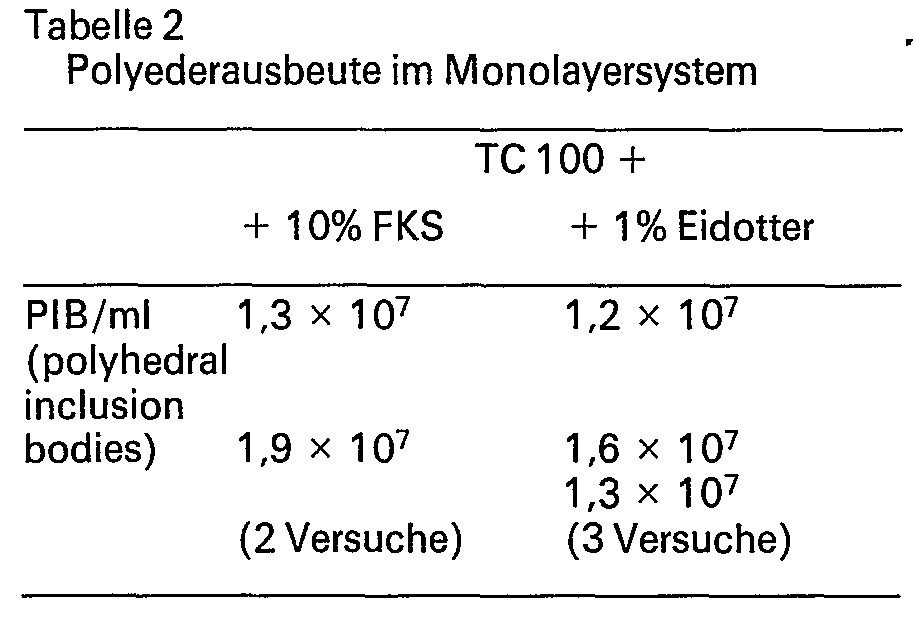
- Die mit Eidotterzusatz in FKS-freiem Medium gezüchteten Zellen wurden regelmässig als Substrat für die Produktion insektenpathogener Kernpolyederviren verwendet. Die Virusausbeute blieb im Vergleich zu Kontrollansätzen mit FKS-Zusatz unverändert (Tabelle 2):
- Elektronenoptische Untersuchungen sowie Infektionsversuche in vitro zeigten, dass die Morphologie sowie die biologische Aktivität der produzierten Viren unverändert war.
Claims (7)
Priority Applications (1)
| Application Number | Priority Date | Filing Date | Title |
|---|---|---|---|
| AT81110440T ATE12658T1 (de) | 1980-12-20 | 1981-12-15 | Verfahren zur zuechtung von insektenzellen. |
Applications Claiming Priority (2)
| Application Number | Priority Date | Filing Date | Title |
|---|---|---|---|
| DE19803048289 DE3048289A1 (de) | 1980-12-20 | 1980-12-20 | "verfahren zur zuechtung von insektenzellen" |
| DE3048289 | 1980-12-20 |
Publications (3)
| Publication Number | Publication Date |
|---|---|
| EP0055835A2 EP0055835A2 (de) | 1982-07-14 |
| EP0055835A3 EP0055835A3 (en) | 1982-07-28 |
| EP0055835B1 true EP0055835B1 (de) | 1985-04-10 |
Family
ID=6119817
Family Applications (1)
| Application Number | Title | Priority Date | Filing Date |
|---|---|---|---|
| EP81110440A Expired EP0055835B1 (de) | 1980-12-20 | 1981-12-15 | Verfahren zur Züchtung von Insektenzellen |
Country Status (12)
| Country | Link |
|---|---|
| US (1) | US4454227A (de) |
| EP (1) | EP0055835B1 (de) |
| JP (1) | JPS57155990A (de) |
| AT (1) | ATE12658T1 (de) |
| AU (1) | AU553484B2 (de) |
| CA (1) | CA1204688A (de) |
| DD (1) | DD201806A5 (de) |
| DE (2) | DE3048289A1 (de) |
| DK (1) | DK563281A (de) |
| HU (1) | HU185997B (de) |
| IL (1) | IL64590A (de) |
| ZA (1) | ZA818761B (de) |
Families Citing this family (10)
| Publication number | Priority date | Publication date | Assignee | Title |
|---|---|---|---|---|
| JPS6255078A (ja) * | 1985-05-17 | 1987-03-10 | Nippon Koutai Kenkyusho:Kk | 細胞培養用添加剤 |
| US5024947A (en) * | 1987-07-24 | 1991-06-18 | Cetus Corporation | Serum free media for the growth on insect cells and expression of products thereby |
| US5023183A (en) * | 1987-11-20 | 1991-06-11 | Biosys Corporation | Mass production in liquid culture of insect-killing nematodes |
| DK53792D0 (da) * | 1992-04-24 | 1992-04-24 | Novo Nordisk As | Fremgangsmaade til fremstilling af proteiner |
| US5426045A (en) * | 1993-12-16 | 1995-06-20 | Sea Run Holdings, Inc. | Method for culturing mammalian cells in a medium containing fish serum |
| US5498540A (en) * | 1994-02-23 | 1996-03-12 | Sea Run Holdings, Inc. | Method for culturing insect cells in a medium containing fish serum |
| US6235528B1 (en) | 1999-02-25 | 2001-05-22 | The United States Of America As Represented By The Secretary Of Agriculture | Artificial diets for arthropods |
| KR20120120197A (ko) | 2009-12-08 | 2012-11-01 | 코닌클리케 필립스 일렉트로닉스 엔.브이. | 교체 인디케이터를 구비하는 면도 도구 |
| US20220290097A1 (en) * | 2019-08-03 | 2022-09-15 | Shenzhen Mytang Biotechnology Co., Ltd. | Poultry Egg-Based Culture Medium |
| EP4172316A4 (de) * | 2020-06-26 | 2024-06-26 | Sunnybrook Research Institute | Eigelbextraktzusätze für kulturmedien und zugehörige verfahren |
Family Cites Families (4)
| Publication number | Priority date | Publication date | Assignee | Title |
|---|---|---|---|---|
| US2598881A (en) * | 1951-05-12 | 1952-06-03 | Ortho Pharma Corp | Whole fresh egg semen diluter |
| US4072570A (en) * | 1972-04-11 | 1978-02-07 | Beatrice Foods Co. | Preparation of a tuberculosis test medium by reconstituting a storage stabilized dry powdered Lowenstein-Jensen medium |
| GB1441094A (en) * | 1972-11-08 | 1976-06-30 | Shell Int Research | Cell culture |
| SU604556A1 (ru) * | 1976-05-25 | 1978-04-30 | Всесоюзный Ордена Трудового Красного Знамени Научно-Исследовательский Институт Животноводства | Синтетическа среда дл разбавлени и замораживани спермы животных |
-
1980
- 1980-12-20 DE DE19803048289 patent/DE3048289A1/de not_active Withdrawn
-
1981
- 1981-12-15 DE DE8181110440T patent/DE3169911D1/de not_active Expired
- 1981-12-15 AT AT81110440T patent/ATE12658T1/de not_active IP Right Cessation
- 1981-12-15 EP EP81110440A patent/EP0055835B1/de not_active Expired
- 1981-12-18 HU HU813864A patent/HU185997B/hu unknown
- 1981-12-18 ZA ZA818761A patent/ZA818761B/xx unknown
- 1981-12-18 AU AU78652/81A patent/AU553484B2/en not_active Ceased
- 1981-12-18 DD DD81235959A patent/DD201806A5/de unknown
- 1981-12-18 DK DK563281A patent/DK563281A/da not_active Application Discontinuation
- 1981-12-18 US US06/332,196 patent/US4454227A/en not_active Expired - Fee Related
- 1981-12-18 IL IL64590A patent/IL64590A/xx unknown
- 1981-12-18 CA CA000392633A patent/CA1204688A/en not_active Expired
- 1981-12-19 JP JP56204554A patent/JPS57155990A/ja active Pending
Also Published As
| Publication number | Publication date |
|---|---|
| ZA818761B (en) | 1982-11-24 |
| AU7865281A (en) | 1982-07-01 |
| EP0055835A2 (de) | 1982-07-14 |
| DE3169911D1 (en) | 1985-05-15 |
| DK563281A (da) | 1982-06-21 |
| AU553484B2 (en) | 1986-07-17 |
| IL64590A (en) | 1985-05-31 |
| CA1204688A (en) | 1986-05-20 |
| JPS57155990A (en) | 1982-09-27 |
| DD201806A5 (de) | 1983-08-10 |
| ATE12658T1 (de) | 1985-04-15 |
| IL64590A0 (en) | 1982-03-31 |
| US4454227A (en) | 1984-06-12 |
| EP0055835A3 (en) | 1982-07-28 |
| DE3048289A1 (de) | 1982-07-29 |
| HU185997B (en) | 1985-04-28 |
Similar Documents
| Publication | Publication Date | Title |
|---|---|---|
| DE102004017483B4 (de) | Verfahren zur Isolierung adulter Stammzellen aus differenziertem Gewebe | |
| Echalier et al. | In vitrol culture of Drosophila melanogaster embryonic cells | |
| DE3854477T2 (de) | Massenherstellung in flüssiger kultur von insektentötenden nematoden. | |
| EP0055835B1 (de) | Verfahren zur Züchtung von Insektenzellen | |
| EP0509008B1 (de) | Biomasse zur produktion von virus/virusantigen | |
| Xie et al. | Three methods for the in vitro culture of Trichogramma pretiosum Riley | |
| Shieh et al. | Production and efficacy of baculviruses | |
| DE2828073C2 (de) | Verfahren zum Kultivieren von Viren | |
| Ushiyama et al. | A mycoplasma-like organism associated with Phormium yellow leaf disease | |
| EP0225777A2 (de) | Insektizide und Viren | |
| CN104430538A (zh) | 苹果蠹蛾颗粒体病毒杀虫悬浮剂及其工厂化生产工艺 | |
| KITAMURA | THE IN VITRO CULTIVATION OF TISSUES FROM THE MOSQUITO, CULEX PIPIENS VAR. MOLSTUS: II. An Improved Culture Medium Useful for Ovarian Tissue Culture | |
| Marks et al. | Cockroach tissue in vitro: A system for the study of insect cell biology | |
| EP3877536A1 (de) | Verfahren zur biotechnologischen gewinnung des blaugrünen pilzpigments xylindein | |
| Arakawa et al. | Flufenoxuron, an insect growth regulator, promotes peroral infection by nucleopolyhedrovirus (BmNPV) budded particles in the silkworm, Bombyx mori L. | |
| EP1516045B1 (de) | Verwendung von glutaminfreien medium | |
| EP0256457B1 (de) | Verfahren zur Züchtung von Granuloseviren | |
| Rahman et al. | Observations on the growth parameters of Spilosoma obliqua (Lepidoptera: Arctiidae) reared on artificial diets and reproductive competence of this irradiated pest and its progeny | |
| DE60025036T2 (de) | Verfahren zur züchtung von haftenden tierischen zellen | |
| Carter | The symbionts of Pseudococcus brevipes (Ckl.) | |
| CN106417378B (zh) | 一种防治螟虫广谱杆状病毒生物农药及制备方法 | |
| Varma et al. | The culture of embryonic cells from the bug Triatoma maculata (Erichson)(Hemiptera: Reduviidae) | |
| DE2355354A1 (de) | Verfahren zur erzeugung von zur schaedlingsbekaempfung verwendbaren insektenviren | |
| DE202025104543U1 (de) | Ein System zur Herstellung von Fruchtkörpern von Blackwellomyces pseudomilitaris | |
| DE2320885A1 (de) | Verbesserungen bei zell- und viruskultursystemen |
Legal Events
| Date | Code | Title | Description |
|---|---|---|---|
| PUAI | Public reference made under article 153(3) epc to a published international application that has entered the european phase |
Free format text: ORIGINAL CODE: 0009012 |
|
| PUAL | Search report despatched |
Free format text: ORIGINAL CODE: 0009013 |
|
| AK | Designated contracting states |
Designated state(s): AT BE CH DE FR GB IT NL SE |
|
| AK | Designated contracting states |
Designated state(s): AT BE CH DE FR GB IT NL SE |
|
| 17P | Request for examination filed |
Effective date: 19830115 |
|
| ITF | It: translation for a ep patent filed | ||
| GRAA | (expected) grant |
Free format text: ORIGINAL CODE: 0009210 |
|
| AK | Designated contracting states |
Designated state(s): AT BE CH DE FR GB IT LI NL SE |
|
| REF | Corresponds to: |
Ref document number: 12658 Country of ref document: AT Date of ref document: 19850415 Kind code of ref document: T |
|
| REF | Corresponds to: |
Ref document number: 3169911 Country of ref document: DE Date of ref document: 19850515 |
|
| ET | Fr: translation filed | ||
| PLBE | No opposition filed within time limit |
Free format text: ORIGINAL CODE: 0009261 |
|
| STAA | Information on the status of an ep patent application or granted ep patent |
Free format text: STATUS: NO OPPOSITION FILED WITHIN TIME LIMIT |
|
| 26N | No opposition filed | ||
| PGFP | Annual fee paid to national office [announced via postgrant information from national office to epo] |
Ref country code: AT Payment date: 19861127 Year of fee payment: 6 |
|
| PGFP | Annual fee paid to national office [announced via postgrant information from national office to epo] |
Ref country code: NL Payment date: 19871231 Year of fee payment: 7 |
|
| PG25 | Lapsed in a contracting state [announced via postgrant information from national office to epo] |
Ref country code: GB Effective date: 19881215 Ref country code: AT Effective date: 19881215 |
|
| PG25 | Lapsed in a contracting state [announced via postgrant information from national office to epo] |
Ref country code: SE Effective date: 19881216 |
|
| PG25 | Lapsed in a contracting state [announced via postgrant information from national office to epo] |
Ref country code: LI Effective date: 19881231 Ref country code: CH Effective date: 19881231 Ref country code: BE Effective date: 19881231 |
|
| BERE | Be: lapsed |
Owner name: HOECHST A.G. Effective date: 19881231 |
|
| PG25 | Lapsed in a contracting state [announced via postgrant information from national office to epo] |
Ref country code: NL Effective date: 19890701 |
|
| NLV4 | Nl: lapsed or anulled due to non-payment of the annual fee | ||
| GBPC | Gb: european patent ceased through non-payment of renewal fee | ||
| PG25 | Lapsed in a contracting state [announced via postgrant information from national office to epo] |
Ref country code: FR Free format text: LAPSE BECAUSE OF NON-PAYMENT OF DUE FEES Effective date: 19890831 |
|
| REG | Reference to a national code |
Ref country code: CH Ref legal event code: PL |
|
| PG25 | Lapsed in a contracting state [announced via postgrant information from national office to epo] |
Ref country code: DE Effective date: 19890901 |
|
| REG | Reference to a national code |
Ref country code: FR Ref legal event code: ST |
|
| EUG | Se: european patent has lapsed |
Ref document number: 81110440.5 Effective date: 19891215 |