EP0055851A1 - 11-Desoxy-hetero-imino-prostacycline, Verfahren zu ihrer Herstellung und ihre Verwendung als Arzneimittel - Google Patents
11-Desoxy-hetero-imino-prostacycline, Verfahren zu ihrer Herstellung und ihre Verwendung als Arzneimittel Download PDFInfo
- Publication number
- EP0055851A1 EP0055851A1 EP81110772A EP81110772A EP0055851A1 EP 0055851 A1 EP0055851 A1 EP 0055851A1 EP 81110772 A EP81110772 A EP 81110772A EP 81110772 A EP81110772 A EP 81110772A EP 0055851 A1 EP0055851 A1 EP 0055851A1
- Authority
- EP
- European Patent Office
- Prior art keywords
- radical
- carbon atoms
- formula
- straight
- chain
- Prior art date
- Legal status (The legal status is an assumption and is not a legal conclusion. Google has not performed a legal analysis and makes no representation as to the accuracy of the status listed.)
- Withdrawn
Links
- 238000000034 method Methods 0.000 title claims abstract description 12
- 230000008569 process Effects 0.000 title claims abstract description 9
- 238000002360 preparation method Methods 0.000 title claims abstract description 6
- 239000003814 drug Substances 0.000 title claims abstract 5
- -1 alkylene radical Chemical class 0.000 claims description 160
- 125000004432 carbon atom Chemical group C* 0.000 claims description 56
- 150000001875 compounds Chemical class 0.000 claims description 42
- UFHFLCQGNIYNRP-UHFFFAOYSA-N Hydrogen Chemical compound [H][H] UFHFLCQGNIYNRP-UHFFFAOYSA-N 0.000 claims description 31
- 239000001257 hydrogen Substances 0.000 claims description 30
- 229910052739 hydrogen Inorganic materials 0.000 claims description 30
- 150000003254 radicals Chemical class 0.000 claims description 28
- 229910052736 halogen Inorganic materials 0.000 claims description 22
- 150000002367 halogens Chemical class 0.000 claims description 21
- 239000000203 mixture Substances 0.000 claims description 21
- 150000001768 cations Chemical class 0.000 claims description 20
- 125000000217 alkyl group Chemical group 0.000 claims description 19
- 125000003545 alkoxy group Chemical group 0.000 claims description 14
- 125000002023 trifluoromethyl group Chemical group FC(F)(F)* 0.000 claims description 14
- 229910052740 iodine Inorganic materials 0.000 claims description 9
- 125000001997 phenyl group Chemical group [H]C1=C([H])C([H])=C(*)C([H])=C1[H] 0.000 claims description 9
- 125000006239 protecting group Chemical group 0.000 claims description 9
- QGZKDVFQNNGYKY-UHFFFAOYSA-O Ammonium Chemical compound [NH4+] QGZKDVFQNNGYKY-UHFFFAOYSA-O 0.000 claims description 8
- 150000001350 alkyl halides Chemical class 0.000 claims description 8
- 239000004215 Carbon black (E152) Substances 0.000 claims description 6
- 229930195733 hydrocarbon Natural products 0.000 claims description 6
- 229910052751 metal Inorganic materials 0.000 claims description 6
- 239000002184 metal Substances 0.000 claims description 6
- 230000007935 neutral effect Effects 0.000 claims description 6
- 125000002924 primary amino group Chemical group [H]N([H])* 0.000 claims description 6
- 150000003335 secondary amines Chemical class 0.000 claims description 6
- 229910052717 sulfur Chemical group 0.000 claims description 6
- 125000004434 sulfur atom Chemical group 0.000 claims description 6
- 150000003512 tertiary amines Chemical class 0.000 claims description 6
- WKBOTKDWSSQWDR-UHFFFAOYSA-N Bromine atom Chemical compound [Br] WKBOTKDWSSQWDR-UHFFFAOYSA-N 0.000 claims description 5
- 150000002431 hydrogen Chemical class 0.000 claims description 5
- 229910052760 oxygen Inorganic materials 0.000 claims description 5
- 239000001301 oxygen Substances 0.000 claims description 5
- 125000000951 phenoxy group Chemical group [H]C1=C([H])C([H])=C(O*)C([H])=C1[H] 0.000 claims description 5
- ZAMOUSCENKQFHK-UHFFFAOYSA-N Chlorine atom Chemical compound [Cl] ZAMOUSCENKQFHK-UHFFFAOYSA-N 0.000 claims description 4
- 150000001412 amines Chemical class 0.000 claims description 4
- GDTBXPJZTBHREO-UHFFFAOYSA-N bromine Substances BrBr GDTBXPJZTBHREO-UHFFFAOYSA-N 0.000 claims description 4
- 229910052794 bromium Inorganic materials 0.000 claims description 4
- 239000000460 chlorine Substances 0.000 claims description 4
- 125000004435 hydrogen atom Chemical group [H]* 0.000 claims description 4
- PNDPGZBMCMUPRI-UHFFFAOYSA-N iodine Chemical compound II PNDPGZBMCMUPRI-UHFFFAOYSA-N 0.000 claims description 4
- 125000004430 oxygen atom Chemical group O* 0.000 claims description 4
- 125000003302 alkenyloxy group Chemical group 0.000 claims description 3
- 150000005840 aryl radicals Chemical class 0.000 claims description 3
- 229910052801 chlorine Inorganic materials 0.000 claims description 3
- 238000010945 base-catalyzed hydrolysis reactiony Methods 0.000 claims description 2
- 239000002552 dosage form Substances 0.000 claims description 2
- MYMOFIZGZYHOMD-UHFFFAOYSA-N Dioxygen Chemical compound O=O MYMOFIZGZYHOMD-UHFFFAOYSA-N 0.000 claims 2
- 239000012059 conventional drug carrier Substances 0.000 claims 1
- 239000000546 pharmaceutical excipient Substances 0.000 claims 1
- 239000003381 stabilizer Substances 0.000 claims 1
- 230000009471 action Effects 0.000 abstract description 3
- 101100297345 Caenorhabditis elegans pgl-2 gene Proteins 0.000 abstract 3
- 239000013543 active substance Substances 0.000 abstract 1
- XEKOWRVHYACXOJ-UHFFFAOYSA-N Ethyl acetate Chemical compound CCOC(C)=O XEKOWRVHYACXOJ-UHFFFAOYSA-N 0.000 description 145
- OKKJLVBELUTLKV-UHFFFAOYSA-N Methanol Chemical compound OC OKKJLVBELUTLKV-UHFFFAOYSA-N 0.000 description 105
- YMWUJEATGCHHMB-UHFFFAOYSA-N Dichloromethane Chemical compound ClCCl YMWUJEATGCHHMB-UHFFFAOYSA-N 0.000 description 32
- 239000000243 solution Substances 0.000 description 30
- IAZDPXIOMUYVGZ-UHFFFAOYSA-N Dimethylsulphoxide Chemical compound CS(C)=O IAZDPXIOMUYVGZ-UHFFFAOYSA-N 0.000 description 28
- YXFVVABEGXRONW-UHFFFAOYSA-N Toluene Chemical compound CC1=CC=CC=C1 YXFVVABEGXRONW-UHFFFAOYSA-N 0.000 description 27
- RTZKZFJDLAIYFH-UHFFFAOYSA-N Diethyl ether Chemical compound CCOCC RTZKZFJDLAIYFH-UHFFFAOYSA-N 0.000 description 24
- WYURNTSHIVDZCO-UHFFFAOYSA-N Tetrahydrofuran Chemical compound C1CCOC1 WYURNTSHIVDZCO-UHFFFAOYSA-N 0.000 description 24
- LFQSCWFLJHTTHZ-UHFFFAOYSA-N Ethanol Chemical compound CCO LFQSCWFLJHTTHZ-UHFFFAOYSA-N 0.000 description 21
- JUJWROOIHBZHMG-UHFFFAOYSA-N Pyridine Chemical compound C1=CC=NC=C1 JUJWROOIHBZHMG-UHFFFAOYSA-N 0.000 description 19
- FAPWRFPIFSIZLT-UHFFFAOYSA-M Sodium chloride Chemical compound [Na+].[Cl-] FAPWRFPIFSIZLT-UHFFFAOYSA-M 0.000 description 19
- ZMANZCXQSJIPKH-UHFFFAOYSA-N Triethylamine Chemical compound CCN(CC)CC ZMANZCXQSJIPKH-UHFFFAOYSA-N 0.000 description 19
- CSCPPACGZOOCGX-UHFFFAOYSA-N Acetone Chemical compound CC(C)=O CSCPPACGZOOCGX-UHFFFAOYSA-N 0.000 description 18
- 150000003951 lactams Chemical class 0.000 description 18
- HEDRZPFGACZZDS-UHFFFAOYSA-N Chloroform Chemical compound ClC(Cl)Cl HEDRZPFGACZZDS-UHFFFAOYSA-N 0.000 description 16
- 150000003571 thiolactams Chemical class 0.000 description 15
- XTHFKEDIFFGKHM-UHFFFAOYSA-N Dimethoxyethane Chemical compound COCCOC XTHFKEDIFFGKHM-UHFFFAOYSA-N 0.000 description 14
- VYPSYNLAJGMNEJ-UHFFFAOYSA-N Silicium dioxide Chemical compound O=[Si]=O VYPSYNLAJGMNEJ-UHFFFAOYSA-N 0.000 description 14
- 239000002904 solvent Substances 0.000 description 14
- 238000006243 chemical reaction Methods 0.000 description 13
- FZRKAZHKEDOPNN-UHFFFAOYSA-N Nitric oxide anion Chemical compound O=[N-] FZRKAZHKEDOPNN-UHFFFAOYSA-N 0.000 description 12
- 239000012442 inert solvent Substances 0.000 description 12
- VEXZGXHMUGYJMC-UHFFFAOYSA-N Hydrochloric acid Chemical compound Cl VEXZGXHMUGYJMC-UHFFFAOYSA-N 0.000 description 11
- 239000000741 silica gel Substances 0.000 description 11
- 229910002027 silica gel Inorganic materials 0.000 description 11
- QTBSBXVTEAMEQO-UHFFFAOYSA-N Acetic acid Chemical compound CC(O)=O QTBSBXVTEAMEQO-UHFFFAOYSA-N 0.000 description 10
- 239000002585 base Substances 0.000 description 10
- 229920006395 saturated elastomer Polymers 0.000 description 10
- ZMXDDKWLCZADIW-UHFFFAOYSA-N N,N-Dimethylformamide Chemical compound CN(C)C=O ZMXDDKWLCZADIW-UHFFFAOYSA-N 0.000 description 9
- 239000012071 phase Substances 0.000 description 9
- UMJSCPRVCHMLSP-UHFFFAOYSA-N pyridine Natural products COC1=CC=CN=C1 UMJSCPRVCHMLSP-UHFFFAOYSA-N 0.000 description 9
- 239000011780 sodium chloride Substances 0.000 description 9
- 229910000104 sodium hydride Inorganic materials 0.000 description 9
- MHDVGSVTJDSBDK-UHFFFAOYSA-N dibenzyl ether Chemical compound C=1C=CC=CC=1COCC1=CC=CC=C1 MHDVGSVTJDSBDK-UHFFFAOYSA-N 0.000 description 8
- XDTMQSROBMDMFD-UHFFFAOYSA-N Cyclohexane Chemical compound C1CCCCC1 XDTMQSROBMDMFD-UHFFFAOYSA-N 0.000 description 7
- 125000002485 formyl group Chemical class [H]C(*)=O 0.000 description 7
- YLQBMQCUIZJEEH-UHFFFAOYSA-N tetrahydrofuran Natural products C=1C=COC=1 YLQBMQCUIZJEEH-UHFFFAOYSA-N 0.000 description 7
- 150000003568 thioethers Chemical class 0.000 description 7
- QGZKDVFQNNGYKY-UHFFFAOYSA-N Ammonia Chemical compound N QGZKDVFQNNGYKY-UHFFFAOYSA-N 0.000 description 6
- 239000008346 aqueous phase Substances 0.000 description 6
- IIEWJVIFRVWJOD-UHFFFAOYSA-N ethyl cyclohexane Natural products CCC1CCCCC1 IIEWJVIFRVWJOD-UHFFFAOYSA-N 0.000 description 6
- 239000000706 filtrate Substances 0.000 description 6
- 239000012074 organic phase Substances 0.000 description 6
- BWHMMNNQKKPAPP-UHFFFAOYSA-L potassium carbonate Chemical compound [K+].[K+].[O-]C([O-])=O BWHMMNNQKKPAPP-UHFFFAOYSA-L 0.000 description 6
- 150000003180 prostaglandins Chemical class 0.000 description 6
- XLYOFNOQVPJJNP-UHFFFAOYSA-N water Substances O XLYOFNOQVPJJNP-UHFFFAOYSA-N 0.000 description 6
- RYHBNJHYFVUHQT-UHFFFAOYSA-N 1,4-Dioxane Chemical compound C1COCCO1 RYHBNJHYFVUHQT-UHFFFAOYSA-N 0.000 description 5
- KFZMGEQAYNKOFK-UHFFFAOYSA-N Isopropanol Chemical compound CC(C)O KFZMGEQAYNKOFK-UHFFFAOYSA-N 0.000 description 5
- 150000001298 alcohols Chemical class 0.000 description 5
- 229940077464 ammonium ion Drugs 0.000 description 5
- 230000037396 body weight Effects 0.000 description 5
- 150000002148 esters Chemical class 0.000 description 5
- TVMXDCGIABBOFY-UHFFFAOYSA-N octane Chemical compound CCCCCCCC TVMXDCGIABBOFY-UHFFFAOYSA-N 0.000 description 5
- 239000000725 suspension Substances 0.000 description 5
- LRHPLDYGYMQRHN-UHFFFAOYSA-N N-Butanol Chemical compound CCCCO LRHPLDYGYMQRHN-UHFFFAOYSA-N 0.000 description 4
- KEAYESYHFKHZAL-UHFFFAOYSA-N Sodium Chemical compound [Na] KEAYESYHFKHZAL-UHFFFAOYSA-N 0.000 description 4
- UIIMBOGNXHQVGW-UHFFFAOYSA-M Sodium bicarbonate Chemical compound [Na+].OC([O-])=O UIIMBOGNXHQVGW-UHFFFAOYSA-M 0.000 description 4
- DKGAVHZHDRPRBM-UHFFFAOYSA-N Tert-Butanol Chemical compound CC(C)(C)O DKGAVHZHDRPRBM-UHFFFAOYSA-N 0.000 description 4
- 229960000583 acetic acid Drugs 0.000 description 4
- ZXKINMCYCKHYFR-UHFFFAOYSA-N aminooxidanide Chemical compound [O-]N ZXKINMCYCKHYFR-UHFFFAOYSA-N 0.000 description 4
- 125000003236 benzoyl group Chemical group [H]C1=C([H])C([H])=C(C([H])=C1[H])C(*)=O 0.000 description 4
- 239000008280 blood Substances 0.000 description 4
- 210000004369 blood Anatomy 0.000 description 4
- 239000003054 catalyst Substances 0.000 description 4
- IJOOHPMOJXWVHK-UHFFFAOYSA-N chlorotrimethylsilane Chemical compound C[Si](C)(C)Cl IJOOHPMOJXWVHK-UHFFFAOYSA-N 0.000 description 4
- 150000002170 ethers Chemical class 0.000 description 4
- 125000001495 ethyl group Chemical group [H]C([H])([H])C([H])([H])* 0.000 description 4
- 238000001704 evaporation Methods 0.000 description 4
- 230000002496 gastric effect Effects 0.000 description 4
- 125000002496 methyl group Chemical group [H]C([H])([H])* 0.000 description 4
- 125000000740 n-pentyl group Chemical group [H]C([H])([H])C([H])([H])C([H])([H])C([H])([H])C([H])([H])* 0.000 description 4
- 238000006386 neutralization reaction Methods 0.000 description 4
- ODUCDPQEXGNKDN-UHFFFAOYSA-N nitroxyl Chemical compound O=N ODUCDPQEXGNKDN-UHFFFAOYSA-N 0.000 description 4
- KDLHZDBZIXYQEI-UHFFFAOYSA-N palladium Substances [Pd] KDLHZDBZIXYQEI-UHFFFAOYSA-N 0.000 description 4
- LEHBURLTIWGHEM-UHFFFAOYSA-N pyridinium chlorochromate Chemical compound [O-][Cr](Cl)(=O)=O.C1=CC=[NH+]C=C1 LEHBURLTIWGHEM-UHFFFAOYSA-N 0.000 description 4
- NDVLTYZPCACLMA-UHFFFAOYSA-N silver oxide Chemical compound [O-2].[Ag+].[Ag+] NDVLTYZPCACLMA-UHFFFAOYSA-N 0.000 description 4
- 239000012312 sodium hydride Substances 0.000 description 4
- 125000001424 substituent group Chemical group 0.000 description 4
- VHYFNPMBLIVWCW-UHFFFAOYSA-N 4-Dimethylaminopyridine Chemical compound CN(C)C1=CC=NC=C1 VHYFNPMBLIVWCW-UHFFFAOYSA-N 0.000 description 3
- QTBSBXVTEAMEQO-UHFFFAOYSA-M Acetate Chemical compound CC([O-])=O QTBSBXVTEAMEQO-UHFFFAOYSA-M 0.000 description 3
- WFDIJRYMOXRFFG-UHFFFAOYSA-N Acetic anhydride Chemical compound CC(=O)OC(C)=O WFDIJRYMOXRFFG-UHFFFAOYSA-N 0.000 description 3
- WEVYAHXRMPXWCK-UHFFFAOYSA-N Acetonitrile Chemical compound CC#N WEVYAHXRMPXWCK-UHFFFAOYSA-N 0.000 description 3
- UHOVQNZJYSORNB-UHFFFAOYSA-N Benzene Chemical compound C1=CC=CC=C1 UHOVQNZJYSORNB-UHFFFAOYSA-N 0.000 description 3
- DGAQECJNVWCQMB-PUAWFVPOSA-M Ilexoside XXIX Chemical compound C[C@@H]1CC[C@@]2(CC[C@@]3(C(=CC[C@H]4[C@]3(CC[C@@H]5[C@@]4(CC[C@@H](C5(C)C)OS(=O)(=O)[O-])C)C)[C@@H]2[C@]1(C)O)C)C(=O)O[C@H]6[C@@H]([C@H]([C@@H]([C@H](O6)CO)O)O)O.[Na+] DGAQECJNVWCQMB-PUAWFVPOSA-M 0.000 description 3
- 241000124008 Mammalia Species 0.000 description 3
- 241001465754 Metazoa Species 0.000 description 3
- 239000002253 acid Substances 0.000 description 3
- 230000001476 alcoholic effect Effects 0.000 description 3
- 150000001408 amides Chemical class 0.000 description 3
- 150000001409 amidines Chemical class 0.000 description 3
- 150000008064 anhydrides Chemical class 0.000 description 3
- 125000003118 aryl group Chemical group 0.000 description 3
- 125000003178 carboxy group Chemical group [H]OC(*)=O 0.000 description 3
- 239000006185 dispersion Substances 0.000 description 3
- 239000000284 extract Substances 0.000 description 3
- RAXXELZNTBOGNW-UHFFFAOYSA-N imidazole Natural products C1=CNC=N1 RAXXELZNTBOGNW-UHFFFAOYSA-N 0.000 description 3
- 239000003112 inhibitor Substances 0.000 description 3
- 238000001990 intravenous administration Methods 0.000 description 3
- 239000007800 oxidant agent Substances 0.000 description 3
- 150000003008 phosphonic acid esters Chemical class 0.000 description 3
- 229910000027 potassium carbonate Inorganic materials 0.000 description 3
- 238000000746 purification Methods 0.000 description 3
- 159000000000 sodium salts Chemical class 0.000 description 3
- VZGDMQKNWNREIO-UHFFFAOYSA-N tetrachloromethane Chemical compound ClC(Cl)(Cl)Cl VZGDMQKNWNREIO-UHFFFAOYSA-N 0.000 description 3
- 238000004809 thin layer chromatography Methods 0.000 description 3
- RMVRSNDYEFQCLF-UHFFFAOYSA-N thiophenol Chemical compound SC1=CC=CC=C1 RMVRSNDYEFQCLF-UHFFFAOYSA-N 0.000 description 3
- 125000006705 (C5-C7) cycloalkyl group Chemical group 0.000 description 2
- 125000004493 2-methylbut-1-yl group Chemical group CC(C*)CC 0.000 description 2
- ILPBINAXDRFYPL-UHFFFAOYSA-N 2-octene Chemical compound CCCCCC=CC ILPBINAXDRFYPL-UHFFFAOYSA-N 0.000 description 2
- ZCYVEMRRCGMTRW-UHFFFAOYSA-N 7553-56-2 Chemical compound [I] ZCYVEMRRCGMTRW-UHFFFAOYSA-N 0.000 description 2
- DLFVBJFMPXGRIB-UHFFFAOYSA-N Acetamide Chemical compound CC(N)=O DLFVBJFMPXGRIB-UHFFFAOYSA-N 0.000 description 2
- XKRFYHLGVUSROY-UHFFFAOYSA-N Argon Chemical compound [Ar] XKRFYHLGVUSROY-UHFFFAOYSA-N 0.000 description 2
- VTYYLEPIZMXCLO-UHFFFAOYSA-L Calcium carbonate Chemical compound [Ca+2].[O-]C([O-])=O VTYYLEPIZMXCLO-UHFFFAOYSA-L 0.000 description 2
- NTYJJOPFIAHURM-UHFFFAOYSA-N Histamine Chemical compound NCCC1=CN=CN1 NTYJJOPFIAHURM-UHFFFAOYSA-N 0.000 description 2
- AVXURJPOCDRRFD-UHFFFAOYSA-N Hydroxylamine Chemical compound ON AVXURJPOCDRRFD-UHFFFAOYSA-N 0.000 description 2
- 102000003960 Ligases Human genes 0.000 description 2
- 108090000364 Ligases Proteins 0.000 description 2
- LSDPWZHWYPCBBB-UHFFFAOYSA-N Methanethiol Chemical compound SC LSDPWZHWYPCBBB-UHFFFAOYSA-N 0.000 description 2
- BAVYZALUXZFZLV-UHFFFAOYSA-O Methylammonium ion Chemical compound [NH3+]C BAVYZALUXZFZLV-UHFFFAOYSA-O 0.000 description 2
- CTQNGGLPUBDAKN-UHFFFAOYSA-N O-Xylene Chemical compound CC1=CC=CC=C1C CTQNGGLPUBDAKN-UHFFFAOYSA-N 0.000 description 2
- OFBQJSOFQDEBGM-UHFFFAOYSA-N Pentane Chemical compound CCCCC OFBQJSOFQDEBGM-UHFFFAOYSA-N 0.000 description 2
- NPXOKRUENSOPAO-UHFFFAOYSA-N Raney nickel Chemical compound [Al].[Ni] NPXOKRUENSOPAO-UHFFFAOYSA-N 0.000 description 2
- WQDUMFSSJAZKTM-UHFFFAOYSA-N Sodium methoxide Chemical compound [Na+].[O-]C WQDUMFSSJAZKTM-UHFFFAOYSA-N 0.000 description 2
- QAOWNCQODCNURD-UHFFFAOYSA-N Sulfuric acid Chemical compound OS(O)(=O)=O QAOWNCQODCNURD-UHFFFAOYSA-N 0.000 description 2
- 208000007536 Thrombosis Diseases 0.000 description 2
- 125000002777 acetyl group Chemical group [H]C([H])([H])C(*)=O 0.000 description 2
- 125000002252 acyl group Chemical group 0.000 description 2
- 125000003158 alcohol group Chemical group 0.000 description 2
- 229910021529 ammonia Inorganic materials 0.000 description 2
- 239000002260 anti-inflammatory agent Substances 0.000 description 2
- 208000006673 asthma Diseases 0.000 description 2
- 150000001805 chlorine compounds Chemical class 0.000 description 2
- 238000004587 chromatography analysis Methods 0.000 description 2
- 229940117975 chromium trioxide Drugs 0.000 description 2
- WGLPBDUCMAPZCE-UHFFFAOYSA-N chromium trioxide Inorganic materials O=[Cr](=O)=O WGLPBDUCMAPZCE-UHFFFAOYSA-N 0.000 description 2
- GAMDZJFZMJECOS-UHFFFAOYSA-N chromium(6+);oxygen(2-) Chemical compound [O-2].[O-2].[O-2].[Cr+6] GAMDZJFZMJECOS-UHFFFAOYSA-N 0.000 description 2
- 239000013078 crystal Substances 0.000 description 2
- 125000000582 cycloheptyl group Chemical group [H]C1([H])C([H])([H])C([H])([H])C([H])([H])C([H])(*)C([H])([H])C1([H])[H] 0.000 description 2
- 125000000113 cyclohexyl group Chemical group [H]C1([H])C([H])([H])C([H])([H])C([H])(*)C([H])([H])C1([H])[H] 0.000 description 2
- 125000004210 cyclohexylmethyl group Chemical group [H]C([H])(*)C1([H])C([H])([H])C([H])([H])C([H])([H])C([H])([H])C1([H])[H] 0.000 description 2
- 125000002933 cyclohexyloxy group Chemical group C1(CCCCC1)O* 0.000 description 2
- 125000001511 cyclopentyl group Chemical group [H]C1([H])C([H])([H])C([H])([H])C([H])(*)C1([H])[H] 0.000 description 2
- 125000004851 cyclopentylmethyl group Chemical group C1(CCCC1)C* 0.000 description 2
- XBPCUCUWBYBCDP-UHFFFAOYSA-O dicyclohexylazanium Chemical compound C1CCCCC1[NH2+]C1CCCCC1 XBPCUCUWBYBCDP-UHFFFAOYSA-O 0.000 description 2
- 230000000694 effects Effects 0.000 description 2
- 125000002541 furyl group Chemical group 0.000 description 2
- 239000007789 gas Substances 0.000 description 2
- 239000012362 glacial acetic acid Substances 0.000 description 2
- 238000010438 heat treatment Methods 0.000 description 2
- 150000002430 hydrocarbons Chemical group 0.000 description 2
- RCBVKBFIWMOMHF-UHFFFAOYSA-L hydroxy-(hydroxy(dioxo)chromio)oxy-dioxochromium;pyridine Chemical compound C1=CC=NC=C1.C1=CC=NC=C1.O[Cr](=O)(=O)O[Cr](O)(=O)=O RCBVKBFIWMOMHF-UHFFFAOYSA-L 0.000 description 2
- 238000000338 in vitro Methods 0.000 description 2
- 239000011630 iodine Substances 0.000 description 2
- 125000000959 isobutyl group Chemical group [H]C([H])([H])C([H])(C([H])([H])[H])C([H])([H])* 0.000 description 2
- 229960004592 isopropanol Drugs 0.000 description 2
- 125000001449 isopropyl group Chemical group [H]C([H])([H])C([H])(*)C([H])([H])[H] 0.000 description 2
- 150000002576 ketones Chemical class 0.000 description 2
- 150000002596 lactones Chemical class 0.000 description 2
- 238000004519 manufacturing process Methods 0.000 description 2
- HRDXJKGNWSUIBT-UHFFFAOYSA-N methoxybenzene Chemical group [CH2]OC1=CC=CC=C1 HRDXJKGNWSUIBT-UHFFFAOYSA-N 0.000 description 2
- 208000010125 myocardial infarction Diseases 0.000 description 2
- 125000004108 n-butyl group Chemical group [H]C([H])([H])C([H])([H])C([H])([H])C([H])([H])* 0.000 description 2
- 125000003136 n-heptyl group Chemical group [H]C([H])([H])C([H])([H])C([H])([H])C([H])([H])C([H])([H])C([H])([H])C([H])([H])* 0.000 description 2
- 125000001280 n-hexyl group Chemical group C(CCCCC)* 0.000 description 2
- CTSLXHKWHWQRSH-UHFFFAOYSA-N oxalyl chloride Chemical compound ClC(=O)C(Cl)=O CTSLXHKWHWQRSH-UHFFFAOYSA-N 0.000 description 2
- 230000003647 oxidation Effects 0.000 description 2
- 238000007254 oxidation reaction Methods 0.000 description 2
- CYQAYERJWZKYML-UHFFFAOYSA-N phosphorus pentasulfide Chemical compound S1P(S2)(=S)SP3(=S)SP1(=S)SP2(=S)S3 CYQAYERJWZKYML-UHFFFAOYSA-N 0.000 description 2
- 238000011321 prophylaxis Methods 0.000 description 2
- 125000001501 propionyl group Chemical group O=C([*])C([H])([H])C([H])([H])[H] 0.000 description 2
- UBQKCCHYAOITMY-UHFFFAOYSA-N pyridin-2-ol Chemical compound OC1=CC=CC=N1 UBQKCCHYAOITMY-UHFFFAOYSA-N 0.000 description 2
- 238000010992 reflux Methods 0.000 description 2
- 150000003839 salts Chemical class 0.000 description 2
- 125000002914 sec-butyl group Chemical group [H]C([H])([H])C([H])([H])C([H])(*)C([H])([H])[H] 0.000 description 2
- 229910001923 silver oxide Inorganic materials 0.000 description 2
- 239000011734 sodium Substances 0.000 description 2
- 229910000030 sodium bicarbonate Inorganic materials 0.000 description 2
- 235000017557 sodium bicarbonate Nutrition 0.000 description 2
- CDBYLPFSWZWCQE-UHFFFAOYSA-L sodium carbonate Substances [Na+].[Na+].[O-]C([O-])=O CDBYLPFSWZWCQE-UHFFFAOYSA-L 0.000 description 2
- 229910000029 sodium carbonate Inorganic materials 0.000 description 2
- 239000007858 starting material Substances 0.000 description 2
- 238000003756 stirring Methods 0.000 description 2
- 239000000126 substance Substances 0.000 description 2
- 125000001544 thienyl group Chemical group 0.000 description 2
- 125000005297 thienyloxy group Chemical group S1C(=CC=C1)O* 0.000 description 2
- 238000011282 treatment Methods 0.000 description 2
- 239000008096 xylene Substances 0.000 description 2
- 125000006274 (C1-C3)alkoxy group Chemical group 0.000 description 1
- 125000000229 (C1-C4)alkoxy group Chemical group 0.000 description 1
- ACMQFLCUSWMWKH-UHFFFAOYSA-N 2-oxoheptylphosphonic acid Chemical compound CCCCCC(=O)CP(O)(O)=O ACMQFLCUSWMWKH-UHFFFAOYSA-N 0.000 description 1
- 125000004179 3-chlorophenyl group Chemical group [H]C1=C([H])C(*)=C([H])C(Cl)=C1[H] 0.000 description 1
- GRHQDJDRGZFIPO-UHFFFAOYSA-N 4-bromobutanoic acid Chemical compound OC(=O)CCCBr GRHQDJDRGZFIPO-UHFFFAOYSA-N 0.000 description 1
- RZVAJINKPMORJF-UHFFFAOYSA-N Acetaminophen Chemical compound CC(=O)NC1=CC=C(O)C=C1 RZVAJINKPMORJF-UHFFFAOYSA-N 0.000 description 1
- 201000001320 Atherosclerosis Diseases 0.000 description 1
- 102100031151 C-C chemokine receptor type 2 Human genes 0.000 description 1
- 101710149815 C-C chemokine receptor type 2 Proteins 0.000 description 1
- YBJPKOOYXZMTKK-UHFFFAOYSA-N C1=CC=NC=C1.S1P(S2)(=S)SP3(=S)SP1(=S)SP2(=S)S3 Chemical compound C1=CC=NC=C1.S1P(S2)(=S)SP3(=S)SP1(=S)SP2(=S)S3 YBJPKOOYXZMTKK-UHFFFAOYSA-N 0.000 description 1
- MKFRMKZJEYTXFX-UHFFFAOYSA-N CSC(CCC1COC(c2ccccc2)=O)(C1[IH]1)NC1=O Chemical compound CSC(CCC1COC(c2ccccc2)=O)(C1[IH]1)NC1=O MKFRMKZJEYTXFX-UHFFFAOYSA-N 0.000 description 1
- 241000282472 Canis lupus familiaris Species 0.000 description 1
- BVKZGUZCCUSVTD-UHFFFAOYSA-L Carbonate Chemical compound [O-]C([O-])=O BVKZGUZCCUSVTD-UHFFFAOYSA-L 0.000 description 1
- RWSOTUBLDIXVET-UHFFFAOYSA-N Dihydrogen sulfide Chemical class S RWSOTUBLDIXVET-UHFFFAOYSA-N 0.000 description 1
- QMMFVYPAHWMCMS-UHFFFAOYSA-N Dimethyl sulfide Chemical compound CSC QMMFVYPAHWMCMS-UHFFFAOYSA-N 0.000 description 1
- 206010014561 Emphysema Diseases 0.000 description 1
- 241001295925 Gegenes Species 0.000 description 1
- 208000031226 Hyperlipidaemia Diseases 0.000 description 1
- 206010061216 Infarction Diseases 0.000 description 1
- 206010022714 Intestinal ulcer Diseases 0.000 description 1
- FEWJPZIEWOKRBE-JCYAYHJZSA-L L-tartrate(2-) Chemical compound [O-]C(=O)[C@H](O)[C@@H](O)C([O-])=O FEWJPZIEWOKRBE-JCYAYHJZSA-L 0.000 description 1
- 208000007101 Muscle Cramp Diseases 0.000 description 1
- SECXISVLQFMRJM-UHFFFAOYSA-N N-Methylpyrrolidone Chemical compound CN1CCCC1=O SECXISVLQFMRJM-UHFFFAOYSA-N 0.000 description 1
- 229910019142 PO4 Inorganic materials 0.000 description 1
- NBIIXXVUZAFLBC-UHFFFAOYSA-N Phosphoric acid Chemical compound OP(O)(O)=O NBIIXXVUZAFLBC-UHFFFAOYSA-N 0.000 description 1
- 206010035664 Pneumonia Diseases 0.000 description 1
- 239000007868 Raney catalyst Substances 0.000 description 1
- 229910000564 Raney nickel Inorganic materials 0.000 description 1
- 208000007107 Stomach Ulcer Diseases 0.000 description 1
- 241000282887 Suidae Species 0.000 description 1
- 239000007983 Tris buffer Substances 0.000 description 1
- 208000025865 Ulcer Diseases 0.000 description 1
- FZNCGRZWXLXZSZ-CIQUZCHMSA-N Voglibose Chemical compound OCC(CO)N[C@H]1C[C@](O)(CO)[C@@H](O)[C@H](O)[C@H]1O FZNCGRZWXLXZSZ-CIQUZCHMSA-N 0.000 description 1
- CIUQDSCDWFSTQR-UHFFFAOYSA-N [C]1=CC=CC=C1 Chemical compound [C]1=CC=CC=C1 CIUQDSCDWFSTQR-UHFFFAOYSA-N 0.000 description 1
- 125000001931 aliphatic group Chemical group 0.000 description 1
- 150000001338 aliphatic hydrocarbons Chemical group 0.000 description 1
- 239000003513 alkali Substances 0.000 description 1
- 229910052783 alkali metal Inorganic materials 0.000 description 1
- 150000008044 alkali metal hydroxides Chemical class 0.000 description 1
- 229910001413 alkali metal ion Inorganic materials 0.000 description 1
- 150000001447 alkali salts Chemical class 0.000 description 1
- 239000002168 alkylating agent Substances 0.000 description 1
- 229940100198 alkylating agent Drugs 0.000 description 1
- 230000002152 alkylating effect Effects 0.000 description 1
- 150000003863 ammonium salts Chemical class 0.000 description 1
- WETUDJASBYAZLS-UHFFFAOYSA-N anisole 1,3,5,7-tetrakis(sulfanylidene)-2,4,6,8,9,10-hexathia-1lambda5,3lambda5,5lambda5,7lambda5-tetraphosphatricyclo[3.3.1.13,7]decane Chemical compound COC1=CC=CC=C1.S1P(S2)(=S)SP3(=S)SP1(=S)SP2(=S)S3 WETUDJASBYAZLS-UHFFFAOYSA-N 0.000 description 1
- 230000003110 anti-inflammatory effect Effects 0.000 description 1
- 230000000702 anti-platelet effect Effects 0.000 description 1
- 239000003146 anticoagulant agent Substances 0.000 description 1
- 239000000427 antigen Substances 0.000 description 1
- 102000036639 antigens Human genes 0.000 description 1
- 108091007433 antigens Proteins 0.000 description 1
- 239000002220 antihypertensive agent Substances 0.000 description 1
- 239000000010 aprotic solvent Substances 0.000 description 1
- 229910052786 argon Inorganic materials 0.000 description 1
- 125000004429 atom Chemical group 0.000 description 1
- 230000015572 biosynthetic process Effects 0.000 description 1
- 230000023555 blood coagulation Effects 0.000 description 1
- 230000036772 blood pressure Effects 0.000 description 1
- 210000004204 blood vessel Anatomy 0.000 description 1
- 201000009267 bronchiectasis Diseases 0.000 description 1
- 206010006451 bronchitis Diseases 0.000 description 1
- 244000309464 bull Species 0.000 description 1
- 229910000019 calcium carbonate Inorganic materials 0.000 description 1
- BRPQOXSCLDDYGP-UHFFFAOYSA-N calcium oxide Chemical compound [O-2].[Ca+2] BRPQOXSCLDDYGP-UHFFFAOYSA-N 0.000 description 1
- 239000000292 calcium oxide Substances 0.000 description 1
- ODINCKMPIJJUCX-UHFFFAOYSA-N calcium oxide Inorganic materials [Ca]=O ODINCKMPIJJUCX-UHFFFAOYSA-N 0.000 description 1
- 239000002775 capsule Substances 0.000 description 1
- 125000001589 carboacyl group Chemical group 0.000 description 1
- 229910052799 carbon Inorganic materials 0.000 description 1
- 150000004649 carbonic acid derivatives Chemical class 0.000 description 1
- 150000007942 carboxylates Chemical group 0.000 description 1
- 230000008859 change Effects 0.000 description 1
- 229920001429 chelating resin Polymers 0.000 description 1
- 239000007795 chemical reaction product Substances 0.000 description 1
- 239000003153 chemical reaction reagent Substances 0.000 description 1
- 239000003638 chemical reducing agent Substances 0.000 description 1
- 238000002512 chemotherapy Methods 0.000 description 1
- KOPOQZFJUQMUML-UHFFFAOYSA-N chlorosilane Chemical compound Cl[SiH3] KOPOQZFJUQMUML-UHFFFAOYSA-N 0.000 description 1
- 229940090961 chromium dioxide Drugs 0.000 description 1
- IAQWMWUKBQPOIY-UHFFFAOYSA-N chromium(4+);oxygen(2-) Chemical compound [O-2].[O-2].[Cr+4] IAQWMWUKBQPOIY-UHFFFAOYSA-N 0.000 description 1
- AYTAKQFHWFYBMA-UHFFFAOYSA-N chromium(IV) oxide Inorganic materials O=[Cr]=O AYTAKQFHWFYBMA-UHFFFAOYSA-N 0.000 description 1
- 238000004140 cleaning Methods 0.000 description 1
- 239000012230 colorless oil Substances 0.000 description 1
- 238000004440 column chromatography Methods 0.000 description 1
- 239000012141 concentrate Substances 0.000 description 1
- 238000007796 conventional method Methods 0.000 description 1
- 238000001816 cooling Methods 0.000 description 1
- 210000004351 coronary vessel Anatomy 0.000 description 1
- 125000004122 cyclic group Chemical group 0.000 description 1
- VAYGXNSJCAHWJZ-UHFFFAOYSA-N dimethyl sulfate Chemical compound COS(=O)(=O)OC VAYGXNSJCAHWJZ-UHFFFAOYSA-N 0.000 description 1
- 238000001035 drying Methods 0.000 description 1
- 239000003480 eluent Substances 0.000 description 1
- KAQKFAOMNZTLHT-VVUHWYTRSA-N epoprostenol Chemical compound O1C(=CCCCC(O)=O)C[C@@H]2[C@@H](/C=C/[C@@H](O)CCCCC)[C@H](O)C[C@@H]21 KAQKFAOMNZTLHT-VVUHWYTRSA-N 0.000 description 1
- 229960001123 epoprostenol Drugs 0.000 description 1
- 230000032050 esterification Effects 0.000 description 1
- 238000005886 esterification reaction Methods 0.000 description 1
- XBPOBCXHALHJFP-UHFFFAOYSA-N ethyl 4-bromobutanoate Chemical compound CCOC(=O)CCCBr XBPOBCXHALHJFP-UHFFFAOYSA-N 0.000 description 1
- 238000004108 freeze drying Methods 0.000 description 1
- BTCSSZJGUNDROE-UHFFFAOYSA-N gamma-aminobutyric acid Chemical compound NCCCC(O)=O BTCSSZJGUNDROE-UHFFFAOYSA-N 0.000 description 1
- 210000004051 gastric juice Anatomy 0.000 description 1
- 230000035876 healing Effects 0.000 description 1
- 238000004128 high performance liquid chromatography Methods 0.000 description 1
- 229960001340 histamine Drugs 0.000 description 1
- 125000002887 hydroxy group Chemical group [H]O* 0.000 description 1
- 230000001077 hypotensive effect Effects 0.000 description 1
- 239000007943 implant Substances 0.000 description 1
- 238000001727 in vivo Methods 0.000 description 1
- 230000007574 infarction Effects 0.000 description 1
- 238000001802 infusion Methods 0.000 description 1
- 208000030603 inherited susceptibility to asthma Diseases 0.000 description 1
- 230000002401 inhibitory effect Effects 0.000 description 1
- 150000007529 inorganic bases Chemical class 0.000 description 1
- 229910052500 inorganic mineral Inorganic materials 0.000 description 1
- INQOMBQAUSQDDS-UHFFFAOYSA-N iodomethane Chemical compound IC INQOMBQAUSQDDS-UHFFFAOYSA-N 0.000 description 1
- 150000002500 ions Chemical class 0.000 description 1
- 230000000302 ischemic effect Effects 0.000 description 1
- 210000003734 kidney Anatomy 0.000 description 1
- 150000002632 lipids Chemical class 0.000 description 1
- 239000007788 liquid Substances 0.000 description 1
- 230000007774 longterm Effects 0.000 description 1
- 210000004072 lung Anatomy 0.000 description 1
- UEGPKNKPLBYCNK-UHFFFAOYSA-L magnesium acetate Chemical compound [Mg+2].CC([O-])=O.CC([O-])=O UEGPKNKPLBYCNK-UHFFFAOYSA-L 0.000 description 1
- 229910052987 metal hydride Inorganic materials 0.000 description 1
- 150000004681 metal hydrides Chemical class 0.000 description 1
- XMYQHJDBLRZMLW-UHFFFAOYSA-N methanolamine Chemical compound NCO XMYQHJDBLRZMLW-UHFFFAOYSA-N 0.000 description 1
- OFXSXYCSPVKZPF-UHFFFAOYSA-N methoxyperoxymethane Chemical compound COOOC OFXSXYCSPVKZPF-UHFFFAOYSA-N 0.000 description 1
- 235000010755 mineral Nutrition 0.000 description 1
- 239000011707 mineral Substances 0.000 description 1
- 239000012452 mother liquor Substances 0.000 description 1
- GCOWZPRIMFGIDQ-UHFFFAOYSA-N n',n'-dimethylbutane-1,4-diamine Chemical compound CN(C)CCCCN GCOWZPRIMFGIDQ-UHFFFAOYSA-N 0.000 description 1
- 229930014626 natural product Natural products 0.000 description 1
- 239000003921 oil Substances 0.000 description 1
- 210000000056 organ Anatomy 0.000 description 1
- 150000007524 organic acids Chemical class 0.000 description 1
- 150000007530 organic bases Chemical class 0.000 description 1
- 125000001181 organosilyl group Chemical group [SiH3]* 0.000 description 1
- 229940094443 oxytocics prostaglandins Drugs 0.000 description 1
- 239000003208 petroleum Substances 0.000 description 1
- NFBAXHOPROOJAW-UHFFFAOYSA-N phenindione Chemical class O=C1C2=CC=CC=C2C(=O)C1C1=CC=CC=C1 NFBAXHOPROOJAW-UHFFFAOYSA-N 0.000 description 1
- 125000000843 phenylene group Chemical group C1(=C(C=CC=C1)*)* 0.000 description 1
- NBIIXXVUZAFLBC-UHFFFAOYSA-K phosphate Chemical compound [O-]P([O-])([O-])=O NBIIXXVUZAFLBC-UHFFFAOYSA-K 0.000 description 1
- 239000010452 phosphate Substances 0.000 description 1
- 229920001467 poly(styrenesulfonates) Polymers 0.000 description 1
- 230000002980 postoperative effect Effects 0.000 description 1
- LPNYRYFBWFDTMA-UHFFFAOYSA-N potassium tert-butoxide Chemical compound [K+].CC(C)(C)[O-] LPNYRYFBWFDTMA-UHFFFAOYSA-N 0.000 description 1
- 239000002244 precipitate Substances 0.000 description 1
- 230000002265 prevention Effects 0.000 description 1
- 239000000047 product Substances 0.000 description 1
- 230000002035 prolonged effect Effects 0.000 description 1
- OGHBATFHNDZKSO-UHFFFAOYSA-N propan-2-olate Chemical compound CC(C)[O-] OGHBATFHNDZKSO-UHFFFAOYSA-N 0.000 description 1
- 150000003815 prostacyclins Chemical class 0.000 description 1
- 230000001681 protective effect Effects 0.000 description 1
- 238000001959 radiotherapy Methods 0.000 description 1
- 230000009467 reduction Effects 0.000 description 1
- 230000029058 respiratory gaseous exchange Effects 0.000 description 1
- 230000028327 secretion Effects 0.000 description 1
- 230000035945 sensitivity Effects 0.000 description 1
- 238000000926 separation method Methods 0.000 description 1
- UKHWJBVVWVYFEY-UHFFFAOYSA-M silver;hydroxide Chemical compound [OH-].[Ag+] UKHWJBVVWVYFEY-UHFFFAOYSA-M 0.000 description 1
- 229910052708 sodium Inorganic materials 0.000 description 1
- ODZPKZBBUMBTMG-UHFFFAOYSA-N sodium amide Chemical compound [NH2-].[Na+] ODZPKZBBUMBTMG-UHFFFAOYSA-N 0.000 description 1
- QDRKDTQENPPHOJ-UHFFFAOYSA-N sodium ethoxide Chemical compound [Na+].CC[O-] QDRKDTQENPPHOJ-UHFFFAOYSA-N 0.000 description 1
- HPALAKNZSZLMCH-UHFFFAOYSA-M sodium;chloride;hydrate Chemical class O.[Na+].[Cl-] HPALAKNZSZLMCH-UHFFFAOYSA-M 0.000 description 1
- 208000010110 spontaneous platelet aggregation Diseases 0.000 description 1
- 238000003860 storage Methods 0.000 description 1
- TZGODTCAKVHMFG-UHFFFAOYSA-N sulfanylmethoxymethanethiol Chemical compound SCOCS TZGODTCAKVHMFG-UHFFFAOYSA-N 0.000 description 1
- 239000000829 suppository Substances 0.000 description 1
- 239000003826 tablet Substances 0.000 description 1
- 229940095064 tartrate Drugs 0.000 description 1
- BCNZYOJHNLTNEZ-UHFFFAOYSA-N tert-butyldimethylsilyl chloride Chemical compound CC(C)(C)[Si](C)(C)Cl BCNZYOJHNLTNEZ-UHFFFAOYSA-N 0.000 description 1
- 238000002560 therapeutic procedure Methods 0.000 description 1
- 206010043554 thrombocytopenia Diseases 0.000 description 1
- 238000002054 transplantation Methods 0.000 description 1
- 239000005051 trimethylchlorosilane Substances 0.000 description 1
- 231100000397 ulcer Toxicity 0.000 description 1
Classifications
-
- C—CHEMISTRY; METALLURGY
- C07—ORGANIC CHEMISTRY
- C07D—HETEROCYCLIC COMPOUNDS
- C07D209/00—Heterocyclic compounds containing five-membered rings, condensed with other rings, with one nitrogen atom as the only ring hetero atom
- C07D209/02—Heterocyclic compounds containing five-membered rings, condensed with other rings, with one nitrogen atom as the only ring hetero atom condensed with one carbocyclic ring
- C07D209/52—Heterocyclic compounds containing five-membered rings, condensed with other rings, with one nitrogen atom as the only ring hetero atom condensed with one carbocyclic ring condensed with a ring other than six-membered
-
- A—HUMAN NECESSITIES
- A61—MEDICAL OR VETERINARY SCIENCE; HYGIENE
- A61P—SPECIFIC THERAPEUTIC ACTIVITY OF CHEMICAL COMPOUNDS OR MEDICINAL PREPARATIONS
- A61P7/00—Drugs for disorders of the blood or the extracellular fluid
- A61P7/02—Antithrombotic agents; Anticoagulants; Platelet aggregation inhibitors
Definitions
- Prostacyclin PGI 2 a recently isolated natural product from the prostaglandin family, is characterized by its highly pronounced antiplatelet properties (The Lancet 1977, 18). In addition, PGI 2 is able to relax some blood vessels, eg coronary arteries (Prostaglandins 13, 3, 1977), so that it can be used for the therapy and prophylaxis of thromboses and infarcts. PGI 2 also shows a pronounced hypotensive effect (eg IRCS Med. Sci. 6, 392 (1978)).
- the lactone of formula II can be mixed with ammonia, e.g. convert in alcoholic solution at elevated temperature (70 to 150 ° C) to the hydroxyamide of formula III.
- the reaction can also be carried out in the presence of catalysts such as e.g. 2-pyridone, sodium amide or sodium alcoholates can be carried out. It is expedient to work in an autoclave.
- the oxidation of the hydroxamide of formula III thus obtained to the ketoamide of formula IV can be carried out using oxidizing agents such as chromium trioxide / dimethyl sulfate, chromium dioxide / pyridine, pyridinium chlorochromate, pyridinium dichromate, chromium trioxide / sulfuric acid / water in inert solvents such as dimethylformamide, methylene chloride or acetone at temperatures from -30 ° C to 40 ° C, preferably between -25 ° C and -20 ° C.
- oxidizing agents such as chromium trioxide / dimethyl sulfate, chromium dioxide / pyridine, pyridinium chlorochromate, pyridinium dichromate, chromium trioxide / sulfuric acid / water in inert solvents such as dimethylformamide, methylene chloride or acetone at temperatures from -30 ° C to 40 ° C, preferably between
- the ketoamide of formula IV is in tautomeric equilibrium with its cyclic isomer, the hydroxylactam of formula V.
- Such equilibria are known from the literature, e.g. Chem. Ber. 103: 3205 (1970).
- ketoamide of formula IV is dissolved in an inert solvent, e.g. Acetone, methanol, ethanol, tetrahydrofuran, chloroform or methylene chloride and leaving the solution at 20 ° C to 40 ° C, the hydroxylactam of formula V is obtained.
- an inert solvent e.g. Acetone, methanol, ethanol, tetrahydrofuran, chloroform or methylene chloride
- the hydroxylactam of formula V, the ketoamide of formula IV or mixtures of the two can be mixed with mercaptans of formula VI and chlorotrimethylsilane in inert solvents, e.g. Convert methylene chloride, chloroform, toluene or dimethoxyethane to thioethers of formula VII.
- inert solvents e.g. Convert methylene chloride, chloroform, toluene or dimethoxyethane to thioethers of formula VII.
- the reaction is carried out at temperatures from 30 ° C to 100 ° C, advantageously in the presence of an organic base, such as e.g. Pyridine, triethylamine or 1,4-diazabicyclo- / 4,3,07nonen-5 (DBN).
- an organic base such as e.g. Pyridine, triethylamine or 1,4-diazabicyclo- / 4,3,07nonen-5 (DBN).
- the thioethers of the formula VII are reduced by reaction with hydrogen in the presence of a metal catalyst such as Pd / C, Raney-Ni or NiCl 2 / NaBH 4 in a low alkanol such as methanol, ethanol, t-butanol or iso-propanol or in acetone.
- a metal catalyst such as Pd / C, Raney-Ni or NiCl 2 / NaBH 4
- a low alkanol such as methanol, ethanol, t-butanol or iso-propanol or in acetone.
- the benzyl ether of the formula VIII is obtained by heating.
- the benzyl ether of formula VIII can be mixed with Pd / C and hydrogen in a low alkanol, e.g. Convert methanol, i-propanol or butanol in THF or ethyl acetate to the alcohol of formula IX. 5 to 10% of a mineral acid, e.g. conc. Hydrochloric acid, or an organic acid such as e.g. Acetic acid can be added. You can work at normal pressure and room temperature or the reaction in an autoclave at 20 to 80 ° C under a pressure of 50 to 100 atm. carry out.
- a low alkanol e.g. Convert methanol, i-propanol or butanol in THF or ethyl acetate
- a mineral acid e.g. conc. Hydrochloric acid
- an organic acid such as e.g. Acetic acid
- the alcohol of the formula IX can be oxidized to the aldehyde of the formula X by oxidizing agents such as pyridinium chlorochromate, pyridinium dichromate in inert solvents such as methylene chloride or chloroform. This oxidation can also be carried out by "activated" dimethyl sulfoxide.
- oxidizing agents such as pyridinium chlorochromate, pyridinium dichromate in inert solvents such as methylene chloride or chloroform.
- This oxidation can also be carried out by "activated" dimethyl sulfoxide.
- a preferred embodiment is that a solution of the alcohol of formula IX in a mixture of methylene chloride and dimethyl sulfoxide is added dropwise at -60 ° C. to a solution of dimethyl sulfoxide which has been activated by oxalyl acid chloride in methylene chloride.
- the aldehyde of the formula X obtained after working up is generally reacted without further purification according to Horner-Emmon-Wittig with a phosphonic acid ester of the formula XI to give an unsaturated ketone of the formula XII, a preferred embodiment consisting in that the sodium salt of the phosphonic acid ester of the formula XI with sodium hydride in dimethoxyethane and then adds the aldehyde of formula X and allowed to react at room temperature for 2 to 6 hours.
- the phosphonic acid esters of the formula XI are prepared by processes known from the literature (see, for example, J. Am. Chem. Soc. 88, 5654 (1966)).
- the alcohols of the formula XIII are obtained in the form of their epimer mixtures if the ketones of the formula XII are reduced with a complex metal hydride, preferably an alkali boranate or with D, L-isobornyloxyaluminum isopropoxide.
- a complex metal hydride preferably an alkali boranate or with D, L-isobornyloxyaluminum isopropoxide.
- silyl protective groups can also be used.
- the alcohol of formula XIII in an inert solvent such as e.g. Chloroform, methylene chloride or toluene at 0 to 30 ° C with the silyl chloride, preferably dimethyl-t-butylsilyl chloride, and a base to react.
- Suitable bases are e.g. Triethylamine, pyridine or imidazole.
- the thiolactams of formula XV can be obtained from the lactams of formula XIV by reaction with sulfur-transferring reagents, such as e.g. Phosphorus pentasulfide, phosphorus pentasulfide / calcium oxide, phosphorus pentasulfide-pyridine complex or phosphorus pentasulfide-anisole complex in inert solvents, such as e.g. Prepare toluene, dimethoxyethane or pyridine by methods known from the literature (see e.g. Bull. Soc. Chim. Belg. 87, (3), 229 (1978)).
- sulfur-transferring reagents such as e.g. Phosphorus pentasulfide, phosphorus pentasulfide / calcium oxide, phosphorus pentasulfide-pyridine complex or phosphorus pentasulfide-anisole complex in inert solvents, such as e.g.
- the thiolactams of the formula XV are alkylated with alkyl halides of the formula XVI. This reaction takes place in an inert Solvents such as toluene, tetrahydrofuran, dimethyxyethane or dimethylformamide in the presence of bases such as pyridine, triethylamine, potassium carbonate or sodium hydride at 15 to 55 ° C.
- inert Solvents such as toluene, tetrahydrofuran, dimethyxyethane or dimethylformamide
- bases such as pyridine, triethylamine, potassium carbonate or sodium hydride at 15 to 55 ° C.
- a preferred embodiment of this reaction consists in that the sodium salt of the thiolactams of the formula XV is prepared with sodium hydride in dimethoxyethane, and a solution of the alkyl halide of the formula XVI in dimethoxyethane is added dropwise and the mixture is stirred at 25 ° C. for 2 to 6 hours.
- Lactimethers of the formula I are prepared by alkylating the lactams of the formula XIV with alkylhalides of the formula XVI in an inert solvent such as benzene, toluene, dioxane or xylene at temperatures from 80 to 160 ° C. in the presence of an inorganic base, preferably silver oxide or silver hydroxide .
- an inert solvent such as benzene, toluene, dioxane or xylene
- the thiolactam of the formula XV is alkylated to an S-alkyl compound of the formula XVII.
- the thiolactam of the formula XV can also be reacted with the alkyl halide of the formula R 2 halogen in an inert solvent such as acetone, ethyl acetate or chloroform, and the thiolactim ether of the formula XVII can be released with bases such as sodium hydrogen carbonate, sodium or potassium carbonate.
- the protective group R 4 in a compound of the formula I can be split off under mild alkaline conditions, for example with sodium or potassium carbonate in alcoholic solution. You work at -10 to + 30 ° C.
- the alkaline application can be exchanged for any cations in the usual way on ion exchangers.
- the solution of the alkali salt of an 11-deoxy-hetero-imino-prostacyclin derivative according to the invention is passed through a solution with a cation exchanger, e.g. Run the Amberlite CG-50 or Dowex CCR-2 filled column.
- the cation exchanger is loaded with the desired cation, e.g. with an ammonium derived from a primary, secondary or tertiary amine.
- the desired salt is obtained by evaporating the eluate.
- esters can be isolated in a simple manner by evaporating the solvent and, if appropriate, purified by chromatography.
- Suitable metal alcoholates are, for example, sodium methylate, sodium ethylate or potassium tert-butylate, and suitable carbonates are, for example, calcium carbonate or sodium hydrogen carbonate.
- Alcohols such as methanol or tert come as a suitable solvent.
- Butanol, ethers such as tetrahydrofuran or 1,2-dimethoxyethane and in particular dipolar aprotic solvents such as dimethylformamide, dimethyl sulfoxide, acetonitrile, or N-methylpyrrolidone into consideration.
- the compounds of the formula XIII can be used as a mixture of diastereomers with respect to the position of the hydroxyl groups on the carbon atom 15 (prostaglandin nomenclature), as pure ⁇ or ⁇ isomers or in the form of optically active antipodes for the subsequent reactions.
- the Separation of stereoisomers or antipodes can also be carried out after each subsequent reaction step. This means that all the reactions described can be carried out with mixed diastereomers, pure diastereomers or optically active antipodes.
- the claimed compounds of formula I therefore include mixtures of diastereomers, pure diastereomers, mixtures of epimers and pure epimers.
- reaction products are not already in a sufficiently pure form so that they can be used for the following reaction step, cleaning by means of e.g. Column, thin layer or high pressure liquid chromatography.
- these compounds are effective in inhibiting platelet aggregation, reducing platelet adhesion, and eliminating or preventing thrombus in mammals, including humans.
- the substances can therefore be used to treat and prevent myocardial infarction, to treat and prevent postoperative thrombi, to keep implanted vessels open and to treat conditions such as atherosclerosis, blood clotting due to lipemia and other clinical conditions in which the underlying etiology is associated with a Lipid imbalance or hyperlipidemia are used.
- Further applications in vivo in geriatric patients are the prevention of central ischemic failures and long-term prophylaxis after myocardial infarctions and strokes.
- the compounds are administered systematically, for example intravenously, orally, subcutaneously, intramuscularly or in the form of sterile implants for prolonged action.
- Intravenous administration is preferred for rapid action.
- Adding these compounds to whole blood leads to in vitro applications such as in the storage of whole blood for use in heart / lung machines.
- the blood containing these compounds can also be passed through organs, e.g. Circulate the heart and kidneys, which have been taken from a donor and are ready for transplantation.
- the compounds of the invention are also useful for the manufacture of platelet-rich concentrates for use in thrombocytopenia, chemotherapy, and radiation therapy.
- compounds of Formula I are also useful as hypotensive agents for lowering blood pressure in mammals, including humans.
- the administration takes place orally in doses of about 1.5 / ug to 1.5 mg / kg body weight, preferably 5 / ug to 1 mg / kg body weight per day, in single doses of 50 / ug to 20 mg per patient or by intravenous infusion in an amount of about 0.001 to about 1 ⁇ g / kg body weight per minute, or several doses of about 1.5 to 150 / ug / kg body weight per day.
- the prostaglandin derivatives are also useful in mammals including humans as well as certain farm animals, e.g. Dogs and pigs, to reduce and control excessive gastric juice secretion, thereby reducing or avoiding the formation of gastric / intestinal ulcers and accelerating the healing of such existing ulcers.
- the compounds are injected or infused intravenously, subcutaneously or intramuscularly.
- the dosing regimen for prostaglandin in this treatment depends on various factors including the type, age, weight, gender and medical condition of the patient, the dosing regimen of the anti-inflammatory synthetase inhibitor and the patient's sensitivity to the synthetase inhibitor for gastrointestinal effects .
- the dosing regimen of the anti-inflammatory synthetase inhibitor and the patient's sensitivity to the synthetase inhibitor for gastrointestinal effects .
- not every patient who needs an anti-inflammatory substance has the same unpleasant gastrointestinal effects. Rather, these often change in type and extent. It is therefore within the physician or veterinarian's experience to
- bronchial dilators or as inhibitors of mediators, e.g. SRS-A and histamine released from cells activated by an antigen / antibody complex.
- mediators e.g. SRS-A and histamine released from cells activated by an antigen / antibody complex.
- the compounds therefore fight cramps and make breathing easier in conditions such as bronchial asthma, bronchitis, bronchiectasis, pneumonia and emphysema.
- the compounds are administered in various dosage forms, e.g. orally in the form of tablets, capsules or liquids, rectally in the form of suppositories, parenterally, subcutaneously or intramuscularly, intravenous administration being preferred in emergency situations.
- Ketoamide ⁇ ppm: 7.3, s, 5H (aryl-H); 5.9, s (broad), 2H (NH; 4.55, s, 2H (CH 2 - ⁇ ); 3.6, d, 2H (CH 2 -O);
- Hydroxylactam ⁇ ppm: 7.3, s, 5H (aryl-H); 6.9, s (broad), 1H (NH); 4.5, s, 2H (CH 2 - ⁇ ); 3.7 - 4.5, m (broad), 1H (OH; 3.45, d, 2H (CH 2 -0);
- Example 3 43 g of thioether (0.12 mol) (Example 3) are mixed with about 250 g of RANEY nickel (anhydrous) in 700 ml of t-butanol for 30 minutes. heated to 50 ° C. The catalyst is suctioned off under a protective gas through a Celite filter, washed thoroughly with methanol, and the filtrate is concentrated. The residue is filtered through a short column with silica gel (mobile phase: ethyl acetate).
- benzyl ether (Example 4) are hydrogenated in 700 ml of methanol with 10 g of palladium on carbon 10% with the addition of 10 ml of glacial acetic acid at 50 ° C and normal pressure.
- the catalyst is suctioned off through a Celite filter, washed well with methanol and the filtrate is neutralized with NaHCO 3 solution. After evaporating to dryness, boil with THF. After removing the solvent, a viscous oil remains.
- the aqueous phase is saturated with NaCl and extracted with ethyl acetate.
- the combined organic phases are dried over MgSO 4 and concentrated.
- the residue is triturated with ether / petroleum ether and the crystals are filtered off with suction.
- Example 10 230 mg of acetate (0.54 mmol) (Example 10) are stirred with 37 mg of K 2 CO 3 (0.27 mmol, 5 hours at 80 ° C. under high vacuum) in 2.3 ml of dry methanol until the starting material has disappeared in the TLC. Then it is neutralized with 0.54 ml of 1N HCl, diluted with ethyl acetate and the organic phase is separated off. The aqueous phase is saturated with NaCl and extracted with ethyl acetate. The combined organic phases are dried over MgSO 4 and concentrated. The residue is filtered through a short column with silica gel (mobile phase: ethyl acetate).
- Example 13 120 mg of acetate (0.317 mmol) (Example 13) are stirred with 22 mg of K 2 CO 3 (0.16 mmol) in 1.2 ml of absolute methanol at room temperature. After neutralization with hydrochloric acid, the mixture is concentrated and the residue is boiled out with THF. The solvent is stripped off and the residue is chromatographed on silica gel (mobile phase: ethyl acetate / methanol 4: 1).
- Example 12 2 0 mg methylthioether (0.372 mmol) (Example 12) are boiled with 33.5 mg dimethylaminobutylamine (0.372 mmol) and 0.5 ml of glacial acetic acid in 1.2 ml of methanol under reflux. The solvent is removed, the R ück- was added in Essigester and washed with 1/2 saturated brine, dried and concentrated. The residue is filtered through a short column with silica gel (mobile phase: ethyl acetate / methanol 4: 1).
- Example 15 90 mg acetate (0.23 mmol) (Example 15) are stirred with 22.8 mg k 2 CO 3 (0.165 mmol) in 1 ml CH 3 0H at room temperature. After neutralization with hydrochloric acid, the mixture is evaporated to dryness and the residue is extracted with THF boils and the solvent is removed. The residue is chromatographed on silica gel (mobile phase: ethyl acetate / methanol 4: 1).
- Example 17 120 mg of acetate (0.295 mmol) (Example 17) are stirred with 20.4 mg of K 2 CO 3 (0.148 mmol) in 1.2 ml of absolute methanol at room temperature. After neutralization with hydrochloric acid, the solution is mixed with ethyl acetate and washed with NaCl solution, dried and concentrated. The residue is chromatographed on silica gel (mobile phase: ethyl acetate / cyclohexane 1: 1).
Landscapes
- Organic Chemistry (AREA)
- Chemical & Material Sciences (AREA)
- Health & Medical Sciences (AREA)
- Engineering & Computer Science (AREA)
- Bioinformatics & Cheminformatics (AREA)
- Diabetes (AREA)
- Chemical Kinetics & Catalysis (AREA)
- General Chemical & Material Sciences (AREA)
- Nuclear Medicine, Radiotherapy & Molecular Imaging (AREA)
- Medicinal Chemistry (AREA)
- Life Sciences & Earth Sciences (AREA)
- Pharmacology & Pharmacy (AREA)
- Hematology (AREA)
- Animal Behavior & Ethology (AREA)
- General Health & Medical Sciences (AREA)
- Public Health (AREA)
- Veterinary Medicine (AREA)
- Pharmaceuticals Containing Other Organic And Inorganic Compounds (AREA)
- Organic Low-Molecular-Weight Compounds And Preparation Thereof (AREA)
- Indole Compounds (AREA)
Abstract
Gegenstand der vorliegenden Erfindung sind neue Analoga des PGl2 der allgemeinen Formel I <IMAGE> die eine spezifischere Wirkung und/oder eine längere Wirkungsdauer als PGl2 besitzen, Verfahren zu ihrer Herstellung sowie Arzneimittel, die solche PGl2-Analoge als Wirkstoffe enthalten.
Description
- Prostacyclin PGI2, ein kürzlich isolierter Naturstoff aus der Familie der Prostaglandine, zeichnet sicht durch seine stark ausgeprägten thrombocytenaggregationshemmenden Eigenschaften aus (The Lancet 1977, 18). Außerdem vermag PGI2 einige Blutgefäße, z.B. Coronararterien zu relaxieren (Prostaglandins 13, 3, 1977), so daß es zur Therapie und Prophylaxe von Thrombosen und Infarkten Verwendung finden kann. PGI2 zeigt weiter eine ausgeprägte blutdrucksenkende Wirkung (z.B. IRCS Med. Sei. 6, 392 (1978)).
- Gegenstand der vorliegenden Erfindung sind neue Analoga des PGI2 der allgemeinen Formel I

- X ein Sauerstoff- oder Schwefelatom oder eine NH-Gruppe;
- Y einen geradkettigen oder verzweigten Alkylenrest mit bis zu 8 Kohlenstoffatomen oder einen geradkettigen oder verzweigten ungesättigten aliphatischen Rest mit 3 bis 8 Kohlenstoffatomen oder einen cycloaliphatischen Rest mit 3 bis 6 Kohlenstoffatomen oder einen Phenylenrest;
- Z einen Rest der Formel -CO2R1 , -CH2OH oder CH2-N (R2)2 wobei bedeuten
- R1 Wasserstoff oder einen geradkettigen oder verzweigten Alkylrest mit bis zu 8 Kohlenstoffatomen oder einen geradkettigen oder verzweigten ungesättigten aliphatischen Kohlenwasserstoffrest mit 3 bis 6 Kohlenstoffatomen oder einen cycloaliphatischen Kohlenwasserstoffrest mit 3 bis 7 Kohlenstoffatomen oder einen araliphatischen Kohlenwasserstoffrest mit 7 bis 9 Kohlenstoffatomen, oder ein physiologisch verträgliches Metall-, NH4- oder ein Ammoniumion, das sich von einem primären, sekundären oder tertiären Amin ableitet, oder ein Tetraalkylammonium-Ion,
- R2 Wasserstoff oder einen geradkettigen oder verzweigten aliphatischen Kohlenwasserstoffrest mit bis zu 5 C-Atomen oder R2-R2 zusammen auch eine -(CH2)n-Gruppe mit n = 3 bis 6,
- R3 einen Arylrest, der im Kern 1- bis 3-fach substituiert sein kann mit Halogen, Trifluormethyl und/oder Alkyl oder Alkoxy mit je 1 bis 6 C-Atomen,
oder einen cycloaliphatischen Rest mit 3 bis 8 Kohlenstoffatomen oder
einen geradkettigen oder verzweigten Alkylrest mit bis zu 8 Kohlenstoffatomen oder einen geradkettigen oder verzweigten ungesättigten aliphatischen Kohlenwasserstoffrest mit 3 bis 8 Kohlenstoffatomen, die ihrerseits substituiert sein können mit- a) einem geradkettigen oder verzweigten Alkoxyrest mit bis zu 6 Kohlenstoffatomen oder einem geradkettigen oder verzweigten Alkenyloxy- oder Alkinyloxyrest mit 3 bis 6 Kohlenstoffatomen,
- b) Halogen, Phenyl oder einem α- oder ß-Thienyl- oder oder ß-Furylrest, die ihrerseits im Kern 1- bis 3-fach substituiert sein können mit Halogen, Trifluormethyl und/oder Alkyl oder Alkoxy mit je-1 bis 6 C-Atomen,
- c) einem Phenoxy-, einem oder ß-Thienyloxyrest oder einem Cycloalkoxyrest mit 3 bis 7 Kohlenstoffatomen, wobei die genannten Reste ihrersseits im Kern 1- bis 3-fach substituiert sein können mit Halogen, Trifluormethyl und/oder Alkyl oder Alkyloxy mit je 1 bis 6 C-Atomen,
- R4 Wasserstoff oder eine unter neutralen oder basischen Bedingungen leicht abspaltbare Schutzgruppe.
- Unter den Substituenten R1 sind bevorzugt:
- Wasserstoff, geradkettiges oder verzweigtes Alkyl mit bis zu 8 C-Atomen, ein geradkettiger oder verzweigter ungesättigter aliphatischer Kohlenwasserstoffrest mit bis zu 4 C-Atomen, ein cycloaliphatischer Kohlenwasserstoffrest mit 5 bis 7 C-Atomen, ein araliphatischer Kohlenwasserstoffrest mit bis zu 9 C-Atomen oder ein Ammoniumion, das sich von einem primären, sekundären oder ·tertiären Amin ableitet, insbesondere:
- Wasserstoff, Methyl, Ethyl, n-Butyl, n-Pentyl, n-Hexyl, n-Heptyl, 2-Propyl, 2-Butyl, 2-Pentyl, 3-Hexyl, 2-Methylpropyl, 2-Methylbutyl, 4,4-Dimethylpentyl, 5,5-Dimethylhexyl, Cyclopentyl, Cyclohexyl, Cycloheptyl, Methylammonium, Dicyclohexylammonium, Tris-(hydroxymethylammonium).
- Unter den Substituenten R3 sind die im folgenden aufgeführten besonders bevorzugt:
- unsubstituiertes Phenyl oder mit Halogen, Trifluormethyl, C 1-4-Alkyl oder C1-4-Alkoxy einfach substituiertes Phenyl, geradkettiges oder verzweigtes C3-7-Alkyl, das substituiert sein kann mit gegebenenfalls substituierten C5-7-Cycloalkyl, mit C1-3-Alkoxy, mit Phenoxy oder Halogenphenoxy, mit Thienyloxy oder Halogenthienyloxy, mit Cyclohexyloxy, mit Thienyl, mit Halogenthienyl oder mit Furyl, insbesondere:
- n-Pentyl, 1,1-Dimethylpentyl, Cyclopentylmethyl, Cyclohexylmethyl, 1,1-Dimethyl-2-ethoxy-ethyl, 1,1-Dimethyl-2-methoxyethyl, 1,1-Dimethyl-cyclohexyloxymethyl, 1-Fluorpentyl, 1-Chlor-pentyl, 5-Fluorpentyl, 5-Chlorpentyl, 3-Thienyl-2-ethyl, 2-Thienyl-2-ethyl, 3-(2-Chlorthienyl)-2-ethyl, 2-(5-Chlor-thienyl)-2-ethyl, Phenoxymethyl, 3-Chlor-phenoxymethyl, 2-Thienyloxymethyl, 3-(2-Chlorthienyl)-oxy-methyl, 2-(5-Chlor-thienyl)-oxymethyl, 3-Furyl-2-ethyl, 2-Furyl-2-ethyl, 2,2,3,3-Tetrafluorcyclobutyl-2-ethyl, Phenyl, 3-Chlor-phenyl, 3-Trifluormethylphenyl.
- Unter den Substituenten Y sind die folgenden aufgeführten besonders bevorzugt:
- Ethyliden, Trimethylen, Methyltrimethylen, Methyltetramethylen, Propenylen, Cyclobutenylen, Cyclopentenylen, Phenylen.
- Gegenstand der Erfindung ist außerdem ein Verfahren zur Herstellung von Prostacyclinderivaten der Formel I, das dadurch gekennzeichnet ist, daß man
- a) den Benzylether der Formel II


- b) das Hydroxyamid der Formel III zum Ketoamid der Formel IV oxidiert


- c) das Hydroxylactam der Formel V, das Ketoamid der Formel IV oder eine Mischung aus Hydroxylactam der Formel V und Ketoamid der Formel IV mit einem Mercaptan der Formel VI


- d) im Thioether der Formel VII den Rest -SR5 durch Reduktion abspaltet, wobei ein Lactam der Formel VIII

- e) die Benzylethergruppe im Lactam der Formel VIII abhydriert, wobei ein Hydroxylacatam der Formel IX

- f) den Alkohol der Formel IX zum Aldehyd der Formel X

- g) den Aldehyd der Formel X mit einem Phosphat der Formel XI


- h) das Enon der Formel XII in bekannter Weise mit einem geeigneten Reduktionsmittel zu einem Epimerengemisch der Alkohole der Formel XIII

- i) die Alkoholfunktion in den Alkoholen der Formel XIII durch eine Gruppe schützt, die unter neutralen oder basischen Bedingungen wieder abgespalten werden kann, wodurch eine Verbindung der Formel XIV

- j) das Lactam der Formel XIV durch übliche Methoden in ein Thiolactam der Formel XV

- k) das Thiolactam der Formel XV mit einem Alkylhalogenid der Formel XVI


- 1) das Lactam der Formel XIV mit einem Alkylhalogenid der Formel XVI zu einem Lactimether der Formel I

- m) ein Thiolactam der Formel XV in ein Alkylthiolactimether der Formel XVII überführt

- n) den Thiolactimether der Formel XVII mit einem Amin der Formel XVIII


- o) gegebenenfalls in einer Verbindung der Formel I die Schutzgruppe R4 durch basisch katalysierte Hydrolyse abspaltet,
- p) gegebenenfalls einer Verbindung der Formel I, in welcher Z den Rest CO2R1 bedeutet, wobei R1 den obengenannten Rest darstellt, jedoch nicht Wasserstoff oder ein Kation bedeutet, und R4 Wasserstoff bedeutet, zu einer Verbindung der Formel I verseift, in welcher Z den Rest CO2R1 darstellt, wobei R1 Wasserstoff oder ein physiologisch verträgliches Kation bedeutet,
- q) gegebenenfalls eine Verbindung der Formel I, in welcher Z den Rest CO2R1 darstellt, wobei R Wasserstoff oder ein Kation bedeutet, zu einer Verbindung der Formel I verestert, worin Z den Rest CO2R1 darstellt, wobei R die zur Formel I genannten Bedeutungen hat, jedoch nicht Wasserstoff oder ein Kation bedeutet, und
- r) gegebenenfalls in einer Verbindung der Formel I, in welcher Z den Rest CO2R1 darstellt, wobei R ein physiologisch verträgliches Kation darstellt, dieses Kation gegen ein anderes austauscht.
- Für die Herstellung des im erfindungsgemäßen Verfahren als Ausgangsmaterial verwendeten Alkohols II kann man analog dem Verfahren arbeiten, das in J. Org. Chem. 39, 256 (1974) beschrieben ist.
- Das Lacton der Formel II läßt sich mit Ammoniak, z.B. in alkoholischer Lösung bei erhöhter Temperatur (70 bis 150°C) zum Hydroxyamid der Formel III umsetzen. Die Reaktion kann auch in Gegenwart von Katalysatoren, wie z.B. 2-Pyridon, Natriumamid oder Natriumalkoholaten durchgeführt werden. Zweckmäßigerweise arbeitet man im Autoklaven.
- Die Oxidation des so erhaltenen Hydroxamids der Formel III zum Ketoamid der Formel IV kann mit Oxidationsmitteln wie Chromtrioxid/Dimethylsulfat, Chromdioxid/Pyridin, Pyridiniumchlorochromat, Pyridiniumdichromat, Chromtrioxid/Schwefelsäure/Wasser in inerten Lösungsmitteln wie Dimethylformamid, Methylenchlorid oder Aceton bei Temperaturen von -30°C bis 40°C, bevorzugt zwischen -25°C und -20°C, durchgeführt werden. Man kann jedoch auch mit "aktiviertem" Dimethylsulfoxid oxidieren (Tetrahedron 34, 1651 (1978)). Das Ketoamid der Formel IV kann an dieser Stelle durch Chromatographie an Kieselgel gereinigt werden.
- Das Ketoamid der Formel IV steht im tautomeren Gleichgewicht mit seinem cyclischen Isomeren, dem Hydroxylactam der Formel V. Solche Gleichgewichte sind aus der Literatur bekannt, z.B. Chem. Ber. 103, 3205 (1970).
- Löst man das Ketoamid der Formel IV in einem inerten Lösungsmittel, z.B. Aceton, Methanol, Ethanol, Tetrahydrofuran, Chloroform oder Methylenchlorid und läßt die Lösung bei 20°C bis 40°C stehen, erhält man das Hydroxylactam der Formel V.
- Das Hydroxylactam der Formel V, das Ketoamid der Formel IV oder Mischungen aus beiden lassen sich mit Mercaptanen der Formel VI und Chlortrimethylsilan in interten Lösungsmitteln, wie z.B. Methylenchlorid, Chloroform, Toluol oder Dimethoxyethan zu Thioethern der Formel VII umsetzen. Die Reaktion wird bei Temperaturen von 30°C bis 100°C durchgeführt, zweckmäßigerweise in Gegenwart einer organischen Base, wie z.B. Pyridin, Triethylamin oder 1,4-Diazabicyclo- /4,3,07nonen-5 (DBN).
- Die Reduktion der Thioether der Formel VII erfolgt durch Umsetzung mit Wasserstoff in Gegenwart eines Metallkatalysators wie z.B. Pd/C, Raney-Ni oder NiCl2/NaBH4 in einem niedrig- Alkanol, wie z.B. Methanol, Ethanol, t-Butanol oder iso-Propanol oder in Aceton.
- Durch Erwärmen erhält man den Benzylether der Formel VIII.
- Der Benzylether der Formel VIII läßt sich mit Pd/C und Wasserstoff in einem niedrig-Alkanol, z.B. Methanol, i-Propanol oder Butanol, in THF oder Essigester zum Alkohol der Formel IX umsetzen. Dabei können dem Lösungsmittel 5 bis 10 % einer Mineralsäure, z.B. konz. Chlorwasserstoffsäure, oder einer organischen Säure wie z.B. Essigsäure zugesetzt werden. Man kann dabei bei Normaldruck und Raumtemperatur arbeiten oder die Reaktion im Autoklaven bei 20 bis 80°C unter einem Druck von 50 bis 100 atm. durchführen.
- Die Oxidation des Alkohols der Formel IX zum Aldehyd der Formel X kann durch Oxidationsmittel wie Pyridiniumchlorochromat, Pyridiniumdichromat in inerten Lösungsmitteln wie Methylenchl orid oder Chloroform erfolgen. Weiter kann diese Oxidation auch durch "aktiviertes" Dimethylsulfoxid erfolgen. Eine bevorzugte Ausführungsform besteht darin, daß man eine Lösung des Alkohols der Formel IX in einer Mischung aus Methylenchlorid und Dimethylsulfoxid bei -60°C zu einer 'Lösung von Dimethylsulfoxid, das durch Oxalylsäurechlorid aktiviert wurde, in Methylenchlorid tropft. Der nach Aufarbeitung erhaltene Aldehyd der Formel X wird im allgemeinen ohne weitere Reinigung nach Horner-Emmon-Wittig mit einem Phosphonsäureester der Formel XI zu einem ungesättigten Keton der Formel XII umgesetzt, wobei eine bevorzugte Ausführungsform darin besteht, daß man das Natriumsalz des Phosphonsäureesters der Formel XI mit Natriumhydrid in Dimethoxyethan herstellt und anschließend den Aldehyd der Formel X zugibt und bei Raumtemperatur 2 bis 6 Stunden reagieren läßt. Die Phosphonsäureester der Formel XI werden nach literaturbekannten Verfahren (s. z.B. J. Am. Chem. Soc. 88, 5654 (1966)) hergestellt.
- Die Alkohole der Formel XIII erhält man in Form ihrer Epimerengemische, wenn man die Ketone der Formel XII mit einem komplexen Metallhydrid, vorzugsweise einem Alkaliboranat oder mit D,L-Isobornyloxyaluminium-isopropoxid reduziert.
- Der Schutz der Alkoholfunktion in Verbindungen der Formel XII erfolgt durch Umsetzung entweder mit Anhydriden der Formel R4-0-R4 oder Säurechloriden der Formel R4-Cl, wobei R4 z.B. eine aliphatische oder aromatische Acylgruppe bedeutet. Unter den Acylgruppen sind die im folgenden aufgeführten Substituenten bevorzugt:
- C2-4-Alkanoyl, insbesondere Acetyl, Propionyl, Benzoyl, sub. Benzoyl (z.B. 3-Methyl-benzoyl, 4-Phenylbenzoyl, 2,4-Dinitrobenzoyl, 2-Nitrobenzoyl), 1-Naphtholyl, 2-Naphtholyl. Die Reaktion wird im Falle der Anhydride ohne Lösungsmittel in Gegenwart einer Base oder im Falle der Umsetzung mit Säurechloriden in inerten Lösungsmitteln wie z.B. Chloroform, Methylenchlorid , Tetrachlorkohlenstoff, Tetrahydrofuran oder Dioxan in Gegenwart einer Base durchgeführt. Als Basen eignen sich z.B. Pyridin, Triethylamin oder 4-Dimethylaminopyridin.
- Man kann aber auch Silylschutzgruppen verwenden. Dazu wird der Alkohol der Formel XIII in einem inerten Lösungsmittel, wie z.B. Chloroform, Methylenchlorid oder Toluol bei 0 bis 30°C mit dem Silylchlorid, bevorzugt Dimethyl-t-butylsilylchlorid, und einer Base zur Reaktion gebracht. Als Basen eignen sich z.B. Triethylamin, Pyridin oder Imidazol.
- Die Thiolactame der Formel XV lassen sich aus den Lactamen der Formel XIV durch Umsetzung mit schwefelübertragenden Reagentien, wie z.B. Phosphorpentasulfid, Phosphorpentasulfid/Calciumoxid, Phosphorpentasulfid-Pyridin-Komplex oder Phosphorpentasulfid-Anisol-Komplex in inerten Lösungsmitteln, wie z.B. Toluol, Dimethoxyethan oder Pyridin nach literaturbekannten Methoden herstellen (s. z.B. Bull. Soc. Chim. Belg. 87, (3), 229 (1978)).
- Zur Darstellung von Thiolactimethern der Formel I werden die Thiolactame der Formel XV mit Alkylhalogeniden der Formel XVI alkyliert. Diese Reaktion wird in einem inerten Lösungsmittel, wie z.B. Toluol, Tetrahydrofuran, Dimethcxyethan oder Dimethylformamid in Gegenwart von Basen, wie z.B. Pyridin, Triethylamin, Kaliumcarbonat oder Natriumhydrid bei 15 bis 55°C durchgeführt. Eine bevorzugte Ausführungsform dieser Reaktion besteht darin, daß man das Natriumsalz der Thiolactame der Formel XV mit Natriumhydrid in Dimethoxyethan herstellt, und dazu eine Lösung des Alkylhalogenids der Formel XVI in Dimethoxyethan tropft und 2 bis 6 Stunden bei 25°C rührt.
- Die Darstellung von Lactimethern der Formel I erfolgt durch Alkylierung der Lactame der Formel XIV mit Alkylhalogeniden der Formel XVI in einem inerten Lösungsmittel wie Benzol, Toluol, Dioxan oder Xylol bei Temperaturen von 80 bis 160°C in Gegenwart einer anorganischen Base, bevorzugt Silberoxid oder Silberhydroxid.
- Zur Darstellung der Amidine der Formel I wird das Thiolactam der Formel XV zu einer S-Alkylverbindung der Formel XVII alkyliert. Dabei kann man wie bei der Herstellung der Thiolactimether der Formel I arbeiten, indem man zunächst mit Natriumhydrid in einem inerten Lösungsmittel wie Dimethoxyethan, Tetrahydrofuran oder Dioxan das Natriumsalz des Thiolactams herstellt und dann mit einem Alkylhalogenid der Formel R6-Halogen, wobei R6 Methyl oder Ethyl und Halogen, Jod, Brom oder Chlor, bevorzugt aber Jod bedeutet, umsetzt. Man kann aber auch das Thiolactam der Formel XV mit dem Alkylhalogenid der Formel R2-Halogen in einem inerten Lösungsmittel wie Aceton, Essigester oder Chloroform umsetzen, und den Thiolactimether der Formel XVII mit Basen wie Natriumhydrogencarbonat, Natrium- oder Kaliumcarbonat freisetzen.
- Durch Erhitzen der Thiolactimether der Formel XVII mit Aminen der Formel XVIII in einem Niedrigalkanol, wie z.B. Methanol oder Ethanol oder in inerten Lösungsmitteln wie Dioxan oder Aceton erhält man die Amidine der Formel I.
- Die Schutzgruppe R4 in einer Verbindung der Formel I kann unter milden alkalischen Bedingungen, z.B. mit Natrium-oder Kaliumcarbonat in alkoholischer Lösung abgespalten werden. Man arbeitet bei -10 bis +30°C.
- Verbindungen der Formel I, worin Z einen Rest der Formel -CO2R1 darstellt und R1 nicht Wasserstoff oder ein Kation bedeutet, können in üblicher Weise in alkalischem Medium zu Verbindungen der Formel I, worin Z eine Carboxylgruppe bedeutet, verseift werden, z.B. mit NaCH oder KOH in einem niedermolekularen Alkohol wie Methanol oder Ether wie Dimethoxyether oder THF, gegebenenfalls in Gegenwart von Wasser. Vorteilhafterweise benutzt man die äquimolare Menge oder einen sehr geringen Überschuß an Alkalihydroxid, so daß man das Alkalisalz der Formel I (R1 = Alkalimetallion) durch Verdampfen des Lösungsmittels erhält, vorzugsweise durch Gefriertrocknung.
- Das Alkalikation läßt sich an Ionenaustauschern in üblicher Weise gegen beliebige Kationen austauschen. Dazu läßt man die Lösung des Alkalisalzes eines erfindungsgemäßen 11-Deoxy-Hetero-Imino-Prostacyclinderivates durch eine mit einem Kationenaustauscher, wie z.B. Amberlite CG-50 oder Dowex CCR-2 gefüllte Säule laufen.
- Der Kationenaustauscher ist mit dem erwünschten Kation beladen, z.B. mit einem Ammonium, das sich von einem primären, sekundären oder tertiären Amin ableitet. Das erwünschte Salz erhält man durch Eindampfen des Eluats.
- Man kann Verbindungen der Formel I, bei denen Z einen Rest der Formel -CO2R1 und R1 = NH4 oder ein Ammoniumion bedeutet, das sich von einem primären, sekundären oder tertiären Amin ableitet, auch herstellen, indem man Verbindungen der Formel I, bei denen Z Carboxyl und R1 = Wasserstoff bedeutet, in einer alkoholischen Lösung mit einer äquimolaren Menge des entsprechenden Amins versetzt und das Lösungsmittel eindampft.
- Verbindungen der Formel I, worin Z eine Carboxy- oder Carboxylatgruppe (R1 Wasserstoff oder ein Kation) bedeutet und R2 die zur Formel I angegebenen Bedeutungen hat, lassen sich ebenfalls verestern. So kann man z.B. ein 11-Deoxy-Hetero-Imino-Prostacyclinderivat der Formel I (R1 = H) bei Tempe- raturen zwischen -40 und +20°C mit-Diazoalkanen der Formel R1 - N1 (R1 = Alkyl) verestern, wobei die üblichen Lösungsmittel, wie z.B. Diethylether, Tetrahydrofuran, Chloro- form oder nieder-molekulare Alkohole wie Methanol verwendet werden können. Die resultierenden Ester können in einfacher Weise durch Eindampfen des Lösungsmittels isoliert und gegebenenfalls chromatographisch gereinigt werden. Eine bevorzugte Veresterungsmethode besteht darin, daß man das Salz des entsprechenden 11-Deoxy-Hetero-Imino-Prostacyclinderivates der Formel I (R1= Kation) in Gegenwart einer Base, wie z.B. eines Metallalkoholats oder Metallcarbonats in einem geeigneten Lösungsmittel mit einem Alkylierungsmittel der Formel R1-Z', worin R1 die zur Formel I genannten Bedeutungen außer Wasserstoff oder Kation hat, und Z' Halogen, vorzugsweise Brom oder Jod oder den Sulfonsäurerest bedeutet, umsetzt. Als Metallalkoholate kommen z.B. Natriummethylat, Natriumethylat oder Kaliumtertiärbutylat in Betracht, als Carbonate eignen sich z.B. Calciumcarbonat oder Natriumhydrogencarbonat. Als geeignetes Lösungsmittel kommen Alkohole wie z.B. Methanol oder tert. Butanol, Ether wie Tetrahydrofuran oder 1,2-Dimethoxyethan und insbesondere dipolare aprotische Lösungsmittel wie Dimethylformamid, Dimethylsulfoxid, Acetonitril, oder N-Methylpyrrolidon in Betracht.
- Die Verbindungen der Formel XIII können als Diastereomerengemisch bezüglich der Stellung der Hydroxylgruppen am Kohlenstoffatom 15 (Prostaglandinnomenklatur), als reine α - oder ß-Isomere oder in Form von optisch aktiven Antipoden für die nachfolgenden Reaktionen eingesetzt werden. Die Trennung von Stereoisomeren bzw. Antipoden kann aber auch nach jeder folgenden Reaktionsstufe erfolgen. Das bedeutet, daß alle beschriebenen Reaktionen mit Diastereomerengemisehen, reinen Diastereomeren oder optisch aktiven Antipoden durchgeführt werden können. Die beanspruchten Verbindungen der Formel I umfassen daher Diastereomerengemische, reine Diastereomere, Epimerengemische und reine Epimeren.
- Sofern die einzelnen Reaktionsprodukte nicht bereits in genügend reiner Form anfallen, so daß sie für den folgenden Reaktionsschritt eingesetzt werden können, empfiehlt sich eine Reinigung mittels z.B. Säulen-, Dünnschicht--oder Hochdruckflüssigkeitschromatographie.
- Analog den in den Beispielen beschrieben Verbindungen lassen sich nach den erfindungsgemäßen Verfahren auch noch folgende Verbindungen herstellen:
- 2-Aza-3-(1-thia-4-carboxymethylbutyl-1)-6-(3-(R,S)-hydroxy-6-oxa-1-octenyl)-bicyclo[3,3,0]octen-2
- 2-Aza-3-(1-thia-4-carboxymethylbutyl-1)-6-(3-(R,S)-hydroxy-4,4-dimethyl-1-octenyl)-bicyclo[3,3,0]octen-2
- 2-Aza-3-(1-thia-4-carboxymethylbutyl-1)-6-(3-(R,S)-hydroxy-3-phenoxymethyl-1-propenyl)-bicyclo[3,3,0]octen-2
- 2-Aza-3-(1-thia-4-carboxymethylbutyl-1)-6-(3-(R,S)-hydroxy-4,4-dimethyl-6-oxa-octenyl-1-bicyclo[3,3,0]octen-2
- 2-Aza-3-(1-thia-4-earboxymethylbutyl-1 )-6-(3-(R,S)-hydroxy-3-thienyloxymethyl-1-propenyl)-bicyclo[3,3,0]octen-2
- 2-Aza-3-(1-thia-4-carboxymethylbutyl-1 )-6-(3-(R,S)-hydroxy-4-fluoroctenyl-1-)bicyclo[3,3,0]octen-2
- 2-Aza-3-(1-thia-4-carboxymethylbutyl-1)-6-(3-(R,S)-hydroxy-3-cyclopentyl-1-propenyl)-bicyclo[3,3,0]octen-2
- 2-Aza-3-(1-thia-4-carboxymethylbutyl-1)-6-(3-(R,S)-hydroxy-3-thienyl-3-ethyl-1-propenyl)-bicyclo[3,3,0]octen-2
- 2-Aza-3-(1-thia-4-carboxymethylbutyl-1)-6-(3-(R,S)-hydroxy-3-m-chlorphenoxymethyl-1-propenyl)-bicyclo[3,3,0]octen-2
- 2-Aza-3-(1-thia-4-carboxymethylbutyl-1)-6-(3-(R,S)-hydroxy-3-(2,2,3,3-tetrafluorcyclobutylethyl-1-propenyl)-bicyclo-[3,3,0]octen-2
- 2-Aza-3-(1-thia-5-carboxymethylpentyl-1 )-6-(3-(R,S)-hydroxy- octenyl-1)-bicyclo[3,3,0]octen-2
- 2-Aza-3-(1-thia-5-carboxymethylpentyl-1)-6-(3-(R,S)-hydroxy-6-oxy-1-octenyl)-bicyclo[3,3,0]octen-2
- 2-Aza-3-(1-thia-5-carboxymethylpentyl-1)-6-(3-(R,S)-hydroxy-4,4-dimethyl-1-octenyl)-bicyclo[3,3,0]octen-2
- 2-Aza-3-(1-thia-5-carboxymethylpentyl-1)-6-(3-(R,S)-hydroxy-3-phenoxymethyl-1-propenyl)-bicyclo[3,3,0]octen-2
- 2-Aza-3-(1-thia-5-carboxymethylpentyl-1 )-6-(3-(R,S)-hydroxy-4,4-dimethyl-6-oxa-octenyl-1)-bicyclo[3,3,0]octen-2
- 2-Aza-3-(1-thia-5-carboxymethylpentyl-1)-6-(3-(R,S)-hydroxy-3-thienyloxymethyl-1-propenyl)-bicyclo/3,3,07octen-2
- 2-Aza-3-(1-thia-5-carboxymethylpentyl-1)-6-(3-(R,S)-hydroxy-4-fluor-octenyl-1 )-bicyclo[3,3,0]octen-2
- 2-Aza-3-(1-thia-5-carboxymethylpentyl-1)-6-(3-(R,S)-hydroxy-3-cyclopentyl-1-propenyl)-bicyclo[3,3,0]octen-2
- 2-Aza-3-(1-thia-5-carboxymethylpentyl-1)-6-(3-(R,S)-hydroxy-3-thienyl-3-ethyl-1-propenyl)-bicyclo[3,3,0]octen-2
- 2-Aza-3-(1-thia-5-carboxymethylpentyl-1)-6-(3-(R,S)-hydroxy-3-m-chlorphenoxymethyl-1-propenyl)-bicyclo[3,3,0]octen-2
- 2-Aza-3-(1-thia-5-carboxymethylbutyl-1)-6-(3-(R,S)-hydroxy-3-(2,2,3,3-tetrafluorcyclobutylethyl)-1-propenyl)-bicyclo-[3,3,0]octen-2
- 2-Aza-3-(1-thia-4-carboxymethylbuten-3-yl-1)-6-(3-(R,S)-hydroxy-1-octenyl)-bicyclo[3,3,0]octen-2
- 2-Aza-3-(1-thia-4-earboxymethylbuten-3-yl-1)-6-(3-(R,S)-hydroxy-6-oxa-1-octenyl)-bicyclo/3,3,07octen-2
- 2-Aza-3-(1-thia-4-carboxymethylbuten-3-yl-1)-6-(3-(R,S)-hydroxy-4,4-dimethyl-1-octenyl)-bicyclo[3,3,0]octen-2
- 2-Aza-3-(1-thia-4-carboxymethylbuten-3-yl-1)-6-(3-(R,S)-hydroxy-3-phenoxymethyl-1-propenyl)-bicyclo[3,3,0]octen-2
- 2-Aza-3-(1-thia-4-carboxymethylbuten-3-yl-1)-6-(3-(R,S)-hydroxy-4,4-dimethyl-6-oxa-octenyl-1)-bicyclo[3,3,0]octen-2
- 2-Aza-3-(1-thia-4-carboxymethylbuten-3-yl-1)-6-(3-(R,S)-hydroxy-3-thienyloxymethyl-1-propenyl)-bicyclo[3,3,0]octen-2
- 2-Aza-3-(1-thia-4-carboxymethylbuten-3-yl-1)-6-(3-(R,S)-hydroxy-4-fluoroctenyl-1)-bicyclo[3,3,0]octen-2
- 2-Aza-3-(1-thia-4-carboxymethylbuten-3-yl-1)-6-(3-(R,S)-hydroxy-3-cyclopentyl-1-propenyl)-bicyclo[3,3,0]octen-2
- 2-Aza-3-(1-thia-4-carboxymethylbuten-3-yl-1)-6-(3-(R,S)-hydroxy-3-thienyl-3-ethyl-1-propenyl)-bicyclo[3,3,0]octen-2
- 2-Aza-3-(1-thia-4-carboxymethylbuten-3-yl-1)-6-(3-(R,S)-hydraxy-3-m-chlorphenoxymethyl-1-propenyl)-bicyclo[3,3,0]-octen-2
- 2-Aza-3-(1-thia-4-carboxymethylbuten-3-yl-1)-6-(3-(R,S)-hydrcxy-3-(2,2,3,3-tetrafluorcyclobutylethyl)-1-propenyl)-bicyclo[3,3,0]octen-2
- 2-Aza-3-(1-aza-4-carboxybutyl-1)-6-(3-(R,S)-hydroxy-6-oxa-1-octenyl)-bicyclo[3,3,0]octen-2
- 2-Aza-3-(1-aza-4-carboxybutyl-1)-6-(3-(R,S)-hydroxy-4,4-dimethyl-1-octenyl)-bicyclo[3,3,0]octen-2
- 2-Aza-3-(1-aza-4-carboxybutyl-1)-6-(3-(R,S)-hydroxy-3-phenoxymethyl-1-propenyl)-bicyclo[3,3,0]octen-2
- 2-Aza-3-(1-aza-4-carboxybutyl-1)-6-(3-(R,S)-hydroxy-4,4-dimethyl-6-oxa-octenyl-1)-bicyclo[3,3,0]octen-2
- 2-Aza-3-(1-aza-4-carboxybutyl-1)-6-(3-(R,S)-hydroxy-3-thienyloxymethyl-1-propenyl)-bicyclo[3,3,0]octen-2
- 2-Aza-3-(1-aza-4-carboxybutyl-1)-6-(3-(R,S)-hydroxy-4-fluoroctenyl-1)-bicyclo[3,3,0]octen-2
- 2-Aza-3-(1-aza-4-carbaxybutyl-1 )-6-(3-(R,S)-hydroxy-3-cyclopentyl-1-propenyl)-bicyclo[3,3,0]octen-2
- 2-Aza-3-(1-aza-4-carboxybutyl-1)-6-(3-(R,S)-hydroxy-3-thienyl-3-ethyl-1-propenyl)-bicyclo[3,3,0]octen-2
- 2-Aza-3-(1-aza-4-carboxybutyl-1 )-6-(3-(R,S)-hydroxy-3-m-chlorphenoxymethyl-1-propenyl)-bicyclo[3,3,0]octen-2
- 2-Aza-3-(1-aza-4-carboxybutyl-1)-6-(3-(R,S)-hydroxy-3-(2,2,3,3-tetrafluorcyclobutylethyl-1-propenyl)-bicyclo-[3,3,0]octen-2
- 2-Aza-3-(4-carboxymethylanilino)-6-(3-(R,S)-hydroxy-1- octenyl)-bicyclo[3,3,0]octen-2
- 2-Aza-3-(4-carboxymethylanilino)-6-(3-(R,S)-hydroxy-3-cyclohexyl-1-propenyl)-bicyclo[3,3,0]octen-2
- 2-Aza-3-(4-carboxymethylanilino)-6-(3-(R,S)-hydroxy-6-oxa-1-octenyl)-bicyclo[3,3,0]octen-2
- 2-Aza-3-(4-carboxymethylanilino)-6-(3-(R,S)-hydroxy-4,4-dimethyl-1-octenyl)-bicyclo[3,3,0]octen-2
- 2-Aza-3-(4-carboxymethylanilino)-6-(3-(R,S)-hydroxy-3-phenoxymethyl-1-propenyl)-bicyclo[3,3,0]octen-2
- 2-Aza-3-(4-carboxymethylanilino)-6-(3-(R,S)-hydroxy-3-(2,2,-3,3-tetrafluorcyclobutylethyl)-1-propenyl)-bicyclo[3,3,0]-octen-2
- 2-Aza-3-(4-carboxymethylanilino)-6-(3-(R,S)-hydroxy-3-(2-chlor-3-thienyoxymethyl)-1-propenyl)-bicyclor3,3,07octen-2
- 2-Aza-3-(1-oxa-4-carboxymethylbutyl-1)-6-(3-(R,S)-hydroxy-3-thienyloxymethyl-1-propenyl)-bicyclo[3,3,0]octen-2
- 2-Aza-3-(1-oxa-4-carboxymethylbutyl-1)-6-(3-(R,S)-hydroxy-4,4-dimethyl-1-octenyl)-bicyclo[3,3,0]octen-2
- 2-Aza-3-(1-oxa-4-carboxymethylbutyl-1)-6-(3-(R,S)-hydroxy-3-phenoxymethyl-1-propenyl)-bicyclo[3,3,0]octen-2
- 2-Aza-3-(1-oxa-4-carboxymethylpentyl-1)-6-(3-(R,S)-hydroxy-3-thienyloxymethyl-1-propenyl)-bicyclo/3,3,07octen-2
- 2-Aza-3-(1-oxa-4-carboxymethylbutyl-1)-6-(3-(R,S)-hydroxy-4,4-dimethyl-1-octenyl)-bicyclo[3,3,0]octen-2
- 2-Aza-3-(1-oxa-4-carboxymethylbutyl-l)-6-(3-(R,S)-hydroxy-3-phenoxymethyl-1-propenyl)-bicyclo/3,3,0]octen-2
- 2-Aza-3-( 4-hydroxybutylamino-1)-6-(3-(R,S)-hydroxy- octenyl-1)-bicyclo[3,3,0]octen-2
- Die erfindungsgemäßen Produkte der Formel I sind physiologisch sehr wirksam..
- So sind diese Verbindungen z.B. wirksam bei der Inhibierung der Blutplättchen-Aggregation, der Verminderung der Hafteigenschaften der Blutplättchen und der Beseitigung oder Verhütung von Thromben bei Säugetieren, einschließlich Menschen. Die Substanzen können daher zur Behandlung und Verhütung von Myocard-Infarkten, zur Behandlung und Verhütung postoperativer Thromben, zum Offenhalten von implantierten Gefäßen und zur Behandlung von Krankheitszuständen wie Atherosklerose, Blutgerinnung durch Lipämie und anderen klinischen Zuständen, bei welchen die zu Grunde liegende Äthiologie mit einem Lipidungleichgewicht oder Hyperlipidämie verbunden sind, verwendet werden. Weitere Anwendungen in vivo sind bei geriatrischen Patienten die Verhütung von zentralen ischiämischen Ausfällen und die Langzeit-Prophylaxe nach Myocard-Infarkten und Schlaganfällen. Die Verbindungen werden zu diesem Zweck systematisch- verabreicht, z.B. intravenös, oral, subkutan, intramuskulär oder in Form steriler Implantate zur verlängerten Wirkung. Zur raschen Wirkung wird die intravenöse Verabreichung bevorzugt. Man verwendet Dosen von etwa 0,15 bis 150 /ug/kg Körpergewicht pro Tag, insbesondere 0,5 bis 1,0 /ug/kg, wobei die genaue Menge von Alter, Gewicht und Zustand der Patienten oder des Tieres, der Häufigkeit und Art der Verabreichung abhängt.
- Beim Zusatz dieser Verbindungen zu Gesamtblut gelangt man zu Anwendungen in vitro, wie z.B. bei der Lagerung von Gesamtblut zur Verwendung in Herz/Lungen-Maschinen. Das diese Verbindungen enthaltende Blut kann auch durch Organe, z.B. Herz und Nieren, zirkulieren, die einem Spender entnommen wurden und zur Verpflanzung bereitstehen. Die erfindungsgemäßen Verbindungen sind auch brauchbar zur Herstellung von an Blutplättchen reichen Konzentraten zur Verwendung bei Thrombocytopenie, Chemotherapie und Bestrahlungstherapie.
- Bei Anwendungen in vitro verwendet man 0,01 bis 1,0 µg/ml Gesamtblut.
- Insbesondere sind Verbindungen der Formel I auch brauchbar als hypotensive Mittel zur Herabsetzung des Blutdrucks bei Säugetieren einschließlich Menschen. Zu diesem Zweck erfolgt die Verabreichung oral in Dosen von etwa 1,5 /ug bis 1,5 mg/kg Körpergewicht, bevorzugt 5 /ug bis 1 mg/kg Körpergewicht pro Tag, in Einzeldosen von 50 /ug bis 20 mg pro Patient oder durch intravenöse Infusion in einer Menge von etwa 0,001 bis etwa 1 µg/kg Körpergewicht pro Minute, oder mehreren Dosen von etwa 1,5 bis 150 /ug/kg Körpergewicht pro Tag.
- Die Prostaglandinderivate sind auch brauchbar bei Säugetieren einschließlich Menschen sowie bestimmten Nutztieren, z.B. Hunden und Schweinen, zur Verminderung und Steuerung übermäßiger Magensaftsekretion, womit die Bildung von Magen-/Darmgeschwüren vermindert oder vermieden werden und die Heilung solcher bereits vorhandener Geschwüre beschleunigt werden kann. Zu diesem Zweck werden die Verbindungen intravenös, subkutan oder intramuskulär injiziert oder infundiert. Das Dosierungsschema für das Prostaglandin hängt bei dieser Behandlung von verschiedenen Faktoren ab einschließlich Typ, Alter, Gewicht, Geschlecht und medizinischem Zustand des Patienten, dem Dosierungsschema des entzündungshemmenden Synthetase-Inhibitors und der Empfindlichkeit des Patienten auf den Synthetase-Inhibitor bezüglich der Magen-/Darmwirkung. So empfindet z.B. nicht jeder Patient, der eine entzündungshemmende Substanz benötigt, die gleichen unangenehmen gastrointestinalen Effekte. Diese ändern sich vielmehr häufig in Art und Ausmaß. Es liegt daher im Erfahrungsbereich des Arztes oder Tierarztes, festzustellen, ob die Verabreichung der entzündungshemmenden Substanz unerwünschte gastrointestinale Effekte beim Mensch oder Tier erzeugt und die wirksame Menge des Prostaglandins zu verschreiben, mit der diese Effekte im wesentlichen eliminiert werden können.
- Einzelne Vertreter dieser Substanzen eignen sich zur Behandlung von Asthma. Sie sind beispielsweise nützlich als Bronchiendilatoren oder als Inhibitoren von Mediatoren, wie z.B. SRS-A und Histamin, die aus durch einen Antigen-/Antikörper-Komplex aktivierten Zellen freigesetzt werden. Die Verbindungen bekämpfen daher Krämpfe und erleichtern das Atmen bei Krankheitszuständen wie Bronchialasthma, Bronchitis, Bronchiectase, Pneumonie und Emphysem. Für diese Zwecke werden die Verbindungen in verschiedenen Dosierungsformen verabreicht, z.B. oral in Form von Tabletten, Kapseln oder Flüssigkeiten, rektal in Form von Suppositorien, parenteral, subkutan oder intramuskulär, wobei intravenöse Verabreichung in Notsituationen bevorzugt wird.
- 122.5 g Lacton werden in 0.5 1 Methanol mit 150 ml flüssigem Ammoniak und 0.2 - 0.4 mol % 2-Pyridon 36 Stunden im Schüttelautoklaven bei 130°C behandelt. Das Lösungsmittel wird abgezogen, und der Rückstand aus Aceton kristallisiert. Die Mutterlauge kann an Kieselgel (Laufmittel: Essigester) filtriert werden.
- Ausbeute: 90 g (68.7 %)
- Schmp.: 123 - 124°C
- NMR (DMSO): 3 ppm: 7.3, s, 5H (Aryl-H); 7.1, 6.7, s (breit), 2H (NH); 4.2, s, 2H (CH2 - Ø); 4.0, m, 1H (CH - OH); 3.3, m, 2H (CH2 -O);
- IR (KBr): cm : 3400 (breit) NH, OH):
- 1670 (C = 0 Amid ) ;
- 1600 (Aromat);
- RF (Essigester/Methanol 8:1) : 0.26
- Zu einer Lösung von 48 g Hydroxyamid (0.182 mol) (Beispiel 1) werden bei -20°C unter Rühren langsam 100 ml JONES-Lösung (0.25 mol) getropft. Danach wird noch 2 Stunden bei dieser Temperatur gerührt. Der Überschuß an Oxidationsmittel wird durch Zugabe von Isopropanol beseitigt. Die grüne Suspension wird mit 100 g MgSO4, versetzt und mit Triethylamin neutralisiert. Man läßt den Ansatz auf Raumtemperatur kommen und saugt über ein Celite-Filter ab. Das Filtrat wird eingeengt und der Rückstand in Essigester aufgenommen, mit Wasser versetzt und die Phasen getrennt. Die wässrige Phase wird mit Kochsalz gesättigt und mit Essigester zurückextrahiert. Die vereinigten Extrakte werden getrocknet und eingeengt. Der Rückstand wird über eine kurze Säule mit Kieselgel (Laufmittel: Essigester/ Methanol 10:1) filtriert.
- Ausbeute: 19 g (61 %)
- Im DC (Essigester/ Methanol 8:1) ist zunächst ein schneller Fleck mit RF = 0.40 zu beobachten (=Ketoamid). Beim Stehenlassen taucht ein Fleck mit Rf = 0.27 auf, der mit der Zeit immer stärker wird (=Hydroxylactam). NMR (CDC1 3)
- Ketoamid: δ ppm: 7.3, s, 5H (Aryl-H); 5.9, s (breit), 2H (NH; 4.55, s, 2H (CH2- Ø); 3.6, d, 2H (CH2-O);
- Hydroxylactam: δ ppm: 7.3, s, 5H (Aryl-H); 6.9, s (breit), 1H (NH); 4.5, s, 2H (CH2-Ø); 3.7 - 4.5, m (breit), 1H (OH; 3.45, d, 2H (CH2-0);
- IR (Film): cm-1:
- Ketoamid: 3200, 3320 (NH), 1735 (C=O Fünfring), 1665 (C=0 Amid);
- Hydroxylactam: 3300 (breit) (OH), 1680 (C=O Amid);
- Zu einer Lösung von 29 g Ketoamid/ Hydroxylactam (0.111 mol) (Beispiel 2) in 280 ml CH2C12/ Pyridin abs. 1:1 werden bei Raumtemperatur 12.87 g Thiophenol (= 12 ml, 0.117 mol) getropft. Danach werden 19.5 g Trimethylchlorsilan (= 22.75 ml, 0.179 mol) langsam zugetropft, und der Ansatz auf 70°C Außentemperatur hochgeheizt. Der Ansatz wird über Nacht bei dieser Temperatur gehalten. Danach läßt man abkühlen, saugt den Niederschlag ab und engt das Filtrat ein. Der Rückstand wird in Essigester aufgenommen und mit halbges. NaCl gesättigt und mit Essigester extrahiert. Die vereinigten Extrakte werden über MgSO4 getrocknet und eingeengt. Der Rückstand kann ohne weitere Reinigung weiterverarbeitet werden.
- Ausbeute: 46 g ( >100 %)
- Schmp.: 65 - 68°C
- NMR (CDCl3):δ ppm: 7.2 - 7.65, m, 10H (Aryl-H); 4.5, s, 2H (O-CH2-Aryl); 3.4, d, 2H (CH2-O);
- IR (Film): cm-1. 3200 (breit) (NH); 3060 (Aryl-H); 1690 (C=0 Lactam)
- RF (Essigester/ Methanol 8:1) : 0.59.
- 43 g Thioether (0.12 mol) (Beispiel 3) werden mit ca. 250 g RANEY-Nickel (wasserfrei) in 700 ml t-Butanol 30 min. auf 50°C erwärmt. Der Katalysator wird unter Schutzgas über ein Celite-Filter abgesaugt, gründlich mit Methanol nachgewaschen, und das Filtrat eingeengt. Der Rückstand wird über eine kurze Säule mit Kieselgel (Laufmittel: Essigester) filtriert.
- Ausbeute: 19.4 g (65 %)
- NMR (CDCl3) : δ, ppm: 7.2, s, 5H (Aryl-H); 7.0, s (breit), 1H (NH); 4.45, s, 2H (0-CH2-Aryl); 3,8 - 4.2, m, 1H (O=C-N-CH); 3.35, d, 2H (CH2-0)
- IR (Film): cm-1: 3200 (breit, NH); 3020 - 3080 (Aryl-H); 1690 (C=O Lactam)
- Rf (Essigester/ Methanol 8:1) : 0.34
- 19.4 g Benzylether (Beispiel 4) werden in 700 ml Methanol mit 10 g Palladium auf Kohle 10 % unter Zusatz von 10 ml Eisessig bei 50°C und Normaldruck hydriert. Der Katalysator wird über ein Celite-Filter abgesaugt, gut mit Methanol nachgewaschen und das Filtrat mit NaHCO3-Lösung neutralisiert. Nach Einengen zur Trockene wird mit THF ausgekocht. Nach Abziehen des Lösungsmittels verbleibt ein zähes öl.
- Ausbeute: 11.4 g (93 %)
- NMR (DMSO):δppm: 7.5, s (breit), 1H (NH); 4.55, m, 1H (OH); 3.95, m 1H (0=C-N-C-H); 3.3, m, 2H (CH2-O)
- IR (Film): cm-1: 3300 (breit, NH, OH); 1670 (C=0 Lactam)
- Rf (Essigester/ Methanol 8:1): 0.14
- Eine Lösung von 1.63 g DMSO (20.9 mmol, 1.48 ml) in 25 ml absolutem Methylenchlorid wird unter Argon auf -60°C abgekühlt. 1.2 g Oxalylchlorid (9.6 mmol, 0.84 ml frisch dest.!) werden zugetropft und noch 10 min. gerührt.
- Danach wird eine Lösung von 1.0 g Alkohol (8.7 mmol) (Beispiel 5) in 15 ml Methylenchlorid/ 1.5 ml DMSO zugetropft und noch 20 min bei -600C gerührt. Bei dieser Temperatur werden 4.4 g Triethylamin (43.5 mmol, 6.06 ml) zugegeben, und die Lösung noch 30 min nachgerührt. Danach wird die Lösung durch Zugabe von ethanolischer HCl-Lösung oder durch Einleiten von HCl-Gas neutralisiert und auf Raumtemperatur kommen lassen. Nach Einengen wird der Rückstand in Essigester aufgenommen, das ausgefallene Ammoniumsalz abfiltriert, mit Essigester gewaschen und das Filtrat erneut eingeengt. Der Rückstand wird nach Trocknen am Hochvakuum direkt weiterverwendet. Zu einer Suspension von 380 mg 55 % NaH-Dispersion (209 mg NaH,' 8.7 mmol) in 150 ml trockenem DME werden 1.93 g 2-Oxoheptylphosponat (8.7 mmol, 1.81 ml) getropft und bei Raumtemperatur so lange gerührt, bis die Wasserstoffentwicklung beendet ist. Danach wird die Lösung des rohen Aldehyds in DME zugeben und über Nacht bei Raumtemperatur stehen lassen. Nach Neutralisation mit Essigsäure wird eingeengt, der Rückstand in Essigester aufgenommen und mit halbgesättigter NaCl-Lösung gewaschen. Die wässrige Phase wird mit NaCl gesättigt und mit Essigester extrahiert. Die vereinigten organischen Phasen werden über MgSO4 getrocknet und eingeengt. Der Rückstand wird mit Ether/ Petrolether angerieben und die Kristalle abgesaugt.
- Ausbeute: 950 mg (59 % bezogen auf Alkohol)
- Schmp.: 99 - 100°C
- NMR (CDCl3):δ ppm: 5.9 - 6.9, m, 3H (H-C=C-H, NH); 3.95 - 4.3, m, 1H (O=C-N-C-H)
- IR (KBr): cm : 3200 (breit, NH); 3080 (H-C=C); 1685 (C=O Lactam); 1635 (C=C)
- Rf Aldehyd (Essigester/ Methanol 4:1): 0.33
- Rf Enon (Essigester/ Methanol 4:1) : 0.41
- 2.04 g Enon (8.18 mmol) (Beispiel 6) werden mit 30 ml einer Toluol-Lösung von Di-isobornyl-Aluminium-isopropylat (0.44 mol/1; 13.2 mmol) in 50 ml trockenem Toluol über Nacht bei Raumtemperatur gerührt. Die Lösung wird mit gesättigter Na/K-Tartrat-Lösung auf pH 5 gestellt, die organische Phase abgetrennt, die wässrige Phase mit NaCl gesättigt und mehrmals mit Essigester extrahiert. Die vereinigten organischen Phasen werden über MgS04 getrocknet und eingeengt. Der Rückstand wird mit Pentan angerieben, die ausgefallenen Kristalle werden abgesaugt.
- NMR (CDCl3):δ ppm: 6.1, s (breit), 1H (NH); 5.4 - 5.6, m, 2H (H-C = C-H); 3.9 - 4.3, m, 2H (O=C-N-C-H,CH-O)
- IR (KBr): cm-1: 3500 - 3000 (OH, NH); 1685 (C=O Lactam) Rf (Ch2Cl2/ Methanol 20:1): O. 127 (β-Isomeres) , 0.093 (α-Isomeres) Beispiel 8:
- 740 mg Alkohol (2.94 mmol) (Beispiel 7) werden mit 974 mg frisch destilliertem Acetanhydrid (0.9 ml, 9.54 mmol) in 10 ml trockenem Pyridin über Nacht bei Raumtemperatur gerührt. Die Lösung wird eingeengt, und der Rückstand in Essigester aufgenommen, mit Wasser gewaschen und getrocknet. Nach Einengen verbleibt ein farbloses öl.
- Ausbeute: 750 mg (68.8 %)
- NMR (CDCl3) : δ ppm: 5.9 - 6.4, s (breit), 1H (NH); 5.4 - 5.6, m, 2H (H-C = C-H); 4.95 - 5.35, m, 1H (H-C-OAc); 3.9 - 4.25, m 1H (O = C-N-C-H); 2.0, s, 3H (O = C-CH3)
- IR (Film): cm-1: 3200 (breit, NH); 1735 (C = O Ester); 1690 (C = O Lactam)
- Rf (Essigester/ Methanol 8:1) : 0.41
- 420 mg Lactam (1.43 mmol) (Beispiel 8) werden mit 1.42g P4S10x 4Py-Komplex (1.86 mmol) in 10 ml Pyridin/ Toluol 1:1 4 Stunden bei 80°C gerührt. Die gelbe Lösung wird abgesaugt, und der Rückstand mehrfach mit Toluol ausgekocht. Die so erhaltene Lösung wird eingeengt, mit Essigester aufgenommen und mit Wasser gewaschen. Die wässrige Phase wird mit NaCl gesättigt und mit Essigester zurückextrahiert. Die vereinigten organischen Phasen werden über MgSO4 getrocknet und eingeengt.
- Ausbeute: 360-mg (81.3 %)
- NMR (CDC13): 8 ppm: 7.6 - 8.0, s (breit, NH); 5.35 - 5.55, m, 2H (H-C = C-H); 4.95 - 5.35, m, 1H (H-C-OAc); 4.15 - 4.5, m, 1H (S = C-N-C-H); 2.0, s, 3H (O = C-CH3)
- IR (Film): cm-1: 1725 (C=O Ester); 1525 (C=N Thiolactam)
- Rf (Essigester/ Methanol 8:1) : 0.57
- Zu einer Suspension von 74 mg 55 % NaH-Dispersion (40.8 mgNaH 1.7 mmol) in 5 ml trockenem DME werden bei Raumtemperatur 510 mg Thiolactam (1.65 mmol) (Beispiel 9) in 1 ml DME getropft und so lange nachgerührt, bis die Wasserstoffentwicklung beendet ist. Danach werden 341.4 mg 4-Brombuttersäureethylester (1.75 mmol, 0.25ml) zugegeben und noch 4 Stunden gerührt. Die erhaltene Suspension wird eingeengt, mit Essigester aufgenommen und mit Wasser gewaschen. Die wässrige Phase wird mit NaCl gesättigt und mit Essigester extrahiert. Die vereinigten Extrakte werden über MgS04 getrocknet und eingeengt.
- Ausbeute: 410 mg (58.7 %)
- NMR (CDCl3): δ ppm: 5.35 - 5.6, m, 2H (H-C = C-H); 5.0 - 5.35, m, 1H (H-C-OAc); 4.3 - 4.7, m, 1H (C=N-C-H); 4.1, q, 2H (O=C-O-CH2); 3.05, t, 2H (S-CH 2); 2.05, s, 3H (O=C-CH3); 1.25, t, 3H (CH2-CH 3)
- IR (Film): cm-1 3030 (H-C=); 1730 (C = O Ester); 1590 (C = N)
- Rf (Essigester/ cyclohexan 1:1) : 0.41
- 230 mg Acetat (0.54 mmol) (Beispiel 10) werden mit 37 mg K2CO3 (0.27 mmol, 5 Stunden bei 80°C am Hochvakuum getrocknet) in 2.3 ml trockenem Methanol so lange gerührt, bis im DC das Ausgangsmaterial verschwunden ist. Danach wird mit 0.54 ml 1n HCl neutralisiert, mit Essigester verdünnt und die organische Phase abgetrennt. Die wässrige Phase wird mit NaCl gesättigt und mit Essigester extrahiert. Die vereinigten organischen Phasen werden über MgSO4 getrocknet und eingeengt. Der Rückstand wird über eine kurze Säule mit Kieselgel (Laufmittel: Essigester) filtriert.
- Ausbeute: 133 mg (64.5 %)
- NMR (CDCl3): δ ppm: 5.4 - 5.55, m, 2H (H-C = C-H); 4.25 - 4.7, m, 1H (C=N-C-H); 3.9 - 4.2, m, 1H (CH-O); 3. 65, s, 3H (CO2CH3); 3.1, t, 2H (S-CH2)
- IR (Film): cm-1: 3400 (breit, OH); 1740 (C=O Ester); 1590 (C=N)
- Rf (Essigester/ Cyclohexan 1:1) : 0.16
- 190 mg Thiolactam (0,614 mmol) (Beispiel 9) werden in 2 ml abs. DME gelöst und zu einer Suspension von 15,6 mg NaH (0.65 mmol, = 28,4 mg 55 % Dispersion) in 3 ml DME getropft.Es wird so lange bei RT gerührt, bis die Wasserstoffentwicklung beendet ist. Danach gibt man 92,3 mg Methyljodid (0.65 mmol, 40.5 ul) zu, und rührt noch 4 - 6 Stunden. Das Lösungsmittel wird abgezogen, der Rückstand in Essigester aufgenommen und mit ges. NaCl-Lösung gewaschen, getrocknet und eingeengt. Der Rückstand kann ohne Reinigung weiter umgesetzt werden.
- Ausbeute: 170 mg (85,6 %)
- NMR (CDC13): δ Ppm: 5,5 - 5,7, m, 2H (H-C=C-H); 5,05 - 5,35, m, 1H (H-C-OAc), 4,3 - 4,7, m, 1 H (C=N-C-H); 3,1, s, 3 H (S-CH3); 2,05, s, 3 H (O=C-CH3)
- Rf (Essigester/Cyclohexan 1:1): 0,35
- 170 mg Thiomethylether (0,526 mmol) (Beispiel 12) werden in 2 ml abs. Methanol mit 54,2 mg y-Aminobuttersäure (0,526 mmol) unter Rückfluß gekocht. Das Lösungsmittel wird abgezogen, und der Rückstand an Kieselgel(Laufmittel:Essigester/Methanol 4:1) filtriert.
- Ausbeute: 123 mg (62 %)
- NMR (DMSO): δ ppm: 5,5 - 5,6, m, 2 H (H-C=C-H);-5,55 - 5,7, m, 1 H (H-C-OAc); 4,25 - 4,4, m, 1 H (C=N-C-H); 3,2, t, 2 H (N=CH2); 2,05, s, 3 H (O=C-CH3)
- Rf (Essigester/Methanol 4:1): 0,43
- 120 mg Acetat (0,317 mmol) (Beispiel 13) werden mit 22 mg K2CO3 (0,16 mmol) in 1,2 ml absolutem Methanol bei Raumtemperatur gerührt. Nach Neutralisation mit Salzsäure wird eingeengt, und der Rückstand mit THF ausgekocht. Das Lösungsmittel wird abgezogen und der Rückstand an Kieselgel (Laufmittel:Essigester/Methanol 4:1) chromatographiert.
- Ausbeute: 52 mg (74 %)
- NMR (DMSO): δ ppm: 5,4 - 5,55, m, 2 H (H-C=C-H); 4,2 - 4,35, m, 1 H (N-C-C-H); 3,8 - 3,95, m, 1H (CH-O); 3,15 - 3,3, m, 2 H (N-CH2)
- Rf (Essigester/Methanol 4:1) : 0,24
- 20 mg Methylthioether (0,372 mmol) (Beispiel 12) werden mit 33,5 mg Dimethylaminobutylamin (0,372 mmol) und 0,5 ml Eisessig in 1,2 ml Methanol unter Rückfluß gekocht. Das Lösungsmittel wird abgezogen, der Rück- stand in Essigester aufgenommen und mit 1/2 gesättigter Kochsalzlösung gewaschen, getrocknet und eingeengt. Der Rückstand wird über eine kurze Säule mit Kieselgel (Laufmittel:Essigester/Methanol 4:1) filtriert.
- Ausbeute: 99 mg (68 %)
- NMR (DMSO): δ ppm: 5,4 - 5,6, m, 2 H (H-C=C-H); 5,1.- 5,3, m, 1 H (H-C-OAc); 4,3 - 4,7, m, 1 H (C=N-C-H); 3,2, t, 2 H (N-CH2); 2,2, s, 6 H (N(CH3)2) 2,05, s, 3 H (O=C-CH3)
- Rf (Essigester/Methanol 4:1) : 0,38
- 2-Aza-3-(4-dimethylaminobutylamino)-6-(3-(R,S)-hy- droxy)bicyclo[3,3,0]octen-2
- 90 mg Acetat (0,23 mmol) (Beispiel 15) werden mit 22,8 mg k2CO3 (0,165 mmol) in 1 ml CH30H bei Raumtemperatur gerührt. Nach Neutralisation mit Salzsäure wird zur Trockene eingeengt, der Rückstand.mit THF ausgekocht und das Lösungsmittel abgezogen. Der Rückstand wird an Kieselgel (Laufmittel:Essigester/Methanol 4:1) chromatographiert.
- Ausbeute: 57 mg (71 %)
- NMR (DMSO): δ ppm: 5,5 - 5,7, m, 2 H (H-C=C-H); 4,3 - 4,7, m, 1 H (C=N-C-H); 3,7 - 3,9, m, 1 H (CH-O); 3,2, t, 2 H (N-CH2); 2,2, s, 6 H (N(CH 3)2)
- Rf (Essigester/Methanol 4:1) : 0,28
- 140 mg Lactam (0,477 mmol) (Beispiel 8) und 195 mg 4-Brombuttersäureethylether (1 mmol) werden in 2 ml trockenem Xylol gelöst. Die Lösung wird auf 60°C erwärmt und mit 139 mg Silberoxid (0,6 mmol) versetzt. und 6 Stunden auf 140 - 160°C erwärmt. Nach Abkühlen wird mit 5 ml Diethylether versetzt, filtritert, und das Filtrat eingeengt. Der Rückstand wird an Kieselgel (Laufmittel:Cyclohexan/Essigester 1:1) chromatographiert.
- Ausbeute: 128 mg (66 %)
- NMR (CDCl3): δ ppm: 5,5 - 5,7, m, 2 H (H-C=C-H); 5,1 - 5,4, m, 1 H (H-C-OAc); 4,1 - 4,3, m, 1 H (C=N-C-H); 4,1, q, 2 H (CO2-CH2); 4,15, t, 2 H (N=C-O-CH2); 2,05, s, 3 H (0 = C-CH3); 1,25, t, 3 H (CH2-CH3)
- Rf (Essigester/Cyclohexan 1:1) : 0,39
- 120 mg Acetat (0,295 mmol) (Beispiel 17) werden mit 20,4 mg K2CO3(0,148 mmol) in 1,2 ml absolutem Methanol bei Raumtemperatur gerührt. Nach Neutralisation mit Salzsäure wird die Lösung mit Essigester versetzt und mit NaCl-Lösung gewaschen, getrocknet und eingeengt. Der Rückstand wird an Kieselgel (Laufmittel: Essigester/Cyclohexan 1:1) chromatographiert.
- Ausbeute: 73 mg (68 %)
- NMR (CDCl3):δ ppm: 5,5 - 5,7, m, 2 H (H-C=C-H); 4,1 - 4,3, m, 1 H (C=N-C-H); 4,15, t, 2 H (N=C-O-CH2); 3,8 - 4,0, m, 1 H (CH-O); 3,7, s, 3 H (CO2CH3)
- Rf (Essigester/Cyclohexan 1:1) : 0,12
Claims (5)
1. Verbindungen der Formel I
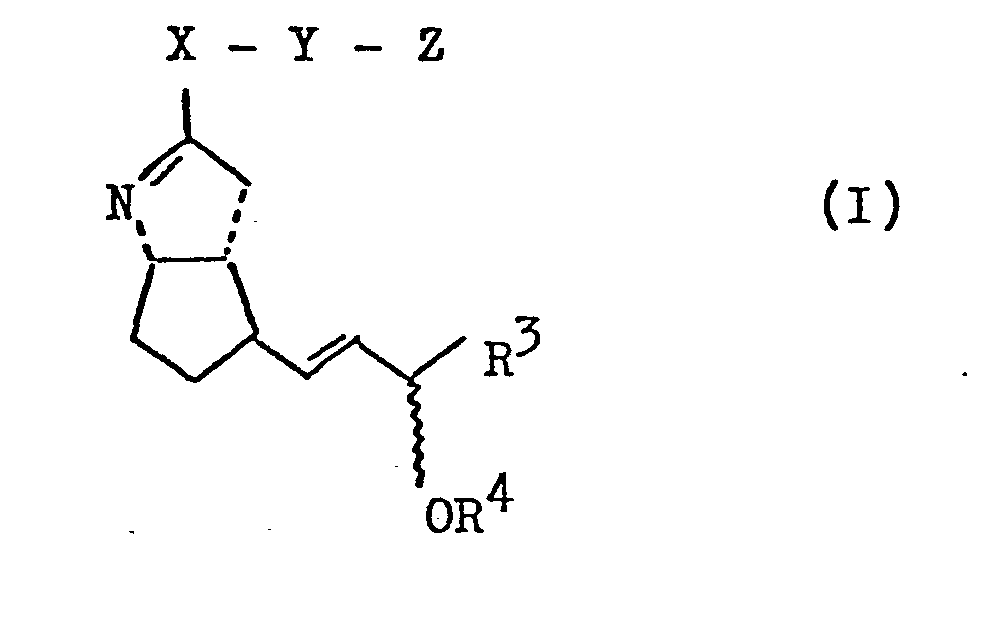
in welcher bedeuten
X ein Sauerstoff- oder Schwefelatom oder eine NH-Gruppe;
Y einen geradkettigen oder verzweigten Alkylenrest mit bis zu 8 Kohlenstoffatomen oder einen geradkettigen oder verzweigten ungesättigten aliphatischen Rest mit 3 bis 8 Kohlenstoffatomen oder einen cycloaliphatisehen Rest mit 3 bis 6 Kohlenstoffatomen oder einen Phenylenrest;
Z einen Rest der Formel -CO2R1, -CH20H oder CH2-N (R2)2 wobei bedeuten
R Wasserstoff oder einen geradkettigen oder verzweigten Alkylrest mit bis zu 8 Kohlenstoffatomen oder einen geradkettigen oder verzweigten ungesättigten aliphatischen Kohlenwasserstoffrest mit 3 bis 6 Kohlenstoffatomen oder einen cycloaliphatischen Kohlenwasserstoffrest mit 3 bis 7 Kohlenstoffatomen oder einen araliphatischen Kohlenwasserstoffrest mit 7 bis 9 Kohlenstoffatomen, oder ein physiologisch verträgliches Metall-, NH4-oder ein Ammoniumion, das sich von einem primären, sekundären oder tertiären Amin ableitet, oder ein Tetraalkylamnonium-Ion,
R2 Wasserstoff oder einen geradkettigen oder verzweigten aliphatischen Kohlenwasserstoffrest mit bis zu 5 C-Atomen oder R2-R2 zusammen auch eine -(CH2)n-Gruppe mit n = 3 bis 6
R 3 einen Arylrest, der im Kern 1- bis 3-fach substituiert sein kann mit Halogen, Trifluormethyl und/oder Alkyl oder Alkoxy mit je 1 bis 6 C-Atomen, oder einen cycloaliphatischen Rest mit 3 bis 8 Kohlenstoffatomen oder einen geradkettigen oder verzweigten Alkylrest mit bis zu 8 Kohlenstoffatomen oder einen geradkettigen oder verzweigten ungesättigten aliphatischen Kohlenwasserstoffrest mit 3 bis 8 Kohlenstoffatomen, wobei Alkyl- und aliphatischer Kohlenwasserstoffrest ihrerseits substituiert sein können mit
a) einem geradkettigen oder verzweigten Alkoxyrest mit bis zu 6 Kohlenstoffatomen oder einem geradkettigen oder verzweigten Alkenyloxy- oder Alkinyloxyrest mit 3 bis 6 Kohlenstoffatomen,
b) Halogen, Phenyl oder einem α- oder ß-Thienyl-oder α- oder ß-Furylrest, die ihrerseits im Kern 1- bis 3-fach substituiert sein können mit Halogen, Trifluormethyl und/ oder Alkyl oder Alkoxy mit je 1 bis 6 C-Atomen,
c) einem Phenoxy-, einem α- oder ß-Thienyloxyrest oder einem Cycloalkoxyrest mit 3 bis 7 Kohlenstoffatomen, wobei die genannten Reste ihrerseits im Kern 1- bis 3-fach substituiert sein können mit Halogen, Trifluormethyl und/oder Alkyl oder Alkyloxy mit je 1 bis 6 C-Atomen,
R4 Wasserstoff oder eine unter neutralen oder basischen Bedingungen leicht abspaltbare Schutzgruppe.
2. Verfahren zur Herstellung von Verbindungen der Formel I

in welcher bedeuten
X ein Sauerstoff- oder Schwefelatom oder eine NH- Gruppe;
Y einen geradkettigen oder verzweigten Alkylenrest mit bis zu 8 Kohlenstoffatomen oder einen geradkettigen. oder verzweigten ungesättigten aliphatischen Rest mit 3 bis 8 Kohlenstoffatomen oder einen cycloaliphatisehen Rest mit 3 bis 6 Kohlenstoffatomen oder einen Phenylenrest;
Z einen Rest der Formel -CO2R1, -CH20H oder CH2-N (R2)2 wobei bedeuten
R1 Wasserstoff oder einen geradkettigen oder verzweigten Alkylrest mit bis zu 8 Kohlenstoffatomen oder einen geradkettigen oder verzweigten ungesättigten aliphatischen Kohlenwasserstoffrest mit 3 bis 6 Kohlenstoffatomen oder einen cycloaliphatischen Kohlenwasserstoffrest mit 3 bis 7 Kohlenstoffatomen oder einen araliphatischen Kohlenwasserstoffrest mit 7 bis 9 Kohlenstoffatomen, oder ein physiologisch verträgliches Metall-, NH4-oder ein Ammoniumion, das sich von einem primären, sekundären oder tertiären Amin ableitet, oder ein Tetraalkylammonium-Ion,
R2 Wasserstoff oder einen geradkettigen oder verzweigten aliphatischen Kohlenwasserstoffrest mit bis zu 5 C-Atomen oder R2-R2 zusammen auch eine -(CH2)n-Gruppe mit n = 3 bis 6.
R3 einen Arylrest, der im Kern 1- bis 3-fach substituiert sein kann mit Halogen, Trifluormethyl und/ oder Alkyl oder Alkoxy mit je 1 bis 6 C-Atomen, oder einen cycloaliphatischen Rest mit 3 bis 8 Kohlenstoffatomen oder einen geradkettigen oder verzweigten Alkylrest mit bis zu 8 Kohlenstoffatomen oder einen geradkettigen oder verzweigten ungesättigten aliphatischen Kohlenwasserstoffrest mit 3 bis 8 Kohlenstoffatomen, wobei Alkyl- und aliphatischer Kohlenwasserstoffrest ihrerseits substituiert sein können mit
a) einem geradkettigen oder verzweigten Alkoxyrest mit bis zu 6 Kohlenstoffatomen oder einem geradkettigen oder verzweigten Alkenyloxy- oder Alkinyloxyrest mit 3 bis 6 Kohlenstoffatomen,
b) Halogen, Phenyl oder einem α- oder ß-Thienyl- oder α- oder ß-Furylrest, die ihrerseits im Kern 1-bis 3-fach substituiert sein können mit Halogen, Trifluormethyl und/ oder Alkyl oder Alkoxy mit je 1 bis 6 C-Atomen,
c) einem Phenoxy-, einem α- oder ß-Thienyloxyrest oder einem Cycloalkoxyrest mit 3 bis 7 Kohlenstoffatomen, wobei die genannten Reste ihrerseits im Kern 1- bis 3-fach substituiert sein können mit Halogen, Trifluormethyl und/oder Alkyl oder Alkyloxy mit je bis 6 C-Atomen,
R Wasserstoff oder eine unter neutralen oder basisehen Bedingungen leicht abspaltbare Schutzgruppe, dadurch gekennzeichnet, daß man
a) eine Verbindung der Formel XIV oder XV

worin R3 die oben genannte Bedeutung hat, R4 eine unter neutralen oder basischen Bedingungen leicht abspaltbare Schutzgruppe darstellt und X ein Sauerstoff- oder Schwefelatom bedeutet, mit einem Alkylhalogenid der Formel XVI

worin Hal Jod, Chlor oder Brom bedeutet und Y und Z die oben genannten Bedeutungen haben, alkyliert zu einer Verbindung der Formel I, worin X ein Sauerstoff- oder Schwefelatom darstellt, oder
b) eine Verbindung der Formel XVII

worin R3 und R4 die oben genannten Bedeutungen haben und R6 einen C1-4-Alkylrest bedeutet, mit einem Amin der Formel XVIII

worin Z und Y die oben genannten Bedeutungen haben, umsetzt zu einer Verbindung der Formel I, worin X den NH-Rest bedeutet,
c) gegebenenfalls in einer Verbindung der Formel I die Schutzgruppe R4 durch basisch katalysierte Hydrolyse abspaltet,
d) gegebenenfalls eine Verbindung der Formel I, in welcher Z den Rest CO2R1 bedeutet, wobei R1 - den oben genannten Rest jedoch nicht Wasserstoff oder ein Kation darstellt und R4 Wasserstoff bedeutet, zu einer Verbindung der Formel I verseift, in welcher Z den Rest CO2R1 darstellt, wobei R1 Wasserstoff oder ein physiologisch verträgliches Kation bedeutet,
e) gegebenenfalls eine Verbindung der Formel I, in welcher Z den Rest CO2R1 darstellt, wobei R1 Wasserstoff oder ein Kation bedeutet, zu einer Verbindung der Formel I verestert, worin Z den Rest CO2R1 darstellt, wobei R1 die zur Formel I genannten Bedeutungen hat, jedoch nicht Wasserstoff oder ein Kation bedeutet, und
f) gegebenenfalls in einer Verbindung der Formel I, in welcher Z den Rest CO2R1 darstellt, wobei R1 ein physiologisch verträglicher Kation darstellt, dieses Kation gegen ein anderes austauscht.
3. Verfahren zur Herstellung von Arzneimitteln, dadurch gekennzeichnet, daß man eine Verbindung der Formel I, gegebenenfalls mit üblichen pharmazeutischen Trägern und/oder Stabilisatoren, in eine therapeutisch geeignete Dareichungsform bringt.
4. Arzneimittel, gekennzeichnet durch den Gehalt an einer Verbindung der Formel I in Mischung mit einem pharmazeutisch üblichen Träger und/oder Stabilisator.
5. Verbindungen der Formel I zur Verwendung als Arzneimittel.
Applications Claiming Priority (2)
| Application Number | Priority Date | Filing Date | Title |
|---|---|---|---|
| DE19813100083 DE3100083A1 (de) | 1981-01-03 | 1981-01-03 | "11-desoxy-hetero-imino-prostacycline, verfahren zu ihrer herstellung und ihre verwendung als arzneimittel" |
| DE3100083 | 1981-01-03 |
Publications (1)
| Publication Number | Publication Date |
|---|---|
| EP0055851A1 true EP0055851A1 (de) | 1982-07-14 |
Family
ID=6122204
Family Applications (1)
| Application Number | Title | Priority Date | Filing Date |
|---|---|---|---|
| EP81110772A Withdrawn EP0055851A1 (de) | 1981-01-03 | 1981-12-24 | 11-Desoxy-hetero-imino-prostacycline, Verfahren zu ihrer Herstellung und ihre Verwendung als Arzneimittel |
Country Status (3)
| Country | Link |
|---|---|
| EP (1) | EP0055851A1 (de) |
| JP (1) | JPS57134464A (de) |
| DE (1) | DE3100083A1 (de) |
Families Citing this family (1)
| Publication number | Priority date | Publication date | Assignee | Title |
|---|---|---|---|---|
| EP2484655A1 (de) * | 2011-02-04 | 2012-08-08 | Vironova AB | Thionationsverfahren und Thionationsmittel |
Citations (1)
| Publication number | Priority date | Publication date | Assignee | Title |
|---|---|---|---|---|
| EP0034778A1 (de) * | 1980-02-23 | 1981-09-02 | Hoechst Aktiengesellschaft | Hetero-Imino-Prostacycline und Verfahren zu ihrer Herstellung |
-
1981
- 1981-01-03 DE DE19813100083 patent/DE3100083A1/de not_active Withdrawn
- 1981-12-24 EP EP81110772A patent/EP0055851A1/de not_active Withdrawn
- 1981-12-28 JP JP56210094A patent/JPS57134464A/ja active Pending
Patent Citations (1)
| Publication number | Priority date | Publication date | Assignee | Title |
|---|---|---|---|---|
| EP0034778A1 (de) * | 1980-02-23 | 1981-09-02 | Hoechst Aktiengesellschaft | Hetero-Imino-Prostacycline und Verfahren zu ihrer Herstellung |
Non-Patent Citations (1)
| Title |
|---|
| Angewandte Chemie, Int. ED. Band 19, Nr. 10, 1980, Verlag Chemie, Weinheim W. BARTMANN et al. "New Prostacyclin Analogues" sieten 819 bis 820 * |
Also Published As
| Publication number | Publication date |
|---|---|
| DE3100083A1 (de) | 1982-08-05 |
| JPS57134464A (en) | 1982-08-19 |
Similar Documents
| Publication | Publication Date | Title |
|---|---|---|
| NO170280B (no) | Analogifremgangsmaate for fremstilling av terapeutisk aktive sulfamatderivater | |
| DE3510978A1 (de) | Neue 9-halogenprostaglandine, verfahren zu ihrer herstellung und ihre verwendung als arzneimittel | |
| EP0034778B1 (de) | Hetero-Imino-Prostacycline und Verfahren zu ihrer Herstellung | |
| CH623809A5 (en) | Process for the preparation of pyrrolidones | |
| EP0563358B1 (de) | 9-substituierte bicyclo [3.3.0]octan-derivate verwendbar als txa2-antagonisten | |
| EP0255894B1 (de) | Pyrimidinderivate, deren Herstellung und Arzneimittel, die diese Derivate enthalten | |
| EP0062902B1 (de) | 2,3,4-Trinor-m-inter-phenylen-prostaglandin-Derivate, Verfahren zu deren Herstellung sowie diese Verbindungen enthaltende pharmazeutische Präparate | |
| DE2737808A1 (de) | 2-substituierte aryl-heterocyclische omega-pentanorprostaglandine | |
| EP0013955B1 (de) | Neue Analoga von Prostacyclin, deren Zwischenprodukte, Verfahren zu ihrer Herstellung sowie sie enthaltende Arzneimittel | |
| EP0098793A1 (de) | Neue Carbacyclinamide, Verfahren zu ihrer Herstellung und ihre Verwendung als Arzneimittel | |
| DE2850885A1 (de) | Bicyclische prostaglandine, verfahren zu ihrer herstellung und sie enthaltende pharmazeutische und veterinaermedizinische mittel | |
| EP0055851A1 (de) | 11-Desoxy-hetero-imino-prostacycline, Verfahren zu ihrer Herstellung und ihre Verwendung als Arzneimittel | |
| DE2524619A1 (de) | (dl)-13-substituierte sulfinyl- prostaglandinartige verbindungen und verfahren zu ihrer herstellung | |
| DE2914793A1 (de) | Pyrrolidincarboxaldehyd- und piperidincarboxaldehyd-derivate, verfahren zu ihrer herstellung und ihre verwendung als blutdrucksenkende wirkstoffe | |
| EP0019069A2 (de) | 6-Keto-PGE1- und PGI1-Derivate, Verfahren zu ihrer Herstellung und ihre Verwendung als Arzneimittel | |
| EP0065200B1 (de) | Delta-1-Pyrrolin-thiolactimäther und Verfahren zu ihrer Herstellung | |
| EP0063538B1 (de) | Neue Prostaglandine und Prostacycline, Verfahren zu ihrer Herstellung und ihre Verwendung als Arzneimittel | |
| DE2816692A1 (de) | Dem prostaglandin analoge verbindungen | |
| EP0080718B1 (de) | Inter-m-Phenylen-PGI2-Derivate, Verfahren zu deren Herstellung und diese Verbindungen enthaltende pharmazeutische Präparate | |
| EP0063338B1 (de) | 4-Oxo-PGI2-Derivate, Verfahren zu deren Herstellung sowie diese Verbindungen enthaltende pharmazeutische Präparate | |
| EP0098794B1 (de) | Neue Carbacycline, Verfahren zu ihrer Herstellung und ihre Verwendung als Arzneimittel | |
| EP0063323B1 (de) | 5-Substituierte 4-Oxo-PGI1-Derivate, Verfahren zu deren Herstellung sowie diese Verbindungen enthaltende pharmazeutische Präparate | |
| EP0142694A1 (de) | Neue 4-substituierte-delta 2-Imidazolinyl-Thioether und Verfahren zu ihrer Herstellung | |
| DE2701455A1 (de) | Neue cyclopentanverbindungen | |
| DE3742437A1 (de) | 5-hydroxi-pgf(pfeil abwaerts)1(pfeil abwaerts)(pfeil abwaerts)(alpha)(pfeil abwaerts)-1,5-lacton-derivate, verfahren zu deren herstellung sowie diese verbindungen enthaltende pharmazeutische praeparate |
Legal Events
| Date | Code | Title | Description |
|---|---|---|---|
| PUAI | Public reference made under article 153(3) epc to a published international application that has entered the european phase |
Free format text: ORIGINAL CODE: 0009012 |
|
| AK | Designated contracting states |
Designated state(s): AT BE CH DE FR GB IT NL |
|
| 17P | Request for examination filed |
Effective date: 19821005 |
|
| STAA | Information on the status of an ep patent application or granted ep patent |
Free format text: STATUS: THE APPLICATION HAS BEEN WITHDRAWN |
|
| 18W | Application withdrawn |
Withdrawal date: 19830418 |
|
| RIN1 | Information on inventor provided before grant (corrected) |
Inventor name: BECK, GERHARD, DR. Inventor name: RUPP, RICHARD HELMUT, DR. Inventor name: BARTMANN, WILHELM, DR. Inventor name: KNOLLE, JOCHEN, DR. |