EP0055908A2 - Bipolare Logikschaltung - Google Patents
Bipolare Logikschaltung Download PDFInfo
- Publication number
- EP0055908A2 EP0055908A2 EP81305942A EP81305942A EP0055908A2 EP 0055908 A2 EP0055908 A2 EP 0055908A2 EP 81305942 A EP81305942 A EP 81305942A EP 81305942 A EP81305942 A EP 81305942A EP 0055908 A2 EP0055908 A2 EP 0055908A2
- Authority
- EP
- European Patent Office
- Prior art keywords
- current
- transistor
- circuit
- resistance
- logic circuit
- Prior art date
- Legal status (The legal status is an assumption and is not a legal conclusion. Google has not performed a legal analysis and makes no representation as to the accuracy of the status listed.)
- Granted
Links
Images




Classifications
-
- H—ELECTRICITY
- H03—ELECTRONIC CIRCUITRY
- H03K—PULSE TECHNIQUE
- H03K19/00—Logic circuits, i.e. having at least two inputs acting on one output; Inverting circuits
- H03K19/01—Modifications for accelerating switching
- H03K19/013—Modifications for accelerating switching in bipolar transistor circuits
-
- H—ELECTRICITY
- H03—ELECTRONIC CIRCUITRY
- H03K—PULSE TECHNIQUE
- H03K19/00—Logic circuits, i.e. having at least two inputs acting on one output; Inverting circuits
- H03K19/02—Logic circuits, i.e. having at least two inputs acting on one output; Inverting circuits using specified components
- H03K19/08—Logic circuits, i.e. having at least two inputs acting on one output; Inverting circuits using specified components using semiconductor devices
- H03K19/082—Logic circuits, i.e. having at least two inputs acting on one output; Inverting circuits using specified components using semiconductor devices using bipolar transistors
Definitions
- This invention relates to a bipolar logic circuit.
- a diode D 1 has a forward voltage V of 0.4 (V) and transistors Q 1 to Q 3 have a V BE of 0.8V and a threshold voltage of 2.0 (V), for example.
- V forward voltage
- transistors Q 1 to Q 3 have a V BE of 0.8V and a threshold voltage of 2.0 (V), for example.
- an input voltage IN is higher than 2.0 (V)
- base current for the transistor Q 2 is supplied from the transistor Q 1 , the first stage transistor, to the transistor Q 2 , the next stage transistor, through the emitter of the transistor Q 1 .
- the transistor Q 2 is turned on, whereby base current for the transistor Q 3 , the output stage transistor, is supplied from the emitter of the transistor Q 2 .
- the transistor Q 3 is turned on.
- the collector potential of the transistor Q 2 falls, thus turning off another transistor Q 4 , another output stage transistor.
- a logic circuit of this type is fabricated in a high speed and high packing density integrated circuit, the waveform of the output OUT is deformed in some instances, being affected by parasitic or stray capacitance or the like.
- Fig. 2 is a representation of an oscilloscope waveform showing how the output OUT changes, with V CC as parameter. It also illustrates the waveform of the input IN.
- the polarity of the input IN is opposite to that of the output OUT.
- the cause of the one or more peaks PK can be attributed to many factors.
- One factor is the collector capacitance of a transistor used. More precisely, since the first stage transistor Q 1 has a large capacitance Cc, indicated in Fig. 1, an oscillation occurs in a loop A (indicated by a broken line) which feeds the output OUT back to the input terminal through the base and emitter of the transistors Q 1 and Q 2 and which is capable of amplifying current. In consequence, such peaks PK as are shown in Fig. 2 are generated.
- a circuit such as is shown in Fig. 3A.
- a plurality of transistors Q a - Qn have their emitters commonly connected and their collectors commonly connected, thus constituting a logical OR gate.
- the bases of the transistors Q - Q n are connected to receive respective inputs IN a -IN n .
- the output of the logical OR gate is coupled to a gate G.
- the integrated circuit will have a pattern such as is shown in Fig. 3B. That is, the transistors Q a -Q n will be formed in the same island L, which functions as a collector common to all the transistors Q a -Q n . Therefore it is natural that the capacitance C c of the common collector is very large.
- a collector electrode is indicated as C
- E represents an emitter electrode
- B designates a base electrode.
- the collector capacitance of the transistor Q 1 is large. In this event the waveform of the output OUT of the circuit of Fig. 1 has peaks PK.
- the input current supplied to the base is, as shown in Fig. 1, divided into a current I 1 flowing to the emitter and current I 2 flowing to the collector when the input IN rises from L level to H level. Since the collector capacitance C c of the transistor Q 1 is large, a time constant C c -R of the transistor Q 1 is large proportionally and the collector potential of the transistor Q 1 inevitably undergoes so called undershoot operation (indicated by US in Fig. 2).
- the base current of the transistor Q 1 so flows as to charge the capacitance C c .
- the transistor Q 1 will be turned off.
- the transistor Q 1 Once the transistor Q 1 is turned off, its collector potential starts rising again. In this way the collector potential falls and rises repeatedly. Consequently, a pulsating current flows through the emitter of the transistor Q 1 .
- the pulsating output current of the transistor Q 1 is amplified by the transistor Q 2 , which generates a larger pulsating current.
- the output current of the transistor Q 2 is then amplified by the transistor Q 3 , which generates a still larger pulsating current.
- the output current of the transistor Q 3 is amplified by the transistor Q 4 .
- the output OUT has a waveform similar to that of the emitter current of the transistor Q 1 . Obviously, it has several peaks PK.
- Fig. 4 of the accompanying drawings is a circuit diagram of a TTL circuit.
- the input threshold voltage V th of a TTL circuit is specified by the sum of base-emitter voltages V BE of transistors used in the circuit and/ or the forward voltage or voltages V F for a diode or diodes. No distinction is made hereinafter.
- the transistors Q 5 to Q 8 determine the input threshold voltage V th .
- the potential of a point R is the sum of the V BE 's of the transistors Q 6 to Q 8 (V BE6 to V BES ) and the input IN is at potential lower by one V BE (V BE5 ). Thereby, the level of output OUT is determined according to whether the input voltage is higher or lower than such input threshold voltage V th .
- the threshold voltage Vth of the TTL circuit shown in Fig. 4 is expressed by the following equation.
- the V BE 's of the transistors must be changed in order to change the threshold voltage.
- the V BE of a transistor is specified by the emitter size and is usually selected within the range from 0.7 to 0.8V.
- V th can be selected only within the range from 1.4 to 1.6V.
- a bipolar logic circuit characterised in that a resistance is provided in the current path in the circuit which determines the input threshold voltage of the circuit.
- An embodiment of the present invention can provide a which TTL or DTL circuit/has stable output waveforms, and can provide for the free setting of input threshold voltage.
- An embodiment of the present invention can provide a bipolar logic circuit which prevents disturbance of output waveforms as a result of the influence of adjacent circuits and parasitic capacitance and which provides a stable waveform.
- An embodiment of the present invention can provide a bipolar logic circuit with stable output waveforms by the addition of only a simplified circuit, and can provide for free selection of threshold voltage.
- An embodiment of the present invention provides a bipolar logic circuit comprising a-first current amplifying transistor and a second current amplifying transistor, the base of which is connected to the emitter of the first current amplifying transistor, and in which a resistor is inserted in the path between the emitter of the first current amplifying transistor and the base of the second current amplifying transistor.
- An embodiment of the present invention provides a bipolar logic circuit in which a current source is connected between the resistor and the lower voltage power source.
- Figs. 5 to 11 illustrate bipolar logic circuits so formed as to prevent disturbance of output waveforms.
- Fig. 5 shows a first embodiment of the present invention.
- the circuit of Fig. 5 is similar to the circuit of Fig. 1, except that resistances R S1 and R S2 are connected in series between the emitter of a transistor Q 1 and the base of a transistor Q 2 and except that resistances R S3 , RS4 and R S5 are connected in series between the emitter of the transistor Q 2 and the base of a transistor Q 3 .
- the resistances R S1 - R S5 are used to stabilise the output signals of the transistor Q 1 and Q 2 .
- only one resistance may be connected between the emitter of the current amplifying transistor Q 1 and the base of the next-stage transistor Q 2 and/or only one resistance may be connected between the emitter of the transistor Q 2 and the base of the next-stage transistor Q 3 .
- the resistances R S1 - R S5 are so connected as mentioned above in order to apply negative feedback on input signals to the transistors Q 2 , Q 2 and Q 3 .
- Fig. 6 illustrates the relationship between emitter current I E and base-emitter voltage V BE of the transistor Q 1 .
- a voltage drop is created at the resistance R S1 in the opposite direction to and in response to a variation ⁇ I E of the emitter current. This voltage drop suppresses varition of the emitter current I E .
- the emitter current I E changes by ⁇ I E
- the base-emitter voltage V BE changes by ⁇ V BE .
- the resistance R S1 reduces the change ⁇ V BE .
- the base-emitter voltage V BE varies in the directions of arrows Y and ultimately reaches a stable point K. That is, even if the transistor Q 1 generates a pulsating current, the resistance R S1 reduces the peaks of the pulsating current. All the other resistances R S2 - R S5 perform the same function as the resistance R S1 .
- the resistances of R S1 -R S5 must be determined according to the value of a current which flows in the circuit including the resistances R S1 -R S5 . For example, they are determined according to the impedance of the circuit including the resistances R S1 -R S5 so that the voltage V RS between the resistance R51 and the resistance R S5 may lie in the range 50mV to 100 mV. If the voltage V RS is normally 60mV, variation of the voltage V BE can be fully compensated even if the variation is so large that the emitter current I E would be reduced in about 1/10. Hence the emitter current I E can remain stable and constant.
- Fig. 7 shows the waveform of the output OUT which is generated in a case in which only the resistance R S1 is used and has a resistance of 110 ⁇ .
- the condition of input IN in Fig. 7 is similar to that illustrated in Fig. 2.
- In-Fig. 7 outputs OUT of different levels, with V CC as parameter, are shown. As is evident from Fig. 7, no peaks are generated after an under-shoot US has taken place.
- Fig. 8 illustrates a second embodiment of the present invention.
- a stabilising resistor R S is connected between the emitter of transistor Q 1 and the base of transistor Q 2 .
- Fig. 9 shows calculated values representing waveforms which the output OUT of the circuit may have when the stabilising resistor R S in Fig. 8 is set to various resistance values.
- the circuit when the resistance of the resistor R s is 0 ⁇ , (i.e. when no stabilising resistor is provided) the circuit generates an output OUT having the same waveform as the output OUT of the circuit shown in Fig. 1. It is a good assumption that this output OUT has two peaks PK 1 and PK 2 .
- the circuit When the resistance of the resistor R S is 50 ⁇ or 150 ⁇ , in an embodiment of the present invention, the circuit generates an output OUT which has no peaks whatsoever. Indeed the output OUT may be delayed due to the stabilising resistor R S . This delay is negligibly small and no problem is experienced in practice if the resistance of the resistor R S is about 10% or less of the impedance of 'the whole circuit.
- Fig. 10 shows a third embodiment of the present invention. This third embodiment is shown in two forms in Fig, 10, (a) and (b), respectively.
- the circuit of Fig. 10 (a) is a DTL circuit
- the circuit of Fig. 10 (b) is a TTL circuit.
- Each circuit uses two current stabilising resistors RS1 and R S'2 .
- the resistor R S1 is connected between the emitter of a transistor Q 1 and a resistor R'
- the resistor R S'2 is connected between the resistor R' and the base of a transistor Q 3 . It is not necessary to use both resistors R S1 and R S , 2 . Any one of them can serve to stabilise the output of either the DTL circuit or the TTL circuit to a sufficient degree.
- Fig. 11 shows a fourth embodiment of the present invention.
- the circuit of Fig. 11 is identical with the circuit of Fig. 5 except that a transistor Q 0 is connected to receive an input signal, in place of diode D 1 .
- a transistor Q 0 is connected to receive an input signal, in place of diode D 1 .
- all the current stabilising resistances R S1 -R S5 need not be used. It is sufficient to use at least one current stabilising resistance.
- the embodiments of the present invention described below utilise at least one stabilising resistance as explained above, and moreover are capable of providing for easy changing of the threshold voltage V th of a bipolar logic circuit such as a TTL or DTL circuit.
- a bipolar logic circuit such as a TTL or DTL circuit.
- Fig. 12 illustrates an embodiment of the present invention applied to a TTL circuit similar in form to that of Fig. 4.
- the threshold voltage V th of the TTL circuit of Fig. 12 can be changed over a wide range by means of a resistor R' S which is inserted in series into the path extending from the emitter of transistor Q 6 to the base of transistor Q 7 , called the phase splitter, and a constant current source IP 1 which supplies a current I.
- a voltage V RS generated by the resistor R S' is included in the input threshold voltage V th . Therefore, the input threshold voltage V th is expressed by the following equation:- and
- a base current for transistor Q 7 flows when the transistors Q87 Q9 turn on, but it is sufficiently low to be ignored for values near V th .
- the maximum value V th(max) of Vt h can be set as high as the power source voltage V cc , but is properly expressed by equation (5) when a margin V thM allowing the TTL circuit to be turned ON stably is considered.
- the operation of the TTL circuit of Fig. 12 is similar to the operation of the circuit of Fig. 1.
- the transistor Q 5 When input voltage to the transistor Q 5 >V th , the transistor Q 5 turns OFF, transistors Q 6 to Q 8 turn ON and Q 9 turns OFF. Thereby output OUT becomes L.
- the transistor Q 5 when input voltage. ⁇ V th , the transistor Q 5 turns ON, transistors Q 6 to Q 8 turns OFF and Q 9 becomes ON. Thereby output OUT becomes H.
- Figure 13 illustrates input/output transfer characteristics where the operating point of the output OUT, namely the threshold.voltage V th of the input IN, becomes small, with V th(min) of equation (4) considered as the lower limit, when the current I or resistance R S , is set small, and where the operating.point becomes large, on the other hand, with V th(max) of equation (5) considered as the upper limit, when the I or R S' is set large.
- D 3 is a speed-up diode which extracts base charges from the transistor Q 7
- D 4 is a level shift diode for output OUT.
- the resistor R S' inserted in the path extending from the emitter of the transistor Q 6 to the base of transistor Q 7 also plays a role, as explained above, as a stabilising resistor for the output waveform.
- Figure 14 is the schematic diagram indicating a modification of Fig. 12 in which the current source is realised with a very simple structure, the resistor R 1 .
- the input threshold voltage V th can be set merely by providing two resistors R S , and R 1 having selected resistance values.
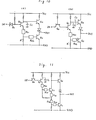
- the TTL circuit of Fig. 12 can be roughly divided into an input stage including transistors Q 5 , Q 6 and an invertor including transistors Q 7 to Q 9 .
- the input stage can take various modified forms as shown in Figs. 15 to F ig. 17, and the structure of the invertor is not limited only to that shown in Fig. 12.
- Fig. 15(a) to Fig. 17(a) are schematic circuit diagrams of the respective previously proposed TTL or DTL circuits which differ only in their input stages, whilst Fig. 15(b) to Fig. 17(b) are schematic diagrams of respective further embodiments of the present invention corresponding in general terms to circuits of Figures 15(a) to 17(a) respectively.
- Fig. 15(a) the transistor Q 6 (of Fig. 12 or Fig. 4) of the input stage is replaced by a diode D 5 and the forward voltage of the diode has effect.
- the resistor R S' is inserted between the cathode of diode D 5 and the base of transistor Q 77 whilst the resistor R 1 is inserted between the base and earth GND.
- the threshold voltage V th can be set as in the case of F ig. 14 merely be selecting the values of resistor R S , or R 1 .
- Fig. 16(a) the transistor Q 5 of Fig. 15(a) is replaced by a diode D 61 thus forming an input stage.
- connection of the resistors R S , and R 1 in the corresponding circuit embodying the present invention is the same as is shown in Fig. 15(b) as indicated in Fig. 16(b).
- Figure 17(a) illustrates an input stage in which the diodes D 5 , D 6 of Fig. 16(a) are replaced by one npn transistor Q 10 .
- the diode D 3 is omitted.
- the resistor R SI is connected between the collector of transistor Q 10 and the base of transistor Q 7 , whilst the resistor R 1 is connected between the said base and the earth GND.
- a resistor R S is inserted between the input stage and the invertor. Since the threshold voltage V th , as explained above, is determined by the total of the V BE 's within the circuit, as viewed from the input IN, it is possible to insert a corresponding resistor in a different location, so long as the location is selected to lie within the path which determines the threshold voltage V th .
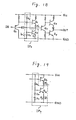
- the current source IP 1 shown in Fig. 12 can be realised most easily as a resistor but it goes without saying that the current source can naturally be formed by any other desirable method, for example as shown in Fig. 18 and Fig. 19.
- Fig. 18 illustrates another embodiment of the present invention, of which the circuit is identical to that of Fig. 14 except for the structure of the current source IP 2 bounded by broken lines in Fig. 18.
- current source IP 2 is formed by a diode D 6 and a resistor R 4 , which are connected in series between power source Vcc and GND, and a transistor Q 11 whose base is connected to the anode of the diode D 6 .
- the current I flowing through transistor Q 11 is the same as the current I D flowing through the diode D 6 in Fig. 18. Therefore, the current I is expressed by the following equation. (V is forward voltage of the diode D 6 )
- the current source IP 2 shown in Fig. 18 is useful in cases in which it is necessary to determine the input threshold voltage V th correctly.
- Fig. 19 illustrates another possible current source structure for use in embodiments of the present invention.
- the current source IP 3 of Fig. 1a is formed by a resistor R 4 , a resistor R 5 , two diodes D 7 and D 8 connected in series between power source Vcc and GND, and transistor Q 11 whose base is connected to the anode of the diode D 8 .
- the current source IP 3 can allow input threshold voltage V th to be set correctly in spite of fluctuation of power source voltage Vcc.
- An embodiment of the present invention can provide a bipolar logic circuit which generates an output signal having a stable waveform.
- a bipolar logic circuit embodying the present invention is useful because its output waveform is corrected or stabilised by the provision of as few as one current stabilising resistance.
- collector capacitance C C is no longer problematical, thus allowing various pattern arrangements.
- the input threshold voltage of a bipolar logic circuit embodying this invention can be changed or selected over a wide range using only a simple structure, thus improving the degree of freedom available in design.
- An embodiment of the present invention is uninfluenced by adjacent circuits even when it is a high density integration and high speed bipolar logic circuit, such as TTL or DTL, and disturbance of output waveforms due to parasitic capacitance is avoided, by the insertion of a resistor in the path between an emitter of a first current amplifying transistor and the base of a second amplifying transistor.
- .an embodiment of the present invention can provide a bipolar logic circuit of which the input threshold voltage can be selected over a wide range by applying a current to the said resistor using a current source.
- a bipolar logic circuit has a resistance (any of RS 1 to RS 5 ) connected between one current-amplifying transistor (Q 1 or Q 2 ) and a following current amplifying transistor (Q 2 or Q 3 , respectively).
- the resistance (RS 1 to RS S ) stabilises the output waveform of the circuit.
- Control of the current (I) delivered by the current source, and/or of the value of the resistance (RS 1 to RS 5 ) allows the input threshold voltage of the circuit to be selected.
Landscapes
- Engineering & Computer Science (AREA)
- Physics & Mathematics (AREA)
- Computer Hardware Design (AREA)
- Computing Systems (AREA)
- General Engineering & Computer Science (AREA)
- Mathematical Physics (AREA)
- Power Engineering (AREA)
- Logic Circuits (AREA)
Applications Claiming Priority (4)
| Application Number | Priority Date | Filing Date | Title |
|---|---|---|---|
| JP55184561A JPS57107639A (en) | 1980-12-25 | 1980-12-25 | Ttl integrated circuit |
| JP184561/80 | 1980-12-25 | ||
| JP188937/80 | 1980-12-26 | ||
| JP18893780A JPS57111126A (en) | 1980-12-26 | 1980-12-26 | Ttl gate |
Publications (3)
| Publication Number | Publication Date |
|---|---|
| EP0055908A2 true EP0055908A2 (de) | 1982-07-14 |
| EP0055908A3 EP0055908A3 (en) | 1982-12-08 |
| EP0055908B1 EP0055908B1 (de) | 1987-09-09 |
Family
ID=26502564
Family Applications (1)
| Application Number | Title | Priority Date | Filing Date |
|---|---|---|---|
| EP19810305942 Expired EP0055908B1 (de) | 1980-12-25 | 1981-12-18 | Bipolare Logikschaltung |
Country Status (3)
| Country | Link |
|---|---|
| EP (1) | EP0055908B1 (de) |
| DE (1) | DE3176442D1 (de) |
| IE (1) | IE53049B1 (de) |
Cited By (1)
| Publication number | Priority date | Publication date | Assignee | Title |
|---|---|---|---|---|
| EP0316884A3 (en) * | 1987-11-17 | 1990-09-05 | Fujitsu Ltd | Schmitt trigger circuit |
Family Cites Families (2)
| Publication number | Priority date | Publication date | Assignee | Title |
|---|---|---|---|---|
| US3317753A (en) * | 1964-06-29 | 1967-05-02 | Rca Corp | Threshold gate |
| US3979607A (en) * | 1975-10-23 | 1976-09-07 | Rca Corporation | Electrical circuit |
-
1981
- 1981-12-18 DE DE8181305942T patent/DE3176442D1/de not_active Expired
- 1981-12-18 EP EP19810305942 patent/EP0055908B1/de not_active Expired
- 1981-12-22 IE IE303381A patent/IE53049B1/en not_active IP Right Cessation
Cited By (1)
| Publication number | Priority date | Publication date | Assignee | Title |
|---|---|---|---|---|
| EP0316884A3 (en) * | 1987-11-17 | 1990-09-05 | Fujitsu Ltd | Schmitt trigger circuit |
Also Published As
| Publication number | Publication date |
|---|---|
| EP0055908B1 (de) | 1987-09-09 |
| IE53049B1 (en) | 1988-05-25 |
| DE3176442D1 (en) | 1987-10-15 |
| EP0055908A3 (en) | 1982-12-08 |
| IE813033L (en) | 1982-06-24 |
Similar Documents
| Publication | Publication Date | Title |
|---|---|---|
| EP0367612B1 (de) | Lastgesteuerter ECL-Treiber | |
| KR910006696B1 (ko) | 출력 인터페이스회로 | |
| EP0155720B1 (de) | Kaskadenstromquellenanordnung | |
| US4599521A (en) | Bias circuit with voltage and temperature compensation for an emitter coupled logic circuit | |
| US4694198A (en) | Schmitt trigger circuit | |
| EP0363298B1 (de) | Stromschalterlogikschaltung mit gesteuerten Ausgangssignalpegeln | |
| US4686395A (en) | Current switching type logic circuit | |
| JPS6027228A (ja) | 論理回路網 | |
| US5136183A (en) | Integrated comparator circuit | |
| EP0191165B1 (de) | Einstellbare Beschleunigungsschaltung für Gatter des TTL-Typs | |
| EP0316884B1 (de) | Schmitt-Trigger-Schaltung | |
| KR900006543B1 (ko) | 저전압 디지탈 투 아날로그 변환기용 입력레벨 시프트회로 | |
| EP0055908A2 (de) | Bipolare Logikschaltung | |
| JPH0828625B2 (ja) | 高スリューレート及び高帯域幅のユニティー・ゲイン増幅器 | |
| US4506176A (en) | Comparator circuit | |
| JP2911494B2 (ja) | 加速切換入力回路 | |
| EP0147635A2 (de) | Tor mit einer reduzierten Millerkapazität | |
| EP0072694A2 (de) | Transistorschaltung | |
| EP0440192A1 (de) | ECL-Schaltung in einem integrierten Halbleiterschaltkreis | |
| JPS59103427A (ja) | 信号レベル変換回路 | |
| US5262688A (en) | Operational amplifier circuit | |
| EP0054408B1 (de) | Logikschaltung | |
| KR930000482B1 (ko) | 고속 저전력 전류-제어 논리 시스템 | |
| JP3076129B2 (ja) | 差動増幅装置 | |
| US5068594A (en) | Constant voltage power supply for a plurality of constant-current sources |
Legal Events
| Date | Code | Title | Description |
|---|---|---|---|
| PUAI | Public reference made under article 153(3) epc to a published international application that has entered the european phase |
Free format text: ORIGINAL CODE: 0009012 |
|
| AK | Designated contracting states |
Designated state(s): DE FR GB NL |
|
| PUAL | Search report despatched |
Free format text: ORIGINAL CODE: 0009013 |
|
| AK | Designated contracting states |
Designated state(s): DE FR GB NL |
|
| 17P | Request for examination filed |
Effective date: 19830520 |
|
| GRAA | (expected) grant |
Free format text: ORIGINAL CODE: 0009210 |
|
| AK | Designated contracting states |
Kind code of ref document: B1 Designated state(s): DE FR GB |
|
| REF | Corresponds to: |
Ref document number: 3176442 Country of ref document: DE Date of ref document: 19871015 |
|
| ET | Fr: translation filed | ||
| PLBE | No opposition filed within time limit |
Free format text: ORIGINAL CODE: 0009261 |
|
| STAA | Information on the status of an ep patent application or granted ep patent |
Free format text: STATUS: NO OPPOSITION FILED WITHIN TIME LIMIT |
|
| 26N | No opposition filed | ||
| PGFP | Annual fee paid to national office [announced via postgrant information from national office to epo] |
Ref country code: GB Payment date: 19930921 Year of fee payment: 13 |
|
| PGFP | Annual fee paid to national office [announced via postgrant information from national office to epo] |
Ref country code: FR Payment date: 19931230 Year of fee payment: 13 |
|
| PGFP | Annual fee paid to national office [announced via postgrant information from national office to epo] |
Ref country code: DE Payment date: 19940224 Year of fee payment: 13 |
|
| PG25 | Lapsed in a contracting state [announced via postgrant information from national office to epo] |
Ref country code: GB Effective date: 19941218 |
|
| GBPC | Gb: european patent ceased through non-payment of renewal fee |
Effective date: 19941218 |
|
| PG25 | Lapsed in a contracting state [announced via postgrant information from national office to epo] |
Ref country code: FR Effective date: 19950831 |
|
| PG25 | Lapsed in a contracting state [announced via postgrant information from national office to epo] |
Ref country code: DE Effective date: 19950901 |
|
| REG | Reference to a national code |
Ref country code: FR Ref legal event code: ST |