EP0056210B1 - Verfahren zur fluoremetrischen Bestimmung von Endotoxinen, in diesem Verfahren zu verwendende Peptide, die eine fluorophore Gruppe tragen, und Verfahren zu deren Herstellung - Google Patents
Verfahren zur fluoremetrischen Bestimmung von Endotoxinen, in diesem Verfahren zu verwendende Peptide, die eine fluorophore Gruppe tragen, und Verfahren zu deren Herstellung Download PDFInfo
- Publication number
- EP0056210B1 EP0056210B1 EP81402087A EP81402087A EP0056210B1 EP 0056210 B1 EP0056210 B1 EP 0056210B1 EP 81402087 A EP81402087 A EP 81402087A EP 81402087 A EP81402087 A EP 81402087A EP 0056210 B1 EP0056210 B1 EP 0056210B1
- Authority
- EP
- European Patent Office
- Prior art keywords
- formula
- peptide
- amino
- group
- denotes
- Prior art date
- Legal status (The legal status is an assumption and is not a legal conclusion. Google has not performed a legal analysis and makes no representation as to the accuracy of the status listed.)
- Expired
Links
- 108090000765 processed proteins & peptides Proteins 0.000 title claims abstract description 66
- 238000000034 method Methods 0.000 title claims abstract description 33
- 239000002158 endotoxin Substances 0.000 title claims abstract description 32
- 102000004196 processed proteins & peptides Human genes 0.000 title claims abstract description 19
- 238000002360 preparation method Methods 0.000 title description 4
- 239000007788 liquid Substances 0.000 claims abstract description 26
- 239000006166 lysate Substances 0.000 claims abstract description 13
- 239000007864 aqueous solution Substances 0.000 claims abstract description 8
- 230000002209 hydrophobic effect Effects 0.000 claims abstract description 8
- 150000001450 anions Chemical class 0.000 claims abstract description 4
- 150000001412 amines Chemical class 0.000 claims description 15
- 150000001875 compounds Chemical class 0.000 claims description 11
- 238000006460 hydrolysis reaction Methods 0.000 claims description 9
- 241001529572 Chaceon affinis Species 0.000 claims description 8
- 230000007062 hydrolysis Effects 0.000 claims description 8
- YXKOGLINWAPXPE-UHFFFAOYSA-N 4-nitro-2,1,3-benzoxadiazol-7-amine Chemical group NC1=CC=C([N+]([O-])=O)C2=NON=C12 YXKOGLINWAPXPE-UHFFFAOYSA-N 0.000 claims description 7
- OXEUETBFKVCRNP-UHFFFAOYSA-N 9-ethyl-3-carbazolamine Chemical compound NC1=CC=C2N(CC)C3=CC=CC=C3C2=C1 OXEUETBFKVCRNP-UHFFFAOYSA-N 0.000 claims description 7
- 125000003277 amino group Chemical group 0.000 claims description 5
- 125000000896 monocarboxylic acid group Chemical group 0.000 claims description 5
- 238000003556 assay Methods 0.000 claims description 4
- PXXJHWLDUBFPOL-UHFFFAOYSA-N benzamidine Chemical compound NC(=N)C1=CC=CC=C1 PXXJHWLDUBFPOL-UHFFFAOYSA-N 0.000 claims description 4
- 230000002452 interceptive effect Effects 0.000 claims description 4
- 125000005931 tert-butyloxycarbonyl group Chemical group [H]C([H])([H])C(OC(*)=O)(C([H])([H])[H])C([H])([H])[H] 0.000 claims description 4
- XCTHZFGSVQBHBW-IUCAKERBSA-N Val-Leu Chemical compound CC(C)C[C@@H](C([O-])=O)NC(=O)[C@@H]([NH3+])C(C)C XCTHZFGSVQBHBW-IUCAKERBSA-N 0.000 claims description 3
- STTYIMSDIYISRG-UHFFFAOYSA-N Valyl-Serine Chemical compound CC(C)C(N)C(=O)NC(CO)C(O)=O STTYIMSDIYISRG-UHFFFAOYSA-N 0.000 claims description 3
- 125000000956 methoxy group Chemical group [H]C([H])([H])O* 0.000 claims description 3
- 108010036320 valylleucine Proteins 0.000 claims description 3
- ASOKPJOREAFHNY-UHFFFAOYSA-N 1-Hydroxybenzotriazole Chemical compound C1=CC=C2N(O)N=NC2=C1 ASOKPJOREAFHNY-UHFFFAOYSA-N 0.000 claims description 2
- 125000002252 acyl group Chemical group 0.000 claims description 2
- 125000001797 benzyl group Chemical group [H]C1=C([H])C([H])=C(C([H])=C1[H])C([H])([H])* 0.000 claims description 2
- 125000001584 benzyloxycarbonyl group Chemical group C(=O)(OCC1=CC=CC=C1)* 0.000 claims description 2
- 125000004435 hydrogen atom Chemical group [H]* 0.000 claims description 2
- 125000002496 methyl group Chemical group [H]C([H])([H])* 0.000 claims description 2
- UYWQUFXKFGHYNT-UHFFFAOYSA-N phenylmethyl ester of formic acid Natural products O=COCC1=CC=CC=C1 UYWQUFXKFGHYNT-UHFFFAOYSA-N 0.000 claims description 2
- 125000002088 tosyl group Chemical group [H]C1=C([H])C(=C([H])C([H])=C1C([H])([H])[H])S(*)(=O)=O 0.000 claims description 2
- GOJUJUVQIVIZAV-UHFFFAOYSA-N 2-amino-4,6-dichloropyrimidine-5-carbaldehyde Chemical group NC1=NC(Cl)=C(C=O)C(Cl)=N1 GOJUJUVQIVIZAV-UHFFFAOYSA-N 0.000 claims 2
- 125000001909 leucine group Chemical group [H]N(*)C(C(*)=O)C([H])([H])C(C([H])([H])[H])C([H])([H])[H] 0.000 claims 2
- 125000002987 valine group Chemical group [H]N([H])C([H])(C(*)=O)C([H])(C([H])([H])[H])C([H])([H])[H] 0.000 claims 2
- 239000002253 acid Substances 0.000 claims 1
- 125000003275 alpha amino acid group Chemical group 0.000 claims 1
- 125000006615 aromatic heterocyclic group Chemical group 0.000 claims 1
- 229910052739 hydrogen Inorganic materials 0.000 claims 1
- 239000001257 hydrogen Substances 0.000 claims 1
- 238000004519 manufacturing process Methods 0.000 claims 1
- -1 heteroaromatic amine Chemical class 0.000 abstract description 9
- 239000000243 solution Substances 0.000 description 16
- ZMXDDKWLCZADIW-UHFFFAOYSA-N N,N-Dimethylformamide Chemical compound CN(C)C=O ZMXDDKWLCZADIW-UHFFFAOYSA-N 0.000 description 9
- 239000000203 mixture Substances 0.000 description 9
- ROHFNLRQFUQHCH-YFKPBYRVSA-N L-leucine Chemical compound CC(C)C[C@H](N)C(O)=O ROHFNLRQFUQHCH-YFKPBYRVSA-N 0.000 description 8
- 108091005804 Peptidases Proteins 0.000 description 8
- 239000004365 Protease Substances 0.000 description 8
- KZSNJWFQEVHDMF-UHFFFAOYSA-N Valine Chemical compound CC(C)C(N)C(O)=O KZSNJWFQEVHDMF-UHFFFAOYSA-N 0.000 description 8
- 239000000047 product Substances 0.000 description 7
- 0 C1*2C1CCC2 Chemical compound C1*2C1CCC2 0.000 description 5
- 102100037486 Reverse transcriptase/ribonuclease H Human genes 0.000 description 5
- 230000005284 excitation Effects 0.000 description 5
- UJOBWOGCFQCDNV-UHFFFAOYSA-N 9H-carbazole Chemical compound C1=CC=C2C3=CC=CC=C3NC2=C1 UJOBWOGCFQCDNV-UHFFFAOYSA-N 0.000 description 4
- WHUUTDBJXJRKMK-VKHMYHEASA-N L-glutamic acid Chemical compound OC(=O)[C@@H](N)CCC(O)=O WHUUTDBJXJRKMK-VKHMYHEASA-N 0.000 description 4
- 229940024606 amino acid Drugs 0.000 description 4
- 235000001014 amino acid Nutrition 0.000 description 4
- 150000001413 amino acids Chemical class 0.000 description 4
- 239000000758 substrate Substances 0.000 description 4
- WHUUTDBJXJRKMK-UHFFFAOYSA-N Glutamic acid Natural products OC(=O)C(N)CCC(O)=O WHUUTDBJXJRKMK-UHFFFAOYSA-N 0.000 description 3
- KZSNJWFQEVHDMF-BYPYZUCNSA-N L-valine Chemical compound CC(C)[C@H](N)C(O)=O KZSNJWFQEVHDMF-BYPYZUCNSA-N 0.000 description 3
- ROHFNLRQFUQHCH-UHFFFAOYSA-N Leucine Natural products CC(C)CC(N)C(O)=O ROHFNLRQFUQHCH-UHFFFAOYSA-N 0.000 description 3
- OKKJLVBELUTLKV-UHFFFAOYSA-N Methanol Chemical compound OC OKKJLVBELUTLKV-UHFFFAOYSA-N 0.000 description 3
- 102000035195 Peptidases Human genes 0.000 description 3
- 230000003213 activating effect Effects 0.000 description 3
- 230000015572 biosynthetic process Effects 0.000 description 3
- 238000005119 centrifugation Methods 0.000 description 3
- PCKPVGOLPKLUHR-UHFFFAOYSA-N indoxyl Chemical group C1=CC=C2C(O)=CNC2=C1 PCKPVGOLPKLUHR-UHFFFAOYSA-N 0.000 description 3
- 230000035945 sensitivity Effects 0.000 description 3
- 239000004474 valine Substances 0.000 description 3
- JWAZRIHNYRIHIV-UHFFFAOYSA-N 2-naphthol Chemical compound C1=CC=CC2=CC(O)=CC=C21 JWAZRIHNYRIHIV-UHFFFAOYSA-N 0.000 description 2
- HSHNITRMYYLLCV-UHFFFAOYSA-N 4-methylumbelliferone Chemical compound C1=C(O)C=CC2=C1OC(=O)C=C2C HSHNITRMYYLLCV-UHFFFAOYSA-N 0.000 description 2
- HEDRZPFGACZZDS-UHFFFAOYSA-N Chloroform Chemical compound ClC(Cl)Cl HEDRZPFGACZZDS-UHFFFAOYSA-N 0.000 description 2
- QOSSAOTZNIDXMA-UHFFFAOYSA-N Dicylcohexylcarbodiimide Chemical compound C1CCCCC1N=C=NC1CCCCC1 QOSSAOTZNIDXMA-UHFFFAOYSA-N 0.000 description 2
- AGPKZVBTJJNPAG-WHFBIAKZSA-N L-isoleucine Chemical compound CC[C@H](C)[C@H](N)C(O)=O AGPKZVBTJJNPAG-WHFBIAKZSA-N 0.000 description 2
- MTCFGRXMJLQNBG-UHFFFAOYSA-N Serine Natural products OCC(N)C(O)=O MTCFGRXMJLQNBG-UHFFFAOYSA-N 0.000 description 2
- 238000004458 analytical method Methods 0.000 description 2
- 238000002189 fluorescence spectrum Methods 0.000 description 2
- 239000000499 gel Substances 0.000 description 2
- 230000002401 inhibitory effect Effects 0.000 description 2
- 229960000310 isoleucine Drugs 0.000 description 2
- AGPKZVBTJJNPAG-UHFFFAOYSA-N isoleucine Natural products CCC(C)C(N)C(O)=O AGPKZVBTJJNPAG-UHFFFAOYSA-N 0.000 description 2
- 239000011541 reaction mixture Substances 0.000 description 2
- JOXIMZWYDAKGHI-UHFFFAOYSA-N toluene-4-sulfonic acid Chemical compound CC1=CC=C(S(O)(=O)=O)C=C1 JOXIMZWYDAKGHI-UHFFFAOYSA-N 0.000 description 2
- XLYOFNOQVPJJNP-UHFFFAOYSA-N water Substances O XLYOFNOQVPJJNP-UHFFFAOYSA-N 0.000 description 2
- ADFXKUOMJKEIND-UHFFFAOYSA-N 1,3-dicyclohexylurea Chemical compound C1CCCCC1NC(=O)NC1CCCCC1 ADFXKUOMJKEIND-UHFFFAOYSA-N 0.000 description 1
- JBIJLHTVPXGSAM-UHFFFAOYSA-N 2-naphthylamine Chemical compound C1=CC=CC2=CC(N)=CC=C21 JBIJLHTVPXGSAM-UHFFFAOYSA-N 0.000 description 1
- NJDSTYFJGBQVAE-UHFFFAOYSA-N CNCCC(CN)=[N]=C Chemical compound CNCCC(CN)=[N]=C NJDSTYFJGBQVAE-UHFFFAOYSA-N 0.000 description 1
- 241000239218 Limulus Species 0.000 description 1
- 241000283973 Oryctolagus cuniculus Species 0.000 description 1
- 241001302191 Polyphemus Species 0.000 description 1
- VYPSYNLAJGMNEJ-UHFFFAOYSA-N Silicium dioxide Chemical compound O=[Si]=O VYPSYNLAJGMNEJ-UHFFFAOYSA-N 0.000 description 1
- 238000010521 absorption reaction Methods 0.000 description 1
- 238000000862 absorption spectrum Methods 0.000 description 1
- 125000002777 acetyl group Chemical group [H]C([H])([H])C(*)=O 0.000 description 1
- 230000010933 acylation Effects 0.000 description 1
- 238000005917 acylation reaction Methods 0.000 description 1
- 230000001580 bacterial effect Effects 0.000 description 1
- QRUDEWIWKLJBPS-UHFFFAOYSA-N benzotriazole Chemical compound C1=CC=C2N[N][N]C2=C1 QRUDEWIWKLJBPS-UHFFFAOYSA-N 0.000 description 1
- 239000012964 benzotriazole Substances 0.000 description 1
- 125000003236 benzoyl group Chemical group [H]C1=C([H])C([H])=C(C([H])=C1[H])C(*)=O 0.000 description 1
- 238000006664 bond formation reaction Methods 0.000 description 1
- 125000004744 butyloxycarbonyl group Chemical group 0.000 description 1
- 238000004737 colorimetric analysis Methods 0.000 description 1
- 238000007796 conventional method Methods 0.000 description 1
- 230000000694 effects Effects 0.000 description 1
- 238000001704 evaporation Methods 0.000 description 1
- 230000008020 evaporation Effects 0.000 description 1
- 238000001914 filtration Methods 0.000 description 1
- ZHNUHDYFZUAESO-UHFFFAOYSA-N formamide Substances NC=O ZHNUHDYFZUAESO-UHFFFAOYSA-N 0.000 description 1
- 235000013922 glutamic acid Nutrition 0.000 description 1
- 239000004220 glutamic acid Substances 0.000 description 1
- 230000023597 hemostasis Effects 0.000 description 1
- 230000003301 hydrolyzing effect Effects 0.000 description 1
- 230000000670 limiting effect Effects 0.000 description 1
- 229920006008 lipopolysaccharide Polymers 0.000 description 1
- 239000012299 nitrogen atmosphere Substances 0.000 description 1
- 238000010647 peptide synthesis reaction Methods 0.000 description 1
- 210000002381 plasma Anatomy 0.000 description 1
- 239000002244 precipitate Substances 0.000 description 1
- 125000002924 primary amino group Chemical group [H]N([H])* 0.000 description 1
- 125000006239 protecting group Chemical group 0.000 description 1
- 239000012460 protein solution Substances 0.000 description 1
- 150000003254 radicals Chemical group 0.000 description 1
- 230000002829 reductive effect Effects 0.000 description 1
- HSSLDCABUXLXKM-UHFFFAOYSA-N resorufin Chemical compound C1=CC(=O)C=C2OC3=CC(O)=CC=C3N=C21 HSSLDCABUXLXKM-UHFFFAOYSA-N 0.000 description 1
- 230000000717 retained effect Effects 0.000 description 1
- 210000002966 serum Anatomy 0.000 description 1
- 239000000741 silica gel Substances 0.000 description 1
- 229910002027 silica gel Inorganic materials 0.000 description 1
- 239000006228 supernatant Substances 0.000 description 1
- 238000003786 synthesis reaction Methods 0.000 description 1
- 238000004809 thin layer chromatography Methods 0.000 description 1
- 210000002700 urine Anatomy 0.000 description 1
Classifications
-
- C—CHEMISTRY; METALLURGY
- C07—ORGANIC CHEMISTRY
- C07K—PEPTIDES
- C07K5/00—Peptides containing up to four amino acids in a fully defined sequence; Derivatives thereof
- C07K5/04—Peptides containing up to four amino acids in a fully defined sequence; Derivatives thereof containing only normal peptide links
- C07K5/10—Tetrapeptides
- C07K5/1002—Tetrapeptides with the first amino acid being neutral
- C07K5/1005—Tetrapeptides with the first amino acid being neutral and aliphatic
-
- C—CHEMISTRY; METALLURGY
- C07—ORGANIC CHEMISTRY
- C07K—PEPTIDES
- C07K5/00—Peptides containing up to four amino acids in a fully defined sequence; Derivatives thereof
- C07K5/04—Peptides containing up to four amino acids in a fully defined sequence; Derivatives thereof containing only normal peptide links
- C07K5/08—Tripeptides
- C07K5/0802—Tripeptides with the first amino acid being neutral
- C07K5/0804—Tripeptides with the first amino acid being neutral and aliphatic
- C07K5/0808—Tripeptides with the first amino acid being neutral and aliphatic the side chain containing 2 to 4 carbon atoms, e.g. Val, Ile, Leu
-
- C—CHEMISTRY; METALLURGY
- C12—BIOCHEMISTRY; BEER; SPIRITS; WINE; VINEGAR; MICROBIOLOGY; ENZYMOLOGY; MUTATION OR GENETIC ENGINEERING
- C12Q—MEASURING OR TESTING PROCESSES INVOLVING ENZYMES, NUCLEIC ACIDS OR MICROORGANISMS; COMPOSITIONS OR TEST PAPERS THEREFOR; PROCESSES OF PREPARING SUCH COMPOSITIONS; CONDITION-RESPONSIVE CONTROL IN MICROBIOLOGICAL OR ENZYMOLOGICAL PROCESSES
- C12Q1/00—Measuring or testing processes involving enzymes, nucleic acids or microorganisms; Compositions therefor; Processes of preparing such compositions
- C12Q1/34—Measuring or testing processes involving enzymes, nucleic acids or microorganisms; Compositions therefor; Processes of preparing such compositions involving hydrolase
-
- G—PHYSICS
- G01—MEASURING; TESTING
- G01N—INVESTIGATING OR ANALYSING MATERIALS BY DETERMINING THEIR CHEMICAL OR PHYSICAL PROPERTIES
- G01N33/00—Investigating or analysing materials by specific methods not covered by groups G01N1/00 - G01N31/00
- G01N33/48—Biological material, e.g. blood, urine; Haemocytometers
- G01N33/50—Chemical analysis of biological material, e.g. blood, urine; Testing involving biospecific ligand binding methods; Immunological testing
- G01N33/52—Use of compounds or compositions for colorimetric, spectrophotometric or fluorometric investigation, e.g. use of reagent paper and including single- and multilayer analytical elements
-
- G—PHYSICS
- G01—MEASURING; TESTING
- G01N—INVESTIGATING OR ANALYSING MATERIALS BY DETERMINING THEIR CHEMICAL OR PHYSICAL PROPERTIES
- G01N33/00—Investigating or analysing materials by specific methods not covered by groups G01N1/00 - G01N31/00
- G01N33/48—Biological material, e.g. blood, urine; Haemocytometers
- G01N33/50—Chemical analysis of biological material, e.g. blood, urine; Testing involving biospecific ligand binding methods; Immunological testing
- G01N33/579—Chemical analysis of biological material, e.g. blood, urine; Testing involving biospecific ligand binding methods; Immunological testing involving limulus lysate
-
- C—CHEMISTRY; METALLURGY
- C12—BIOCHEMISTRY; BEER; SPIRITS; WINE; VINEGAR; MICROBIOLOGY; ENZYMOLOGY; MUTATION OR GENETIC ENGINEERING
- C12Q—MEASURING OR TESTING PROCESSES INVOLVING ENZYMES, NUCLEIC ACIDS OR MICROORGANISMS; COMPOSITIONS OR TEST PAPERS THEREFOR; PROCESSES OF PREPARING SUCH COMPOSITIONS; CONDITION-RESPONSIVE CONTROL IN MICROBIOLOGICAL OR ENZYMOLOGICAL PROCESSES
- C12Q2337/00—N-linked chromogens for determinations of peptidases and proteinases
-
- G—PHYSICS
- G01—MEASURING; TESTING
- G01N—INVESTIGATING OR ANALYSING MATERIALS BY DETERMINING THEIR CHEMICAL OR PHYSICAL PROPERTIES
- G01N2333/00—Assays involving biological materials from specific organisms or of a specific nature
- G01N2333/90—Enzymes; Proenzymes
- G01N2333/914—Hydrolases (3)
- G01N2333/948—Hydrolases (3) acting on peptide bonds (3.4)
Definitions
- the subject of the present invention is a process for the fluorimetric determination of endotoxins (lipopolysaccharides or bacterial lipopolyosides) using a peptide carrying a fluorophore.
- the invention also relates to new peptides carrying a fluorophore that can be used in said method and to their method of preparation.
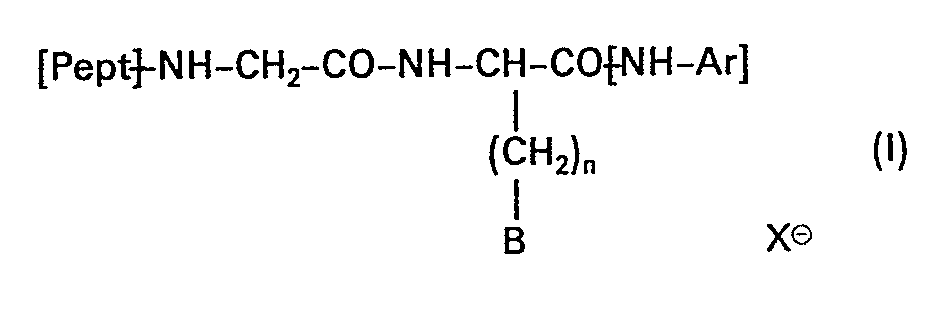
- the method according to the invention consists in bringing the liquid to be analyzed into contact with a lysate of limb ambocytes and an aqueous solution of a peptide of formula, at a temperature in the range 25 ° C-37 ° C.
- [Pept ⁇ denotes a hydrophobic peptide chain, n is equal to 1, 2, 3, 4 or 5
- B is a radical denoting hydrogen atoms or methyl groups
- fNH-Ar denotes the remainder of 3-amino-9-ethyl carbazole or of 7-amino-4-nitro-2-oxa-1,3-benzodiazole
- X ⁇ denotes an anion, to adjust if necessary the pH of the medium thus obtained to a value included in the range 6 to 7.5, and to measure by fluorimetry the heteroaromatic amine Ar-NH 2 formed.
- the fluorescent heteroaromatic amine Ar-NH 2 has a fluorescence spectrum strongly displaced by acylation of the amine.
- the fluorescence intensity at the emission wavelength of said free amine is at least 100 times greater than the fluorescence intensity, at this same wavelength, of the corresponding compounds of formula (1).
- the heteromatic fluorescent amine Ar-NH 2 is either amino-7 nitro-4 oxa-2 benzodiazole-1,3, or amino-3 ethyl-9 carbazole.
- the amino group NH 2 of the amino acid link when there is only one link, and the amino group NH 2 of the left amino acid link, when there are two links, may be unsubstituted or substituted by a tert-butyloxycarbonyl (t Boc), benzyloxycarbonyl, benzyl, tosyl or acyl group, in particular acetyl or benzoyl.
- t Boc tert-butyloxycarbonyl
- benzyloxycarbonyl benzyloxycarbonyl
- benzyl tosyl or acyl group
- acetyl or benzoyl in particular acetyl or benzoyl.
- the endotoxin assay method according to the invention is based on the property possessed by endotoxins of activating a protease contained in the lysate of horseshoe crab (Lumulus polyphemus). In the absence of endotoxin, the protease does not act on the peptides of formula (1). In the presence of endotoxin, the protease carries out the hydrolysis of the peptides of formula (1) with release on the one hand of the peptides of formula: in which [Peptt, n, B and X ⁇ have the same meanings as in formula (1), and on the other hand of the fluorescent heteroaromatic amine Ar-NH 2 .
- the activity of the protease is strictly proportional to the concentration of endotoxin in the medium.
- the concentration of the amine Ar-NH 2 released and the fluorescence intensity measured at the emission wavelength of said free amine are, at a determined time after the contact of the liquid containing the endotoxin , of the amulocyte lysate of the horseshoe crab and of the peptide of formula (1), strictly proportional to the endotoxin concentration of the medium.
- the liquid to be analyzed, the lysate of amebocytes from the horseshoe crab and the aqueous solution of the peptide of formula (1) are left in contact, after possible adjustment of the pH and at the temperature indicated above, for a predetermined time fixed in advance, which is preferably 10 minutes to 30 minutes, then a compound is added to the medium which stops the hydrolysis of the peptide of formula (1) without interfering with the fluorescence of the heteroaromatic amine Ar-NH 2 formed, and the heteroaromatic amine Ar-NH 2 formed is measured by measuring the fluorescence intensity at the emission wavelength of the free amine.
- the fluorescence intensity at the emission wavelength of the free amine is recorded continuously as soon as the liquid to be analyzed, the lysate of amulocytes of the horseshoe crab and the aqueous solution of the peptide of formula (1) and the possible adjustment of the pH, the temperature being kept constant at a value situated in the range defined above.
- This second way of operating known as the kinetic method, allows the duration of hydrolysis to be adjusted without trial and error to the quantity of endotoxins present in the sample to be analyzed.
- the method according to the invention makes it possible to assay the endotoxins in various liquids (aqueous injectable solutions of natural or synthetic products, protein solutions, physiological liquids such as serum, plasma, urine, etc.). It is particularly sensitive since it makes it possible to detect quantities of endotoxin of the order of a hundredth of a picogram. In addition, it allows quantitative determination of endotoxins with an accuracy of the order of a few percent, it is fast and can be made automatic. By way of comparison, the method based on measuring the time of formation of a gel does not make it possible to detect amounts of endotoxin less than 30 picograms, is relatively long (duration: 1 hour) and is only half quantitative.
- peptides of formula (1) for which fNH-Ar] is the remainder of 7-amino-4-nitro-2-oxa-1,3-benzodiazole or of 3-amino-9-ethyl-carbazole are new products and make part as such of the invention.
- these peptides of general formula (1) can be prepared by action, in the presence of an activating compound of the COOH group and of 1-hydroxy benzotriazole, of the fluorescent heteroaromatic amine Ar-NH 2 on the peptides of general formula: in which [Peptt, n, B and Xo have the same meanings as in formula (1).
- activating compounds of the COOH group which can be used, mention may be made of those mentioned by Konig W., Geiger R., Chem. Ber., 103, (1970), 788-798 and by Gross E., MeienhoferJ. (The peptides: Analysis, synthesis and biology. 1. Major methods of peptide bond formation, Academic Press, 1979, p. 435), and in particular dicyclohexylcarbodiimide.
- the peptides of general formula (II) are known products which can be obtained by the conventional methods of peptide synthesis (cf. Konig W., Geiger R. and Gross E., Meienhofer J., already cited).
- the reaction mixture is kept for 2 hours at 0 ° C., then 18 hours at 25 ° C.
- the di-cyclohexylurea formed is precipitated while maintaining the mixture at 0 ° C for 24 hours, then is separated by filtration or centrifugation.
- the dimethylformamide is removed by evaporation under deduced pressure.
- the residue obtained, which contains, in the raw state, the peptide carrying the fluorophore is dissolved in a mixture containing 80 parts by volume of chloroform, 20 parts by volume of methanol and 3 parts by volume of water, then is fixed on a column of silica gel, and eluted with the above mixture.
- the fractions containing the peptide carrying the fluorophore are evaporated under reduced pressure.
- the purity and identity of the product obtained are proven by, inter alia, analysis by thin layer chromatography and the absorption and fluorescence spectra. Unlike the amino-3 ethyl-9 carbazole which, when excited at 362 nm, exhibits a very intense fluorescence (200 fluorescence units) at 460 nm, the peptide of formula (IV), when excited at 362 nm, exhibits only very weak fluorescence (1 fluorescence unit) at 460 nm.
- the intensity of fluorescence obtained is compared with that provided, under the same conditions, by a reaction mixture containing 400 ⁇ l of the solution of the peptide of formula (IV), 200 ⁇ l of lysate of amulocytes of limule and 200 ⁇ l of a standard endotoxin solution at 50 pg / ml. From the comparison of the results, the endotoxin content of the liquid to be analyzed is deduced.
- Solutions A, B, C, D are prepared, the composition of which is indicated in the table below.
- Solutions A, B, C, D are then treated according to one or the other of the procedures a) and b) previously defined.
- the test with solution A makes it possible to detect the possible presence of proteases in the sample to be analyzed and to take this presence into account when assaying endotoxins in the sample (test with solution D).
- the test with solution C which contains an internal standard, makes it possible, by comparison with the tests relating to solutions B and D, to detect the possible presence in the sample to be analyzed of products inhibiting the hydrolysis of the peptide of formula ( IV) and take this presence into account when measuring endotoxins.
Landscapes
- Chemical & Material Sciences (AREA)
- Health & Medical Sciences (AREA)
- Life Sciences & Earth Sciences (AREA)
- Engineering & Computer Science (AREA)
- Organic Chemistry (AREA)
- Molecular Biology (AREA)
- Immunology (AREA)
- Biochemistry (AREA)
- Hematology (AREA)
- General Health & Medical Sciences (AREA)
- Biomedical Technology (AREA)
- Proteomics, Peptides & Aminoacids (AREA)
- Urology & Nephrology (AREA)
- Medicinal Chemistry (AREA)
- Microbiology (AREA)
- Biophysics (AREA)
- Physics & Mathematics (AREA)
- Genetics & Genomics (AREA)
- Biotechnology (AREA)
- Analytical Chemistry (AREA)
- Pathology (AREA)
- Cell Biology (AREA)
- General Physics & Mathematics (AREA)
- Wood Science & Technology (AREA)
- Zoology (AREA)
- Food Science & Technology (AREA)
- Bioinformatics & Cheminformatics (AREA)
- General Engineering & Computer Science (AREA)
- Investigating Or Analysing Biological Materials (AREA)
- Investigating Or Analysing Materials By The Use Of Chemical Reactions (AREA)
- Measuring Or Testing Involving Enzymes Or Micro-Organisms (AREA)
- Peptides Or Proteins (AREA)
Claims (14)


Wasserstoffatome oder Methylgruppen bezeichnen, -[NH-Ar] den 3-Amino-9-ethyl-carbazolrest oder den 7-Amino-4-nitro-2-oxabenzodiazol'-1,3-Rest bezeichnet und Xo ein Anion darstellt im Einstellen, falls erforderlich, des pH-Werts des so erhaltenen Mediums auf einen Wert im Bereich von 6 bis 7,5 und im fluorimetrischen Bestimmen des gebildeten heteroaromatischen Amins Ar-NH2besteht.




Priority Applications (1)
| Application Number | Priority Date | Filing Date | Title |
|---|---|---|---|
| AT81402087T ATE18563T1 (de) | 1981-01-09 | 1981-12-29 | Verfahren zur fluoremetrischen bestimmung von endotoxinen, in diesem verfahren zu verwendende peptide, die eine fluorophore gruppe tragen, und verfahren zu deren herstellung. |
Applications Claiming Priority (2)
| Application Number | Priority Date | Filing Date | Title |
|---|---|---|---|
| FR8100261 | 1981-01-09 | ||
| FR8100261A FR2497798A1 (fr) | 1981-01-09 | 1981-01-09 | Nouveaux peptides portant un fluorophore, procede pour leur preparation et leur application au dosage fluorimetrique des endotoxines |
Publications (3)
| Publication Number | Publication Date |
|---|---|
| EP0056210A2 EP0056210A2 (de) | 1982-07-21 |
| EP0056210A3 EP0056210A3 (en) | 1982-08-18 |
| EP0056210B1 true EP0056210B1 (de) | 1986-03-12 |
Family
ID=9253979
Family Applications (1)
| Application Number | Title | Priority Date | Filing Date |
|---|---|---|---|
| EP81402087A Expired EP0056210B1 (de) | 1981-01-09 | 1981-12-29 | Verfahren zur fluoremetrischen Bestimmung von Endotoxinen, in diesem Verfahren zu verwendende Peptide, die eine fluorophore Gruppe tragen, und Verfahren zu deren Herstellung |
Country Status (7)
| Country | Link |
|---|---|
| US (1) | US4576745A (de) |
| EP (1) | EP0056210B1 (de) |
| JP (1) | JPS57502266A (de) |
| AT (1) | ATE18563T1 (de) |
| DE (1) | DE3174109D1 (de) |
| FR (1) | FR2497798A1 (de) |
| WO (1) | WO1982002382A1 (de) |
Families Citing this family (11)
| Publication number | Priority date | Publication date | Assignee | Title |
|---|---|---|---|---|
| SE431228B (sv) * | 1981-12-17 | 1984-01-23 | Kenneth Soderhell | Sett att bestemma bakteriella endotoxin medelst profenoloxidashaltigt blodkroppslysat fran kreftdjur eller insekter och reagens herfor |
| DE3211932A1 (de) * | 1982-03-31 | 1983-10-13 | Hoechst Ag, 6230 Frankfurt | Chromophore peptide, verfahren zu ihrer herstellung, diese enthaltende mittel und ihre verwendung zum nachweis von dd-carboxypeptidasen |
| DE3428543A1 (de) * | 1984-08-02 | 1986-02-13 | Boehringer Mannheim Gmbh, 6800 Mannheim | Neue p-phenylendiamin-peptide und diese enthaltende reagenzien zur bestimmung von proteasen des blutgerinnungssystems |
| US4717658A (en) * | 1985-12-03 | 1988-01-05 | Miles Inc. | Gram negative bacteria screening method with horseshoe crab amebocyte lysate (LAL) |
| US4921941A (en) * | 1987-07-01 | 1990-05-01 | Schering Corporation | Orally active antiandrogens |
| GB8727796D0 (en) * | 1987-11-27 | 1987-12-31 | Radiometer Corporate Developme | Urine assay process and kit |
| JPH0711523B2 (ja) * | 1988-03-16 | 1995-02-08 | 和光純薬工業株式会社 | 試薬の調製方法 |
| DE68929334T2 (de) * | 1988-06-23 | 2005-08-18 | Associates of Cape Cod, Inc., Falmouth | Verfahren zumm Assay von Endotoxin-Konzentration |
| US5594113A (en) * | 1988-06-23 | 1997-01-14 | Associates Of Cape Cod, Inc. | Endotoxin binding and neutralizing protein and uses thereof |
| SE8904188D0 (sv) * | 1989-12-12 | 1989-12-12 | Kabivitrum Ab | Chromogenic substrate |
| JP5397229B2 (ja) | 2008-02-22 | 2014-01-22 | 和光純薬工業株式会社 | β−グルカン及び/又はエンドトキシン測定用基質並びに測定方法 |
Family Cites Families (3)
| Publication number | Priority date | Publication date | Assignee | Title |
|---|---|---|---|---|
| US4215047A (en) * | 1977-06-06 | 1980-07-29 | Ajinomoto Company Incorporated | 7-(Arginylamino)-4-methylcoumarins |
| SE7801373L (sv) * | 1978-02-07 | 1979-08-08 | Kabi Ab | Lett spjelkbara substrat for kvantifiering av proteaser |
| US4294923A (en) * | 1979-04-23 | 1981-10-13 | Smith Robert E | Substrates and method for determining enzymes |
-
1981
- 1981-01-09 FR FR8100261A patent/FR2497798A1/fr active Granted
- 1981-12-29 EP EP81402087A patent/EP0056210B1/de not_active Expired
- 1981-12-29 DE DE8181402087T patent/DE3174109D1/de not_active Expired
- 1981-12-29 AT AT81402087T patent/ATE18563T1/de not_active IP Right Cessation
-
1982
- 1982-01-06 US US06/422,976 patent/US4576745A/en not_active Expired - Fee Related
- 1982-01-06 JP JP57500243A patent/JPS57502266A/ja active Pending
- 1982-01-06 WO PCT/FR1982/000003 patent/WO1982002382A1/fr not_active Ceased
Also Published As
| Publication number | Publication date |
|---|---|
| EP0056210A2 (de) | 1982-07-21 |
| WO1982002382A1 (fr) | 1982-07-22 |
| FR2497798B1 (de) | 1984-03-30 |
| JPS57502266A (de) | 1982-12-23 |
| US4576745A (en) | 1986-03-18 |
| FR2497798A1 (fr) | 1982-07-16 |
| DE3174109D1 (en) | 1986-04-17 |
| ATE18563T1 (de) | 1986-03-15 |
| EP0056210A3 (en) | 1982-08-18 |
Similar Documents
| Publication | Publication Date | Title |
|---|---|---|
| Chen et al. | Fluorescence properties of o-phthaldialdehyde derivatives of amino acids | |
| Melchior Jr et al. | Ethoxyformylation of proteins. Reaction of ethoxyformic anhydride with. alpha.-chymotrypsin, pepsin, and pancreatic ribonuclease at pH 4 | |
| Miles | [41] Modification of histidyl residues in proteins by diethylpyrocarbonate | |
| Hummel | A modified spectrophotometric determination of chymotrypsin, trypsin, and thrombin | |
| JP4323429B2 (ja) | 新規なフルクトシルペプチドオキシダーゼとその利用 | |
| CN101948906B (zh) | 含有蛋白酶反应促进剂和/或色素稳定剂的试剂 | |
| EP0056210A2 (de) | Verfahren zur fluoremetrischen Bestimmung von Endotoxinen, in diesem Verfahren zu verwendende Peptide, die eine fluorophore Gruppe tragen, und Verfahren zu deren Herstellung | |
| US4167449A (en) | Composition and method for determining transferase and protease activity | |
| EP2155892B1 (de) | Neuartige peptidase-substrate | |
| CA2318461A1 (fr) | Derives d'indolamine dans la detection de peptidases de micro-organismes | |
| US4056519A (en) | Substrate for assay of plasmin | |
| EP0516532B1 (de) | Wasserlösliche Cumarderivate, ihre Herstellung und ihre Verwendung als Enzymsubstrate oder für die Zubereitung von solchen Substraten | |
| FR2669638A1 (fr) | Procede de preparation de dipeptides. | |
| EP1743034B1 (de) | Mittels botulinumtoxin a (bont/a) erkennbare peptidsubstrate und verwendung | |
| JPS62267281A (ja) | 7−フエニル酢酸−4−アルキル−クマリニルアミド、その製法及び使用法 | |
| EP1587793B1 (de) | Enzymsubstrate, diese enthaltende kulturmedien und deren verwendung zum nachweis von aminopeptidaseaktivität und/oder zur differenzierung von grampositiven bakterien von gramnegativenbakterien | |
| FR2509324A1 (fr) | Substrat pour doser la a-glutamyl transpeptidase et methode de dosage utilisant ce substrat | |
| Prusak et al. | A new fluorimetric method for the determination of 7-glutamyltransferase activity in blood serum | |
| Naik et al. | Kinetics and Spectral Properties of Carboxypeptidase A Labeled with the 2-Hydroxy-5-nitrobenzyl Reporter Group | |
| EP2459734B1 (de) | Neuartige peptidase-substrate | |
| EP2459735B1 (de) | Neuartige peptidase-substrate | |
| CH645992A5 (en) | Reagent for the fluorimetric determination of transferase and protease activity and its use for this determination | |
| TANKSLEY JR | Effect of gossypol on specific enzyme systems | |
| Robinson et al. | A spectrophotometric method for the analysis of pepsin | |
| FR2869908A1 (fr) | Substrat peptidique reconnu par la toxine botulique de type a, bont/a et son utilisation pour detecter et/ou doser ladite toxine ou des inhibiteurs de son activite |
Legal Events
| Date | Code | Title | Description |
|---|---|---|---|
| PUAI | Public reference made under article 153(3) epc to a published international application that has entered the european phase |
Free format text: ORIGINAL CODE: 0009012 |
|
| PUAL | Search report despatched |
Free format text: ORIGINAL CODE: 0009013 |
|
| 17P | Request for examination filed |
Effective date: 19820102 |
|
| AK | Designated contracting states |
Designated state(s): AT BE CH DE FR GB IT LI LU NL SE |
|
| AK | Designated contracting states |
Designated state(s): AT BE CH DE FR GB IT LI LU NL SE |
|
| RAP1 | Party data changed (applicant data changed or rights of an application transferred) |
Owner name: PHARMUKA LABORATOIRES |
|
| RAP1 | Party data changed (applicant data changed or rights of an application transferred) |
Owner name: MONSIGNY, MICHEL |
|
| RIN1 | Information on inventor provided before grant (corrected) |
Inventor name: MONSIGNY, MICHEL |
|
| RAP1 | Party data changed (applicant data changed or rights of an application transferred) |
Owner name: CENTRE NATIONAL DE LA RECHERCHE SCIENTIFIQUE (CNRS |
|
| RIN1 | Information on inventor provided before grant (corrected) |
Inventor name: MONSIGUY, MICHEL |
|
| GRAA | (expected) grant |
Free format text: ORIGINAL CODE: 0009210 |
|
| RAP1 | Party data changed (applicant data changed or rights of an application transferred) |
Owner name: CENTRE NATIONAL DE LA RECHERCHE SCIENTIFIQUE (CNRS |
|
| RIN1 | Information on inventor provided before grant (corrected) |
Inventor name: MONSIGNY, MICHEL |
|
| AK | Designated contracting states |
Kind code of ref document: B1 Designated state(s): AT BE CH DE FR GB IT LI LU NL SE |
|
| REF | Corresponds to: |
Ref document number: 18563 Country of ref document: AT Date of ref document: 19860315 Kind code of ref document: T |
|
| REF | Corresponds to: |
Ref document number: 3174109 Country of ref document: DE Date of ref document: 19860417 |
|
| ITF | It: translation for a ep patent filed | ||
| PGFP | Annual fee paid to national office [announced via postgrant information from national office to epo] |
Ref country code: AT Payment date: 19861223 Year of fee payment: 6 |
|
| PG25 | Lapsed in a contracting state [announced via postgrant information from national office to epo] |
Ref country code: LU Free format text: LAPSE BECAUSE OF NON-PAYMENT OF DUE FEES Effective date: 19861231 |
|
| PLBE | No opposition filed within time limit |
Free format text: ORIGINAL CODE: 0009261 |
|
| STAA | Information on the status of an ep patent application or granted ep patent |
Free format text: STATUS: NO OPPOSITION FILED WITHIN TIME LIMIT |
|
| 26N | No opposition filed | ||
| PGFP | Annual fee paid to national office [announced via postgrant information from national office to epo] |
Ref country code: NL Payment date: 19871231 Year of fee payment: 7 |
|
| PG25 | Lapsed in a contracting state [announced via postgrant information from national office to epo] |
Ref country code: GB Effective date: 19881229 Ref country code: AT Effective date: 19881229 |
|
| PG25 | Lapsed in a contracting state [announced via postgrant information from national office to epo] |
Ref country code: LI Effective date: 19881231 Ref country code: CH Effective date: 19881231 Ref country code: BE Effective date: 19881231 |
|
| BERE | Be: lapsed |
Owner name: CENTRE NATIONAL DE LA RECHERCHE SCIENTIFIQUE CNRS Effective date: 19881231 |
|
| PG25 | Lapsed in a contracting state [announced via postgrant information from national office to epo] |
Ref country code: NL Effective date: 19890701 |
|
| NLV4 | Nl: lapsed or anulled due to non-payment of the annual fee | ||
| GBPC | Gb: european patent ceased through non-payment of renewal fee | ||
| PG25 | Lapsed in a contracting state [announced via postgrant information from national office to epo] |
Ref country code: FR Free format text: LAPSE BECAUSE OF NON-PAYMENT OF DUE FEES Effective date: 19890831 |
|
| REG | Reference to a national code |
Ref country code: CH Ref legal event code: PL |
|
| PG25 | Lapsed in a contracting state [announced via postgrant information from national office to epo] |
Ref country code: DE Effective date: 19890901 |
|
| REG | Reference to a national code |
Ref country code: FR Ref legal event code: ST |
|
| PG25 | Lapsed in a contracting state [announced via postgrant information from national office to epo] |
Ref country code: SE Effective date: 19891230 |
|
| EUG | Se: european patent has lapsed |
Ref document number: 81402087.1 Effective date: 19900104 |