EP0056507A1 - Appareil et procédé pour la création d'images visuelles des mouvements de lèvres - Google Patents
Appareil et procédé pour la création d'images visuelles des mouvements de lèvres Download PDFInfo
- Publication number
- EP0056507A1 EP0056507A1 EP19810300211 EP81300211A EP0056507A1 EP 0056507 A1 EP0056507 A1 EP 0056507A1 EP 19810300211 EP19810300211 EP 19810300211 EP 81300211 A EP81300211 A EP 81300211A EP 0056507 A1 EP0056507 A1 EP 0056507A1
- Authority
- EP
- European Patent Office
- Prior art keywords
- speech sounds
- lip movements
- data
- coded
- memory device
- Prior art date
- Legal status (The legal status is an assumption and is not a legal conclusion. Google has not performed a legal analysis and makes no representation as to the accuracy of the status listed.)
- Granted
Links
- 230000033001 locomotion Effects 0.000 title claims abstract description 50
- 230000000007 visual effect Effects 0.000 title claims abstract description 32
- 238000000034 method Methods 0.000 title claims abstract description 14
- 239000002131 composite material Substances 0.000 abstract 1
- 239000004020 conductor Substances 0.000 description 5
- 238000010586 diagram Methods 0.000 description 3
- 238000012937 correction Methods 0.000 description 2
- 230000003287 optical effect Effects 0.000 description 2
- 241001465754 Metazoa Species 0.000 description 1
- 241001422033 Thestylus Species 0.000 description 1
- 238000010420 art technique Methods 0.000 description 1
- 230000005540 biological transmission Effects 0.000 description 1
- 230000002452 interceptive effect Effects 0.000 description 1
- 238000004519 manufacturing process Methods 0.000 description 1
- 239000000463 material Substances 0.000 description 1
Images

Classifications
-
- G—PHYSICS
- G03—PHOTOGRAPHY; CINEMATOGRAPHY; ANALOGOUS TECHNIQUES USING WAVES OTHER THAN OPTICAL WAVES; ELECTROGRAPHY; HOLOGRAPHY
- G03B—APPARATUS OR ARRANGEMENTS FOR TAKING PHOTOGRAPHS OR FOR PROJECTING OR VIEWING THEM; APPARATUS OR ARRANGEMENTS EMPLOYING ANALOGOUS TECHNIQUES USING WAVES OTHER THAN OPTICAL WAVES; ACCESSORIES THEREFOR
- G03B15/00—Special procedures for taking photographs; Apparatus therefor
- G03B15/08—Trick photography
-
- G—PHYSICS
- G09—EDUCATION; CRYPTOGRAPHY; DISPLAY; ADVERTISING; SEALS
- G09B—EDUCATIONAL OR DEMONSTRATION APPLIANCES; APPLIANCES FOR TEACHING, OR COMMUNICATING WITH, THE BLIND, DEAF OR MUTE; MODELS; PLANETARIA; GLOBES; MAPS; DIAGRAMS
- G09B5/00—Electrically-operated educational appliances
- G09B5/06—Electrically-operated educational appliances with both visual and audible presentation of the material to be studied
- G09B5/065—Combinations of audio and video presentations, e.g. videotapes, videodiscs, television systems
-
- G—PHYSICS
- G10—MUSICAL INSTRUMENTS; ACOUSTICS
- G10L—SPEECH ANALYSIS TECHNIQUES OR SPEECH SYNTHESIS; SPEECH RECOGNITION; SPEECH OR VOICE PROCESSING TECHNIQUES; SPEECH OR AUDIO CODING OR DECODING
- G10L21/00—Speech or voice signal processing techniques to produce another audible or non-audible signal, e.g. visual or tactile, in order to modify its quality or its intelligibility
- G10L21/06—Transformation of speech into a non-audible representation, e.g. speech visualisation or speech processing for tactile aids
-
- G—PHYSICS
- G10—MUSICAL INSTRUMENTS; ACOUSTICS
- G10L—SPEECH ANALYSIS TECHNIQUES OR SPEECH SYNTHESIS; SPEECH RECOGNITION; SPEECH OR VOICE PROCESSING TECHNIQUES; SPEECH OR AUDIO CODING OR DECODING
- G10L21/00—Speech or voice signal processing techniques to produce another audible or non-audible signal, e.g. visual or tactile, in order to modify its quality or its intelligibility
- G10L21/06—Transformation of speech into a non-audible representation, e.g. speech visualisation or speech processing for tactile aids
- G10L21/10—Transforming into visible information
- G10L2021/105—Synthesis of the lips movements from speech, e.g. for talking heads
Definitions
- This invention relates to an apparatus and a method for creating visual images responsive to analyzed speech data so as to produce a graphical representation of known type such as the lip movements corresponding to the speech sounds.
- the invention is particularly suitable for creating visual images of lip movements in films, video tapes, and on other recorded media.
- the speech sounds and the visual images are recorded simultaneously.
- the voice of the actor is recorded on the sound track at the same time that the actor is emitting speech sounds.
- the speech sounds of the sound track correspond to the lip movements emitted.
- the audio portion or sound track is to be in a language other than the original one spoken by the actor. Under such circumstances a new sound track in another language is "dubbed in", When this is done the speech sounds do not correspond to the lip movements, resulting in an audio- visual presentation that looks unreal or inferior.
- predetermined visual images such as lip movements are graphically created to correspond with speech sounds so that when the visual images and speech sounds are recorded on film, video tape or other media, the presentation (listening and viewing) will tend to be more real and interesting.
- the method and apparatus of the invention creates graphical images with a minimum of human effort by the unique utilization of computerized graphic techniques.
- a coded representation of speech sounds may be associated with lip movements from visual information, which lip movements do not correspond to the speech sound as in a "dubbed in" sound track of a motion picture.
- the coded representations of the speech sounds are transmitted to a data memory device (e.g. computer) for storage therein.
- coded data for creating a predetermined graphical representation (e.g. lip movements) corresponding to the speech sounds.
- This coded data or software is intended to respond to the coded data representing the speech sound so that the coded speech sounds can instruct the computer to send out graphical signals of new lip movements or other graphical representation corresponding to the speech sounds.
- the new lip movement data is thus transmitted to a graphic output device of known type from which a suitable graphic display may be created.
- This graphic display may be, for example, a video display or a film frame.
- the audio or speech portions may be combined in correlation with the graphical display.
- the encoding of the lip movements may be done on a frame-by-frame basis.
- the coded speech sounds may be extracted from the sound track, frame-by-frame, and sent to the computer.
- the computer may receive information as to the mouth position on each frame as well as information relating to the mouth shape of the actor.
- the entire film may be optically scanned on a frame-by-frame basis so that each frame with mouth location and mouth configuration data may be stored in the computer in digital form along with data in digital form as to the analyzed speech sounds.
- the data for the speech sounds causes the computer to send out the proper graphical output signals to the graphical output device corresponding to the particular speech sounds on the sound track of the film.
- the film is reconstructed to the extent necessary to change the mouth shape and lip movement or configuration to correspond with the speech sound.
- Typical apparatus of the present invention for creating visual images of lip movements comprises means such as a speech analyzer for providing a coded representation of speech sounds, a data memory device, means for transmitting said coded representation to said data memory device for storage therein, said data memory device having stored therein coded data for creating a graphical representation of lip movements corresponding to the speech sounds, a graphical output device, and means for transmitting to said graphical output device and under control of the coded speech representation data for the lip movements corresponding to the speech sounds.
- the apparatus further includes means for extracting the coded speech sounds from a series of frames of audio and visual information, means for transmitting said coded speech sounds to said data memory device on a frame-by-frame basis for storage therein on that basis. Means are also provided for optically scanning a series of frames in sequence to provide an encoded graphical image of the visual information. Means are provided for transmitting the encoded graphical image data to the computer or data memory device. Means are also provided for transmitting from the data memory device to the graphical output device the visual information data plus the data for the new lip movements which, in a corrected film, replace the old lip movements on the film.
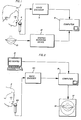
- Fig. 1 there is shown an arrangement for storing phoneme and graphic codes into a digital electronic computer.
- One set of codes represents the spoken phoneme of a language (e.g. the English language).
- the other codes are graphic codes representing visual images of lips of various mouth types such as male, female, cartoon animal, etc. together with orientations of the mouth such as front view, three quarter view, side view, etc.
- a person such as an actor pronounces phoneme into a voice encoder.
- the voice encoder translates the phoneme into a digital electronic phoneme code which is transmitted to a digital computer and stored in its memory.
- a phoneme for entire language may be thus be digitally coded.
- an artist may draw one or more mouth shapes.
- a programmer or electronic graphic scanning device encodes the artist's drawing into graphic code, which code is also sent for storage into the electronic digital computer. The foregoing is repeated until a complete set of phoneme and graphic codes are stored in digital form representing the basic phoneme code, standard mouth types and orientations, etc. as heretofore stated.
- a phoneme code is a representation of intensities of sound over a specified series of frequencies. The number of frequencies selected depends upon the degree of refinement of the code. Typically, three frequencies may be used to obtain three intensities (decibel level), one for each frequency..
- the English language has sixty-two phonemes. Thus, each of the sixty-two phonemes will be coded at three selected frequencies.
- an actor 2 speaking into a microphone 4 transmits phoneme to a voice encoder 6, which digitally encodes the phoneme and transmits the encoded data to a data memory device 8.
- This data memory device may be any known type of electronic digital computer. An example is the model PDP-11/40 of Digital Equipment Corporation, Maynard, Massachusetts. An artist may produce a drawing 10 of a particular lip or mouth shape. This drawing 10 may be graphically encoded by the programmer or electronic graphic scanning device 12. This unit may be of the type described in United States Patent 3,728,576 and is basically an optical scanner which encodes the artist's drawing into a graphic digital code for transmission to the computer 8.
- the voice encoder 6 previously referred to, is sometimes known as a speech encoder and is a known piece of equipment. Such a device is sold under the trademark SPEECH LAB and is obtainable from Heuristics, Inc. of Los Altos, California.
- the voice encoder 6 is a device which translates the phoneme into a digital electronic phoneme code.
- the artist will draw as many mouth or lip shapes 10 as may be necessary to encode the computer 8 with a complete phomeme language code and all of the mouth or lip shapes which may be needed for subsequent graphical reproduction.
- a keyboard 13 is used to select a mouth type (male, female, etc.) orientation front, three-quarter, side, etc. from among the previously encoded lip or mouth shapes.
- the keyboard is of a known type and may be, for example, a DEC LA 36 DECWRITER II and/or VT 50 DECSCOPE, products of Digital Equipment Corporation.
- the keyboard 13 is connected to the computer 8 so that the mouth type, mouth orientation, etc. may be chosen by keying in the desired selection.
- the actor 2 speaking in the microphone 24 reads a script or other voice material into the voice encoder 60 which is similar to the voice encoder 6 previously described.
- the voice encoder 60 translates the actor's voice into a digital electronic voice code.
- the output of the encoder 60 is transmitted to the computer 8.
- the data memory device or computer -8 Under control of the keyed-in signal from the keyboard 13 and of the encoded output of the voice encoder 60, the data memory device or computer -8 sends to display device 14 signals corresponding to the selected graphic code from its memory and also the phoneme code which most closely matches the actor's encoded voice.
- This display device 14 converts the graphic codes and size information into visual information such as the lip shape 16 shown.
- the visual images 16 can be recorded on film or other audio/visual media. For example, visual images may be enlarged into framed transparencies for overlay into compounded frames.
- the playback mode of the present arrangement shown in Fig. 2 allows a simple selection of mouth orientation and related mouth characteristics to be simply keyed into the computer which has the various mouth information stored therein.
- the voice of the actor 2 may be encoded to provide an input signal to the computer causing it to produce a phoneme output most nearly in accordance with the coded signals.
- the output from the computer 8 to the graphic display 14 is controlled by the keyboard input from the keyboard 13 and the output from the voice encoder 60, the latter of which determines the lip configuration shown in the graphic display 16.
- the coded input signal to the computer 8 will find or select the nearest phoneme code in accordance with known data comparison techniques. This code will then be used to provide a predetermined output to display device 14 that will. result in an "ah” shaped lip configuration in display 16.
- the graphic display device 14 is itself a known item and may, for example, be a RAMTEK G-100-A color display system, sold by Ramtek Corporation of Sunnydale, California.
- the original film is converted by an electronic graphic scanning device, such as is shown at 12 in Fig. 1 and previously described, into what is known as "pixels".
- pixels These are electronic digital codes representing the light intensity at a large number of points on the screen.
- the "pixels” are analyzed by an electronic digital computer by various algorithms to determine the size, orientation and/or location of features (in this case the mouth).
- the pixels in the local region of the located mouth can be replaced in the electronic digital computer memory by existing computer instructions of graphic codes from the sets of phoneme graphic codes stored previously therein and selected by the arrangement shown and described with respect to Fig. 2.
- the resulting pixels representing the original frame with mouth replaced can be sent to an electronic graphic display device for display and recording.
- Fig. 3 and Fig. 4 show a modified form of the invention which may be used for correcting the lip movements in motion picture film.
- Fig. 3 shows a motion picture film 20 having a series of frames 22, 24 etc. that include a visual image 25 and a sound track 26.
- the sound of the sound track may be a foreign language dubbed in, resulting in a sound which does not correspond to the lip movements in the various frames.
- the film 20 may be run through a sound projector 28 that embodies a frame counter that sends frame count output pulses over conductor 30 to the digital memory device or computer 8.
- the sound projector 28 also projects an image 32 on a suitable screen. This screen may be a so-called inter-active graphic tablet.
- a stylus 34 is used in a known fashion to select the mouth position relative to coordinates on the graphic tablet 32.
- the stylus 34 records the position of the mouth as a digital code and in accordance with known techniques transmits the information over a conductor 36 for storage into the computer 8. If needed, a keyboard 40 is also utilized whereby data representing a mouth type or other configuration may be transmitted to the computer 8.
- An encoder 6a may also be used and is of the type similar to the encoder 6 previously described. This encoder transmits the digital phoneme into the computer 8. Furthermore, the output sound from the projector as an electrical signal is transmitted over conductor 42 to the encoder 6a, such electrical signal representing the output sound from the sound track 26.
- the digital computer 8 has stored therein considerable data in coded form.
- This data consists of the frame counts, the mouth position, the phoneme code, and the mouth type.
- Fig. 4 the playback or output arrangement is shown.
- the images 25 of frames 22, 24 etc. are scanned by a conventional optical scanner 50 which sends a digitally coded image for each frame over conductor 52 to the computer 8.
- a pulse advance is supplied over conductor 54 to advance the frame of the film.
- the output signal from the digital computer 8 is sent to a graphic output device 56 which provides a graphic display 58 that has the new lip movements thereon.
- the graphic display 58 may be recombined with the sound in the form of a new film,videotape, or the like.
Landscapes
- Engineering & Computer Science (AREA)
- Physics & Mathematics (AREA)
- General Physics & Mathematics (AREA)
- Multimedia (AREA)
- Signal Processing (AREA)
- Health & Medical Sciences (AREA)
- Audiology, Speech & Language Pathology (AREA)
- Human Computer Interaction (AREA)
- Quality & Reliability (AREA)
- Acoustics & Sound (AREA)
- Computational Linguistics (AREA)
- Data Mining & Analysis (AREA)
- Business, Economics & Management (AREA)
- Educational Administration (AREA)
- Educational Technology (AREA)
- Theoretical Computer Science (AREA)
- Processing Or Creating Images (AREA)
Priority Applications (2)
| Application Number | Priority Date | Filing Date | Title |
|---|---|---|---|
| DE8181300211T DE3170907D1 (en) | 1981-01-19 | 1981-01-19 | Apparatus and method for creating visual images of lip movements |
| EP19810300211 EP0056507B1 (fr) | 1981-01-19 | 1981-01-19 | Appareil et procédé pour la création d'images visuelles des mouvements de lèvres |
Applications Claiming Priority (1)
| Application Number | Priority Date | Filing Date | Title |
|---|---|---|---|
| EP19810300211 EP0056507B1 (fr) | 1981-01-19 | 1981-01-19 | Appareil et procédé pour la création d'images visuelles des mouvements de lèvres |
Publications (2)
| Publication Number | Publication Date |
|---|---|
| EP0056507A1 true EP0056507A1 (fr) | 1982-07-28 |
| EP0056507B1 EP0056507B1 (fr) | 1985-06-12 |
Family
ID=8188188
Family Applications (1)
| Application Number | Title | Priority Date | Filing Date |
|---|---|---|---|
| EP19810300211 Expired EP0056507B1 (fr) | 1981-01-19 | 1981-01-19 | Appareil et procédé pour la création d'images visuelles des mouvements de lèvres |
Country Status (2)
| Country | Link |
|---|---|
| EP (1) | EP0056507B1 (fr) |
| DE (1) | DE3170907D1 (fr) |
Cited By (6)
| Publication number | Priority date | Publication date | Assignee | Title |
|---|---|---|---|---|
| EP0145683A1 (fr) * | 1983-09-30 | 1985-06-19 | Asea Ab | Robot industriel |
| GB2231246A (en) * | 1989-03-08 | 1990-11-07 | Kokusai Denshin Denwa Co Ltd | Converting text input into moving-face picture |
| GB2250405A (en) * | 1990-09-11 | 1992-06-03 | British Telecomm | Speech analysis and image synthesis |
| EP0721727A4 (fr) * | 1993-09-24 | 1997-03-05 | Readspeak Inc | Procede d'association de prononciations orales dont le sens correspond a la succession de mots dans l'oeuvre audiovisuelle |
| DE19627045A1 (de) * | 1996-07-05 | 1998-01-15 | Erf Verlag Gmbh | Verfahren zum Erzeugen von Bewegungsabläufen in Trickfilmen sowie Vorrichtung zur Durchführung des Verfahrens |
| WO2003023765A1 (fr) * | 2001-09-12 | 2003-03-20 | Ryshco Media Inc. | Procede et dispositif pour traiter des donnees audiovisuelles a l'aide d'une reconnaissance vocale |
Citations (2)
| Publication number | Priority date | Publication date | Assignee | Title |
|---|---|---|---|---|
| US3639691A (en) * | 1969-05-09 | 1972-02-01 | Perception Technology Corp | Characterizing audio signals |
| US3662374A (en) * | 1970-07-13 | 1972-05-09 | Computer Image Corp | Automatic generation of a mouth display and animation of the mouth in response to sound |
-
1981
- 1981-01-19 DE DE8181300211T patent/DE3170907D1/de not_active Expired
- 1981-01-19 EP EP19810300211 patent/EP0056507B1/fr not_active Expired
Patent Citations (2)
| Publication number | Priority date | Publication date | Assignee | Title |
|---|---|---|---|---|
| US3639691A (en) * | 1969-05-09 | 1972-02-01 | Perception Technology Corp | Characterizing audio signals |
| US3662374A (en) * | 1970-07-13 | 1972-05-09 | Computer Image Corp | Automatic generation of a mouth display and animation of the mouth in response to sound |
Non-Patent Citations (1)
| Title |
|---|
| British Kinematography Sound and Television, Vol. 53, No. 12, December 1971 A. KITCHING: "Computer Animation: Answer or Problem?" pages 436 to 441 * page 439, right-hand column, lines 62 to 72 * * |
Cited By (10)
| Publication number | Priority date | Publication date | Assignee | Title |
|---|---|---|---|---|
| EP0145683A1 (fr) * | 1983-09-30 | 1985-06-19 | Asea Ab | Robot industriel |
| GB2231246A (en) * | 1989-03-08 | 1990-11-07 | Kokusai Denshin Denwa Co Ltd | Converting text input into moving-face picture |
| GB2231246B (en) * | 1989-03-08 | 1993-06-30 | Kokusai Denshin Denwa Co Ltd | Picture synthesizing method and apparatus |
| GB2250405A (en) * | 1990-09-11 | 1992-06-03 | British Telecomm | Speech analysis and image synthesis |
| EP0721727A4 (fr) * | 1993-09-24 | 1997-03-05 | Readspeak Inc | Procede d'association de prononciations orales dont le sens correspond a la succession de mots dans l'oeuvre audiovisuelle |
| US5741136A (en) * | 1993-09-24 | 1998-04-21 | Readspeak, Inc. | Audio-visual work with a series of visual word symbols coordinated with oral word utterances |
| DE19627045A1 (de) * | 1996-07-05 | 1998-01-15 | Erf Verlag Gmbh | Verfahren zum Erzeugen von Bewegungsabläufen in Trickfilmen sowie Vorrichtung zur Durchführung des Verfahrens |
| DE19627045C2 (de) * | 1996-07-05 | 1998-05-28 | Erf Verlag Gmbh | Verfahren zum Erzeugen von Bewegungsabläufen in Trickfilmen sowie Vorrichtung zur Durchführung des Verfahrens |
| WO2003023765A1 (fr) * | 2001-09-12 | 2003-03-20 | Ryshco Media Inc. | Procede et dispositif pour traiter des donnees audiovisuelles a l'aide d'une reconnaissance vocale |
| US7343082B2 (en) | 2001-09-12 | 2008-03-11 | Ryshco Media Inc. | Universal guide track |
Also Published As
| Publication number | Publication date |
|---|---|
| DE3170907D1 (en) | 1985-07-18 |
| EP0056507B1 (fr) | 1985-06-12 |
Similar Documents
| Publication | Publication Date | Title |
|---|---|---|
| US4260229A (en) | Creating visual images of lip movements | |
| US6492990B1 (en) | Method for the automatic computerized audio visual dubbing of movies | |
| US4600281A (en) | Altering facial displays in cinematic works | |
| CA1263187A (fr) | Codage et synthese d'images | |
| US5623587A (en) | Method and apparatus for producing an electronic image | |
| US5729252A (en) | Multimedia program editing system and method | |
| US6351265B1 (en) | Method and apparatus for producing an electronic image | |
| US7109993B2 (en) | Method and system for the automatic computerized audio visual dubbing of movies | |
| US6067095A (en) | Method for generating mouth features of an animated or physical character | |
| US5657426A (en) | Method and apparatus for producing audio-visual synthetic speech | |
| US5734794A (en) | Method and system for voice-activated cell animation | |
| EP0674315A1 (fr) | Système et méthode de réenregistrement de signaux audiovisuels | |
| US20070165022A1 (en) | Method and system for the automatic computerized audio visual dubbing of movies | |
| JP2009533786A (ja) | 自分でできるフォトリアリスティックなトーキングヘッド作成システム及び方法 | |
| US20030049015A1 (en) | Universal guide track | |
| Steinmetz et al. | Multimedia fundamentals, Volume 1: Media coding and content processing | |
| KR102186607B1 (ko) | 증강현실을 통한 발레 공연 시스템 및 방법 | |
| EP0056507B1 (fr) | Appareil et procédé pour la création d'images visuelles des mouvements de lèvres | |
| CA1149961A (fr) | Systeme de creation d'images du mouvement des levres | |
| JP2795084B2 (ja) | 口形状画像合成方法及び装置 | |
| CA2129925A1 (fr) | Audio-synchronisation de sous-titres | |
| WO2001086350A1 (fr) | Systeme et procede de traduction d'un film | |
| CN121531206B (zh) | 基于时序解耦的数字人口型语音同步生成方法及系统 | |
| Theobald et al. | Towards a low bandwidth talking face using appearance models | |
| FR2749420A1 (fr) | Procede et dispositif de formation d'images animees d'un interlocuteur |
Legal Events
| Date | Code | Title | Description |
|---|---|---|---|
| PUAI | Public reference made under article 153(3) epc to a published international application that has entered the european phase |
Free format text: ORIGINAL CODE: 0009012 |
|
| AK | Designated contracting states |
Designated state(s): DE FR GB IT |
|
| 17P | Request for examination filed |
Effective date: 19830121 |
|
| ITF | It: translation for a ep patent filed | ||
| GRAA | (expected) grant |
Free format text: ORIGINAL CODE: 0009210 |
|
| AK | Designated contracting states |
Designated state(s): DE FR GB IT |
|
| REF | Corresponds to: |
Ref document number: 3170907 Country of ref document: DE Date of ref document: 19850718 |
|
| ET | Fr: translation filed | ||
| PLBE | No opposition filed within time limit |
Free format text: ORIGINAL CODE: 0009261 |
|
| STAA | Information on the status of an ep patent application or granted ep patent |
Free format text: STATUS: NO OPPOSITION FILED WITHIN TIME LIMIT |
|
| 26N | No opposition filed | ||
| ITTA | It: last paid annual fee | ||
| PGFP | Annual fee paid to national office [announced via postgrant information from national office to epo] |
Ref country code: FR Payment date: 19960109 Year of fee payment: 16 |
|
| PGFP | Annual fee paid to national office [announced via postgrant information from national office to epo] |
Ref country code: GB Payment date: 19960110 Year of fee payment: 16 |
|
| PGFP | Annual fee paid to national office [announced via postgrant information from national office to epo] |
Ref country code: DE Payment date: 19960126 Year of fee payment: 16 |
|
| PG25 | Lapsed in a contracting state [announced via postgrant information from national office to epo] |
Ref country code: GB Effective date: 19970119 |
|
| GBPC | Gb: european patent ceased through non-payment of renewal fee |
Effective date: 19970119 |
|
| PG25 | Lapsed in a contracting state [announced via postgrant information from national office to epo] |
Ref country code: FR Effective date: 19970930 |
|
| PG25 | Lapsed in a contracting state [announced via postgrant information from national office to epo] |
Ref country code: DE Effective date: 19971001 |
|
| REG | Reference to a national code |
Ref country code: FR Ref legal event code: ST |