EP0056530A2 - Procédé pour la formation d'une configuration en silicium polycristallin - Google Patents
Procédé pour la formation d'une configuration en silicium polycristallin Download PDFInfo
- Publication number
- EP0056530A2 EP0056530A2 EP81306155A EP81306155A EP0056530A2 EP 0056530 A2 EP0056530 A2 EP 0056530A2 EP 81306155 A EP81306155 A EP 81306155A EP 81306155 A EP81306155 A EP 81306155A EP 0056530 A2 EP0056530 A2 EP 0056530A2
- Authority
- EP
- European Patent Office
- Prior art keywords
- polycrystalline silicon
- impurity
- ion
- silicon layer
- process according
- Prior art date
- Legal status (The legal status is an assumption and is not a legal conclusion. Google has not performed a legal analysis and makes no representation as to the accuracy of the status listed.)
- Granted
Links
Images




Classifications
-
- H—ELECTRICITY
- H10—SEMICONDUCTOR DEVICES; ELECTRIC SOLID-STATE DEVICES NOT OTHERWISE PROVIDED FOR
- H10P—GENERIC PROCESSES OR APPARATUS FOR THE MANUFACTURE OR TREATMENT OF DEVICES COVERED BY CLASS H10
- H10P50/00—Etching of wafers, substrates or parts of devices
- H10P50/20—Dry etching; Plasma etching; Reactive-ion etching
- H10P50/26—Dry etching; Plasma etching; Reactive-ion etching of conductive or resistive materials
- H10P50/264—Dry etching; Plasma etching; Reactive-ion etching of conductive or resistive materials by chemical means
- H10P50/266—Dry etching; Plasma etching; Reactive-ion etching of conductive or resistive materials by chemical means by vapour etching only
- H10P50/267—Dry etching; Plasma etching; Reactive-ion etching of conductive or resistive materials by chemical means by vapour etching only using plasmas
- H10P50/268—Dry etching; Plasma etching; Reactive-ion etching of conductive or resistive materials by chemical means by vapour etching only using plasmas of silicon-containing layers
-
- H—ELECTRICITY
- H10—SEMICONDUCTOR DEVICES; ELECTRIC SOLID-STATE DEVICES NOT OTHERWISE PROVIDED FOR
- H10P—GENERIC PROCESSES OR APPARATUS FOR THE MANUFACTURE OR TREATMENT OF DEVICES COVERED BY CLASS H10
- H10P32/00—Diffusion of dopants within, into or out of wafers, substrates or parts of devices
- H10P32/30—Diffusion for doping of conductive or resistive layers
- H10P32/302—Doping polycrystalline silicon or amorphous silicon layers
-
- Y—GENERAL TAGGING OF NEW TECHNOLOGICAL DEVELOPMENTS; GENERAL TAGGING OF CROSS-SECTIONAL TECHNOLOGIES SPANNING OVER SEVERAL SECTIONS OF THE IPC; TECHNICAL SUBJECTS COVERED BY FORMER USPC CROSS-REFERENCE ART COLLECTIONS [XRACs] AND DIGESTS
- Y10—TECHNICAL SUBJECTS COVERED BY FORMER USPC
- Y10S—TECHNICAL SUBJECTS COVERED BY FORMER USPC CROSS-REFERENCE ART COLLECTIONS [XRACs] AND DIGESTS
- Y10S438/00—Semiconductor device manufacturing: process
- Y10S438/914—Doping
- Y10S438/924—To facilitate selective etching
Definitions
- the polycrystalline silicon layer which is doped with an impurity is etched by the process as described above, it becomes more difficult to obtain a pattern with high precision because the polycrystalline silicon which is doped with .an impurity has an etching rate by plasma etching higher than the polycrystalline silicon which is not doped with an impurity. Therefore, side etching of the pattern is increased.
- a polycrystalline silicon layer which is not doped with an impurity is first patterned and an impurity is then ion-implanted into the entire surface of the semiconductor device.
- the patterning precision is not remarkably improved, due to the side etching. Further, ions become implanted in areas other than the polycrystalline silicon pattern and these areas are damaged, thus degrading the performance characteristics of the semiconductor device. Anyhow etching is performed using a photoresist film as a mask, the polycrystalline silicon pattern may not satisfy the requirements of high precision.
- the present invention provides a process of forming a polycrystalline silicon layer which is selectively etched, without using the photoresist film.
- plasma etching herein means etching in a plasma which is energized with a radio frequency.
- the etching rate of the polycrystalline silicon layer by plasma etching varies in accordance with the conditions of the polycrystalline silicon layer. For example, as described above, the etching rate of the polycrystalline silicon which is doped with an impurity is higher than that of the polycrystalline silicon which is not doped with an impurity.
- Line A shows the etching rate of a polycrystalline silicon layer which is formed by the CVD method (with the temperature range of thermal decomposition of SiH 4 being 600 to 650°C) to a thickness of 300 nm and which is not doped with an impurity.
- Line B shows the etching rate of a polycrystalline silicon layer of 300 nm thickness in which arsenic of high concentration is uniformly doped at a dose of about 10 19 atoms/cm 3 .
- Line C shows the etching rate of a polycrystalline silicon layer of 300 nm thickness in which arsenic is ion-implanted at a dose of about 10 16 ions/cm 2 and at an acceleration voltage of 100 KeV.
- a dose of 0.5 x 10 16 to 2 x 10 16 ions/cm 2 is required.
- etching of-the layer is initiated simultaneously with the beginning of the plasma etching.
- the etching rate of the polycrystalline silicon layer in which an impurity is doped is higher than that of the polycrystalline silicon layer in which an impurity is not doped (indicated by line A).
- etching does not occur for about the first two minutes after plasma etching is initiated. Once etching begins, the etching rate is very high, which is about 400 nm/min.
- the present invention is based on this discovery. That is, when an impurity of high concentration is ion-implanted only into the region which is to remain as a pattern of the polycrystalline silicon layer, the ion-implanted region is not etched for about the first two minutes and other areas are etched when the poly- . crystalline silicon layer is entirely etched by plasma etching.
- the thickness of the polycrystalline silicon pattern which is used for the semiconductor device is about 300 nm, and the polycrystalline layer of about 300 nm thickness is etched for one and a half minutes in accordance with line A.
- the plasma etching in the conditions as described above is stopped between one and a half minutes to two minutes after the initiation of the etching, the areas other than the prospective pattern formation region are completely etched, while the prospective pattern formation region into which an impurity of high concentration is ion-implanted is not substantially etched to remain. Further, since the-photoresist film as a mask is not used, the side etching is substantially prevented and a polycrystalline silicon pattern with high precision may be obtained.
- the reason why the peculiar profile of etching rate occurs for the polycrystalline silicon layer which is ion-implanted with an impurity of high concentration may be that a metallic barrier layer is formed in the surface of the polycrystalline silicon layer with the implanted impurity ion. In order to accomplish this effect, an impurity must be ion-implanted into the polycrystalline silicon layer with high concentration.
- the ion-implantation with an impurity of low concentration merely increases the etching rate of the polycrystalline silicon layer, since the barrier layer as described above is not formed therein.
- High concentration here means a concentration of 10 15 ions/cm 2 or higher.
- the concentration. of the impurity is preferably about 10 16 ions/cm 2 .
- the impurities to be implanted include P, B, Ga and Sb as well as above-mentioned As. It is advantageous that a polycrystalline silicon pattern into which an impurity of high concentration is ion-implanted may be used as it is as a wiring or a resistance without further doping an impurity in order, to drop the electric resistance. Further, since the impurities as described above may be used for forming a p-type or n-type semiconductor, the polycrystalline silicon pattern into which one of these impurities is ion-implanted may be used as the diffusion source of the impurity when it is directly formed on the semiconductor substrate.
- the barrier layer for plasma etching must be formed in the surface of a polycrystalline silicon layer, . ions must be implanted to a certain extent that they do not reach deep portion of the polycrystalline silicon layer. For this purpose, when B whose atom radius is small is implanted, an acceleration voltage must be 100 KeV or less. When P, As, Ga or Sb whose atom radius is large is implanted, an acceleration voltage must be 200 KeV or less.
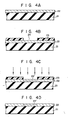
- a polycrystalline silicon layer 12 is formed on an insulating film which is formed on a semiconductor substrate 11 or directly on the semiconductor layer 11 (Fig. 3A).
- the application of the polycrystalline silicon pattern determines whether the polycrystalline sili - con pattern is directly formed on the semiconductor substrate 11 or on the semiconductor substrate 11 through the insulating film. For example, when the polycrystalline silicon pattern is used for the gate electrode or the wiring, the polycrystalline silicon pattern is formed on the semiconductor substrate 11 through the insulating film. On the other hand, when the polycrystalline silicon patterns used for the diffusion source which is used for forming an impurity region, the polycrystalline silicon pattern is directly formed on the semiconductor substrate 11. In both cases, the process is completely the same.
- a polycrystalline silicon layer 12 is formed by the CVD method in which Si produced by thermally decomposing a silane type compound such as SiH 4 , SiH 3 CL and SiH 2 CL 2 is deposited.
- the CVD method is well known in this field, and further description - thereof may be omitted here.
- the polycrystalline layer 12 may be formed to have n-type or p-type conductivity by introducing an impurity such as P and B into the thermal decomposition system of SiH 4 or the like in the CVD method.
- the impurity is usually introduced in the form of a compound such as PH 3 and B 2 H 6 .
- the doped polycrystalline silicon layer has a high etching rate as described above when plasma etching is performed, so that etching time is shortened and selectivity of the etching is high. Therefore, the polycrystalline silicon pattern with high precision is advantageously accomplished.
- a process of forming a doped polycrystalline silicon layer a process may be utilized in which an undoped polycrystalline silicon layer is first formed and an impurity is doped therein by thermal diffusion or the low concentration ion-implantation method.
- An impurity of high concentration is selectively ion-implanted into the prospective polycrystalline silicon pattern formation region, which is to remain as a polycrystalline silicon pattern.
- areas other than the prospective polycrystalline silicon pattern formation region are covered with a protective film 13 against ion-implantation.
- the ion-implantation of high concentration is performed, using the protective film 13 as a mask.
- the protective film 13 may be a photoresist film or a CVD-Si0 2 film. After the impurity of high concentration is ion-implanted, the protective film 13 is removed.
- the protective film 13 consisting of a photoresist film may be removed by carbonization with a hot sulfuric acid or the G 2 plasma asher treatment.
- the protective film consisting of a CVD-Si0 2 film is removed by hydrofluoric acid.
- the ion-implantation of high concentration can be selectively performed without using a protective film.
- concentration of the impurity, the acceleration voltage, and the kind of impurity are described above.
- Fig. 3C After the protective film 13 is removed (Fig. 3C) (although the protective film is not required when the ion beam implantation method is used), plasma etching is performed for the entire surface of the polycrystalline silicon layer. As described above, the region into which ions of high concentration are implanted is not etched for about the first two minutes, and other areas are etched from the beginning of the plasma etching. Therefore, only the desired polycrystalline silicon pattern 12' may remain as shown in Fig. 3D if the plasma etching is stopped at the time when the high concentration ion-implanted region (prospective polycrystalline silicon pattern region) is not substantially etched at all while the areas other than the region is completely etched. Before plasma etching is performed, the polycrystalline silicon layer must not be heated because the barrier layer against ion-implantation is then diffused and disappears.
- the etching time which is required for etching the polycrystalline silicon layer of 300 .nm thickness is one and a half minutes.
- plasma etching was, however, performed for one minute and forty-five seconds. This is because the possibility that the thickness of the polycrystalline silicon layer is not uniform and some areas may have a thickness of 300 nm or more was taken into consideration.
- the polycrystalline silicon pattern which was formed in the above example was not substantially affected by side etching and has high precision.
- the etching time may be half of the etching time of Example 1, that is, about 50 seconds.
- the obtained polycrystalline silicon pattern is more precise than that of in Example 1 because the arsenic-doped polycrystalline silicon layer 32 is used, so that the etching rate of this polycrystalline silicon layer 32, as shown by line B in Fig. 2, is higher than the polycrystalline silicon layer 22 of Example 1.
- the etching time is shortened and selective etching is easily performed.
- the impurity of high concentration is selectively ion-implanted, using a mask.
- selective ion-implantation is performed with an impurity of high concentration without using a mask.
- the polycrystalline silicon layer may be patterned without using PEP process, thus simplifying the process of forming the polycrystalline silicon pattern.
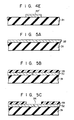
- Fig. 6 shows a structure of a semiconductor device in which a polycrystalline silicon pattern is used as a wiring (or resistance).
- a polycrystalline silicon pattern is used as a wiring (or resistance).
- an insulating film 41 is formed on a semiconductor substrate (not shown).
- a wiring (or resistance) 42 which is made of the polycrystalline silicon pattern is selectively formed.
- a passivation film 43 is formed to cover the entire surface.
- the arsenic ion is of a low penetration power, so that it does not pass through the polycrystalline silicon layer 55 into the p-type base region 52.
- arsenic ion is not implanted since it is interrupted by the film 56.
- the Si0 2 insulating film 56 and the polycrystalline silicon layer 55 act as buffer members, against the impact of ion-implantation, so that degradation of the surface conditions of the insulating film 53 and instability of the p-type base region 52 and the surface of the n-type silicon semiconductor substrate 51 are prevented.
- the areas of the polycrystalline silicon layer 55 other than the region into which arsenic ion was implanted (prospective emitter electrode formation region 55 1 ) were etched off to leave the desired polycrystalline silicon pattern (emitter electrode) 55' (Fig. 7F).
- the npn bipolar transistor is formed.
- the polycrystalline silicon pattern 55 1 whose electric resistance is dropped by doping arsenic may be used as the electrode of the n-type emitter region 58 without further treatment.
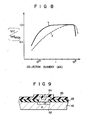
- the precision of the polycrystalline silicon pattern 55 1 which is used as the emitter electrode and which is formed in this example is very high. Further, as described above, since the silicon semiconductor substrate 51 is protectd from the impact of ion-implantation, the instability of the surface of the silicon substrate does not occur. As a result, the npn bipolar transistor which is accomplished in this example has more excellent electric characteristics than the npn bipolar transistor which is manufactured by the conventional process in which an undoped polycrystalline silicon layer is deposited by the CVD method and plasma etching is performed using a photoresist film as a mask to form a polycrystalline silicon pattern, and thereafter ion-implantation is performed on the entire surface of the transistor. Fig. 8 shows this difference.
- Curve Y shows electric characteristics of the npn transistor which is formed according to the process of the present invention
- curve X shows the electric characteristics of the npn transistor which is formed by the conventional process.
- the static forward current transfer ratio h FE is abruptly reduced where the collector current is small, while in the npn bipolar transistor by the process of the present invention, high h FE is maintained.
- the semiconductor device with the structure as shown in Fig. 9 may be obtained by the same process as Example 3 except that a p-type silicon semiconductor substrate 61 is used and a passivation film 65 covers the entire surface.
- a polycrystalline silicon pattern 64 with high precision is accomplished in the same manner as in. Example 3.
- This polycrystalline silicon pattern 64 is used as the diffusion source to form an impurity region 62 with stability. Further, the surface of the silicon semiconductor substrate 61 is not damaged.
- the process of forming a polycrystalline silicon pattern according to the present invention is apparently applicable to manufacture of MOS transistors, diodes and I 2 L .
- the polycrystalline silicon pattern is formed with high precision. As a result, an elaborate semiconductor device is accomplished. Further, when a semiconductor device is formed according to the process of the present invention, the semiconductor device with excellent electric characteristics is accomplished.
Landscapes
- Drying Of Semiconductors (AREA)
- Internal Circuitry In Semiconductor Integrated Circuit Devices (AREA)
Applications Claiming Priority (4)
| Application Number | Priority Date | Filing Date | Title |
|---|---|---|---|
| JP2988/81 | 1981-01-12 | ||
| JP56002988A JPS57117239A (en) | 1981-01-12 | 1981-01-12 | Forming method for polycrystal silicon pattern |
| JP53393/81 | 1981-04-09 | ||
| JP56053393A JPS57169236A (en) | 1981-04-09 | 1981-04-09 | Manufacture of semiconductor device |
Publications (3)
| Publication Number | Publication Date |
|---|---|
| EP0056530A2 true EP0056530A2 (fr) | 1982-07-28 |
| EP0056530A3 EP0056530A3 (en) | 1982-08-18 |
| EP0056530B1 EP0056530B1 (fr) | 1984-11-21 |
Family
ID=26336475
Family Applications (1)
| Application Number | Title | Priority Date | Filing Date |
|---|---|---|---|
| EP81306155A Expired EP0056530B1 (fr) | 1981-01-12 | 1981-12-24 | Procédé pour la formation d'une configuration en silicium polycristallin |
Country Status (3)
| Country | Link |
|---|---|
| US (1) | US4438556A (fr) |
| EP (1) | EP0056530B1 (fr) |
| DE (1) | DE3167348D1 (fr) |
Cited By (3)
| Publication number | Priority date | Publication date | Assignee | Title |
|---|---|---|---|---|
| GB2159327A (en) * | 1984-05-22 | 1985-11-27 | Hughes Aircraft Co | Method for forming thin conducting lines by ion implantation and preferential etching |
| WO1985005493A1 (fr) * | 1984-05-22 | 1985-12-05 | Hughes Aircraft Company | Procede de fabrication de lignes de silicium tres conductrices |
| EP0560575A1 (fr) * | 1992-03-09 | 1993-09-15 | Nec Corporation | Méthode de gravure d'un film de polysilicium sur un substrat de silicium mono-cristallin |
Families Citing this family (22)
| Publication number | Priority date | Publication date | Assignee | Title |
|---|---|---|---|---|
| US4575923A (en) * | 1983-04-06 | 1986-03-18 | North American Philips Corporation | Method of manufacturing a high resistance layer having a low temperature coefficient of resistance and semiconductor device having such high resistance layer |
| US4554728A (en) * | 1984-06-27 | 1985-11-26 | International Business Machines Corporation | Simplified planarization process for polysilicon filled trenches |
| US4573257A (en) * | 1984-09-14 | 1986-03-04 | Motorola, Inc. | Method of forming self-aligned implanted channel-stop and buried layer utilizing non-single crystal alignment key |
| US4616404A (en) * | 1984-11-30 | 1986-10-14 | Advanced Micro Devices, Inc. | Method of making improved lateral polysilicon diode by treating plasma etched sidewalls to remove defects |
| US4601778A (en) * | 1985-02-25 | 1986-07-22 | Motorola, Inc. | Maskless etching of polysilicon |
| US4772539A (en) * | 1987-03-23 | 1988-09-20 | International Business Machines Corporation | High resolution E-beam lithographic technique |
| US4880493A (en) * | 1988-06-16 | 1989-11-14 | The United States Of America As Represented By The United States Department Of Energy | Electronic-carrier-controlled photochemical etching process in semiconductor device fabrication |
| US5136344A (en) * | 1988-11-02 | 1992-08-04 | Universal Energy Systems, Inc. | High energy ion implanted silicon on insulator structure |
| US4927775A (en) * | 1989-03-06 | 1990-05-22 | Motorola Inc. | Method of fabricating a high performance bipolar and MOS device |
| SG71664A1 (en) * | 1992-04-29 | 2000-04-18 | Siemens Ag | Method for the production of a contact hole to a doped region |
| US5674784A (en) * | 1996-10-02 | 1997-10-07 | Taiwan Semiconductor Manufacturing Company, Ltd. | Method for forming polish stop layer for CMP process |
| US5851889A (en) * | 1997-01-30 | 1998-12-22 | Advanced Micro Devices, Inc. | Semiconductor gate conductor with a substantially uniform doping profile having minimal susceptibility to dopant penetration into the underlying gate dielectric |
| DE19710375C2 (de) * | 1997-03-13 | 2002-11-07 | Micronas Semiconductor Holding | Verfahren zum Herstellen von räumlich strukturierten Bauteilen |
| US6309975B1 (en) | 1997-03-14 | 2001-10-30 | Micron Technology, Inc. | Methods of making implanted structures |
| US6083803A (en) * | 1998-02-27 | 2000-07-04 | Micron Technology, Inc. | Semiconductor processing methods of forming a conductive projection and methods of increasing alignment tolerances |
| US6137145A (en) | 1999-01-26 | 2000-10-24 | Advanced Micro Devices, Inc. | Semiconductor topography including integrated circuit gate conductors incorporating dual layers of polysilicon |
| US6475841B1 (en) * | 2000-06-02 | 2002-11-05 | Motorola, Inc. | Transistor with shaped gate electrode and method therefor |
| DE10329389B4 (de) * | 2003-06-30 | 2006-05-04 | Advanced Micro Devices, Inc., Sunnyvale | Verfahren zur Kompensierung von Ätzratenungleichförmigkeiten mittels Ionenimplantation |
| KR100877256B1 (ko) * | 2007-05-21 | 2009-01-09 | 주식회사 동부하이텍 | 반도체 소자의 게이트 전극 형성 방법 |
| US9941125B2 (en) * | 2015-08-31 | 2018-04-10 | Taiwan Semiconductor Manufacturing Company, Ltd. | Method for integrated circuit patterning |
| CN110060934B (zh) * | 2019-04-30 | 2024-02-09 | 苏州固锝电子股份有限公司 | 一种四颗二极管集成芯片的制造工艺 |
| US11373878B2 (en) * | 2020-07-16 | 2022-06-28 | Taiwan Semiconductor Manufacturing Company Ltd. | Technique for semiconductor manufacturing |
Family Cites Families (9)
| Publication number | Priority date | Publication date | Assignee | Title |
|---|---|---|---|---|
| US3738880A (en) * | 1971-06-23 | 1973-06-12 | Rca Corp | Method of making a semiconductor device |
| GB1501114A (en) * | 1974-04-25 | 1978-02-15 | Rca Corp | Method of making a semiconductor device |
| DE2723933A1 (de) * | 1975-12-04 | 1978-06-01 | Siemens Ag | Verfahren zur erzeugung definierter boeschungswinkel bei einer aetzkante |
| US4092209A (en) * | 1976-12-30 | 1978-05-30 | Rca Corp. | Silicon implanted and bombarded with phosphorus ions |
| US4093503A (en) * | 1977-03-07 | 1978-06-06 | International Business Machines Corporation | Method for fabricating ultra-narrow metallic lines |
| CA1129118A (fr) * | 1978-07-19 | 1982-08-03 | Tetsushi Sakai | Dispositifs a semi-conducteurs et methode de fabrication |
| US4209350A (en) * | 1978-11-03 | 1980-06-24 | International Business Machines Corporation | Method for forming diffusions having narrow dimensions utilizing reactive ion etching |
| JPS55157234A (en) * | 1979-05-25 | 1980-12-06 | Chiyou Lsi Gijutsu Kenkyu Kumiai | Manufacture of semiconductor device |
| JPS5656636A (en) * | 1979-10-13 | 1981-05-18 | Mitsubishi Electric Corp | Processing method of fine pattern |
-
1981
- 1981-12-21 US US06/332,973 patent/US4438556A/en not_active Expired - Lifetime
- 1981-12-24 DE DE8181306155T patent/DE3167348D1/de not_active Expired
- 1981-12-24 EP EP81306155A patent/EP0056530B1/fr not_active Expired
Cited By (4)
| Publication number | Priority date | Publication date | Assignee | Title |
|---|---|---|---|---|
| GB2159327A (en) * | 1984-05-22 | 1985-11-27 | Hughes Aircraft Co | Method for forming thin conducting lines by ion implantation and preferential etching |
| WO1985005493A1 (fr) * | 1984-05-22 | 1985-12-05 | Hughes Aircraft Company | Procede de fabrication de lignes de silicium tres conductrices |
| EP0560575A1 (fr) * | 1992-03-09 | 1993-09-15 | Nec Corporation | Méthode de gravure d'un film de polysilicium sur un substrat de silicium mono-cristallin |
| US5593906A (en) * | 1992-03-09 | 1997-01-14 | Nec Corporation | Method of processing a polysilicon film on a single-crystal silicon substrate |
Also Published As
| Publication number | Publication date |
|---|---|
| EP0056530A3 (en) | 1982-08-18 |
| US4438556A (en) | 1984-03-27 |
| DE3167348D1 (en) | 1985-01-03 |
| EP0056530B1 (fr) | 1984-11-21 |
Similar Documents
| Publication | Publication Date | Title |
|---|---|---|
| US4438556A (en) | Method of forming doped polycrystalline silicon pattern by selective implantation and plasma etching of undoped regions | |
| US4299024A (en) | Fabrication of complementary bipolar transistors and CMOS devices with poly gates | |
| EP0139165B1 (fr) | Procédé pour la fabrication d'un dispositif à circuit intégré comportant des rainures d'isolation | |
| US4060427A (en) | Method of forming an integrated circuit region through the combination of ion implantation and diffusion steps | |
| EP0068154B1 (fr) | Circuit intégré comportant un substrat semiconducteur ayant des régions d'isolation et des régions électriquement conductrices | |
| EP0076942A2 (fr) | Procédé pour la fabrication de dispositifs à circuit intégré comportant des régions d'isolation diélectrique | |
| US4871685A (en) | Method of manufacturing bipolar transistor with self-aligned external base and emitter regions | |
| JPH07118478B2 (ja) | 横方向トランジスタの製造方法 | |
| US4412378A (en) | Method for manufacturing semiconductor device utilizing selective masking, etching and oxidation | |
| EP0224717B1 (fr) | Interrupteur de canal auto-aligné | |
| JPH0695524B2 (ja) | バイポーラ・トランジスタの製造方法 | |
| EP0052198B1 (fr) | Procédé de fabrication de dispositifs semiconducteurs utilisant des techniques d'autoalignement | |
| JPH0251255B2 (fr) | ||
| US4853342A (en) | Method of manufacturing semiconductor integrated circuit device having transistor | |
| EP0076106B1 (fr) | Procédé de fabrication d'un transistor bipolaire | |
| US4151006A (en) | Method of manufacturing a semiconductor device | |
| EP0314600B1 (fr) | Emetteur auto-aligné en polysilicium et structure de contact pour un transistor bipolaire haute performance | |
| GB1587398A (en) | Semiconductor device manufacture | |
| US4824794A (en) | Method for fabricating a bipolar transistor having self aligned base and emitter | |
| JP3098848B2 (ja) | 自己整合型プレーナモノリシック集積回路縦型トランジスタプロセス | |
| EP0421507B1 (fr) | Méthode de fabrication d'un transistor bipolaire | |
| EP0017377B1 (fr) | Procédé de fabrication de transistors bipolaires isolés | |
| EP0263504B1 (fr) | Procédé pour la fabrication d'un dispositif semi-conducteur à haute tension de claquage | |
| US4435225A (en) | Method of forming self-aligned lateral bipolar transistor | |
| US4669178A (en) | Process for forming a self-aligned low resistance path in semiconductor devices |
Legal Events
| Date | Code | Title | Description |
|---|---|---|---|
| PUAI | Public reference made under article 153(3) epc to a published international application that has entered the european phase |
Free format text: ORIGINAL CODE: 0009012 |
|
| PUAL | Search report despatched |
Free format text: ORIGINAL CODE: 0009013 |
|
| AK | Designated contracting states |
Designated state(s): DE GB NL |
|
| AK | Designated contracting states |
Designated state(s): DE GB NL |
|
| 17P | Request for examination filed |
Effective date: 19820112 |
|
| RAP1 | Party data changed (applicant data changed or rights of an application transferred) |
Owner name: KABUSHIKI KAISHA TOSHIBA |
|
| GRAA | (expected) grant |
Free format text: ORIGINAL CODE: 0009210 |
|
| AK | Designated contracting states |
Designated state(s): DE GB NL |
|
| REF | Corresponds to: |
Ref document number: 3167348 Country of ref document: DE Date of ref document: 19850103 |
|
| PLBE | No opposition filed within time limit |
Free format text: ORIGINAL CODE: 0009261 |
|
| STAA | Information on the status of an ep patent application or granted ep patent |
Free format text: STATUS: NO OPPOSITION FILED WITHIN TIME LIMIT |
|
| 26N | No opposition filed | ||
| REG | Reference to a national code |
Ref country code: GB Ref legal event code: 746 |
|
| PGFP | Annual fee paid to national office [announced via postgrant information from national office to epo] |
Ref country code: GB Payment date: 19951215 Year of fee payment: 15 |
|
| PGFP | Annual fee paid to national office [announced via postgrant information from national office to epo] |
Ref country code: DE Payment date: 19951222 Year of fee payment: 15 |
|
| PGFP | Annual fee paid to national office [announced via postgrant information from national office to epo] |
Ref country code: NL Payment date: 19951230 Year of fee payment: 15 |
|
| PG25 | Lapsed in a contracting state [announced via postgrant information from national office to epo] |
Ref country code: GB Effective date: 19961224 |
|
| PG25 | Lapsed in a contracting state [announced via postgrant information from national office to epo] |
Ref country code: NL Effective date: 19970701 |
|
| GBPC | Gb: european patent ceased through non-payment of renewal fee |
Effective date: 19961224 |
|
| NLV4 | Nl: lapsed or anulled due to non-payment of the annual fee |
Effective date: 19970701 |
|
| PG25 | Lapsed in a contracting state [announced via postgrant information from national office to epo] |
Ref country code: DE Effective date: 19970902 |