EP0056597B1 - Objet céramique préformé, thermiquement isolant et son procédé de fabrication - Google Patents
Objet céramique préformé, thermiquement isolant et son procédé de fabrication Download PDFInfo
- Publication number
- EP0056597B1 EP0056597B1 EP82100143A EP82100143A EP0056597B1 EP 0056597 B1 EP0056597 B1 EP 0056597B1 EP 82100143 A EP82100143 A EP 82100143A EP 82100143 A EP82100143 A EP 82100143A EP 0056597 B1 EP0056597 B1 EP 0056597B1
- Authority
- EP
- European Patent Office
- Prior art keywords
- shaped body
- mixture
- sintering
- burnt away
- carbon
- Prior art date
- Legal status (The legal status is an assumption and is not a legal conclusion. Google has not performed a legal analysis and makes no representation as to the accuracy of the status listed.)
- Expired
Links
- 238000000034 method Methods 0.000 title claims abstract description 25
- 239000000919 ceramic Substances 0.000 title description 8
- 239000000463 material Substances 0.000 claims abstract description 34
- 239000000203 mixture Substances 0.000 claims abstract description 20
- 238000005245 sintering Methods 0.000 claims abstract description 18
- 229910010293 ceramic material Inorganic materials 0.000 claims abstract description 8
- 239000011810 insulating material Substances 0.000 claims abstract description 7
- 239000003658 microfiber Substances 0.000 claims abstract description 7
- 239000007858 starting material Substances 0.000 claims abstract description 7
- 238000004519 manufacturing process Methods 0.000 claims abstract description 4
- OKTJSMMVPCPJKN-UHFFFAOYSA-N Carbon Chemical compound [C] OKTJSMMVPCPJKN-UHFFFAOYSA-N 0.000 claims description 22
- 239000011148 porous material Substances 0.000 claims description 16
- 229910052799 carbon Inorganic materials 0.000 claims description 14
- 238000005299 abrasion Methods 0.000 claims description 6
- 239000000835 fiber Substances 0.000 claims description 5
- PNEYBMLMFCGWSK-UHFFFAOYSA-N Alumina Chemical compound [O-2].[O-2].[O-2].[Al+3].[Al+3] PNEYBMLMFCGWSK-UHFFFAOYSA-N 0.000 claims description 4
- 229910052814 silicon oxide Inorganic materials 0.000 claims description 3
- VYPSYNLAJGMNEJ-UHFFFAOYSA-N Silicium dioxide Chemical compound O=[Si]=O VYPSYNLAJGMNEJ-UHFFFAOYSA-N 0.000 claims description 2
- BRPQOXSCLDDYGP-UHFFFAOYSA-N calcium oxide Chemical compound [O-2].[Ca+2] BRPQOXSCLDDYGP-UHFFFAOYSA-N 0.000 claims 1
- ODINCKMPIJJUCX-UHFFFAOYSA-N calcium oxide Inorganic materials [Ca]=O ODINCKMPIJJUCX-UHFFFAOYSA-N 0.000 claims 1
- 239000000292 calcium oxide Substances 0.000 claims 1
- 229920001410 Microfiber Polymers 0.000 abstract description 6
- 238000009413 insulation Methods 0.000 description 10
- 239000005995 Aluminium silicate Substances 0.000 description 5
- 235000012211 aluminium silicate Nutrition 0.000 description 5
- NLYAJNPCOHFWQQ-UHFFFAOYSA-N kaolin Chemical compound O.O.O=[Al]O[Si](=O)O[Si](=O)O[Al]=O NLYAJNPCOHFWQQ-UHFFFAOYSA-N 0.000 description 5
- QVGXLLKOCUKJST-UHFFFAOYSA-N atomic oxygen Chemical compound [O] QVGXLLKOCUKJST-UHFFFAOYSA-N 0.000 description 3
- 229910052734 helium Inorganic materials 0.000 description 3
- SWQJXJOGLNCZEY-UHFFFAOYSA-N helium atom Chemical compound [He] SWQJXJOGLNCZEY-UHFFFAOYSA-N 0.000 description 3
- 238000000465 moulding Methods 0.000 description 3
- 239000001301 oxygen Substances 0.000 description 3
- 229910052760 oxygen Inorganic materials 0.000 description 3
- 238000009987 spinning Methods 0.000 description 3
- 238000005253 cladding Methods 0.000 description 2
- 239000011248 coating agent Substances 0.000 description 2
- 238000000576 coating method Methods 0.000 description 2
- 238000009826 distribution Methods 0.000 description 2
- 230000002349 favourable effect Effects 0.000 description 2
- 239000001307 helium Substances 0.000 description 2
- 238000009421 internal insulation Methods 0.000 description 2
- 238000002844 melting Methods 0.000 description 2
- 230000008018 melting Effects 0.000 description 2
- 238000002156 mixing Methods 0.000 description 2
- 229920000049 Carbon (fiber) Polymers 0.000 description 1
- GWEVSGVZZGPLCZ-UHFFFAOYSA-N Titan oxide Chemical compound O=[Ti]=O GWEVSGVZZGPLCZ-UHFFFAOYSA-N 0.000 description 1
- 230000001133 acceleration Effects 0.000 description 1
- 239000004917 carbon fiber Substances 0.000 description 1
- 238000006243 chemical reaction Methods 0.000 description 1
- 238000001816 cooling Methods 0.000 description 1
- 238000001035 drying Methods 0.000 description 1
- 239000000839 emulsion Substances 0.000 description 1
- 230000007717 exclusion Effects 0.000 description 1
- 239000007789 gas Substances 0.000 description 1
- 238000010438 heat treatment Methods 0.000 description 1
- 239000012774 insulation material Substances 0.000 description 1
- 230000003647 oxidation Effects 0.000 description 1
- 238000007254 oxidation reaction Methods 0.000 description 1
- TWNQGVIAIRXVLR-UHFFFAOYSA-N oxo(oxoalumanyloxy)alumane Chemical compound O=[Al]O[Al]=O TWNQGVIAIRXVLR-UHFFFAOYSA-N 0.000 description 1
- CHWRSCGUEQEHOH-UHFFFAOYSA-N potassium oxide Chemical compound [O-2].[K+].[K+] CHWRSCGUEQEHOH-UHFFFAOYSA-N 0.000 description 1
- 229910001950 potassium oxide Inorganic materials 0.000 description 1
- 230000005855 radiation Effects 0.000 description 1
- 238000007493 shaping process Methods 0.000 description 1
- LIVNPJMFVYWSIS-UHFFFAOYSA-N silicon monoxide Chemical compound [Si-]#[O+] LIVNPJMFVYWSIS-UHFFFAOYSA-N 0.000 description 1
- 238000005507 spraying Methods 0.000 description 1
- 239000000126 substance Substances 0.000 description 1
- OGIDPMRJRNCKJF-UHFFFAOYSA-N titanium oxide Inorganic materials [Ti]=O OGIDPMRJRNCKJF-UHFFFAOYSA-N 0.000 description 1
- 238000009827 uniform distribution Methods 0.000 description 1
Images
Classifications
-
- C—CHEMISTRY; METALLURGY
- C04—CEMENTS; CONCRETE; ARTIFICIAL STONE; CERAMICS; REFRACTORIES
- C04B—LIME, MAGNESIA; SLAG; CEMENTS; COMPOSITIONS THEREOF, e.g. MORTARS, CONCRETE OR LIKE BUILDING MATERIALS; ARTIFICIAL STONE; CERAMICS; REFRACTORIES; TREATMENT OF NATURAL STONE
- C04B38/00—Porous mortars, concrete, artificial stone or ceramic ware; Preparation thereof
- C04B38/06—Porous mortars, concrete, artificial stone or ceramic ware; Preparation thereof by burning-out added substances by burning natural expanding materials or by sublimating or melting out added substances
- C04B38/063—Preparing or treating the raw materials individually or as batches
- C04B38/0635—Compounding ingredients
- C04B38/0645—Burnable, meltable, sublimable materials
- C04B38/068—Carbonaceous materials, e.g. coal, carbon, graphite, hydrocarbons
-
- G—PHYSICS
- G21—NUCLEAR PHYSICS; NUCLEAR ENGINEERING
- G21C—NUCLEAR REACTORS
- G21C11/00—Shielding structurally associated with the reactor
- G21C11/08—Thermal shields; Thermal linings, i.e. for dissipating heat from gamma radiation which would otherwise heat an outer biological shield ; Thermal insulation
- G21C11/081—Thermal shields; Thermal linings, i.e. for dissipating heat from gamma radiation which would otherwise heat an outer biological shield ; Thermal insulation consisting of a non-metallic layer of insulating material
-
- Y—GENERAL TAGGING OF NEW TECHNOLOGICAL DEVELOPMENTS; GENERAL TAGGING OF CROSS-SECTIONAL TECHNOLOGIES SPANNING OVER SEVERAL SECTIONS OF THE IPC; TECHNICAL SUBJECTS COVERED BY FORMER USPC CROSS-REFERENCE ART COLLECTIONS [XRACs] AND DIGESTS
- Y02—TECHNOLOGIES OR APPLICATIONS FOR MITIGATION OR ADAPTATION AGAINST CLIMATE CHANGE
- Y02E—REDUCTION OF GREENHOUSE GAS [GHG] EMISSIONS, RELATED TO ENERGY GENERATION, TRANSMISSION OR DISTRIBUTION
- Y02E30/00—Energy generation of nuclear origin
- Y02E30/30—Nuclear fission reactors
Definitions
- the invention relates to a heat-insulating ceramic molded body and a method for its production according to the preamble of claim 1.
- the poor thermal conductivity of gases is exploited by certain thermal conductivity properties being achieved by a certain distribution and size of pores.
- Various methods for producing such pores in ceramic materials are known, in particular the admixing of a material which can later be burned out, such as, for. B. carbon.
- US Pat. No. 4,221,594 describes a process for producing a porous ceramic material, which consists in mixing a base material made of ceramic material with a burnable material, in particular carbon, the mixture being sintered in an oxygen-free atmosphere and thereby or the burnable substance is then burned out. This creates a porous material that has good insulation properties.
- FR-A-1 346 520 also discloses a process for producing a porous ceramic material in which ceramic oxide mixtures and carbon serve as the starting material and the carbon is burned out after sintering.
- the object of the present invention is a method by which porous ceramic moldings can be produced which, with good heat-insulating properties and low specific weight, i. H. great porosity, yet have increased strength compared to the known materials.
- they should be suitable for use as heat insulation in helium-filled high-temperature circuits.
- the pore size in the insulating material is smaller than the mean free path of a helium atom under the relevant operating conditions, for example 900 ° C. and approximately 40 bar operating pressure. Further considerations have shown that it is sufficient if the pores in a heat-insulating material are at least one dimension smaller than the relevant free path length, because this reliably prevents convection within the pores.
- a method according to claim 1 is proposed for producing such an insulating material. This method is based on the knowledge that, in an oxygen-free atmosphere, when sintering a mixture of a basic material for ceramic material and a very finely divided combustible material, at least the combustible material consists of microfibers, the combustible material is first built into the structure, while all Cavities are filled by the first softening component. If oxygen is allowed to enter the sintered material at a temperature significantly below the sintering temperature, the combustible material burns out, leaving behind tubular micropores. It is important to ensure that the exothermic reaction does not increase the temperature of the material too much.
- the tiny pores would close by melting together the remaining grains of the ceramic material, which is avoided by the method according to the invention.
- the diameter and length of the resulting pores essentially depend on the size of the fibers of the burnable material.
- a mixture of aluminum oxide, silicon oxide, potassium oxide and carbon fibers as the starting material, carbon being the combustible material.
- Admixtures of other materials, e.g. Titanium oxide, can affect color and radiation properties.
- This mixture is sintered in an oxygen-free atmosphere at temperatures above 1150 ° C. The exact level of the sintering temperature depends on the proportions and melting points of the individual components.
- the carbon is then burned out with oxygen at about 750 ° C.
- Kaolin and alumina or mixtures thereof also serve as suitable starting materials.
- activated carbon in the form of activated carbon, depending on the requirements for the material in proportions between 10 and 50%. Since activated carbon can be produced in the form of microfibers of the desired size, it is particularly suitable as a combustible material for the creation of tubular micropores.
- the claim 6 specifies the properties that a mixture must have to produce a thermal insulation material with micropores.
- the pore size is essentially determined by the diameter and length of the microfibers of the combustible material and to a small extent also by the grain size of the other components.
- the fiber diameter of the combustible material for micropores should be less than 1 pm.
- the treatment of the mixture consisting of microfibers as proposed in claim 8 offers an additional possibility of influencing the properties of the shaped body.
- controlled spinning of the mixture i.e.
- the layering and alignment of the microfibers can be influenced by spinning with defined acceleration, axis of rotation and duration. Since the carbon is lighter than the other components of the mixture, the amount of pores on the outside can be reduced by spinning, which results in an abrasion-resistant surface, while particularly favorable thermal insulation properties arise further inside.
- the fibers align themselves to some extent, which increases the strength of the molded body formed.
- Claim 9 relates to a porous ceramic molded body produced by the above method.
- such a porous ceramic molded body should consist of several layers with different pores. In this way, as already mentioned above, the requirements for thermal insulation and mechanical properties of the material are met.
- batch B is first distributed with a layer thickness of approximately 10 mm. This is followed by a layer of batch A of the desired thickness and finally another layer of B approximately 10 mm thick.
- the sample shrinks to approximately 1/3 of the original height.
- the sample is heated to 1150 ° C with a temperature increase of about 6 ° C / min. This happens with the exclusion of oxygen.
- the temperature is reduced to approx. 750 ° C and a free air supply to the sample is ensured.
- the carbon burned out After a few hours of oxidation (depending on the thickness of the sample), the carbon burned out.
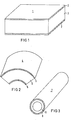
- FIGS. 1, 2 and 3 show different shaped bodies which are produced from the material according to the invention and according to the above-mentioned method.
- Figure 1 shows a heat insulating plate 1, the inner layer 3 is made of batch A and the top and bottom of each consists of a layer 2 of batch B.
- This heat insulation plate has 3 good heat insulation properties in the inner area and has 2 abrasion-resistant surfaces and great stability due to the outer coating.
- Such plates optionally provided with a tongue and groove, can be used for the internal insulation of a helium-filled pressure vessel.
- FIG. 2 shows a further shaped piece 4 produced by the method according to the invention, which is designed as a hollow cylinder segment.
- This hollow cylinder segment consists of a layer 6, which is produced from batch A, the outside and inside of the hollow cylinder in turn being reinforced and protected by a thin layer 5 of batch B.
- this shaped body could also be a hollow spherical segment, depending on the shape of the container to be insulated.
- FIG. 3 shows a tube 7, the inner part 9 of which consists of batch A and which is provided on the outside with a layer 8 of batch B.
- This tube 7 is used for the internal insulation of a cladding tube, not shown in the drawing, the abrasion-resistant surface from the layer 8 being particularly important if different coefficients of expansion of the cladding tube and the inner insulation lead to friction between the insulating material and the tube wall.
- a spin of the hollow rotating body about its axis of rotation can be used achieve partial alignment of the fibers and distribution of the pores.
Landscapes
- Engineering & Computer Science (AREA)
- Chemical & Material Sciences (AREA)
- Physics & Mathematics (AREA)
- Ceramic Engineering (AREA)
- General Engineering & Computer Science (AREA)
- Life Sciences & Earth Sciences (AREA)
- General Health & Medical Sciences (AREA)
- Plasma & Fusion (AREA)
- Health & Medical Sciences (AREA)
- High Energy & Nuclear Physics (AREA)
- Biomedical Technology (AREA)
- Molecular Biology (AREA)
- Materials Engineering (AREA)
- Structural Engineering (AREA)
- Organic Chemistry (AREA)
- Compositions Of Oxide Ceramics (AREA)
- Thermal Insulation (AREA)
- Inorganic Insulating Materials (AREA)
- Inorganic Fibers (AREA)
Claims (10)
Priority Applications (1)
| Application Number | Priority Date | Filing Date | Title |
|---|---|---|---|
| AT82100143T ATE19769T1 (de) | 1981-01-16 | 1982-01-11 | Waermeisolierender keramischer formkoerper und verfahren zu seiner herstellung. |
Applications Claiming Priority (2)
| Application Number | Priority Date | Filing Date | Title |
|---|---|---|---|
| DE19813101257 DE3101257A1 (de) | 1981-01-16 | 1981-01-16 | "keramisches waermeisoliermaterial und verfahren zur herstellung" |
| DE3101257 | 1981-01-16 |
Publications (3)
| Publication Number | Publication Date |
|---|---|
| EP0056597A2 EP0056597A2 (fr) | 1982-07-28 |
| EP0056597A3 EP0056597A3 (en) | 1982-08-11 |
| EP0056597B1 true EP0056597B1 (fr) | 1986-05-14 |
Family
ID=6122754
Family Applications (1)
| Application Number | Title | Priority Date | Filing Date |
|---|---|---|---|
| EP82100143A Expired EP0056597B1 (fr) | 1981-01-16 | 1982-01-11 | Objet céramique préformé, thermiquement isolant et son procédé de fabrication |
Country Status (3)
| Country | Link |
|---|---|
| EP (1) | EP0056597B1 (fr) |
| AT (1) | ATE19769T1 (fr) |
| DE (2) | DE3101257A1 (fr) |
Families Citing this family (4)
| Publication number | Priority date | Publication date | Assignee | Title |
|---|---|---|---|---|
| NL8200087A (nl) * | 1981-01-19 | 1982-08-16 | Mitsubishi Chem Ind | Werkwijze voor het bereiden van een poreus vuurvast anorganisch oxyde. |
| DE3503122A1 (de) * | 1984-02-01 | 1985-08-01 | Morgan Matroc Ltd., Stourport-on-Severn, Worcestershire | Keramikmaterialien, verfahren zu ihrer herstellung und daraus hergestellte gegenstaende |
| GB2188401B (en) * | 1986-03-27 | 1989-11-15 | Thorn Emi Appliances | Improvements in or relating to ovens |
| FR2816613B1 (fr) * | 2000-11-14 | 2003-11-07 | Mantion Serge | Terres cuites allegees |
Family Cites Families (5)
| Publication number | Priority date | Publication date | Assignee | Title |
|---|---|---|---|---|
| DE490597C (de) * | 1930-01-30 | Aeg | Verfahren zur Herstellung eines Tiegels fuer elektrische Hochfrequenzoefen | |
| FR1346570A (fr) * | 1962-12-27 | 1963-12-20 | Corning Glass Works | Procédé de fabrication d'articles en céramique à cloisons minces présentant de grands rapports superficie/poids |
| DE2511869A1 (de) * | 1975-03-18 | 1976-10-07 | Schneider & Co | Aus schaumkeramik bestehender baukoerper und verfahren zu seiner herstellung |
| US4221594A (en) * | 1977-10-06 | 1980-09-09 | General Electric Company | Material composition for fired ceramic articles having a high degree of porosity and crushability characteristics |
| US4191721A (en) * | 1977-10-06 | 1980-03-04 | General Electric Company | Making ceramic articles having a high degree of porosity and crushability characteristics |
-
1981
- 1981-01-16 DE DE19813101257 patent/DE3101257A1/de not_active Withdrawn
-
1982
- 1982-01-11 EP EP82100143A patent/EP0056597B1/fr not_active Expired
- 1982-01-11 DE DE8282100143T patent/DE3271082D1/de not_active Expired
- 1982-01-11 AT AT82100143T patent/ATE19769T1/de not_active IP Right Cessation
Also Published As
| Publication number | Publication date |
|---|---|
| EP0056597A2 (fr) | 1982-07-28 |
| ATE19769T1 (de) | 1986-05-15 |
| DE3271082D1 (en) | 1986-06-19 |
| DE3101257A1 (de) | 1982-12-02 |
| EP0056597A3 (en) | 1982-08-11 |
Similar Documents
| Publication | Publication Date | Title |
|---|---|---|
| EP0300543B1 (fr) | Procédé de fabrication de sphères creuses métalliques ou céramiques | |
| DE2301741C3 (de) | Verfahren zur Herstellung von stark durchlässigen keramischen Werkstücken | |
| DE3805110C2 (de) | Hitzebeständiger Formkörper | |
| DE4440104A1 (de) | Formkörper aus Quarzglas und Verfahren zur Herstellung eines Formkörpers aus Quarzglas | |
| EP0308780A1 (fr) | Procédé de préparation de corps frittés poreux | |
| DE3816892A1 (de) | Brennhilfsmittel zum brennen von keramik | |
| DE3620178C2 (fr) | ||
| DE3540450C2 (fr) | ||
| DE69312706T2 (de) | Keramische produkte | |
| DE19929760C2 (de) | Verfahren zur Herstellung metallischer, oxydischer oder keramischer Hohlkugeln | |
| DE10114774A1 (de) | Verfahren zur Herstellung eines Metall/Keramik-Komposits und Verfahren zur Herstellung eines porösen keramischen Körpers | |
| DE3736660C2 (fr) | ||
| EP0056597A2 (fr) | Objet céramique préformé, thermiquement isolant et son procédé de fabrication | |
| DE4011346A1 (de) | Transportrohr und verfahren zu dessen herstellung | |
| DE2326937A1 (de) | Kohlenstoffhaltiger poroeser koerper und verfahren zu seiner herstellung | |
| DE3938657A1 (de) | An einem eisenteil haftende keramikbeschichtung und verfahren zur herstellung hiervon | |
| DE1696691B1 (de) | Verfahren zur herstellung geformter hitzebestaendiger aluminiumoxid enthaltender koerper | |
| DE4343315C2 (de) | Verfahren zum Ausbilden eines oder mehrerer Hohlräume oder Poren in oder unter einer Beschichtung eines Keramikkörpers und Verwendung des Verfahrens für die Herstellung planarer Sonden | |
| DE4206800C2 (de) | Wärmeisolationsmaterial | |
| DE4139004C2 (de) | Verfahren zur Herstellung einer supraleitenden oxidkeramischen Röhre | |
| DE3503161C2 (fr) | ||
| DE2644915C3 (de) | Glaskeramik des Systems SiO2 -Al2 O3 -CaO mit nadeiförmigen ß-Wollastonit-Kristallen | |
| DE2718332A1 (de) | Hitzebestaendiges poroeses verbundmaterial | |
| WO1996027569A1 (fr) | Procede de fabrication d'un materiau ceramique | |
| DE1250332B (de) | Verfahren zum Herstellen von infiltrierten Carbidkorpern |
Legal Events
| Date | Code | Title | Description |
|---|---|---|---|
| PUAI | Public reference made under article 153(3) epc to a published international application that has entered the european phase |
Free format text: ORIGINAL CODE: 0009012 |
|
| PUAL | Search report despatched |
Free format text: ORIGINAL CODE: 0009013 |
|
| 17P | Request for examination filed |
Effective date: 19820111 |
|
| AK | Designated contracting states |
Designated state(s): AT BE CH DE FR GB IT LU NL SE |
|
| AK | Designated contracting states |
Designated state(s): AT BE CH DE FR GB IT LU NL SE |
|
| RAP1 | Party data changed (applicant data changed or rights of an application transferred) |
Owner name: INTERATOM GESELLSCHAFT MIT BESCHRAENKTER HAFTUNG |
|
| GRAA | (expected) grant |
Free format text: ORIGINAL CODE: 0009210 |
|
| AK | Designated contracting states |
Kind code of ref document: B1 Designated state(s): AT BE CH DE FR GB IT LI LU NL SE |
|
| REF | Corresponds to: |
Ref document number: 19769 Country of ref document: AT Date of ref document: 19860515 Kind code of ref document: T |
|
| REF | Corresponds to: |
Ref document number: 3271082 Country of ref document: DE Date of ref document: 19860619 |
|
| ITF | It: translation for a ep patent filed | ||
| ET | Fr: translation filed | ||
| PG25 | Lapsed in a contracting state [announced via postgrant information from national office to epo] |
Ref country code: LU Free format text: LAPSE BECAUSE OF NON-PAYMENT OF DUE FEES Effective date: 19870131 |
|
| PLBE | No opposition filed within time limit |
Free format text: ORIGINAL CODE: 0009261 |
|
| STAA | Information on the status of an ep patent application or granted ep patent |
Free format text: STATUS: NO OPPOSITION FILED WITHIN TIME LIMIT |
|
| 26N | No opposition filed | ||
| PGFP | Annual fee paid to national office [announced via postgrant information from national office to epo] |
Ref country code: AT Payment date: 19881227 Year of fee payment: 8 |
|
| PGFP | Annual fee paid to national office [announced via postgrant information from national office to epo] |
Ref country code: LU Payment date: 19890110 Year of fee payment: 8 |
|
| PGFP | Annual fee paid to national office [announced via postgrant information from national office to epo] |
Ref country code: BE Payment date: 19890125 Year of fee payment: 8 |
|
| PGFP | Annual fee paid to national office [announced via postgrant information from national office to epo] |
Ref country code: NL Payment date: 19890131 Year of fee payment: 11 |
|
| PGFP | Annual fee paid to national office [announced via postgrant information from national office to epo] |
Ref country code: CH Payment date: 19890424 Year of fee payment: 8 |
|
| PG25 | Lapsed in a contracting state [announced via postgrant information from national office to epo] |
Ref country code: AT Effective date: 19900111 |
|
| PG25 | Lapsed in a contracting state [announced via postgrant information from national office to epo] |
Ref country code: LI Effective date: 19900131 Ref country code: CH Effective date: 19900131 Ref country code: BE Effective date: 19900131 |
|
| BERE | Be: lapsed |
Owner name: INTERATOM G.M.B.H. Effective date: 19900131 |
|
| PG25 | Lapsed in a contracting state [announced via postgrant information from national office to epo] |
Ref country code: NL Effective date: 19900801 |
|
| NLV4 | Nl: lapsed or anulled due to non-payment of the annual fee | ||
| REG | Reference to a national code |
Ref country code: CH Ref legal event code: PL |
|
| PGFP | Annual fee paid to national office [announced via postgrant information from national office to epo] |
Ref country code: GB Payment date: 19901217 Year of fee payment: 10 |
|
| PGFP | Annual fee paid to national office [announced via postgrant information from national office to epo] |
Ref country code: FR Payment date: 19910121 Year of fee payment: 10 |
|
| PGFP | Annual fee paid to national office [announced via postgrant information from national office to epo] |
Ref country code: SE Payment date: 19910125 Year of fee payment: 10 |
|
| ITTA | It: last paid annual fee | ||
| PGFP | Annual fee paid to national office [announced via postgrant information from national office to epo] |
Ref country code: DE Payment date: 19910325 Year of fee payment: 10 |
|
| PG25 | Lapsed in a contracting state [announced via postgrant information from national office to epo] |
Ref country code: GB Effective date: 19920111 |
|
| PG25 | Lapsed in a contracting state [announced via postgrant information from national office to epo] |
Ref country code: SE Effective date: 19920112 |
|
| GBPC | Gb: european patent ceased through non-payment of renewal fee | ||
| PG25 | Lapsed in a contracting state [announced via postgrant information from national office to epo] |
Ref country code: FR Effective date: 19920930 |
|
| PG25 | Lapsed in a contracting state [announced via postgrant information from national office to epo] |
Ref country code: DE Effective date: 19921001 |
|
| REG | Reference to a national code |
Ref country code: FR Ref legal event code: ST |
|
| EUG | Se: european patent has lapsed |
Ref document number: 82100143.5 Effective date: 19920806 |