EP0056614A2 - Siège réglable pour enfant - Google Patents
Siège réglable pour enfant Download PDFInfo
- Publication number
- EP0056614A2 EP0056614A2 EP82100193A EP82100193A EP0056614A2 EP 0056614 A2 EP0056614 A2 EP 0056614A2 EP 82100193 A EP82100193 A EP 82100193A EP 82100193 A EP82100193 A EP 82100193A EP 0056614 A2 EP0056614 A2 EP 0056614A2
- Authority
- EP
- European Patent Office
- Prior art keywords
- children
- chair according
- back part
- chair
- belt
- Prior art date
- Legal status (The legal status is an assumption and is not a legal conclusion. Google has not performed a legal analysis and makes no representation as to the accuracy of the status listed.)
- Withdrawn
Links
Images



Classifications
-
- A—HUMAN NECESSITIES
- A47—FURNITURE; DOMESTIC ARTICLES OR APPLIANCES; COFFEE MILLS; SPICE MILLS; SUCTION CLEANERS IN GENERAL
- A47D—FURNITURE SPECIALLY ADAPTED FOR CHILDREN
- A47D1/00—Children's chairs
- A47D1/002—Children's chairs adjustable
- A47D1/004—Children's chairs adjustable in height
-
- A—HUMAN NECESSITIES
- A47—FURNITURE; DOMESTIC ARTICLES OR APPLIANCES; COFFEE MILLS; SPICE MILLS; SUCTION CLEANERS IN GENERAL
- A47D—FURNITURE SPECIALLY ADAPTED FOR CHILDREN
- A47D1/00—Children's chairs
- A47D1/002—Children's chairs adjustable
Definitions
- the invention relates to an adjustable child's chair with a stand which carries a seat part and a back part which is adjustable at an angle to the seat part, and with at least one lateral clamping device for holding the back part to the stand.
- the seat part and the back part consist of plastic shells, the edges of which are pulled up laterally.
- the wall parts of the edges of the seat part and back part overlap and are pressed against one another in their overlap regions by clamping devices, as a result of which the angle between the seat part and back part is fixed. This angle of inclination can be changed by releasing the clamping devices.
- the ends of a wire stand, which supports the seat part and the back part engage the clamping devices.
- This well-known children's chair serves as a baby seesaw in which a toddler can rock or bob due to the elasticity of the stand.
- the clamping devices which are separated from each other, can be adjusted individually, so that with awkward adjustment on both sides of the child's chair, different angles of inclination between the seat part and the back part can result.
- the known construction is also only useful for small children. For older children, it does not provide the necessary body support.
- chairs or armchairs are known in which the angle of the back part can be continuously adjusted relative to the seat part.
- the back section has been pivoted into the lying position, there is a wide gap between the back section and the seat section.
- the seat surface and back surface have different heights in their adjoining areas, so that it is extremely uncomfortable to use such armchairs for lying down.
- the invention has for its object to provide an adjustable children's chair of the type mentioned, which allows a wide adjustment range for the angle of the seat part, right down to the lying position and has a stable construction so that it is suitable for children of different ages and thus different K örperieren and weights are equally usable.
- the invention provides that the stator rotationally fixed a horizontal jolt strut Inappropriate D, against which the seat part and at least one approach are mounted in the rear part, and that the clamping device consists of a screwed to the strut clamping piece that the bearing sleeves of the back part and axially compresses the seat part.
- the seat part and back part are firmly clamped to one another and to the stand, so that by tightening a single clamping device the three parts mentioned are fixed relative to one another.
- the strut is part of the stand and firmly connected to it. It serves as an axis around which both the seat part and the back part can be pivoted. This axis extends essentially over the entire width of the children's chair and carries the bearing bushes of the back part and seat part, which are pressed against each other and against the legs of the stand when tightening the clamping piece.
- the seat part has at its rear end at least one recess for the passage of the shoulder of the back part through the seat surface.
- the approach which projects downward from the back part and protrudes through the recess in the seat part, closes this recess in the lying position.
- the approach is in the central region of the back part, from where it projects down to below the seat.
- the recess of the seat part which is adapted to the shape of the attachment is delimited by two side regions which, when the back part is raised, protrude beyond the lower region of the back part.
- two projections projecting downward are provided on the side regions of the back part, each of which protrudes through a lateral recess in the seat part.
- the back part is mounted on the pressure strut with two bearing bushes and the seat part with a middle bearing bush.
- the stand preferably consists of two lateral legs which are connected to one another by the pressure strut and a hole for the passage of a clamping piece. exhibit.
- the pressure strut which preferably consists of a metal, can be pulled out and the seat part and back part can be separated from one another.
- the pressure strut preferably consists of a longitudinally slotted tube, in whose slot engaging ribs projecting inwards from the bearing bushes. In this way, the swivel ranges of the seat part and back part are limited. At the same time, the seat part and the back part are prevented from being fitted incorrectly.
- inward-pointing approaches can be provided on the legs which engage in recesses in the pressure strut.
- the children's chair according to the invention also allows the attachment of additional parts, such as a table, a parasol or the like.
- additional parts such as a table, a parasol or the like.
- brackets for attaching an additional part can be provided on the legs. The position of the additional part is therefore independent of the respective positions of the seat part and back part.
- the legs at their lower ends have horizontal feet projecting forward and backward, at the ends of which hinged supports are fastened, which, when folded, lie parallel to the feet and, when unfolded, protrude downward from the feet.
- the supports are permanently attached to the feet of the stand and therefore cannot be lost.
- To raise the child's chair they are folded down approximately at a right angle.
- the free ends of two supports are expediently connected to one another by a cross strut. When the supports are folded in, the cross struts can overlap one another and engage in alignment with their ends in cutouts at the lower ends of the legs.
- an advantageous development of the invention provides that the supports snap into the feet in the unfolded state with manually releasable latching devices.
- the locking devices In order to bring the chair back down, the locking devices must be triggered manually.
- the back part In order to prevent the child from slipping downward when the seat part and the back part are inclined, in an advantageous development of the invention the back part has a flap which can be folded out from the back surface to the front.
- a horizontal support rail for a lap belt is attached to the back part.
- a belt loop that sags down leads from the holding rail or the rear section of the lap belt to the front section of the lap belt.
- the holding rail can be mounted vertically displaceably on a belt stretched along the back part in order to be able to adjust the height of the lap belt to the height of the child.
- a headrest can be attached in a height-adjustable manner above the holding rail
- the children's chair shown has a seat part 10 and a back part 11, both of which are fastened to the upper end of the stand 12 with the clamping device 13 and can be pivoted relative to one another and relative to the stand 12.
- the seat part 10 and the back part 11 consist of rigid plastic shells, each of which is covered with a cushion cover 10 ', 11' forming the seat or back surface.
- the legs 13, 14, which have feet 15 projecting forward and backward, are T-shaped overall, the feet 15 which can be placed on the floor forming the crossbeams.
- the upper ends of the legs 13 are connected to each other by the metal strut 16.
- the pressure strut 16 is a tubular aluminum profile with an outer jacket 17 which runs coaxially with an inner tube 18 and is connected to the latter via radial webs 19.
- the outer jacket 17 has a continuous longitudinal slot 20 between two adjacent radial webs 19, which extends - based on the outer jacket 17 - over an angle of approximately 80 °.
- the ends of the strut 16 are inserted into profile pieces 21, which are provided at the upper ends of the legs 13, 14.
- the profile pieces 21 have a cross-sectional profile that represents the negative profile to the cross-sectional profile of the pressure strut 16. If the profile pieces 21 axially the ends of the strut 16 are pushed on, the strut 16 can no longer rotate about its axis. In addition, the legs 13 and 14 are then non-rotatably connected to one another via the pressure strut 16.
- the profile pieces 21 are located on the mutually facing inner sides of the legs 13 and 14. In the outwardly directed rear wall of each profile part 21 there is a hole 22 through which the threaded attachment 24 of a clamping piece 23 can be inserted from the outside. By turning the clamping piece 23, the threaded neck 24 is screwed into an internal thread 25 of the inner tube 18.
- the clamping piece has a flange 26 at the foot of the threaded projection 24, which lies against the outer wall of the leg 13 in question, which closes the profile piece 21, and a gripping rib 27 projecting perpendicularly from the flange 26 for rotating the clamping piece.
- the outer edge of the profile piece 21 on the inside of the foot 13 (or 14) is provided with an axial toothing 27 which engages over the end of the pressure strut 16.
- a total of three bearing bushes 28, 29, 30 are mounted on the pressure strut 16, of which the bearing bushes 28, 29 are integrally connected to the seat part 10 and the bearing bush 30 is integrally connected to the back part 11.
- the bearing bush 30 is arranged between the bearing bushes 28 and 29. All three bearing bushes 28, 29, 30 are provided with axial teeth 27 on their end faces.
- the total length of the three bearing bushings 28, 29 and 30 placed one against the other is somewhat greater than the free length of the pressure strut 16 projecting from the legs 13 and 14, see above that by screwing the clamping pieces 23, the axial teeth of the parts 13, 14, 28, 29 and 30 are pressed axially against each other and interlock.
- the bearing bushes 28, 29 and 30 each have an inwardly projecting rib 31 which projects into the longitudinal slot 20 of the pressure strut 16. If at least one of the clamping pieces 23 is loosened, the bearing bush 30 and the bearing bushes 28, 29 can be rotated independently of one another in the angular range defined by the longitudinal slot 20 on the pressure strut 16 because the axial toothings 27 can then be disengaged. If, however, both clamping pieces 23 are tightened, then the bearing bushes 28, 29 and 30 are clamped relative to one another and to the legs 13 and 14.
- the pressure strut 16 is located below the seat surface 10 ', which, as shown in FIG. 1, still projects beyond the pressure strut to the rear.
- the bearing bushes 28 and 29 are molded onto the underside of the seat part 10.
- the back part 11 is extended by a projection 33 projecting downwards in the sitting position (FIG. 1), on the rear side of which the bearing bush 30 is located.
- the width of the extension 33 corresponds to about a third of the width of the child seat.
- the extension 33 protrudes through a recess 34 or bulge at the rear end of the seat part 10 (FIG. 7).
- the recess 34 is essentially adapted to the shape and size of the extension 33. In the lying position, the axis of the pressure strut 16 or the bearing bushes 28, 29 and 30 runs below the shoulder 33 and below the recess 34. If the back part is raised, then The extension 33 no longer completely fills the recess 34, but runs at an angle to the seat surface 10 '. However, the child's sitting position is not disturbed because the recess is only in the area of the longitudinal central axis of the seat part 10 and the lateral areas 35 of the seat part delimiting the recess 34 protrude to the rear (FIG. 7).
- brackets 36 On the inner sides of the legs 13, 14, below the axial teeth 27 surrounding the profile pieces 21, holders 36 are fastened, to which additional parts can be fastened to the child's chair with wire brackets, e.g. a table.
- These brackets 36 have a vertical tube piece 37, which is closed at its lower end and into which the wire bracket can be inserted.
- hinged supports 39 are attached via hinges 38, which can be folded down (FIG. 9) and engage in the unfolded state after they have exceeded the vertical position. So that the supports 39 cannot be accidentally folded in, a latching device is attached to the foot 15 in the vicinity of each joint 38.
- This can e.g. consist of a spring-loaded latch 41, which engages in a locking recess on the hinge part of the support 39 and which can be released by retracting a slide 42.
- the two supports 39 which are articulated at the front ends of the feet 15, are connected to one another at their ends by a cross strut 43, while the ends of the rear supports are connected by a cross strut 44.
- the two cross struts 43, 44 are flat shaped. When the supports 39 are folded in, they lie flat against one another horizontally. 7 shows, the ends of the cross struts 43, 44 project laterally beyond the pivoting planes of the supports 39.
- the feet 15 therefore have cutouts 45 which are open at the bottom for the passage of the cross struts 43, 44 lying flat on one another.
- the long length of the cross struts 43, 44 increases the stability of the stand 12.
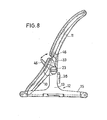
- a flap 46 folds forward out of the extension 33 of the back part 11 in order to enable additional seat support.
- the flap 46 is mounted with a bearing bush 46 '(FIG. 4) on the pressure strut 16 in an interruption of the bearing bush 30. Since the bearing bush 46 'likewise has a nose (not shown) which engages in the longitudinal slot 20, but is not axially clamped by the clamping device 23, it can be pivoted freely in the angular range predetermined by the longitudinal slot 20. In the pivoted-in state, the outside of the flap 46 is aligned with the shoulder 33 of the back part 11 or with the back surface 11 '. In the folded-out state (FIG. 8), on the other hand, the flap 46 protrudes from the extension 33 at approximately a right angle.
- the belt system shown in Fig. 2 can be used to fasten the child in the seat.
- a belt 50 runs along the back part 11 on the back surface 11 'and is tensioned along the vertical center line of the back part.
- a horizontal holding rail 51 is attached to the belt 50 so as to be vertically displaceable.
- a lap belt 52 runs through the holding rail 51, the ends of which can be connected to one another by a buckle in front of the child's body.
- the belt 50 extends downward from the holding rail 51, where its lower end is fastened to the extension 33.
- a downwardly sagging loop 53 is fastened to the belt 50, the other end of which leads to the front region of the lap belt 52, where it is fastened with a loop 54.
- the upper end of the belt 50 is fixedly attached to the upper end of the back part 11.
- the belt 50 can additionally be fastened in the lower area by cross belts.
- a further holding rail 55 for a headrest 56 is attached to the belt 50 above the holding rail 51.
- the headrest 56 has two padded side jaws holding the head. It can be moved on the belt 50 in the vertical direction.
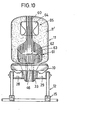
- FIG. 10 The embodiment of FIG. 10 is the same as that of FIGS. 1 to 9, with the exception of the belt system 50 to 56.
- a belt 60 is fastened to the back part 11, which runs over the center line of the support 11 'and whose upper end is at the upper edge of the back part 11 and its lower end is attached to the neck 33.
- the belt 60 is formed above the seat part 10 in the form of trousers 61.
- the two laterally protruding belt parts 62, 63 are placed one above the other and enclose the child's body.
- the upper end of the belt 60 has on its back Velcro fastener part that presses against a second Velcro fastener part that is located on the front of a plate 64 that forms the base part of a headrest 65.
- the headrest which is equipped with side jaws, can be adjusted in the longitudinal direction of the belt .60 - i.e. in height.
Landscapes
- Chairs For Special Purposes, Such As Reclining Chairs (AREA)
- Chair Legs, Seat Parts, And Backrests (AREA)
Applications Claiming Priority (2)
| Application Number | Priority Date | Filing Date | Title |
|---|---|---|---|
| DE3101605 | 1981-01-20 | ||
| DE19813101605 DE3101605A1 (de) | 1981-01-20 | 1981-01-20 | Verstellbarer kinderstuhl |
Publications (2)
| Publication Number | Publication Date |
|---|---|
| EP0056614A2 true EP0056614A2 (fr) | 1982-07-28 |
| EP0056614A3 EP0056614A3 (fr) | 1982-08-04 |
Family
ID=6122936
Family Applications (1)
| Application Number | Title | Priority Date | Filing Date |
|---|---|---|---|
| EP82100193A Withdrawn EP0056614A3 (fr) | 1981-01-20 | 1982-01-13 | Siège réglable pour enfant |
Country Status (2)
| Country | Link |
|---|---|
| EP (1) | EP0056614A3 (fr) |
| DE (1) | DE3101605A1 (fr) |
Cited By (4)
| Publication number | Priority date | Publication date | Assignee | Title |
|---|---|---|---|---|
| GB2342288B (en) * | 1998-10-07 | 2002-08-28 | Graco Childrens Prod Inc | Adjustable car seat |
| US6705675B1 (en) | 2000-05-08 | 2004-03-16 | Graco Children's Products Inc. | Adjustable child seat for toddlers to small children |
| US7066536B2 (en) | 2002-02-11 | 2006-06-27 | Graco Children's Products Inc. | Child seat |
| EP2687131A1 (fr) * | 2012-07-16 | 2014-01-22 | ROBA Baumann GmbH | Chaise haute avec dossier pivotant |
Families Citing this family (1)
| Publication number | Priority date | Publication date | Assignee | Title |
|---|---|---|---|---|
| AT388859B (de) * | 1982-11-12 | 1989-09-11 | Schaller Herta | Sicherheitssitz |
Family Cites Families (4)
| Publication number | Priority date | Publication date | Assignee | Title |
|---|---|---|---|---|
| US2410088A (en) * | 1941-11-14 | 1946-10-29 | Lundquist Carl Ernst Edvard | Adjustable chair, bedstead, stretcher, or the like |
| FR1347005A (fr) * | 1962-07-17 | 1963-12-27 | Siège réglable pour bébé | |
| CH425119A (fr) * | 1963-10-30 | 1966-11-30 | Dudouyt Jean Paul | Articulation pour éléments de siège |
| FR1396343A (fr) * | 1963-12-03 | 1965-04-23 | Siège-chariot à usages multiples pour bébés et adultes |
-
1981
- 1981-01-20 DE DE19813101605 patent/DE3101605A1/de not_active Withdrawn
-
1982
- 1982-01-13 EP EP82100193A patent/EP0056614A3/fr not_active Withdrawn
Cited By (8)
| Publication number | Priority date | Publication date | Assignee | Title |
|---|---|---|---|---|
| GB2342288B (en) * | 1998-10-07 | 2002-08-28 | Graco Childrens Prod Inc | Adjustable car seat |
| US6474735B1 (en) | 1998-10-07 | 2002-11-05 | Graco Children's Products Inc. | Adjustable car seat |
| US6705675B1 (en) | 2000-05-08 | 2004-03-16 | Graco Children's Products Inc. | Adjustable child seat for toddlers to small children |
| US6857700B2 (en) | 2000-05-08 | 2005-02-22 | Graco Children's Products Inc. | Adjustable child seat for toddlers to small children |
| US7066536B2 (en) | 2002-02-11 | 2006-06-27 | Graco Children's Products Inc. | Child seat |
| US7278683B2 (en) | 2002-02-11 | 2007-10-09 | Graco Children's Products, Inc. | Child seat with object holder |
| US7370912B2 (en) | 2002-02-11 | 2008-05-13 | Graco Children's Products, Inc. | Child seat |
| EP2687131A1 (fr) * | 2012-07-16 | 2014-01-22 | ROBA Baumann GmbH | Chaise haute avec dossier pivotant |
Also Published As
| Publication number | Publication date |
|---|---|
| DE3101605A1 (de) | 1982-08-26 |
| EP0056614A3 (fr) | 1982-08-04 |
Similar Documents
| Publication | Publication Date | Title |
|---|---|---|
| DE2618160C3 (de) | Liegestuhl | |
| DE3879864T2 (de) | Verstellbares rollstuhlgestell. | |
| DE202019005729U1 (de) | Klappstuhl, Klappliege und Klappstuhlgestell dafür | |
| DE69420426T2 (de) | Anordnung für einen stuhl, insbesondere kinderstuhl | |
| DE1815331A1 (de) | Tragbarer Babystuhl | |
| DE4330514C2 (de) | Fahrzeugsitz | |
| DE6751421U (de) | Bettstuetze. | |
| DE69308365T2 (de) | Stützvorrichtung | |
| DE3903388C2 (fr) | ||
| EP0288047A1 (fr) | Garniture d'enveloppement | |
| EP0056614A2 (fr) | Siège réglable pour enfant | |
| EP1614371B1 (fr) | Chaise haute pour enfants | |
| DE10229436A1 (de) | Kinderstuhl mit einer höhenverstellbaren Sitz- und/oder Fußfläche sowie einem Möbelbeschlag hierfür | |
| DE202014003920U1 (de) | Rückenlehnenverbindungsmechanismus und damit ausgestatteter Kindersitz | |
| DE10051261A1 (de) | Klappbarer Kinderstuhl | |
| CH721002A1 (de) | Stuhl für ein Baby oder Kleinkind | |
| DE19519739C2 (de) | Sitzmöbel mit verstellbarer Rückenlehne | |
| DE851405C (de) | Zusammenklappbares Moebelstueck, bestehend aus einem Tisch und um diesen herum angeordneten, unter die Tischplatte klappbaren Stuehlen | |
| DE3008011C2 (fr) | ||
| DE3916369A1 (de) | Tragbarer kindersitz | |
| DE3916370A1 (de) | Tragbarer kindersitz | |
| EP3854269B1 (fr) | Agencement convertible d'assise et de couchage pour une poussette | |
| DE1143983B (de) | Sesselartiger Sitz | |
| CH570140A5 (en) | Baby feeding attachment for bed - has mechanically pivoted frame support for bottles held at ends | |
| DE3201462C2 (fr) |
Legal Events
| Date | Code | Title | Description |
|---|---|---|---|
| PUAI | Public reference made under article 153(3) epc to a published international application that has entered the european phase |
Free format text: ORIGINAL CODE: 0009012 |
|
| PUAL | Search report despatched |
Free format text: ORIGINAL CODE: 0009013 |
|
| AK | Designated contracting states |
Designated state(s): AT BE CH DE FR GB IT LU NL SE |
|
| AK | Designated contracting states |
Designated state(s): AT BE CH DE FR GB IT LU NL SE |
|
| STAA | Information on the status of an ep patent application or granted ep patent |
Free format text: STATUS: THE APPLICATION IS DEEMED TO BE WITHDRAWN |
|
| 18D | Application deemed to be withdrawn |
Effective date: 19830709 |
|
| RIN1 | Information on inventor provided before grant (corrected) |
Inventor name: STORP, ALBRECHT K.F. |