EP0056787A1 - Photographisches Aufzeichnungsmaterial und Verfahren zu seiner Herstellung - Google Patents
Photographisches Aufzeichnungsmaterial und Verfahren zu seiner Herstellung Download PDFInfo
- Publication number
- EP0056787A1 EP0056787A1 EP82810012A EP82810012A EP0056787A1 EP 0056787 A1 EP0056787 A1 EP 0056787A1 EP 82810012 A EP82810012 A EP 82810012A EP 82810012 A EP82810012 A EP 82810012A EP 0056787 A1 EP0056787 A1 EP 0056787A1
- Authority
- EP
- European Patent Office
- Prior art keywords
- carbon atoms
- alkyl
- optionally substituted
- formula
- radical
- Prior art date
- Legal status (The legal status is an assumption and is not a legal conclusion. Google has not performed a legal analysis and makes no representation as to the accuracy of the status listed.)
- Granted
Links
- 239000000463 material Substances 0.000 title claims abstract description 54
- 238000000034 method Methods 0.000 title description 6
- 238000002360 preparation method Methods 0.000 title description 2
- 125000000217 alkyl group Chemical group 0.000 claims abstract description 142
- -1 cyclic amino Chemical group 0.000 claims abstract description 120
- 229910052739 hydrogen Inorganic materials 0.000 claims abstract description 80
- 239000001257 hydrogen Substances 0.000 claims abstract description 80
- 229910052709 silver Inorganic materials 0.000 claims abstract description 34
- 239000004332 silver Substances 0.000 claims abstract description 34
- 125000000753 cycloalkyl group Chemical group 0.000 claims abstract description 15
- 229910052736 halogen Inorganic materials 0.000 claims abstract description 11
- 150000002367 halogens Chemical class 0.000 claims abstract description 11
- 125000002924 primary amino group Chemical group [H]N([H])* 0.000 claims abstract description 9
- 125000004104 aryloxy group Chemical group 0.000 claims abstract description 5
- 150000002431 hydrogen Chemical class 0.000 claims abstract 19
- 125000004432 carbon atom Chemical group C* 0.000 claims description 202
- UFHFLCQGNIYNRP-UHFFFAOYSA-N Hydrogen Chemical compound [H][H] UFHFLCQGNIYNRP-UHFFFAOYSA-N 0.000 claims description 71
- 239000000839 emulsion Substances 0.000 claims description 32
- 125000002496 methyl group Chemical group [H]C([H])([H])* 0.000 claims description 32
- 229920006395 saturated elastomer Polymers 0.000 claims description 30
- 125000003545 alkoxy group Chemical group 0.000 claims description 27
- 125000000547 substituted alkyl group Chemical group 0.000 claims description 27
- 125000000113 cyclohexyl group Chemical group [H]C1([H])C([H])([H])C([H])([H])C([H])(*)C([H])([H])C1([H])[H] 0.000 claims description 23
- 125000005842 heteroatom Chemical group 0.000 claims description 23
- 125000003342 alkenyl group Chemical group 0.000 claims description 21
- 125000001997 phenyl group Chemical group [H]C1=C([H])C([H])=C(*)C([H])=C1[H] 0.000 claims description 20
- 125000001424 substituent group Chemical group 0.000 claims description 16
- OMDCSPXITNMPHV-UHFFFAOYSA-N 2h-oxaphosphinine Chemical group O1PC=CC=C1 OMDCSPXITNMPHV-UHFFFAOYSA-N 0.000 claims description 14
- 125000002947 alkylene group Chemical group 0.000 claims description 14
- 125000004001 thioalkyl group Chemical group 0.000 claims description 14
- 125000001495 ethyl group Chemical group [H]C([H])([H])C([H])([H])* 0.000 claims description 13
- ZAMOUSCENKQFHK-UHFFFAOYSA-N Chlorine atom Chemical compound [Cl] ZAMOUSCENKQFHK-UHFFFAOYSA-N 0.000 claims description 11
- 125000003118 aryl group Chemical group 0.000 claims description 11
- 229910052801 chlorine Inorganic materials 0.000 claims description 11
- 239000000460 chlorine Substances 0.000 claims description 11
- 125000000956 methoxy group Chemical group [H]C([H])([H])O* 0.000 claims description 11
- WKBOTKDWSSQWDR-UHFFFAOYSA-N Bromine atom Chemical compound [Br] WKBOTKDWSSQWDR-UHFFFAOYSA-N 0.000 claims description 10
- CIUQDSCDWFSTQR-UHFFFAOYSA-N [C]1=CC=CC=C1 Chemical compound [C]1=CC=CC=C1 CIUQDSCDWFSTQR-UHFFFAOYSA-N 0.000 claims description 10
- GDTBXPJZTBHREO-UHFFFAOYSA-N bromine Substances BrBr GDTBXPJZTBHREO-UHFFFAOYSA-N 0.000 claims description 10
- 229910052794 bromium Inorganic materials 0.000 claims description 10
- 125000000640 cyclooctyl group Chemical group [H]C1([H])C([H])([H])C([H])([H])C([H])([H])C([H])(*)C([H])([H])C([H])([H])C1([H])[H] 0.000 claims description 9
- 125000004433 nitrogen atom Chemical group N* 0.000 claims description 9
- 125000004429 atom Chemical group 0.000 claims description 8
- 125000005346 substituted cycloalkyl group Chemical group 0.000 claims description 7
- 125000001797 benzyl group Chemical group [H]C1=C([H])C([H])=C(C([H])=C1[H])C([H])([H])* 0.000 claims description 6
- 239000000084 colloidal system Substances 0.000 claims description 6
- 229910052757 nitrogen Inorganic materials 0.000 claims description 6
- 125000005415 substituted alkoxy group Chemical group 0.000 claims description 6
- YMWUJEATGCHHMB-UHFFFAOYSA-N Dichloromethane Chemical compound ClCCl YMWUJEATGCHHMB-UHFFFAOYSA-N 0.000 claims description 5
- 125000000304 alkynyl group Chemical group 0.000 claims description 5
- 238000004519 manufacturing process Methods 0.000 claims description 5
- 125000003386 piperidinyl group Chemical group 0.000 claims description 5
- HEDRZPFGACZZDS-UHFFFAOYSA-N Chloroform Chemical compound ClC(Cl)Cl HEDRZPFGACZZDS-UHFFFAOYSA-N 0.000 claims description 4
- ZFIVKAOQEXOYFY-UHFFFAOYSA-N Diepoxybutane Chemical compound C1OC1C1OC1 ZFIVKAOQEXOYFY-UHFFFAOYSA-N 0.000 claims description 4
- 125000003903 2-propenyl group Chemical group [H]C([*])([H])C([H])=C([H])[H] 0.000 claims description 3
- 125000000719 pyrrolidinyl group Chemical group 0.000 claims description 3
- 125000003107 substituted aryl group Chemical group 0.000 claims description 3
- 125000000286 phenylethyl group Chemical group [H]C1=C([H])C([H])=C(C([H])=C1[H])C([H])([H])C([H])([H])* 0.000 claims description 2
- 125000004426 substituted alkynyl group Chemical group 0.000 claims description 2
- 150000001875 compounds Chemical class 0.000 abstract description 21
- BQCADISMDOOEFD-UHFFFAOYSA-N Silver Chemical compound [Ag] BQCADISMDOOEFD-UHFFFAOYSA-N 0.000 abstract description 15
- 230000035945 sensitivity Effects 0.000 abstract description 4
- GGCZERPQGJTIQP-UHFFFAOYSA-N sodium;9,10-dioxoanthracene-2-sulfonic acid Chemical compound [Na+].C1=CC=C2C(=O)C3=CC(S(=O)(=O)O)=CC=C3C(=O)C2=C1 GGCZERPQGJTIQP-UHFFFAOYSA-N 0.000 abstract 1
- 150000003254 radicals Chemical class 0.000 description 47
- 125000004435 hydrogen atom Chemical class [H]* 0.000 description 23
- 239000000203 mixture Substances 0.000 description 16
- XEKOWRVHYACXOJ-UHFFFAOYSA-N Ethyl acetate Chemical compound CCOC(C)=O XEKOWRVHYACXOJ-UHFFFAOYSA-N 0.000 description 12
- 125000000999 tert-butyl group Chemical group [H]C([H])([H])C(*)(C([H])([H])[H])C([H])([H])[H] 0.000 description 12
- 239000000243 solution Substances 0.000 description 11
- 239000000126 substance Substances 0.000 description 9
- 238000005266 casting Methods 0.000 description 7
- 125000004093 cyano group Chemical group *C#N 0.000 description 7
- 239000000975 dye Substances 0.000 description 7
- YSMRWXYRXBRSND-UHFFFAOYSA-N TOTP Chemical compound CC1=CC=CC=C1OP(=O)(OC=1C(=CC=CC=1)C)OC1=CC=CC=C1C YSMRWXYRXBRSND-UHFFFAOYSA-N 0.000 description 6
- 125000000484 butyl group Chemical group [H]C([*])([H])C([H])([H])C([H])([H])C([H])([H])[H] 0.000 description 6
- 108010010803 Gelatin Proteins 0.000 description 5
- 239000007864 aqueous solution Substances 0.000 description 5
- 229920000159 gelatin Polymers 0.000 description 5
- 239000008273 gelatin Substances 0.000 description 5
- 235000019322 gelatine Nutrition 0.000 description 5
- 235000011852 gelatine desserts Nutrition 0.000 description 5
- 125000000449 nitro group Chemical group [O-][N+](*)=O 0.000 description 5
- 238000004061 bleaching Methods 0.000 description 4
- 125000004051 hexyl group Chemical group [H]C([H])([H])C([H])([H])C([H])([H])C([H])([H])C([H])([H])C([H])([H])* 0.000 description 4
- 125000001449 isopropyl group Chemical group [H]C([H])([H])C([H])(*)C([H])([H])[H] 0.000 description 4
- 125000000951 phenoxy group Chemical group [H]C1=C([H])C([H])=C(O*)C([H])=C1[H] 0.000 description 4
- 125000001436 propyl group Chemical group [H]C([*])([H])C([H])([H])C([H])([H])[H] 0.000 description 4
- YXFVVABEGXRONW-UHFFFAOYSA-N Toluene Chemical compound CC1=CC=CC=C1 YXFVVABEGXRONW-UHFFFAOYSA-N 0.000 description 3
- ZMANZCXQSJIPKH-UHFFFAOYSA-N Triethylamine Chemical compound CCN(CC)CC ZMANZCXQSJIPKH-UHFFFAOYSA-N 0.000 description 3
- 239000000654 additive Substances 0.000 description 3
- 125000006193 alkinyl group Chemical group 0.000 description 3
- 238000009835 boiling Methods 0.000 description 3
- UAOMVDZJSHZZME-UHFFFAOYSA-N diisopropylamine Chemical compound CC(C)NC(C)C UAOMVDZJSHZZME-UHFFFAOYSA-N 0.000 description 3
- 238000002844 melting Methods 0.000 description 3
- 230000008018 melting Effects 0.000 description 3
- 239000003960 organic solvent Substances 0.000 description 3
- 239000002904 solvent Substances 0.000 description 3
- 239000000080 wetting agent Substances 0.000 description 3
- GVNVAWHJIKLAGL-UHFFFAOYSA-N 2-(cyclohexen-1-yl)cyclohexan-1-one Chemical compound O=C1CCCCC1C1=CCCCC1 GVNVAWHJIKLAGL-UHFFFAOYSA-N 0.000 description 2
- 101150065749 Churc1 gene Proteins 0.000 description 2
- XBPCUCUWBYBCDP-UHFFFAOYSA-N Dicyclohexylamine Chemical compound C1CCCCC1NC1CCCCC1 XBPCUCUWBYBCDP-UHFFFAOYSA-N 0.000 description 2
- PXGOKWXKJXAPGV-UHFFFAOYSA-N Fluorine Chemical compound FF PXGOKWXKJXAPGV-UHFFFAOYSA-N 0.000 description 2
- 239000004698 Polyethylene Substances 0.000 description 2
- 102100038239 Protein Churchill Human genes 0.000 description 2
- PAFZNILMFXTMIY-UHFFFAOYSA-N cyclohexylamine Chemical compound NC1CCCCC1 PAFZNILMFXTMIY-UHFFFAOYSA-N 0.000 description 2
- DOIRQSBPFJWKBE-UHFFFAOYSA-N dibutyl phthalate Chemical compound CCCCOC(=O)C1=CC=CC=C1C(=O)OCCCC DOIRQSBPFJWKBE-UHFFFAOYSA-N 0.000 description 2
- 230000000694 effects Effects 0.000 description 2
- 125000001301 ethoxy group Chemical group [H]C([H])([H])C([H])([H])O* 0.000 description 2
- 229910052731 fluorine Inorganic materials 0.000 description 2
- 239000011737 fluorine Substances 0.000 description 2
- 125000000959 isobutyl group Chemical group [H]C([H])([H])C([H])(C([H])([H])[H])C([H])([H])* 0.000 description 2
- 125000000740 n-pentyl group Chemical group [H]C([H])([H])C([H])([H])C([H])([H])C([H])([H])C([H])([H])* 0.000 description 2
- 125000001971 neopentyl group Chemical group [H]C([*])([H])C(C([H])([H])[H])(C([H])([H])[H])C([H])([H])[H] 0.000 description 2
- 229920000573 polyethylene Polymers 0.000 description 2
- 239000004848 polyfunctional curative Substances 0.000 description 2
- 230000005070 ripening Effects 0.000 description 2
- 125000005017 substituted alkenyl group Chemical group 0.000 description 2
- 238000002604 ultrasonography Methods 0.000 description 2
- WJGPNUBJBMCRQH-UHFFFAOYSA-N 2,2-dimethyl-2,3-dihydro-1-benzofuran-7-ol Chemical compound C1=CC(O)=C2OC(C)(C)CC2=C1 WJGPNUBJBMCRQH-UHFFFAOYSA-N 0.000 description 1
- KBLAMUYRMZPYLS-UHFFFAOYSA-N 2,3-bis(2-methylpropyl)naphthalene-1-sulfonic acid Chemical compound C1=CC=C2C(S(O)(=O)=O)=C(CC(C)C)C(CC(C)C)=CC2=C1 KBLAMUYRMZPYLS-UHFFFAOYSA-N 0.000 description 1
- 125000003229 2-methylhexyl group Chemical group [H]C([H])([H])C([H])([H])C([H])([H])C([H])([H])C([H])(C([H])([H])[H])C([H])([H])* 0.000 description 1
- 125000003469 3-methylhexyl group Chemical group [H]C([H])([H])C([H])([H])C([H])([H])C([H])(C([H])([H])[H])C([H])([H])C([H])([H])* 0.000 description 1
- UBEUAZASIHVFOB-UHFFFAOYSA-N 6-chlorobenzo[c][2,1]benzoxaphosphinine Chemical compound C1=CC=C2P(Cl)OC3=CC=CC=C3C2=C1 UBEUAZASIHVFOB-UHFFFAOYSA-N 0.000 description 1
- CGPYNUAPVFBCFD-UHFFFAOYSA-N C1C2OCCC12 Chemical compound C1C2OCCC12 CGPYNUAPVFBCFD-UHFFFAOYSA-N 0.000 description 1
- VKKPAEQQKMWJAH-UHFFFAOYSA-N CC(CNC)C(CN)NC Chemical compound CC(CNC)C(CN)NC VKKPAEQQKMWJAH-UHFFFAOYSA-N 0.000 description 1
- SNRUBQQJIBEYMU-UHFFFAOYSA-N Dodecane Natural products CCCCCCCCCCCC SNRUBQQJIBEYMU-UHFFFAOYSA-N 0.000 description 1
- 241000282376 Panthera tigris Species 0.000 description 1
- 229910021607 Silver chloride Inorganic materials 0.000 description 1
- SJOOOZPMQAWAOP-UHFFFAOYSA-N [Ag].BrCl Chemical compound [Ag].BrCl SJOOOZPMQAWAOP-UHFFFAOYSA-N 0.000 description 1
- 238000010521 absorption reaction Methods 0.000 description 1
- 239000002253 acid Substances 0.000 description 1
- 230000000996 additive effect Effects 0.000 description 1
- 239000012670 alkaline solution Substances 0.000 description 1
- 125000001204 arachidyl group Chemical group [H]C([*])([H])C([H])([H])C([H])([H])C([H])([H])C([H])([H])C([H])([H])C([H])([H])C([H])([H])C([H])([H])C([H])([H])C([H])([H])C([H])([H])C([H])([H])C([H])([H])C([H])([H])C([H])([H])C([H])([H])C([H])([H])C([H])([H])C([H])([H])[H] 0.000 description 1
- 239000011230 binding agent Substances 0.000 description 1
- 229940125773 compound 10 Drugs 0.000 description 1
- 229940125898 compound 5 Drugs 0.000 description 1
- 229920001577 copolymer Polymers 0.000 description 1
- 125000004122 cyclic group Chemical group 0.000 description 1
- 125000002704 decyl group Chemical group [H]C([H])([H])C([H])([H])C([H])([H])C([H])([H])C([H])([H])C([H])([H])C([H])([H])C([H])([H])C([H])([H])C([H])([H])* 0.000 description 1
- 229940043279 diisopropylamine Drugs 0.000 description 1
- 239000002270 dispersing agent Substances 0.000 description 1
- 125000003438 dodecyl group Chemical group [H]C([H])([H])C([H])([H])C([H])([H])C([H])([H])C([H])([H])C([H])([H])C([H])([H])C([H])([H])C([H])([H])C([H])([H])C([H])([H])C([H])([H])* 0.000 description 1
- 239000000706 filtrate Substances 0.000 description 1
- 238000001914 filtration Methods 0.000 description 1
- 238000005558 fluorometry Methods 0.000 description 1
- 125000003187 heptyl group Chemical group [H]C([*])([H])C([H])([H])C([H])([H])C([H])([H])C([H])([H])C([H])([H])C([H])([H])[H] 0.000 description 1
- 125000000623 heterocyclic group Chemical group 0.000 description 1
- 230000007062 hydrolysis Effects 0.000 description 1
- 238000006460 hydrolysis reaction Methods 0.000 description 1
- ZLVXBBHTMQJRSX-VMGNSXQWSA-N jdtic Chemical compound C1([C@]2(C)CCN(C[C@@H]2C)C[C@H](C(C)C)NC(=O)[C@@H]2NCC3=CC(O)=CC=C3C2)=CC=CC(O)=C1 ZLVXBBHTMQJRSX-VMGNSXQWSA-N 0.000 description 1
- 229920000126 latex Polymers 0.000 description 1
- 238000005259 measurement Methods 0.000 description 1
- 125000001421 myristyl group Chemical group [H]C([*])([H])C([H])([H])C([H])([H])C([H])([H])C([H])([H])C([H])([H])C([H])([H])C([H])([H])C([H])([H])C([H])([H])C([H])([H])C([H])([H])C([H])([H])C([H])([H])[H] 0.000 description 1
- 125000001280 n-hexyl group Chemical group C(CCCCC)* 0.000 description 1
- 125000001624 naphthyl group Chemical group 0.000 description 1
- 125000001196 nonadecyl group Chemical group [H]C([*])([H])C([H])([H])C([H])([H])C([H])([H])C([H])([H])C([H])([H])C([H])([H])C([H])([H])C([H])([H])C([H])([H])C([H])([H])C([H])([H])C([H])([H])C([H])([H])C([H])([H])C([H])([H])C([H])([H])C([H])([H])C([H])([H])[H] 0.000 description 1
- 125000000913 palmityl group Chemical group [H]C([*])([H])C([H])([H])C([H])([H])C([H])([H])C([H])([H])C([H])([H])C([H])([H])C([H])([H])C([H])([H])C([H])([H])C([H])([H])C([H])([H])C([H])([H])C([H])([H])C([H])([H])C([H])([H])[H] 0.000 description 1
- 125000001147 pentyl group Chemical group C(CCCC)* 0.000 description 1
- KHUXNRRPPZOJPT-UHFFFAOYSA-N phenoxy radical Chemical compound O=C1C=C[CH]C=C1 KHUXNRRPPZOJPT-UHFFFAOYSA-N 0.000 description 1
- 125000004482 piperidin-4-yl group Chemical group N1CCC(CC1)* 0.000 description 1
- 239000000047 product Substances 0.000 description 1
- 238000010992 reflux Methods 0.000 description 1
- 150000003839 salts Chemical class 0.000 description 1
- 230000001235 sensitizing effect Effects 0.000 description 1
- ADZWSOLPGZMUMY-UHFFFAOYSA-M silver bromide Chemical compound [Ag]Br ADZWSOLPGZMUMY-UHFFFAOYSA-M 0.000 description 1
- ZUNKMNLKJXRCDM-UHFFFAOYSA-N silver bromoiodide Chemical compound [Ag].IBr ZUNKMNLKJXRCDM-UHFFFAOYSA-N 0.000 description 1
- HKZLPVFGJNLROG-UHFFFAOYSA-M silver monochloride Chemical compound [Cl-].[Ag+] HKZLPVFGJNLROG-UHFFFAOYSA-M 0.000 description 1
- 159000000000 sodium salts Chemical class 0.000 description 1
- 125000004079 stearyl group Chemical group [H]C([*])([H])C([H])([H])C([H])([H])C([H])([H])C([H])([H])C([H])([H])C([H])([H])C([H])([H])C([H])([H])C([H])([H])C([H])([H])C([H])([H])C([H])([H])C([H])([H])C([H])([H])C([H])([H])C([H])([H])C([H])([H])[H] 0.000 description 1
- 125000000020 sulfo group Chemical group O=S(=O)([*])O[H] 0.000 description 1
- 125000004213 tert-butoxy group Chemical group [H]C([H])([H])C(O*)(C([H])([H])[H])C([H])([H])[H] 0.000 description 1
- ILJSQTXMGCGYMG-UHFFFAOYSA-N triacetic acid Chemical compound CC(=O)CC(=O)CC(O)=O ILJSQTXMGCGYMG-UHFFFAOYSA-N 0.000 description 1
- ILWRPSCZWQJDMK-UHFFFAOYSA-N triethylazanium;chloride Chemical compound Cl.CCN(CC)CC ILWRPSCZWQJDMK-UHFFFAOYSA-N 0.000 description 1
- 125000002948 undecyl group Chemical group [H]C([*])([H])C([H])([H])C([H])([H])C([H])([H])C([H])([H])C([H])([H])C([H])([H])C([H])([H])C([H])([H])C([H])([H])C([H])([H])[H] 0.000 description 1
- XLYOFNOQVPJJNP-UHFFFAOYSA-N water Substances O XLYOFNOQVPJJNP-UHFFFAOYSA-N 0.000 description 1
- 238000009736 wetting Methods 0.000 description 1
Classifications
-
- G—PHYSICS
- G03—PHOTOGRAPHY; CINEMATOGRAPHY; ANALOGOUS TECHNIQUES USING WAVES OTHER THAN OPTICAL WAVES; ELECTROGRAPHY; HOLOGRAPHY
- G03C—PHOTOSENSITIVE MATERIALS FOR PHOTOGRAPHIC PURPOSES; PHOTOGRAPHIC PROCESSES, e.g. CINE, X-RAY, COLOUR, STEREO-PHOTOGRAPHIC PROCESSES; AUXILIARY PROCESSES IN PHOTOGRAPHY
- G03C1/00—Photosensitive materials
- G03C1/005—Silver halide emulsions; Preparation thereof; Physical treatment thereof; Incorporation of additives therein
- G03C1/06—Silver halide emulsions; Preparation thereof; Physical treatment thereof; Incorporation of additives therein with non-macromolecular additives
- G03C1/08—Sensitivity-increasing substances
- G03C1/10—Organic substances
-
- C—CHEMISTRY; METALLURGY
- C07—ORGANIC CHEMISTRY
- C07F—ACYCLIC, CARBOCYCLIC OR HETEROCYCLIC COMPOUNDS CONTAINING ELEMENTS OTHER THAN CARBON, HYDROGEN, HALOGEN, OXYGEN, NITROGEN, SULFUR, SELENIUM OR TELLURIUM
- C07F9/00—Compounds containing elements of Groups 5 or 15 of the Periodic Table
- C07F9/02—Phosphorus compounds
- C07F9/547—Heterocyclic compounds, e.g. containing phosphorus as a ring hetero atom
- C07F9/6564—Heterocyclic compounds, e.g. containing phosphorus as a ring hetero atom having phosphorus atoms, with or without nitrogen, oxygen, sulfur, selenium or tellurium atoms, as ring hetero atoms
- C07F9/6571—Heterocyclic compounds, e.g. containing phosphorus as a ring hetero atom having phosphorus atoms, with or without nitrogen, oxygen, sulfur, selenium or tellurium atoms, as ring hetero atoms having phosphorus and oxygen atoms as the only ring hetero atoms
- C07F9/657163—Heterocyclic compounds, e.g. containing phosphorus as a ring hetero atom having phosphorus atoms, with or without nitrogen, oxygen, sulfur, selenium or tellurium atoms, as ring hetero atoms having phosphorus and oxygen atoms as the only ring hetero atoms the ring phosphorus atom being bound to at least one carbon atom
- C07F9/65719—Heterocyclic compounds, e.g. containing phosphorus as a ring hetero atom having phosphorus atoms, with or without nitrogen, oxygen, sulfur, selenium or tellurium atoms, as ring hetero atoms having phosphorus and oxygen atoms as the only ring hetero atoms the ring phosphorus atom being bound to at least one carbon atom the ring phosphorus atom and, at least, one ring oxygen atom being part of a (thio)phosphonous acid derivative
Definitions
- the present invention relates to photographic recording material which contains at least one development accelerator in at least one silver halide emulsion layer or in a colloid layer adjacent to the silver halide emulsion layer.
- the invention further relates to the use of the photographic recording material for the production of photographic images.
- Another object relates to the photographic images produced with the photographic recording material.
- the invention also relates to a method for producing the photographic recording material.
- the invention further relates to a development bath which contains development accelerators of the formula (1) and is suitable for the development of exposed photographic materials.
- the substituent A in compounds of the formula (1) is a dibenz - [c, e] [1,2] -oxaphosphorine radical, in which both aromatic systems can be unsubstituted or substituted.
- R 'and R are suitable as substituents. They independently of one another denote hydrogen or optionally substituted alkyl having 1 to 4 carbon atoms. Substituents for these alkyl radicals are, for example, halogen, such as chlorine and bromine, and also methoxy, ethoxy, cyano or nitro. Chlorine, Methoxy and cyano are preferred. Particularly suitable alkyl radicals are methyl and ethyl. If R 'and R "independently of one another denote halogen, chlorine and bromine are preferred.
- the indices x and y are independently 0, 1, 2 or 3, preferably 0 or 1.
- R represents substituted amino of the formula -NR R.
- R and R 2 are independently hydrogen or alkyl having 1 to 22 carbon atoms, where the alkyl radicals can be straight-chain or branched, such as methyl, ethyl, propyl, i-propyl, butyl, i-butyl, tert-butyl, amyl, tert-amyl (1,1-dimethylpropyl), 1,1,3,3-tetramethylbutyl, 1-methylethylpentyl, hexyl, 1-methylpentyl, neopentyl, 1-, 2- or 3-methylhexyl, heptyl, n-octyl, tert -Octyl, 2-ethylhexyl, n-nonyl, isononyl, tert-nonyl, decyl, tert-decyl, undecyl; furthermore dodec
- Alkyl radicals having 1 to 18, in particular 1 to 12, carbon atoms are preferred. Alkyl radicals with 1 to 8 carbon atoms are very particularly suitable.
- the alkyl radicals can be halogenated, e.g. Fluorine, chlorine or bromine, alkoxy with 1 to 4 carbon atoms or phenyl.
- R 1 and R also represent alkenyl having 2 to 12 carbon atoms. With regard to their chemical structure, they are derived from the alkyl radicals mentioned above, 1, 2 or 3, preferably 1, double bond being present in the alkenyl radical.
- Halogen for example bromine or chlorine, or alkoxy, for example methoxy or ethoxy, can be used as substituents for the alkenyl radicals.
- Alkenyl radicals having 2 to 6, in particular 3, carbon atoms are preferred.
- R and R 2 also independently represent alkynyl having 2 to 18 carbon atoms.
- the alkynyl radicals corresponding to the alkyl radicals mentioned can be used, 1, 2 or 3, preferably 1 triple bond being present in the alkynyl radical.
- Suitable Substituents for the alkynyl radicals can be halogen, for example fluorine, chlorine or bromine, and also cyano, nitro or methoxy.
- Alkynyl radicals having 2 to 6, in particular 3, carbon atoms are preferred.
- R and R are also, independently of one another, optionally substituted cycloalkyl having 6 to 8, preferably 6, carbon atoms.
- Preferred substituents can be methyl and tert-butyl.
- R 1 and R 2 are independently phenyl or naphthyl. These radicals can be alkyl with 1 to 6 carbon atoms such as methyl, ethyl, propyl, i-propyl, butyl, i-butyl, tert-butyl, amyl, tert-amyl, hexyl, 1,1,3,3-tetramethylbutyl, 1-methylpentyl or neopentyl.
- the aryl systems can be substituted with up to 3 such alkyl radicals.
- the preferred aryl is phenyl.
- Preferred aryl substituents are methyl, tert-butyl, tert-amyl and hexyl.
- R 1 and R 2 are, independently of one another, an optionally substituted, saturated or unsaturated, heterocyclic radical containing at least one nitrogen atom and having 4 or 5 carbon atoms, saturated systems, preferably having 5 carbon atoms, are particularly suitable.
- Alkyl residues with 1 to 4 carbon atoms can be considered as substituents of these systems, it being possible for up to 6 such alkyl residues to be bonded to a heterocyclic ring.
- Preferred alkyl radicals are methyl and tert-butyl.
- R is also optionally substituted cyclic amino.
- the radicals R 1 and R 2 in the formula together form an alkylene chain with 4 or 5, preferably 5 carbon atoms or divalent radicals of the formula -CH 2 CH 2 -O-CH 2 CH 2 - or -CH2CH2-NT-CH2CH2, in which T is hydrogen or alkyl having 1 to 4 carbon atoms, especially methyl.
- R is optionally substituted aryloxy, such as, for example, phenoxy or naphthoxy
- phenoxy radical is preferred.
- this can be substituted with 1 to 4 substituents and, for example, of the formula correspond.
- R 9 and R 10 are independently hydrogen or alkyl having 1 to 12 carbon atoms.
- alkyl radicals are given in the definitions of R and R 2 . These radicals can be further substituted with phenyl, where the phenyl radical (s) may have methyl or tert-butyl groups as further substituents.
- Preferred alkyl radicals are methyl, tert-butyl, tert-amyl and tert-octyl.
- R 11 represents hydrogen or optionally substituted alkyl having 1 to 4 carbon atoms.
- Preferred alkyl groups are methyl, i-propyl, butyl and tert-butyl. Methoxy, cyano or nitro can be used as substituents for these alkyl radicals.
- R 12 is hydrogen or optionally substituted alkyl having 1 to 12 carbon atoms.
- the corresponding alkyl radicals mentioned above can be considered as an example. These can be further substituted with alkoxy having 1 to 18 carbon atoms.
- Preferred alkoxy radicals are octadecyloxy, hexadecyloxy, tert-octyloxy, tert-nonyloxy, tert-amyloxy, tert-butoxy, ethoxy and methoxy.
- suitable alkoxy radicals can be derived from the above list of alkyl radicals in the definitions of R and R 2 .
- the alkyl radicals can be substituted with carbalkoxy having 2 to 24, in particular 2 to 18, carbon atoms.
- R 12 is optionally substituted alkoxy having 1 to 18 carbon atoms
- alkoxy radicals having up to 12 carbon atoms are preferred.
- the alkoxy radicals mentioned above can be considered as examples.
- alkoxy radicals having 1 to 4 carbon atoms such as methoxy, ethoxy, propoxy, butoxy or tert-butoxy, are particularly suitable.
- the alkoxy radicals can be further substituted with carbalkoxy having 2 to 4 carbon atoms.
- R 12 also denotes carbalkoxy having 2 to 24, in particular 2 to 19, carbon atoms.
- the corresponding alkoxy radicals with 1 to 18 carbon atoms can be derived from the above list of alkyl radicals in the definitions of R 1 and R 2 .
- the alkoxy radicals can with methoxy, halogen such as . Chlorine or bromine, and further substituted with cyano or nitro.
- R 12 means thioalkyl having 1 to 18 carbon atoms.
- the chemical structure of these thioalkyl radicals is derived from the alkoxy radicals mentioned above.
- the alkyl radical is a methyl, ethyl, butyl, tert-butyl, pentyl or hexyl group.
- the alkyl radical is optionally substituted with methoxy, ethoxy, halogen such as chlorine or bromine, or carbalkoxy with 2 to 4 carbon atoms.
- R is also a group of the formula -CO-NR 13 R 14 , wherein R 13 and R are independently hydrogen or optionally substituted alkyl having 1 to 4 carbon atoms, such as methyl, ethyl, propyl, butyl and tert-butyl. These can be further substituted with alkoxy such as methoxy or ethoxy and with carbalkoxy with 2 to 4 carbon atoms.
- R 13 and R 14 also independently of one another denote alkenyl having 3 to 6, in particular 3, carbon atoms.
- R 11 and R 12 together with the carbon atoms to which they are attached can form an optionally substituted, saturated or unsaturated, 5- or 6-membered ring.
- Saturated, 5-membered ring systems are preferred which are further substituted by methyl, i-propyl or tert-butyl.
- R is also a group of the formula wherein R ', R ", x and y have the meanings given above.
- Z means alkyl having 1 to 22, in particular 1 to 16, carbon atoms.
- Alkyl radicals with 8 to 12 carbon atoms are very particularly suitable. Examples of the residues can be derived from the list given in the definitions for R1 and R 2 . Possible substituents for these radicals are alkoxy with 1 to 4 carbon atoms, carbalkoxy with 2 to 4 carbon atoms or cyano.
- Z furthermore denotes optionally substituted cycloalkyl which contains 5 or 6, preferably 6, carbon atoms. It is optionally further substituted with alkyl or alkoxy each having 1 to 4 carbon atoms.
- L is also an optionally substituted 5- or 6-membered, saturated or unsaturated ring containing at least 2 heteroatoms, the bonds of this ring to the oxaphosphorine residues being established by the heteroatoms.
- Saturated 5- or 6-membered rings containing 2 nitrogen atoms are preferred, such as: the former two being particularly suitable.
- All rings can be substituted with methyl, ethyl, propyl, butyl or tert-butyl.
- L also means optionally substituted aryleneoxy.
- Preferred aryleneoxy radicals are phenyleneoxy or naphthyleneoxy, phenyleneoxy being very particularly suitable. Like the naphthyleneoxy radical, this can be substituted with 1 to 4 further substituents, and for example of the formula correspond.
- R 9 , R 10 and R 11 have the meanings given above.
- L can therefore represent the following pontics: If L is optionally substituted oxyarylenoxy, then oxyphenyleneoxy and oxynaphthyleneoxy are the preferred radicals.
- Oxyphenyleneoxy radicals which, like the oxynaphthyleneoxy radicals, can have 1 or 2 further substituents and, for example, the formula are particularly suitable correspond.
- R 23 and R 24 are independently hydrogen or optionally substituted alkyl having 1 to 18, in particular 1 to 12, carbon atoms. Examples of the alkyl radicals can be derived from the list of alkyl radicals mentioned in the definitions of R 1 and R 2 . Methoxy, halogen such as chlorine or bromine, and cyano or nitro can be used as substituents for these radicals.
- Alkyl radicals with 4 to 8 carbon atoms are very particularly suitable.
- R 23 and R 24 also denote optionally substituted alkoxy having 1 to 4 carbon atoms, such as methoxy, propoxy or butoxy, methoxy is preferred.
- the oxyphenyleneoxy radical thus means bridge members of the formula
- L is a radical of the formula -NB 1 -E-NB 2 -.
- E is an alkylene group with 1 to 8, in particular 1 to 6, carbon atoms.
- B 1 and B 2 are independently hydrogen or alkyl of 1 to 4 carbon atoms. Methyl and ethyl are preferred.
- B and B 2 independently of one another represent the radical A, where A has the meanings given above.
- Also of interest is a photographic material which is a development accelerator of the formula contains, wherein R 7 is optionally substituted phenoxy and R ', R ", x and y has the meanings given above.
- photographic recording material which has a development accelerator of the formula contains, wherein R 9 , R "', R"", x and y' have the meanings given above.
- Preferred photographic material contains a development accelerator of the formula wherein R "', R"",x', y 'and L7 have the meanings given above.
- the compounds of formula (1) are known from EP-OS 352, EP-OS 5 441 and US 4,185,006.
- the development accelerators used in the present invention are used in contact with the silver halide emulsion layer. This means that they have to be present in the emulsion layer during development. This can be achieved either by incorporating the compounds into the emulsion layer before exposure or by giving them the ability to diffuse into the emulsion layer from a developer. This is possible because the development accelerators are stable against hydrolysis and can therefore be present in a processing bath in solution for a long time.
- the introduction of the compounds directly into the silver halide emulsion is preferred. Either aqueous solutions of these compounds can be used or solutions in an organic solvent that do not affect the photographic properties of the light-sensitive material.
- the sensitivity-increasing compounds used according to the invention can be added to the emulsion at various times during the preparation of the emulsion. You can, for example, individually or add mixed with other common additives during physical or chemical ripening or at any other time before pouring the emulsion. This is most conveniently done after chemical ripening and shortly before the emulsion is poured.
- the amount added depends on the compound selected and on the type of colloidal binder used for the silver halide emulsion. In general, the compounds according to the present invention are used in an amount of 1 to 50 g per mole of silver halide.
- the usual methods can be used to incorporate the compounds into the silver halide emulsions.
- You can e.g. from solutions in hardly water-miscible, high-boiling solvents e.g. Di-n-butyl phthalate and tricresyl phosphate, or in hardly water-miscible, low-boiling solvents such as ethyl acetate, methylene chloride and chloroform, etc., or mixtures thereof.
- these solutions are dispersed in extremely fine droplets, preferably in the presence of a wetting or dispersing agent, in the hydrophilic, colloidal medium.
- the low-boiling solvent which hardly mixes with water, is then evaporated off.
- any other technique known to those skilled in the art of incorporating additives into colloid mixtures can be used.
- the water-soluble substances which contain a water-solubilizing sulfo group are incorporated into the casting composition of the layer in question from an aqueous or alkaline solution.
- the hydrophilic colloid composition in which the compounds according to the invention are dispersed or dissolved does not necessarily have to be the casting composition of the silver halide emulsion layer itself in which it should be contained.
- the compounds can advantageously only be dispersed or dissolved in an aqueous, light-insensitive, hydrophilic colloid solution, whereupon the resulting mixture is thoroughly mixed with the casting composition of the light-sensitive silver halide emulsion layer shortly before application, if appropriate after removal of the organic solvents.
- polymeric or copolymeric latices may be loaded with the compounds according to the invention in the presence of an organic solvent.
- the mixture thus obtained is then mixed in before the photosensitive silver halide emulsion is applied.
- the compounds used according to the invention are particularly suitable for increasing the sensitivity to X-rays and the general sensitivity to light, both of orthochromatic, panchromatic and other special emulsions and of conventional spectrally non-sensitized emulsions.
- the substances can be added to these emulsions either separately or together with the usual sensitizing dyes. It should also be mentioned that the advantages described for the compounds used according to the invention relate to both negative and positive emulsions.
- the new compounds are advantageous for the development of light-sensitive materials which are intended for the reproduction of graphic representations.
- the compounds according to the invention have proven particularly useful. In their presence, significantly larger amounts of silver are developed after exposure of the material, which then results in better and more complete bleaching of the dye. By making better use of the poured-in silver, not inconsiderable amounts of silver can be saved.
- developer substances known to the person skilled in the art are suitable as developers.
- the processing corresponds to the methods usually used for the corresponding photographic material.
- Example 2 If the procedure is as described in Example 1 and 15.1 g (0.15 mol) of diisopropylamine are used instead of the dicyclohexylamine, the 6- (N, N-di-isopropylamino) -dibenz [c, e] is obtained. [1,2] -oxaphosphorine with a melting point of 111 ° C. (Compound 5 in Table 1).
- Example 3 Using one molar equivalent of cyclohexylamine and two molar equivalents of 6-chlorodibenz [c, e] [1,2] -oxaphosphorin under the same conditions as described in Example 1, the N, N-bis is obtained - (dibenz [c, e] [1,2] -oxaphosphorin-6-yl) -N-cyclohexylamine with a melting point of 191 ° C (compound 10 in Table 1).
- Example 4 The amounts of development accelerator given in Table 2 below are each dissolved in a mixture of 534 mg of tricresyl phosphate and 20 ml of ethyl acetate. 140 ml of an aqueous 6% gelatin solution and 1 ml of a 0.8% solution of diisobutylnaphthalenesulfonic acid (sodium salt) are added.
- the mixture is emulsified with an ultrasound device for 5 minutes.
- a silver halide emulsion with a total silver content of 0.6 g of silver and an aqueous solution of the hardener of the formula are added
- the mixture is poured onto polyethylene-coated paper at ⁇ 40 ° C and dried at room temperature.
- the processing baths used have the usual compositions known in photography.
- Example 5 Castings are produced in accordance with Example 4, but with the development accelerators given in Table 3. The samples are exposed under a 5-step wedge at 200 lux for two seconds and processed as in Example 4. The developed metallic silver is determined by X-ray fluorometry at the individual stages. The results obtained are shown in Table 3.
- Example 6 0.427 mmol of Development Accelerator No. (13) and 0.32 mmol of the dye of the formula are dissolved in a mixture of 2.5 g of tricresyl phosphate and 25 ml of ethyl acetate. 8.5 g of gelatin are added in the form of a 6% strength aqueous solution and 1.0 ml of a 0.8% strength solution of a wetting agent of the formula and emulsify for 5 minutes with an ultrasound device. A silver halide emulsion with a silver content of 0.75 g and an aqueous solution of the hardener of the formula are added to the freshly prepared emulsion containing dye and development accelerator
- the mixture is adjusted to a pH of 6.5 and poured onto polyethylene-coated paper at 40 ° C. After the layer has solidified, it is dried at room temperature.
- Samples are poured in the same way, but instead of the additive of number (13) they contain equimolar amounts of the development accelerator of number (10). As a control, a sample is made without the addition of an accelerator.
- the processing baths 1 and 5 have the same composition as in Example - l.
- the color bleaching bath 3. is composed as follows:
- Example 7 Castings are produced in accordance with Example 4, but with the dye of the formula as a further component contain. The castings obtained are exposed and processed according to Example 6. Clear, sharp yellow wedges are obtained. The measured densities are summarized in Table 5.
- Example 8 0.1 0 8 g of development accelerator No. '(10) are dissolved in a mixture of 20 ml of ethyl acetate and 534 mg of tricresyl phosphate. This solution is, according to Example 4, in an aqueous gelatin solution in the presence of a wetting agent of the formula emulsified. The emulsion obtained is poured onto a triacetate support together with a silver bromide gelatin emulsion. The casting weight is 3 g / m 2 gelatin, 4.5 g / m 2 silver, 54 mg / m 2 development accelerator (sample A).
Landscapes
- Chemical & Material Sciences (AREA)
- Organic Chemistry (AREA)
- Physics & Mathematics (AREA)
- Spectroscopy & Molecular Physics (AREA)
- Engineering & Computer Science (AREA)
- Molecular Biology (AREA)
- Biochemistry (AREA)
- Life Sciences & Earth Sciences (AREA)
- Health & Medical Sciences (AREA)
- Chemical Kinetics & Catalysis (AREA)
- General Health & Medical Sciences (AREA)
- Materials Engineering (AREA)
- General Physics & Mathematics (AREA)
- Thermal Transfer Or Thermal Recording In General (AREA)
- Heterocyclic Carbon Compounds Containing A Hetero Ring Having Nitrogen And Oxygen As The Only Ring Hetero Atoms (AREA)
- Organic Low-Molecular-Weight Compounds And Preparation Thereof (AREA)
- Optical Record Carriers And Manufacture Thereof (AREA)
- Silver Salt Photography Or Processing Solution Therefor (AREA)
Abstract
Description
- Die vorliegende Erfindung betrifft photographisches Aufzeichnungsmaterial, das in mindestens einer Silberhalogenidemulsionsschicht oder in einer an die Silberhalogenidemulsionsschicht angrenzenden Kolloidschicht mindestens einen Entwicklungsbeschleuniger enthält.
- Es ist bekannt, die Empfindlichkeit photographischer Silberhalogenidemulsionen durch Zusatz von Entwicklungsbeschleunigern oder chemischen Sensibilisatoren indirekt oder direkt zu erhöhen. Solche Verbindungen sind beispielsweise in der britischen Patentschrift 1.430.998 sowie in der deutschen Offenlegungsschrift 26 27 878 beschrieben. Jedoch haben diese Verbindungen vielfach nur eine sehr schwache empfindlichkeitssteigernde Wirkung. Sie neigen ferner zur Schleierbildung und besitzen oft sehr geringe chemische und thermische Stabilität.
- Aufgabe der vorliegenden Erfindung ist somit die Bereitstellung von neuen photographischen Aufzeichnungsmaterialien unter Verwendung von Entwicklungsbeschleunigern, welche eine hohe empfindlichkeitssteigernde Wirkung besitzen, ohne dabei die genannten Nachteile zu zeigen.
- Es wurden nun Derivate des Oxaphosphorins für die Verwendung in Schichten photographischer Materialien gefunden, die dem Aufzeichnungsmaterial die gewünschten Eigenschaften verleihen.
- Gegenstand der vorliegenden Erfindung ist daher ein photographisches Aufzeichnungsmaterial, das in mindestens'einer Silberhalogenidemulsionsschicht oder in einer an die Silberhalogenidemulsionsschicht angrenzenden Kolloidschicht mindestens einen Entwicklungsbeschleuniger enthält, dadurch gekennzeichnet, dass der Entwicklungsbeschleuniger der Formel

A ein Dibenz-[c,e][1,2]-oxaphosphorinrest der Formel
- RJ und R" unabhängig voneinander Wasserstoff, gegebenenfalls substituiertes Alkyl mit 1 bis 4 Kohlenstoffatomen oder Halogen,
- x und y unabhängig voneinander 0, 1, 2 oder 3 sind und R gegebenenfalls substituiertes Amino, gegebenenfalls substituiertes cyclisches Amino, gegebenenfalls substituiertes Aryloxy oder eine Gruppe der Formel
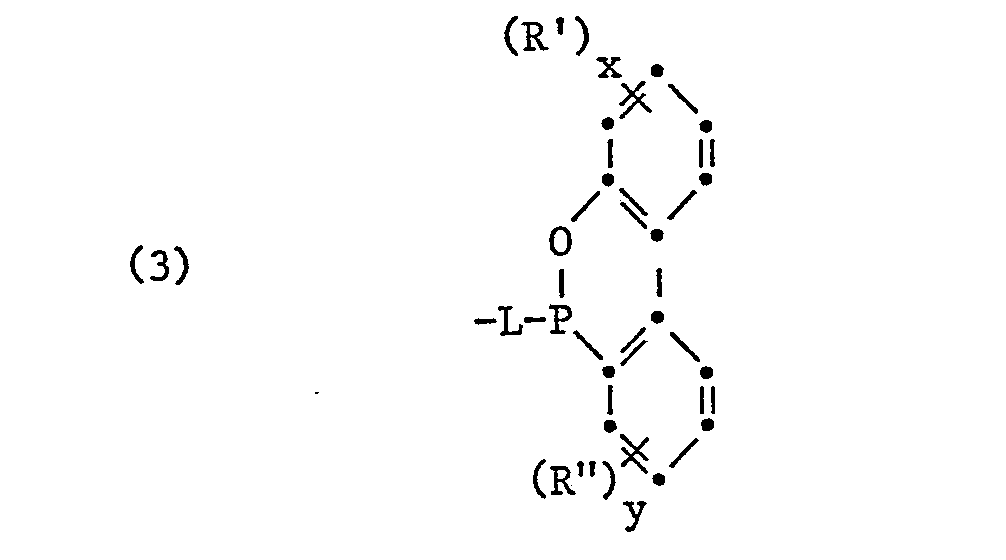
- L ein Rest der Formel=N-Z, worin Z gegebenenfalls substituiertes Alkyl oder Cycloalkyl ist, ein gegebenenfalls substituierter 5- oder 6-gliedriger, gesättigter oder ungesättigter, mindestens 2 Heteroatome enthaltender Ring, wobei die Bindungen dieses Ringes zu den Oxaphosphorinresten durch die Heteroatome erfolgen, gegebenenfalls substituiertes Arylenoxy, gegebenenfalls substituiertes Oxyarylenoxy oder ein Rest der Formel -NB1-E-NB2- ist, worin B1und B2 unabhängig voneinander Wasserstoff, Alkyl oder den Rest A sind, und E Alkylen oder

- Gegenstand der Erfindung ist ferner die Verwendung des photographischen Aufzeichnungsmaterials zur Herstellung photographischer Bilder.
- Ein weiterer Gegenstand betrifft die mit dem photographischen Aufzeichnungsmaterial hergestellten photographischen Bilder.
- Gegenstand der Erfindung ist auch ein Verfahren zur Herstellung des photographischen Aufzeichnungsmaterials.
- Gegenstand der Erfindung ist ferner ein Entwicklungsbad, das Entwicklungsbeschleuniger der Formel (1) enthält und zur Entwicklung belichteter photographischer Materialien geeignet ist.
- Der Substituent A in Verbindungen der Formel (1) ist ein Dibenz--[c,e][1,2]-oxaphosphorinrest, worin beide aromatischen Systeme unsubstituiert oder substituiert sein können. Als Substituenten kommen R' und R" in Frage. Sie bedeuten unabhängig voneinander Wasserstoff oder gegebenenfalls substituiertes Alkyl mit 1 bis 4 Kohlenstoffatomen. Substituenten für diese Alkylreste sind beispielsweise Halogen, wie Chlor und Brom, ferner Methoxy, Aethoxy, Cyano oder Nitro. Chlor, Methoxy und Cyano sind bevorzugt. Besonders geeignete Alkylreste sind Methyl und Aethyl. Bedeuten R' und R" unabhängig voneinander Halogen, so sind Chlor und Brom bevorzugt.
- Die Indizes x und y sind unabhängig voneinander 0, 1, 2 oder 3, vorzugsweise 0 oder 1.
- R bedeutet substituiertes Amino der Formel -NR R . Darin sind R und R2 unabhängig voneinander Wasserstoff oder Alkyl mit 1 bis 22 Kohlenstoffatomen, wobei die Alkylreste geradkettig oder verzweigt sein können, wie z.B. Methyl, Aethyl, Propyl, i-Propyl, Butyl, i-Butyl, tert-Butyl, Amyl, tert-Amyl (1,1-Dimethylpropyl), 1,1,3,3-Tetramethylbutyl, 1-Methyläthylpentyl, Hexyl, 1-Methylpentyl, Neopentyl, 1-, 2-oder 3-Methylhexyl, Heptyl, n-Octyl, tert-Octyl, 2-Aethylhexyl, n-Nonyl, Isononyl, tert-Nonyl, Decyl, tert-Decyl, Undecyl; ferner Dodecyl, Tetradecyl, Hexadecyl, Octadecyl, Nonadecyl oder Eicosyl sowie die dazugehörenden Isomeren.
- Alkylreste mit 1 bis 18, insbesondere 1 bis 12 Kohlenstoffatomen sind bevorzugt. Ganz besonders geeignet sind Alkylreste mit 1 bis 8 Kohlenstoffatomen. Die Alkylreste können mit_Halogen, wie z.B. Fluor, Chlor oder Brom, Alkoxy mit 1 bis 4 Kohlenstoffatomen oder Phenyl substituiert sein.
- R 1 und R bedeuten ferner Alkenyl mit 2 bis 12 Kohlenstoffatomen. Sie leiten sich hinsichtlich ihrer chemischen Struktur von den oben genannten Alkylresten ab, wobei 1, 2 oder 3, vorzugsweise 1 Doppelbindung im Alkenylrest vorhanden ist. Als Substituenten der Alkenylreste können Halogen, z.B. Brom oder Chlor, oder Alkoxy, z.B. Methoxy oder Aethoxy, in Frage kommen.
- Alkenylreste mit 2 bis 6, insbesondere 3 Kohlenstoffatomen sind bevorzugt.
- R und R2 bedeuten ferner unabhängig voneinander Alkinyl mit 2 bis 18 Kohlenstoffatomen. Es können dabei die den genannten Alkylresten entsprechenden Alkinylreste in Frage kommen, wobei 1, 2 oder 3, vorzugsweise 1 Dreifachbindung im Alkinylrest vorhanden ist. Geeignete Substituenten für die Alkinylreste können Halogen, z.B. Fluor, Chlor oder Brom, ferner Cyano, Nitro oder Methoxy sein. Alkinylreste mit 2 bis 6, insbesondere 3 Kohlenstoffatomen sind bevorzugt.
- R und R sind auch unabhängig voneinander gegebenenfalls substituiertes Cycloalkyl mit 6 bis 8, vorzugsweise 6 Kohlenstoffatomen. Bevorzugte Substituenten können Methyl und tert-Butyl sein.
- In der Bedeutung von gegebenenfalls substituiertem Aryl sind R 1 und R 2 unabhängig voneinander Phenyl oder Naphthyl. Diese Reste können mit Alkyl mit 1 bis 6 Kohlenstoffatomen wie z.B. Methyl, Aethyl, Propyl, i-Propyl, Butyl, i-Butyl, tert-Butyl, Amyl, tert-Amyl, Hexyl, 1,1,3,3-Tetramethylbutyl, 1-Methylpentyl oder Neopentyl substituiert sein. Die Arylsysteme können mit bis zu 3 solcher Alkylreste substituiert sein. Bevorzugtes Aryl ist Phenyl. Bevorzugte Arylsubstituenten sind Methyl, tert-Butyl, tert-Amyl und Hexyl.
- Sind R1 und R2 unabhängig voneinander ein gegebenenfalls substituierter, gesättigter oder ungesättigter, mindestens ein Stickstoffatom enthaltender heterocyclischer Rest mit 4 oder 5 Kohlenstoffatomen, so sind gesättigte Systeme, vorzugsweise mit 5 Kohlenstoffatomen, besonders geeignet. Als Substituenten dieser Systeme können Alkylreste mit 1 bis 4 Kohlenstoffatomen in Frage kommen, wobei bis zu 6 solcher Alkylreste an einen heterocyclischen Ring gebunden sein können. Bevorzugte Alkylreste sind Methyl und tert-Butyl.
- R ist ferner gegebenenfalls substituiertes cyclisches Amino. Die Reste R1 und R2 in der Formel

- Bedeutet R gegebenenfalls substituiertes Aryloxy wie z.B. Phenoxy oder Naphthoxy, so ist der Phenoxyrest bevorzugt. Dieser kann, wie auch der Naphthoxyrest, mit 1 bis 4 Substituenten substituiert sein und z.B. der Formel

- Dabei bedeuten R 9 und R10 unabhängig voneinander Wasserstoff oder Alkyl mit 1 bis 12 Kohlenstoffatomen. Beispiele für die Alkylreste sind in den Definitionen von R und R2 angegeben. Diese Reste können mit Phenyl weitersubstituiert sein, wobei der (die) Phenylrest(e) Methyl- oder tert-Butyl-gruppen als weitere Substituenten besitzen kann (können). Bevorzugte Alkylreste sind Methyl, tert-Butyl, tert--Amyl und tert-Octyl.
- R11 bedeutet Wasserstoff oder gegebenenfalls substituiertes Alkyl mit 1 bis 4 Kohlenstoffatomen. Bevorzugte Alkylgruppen sind Methyl, i-Propyl, Butyl und tert-Butyl. Als Substituenten dieser Alkylreste können Methoxy, Cyano oder Nitro in Frage kommen.
- R12 ist Wasserstoff oder gegebenenfalls substituiertes Alkyl mit 1 bis 12 Kohlenstoffatomen. Als Beispiel können die entsprechenden obengenannten Alkylreste in Frage kommen. Diese können weiter substituiert sein mit Alkoxy mit 1 bis 18 Kohlenstoffatomen. Bevorzugte Alkoxyreste sind Octadecyloxy, Hexadecyloxy, tert-Octyloxy, tert-Nonyloxy, tert-Amyloxy, tert-Butoxy, Aethoxy und Methoxy. Weitere Beispiele geeigneterAlkoxyreste lassen sich von der oben stehenden Aufzählung der Alkylreste in den Definitionen von R und R2 ableiten. Ferner können die Alkylreste mit Carbalkoxy mit 2 bis 24, insbesondere 2 bis 18 Kohlenstoffatomen substituiert sein.
- Bedeutet R12 gegebenenfalls substituiertes Alkoxy mit 1 bis 18 Kohlenstoffatomen, so sind Alkoxyreste mit bis zu 12 Kohlenstoffatomen bevorzugt. Als Beispiele können die oben genannten Alkoxyreste in Frage kommen. Ferner sind Alkoxyreste mit 1 bis 4 Kohlenstoffatomen wie z.B. Methoxy, Aethoxy, Propoxy, Butoxy oder tert-Butoxy, besonders geeignet. Die Alkoxyreste können mit Carbalkoxy mit 2 bis 4 Kohlenstoffatomen weiter substituiert sein.
- Ferner bedeutet R12 Carbalkoxy mit 2 bis 24, insbesondere 2 bis 19 Kohlenstoffatomen. Die entsprechenden Alkoxyreste mit 1 bis 18 Kohlenstoffatomen lassen sich von der obenstehenden Aufzählung der Alkylreste in den Definitionen von R1 und R2 ableiten. Die Alkoxyreste können mit Methoxy, Halogen wie z.B..Chlor oder Brom, sowie mit Cyano oder Nitro weiter substituiert sein.
- Desweiteren bedeutet R12 Thioalkyl mit 1 bis 18 Kohlenstoffatomen. Diese Thioalkylreste leiten sich bezüglich ihrer chemischen Struktur von den oben genannten Alkoxyresten ab. Bei besonders geeigneten Thioalkylverbindungen ist der Alkylrest eine Methyl-, Aethyl-, Butyl-, tert-Butyl-, Pentyl- oder Hexylgruppe. Der Alkylrest ist gegebenenfalls mit Methoxy, Aethoxy, Halogen wie z.B. Chlor oder Brom, oder Carbalkoxy mit 2 bis 4 Kohlenstoffatomen substituiert.
- R ist ferner eine Gruppe der Formel -CO-NR13 R14, worin R13 und R unabhängig voneinander Wasserstoff oder gegebenenfalls substituiertes Alkyl mit 1 bis 4 Kohlenstoffatomen wie z.B. Methyl, Aethyl, Propyl, Butyl und tert-Butyl sind. Diese können mit Alkoxy wie z.B. Methoxy oder Aethoxy sowie mit Carbalkoxy mit 2 bis 4 Kohlenstoffatomen weiter substituiert sein.
- R 13 und R 14 bedeuten auch unabhängig voneinander Alkenyl mit 3 bis 6, insbesondere 3 Kohlenstoffatomen.
- Ferner können R11 und R12 zusammen mit den Kohlenstoffatomen, an die sie gebunden sind, einen gegebenenfalls substituierten, gesättigten oder ungesättigten, 5- oder 6-gliedrigen Ring bilden.
- Gesättigte, 5-gliedrige Ringsysteme sind bevorzugt, welche mit Methyl, i-Propyl oder tert-Butyl weiter substituiert sind.
- R ist ferner eine Gruppe der Formel

- L ist ein zweiwertiger Rest und bedeutet einen gegebenenfalls substituierten 5- oder 6-gliedrigen, mindestens 2 Heteroatome enthaltenden Ring, wobei die Bindungen dieses Ringes zu den Oxaphosphorinresten durch die Heteroatome erfolgen, gegebenenfalls substituiertes Arylenoxy, gegebenenfalls substituiertes Oxyarylenoxy oder ein Rest der Formel =N-Z.
- Ist L eine Gruppierung=N-Z, so bedeutet Z Alkyl mit 1 bis 22, insbesondere 1 bis 16 Kohlenstoffatomen. Alkylreste mit 8 bis 12 Kohlenstoffatomen sind ganz besonders geeignet. Beispiele für die Reste lassen sich von der in den Definitionen für R1 und R2 genannten Aufzählung ableiten. Als Substituenten dieser Reste können Alkoxy mit 1 bis 4 Kohlenstoffatomen, Carbalkoxy mit 2 bis 4 Kohlenstoffatomen oder Cyano in Frage kommen. Z bedeutet ferner gegebenenfalls substituiertes Cycloalkyl, das 5 oder 6, vorzugsweise 6 Kohlenstoffatome enthält. Es ist gegebenenfalls mit Alkyl oder Alkoxy mit je 1 bis 4 Kohlenstoffatomen weiter substituiert.
- L ist desweiteren ein gegebenenfalls substituierter 5- oder 6-gliedriger, gesättigter oder ungesättigter, mindestens 2 Heteroatome enthaltender Ring, wobei die Bindungen dieses Ringes zu den Oxaphosphorinresten durch die Heteroatome erfolgen. Gesättigte 5- oder 6-gliedrige Ringe, die 2 Stickstoffatome enthalten sind bevorzugt, wie z.B.:

- Alle Ringe können mit Methyl, Aethyl, Propyl, Butyl oder tert.-Butyl substituiert sein.
- L bedeutet ferner gegebenenfalls substituiertes Arylenoxy. Bevorzugte Arylenoxyreste sind Phenylenoxy oder Naphthylenoxy, wobei Phenylenoxy ganz besonders geeignet ist. Dieses kann, wie auch der Naphthylenoxyrest, mit 1 bis 4 weiteren Substituenten substituiert sein, und z.B. der Formel


- R9, R10 und R11 haben die oben angegebenen Bedeutungen. L kann also die folgenden Brückenglieder darstellen:


- R 23 und R 24 bedeuten auch gegebenenfalls substituiertes Alkoxy mit 1 bis 4 Kohlenstoffatomen, wie z.B. Methoxy, Propoxy oder Butoxy, Methoxy ist bevorzugt.
- Der Oxyphenylenoxyrest bedeutet also Brückenglieder der Formel

- Ferner ist L ein Rest der Formel -NB1-E-NB2-. E ist eine Alkylengruppe mit 1 bis 8, insbesondere 1 bis 6 Kohlenstoffatomen. E bedeutet eine Gruppe der Formel

- Bevorzugt ist nun ein solches photographisches Aufzeichnungsmaterial, worin der Entwicklungsbeschleuniger der Formel

- R1 gegebenenfalls mit Alkyl, Alkenyl, Alkinyl, Cycloalkyl, Aryl oder mit einem heterocyclischen Rest substituiertes Amino, gegebenenfalls substituiertes 5- oder 6-gliedriges cyclisches Amino, gegebenenfalls mit Alkyl, Alkoxy, Carbalkoxy, Thioalkyl oder Carbonamido substituiertes Phenoxy, oder einer Gruppe der Formel

- L1 ein Rest der Formel =N-Z ist, worin Z die oben angegebene Bedeutung hat, ein gegebenenfalls substituierter 5- oder 6-gliedriger, gesättigter oder ungesättigter, mindestens 2 Heteroatome enthaltender Ring, wobei die Bindungen diese Ringes zu den Oxaphosphorinresten durch die Heteroatome erfolgen, gegebenenfalls substituiertes Arylenoxy, gegebenenfalls substituiertes Oxyarylenoxy oder ein Rest der Formel -NB3-E1-NB4- ist, worin B3 und B4 unabhängig voneiander Wasserstoff, Alkyl mit 1 bis 4 Kohlenstoffatomen oder der Rest A sind, und E1 Alkylen mit 1 bis 12 Kohlenstoffatomen oder

- A und R', R", x und y die oben angegebenen Bedeutungen haben.
- Geeignetes photographisches Aufzeichnungsmaterial enthält einen Entwicklungsbeschleuniger der Formel

- R2 gegebenenfalls mit Alkyl, Alkenyl, Alkinyl, Cycloalkyl, Aryl oder mit einem heterocyclischen Rest substituiertes Amino, gegebenenfalls mit Alkyl, Alkoxy, Carbalkoxy, Thioalkyl oder Carbonamido substituiertes Phenoxy, oder eine Gruppe der Formel

- L2 ein Rest der Formel =N-Z1, worin Z1 gegebenenfalls substituiertes Alkyl mit 1 bis 22 Kohlenstoffatomen oder gegebenenfalls substituiertes Cycloalkyl mit 5 oder 6 Kohlenstoffatomen ist, ein gegebenenfalls substituierter 5- oder 6-gliedriger, gesättigter oder ungesättigter, mindestens 2 Heteroatome enthaltender Ring, wobei die Bindungen dieses Ringes zu den Oxaphosphorinresten durch die Heteroatome erfolgen, gegebenenfalls substituiertes Arylenoxy, gegebenenfalls substituiertes Oxyarylenoxy oder ein Rest der Formel -NB3-E2-NB4- ist, worin E2 Alkylen mit 1 bis 8 Kohlenstoffatomen oder

- Bevorzugt ist ferner ein photographisches Aufzeichnungsmaterial, welches einenEntwicklungsbeschleuniger der Formel

- R 3 der Formel

- R und R2 unabhängig voneinander Wasserstoff, gegebenenfalls substituiertes Alkyl mit 1 bis 22 Kohlenstoffatomen, gegebenenfalls substituiertes Alkenyl mit 2 bis 18 Kohlenstoffatomen, gegebenenfalls substituiertes Alkinyl mit 2 bis 18 Kohlenstoffatomen, gegebenenfalls substituiertes Cycloalkyl mit 6 bis 8 Kohlenstoffatomen, gegebenenfalls substituiertes Aryl oder ein gegebenenfalls substituierter, gesättigter oder ungesättigter, mindestens ein Stickstoffatom enthaltender heterocyclischer Rest mit 4 oder 5 Kohlenstoffatomen sind, oder worin R und R zusammen einen zweiwertigen Rest zur Bildung eines 5- oder 6-gliedrigen, gegebenenfalls ein weiteres Heteroatom enthaltenden, gegebenenfalls substituierten, gesättigten Ringes sind, und R', R", x und y die oben angegebenen Bedeutungen haben.
- Von Interesse ist photographisches Aufzeichnungsmaterial, worin der Entwicklungsbeschleuniger der Formel


- R 3 und R4 unabhängig voneinander Wasserstoff, gegebenenfalls substituiertes Alkyl mit 1 bis 18 Kohlenstoffatosen, gegebenenfalls substituiertes Alkenyl mit 2 bis 12 Kohlenstoffatomen, gegebenenfalls substituiertes Cycloalkyl mit 6 bis 8 Kohlenstoffatomen, gegebenenfalls substituiertes Phenyl oder ein gegebenenfalls substituierter, gesättigter oder ungesättigter, mindestens ein Stickstoffatom enthaltender heterocyclischer Rest mit 4 oder 5 Kohlenstoffatomen sind, oder worin R 3 und R4 zusammen einen zweiwertigen Rest zur Bildung eines 5- oder 6-gliedrigen, gegebenenfalls ein weiteres Heteroatom enthaltenden, gegebenenfalls substituierten, gesättigten Ringes sind, und R', R", x und y die oben angegebenen Bedeutungen haben.
- Besonders bevorzugtes photographisches Aufzeichnungsmaterial enthält einen Entwicklungsbeschleuniger der Formel

- R 5 der Formel

- R5und R6 unabhängig voneinander Wasserstoff, Alkyl mit 1 bis 18 Kohlenstoffatomen, Alkenyl mit 2 bis 12 Kohlenstoffatomen, Cycloalkyl mit 6 bis 8 Kohlenstoffatomen, gegebenenfalls mit Alkyl mit 1 bis 6 Kohlenstoffatomen substituiertes Phenyl, wobei der Phenylrest 1, 2 oder 3 solcher Alkylsubstituenten tragen kann, oder ein gegebenenfalls mit Alkyl mit 1 bis 4 Kohlenstoffatomen substituierter, gesättigter, mindestens ein Stickstoffatom enthaltender heterocyclischer Rest mit 4 oder 5 Kohlenstoffatomen sind, wobei der heterocyclische Rest 1 bis 6 solcher Alkylsubstituenten tragen kann, oder worin R5 und R6 zusammen ei-nen Rest der Formel -(CH2)4-, -(CH2)5- , -CH2CH2-O-CH2CH2- oder -CH2CH2-NT-CH2CH2- bilden, worin T Wasserstoff oder Alkyl mit 1 bis 4 Kohlenstoffatomen ist, und R', R", x und y die oben angegebenen Bedeutungen haben.
- Ferner ist photographisches Aufzeichnungsmaterial von Bedeutung, das einen Entwicklungsbeschleuniger der Formel


- R und R8 unabhängig voneinander Wasserstoff, Alkyl mit 1 bis 12 Kohlenstoffatomen, Alkenyl mit 2 bis 6 Kohlenstoffatomen, Cyclohexyl, Cyclooctyl, gegebenenfalls mit Alkyl mit 1 bis 6 Kohlenstoffatomen substituiertes Phenyl, wobei der Phenylrest 1, 2 oder 3 solcher Substituenten tragen kann, oder gegebenenfalls mit Alkyl mit 1 bis 4 Kohlenstoffatomen substituiertes Pyrrolidinyl oder Piperidinyl sind, wobei die heterocyclischen Reste 1 bis 6 solcher Alkylsubstituenten tragen können, oder worin R und R8 zusammen einen Rest der Formel -(CH2)4-, -(CH2)5-, -CH2CH2-O-CH2CH2 oder -CH2CH2-NH-CH2CH2-bilden, und R', R", x und y die oben angegebenen Bedeutungen haben.
- Besonders geeignetes photographisches Aufzeichnungsmaterial enthält einen Entwicklungsbeschleuniger der Formel

- x' und y' unabhängig voneinander 0 oder 1 sind,und
- R6 die oben angegebene Bedeutung hat.
- Desweiteren ist ein photographisches Aufzeichnungsmaterial von Interesse, das einen Entwicklungsbeschleuniger der Formel

- Wertvolles photographisches Aufzeichnungsmaterial enthält einen Entwicklungsbeschleuniger der Formel


- R 9 und R 10 unabhängig voneinander Wasserstoff oder gegebenenfalls substituiertes Alkyl mit 1 bis 12 Kohlenstoffatomen sind,
- R 11 Wasserstoff oder gegebenenfalls substituiertes Alkyl mit 1 bis 4 Kohlenstoffatomen,
- R 12 Wasserstoff, gegebenenfalls substituiertes Alkyl mit 1 bis 12 Kohlenstoffatomen, gegebenenfalls substituiertes Alkoxy mit 1 bis 18 Kohlenstoffatomen, Carbalkoxy mit 2 bis 24 Kohlenstoffatomen, wobei der Alkoxyteil weiter substituiert sein kann oder gegebenenfalls substituiertes Thioalkyl mit 1 bis 18 Kohlenstoffatomen ist oder der Formel

- R 13 und R 14 unabhängig voneinander Wasserstoff, gegebenenfalls substituiertes Alkyl mit 1 bis 4 Kohlenstoffatomen oder Alkenyl mit 3 bis 6 Kohlenstoffatomen sind, oder
- R 12 und R 11 zusammen diejenigen Atome sind, um zusammen mit den Kohlenstoffatomen, an die sie gebunden sind, einen gegebenenfalls substituierten, gesättigten oder ungesättigten, 5- oder 6-gliedrigen Ring zu bilden und R', R", x und y die oben angegebenen Bedeutungen haben.
- Sehr geeignetes photographisches Aufzeichnungsmaterial enthält einen Entwicklungsbeschleuniger der Formel


- R 15 und R 16 unabhängig voneinander Wasserstoff oder gegebenenfalls mit substituiertem Phenyl substituiertes Alkyl mit 1 bis 12 Kohlenstoffatomen sind,
- R17 Wasserstoff oder Alkyl mit 1 bis 4 Kohlenstoffatomen,
- R18 Wasserstoff, gegebenenfalls mit Alkoxy mit 1 bis 18 Kohlenstoffatomen oder mit Carbalkoxy mit 2 bis 24 Kohlenstoffatomen substituiertes Alkyl mit 1 bis 12 Kohlenstoffatomen, Alkoxy mit 1 bis 12 Kohlenstoffatomen, Carbalkoxy mit 2 bis 24 Kohlenstoffatomen, oder Thioalkyl mit 1 bis 18 Kohlenstoffatomen ist oder der Formel

- R19 und R20 unabhängig voneinander Wasserstoff oder Alkyl mit 1 bis 4 Kohlenstoffatomen sind, oder worin
- R18 und R17 zusammen diejenigen Atome sind, um zusammen mit den Kohlenstoffatomen, an die sie gebunden sind, einen gegebenenfalls mit Alkyl mit 1 bis 4 Kohlenstoffatomen substituierten, gesättigten, 5-oder 6-gliedrigen Ring zu bilden, wobei dieser mit bis zu 4 solcher Alkylsubstituenten substituiert sein kann, und R', R", x und y die oben angegebenen Bedeutungen haben.
- Von besonderem Interesse ist photographisches Aufzeichnungsmaterial, das einen Entwicklungsbeschleuniger der Formel

- Ferner ist photographisches Material von Bedeutung, welches einen Entwicklungsbeschleuniger der Formel

- L3 ein Rest der Formel=N-Z2, worin Z gegebenenfalls substituiertes Alkyl mit 1 bis 16 Kohlenstoffatomen oder gegebenenfalls substituiertes Cyclohexyl ist, ein gegebenenfalls substituierter 5- oder 6-gliedriger, gesättigter, mindestens 2 Heteroatome enthaltender Ring, wobei die Bindungen dieses Ringes zu den Oxaphosphorinresten durch die Heteroatome erfolgen, gegebenenfalls substituiertes Phenylenoxy oder Naphthylenoxy oder gegebenenfalls substituiertes Oxyphenylenoxy oder Oxynaphthylenoxy ist, und R', R", x und y die oben angegebenen Bedeutungen haben.
- Wertvolles photographisches Aufzeichnungsmaterial enthält einen Entwicklungsbeschleuniger der Formel

- L4 ein Rest der Formel =N-Z3, worin Z3 Alkyl mit 1 bis 16 Kohlenstoffatomen oder Cyclohexyl ist, ein 5- oder 6-gliedriger, gesättigter, mindestens 2 Stickstoffatome enthaltender Ring, wobei die Bindungen dieses Ringes zu den Oxaphosphorinresten durch die Stickstoffatome erfolgen, oder L4 ein Rest der Formel

- R 21 einem Rest der Formeln


- Ein ausserordentlich geeignetes photographisches Aufzeichnungsmaterial enthält einen Entwicklunsbeschleuniger der Formel


- oder L5 der Formel

- R 25 einem Rest der Formeln

- R26 =CR51R61 ist, worin R51 und R61 die oben angegebenen Bedeutungen haben und
- R15, R 16 und R 17 die angegebenen Bedeutungen haben, oder L5 ein Rest der Formel

- R 27 und R 28 unabhängig voneinander Wasserstoff, Alkyl mit 1 bis 12 Kohlenstoffatomen oder Alkoxy mit 1 bis 4 Kohlenstoffatomen sind, und R', R", x und y die oben angegebenen Bedeutungen haben.
- Von besonderem Interesse ist ein photographisches Aufzeichnungsmaterial, das einen Entwicklungsbeschleuniger der Formel

- L6 ein Rest der Formel =N-Z3, worin Z3 die oben angegebenen Bedeutungen hat, oder ein Rest der Formeln

- oder L6 der Formel

- entspricht, worin R29 einem Rest der Formeln


- R30 = CR51R61 ist und
- R15, R16 und R17 sowie R51 und R61 die oben angegebenen Bedeutungen haben, oder
- L6 der Formel

- R 31 und R 32 unabhängig voneinander Wasserstoff oder Alkyl mit 1 bis 12 Kohlenstoffatomen sind, und
- R', R", x und y die oben angegebenen Bedeutungen haben.
- Von grosser Bedeutung ist ein photographisches Aufzeichnungsmaterial, das einen Entwicklungsbeschleuniger der Formel

- Besonders geeignetes photographisches Aufzeichnungsmaterial enthält einen Entwicklungsbeschleuniger der Formel


- Bevorzugtes photographisches Aufzeichnungsmaterial enthält einen Entwicklungsbeschleuniger der Formel

- Besonders geeignetes photographisches Aufzeichnungsmaterial enthält einen Entwicklungsbeschleuniger der Formel


- R71 Wasserstoff, Alkyl mit 1 bis 12 Kohlenstoffatomen, Cyclohexyl oder Cyclooctyl, und
- R81 Alkyl mit 1 bis 12 Kohlenstoffatomen, Cyclohexyl, Cyclooctyl,
- Alkenyl mit 2 bis 6 Kohlenstoffatomen, gegebenenfalls mit Alkyl mit 1 bis 6 Kohlenstoffatomen substituiertes Phenyl, wobei dieses 1 oder 2 solcher Alkylsubstituenten tragen kann, oder gegebenenfalls mit Alkyl mit 1 bis 4 Kohlenstoffatomen substituiertes Piperidinyl ist, wobei dieses 1 bis 4 solcher Alkylsubstituenten tragen kann, oder worin R81 und R 71 zusammen einen Rest der Formeln -(CH2)4-, -(CH2)5-, -CH2CH2-O-CH2CH2- oder -CH2CH2-NH-CH2CH2- bilden, oder worin F10 der Formel

- R 151 und R 161 unabhängig voneinander Wasserstoff, Alkyl mit 1 bis 8 Kohlenstoffatomen, Benzyl oder Phenyläthyl sind, wobei die Phenylreste mit Alkyl mit 1 bis 4 Kohlenstoffatomen substituiert sein können, R171 Wasserstoff, Methyl oder Aethyl und
- R181 Wasserstoff, gegebenenfalls mit Carbalkoxy mit 2 bis 24 Kohlenstoffatomen substituiertes Alkyl mit 1 bis 8 Kohlenstoffatomen, Alkoxy mit 1 bis 8 Kohlenstoffatomen oder Carbalkoxy mit 2 bis 19 Kohlenstoffatomen ist, oder R181 zusammen mit R171 diejenigen Atome bedeutet, um zusammen mit den Kohlenstoffatomen, an die sie gebunden sind, einen gegebenenfalls mit Alkyl mit 1 bis 4 Kohlenstoffatomen substituierten, gesättigten, 5-gliedrigen Ring zu bilden, wobei dieser mit bis zu 4 solcher Alkylsubstituenten substituiert sein kann,
oder worin R10 der Formel
- L61 ein Rest der Formel =N-Z4, worin Z4 Alkyl mit 1 bis 12 Kohlenstoffatomen oder Cyclohexyl ist, ein Rest der Formeln


- R291 einem Rest der Formeln
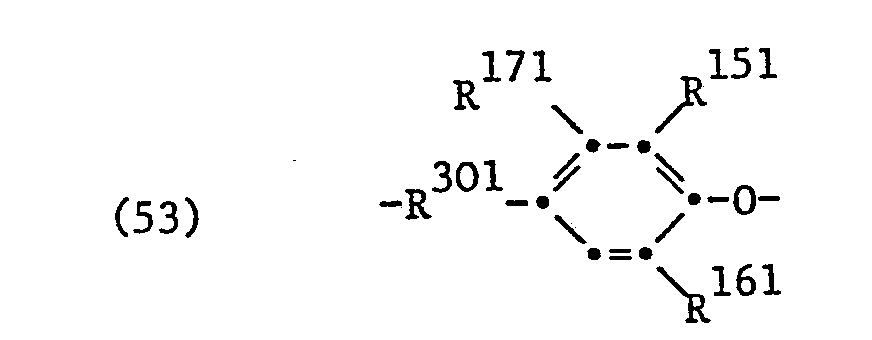

- R301 =CR52R62 ist, worin R 52 und R62 unabhängig voneinander Wasserstoff oder Alkyl mit 1 bis 4 Kohlenstoffatomen sind,
- oder worin L61 der Formel

- R311 und R 321 unabhängig voneinander Wasserstoff oder Alkyl mit 1 bis 8 Kohlenstoffatomen sind,
- oder worin R10 der Formel

- L71 ein Rest der Formel -NB7-E4-NB8- ist, worin B7 und B8 unabhängig voneinander Wasserstoff oder den Rest A bedeuten, und E4 Alkylen mit 1 bis 6 Kohlenstoffatomen oder ein Rest der Formel

- Wertvoll ist auch ein photographisches Aufzeichnungsmaterial, das einen Entwicklungsbeschleuniger der Formel

- R11 der Formel

- R72 Wasserstoff, Alkyl mit 1 bis 8 Kohlenstoffatomen oder Cyclohexyl und
- R 82 Alkyl mit 1 bis 8 Kohlenstoffatomen, Cyclohexyl, Allyl, gegebenenfalls mit Alkyl mit 1 bis 4 Kohlenstoffatomen substituiertes Phenyl, wobei dieses 1 oder 2 solcher Alkyl substituenten tragen kann, oder gegebenenfalls mit Methyl substituiertes Piperidin-4-yl ist, wobei dieses 1 bis 4 Methylgruppen tragen kann, oder worin R82 und R72 zusammen einen Rest der Formeln -(CH2)5- oder -CH2CH2-NH-CH2CH2- bilden, oder worin
- R 11 der Formel

- R 152 und R 162 unabhängig voneinander Wasserstoff, Alkyl mit 1 bis 8 Kohlenstoffatomen oder Benzyl sind, wobei der Phenylrest mit Methylgruppen substituiert sein kann,
- R172 Wasserstoff oder Methyl und
- R182 Wasserstoff, Alkyl mit 1 bis 8 Kohlenstoffatomen, mit Carbalkoxy mit 2 bis 19 Kohlenstoffatomen substituiertes Alkyl mit 1 bis 4 Kohlenstoffatomen, Methoxy oder Carbalkoxy mit 2 bis 19 Kohlenstoffatomen ist, oder R182 zusammen mit R172 diejenigen Atome bedeutet, um zusammen mit den Kohlenstoffatomen, an die sie gebunden sind, einen gegebenenfalls mit 1 bis 4 Methylgruppen substituierten, gesättigten, 5-gliedrigen Ring zu bilden, oder worin
- R11 der Formel

- L62 ein Rest der Formel =N-Z4 ist, worin Z4 die oben angegebenen Bedeutungen hat, oder der Formel


- R292 einem Rest der Formeln


- R 302 -CH2-, -CHCH3- oder -C(CH3)2- ist,
- oder worin L62 der Formel

- R312 und R322 unabhängig voneinander Wasserstoff oder Alkyl mit 1 bis 4 Kohlenstoffatomen sind,
- oder worin R11 der Formel

- L72 ein Rest der Formel -NB7-E5-NB8- ist, worin B7 und B8die oben angegebenen Bedeutungen haben, und E Alkylen mit 1 bis 6 Kohlenstoffatomen ist, und worin R"', R"", x' und y' die oben angegebenen Bedeutungen haben.
- Die Verbindungen der Formel (1) sind aus EP-OS 352, EP-OS 5 441 und US 4.185.006 bekannt.
- Die erfindungsgemäss verwendeten Entwicklungsbeschleuniger werden in Kontakt mit der Silberhalogenidemulsionsschicht verwendet. Das heisst, sie müssen während der Entwicklung in der Emulsionsschicht anwesend sein. Dies kann entweder dadurch erreicht werden, dass man die Verbindungen in die Emulsionsschicht vor der Belichtung einarbeitet oder in dem man ihnen die Möglichkeit gibt, aus einem Entwickler in die Emulsionsschicht einzudiffundieren. Dies ist möglich, da die Entwicklungsbeschleuniger gegen Hydrolyse stabil sind und deshalb über längere Zeit gelöst in einem Verarbeitungsbad vorliegen können. Das Einbringen der Verbindungen direkt in die Silberhalogenidemulsion ist bevorzugt. Man kann entweder wässrige Lösungen dieser Verbindungen verwenden oder Lösungen in einem organischen Lösungsmittel, das die photographischen Eigenschaften des lichtempfindlichen Materials nicht beeinflusst.
- Die erfindungsgemäss verwendeten empfindlichkeitssteigernden Verbindungen können der Emulsion zu verschiedenen Zeitpunkten der Emülsionsherstellung zugefügt werden. Man kann sie beispielsweise einzeln oder gemischt mit anderen üblichen Zusätzen während der physikalischen oder chemischen Reifung oder zu irgend einem anderen Zeitpunkt vor dem Vergiessen der Emulsion zugeben. Am zweckmässigsten geschieht dies jedoch nach der chemischen Reifung und kurz vor dem Vergiessen der Emulsion.
- Die zugesetzte Menge richtet sich nach der gewählten Verbindung sowie nach der Art des für die Silberhalogenidemulsion verwendeten kolloidalen Bindemittels. Im allgemeinen werden die Verbindungen gemäss vorliegende Erfindung in einer Menge von 1 bis 50 g pro Mol Silberhalogenid verwendet.
- Zur Einarbeitung der Verbindungen in die Silberhalogenidemulsionen können die üblichen Methoden angwandt werden. Sie können z.B. aus Lösungen in kaum wassermischbaren, hochsiedenden Lösungsmitteln z.B. Di-n-butylphthalat und Tricresylphosphat, oder in kaum wassermischbaren, niederigsiedenden Lösungsmitteln, wie Aethylacetat, Methylenchlorid und Chloroform, usw., oder Mischungen davon, eingearbeitet werden. Zu diesem Zweck werden diese Lösungen in ausserordentlich feinen Tröpfchen, vorzugsweise in Gegenwart eines Netz- oder Dispergiermittels, in dem hydrophilen, kolloidalen Medium dispergiert. Das sich kaum mit Wasser mischende, niederigsiedende Lösungsmittel wird dann abgedampft. Natürlich kann jede andere dem Fachmann bekannte Technik, Additive in Kolloidmischungen einzuarbeiten, angewendet werden. Es können z.B. die wasserlöslichen Substanzen, die eine wasserlöslichmachende Sulfogruppe (in Säure- oder Salzform) enthalten, der Giesszusammensetzung der in Frage kommenden Schicht aus einer wässrigen oder alkalischen Lösung einverleibt werden.
- Die hydrophile Kolloidzusammensetzung, in der die erfindungsgemässen Verbindungen dispergiert oder gelöst werden, braucht nicht unbedingt die Giesszusammensetzung der Silberhalogenidemulsionsschicht selbst zu sein, in der sie enthalten sein sollten. Die Verbindungen können vorteilhafterweise erst in einer wässrigen, lichtunempflindlichen, hydrophilen Kolloidlösung dispergiert oder gelöst werden, worauf die entstandene Mischung gegebenenfalls nach Entfernen der organischen Lösungsmittel mit der Giesszusammensetzung der lichtempfindlichen Silberhalogenidemulsionsschicht kurz vor dem Auftragen eingehend gemischt wird.
- So können z.B. polymere oder copolymere Latices gegebenenfalls in Gegenwart eines organischen Lösungsmittels mit den erfindungsgemässen Verbindungen beladen werden. Das so erhaltene Gemisch wird dann vor dem Auftrag der lichtempfindlichen Silberhalogenidemulsion zugemischt.
- Aufgrund ihrer Eigenschaft, die Entwickelbarkeit photographischer Schichten zu unterstützen, eignen sich die erfindungsgemäss verwendeten Verbindungen vorzüglich zur Steigerung der Röntgenlichtempfindlichkeit sowie der allgemeinen Lichtempfindlichkeit, sowohl von orthochromatischen, panchromatischen und anderen speziellen Emulsionen, als auch von konventionellen spektral nicht sensibilisierten Emulsionen. Die Substanzen können diesen Emulsionen entweder getrennt oder gemeinsam mit den üblichen Sensibilisierungsfarbstoffen zugesetzt werden. Es sei noch erwähnt, dass die beschriebenen Vorteile der erfindungsgemäss angewandten Verbindungen sowohl Negativ- als auch Positivemulsionen betreffen.
- Vorteilhaft sind die neuen Verbindungen für die Entwicklung lichtempfindlicher Materialien, die für die Wiedergabe graphischer Darstellungen bestimmt sind.
- Im Silberfarbbleichverfahren, wo nach einer ersten Schwarzweissentwicklung mit Hilfe des entstandenen Silberbildes der eingelagerte Farbstoff bildmässig proportional der Silbermenge ausgebleicht wird, haben sich die erfindungsgemässen Verbindungen ganz besonders bewährt. In ihrer Gegenwart werden nach der Belichtung des Materials erheblich grössere Mengen an Silber entwickelt, was sich dann in einer besseren und vollständigeren Bleichung des Farbstoffes auswirkt. Durch die besser Ausnützung des eingegossenen Silbers lassen sich auch nicht unerhebliche Mengen an Silber einsparen.
- Als Entwickler kommen die dem Fachmann bekannten Entwicklersubstanzen in Frage. Die Verarbeitung entspricht den üblicherweise für das entsprechende photographische Material angewandten Methoden.
- Die Herstellung der erfindungsgemäss verwendeten Entwicklungsbeschleuniger ist aus der genannten Literatur bekannt. Sie wird in den folgenden Beispielen näher erläutert.
- 35,1 g (0,15 Mol) 6-Chloro-dibenz[c,e][1,2]-oxaphosphorin, 27,1 g (0,15 Mol) Dicyclohexylamin und 50 ml Triäthylamin werden während 10 Stunden bei Rückflusstemperatur gehalten. Die Lösung wird mit Toluol versetzt, das Triäthylaminhydrochlorid durch Filtration entfernt, und das Filtrat am Vakuum eingeengt. Das kristalline Produkt besitzt einen Schmelzpunkt von 162°C (Verbindung 4 in Tabelle 1).
- Beispiel 2: Verfährt man wie in Beispiel 1 beschrieben und verwendet man anstelle des Dicyclohexylamins 15,1 g (0,15 Mol) Diisopropylamin, so erhält man das 6-(N,N-Di-isopropylamino)-dibenz[c,e][1,2]-oxaphos- phorin mit einem Schmelzpunkt von 111°C. (Verbindung 5 in Tabelle 1).
- Beispiel 3: Unter Verwendung eines Mol-Aequivalents Cyclohexylamin und zwei Mol-Aequivalenten 6-Chloro-dibenz[c,e][1,2]-oxaphosphorin unter sonst gleichen Bedingungen wie in Beispiel 1 beschrieben, erhält man das N,N-Bis-(dibenz[c,e][1,2]-oxaphosphorin-6-yl)-N-cyclohexylamin mit einem Schmelzpunkt von 191°C (Verbindung 10 in Tabelle 1).
- Entsprechend erhält man die in Tabelle 1 zusammengestellten Verbindungen.


- Beispiel 4: Die in der folgenden Tabelle 2 angegebenen Mengen an Entwicklungsbeschleuniger werden jeweils in einem Gemisch von 534 mg Trikresylphosphat und 20 ml Aethylacetat gelöst. Dazu gibt man 140 ml einer wässrigen 6%igen Gelatinelösung sowie 1 ml einer 0,8%igen Lösung von Diisobutylnaphthalinsulfonsäure (Natriumsalz).
- Das Gemisch wird 5 Minuten mit einem Ultraschallgerät emulgiert. Dazu gibt man eine Silberhalogenidemulsion mit einem Silbergehalt von insgesamt 0,6 g Silber sowie eine wässrige Lösung des Härters der Formel

- Das Gemisch wird auf polyäthylen beschichtetem Papier bei ~ 40°C vergossen und bei Raumtemperatur getrocknet.
- Die so erhaltenen Proben des beschichteten Papiers werden unter einem 21-Stufenkeil (A = 0.15) 2 Sekunden mit 200 Lux belichtet und anschliessend bei 30°C wie folgt verarbeitet:
- 3 Minuten Entwicklung
- 1 Minute Wässern
- 3 Minuten Fixieren
- 4 Minuten Wässern, anschliessend getrocknet.
- Die angewandten Verarbeitungsbäder weisen die üblichen in der Photographie bekannten Zusammensetzungen auf.
- Man erhält Schwarzweissabbildungen des Keils mit den in der Tabelle 2 beschriebenen Kenngrössen.

- Daraus geht eindeutig hervor, dass über den ganzen Belichtungsbereich in Gegenwart der Oxaphosphorine bei gleicher Entwicklung höhere Silberdichten erreicht werden.
- Beispiel 5: Es werden Güsse entsprechend Beispiel 4 hergestellt, jedoch mit den in Tabelle 3 angegebenen Entwicklungsbeschleunigern. Die Proben werden unter einem 5-Stufenkeil mit 200 Lux zwei Sekunden belichtet und wie in Beispiel 4 verarbeitet. Auf den einzelnen Stufen wird das entwickelte, metallische Silber röntgenfluorimetrisch bestimmt. Die erhaltenen Resultate sind in Tabelle 3 zusammengestellt.

- Es wurden auf allen Stufen bei Zugabe der Oxaphosphorine unter gleichen Entwicklungsbedingungen höhere Silbermengen gemessen.
- Beispiel 6: 0,427 mMol des Entwicklungsbeschleunigers Nr. (13) und 0.32 mMol des Farbstoffes der Formel


- Das Gemisch wird auf einen pH-Wert von 6.5 eingestellt und bei 40°C auf polyäthylenbeschichtetes Papier vergossen. Nach Erstarren der Schicht wird bei Raumtemperatur getrocknet.
- In gleicher Weise werden Proben begossen, die jedoch an Stelle des Additives der Nr. (13) äquimolare Mengen des Entwicklungsbeschleunigers der Nr. (10) enthalten. Zur Kontrolle wird eine Probe ohne Beschleunigerzusatz hergestellt.
- Diese Proben werden unter einem 21-Stufenkeil mit 500 Lux 2 Sekunden belichtet und bei 30°C wie folgt verarbeitet:

- Die Verarbeitungsbäder 1. und 5. haben die gleiche Zusammensetzung wie in Beispiel-l. Das Farbbleichbad 3. ist wie folgt zusammengesetzt:

- Man erhält klare, scharfe Magentakeile mit einem Absorbtionsmaximum bei 564 nm und den in Tabelle 4 angegebenen Dichten.

- Aus diesem Vergleich geht hervor, dass bei Zugabe von Entwicklungsbeschleuniger der eingegossene Farbstoff über den ganzen Belichtungsbereich infolge höherer Silbermengen in grösserem Masse gebleicht wird.
- Beispiel 7: Es werden Güsse entsprechend Beispiel 4 hergestellt, die jedoch noch als weitere Komponente den Farbstoff der Formel


- Die wesentlich vollständigere Farbbleichung (niedrigere Farbdichten) ist bei den die Entwicklungsbeschleuniger enthaltenden Proben deutlich erkennbar.
- Beispiel 8: 0.108 g Entwicklungsbeschleuniger der Nr.'(10) werden in einem Gemisch aus 20 ml Aethylacetat und 534 mg Trikresylphosphat gelöst. Diese Lösung wird gemäss Beispiel 4 in einer wässrigen Gelatinelösung in Gegenwart eines Netzmittels der Formel

- Zwei weitere Proben werden wie beschrieben hergestellt, wobei die eine jedoch keinen Entwicklungsbeschleuniger und kein Trikresylphosphat enthält (Probe B) und die andere keinen Entwicklungsbeschleuniger jedoch Trikresylphosphat enthält (Probe C).
- Die Proben A, B und C werden gemäss Beispiel 4 belichtet und verarbeitet. Die Ausmessung der erhaltenen Keile ergibt folgende sensitometrische Daten:

- Diese Ergebnisse zeigen, dass das den Entwicklungsbeschleuniger enthaltende Material ohne die Schleierbildung zu begünstigen eine um das 1,5-fache höhere Empfindlichkeit besitzt als die entsprechenden Materialien ohne Beschleuniger.
- Aehnliche Ergebnisse erhält man, wenn andere übliche Silberhalogenidemulsionen wie z.B. Silberchlorid, Silberchlorobromid- oder Silberbromojodidemulsionen eingesetzt werden.
Claims (15)


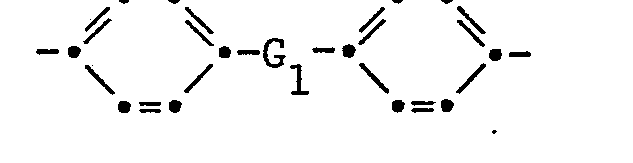


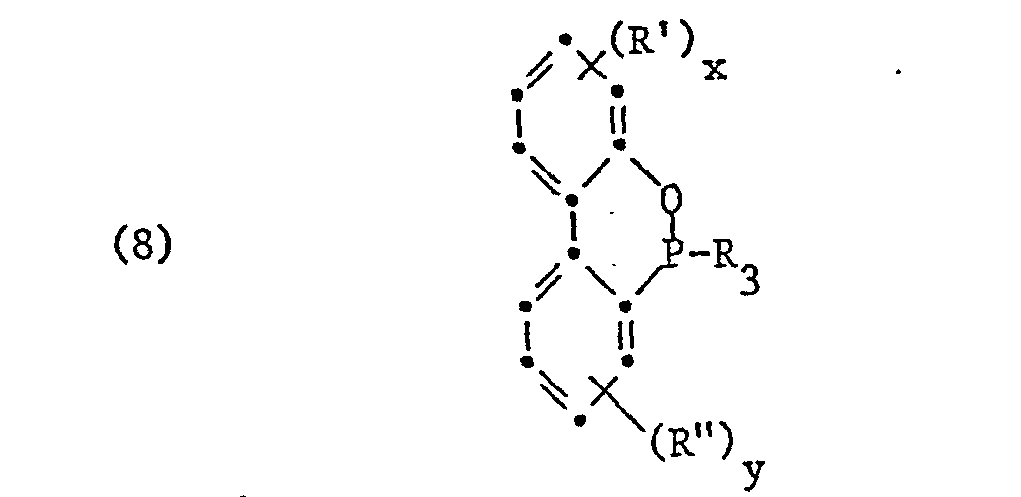


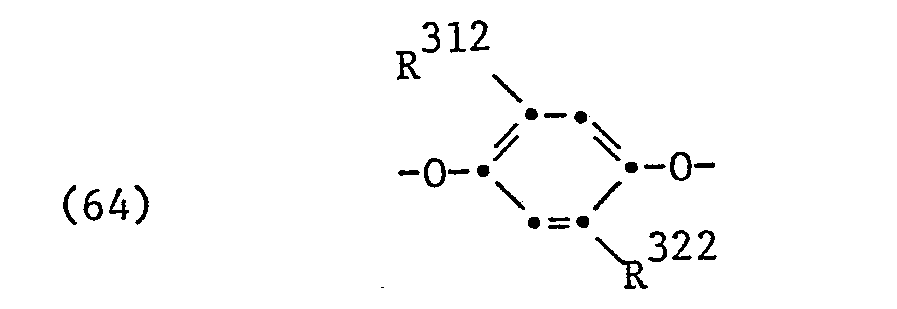

Applications Claiming Priority (2)
| Application Number | Priority Date | Filing Date | Title |
|---|---|---|---|
| CH352/81 | 1981-01-20 | ||
| CH35281 | 1981-01-20 |
Publications (2)
| Publication Number | Publication Date |
|---|---|
| EP0056787A1 true EP0056787A1 (de) | 1982-07-28 |
| EP0056787B1 EP0056787B1 (de) | 1985-06-19 |
Family
ID=4185064
Family Applications (1)
| Application Number | Title | Priority Date | Filing Date |
|---|---|---|---|
| EP82810012A Expired EP0056787B1 (de) | 1981-01-20 | 1982-01-14 | Photographisches Aufzeichnungsmaterial und Verfahren zu seiner Herstellung |
Country Status (5)
| Country | Link |
|---|---|
| US (1) | US4407935A (de) |
| EP (1) | EP0056787B1 (de) |
| JP (1) | JPS57138629A (de) |
| CA (1) | CA1178471A (de) |
| DE (1) | DE3264151D1 (de) |
Cited By (5)
| Publication number | Priority date | Publication date | Assignee | Title |
|---|---|---|---|---|
| EP0181289A3 (en) * | 1984-11-07 | 1986-08-20 | Ciba-Geigy Ag | Process for stabilizing a photographic material containing a magenta coupler |
| EP0223739A1 (de) * | 1985-11-06 | 1987-05-27 | Ciba-Geigy Ag | Neue Dibenzoxaphosphorine |
| WO2013068437A2 (en) | 2011-11-11 | 2013-05-16 | Basf Se | P-n-compounds as flame retardants |
| WO2013072295A1 (en) | 2011-11-15 | 2013-05-23 | Basf Se | P-piperazine compounds as flame retardants |
| AT507172A3 (de) * | 2008-08-14 | 2014-11-15 | Ems Patent Ag | Verfahren zur herstellung von dibenz (c,e) (1,2)- oxaphosphorin-derivaten, amino-dibenz (c,e) (1,2)-oxaphosphorin sowie deren verwendung |
Families Citing this family (1)
| Publication number | Priority date | Publication date | Assignee | Title |
|---|---|---|---|---|
| US4436811A (en) * | 1981-07-10 | 1984-03-13 | Ciba-Geigy Ag | Photographic material |
Citations (1)
| Publication number | Priority date | Publication date | Assignee | Title |
|---|---|---|---|---|
| EP0005441A1 (de) * | 1978-04-14 | 1979-11-28 | Ciba-Geigy Ag | Aminodibenzoxaphosphorine, Verfahren zu ihrer Herstellung und ihre Verwendung als Stabilisatoren |
Family Cites Families (3)
| Publication number | Priority date | Publication date | Assignee | Title |
|---|---|---|---|---|
| BE635167A (de) * | 1962-07-21 | |||
| GB1430998A (en) * | 1973-06-07 | 1976-04-07 | Ciba Geigy Ag | Photographic development process |
| US4185006A (en) * | 1978-07-06 | 1980-01-22 | Ciba-Geigy Corporation | Cyclic phosphonite stabilizers |
-
1982
- 1982-01-14 EP EP82810012A patent/EP0056787B1/de not_active Expired
- 1982-01-14 DE DE8282810012T patent/DE3264151D1/de not_active Expired
- 1982-01-15 US US06/339,816 patent/US4407935A/en not_active Expired - Fee Related
- 1982-01-19 CA CA000394443A patent/CA1178471A/en not_active Expired
- 1982-01-20 JP JP57006175A patent/JPS57138629A/ja active Pending
Patent Citations (1)
| Publication number | Priority date | Publication date | Assignee | Title |
|---|---|---|---|---|
| EP0005441A1 (de) * | 1978-04-14 | 1979-11-28 | Ciba-Geigy Ag | Aminodibenzoxaphosphorine, Verfahren zu ihrer Herstellung und ihre Verwendung als Stabilisatoren |
Cited By (5)
| Publication number | Priority date | Publication date | Assignee | Title |
|---|---|---|---|---|
| EP0181289A3 (en) * | 1984-11-07 | 1986-08-20 | Ciba-Geigy Ag | Process for stabilizing a photographic material containing a magenta coupler |
| EP0223739A1 (de) * | 1985-11-06 | 1987-05-27 | Ciba-Geigy Ag | Neue Dibenzoxaphosphorine |
| AT507172A3 (de) * | 2008-08-14 | 2014-11-15 | Ems Patent Ag | Verfahren zur herstellung von dibenz (c,e) (1,2)- oxaphosphorin-derivaten, amino-dibenz (c,e) (1,2)-oxaphosphorin sowie deren verwendung |
| WO2013068437A2 (en) | 2011-11-11 | 2013-05-16 | Basf Se | P-n-compounds as flame retardants |
| WO2013072295A1 (en) | 2011-11-15 | 2013-05-23 | Basf Se | P-piperazine compounds as flame retardants |
Also Published As
| Publication number | Publication date |
|---|---|
| US4407935A (en) | 1983-10-04 |
| CA1178471A (en) | 1984-11-27 |
| EP0056787B1 (de) | 1985-06-19 |
| DE3264151D1 (en) | 1985-07-25 |
| JPS57138629A (en) | 1982-08-27 |
Similar Documents
| Publication | Publication Date | Title |
|---|---|---|
| DE2329587C2 (de) | Farbphotographisches Aufzeichnungsmaterial | |
| DE2165371C2 (de) | Farbphotographisches Aufzeichnungsmaterial | |
| DE3209671A1 (de) | Lichtempfindliches photographisches silberhalogenidmaterial | |
| DE1286900B (de) | Gruenempfindliche supersensibilisierte Silberhalogenidemulsion | |
| DE2219917A1 (de) | Verfahren zur herstellung von gelbbildern | |
| DE2502820C3 (de) | Farbfotografisches Verfahren zur Herstellung von Cyanbildern | |
| DE2053187B2 (de) | Photographisches Aufzeichnungs material | |
| EP0127063B1 (de) | Fotografisches Aufzeichnungsmaterial mit einer Vorläuferverbindung einer fotografisch wirksamen Verbindung | |
| DE2424946C2 (de) | Verwendung von 2-Äquivalent-Cyankupplern in der Farbphotographie | |
| DE2360878C2 (de) | Verfahren zur Entwicklung eines photographischen Materials mit wenigstens einer Silberhalogenidemulsionsschicht durch Belichten und Entwickeln mit einer photographischen, wäßrig-alkalischen Entwicklerlösung in Gegenwart einer Thioethergruppen enthaltenden Polyoxyethylenverbindung | |
| DE2344155C2 (de) | ||
| DE1285882B (de) | Verfahren zum Schutze von photographischem Material vor der Einwirkung ultravioletter Strahlung | |
| DE2601779A1 (de) | Entwicklung von belichteten silberhalogenidmaterialien | |
| EP0056787B1 (de) | Photographisches Aufzeichnungsmaterial und Verfahren zu seiner Herstellung | |
| DE2515771A1 (de) | Verfahren zur erzeugung eines farbphotographischen bildes | |
| DE69203022T2 (de) | Photographische Kupplerzusammensetzungen, die Ballastgruppen aufweisende Sulfoxide oder Sulfone enthalten sowie Verfahren zur Herstellung von Farbbildern. | |
| DE2731676A1 (de) | Photographische silberhalogenidemulsion | |
| DE2747198B2 (de) | Farbphotographisches Aufzeichnungsmaterial | |
| EP0070254B1 (de) | Entwicklungsbeschleuniger enthaltendes photographisches Material | |
| DE2601778A1 (de) | Entwicklung von photographischen silberhalogenidemulsionen | |
| DE3622007C2 (de) | Farbfotografisches Aufzeichnungsmaterial mit 2-Äquivalentpurpurkupplern | |
| DE2705974C2 (de) | ||
| EP0039312A1 (de) | Farbphotographisches Aufzeichnungsmaterial für das Silberfarbbleichverfahren; Verfahren zur Herstellung dieses Materials und seine Verwendung zur Herstellung photographischer Bilder | |
| DE3210627A1 (de) | Verfahren zur erzeugung blaugruener farbstoffbilder und dabei verwendetes farbphotographisches silberhalogenid-aufzeichnungsmaterial | |
| DE2850626C2 (de) | Farbphotographisches Aufzeichnungsmaterial |
Legal Events
| Date | Code | Title | Description |
|---|---|---|---|
| PUAI | Public reference made under article 153(3) epc to a published international application that has entered the european phase |
Free format text: ORIGINAL CODE: 0009012 |
|
| AK | Designated contracting states |
Designated state(s): BE CH DE FR GB IT NL |
|
| 17P | Request for examination filed |
Effective date: 19820116 |
|
| ITF | It: translation for a ep patent filed | ||
| GRAA | (expected) grant |
Free format text: ORIGINAL CODE: 0009210 |
|
| AK | Designated contracting states |
Designated state(s): BE CH DE FR GB IT LI NL |
|
| REF | Corresponds to: |
Ref document number: 3264151 Country of ref document: DE Date of ref document: 19850725 |
|
| ET | Fr: translation filed | ||
| PG25 | Lapsed in a contracting state [announced via postgrant information from national office to epo] |
Ref country code: LI Effective date: 19860131 Ref country code: CH Effective date: 19860131 Ref country code: BE Effective date: 19860131 |
|
| PLBE | No opposition filed within time limit |
Free format text: ORIGINAL CODE: 0009261 |
|
| STAA | Information on the status of an ep patent application or granted ep patent |
Free format text: STATUS: NO OPPOSITION FILED WITHIN TIME LIMIT |
|
| 26N | No opposition filed | ||
| BERE | Be: lapsed |
Owner name: CIBA-GEIGY A.G. Effective date: 19860131 |
|
| PG25 | Lapsed in a contracting state [announced via postgrant information from national office to epo] |
Ref country code: NL Effective date: 19860801 |
|
| GBPC | Gb: european patent ceased through non-payment of renewal fee | ||
| NLV4 | Nl: lapsed or anulled due to non-payment of the annual fee | ||
| PG25 | Lapsed in a contracting state [announced via postgrant information from national office to epo] |
Ref country code: FR Free format text: LAPSE BECAUSE OF NON-PAYMENT OF DUE FEES Effective date: 19860930 |
|
| REG | Reference to a national code |
Ref country code: CH Ref legal event code: PL |
|
| PG25 | Lapsed in a contracting state [announced via postgrant information from national office to epo] |
Ref country code: DE Effective date: 19861001 |
|
| REG | Reference to a national code |
Ref country code: FR Ref legal event code: ST |
|
| PG25 | Lapsed in a contracting state [announced via postgrant information from national office to epo] |
Ref country code: GB Effective date: 19881121 |