EP0056819B1 - Appareil électronique pour jouer aux dés - Google Patents
Appareil électronique pour jouer aux dés Download PDFInfo
- Publication number
- EP0056819B1 EP0056819B1 EP19810902276 EP81902276A EP0056819B1 EP 0056819 B1 EP0056819 B1 EP 0056819B1 EP 19810902276 EP19810902276 EP 19810902276 EP 81902276 A EP81902276 A EP 81902276A EP 0056819 B1 EP0056819 B1 EP 0056819B1
- Authority
- EP
- European Patent Office
- Prior art keywords
- button
- display
- hold
- roll
- changing
- Prior art date
- Legal status (The legal status is an assumption and is not a legal conclusion. Google has not performed a legal analysis and makes no representation as to the accuracy of the status listed.)
- Expired
Links
Images

Classifications
-
- G—PHYSICS
- G07—CHECKING-DEVICES
- G07F—COIN-FREED OR LIKE APPARATUS
- G07F17/00—Coin-freed apparatus for hiring articles; Coin-freed facilities or services
- G07F17/32—Coin-freed apparatus for hiring articles; Coin-freed facilities or services for games, toys, sports, or amusements
- G07F17/3202—Hardware aspects of a gaming system, e.g. components, construction, architecture thereof
- G07F17/3204—Player-machine interfaces
- G07F17/3211—Display means
-
- A—HUMAN NECESSITIES
- A63—SPORTS; GAMES; AMUSEMENTS
- A63F—CARD, BOARD, OR ROULETTE GAMES; INDOOR GAMES USING SMALL MOVING PLAYING BODIES; VIDEO GAMES; GAMES NOT OTHERWISE PROVIDED FOR
- A63F9/00—Games not otherwise provided for
- A63F9/04—Dice; Dice-boxes; Mechanical dice-throwing devices
- A63F9/0468—Electronic dice; electronic dice simulators
Definitions
- This invention relates to electronic dice game apparatus.
- Dice may take two forms. In the first form, known as “spot dice”, the six faces of each dice show respectively one, two, three, four, five and six dots. In the second form, known as “poker dice”, the six faces of each dice show respectively pictures depicting the nine, ten, jack, queen, king and ace of a pack of cards.
- This circuit includes five display devices each of which is capable of displaying the six faces of a poker dice.
- a set button is provided for each display device.
- Each display device is driven by an individual shift register clocked by an individual oscillator.
- a single start button and a single stop button are provided for simultaneously starting and stopping all five oscillators. In operation, one or more set buttons are pressed and then the start button is pressed. This causes the display of the selected display devices to change randomly. When the stop button is pressed, the result of the "throw" can be read on the display devices.
- This circuit suffers from a number of disadvantages.
- the circuit is awkward to operate because the player must press the set button for each selected display device and must then press both the start button and the stop button to make his throw.
- the circuit makes no provision for rendering the display device unreadable. Because all five oscillators stop instantaneously when the stop button is pressed, a skilled player may learn how to influence the resulting throw by selecting the instant at which he presses the stop button. Also, it is recognized that many players have difficulty in using poker dice as opposed to spot dice when playing the game of liar dice.
- a dice game apparatus comprising a plurality of electric display devices each capable of displaying a number of alternative display configurations, a player operable roll device for randomly changing the configuration of all of said display devices, a hold device associated with each display device and capable of preventing the configuration of the associated display device from changing, and a cancelling device for deactuating the hold device, characterized in that the player operable roll device comprises a single player operable roll button, means responsive to operation of the roll button for randomly changing the display configurations and delay means for causing the display configurations to continue changing for a period after operation of the single roll button, each hold device comprises an individual hold button and individual means associated with the hold button for preventing the configuration of the associated display device from changing upon operation of the hold button, the cancelling device comprises a single cancel button and meams for deactuating all the hold devices upon operation of the cancel button, each display device is capable of displaying six different configurations corresponding respectively to the six different faces of spot dice, and the apparatus further includes a blanking button and means responsive to
- FIG. 1 there is shown the face 1 of an apparatus for playing a game based on dice suitable for 2 or more players.
- the face is mounted on a case which encloses the electronic circuitry of the apparatus and the case is of suitable dimensions for holding in the hand.
- the face comprises five dice or display devices 2 to 6, a roll button 7, five hold buttons 8 to 12 associated respectively with the display devices 2 to 6, a hold cancel button 13, and a blanking button 14.
- Each display device consists of seven light emitting diodes (LEDs) arranged in an array at positions corresponding to the dots on a spot dice, i.e. with four LEDs at four corner positions, two more at the centre of two opposite sides and the seventh LED at the centre.
- LEDs light emitting diodes
- each of the display devices normally displays a configuration of lit LEDs corresponding to one face of a spot dice.
- the configuration changes in a random manner. If one of the hold buttons is pressed, its associated display device is prevented from changing configuration but this hold action may be cancelled by pressing the cancel button 13.
- the display may be blanked by pressing the blanking button 14 and then returned by pressing the blanking button 14 a second time.
- the first player presses the roll button 7, and then releases it. After roll button 7 is released, the display continues to change for a short period.
- the player notes the resulting throw displayed on the five dice 2 to 6, removes the display by pressing the blanking button 13, and calls this throw. His call may be true or false. He then passes the apparatus to the next player who may accept the call or challenge it prior to unblanking the display. If he challenges, then the first player loses a stake if his call is higher than the actual throw but otherwise the challenger loses. If he accepts, he may press the roll button after optionally pressing one or more of the hold buttons and play then proceeds as before until a challenge occurs. Each successive player must call a higher throw.
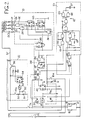
- the circuit includes a battery 15 the positive pole of which is connected to a +5V rail and the negative pole of which is connected to a 0V rail.
- the +5V rail is connected through a roll switch 7A, operated by the roll button 7, and a pair of resistors 16 and 17 connected in series to the 0V rail.
- the resistors 16 and 17 are bridged by a capacitor 18.
- the junction of switch 7A and resistor 16 is connected to the input of a Schmitt inverter 19, the output of which is connected to the input of a further Schmitt inverter 20.
- FIG. 2 Also shown in Figure 2 are the seven light emitting diodes 2A to 2G of the display device 2.
- the light emitting diodes are driven by a channel circuit generally indicated at 21 and which will be described in more detail hereinafter.
- Each set of seven diodes which respectively form the display devices 3 to 6 are driven by four further channel circuits which are identical to the circuit 21. These further channel circuits and their associated diodes are not shown in Figure 2.
- the apparatus further includes a blanking circuit 22, and a sound circuit 23, both of which will be described in more detail hereinafter.
- the channel circuit 21 includes a counter/ decoder which includes a pair of NOR gates 30, 31, a NAND gate 32, and three flip-flops 33 to 35.
- the clock input CLK of flip-flop 35 receives clock pulses from an oscillator 36 to be described, and its S and R inputs are connected to the 0V rail.
- the Q- output of flip-flop 35 is connected to its D input and the Q- output also drives LED 2A.
- the Q output of flip-flop 35 is connected to the clock input of flip-flop 34 and also to one input of NOR gate 31.
- the S input of flip-flop 34 is connected to the output of NOR gate 31 and the R input is connected to the 0V rail.
- the Q output is connected to another input of NOR gate 31, to the clock input of flip-flop 33, to one input of NOR gate 30, and to one input of NAND gate 32.
- the Q output is connected to the D input.
- the S input of flip-flop 33 is connected to the output of NOR gate 31 and the R input is connected to the 0V rail.
- the Q output of flip-flop 33 is connected to the third input of NOR gate 31, the other input of NOR gate 30, and the other input of NAND gate 32.
- the Q output of flip-flop 33 is connected to the D input and the Q output drives LEDs 2F and 2G.
- NOR gate 30 drives LEDs 2B and 2C and the NAND gate 32 drives the LEDs 2D and 2E.
- the counter/decoder operates as a divide by six counter with LED 2A being turned on and off by alternate pulses from the oscillator to indicate odd and even counts, diodes 2F and 2G turning on and off on the fourth, fifth and sixth count, LEDs 2B and 2C turning on for all the counts except for the first, and diodes 2D and 2E turning on for the sixth count only.
- the oscillator 36 comprises a NAND gate 37 and a NOR gate 38, the output of NOR gate 38 providing the clock pulses and being connected to its input through a capacitor 39 and a resistor 70.
- the junction of capacitor 39 and resistor 70 is connected through a resistor 71 to one input of NAND gate 37, the output of which is connected to both inputs of NOR gate 38.
- the values of capacitor 39 and resistor 71 are identical to the values of the corresponding components in the remaining four channel circuits but the value of the resistor 70 and the corresponding resistors in the other channel circuits differ from channel to channel to cause the oscillators of different channels to run at different frequencies.
- the oscillator 36 is controlled by a NAND gate 138, the two inputs of which are connected to the output of a further NAND gate 139.
- One input of NAND gate 139 is connected to the junction of resistors 16 and 17, the junction of resistors 16 and 17 also being connected to one input of identical NAND gates in the remaining channel circuits.
- the other input of NAND gate 139 is connected to the Q output of a flip-flop 40.
- the clock input of flip-flop 40 is connected to the output of Schmitt inverter 19, the output of Schmitt inverter 19 also being connected to the clock input of identical flip-flops in the other channel circuits.
- the D input of flip-flop 40 is connected to the 0V rail.
- the S input of flip-flop 40 is connected through a hold switch 8A operated by the hold button 8 to a rail 57, and the S input is also connected to the 0V rail through a pull-down resistor 41.
- the R input of flip-flop 40 is connected through a cancel switch 13A to the +5V rail, the cancel switch 13A being operated by the cancel button 13 and being common to all five channel circuits.
- the R input is also connected to the 0V rail through a pull-down resistor 42 and the junction of pull down resistor 42 and cancel switch 13A is connected to the R input of flip-flops corresponding to the flip-flop 40 in the remaining channel circuits.
- the +5V rail is connected through a blanking switch 14A operated by blanking button 14, and a pair of resistors 50 and 51, connected in series, to the 0V rail.
- the resistor 51 is bridged by a capacitor 52 and the junction of resistors 50 and 51 is connected to the input of a Schmitt inverter 53.
- the output of Schmitt inverter 53 is connected to the clock input of a flip-flop 44.
- the J and K inputs of flip-flop 54 are connected to the +5V rail.
- the Q output of flip-flop 54 is connected through a resistor 55 to the base of a PNP transistor 56, the emitter of which is connected to the +5V rail and the collector of which is connected to the rail 57, which is the supply rail for the LEDs.
- the supply rail 57 will be alternately energised and de-energised by successive closures of the blanking switch 14A.
- the sound circuit 23 comprises three oscillators 60, 61 and 62.
- the input of oscillator 60 is connected to the junction of cancel switch 13A and resistor 42 and the output of this oscillator provides an input signal to oscillator 62.
- the input of oscillator 61 is connected to the output of Schmitt inverter 20 and the output of this oscillator provides a further input signal to oscillator 62.
- the oscillator 62 also receives an input signal from the output of a NAND gate 63, the two inputs of which are connected to the output of a NOR gate 64.
- the NOR gate 64 has five inputs, one of which is connected to the junction of hold switch 8A and resistor 41 in channel circuit 21 and the remaining inputs are connected to corresponding junctions in the remaining- channel circuits.
- the output of oscillator 62 is connected through a pair of NAND gates 65 and 66 to one side of an acoustic transducer 67, the other side of which is connected to the 0V rail.
- the oscillators 60, 61 and 62 are tuned to different frequencies so as to produce three tones. Each time the roll switch 7A, or the cancel switch 13A or one of the hold switches is depressed, a tone signal will be emitted by the transducer 67.
- display blanking means could also be used such as a hinged flap movable to a display covering position.
- the display devices could employ liquid crystal devices.
Landscapes
- Physics & Mathematics (AREA)
- General Physics & Mathematics (AREA)
- Engineering & Computer Science (AREA)
- Multimedia (AREA)
- Control Of Indicators Other Than Cathode Ray Tubes (AREA)
Claims (6)
Priority Applications (1)
| Application Number | Priority Date | Filing Date | Title |
|---|---|---|---|
| AT81902276T ATE33074T1 (de) | 1980-07-30 | 1981-07-30 | Elektronisches wuerfelspiel. |
Applications Claiming Priority (2)
| Application Number | Priority Date | Filing Date | Title |
|---|---|---|---|
| GB8024911 | 1980-07-30 | ||
| GB8024911 | 1980-07-30 |
Publications (2)
| Publication Number | Publication Date |
|---|---|
| EP0056819A1 EP0056819A1 (fr) | 1982-08-04 |
| EP0056819B1 true EP0056819B1 (fr) | 1988-03-16 |
Family
ID=10515143
Family Applications (1)
| Application Number | Title | Priority Date | Filing Date |
|---|---|---|---|
| EP19810902276 Expired EP0056819B1 (fr) | 1980-07-30 | 1981-07-30 | Appareil électronique pour jouer aux dés |
Country Status (3)
| Country | Link |
|---|---|
| EP (1) | EP0056819B1 (fr) |
| DE (1) | DE3176686D1 (fr) |
| WO (1) | WO1982000537A1 (fr) |
Families Citing this family (2)
| Publication number | Priority date | Publication date | Assignee | Title |
|---|---|---|---|---|
| US4517558A (en) * | 1982-05-03 | 1985-05-14 | International Game Technology | Three dimensional video screen display effect |
| FR2671980B1 (fr) * | 1991-01-24 | 1995-01-27 | Jean Butaye | Dispositif pour des a jouer electroniques de poche. |
Family Cites Families (2)
| Publication number | Priority date | Publication date | Assignee | Title |
|---|---|---|---|---|
| US3124359A (en) * | 1964-03-10 | bottini | ||
| US3642287A (en) * | 1969-01-07 | 1972-02-15 | Bally Mfg Corp | Rotating reel game with masking shutter |
-
1981
- 1981-07-30 WO PCT/GB1981/000151 patent/WO1982000537A1/fr not_active Ceased
- 1981-07-30 EP EP19810902276 patent/EP0056819B1/fr not_active Expired
- 1981-07-30 DE DE8181902276T patent/DE3176686D1/de not_active Expired
Also Published As
| Publication number | Publication date |
|---|---|
| WO1982000537A1 (fr) | 1982-02-18 |
| EP0056819A1 (fr) | 1982-08-04 |
| DE3176686D1 (de) | 1988-04-21 |
Similar Documents
| Publication | Publication Date | Title |
|---|---|---|
| US4359220A (en) | Microcomputer controlled game | |
| EP0056819B1 (fr) | Appareil électronique pour jouer aux dés | |
| US3834710A (en) | Electronic random predictor | |
| US4163360A (en) | Timer device | |
| US4079583A (en) | Electrical chess clock | |
| US4968030A (en) | Electronic cribbage board and game scoring device | |
| US3975836A (en) | Logic learning apparatus | |
| EP0180676A2 (fr) | Ordinateur de loterie aléatoire | |
| WO1981001766A1 (fr) | Tableau electronique d'affichage du nombre de points pour le jeu de cribbage | |
| US4326715A (en) | Simulated baseball game device | |
| SU1553158A1 (ru) | Устройство управлени электронной игрой | |
| JPH03286794A (ja) | カードゲーム機 | |
| SU1366168A1 (ru) | Уctpoйctbo упpabлehия teлeигpoй | |
| SU1674888A1 (ru) | Электронна игра | |
| RU1787470C (ru) | Электронный отгадчик | |
| SU1389794A1 (ru) | Устройство управлени электронной игрой | |
| SU1721583A1 (ru) | Электронные шахматные часы | |
| SU1447388A1 (ru) | Устройство управлени электронной игрой | |
| RU2068725C1 (ru) | Устройство управления электронной игрой | |
| SU1430045A1 (ru) | Электронна игра | |
| SU1219103A1 (ru) | Электронна игра | |
| SU1526708A1 (ru) | Устройство дл игры | |
| KR900007309Y1 (ko) | 전자오락기의 코인 계수기 | |
| SU1380756A1 (ru) | Электронна игра | |
| JP2002292079A (ja) | 遊技機管理装置およびこの動作プログラム |
Legal Events
| Date | Code | Title | Description |
|---|---|---|---|
| PUAI | Public reference made under article 153(3) epc to a published international application that has entered the european phase |
Free format text: ORIGINAL CODE: 0009012 |
|
| 17P | Request for examination filed |
Effective date: 19820426 |
|
| AK | Designated contracting states |
Designated state(s): AT CH DE FR GB NL SE |
|
| GRAA | (expected) grant |
Free format text: ORIGINAL CODE: 0009210 |
|
| AK | Designated contracting states |
Kind code of ref document: B1 Designated state(s): AT CH DE FR GB LI NL SE |
|
| REF | Corresponds to: |
Ref document number: 33074 Country of ref document: AT Date of ref document: 19880415 Kind code of ref document: T |
|
| REF | Corresponds to: |
Ref document number: 3176686 Country of ref document: DE Date of ref document: 19880421 |
|
| ET | Fr: translation filed | ||
| PLBE | No opposition filed within time limit |
Free format text: ORIGINAL CODE: 0009261 |
|
| STAA | Information on the status of an ep patent application or granted ep patent |
Free format text: STATUS: NO OPPOSITION FILED WITHIN TIME LIMIT |
|
| 26N | No opposition filed | ||
| PGFP | Annual fee paid to national office [announced via postgrant information from national office to epo] |
Ref country code: AT Payment date: 19890913 Year of fee payment: 9 |
|
| PGFP | Annual fee paid to national office [announced via postgrant information from national office to epo] |
Ref country code: DE Payment date: 19891002 Year of fee payment: 9 |
|
| PG25 | Lapsed in a contracting state [announced via postgrant information from national office to epo] |
Ref country code: AT Effective date: 19900730 |
|
| PGFP | Annual fee paid to national office [announced via postgrant information from national office to epo] |
Ref country code: NL Payment date: 19900731 Year of fee payment: 10 |
|
| PGFP | Annual fee paid to national office [announced via postgrant information from national office to epo] |
Ref country code: GB Payment date: 19901218 Year of fee payment: 10 |
|
| PGFP | Annual fee paid to national office [announced via postgrant information from national office to epo] |
Ref country code: SE Payment date: 19901221 Year of fee payment: 10 |
|
| PGFP | Annual fee paid to national office [announced via postgrant information from national office to epo] |
Ref country code: FR Payment date: 19901227 Year of fee payment: 10 |
|
| PGFP | Annual fee paid to national office [announced via postgrant information from national office to epo] |
Ref country code: CH Payment date: 19910111 Year of fee payment: 10 |
|
| PG25 | Lapsed in a contracting state [announced via postgrant information from national office to epo] |
Ref country code: DE Effective date: 19910403 |
|
| PG25 | Lapsed in a contracting state [announced via postgrant information from national office to epo] |
Ref country code: GB Effective date: 19910730 |
|
| PG25 | Lapsed in a contracting state [announced via postgrant information from national office to epo] |
Ref country code: LI Effective date: 19910731 Ref country code: SE Effective date: 19910731 Ref country code: CH Effective date: 19910731 |
|
| PG25 | Lapsed in a contracting state [announced via postgrant information from national office to epo] |
Ref country code: NL Effective date: 19920201 |
|
| NLV4 | Nl: lapsed or anulled due to non-payment of the annual fee | ||
| GBPC | Gb: european patent ceased through non-payment of renewal fee | ||
| PG25 | Lapsed in a contracting state [announced via postgrant information from national office to epo] |
Ref country code: FR Effective date: 19920331 |
|
| REG | Reference to a national code |
Ref country code: CH Ref legal event code: PL |
|
| REG | Reference to a national code |
Ref country code: FR Ref legal event code: ST |
|
| EUG | Se: european patent has lapsed |
Ref document number: 81902276.5 Effective date: 19920210 |