EP0056861A1 - Farbstabilisierte Phenolharzschäume - Google Patents
Farbstabilisierte Phenolharzschäume Download PDFInfo
- Publication number
- EP0056861A1 EP0056861A1 EP81110393A EP81110393A EP0056861A1 EP 0056861 A1 EP0056861 A1 EP 0056861A1 EP 81110393 A EP81110393 A EP 81110393A EP 81110393 A EP81110393 A EP 81110393A EP 0056861 A1 EP0056861 A1 EP 0056861A1
- Authority
- EP
- European Patent Office
- Prior art keywords
- foams
- stabilizers
- foam
- salts
- phenolic
- Prior art date
- Legal status (The legal status is an assumption and is not a legal conclusion. Google has not performed a legal analysis and makes no representation as to the accuracy of the status listed.)
- Granted
Links
- 239000006260 foam Substances 0.000 title claims abstract description 73
- 229920001568 phenolic resin Polymers 0.000 title abstract description 20
- 239000005011 phenolic resin Substances 0.000 title abstract description 19
- KXGFMDJXCMQABM-UHFFFAOYSA-N 2-methoxy-6-methylphenol Chemical compound [CH]OC1=CC=CC([CH])=C1O KXGFMDJXCMQABM-UHFFFAOYSA-N 0.000 title abstract description 14
- 229920005989 resin Polymers 0.000 claims abstract description 25
- 239000011347 resin Substances 0.000 claims abstract description 25
- 239000000203 mixture Substances 0.000 claims abstract description 20
- ISWSIDIOOBJBQZ-UHFFFAOYSA-N phenol group Chemical group C1(=CC=CC=C1)O ISWSIDIOOBJBQZ-UHFFFAOYSA-N 0.000 claims abstract description 20
- 229920003987 resole Polymers 0.000 claims abstract description 20
- ABLZXFCXXLZCGV-UHFFFAOYSA-N Phosphorous acid Chemical class OP(O)=O ABLZXFCXXLZCGV-UHFFFAOYSA-N 0.000 claims abstract description 16
- 150000003839 salts Chemical class 0.000 claims abstract description 15
- 239000003381 stabilizer Substances 0.000 claims abstract description 14
- ACVYVLVWPXVTIT-UHFFFAOYSA-N phosphinic acid Chemical class O[PH2]=O ACVYVLVWPXVTIT-UHFFFAOYSA-N 0.000 claims abstract description 8
- 238000000034 method Methods 0.000 claims abstract description 6
- 239000000975 dye Substances 0.000 claims description 11
- 238000005187 foaming Methods 0.000 claims description 9
- XYFCBTPGUUZFHI-UHFFFAOYSA-N Phosphine Chemical class P XYFCBTPGUUZFHI-UHFFFAOYSA-N 0.000 claims description 6
- 239000004848 polyfunctional curative Substances 0.000 claims description 5
- 239000004604 Blowing Agent Substances 0.000 claims description 4
- 239000013543 active substance Substances 0.000 claims description 4
- AAAQKTZKLRYKHR-UHFFFAOYSA-N triphenylmethane Chemical compound C1=CC=CC=C1C(C=1C=CC=CC=1)C1=CC=CC=C1 AAAQKTZKLRYKHR-UHFFFAOYSA-N 0.000 claims description 4
- 229910000073 phosphorus hydride Inorganic materials 0.000 claims description 3
- 238000002360 preparation method Methods 0.000 claims description 3
- 230000008569 process Effects 0.000 claims description 3
- 239000007864 aqueous solution Substances 0.000 claims description 2
- 150000001447 alkali salts Chemical class 0.000 claims 1
- 230000008859 change Effects 0.000 abstract description 6
- 239000000654 additive Substances 0.000 abstract description 4
- 230000009471 action Effects 0.000 abstract description 3
- AQSJGOWTSHOLKH-UHFFFAOYSA-N phosphite(3-) Chemical class [O-]P([O-])[O-] AQSJGOWTSHOLKH-UHFFFAOYSA-N 0.000 abstract description 3
- 230000000996 additive effect Effects 0.000 abstract description 2
- 239000003513 alkali Substances 0.000 abstract 2
- 239000000126 substance Substances 0.000 abstract 1
- 239000003570 air Substances 0.000 description 9
- 239000000523 sample Substances 0.000 description 9
- 238000012360 testing method Methods 0.000 description 9
- 238000004519 manufacturing process Methods 0.000 description 8
- HVLLSGMXQDNUAL-UHFFFAOYSA-N triphenyl phosphite Chemical compound C=1C=CC=CC=1OP(OC=1C=CC=CC=1)OC1=CC=CC=C1 HVLLSGMXQDNUAL-UHFFFAOYSA-N 0.000 description 8
- XLYOFNOQVPJJNP-UHFFFAOYSA-N water Substances O XLYOFNOQVPJJNP-UHFFFAOYSA-N 0.000 description 7
- 230000000694 effects Effects 0.000 description 6
- 239000011148 porous material Substances 0.000 description 5
- OFBQJSOFQDEBGM-UHFFFAOYSA-N Pentane Chemical compound CCCCC OFBQJSOFQDEBGM-UHFFFAOYSA-N 0.000 description 4
- 150000001875 compounds Chemical class 0.000 description 4
- 238000000465 moulding Methods 0.000 description 4
- 238000003860 storage Methods 0.000 description 4
- QTBSBXVTEAMEQO-UHFFFAOYSA-N Acetic acid Chemical compound CC(O)=O QTBSBXVTEAMEQO-UHFFFAOYSA-N 0.000 description 3
- WSFSSNUMVMOOMR-UHFFFAOYSA-N Formaldehyde Chemical compound O=C WSFSSNUMVMOOMR-UHFFFAOYSA-N 0.000 description 3
- -1 aryl phosphites Chemical class 0.000 description 3
- 230000000052 comparative effect Effects 0.000 description 3
- 229910052751 metal Inorganic materials 0.000 description 3
- 239000002184 metal Substances 0.000 description 3
- DIZBQMTZXOUFTD-UHFFFAOYSA-N 2-(furan-2-yl)-3h-benzimidazole-5-carboxylic acid Chemical compound N1C2=CC(C(=O)O)=CC=C2N=C1C1=CC=CO1 DIZBQMTZXOUFTD-UHFFFAOYSA-N 0.000 description 2
- VEXZGXHMUGYJMC-UHFFFAOYSA-N Hydrochloric acid Chemical compound Cl VEXZGXHMUGYJMC-UHFFFAOYSA-N 0.000 description 2
- 238000010521 absorption reaction Methods 0.000 description 2
- 239000002253 acid Substances 0.000 description 2
- 229910052783 alkali metal Inorganic materials 0.000 description 2
- QVGXLLKOCUKJST-UHFFFAOYSA-N atomic oxygen Chemical group [O] QVGXLLKOCUKJST-UHFFFAOYSA-N 0.000 description 2
- 239000013065 commercial product Substances 0.000 description 2
- 239000000839 emulsion Substances 0.000 description 2
- 125000004435 hydrogen atom Chemical group [H]* 0.000 description 2
- 239000007788 liquid Substances 0.000 description 2
- FDZZZRQASAIRJF-UHFFFAOYSA-M malachite green Chemical compound [Cl-].C1=CC(N(C)C)=CC=C1C(C=1C=CC=CC=1)=C1C=CC(=[N+](C)C)C=C1 FDZZZRQASAIRJF-UHFFFAOYSA-M 0.000 description 2
- 229940107698 malachite green Drugs 0.000 description 2
- 238000005259 measurement Methods 0.000 description 2
- 239000001301 oxygen Substances 0.000 description 2
- 229910052760 oxygen Inorganic materials 0.000 description 2
- 229920000647 polyepoxide Polymers 0.000 description 2
- 229920001225 polyester resin Polymers 0.000 description 2
- 239000000243 solution Substances 0.000 description 2
- 230000006641 stabilisation Effects 0.000 description 2
- 238000011105 stabilization Methods 0.000 description 2
- 238000003756 stirring Methods 0.000 description 2
- JOXIMZWYDAKGHI-UHFFFAOYSA-N toluene-4-sulfonic acid Chemical compound CC1=CC=C(S(O)(=O)=O)C=C1 JOXIMZWYDAKGHI-UHFFFAOYSA-N 0.000 description 2
- KWSLGOVYXMQPPX-UHFFFAOYSA-N 5-[3-(trifluoromethyl)phenyl]-2h-tetrazole Chemical group FC(F)(F)C1=CC=CC(C2=NNN=N2)=C1 KWSLGOVYXMQPPX-UHFFFAOYSA-N 0.000 description 1
- OKTJSMMVPCPJKN-UHFFFAOYSA-N Carbon Chemical compound [C] OKTJSMMVPCPJKN-UHFFFAOYSA-N 0.000 description 1
- 239000004593 Epoxy Substances 0.000 description 1
- 229920000877 Melamine resin Polymers 0.000 description 1
- 239000004952 Polyamide Substances 0.000 description 1
- XSQUKJJJFZCRTK-UHFFFAOYSA-N Urea Chemical compound NC(N)=O XSQUKJJJFZCRTK-UHFFFAOYSA-N 0.000 description 1
- 229920001807 Urea-formaldehyde Polymers 0.000 description 1
- 230000002378 acidificating effect Effects 0.000 description 1
- 230000002730 additional effect Effects 0.000 description 1
- 150000001340 alkali metals Chemical class 0.000 description 1
- 229920000180 alkyd Polymers 0.000 description 1
- 125000000217 alkyl group Chemical group 0.000 description 1
- 239000012080 ambient air Substances 0.000 description 1
- 239000003963 antioxidant agent Substances 0.000 description 1
- 239000011230 binding agent Substances 0.000 description 1
- 230000015572 biosynthetic process Effects 0.000 description 1
- 238000009835 boiling Methods 0.000 description 1
- 159000000007 calcium salts Chemical class 0.000 description 1
- 239000004202 carbamide Substances 0.000 description 1
- 229910052799 carbon Inorganic materials 0.000 description 1
- 238000005266 casting Methods 0.000 description 1
- 230000015556 catabolic process Effects 0.000 description 1
- 239000001913 cellulose Substances 0.000 description 1
- 229920002678 cellulose Polymers 0.000 description 1
- 238000006243 chemical reaction Methods 0.000 description 1
- 238000004040 coloring Methods 0.000 description 1
- 239000000470 constituent Substances 0.000 description 1
- 230000001186 cumulative effect Effects 0.000 description 1
- 230000006735 deficit Effects 0.000 description 1
- 238000006731 degradation reaction Methods 0.000 description 1
- 150000001990 dicarboxylic acid derivatives Chemical class 0.000 description 1
- 238000002845 discoloration Methods 0.000 description 1
- 239000006185 dispersion Substances 0.000 description 1
- 238000009826 distribution Methods 0.000 description 1
- 239000003822 epoxy resin Substances 0.000 description 1
- 238000011156 evaluation Methods 0.000 description 1
- 239000000835 fiber Substances 0.000 description 1
- 239000000945 filler Substances 0.000 description 1
- 239000003063 flame retardant Substances 0.000 description 1
- 239000006261 foam material Substances 0.000 description 1
- 238000009472 formulation Methods 0.000 description 1
- 239000001046 green dye Substances 0.000 description 1
- 238000000227 grinding Methods 0.000 description 1
- 238000010438 heat treatment Methods 0.000 description 1
- 229930195733 hydrocarbon Natural products 0.000 description 1
- 150000002430 hydrocarbons Chemical class 0.000 description 1
- 230000001771 impaired effect Effects 0.000 description 1
- 230000006872 improvement Effects 0.000 description 1
- 230000003993 interaction Effects 0.000 description 1
- 230000001678 irradiating effect Effects 0.000 description 1
- 239000004611 light stabiliser Substances 0.000 description 1
- 230000007774 longterm Effects 0.000 description 1
- 230000014759 maintenance of location Effects 0.000 description 1
- 239000000463 material Substances 0.000 description 1
- 229920003986 novolac Polymers 0.000 description 1
- 239000000049 pigment Substances 0.000 description 1
- 229920002647 polyamide Polymers 0.000 description 1
- 239000004645 polyester resin Substances 0.000 description 1
- 239000004800 polyvinyl chloride Substances 0.000 description 1
- 229920000915 polyvinyl chloride Polymers 0.000 description 1
- 229910052700 potassium Inorganic materials 0.000 description 1
- 229910001380 potassium hypophosphite Inorganic materials 0.000 description 1
- CRGPNLUFHHUKCM-UHFFFAOYSA-M potassium phosphinate Chemical compound [K+].[O-]P=O CRGPNLUFHHUKCM-UHFFFAOYSA-M 0.000 description 1
- 238000012545 processing Methods 0.000 description 1
- 230000033458 reproduction Effects 0.000 description 1
- 229920006395 saturated elastomer Polymers 0.000 description 1
- 229910052708 sodium Inorganic materials 0.000 description 1
- 239000011734 sodium Substances 0.000 description 1
- 229910001379 sodium hypophosphite Inorganic materials 0.000 description 1
- NQXGLOVMOABDLI-UHFFFAOYSA-N sodium oxido(oxo)phosphanium Chemical group [Na+].[O-][PH+]=O NQXGLOVMOABDLI-UHFFFAOYSA-N 0.000 description 1
- 239000007787 solid Substances 0.000 description 1
- 230000003595 spectral effect Effects 0.000 description 1
- 230000000087 stabilizing effect Effects 0.000 description 1
- 150000003460 sulfonic acids Chemical class 0.000 description 1
- 230000001629 suppression Effects 0.000 description 1
- 229920003002 synthetic resin Polymers 0.000 description 1
- 239000000057 synthetic resin Substances 0.000 description 1
- NCPXQVVMIXIKTN-UHFFFAOYSA-N trisodium;phosphite Chemical compound [Na+].[Na+].[Na+].[O-]P([O-])[O-] NCPXQVVMIXIKTN-UHFFFAOYSA-N 0.000 description 1
- 238000009827 uniform distribution Methods 0.000 description 1
Classifications
-
- C—CHEMISTRY; METALLURGY
- C08—ORGANIC MACROMOLECULAR COMPOUNDS; THEIR PREPARATION OR CHEMICAL WORKING-UP; COMPOSITIONS BASED THEREON
- C08J—WORKING-UP; GENERAL PROCESSES OF COMPOUNDING; AFTER-TREATMENT NOT COVERED BY SUBCLASSES C08B, C08C, C08F, C08G or C08H
- C08J9/00—Working-up of macromolecular substances to porous or cellular articles or materials; After-treatment thereof
- C08J9/0014—Use of organic additives
- C08J9/0038—Use of organic additives containing phosphorus
-
- C—CHEMISTRY; METALLURGY
- C08—ORGANIC MACROMOLECULAR COMPOUNDS; THEIR PREPARATION OR CHEMICAL WORKING-UP; COMPOSITIONS BASED THEREON
- C08K—Use of inorganic or non-macromolecular organic substances as compounding ingredients
- C08K3/00—Use of inorganic substances as compounding ingredients
- C08K3/32—Phosphorus-containing compounds
-
- C—CHEMISTRY; METALLURGY
- C08—ORGANIC MACROMOLECULAR COMPOUNDS; THEIR PREPARATION OR CHEMICAL WORKING-UP; COMPOSITIONS BASED THEREON
- C08J—WORKING-UP; GENERAL PROCESSES OF COMPOUNDING; AFTER-TREATMENT NOT COVERED BY SUBCLASSES C08B, C08C, C08F, C08G or C08H
- C08J2361/00—Characterised by the use of condensation polymers of aldehydes or ketones; Derivatives of such polymers
- C08J2361/04—Condensation polymers of aldehydes or ketones with phenols only
- C08J2361/06—Condensation polymers of aldehydes or ketones with phenols only of aldehydes with phenols
Definitions
- the present invention relates to foams made from phenolic resole resins which, by adding defined stabilizers when exposed to light and / or heat, show less color change than known phenolic resin foams.
- phenolic resins or phenolic resins are used as binders, e.g. Cast resin reproductions, foams for various, preferably technical, applications, molding compounds, casting compounds, laminates, molding sands for foundry purposes, inorganic and organic fiber mats, carbon moldings; Grinding discs, friction linings etc. manufactured. Color changes only play a minor role in these applications.
- phenolic resin foams e.g. their use in the form of plug-in compositions for cut flowers, where at least for a limited time (eg 2-12 months) from their manufacture to their use, which is also limited in time (use time approx. 1-3 months), the highest possible stability of the mostly green colored would like to have foams.
- phenolic resin floral foams are fine and largely open-pore, brittle hard foams, which are usually made from liquid foamable phenolic resole resins using organic sulfonic acids, e.g.
- p-toluenesulfonic acid p-phenolsulfonic acid and, in the acidic range, dyes that are largely stable at least for a short time, such as e.g. the triphenylmethane dye malachite green.
- These acid-resistant green dyes which are suitable for the production of such foams are generally, such as Triphenylmethane dyes, not very light stable. Both factors - i.e. The fundamentally low stability of the inherent color of the hardened phenolic resins and the possibly low light stability of the dyes in question - lead to a basically inadequate color stability of the known phenolic resin foams. Depending on the intensity of the influence of light and / or air and / or temperatures on such foams, they change color from green to violet or gray or brown within 2-30 days. Non-colored foams of this type usually change color from white to pink (color immediately after they are made) to brown to reddish brown.
- foams made from phenolic resole resins with a reduced tendency to discolouration have now been found, which are characterized by an additional content of salts of phosphine or phosphonic acid.
- the salts of phosphinic and phosphonic acid in foams which are produced in the presence of acid at room or moderately elevated temperature from phenolic resole resins, show an increased color-stabilizing effect against color changes through direct exposure to light and / or air and / or heat.
- the undesirable side effects mentioned above do not occur during the production of the foams and the foams obtained have the desired properties. Accordingly, in the production of the foams according to the invention, it is not necessary to correct the known formulation for the production of the foams in order to maintain the essential properties of the foams.
- the foams according to the invention are therefore produced in a manner known per se by foaming and curing a foamable or foamable mixture of phenolic resole resin, blowing agent, hardener, surface-active substances and, if appropriate, dyes and / or other additives such as fillers or flame retardants.
- Low boiling hydrocarbons which are liquid at room temperature, such as e.g. n-pentane and preferably aromatic sulfonic acids or hydrochloric acid are used as hardeners.
- the type and amount of the surface-active substances influence the porosity of the foam obtained.
- the correct dosage for the desired influencing of the pores is also known to the person skilled in the art.
- the salts of phosphonic or phosphinic acid can be mixed into the mixture at any stage before foaming. It is thus possible to premix the salts in the phenolic resole resin, if appropriate with the surface-active substances, and then to mix this mixture with the other constituents. This is a preferred embodiment. But it is also possible to mix all components of the foamable mixture together with the salts.
- the salts are mixed into the ready-made mixture, it is advantageous to dissolve or disperse the salts in water and to add these solutions or dispersions to the foamable resole resin mixtures. In this way, a uniform distribution of the stabilizing salts in the mixture to be foamed and the phenolic resin foam formed therefrom is quickly obtained.
- the stabilizers used according to the invention include the inorganic salts of phosphinic acid and phosphonic acid.
- the phosphinic acid corresponds to the general formula H 2 P (0) OH; in their salts, which are referred to as phosphinates or hypophosphites, only the hydrogen atom bound to oxygen is replaced by a metal equivalent.
- the preferred metal salts are the alkali metal salts, which correspond to the formula Me H 2 P0 2 .xH 2 0.
- the salts of phosphonic acid which can also be used according to the invention are known under the name of phosphonates or primary and secondary phosphites. They are derived from the phosphonic acid HP (0) (OH) 2 , it being possible for one or both of the hydrogen atoms bonded to the oxygen to be replaced by a metal equivalent.
- the amount of stabilizers which are used according to the invention should be at least 0.1% by weight, based on the finished foam. Amounts of between 0.3 and 1.0% by weight, based on the weight of the finished foam, are preferably used. In general, it is not necessary to use more than 5% by weight to show the effect according to the invention, although in principle it is also possible to use even larger amounts.
- the color-stabilizing effect of the additives according to the invention is expediently recorded or detected in a timely manner by exposing foam samples to lamps whose spectral energy distribution comes very close to that of sunlight and which also leads to simultaneous heating of the samples. It was found that by irradiating the stabilized foams with a 300 watt lamp (Osram-Vitalux®) at a sample distance of 50 cm, a 10-fold time lapse is achieved compared to a natural intense exposure to sunlight, so that the long-term effect of the stabilizers according to the invention could be determined.
- the foamable phenolic resole resin T 612 S used in the tests had the following properties:
- Tables 1 and 2 also give its density as a further general evaluation criterion for the foam.
- the samples discolored in some cases similar to brown or reddish brown, as in the case of natural weeks or months of storage.
- a foamable mixture of the same composition is prepared analogously to Example 1, with the difference that triphenyl phosphite or trisnonylphenyl phosphite was used instead of the phosphinates or phosphites according to the invention.
- the foam containing the triphenyl phosphite had sunken edges and showed almost the same color measurement values as the untreated foam mentioned in Example 1.
Landscapes
- Chemical & Material Sciences (AREA)
- Health & Medical Sciences (AREA)
- Chemical Kinetics & Catalysis (AREA)
- Medicinal Chemistry (AREA)
- Polymers & Plastics (AREA)
- Organic Chemistry (AREA)
- Engineering & Computer Science (AREA)
- Materials Engineering (AREA)
- Manufacture Of Porous Articles, And Recovery And Treatment Of Waste Products (AREA)
- Compositions Of Macromolecular Compounds (AREA)
Abstract
Description
- Gegenstand der vorliegenden Erfindung sind Schäume aus Phenolresolharzen, die durch Zusatz von definierten Stabilisatoren bei Einwirkung von Licht und/oder Wärme eine geringere Farbveränderung zeigen als bekannte Phenolharzschäume.
- Es ist bekannt, daß die Widerstandsfähigkeit von festen Körpern, die ganz oder zu einem erheblichen Teil aus gehärteten Phenolformäldehydharzen bestehen, gegen Farbänderungen durch direkte Einwirkung von Licht und/oder Luft und/oder Wärme relativ gering ist im Gegensatz zu manchen anderen ausgehärteten Kunstharzen auf Basis von z.B. Harnstoff- oder Melaminformaldehydharzen, Epoxidharz Polyesterharzen. Je nach Phenolharztyp (Novolak oder Resol) und Härtungsart sowie der Intensität bezüglich der Einwirkung von Licht und/oder Luft und/oder Wärme verfärben sich die ausgehärteten Phenolharze von ihrer Eigenfarbe Weiß bis gelblich ausgehend, in Gelb-Braun und fortschreitend in Braun bis Rotbraun, Dunkelbraun bis fast Schwarz.
- Bei der Einfärbung von Phenolharzen bzw. Formkörpern aus ausgehärteten Phenolformaldehydharzen ist man daher gezwungen, sich im allgemeinen auf relativ dunkle Farbtöne, wie z.B. dunkelrot, braun, schwarz etc. zu beschränken oder man verzichtet je nach Nutzung der Formkörper ganz auf die Zugabe von Farbstoffen und/oder Pigmenten.
- So werden aus Phenolharzen oder unter Verwendung von Phenolharzen als Bindemittel z.B. Gießharzreproduktionen, Schaumstoffe für diverse vorzugsweise technische Anwendungen, Preßmasseformteile, Vergußmassen, Schichtpreßstoffe, Formsande für Gießereizwecke, anorganische und organische Fasermatten, Kohleformkörper; Schleifscheiben, Reibbeläge etc. hergestellt. Bei diesen Anwendungen spielen Farbveränderungen nur eine untergeordnete Rolle.
- Es gibt jedoch Einsatzgebiete für Phenolharzschaumstoffe, wie z.B. ihre Verwendung in Form von Steckmassen für Schnittblumen, wo man zumindest für eine begrenzte Zeit (z.B. 2-12 Monate) von ihrer Herstellung bis zu ihrer ebenfalls zeitlich begrenzten Verwendung (Verwendungsdauer ca. 1-3 Monate) eine möglichst hohe Stabilität der meist grün eingefärbten Schaumstoffe haben möchte. Diese sogenannten Phenolharz-Blumensteckschäume sind fein-und weitgehend offenporige, sprödharte Schaumstoffe, die in der Regel aus flüssigen schäumfähigen Phenolresolharzen unter Verwendung von organischen Sulfonsäuren, z.B. p-Toluolsulfonsäure, p-Phenolsulfonsäure und im sauren Bereich zumindest kurzfristig weitgehend stabilen Farbstoffen, wie z.B. dem Triphenylmethanfarbstoff Malachitgrün hergestellt werden.
- Diese für die Herstellung solcher Schaumstoffe in Betracht kommenden säurefesten grünen Farbstoffe sind in der Regel, wie z.B. Triphenylmethanfarbstoffe, wenig lichtstabil. Beide Faktoren- d.h. die grundsätzlich geringe Stabilität der Eigenfarbe der gehärteten Phenolharze und die unter Umständen hinzukommende geringe Lichtstabilität der in Frage kommenden Farbstoffe - führen zu einer im Grunde mangelhaften Farbstabilität der bekannten Phenolharzschaumstoffe. Je nach der Intensität der Einwirkung von Licht und/oder Luft und/oder Temperaturen auf solche Schaumstoffe, verfärben sich diese innerhalb von 2-30 Tagen von Grün nach Violett oder Grau oder Braun. Nicht eingefärbte Schaumstoffe dieser Art verfärben sich in der Regel von Weiß bis Rosa (Farbe unmittelbar nach ihrer Herstellung) nach Braun bis Rotbraun.
- Im Zusammenhang mit der relativ geringen Widerstandsfähigkeit dieser nicht oder grün eingefärbten Schaumstoffe gege Farbänderungen, kann als Ursache die Lichteinwirkung kaum getrennt erfaßt werden von den Wechselwirkungen durch zusätzliche Einwirkung von Luft und/oder Wärme. Alle Faktoren können durch physikalische Auflockerung des Gefüges dem Abbau durch UV-Licht Wege bahnen.
- Es bestand nun die Aufgabe, die Widerstandsfähigkeit von nicht oder im wesentlichen mit Triphenylmethanfarbstoffen grün eingefärbten Phenolharzschaumstoffen gegen Farbänderungen durch Einwirkung von Licht und/oder Luft und/oder Wärme zumindest für eine begrenzte Zeit deutlich zu erhöhen, ohne daß dabei wesentliche andere allgemeine Anforderungen an das Verarbeitungsverhalten der Phenolschaum harze oder der daraus hergestellten Schäume beeinträchtigt werden. Solche wesentlichen Anforderungen sind z.B.:
- a) Ausreichende Lagerfähigkeit der Phenolschaumharze,
- b) keine negative Beeinflussung des Schäum- und Härtungsverhaltens der Resolharze bzw. der schäumfähigen Phenolharz-Härter-Treibmittel (Farbstoff)-Mischungen, wie . z.B. Verlängerung oder sogar Unterbindung des Schäum-und Härtungsvorganges, Lunkerbildung etc.,
- c) keine Beeinträchtigung wesentlicher Gebrauchseigenschaften der Schäume, wie z.B. Veränderung des optimalen Anteils an geschlossenen oder offenen Zellen, Veränderung der mittleren Zellendurchmesser, der Schaumstoffdichte, der mechanischen Eigenschaftswerte oder bei den sogenannten Phenolharz-Blumensteckschaumstoffen eine Veränderung der Wasseraufnahme- und Retentionseigenschaften.
- In Erfüllung dieser Aufgabe wurden nun Schäume aus Phenolresolharzen mit reduzierter Neigung zu Verfärbungen gefunden, die durch einen zusätzlichen Gehalt an Salzen der Phosphin- oder Phosphonsäure gekennzeichnet sind.
- Es ist zwar bekannt, Triarylphosphite Phenolresolharzen bei deren Herstellung zuzusetzen, um die bei der Heißhärtung solcher Harze im allgemeinen eintretende Verfärbung bzw. Braunfärbung zu vermeiden. Der Zusatz solcher Verbindungen zu schäumfähigen Phenolresolharzen führt jedoch dazu, daß der Schaum entweder zusammenfällt oder eine unerwünscht hohe Dichte erhält. Auch ist der Farbstabilisierungseffekt solcher Verbindungen ungenügend. Gleiches gilt auch für Dicarbonsäureester des Pentaerythritylphosphits sowie verschiedene Alkyl- und Arylphosphite, die entweder als Lichtstabilisatoren oder als Antioxidantien und Stabilisatoren für Polyester-, Epoxid- und Alkydharze, sowie für PVC, Polyamide und Cellulosederivate bereits beschrieben sind. (Vgl. US-PS 36 34 317 und DE-OS 25 06 207).
- Überraschenderweise zeigen jedoch die Salze der Phosphin-und Phosphonsäure bei Schäumen, die in Gegenwart von Säure bei Raum- oder mäßig erhöhter Temperatur aus Phenolresolharzen hergestellt sind, eine erhöhte farbstabilisierende Wirkung gegen Farbänderungen durch direkte Einwirkung von Licht und/oder Luft und/oder Wärme. Dabei treten die oben genannten unerwünschten Nebenwirkungen bei der Herstellung der Schaumstoffe nicht ein und die erhaltenen Schäume besitzen die gewünschten Gebrauchseigenschaften. Es ist demzufolge bei der Herstellung der erfindungsgemäßen Schäume nicht nötig, zur Einhaltung der wesentlichen Gebrauchseigenschaften der Schäume eine Korrektur der an sich bekannten Rezeptur für die Herstellung der Schäume durchzuführen.
- Die Herstellung der erfindungsgemäßen Schäume erfolgt daher in an sich bekannter Weise durch Aufschäumen und Härten eines schäumfähigen bzw.schäumbaren Gemisches aus Phenolresolharz, Treibmittel, Härter, oberflächenaktive Substanzen sowie gegebenenfalls Farbstoffen und/oder anderen Zusatzstoffen wie Füllmittel oder Flammschutzmittel. Als Treibmittel werden vorzugsweise niedrig siedende, bei Raumtemperatur flüssige Kohlenwasserstoffe., wie z.B. n-Pentan und als Härter vorzugsweise aromatische Sulfonsäuren oder Salzsäure eingesetzt. Art und Menge der oberflächenaktiven Substanzen beeinflussen die Porigkeit des erhaltenen Schaumes. Ihre richtige Dosierung zur gewünschten Beeinflussung der Poren ist dem Fachmann ebenfalls bekannt.
- Die Salze der Phosphon- oder Phosphinsäure können dem Gemisch in jedem beliebigen Stadium vor dem Aufschäumen untergemischt werden. So ist es möglich, die Salze in dem Phenolresolharz, gegebenenfalls mit den oberflächenaktiven Substanzen, vorzumischen und dieses Gemisch mit den übri- >gen Bestandteilen anschließend zu vermischen. Dies ist eine bevorzugte Durchführungsform. Es ist aber auch möglich, alle Bestandteile des schäumfähigen Gemisches gemein sam mit den Salzen zu vermischen.
- In manchen Fällen, besonders wenn man die Salze dem bereit vorgefertigten Gemisch untermischt, ist es vorteilhaft, die Salze in Wasser zu lösen oder zu dispergieren und diese Lösungen oder Dispersionen den schäumfähigen Resolharzmischungen zuzusetzen. Auf diese Weise erhält man schnell eine gleichmäßige Verteilung der stabilisierend wirkenden Salze in dem aufzuschäumenden Gemisch und dem daraus gebildeten Phenolharzschaum.
- Die erfindungsgemäß eingesetzten Stabilisatoren umfassen die anorganischen Salze der Phosphinsäure und der Phosphonsäure. Die Phosphinsäure entspricht der allgemeinen Formel H2P(0)OH; in ihren Salzen, die als Phosphinate oder auch Hypophosphite bezeichnet werden, ist nur das am Sauerstoff gebundene Wasserstoffatom durch ein Metalläquivalent ersetzt. Die bevorzugt eingesetzten Metallsalze sind die Alkalimetallsalze, die der Formel Me H2P02.xH20 entsprechen.
- Die weiterhin erfindungsgemäß einsetzbaren Salze der Phosphonsäure sind unter dem Namen Phosphonate bzw. primäre und sekundäre Phosphite bekannt. Sie leiten sich von der Phosphonsäure HP(0)(OH)2 ab, wobei ein oder beide an den Sauerstoff gebundenen Wasserstoffatome durch ein Metall- äquivalent ersetzt sein können. Die bevorzugt einzusetzenden Phosphonate sind diejenigen der Alkalimetalle Me H2PO3 und Me2HP03 (Me=Na oder K), sowie die entsprechenden Calciumsalze.
- Die Menge an Stabilisatoren, die erfindungsgemäß eingesetzt werden, soll mindestens 0,1 Gew.-%, bezogen auf den fertigen Schaum, betragen. Vorzugsweise werden Mengen zwischen 0,3 und 1,0 Gew.-%, bezogen auf das Gewicht des fertigen Schaums, eingesetzt. Im allgemeinen brauchen nicht mehr als 5 Gew.-% eingesetzt zu werden, um die erfindungsgemäße Wirkung zu zeigen, obwohl es prinzipiell auch möglich ist, noch größere Mengen einzusetzen.
- Die farbstabilisierende Wirkung der erfindungsgemäßen Zusätze wird zweckmäßigerweise durch Belichtung von Schaum stoffproben mit Lampen, deren spektrale Energieverteilung der des Sonnenlichtes sehr nahe kommt und die auch zu einer gleichzeitigen Erwärmung der Proben führt, gut zeitraffend erfaßt bzw. nachgewiesen. Es wurde festgestellt, daß durch eine Bestrahlung der stabilisierten Schaumstoffe mit einer 300 Watt-Lampe (Osram-Vitalux®) bei einem Proben abstand von 50 cm etwa eine 10fache Zeitraffung gegenüber einer natürlichen intensiven Sonnenlichteinwirkung erzielt wird, so daß auf diese Weise die Langzeitwirkung der erfindungsgemäßen Stabilisatoren ermittelt werden konnte.
- Zur Herstellung von weitgehend geschlossenzelligen Phenolharzschaumstoffen wurden in 500 g eines handelsüblichen Phenolresolharzes (Handelsprodukt T 612 S der Dynamit Nobel AG, Troisdorf) bei 20 °C 2,5 g verschiedener Phosphinate bzw. Hypophosphite gelöst und danach der Mischung 60 cm n-Pentan unter Rühren zugesetzt. Es bildete sich dabei eine relativ stabile Emulsion. Zur Auslösung einer exothermen Schäum- und Härtereaktion wurden der Emulsion anschließend 20 cm3 einer 65 %igen wässrigen Lösung von p-Phenolsulfonsäure unter Rühren zugesetzt. Das so hergestellte schäumfähige Gemisch wurde in Papiertüten (φ 170 mm, Höhe= 400 mm) gegossen und diese dann in einen Umluftwärmeschrank, Lufttemperatur 50 °C, gestellt. Die Gemische schäumten innerhalb von 5-15 Minuten auf und der zunächst sahneartige Schaum erhärtet dann innerhalb weiterer 30 Minuten zu einem sprödharten Phenolharzschaumstoff.
- Das bei den Versuchen benutzte verschäumbare Phenolresolharz T 612 S hatte folgende Eigenschaften:

- Als Farbstabilisatoren wurden benutzt:
- A = Kaliumhypophosphit
- B = Natriumhypophosphit
- C = Natriumphosphit
- D = ohne Farbstabilisator.
- Nach dem Erkalten der in der Regel zylinderförmigen Schaum stoffproben wurden diese, soweit möglich, etwa in der Mitt senkrecht zur Schäumrichtung durchgesägt und dann das Gefüge der gesamten Probe und die Schaumstoffstruktur auf Gefüge und Struktur untersucht. Bei allen Proben war das Phenolresolharz in der Formtüte voll und fehlerfrei ausgeschäumt. Die Schaumstoffstruktur ist in den folgenden Tabellen wie folgt gekennzeichnet:
- g = Schaum grobporig, mittlerer Zellendurchmesser ca,>0,4 mm,
- mp = Schaumstoff mittelporig, mittlerer Zellendurchmesser 0,3 bis 0,4 mm,
- mfp = Schaumstoff mittel bis feinporig, mittlerer Zellendurchmesser von 0,2 bis 0,3 mm,
- fp = Schaumstoff feinporig, mittlerer Zellendurchmesser <0,2 mm.
- In den Tabellen 1 und 2 ist als weiteres allgemeines Beurteilungskriterium für den Schaumstoff noch seine Dichte angegeben.
- Zur Beurteilung der Widerstandsfähigkeit der nach ihrer Herstellung zunächst weiß bis gelb bzw. leicht rosa gefärbten Schaumstoffproben gegen Farbveränderungen durch Einwirkung von Licht und/oder Wärme wurden zylinderförmige Schaumstoffproben (0 30 mm, h = 60 mm) verschiedene Zeiten im Abstand von 50 cm unter einer 300 Watt-Lampe (Osram-Vitalux®-Lampe) oder 96h in einem Wärmeschrank bei 60 °C Umlufttemperatur gelagert. Dabei verfärbten sich die Proben teilweise ähnlich wie bei einer natürlichen wochen-oder monatelangen Ablagerung nach braun oder rotbraun.
- Die durch Licht- und/oder Wärmeeinwirkung eingetretenen Farbänderungen wurden gegenüber einem nicht mit Licht und/ oder Wärme behandelten Material (Standardmuster) nach DIN 5033 mit einem Filterfarbmeßgerät Typ RFC 3 der Fa. Zeiss im Bereich von 400 bis 699 Nanometer mit Lichtart
- D 65 (Tageslicht) miteinander verglichen. Die dabei erhaltenen Werte sind in Tabelle 1 und 2 aufgeführt, dabei bedeuten:
- Δ L = Helligkeitsabweichung, + Probe ist heller - Probe ist dunkler als Standardmuster
- Δ E = Kummulierte Gesamtabweichung der Rot/Grün- und der Gelb/Blau-Abweichung.
- Nach diesen Vergleichsmessungen hat diejenige Probe die geringste Farbabweichung bzw. die höchste Widerstandsfähigkeit gegen eine Farbänderung durch Licht und/oder Wärmeeinwirkung, die die größte positive Δ L-Wert-Abweichung gegenüber der D-Probe und gleichzeitig den geringsten A E-Wert hat. In Tabelle 1 sind die Ergebnisse mit den 48 Stunden bei 60 °C gelagerten Proben aufgeführt. Die angegebenen Dichtewerte sind diejenigen, die zusammen mit der Porenstruktur nach der Herstellung der Schäume, jedoch vor deren Belichtung bzw. Warmlagerung, ermittelt wurden.
- Analog Beispiel 1 wird eine schäumfähige Mischung der gleichen Zusammensetzung hergestellt mit dem Unterschied, daß anstelle der erfindungsgemäßen Phosphinate bzw. Phosphite Triphenylphosphit oder Trisnonylphenylphosphit eingesetzt wurde.
- Die Mischung mit dem Trisnonylphenylphosphit war nach dem Aufschäumen wieder zusammengefallen; d.h. dieser Zusatz verhindert ein einwandfreies Aufschäumen und Aushärten.
- Der das Triphenylphosphit enthaltene Schaum hatte eingefallene Ränder und zeigte nahezu die gleichen Farbmesswerte wie der in Beispiel 1 genannte, unbehandelte Schaum.
- Seine Dichte war mit 29,1 kg/cm3 noch größer als diejenige des stabilisatorfreien Schaumes. Daraus geht hervor, daß Triphenylphosphit vollkommen ungeeignet zur Erzielung der gewünschten Stabilisierung ist.


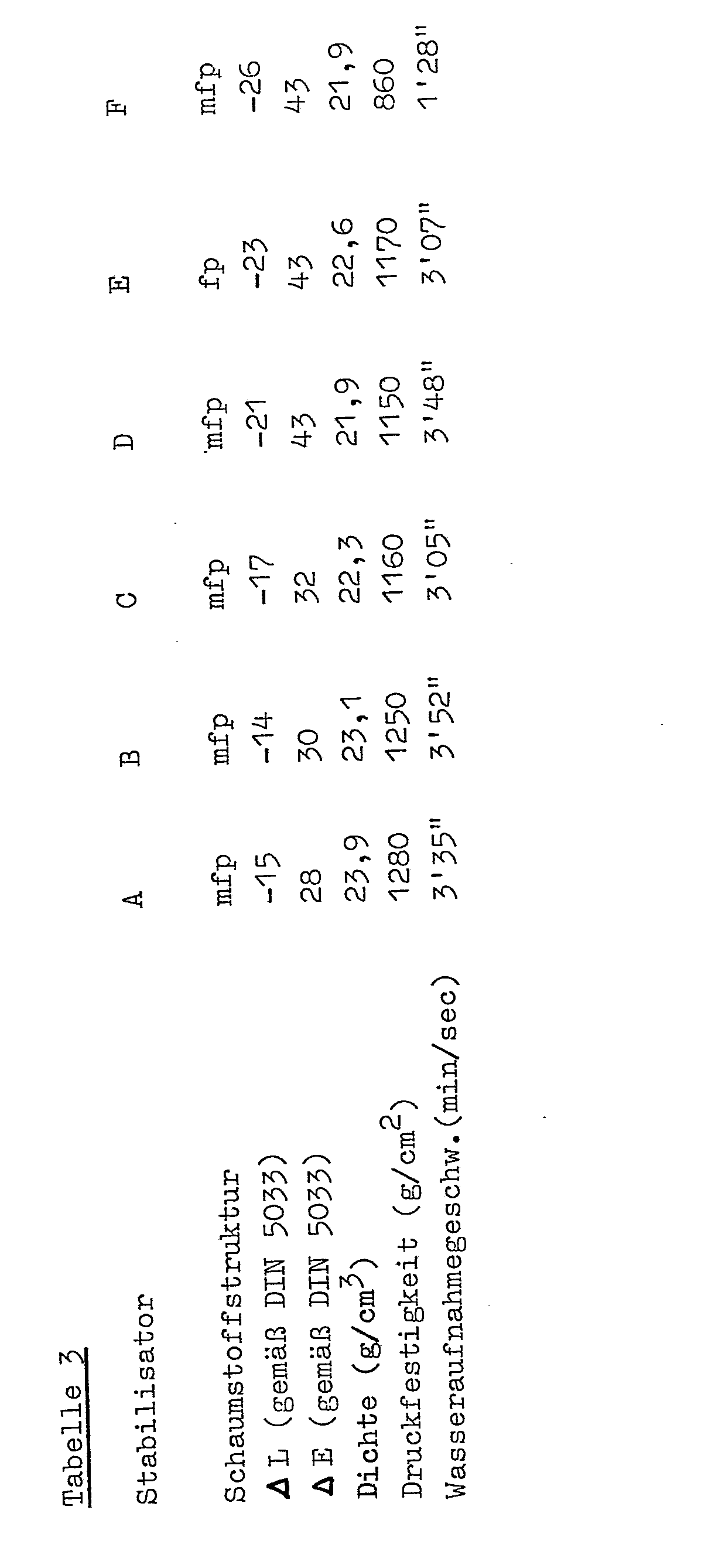
- Zur Herstellung von weitgehend offenzelligen, grün eingefärbten Phenolharzschaumstoffmustern, wie sie zur Herstellung von sogenannten Blumensteckschäumen verwendet werden, wurde gemäß Beispiel 1 verfahren, jedoch wurde anstelle des dort genannten Harzes ein im Handel unter der Bezeichnung Phenolresolharz T 910 S (Handelsprodukt der Dynamit Nobel AG, Troisdorf) benutzt, welches vorab durch Zugabe von 0,4 Gew.-% einer 50 %igen wässrigen, essigsaure Malachitgrünlösung eingefärbt wurde.
- Durch den hohen Grad an Offenzelligkeit bedingt, zeigen solche Schäume beim Auflegen auf eine Wasseroberfläche in der Regel innerhalb weniger Minuten eine Wasseraufnahme von >90 Vol.-%. Der Grad der Offenporigkeit ist bei solchen Schäumen ein entscheidendes Qualitätskriterium und wurde daher in dieser Versuchsreihe durch Messung der Saug zeiten mit berücksichtigt. Zur Bestimmung der Saugzeiten wurden aus den Versuchsschäumen zylinderförmige Prüfkörper (φ 81 mm, h = 60 mm) herausgeschnitten und diese nach 16 bis 24 stündiger offener Lagerung (zum Pentan-Luft-Austausch) auf eine Wasseroberfläche, Wassertemperatur 20 °C, aufgelegt und die Zeit gemessen, die notwendig war, bis sich die Prüfkörper restlos mit Wasser vollgesogen hatten bzw. total benetzt erschienen.
- Die Prüfung der durch Belichtung der Proben verursachten Farbänderungen wurde analog wie in Beispiel 1 beschrieben, vorgenommen.
- Die Ergebnisse sind in Tabelle 3 aufgeführt; in die Tabelle wurden auch Vergleichsversuche mit Triphenylphosphit (Versuch E) und Trisnonylphenylphosphit (Versuch F) aufgenommen. Mit diesen, nicht erfindungsgemäßen Stabilisatoren ergibt sich praktisch keine Verbesserung der Farbwerte, obwohl die Schaunstoffeigenschaften teilweise - mit Ausnahme der Druckfestigkeit bei Versuch E - sich praktisch nicht verschlechtert haben. Alle Schäume waren in der Formtüte voll und fehlerfrei aufgeschäumt.
Claims (6)
Applications Claiming Priority (2)
| Application Number | Priority Date | Filing Date | Title |
|---|---|---|---|
| DE3102066 | 1981-01-23 | ||
| DE3102066A DE3102066C2 (de) | 1981-01-23 | 1981-01-23 | Farbstabilisierte Phenolharzschäume |
Publications (2)
| Publication Number | Publication Date |
|---|---|
| EP0056861A1 true EP0056861A1 (de) | 1982-08-04 |
| EP0056861B1 EP0056861B1 (de) | 1985-04-10 |
Family
ID=6123146
Family Applications (1)
| Application Number | Title | Priority Date | Filing Date |
|---|---|---|---|
| EP81110393A Expired EP0056861B1 (de) | 1981-01-23 | 1981-12-12 | Farbstabilisierte Phenolharzschäume |
Country Status (9)
| Country | Link |
|---|---|
| US (1) | US4369259A (de) |
| EP (1) | EP0056861B1 (de) |
| JP (1) | JPS57145129A (de) |
| AU (1) | AU548145B2 (de) |
| CA (1) | CA1188050A (de) |
| DE (1) | DE3102066C2 (de) |
| DK (1) | DK28182A (de) |
| IL (1) | IL64843A (de) |
| ZA (1) | ZA82404B (de) |
Families Citing this family (8)
| Publication number | Priority date | Publication date | Assignee | Title |
|---|---|---|---|---|
| GB8528294D0 (en) * | 1985-11-16 | 1985-12-18 | Bp Chem Int Ltd | Flame retardant phenolic foams |
| CA2336374C (en) * | 1998-07-03 | 2004-06-01 | Yuichi Arito | Phenolic foam |
| EP1583794B1 (de) * | 2003-01-13 | 2007-05-09 | Kingspan Holdings (IRL) Limited | Phenolharzschaumstoff |
| KR101230692B1 (ko) * | 2005-03-16 | 2013-02-07 | 가부시키가이샤 호리바 세이샤쿠쇼 | 성막 장치 및 성막 방법 |
| JP5198853B2 (ja) * | 2005-03-18 | 2013-05-15 | 株式会社堀場製作所 | 成膜方法及び成膜装置 |
| WO2010057076A2 (en) * | 2008-11-17 | 2010-05-20 | Saint-Gobain Abrasives, Inc. | Acrylate color-stabilized phenolic bound abrasive products and methods for making same |
| GB2575242B (en) | 2018-05-30 | 2022-11-23 | Acell Ind Ltd | Vacuum forming process |
| GB2644169A (en) | 2024-09-13 | 2026-03-25 | Acell Ind Ltd | Method for producing cured polymeric skins |
Citations (8)
| Publication number | Priority date | Publication date | Assignee | Title |
|---|---|---|---|---|
| FR573150A (fr) * | 1922-11-30 | 1924-06-18 | Amalith Chemische Ind Ges M B | Procédé de préparation de produits de condensation durs, infusibles et insolubles, de coloration claire et stable, en partant de phénols et d'aldéhydes |
| US3389095A (en) * | 1963-12-16 | 1968-06-18 | Dow Chemical Co | Process for stabilizing phenolic foam with alkylene oxide and product obtained therefrom |
| FR2007987A1 (en) * | 1968-05-07 | 1970-01-16 | Bp Chem Int Ltd | Production of colourless polyamides from isophorone |
| US3673130A (en) * | 1969-04-04 | 1972-06-27 | Union Carbide Corp | Non-punking phenolic foam |
| DE2331350A1 (de) * | 1972-06-22 | 1974-01-03 | Gen Electric | Oxydationsstabile polycarbonat-zusammensetzung |
| DE2500213A1 (de) * | 1974-01-08 | 1975-07-17 | American Cyanamid Co | Verfahren zum faerben einer waermehaertbaren kunststoffzubereitung |
| JPS5176346A (ja) * | 1974-12-27 | 1976-07-01 | Mitsubishi Chem Ind | Mikokafuenoorujushisoseibutsu |
| JPS5667341A (en) * | 1979-11-07 | 1981-06-06 | Sumitomo Bakelite Co Ltd | Phenolic resin foam |
Family Cites Families (7)
| Publication number | Priority date | Publication date | Assignee | Title |
|---|---|---|---|---|
| US2186687A (en) * | 1938-02-01 | 1940-01-09 | Catalin Corp Of America | Liquid phenol-formaldehyde resin composition |
| US2816876A (en) * | 1955-05-20 | 1957-12-17 | Monsanto Chemicals | Phenol-formaldehyde resins stabilized with triaryl phosphites |
| DE1044397B (de) * | 1956-04-21 | 1958-11-20 | Hoechst Ag | Verfahren zur Herstellung verformter hochvernetzter Resol-Phenol-Formaldehyd-Harze |
| US3383338A (en) * | 1963-10-17 | 1968-05-14 | Allied Chem | Flame-retardant, non-shrinking ureaformaldehyde foams and process of making same |
| US3409571A (en) * | 1964-11-30 | 1968-11-05 | Hooker Chemical Corp | Phenol-aldehyde/phenol-ketone condensate-phosphorus containing esters |
| US3541046A (en) * | 1968-09-11 | 1970-11-17 | Monsanto Co | Organo-amino-polyphosphonates as flame retardants for polymers |
| US3634317A (en) * | 1969-09-19 | 1972-01-11 | Mohawk Ind Inc | Preparation of white stabilized phenol formaldehyde condensation resins |
-
1981
- 1981-01-23 DE DE3102066A patent/DE3102066C2/de not_active Expired
- 1981-12-07 AU AU78338/81A patent/AU548145B2/en not_active Ceased
- 1981-12-12 EP EP81110393A patent/EP0056861B1/de not_active Expired
-
1982
- 1982-01-21 ZA ZA82404A patent/ZA82404B/xx unknown
- 1982-01-21 JP JP57006903A patent/JPS57145129A/ja active Pending
- 1982-01-22 DK DK28182A patent/DK28182A/da not_active Application Discontinuation
- 1982-01-22 IL IL64843A patent/IL64843A/xx unknown
- 1982-01-22 CA CA000394760A patent/CA1188050A/en not_active Expired
- 1982-01-25 US US06/342,342 patent/US4369259A/en not_active Expired - Fee Related
Patent Citations (8)
| Publication number | Priority date | Publication date | Assignee | Title |
|---|---|---|---|---|
| FR573150A (fr) * | 1922-11-30 | 1924-06-18 | Amalith Chemische Ind Ges M B | Procédé de préparation de produits de condensation durs, infusibles et insolubles, de coloration claire et stable, en partant de phénols et d'aldéhydes |
| US3389095A (en) * | 1963-12-16 | 1968-06-18 | Dow Chemical Co | Process for stabilizing phenolic foam with alkylene oxide and product obtained therefrom |
| FR2007987A1 (en) * | 1968-05-07 | 1970-01-16 | Bp Chem Int Ltd | Production of colourless polyamides from isophorone |
| US3673130A (en) * | 1969-04-04 | 1972-06-27 | Union Carbide Corp | Non-punking phenolic foam |
| DE2331350A1 (de) * | 1972-06-22 | 1974-01-03 | Gen Electric | Oxydationsstabile polycarbonat-zusammensetzung |
| DE2500213A1 (de) * | 1974-01-08 | 1975-07-17 | American Cyanamid Co | Verfahren zum faerben einer waermehaertbaren kunststoffzubereitung |
| JPS5176346A (ja) * | 1974-12-27 | 1976-07-01 | Mitsubishi Chem Ind | Mikokafuenoorujushisoseibutsu |
| JPS5667341A (en) * | 1979-11-07 | 1981-06-06 | Sumitomo Bakelite Co Ltd | Phenolic resin foam |
Non-Patent Citations (2)
| Title |
|---|
| CHEMICAL ABSTRACTS, vol. 85, no. 16, 18 October 1976, Columbus, Ohio, US; abstract no. 109417X, KIMURA ET AL.: "Antioxidants for Phenolic Resins" * |
| PATENT ABSTRACTS OF JAPAN vol. 5, no. 132 22 August 1981 (1981-08-22) * |
Also Published As
| Publication number | Publication date |
|---|---|
| ZA82404B (en) | 1982-12-29 |
| JPS57145129A (en) | 1982-09-08 |
| DE3102066C2 (de) | 1984-04-05 |
| DE3102066A1 (de) | 1982-08-26 |
| US4369259A (en) | 1983-01-18 |
| EP0056861B1 (de) | 1985-04-10 |
| AU7833881A (en) | 1982-07-29 |
| IL64843A (en) | 1985-07-31 |
| IL64843A0 (en) | 1982-03-31 |
| DK28182A (da) | 1982-07-24 |
| CA1188050A (en) | 1985-05-28 |
| AU548145B2 (en) | 1985-11-28 |
Similar Documents
| Publication | Publication Date | Title |
|---|---|---|
| DE69734315T2 (de) | Bindemittel für giessformen und kerne | |
| EP0953007B1 (de) | Verfahren zur herstellung farbneutraler polymethylmethacrylat-formmassen | |
| EP1505108A2 (de) | Polyamid-Laser-Sinter-Pulver mit einem Metallsalz und einem Fettsäurederivat, Verfahren zur Herstellung und daraus hergestellte Formkörper | |
| DE10334497A1 (de) | Polymerpulver mit phosphonatbasierendem Flammschutzmittel, Verfahren zu dessen Herstellung und Formkörper, hergestellt aus diesem Polymerpulver | |
| EP0056861B1 (de) | Farbstabilisierte Phenolharzschäume | |
| DE2832180A1 (de) | Flammhemmender, nichttropfender flexibler polyurethanschaum und verfahren zu seiner herstellung | |
| DE4400801A1 (de) | Neue Verflüssiger und Verfahren zu ihrer Herstellung | |
| DE1769823B2 (de) | Farbstabilisierte Polycarbonatmassen | |
| DE1111376B (de) | Verfahren zum Stabilisieren von linearen, Carbonamidgruppen enthaltenden Polykondensaten | |
| EP0596324A1 (de) | Gelbildner- und Gele, ihre Herstellung und Verwendung | |
| DE1508634A1 (de) | Bindemittel fuer selbsthaertende Giessformen | |
| DE2927005A1 (de) | Dauerstempelmasse | |
| DE1808669B2 (de) | Bei Raumtemperatur unter Bildung von Elastomeren härtende Abdruckmasse | |
| DE2031675B2 (de) | Verfahren zum Herstellen von gefärbten Kunstharzpartikeln | |
| DE3514869C1 (de) | Aminoplastharz-Formmassen mit verringerter Nachschwindung auf der Basis von aminogruppenhaltigen Kondensationskomponenten und Formaldehyd und Verfahren zu ihrer Herstellung | |
| DE688516C (de) | Verfahren, um in natuerlichen oder kuenstlichen Harzen, OElen, Fetten, in Kondensationsprodukten und in anderen organischen Stoffen Verfaerbungen zu verhindern oder zu verzoegern | |
| DE2241715A1 (de) | Verfahren zur verminderung des schwundes und der brennbarkeit von schaummassen aus haertbaren aminoplastkondensaten | |
| DE2336172A1 (de) | Verfahren zum stabilisieren einer polymeren organischen zusammensetzung gegen den abbau durch ultraviolettes licht und feuer | |
| DE2751076A1 (de) | Stabile waessrige formaldehydsuspensionen, verfahren zur herstellung derselben und ihre verwendung | |
| DE3882929T2 (de) | Bindemittel für Giessereiformen. | |
| DE2113834A1 (de) | Verfahren zur Herstellung von Aufschlaemmungen von optischen Aufhellern aus der Gruppe der Triazine | |
| DE604081C (de) | Verfahren zur Herstellung von Dispersionen aus Kondensationsprodukten mehrwertiger Alkohole und mehrbasischer Saeuren | |
| DE102015112899B4 (de) | Borarmes bis borfreies anorganisches Bindemittelsystem und Verfahren zur Herstellung eines abgebundenen Bindemittels oder eines Verbundwerkstoffs | |
| EP0032596B1 (de) | Verfahren zur Herstellung von verlorenen Formen | |
| DE1051490B (de) | Verfahren zur Herstellung eines Phenolformaldehydharzschaums |
Legal Events
| Date | Code | Title | Description |
|---|---|---|---|
| PUAI | Public reference made under article 153(3) epc to a published international application that has entered the european phase |
Free format text: ORIGINAL CODE: 0009012 |
|
| AK | Designated contracting states |
Designated state(s): BE FR GB IT NL |
|
| 17P | Request for examination filed |
Effective date: 19830111 |
|
| ITF | It: translation for a ep patent filed | ||
| GRAA | (expected) grant |
Free format text: ORIGINAL CODE: 0009210 |
|
| AK | Designated contracting states |
Designated state(s): BE FR GB IT NL |
|
| ET | Fr: translation filed | ||
| PLBE | No opposition filed within time limit |
Free format text: ORIGINAL CODE: 0009261 |
|
| STAA | Information on the status of an ep patent application or granted ep patent |
Free format text: STATUS: NO OPPOSITION FILED WITHIN TIME LIMIT |
|
| 26N | No opposition filed | ||
| PGFP | Annual fee paid to national office [announced via postgrant information from national office to epo] |
Ref country code: NL Payment date: 19861231 Year of fee payment: 6 |
|
| PG25 | Lapsed in a contracting state [announced via postgrant information from national office to epo] |
Ref country code: BE Effective date: 19871231 |
|
| BERE | Be: lapsed |
Owner name: DYNAMIT NOBEL A.G. Effective date: 19871231 |
|
| PG25 | Lapsed in a contracting state [announced via postgrant information from national office to epo] |
Ref country code: NL Effective date: 19880701 |
|
| NLV4 | Nl: lapsed or anulled due to non-payment of the annual fee | ||
| GBPC | Gb: european patent ceased through non-payment of renewal fee | ||
| PG25 | Lapsed in a contracting state [announced via postgrant information from national office to epo] |
Ref country code: FR Free format text: LAPSE BECAUSE OF NON-PAYMENT OF DUE FEES Effective date: 19880831 |
|
| REG | Reference to a national code |
Ref country code: FR Ref legal event code: ST |
|
| PG25 | Lapsed in a contracting state [announced via postgrant information from national office to epo] |
Ref country code: GB Free format text: LAPSE BECAUSE OF NON-PAYMENT OF DUE FEES Effective date: 19881121 |