EP0056940B1 - Dérivés de phtacyanine, matériau de reproduction pour la photographie en couleurs qui contient ces dérivés ainsi qu'une image photographique en couleurs qui contient le colorant de phtalocyanine libéré par le dérivé de phtalocyanine comme colorant d'image - Google Patents
Dérivés de phtacyanine, matériau de reproduction pour la photographie en couleurs qui contient ces dérivés ainsi qu'une image photographique en couleurs qui contient le colorant de phtalocyanine libéré par le dérivé de phtalocyanine comme colorant d'image Download PDFInfo
- Publication number
- EP0056940B1 EP0056940B1 EP82100122A EP82100122A EP0056940B1 EP 0056940 B1 EP0056940 B1 EP 0056940B1 EP 82100122 A EP82100122 A EP 82100122A EP 82100122 A EP82100122 A EP 82100122A EP 0056940 B1 EP0056940 B1 EP 0056940B1
- Authority
- EP
- European Patent Office
- Prior art keywords
- denotes
- compound
- alkyl
- image
- phthalocyanine
- Prior art date
- Legal status (The legal status is an assumption and is not a legal conclusion. Google has not performed a legal analysis and makes no representation as to the accuracy of the status listed.)
- Expired
Links
- 239000000463 material Substances 0.000 title claims description 23
- 239000000975 dye Substances 0.000 title description 50
- IEQIEDJGQAUEQZ-UHFFFAOYSA-N phthalocyanine Chemical class N1C(N=C2C3=CC=CC=C3C(N=C3C4=CC=CC=C4C(=N4)N3)=N2)=C(C=CC=C2)C2=C1N=C1C2=CC=CC=C2C4=N1 IEQIEDJGQAUEQZ-UHFFFAOYSA-N 0.000 title description 29
- 150000001875 compounds Chemical class 0.000 claims description 75
- -1 methoxy, acetamido Chemical group 0.000 claims description 37
- 238000009792 diffusion process Methods 0.000 claims description 20
- 229910052709 silver Inorganic materials 0.000 claims description 20
- 239000004332 silver Substances 0.000 claims description 20
- 125000004432 carbon atom Chemical group C* 0.000 claims description 19
- 125000000217 alkyl group Chemical group 0.000 claims description 17
- 229910052739 hydrogen Inorganic materials 0.000 claims description 15
- 239000001257 hydrogen Substances 0.000 claims description 15
- 238000000034 method Methods 0.000 claims description 15
- 125000003545 alkoxy group Chemical group 0.000 claims description 12
- 230000008569 process Effects 0.000 claims description 11
- UFHFLCQGNIYNRP-UHFFFAOYSA-N Hydrogen Chemical compound [H][H] UFHFLCQGNIYNRP-UHFFFAOYSA-N 0.000 claims description 10
- 125000004442 acylamino group Chemical group 0.000 claims description 10
- 239000000839 emulsion Substances 0.000 claims description 10
- 238000012546 transfer Methods 0.000 claims description 10
- 238000009826 distribution Methods 0.000 claims description 9
- 229910052736 halogen Inorganic materials 0.000 claims description 9
- 150000002367 halogens Chemical class 0.000 claims description 9
- 238000004519 manufacturing process Methods 0.000 claims description 9
- 125000002496 methyl group Chemical group [H]C([H])([H])* 0.000 claims description 9
- 229920006395 saturated elastomer Polymers 0.000 claims description 6
- 125000003107 substituted aryl group Chemical group 0.000 claims description 6
- 125000003342 alkenyl group Chemical group 0.000 claims description 5
- 125000003118 aryl group Chemical group 0.000 claims description 4
- 125000002091 cationic group Chemical group 0.000 claims description 4
- 150000001768 cations Chemical class 0.000 claims description 4
- 125000000547 substituted alkyl group Chemical group 0.000 claims description 4
- 239000003638 chemical reducing agent Substances 0.000 claims description 3
- 125000004123 n-propyl group Chemical group [H]C([H])([H])C([H])([H])C([H])([H])* 0.000 claims description 3
- 229910052759 nickel Inorganic materials 0.000 claims description 2
- 150000002431 hydrogen Chemical class 0.000 claims 5
- 150000001449 anionic compounds Chemical class 0.000 claims 1
- 239000010410 layer Substances 0.000 description 53
- YMWUJEATGCHHMB-UHFFFAOYSA-N Dichloromethane Chemical compound ClCCl YMWUJEATGCHHMB-UHFFFAOYSA-N 0.000 description 21
- OKKJLVBELUTLKV-UHFFFAOYSA-N Methanol Chemical compound OC OKKJLVBELUTLKV-UHFFFAOYSA-N 0.000 description 21
- 239000003795 chemical substances by application Substances 0.000 description 19
- 238000011161 development Methods 0.000 description 15
- 239000000203 mixture Substances 0.000 description 14
- 238000002360 preparation method Methods 0.000 description 14
- JUJWROOIHBZHMG-UHFFFAOYSA-N Pyridine Chemical compound C1=CC=NC=C1 JUJWROOIHBZHMG-UHFFFAOYSA-N 0.000 description 12
- 229920000159 gelatin Polymers 0.000 description 12
- 235000019322 gelatine Nutrition 0.000 description 12
- 239000001007 phthalocyanine dye Substances 0.000 description 12
- XLYOFNOQVPJJNP-UHFFFAOYSA-N water Substances O XLYOFNOQVPJJNP-UHFFFAOYSA-N 0.000 description 12
- 239000000047 product Substances 0.000 description 11
- XEKOWRVHYACXOJ-UHFFFAOYSA-N Ethyl acetate Chemical compound CCOC(C)=O XEKOWRVHYACXOJ-UHFFFAOYSA-N 0.000 description 9
- 239000003973 paint Substances 0.000 description 9
- 230000035945 sensitivity Effects 0.000 description 9
- 239000011230 binding agent Substances 0.000 description 8
- 238000006243 chemical reaction Methods 0.000 description 8
- 230000003647 oxidation Effects 0.000 description 8
- 238000007254 oxidation reaction Methods 0.000 description 8
- 108010010803 Gelatin Proteins 0.000 description 7
- 239000008273 gelatin Substances 0.000 description 7
- 235000011852 gelatine desserts Nutrition 0.000 description 7
- RBTKNAXYKSUFRK-UHFFFAOYSA-N heliogen blue Chemical compound [Cu].[N-]1C2=C(C=CC=C3)C3=C1N=C([N-]1)C3=CC=CC=C3C1=NC([N-]1)=C(C=CC=C3)C3=C1N=C([N-]1)C3=CC=CC=C3C1=N2 RBTKNAXYKSUFRK-UHFFFAOYSA-N 0.000 description 7
- 125000002924 primary amino group Chemical group [H]N([H])* 0.000 description 7
- 150000003254 radicals Chemical class 0.000 description 7
- BQCADISMDOOEFD-UHFFFAOYSA-N Silver Chemical compound [Ag] BQCADISMDOOEFD-UHFFFAOYSA-N 0.000 description 6
- 125000000129 anionic group Chemical group 0.000 description 6
- 238000004040 coloring Methods 0.000 description 6
- 229940125782 compound 2 Drugs 0.000 description 6
- UMJSCPRVCHMLSP-UHFFFAOYSA-N pyridine Natural products COC1=CC=CN=C1 UMJSCPRVCHMLSP-UHFFFAOYSA-N 0.000 description 6
- 239000000243 solution Substances 0.000 description 6
- QTBSBXVTEAMEQO-UHFFFAOYSA-N Acetic acid Chemical compound CC(O)=O QTBSBXVTEAMEQO-UHFFFAOYSA-N 0.000 description 5
- 239000001828 Gelatine Substances 0.000 description 5
- 239000002904 solvent Substances 0.000 description 5
- VEXZGXHMUGYJMC-UHFFFAOYSA-N Hydrochloric acid Chemical compound Cl VEXZGXHMUGYJMC-UHFFFAOYSA-N 0.000 description 4
- 230000002209 hydrophobic effect Effects 0.000 description 4
- 229920000642 polymer Polymers 0.000 description 4
- 230000027756 respiratory electron transport chain Effects 0.000 description 4
- 238000003756 stirring Methods 0.000 description 4
- 238000004809 thin layer chromatography Methods 0.000 description 4
- UHOVQNZJYSORNB-UHFFFAOYSA-N Benzene Chemical compound C1=CC=CC=C1 UHOVQNZJYSORNB-UHFFFAOYSA-N 0.000 description 3
- ZMXDDKWLCZADIW-UHFFFAOYSA-N N,N-Dimethylformamide Chemical compound CN(C)C=O ZMXDDKWLCZADIW-UHFFFAOYSA-N 0.000 description 3
- RWRDLPDLKQPQOW-UHFFFAOYSA-N Pyrrolidine Chemical compound C1CCNC1 RWRDLPDLKQPQOW-UHFFFAOYSA-N 0.000 description 3
- 230000006399 behavior Effects 0.000 description 3
- 238000003776 cleavage reaction Methods 0.000 description 3
- 125000004435 hydrogen atom Chemical class [H]* 0.000 description 3
- NYGZLYXAPMMJTE-UHFFFAOYSA-M metanil yellow Chemical group [Na+].[O-]S(=O)(=O)C1=CC=CC(N=NC=2C=CC(NC=3C=CC=CC=3)=CC=2)=C1 NYGZLYXAPMMJTE-UHFFFAOYSA-M 0.000 description 3
- MEBZVMXZXFKHJS-UHFFFAOYSA-N n,n-diethylhexadecanamide Chemical compound CCCCCCCCCCCCCCCC(=O)N(CC)CC MEBZVMXZXFKHJS-UHFFFAOYSA-N 0.000 description 3
- 125000001997 phenyl group Chemical group [H]C1=C([H])C([H])=C(*)C([H])=C1[H] 0.000 description 3
- 238000005554 pickling Methods 0.000 description 3
- 230000009467 reduction Effects 0.000 description 3
- 150000003335 secondary amines Chemical class 0.000 description 3
- 125000001424 substituent group Chemical group 0.000 description 3
- 125000001273 sulfonato group Chemical group [O-]S(*)(=O)=O 0.000 description 3
- XTHPWXDJESJLNJ-UHFFFAOYSA-N sulfurochloridic acid Chemical group OS(Cl)(=O)=O XTHPWXDJESJLNJ-UHFFFAOYSA-N 0.000 description 3
- AZQWKYJCGOJGHM-UHFFFAOYSA-N 1,4-benzoquinone Chemical compound O=C1C=CC(=O)C=C1 AZQWKYJCGOJGHM-UHFFFAOYSA-N 0.000 description 2
- 150000005208 1,4-dihydroxybenzenes Chemical class 0.000 description 2
- HZAXFHJVJLSVMW-UHFFFAOYSA-N 2-Aminoethan-1-ol Chemical compound NCCO HZAXFHJVJLSVMW-UHFFFAOYSA-N 0.000 description 2
- BNXASZRTKKGHNG-UHFFFAOYSA-N 2-aminobenzenesulfinic acid Chemical class NC1=CC=CC=C1S(O)=O BNXASZRTKKGHNG-UHFFFAOYSA-N 0.000 description 2
- PLIKAWJENQZMHA-UHFFFAOYSA-N 4-aminophenol Chemical compound NC1=CC=C(O)C=C1 PLIKAWJENQZMHA-UHFFFAOYSA-N 0.000 description 2
- XVMSFILGAMDHEY-UHFFFAOYSA-N 6-(4-aminophenyl)sulfonylpyridin-3-amine Chemical compound C1=CC(N)=CC=C1S(=O)(=O)C1=CC=C(N)C=N1 XVMSFILGAMDHEY-UHFFFAOYSA-N 0.000 description 2
- NQRYJNQNLNOLGT-UHFFFAOYSA-N Piperidine Chemical compound C1CCNCC1 NQRYJNQNLNOLGT-UHFFFAOYSA-N 0.000 description 2
- 239000004698 Polyethylene Substances 0.000 description 2
- PPBRXRYQALVLMV-UHFFFAOYSA-N Styrene Chemical compound C=CC1=CC=CC=C1 PPBRXRYQALVLMV-UHFFFAOYSA-N 0.000 description 2
- WYURNTSHIVDZCO-UHFFFAOYSA-N Tetrahydrofuran Chemical compound C1CCOC1 WYURNTSHIVDZCO-UHFFFAOYSA-N 0.000 description 2
- 229960000583 acetic acid Drugs 0.000 description 2
- 125000001931 aliphatic group Chemical group 0.000 description 2
- 125000004397 aminosulfonyl group Chemical group NS(=O)(=O)* 0.000 description 2
- 230000008901 benefit Effects 0.000 description 2
- 125000001797 benzyl group Chemical group [H]C1=C([H])C([H])=C(C([H])=C1[H])C([H])([H])* 0.000 description 2
- 230000015572 biosynthetic process Effects 0.000 description 2
- 125000002837 carbocyclic group Chemical group 0.000 description 2
- MDLLSWJQIIAUQU-UHFFFAOYSA-N chembl1717293 Chemical group C12=CC=CC=C2C(O)=CC=C1N=NC1=CC=C([N+]([O-])=O)C=C1 MDLLSWJQIIAUQU-UHFFFAOYSA-N 0.000 description 2
- MVPPADPHJFYWMZ-UHFFFAOYSA-N chlorobenzene Chemical compound ClC1=CC=CC=C1 MVPPADPHJFYWMZ-UHFFFAOYSA-N 0.000 description 2
- 239000010949 copper Substances 0.000 description 2
- 238000001035 drying Methods 0.000 description 2
- 238000000921 elemental analysis Methods 0.000 description 2
- 238000003379 elimination reaction Methods 0.000 description 2
- 239000003995 emulsifying agent Substances 0.000 description 2
- 230000007717 exclusion Effects 0.000 description 2
- 230000002349 favourable effect Effects 0.000 description 2
- 150000002576 ketones Chemical class 0.000 description 2
- MXWHMTNPTTVWDM-NXOFHUPFSA-N mitoguazone Chemical class NC(N)=N\N=C(/C)\C=N\N=C(N)N MXWHMTNPTTVWDM-NXOFHUPFSA-N 0.000 description 2
- SYSQUGFVNFXIIT-UHFFFAOYSA-N n-[4-(1,3-benzoxazol-2-yl)phenyl]-4-nitrobenzenesulfonamide Chemical class C1=CC([N+](=O)[O-])=CC=C1S(=O)(=O)NC1=CC=C(C=2OC3=CC=CC=C3N=2)C=C1 SYSQUGFVNFXIIT-UHFFFAOYSA-N 0.000 description 2
- AICOOMRHRUFYCM-ZRRPKQBOSA-N oxazine, 1 Chemical compound C([C@@H]1[C@H](C(C[C@]2(C)[C@@H]([C@H](C)N(C)C)[C@H](O)C[C@]21C)=O)CC1=CC2)C[C@H]1[C@@]1(C)[C@H]2N=C(C(C)C)OC1 AICOOMRHRUFYCM-ZRRPKQBOSA-N 0.000 description 2
- 229920000573 polyethylene Polymers 0.000 description 2
- 239000002243 precursor Substances 0.000 description 2
- 125000001453 quaternary ammonium group Chemical group 0.000 description 2
- 230000035484 reaction time Effects 0.000 description 2
- 238000000926 separation method Methods 0.000 description 2
- 239000007858 starting material Substances 0.000 description 2
- 125000000020 sulfo group Chemical group O=S(=O)([*])O[H] 0.000 description 2
- FYSNRJHAOHDILO-UHFFFAOYSA-N thionyl chloride Chemical compound ClS(Cl)=O FYSNRJHAOHDILO-UHFFFAOYSA-N 0.000 description 2
- 0 *C1C/C=C/C(/NS(=O)=O)=C\*(*)C1 Chemical compound *C1C/C=C/C(/NS(=O)=O)=C\*(*)C1 0.000 description 1
- QLDQYRDCPNBPII-UHFFFAOYSA-N 1,2-benzoxazol-3-one Chemical compound C1=CC=C2C(O)=NOC2=C1 QLDQYRDCPNBPII-UHFFFAOYSA-N 0.000 description 1
- KEQGZUUPPQEDPF-UHFFFAOYSA-N 1,3-dichloro-5,5-dimethylimidazolidine-2,4-dione Chemical compound CC1(C)N(Cl)C(=O)N(Cl)C1=O KEQGZUUPPQEDPF-UHFFFAOYSA-N 0.000 description 1
- RAARYHFSFBRBOV-UHFFFAOYSA-N 2,5-dihydroxy-4-(16-methylheptadecyl)benzenesulfonic acid Chemical compound CC(C)CCCCCCCCCCCCCCCC1=CC(O)=C(S(O)(=O)=O)C=C1O RAARYHFSFBRBOV-UHFFFAOYSA-N 0.000 description 1
- WYBPYERZMBLFDX-UHFFFAOYSA-N 2-(1-hydroxytetradecyl)-5,6-dimethyl-3-propylbenzene-1,4-diol Chemical compound CCCCCCCCCCCCCC(O)C1=C(O)C(C)=C(C)C(O)=C1CCC WYBPYERZMBLFDX-UHFFFAOYSA-N 0.000 description 1
- OEDQNDJKBBYAHI-UHFFFAOYSA-N 2-ethenyl-1-methyl-2h-pyridine Chemical compound CN1C=CC=CC1C=C OEDQNDJKBBYAHI-UHFFFAOYSA-N 0.000 description 1
- 125000003903 2-propenyl group Chemical group [H]C([*])([H])C([H])=C([H])[H] 0.000 description 1
- YSEBWPQBEDKBBV-UHFFFAOYSA-N 4-aminobenzenesulfinic acid Chemical compound NC1=CC=C(S(O)=O)C=C1 YSEBWPQBEDKBBV-UHFFFAOYSA-N 0.000 description 1
- RUKJCCIJLIMGEP-ONEGZZNKSA-N 4-dimethylaminocinnamaldehyde Chemical compound CN(C)C1=CC=C(\C=C\C=O)C=C1 RUKJCCIJLIMGEP-ONEGZZNKSA-N 0.000 description 1
- CIWBSHSKHKDKBQ-JLAZNSOCSA-N Ascorbic acid Natural products OC[C@H](O)[C@H]1OC(=O)C(O)=C1O CIWBSHSKHKDKBQ-JLAZNSOCSA-N 0.000 description 1
- GAWIXWVDTYZWAW-UHFFFAOYSA-N C[CH]O Chemical group C[CH]O GAWIXWVDTYZWAW-UHFFFAOYSA-N 0.000 description 1
- IMROMDMJAWUWLK-UHFFFAOYSA-N Ethenol Chemical compound OC=C IMROMDMJAWUWLK-UHFFFAOYSA-N 0.000 description 1
- 235000014820 Galium aparine Nutrition 0.000 description 1
- 240000005702 Galium aparine Species 0.000 description 1
- QAQJMLQRFWZOBN-LAUBAEHRSA-N L-ascorbyl-6-palmitate Chemical compound CCCCCCCCCCCCCCCC(=O)OC[C@H](O)[C@H]1OC(=O)C(O)=C1O QAQJMLQRFWZOBN-LAUBAEHRSA-N 0.000 description 1
- 239000011786 L-ascorbyl-6-palmitate Substances 0.000 description 1
- 239000002841 Lewis acid Substances 0.000 description 1
- YNAVUWVOSKDBBP-UHFFFAOYSA-N Morpholine Chemical group C1COCCN1 YNAVUWVOSKDBBP-UHFFFAOYSA-N 0.000 description 1
- FXHOOIRPVKKKFG-UHFFFAOYSA-N N,N-Dimethylacetamide Chemical compound CN(C)C(C)=O FXHOOIRPVKKKFG-UHFFFAOYSA-N 0.000 description 1
- SECXISVLQFMRJM-UHFFFAOYSA-N N-Methylpyrrolidone Chemical compound CN1CCCC1=O SECXISVLQFMRJM-UHFFFAOYSA-N 0.000 description 1
- WHNWPMSKXPGLAX-UHFFFAOYSA-N N-Vinyl-2-pyrrolidone Chemical compound C=CN1CCCC1=O WHNWPMSKXPGLAX-UHFFFAOYSA-N 0.000 description 1
- SJEYSFABYSGQBG-UHFFFAOYSA-M Patent blue Chemical compound [Na+].C1=CC(N(CC)CC)=CC=C1C(C=1C(=CC(=CC=1)S([O-])(=O)=O)S([O-])(=O)=O)=C1C=CC(=[N+](CC)CC)C=C1 SJEYSFABYSGQBG-UHFFFAOYSA-M 0.000 description 1
- 206010070834 Sensitisation Diseases 0.000 description 1
- PMZURENOXWZQFD-UHFFFAOYSA-L Sodium Sulfate Chemical compound [Na+].[Na+].[O-]S([O-])(=O)=O PMZURENOXWZQFD-UHFFFAOYSA-L 0.000 description 1
- 241000950638 Symphysodon discus Species 0.000 description 1
- 238000010521 absorption reaction Methods 0.000 description 1
- 239000002253 acid Substances 0.000 description 1
- 239000000980 acid dye Substances 0.000 description 1
- 230000002378 acidificating effect Effects 0.000 description 1
- 150000007513 acids Chemical class 0.000 description 1
- 230000009471 action Effects 0.000 description 1
- 125000002252 acyl group Chemical group 0.000 description 1
- 150000001412 amines Chemical class 0.000 description 1
- 125000003277 amino group Chemical group 0.000 description 1
- 150000001450 anions Chemical class 0.000 description 1
- 239000000010 aprotic solvent Substances 0.000 description 1
- 239000012736 aqueous medium Substances 0.000 description 1
- 150000004982 aromatic amines Chemical class 0.000 description 1
- 150000005840 aryl radicals Chemical class 0.000 description 1
- 235000010323 ascorbic acid Nutrition 0.000 description 1
- 229960005070 ascorbic acid Drugs 0.000 description 1
- 239000011668 ascorbic acid Substances 0.000 description 1
- 235000010385 ascorbyl palmitate Nutrition 0.000 description 1
- 239000000987 azo dye Substances 0.000 description 1
- WDEQGLDWZMIMJM-UHFFFAOYSA-N benzyl 4-hydroxy-2-(hydroxymethyl)pyrrolidine-1-carboxylate Chemical compound OCC1CC(O)CN1C(=O)OCC1=CC=CC=C1 WDEQGLDWZMIMJM-UHFFFAOYSA-N 0.000 description 1
- VGUXWSJVGWCTEC-UHFFFAOYSA-N bicyclo[2.2.1]hept-3-ene Chemical group C1C(C2)CCC2=C1 VGUXWSJVGWCTEC-UHFFFAOYSA-N 0.000 description 1
- 230000005540 biological transmission Effects 0.000 description 1
- 238000009835 boiling Methods 0.000 description 1
- OIPQUBBCOVJSNS-UHFFFAOYSA-L bromo(iodo)silver Chemical compound Br[Ag]I OIPQUBBCOVJSNS-UHFFFAOYSA-L 0.000 description 1
- 125000003178 carboxy group Chemical group [H]OC(*)=O 0.000 description 1
- 150000001767 cationic compounds Chemical class 0.000 description 1
- 229920002678 cellulose Polymers 0.000 description 1
- 150000008280 chlorinated hydrocarbons Chemical class 0.000 description 1
- 238000005957 chlorosulfonylation reaction Methods 0.000 description 1
- 239000004927 clay Substances 0.000 description 1
- 239000011248 coating agent Substances 0.000 description 1
- 238000000576 coating method Methods 0.000 description 1
- 239000000084 colloidal system Substances 0.000 description 1
- 230000000295 complement effect Effects 0.000 description 1
- 229940125904 compound 1 Drugs 0.000 description 1
- 229940126214 compound 3 Drugs 0.000 description 1
- 229920001577 copolymer Polymers 0.000 description 1
- 229910052802 copper Inorganic materials 0.000 description 1
- XCJYREBRNVKWGJ-UHFFFAOYSA-N copper(II) phthalocyanine Chemical compound [Cu+2].C12=CC=CC=C2C(N=C2[N-]C(C3=CC=CC=C32)=N2)=NC1=NC([C]1C=CC=CC1=1)=NC=1N=C1[C]3C=CC=CC3=C2[N-]1 XCJYREBRNVKWGJ-UHFFFAOYSA-N 0.000 description 1
- 239000002274 desiccant Substances 0.000 description 1
- 230000000694 effects Effects 0.000 description 1
- 230000008030 elimination Effects 0.000 description 1
- 150000002148 esters Chemical class 0.000 description 1
- 125000001495 ethyl group Chemical group [H]C([H])([H])C([H])([H])* 0.000 description 1
- 230000006870 function Effects 0.000 description 1
- 239000012362 glacial acetic acid Substances 0.000 description 1
- 239000001046 green dye Substances 0.000 description 1
- 238000010438 heat treatment Methods 0.000 description 1
- 125000003187 heptyl group Chemical group [H]C([*])([H])C([H])([H])C([H])([H])C([H])([H])C([H])([H])C([H])([H])C([H])([H])[H] 0.000 description 1
- 125000000623 heterocyclic group Chemical group 0.000 description 1
- 230000007062 hydrolysis Effects 0.000 description 1
- 238000006460 hydrolysis reaction Methods 0.000 description 1
- 150000004679 hydroxides Chemical class 0.000 description 1
- DOUHZFSGSXMPIE-UHFFFAOYSA-N hydroxidooxidosulfur(.) Chemical group [O]SO DOUHZFSGSXMPIE-UHFFFAOYSA-N 0.000 description 1
- 238000003384 imaging method Methods 0.000 description 1
- 238000010348 incorporation Methods 0.000 description 1
- 229910001411 inorganic cation Inorganic materials 0.000 description 1
- 230000003993 interaction Effects 0.000 description 1
- HOQADATXFBOEGG-UHFFFAOYSA-N isofenphos Chemical compound CCOP(=S)(NC(C)C)OC1=CC=CC=C1C(=O)OC(C)C HOQADATXFBOEGG-UHFFFAOYSA-N 0.000 description 1
- TYQCGQRIZGCHNB-JLAZNSOCSA-N l-ascorbic acid Chemical compound OC[C@H](O)[C@H]1OC(O)=C(O)C1=O TYQCGQRIZGCHNB-JLAZNSOCSA-N 0.000 description 1
- 150000007517 lewis acids Chemical class 0.000 description 1
- 125000002960 margaryl group Chemical group [H]C([*])([H])C([H])([H])C([H])([H])C([H])([H])C([H])([H])C([H])([H])C([H])([H])C([H])([H])C([H])([H])C([H])([H])C([H])([H])C([H])([H])C([H])([H])C([H])([H])C([H])([H])C([H])([H])C([H])([H])[H] 0.000 description 1
- 239000002609 medium Substances 0.000 description 1
- 239000002184 metal Substances 0.000 description 1
- 229910052751 metal Inorganic materials 0.000 description 1
- 239000002808 molecular sieve Substances 0.000 description 1
- 125000001421 myristyl group Chemical group [H]C([*])([H])C([H])([H])C([H])([H])C([H])([H])C([H])([H])C([H])([H])C([H])([H])C([H])([H])C([H])([H])C([H])([H])C([H])([H])C([H])([H])C([H])([H])C([H])([H])[H] 0.000 description 1
- 230000007935 neutral effect Effects 0.000 description 1
- PXHVJJICTQNCMI-UHFFFAOYSA-N nickel Substances [Ni] PXHVJJICTQNCMI-UHFFFAOYSA-N 0.000 description 1
- QJGQUHMNIGDVPM-UHFFFAOYSA-N nitrogen group Chemical group [N] QJGQUHMNIGDVPM-UHFFFAOYSA-N 0.000 description 1
- 239000012457 nonaqueous media Substances 0.000 description 1
- 230000003287 optical effect Effects 0.000 description 1
- 150000002892 organic cations Chemical class 0.000 description 1
- 125000001477 organic nitrogen group Chemical group 0.000 description 1
- 239000007800 oxidant agent Substances 0.000 description 1
- 125000002958 pentadecyl group Chemical group [H]C([*])([H])C([H])([H])C([H])([H])C([H])([H])C([H])([H])C([H])([H])C([H])([H])C([H])([H])C([H])([H])C([H])([H])C([H])([H])C([H])([H])C([H])([H])C([H])([H])C([H])([H])[H] 0.000 description 1
- 150000004714 phosphonium salts Chemical class 0.000 description 1
- 239000000049 pigment Substances 0.000 description 1
- 239000002798 polar solvent Substances 0.000 description 1
- 229920002959 polymer blend Polymers 0.000 description 1
- 229920002635 polyurethane Polymers 0.000 description 1
- 239000004814 polyurethane Substances 0.000 description 1
- 229920000036 polyvinylpyrrolidone Polymers 0.000 description 1
- 239000001267 polyvinylpyrrolidone Substances 0.000 description 1
- 235000013855 polyvinylpyrrolidone Nutrition 0.000 description 1
- 239000002244 precipitate Substances 0.000 description 1
- 238000001556 precipitation Methods 0.000 description 1
- 150000003141 primary amines Chemical class 0.000 description 1
- 150000003142 primary aromatic amines Chemical class 0.000 description 1
- 238000012545 processing Methods 0.000 description 1
- 239000011241 protective layer Substances 0.000 description 1
- 239000003586 protic polar solvent Substances 0.000 description 1
- JUJWROOIHBZHMG-UHFFFAOYSA-O pyridinium Chemical compound C1=CC=[NH+]C=C1 JUJWROOIHBZHMG-UHFFFAOYSA-O 0.000 description 1
- 150000004059 quinone derivatives Chemical class 0.000 description 1
- 239000000376 reactant Substances 0.000 description 1
- 239000012429 reaction media Substances 0.000 description 1
- 239000011541 reaction mixture Substances 0.000 description 1
- 230000009257 reactivity Effects 0.000 description 1
- 238000011160 research Methods 0.000 description 1
- 230000000717 retained effect Effects 0.000 description 1
- 238000009666 routine test Methods 0.000 description 1
- 150000003839 salts Chemical class 0.000 description 1
- 230000007017 scission Effects 0.000 description 1
- 230000008313 sensitization Effects 0.000 description 1
- SQGYOTSLMSWVJD-UHFFFAOYSA-N silver(I) nitrate Inorganic materials [Ag+].[O-]N(=O)=O SQGYOTSLMSWVJD-UHFFFAOYSA-N 0.000 description 1
- 239000011734 sodium Substances 0.000 description 1
- URGAHOPLAPQHLN-UHFFFAOYSA-N sodium aluminosilicate Chemical compound [Na+].[Al+3].[O-][Si]([O-])=O.[O-][Si]([O-])=O URGAHOPLAPQHLN-UHFFFAOYSA-N 0.000 description 1
- 229910052938 sodium sulfate Inorganic materials 0.000 description 1
- 235000011152 sodium sulphate Nutrition 0.000 description 1
- 230000003595 spectral effect Effects 0.000 description 1
- 125000004079 stearyl group Chemical group [H]C([*])([H])C([H])([H])C([H])([H])C([H])([H])C([H])([H])C([H])([H])C([H])([H])C([H])([H])C([H])([H])C([H])([H])C([H])([H])C([H])([H])C([H])([H])C([H])([H])C([H])([H])C([H])([H])C([H])([H])C([H])([H])[H] 0.000 description 1
- 239000012258 stirred mixture Substances 0.000 description 1
- 239000000126 substance Substances 0.000 description 1
- 125000000626 sulfinic acid group Chemical group 0.000 description 1
- 150000003460 sulfonic acids Chemical class 0.000 description 1
- QAOWNCQODCNURD-UHFFFAOYSA-N sulfuric acid Substances OS(O)(=O)=O QAOWNCQODCNURD-UHFFFAOYSA-N 0.000 description 1
- 125000000999 tert-butyl group Chemical group [H]C([H])([H])C(*)(C([H])([H])[H])C([H])([H])[H] 0.000 description 1
- 150000004026 tertiary sulfonium compounds Chemical class 0.000 description 1
- YLQBMQCUIZJEEH-UHFFFAOYSA-N tetrahydrofuran Natural products C=1C=COC=1 YLQBMQCUIZJEEH-UHFFFAOYSA-N 0.000 description 1
- 125000002889 tridecyl group Chemical group [H]C([*])([H])C([H])([H])C([H])([H])C([H])([H])C([H])([H])C([H])([H])C([H])([H])C([H])([H])C([H])([H])C([H])([H])C([H])([H])C([H])([H])C([H])([H])[H] 0.000 description 1
- 238000009827 uniform distribution Methods 0.000 description 1
Classifications
-
- G—PHYSICS
- G03—PHOTOGRAPHY; CINEMATOGRAPHY; ANALOGOUS TECHNIQUES USING WAVES OTHER THAN OPTICAL WAVES; ELECTROGRAPHY; HOLOGRAPHY
- G03C—PHOTOSENSITIVE MATERIALS FOR PHOTOGRAPHIC PURPOSES; PHOTOGRAPHIC PROCESSES, e.g. CINE, X-RAY, COLOUR, STEREO-PHOTOGRAPHIC PROCESSES; AUXILIARY PROCESSES IN PHOTOGRAPHY
- G03C8/00—Diffusion transfer processes or agents therefor; Photosensitive materials for such processes
- G03C8/02—Photosensitive materials characterised by the image-forming section
- G03C8/08—Photosensitive materials characterised by the image-forming section the substances transferred by diffusion consisting of organic compounds
- G03C8/10—Photosensitive materials characterised by the image-forming section the substances transferred by diffusion consisting of organic compounds of dyes or their precursors
-
- C—CHEMISTRY; METALLURGY
- C09—DYES; PAINTS; POLISHES; NATURAL RESINS; ADHESIVES; COMPOSITIONS NOT OTHERWISE PROVIDED FOR; APPLICATIONS OF MATERIALS NOT OTHERWISE PROVIDED FOR
- C09B—ORGANIC DYES OR CLOSELY-RELATED COMPOUNDS FOR PRODUCING DYES, e.g. PIGMENTS; MORDANTS; LAKES
- C09B47/00—Porphines; Azaporphines
- C09B47/04—Phthalocyanines abbreviation: Pc
- C09B47/08—Preparation from other phthalocyanine compounds, e.g. cobaltphthalocyanineamine complex
- C09B47/24—Obtaining compounds having —COOH or —SO3H radicals, or derivatives thereof, directly bound to the phthalocyanine radical
- C09B47/26—Amide radicals
Definitions
- the published European patent application 0 004 399 describes non-diffusing quinoid compounds which are reduced under the action of a reducing agent which is not consumed during simultaneous silver development - hereinafter referred to as electron donor compound or ED compound - and in an elimination reaction a diffusible dye with a sulfinic acid residue release as a leaving group. Since the ED compound originally present in uniform distribution in the light-sensitive element of the photographic recording material is consumed imagewise by the development of the silver halide, a state in which there is an imagewise distribution of the ED compound quickly arises after the start of silver halide development.
- the non-diffusing quinoid compound is reduced imagewise.
- the diffusible dye-sulfinic acid residue which is split off as a result of the reduction is accordingly released imagewise and transferred to an image-receiving layer or detached from the layer.
- An image-wise distribution of the dye thus exists both with regard to the split off and soon transferred to the image-receiving layer and also with regard to the non-split non-diffusing dye portion.
- the desired color image can thus be both a transmission image in an image-receiving layer and also a retained image in the image-forming layer. It is also possible to convert the residual dye image into diffusible dyes in a second non-imagewise reduction step and to transfer it to a further image-receiving layer.
- the imagewise release of the dyes is presumably due to the fact that the imagewise transfer of 2 electrons from the ED compound to the dye releaser produces a hydroquinone-like compound which can be cleaved under alkaline conditions, from which the dye is then released.
- the electron transfer takes place either by direct reduction in a common, preferably hydrophobic phase or in 2 at least originally separated phases, the use of an electron transfer compound being permissible.
- Suitable ED compounds are, for example, derivatives of hydroquinone, benzisoxazolone, p-aminophenol or ascorbic acid (for example ascorbyl palmitate) which do not or only slightly diffuse. Particularly favorable ED compounds are described in EP-A 0 034 749. Essentially all known developer compounds are suitable as electron transfer compounds, but in particular substituted phenidones.
- color releasers of the phthalocyanine type in recording materials for the color diffusion transfer process are not new per se.
- Color releasers in the form of oxidizable redox compounds which release a diffusible blue-green phthalocyanine dye after imagewise oxidation, are e.g. B. in Research Disclosure No. 15654 (April 1977) described, special types thereof in DE-A-2 630 999. These compounds have in common that the cleavage of the dye only begins after the imagewise oxidation by the oxidation product of an auxiliary developer or electron transfer compound and the diffusion takes place accordingly with a delay. This delay in the cleavage reaction from a quinoid oxidation product of the color cleaver is process-related and cannot be eliminated.
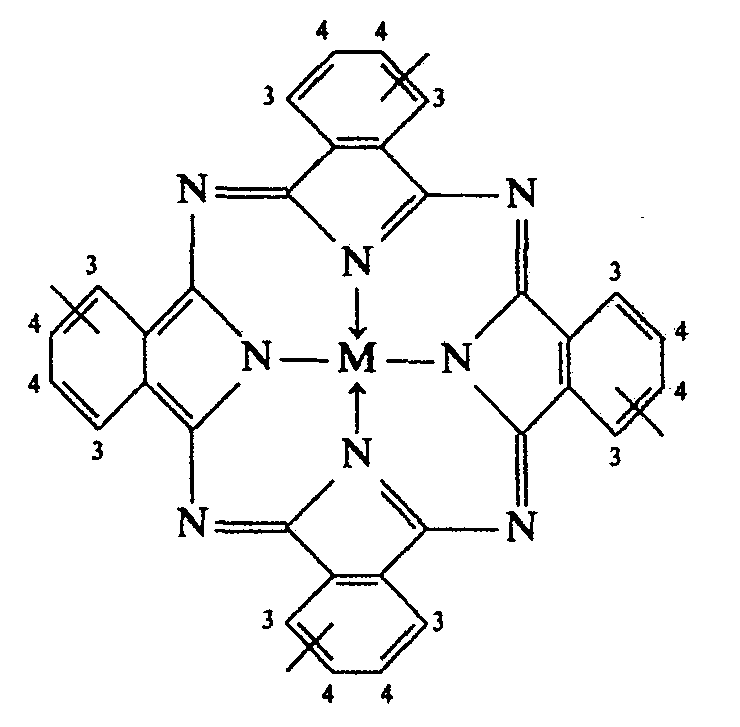
- phthalocyanine dyes which in the context of the invention is understood to mean derivatives of non-metallized phthalocyanine and also of nickel phthalocyanine and in particular of copper phthalocyanine, is particularly interesting for the process of published European patent application 0 004 399, because phthalocyanine dyes have a clarity and unequaled with other cyan dye types Brilliance of the shade, as well as increased light fastness, which is comparable to that of the azomethine and monoazo dyes used for the shades of yellow and purple.
- the invention has for its object to provide blue-green dyes releasing color releasers which overall have a property profile which makes them suitable for use in color photographic recording materials for the color diffusion transfer process according to the published European patent application 0 004 399, so that they are successful in combination with the Color separators with monoazo or azomethine dye groups described there, used for producing the yellow and purple hues, can be used in recording materials for the production of multicolored images.
- the alkyl and alkoxy radicals represented by R I , R 2 and R 3 can be straight-chain or branched and generally contain up to 18 carbon atoms. Examples are methyl, n-propyl, tert-butyl, tetradecyl, octadecyl, methoxy, dodecoxy, tetradecoxy.
- the aryl radicals represented by the said radicals R I , R 2 and R 3 are, for example, phenyl groups which may be substituted, for. B. by long chain alkoxy groups.
- the acyl groups are derived from aliphatic or aromatic carboxylic or sulfonic acids.
- the condensed rings completed by R 2 and R 3 are preferably carbocyclic rings, e.g. B. fused benzene or bicyclo [2,2,1] heptene rings.
- An alkyl radical represented by R 4 can be straight-chain or branched, substituted or unsubstituted and contain up to 21 C atoms. Examples are methyl, nitromethyl, phenylmethyl (benzyl), heptyl, tridecyl; Pentadecyl, heptadecyl, -C 21 H 43 .
- Examples of the alkyl, alkoxy and acylamino groups represented by R 5 are methyl, methoxy, acetamido and methylsulfonamido.
- R 6 and R 7 are methyl, ethyl, hydroxyethyl, allyl, sulfamoylphenyl.
- rings completed by R 6 and R 7 are pyrrolidine, piperidine and morpholine rings.
- the index p can also assume a non-integer value for specific preparations (batches) of the color releasers according to the invention in the range from 0 to 2; these are average values of mixtures in which components p is an integer (0.1 or 2).
- Preferred embodiments of the color releasers according to the invention are those in which R 1 , R 2 and R 3 together in a quinoid carrier radical together do not exceed 8, in particular not exceed 5 Contain carbon atoms, and R 4 represents an alkyl radical with at least 11 carbon atoms.
- Preferred execution forums are also those in which R 'is an alkoxyphenyl radical with at least 12 C atoms in the alkoxy group and R 2 , R 3 , R 4 together contain no more than 8 C atoms.
- the diffusion-proofing residue may also contain water-solubilizing groups, such as. B. sulfo groups or carboxyl groups, which may also be in anionic form. Since the diffusion properties depend on the molecular size of the total compound used, it is sufficient in certain cases, e.g. B. if the total molecule used is large enough to use short-chain residues as "diffusion-proofing residues".
- the color releasing agents according to the invention contain two diffusible quinoid carrier residues of the formula which make diffusion-resistant
- detachable carrier residues are linked by a formula linked to the phthalocyanine residue MPc, two of the usually four free bonds present being saturated.
- the groups of the formula are located here instead of the groups -Link-Carquin
- coloring compounds according to the invention color releasers
- CuPc copper phthalocyanine
- the phthalocyanine tetrasulfochloride MPc (S0 2 CI) 4 used as the starting compound in the production of the dye releasing agent according to the invention offers the possibility of linking up to 4 quinoid carrier residues.
- color releasers of the type according to the invention in the presence of exactly 2 quinoid carrier residues per phthalocyanine unit, have particularly advantageous properties for use in color photographic recording materials.
- the reason for the favorable overall behavior of the paint releasing agents according to the invention, which differs significantly from that of similarly composed non-diffusing coloring compounds with a different number of quinoid carrier residues, is not known in detail. However, an attempt to interpret it will be made below.
- the image formation rate is not affected because the diffusion properties of the cleaved dye remain almost unchanged.
- a sufficient density of the color transfer image can then only be ensured by a disproportionate increase in the amount of ED compound, which, however, results in a loss of sensitivity.
- increased silver applications are again required. If, on the other hand, the phthalocyanine residue is only provided with a single quinoid carrier residue, then the amount of ED compound and thus the amount of silver applied can be kept low.
- a method which is known in principle is used to produce the dye releasing agents according to the invention, namely a phthalocyanine tetrasulfochloride MP C - (S0 2 C1) 4 initially with a quinoid carrier residue of the formula (11) modified by a primary amino group in the predetermined molar ratio, preferably in the ratio 1: 2, and optionally with a primary or secondary amine of the formula (III) is implemented in a quantity determined by the number index p, whereupon the remaining sulfochloride groups are saponified with water.
- the reactions with the quinoid carrier residue (11) modified by the primary amino group and with the primary or secondary amine (111) can optionally be carried out simultaneously or in succession, in the latter case the product being isolated from the reaction with the amino group-modified quinoid carrier residue can.
- Suitable as reaction medium are, for example, slightly or moderately polar solvents such as dichloromethane, chlorobenzene, tetrahydrofuran, pyridine or so-called dipolar aprotic solvents such as dimethylformamide, dimethylacetamide, N-methylpyrrolidone.
- Pyridine for example, is an excellent auxiliary base.
- the reaction temperatures and reaction times can be varied within wide limits depending on the nucleophilicity of the amines to be used, on the solvent effects of the solvents and on the effectiveness of the auxiliary base.
- substituents on the phthalocyanine are wholly or predominantly in the 3- or 4-position can be controlled via the synthetic routes; this is known from the literature.
- color releasers are preferred, in which the attachment takes place predominantly via the 3-positions of the benzene rings of the phthalocyanine system.
- the starting compounds for this are obtained by chlorosulfonylation of MPc with chlorosulfonic acid, optionally in combination with thionyl chloride. This is also known from the literature.
- the amine-modified quinoid support residues of the formula (11) which are suitable as reactants are obtained by reacting the corresponding aminobenzenesulfinic acids with carbinol-modified hydroquinones of the formula (IV).
- the phthalocyanine color releasers according to the invention which are accessible by the production process described are not strictly uniform. However, they are mixtures with surprisingly high uniformity, particularly as regards the number of quinoid carrier residues per phthalocyanine unit. Mixtures of isomers exist essentially; to the already discus Possible isomerism is remembered. The proportions of color releasers with a higher lipophilic content (3 or more quinoid support residues) and those with a higher sulfonate group content (a quinoid support residue) are unexpectedly low.
- the proportions of the non-hydrophobizing sulfamoyl groups recorded with the index p are statistical variables, the significance of which is essentially in the solubility of the color releasers in hydrophobic solvents of medium dielectric constant, e.g. B. in esters, ketones, chlorinated hydrocarbons, is expressed.
- the preparation (2 g 54% of theory) had the gross composition expected for compound 1.
- the product proves to be an almost uniform substance (mixture of isomers) by thin layer chromatography.
- the analogue compound with only one quinoid carrier residue is completely absent and the analogue compound with 3 or more quinoid carrier residues does not contribute more than 5% to the product.
- Compound 1 is readily soluble in dichloromethane, but not in ethyl acetate.
- the amino group-modified quinoid carrier residue required for the preparation of compound 2 2,3-dimethyl-5-prgpyl-6- ⁇ - (2-methyl-5-aminobenzenesulfonyl) tetradecylbenzoquinone-1,4 was obtained in an analogous manner to that described under 1a) specified specified manufactured.
- 2 (0.004 mol) of this compound and 1.3 ml (0.016 mol) of pyridine were added to a solution of 2 g (0.002 mol) of well-dried copper phthalocyanine tetrasulfochloride in 60 ml of dichloromethane. The mixture was stirred at room temperature with the exclusion of water for about 4 hours.
- the paint releasing agents according to the invention are reducible, non-diffusing coloring compounds which release a diffusible phthalocyanine dye in reduced form under the alkaline development conditions.
- Compounds of this type as described in published European patent application 0004399, are used together with ED compounds, which in turn are reducing agents and are used imagewise by oxidation in development by reaction with exposed silver halide or with imaging oxidation products of auxiliary developer compounds.
- ED compounds which in turn are reducing agents and are used imagewise by oxidation in development by reaction with exposed silver halide or with imaging oxidation products of auxiliary developer compounds.
- the dye releaser is reduced in image and caused to release the diffusible dye.
- a combination of color releaser and ED compound is assigned to a light-sensitive silver halide emulsion layer and, on the other hand, care is taken by suitable measures, preferably by separating layers arranged between the light-sensitive layers, that such assignments remain spatially and functionally separate from one another .
- the assignment between the color releaser and the photosensitive silver halide emulsion layer is usually of such a type that the image color of the image dye released from the color releaser is complementary to the spectral color for which the assigned silver halide emulsion layer has maximum sensitivity.
- the paint releasing agent of the present invention is used, for example, in amounts of 0.05-0.2 mol and the ED compound in amounts of 0.1-0.6 mol per mol of silver halide.
- the molar related to the color releasing agent is natural Amount of ED compound higher than usual, since the dye releasers according to the invention have two quinoid carrier residues which can be split off.
- the development of the imagewise exposed color photographic recording material according to the invention is initiated by treatment with an aqueous alkaline, optionally highly viscous developer solution.
- the auxiliary developer compounds required for development are either contained in the developer solution or can also be contained in whole or in part in one or more layers of the color photographic recording material according to the invention.
- dyes which are diffusible in terms of image are released from the dye releasers and transferred to an image-receiving layer which is either an integral part of the color photographic recording material according to the invention or is in contact with it at least during the development period.
- the image-receiving layer can accordingly be arranged on the same support as the light-sensitive element or on a separate support.
- It essentially consists of a binder which contains mordants for the determination of the diffusing dyes released from the non-diffusing paint releasing agents.
- mordants for the determination of the diffusing dyes released from the non-diffusing paint releasing agents.
- certain metal salts and their hydroxides which form poorly soluble compounds with the acid dyes, can also be used.
- Polymeric mordants should also be mentioned here, such as those described in DE-A-2 315 304, DE-A-2 631 521 or in DE-A-2 941 818.
- the dye mordants are dispersed in the mordant layer in one of the usual hydrophilic binders, e.g. B. in gelatin, polyvinyl pyrrolidone, completely or partially hydrolyzed cellulose esters.
- binders can also act as mordants, e.g. B. copolymers or polymer mixtures of vinyl alcohol and N-vinylpyrrolidone, as described for example in DE-B-1 130 284, furthermore those which are polymers of nitrogen-containing quaternary bases, for.
- binders which can be used are, for example, guanylhydrazone derivatives of alkylvinyl ketone polymers, as described, for example, in US Pat. No. 2,882,156, or guanylhydrazone derivatives of Acyl styrene polymers, as described, for example, in DE-A-2009498.
- other binders e.g. B. add gelatin.
- the phthalocyanine dyes released have 2 sulfinate groups and, if appropriate, further anionic groups in the form of sulfonate groups in a number determined by the index number p. These dyes are presumably bound to the cationic groups of the mordant in the image-receiving layer via the anionic groups present.
- the image-receiving layer remains in layer contact with the photosensitive element even after development is complete, there is usually an alkali-permeable, pigment-containing, light-reflecting binder layer between them, which serves for the optical separation between negative and positive and as an optically appealing background for the transferred color image.
- an alkali-permeable, pigment-containing, light-reflecting binder layer between them, which serves for the optical separation between negative and positive and as an optically appealing background for the transferred color image.
- Such a light-reflecting layer can already be pre-formed in a known manner in the light-sensitive color photographic recording material or can only be produced in a likewise known manner during development.
- the image-receiving layer is arranged between the support and the photosensitive element and is separated from the latter by a pre-formed light-reflecting layer, either the support must be transparent so that the color transfer image produced can be viewed through it, or the photosensitive element together with the light-reflecting layer of the image-receiving layer are removed to expose the latter.
- the image-receiving layer can, however, also be present as the top layer in an integral color photographic recording material, in which case the exposure is expediently carried out through the transparent layer support.
- the imagewise exposed photosensitive element and the image-receiving sheet were impregnated with a treatment solution of the composition given below and pressed together on the layer side:
- the sheets were separated and the image-receiving sheet was soaked for 30 seconds. After drying, the Dmin / Dmax values of the positive blue-green image were measured.
- Example 2 The procedure was as in Example 1, but instead of the photosensitive element described there, those were used which, as color releasers, contained 0.6 g of one of the compounds 1, 3, 5, 7 and 14 and the ED compound B in an amount of Contained 0.48 g. 1.08 g of palmitic acid diethylamide were used as oil formers for the ED compound and the color releasing agent.
- Example 2 The procedure was as described in Example 1, but using a phthalocyanine preparation (preparation D) not according to the invention which contained an average of 3.5 quinoid carrier residues and 0.5 sulfo groups per phthalocyanine unit, the quinoid carrier residues being identical to those of the Compounds 2 to 22. 0.85 g of preparation D and 0.65 g of ED compound B were emulsified with 1.49 g of palmitic acid diethylamide.
- the Dmin and Dmax values obtained with the photosensitive elements of Examples 1 to 7, the sensitivity and the light fastness are shown in the following table.
- the sensitivity E is given in relative log I - t units (measured at density 0.6; 30 units correspond to one aperture).
- the deviation from the average sensitivity of Examples 2 to 6 is given in relative log I - t units as » ⁇ E «:
- the color images obtained according to Examples 1 to 7 were irradiated for 48 hours in a Xenotest device (4.8-10 6 lux. H); the percentage decrease in density is given in the last column of the table.
- the phthalocyanine color releasers according to the invention are equivalent in terms of the Dmin and Dmax values obtained to the known color releasers which contain a 4- (4-nitrophenylazo) naphthol residue as the dye residue.
- the sensitivity distance of Examples 2 to 6 to Example 1 can be explained by the hypsochromically shifted absorption of the 4- (4-nitrophenylazo) naphthol chromophore; In contrast to phthalocyanine dyes, this is a so-called "shifted dye”.
- the sensitivity can also be improved by embedding the paint releasing agent according to the invention in a binder layer adjacent to the light-sensitive layer. With regard to light fastness, the color releasing agent according to the invention is clearly superior to the known one, as is the brilliance of the released image dye.
- the color releasing agents according to the invention provide fog-free color densities which are comparable to those of the known azo dye releasing agents, without the silver application having to be increased in accordance with the higher ED compound content due to the double number of quinoid carrier residues per dye molecule.
- example 7 which is not according to the invention, a serious loss of sensitivity is observed, which could only be compensated for by increasing the silver coating.
Landscapes
- Physics & Mathematics (AREA)
- General Physics & Mathematics (AREA)
- Chemical & Material Sciences (AREA)
- Organic Chemistry (AREA)
- Thermal Transfer Or Thermal Recording In General (AREA)
Claims (10)

MPc représente un radical tétravalent de phtalocyanine de formule:

au moins un des radicaux RI, R2, R3 et R4 contenant un radical conférant une résistance à la diffusion.

MPc représente un radical tétravalent de phtalocyanine de formule:
au moins un des radicaux R1, R2, R3 et R4 contenant un radical conférant une résistance à la diffusion.

MPc représente un radical tétravalent de phtalocyanine de formule:

Applications Claiming Priority (2)
| Application Number | Priority Date | Filing Date | Title |
|---|---|---|---|
| DE19813101036 DE3101036A1 (de) | 1981-01-15 | 1981-01-15 | Neue phthalocyaninverbindungen, ein farbfotografisches aufzeichnungsmaterial, das die neuen phthalocyaninverbindungen enthaelt sowie ein farbfotografisches bild, das aus den phthalocyaninverbindungen freigesetzte phthalocyaninfarbstoffe als bildfarbstoffe enthaelt |
| DE3101036 | 1981-01-15 |
Publications (2)
| Publication Number | Publication Date |
|---|---|
| EP0056940A1 EP0056940A1 (fr) | 1982-08-04 |
| EP0056940B1 true EP0056940B1 (fr) | 1984-07-18 |
Family
ID=6122646
Family Applications (1)
| Application Number | Title | Priority Date | Filing Date |
|---|---|---|---|
| EP82100122A Expired EP0056940B1 (fr) | 1981-01-15 | 1982-01-11 | Dérivés de phtacyanine, matériau de reproduction pour la photographie en couleurs qui contient ces dérivés ainsi qu'une image photographique en couleurs qui contient le colorant de phtalocyanine libéré par le dérivé de phtalocyanine comme colorant d'image |
Country Status (4)
| Country | Link |
|---|---|
| EP (1) | EP0056940B1 (fr) |
| JP (1) | JPS57138635A (fr) |
| CA (1) | CA1194859A (fr) |
| DE (2) | DE3101036A1 (fr) |
Families Citing this family (1)
| Publication number | Priority date | Publication date | Assignee | Title |
|---|---|---|---|---|
| KR100431717B1 (ko) * | 2001-06-21 | 2004-05-17 | 제일모직주식회사 | 프탈로시아닌계 혼정조성물 및 이를 사용한 전자사진용감광체 |
Family Cites Families (2)
| Publication number | Priority date | Publication date | Assignee | Title |
|---|---|---|---|---|
| JPS528827A (en) * | 1975-07-10 | 1977-01-24 | Fuji Photo Film Co Ltd | Photosensitive element for diffusion transfer |
| DE2962762D1 (en) * | 1978-03-22 | 1982-07-01 | Agfa Gevaert Nv | Photographic material suited for use in diffusion transfer photography and method of diffusion transfer photography using such material |
-
1981
- 1981-01-15 DE DE19813101036 patent/DE3101036A1/de not_active Withdrawn
-
1982
- 1982-01-11 EP EP82100122A patent/EP0056940B1/fr not_active Expired
- 1982-01-11 DE DE8282100122T patent/DE3260377D1/de not_active Expired
- 1982-01-13 CA CA000394035A patent/CA1194859A/fr not_active Expired
- 1982-01-14 JP JP57003540A patent/JPS57138635A/ja active Pending
Also Published As
| Publication number | Publication date |
|---|---|
| JPS57138635A (en) | 1982-08-27 |
| DE3101036A1 (de) | 1982-08-05 |
| DE3260377D1 (en) | 1984-08-23 |
| EP0056940A1 (fr) | 1982-08-04 |
| CA1194859A (fr) | 1985-10-08 |
Similar Documents
| Publication | Publication Date | Title |
|---|---|---|
| DE3115648A1 (de) | Farbfotografisches aufzeichnungsmaterial | |
| EP0131733B1 (fr) | Colorants monoazoiques chélatables ou chélatés par des ions métalliques; leur utilisation dans la production d'images photographiques; un matériau d'enregistrement photographique en couleurs avec des séparateurs de colorants qui libèrent les colorants mobiles; et une image en couleurs ayant une répartition d'image de complexes de nickel des colorants | |
| EP0132577B1 (fr) | Matériau d'enregistrement photographique en couleurs avec un élément libérant des colorants bleu-verts, une image en couleurs obtenue avec ces colorants et les colorants eux-mêmes | |
| DE69328335T2 (de) | Verfahren zur Herstellung eines photographischen Farbbildes | |
| EP0034749A2 (fr) | Matériau d'enregistrement pour la photographie en couleurs avec des composés précurseurs donneurs d'électrons non diffusants | |
| DE2626821B2 (de) | Farbbildner für Aufzeichnungsmaterialien nach dem Diffusionsübertragungsverfahren | |
| DE2645656C2 (de) | Photographisches Farbdiffusionsübertragungsverfahren | |
| EP0222271A2 (fr) | Procédé de thermodéveloppement et matériau d'enregistrement photographique couleur à cet effet | |
| DE2947425A1 (de) | Farbphotograpfisches aufzeichnungsmaterial mit nicht diffundierenden elektronendonor-verbindungen | |
| DE2729820A1 (de) | Photographisches farbdiffusionsuebertragungsmaterial | |
| DE2934767C2 (de) | Photographisches Aufzeichnungsmaterial | |
| EP0250954B1 (fr) | Matériau de reproduction photographique couleur avec un composé libérant des colorants bleu-vert et images couleur produites avec ces colorants | |
| EP0059354B1 (fr) | Matériau d'enregistrement photographique en couleurs | |
| EP0150319B1 (fr) | Matériau d'enregistrement photographique en couleurs comprenant un libérateur de colorants bleu-verts, image en couleur obtenue an moyen de ces colorants ainsi que les colorants en soi | |
| DE3200705A1 (de) | Farbfotografisches aufzeichnungsmaterial | |
| EP0012908A2 (fr) | Procédé photographique par diffusion-transfert de colorants et matériau d'enregistrement photographique utilisé dans ce procédé | |
| EP0141920B1 (fr) | Matériau d'enregistrement photographique en couleurs comprenant des libérateurs de colorants libérant des colorants 6-arylazo-2-amino-3 pyridinol formant des chélates avec des ions métalliques ainsi qu'une image en couleurs comprenant une distribution selon une image de complexes de nickel de ces colorants | |
| EP0056940A1 (fr) | Dérivés de phtacyanine, matériau de reproduction pour la photographie en couleurs qui contient ces dérivés ainsi qu'une image photographique en couleurs qui contient le colorant de phtalocyanine libéré par le dérivé de phtalocyanine comme colorant d'image | |
| EP0003581A2 (fr) | Procédé photographique par transfert avec diffusion de colorant | |
| DE3312500A1 (de) | Chelatisierbare azofarbstoffe, deren verwendung zur bilderzeugung und ein farbfotografisches aufzeichnungsmaterial mit farbabspaltern, die die chelatisierbaren farbstoffe freisetzten | |
| EP0035685A2 (fr) | Matériaux photographiques d'enregistrement pour des procédés de diffusion et composés de sulfilimine non-diffusants appropriés pour ces procédés | |
| DE2027279C3 (de) | Gelbe Azomethin-Chromkomplex-Entwicklerfarbstoffe und ihre Verwendung | |
| EP0215356B1 (fr) | Procédé de thermo-développement et feuille réceptrice d'images à cet effet | |
| DE3337118A1 (de) | Farbfotografisches aufzeichnungsmaterial mit farbabspaltern, die mit metallionen chelatisierbare 6-arylazo-2-amino-3-pyridinolfarbstoffe freisetzen, und ein farbbild mit einer bildmaessigen verteilung von nickelkomplexen der farbstoffe | |
| EP0078959B1 (fr) | Matériau d'enregistrement pour la photographie en couleurs avec des composés précurseurs donneurs d'électrons non diffuseurs |
Legal Events
| Date | Code | Title | Description |
|---|---|---|---|
| PUAI | Public reference made under article 153(3) epc to a published international application that has entered the european phase |
Free format text: ORIGINAL CODE: 0009012 |
|
| 17P | Request for examination filed |
Effective date: 19820111 |
|
| AK | Designated contracting states |
Designated state(s): BE DE FR GB |
|
| GRAA | (expected) grant |
Free format text: ORIGINAL CODE: 0009210 |
|
| AK | Designated contracting states |
Designated state(s): BE DE FR GB |
|
| REF | Corresponds to: |
Ref document number: 3260377 Country of ref document: DE Date of ref document: 19840823 |
|
| ET | Fr: translation filed | ||
| PGFP | Annual fee paid to national office [announced via postgrant information from national office to epo] |
Ref country code: DE Payment date: 19841217 Year of fee payment: 4 |
|
| PGFP | Annual fee paid to national office [announced via postgrant information from national office to epo] |
Ref country code: BE Payment date: 19841231 Year of fee payment: 4 |
|
| PLBE | No opposition filed within time limit |
Free format text: ORIGINAL CODE: 0009261 |
|
| STAA | Information on the status of an ep patent application or granted ep patent |
Free format text: STATUS: NO OPPOSITION FILED WITHIN TIME LIMIT |
|
| 26N | No opposition filed | ||
| BERE | Be: lapsed |
Owner name: AGFA-GEVAERT A.G. Effective date: 19880131 |
|
| GBPC | Gb: european patent ceased through non-payment of renewal fee | ||
| PG25 | Lapsed in a contracting state [announced via postgrant information from national office to epo] |
Ref country code: FR Free format text: LAPSE BECAUSE OF NON-PAYMENT OF DUE FEES Effective date: 19880930 |
|
| PG25 | Lapsed in a contracting state [announced via postgrant information from national office to epo] |
Ref country code: DE Effective date: 19881001 |
|
| PG25 | Lapsed in a contracting state [announced via postgrant information from national office to epo] |
Ref country code: GB Free format text: LAPSE BECAUSE OF NON-PAYMENT OF DUE FEES Effective date: 19881121 |
|
| REG | Reference to a national code |
Ref country code: FR Ref legal event code: ST |
|
| PG25 | Lapsed in a contracting state [announced via postgrant information from national office to epo] |
Ref country code: BE Effective date: 19890131 |