EP0057090A1 - Procédé pour la préparation de monoxyde de carbone - Google Patents
Procédé pour la préparation de monoxyde de carbone Download PDFInfo
- Publication number
- EP0057090A1 EP0057090A1 EP82300314A EP82300314A EP0057090A1 EP 0057090 A1 EP0057090 A1 EP 0057090A1 EP 82300314 A EP82300314 A EP 82300314A EP 82300314 A EP82300314 A EP 82300314A EP 0057090 A1 EP0057090 A1 EP 0057090A1
- Authority
- EP
- European Patent Office
- Prior art keywords
- methyl formate
- alkali metal
- carbon monoxide
- methanol
- process according
- Prior art date
- Legal status (The legal status is an assumption and is not a legal conclusion. Google has not performed a legal analysis and makes no representation as to the accuracy of the status listed.)
- Granted
Links
Images
Classifications
-
- C—CHEMISTRY; METALLURGY
- C01—INORGANIC CHEMISTRY
- C01B—NON-METALLIC ELEMENTS; COMPOUNDS THEREOF; METALLOIDS OR COMPOUNDS THEREOF NOT COVERED BY SUBCLASS C01C
- C01B32/00—Carbon; Compounds thereof
- C01B32/40—Carbon monoxide
Definitions
- This invention relates to a process for the production of carbon monoxide of high purity by pyrolysis of methyl formate.
- High purity carbon monoxide is an important material as a principal raw material for C1 chemistry or a raw material for carbonylation.
- carbon monoxide is separated from a mixture comprising carbon monoxide, hydrogen, methane, carbon dioxide and the like, and the carbon monoxide thus separated is compressed to a required pressure, the compressed carbon monoxide then being used for various applications.
- carbon monoxide When the carbon monoxide is prepared by using a process in which methyl formate is pyrolytically decomposed by the use of an alkali metal compound as the catalyst, carbon monoxide of high purity and at high pressure can be obtained without such separation and compression of gas. Such a process is therefore very desirable from an industrial view point.
- Methyl formate is usually produced by reacting methanol with carbon monoxide (CH 3 0H + CO ⁇ HCOOCH 3 ), by esterify- in g formic acid with methanol (HCOOH + CH 3 OH ⁇ HCOOCH 3 + H 2 0), or by dehydrogenating methanol (2CH 3 OH ⁇ HCOOCH 3 + 2H 2 ).
- the reaction products obtained by these processes ordinarily contain a large amount of unreacted methanol and a minor amount of other by-products.
- the present invention provides a process for the production of carbon monoxide in which a mixture comprising methyl formate and methanol is heated in the presence of an alkali metal catalyst other than an alkali metal alcoholate, whereby the methyl formate in the aforesaid mixture of methyl formate and methanol is pyrolytically decomposed to produce carbon monoxide, characterised in that the concentration of methyl formate in the said mixture is higher than 70 wt.%.
- methyl formate is produced.
- suitable ways of producing methyl formate are i) by reacting methanol with carbon monoxide, ii) by esterifying formic acid with methanol and iii) by dehydrogenating methanol.
- Process iii) is preferred because the quantity of heat required for separating the methyl formate or methanol from the resultant reaction product can be obtained from the heat produced in the synthesis of methyl formate.
- a continuous process combined with a reaction iii for synthesising methyl formate is advantageous because both hydrogen of high purity and carbon monoxide of high purity can be obtained as separate ingredients, and the ingredients under high pressure, if desired, can be obtained from methanol alone as the raw material.
- methyl formate When the methyl formate is contaminated with a large amount of methanol, methanol is removed from the mixture by means of, for example, distillation to concentrate the methyl formate in the solution until it is higher than 70 wt %.
- concentration of methyl formate in the product of the methyl formate-synthesis is higher than 70 wt % at the outset, such product may be utilised without no treatment, as a matter of course.
- the methyl formate solution contains a large amount of methanol, and a solution having a concentration of 70 wt. % or less of methyl formate is employed, the life of the catalyst decreases and the amount of carbon monoxide produced also decreases.
- concentration of methyl formate in the methyl formate solution which, is higher than 70 up to 95 wt. /.
- the catalyst employed in the present invention may be an alkali metal compound other than an alkali metal alcoholate and. which has no or little reactivity with methanol or methyl formate.
- alkali metal compounds such as potassium, sodium, lithium and cesium, as well as organic acid salts of these alkali metals such as alkali metal formates and acetates.
- these compounds the most preferable are carbonates.
- the typical compounds include potassium hydroxide, potassium chloride, potassium formate, sodium sulfide, sodium sulfate, potassium carbonate, sodium carbonate, and lithium chloride. It is to be recognised that any of the foregoing alkali metal compounds can either be used separately or as mixtures.
- Alkali metal alcoholates react with methyl formate at a reaction temperature of 35 - 200°C and are easily converted into other compounds, so that the quantity of carbon monoxide produced from methyl formate decreases in such cases, and the carbon monoxide is contaminated with dimethyl ether produced at that time. Therefore, alkali metal alcoholates cannot be utilised as catalysts in the process of the present invention.
- the reaction may be carried out batch-wise or in continuous manner.
- the catalyst is used in such a form that the alkali metal compound itself is dissolved homogeneously in the starting mixture, or slurried therewith when the compound is slightly soluble in the starting mixture, and the resultant mixture is charged into a suitable reaction chamber.
- the starting mixture is continuously fed to a reactor as is the catalyst and the reaction product is continuously withdrawn therefrom.
- a continuous fixed bed method may be used in which the alkali metal compound catalyst itself or a catalyst prepared by supporting the alkali metal compound on a neutral or basic carrier such as silica gel, diatomaceous earth, pumice, brick or activated carbon is previously charged into a reactor, and the starting mixture only is continuously supplied to the reactor while drawing out the reaction product continuously therefrom.
- a neutral or basic carrier such as silica gel, diatomaceous earth, pumice, brick or activated carbon
- the amount of catalyst employed in the present invention varies in accordance with which catalyst is used. For instance, in the continuous fixed bed method, no particular limitation exists on the amount of the catalyst. However, in those cases where the catalyst is mixed with the starting mixture or where the catalyst is not mixed with the starting mixture, but is added to a reactor independently and the reaction is carried out in a batch-wise or continuous manner, the amount of the catalyst is preferably 0.1 - 400 milliatoms, more preferably 0.4 -100,milliatoms of alkali metal per mol of methyl formate. If the amount of the catalyst is less than 0.1 milliatom of alkali metal per mol of methyl formate, the rate of reaction will be too slow. On the other hand, if the amount exceeds 400 milliatoms, there is a danger of side decomposition reactions of methanol or methyl formate.
- the amount of alkali metal compound supported on the aforesaid carriers in a solid catalyst is 0.05 - 3 milliatoms, preferably 0.1 - 1.5 milliatoms, alkali metal per gram of the carrier.
- reaction temperature is usually from 200 to 500°C, preferably from 250 to 450°C.
- the velocity of decomposition of methyl formate is insufficient at a reaction temperature lower than 200°C, while the amount of methyl formate consumed by side reactions increases at a reaction temperature of more than 500°C, and also decomposition of methanol takes place giving a decrease in the yield of carbon monoxide, which becomes contaminated with the resultant by-products.
- reaction time is from 500 to 50,000 (normal state) hr -1 in terms of the gas space velocity per hour (hereinafter referred to simply as "GSVH") or from 1.3 to 130 hr -1 in terms of the liquid space velocity per hour (hereinafter referred to simply as "LSVH").
- GSVH gas space velocity per hour
- LSVH liquid space velocity per hour
- reaction pressure there is also no particular limitation in the reaction pressure, but the reaction is generally carried out at a pressure ranging from normal pressure to 350 kg/cm 2 G.
- carbon monoxide of high purity can easily and effectively be obtained under high pressure, if required, and the activity of the catalyst used to generate carbon monoxide from methyl formate can be maintained for a long period of time.
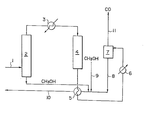
- Methyl formate is synthesised from methanol and the resultant reaction product is introduced through supply line 1 into a distillation column 2.
- the solution is distilled in distillation column 2, and as a consequence, methanol is discharged from the bottom of the column 2, while a methyl formate reaction product' solution comprising methyl formate in a concentration higher than 70 wt % and methanol is taken out from the top of the column 2.
- the methyl formate solution thus taken out is passed through a heat exchanger 3, the solution is then passed to a decomposition reactor 4 containing a packed solid catalyst in accordance with the invention, and the methyl formate is decomposed in the reactor 4.
- the resultant decomposed reaction product is cooled by means of a heat exchanger 5 and cooler 6, and the cooled decomposed reaction product is separated into carbon monoxide vapor and liquid methanol in a vapor-liquid separator 7.
- the resulting methanol is supplied through a line 8 together with fresh methanol delivered through a line 9 as well as the methanol discharged from the bottom of the distillation column 2 to a reactor for synthesising methyl formate (not shown) through the heat exchanger 5 and a line 10.
- the carbon monoxide obtained in the vapor-liquid separator 7 is recovered throuh a line 11.
- Methyl formate is prepared from methanol to give a methyl formate product containing 28 wt % of methyl formate. Referring to the drawing, this product was supplied to a distillation column 2 in which the number. of theoretical plates was 15, and distillation was effected at a reflux ratio of 3. As a result, a methyl formate solution consisting of 85 wt % of methyl formate and 15 wt % of methanol was obtained from the top of column 2.
- the methyl formate solution was fed to decomposition reactor 4 under conditions involving a reaction pressure of 9.5 kg/cm 2 G, a GSVH of 2000 hr -1 on the basis of methyl formate, and a reaction temperature of 290°C, and the methyl formate was decomposed.
- a catalyst 10 wt % of potassium hydroxide supported on activated carbon was employed. The flow for treating the decomposed reaction product is as illustrated in the accompanying drawing.
- the rate of production of carbon monoxide at the beginning of the process and after 100 days from the start of the process was from 98 to 99%, and the purity of carbon monoxide obtained each time was from 97 to 98%, so that there was substantially no decrease in efficiency with time.
- Methyl formate was produced from methanol to give a product containing methyl formate and methanol in which the concentration of methyl formate is 30 wt %. This product was supplied to the reactor at a rate of GSVH of 2000hr -1 on the basis of methyl formate, and pyrolytical decomposition was effected as in Example 1. The conversion of methyl formate was 99% at the time of starting the reaction, this decreased to 90% after 15 days from the time of starting the reaction and to 80% after an additional 30 days. Thus, it became necessary to further raise the reaction temperature in order to increase the rate of conversion to carbon monoxide.
- Methyl formate was prepared from methanol to give a reaction product containing 28 wt. % methyl formate. This product was supplied to a distillation column 2 in which the number of theoretical plates was 15, . and distillation was effected at a reflux ratio of 4. As a result, a methyl formate solution consisting of 90 wt.% of methyl formate and 10 wt.% of methanol was obtained at the top of column 2.
- the methyl formate solution was treated under conditions involving a reaction pressure of 100 kg/cm 2 G, a GSVH of 1800 hr -1 on the basis of methyl formate, and a reaction temperature of 295°C so as to pyrolytically decompose methyl formate.
- a reaction pressure 100 kg/cm 2 G
- a GSVH 1800 hr -1
- a reaction temperature 295°C
- 10 wt.% of potassium carbonate supported on brick was employed.
- the resulting reaction product was subjected to vapor-liquid separation to obtain 17 litres (normal condition) of carbon monoxide (98% purity) per hour under a pressure of 100 kg/cm 2 G. This carbon monoxide corresponds to 96% of the total theoretical yield of carbon monoxide.
Landscapes
- Chemical & Material Sciences (AREA)
- Organic Chemistry (AREA)
- Inorganic Chemistry (AREA)
- Catalysts (AREA)
- Organic Low-Molecular-Weight Compounds And Preparation Thereof (AREA)
- Carbon And Carbon Compounds (AREA)
Applications Claiming Priority (2)
| Application Number | Priority Date | Filing Date | Title |
|---|---|---|---|
| JP8347/81 | 1981-01-22 | ||
| JP56008347A JPS5911525B2 (ja) | 1981-01-22 | 1981-01-22 | 一酸化炭素の製造方法 |
Publications (2)
| Publication Number | Publication Date |
|---|---|
| EP0057090A1 true EP0057090A1 (fr) | 1982-08-04 |
| EP0057090B1 EP0057090B1 (fr) | 1984-08-01 |
Family
ID=11690680
Family Applications (1)
| Application Number | Title | Priority Date | Filing Date |
|---|---|---|---|
| EP82300314A Expired EP0057090B1 (fr) | 1981-01-22 | 1982-01-21 | Procédé pour la préparation de monoxyde de carbone |
Country Status (4)
| Country | Link |
|---|---|
| EP (1) | EP0057090B1 (fr) |
| JP (1) | JPS5911525B2 (fr) |
| CA (1) | CA1176821A (fr) |
| DE (1) | DE3260473D1 (fr) |
Cited By (2)
| Publication number | Priority date | Publication date | Assignee | Title |
|---|---|---|---|---|
| EP0853075A1 (fr) * | 1997-01-08 | 1998-07-15 | Mitsubishi Gas Chemical Company, Inc. | Méthode de récupération et d'utilisation de chaleur par utilisation de l'énergie chimique de la synthèse et de la décompostion du formiate de méthyle |
| CN114315511A (zh) * | 2020-09-27 | 2022-04-12 | 上海浦景化工技术股份有限公司 | 一种甲酸甲酯脱羰制高纯度甲醇和co的方法 |
Families Citing this family (1)
| Publication number | Priority date | Publication date | Assignee | Title |
|---|---|---|---|---|
| JP2009079051A (ja) * | 2008-10-02 | 2009-04-16 | Mitsubishi Gas Chem Co Inc | アルキルフェノールの製造法 |
Citations (4)
| Publication number | Priority date | Publication date | Assignee | Title |
|---|---|---|---|---|
| US3716619A (en) * | 1971-03-19 | 1973-02-13 | Bethlehem Steel Corp | Process for recovering carbon monoxide from fuel gas |
| US3812210A (en) * | 1971-08-13 | 1974-05-21 | Celanese Corp | Vapor phase decomposition of methyl formate to yield methanol |
| JPS5632315A (en) * | 1979-08-17 | 1981-04-01 | Mitsubishi Gas Chem Co Inc | Manufacture of carbon monoxide |
| GB2058733A (en) * | 1979-08-17 | 1981-04-15 | Mitsubishi Gas Chemical Co | Process for the production of carbon monoxide |
-
1981
- 1981-01-22 JP JP56008347A patent/JPS5911525B2/ja not_active Expired
-
1982
- 1982-01-14 CA CA000394181A patent/CA1176821A/fr not_active Expired
- 1982-01-21 DE DE8282300314T patent/DE3260473D1/de not_active Expired
- 1982-01-21 EP EP82300314A patent/EP0057090B1/fr not_active Expired
Patent Citations (4)
| Publication number | Priority date | Publication date | Assignee | Title |
|---|---|---|---|---|
| US3716619A (en) * | 1971-03-19 | 1973-02-13 | Bethlehem Steel Corp | Process for recovering carbon monoxide from fuel gas |
| US3812210A (en) * | 1971-08-13 | 1974-05-21 | Celanese Corp | Vapor phase decomposition of methyl formate to yield methanol |
| JPS5632315A (en) * | 1979-08-17 | 1981-04-01 | Mitsubishi Gas Chem Co Inc | Manufacture of carbon monoxide |
| GB2058733A (en) * | 1979-08-17 | 1981-04-15 | Mitsubishi Gas Chemical Co | Process for the production of carbon monoxide |
Cited By (3)
| Publication number | Priority date | Publication date | Assignee | Title |
|---|---|---|---|---|
| EP0853075A1 (fr) * | 1997-01-08 | 1998-07-15 | Mitsubishi Gas Chemical Company, Inc. | Méthode de récupération et d'utilisation de chaleur par utilisation de l'énergie chimique de la synthèse et de la décompostion du formiate de méthyle |
| US5965769A (en) * | 1997-01-08 | 1999-10-12 | Mitsubish Gas Chemical Company, Inc. | Method for heat recovery and utilization by use of chemical energy of synthesis and decomposition of methyl formate |
| CN114315511A (zh) * | 2020-09-27 | 2022-04-12 | 上海浦景化工技术股份有限公司 | 一种甲酸甲酯脱羰制高纯度甲醇和co的方法 |
Also Published As
| Publication number | Publication date |
|---|---|
| CA1176821A (fr) | 1984-10-30 |
| DE3260473D1 (en) | 1984-09-06 |
| JPS57123811A (en) | 1982-08-02 |
| EP0057090B1 (fr) | 1984-08-01 |
| JPS5911525B2 (ja) | 1984-03-16 |
Similar Documents
| Publication | Publication Date | Title |
|---|---|---|
| US5908963A (en) | Preparation of fuel grade dimethyl ether | |
| EP0425197B2 (fr) | Procédé de préparation d'un diester d'acide carbonique | |
| EP0460732B1 (fr) | Procédé pour la fabrication de carbonate de diméthyle | |
| KR960006550B1 (ko) | 알킬카보네이트 제조방법 | |
| JPS617222A (ja) | エタノ−ルの製造方法 | |
| US5214185A (en) | Continuous process for preparing dimethyl carbonate | |
| US5349077A (en) | Process for producing alkylene carbonates | |
| EP0046598B1 (fr) | Procédé pour la préparation continue d'un diester de l'acide oxalique | |
| JP4011286B2 (ja) | 炭酸ジアリールの製造方法 | |
| US5534648A (en) | Process for continuously producing dimethyl carbonate | |
| EP0057090B1 (fr) | Procédé pour la préparation de monoxyde de carbone | |
| JPS6228081B2 (fr) | ||
| US5780663A (en) | Process for producing carbonic acid diester | |
| EP0608446B1 (fr) | Procédé continue de production de disulfides | |
| EP0134668A1 (fr) | Préparation de carbonates | |
| KR920005846B1 (ko) | 오르토알킬페놀의 제조방법 | |
| JP2795360B2 (ja) | 炭酸ジメチルの連続的製法 | |
| US4303630A (en) | Process for the production of carbon monoxide | |
| CA1175798A (fr) | Methode d'obtention de formate de methyle et de methanol | |
| JP4529885B2 (ja) | 一酸化炭素の製造方法、ホスゲンの製造方法及び炭酸ジアリールの製造方法 | |
| JPH0250088B2 (fr) | ||
| JPH1036322A (ja) | 炭酸ジメチルの製造方法 | |
| EP0075952A1 (fr) | Procédé d'hydrogénolyse pour la production de monométhyl éther de monoéthylène glycol, monoéthylèneglycol et éthanol | |
| EP0058531B1 (fr) | Procédé pour la préparation d'ammoniac | |
| JP2962454B2 (ja) | 炭酸ジメチルの連続製造法 |
Legal Events
| Date | Code | Title | Description |
|---|---|---|---|
| PUAI | Public reference made under article 153(3) epc to a published international application that has entered the european phase |
Free format text: ORIGINAL CODE: 0009012 |
|
| AK | Designated contracting states |
Designated state(s): DE FR GB NL |
|
| 17P | Request for examination filed |
Effective date: 19830127 |
|
| GRAA | (expected) grant |
Free format text: ORIGINAL CODE: 0009210 |
|
| AK | Designated contracting states |
Designated state(s): DE FR GB NL |
|
| PG25 | Lapsed in a contracting state [announced via postgrant information from national office to epo] |
Ref country code: NL Effective date: 19840801 |
|
| REF | Corresponds to: |
Ref document number: 3260473 Country of ref document: DE Date of ref document: 19840906 |
|
| ET | Fr: translation filed | ||
| PGFP | Annual fee paid to national office [announced via postgrant information from national office to epo] |
Ref country code: FR Payment date: 19841122 Year of fee payment: 4 |
|
| NLV1 | Nl: lapsed or annulled due to failure to fulfill the requirements of art. 29p and 29m of the patents act | ||
| PGFP | Annual fee paid to national office [announced via postgrant information from national office to epo] |
Ref country code: DE Payment date: 19850221 Year of fee payment: 4 |
|
| PLBE | No opposition filed within time limit |
Free format text: ORIGINAL CODE: 0009261 |
|
| STAA | Information on the status of an ep patent application or granted ep patent |
Free format text: STATUS: NO OPPOSITION FILED WITHIN TIME LIMIT |
|
| 26N | No opposition filed | ||
| GBPC | Gb: european patent ceased through non-payment of renewal fee | ||
| PG25 | Lapsed in a contracting state [announced via postgrant information from national office to epo] |
Ref country code: FR Free format text: LAPSE BECAUSE OF NON-PAYMENT OF DUE FEES Effective date: 19860930 |
|
| PG25 | Lapsed in a contracting state [announced via postgrant information from national office to epo] |
Ref country code: DE Effective date: 19861001 |
|
| REG | Reference to a national code |
Ref country code: FR Ref legal event code: ST |
|
| PG25 | Lapsed in a contracting state [announced via postgrant information from national office to epo] |
Ref country code: GB Effective date: 19881121 |