EP0057152A2 - Anaerober Fermentationsreaktor mit Packungsmaterial - Google Patents
Anaerober Fermentationsreaktor mit Packungsmaterial Download PDFInfo
- Publication number
- EP0057152A2 EP0057152A2 EP82400156A EP82400156A EP0057152A2 EP 0057152 A2 EP0057152 A2 EP 0057152A2 EP 82400156 A EP82400156 A EP 82400156A EP 82400156 A EP82400156 A EP 82400156A EP 0057152 A2 EP0057152 A2 EP 0057152A2
- Authority
- EP
- European Patent Office
- Prior art keywords
- fermenter
- liquid
- fermentation
- elements
- free
- Prior art date
- Legal status (The legal status is an assumption and is not a legal conclusion. Google has not performed a legal analysis and makes no representation as to the accuracy of the status listed.)
- Granted
Links
Images

Classifications
-
- C—CHEMISTRY; METALLURGY
- C02—TREATMENT OF WATER, WASTE WATER, SEWAGE, OR SLUDGE
- C02F—TREATMENT OF WATER, WASTE WATER, SEWAGE, OR SLUDGE
- C02F3/00—Biological treatment of water, waste water, or sewage
- C02F3/28—Anaerobic digestion processes
- C02F3/2806—Anaerobic processes using solid supports for microorganisms
-
- Y—GENERAL TAGGING OF NEW TECHNOLOGICAL DEVELOPMENTS; GENERAL TAGGING OF CROSS-SECTIONAL TECHNOLOGIES SPANNING OVER SEVERAL SECTIONS OF THE IPC; TECHNICAL SUBJECTS COVERED BY FORMER USPC CROSS-REFERENCE ART COLLECTIONS [XRACs] AND DIGESTS
- Y02—TECHNOLOGIES OR APPLICATIONS FOR MITIGATION OR ADAPTATION AGAINST CLIMATE CHANGE
- Y02E—REDUCTION OF GREENHOUSE GAS [GHG] EMISSIONS, RELATED TO ENERGY GENERATION, TRANSMISSION OR DISTRIBUTION
- Y02E50/00—Technologies for the production of fuel of non-fossil origin
- Y02E50/30—Fuel from waste, e.g. synthetic alcohol or diesel
Definitions
- a large number of fermentations of organic media are anaerobic fermentations. This is particularly the case with the fermentation of stagnant water, which gives rise to swamp gas, that is to say in fact to methane through a double fermentation, acidogenic then methanogenic.
- This fermentation is that which is often used downstream of conventional aerobic biological treatments of sluice gates, to digest the fermentable sludges obtained, in order to stabilize them. It also applies well to liquid effluents containing organic pollutants concentrated in solution or in suspension, and thus makes it possible to significantly reduce their oxidizable pollution rate measured according to the usual criteria, COD and BOD 5 .
- the anaerobic fermentation systems already implemented or currently under development are transpositions of existing solutions for anaerobic digestion of fermentable sludge from conventional biological treatments.
- the operation is carried out in closed tanks making it possible to operate in the absence of air and within a given temperature range, possibly using a suitable adjustment system.
- a lining consisting of bodies lighter than liquid is advantageously used, in particular porous granules whose surface grips the sludge well and which float freely despite the charge created by the fact that this sludge is denser than water, or are kept fully submerged by an upper grid.
- the known floating beds do not lend themselves better to methane fermentation.
- the linings used have a relatively low percentage of intergranular void or free passage rate while the process generates sludges that are both thick and light because they are loaded with gas, the high buoyancy of which also does not allow suspension. continuous, due to the low passage velocities required in this particular case, and further exposes to the formation of a surface crust.
- the present invention which has benefited from the collaboration of the oenology and plant technology station of the National Institute of Agronomic Research of NARBONNE, and in particular the work of Mr. Jacques MAUGENET and his collaborators on methane fermentation, aims to propose a device allowing, from the initial phase of the process, to fix and accumulate microorganisms, in particular acidogenic or methanogenic, on a mobile packing, thus authorizing, without risk of engorgement, a work with volume load high and therefore leading to a much more intense production of gas per unit volume of fermenter than in conventional fermenters.
- the fermenter will use a bed consisting of a lining of independent elements of density little higher than that of the liquid, having a high free passage rate or percentage of vacuum and a high specific support surface. sludge, and not filling the entire enclosure, for example a bed of rings such as FLOCOR rings, tubular plastic elements of a length close to their diameter and of corrugated structure to increase the useful specific surface and rigidity.
- this "free" or “floating" bed consists of a stack of elements resting freely on a support grid, and not immobilized between walls inside the treatment tank. Because of their relatively low density, these elements, once they are covered with sludge charged with gas bubbles under the effect of fermentation, will be able to float weakly and by Consequently, to move relative to each other under the effect of limited efforts or to fall back in the event of a slowdown of the reaction.
- the invention provides for superimposing in the same tank several stages of similar beds each preferably having a maximum height of approximately 4 m.
- a stack of packing elements resting at least initially on a lower grid exceeds at least in operation the free level of the liquid, preferably over a height of the order of 5 to 10% at most. the submerged height.
- the emerged part is subjected to watering under an adjustable flow rate which can reach or even exceed 5 m 3 / m 2 h.
- This watering obtained by recycling the liquid contained in the tank, also provides a convenient means for homogenizing the temperature of the latter and adjusting it if this recycling is carried out through a heat exchanger.
- the watering of the bed can be changed or deleted when desired, and for example periodically, to lighten the ballast; it is therefore easy to modify, in particular by simply stopping a circulation pump, the counterweight opposite to the flotation effect caused by the release of gas and constituted by the emerged part of the lining, which raises the elements of the bed, the stacking of which is reorganized by breaking the bottlenecks.
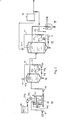
- the fermenter shown in Figure 1 is suitable for the implementation of an acidogenic fermentation as that of a methanogenic fermentation or, depending on the operating conditions, a double fermentation leading directly to obtaining a gas with high methane content.
- It essentially consists of a tank 1 formed by a conical bottom 1a, a ferrule 1b and a sealed cover 1c carrying a visit hole Id for periodic maintenance operations and a safety valve or membrane d burst on.
- It is lined with an lf heat-resistant coating intended to facilitate its maintenance at the desired working temperature.
- Its tank carries one or more supply pipes 2 shown here in the form of a side tap but which could also supply a distribution network placed at the desired level.
- the tank is equipped with a weir 3 protected by a strainer 3a and connected to a discharge pipe not shown; this weir fixes the level of the liquid inside the tank, whose evacuation is done by overflow.
- the device carries at its top a pipe 4 for discharging fermentation gas.
- a grid 5 placed at the lower part of the shell, supports a lining of plastic elements with a high percentage of vacuum, with a high specific surface area and at low density 6, arranged in bulk.
- an advantageous filling will have a percentage of void greater than 90% and preferably 95%, a specific surface at least equal to 100 m 2 / m 3 and preferably greater than 200 m 2 / m 3 , and be made of a material with a density at most equal to 1.5; the requirements of inalterability in the presence of the suspension to be treated and of the biological film, as well as the need for good adhesion of this biological film lead, for example, to the choice of ribbed or corrugated rings of PVC or polystyrene, in particular rings of the known type under the name FLOCOR R, whose specific surface reaches 230 m 2 / m 3. It will not occupy more than 90% of the volume of the enclosure.
- such packing elements are in almost indifferent equilibrium in the liquid medium; they can therefore easily be lifted and moved under the flotation effect due to the release of gas caused by fermentation or, if necessary, caused by a forced sending of gas through a nozzle 7 placed under the grid 5, their movements being however hampered by the overload that the emerged layer 6e creates on the submerged part 6i.
- the emerged layer then reaches a height sufficiently lower than that of the upper part of the strainer 3a, while the lower part 6i of the lining, submerged below the level of the liquid, takes off somewhat from the support grid.
- the conical bottom carries a nozzle 9 at its lower end connected on the one hand, at 9a, to a purge valve but also, at 9b, to a pipe 11 equipped with a pumping member 12 supplying the ramp 8.
- Watering makes it possible to maintain a biological film on the rings of the emerged part 6e in the presence of which, for example, a watering rate of 4 m 3 / m 2 h creates an overload of the order of 80 to 100 kg / m 2 , on the submerged part 6i, on the assumption that the lining is formed of rings FLOCOR R, and that the emerged part has a thick 0.50 m.
- Watering is generally carried out at a flow rate much higher than the supply flow rate, so as to ensure a recycling rate of up to 20 or more, thus creating a general circulation from top to bottom accompanied by d '' mixing the liquid. This is why the tube 2 for supplying the liquid to be treated will be conveniently placed on the side.
- the pipe 11 of the recycling loop is provided with a temperature regulator 13 which constitutes a control means for bringing the regime into operation and then adjusting the temperature of the fermenter to the desired value, taking advantage of the homogenization. created by stirring, and this preferably automatically, using a suitable control circuit 13r.
- a temperature regulator 13 which constitutes a control means for bringing the regime into operation and then adjusting the temperature of the fermenter to the desired value, taking advantage of the homogenization. created by stirring, and this preferably automatically, using a suitable control circuit 13r.
- the optimal methane yield is obtained at around 35 ° C.
- the vinasse treatment installation shown in FIG. 2 is designed for an average flow rate of 5 m 3 / h, ie 75 kg / h of BOD 5 . It has two successive stages of fermentation, one acidogenic, the other methanogenic, and essentially comprises a pretreatment tank 20, two fermenters 30 and 40, a clarifier 50. Each of the two fermenters conforms to the description given below. above in connection with Figure 1.
- the vinasses are taken up by a lifting pump 21, and sent to the tank 20 which allows not only to store them to regulate the flow, or if necessary, to carry out isolated operations such as samples intended for measurements and analyzes for monitoring the process or for balance sheet calculations, but above all to neutralize them. Indeed, these vinasses are normally acidic, and it is necessary to bring their pH to around 6.5 to allow the fermentation to progress properly.
- the tank 20 is provided with an agitator 22 and supplied with alkaline detergent, in principle sodium, from of a reservoir 23, by an injector member 23a controlled by a pH regulation 23r which makes it possible to carry out neutralization continuously.
- the tank 20 is preferably insulated and provided with a heating device 24 which makes it possible to supply the first stage of fermentation with liquid at the desired temperature, of the order of 35 ° C. for example, thanks to a loop. regulation 24r, while the actual fermentation temperature will be adjusted by the regulation system specific to the fermenter 30 to which, at the outlet of the tank 20, the vinasses are therefore sent continuously by a metering pump 25.
- This fermenter 30, with a volume of 40 m 3 and a grid area of 10 m 2 is intended to carry out the acidogenic stage of fermentation.
- the heating device 33a of the primary circuit of the exchanger is controlled by the regulation circuit 33r on reading a thermometric probe 33b.
- the fermentation gases essentially consisting of carbon dioxide and a little hydrogen, are evacuated to the atmosphere by a small chimney 34 equipped, where appropriate, with a counter 34a.
- the vinasses having undergone the first fermentation step flow by gravity to the second stage, intended for the production of methane and which comprises in parallel two fermenters 40.
- Each of these fermenters has a volume of 100 m 3 , for a grid area of 25 m 2 but its operating mode is identical to that of the previous device.
- the recycling of the liquid is ensured through the loop 41 by a pump 42 of 100 m 3 / h, through an exchanger 43 equipped as before with a temperature regulation device 43r.
- the fermentation gas essentially consisting of methane at 25% carbon dioxide and nitrogen, is sent in very slight overpressure to a gasometer 44 through a counter 44a.
- the production obtained is of the order of 100 m 3 / h.
- a booster 45 makes it possible, if necessary, to carry out a relatively intensive gas injection for unclogging.
- Fermented vinasses depleted at least 90% of their organic carbon, are evacuated by gravity to a clarifier 50 forming a hydraulic guard, which can be a decanter as in the diagram or better still a sealed flotation cell, operating from dissolved methane thanks to a hydrocompressor system.
- a clarifier 50 forming a hydraulic guard, which can be a decanter as in the diagram or better still a sealed flotation cell, operating from dissolved methane thanks to a hydrocompressor system.
- Such a cell makes it possible to obtain a further separation of the suspended matter and part of the sludge which it produces, kept completely sheltered from the air, can be freeze-dried in order to be used for reseeding.
- the liquid purified at least 90% can be rejected or directed to a complementary purification treatment, for example an aerobic biological treatment.
Landscapes
- Life Sciences & Earth Sciences (AREA)
- Microbiology (AREA)
- Water Supply & Treatment (AREA)
- Hydrology & Water Resources (AREA)
- Engineering & Computer Science (AREA)
- Environmental & Geological Engineering (AREA)
- Biodiversity & Conservation Biology (AREA)
- Chemical & Material Sciences (AREA)
- Organic Chemistry (AREA)
- Apparatus Associated With Microorganisms And Enzymes (AREA)
- Treatment Of Sludge (AREA)
- Purification Treatments By Anaerobic Or Anaerobic And Aerobic Bacteria Or Animals (AREA)
- Biological Treatment Of Waste Water (AREA)
- Processing Of Solid Wastes (AREA)
- Micro-Organisms Or Cultivation Processes Thereof (AREA)
Priority Applications (1)
| Application Number | Priority Date | Filing Date | Title |
|---|---|---|---|
| AT82400156T ATE9574T1 (de) | 1981-01-28 | 1982-01-28 | Anaerober fermentationsreaktor mit packungsmaterial. |
Applications Claiming Priority (2)
| Application Number | Priority Date | Filing Date | Title |
|---|---|---|---|
| FR8101564A FR2498589B1 (fr) | 1981-01-28 | 1981-01-28 | Fermenteur anaerobie a garnissage |
| FR8101564 | 1981-01-28 |
Publications (4)
| Publication Number | Publication Date |
|---|---|
| EP0057152A2 true EP0057152A2 (de) | 1982-08-04 |
| EP0057152A3 EP0057152A3 (en) | 1982-08-25 |
| EP0057152B1 EP0057152B1 (de) | 1984-09-26 |
| EP0057152B2 EP0057152B2 (de) | 1991-03-13 |
Family
ID=9254582
Family Applications (1)
| Application Number | Title | Priority Date | Filing Date |
|---|---|---|---|
| EP19820400156 Expired - Lifetime EP0057152B2 (de) | 1981-01-28 | 1982-01-28 | Anaerober Fermentationsreaktor mit Packungsmaterial |
Country Status (5)
| Country | Link |
|---|---|
| EP (1) | EP0057152B2 (de) |
| AT (1) | ATE9574T1 (de) |
| DE (1) | DE3260797D1 (de) |
| ES (1) | ES509110A0 (de) |
| FR (1) | FR2498589B1 (de) |
Cited By (15)
| Publication number | Priority date | Publication date | Assignee | Title |
|---|---|---|---|---|
| GB2149390A (en) * | 1983-09-21 | 1985-06-12 | Biomass International | Anaerobic fermentation process |
| US4532042A (en) * | 1982-12-20 | 1985-07-30 | Kernforschungsanlage Julich Gesellschaft Mit Beschrankter Haftung | Process and apparatus for the continuous anaerobic decomposition of organic compounds |
| EP0058247B1 (de) * | 1981-02-09 | 1985-10-23 | GebràDer Sulzer Aktiengesellschaft | Verfahren zur anaeroben Reinigung von mit organischen Stoffen belasteten Flüssigkeiten und Anlage zur Durchführung des Verfahrens |
| EP0161469A1 (de) * | 1984-04-19 | 1985-11-21 | Linde Aktiengesellschaft | Verfahren und Vorrichtung zum anaeroben Abbau von organischem Substrat |
| EP0237430A1 (de) * | 1986-03-10 | 1987-09-16 | SOCIETE GENERALE POUR LES TECHNIQUES NOUVELLES S.G.N. Société anonyme dite: | Verfahren für die methanische Gärung mit festem Film und doppeltem Durchfluss |
| WO1989000151A1 (en) * | 1987-07-03 | 1989-01-12 | Oy Dn-Bioprocessing Ltd | Reactor for producing biogas |
| US4904600A (en) * | 1987-02-05 | 1990-02-27 | Floyd Ramp | Bioreactor for continuous processing of a reactant fluid |
| EP0531586A1 (de) * | 1990-06-13 | 1993-03-17 | Zaidan Hojin Nanyo Kyokai | Verfahren und System für die Behandlung von organischem Abwasser |
| ES2094679A1 (es) * | 1994-02-21 | 1997-01-16 | Consejo Superior Investigacion | Procedimiento para convertir aguas residuales urbanas en facimente biodegradables. |
| CN102676373A (zh) * | 2011-03-10 | 2012-09-19 | 苏州波塞顿节能环保工程有限公司 | 一种养牛场沼气发生器 |
| CN103224287A (zh) * | 2013-05-16 | 2013-07-31 | 南京大学 | 一种水力射流循环厌氧生物滤池处理有机废水的装置及其方法 |
| MD4244C1 (ro) * | 2012-06-11 | 2014-02-28 | Государственный Университет Молд0 | Reactor anaerob combinat pentru obţinerea biometanului |
| CN103923821A (zh) * | 2014-04-29 | 2014-07-16 | 江苏理工学院 | 餐厨垃圾的厌氧消化装置和消化方法 |
| WO2019121876A1 (fr) | 2017-12-19 | 2019-06-27 | Afyren | Vinasse comme milieu de fermentation |
| CN119847220A (zh) * | 2025-01-10 | 2025-04-18 | 南通大学 | 基于改进蜣螂算法的模糊神经网络pid液位控制方法 |
Families Citing this family (5)
| Publication number | Priority date | Publication date | Assignee | Title |
|---|---|---|---|---|
| DE8808967U1 (de) * | 1988-07-13 | 1988-09-01 | Philipp-Gebauer, Susann, 2000 Hamburg | Behälter zum Erzeugen von zu Heizzwecken nutzbarem Biogas |
| DE4028037A1 (de) * | 1990-08-31 | 1992-03-05 | Herbert Lindner Maschinenbau U | Verfahren und vorrichtung zur anaeroben biologischen reinigung von mit organischen inhaltsstoffen belasteten waessern |
| CN108841480B (zh) * | 2018-06-29 | 2022-02-01 | 贵州省仁怀市水码头酿酒作坊 | 发酵装置 |
| CN117106689A (zh) * | 2019-06-13 | 2023-11-24 | 尤尼比奥股份公司 | 控制发酵过程的方法 |
| CN112897707B (zh) * | 2021-01-15 | 2023-03-28 | 四川渔光物联技术有限公司 | 一种尾水处理装置 |
Family Cites Families (5)
| Publication number | Priority date | Publication date | Assignee | Title |
|---|---|---|---|---|
| DE1246610B (de) * | 1959-03-14 | 1967-08-03 | Hans Roediger Dr Ing | Vorrichtung zur Beschickung eines Faulbehaelters in Klaeranlagen |
| DE2549415C2 (de) * | 1975-11-04 | 1982-11-04 | Preussag Ag, 3000 Hannover Und 1000 Berlin | Verfahren zur Denitrifizierung von nitrathaltigem Wasser |
| JPS52152649A (en) * | 1976-06-11 | 1977-12-19 | Nagasei Kougiyou Kk | Water treating method by using moving contact bed |
| IE772633L (en) * | 1977-12-29 | 1979-06-29 | Sweeney J J Newell P J | Treating waste products |
| JPS54108464A (en) * | 1978-02-14 | 1979-08-25 | Chiyoda Chem Eng & Constr Co Ltd | Method of biologically treating drainage by downward flow |
-
1981
- 1981-01-28 FR FR8101564A patent/FR2498589B1/fr not_active Expired
-
1982
- 1982-01-27 ES ES509110A patent/ES509110A0/es active Granted
- 1982-01-28 DE DE8282400156T patent/DE3260797D1/de not_active Expired
- 1982-01-28 AT AT82400156T patent/ATE9574T1/de not_active IP Right Cessation
- 1982-01-28 EP EP19820400156 patent/EP0057152B2/de not_active Expired - Lifetime
Cited By (22)
| Publication number | Priority date | Publication date | Assignee | Title |
|---|---|---|---|---|
| EP0058247B1 (de) * | 1981-02-09 | 1985-10-23 | GebràDer Sulzer Aktiengesellschaft | Verfahren zur anaeroben Reinigung von mit organischen Stoffen belasteten Flüssigkeiten und Anlage zur Durchführung des Verfahrens |
| US4532042A (en) * | 1982-12-20 | 1985-07-30 | Kernforschungsanlage Julich Gesellschaft Mit Beschrankter Haftung | Process and apparatus for the continuous anaerobic decomposition of organic compounds |
| GB2149390A (en) * | 1983-09-21 | 1985-06-12 | Biomass International | Anaerobic fermentation process |
| EP0161469A1 (de) * | 1984-04-19 | 1985-11-21 | Linde Aktiengesellschaft | Verfahren und Vorrichtung zum anaeroben Abbau von organischem Substrat |
| EP0237430A1 (de) * | 1986-03-10 | 1987-09-16 | SOCIETE GENERALE POUR LES TECHNIQUES NOUVELLES S.G.N. Société anonyme dite: | Verfahren für die methanische Gärung mit festem Film und doppeltem Durchfluss |
| US4904600A (en) * | 1987-02-05 | 1990-02-27 | Floyd Ramp | Bioreactor for continuous processing of a reactant fluid |
| WO1989000151A1 (en) * | 1987-07-03 | 1989-01-12 | Oy Dn-Bioprocessing Ltd | Reactor for producing biogas |
| EP0531586A1 (de) * | 1990-06-13 | 1993-03-17 | Zaidan Hojin Nanyo Kyokai | Verfahren und System für die Behandlung von organischem Abwasser |
| ES2094679A1 (es) * | 1994-02-21 | 1997-01-16 | Consejo Superior Investigacion | Procedimiento para convertir aguas residuales urbanas en facimente biodegradables. |
| CN102676373A (zh) * | 2011-03-10 | 2012-09-19 | 苏州波塞顿节能环保工程有限公司 | 一种养牛场沼气发生器 |
| MD4244C1 (ro) * | 2012-06-11 | 2014-02-28 | Государственный Университет Молд0 | Reactor anaerob combinat pentru obţinerea biometanului |
| CN103224287A (zh) * | 2013-05-16 | 2013-07-31 | 南京大学 | 一种水力射流循环厌氧生物滤池处理有机废水的装置及其方法 |
| CN103224287B (zh) * | 2013-05-16 | 2014-09-17 | 南京大学 | 一种水力射流循环厌氧生物滤池处理有机废水的装置及其方法 |
| CN103923821A (zh) * | 2014-04-29 | 2014-07-16 | 江苏理工学院 | 餐厨垃圾的厌氧消化装置和消化方法 |
| CN103923821B (zh) * | 2014-04-29 | 2016-01-06 | 江苏理工学院 | 餐厨垃圾的厌氧消化装置和消化方法 |
| CN105368710A (zh) * | 2014-04-29 | 2016-03-02 | 江苏理工学院 | 餐厨垃圾的厌氧消化装置 |
| CN105400824A (zh) * | 2014-04-29 | 2016-03-16 | 江苏理工学院 | 餐厨垃圾的厌氧消化方法 |
| CN105368710B (zh) * | 2014-04-29 | 2018-04-13 | 江苏理工学院 | 餐厨垃圾的厌氧消化装置 |
| CN105400824B (zh) * | 2014-04-29 | 2018-10-09 | 江苏理工学院 | 餐厨垃圾的厌氧消化方法 |
| WO2019121876A1 (fr) | 2017-12-19 | 2019-06-27 | Afyren | Vinasse comme milieu de fermentation |
| CN119847220A (zh) * | 2025-01-10 | 2025-04-18 | 南通大学 | 基于改进蜣螂算法的模糊神经网络pid液位控制方法 |
| CN119847220B (zh) * | 2025-01-10 | 2025-11-14 | 南通大学 | 基于改进蜣螂算法的模糊神经网络pid液位控制方法 |
Also Published As
| Publication number | Publication date |
|---|---|
| ES8302607A1 (es) | 1982-12-16 |
| ES509110A0 (es) | 1982-12-16 |
| FR2498589B1 (fr) | 1985-02-15 |
| EP0057152B2 (de) | 1991-03-13 |
| EP0057152A3 (en) | 1982-08-25 |
| DE3260797D1 (en) | 1984-10-31 |
| EP0057152B1 (de) | 1984-09-26 |
| FR2498589A1 (fr) | 1982-07-30 |
| ATE9574T1 (de) | 1984-10-15 |
Similar Documents
| Publication | Publication Date | Title |
|---|---|---|
| EP0057152B1 (de) | Anaerober Fermentationsreaktor mit Packungsmaterial | |
| EP2176176B1 (de) | Verfahren und einheit zur reinigung von abwässern mit aerobem granularem schlamm | |
| FR2488591A1 (fr) | Procede et installation de traitement bacterien de rejets industriels, et procede d'etablissement d'une population de bacteries anaerobies dans ladite installation | |
| EP0105788A1 (de) | Verfahren und Vorrichtung für die anaerobe Behandlung von Abwasser in einem Filter mit körniger Füllung | |
| LU82688A1 (fr) | Procede de preparation d'une biomasse fixee sur un support | |
| CA3135864A1 (fr) | Procede et dispositif pour la production de methane | |
| EP0120772A1 (de) | Anlagen und Verfahren der biologischen Reinigung und Herstellung von brennbaren Gasen durch die zweiphasige anaerobe Gärung | |
| FR2538800A1 (fr) | Procede de traitement biologique et reacteur a lit fixe pour sa mise en oeuvre | |
| LU82687A1 (fr) | Procede d'epuration biologique des eaux usees par oxydation | |
| EP0306431B2 (de) | Verfahren für die Verminderung von aufgelösten Verunreinigungen in einer Flüssigkeit | |
| Russo et al. | An anaerobic filter applied to the treatment of distillery wastewaters | |
| EP0549443B1 (de) | Verfahren zur biologischen Reinigung von mit Verunreinigungen belasteten Flüssigkeiten | |
| FR2706883A1 (de) | ||
| FR2707183A1 (fr) | Procédé de mise en mouvement de particules supports de microorganismes dans un liquide à traiter par voie biologique, et installation de mise en Óoeuvre du procédé. | |
| CA2957364A1 (fr) | Installation et procede batch sequence pour reduire la teneur en azote dans les eaux residuaires | |
| CA2438525A1 (fr) | Procede d'epuration biologique des eaux residuaires utilisant des particules support de biofilm | |
| CA2704793A1 (fr) | Digesteur anaerobie lavable avec biofilm fixe | |
| EP0237430B1 (de) | Verfahren für die methanische Gärung mit festem Film und doppeltem Durchfluss | |
| EP2571820A1 (de) | Bioreaktor mit separaten sauerstoffanreicherungs- und tropfkörperbereichen sowie behandlungsverfahren | |
| EP0051063A1 (de) | Verfahren und vorrichtung zum umformen organischen materials gemäss eines biologischen weges. | |
| FR2939424A1 (fr) | Nouveau procede d'epuration des eaux usees et le procede utile a cet effet | |
| EP1390304A1 (de) | Reaktor zur biologischen behandlung von abwasser in einer kläranlage | |
| FR2631040A1 (fr) | Procede de production d'anhydride carbonique et d'ethanol par fermentation continue multietagee et installation | |
| FR2822150A1 (fr) | Procede et installation pour le traitement des eaux mettant en oeuvre au moins un bio-reacteur a membrane immergee | |
| EP0325643B1 (de) | Vorrichtung für anaerobe abwasserbehandlung |
Legal Events
| Date | Code | Title | Description |
|---|---|---|---|
| PUAI | Public reference made under article 153(3) epc to a published international application that has entered the european phase |
Free format text: ORIGINAL CODE: 0009012 |
|
| PUAL | Search report despatched |
Free format text: ORIGINAL CODE: 0009013 |
|
| AK | Designated contracting states |
Designated state(s): AT BE CH DE GB IT LI NL SE |
|
| AK | Designated contracting states |
Designated state(s): AT BE CH DE GB IT LI NL SE |
|
| 17P | Request for examination filed |
Effective date: 19820805 |
|
| ITF | It: translation for a ep patent filed | ||
| GRAA | (expected) grant |
Free format text: ORIGINAL CODE: 0009210 |
|
| AK | Designated contracting states |
Designated state(s): AT BE CH DE GB IT LI NL SE |
|
| REF | Corresponds to: |
Ref document number: 9574 Country of ref document: AT Date of ref document: 19841015 Kind code of ref document: T |
|
| REF | Corresponds to: |
Ref document number: 3260797 Country of ref document: DE Date of ref document: 19841031 |
|
| PLBI | Opposition filed |
Free format text: ORIGINAL CODE: 0009260 |
|
| 26 | Opposition filed |
Opponent name: LINDE AKTIENGESELLSCHAFT, WIESBADEN Effective date: 19850626 |
|
| NLR1 | Nl: opposition has been filed with the epo |
Opponent name: LINDE AKTIENGESELLSCHAFT |
|
| PUAH | Patent maintained in amended form |
Free format text: ORIGINAL CODE: 0009272 |
|
| STAA | Information on the status of an ep patent application or granted ep patent |
Free format text: STATUS: PATENT MAINTAINED AS AMENDED |
|
| 27A | Patent maintained in amended form |
Effective date: 19910313 |
|
| AK | Designated contracting states |
Kind code of ref document: B2 Designated state(s): AT BE CH DE GB IT LI NL SE |
|
| ITF | It: translation for a ep patent filed | ||
| REG | Reference to a national code |
Ref country code: CH Ref legal event code: AEN |
|
| NLR2 | Nl: decision of opposition | ||
| NLR3 | Nl: receipt of modified translations in the netherlands language after an opposition procedure | ||
| ITTA | It: last paid annual fee | ||
| EAL | Se: european patent in force in sweden |
Ref document number: 82400156.4 |
|
| REG | Reference to a national code |
Ref country code: CH Ref legal event code: PUE Owner name: SOCIETE GENERALE POUR LES TECHNIQUES NOUVELLES S.G |
|
| NLS | Nl: assignments of ep-patents |
Owner name: PROSERPOL |
|
| REG | Reference to a national code |
Ref country code: GB Ref legal event code: 732E |
|
| PGFP | Annual fee paid to national office [announced via postgrant information from national office to epo] |
Ref country code: AT Payment date: 19980131 Year of fee payment: 17 |
|
| PGFP | Annual fee paid to national office [announced via postgrant information from national office to epo] |
Ref country code: DE Payment date: 19980309 Year of fee payment: 17 |
|
| PG25 | Lapsed in a contracting state [announced via postgrant information from national office to epo] |
Ref country code: AT Free format text: LAPSE BECAUSE OF NON-PAYMENT OF DUE FEES Effective date: 19990128 |
|
| PG25 | Lapsed in a contracting state [announced via postgrant information from national office to epo] |
Ref country code: DE Free format text: LAPSE BECAUSE OF NON-PAYMENT OF DUE FEES Effective date: 19991103 |
|
| PGFP | Annual fee paid to national office [announced via postgrant information from national office to epo] |
Ref country code: SE Payment date: 20001218 Year of fee payment: 20 Ref country code: NL Payment date: 20001218 Year of fee payment: 20 |
|
| PGFP | Annual fee paid to national office [announced via postgrant information from national office to epo] |
Ref country code: CH Payment date: 20010115 Year of fee payment: 20 |
|
| PGFP | Annual fee paid to national office [announced via postgrant information from national office to epo] |
Ref country code: GB Payment date: 20010123 Year of fee payment: 20 |
|
| PGFP | Annual fee paid to national office [announced via postgrant information from national office to epo] |
Ref country code: BE Payment date: 20010209 Year of fee payment: 20 |
|
| BE20 | Be: patent expired |
Free format text: 20020128 *PROSERPOL |
|
| REG | Reference to a national code |
Ref country code: GB Ref legal event code: IF02 |
|
| PG25 | Lapsed in a contracting state [announced via postgrant information from national office to epo] |
Ref country code: LI Free format text: LAPSE BECAUSE OF EXPIRATION OF PROTECTION Effective date: 20020127 Ref country code: GB Free format text: LAPSE BECAUSE OF EXPIRATION OF PROTECTION Effective date: 20020127 Ref country code: CH Free format text: LAPSE BECAUSE OF EXPIRATION OF PROTECTION Effective date: 20020127 |
|
| PG25 | Lapsed in a contracting state [announced via postgrant information from national office to epo] |
Ref country code: NL Free format text: LAPSE BECAUSE OF EXPIRATION OF PROTECTION Effective date: 20020128 |
|
| REG | Reference to a national code |
Ref country code: GB Ref legal event code: PE20 Effective date: 20020127 |
|
| REG | Reference to a national code |
Ref country code: CH Ref legal event code: PL |
|
| EUG | Se: european patent has lapsed |
Ref document number: 82400156.4 |
|
| NLV7 | Nl: ceased due to reaching the maximum lifetime of a patent |