EP0057750B1 - Méthode de représentation d'attributs de caractères sur un écran de visualisation et dispositif de mise en oeuvre - Google Patents
Méthode de représentation d'attributs de caractères sur un écran de visualisation et dispositif de mise en oeuvre Download PDFInfo
- Publication number
- EP0057750B1 EP0057750B1 EP81108293A EP81108293A EP0057750B1 EP 0057750 B1 EP0057750 B1 EP 0057750B1 EP 81108293 A EP81108293 A EP 81108293A EP 81108293 A EP81108293 A EP 81108293A EP 0057750 B1 EP0057750 B1 EP 0057750B1
- Authority
- EP
- European Patent Office
- Prior art keywords
- characters
- character
- screen
- control
- assigned
- Prior art date
- Legal status (The legal status is an assumption and is not a legal conclusion. Google has not performed a legal analysis and makes no representation as to the accuracy of the status listed.)
- Expired
Links
Images

Classifications
-
- G—PHYSICS
- G09—EDUCATION; CRYPTOGRAPHY; DISPLAY; ADVERTISING; SEALS
- G09G—ARRANGEMENTS OR CIRCUITS FOR CONTROL OF INDICATING DEVICES USING STATIC MEANS TO PRESENT VARIABLE INFORMATION
- G09G1/00—Control arrangements or circuits, of interest only in connection with cathode-ray tube indicators; General aspects or details, e.g. selection emphasis on particular characters, dashed line or dotted line generation; Preprocessing of data
-
- G—PHYSICS
- G06—COMPUTING OR CALCULATING; COUNTING
- G06F—ELECTRIC DIGITAL DATA PROCESSING
- G06F40/00—Handling natural language data
- G06F40/10—Text processing
- G06F40/103—Formatting, i.e. changing of presentation of documents
-
- G—PHYSICS
- G06—COMPUTING OR CALCULATING; COUNTING
- G06F—ELECTRIC DIGITAL DATA PROCESSING
- G06F40/00—Handling natural language data
- G06F40/10—Text processing
- G06F40/166—Editing, e.g. inserting or deleting
Definitions
- the invention relates to a method and an arrangement for displaying control characters on a screen of a display device which contains a page memory in which code words can be stored, the alphanumeric and / or graphic characters which can be displayed on the screen and the control characters which determine the properties of the characters are assigned , which contains a keyboard, by means of which the code words assigned to the characters and the control characters can be entered into the page memory and which contains an image control unit provided with a character generator which controls the display of the characters on the screen and in which for creating and When editing the screen content, a special operating state can be set, in which special characters assigned to the control characters can be displayed on the screen.
- Videotex-Interactive With the telecommunication service "on-screen text" (“Videotex-Interactive”) it is possible to call up information stored in a control center via a telephone line with the aid of a television set.
- the information is displayed on the screen of the television set serving as a display device. It can display alphanumeric characters and / or patterns formed from graphic characters.
- Editing devices are provided for the information providers, by means of which the information is prepared in the form of screen contents. The screen was then transferred to the control center and can then be called up by the participants.
- a screen content. is called a page.
- the page contains 960 character fields arranged in 24 rows with 40 character fields each.
- the character field consists, for example, of 8x10 or 8x12 pixels with which the individual characters are displayed.
- the graphic patterns are represented in that each character field contains a graphic character which is formed from 2x3 graphic elements.
- the graphic patterns are built up from the combinations of light and dark graphic elements in the different colors, whereby the colors cannot be changed within a drawing field.
- the display device contains an image control unit which controls the display of the characters on the screen.
- the image control unit contains a character generator in which a predetermined supply of alphanumeric and graphic characters is stored. Using code words which are stored in a page memory and which represent the addresses of the character generator, data words associated with the pixels of the characters or the graphic elements are read out from the character generators and fed to a display unit containing the screen.
- the properties of the representable characters are determined by control characters, which are also stored in the form of code words in the page memory.
- the control characters specify, for example, the color in which the characters are to be displayed, whether the characters are to be displayed flashing, not flashing, at normal height or at double height.
- serial coding of the characters and the control characters each location on the screen is assigned a memory area in the page memory intended for a bottom word. If a code word of a control character is stored in a memory area, generally no character is displayed at the corresponding position on the screen.
- the assignment of the code words to the characters and the control characters is known for serial coding, for example, from the magazine "Funkschau" (1977), number 18, pages 78-82.
- the number of binary characters of the code words assigned to the representable characters is increased in such a way that a control character can be added to each character as accompanying information.
- the gaps provided for the control characters are omitted and characters can be displayed at all points on the screen. It is also possible to combine the parallel coding with the serial coding.
- control characters are not displayed and thus do not differ from the "space" character in the serial coding on the screen, it is not possible to recognize the positions of control characters already entered when creating or changing a screen content.
- the invention is therefore based on the object of specifying a method with which the position assigned to a specific control character on the screen of a display device can be determined in a simple manner and very quickly.
- the object is achieved in the method of the type mentioned in the introduction that after pressing a key assigned to a specific control character on the keyboard, at least one point on the screen that is assigned to this control character in the page memory, a special character assigned only to this control key is displayed and that the display of the special characters assigned to the other control characters is blocked on the screen.
- the method according to the invention has the advantage that the creation, correction and updating of a screen content can be carried out in a simple and very quick manner, since the position assigned to a specific control character is displayed directly on the screen
- control character can be called up in a simple manner by pressing the special character at the next position assigned to this control character each time the key is pressed again Screen is displayed. In this case, only one position assigned to this control character is shown on the screen. However, it may prove useful that the special characters shown above continue to be displayed.
- a character identifying the respective control character is provided as a special character.
- These characters can, for example, each be a mnemonic conversion of the function of the respective control character.
- a text identifying the control characters is displayed simultaneously with the special characters on the screen in an additional display line.
- An advantageous embodiment of a shaft arrangement for carrying out the method is achieved if it is provided that the code word assigned to the respective control character is fed from the keyboard to a switching stage which compares the code word with code words stored in the page memory and which emits signals to the image control unit which the display of the special character on the trigger Blldle when a comparison of a data read out from the page memory codeword with ascertains the equality means of the keyboard, a g e-added code word.
- the switching stage contains a clock generator which generates clock pulses with which the display of the special characters is advanced and which is blocked by a signal emitted by the comparator when the code word read from the page memory and the entered code word are the same.
- the "space" key can be pressed and the control character "BI on” is deleted. In other cases, the cursor must be moved to the appropriate location for deletion.
- alphanumeric characters can be displayed as special characters.
- the control character "BI on” can be represented in a simple manner by the alphanumeric character "H", since the last six binary characters match for both code words.
- this alphanumeric character used as a special character it is possible to invert this, i.e. with swapping of background and foreground colors or underlined.
- a character as a special character which represents a mnemonic abbreviation of the function of the control character.
- a character generator which contains data words assigned to the forms of these characters.
- This character generator can of course also be part of the character generator provided in the display device. It is also possible to display the special character according to its function.
- the control character "BI on” can be represented as a flashing special character.
- a display of the characters can be blocked or, as shown at a and b, the special characters can be displayed in addition to the characters.
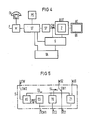
- the display device shown in FIG. 4, which is provided for the telecommunications service "screen text" is connected to a telephone line F via a modem M.
- a telephone FA is connected to the modem M in a known manner.
- the display device contains a control unit ST, which controls the chronological sequence and usually contains a microprocessor.
- the keyboard TA is connected to the control unit ST.
- the display device contains a page memory SP, in which code words CW of at least one screen, one page, are stored.
- An image control unit BST is connected downstream of the page memory SP and, depending on the content of the page memory, outputs video signals to a display unit AE provided with the screen BS.
- the image control unit BST contains a character generator Z which is addressed by the code words CW and which contains data words assigned to the forms of the alphanumeric or graphic characters to be displayed.
- the display device contains a switching stage S, by means of which it is possible to display certain control characters on the screen BS. Further details of FIG. 4 are described below together with the block diagram of the switching stage S shown in FIG.
- a switch SW1 is normally in the solid position and using signals S1, which are switched through as signals S2 to the control unit ST, the cursor is normally moved over the keyboard.
- the switch SW1 takes the position shown in dashed lines.
- the switch SW2 is also closed and the page memory SP is read out in synchronization with the movement of the cursor.
- the code words CW are fed to a comparator VG. If a code word CW matches a stored code word CW1, the comparator VG emits a signal S5 which blocks the clock generator TG and thus stops the cursor at the corresponding point. In this way, the position that is assigned to the control character is marked.
- the clock generator TG is released again with the aid of the signal S3 and the cursor is moved over the screen BS until the comparator VG again emits a signal S5 and blocks the clock generator TG again. In this way, the entire page memory SP can be searched for a specific control character by repeatedly pressing the key.
- control character represents mnemotechnically reproducing characters at the corresponding positions on the BS screen or if a text identifying the control character is to be shown in an additional display line on the BS screen
- a further character generator Z1 can also be provided in which the corresponding data words are stored. The signal S5 and the code word CW1 are then fed to this character generator Z1 and this outputs the corresponding data words as signals S6 to the image control unit BST.
- the data words of the special character are stored under the address in the character generator Z which corresponds to the respective code word CW1.
- the comparator VG determines the equality of the entered code word CW1 with the read code word CW, the corresponding special character is displayed on the screen BS.
- the clock generator TG is not required in this case and the signal S5 can be fed directly to the image control unit BST.
Landscapes
- Engineering & Computer Science (AREA)
- Theoretical Computer Science (AREA)
- General Physics & Mathematics (AREA)
- Physics & Mathematics (AREA)
- General Engineering & Computer Science (AREA)
- Health & Medical Sciences (AREA)
- Artificial Intelligence (AREA)
- Audiology, Speech & Language Pathology (AREA)
- Computational Linguistics (AREA)
- General Health & Medical Sciences (AREA)
- Computer Hardware Design (AREA)
- Remote Sensing (AREA)
- Radar, Positioning & Navigation (AREA)
- Controls And Circuits For Display Device (AREA)
- Input From Keyboards Or The Like (AREA)
- Digital Computer Display Output (AREA)
Claims (9)
Priority Applications (1)
| Application Number | Priority Date | Filing Date | Title |
|---|---|---|---|
| AT81108293T ATE18820T1 (de) | 1981-02-10 | 1981-10-13 | Verfahren und anordnung zum darstellen von steuerzeichen an einem bildschirm einer anzeigeeinrichtung. |
Applications Claiming Priority (2)
| Application Number | Priority Date | Filing Date | Title |
|---|---|---|---|
| DE3104639 | 1981-02-10 | ||
| DE3104639A DE3104639C2 (de) | 1981-02-10 | 1981-02-10 | Schaltungsanordnung zum Darstellen von Steuerzeichen an einem Bildschirm einer Anzeigeeinrichtung |
Publications (3)
| Publication Number | Publication Date |
|---|---|
| EP0057750A2 EP0057750A2 (fr) | 1982-08-18 |
| EP0057750A3 EP0057750A3 (en) | 1982-09-08 |
| EP0057750B1 true EP0057750B1 (fr) | 1986-03-26 |
Family
ID=6124464
Family Applications (1)
| Application Number | Title | Priority Date | Filing Date |
|---|---|---|---|
| EP81108293A Expired EP0057750B1 (fr) | 1981-02-10 | 1981-10-13 | Méthode de représentation d'attributs de caractères sur un écran de visualisation et dispositif de mise en oeuvre |
Country Status (4)
| Country | Link |
|---|---|
| EP (1) | EP0057750B1 (fr) |
| AT (1) | ATE18820T1 (fr) |
| CA (1) | CA1195788A (fr) |
| DE (1) | DE3104639C2 (fr) |
Families Citing this family (1)
| Publication number | Priority date | Publication date | Assignee | Title |
|---|---|---|---|---|
| DE3244115C2 (de) * | 1982-11-29 | 1987-01-22 | Siemens AG, 1000 Berlin und 8000 München | Verfahren zum Darstellen von Steuerzeichen an einer Anzeigeeinheit einer Textstation |
Citations (1)
| Publication number | Priority date | Publication date | Assignee | Title |
|---|---|---|---|---|
| DE2540734A1 (de) * | 1975-09-12 | 1977-03-17 | Siemens Ag | Bildsteuereinheit fuer ein datensichtgeraet |
Family Cites Families (3)
| Publication number | Priority date | Publication date | Assignee | Title |
|---|---|---|---|---|
| JPS5027332B1 (fr) * | 1969-10-08 | 1975-09-06 | ||
| DE2114665B2 (de) * | 1971-03-26 | 1973-03-15 | Licentia Patent Verwaltungs GmbH, 6000 Frankfurt | Schaltungsanordnung fuer ein im videozeilen-modus arbeitendes, durch digitalkodes steuerbares sichtgeraet |
| DE2636788C3 (de) * | 1976-08-16 | 1980-01-31 | Siemens Ag, 1000 Berlin Und 8000 Muenchen | Datenspeicher für Datensichtgeräte |
-
1981
- 1981-02-10 DE DE3104639A patent/DE3104639C2/de not_active Expired
- 1981-10-13 EP EP81108293A patent/EP0057750B1/fr not_active Expired
- 1981-10-13 AT AT81108293T patent/ATE18820T1/de not_active IP Right Cessation
-
1982
- 1982-02-08 CA CA000395759A patent/CA1195788A/fr not_active Expired
Patent Citations (1)
| Publication number | Priority date | Publication date | Assignee | Title |
|---|---|---|---|---|
| DE2540734A1 (de) * | 1975-09-12 | 1977-03-17 | Siemens Ag | Bildsteuereinheit fuer ein datensichtgeraet |
Non-Patent Citations (1)
| Title |
|---|
| Funkschau 49 (26.August 1977) 18, Seiten 78-82 * |
Also Published As
| Publication number | Publication date |
|---|---|
| CA1195788A (fr) | 1985-10-22 |
| EP0057750A2 (fr) | 1982-08-18 |
| ATE18820T1 (de) | 1986-04-15 |
| DE3104639A1 (de) | 1982-09-09 |
| DE3104639C2 (de) | 1986-05-28 |
| EP0057750A3 (en) | 1982-09-08 |
Similar Documents
| Publication | Publication Date | Title |
|---|---|---|
| DE4115179C2 (de) | Einrichtung zum Speichern und Ausgeben von Daten in einem TV-System und Verfahren zu dessen Steuerung hierfür | |
| DE2226290C2 (de) | Vorrichtung und Verfahren zum Darstellen von Information auf einer zyklisch auffrischbaren Anzeigevorrichtung | |
| DE1774682C3 (de) | Einrichtung zur sichtbaren Datenwiedergabe | |
| DE2851772C2 (de) | Schaltungsanordnung für ein Farbdatensichtgerät | |
| DE2740009A1 (de) | Vorrichtung zur steuerung von information, die auf einer fernsehartigen sichtvorrichtung dargestellt werden soll | |
| DE2845290A1 (de) | Datensichtgeraet | |
| DE2438203C3 (de) | Anzeigeeinrichtung | |
| DE3233630C2 (fr) | ||
| DE2213953C3 (de) | Schaltungsanordnung zum Darstellen von Zeichen auf dem Bildschirm eines Sichtgerätes | |
| DE1549681B1 (de) | Einrichtung zum optischen darstellen von zeichen | |
| DE3149861A1 (de) | Informationsverarbeitungsanordnung | |
| EP0006131A1 (fr) | Procédé de transmission d'enregistrements contenant des représentations mixtes à un écran de visualisation, particulièrement dans des installations téléphoniques | |
| EP0057750B1 (fr) | Méthode de représentation d'attributs de caractères sur un écran de visualisation et dispositif de mise en oeuvre | |
| DE3516416A1 (de) | Schaltungsanordnung zur erzeugung graphischer darstellungen auf einer anzeigeeinrichtung | |
| DE2636788C3 (de) | Datenspeicher für Datensichtgeräte | |
| DE2419733A1 (de) | Schaltungsanordnung zur wiedergabe von mehrstelligen binaer-zahlen codierten daten als alphanumerische zeichen in form einer 7x5-matrix | |
| DE2760395C2 (fr) | ||
| DE69602956T2 (de) | Bildschirmanzeigesystem mit parallelmodus | |
| DE2150389C3 (de) | Anordnung zum Darstellen von Blindschaltbildern | |
| DE3304859C2 (fr) | ||
| DE2926501C2 (de) | Schaltungsanordnung mit interaktive Benutzerdialoge simulierender Betriebsweise in Videotext/Kabeltext-Systemen ohne Rückkanal | |
| EP0057754A2 (fr) | Méthode de représentation des attributs de caractères sur un écran de visualisation et dispositif de mise en oeuvre | |
| DE2827714A1 (de) | Dateneingabeanordnung | |
| DE3046513C2 (de) | Verfahren und Anordnung zum Speichern von graphischen Mustern | |
| DE2525509A1 (de) | Datensichtgeraet mit bildgenerator |
Legal Events
| Date | Code | Title | Description |
|---|---|---|---|
| PUAI | Public reference made under article 153(3) epc to a published international application that has entered the european phase |
Free format text: ORIGINAL CODE: 0009012 |
|
| PUAL | Search report despatched |
Free format text: ORIGINAL CODE: 0009013 |
|
| 17P | Request for examination filed |
Effective date: 19811013 |
|
| AK | Designated contracting states |
Designated state(s): AT CH FR GB NL SE |
|
| AK | Designated contracting states |
Designated state(s): AT CH FR GB NL SE |
|
| GRAA | (expected) grant |
Free format text: ORIGINAL CODE: 0009210 |
|
| AK | Designated contracting states |
Kind code of ref document: B1 Designated state(s): AT CH FR GB LI NL SE |
|
| REF | Corresponds to: |
Ref document number: 18820 Country of ref document: AT Date of ref document: 19860415 Kind code of ref document: T |
|
| ET | Fr: translation filed | ||
| PGFP | Annual fee paid to national office [announced via postgrant information from national office to epo] |
Ref country code: AT Payment date: 19861003 Year of fee payment: 6 |
|
| PLBE | No opposition filed within time limit |
Free format text: ORIGINAL CODE: 0009261 |
|
| STAA | Information on the status of an ep patent application or granted ep patent |
Free format text: STATUS: NO OPPOSITION FILED WITHIN TIME LIMIT |
|
| 26N | No opposition filed | ||
| PGFP | Annual fee paid to national office [announced via postgrant information from national office to epo] |
Ref country code: NL Payment date: 19871031 Year of fee payment: 7 |
|
| PG25 | Lapsed in a contracting state [announced via postgrant information from national office to epo] |
Ref country code: GB Effective date: 19881013 Ref country code: AT Effective date: 19881013 |
|
| PG25 | Lapsed in a contracting state [announced via postgrant information from national office to epo] |
Ref country code: SE Effective date: 19881014 |
|
| PG25 | Lapsed in a contracting state [announced via postgrant information from national office to epo] |
Ref country code: LI Effective date: 19881031 Ref country code: CH Effective date: 19881031 |
|
| PG25 | Lapsed in a contracting state [announced via postgrant information from national office to epo] |
Ref country code: NL Effective date: 19890501 |
|
| NLV4 | Nl: lapsed or anulled due to non-payment of the annual fee | ||
| PG25 | Lapsed in a contracting state [announced via postgrant information from national office to epo] |
Ref country code: FR Free format text: LAPSE BECAUSE OF NON-PAYMENT OF DUE FEES Effective date: 19890630 |
|
| REG | Reference to a national code |
Ref country code: CH Ref legal event code: PL |
|
| GBPC | Gb: european patent ceased through non-payment of renewal fee | ||
| REG | Reference to a national code |
Ref country code: FR Ref legal event code: ST |
|
| EUG | Se: european patent has lapsed |
Ref document number: 81108293.2 Effective date: 19890614 |