EP0057809A2 - Procédé de détermination du pH intracellulaire - Google Patents
Procédé de détermination du pH intracellulaire Download PDFInfo
- Publication number
- EP0057809A2 EP0057809A2 EP82100051A EP82100051A EP0057809A2 EP 0057809 A2 EP0057809 A2 EP 0057809A2 EP 82100051 A EP82100051 A EP 82100051A EP 82100051 A EP82100051 A EP 82100051A EP 0057809 A2 EP0057809 A2 EP 0057809A2
- Authority
- EP
- European Patent Office
- Prior art keywords
- cell
- fluorescent substance
- dicyano
- compound
- emission
- Prior art date
- Legal status (The legal status is an assumption and is not a legal conclusion. Google has not performed a legal analysis and makes no representation as to the accuracy of the status listed.)
- Granted
Links
Images



Classifications
-
- C—CHEMISTRY; METALLURGY
- C07—ORGANIC CHEMISTRY
- C07C—ACYCLIC OR CARBOCYCLIC COMPOUNDS
- C07C255/00—Carboxylic acid nitriles
-
- G—PHYSICS
- G01—MEASURING; TESTING
- G01N—INVESTIGATING OR ANALYSING MATERIALS BY DETERMINING THEIR CHEMICAL OR PHYSICAL PROPERTIES
- G01N33/00—Investigating or analysing materials by specific methods not covered by groups G01N1/00 - G01N31/00
- G01N33/48—Biological material, e.g. blood, urine; Haemocytometers
- G01N33/50—Chemical analysis of biological material, e.g. blood, urine; Testing involving biospecific ligand binding methods; Immunological testing
- G01N33/84—Chemical analysis of biological material, e.g. blood, urine; Testing involving biospecific ligand binding methods; Immunological testing involving inorganic compounds or pH
Definitions
- the invention relates to a method for determining the pH in the interior of a cell by measuring the emission of a fluorescent substance which is absorbed by the cell by incubation in a solution, the solution containing a compound of the fluorescent substance mentioned and the fluorescent substance of this compound is cleaved in the cell by an enzyme present there.
- the pH I can now be determined by suspending cells in a photometric cuvette in a physiological buffer solution containing fluorescein ester, and this suspension alternating with two light sources of different excitation wavelengths while simultaneously measuring the intensity of the fluorescent light at the frequency of the emission maximum (Thomas et al., Intracellular pH Measurements in Ehrlich Ascites Tumor Cells Utilizing Spectroscopic Probes Generated in situ, Biochemistry Vol. 18, No. 11, p. 2210-2218 (1979)).
- This method has the disadvantage that no single cells can be measured.
- single cell measurement is of great importance because a cell suspension can contain several cell types with different pH I, which cannot be detected with the photometric cuvette method.
- the object of the invention is to provide a method and to provide the substances required for this, by means of which the determination of the pH value in the interior of individual cells is possible.
- This method is said to be particularly suitable for measuring entire cell populations in flow cytometers, so that corresponding distribution curves can be created in a simple manner, which in turn open up new possibilities for diagnostics.
- This object is achieved in that one is selected as the fluorescent substance in which the frequency of the maximum of the emission is pH-dependent, and in that as a compound of this fluorescent substance one is used which is membrane-permeable, and also in the measurement the fluorescence, the pH-dependent frequency is determined at which the maximum of the fluorescence emission occurs.
- the essence of the invention thus consists first of all in taking a substance as a fluorescent indicator in which the frequency and not the intensity of the fluorescence is pH-dependent. This means that the frequency at which the emission spectrum has its maximum is pH-dependent. It is also important to make this substance membrane-permeable so that it can pass from the solution in which the cells are incubated through the cell wall into the cell. inner entry.
- the source substance is not suitable for this. However, it now emerges that the derivatization brought about to improve the passage through the cell wall results in a compound which in turn does not fluoresce in the desired manner.
- the disadvantage of sequential intensity measurement of fluorescence at two different excitation wavelengths is avoided, as is required for fluorescein esters for pH I determination and as a result of which pH I determination can only be carried out on cell suspensions and not for individual cells, in that substances with pH-dependent emission spectrum can be used.
- the advantages are that the pH I determination in single cells is possible, that only one excitation wavelength is required, and that the pH-dependent changes in the maximum of the fluorescence emission are measured simultaneously. This is done in a manner known per se by simultaneously measuring the intensity in two “light windows” within the frequency range in question, for example between 420 and 440 and also between 500 and 580 mm.
- the ratio of the two values is a measure of the frequency of the maximum of the fluorescence emission, the frequency in turn a measure of the pH value.
- the substances which have these properties for example 2,3-dicyano-1,4-hydroquinone (DH), are not membrane-permeable, it has not been possible since then to use them on a larger scale because, if one incubated in a solution of the DH cells, this did not migrate through the cell walls into the interior of the cells and accumulated there.
- DH 2,3-dicyano-1,4-hydroquinone
- the invention provides for derivatization, ie conversion into a substance which tends to pass from a solution through the cell wall into the interior of the cell. At the same time, this must be such a compound of the fluorescent substance that is in turn split in the interior of the cell by the enzymes present there in such a way that the original fluorescent substance is formed.
- the 2,3-dicyano-1,4-hydroquinone (also: 2,3-dicyanohydroquinone) is used as such a fluorescent substance, which fluoresces in the manner described depending on the pH.
- This substance is known per se (see CRC Handbook of Chemistry and Physics, 54th ed., P. D-117; referred to there in a different nomenclature as 3,6-Dioxyphtalic dinitrile (English)).
- This substance has the desired properties of fluorescence.
- the maximum of the emission is pH-dependent.
- the fluorescence occurs in a frequency range which is significantly different from that in which other fluorescences which are important for analytical purposes occur (e.g. those which are important for determining the DNA concentration). In this way you can not only measure the fluorescence, which is important for the pH determination, but also other fluorescences and thus more than just one parameter at the same time.
- acylation One way to maintain membrane permeability is by acylation.
- An example of this is esterification. Then it is the esterases present in a cell that cleave the indicator again by hydrolysis after the ester has passed through the cell wall and thus make it effective.
- the esterification e.g. with acetic acid gives the new 1,4-diacetoxy-2,3-dicyano-benzene (DDB) in the case of 2,3-dicyano-1,4-hydroquinone.
- DDB 1,4-diacetoxy-2,3-dicyano-benzene
- the 2,3-dicyano-1,4-hydroquinone is formed in the cell again by hydrolysis. It turns out that the DH formed in the cell and also in the solution by hydrolysis from DDB has about twice the working range than since then knew, apparently because the phenolic structure responsible for the fluorescence activity in the cell interior and in solution cannot be changed decisively by oxidation.
- the new 1,4-diacetoxy-2,3-dicyano-benzene is structured so that there is an acetoxy group at the 1st and 4th position of the benzene ring and at the 2nd and 3rd position each a cyano group is located.
- the 5th and 6th positions are occupied by H atoms.
- the invention also includes substances in which these sites are occupied by other groups or compounds (including the attachment of further benzene rings) by which the activities mentioned (fluorescence after hydrolysis in the cell; good migration into the cell) are not eliminated or even be increased.
- butyric acid or an N-protected amino acid can also be used to acylate the hydroquinone.
- the likewise new substances 1,4-dibutyryloxy-2,3-dicyanobenzene or 1,4-di (-tert-butyloxycarbonyl-l-alanyl-oxy) -2,3-dicyano-benzene are then obtained as membrane-compatible compounds of the 2nd , 3-dicyanohydroquinones.
- this method also enables the concentration and kinetics of enzymes to be determined in individual compartments of a cell.
- the transport through the cell wall is effected by coupling such a group, which is only split off by an enzyme in a certain compartment of the cell.
- the fluorescence within the cell only occurs where this enzyme is also present.
- fluorescent substance is 2,3-dicyano-1,4-hydroquinone (DH). It has the following structural formula: 3.2 g of the freshly recrystallized DH are mixed with 4.7 ml of acetic anhydride in 30 ml of H 2 O + 2.4 g of NaOH under an argon atmosphere at 0 ° C. The rapidly separating precipitate is filtered off after four minutes, washed with water and dried. After drying in vacuo, the precipitate is recrystallized from ethanol. The yield for the starting quantities mentioned is 3.09 g. In this way 1,4-diacetoxy-2,3-dicyano-benzene C 12 H 8 N 2 O 4 (DDB) is obtained.
- DDB 1,4-diacetoxy-2,3-dicyano-benzene C 12 H 8 N 2 O 4
- the cell suspension containing DDB is incubated for 10 minutes at room temperature.
- the cell suspension is then placed in the cell storage container of a flow cytometer and the fluorescence of the individual cells is measured in two light windows.
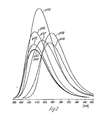
- the fluorescence of the individual cells can be excited according to the spectra in FIG. 1 in the range 300-410 nm. This results in emission spectra for the substance which has meanwhile been hydrolyzed and enriched in the cell interior, namely for 2,3-dicyanohydroquinone, which are similar to those of FIG. 2 and which were measured in free solution. It can be seen that the position of the maxima is clearly dependent on the pH.
- the amount of DDB and the rate of passage depend on the difference in the concentrations of this substance outside and inside the cell.
- the DDB that has entered the cell is hydrolysed (split) enzymatically to DH
- there is a concentration gradient for DDB as long as the solution in which the cells are incubated still has a significant concentration of DDB.
- the 10 minutes given above for the exposure conditions are sufficient to accumulate enough DH for the measurement of the fluorescence in the cell.
- the shift in the maxima of the emission spectra at different pH I values shown in FIG. 2 is recorded by measuring the fluorescence in two “light windows” and forming the quotient of the measured values.
- the dependence of the frequency at which the maximum of the emission spectrum occurs on the pH is shown in FIG. 3. Three curves are drawn there.
- the first curve (represented by small circles) shows the dependency of the wavelength of the emission peak for the original substance DH before esterification and before entering the cell interior. Between pH 5.5 and pH 8, an almost linear increase can be seen, which shows the suitability of the substance for such a measurement.
- Curve 2 shows the measurements for the esterified substance DDB, which penetrates into the cell interior. As can be seen, the esterification has the effect that the emission spectrum and the position of the peak are independent of the pH.
- Curve 3 shows the measurement after the penetration of DDB into the cell and the re-emergence of DH by hydrolysis.
- the dependency of the frequency at which the emission peak occurs on the pH value is again evident, and - which is particularly surprising - in a much wider working range, namely between pH 3 and pH 9.
- this is probably due to this that when DH arises in the cell by hydrolysis from DDB, partial ineffectiveness does not immediately occur again because the OH groups responsible for the fluorescence (at positions 1 and 4) of the DH are already partially oxidized again.
- Figure 4 now explains the diagnostic value of the measurement of the pH I value for cell population.
- Figure 4 shows three distribution curves, curve 1 (black dots) for healthy bone marrow cells from rats.
- Fig. 2 small crosses
- Fig. 3 small triangles
Landscapes
- Chemical & Material Sciences (AREA)
- Health & Medical Sciences (AREA)
- Life Sciences & Earth Sciences (AREA)
- Engineering & Computer Science (AREA)
- Organic Chemistry (AREA)
- Molecular Biology (AREA)
- Immunology (AREA)
- Biomedical Technology (AREA)
- Urology & Nephrology (AREA)
- Hematology (AREA)
- Physics & Mathematics (AREA)
- General Health & Medical Sciences (AREA)
- Inorganic Chemistry (AREA)
- Cell Biology (AREA)
- Food Science & Technology (AREA)
- Medicinal Chemistry (AREA)
- Biotechnology (AREA)
- Analytical Chemistry (AREA)
- Biochemistry (AREA)
- Microbiology (AREA)
- General Physics & Mathematics (AREA)
- Pathology (AREA)
- Investigating Or Analysing Biological Materials (AREA)
- Investigating Or Analysing Materials By The Use Of Chemical Reactions (AREA)
- Measuring Or Testing Involving Enzymes Or Micro-Organisms (AREA)
- Treatment Of Sludge (AREA)
- Organic Low-Molecular-Weight Compounds And Preparation Thereof (AREA)
Priority Applications (1)
| Application Number | Priority Date | Filing Date | Title |
|---|---|---|---|
| AT82100051T ATE20498T1 (de) | 1981-02-06 | 1982-01-07 | Verfahren zur bestimmung des ph-wertes im innern einer zelle. |
Applications Claiming Priority (2)
| Application Number | Priority Date | Filing Date | Title |
|---|---|---|---|
| DE3104078 | 1981-02-06 | ||
| DE3104078A DE3104078C2 (de) | 1981-02-06 | 1981-02-06 | Verfahren zur Bestimmung des pH-Wertes im Innern einer Zelle; 1,4-Dibutyryloxy-2,3-dicyanobenzol; 1,4-Di(-tert-butyloxycarbonyl-l-alanyloxy)-2-3-dicyanobenzol |
Publications (3)
| Publication Number | Publication Date |
|---|---|
| EP0057809A2 true EP0057809A2 (fr) | 1982-08-18 |
| EP0057809A3 EP0057809A3 (en) | 1982-09-08 |
| EP0057809B1 EP0057809B1 (fr) | 1986-06-18 |
Family
ID=6124174
Family Applications (1)
| Application Number | Title | Priority Date | Filing Date |
|---|---|---|---|
| EP82100051A Expired EP0057809B1 (fr) | 1981-02-06 | 1982-01-07 | Procédé de détermination du pH intracellulaire |
Country Status (6)
| Country | Link |
|---|---|
| US (3) | US4503148A (fr) |
| EP (1) | EP0057809B1 (fr) |
| JP (1) | JPS57148255A (fr) |
| AT (1) | ATE20498T1 (fr) |
| CA (1) | CA1194888A (fr) |
| DE (2) | DE3104078C2 (fr) |
Cited By (2)
| Publication number | Priority date | Publication date | Assignee | Title |
|---|---|---|---|---|
| US9063127B1 (en) | 2013-12-11 | 2015-06-23 | Analiza, Inc. | Devices and methods for determining and/or isolating cells such as circulating cancer or fetal cells |
| US10928405B2 (en) | 2013-12-11 | 2021-02-23 | Analiza, Inc. | Devices and methods for determining and/or isolating cells such as circulating cancer or fetal cells |
Families Citing this family (10)
| Publication number | Priority date | Publication date | Assignee | Title |
|---|---|---|---|---|
| DE3104078C2 (de) * | 1981-02-06 | 1983-07-21 | Max Planck Gesellschaft zur Förderung der Wissenschaften e.V., 3400 Göttingen | Verfahren zur Bestimmung des pH-Wertes im Innern einer Zelle; 1,4-Dibutyryloxy-2,3-dicyanobenzol; 1,4-Di(-tert-butyloxycarbonyl-l-alanyloxy)-2-3-dicyanobenzol |
| JPS6027398A (ja) * | 1983-07-26 | 1985-02-12 | Hitachi Ltd | 微生物検査方法 |
| US4916060A (en) * | 1985-09-17 | 1990-04-10 | Massachusetts Institute Of Technology | Process for chemical measurement in small volume samples by fluorescent indicators |
| US4945171A (en) * | 1987-08-10 | 1990-07-31 | Molecular Probes, Inc. | Xanthene dyes having a fused (C) benzo ring |
| US5153141A (en) * | 1991-09-04 | 1992-10-06 | Hobbs David T | Method of determining pH by the alkaline absorption of carbon dioxide |
| IL110192A (en) * | 1994-07-01 | 2000-09-28 | Israel Mini Ind & Trade | Reagent for the determination of acids in oils |
| US6547861B2 (en) * | 2000-12-26 | 2003-04-15 | Matheson Tri-Gas,, Inc. | Method and materials for purifying reactive gases using preconditioned ultra-low emission carbon material |
| JP2019515681A (ja) * | 2016-03-22 | 2019-06-13 | パービッチ サージカル イノベーション, エルエルシーParvizi Surgical Innovation, Llc | 電気化学的検査を用いた活性を有する白血球細胞の存在測定のための組成物及び方法 |
| US11104933B1 (en) | 2016-03-22 | 2021-08-31 | Cleu Diagnostics, Llc | Compositions and methods for determining the presence of active leukocyte cells using an electrochemical assay |
| US20190064165A1 (en) * | 2016-03-22 | 2019-02-28 | Parvizi Surgical Innovation, Llc | Compositions and methods for determining the presence of active leukocyte cells using an electrochemical assay |
Family Cites Families (1)
| Publication number | Priority date | Publication date | Assignee | Title |
|---|---|---|---|---|
| DE3104078C2 (de) * | 1981-02-06 | 1983-07-21 | Max Planck Gesellschaft zur Förderung der Wissenschaften e.V., 3400 Göttingen | Verfahren zur Bestimmung des pH-Wertes im Innern einer Zelle; 1,4-Dibutyryloxy-2,3-dicyanobenzol; 1,4-Di(-tert-butyloxycarbonyl-l-alanyloxy)-2-3-dicyanobenzol |
-
1981
- 1981-02-06 DE DE3104078A patent/DE3104078C2/de not_active Expired
-
1982
- 1982-01-07 DE DE8282100051T patent/DE3271709D1/de not_active Expired
- 1982-01-07 AT AT82100051T patent/ATE20498T1/de not_active IP Right Cessation
- 1982-01-07 EP EP82100051A patent/EP0057809B1/fr not_active Expired
- 1982-01-26 CA CA000394985A patent/CA1194888A/fr not_active Expired
- 1982-02-05 US US06/346,094 patent/US4503148A/en not_active Expired - Fee Related
- 1982-02-06 JP JP57018080A patent/JPS57148255A/ja active Pending
- 1982-07-02 US US06/394,784 patent/US4515730A/en not_active Expired - Fee Related
-
1984
- 1984-12-10 US US06/680,078 patent/US4677060A/en not_active Expired - Fee Related
Non-Patent Citations (7)
| Title |
|---|
| (CHISSO CORP. OSAKA, JAPAN) * |
| BIOCHEMISTRY, Band 18, nr. 11, 29. Mai 1979, Seiten 2210-2218, (USA) J.A. THOMAS et al.: "Intracellular pH measurements in Ehrlich Ascites Tumor Cells utilizing spectroscopic probes generated in situ" * |
| CHEMICAL ABSTRACTS, Band 90, nr. 19, 7. Mai 1979, Seite 258, nr. 148002f, Columbus, Ohio, (USA) J.W.M. VISSER et al.: "Intracellular pH-determination by fluorescence measurements"; & J. HISTOCHEM. CYTOCHEM. 1979, 27(1), 32-35 * |
| CHEMICAL ABSTRACTS, Band 93, nr. 7, 18. August 1980, Seite 427, nr. 65125j, Columbus, Ohio, (USA) O.V. YARANTSEVA et al.: "Fluorescence method for the determination of cell pH using the phenomenon of "fluorochromasia"; & TSITOLOGIYA 1980, 22(5), 610-613 * |
| Handbook of Chemistry and Physics, 54.Auflage (CRC-Press 1973-1974), S. D-117 und D-118 * |
| J. Chem. Soc. 1948, 303 * |
| JOURNAL OF THE CHEMICAL SOCIETY, Faraday Trans. 1, Band 73, nr. 9, 1977, Seiten 1281-1285: R.G. BROWN et al.: "Effect of pH on the emission and absorption characteristics of 2,3-dicyano-p-hydroquinone" * |
Cited By (3)
| Publication number | Priority date | Publication date | Assignee | Title |
|---|---|---|---|---|
| US9063127B1 (en) | 2013-12-11 | 2015-06-23 | Analiza, Inc. | Devices and methods for determining and/or isolating cells such as circulating cancer or fetal cells |
| US9709556B2 (en) | 2013-12-11 | 2017-07-18 | Analiza, Inc. | Devices and methods for determining and/or isolating circulating cancer cells |
| US10928405B2 (en) | 2013-12-11 | 2021-02-23 | Analiza, Inc. | Devices and methods for determining and/or isolating cells such as circulating cancer or fetal cells |
Also Published As
| Publication number | Publication date |
|---|---|
| US4677060A (en) | 1987-06-30 |
| JPS57148255A (en) | 1982-09-13 |
| DE3104078A1 (de) | 1982-08-12 |
| EP0057809B1 (fr) | 1986-06-18 |
| CA1194888A (fr) | 1985-10-08 |
| DE3104078C2 (de) | 1983-07-21 |
| ATE20498T1 (de) | 1986-07-15 |
| US4515730A (en) | 1985-05-07 |
| US4503148A (en) | 1985-03-05 |
| EP0057809A3 (en) | 1982-09-08 |
| DE3271709D1 (en) | 1986-07-24 |
Similar Documents
| Publication | Publication Date | Title |
|---|---|---|
| DE3587793T2 (de) | Lumineszierende metallchelatmarker und mittel zu deren nachweis. | |
| DE4439783C2 (de) | Fluoreszente Verbindung | |
| DE4239016C2 (de) | Verfahren zum Bestimmen der Konzentration von freien Ionen innerhalb einer Zelle unter Verwendung eines Fluoreszenzindikatorfarbstoffs | |
| EP0057809B1 (fr) | Procédé de détermination du pH intracellulaire | |
| DE2858792C2 (fr) | ||
| DE69624942T2 (de) | Screening von natürlichen proben für neue therapeutische verbindungen mittels kapillarelectrophorese | |
| DE60112585T2 (de) | Farbstoffe und Verfahren zum Nachweis von Nukleinsäure in unreifen roten Blutzellen | |
| DE69506394T2 (de) | Verfahren zum kalibrieren chemischer tests | |
| DE2618511A1 (de) | Verfahren zur bestimmung eines liganden in einem fluessigen medium und mittel zu dessen durchfuehrung | |
| EP0106339A2 (fr) | Procédé pour la détermination quantitative simultanée de cellules et réactif utilisé à cette fin | |
| DE2921975A1 (de) | Verfahren und reagens fuer die biolumineszenz | |
| EP0698217B1 (fr) | Procede permettant d'identifier des substances | |
| DE3202779A1 (de) | Kaliumreagens und verfahren zur bestimmung von kaliumionen | |
| DE60027916T2 (de) | Fluoreszierende verbindungen für die verwendung in industriellen wassersystemen | |
| DE69517179T2 (de) | Verfahren zur bestimmung glykosilierter proteine | |
| DE2858733C2 (fr) | ||
| EP0154152B1 (fr) | Procédé et réactif pour la détermination d'ions de nitrate | |
| DE60226151T2 (de) | Verbessertes verfahren zur membranpotentialmessung | |
| EP0397641B1 (fr) | Procédé pour la détermination quantitative d'au moins un paramètre chimique d'un échantillon | |
| DE3044433A1 (de) | Verfahren und mittel zur bestimmung von nitrationen | |
| DE3614647A1 (de) | 7-phenylessigsaeure-4-alkyl-coumarinylamide, verfahren zu ihrer herstellung sowie ihre verwendung in verfahren zur fluorometrischen bestimmung der aktivitaet von hydrolasen, insbesondere von penicillin-g-acylase | |
| EP0052790A1 (fr) | Procédé pour déterminer la composition de mélanges binaires liquides | |
| DE60220056T2 (de) | Verfahren zur spaltung einer in einem käfig gefangenen substanz | |
| EP0351605B1 (fr) | Détermination quantitative de phosphore | |
| DE3586511T2 (de) | Diagnostisches reagenz zur bestimmung von harnstickstoff. |
Legal Events
| Date | Code | Title | Description |
|---|---|---|---|
| PUAI | Public reference made under article 153(3) epc to a published international application that has entered the european phase |
Free format text: ORIGINAL CODE: 0009012 |
|
| PUAL | Search report despatched |
Free format text: ORIGINAL CODE: 0009013 |
|
| AK | Designated contracting states |
Designated state(s): AT BE CH DE FR GB IT LU NL SE |
|
| AK | Designated contracting states |
Designated state(s): AT BE CH DE FR GB IT LU NL SE |
|
| 17P | Request for examination filed |
Effective date: 19821230 |
|
| GRAA | (expected) grant |
Free format text: ORIGINAL CODE: 0009210 |
|
| AK | Designated contracting states |
Kind code of ref document: B1 Designated state(s): AT BE CH DE FR GB IT LI LU NL SE |
|
| REF | Corresponds to: |
Ref document number: 20498 Country of ref document: AT Date of ref document: 19860715 Kind code of ref document: T |
|
| REF | Corresponds to: |
Ref document number: 3271709 Country of ref document: DE Date of ref document: 19860724 |
|
| ET | Fr: translation filed | ||
| ITF | It: translation for a ep patent filed | ||
| PGFP | Annual fee paid to national office [announced via postgrant information from national office to epo] |
Ref country code: AT Payment date: 19870126 Year of fee payment: 6 |
|
| PG25 | Lapsed in a contracting state [announced via postgrant information from national office to epo] |
Ref country code: LU Free format text: LAPSE BECAUSE OF NON-PAYMENT OF DUE FEES Effective date: 19870131 |
|
| PGFP | Annual fee paid to national office [announced via postgrant information from national office to epo] |
Ref country code: NL Payment date: 19870131 Year of fee payment: 6 |
|
| PLBE | No opposition filed within time limit |
Free format text: ORIGINAL CODE: 0009261 |
|
| STAA | Information on the status of an ep patent application or granted ep patent |
Free format text: STATUS: NO OPPOSITION FILED WITHIN TIME LIMIT |
|
| 26N | No opposition filed | ||
| PG25 | Lapsed in a contracting state [announced via postgrant information from national office to epo] |
Ref country code: AT Effective date: 19880107 |
|
| PG25 | Lapsed in a contracting state [announced via postgrant information from national office to epo] |
Ref country code: SE Effective date: 19880108 |
|
| PG25 | Lapsed in a contracting state [announced via postgrant information from national office to epo] |
Ref country code: LI Effective date: 19880131 Ref country code: CH Effective date: 19880131 |
|
| BERE | Be: lapsed |
Owner name: MAX-PLANCK-G ZUR FORDERUNG DER WISSENSCHAFTEN E.V Effective date: 19880131 |
|
| PG25 | Lapsed in a contracting state [announced via postgrant information from national office to epo] |
Ref country code: NL Effective date: 19880801 |
|
| NLV4 | Nl: lapsed or anulled due to non-payment of the annual fee | ||
| GBPC | Gb: european patent ceased through non-payment of renewal fee | ||
| PG25 | Lapsed in a contracting state [announced via postgrant information from national office to epo] |
Ref country code: FR Free format text: LAPSE BECAUSE OF NON-PAYMENT OF DUE FEES Effective date: 19880930 |
|
| REG | Reference to a national code |
Ref country code: CH Ref legal event code: PL |
|
| PG25 | Lapsed in a contracting state [announced via postgrant information from national office to epo] |
Ref country code: DE Effective date: 19881001 |
|
| PG25 | Lapsed in a contracting state [announced via postgrant information from national office to epo] |
Ref country code: GB Free format text: LAPSE BECAUSE OF NON-PAYMENT OF DUE FEES Effective date: 19881121 |
|
| REG | Reference to a national code |
Ref country code: FR Ref legal event code: ST |
|
| PG25 | Lapsed in a contracting state [announced via postgrant information from national office to epo] |
Ref country code: BE Effective date: 19890131 |
|
| EUG | Se: european patent has lapsed |
Ref document number: 82100051.0 Effective date: 19880913 |