EP0057997A2 - Machine pour monter les parties latérales de chaussures - Google Patents
Machine pour monter les parties latérales de chaussures Download PDFInfo
- Publication number
- EP0057997A2 EP0057997A2 EP82300296A EP82300296A EP0057997A2 EP 0057997 A2 EP0057997 A2 EP 0057997A2 EP 82300296 A EP82300296 A EP 82300296A EP 82300296 A EP82300296 A EP 82300296A EP 0057997 A2 EP0057997 A2 EP 0057997A2
- Authority
- EP
- European Patent Office
- Prior art keywords
- movement
- shoe
- carriage
- support
- lasting
- Prior art date
- Legal status (The legal status is an assumption and is not a legal conclusion. Google has not performed a legal analysis and makes no representation as to the accuracy of the status listed.)
- Withdrawn
Links
Images


Classifications
-
- A—HUMAN NECESSITIES
- A43—FOOTWEAR
- A43D—MACHINES, TOOLS, EQUIPMENT OR METHODS FOR MANUFACTURING OR REPAIRING FOOTWEAR
- A43D25/00—Devices for gluing shoe parts
- A43D25/047—Devices for lasting with adhesives or for gluing together insoles and uppers
- A43D25/053—Devices for lasting with adhesives or for gluing together insoles and uppers with rotating gripping means
Definitions
- This invention is concerned with a machine for lasting side portions of shoes comprising a shoe support for supporting, bottom uppermost, a shoe comprising an upper mounted on a last and an insole on the last bottom, two side lasting assemblies, arranged one at either side of the last support, two adhesive-applying nozzles, and means for effecting relative movement between the shoe support and the nozzles in one direction to bring them to a start position and thereafter in a reverse direction whereby adhesive can be applied by the nozzles progressively along opposite side portions of the shoe bottom prior to the operation of the side lasting assemblies thereon, wherein the shoe support comprises a heel support, toe end support menas, including a toe end engaging member movable towards the heel support into an operative position, in which it is in engagement with the toe end of the shoe placed on the heel support, and abutment means including an abutment member which is operatively connected with the toe end engaging member and positioned according to the operative position thereof, and further wherein the relative movement between the shoe support and the nozzles
- a sensing member is mounted on the machine frame, for sliding movement relative thereto, whereby, as the shoe support is moved into an operative position, the sensing member is positioned in relation to the machine frame by engagement thereof by the abutment member.
- the valve means and actuator means therefor are mounted one on the sensing member and the other for movement relative thereto, as relative movement is effected between the shoe support and the nozzles as aforesaid.
- the shoe support is mounted on a carriage for movement thereon from a loading position to an operative position, and thereafter the carriage is movable to effect movement of the shoe support, with the shoe thereon, relative to the nozzles as aforesaid.
- Each side lasting assembly of said machine furthermore, comprises a lasting roll which is rotatable about an axis extending widthwise of the shoe bottom and comprises a wiping element disposed helically about the circumference thereof, each roll being arranged to track along a side portion of the shoe bottom immediately following the application of adhesive thereto by the nozzle associated with said lasting roll.
- the lasting rolls are again mounted on the machine frame and movement of the carriage on which the shoe support is mounted is effective to cause relative movement to take place between the lasting rolls and the shoe bottom.
- the machine also comprises control means whereby the angular relationship between each lasting roll and the shoe bottom can be varied, to accommodate changes in the control of the shoe bottom.
- the nozzles and lasting rolls be mounted on a carriage for movement in a direction extending widthwise of the shoe bottom to be operated upon, whereby to control the initial position of the nozzles, widthwise of the shoe bottom, prior to being brought into engagement with the shoe bottom, and also it has been proposed that the speed of relative movement between the shoe support and the nozzles and lasting rolls in a direction extending lengthwise of the shoe bottom be varied during the course of such movement, thus to enable a more uniform amount of adhesive to be applied, depending upon the contour of the shoe bottom, and be more reliably lasted by the lasting rolls.
- the variation of the angular relationship between the lasting rolls and the shoe bottom is arranged to take place at the ball region of the shoe, and it will be appreciated that the position of the ball region of the shoe on the shoe support varies proportionately with the overall length of the shoe.
- the position of the abutment member on the shoe support is such that it moves proportionately to the toe end engaging member, in a relationship equivalent to the proportionate variation of the ball region in relation to the shoe length.
- the start position for the nozzles is at a fixed distance from the toe end of the shoe, according to the size of toe lasting plate which has been used in a previous toe lasting operation.
- the valve means and actuator means therefor referred to above are positioned by the abutment member operating through a grading mechanism, which is effective to scale up the movement of the abutment member to equal the full amount of movement of the toe end engaging member.
- the control means also comprises a sensing member mounted on the carriage, for sliding movement relative thereto, and resiliently urged into a projecting condition thereon, the arrangement being such that, as the carriage is advanced towards the shoe support, with the sensing member in its projecting condition, movement ' of the sensing member therewith is arrested by engagement with the abutment member and the sensing member is thus held against further movement during the remainder of the advancing movement of the carriage, and in that the valve means and the actuator means therefor are mounted one on the sensing member and the other for movement with the carriage, the arrangement being such that the valve means is actuated as aforesaid during the advancing movement of the carriage, after movement of the sensing member therewith has been arrested.
- valve means comprises two valves actuation by the actuator means of a first of which causes the advancing movement of the carriage to be arrested and the nozzles to be lowered into engagement with a central portion of the shoe bottom, whereafter such advancing movement is continued until actuation by the actuator means of the second of said valves, such actuation causing the advancing movement to be terminated, the nozzles to be moved outwardly towards the shoe bottom margin, and movement of the carriage in a reverse direction to be initiated, whereby the nozzles are caused to apply adhesive progressively along the side portions of the shoe bottom as aforesaid.
- the abutment member is connected to the toe end engaging member through a support which can thus be positioned according to the operative position of said member and on which the abutment member is mounted for adjusting movement by the operator.
- the abutment member may be mounted for rocking movement on the support therefor, a ratchet arrangement being provided for holding the member in adjusted position on the support, and the rocking movement facilitating disengagement of the ratchet arrangement to enable adjustment of the abutment member to take place.
- the side lasting assemblies of the machine in accordance with the invention each comprise a lasting roll which is rotatable about an axis extending widthwise of the shoe bottom and comprises a wiping element disposed helically about the circumference thereof, each roll being arranged to track along a side portion of the shoe bottom immediately following the application of adhesive thereto by the nozzle associated with said lasting roll.
- the side lasting assemblies are so constituted, preferably the angular relationship between each lasting roll and the shoe bottom can be varied, during the operating cycle to accommodate changes in the -contour of the shoe bottom.
- the side lasting assemblies may also be mounted on the carriage by which the nozzles are supported, and, for controlling said angular relationship
- said control means comprises a further sensing member, which is connected, through a grading arrangement, with a carrier member, valve means, actuation of which causes the angular relationship between the lasting rolls and shoe bottom to be varied as aforesaid, and actuator means for said valve means, said valve means and said actuator means being mounted one on said carrier member and the other for movement with the carriage, and in that said further sensing member is mounted for movement independently of the carriage and is brought into engagement with a further abutment member, associated with the first-mentioned abutment member, when movement of the carriage is initiated, whereby to position the further sensing member and thus, through the grading arrangement, the carrier member in relation to the shoe bottom to be operated upon, according to the position of the toe end engaging member.
- the nozzles and lasting rolls may be mounted on the carriage for movement in a direction extending widthwise of the shoe bottom to be operated upon, whereby to control the initial position thereof, widthwise of the shoe bottom, prior to being brought into engagement with the shoe bottom, fluid pressure operated means being provided for effecting such movement.
- the control means may also comprise further valve means, by which the supply of pressure fluid to said fluid pressure operated means is controlled, and actuator means for the further valve means, said further valve means and actuator means being mounted one on said carrier member and the other for movement with the carriage.
- control means for controlling the operation of the speed control means, conveniently also comprises still further valve means, which controls the supply of pressure fluid to the speed control means, and actuator means therefor, said still further valve means and actuator means therefor being mounted one on said carrier member and the other for movement with the carriage.
- each of the operations of the machine in accordance with the invention which are to take place at the ball region of the shoe bottom are under the control of the further abutment member and its associated parts.
- the grading arrangement comprising a lever to which the carrier member is connected, at a position intermediate the length of the lever, and the lever being mounted at one end on a frame portion of the machine for pivotal movement thereon, while its other end is pivotally connected to the further sensing member, the arrangement being such that movement of the carrier member is limited by engagement of the further sensing member with the further abutment member, the ratio between such movement of the carrier member and that of the further sensing member being the same as the ratio between the distances between the pivot point of the lever and the points along the length of the lever at which respectively the carrier member and further sensing member are connected to the lever.
- the machine now to be described is a machine for lasting side portions of shoes, forming part of a heel seat and side lasting apparatus which comprises a transporting device having a loading station and three operating stations, at a first of which the side lasting machine is arranged.
- the device comprises a turret arrangement having four arms 18 arranged in cross-form, each arm supporting a shoe support generally designated 20.
- Each shoe support comprises a mounting 22, including a sleeve portion 24 at an upper end of which is a heightwise adjustable collar 26, for a heightwise slidable rod 28 carrying a heel support member 30 with an upwardly projecting last pin 32.
- Each shoe support 20 also comprises toe support means generally designated 34 comprising a carriage 36 slidable, towards and away from the sleeve portion 24, on two rods 38 carried by upstanding plates 40 on the arm 18.
- the carriage 36 carrier a transversely slidable plate 42, which can be locked by locking means 44, in adjusted widthwise position. In this way, the toe support means can be set for a left or a right shoe.
- the slide plate 42 carries two support plates 46, on upper end portions of which is carried a V-shaped toe end engaging member 48.
- the support plates 46 also support a bell crank lever 50 parallel with an upper arm of which are two parallel levers 52, a link 54 extending between the upper arm of the bell crank lever and said further levers, thus forming a parallel linkage arrangement.
- the levers 52 carry a support post 56 for a toe pad member 58, which can engage a toe cap portion of a shoe supported on the last support.
- a downwardly depending arm of the bell crank lever 50 engages with a block 60 slidable on the rods 38 independently of the carriage 36.
- a link 62 is one arm of a bell crank lever 64, pivotally mounted on the mounting 22, the other arm of which carries a roller 66 which can be engaged by a pusher block 68 carried on a piston rod of a piston-and-cylinder arrangement 70 mounted on a frame portion 72.
- Actuation of said arrangement 70 thus causes the toe end engaging member to move to engage a shoe carried by the heel support, and continued operation of the arrangement 70 after such engagement is effective, through the parallel linkage arrangement, to raise the toe pad 58 into engagement with the toe cap portion of the shoe.
- the toe end engaging member 48 forms part of shoe length sensing means, also comprising an arm 74 secured to the carriage 36 and projecting towards the heel support.
- the arm 74 carries a slide rod 76 on which a block 78 is slidable, said block carrying a metal strip 80 and also an abutment member 82 an end face 84 or which, facing the heel support, constitutes an abutment face.
- a spring-urged plunger 88 captive in the block 78, urges the serrations into meshing engagement.
- the block can rock on the rod 76 to disengage the serrations, to allow the position of the member 82 to be adjusted lengthwise of the shoe bottom.
- the abutment.face 84 can be set according to the size of the wiper plates used in a previous toe lasting operation.
- an end face 90 of the arm 74 provides a further abutment face, the position'of which is determined by the position to which the toe end engaging member 48 is moved as aforesaid.
- a plate 92 is slidable on one of the rods 38 and is connected to a heelward face of the block 60 whereby to constitute a bar lock arrangement, said arrangement allowing the toe support means to move towards the heel support, while preventing movement thereof away from said support.
- a piston-and-cylinder arrangement 94 For bringing the heel seat of a shoe supported on the last pin 32 to a datum height position, a piston-and-cylinder arrangement 94 is provided a piston tod of which carries a pusher member 96 engageable with a head portion on the lower end of the rod 28 at the loading station.
- a bar lock arrangement comprising a plate 98 secured to the under-side of the mounting 22, is also provided for locking the rod in adjusted position.
- a heel height determining member 100 is provided having a heel seat engaging surface 102.
- the arm 100 is carried by a block 104, itself adjustable heightwise by means of an adjusting screw 106.
- the block 104 is supported by a shaft 108, movable heightwise by a piston-and-cylinder arrangement 110.
- the shaft 108 supported within a support column 112, has a pin (118) and slot (116) connection with a supporting bush portion 114, the slot 116 being part-helical and part-vertical, so that, as the shaft 108 is moved heightwise, it is rotated between an operative position, in which it is disposed above the last pin 32, in a datum position, and an out-of-the-way position.
- the heel height determining member 100 is thus moved on actuation of a thumb switch 122 in a hand grip 120 thereof, said actuation also initiating, in sequence, operation of the piston-and-cylinder arrangements 94 and 70.
- Each shoe support 20 also comprises a pair of side clamp members 186, each member being of a plastic material, e.g. polytetrafluoroethylene, and being shaped generally to the side portions of the shoe to be operated upon.
- Each member 186 is supported by a post 188 on a block 190 which is in turn carried on an arm 192 supported by a vertical shaft 194.
- Each shaft 194 is carried by the base support 16 of the turret arrangement.
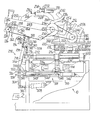
- the side lasting machine (Fig.2) comprises a main frame 210 including two pairs of support blocks 212 each part supporting a slide rod 214, extending, in a direction lengthwise of the shoe bottom.
- a carriage 216 which itself includes two pairs of support blocks 218, each pair supporting a slide rod 220 extending widthwise of the shoe bottom.
- Mounted for movement along the slide rods 220 is a support plate 222 on which side lasting instrumentalities and adhesive-applying means are mounted.
- the side lasting isntrumentalities comprise two lasting rolls 224, each roll being rotatable about an axis extending widthwise of the shoe bottom and comprising a wiping element disposed helically about the circumference thereof.
- Each roll is mounted on a shaft 228, operatively connected, by means of pulleys 226, 232 and a belt 230, to a shaft 234 in turn operatively connected by pulleys 236, 240 and a belt 238 to an output drive shaft 242 of an electric motor 244 carried on the support plate 222.
- Each lasting roll 224 is supported in a housing 246 which is mounted, for pivotal movement about an axis extending generally lengthwise of the shoe bottom, in a support frame 248, a fluid pressure operated piston-and-cylinder arrangement 250 being mounted on the support frame and a piston rod 252 thereof being connected to the housing for effecting such pivotal movement, whereby to vary the angular relationship between each lasting roll 224 and the shoe bottom, such variation being able to take place during the operating cycle of the machine.
- the support frame 248 is pivotally mounted on a cross-shaft 278 carried by a bracket 280 on the support plate 222 and extending widthwise of the shoe bottom, its axis coincident with that of the shaft 234.
- a piston-and-cylinder arrangement 258 carried on a bracket 260 on the plate 222 is operatively connected, through its piston rod 256, to a rearward extension 254 of the support frame 248, thus to cause the rolls 224 to be moved into and out of operative engagement with the shoe bottom, and also to maintain a resilient pressure on the rolls during the lasting operation.
- the adhesive-applying means comprises two nozzles 262, each depending from a melt changer 264, which in turn is carried by a carrier arm 266.
- Each arm 266 is mounted, for pivotal movement about an axis extending heightwise of the shoe bottom, on a further arm 268, whereby the nozzles can be moved widthwise of the shoe bottom and thus follow the contour of the shoe bottom as they are caused to track therealong.
- the nozzles 262 can be moved between an initial condition, in which they are positioned adjacent one another and an operating condition, in which they can follow the outside contour of the shoe bottom, by a piston-and-cylinder arrangement 270, carried on its associated arm 268, and a piston rod 272 of which can be urged into engagement with a bracket 274 on an arm 276 secured to the arm 266.
- Each arm 268 is mounted on the cross-shaft 278, a piston-and-cylinder arrangement 282 being associated therewith, and each arrangement being supported on a bracket 284 on the bracket 280, and acting on a lever 286 secured to its associated arm 268, thus to cause each nozzle to be moved, independently of the other, heightwise of the shoe bottom.
- a piston-and-cylinder arrangement (now shown) is provided which is thus effective to cause the nozzles and lasting rolls to track progressively along opposite side portions of the shoe bottom.
- a lever 288 is mounted, pivotally at its centre, on the under-side of the support plate 222, and has connected to each end thereof a piston-and-cylinder arrangement 290. By operating a selected one or both of said arrangements 290, the support plate can be positioned in one of three positions widthwise of the shoe bottom.
- the nozzles and rolls can be positioned in relation to the shoe bottom in one of three widthwise positions so as to ensure that, regardless of the shoe bottom shape, the nozzles, in their initial condition, can be brought into engagement with the shoe bottom at a position centrally thereof (considered widthwise), and similarly it can be ensured that the lasting rolls engage the lasting margin of the shoe bottom as they are brought into engagement therewith.
- the side lasting machine also comprises heel end support means generally designated 292 comprising two side clamps 294 supported by two pivoting arms 296 carried by a support post 298.
- the arms 296 have rearward extensions between which is arranged a piston-and-cylinder arrangement 322, thus to cause the side clamps 294 to clamp the heel end of a shoe presented thereto.
- the support post 298 is itself mounted for pivotal movement, about an axis extending widthwise of the shoe bottom, on a shaft 300 carried on a bracket 302 on the frame 210 of the machine.
- a link 304 is secured to a piston rod 306 of a piston-and-cylinder arrangement 308 carried on the frame 210, whereby to enable the side clamps 294 to be moved into and out of an operative position.
- the heel end support means 292 also comprises a holddown foot 312 pivotally secured in bracket 310 on the post 298, a piston-and-cylinder arrangement 314 being carried on the post 298, and the piston rod 316 thereof being connected, through a lever 318, pivoted on the support post 298, and a link 320 with an intermediate portion of the holddown foot, whereby the holddown foot can be moved into and out of operative engagement with a shoe.
- valve 358 associated with the holddown member 312 is a sensor in the form of a valve 358 which, in a normal cycle of operation in which a shoe is supported by the shoe support 20, remains unactuated, but which, in the event of no shoe being so supported, is actuated by the holddown member 312 effecting an overtravel.
- the valve 358 thus acts as a "no shoe” indicator. If valve 358 is actuated, the movement of the carriage 216 towards the shoe support is interrupted and the carriage is returned to its initial position.
- control means generally designated 324 which co-operates with the abutment faces 84, 90 associated with the toe support means 34 of the shoe support 20 presented at the first operating station. More specifically, for co-operating with the abutment face 84, a rod 326 is mounted on a support plate 328 carried on the carriage 216, the rod 326 being mounted for sliding movement, in a direction lengthwise of the shoe bottom, on siad plate.
- the rod 326 carries a plurality of (in this case two) cam portions 330, 332, arranged to actuate respectively valves 334, 336 mounted on the support plate 328.
- the widthwise position of the support plate 222 in relation to the carriage 216 will already have been determined, according to whether it is desired that the nozzles be brought into engagement with the shoe bottom in an offset condition or in a centralised condition, according to the shape of the shoe bottom; this selection can be made by manual operation of an appropriate switch (not shown).
- valve 336 is actuated by the cam portion 332, whereupon the carriage movement is terminated, the nozzles are moved outwardly under the action of piston-and-cylinder arrangements 270, and then the movement of the carriage 216 takes place in a reverse direction, thus to cause the nozzles to begin applying adhesive progressively along opposite side portions of the shoe bottom.
- the lasting rolls 224 which are arranged toewardly of the nozzles, reach the point at which adhesive application has begun, they too are brought into engagement with the shoe bottom, by operation of the piston-and-cylinder arrangements 258, and are caused to track progressively along the shoe bottom, thus to cause lasting marginal portions of the upper to be wiped over and pressed against corresponding marginal portions of the insole.
- the nozzles 262 engage over edge portions of the insole, whereafter the piston-and-cylinder arrangements 270 act to urge the nozzles inwardly, thereby maintaining them in contact with the edge portion of the insole, which serves in this manner to guide the nozzles appropriately along the insole edge. It is, however, envisaged within the scope of the present invention that other systems of nozzle guidance may be utilised.
- the control means 324 also comprises a further rod 338 arranged to engage the abutment face 90 associated with the shoe support, as the carriage 216 is moved there- towards as aforesaid.
- the rod 338 is mounted for sliding movement, in a direction extending lengthwise of the shoe bottom, in mountings on a plate 340, on which also a lever 342 is pivotally mounted.
- the lever 3 42 is connected to an intermediate portion of the rod 338, while, at an intermediate portion, it is connected to a control rod 344 which is also mounted for sliding movement, in a direction parallel to the rod 338, in mountings on the plate 340, a piston-and-cylinder arrangement 346 being p provided, a piston rod 348 of which is connected to the rod 344, and thus through the lever 342, of the rod 338.
- the arrangement of the rods 338, 344 and lever 342 constitutes a grading arrangement whereby the rod 338 is moved proportionately to rod 334, the proportion of such movement being in the ration 26:14 (which is generally considered to be the ratio between the overall length of a shoe and the distance of the ball region thereof from the heel end).
- the control rod 344 has a plurality of (in this case, two) cam portions 350, 352 arranged to actuate respectively valves 354, 356 mounted on the carriage 216 for movement therewith.
- Valve 354 is effective, when actuated, to operate piston-and-cylinder arrangements 290 to vary the position of the support plate 222, and thus the lasting rolls supported thereby, widthwise of the machine, while valve 356 when actuated, is effective to operate piston-and-cylinder arrangements 250 to cause the housings 246 for the lasting rolls 224 to pivot thus to vary the angular relationship of the lasting rolls 224 to the shoe bottom.
- the timing of both these operations is dependent upon the shoe length (as opposed to the timeing of the operations controlled by the rod 326, which are dependent upon the size of toe lasting plates which have been used for a prior toe lasting operation), and both operations take place generally in the ball region of the shoe.
- piston-and-cylinder arrangement 346 is operated to urge the rod 338 to a projecting position so that, as the carriage 216 is advanced towards the shoe support, the rod 338 engages the face 90 of the arm 74 and is thereafter maintained in contact with said face during the rearward movement of the carriage.
- the valves carried thereby are actuated by the cam portions 350,352 in sequence, as above described.
- the heel end support means Prior to the initiation of the movement of the carriage 216 as aforesaid, the heel end support means is swung about the shaft 300 to bring the support post 298 to a vertical position, whereafter the side clamps 294 are operated to clamp the shoe in the region of the cone of the last.
- the side clamp members 186 associated with the shoe support 20 are operated to clamp the upper of the shoe against its last in the region of the joint, such operation being under the control of piston-and cylinder arrangements 206, as above described.
- the holddown member 312 is operated to hold the insole against the last bottom during the side lasting operation.
- the movement of-the carriage 216 in a return direction is terminated by a further valve (not shown) mounted on the machine frame 210 and actuated by an actuator (also not shown) mounted on the support plate 328.
- Actuation of said valve is first effective to raise the nozzles 262 out of engagement with the shoe bottom, and thereafter to raise the lasting rolls 224 out of such engagement, at the same time as the arrest of the movement of the carriage.
- actuation of said valve is effective to cause the carriage 216 to move again through a limited distance towards the shoe support, which position then constitutes the rest position of the carriage.
- the rod 326 constitutes a sensing member
- the valves 334, 336 and cam portions 330, 332 constitute valve means and actuator means therefor, for controlling the movement of the carriage 216.
- the rod 338 constitutes a further sensing member and the control rod 334 a carrier emmber associated with the grading arrangement, these various integers serving, in combination with the valves 354, 356 and cam portions 350, 352 (constituting valve means and actuator means therefor), respectively to control the movement of the carriage 216 in a direction extending widthwise of the shoe bottom and to vary the angular relationship between each lasting roll and the shoe bottom.
- the control rod 344 also carries a further cam portion (not shown) for actuating a further valve (also not shown) mounted on the carriage 216, said further valve being arranged to cause the speed at which the carriage 216 is moved in a return direction as aforesaid to be varied during the course of such movement.
- This facility may be of particular advantage where the contour of the shoe bottom especially in the joint region thereof, is steeply inclined inwardly so that, for a relatively short amount of lengthwise movement of the carriage 216, the nozzles move at a relatively high rate, because of the extra distance they cover in moving inwardly.
- the lasting rolls in traversing over the joint region, also move at a relatively high rate for a small amount of movement of the'carriage.
- the cam portion and valve just hereinbefore metnioned constitute part of speed control means of the machine.
- a machine in accordance with the invention forms part of an apparatus including a turret arrangement with a plurality of shoe supports for successive automatic presentation to the machine
- a machine in accordance with the invention otherwise similar to the machine just described may comprise a single, fixed, shoe support located at its operating locality.
Landscapes
- Footwear And Its Accessory, Manufacturing Method And Apparatuses (AREA)
Applications Claiming Priority (2)
| Application Number | Priority Date | Filing Date | Title |
|---|---|---|---|
| GB8102296 | 1981-01-26 | ||
| GB8102296 | 1981-01-26 |
Publications (2)
| Publication Number | Publication Date |
|---|---|
| EP0057997A2 true EP0057997A2 (fr) | 1982-08-18 |
| EP0057997A3 EP0057997A3 (fr) | 1985-07-31 |
Family
ID=10519229
Family Applications (1)
| Application Number | Title | Priority Date | Filing Date |
|---|---|---|---|
| EP82300296A Withdrawn EP0057997A3 (fr) | 1981-01-26 | 1982-01-21 | Machine pour monter les parties latérales de chaussures |
Country Status (3)
| Country | Link |
|---|---|
| US (1) | US4404700A (fr) |
| EP (1) | EP0057997A3 (fr) |
| CA (1) | CA1174402A (fr) |
Cited By (1)
| Publication number | Priority date | Publication date | Assignee | Title |
|---|---|---|---|---|
| US8703499B2 (en) | 2009-04-27 | 2014-04-22 | E-Vitae Pte. Ltd. | On-chip laboratory for blood analysis |
Families Citing this family (2)
| Publication number | Priority date | Publication date | Assignee | Title |
|---|---|---|---|---|
| US4939805A (en) * | 1989-06-13 | 1990-07-10 | International Show Machine Corporation | Heel laster |
| GB8918037D0 (en) * | 1989-08-07 | 1989-09-20 | British United Shoe Machinery | Shoe support |
Family Cites Families (4)
| Publication number | Priority date | Publication date | Assignee | Title |
|---|---|---|---|---|
| US3651526A (en) * | 1970-03-03 | 1972-03-28 | Takero Ogawa | Lasting device for shoes |
| US3758904A (en) * | 1973-01-22 | 1973-09-18 | J Kamborian | Method and mechanism for applying cement in the corner between an upper margin and an insole |
| US4082060A (en) * | 1977-01-26 | 1978-04-04 | International Shoe Machine Corporation | Cement side and heel lasting machine |
| GB2047577B (en) * | 1979-04-28 | 1983-01-26 | British United Shoe Machinery | Applying adhesive to shoe upper margins/insoles |
-
1982
- 1982-01-21 EP EP82300296A patent/EP0057997A3/fr not_active Withdrawn
- 1982-01-25 US US06/342,713 patent/US4404700A/en not_active Expired - Fee Related
- 1982-01-26 CA CA000394980A patent/CA1174402A/fr not_active Expired
Cited By (1)
| Publication number | Priority date | Publication date | Assignee | Title |
|---|---|---|---|---|
| US8703499B2 (en) | 2009-04-27 | 2014-04-22 | E-Vitae Pte. Ltd. | On-chip laboratory for blood analysis |
Also Published As
| Publication number | Publication date |
|---|---|
| EP0057997A3 (fr) | 1985-07-31 |
| CA1174402A (fr) | 1984-09-18 |
| US4404700A (en) | 1983-09-20 |
Similar Documents
| Publication | Publication Date | Title |
|---|---|---|
| US5722103A (en) | Toe and side and heel lasting machine and method of lasting | |
| GB1454939A (en) | Cement lasting machine | |
| EP0113192B1 (fr) | Dispositif de montage de la partie de pointe et des parties cambrées d'une chaussure | |
| US4082060A (en) | Cement side and heel lasting machine | |
| EP0057997A2 (fr) | Machine pour monter les parties latérales de chaussures | |
| US4400839A (en) | Machine for lasting heel seat portions of shoes | |
| US3077098A (en) | Bottom roughing equipment for slip shoes | |
| EP0210824B1 (fr) | Machine de montage de la partie talon | |
| US3849818A (en) | Adhesive control for shoe lasting machine | |
| US4407033A (en) | Combination toe and side lasting machine | |
| GB2091535A (en) | Automatically controlling shoe machinery as a lasted assembly is conveyed therethrough | |
| US2869155A (en) | Heel and shank lasting machines | |
| GB2052950A (en) | Machine for lasting heel seat portions of shoes | |
| US5263216A (en) | Machine for lasting side and heel seat portions of shoes | |
| US4467487A (en) | Shoe upper conforming machine | |
| GB1048813A (en) | Improvements in or relating to shoe upper conforming machines | |
| GB1158743A (en) | Lasting Machine | |
| US4435869A (en) | Shoe lasting machines | |
| US4377876A (en) | Shoe lasting machine | |
| US5678269A (en) | Toe and side and heel lasting machine and method of lasting | |
| US3178742A (en) | Lasting machine | |
| US4380524A (en) | Cement applying machine and method | |
| US3657756A (en) | Combined heel, forepart and cement-lasting machine | |
| US3365737A (en) | Shoe lasting machines | |
| USRE26860E (en) | Method and apparatus for clamping an end of a shoe assembly |
Legal Events
| Date | Code | Title | Description |
|---|---|---|---|
| PUAI | Public reference made under article 153(3) epc to a published international application that has entered the european phase |
Free format text: ORIGINAL CODE: 0009012 |
|
| AK | Designated contracting states |
Designated state(s): DE FR GB IT |
|
| 17P | Request for examination filed |
Effective date: 19830204 |
|
| PUAL | Search report despatched |
Free format text: ORIGINAL CODE: 0009013 |
|
| AK | Designated contracting states |
Designated state(s): DE FR GB IT |
|
| STAA | Information on the status of an ep patent application or granted ep patent |
Free format text: STATUS: THE APPLICATION IS DEEMED TO BE WITHDRAWN |
|
| 18D | Application deemed to be withdrawn |
Effective date: 19850801 |
|
| RIN1 | Information on inventor provided before grant (corrected) |
Inventor name: BERRILL, WILLIAM HERBERT Inventor name: PRICE, FRANK CHRISTOPHER |