EP0058037B1 - Vorrichtung zur Bildung einer konstanten Umdrehungsgeschwindigkeit aus einer variablen Eingangsgeschwindigkeit - Google Patents
Vorrichtung zur Bildung einer konstanten Umdrehungsgeschwindigkeit aus einer variablen Eingangsgeschwindigkeit Download PDFInfo
- Publication number
- EP0058037B1 EP0058037B1 EP82300523A EP82300523A EP0058037B1 EP 0058037 B1 EP0058037 B1 EP 0058037B1 EP 82300523 A EP82300523 A EP 82300523A EP 82300523 A EP82300523 A EP 82300523A EP 0058037 B1 EP0058037 B1 EP 0058037B1
- Authority
- EP
- European Patent Office
- Prior art keywords
- speed
- electrical generator
- input
- pump
- epicyclic gear
- Prior art date
- Legal status (The legal status is an assumption and is not a legal conclusion. Google has not performed a legal analysis and makes no representation as to the accuracy of the status listed.)
- Expired
Links
- 238000006243 chemical reaction Methods 0.000 claims abstract description 31
- 238000012544 monitoring process Methods 0.000 claims abstract description 11
- 230000005540 biological transmission Effects 0.000 claims description 13
- 230000008878 coupling Effects 0.000 claims description 12
- 238000010168 coupling process Methods 0.000 claims description 12
- 238000005859 coupling reaction Methods 0.000 claims description 12
- 239000012530 fluid Substances 0.000 claims description 8
- 238000006073 displacement reaction Methods 0.000 claims description 7
- 230000004075 alteration Effects 0.000 claims description 2
- 239000007788 liquid Substances 0.000 claims 1
- 238000000034 method Methods 0.000 abstract 1
- 230000002441 reversible effect Effects 0.000 description 9
- XLYOFNOQVPJJNP-UHFFFAOYSA-N water Substances O XLYOFNOQVPJJNP-UHFFFAOYSA-N 0.000 description 4
- 230000008859 change Effects 0.000 description 3
- 230000005611 electricity Effects 0.000 description 3
- 230000033001 locomotion Effects 0.000 description 3
- 230000009467 reduction Effects 0.000 description 3
- 230000001419 dependent effect Effects 0.000 description 2
- 230000000694 effects Effects 0.000 description 2
- 230000009471 action Effects 0.000 description 1
- 238000013016 damping Methods 0.000 description 1
- 239000000446 fuel Substances 0.000 description 1
- 238000009434 installation Methods 0.000 description 1
- 238000012423 maintenance Methods 0.000 description 1
- 230000007246 mechanism Effects 0.000 description 1
- 238000010248 power generation Methods 0.000 description 1
- 239000007787 solid Substances 0.000 description 1
Images

Classifications
-
- H—ELECTRICITY
- H02—GENERATION; CONVERSION OR DISTRIBUTION OF ELECTRIC POWER
- H02P—CONTROL OR REGULATION OF ELECTRIC MOTORS, ELECTRIC GENERATORS OR DYNAMO-ELECTRIC CONVERTERS; CONTROLLING TRANSFORMERS, REACTORS OR CHOKE COILS
- H02P29/00—Arrangements for regulating or controlling electric motors, appropriate for both AC and DC motors
- H02P29/0016—Control of angular speed of one shaft without controlling the prime mover
Definitions
- This invention relates to apparatus for producing a constant rotational output speed from a variable speed input.
- One example of an application for apparatus according to the invention is in the generation of alternating current electricity from a power source which provides a variable speed output, such as a marine prime mover, or wind or water- powered devices.
- the frequency of the current produced will also vary, causing problems with some electrical equipment. For example, clocks will not keep correct time, and AC motors will run at variable speeds. Similarly, if a DC generator is used, the voltage of the current produced will also vary.
- the present invention has been developed primarily, though not exclusively, with a view to providing apparatus which can produce a constant speed output drive, from a power source which supplies an input to the apparatus at a speed which may fluctuate, for the purposes of electrical power generation.
- a constant speed output drive is necessary.
- the generation of electrical power on board a ship can be derived from the prime mover of the ship, when it is not in port, since this is more economical than to operate a secondary auxiliary engine.
- a disadvantage of using the prime mover is that its speed, and that of the drive train, from the prime mover to an AC generator, may vary depending upon external factors e:g. if the ship is sailing through a storm. When a ship is crusiing at a nominally constant speed, it might be expected the ship's engine(s) and propeller(s) would be rotating at a constant speed, but this is not always the case.
- the known arrangement provides a controlled drive transmission for an electrical generator from a power source (a turbojet engine) which will normally provide input power at a substantially constant speed, or in which the speed will vary only gradually following operation of the throttle of the engine.
- the known arrangement can therefore respond satisfactorily to gradual changes of input rotation from a power source, but cannot respond readily to abrupt changes in input speed.
- the known arrangement does not incorporate any damping means for absorbing the effect on the transmission unit of any sudden changes of input speed.
- an electrical generator drive comprising a power source to transmit power at a rotational speed which may fluctuate substantially in service, an electrical generator which requires a rotational input of power at a substantially constant speed, and a controllable drive transmission coupling together the power source and the electrical generator, said drive transmission comprising:
- An electrical generator drive according to the invention may be operated by any convenient power source.
- the prime mover of the ship may be used as the power source.
- other power sources may be employed, including air or wind driven devices, or water driven devices.
- substantially constant frequency electrical power can be obtained by driving a marine generator from the output member of the epicyclic gear.
- Marine generators usually run at either 1200 or 1800 r.p.m., in order to generate 60 Hz electricity, in which case it is preferable to provide a variable ratio step-up drive when the ship is powered by a diesel engine.
- a variable ratio step-down drive could be more appropriate.
- suitable power sources may be coupled with the electrical generator drive which are rotated by the use, for example, of tidal powered, or wind-powered devices.
- other means of deriving energy from natural sources may comprise a power source which takes energy from the rise and fall of waves e.g. as disclosed in GB PS1,601,467.
- the preferred control means coupled with the reaction member, to vary the relative rotation between the reaction member and the other members of the epicyclic gear comprises a linked arrangement of first and second hydraulic pump/ motors. At least one of the pump/motors is of variable displacement, or variable and reversible displacement, and the arrangement of the pump/ motors is such that the reaction member is coupled with one of them, so as to vary the speed of rotation, or speed and direction of rotation, respectively of the reaction member. In this manner, the necessary relative rotation between the reaction member and the other members of the epicyclic gear can be achieved, so as to maintain a substantially constant predetermined output speed of the output member when fluctuation occurs in the speed of the input member.
- reaction member of the epicyclic gear may be driven by a variable speed or reversible, variable speed electric or pneumatic motor.
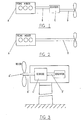
- Figures 1 and 2 show diagrammatically the basic layouts of conventional ship drive trains.
- Figure 1 shows a prime mover, e.g. a slow or medium speed diesel engine or turbine, driving the propeller via a reduction gearbox.
- Figure 2 shows a similar train in which the prime mover, e.g. a slow speed diesel engine, drives the propeller directly.
- the prime mover e.g. a slow speed diesel engine
- Figures 3 shows diagrammatically the drive train for an aerogenerator.
- the drive train comprises a wind turbine of variable speed coupled through the apparatus to a generator.
- the points of power source for the apparatus equivalent to positions shown in Figure 1, are shown as B', C' and D', and are:-
- An epicyclic gear consists of three basic elements which are the sun wheel, the carrier supporting a plurality of planetary pinions and an annulus gear; any one of these basic elements may act as the input member, a second may act as the output member and the third will become the reaction member of the epicyclic gear.
- the reaction member may be caused to revolve in either sense of rotation or be held stationary i.e. the relative rotation between the reaction member and the other members of the epicyclic gear may be varied.
- the ratio of the epicyclic gear may be infinitely and steplessly varied within given limits by turning the reaction member from its maximum negative speed of roation, or vice versa through zero to its maximum positive speed of rotation.
- Figures 4, 5 and 6 show the basic planetary, star and solar epicyclic gear arrangement to achieve the variable-ratio gearing described in the preceding paragraph.
- solid arrows indicate the movement of power from left to right through the gear trains and this section of the specification is written on this basis; however, the power could equally well pass from right to left, as indicated by the dotted arrowheads.
- the elements of the epicyclic gear are marked for clarity as follows:-
- the reaction member of the epicyclic gear is the annulus wheel in the planetary arrangement ( Figure 4), the planet carrier in the star arrangement ( Figure 5), and the sun wheel in the solor arrangement ( Figure 6).
- the reaction member is rotatably connected to a first hydraulic pump/motor H1, either directly as in Figure 6 or indirectly via gearing as in Figure 4 or indirectly via gearing and rotatable structural members as in Figure 5.
- Hydraulic pump/motors are usually used in pairs and in Figures 4, 5 and 6, the second hydraulic pump/motor may either be rotatably connected via gearing to the input shaft, where it is designated H2A, or to the output shaft where it is designated H2B.
- Hydraulic pump/motors H1 and either H2A or H2B would be interconnected by two pipes (not shown for clarity) thus forming a closed loop around which hydraulic fluid may be circulated by either one acting as a pump and causing the other to be operated as a motor.
- one of the pair of hydraulic pump/motors H1 or H2A (or H2B) would be fitted with a reversible, variable swash plate so that the quantity and direction of oil being circulated through the closed pipe loop and through the other of said pair of hydraulic pump/motors may be varied.
- the speed and sense of rotation of the reaction member may be varied infinitely between a given speed of anticlockwise rotation, through zero (i.e.
- the apparatus can receive a rotational input from a ships drive train at any point A, B, C, D in Figure 1, or A and D in Figure 2, or 8 1 , C 1 , or D 1 in Figure 3, to drive at constant speed, a generator via a variable ratio epicyclic gear train.
- the power required to operate the coupled pair of hydraulic motors controlling the speed and sense of the rotation of the reaction member of the epicyclic gear is derived from the ships drive train.
- One hydraulic pump/motor, H1 is coupled directly to the reaction member, as in Figure 6, or via gearing to the reaction member as in Figures 4 and 5.
- the second hydraulic pump/motor can be coupled through gearing to the same point used to drive the generator, H2B of Figures 4, 5 and 6, or the input drive from the prime mover, H2A in Figures 4, 5 and6, or any other suitable point on the drive train.
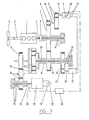
- Figure 7 shows one preferred embodiment by which the principle disclosed herein may be put into effect.
- a prime mover for example a diesel engine, drives a propeller 3 via shaft 2.
- power is taken via a shaft 4, a clutch or flexible coupling 5 and a cardan shaft/flexible coupling 6 to a gear wheel 7.
- a pinion 8 meshes with gear wheel 7 and drives hydraulic pump/motor 9 via shaft 10, step-up gearing 11 and shaft 12.
- a second gear wheel 13 also meshes with gear wheel 7.
- Gear wheel 13 is fast with a member 14 which also acts as the carrier C supporting the plurality of planetary pinions P of epicyclic gear 15; thus the planet carrier C forms the input member of epicyclic gear 15 which, in this embodiment, is operated in the Solar configuration.
- the output member of epicyclic gear 15 is the annulus wheel A which is rotationally fast with a member 16.
- Gearwheel 17 is also rotationallyfast with member 16 so that the output from epicyclic gear 15 passes via member 16 into gear wheel 17, thence via step-up gearing 18, cardan shaft/flexible coupling 19 and shaft 33 to generator 20.
- the ratio of epicyclic gear 15 may be varied by controlled rotation of the sun wheel S.
- the speed and directin of rotation of the sun wheel S may be controlled by hydraulic pump/motor 21 which drives, via shaft 22, a pinion 23 meshing with gear wheel 24.
- Flexible coupling/cardan shaft 25 is rotationally fast with gear wheel 24 to transmit the drive via shaft 26 into sun wheel S.
- Shaft 26 is co-axial with gear wheels 24 and 13 and member 14.
- Hydraulic pump/motor 21 is connected via piping 27 to pump/motor 9 to form a pair, of which one would have a fixed displacement and the other would have the reversible variable displacement swash plate.
- Flexible couplings/cardan shafts 6, 19 and 25 are typical of the sort of arrangements used to rotatably connect fixed members. Other types of coupling are equally possible. Also, a clutch which may be located in member 5 could equally well be located in the position of members 6, 19 or 25.
- a control unit 29 is fed with an input signal which could either be a direct measure of the speed of rotation 30 of generator drive shaft 33 (or some other suitable shaft) or some property dependent upon the speed of rotation of generator shaft 33, e.g. the frequency 31 of the alternating current 32 generated.
- Control unit 29 would compare the value of input signal 30 or 31 with the value stored in its memory and, if it differed by more than a defined amount, would produce an output signal 28 to alter the setting of the swash plate on hydraulic pump/motor 9. This action would cause the flow of hydraulic fluid in pipes 27 to change so that speed of rotation (and possibly the direction of rotation as well) of pump/motor 21 would also change resulting in a new speed and/or direction of rotation of sun wheel S of epicyclic gear 15. The new conditions now prevailing in the epicyclic gear 15 should restore the original speed of rotation of annulus wheel A and hence of generator shaft 33.
- gear wheels 7 and 13 the configuration of epicyclic gear 15 and gear wheels 17 and 18 all give step-up ratios so that the speed of rotation gradually increases from, say, 65-100 RPM for a direct drive diesel engine or 400-800 RPM for a medium speed diesel engine driving through a gearbox to the 1200 or 1800 RPM required for a marine generator generating 60 Hz current. If the prime mover was a turbine operating at tens of thousands of revolutions per minute, the gear wheels 7, 13, epicyclic gear 15 and gearwheels 17 and 18 would have step-down ratios.
- engine 1 may have a fuel efficient cruising speed of, say, P RPM and the gear ratios through the train would be so chosen that the correct alternator speed would be achieved with the reaction member of the epicyclic gear 15, i.e. sun wheel S, not rotating. This would mean that pump/motor 21 was not rotating and that the swash plate of pump/motor 9 was set to zero so that no hydraulic fluid flowed in pipes 27.
- a hydraulic pump/ motor 9 with only a variable swash plate i.e. not a reversible one.
- the swash plate of pump/motor 9 could be set to an intermediate point of its travel when prime mover 1 was operating at its cruising speed of P RPM. If the speed of the prime mover fell below P RPM, the angle of the swash plate of pump/motor 9 would be increased so that the speed of pump-motor 21, and hence also of sun wheel 15S, would increase to compensate for the reduction in speed of member 14. Conversely, if the speed of the prime mover rose above P, the angle of the swash plate or pump/motor 9 would be reduced to reduce the speed of pump/motor 21 and sun wheel 15S.
- a non-reversible swash plate pump/motor 9 is used, power is always put into epicyclic gear 15 via both the mechanical and hydraulic paths and no power re-circulation loop is possible.
- the purpose of this disclosure is to so control the speed of the reaction member of epicyclic gear 15 so that a constant speed output may be obtained.
- This control has been described using hydraulic means, but could equally well be performed by a variable speed or reversible and variable speed electric or pneumatic motor.
- natural power sources may be used to drive the apparatus which have fluctuating outputs, such as air or wind-driven devices, water driven devices, and devices which take energy from wave-motion as described for example in U.K. Patent Specification No. 1,601,467.
Landscapes
- Engineering & Computer Science (AREA)
- Power Engineering (AREA)
- Structure Of Transmissions (AREA)
- Extrusion Moulding Of Plastics Or The Like (AREA)
- Fats And Perfumes (AREA)
- Curing Cements, Concrete, And Artificial Stone (AREA)
- Pharmaceuticals Containing Other Organic And Inorganic Compounds (AREA)
- Control Of Velocity Or Acceleration (AREA)
- Control Of Eletrric Generators (AREA)
Claims (8)
Priority Applications (1)
| Application Number | Priority Date | Filing Date | Title |
|---|---|---|---|
| AT82300523T ATE26029T1 (de) | 1981-02-11 | 1982-02-02 | Vorrichtung zur bildung einer konstanten umdrehungsgeschwindigkeit aus einer variablen eingangsgeschwindigkeit. |
Applications Claiming Priority (2)
| Application Number | Priority Date | Filing Date | Title |
|---|---|---|---|
| GB8104286 | 1981-02-11 | ||
| GB8104286 | 1981-02-11 |
Publications (3)
| Publication Number | Publication Date |
|---|---|
| EP0058037A2 EP0058037A2 (de) | 1982-08-18 |
| EP0058037A3 EP0058037A3 (en) | 1983-10-05 |
| EP0058037B1 true EP0058037B1 (de) | 1987-03-18 |
Family
ID=10519626
Family Applications (1)
| Application Number | Title | Priority Date | Filing Date |
|---|---|---|---|
| EP82300523A Expired EP0058037B1 (de) | 1981-02-11 | 1982-02-02 | Vorrichtung zur Bildung einer konstanten Umdrehungsgeschwindigkeit aus einer variablen Eingangsgeschwindigkeit |
Country Status (4)
| Country | Link |
|---|---|
| EP (1) | EP0058037B1 (de) |
| AT (1) | ATE26029T1 (de) |
| DE (1) | DE3275768D1 (de) |
| GB (1) | GB2092687B (de) |
Cited By (1)
| Publication number | Priority date | Publication date | Assignee | Title |
|---|---|---|---|---|
| DE4032735A1 (de) * | 1990-10-15 | 1992-04-16 | Renk Tacke Gmbh | Stromerzeugungsanlage an bord von schiffen |
Families Citing this family (7)
| Publication number | Priority date | Publication date | Assignee | Title |
|---|---|---|---|---|
| EP0120654B1 (de) * | 1983-03-23 | 1988-06-08 | The English Electric Company Limited | Energieerzeugungsgerät |
| JPS60207477A (ja) * | 1984-03-30 | 1985-10-19 | Hitachi Ltd | 電動アクチユエ−タ |
| GB8421103D0 (en) * | 1984-08-20 | 1984-09-26 | English Electric Co Ltd | Power generating equipment |
| DE3546420A1 (de) * | 1985-08-19 | 1987-02-26 | Montalvo Corp | Stroemungsmechanisches getriebe |
| BR122020019020B1 (pt) | 2009-03-25 | 2021-05-04 | Bayer Cropscience Aktiengesellschaft | Combinação de substância ativa nematicida, seus usos, composição e seu processo de produção, semente resistente a pestes, e método para combate de pestes animais |
| EP2382865A1 (de) | 2010-04-28 | 2011-11-02 | Bayer CropScience AG | Synergistische Wirkstoffkombinationen |
| CN103732490B (zh) * | 2011-06-22 | 2016-03-09 | 瓦锡兰芬兰有限公司 | 船只推进引擎燃料效率的改进 |
Citations (1)
| Publication number | Priority date | Publication date | Assignee | Title |
|---|---|---|---|---|
| US3298251A (en) * | 1963-01-11 | 1967-01-17 | Plessey Uk Ltd | Constant-speed drives |
Family Cites Families (6)
| Publication number | Priority date | Publication date | Assignee | Title |
|---|---|---|---|---|
| GB1213178A (en) * | 1968-11-12 | 1970-11-18 | Hobson Ltd H M | An improved constant speed drive |
| GB1381477A (en) * | 1970-12-01 | 1975-01-22 | Hawker Siddeley Dynamics Ltd | Speed regulating systems |
| JPS5185412A (en) * | 1975-01-20 | 1976-07-27 | Hitachi Ltd | Kaitenkino hensokuseigyohoshiki |
| US4046029A (en) * | 1976-09-10 | 1977-09-06 | Sundstrand Corporation | Hydromechanical transmission |
| GB1563698A (en) * | 1976-10-04 | 1980-03-26 | Vickers Shipbuilding Group Ltd | Variable speed-ratio transmissions |
| SE424232B (sv) * | 1979-02-14 | 1982-07-05 | Sab Ind Ab | Sett att dempa pendlingar hos ett roterande system |
-
1982
- 1982-01-25 GB GB8202043A patent/GB2092687B/en not_active Expired
- 1982-02-02 DE DE8282300523T patent/DE3275768D1/de not_active Expired
- 1982-02-02 AT AT82300523T patent/ATE26029T1/de not_active IP Right Cessation
- 1982-02-02 EP EP82300523A patent/EP0058037B1/de not_active Expired
Patent Citations (1)
| Publication number | Priority date | Publication date | Assignee | Title |
|---|---|---|---|---|
| US3298251A (en) * | 1963-01-11 | 1967-01-17 | Plessey Uk Ltd | Constant-speed drives |
Cited By (1)
| Publication number | Priority date | Publication date | Assignee | Title |
|---|---|---|---|---|
| DE4032735A1 (de) * | 1990-10-15 | 1992-04-16 | Renk Tacke Gmbh | Stromerzeugungsanlage an bord von schiffen |
Also Published As
| Publication number | Publication date |
|---|---|
| ATE26029T1 (de) | 1987-04-15 |
| GB2092687A (en) | 1982-08-18 |
| GB2092687B (en) | 1985-09-18 |
| EP0058037A2 (de) | 1982-08-18 |
| EP0058037A3 (en) | 1983-10-05 |
| DE3275768D1 (en) | 1987-04-23 |
Similar Documents
| Publication | Publication Date | Title |
|---|---|---|
| US4774855A (en) | Apparatus for providing an electrical generator with a constant rotational speed from a variable speed input | |
| US4112311A (en) | Windmill plant for generating energy | |
| EP0666633B1 (de) | System zur Generation und Speicherung elektrischer Energie | |
| US6304002B1 (en) | Distributed powertrain for high torque, low electric power generator | |
| US9476401B2 (en) | Marine hydrokinetic turbine | |
| EP0635639A1 (de) | Windturbinengetriebe | |
| US20180195582A1 (en) | Control apparatus and method for variable renewable energy | |
| US20150357951A1 (en) | Adjustable assembly of rotor and stator and applications thereof with a variable power generator | |
| US10947956B2 (en) | Expandable power marine hydrokinetic turbines, pumps, compressors and transmissions | |
| IE53230B1 (en) | Exploitation of wind energy for producing electrical power | |
| CN101344073A (zh) | 风力发电机组变速恒频装置 | |
| KR20100139120A (ko) | 중첩 기어를 구비한 풍력 에너지 변환장치 | |
| IE51905B1 (en) | Exploitation of wind energy for producing electrical power | |
| EP0058037A2 (de) | Vorrichtung zur Bildung einer konstanten Umdrehungsgeschwindigkeit aus einer variablen Eingangsgeschwindigkeit | |
| Li et al. | Time-delay closed-loop control of an infinitely variable transmission system for tidal current energy converters | |
| EP0120654A1 (de) | Energieerzeugungsgerät | |
| Yin et al. | Maximizing tidal energy conversion by adopting hydraulic transformation and LMI based robust control | |
| US11111898B2 (en) | Voltage converter-controlled damless hydrokinetic river turbines | |
| US10941749B2 (en) | Speed converter-controlled river turbines | |
| CA2371694C (en) | Powertrain for power generator | |
| Akbari et al. | Reduced-size converter in dfig-based wind energy conversion system | |
| AU2019290039B2 (en) | Mechanical engine for generating energy by means of water movement | |
| CN116335889A (zh) | 风力发电机组驱动链及包括其的风力发电机组 | |
| CA3112223C (en) | Mechanical speed converter-controlled wind and hydrokinetic turbines | |
| JPS5934046A (ja) | 変速性回転入力から定速の回転出力を得るための装置 |
Legal Events
| Date | Code | Title | Description |
|---|---|---|---|
| PUAI | Public reference made under article 153(3) epc to a published international application that has entered the european phase |
Free format text: ORIGINAL CODE: 0009012 |
|
| AK | Designated contracting states |
Designated state(s): AT BE CH DE FR GB IT LI LU NL SE |
|
| PUAL | Search report despatched |
Free format text: ORIGINAL CODE: 0009013 |
|
| AK | Designated contracting states |
Designated state(s): AT BE CH DE FR GB IT LI LU NL SE |
|
| 17P | Request for examination filed |
Effective date: 19831121 |
|
| GRAA | (expected) grant |
Free format text: ORIGINAL CODE: 0009210 |
|
| AK | Designated contracting states |
Kind code of ref document: B1 Designated state(s): AT BE CH DE FR GB IT LI LU NL SE |
|
| PG25 | Lapsed in a contracting state [announced via postgrant information from national office to epo] |
Ref country code: AT Effective date: 19870318 |
|
| REF | Corresponds to: |
Ref document number: 26029 Country of ref document: AT Date of ref document: 19870415 Kind code of ref document: T |
|
| ITF | It: translation for a ep patent filed | ||
| REF | Corresponds to: |
Ref document number: 3275768 Country of ref document: DE Date of ref document: 19870423 |
|
| ET | Fr: translation filed | ||
| PLBI | Opposition filed |
Free format text: ORIGINAL CODE: 0009260 |
|
| PLBI | Opposition filed |
Free format text: ORIGINAL CODE: 0009260 |
|
| 26 | Opposition filed |
Opponent name: RENK TACKE GMBH Effective date: 19871205 |
|
| 26 | Opposition filed |
Opponent name: GEBRUEDER SULZER AKTIENGESELLSCHAFT Effective date: 19871218 Opponent name: RENK TACKE GMBH Effective date: 19871205 |
|
| PG25 | Lapsed in a contracting state [announced via postgrant information from national office to epo] |
Ref country code: LU Free format text: LAPSE BECAUSE OF NON-PAYMENT OF DUE FEES Effective date: 19880229 |
|
| NLR1 | Nl: opposition has been filed with the epo |
Opponent name: GEBRUEDER SULZER AKTIENGESELLSCHAFT Opponent name: RENK TACKE GMBH |
|
| GBPC | Gb: european patent ceased through non-payment of renewal fee | ||
| PGFP | Annual fee paid to national office [announced via postgrant information from national office to epo] |
Ref country code: DE Payment date: 19890109 Year of fee payment: 8 |
|
| PGFP | Annual fee paid to national office [announced via postgrant information from national office to epo] |
Ref country code: GB Payment date: 19890202 Year of fee payment: 8 |
|
| ITTA | It: last paid annual fee | ||
| PG25 | Lapsed in a contracting state [announced via postgrant information from national office to epo] |
Ref country code: FR Free format text: LAPSE BECAUSE OF NON-PAYMENT OF DUE FEES Effective date: 19890228 |
|
| PGFP | Annual fee paid to national office [announced via postgrant information from national office to epo] |
Ref country code: SE Payment date: 19890228 Year of fee payment: 8 Ref country code: NL Payment date: 19890228 Year of fee payment: 8 Ref country code: BE Payment date: 19890228 Year of fee payment: 8 |
|
| PGFP | Annual fee paid to national office [announced via postgrant information from national office to epo] |
Ref country code: CH Payment date: 19890512 Year of fee payment: 8 |
|
| PG25 | Lapsed in a contracting state [announced via postgrant information from national office to epo] |
Ref country code: SE Effective date: 19900203 |
|
| PG25 | Lapsed in a contracting state [announced via postgrant information from national office to epo] |
Ref country code: BE Effective date: 19900228 |
|
| RDAG | Patent revoked |
Free format text: ORIGINAL CODE: 0009271 |
|
| STAA | Information on the status of an ep patent application or granted ep patent |
Free format text: STATUS: PATENT REVOKED |
|
| BERE | Be: lapsed |
Owner name: VICKERS SHIPBUILDING & ENGINEERING LTD Effective date: 19900228 |
|
| 27W | Patent revoked |
Effective date: 19900501 |
|
| GBPR | Gb: patent revoked under art. 102 of the ep convention designating the uk as contracting state | ||
| REG | Reference to a national code |
Ref country code: CH Ref legal event code: PL |
|
| NLV4 | Nl: lapsed or anulled due to non-payment of the annual fee | ||
| EUG | Se: european patent has lapsed |
Ref document number: 82300523.6 Effective date: 19901107 |