EP0058837B1 - Procédé pour la fabrication d'aciers austénitiques inoxydables, moins susceptibles aux défauts de laminage - Google Patents
Procédé pour la fabrication d'aciers austénitiques inoxydables, moins susceptibles aux défauts de laminage Download PDFInfo
- Publication number
- EP0058837B1 EP0058837B1 EP82100645A EP82100645A EP0058837B1 EP 0058837 B1 EP0058837 B1 EP 0058837B1 EP 82100645 A EP82100645 A EP 82100645A EP 82100645 A EP82100645 A EP 82100645A EP 0058837 B1 EP0058837 B1 EP 0058837B1
- Authority
- EP
- European Patent Office
- Prior art keywords
- steel
- slivers
- rolling
- occurrence
- condition
- Prior art date
- Legal status (The legal status is an assumption and is not a legal conclusion. Google has not performed a legal analysis and makes no representation as to the accuracy of the status listed.)
- Expired
Links
Images

Classifications
-
- B—PERFORMING OPERATIONS; TRANSPORTING
- B22—CASTING; POWDER METALLURGY
- B22D—CASTING OF METALS; CASTING OF OTHER SUBSTANCES BY THE SAME PROCESSES OR DEVICES
- B22D11/00—Continuous casting of metals, i.e. casting in indefinite lengths
- B22D11/12—Accessories for subsequent treating or working cast stock in situ
- B22D11/1206—Accessories for subsequent treating or working cast stock in situ for plastic shaping of strands
Definitions
- the present invention relates to a process for producing austenitic stainless steels which process prevents occurrence of rolling defects, particularly slivers.
- austenitic alloys such as austenitic stainless steels show inferior hot workability during break-down rolling of ingots, for example, thus being susceptible to cracks, and higher alloy steels are more difficult to work from a large steel ingot.
- various studies have been made for overcoming these difficulties. Effective means for preventing cracks even in the case of high alloy steels have been taken and it is now very seldom that a high alloy steel cannot be satisfactorily produced due to the occurrence of large cracks, but they are still susceptible to small cracks.
- the present inventors have made investigations for determining the causes for these fine defects and slivers (hereinafter called "slivers”) and have found that these slivers are to be a kind of hot working crack due to inferior hot workability. Although these slivers do not cause a vital problem which prohibits commercial production with respect to the hot workability, these cracks must be considered to be practically a great problem, because these cracks are found in steel grades, such as SUS (Japanese Industrial Standard) 304, SUS 316 and SUS 347 stainless steels which are normally produced on a mass-production scale.
- SUS Japanese Industrial Standard
- the present inventors have found that for preventing the occurrence of slivers it is very effective to control the heating temperature H T for hot rolling under the condition of H T (°C ⁇ 1325(°C)-50 ⁇ [N* ⁇ T].
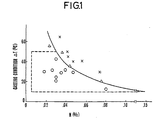
- the present invention provides a process for producing an austenitic stainless steel less susceptible to the occurrence of rolling defects, which comprises continuously casting an austenitic stainless steel melt containing not less than 0.005% N under the condition of NxAT:51.5, in which N represents the nitrogen content in % by weight, AT represents the difference between the tundish temperature and the melting point of the stainless steel and ranges from 10°C to 50°C and hot rolling the steel slab thus obtained.
- the invention provides a process for producing an austenitic stainless steel less susceptible to the occurrence of rolling defects, which comprises continuously casting an austenitic stainless steel melt containing nitrogen under the condition of N ⁇ T ⁇ 1.5, in which N represents the nitrogen content (% by weight) in the steel and ⁇ T represents the difference in the tundish temperature of the steel and the melting point of the steel, and heating the steel slab thus obtained for hot rolling under the condition of in which H T represents the heating temperature ranging from 1130°C to 1320°C for the hot rolling.
- the present inventors have investigated casting conditions and repeated various tests to determine the interrelation between the casting conditions and the steel composition and have found that the hot workability is greatly influenced by the relation between the nitrogen content and the casting temperature (tundish temperature) among the continuous casting conditions.
- the present inventors have found that the occurrence of defects due to hot working can be prevented by controlling the casting temperature on the basis of the nitrogen content in the molten steel. In order to confirm this discovery, the following experiment was made.
- the casting must be done at lower temperatures by lowering the tundish temperature, thus reducing the difference ⁇ T. Otherwise, slivers and other rolling defects have an increased tendency to occur during the hot rolling. Also if the nitrogen content is lowered, the rolling defects are more apt to occur during the hot rolling when the casting is done at an increased tundish temperature.
- the heating temperature range may be made wider for the hot working without occurrence of defects, but on the other hand, in the case of a slab having a large value of N ⁇ T and having an inferior hot workability, the heating temperature for the hot rolling must be made low.
- the allowable heating temperature range H T is determined by the following formula on the basis of N ⁇ T.
- the working temperature has some considerable effect on the occurrence of defects.
- a lower working temperature is advantageous.
- the heating temperature can be lowered on the basis of N ⁇ T and hence the working temperature is made relatively low, thus contributing to preventing the occurrence of slivers.
- the nitrogen content N(%), the casting temperature condition ⁇ T(°C) and the heating temperature H T (°C) are considered to be related with the y grain size after the casting and during the heating and to have an influence on the occurrence of cracks at the y grain boundaries during the hot working. Therefore, the principle for the prevention of rolling defects is basically applicable to the reheating process of a continuously cast steel slab and further applicable to the hot-charge process or CC-DR process (continuous casting-direct rolling process).
- a lower carbon content is more favourable, and the lower limit is set at 0.001 %.
- a higher carbon content is more desirable and the upper limit is set at 0.20%.
- Silicon should be in an amount not less than 0.1 % so as to assure satisfactory deoxidation of the steel, and a higher silicon content is desirable for oxidation resistance, and the upper limit of the silicon content is set at 4%, beyond which the tendency of embrittlement becomes large.
- Lower phosphorus contents are more desirable, and the upper limit is set at 0.06%, preferably 0.004%. Beyond 0.06% the corrosion resistance deteriorates.
- Sulfur has a large tendency to segregate at the y grain boundaries during the solidification of the steel, and is a principal cause for the occurrence of slivers. Therefore, the sulfur content should be maintained as low as possible, and the upper limit is set at 0.01, preferably 0.005%. Beyond 0.01 % the hot workability deteriorates even if all other measures are taken.
- Oxygen just as sulfur, promotes the occurrence of slivers and should be maintained as low as possible.
- the upper limit is set at 0.01%, preferably 0.006%.
- Chromium should be maintained at at least 15% to obtain the desired corrosion resistance; but more than 30% chromium causes difficulties in working.
- Nickel should be maintained at at least 7% for the desired stabilization of the structure as a stainless steel, but the upper limit is set at 28%, beyond which no substantial effect is obtained apart from increased production costs.
- Molybdenum is effective to increase the acid resistance and pit corrosion resistance and may be selectively added up to 3% depending on the final application of the steel.
- Copper is also effective for acid resistance and may be selectively added up to 3% in some applications.
- Niobium is effective to stabilize carbides and may be selectively added up to 1%, beyond which the tendency of embrittlement becomes apparent.
- one or more of 0.005 to 0.1 % Ti, 0.005 to 0.1% Zr and 0.0005 to 0.050% Ca may be added optionally.
- Nitrogen is an effective austenite former, but an excessive addition of nitrogen deteriorates the hot workability of the steel.
- the lower limit of the nitrogen content depends on the technical accessibility and it is normally difficult to lower the nitrogen content to 0.001% or less.
- slivers can be effectively prevented by controlling elements other than the main elements, such as sulfur, phosphorus, oxygen so as to satisfy the following condition:
- the upper limit of the nitrogen content is determined by AT in the formula of N ⁇ T ⁇ 1.5.
- the factor AT is also limited to the range from 10°C to 50°C. Beyond 50°C, the surface portion of the resultant cast steel slab is of coarse-grained structure with deteriorated hot workability. Although a smaller AT value is desirable for the hot workability, if it gets smaller than 10°C, the slab becomes much more susceptible to defects due to non-metallic inclusions.
- the upper limit of H T is set at 1320°C, beyond which the grain growth becomes so vigorous as to lower the hot workability with increased scale loss.
- lower limit is set at 1130°C, below which the deformation resistance of the steel becomes larger, requiring increased rolling load thus prohibiting the rolling operation, or remarkably lowering the rolling efficiency.
- the rolling operation was performed under conventional conditions other than the heating condition as mentioned above.
- the steel plates (1Q-16 mm thick) thus obtained were subjected to heat treatments and acid-pickling and then investigated for evaluation of the occurrence of slivers.
- the evaluation was made in the same way as in Example 1. The results of the investigation are shown in Table 2 and Fig. 2.
Landscapes
- Engineering & Computer Science (AREA)
- Mechanical Engineering (AREA)
- Heat Treatment Of Steel (AREA)
Claims (6)

Applications Claiming Priority (4)
| Application Number | Priority Date | Filing Date | Title |
|---|---|---|---|
| JP13696/81 | 1981-01-31 | ||
| JP13697/81 | 1981-01-31 | ||
| JP1369681A JPS57127506A (en) | 1981-01-31 | 1981-01-31 | Hot rolling method for austenite stainless steel with few flaws by rolling |
| JP56013697A JPS5910861B2 (ja) | 1981-01-31 | 1981-01-31 | 圧延による疵発生の少ないオ−ステナイト系ステンレス鋼の製造法 |
Publications (2)
| Publication Number | Publication Date |
|---|---|
| EP0058837A1 EP0058837A1 (fr) | 1982-09-01 |
| EP0058837B1 true EP0058837B1 (fr) | 1985-05-08 |
Family
ID=26349525
Family Applications (1)
| Application Number | Title | Priority Date | Filing Date |
|---|---|---|---|
| EP82100645A Expired EP0058837B1 (fr) | 1981-01-31 | 1982-01-29 | Procédé pour la fabrication d'aciers austénitiques inoxydables, moins susceptibles aux défauts de laminage |
Country Status (3)
| Country | Link |
|---|---|
| US (1) | US4494998A (fr) |
| EP (1) | EP0058837B1 (fr) |
| DE (1) | DE3263615D1 (fr) |
Families Citing this family (6)
| Publication number | Priority date | Publication date | Assignee | Title |
|---|---|---|---|---|
| JPS61295356A (ja) * | 1985-06-24 | 1986-12-26 | Nisshin Steel Co Ltd | 高強度ステンレス鋼 |
| US4657066A (en) * | 1985-06-28 | 1987-04-14 | Allegheny Ludlum Corporation | Method of continuous casting slabs to produce good surface quality hot-rolled band |
| JPH0694057B2 (ja) * | 1987-12-12 | 1994-11-24 | 新日本製鐵株式會社 | 耐海水性に優れたオーステナイト系ステンレス鋼の製造方法 |
| US8430075B2 (en) * | 2008-12-16 | 2013-04-30 | L.E. Jones Company | Superaustenitic stainless steel and method of making and use thereof |
| KR20110128924A (ko) * | 2009-03-27 | 2011-11-30 | 수미도모 메탈 인더스트리즈, 리미티드 | 오스테나이트계 스테인리스강 |
| US8479700B2 (en) * | 2010-01-05 | 2013-07-09 | L. E. Jones Company | Iron-chromium alloy with improved compressive yield strength and method of making and use thereof |
Family Cites Families (6)
| Publication number | Priority date | Publication date | Assignee | Title |
|---|---|---|---|---|
| DE2452372B2 (de) * | 1974-11-05 | 1976-08-19 | Thyssen Edelstahlwerke AG, 4000 Düsseldorf | Verfahren zur vermeidung von schuppenzeilen/haeutchen auf der oberflaeche von rost- und saeure- und hitzebestaendigen stahlbaendern |
| JPS5168422A (en) * | 1974-12-11 | 1976-06-14 | Nippon Steel Corp | Kyojinkono seizoho |
| DE2544947A1 (de) * | 1975-09-30 | 1977-09-22 | Thyssen Edelstahlwerke Ag | Verfahren zur vermeidung von schuppenzeilen/haeutchen auf der oberflaeche von rost-, saeure- und hitzebestaendigen stahlbaendern |
| JPS52123325A (en) * | 1976-04-09 | 1977-10-17 | Hitachi Shipbuilding Eng Co | Casting method of electro slug |
| JPS5939225B2 (ja) * | 1978-02-13 | 1984-09-21 | 日本鋼管株式会社 | 鋼の連続鋳造法 |
| JPS5810444B2 (ja) * | 1979-03-28 | 1983-02-25 | 住友金属工業株式会社 | 耐水素誘起割れ性のすぐれた鋼板の製造法 |
-
1982
- 1982-01-29 DE DE8282100645T patent/DE3263615D1/de not_active Expired
- 1982-01-29 EP EP82100645A patent/EP0058837B1/fr not_active Expired
- 1982-08-26 US US06/411,953 patent/US4494998A/en not_active Expired - Fee Related
Also Published As
| Publication number | Publication date |
|---|---|
| US4494998A (en) | 1985-01-22 |
| EP0058837A1 (fr) | 1982-09-01 |
| DE3263615D1 (en) | 1985-06-13 |
Similar Documents
| Publication | Publication Date | Title |
|---|---|---|
| EP0309587A1 (fr) | Rouleau composite resistant a l'abrasion et procede de production | |
| EP4166680A1 (fr) | Tôle d'acier inoxydable martensitique de type à durcissement par précipitation ayant une excellente résistance à la fatigue | |
| US5662748A (en) | Thin cast strip and thin steel sheet of common carbon steel containing large amounts of copper and tin and process for producing the same | |
| WO2022145061A1 (fr) | Matériau d'acier | |
| JP6842257B2 (ja) | Fe−Ni−Cr−Mo合金とその製造方法 | |
| KR19990063175A (ko) | 리징이 없는 페라이트계 크롬 합금강 | |
| US5858129A (en) | Austenite stainless steel | |
| EP0392011B1 (fr) | ACIER AUSTENITIQUE THERMORESISTANT A HAUTE TENEUR EN Al ET PRESENTANT D'EXCELLENTES PROPRIETES D'USINAGE A CHAUD | |
| US4494998A (en) | Process for producing austenitic stainless steels less susceptible to rolling defects | |
| JP6950071B2 (ja) | Ni−Cr−Mo−Nb合金 | |
| JPS5915979B2 (ja) | 熱間圧延において圧延による疵発生の少ないステンレス合金 | |
| EP1964939B1 (fr) | Acier de decolletage a faible teneur en carbone resulfure ayant une excellente aptitude a l'usinage | |
| JP7440805B2 (ja) | 鋼材 | |
| JPH0617505B2 (ja) | 含Mo,Nオ−ステナイト系ステンレス鋼の熱間加工法 | |
| JP2838468B2 (ja) | 熱間圧延での割れを防止するCr−Ni系ステンレス合金の製造方法 | |
| EP1852514B1 (fr) | Procédé de fabrication d une feuille en acier à teneur extrêmement faible en carbone et objet moulé à teneur extrêmement faible en carbone présentant d'excellentes propriétés de surface, d'aptitude au façonnage et d'aptitude a la mise en forme | |
| WO2022145064A1 (fr) | Matériau d'acier | |
| JPH0692625B2 (ja) | 熱間圧延用ロール | |
| WO2022145065A1 (fr) | Matériau d'acier | |
| WO2022145066A1 (fr) | Matériau d'acier | |
| WO2022145069A1 (fr) | Matériau d'acier | |
| JP3477098B2 (ja) | 表面性状とリジング性に優れたフェライト系ステンレス鋼薄板およびその製造方法 | |
| JP3101411B2 (ja) | 加工性に優れたフェライト系ステンレス鋼及び製造方法 | |
| US6110422A (en) | Ductile nickel-iron-chromium alloy | |
| US4657066A (en) | Method of continuous casting slabs to produce good surface quality hot-rolled band |
Legal Events
| Date | Code | Title | Description |
|---|---|---|---|
| PUAI | Public reference made under article 153(3) epc to a published international application that has entered the european phase |
Free format text: ORIGINAL CODE: 0009012 |
|
| AK | Designated contracting states |
Designated state(s): DE FR GB IT |
|
| 17P | Request for examination filed |
Effective date: 19830217 |
|
| ITF | It: translation for a ep patent filed | ||
| GRAA | (expected) grant |
Free format text: ORIGINAL CODE: 0009210 |
|
| AK | Designated contracting states |
Designated state(s): DE FR GB IT |
|
| REF | Corresponds to: |
Ref document number: 3263615 Country of ref document: DE Date of ref document: 19850613 |
|
| ET | Fr: translation filed | ||
| PLBE | No opposition filed within time limit |
Free format text: ORIGINAL CODE: 0009261 |
|
| STAA | Information on the status of an ep patent application or granted ep patent |
Free format text: STATUS: NO OPPOSITION FILED WITHIN TIME LIMIT |
|
| 26N | No opposition filed | ||
| ITTA | It: last paid annual fee | ||
| PGFP | Annual fee paid to national office [announced via postgrant information from national office to epo] |
Ref country code: FR Payment date: 19950110 Year of fee payment: 14 |
|
| PGFP | Annual fee paid to national office [announced via postgrant information from national office to epo] |
Ref country code: GB Payment date: 19950119 Year of fee payment: 14 |
|
| PGFP | Annual fee paid to national office [announced via postgrant information from national office to epo] |
Ref country code: DE Payment date: 19950121 Year of fee payment: 14 |
|
| PG25 | Lapsed in a contracting state [announced via postgrant information from national office to epo] |
Ref country code: GB Effective date: 19960129 |
|
| GBPC | Gb: european patent ceased through non-payment of renewal fee |
Effective date: 19960129 |
|
| PG25 | Lapsed in a contracting state [announced via postgrant information from national office to epo] |
Ref country code: FR Effective date: 19960930 |
|
| PG25 | Lapsed in a contracting state [announced via postgrant information from national office to epo] |
Ref country code: DE Effective date: 19961001 |
|
| REG | Reference to a national code |
Ref country code: FR Ref legal event code: ST |