EP0058863B1 - Verfahren zur Herstellung von Trimethinfarbstoffen - Google Patents
Verfahren zur Herstellung von Trimethinfarbstoffen Download PDFInfo
- Publication number
- EP0058863B1 EP0058863B1 EP82100892A EP82100892A EP0058863B1 EP 0058863 B1 EP0058863 B1 EP 0058863B1 EP 82100892 A EP82100892 A EP 82100892A EP 82100892 A EP82100892 A EP 82100892A EP 0058863 B1 EP0058863 B1 EP 0058863B1
- Authority
- EP
- European Patent Office
- Prior art keywords
- dihydro
- trimethyl
- methylene
- methylen
- indol
- Prior art date
- Legal status (The legal status is an assumption and is not a legal conclusion. Google has not performed a legal analysis and makes no representation as to the accuracy of the status listed.)
- Expired
Links
- 0 CC(C)(C(**)=CC=CC(C1(C)C)=*(*)C2=C1C=C*(C*)C=C2)C1=C(C)C=C*(*=C)C=C1 Chemical compound CC(C)(C(**)=CC=CC(C1(C)C)=*(*)C2=C1C=C*(C*)C=C2)C1=C(C)C=C*(*=C)C=C1 0.000 description 3
Classifications
-
- C—CHEMISTRY; METALLURGY
- C09—DYES; PAINTS; POLISHES; NATURAL RESINS; ADHESIVES; COMPOSITIONS NOT OTHERWISE PROVIDED FOR; APPLICATIONS OF MATERIALS NOT OTHERWISE PROVIDED FOR
- C09B—ORGANIC DYES OR CLOSELY-RELATED COMPOUNDS FOR PRODUCING DYES, e.g. PIGMENTS; MORDANTS; LAKES
- C09B23/00—Methine or polymethine dyes, e.g. cyanine dyes
- C09B23/02—Methine or polymethine dyes, e.g. cyanine dyes the polymethine chain containing an odd number of >CH- or >C[alkyl]- groups
- C09B23/06—Methine or polymethine dyes, e.g. cyanine dyes the polymethine chain containing an odd number of >CH- or >C[alkyl]- groups three >CH- groups, e.g. carbocyanines
Definitions
- the reaction is preferably carried out at 40-80 ° C. for 10-30 h.
- the aliphatic and aromatic radicals contained in the formulas can be substituted by nonionic radicals, preferably by hydroxyl, C 1 - to C 4 -alkyl, C 1 - to C 4 -alkoxy, C 1 - to C 4 -acyloxy, chlorine, bromine , Cyan or C 1 - to C 4 alkyl sulfone residues.
- Inorganic and organic acid residues are suitable as anions, provided they do not adversely affect the solubility of the dyes.
- the process according to the invention is particularly suitable for the production of dyes of the general formula in which
- Sodium formate and potassium formate are particularly suitable as alkali salts of formic acid.
- trimethine dyes are obtained by this process in high yield and in a particularly pure form. This makes it possible to produce a stable, ready-to-use dye solution from the condensation mixture by adding water to destroy the remaining acetic anhydride without isolating the dye.
- DE-PS 410 487 describes a process for the preparation of trimethine dyes by reacting a-methyl-indolenium salts with orthoformic acid ester in the presence of acetic anhydride, chlorozinc, nitrobenzene or tetrachloroethane at a higher temperature. As a by-product, ethyl acetate and methyl or ethyl iodide are formed.
- DE-PS 415 534 describes the condensation with sodium formate instead of orthoformate. Since the condensation is carried out in acetic anhydride, the acetyl compound of trimethylindolenium iodomethylate is formed as a by-product.
- the dyes can also be obtained by the process of DE-PS 585 186 by condensation of the indoline compounds with formaldehyde to form the leuco compound and subsequent oxidation with oxygen, air, silver oxide, silver acetate, lead dioxide, nitrosobenzene or quinones, such as naphthoquinone, chloranil or benzoquinone.
- This process requires a further reaction step, and the condensation solution is also contaminated by reaction products of the oxidizing agent - in the case of quinone, by hydroxyquinone.
- methylene bases of indoline or cyclammonium salts of weak acids are condensed with formic acid in acetic anhydride. While alkali salts of formic acid react with acetic anhydride, this reaction cannot be observed to the same extent with free formic acid.
- the use of pure acetic anhydride leads to the partial acetylation of the methylene base of indoline. The reaction is therefore less uniform and the condensation solution cannot be diluted directly to form a stable dye solution. All of the methods described so far have disadvantages compared to the method according to the invention.
- the direct condensation to the salable dye solution has the additional advantage that no waste water is produced in this manufacturing process.
- the mixture is heated to 50-53 ° C. and stirring is continued for 18 h at this temperature. If the 1,3,3-trimethyl-2-methylene-indoline content is still above 1%, the melt is stirred at 50-53 ° C for a further 5 ⁇ 10 h. The mixture is then diluted with 150 ml of water and stirred at 50 ° C. for 30 min until homogenization. Then the condensation mixture is poured into a 35-40 ° C warm solution of 210 g of 30% hydrochloric acid in 2.8 l of water. After cooling to room temperature, the dye is salted out with 500 g of common salt.
- Example 1 According to the instructions in Example 1, 93.2 g of sodium formate and 200 g of acetic anhydride are reacted in 200 g of glacial acetic acid with 200 g of 1,3,3-trimethyl-2-methylene-indoline. As soon as the 1,3,3-trimethyl-2-methylene-indoline content has dropped below 1%, 43 g of glacial acetic acid, 7.5 g of ethylene glycol and 1 g of the addition product of 40 mol of ethylene oxide to oleyl alcohol are added to the condensation melt at 50 ° C. and 140 g of water. A stable dye solution is obtained, the colorations of which do not show any shade deviation from colorations which have been prepared using crystallized dye.
- a mixture of 45 g of acetic anhydride and 45 g of glacial acetic acid is cooled to 10 ° C. and then 21 g of sodium formate are added in portions. Then 52.8 g of 5-methoxy-1,3,3-trimethyl-2-methylene-indoline are introduced within 1 h at a temperature below 10 ° C.
- the mixture is initially stirred for 1 h without cooling, the temperature rising to 30 ° C.
- the mixture is then heated to 50 ° C. and the reaction mixture is stirred at 50 ° C. for 23 h.
- the condensation solution is poured onto 700 ml of water at 70 ° C., the mixture is stirred for 3 h and then the dye is salted out with 105 g of sodium chloride.
- the dye suspension is allowed to stir overnight, the dye is suctioned off, washed with 200 ml of 20% sodium chloride solution and dried. This gives 50.8 g of the dye of the formula: of the polyacrylonitrile fibers stains in a clear bluish red.
- a mixture of 45 g of acetic anhydride and 45 g of glacial acetic acid is cooled to 10 ° C. and 21 g of sodium formate are added in portions. Then 54.1 g of 5-chloro-1,3,3-trimethyl-2-methylene-indoline are added dropwise at a temperature below 10 ° C. in the course of 1-2 hours.
- the reaction mixture is allowed to stir for 1 h without cooling, the temperature rising to 30 ° C. Then heated to 50 ° C and stirred at this temperature for 23 h.
- the dye melt is then discharged to 700 ml of water heated to 70 ° C. and stirred for a few hours until the dye suspension has reached room temperature. The dye crystallizes in a very pure form. This gives 66.8 g of the dye of the formula: stains the polyacrylonitrile materials in a clear pink.
- the batch is then carried out in 700 ml of water, the dye is salted out with 70 g of sodium chloride, the dye suspension is allowed to stir overnight, the dye is filtered off and washed with 250 ml of 10% sodium chloride solution. After drying in vacuo, the trimethine dye of the formula: of the polyacrylonitrile fibers stains in a clear pink.
Landscapes
- Chemical & Material Sciences (AREA)
- Organic Chemistry (AREA)
- Indole Compounds (AREA)
Description
- Gegenstand der Erfindung ist ein Verfahren zur Herstellung von Trimethinfarbstoffen der allgemeinen Formel



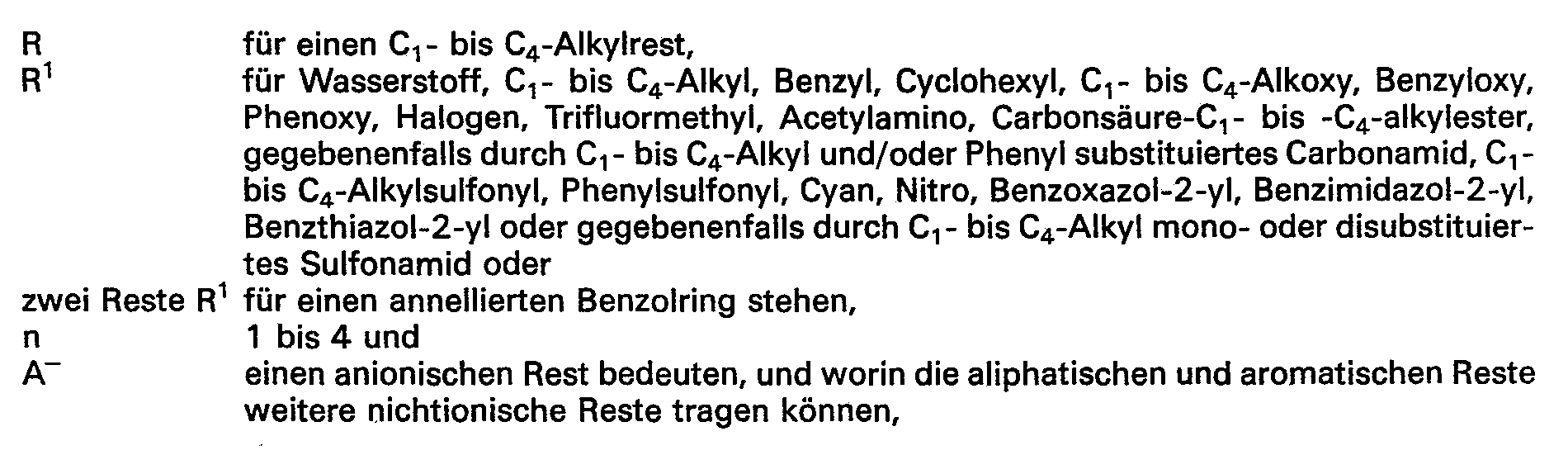
- R, R1 und n die oben angegebene Bedeutung haben,
- Bevorzugt wird die Reaktion bei 40-80°C während 10-30 h durchgeführt.
- Die in den Formeln enthaltenen aliphatischen und aromatischen Reste können durch nichtionische Reste substituiert sein, vorzugsweise durch Hydroxyl, C1- bis C4-Alkyl, C1- bis C4-Alkoxy, C1- bis C4-Acyloxy, Chlor, Brom, Cyan oder C1- bis C4-Alkylsulfonreste.
- Geeignete gegebenenfalls substituierte C1- bis C4-Alkylreste sind:
- Methyl, Ethyl, Propyl und Butyl, Cyanethyl, Methoxyethyl, Ethoxyethyl, Chlorethyl,ß-Hydroxyethyl, ß-Hydroxypropyl und β,γ-Dihydroxypropyl.
- Geeignete gegebenenfalls substituierte C1- bis C4-Alkoxyreste sind:
- Methoxy, Ethoxy, Propoxy, Butoxy, Methoxyethoxy, Ethoxyethoxy, Butoxyethoxy und Hydroxyethoxy
- Geeignete C1- bis C4-Acyloxyreste sind:
- Acetoxy und Propionyloxy.
- Geeignete ggf. substituierte Phenylreste sind:
- Phenyl, 4-Chlor-phenyl, 2-Brom-phenyl, 4-Methoxy-phenyl, 2-Methoxy-phenyl, 4-Ethoxy-phenyl und 2-Ethoxy-phenyl.
- Als Anionen eignen sich anorganische und organische Säurereste, soweit sie nicht die Löslichkeit der Farbstoffe nachteilig beeinflussen.
- Das erfindungsgemäße Verfahren ist insbesondere geeignet zur Herstellung von Farbstoffen der allgemeinen Formel


- Als Alkalisalze der Ameisensäure eignen sich insbesondere Natriumformiat und Kaliumformiat.
- Geeignete Indolinverbindungen der Formel sind:
- 1,3,3-Trimethyl-2-methylen-2,3-dihydro-indol,
- 1,3,3,5 Tetramethyl-2-methylen-2,3-dihydro-indol,
- 1,3,3-Trimethyl-5-chlor-2-methylen-2,3-dihydro-indol,
- 1,3,3-Trimethyl-5-methoxy-2-methylen-2,3-dihydro-indol,
- 1,3,3-Trimethyl-5-carbomethoxy-2-methylen-2,3-dihydro-indol,
- 1,3,3-Trimethyl-5-carboethoxy-2-methylen-2,3-dihydro-indol,
- 1,3,3-Trimethyl-5-cyclohexyl-2-methylen-2,3-dihydro-indol,
- 1,3,3-Trimethyl-5-benzyl-2-methylen-2,3-dihydro-indol,
- 1,3,3-Trimethyl-5-nitro-2-methylen-2,3-dihydro-indol,
- 1,3,3,7-Tetramethyl-2-methylen-2,3-dihydro-indol,
- 1,3,3-Trimethyl-5-trifluormethyl-2-methylen-2,3-dihydro-indol,
- 1,3,3-Trimethyl-7-methoxy-2-methylen-2,3-dihydro-indol,
- 1,3,3-Trimethyl-7-chlor-2-methylen-2,3-dihydro-indol,
- 1-Ethyl-3,3-dimethyl-2-methylen-2,3-dihydro-indol,
- 1-Ethyl-3,3,5-trimethyl-2-methylen-2,3-dihydro-indol,
- 1-Ethyl-3,3-dimethyl-5-chlor-2-methylen-2,3-dihydro-indol,
- 1-Ethyl-3,3-dimethyl-5-methoxy-2-methylen-2,3-dihydro-indol,
- 1-Ethyl-3,3-dimethyl-5-carbomethoxy-2-methylen-2,3-dihydro-indol,
- 1-Ethyl-3,3-dimethyl-5-carboethoxy-2-methylen-2,3-dihydro-indol,
- 1-Ethyl-3,3,7-trimethyl-5-cyclohexyl-2-methylen-2,3-dihydro-indol,
- 1-Ethyl-3,3-dimethyl-5-benzyl-2-methylen-2,3-dihydro-indol,
- 1-Ethyl-3,3-dimethyl-5-nitro-2-methylen-2,3-dihydro-indol,
- 1,3,3-Trimethyl-5-benzyloxy-2-methylen-2,3-dihydro-indol,
- 1-Ethyl-3,3-dimethyl-5-benzyloxy-2-methylen-2,3-dihydro-indol,
- 1,3,3-Trimethyl-7-benzyl-2-methylen-2,3-dihydro-indol,
- 1,3,3 Trimethyl-4-benzyloxy-2-methylen-2,3-dihydro-indol,
- 1,3,3-Trimethyl-6-benzyloxy-2-methylen-2,3-dihydro-indol,
- 1,3,3-Trimethyl-7-benzyloxy-2-methylen-2,3-dihydro-indol,
- 1,3,3-Trimethyl-5-(p-methyl-benzyloxy)-2-methylen-2,3-dihydro-indol,
- 1,3,3-Trimethyl-5-(o-methyl-benzyloxy)-2-methylen-2,3-dihydro-indol,
- 1,3,3-Trimethyl-7-(p-chlor-benzyloxy)-2-methylen-2,3-dihydro-indol,
- 1,3,3-Trimethyl-5-methyl-7-benzyloxy-2-methylen-2,3-dihydro-indol,
- 1,3,3-Trimethyl-4-methoxy-5-benzyloxy-2-methylen-2,3-dihydro-indol,
- 1,3,3-Trimethyl-6-methoxy-5-benzyloxy-2-methylen-2,3-dihydro-indol,
- 1,3,3,5-Tetramethyl-4-benzyloxy-2-methylen-2,3-dihydro-indol,
- 1,3,3,5-Tetramethyl-6-benzyloxy-2-methylen-2,3-dihydro-indol,
- 1,3,3-Trimethyl-7-(p-methyl-benzyloxy)-2-methylen-2,3-dihydro-indol,
- 1,3,3-Trimethyl-7-(o-chlor-benzyloxy)-2-methylen-2,3-dihydro-indol,
- 1,3,3-Trimethyl-5-benzyloxy-7-methy1-2-methylen-2,3-dihydro-indol,
- 1,3,3,5-Tetramethyl-7-(p-methyl-benzyloxy)-2-methylen-2,3-dihydro-indol,
- 1.3,3-Trimethyl-5-methoxy-2-methylen-2,3-dihydro-indol,
- 1,3,3-Trimethyl-7-phenoxy-2-methylen-2,3-dihydro-indol,
- 1,3,3-Trimethyl-5-(4-methyl-phenoxy)-2-methylen-2,3-dihydro-indol,
- 1,3,3-Trimethyl-5-(4-methoxy-phenoxy)-2-methylen-2,3-dihydro-indol,
- 1,3,3-Trimethyl-7-(4-methoxy-phenoxy)-2-methylen-2,3-dihydro-indol,
- 1,3,3-Trimethyl-5-(4-chlor-phenoxy)-2-methylen-2.3-dihydro-indol,
- 1,3,3-Trimethyl-7-(3-methyl-phenoxy)-2-methylen-2,3-dihydro-indol,
- 1,3,3-Trimethyl-5-(3-methoxy-phenoxy)-2-methylen-2,3-dihydro-indol,
- 1,3,3-Trimethyl-6,7-benzo-2-methylen-2,3-dihydro-indol,
- 1,3,3 Trimethyl-5-fluor-2-methylen-2,3-dihydro-indol,
- 1,3,3 Trimethyl-5-ethoxy-2-methylen-2,3-dihydro-indol,
- 1,3,3 Trimethyl-7-ethoxy-2-methylen-2,3-dihydro-indol,
- 1,3,3-Trimethyl-5-cyan-2-methylen-2,3-dihydro-indol,
- 1,3,3-Trimethyl-5-acetylamino-2-methylen-2,3-dihydro-indol,
- 1,3,3-Trimethyl-5-methylsulfonyl-2-methylen-2,3-dihydro-indol,
- 1,3,3-Trimethyl-5-phenylsulfonyl-2-methylen-2,3-dihydro-indol,
- 1 ,3,3-Trimethyl-5-sulfonamido-2-methylen-2,3-dihydro-indol,
- 1,3,3-Trimethyl-5-(carbonsäure-N-ethylanilid)-2-methylen-2,3-dihydro-indol,
- 1,3,3-Trimethyl-7-ethyl-2-methylen-2,3-dihydro-indol,
- 1,3,3-Trimethyl-5-chlor-7-methoxy-2-methylen-2,3-dihydro-indol,
- 1,3,3-Trimethyl-4-chlor-7-methoxy-2-methylen-2,3-dihydro-indol,
- 1,3,3-Trimethyl-4,6-dicarbomethoxy-2-methylen-2,3-dihydro-indol,
- 1,3,3-Trimethyl-4,5-dichlor-7-methoxy-2-methylen-2,3-dihydro-indol,
- 1,3,3-Trimethyl-5-chlor-4,7-dimethoxy-2-methylen-2,3-dihydro-indol,
- 1,3,3,4,5,7-Hexamethyl-2-methylen-2,3-dihydro-indol und
- 1,3,3,4,6,7-Hexamethyl-2-methylen-2,3-dihydro-Indol.
- Man erhält die Trimethinfarbstoffe nach diesem Verfahren in hoher Ausbeute und in besonders reiner Form. Dadurch ist es möglich, aus dem Kondensationsansatz durch Zusatz von Wasser zur Zerstörung des restlichen Essigsäureanhydrids ohne Isolierung des Farbstoffes eine stabile gebrauchsfertige Farbstofflösung herzustellen.
- Es ist anzunehmen, aber nicht Gegenstand dieser Erfindung, daß sich bei der Umsetzung von Essigsäureanhydrid und Natriumformiat als Zwischenprodukt das instabile, aber sehr reaktionsfähige gemischte Anhydrid aus Essigsäure und Ameisensäure bildet.
- In der DE-PS 410 487 ist ein Verfahren zur Herstellung von Trimethinfarbstoffen durch Umsetzung von a-Methyl-indoleniumsalzen mit Orthoameisensäureester in Gegenwart von Essigsäureanhydrid, Chlorzink, Nitrobenzol oder Tetrachlorethan bei höherer Temperatur beschrieben. Hierbei bildet sich als Nebenprodukt Essigester und Methyl- bzw. Ethyljodid. In der DE-PS 415 534 wird die Kondensation mit Natriumformiat anstelle von Orthoameisensäureester beschrieben. Da die Kondensation in Essigsäureanhydrid vorgenommen wird, bildet sich als Nebenprodukt die Acetylverbindung des Trimethylindoleniumjodmethylates. Man kann die Farbstoffe auch nach dem Verfahren der DE-PS 585 186 durch Kondensation der Indolinverbindungen mit Formaldehyd zur Leukoverbindung und anschließende Oxidation mit Sauerstoff, Luft, Silberoxid, Silberacetat, Bleidioxid, Nitrosobenzol oder Chinonen, wie Naphthochinon, Chloranil oder Benzochinon, erhalten. Dieses Verfahren benötigt eine weitere Reaktionsstufe, außerdem wird die Kondensationslösung durch Reaktionsprodukte des Oxidationsmittels - im Falle von Chinon durch Hydroxychinon - verunreinigt.
- Nach dem Verfahren der DE-PS 599 560 kondensiert man Methylenbasen des Indolins bzw. Cyclammoniumsalze schwacher Säuren mit Ameisensäure in Essigsäureanhydrid. Während Alkalisalze der Ameisensäure sich mit Essigsäureanhydrid umsetzen, läßt sich diese Reaktion bei der freien Ameisensäure nicht mit gleichen Maße beobachten. Außerdem führt die Verwendung reinen Essigsäureanhydrids zur teilweisen Acetylierung der Methylenbase des Indolins. Die Reaktion verläuft daher weniger einheitlich, und die Kondensationslösung läßt sich nicht unmittelbar zur stabilen Farbstofflösung verdünnen. Alle bisher beschriebenen Verfahren weisen somit Nachteile gegenüber dem erfindungsgemäßen Verfahren auf. Die Direktkondensation zur verkaufsfähigen Farbstofflösung hat darüberhinaus den Vorteil, daß bei diesem Herstellungsverfahren kein Abwasser anfällt.
- Man kühlt die Mischung von 200 g Eisessig und 200 g Essigsäureanhydrid auf 0 bis -6°C ab. Bei schwachexothermer Reaktion trägt man 93,2 g Natriumformiat ein. Hierbei steigt die Temperatur auf 2-.6°C an. Es entsteht eine dünnflüssige Suspension, die sich bei längerem Nachrühren verdickt. Unmittelbar nach der Natriumformiatzugabe beginnt man bei 5°C mit dem Eindosieren von 200 g 1,3,3-Trimethyl-2-methylen-indolin bei einer Temperatur von 10-15°C. Sobald die Base eindosiert ist, wird die Solekühlung entfernt und der Ansatz 1 h nachgerührt, wobei sich die Mischung auf 20°C erwärmt. In einer weiteren Stunde erhitzt man auf 50- 53°C und rührt bei dieser Temperatur 18 h weiter. Sollte der Gehalt an 1,3,3-Trimethyl-2-methylen-indolin noch über 1 % liegen, so wird die Schmelze bei 50-53°C weitere 5―10 h nachgerührt. Anschließend verdünnt man mit 150 ml Wasser und rührt 30 min bis zur Homogenisierung bei 50°C nach. Dann gibt man den Kondensationsansatz auf eine 35-40°C warme Lösung von 210g 30%iger Salzsäure in 2,8 1 Wasser. Nach Abkühlen auf Raumtemperatur salzt man mit 500 g Kochsalz den Farbstoff aus. Die Suspension wird 5 h bei Raumtemperatur nachgerührt, abfiltriert und mit einer Lösung von 15 g 30%iger Salzsäure und 90 g Kochsalz in 850 ml Wasser gewaschen. Schließlich wäscht man den Preßkuchen mit der Lösung aus 850 ml Wasser und 95 g Kochsalz nach. Man erhält 229 g des Farbstoffs der Formel:

- Nach den Angaben des Beispiels 1 setzt man 93,2 g Natriumformiat und 200 g Essigsäureanhydrid in 200g Eisessig mit 200g 1,3,3-Trimethyl-2-methylen-indolin um. Sobald der Gehalt an 1,3,3-Trimethyl-2-methylen-indolin unter 1 % abgesunken ist, setzt man der Kondensationsschmelze bei 50°C 43 g Eisessig, 7 5 g Ethylenglykol, 1 g des Additionsproduktes von 40 mol Ethylenoxid an Oleylalkohol und 140 g Wasser zu. Man erhält eine stabile Farbstofflösung, deren Färbungen keine Farbtonabweichung gegenüber Färbungen zeigen, die mit kristallisiertem Farbstoff hergestellt wurden.
- Eine Mischung von 45 g Essigsäureanhydrid und 45 g Eisessig wird auf 10°C abgekühlt und dann portionsweise mit 21 g Natriumformiat versetzt. Anschließend trägt man 52,8 g 5-Methoxy-1,3,3-trimethyl-2-methylen-indolin innerhalb 1 h bei einer Temperatur unterhalb 10°C ein. Man läßt zunächst 1 h ohne Kühlung nachrühren, wobei die Temperatur bis auf 30°C ansteigt. Dann erwärmt man auf 50°C und läßt das Reaktionsgemisch 23 h bei 50°C rühren. Dann trägt man die Kondensationslösung auf 700 ml Wasser von 70°C aus, läßt 3 h nachrühren und salzt dann den Farbstoff mit 105 g Kochsalz aus. Die Farbstoffsuspension läßt man über Nacht rühren, saugt den Farbstoff ab, wäscht ihn mit 200 ml 20%iger Kochsalzlösung und trocknet ihn. Man erhält 50,8 g des Farbstoffes der Formel:

- Eine Mischung von 45 g Essigsäureanhydrid und 45 g Eisessig wird auf 10°C abgekühlt und portionsweise mit 21 g Natriumformiat versetzt. Dann tropft man bei einer Temperatur unterhalb 10°C 54,1 g 5-Chlor-1,3,3-trimethyl-2-methylen-indolin innerhalb von 1 - 2 h ein. Man läßt das Reaktionsgemisch 1 h ohne Kühlung nachrühren, wobei die Temperatur auf 30°C ansteigt. Dann erwärmt man auf 50°C und rührt bei dieser Temperatur während 23 h nach. Die Farbstoffschmelze wird anschließend auf 700 ml auf 70°C erwärmtes Wasser ausgetragen und einige Stunden nachgerührt, bis die Farbstoffsuspension Raumtemperatur erreicht hat. Der Farbstoff kristallisiert in sehr reiner Form aus. Man erhält 66,8 g des Farbstoffes der Formel:

- 45 g Essigsäureanhydrid werden mit 45 g Eisessig vermischt und auf 10°C abgekühlt. Bei dieser Temperatur trägt man 21 g Natriumformiat ein. Nachdem sich im Reaktionsgemisch ein dicker Brei gebildet hat, gibt man 60,2 g frisch destilliertes 5-Carbomethoxy-1,3,3-trimethyl-2-methylen-indolin bei einer Temperatur unter 10°C zu. Man läßt 1 h ohne Kühlung nachrühren, wobei die Temperatur bis auf 28°C ansteigt. Dann erwärmt man auf 50°C und läßt die Reaktionsmischung 23 h bei 50°C rühren. Dann trägt man den Ansatz auf 700 ml Wasser aus, salzt den Farbstoff mit 70 g Kochsalz aus, läßt die Farbstoffsuspension über Nacht rühren, saugt den Farbstoff ab und wäscht ihn mit 250 ml 10%iger Kochsalzlösung. Nach Trocknen im Vakuum erhält man den Trimethinfarbstoff der Formel:

umsetzt.
Claims (4)


umsetzt.

verwendet.
Applications Claiming Priority (2)
| Application Number | Priority Date | Filing Date | Title |
|---|---|---|---|
| DE3105778 | 1981-02-17 | ||
| DE19813105778 DE3105778A1 (de) | 1981-02-17 | 1981-02-17 | Verfahren zur herstellung von trimethinfarbstoffen |
Publications (2)
| Publication Number | Publication Date |
|---|---|
| EP0058863A1 EP0058863A1 (de) | 1982-09-01 |
| EP0058863B1 true EP0058863B1 (de) | 1985-01-23 |
Family
ID=6125079
Family Applications (1)
| Application Number | Title | Priority Date | Filing Date |
|---|---|---|---|
| EP82100892A Expired EP0058863B1 (de) | 1981-02-17 | 1982-02-08 | Verfahren zur Herstellung von Trimethinfarbstoffen |
Country Status (4)
| Country | Link |
|---|---|
| US (1) | US4419511A (de) |
| EP (1) | EP0058863B1 (de) |
| JP (1) | JPS57153051A (de) |
| DE (2) | DE3105778A1 (de) |
Families Citing this family (6)
| Publication number | Priority date | Publication date | Assignee | Title |
|---|---|---|---|---|
| JP3038339B2 (ja) * | 1988-05-02 | 2000-05-08 | ザイナクシス・テクノロジーズ・インコーポレーテッド | バイオ粒子の表面膜に対してバイオアフェクティング物質を結合する化合物 |
| US5229522A (en) * | 1989-03-08 | 1993-07-20 | Appleton Papers Inc. | Bis-(indolyl)ethylenes: process for their preparation |
| US4981977A (en) * | 1989-06-09 | 1991-01-01 | Carnegie-Mellon University | Intermediate for and fluorescent cyanine dyes containing carboxylic acid groups |
| US5120858A (en) * | 1991-03-25 | 1992-06-09 | Miles Inc. | Process for the preparation of trimethine dyestuffs |
| CN101012207B (zh) * | 2007-01-04 | 2010-09-15 | 山东师范大学 | 检测超氧阴离子自由基的荧光探针及合成方法和用途 |
| EP2904531B1 (de) | 2012-10-02 | 2018-12-19 | Covestro Deutschland AG | Auswahlverfahren für photoinitiatorsysteme |
Family Cites Families (6)
| Publication number | Priority date | Publication date | Assignee | Title |
|---|---|---|---|---|
| DE415534C (de) * | 1924-03-11 | 1925-06-22 | Farbenfab Vorm Bayer F & Co | Verfahren zur Darstellung von Polymethinfarbstoffen |
| DE511078C (de) * | 1929-07-06 | 1930-10-25 | Knorr Bremse Akt Ges | Bremsventil fuer Druckluft- oder Saugluftbremsen, insbesondere fuer Kraftfahrzeuge |
| FR669272A (fr) * | 1929-02-13 | 1929-11-14 | Production de colorants polyméthiniques | |
| BE403179A (de) * | 1933-05-16 | |||
| FR1520821A (fr) * | 1966-03-11 | 1968-04-12 | Eastman Kodak Co | Nouvelles émulsions photographiques contenant un colorant du type carbocyanine |
| JPS5534420A (en) * | 1978-09-01 | 1980-03-11 | Hitachi Ltd | Device for supporting lead wire of transformer |
-
1981
- 1981-02-17 DE DE19813105778 patent/DE3105778A1/de not_active Withdrawn
-
1982
- 1982-01-28 US US06/344,262 patent/US4419511A/en not_active Expired - Lifetime
- 1982-02-08 EP EP82100892A patent/EP0058863B1/de not_active Expired
- 1982-02-08 DE DE8282100892T patent/DE3261984D1/de not_active Expired
- 1982-02-15 JP JP57021343A patent/JPS57153051A/ja active Granted
Also Published As
| Publication number | Publication date |
|---|---|
| JPH0225943B2 (de) | 1990-06-06 |
| DE3261984D1 (en) | 1985-03-07 |
| EP0058863A1 (de) | 1982-09-01 |
| US4419511A (en) | 1983-12-06 |
| JPS57153051A (en) | 1982-09-21 |
| DE3105778A1 (de) | 1982-09-02 |
Similar Documents
| Publication | Publication Date | Title |
|---|---|---|
| EP0252406B1 (de) | Verfahren zur Herstellung polycyclischer Verbindungen | |
| DE3834239C2 (de) | Verfahren zur Herstellung von p-Benzochinon | |
| EP0058863B1 (de) | Verfahren zur Herstellung von Trimethinfarbstoffen | |
| DE2148866C3 (de) | Chinacridonpigmentgemische und Verfahren zu ihrer Herstellung | |
| DE69502148T2 (de) | Verfahren zur Herstellung von Chinacridonen aus Dihydrochinacridonen in einem wässerigen Medium | |
| EP0092698A1 (de) | Verfahren zur Herstellung von kationischen Methinfarbstoffen | |
| DE2509622A1 (de) | Loesungen von azomethinfarbstoffen und verfahren zur herstellung gelber, basischer azomethinfarbstoffe | |
| EP0021304B1 (de) | Cumarinverbindungen sowie deren Herstellung und Verwendung als Farbstoffe | |
| DE1695122C3 (de) | Verfahren zur Herstellung von v-Triazolyl-cumarinen | |
| EP0017132A1 (de) | Neue Farbstoffe, deren Herstellung und Verwendung | |
| EP0074569B1 (de) | Kationische Methinfarbstoffe, Verfahren zu ihrer Herstellung sowie deren Verwendung zum Färben von Textilmaterialien und anderen Substraten | |
| DE2247971C3 (de) | Verfahren zur Herstellung von 3'-Hydroxychinophthalonen | |
| DE3545605A1 (de) | Verfahren zur herstellung kationischer hydrazonfarbstoffe | |
| DE2031134A1 (de) | Wasserlösliche Stammlösungen von sulfosäuregruppenhaltigen, chromhaltigen Azofarbstoffen | |
| DE3515875A1 (de) | Verfahren zur herstellung von linearen chinacridonen | |
| EP0089566B1 (de) | Verfahren zur Herstellung von kationischen Methinfarbstoffen | |
| EP0070445B1 (de) | Verfahren zur Herstellung von Styrylfarbstoffen | |
| EP0504182A1 (de) | Verfahren zur herstellung von chinophthalonderivaten. | |
| DE2040189A1 (de) | Aufhellungsmittel | |
| EP0001582B1 (de) | Verfahren zur Herstellung von Bis-triazolylstilbenen | |
| EP0643108A1 (de) | Imidazolylmethylierte Kupferphthalocyaninfarbstoffe | |
| DE2413189C2 (de) | Verfahren zur Herstellung von Benzohydrochinonen | |
| DE2215048A1 (de) | Verfahren zur herstellung von 2eckige klammer auf bis-(4', 4"-dialkylamino)benzhydryl eckige klammer zu -5-aminobenzoesaeuren | |
| DE935567C (de) | Verfahren zur Herstellung von Kobaltphthalocyaninen | |
| DE506442C (de) | Verfahren zur Oxydation von Acylamino-ª‡-naphtholen |
Legal Events
| Date | Code | Title | Description |
|---|---|---|---|
| PUAI | Public reference made under article 153(3) epc to a published international application that has entered the european phase |
Free format text: ORIGINAL CODE: 0009012 |
|
| 17P | Request for examination filed |
Effective date: 19820208 |
|
| AK | Designated contracting states |
Designated state(s): CH DE FR GB IT |
|
| ITF | It: translation for a ep patent filed | ||
| GRAA | (expected) grant |
Free format text: ORIGINAL CODE: 0009210 |
|
| AK | Designated contracting states |
Designated state(s): CH DE FR GB IT LI |
|
| REF | Corresponds to: |
Ref document number: 3261984 Country of ref document: DE Date of ref document: 19850307 |
|
| ET | Fr: translation filed | ||
| PLBE | No opposition filed within time limit |
Free format text: ORIGINAL CODE: 0009261 |
|
| STAA | Information on the status of an ep patent application or granted ep patent |
Free format text: STATUS: NO OPPOSITION FILED WITHIN TIME LIMIT |
|
| 26N | No opposition filed | ||
| PGFP | Annual fee paid to national office [announced via postgrant information from national office to epo] |
Ref country code: CH Payment date: 19940208 Year of fee payment: 13 |
|
| PG25 | Lapsed in a contracting state [announced via postgrant information from national office to epo] |
Ref country code: LI Effective date: 19950228 Ref country code: CH Effective date: 19950228 |
|
| PGFP | Annual fee paid to national office [announced via postgrant information from national office to epo] |
Ref country code: GB Payment date: 19960130 Year of fee payment: 15 Ref country code: FR Payment date: 19960130 Year of fee payment: 15 |
|
| PGFP | Annual fee paid to national office [announced via postgrant information from national office to epo] |
Ref country code: DE Payment date: 19970115 Year of fee payment: 16 |
|
| PG25 | Lapsed in a contracting state [announced via postgrant information from national office to epo] |
Ref country code: GB Effective date: 19970208 |
|
| GBPC | Gb: european patent ceased through non-payment of renewal fee |
Effective date: 19970208 |
|
| PG25 | Lapsed in a contracting state [announced via postgrant information from national office to epo] |
Ref country code: FR Effective date: 19971030 |
|
| REG | Reference to a national code |
Ref country code: FR Ref legal event code: ST |
|
| PG25 | Lapsed in a contracting state [announced via postgrant information from national office to epo] |
Ref country code: DE Free format text: LAPSE BECAUSE OF NON-PAYMENT OF DUE FEES Effective date: 19981201 |