EP0059083A2 - Elektrophotographisches Kopiergerät und -verfahren - Google Patents
Elektrophotographisches Kopiergerät und -verfahren Download PDFInfo
- Publication number
- EP0059083A2 EP0059083A2 EP82300853A EP82300853A EP0059083A2 EP 0059083 A2 EP0059083 A2 EP 0059083A2 EP 82300853 A EP82300853 A EP 82300853A EP 82300853 A EP82300853 A EP 82300853A EP 0059083 A2 EP0059083 A2 EP 0059083A2
- Authority
- EP
- European Patent Office
- Prior art keywords
- copy sheet
- document
- size
- signal
- printing machine
- Prior art date
- Legal status (The legal status is an assumption and is not a legal conclusion. Google has not performed a legal analysis and makes no representation as to the accuracy of the status listed.)
- Withdrawn
Links
Images

Classifications
-
- G—PHYSICS
- G03—PHOTOGRAPHY; CINEMATOGRAPHY; ANALOGOUS TECHNIQUES USING WAVES OTHER THAN OPTICAL WAVES; ELECTROGRAPHY; HOLOGRAPHY
- G03G—ELECTROGRAPHY; ELECTROPHOTOGRAPHY; MAGNETOGRAPHY
- G03G15/00—Apparatus for electrographic processes using a charge pattern
- G03G15/04—Apparatus for electrographic processes using a charge pattern for exposing, i.e. imagewise exposure by optically projecting the original image on a photoconductive recording material
- G03G15/041—Apparatus for electrographic processes using a charge pattern for exposing, i.e. imagewise exposure by optically projecting the original image on a photoconductive recording material with variable magnification
Definitions
- This invention relates generally to an electrophotographic printing machine of the type having a variable magnification optical system for adjusting the size of indicia reproduced on a copy sheet from a document.
- the invention also relates to a method of reproducing an original document on a copy sheet.
- an electrophotographic printing machine includes a photoconductive member which is charged to a substantially uniform potential to sensitize the surface thereof. The charged portion of the photoconductive surface is exposed to a light image of an original document being reproduced. This records an electrostatic latent image on the photoconductive member corresponding to the indicia contained on the original document. After recording the electrostatic latent image on the photoconductive member, the latent image is developed by bringing a developer mixture into contact therewith. This forms a powder image on the photoconductive member which is subsequently transferred to a copy sheet. Finally, the copy sheet is heated to permanently affix the powder image thereto in image configuration.
- the electrophotographic printing machine is generally capable of producing a copy that corresponds at a 1:1 magnification ratio with respect to the original document.
- the copies produced by the printing machine may be reduced or magnified in size from the original document.
- there is no assurance that the information contained in the original document will be capable of fitting on the copy sheet for the desired magnification or reduction selected by the operator.
- U.S. Patent No. 3 556 655 discloses an electrophotographic printing machine having a turret lens assembly for projecting a full size or reduced size image on the charged photoconductive copy sheet.
- U.S. Patent No. 3 703 334 describes an optical system comprising a pair of mirrors. One mirror is operable to achieve a first magnification with the other mirror being operable to achieve a second magnification. A lens is selectively movable to focus the light image from the operable mirror onto the photosensitive member.
- U.S. Patent No. 3 778 147 discloses an electrophotographic printing machine having a movable lens to vary the magnification of the optical system. Magnification ratios are selected manually.
- U.S. Patent No. 4 118 118 discloses an electrophotographic printing machine in which the optical system includes a retractible auxiliary lens arranged to be placed in front of the lens to adjust the magnification. The position of the image mirror relative to the photoconductive drum is shifted to focus the image on the drum. The scan velocity is adjusted to a value appropriate for the selected magnification ratio.
- U.S. Patent No 4 211 482 discloses an electrophotographic printing machine in which movement of the scanning system is controlled by the detected copy paper size and copying magnification to correspond to the area available for copying on the original platform.
- U.S.P. 4 209 248 and 4 120 578 disclose operator actuated controls for energizing a motor to position the optical system at the desired magnification.
- the other patents illustrate various types of combinations of copy sheet magnification selection ona semi-automatic basis.
- the present invention is characterized by means for comparing the size of the surface area of the copy sheet with the surface area of the document and generating a signal indicative of the difference therebetween and means, responsive to the signal, control the optical system to adjust the magnification so as to reproduce the indicia of the document on the copy sheet.
- the invention also provides a method of reproducing an original document on a copy sheet, including the steps of: generating a signal indicative of the difference in size between the surface area of the original document and the surface area of the copy sheet; and adjusting the magnification of an optical system in response to the signal so as to reproduce the original document on the copy sheet.
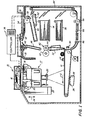
- the illustrative electrophotographic printing machine employs a belt 10 having a photoconductive surface thereon.
- the photoconductive surface is made from a selenium alloy.
- Belt 10 moves in the direction of arrow 12 to advance successive portions of the photoconductive surface through the various processing stations disposed about the path of movement thereof.
- a corona generating device indicated generally by the reference numeral 14, charges the photoconductive surface to a relatively high substantially uniform potential.
- the charged portion of the photoconductive surface is advanced through imaging station B.
- a document handling unit indicated generally by the reference numeral 15, positions original document 16 facedown over exposure system 17.
- the exposure system indicated generally by reference numeral 17 includes lamp 20 which illuminates document 16,positioned on transparent platen 18.
- the light rays reflected from document 16 are transmitted through lens 22.
- Lens 22 focuses the light image - of original document 16 onto the charged portion of the photoconductive surface of belt 10 to selectively dissipate the charge thereof.
- This records an electrostatic latent image on the photoconductive surface which corresponds to the informational areas contained within the original document.
- belt 10 advances the electrostatic latent image recorded on the photoconductive surface to development station C.
- Platen 18 is mounted movably and arranged to move in the direction of arrows 24 to adjust the magnification of the original document being reproduced.
- Lens 22 moves in synchronism therewith so as to focus the light image of original document 16 onto the charged portion of the photoconductive surface of belt 10.
- Document handling unit 15 sequentially feeds documents from a stack of documents placed by the operator in a normal forward collated order in a document stacking and holding tray.
- the documents are fed from the holding tray, in seriatim, to platen 18.
- the document handling unit recirculates documents back to the stack supported on the tray.
- the document handling unit is adapted to serially sequentially feed the documents, which may be of various sizes and weights of paper or plastic containing information to be copied.
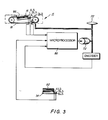
- the size of the original document disposed in the holding fray -and the size of the copy sheet are measured. Magnification of the imaging system is adjusted to insure that the indicia or information contained on the original document is reproduced within the space of the copy sheet. The details of the control system for adjusting the imaging systems magnification are described, in greater detail, in Figure 3.
- a pair of magnetic brush developer rollers indicated generally by the reference numerals 26 and 28, advance a developer material into contact with the electrostatic latent image.
- the latent image attracts toner particles from the carrier granules of the developer material to form a toner powder image on the photoconductive surface of belt 10.
- belt 10 advances the toner powder image to transfer station D.
- transfer station D a copy sheet is moved into contact with the toner powder image.
- Transfer station D includes a corona generating device 30 which sprays ions onto the backside of the copy sheet. This attracts the toner powder image from the photoconductive surface of belt 10 to the sheet.
- conveyor 32 advances the sheet to fusing station E.
- the copy sheets are fed from a selected one of trays 34 or 36 to transfer station D.
- Each of these trays sense the size of the copy sheet and send an electrical signal indicative thereof to a microprocessor 80 ( Figure 3) within controller 38.
- the holding tray of document handling unit 15 includes switches thereon which detect the size of the original document and generate an electrical signal indicative thereof which is transmitted also to microprocessor 80 ( Figure 3) of controller 38.
- Fusing station E includes a fuser assembly, indicated generally by the reference numeral 40, which permanently affixes the transferred powder image to the copy sheet.
- fuser assembly 40 includes a heated fuser roller 42 and backup roller 44. The sheet passes between fuser roller 42 and backup roller 44 with the powder image contacting fuser roller 42. In this manner, the powder image is permanently affixed to the sheet.
- conveyor 46 transports the sheets to gate 48 which functions as an inverter selector.
- gate 48 the copy sheets will either be deflected into a sheet inverter 50 or bypass sheet inverter 50 and be fed directly onto a second decision gate 52.
- copy sheets which bypass inverter 50 turn a 90° corner in the sheet path before reaching gate 52.
- Gate 52 inverts the sheets into a faceup orientation so that the imaged side which has been transferred and fused is faceup. If inverter path 50 is selected, the opposite is true, i.e. the last printed face is facedown.
- Second decision gate.52 deflects the sheet directly into an output tray 54 or deflects the sheet into a transport path which carries them on without inversion to a third decision gate 56.
- Gate 56 either passes the sheets directly on without inversion into the output path of the copier, or deflects the sheets into a duplex inverter roll transport 58.
- Inverting transport 58 inverts and stacks the sheets to be duplexed in a duplex tray 60 when gate 56 so directs.
- Duplex tray 60 provides intermediate or buffer storage for those sheets which have been printed on one side and on which an image will be subsequently printed on the side opposed thereto, i.e. the copy sheets being duplexed. Due to the sheet inverting by rollers 58, these buffer set sheets are stacked in duplex tray 60 facedown. They are stacked in duplex tray 60 on top of one another in the order in which they are copied.
- the previously simplexed sheets in tray 60 are fed seriatim by bottom feeder 62 back to transfer station D for transfer of the toner powder image to the opposed side of the sheet.
- Conveyers 64 and 66 advance the sheet along a path which produces an inversion thereof.
- the proper or clean side of the copy sheet is positioned in contact with belt 10 at transfer station D so that the toner powder image thereon is transferred thereto.
- the duplex sheets are then fed through the same path as the previously simplexed sheets to be stacked in tray 54 for subsequent removal by the printing machine operator.
- Cleaning station F includes a rotatably mounted fibrous brush 68 in contact with the photoconductive surface of belt 10. These particles are cleaned from the photoconductive surface of belt 10 by the rotation of brush 68 in contact therewith.
- a discharge lamp (not shown) floods the photoconductive surface with light to dissipate any residual electrostatic charge remaining thereon prior to the charging thereof for the next. successive - imaging cycle.
- the magnification control system of the exposure system 17 may be characterized as a relative position automatic control system using a reversable AC motor, digital feedback encoder, and microprocessor controller to position the platen and lens so as to achieve the correct magnification and focus of images.
- the location of the platen and lens is controlled by cams, a band drive and a cable attached to a capstan directly coupled to the output drive shaft of the motor.
- Platen 18 is positioned on top of integrated cavity 70.
- Drive motor 72 is coupled to cams 74. As drive motor 72 rotate, cams 74 rotate in conjunction therewith. Rotation of cams 74 move cam followers 76.
- Cam followers 76 are secured to platen 18. In this manner, platen 18 is translated so as to vary the magnification of the original document being reproduced. Movement of platen 18 is controlled by the rotation of cams 74 having cam followers 76 riding thereon. Cam followers 76 are directly coupled to platen 18. Thus, any movement of cam followers 76 is directly transmitted to platen 18. Platen 18 is translated in a bidirectional manner. In one direction, the optical image is magnified with the optical image being reduced by movement in the other direction.
- the cam drive and cable system indicated generally by the reference numeral 78, is attached to a capstan directly coupled to the output drive shaft of motor 72. This system is also connected to lens 22. Thus, any rotation of motor 72 moves lens 22.
- motor 72 drives both platen 18 and lens 22 in synchronism so as to focus the image which may be magnified or reduced in size onto the photoconductive surface of belt 10.
- drive motor 72 is a reversable permanent capacitor AC induction gear motor.
- the rotor speed is normally 3200 rpm and the output speed is 10 rpm.
- the microprocessor of controller 38 turns drive motor 72 on and off in either the forward or reverse phase causing the output shaft to rotate and position the platen 18 and lens 22 in accordance with the desired magnification.
- document handling unit 15 includes a holding tray 86 which has original document 16 disposed thereon.
- Holding tray 86 has a plurality of switches.
- switches lLS, 2LS and 3LS are activated by differing lengths of original documents 16.
- an 8 1/2 inch long original document will activate switch 1LS while an 11 inch original document will energize switches 1LS and 2LS, and a 14 inch original document will energize switches lLS, 2LS and 3LS.
- tray 34 and 36 include a plurality of switches thereon for measuring the size of the copy sheets. Inasmuch as trays 34 and 36 are identical with one another, only one tray will be described hereinafter. Thus, only tray 34 will be discussed. As shown in Figure 3, tray 34 includes a plurality of switches 4LS, 5LS and 6LS. Switches 4LS, 5LS and 6LS are activated by differing lengths of stacks of copy sheets 82.
- an 8 1/2 inch long stack of copy paper will activate switch 4LS with an 11 inch stack of copy paper energizing switches 4LS and 5LS and a 14 inch stack of copy paper energizing switches 4LS, 5LS and 6LS.
- the electrical output signals from switches 4LS, 5LS and 6LS are processed by microprocessor 80.
- Microprocessor 80 compares the signal indicative of the length of original document 16 with the signal indicative of the length of copy sheet 82. The difference therebetween is employed to drive motor 72.
- drive motor 72 At initiation of power-on, or at the appropriate command, drive motor 72 will axially drive lens 22 and platen 18 to the home positions, which are physically established by activating a micro-switch or similar detecting device. Thereafter, motor 72 will rotate and each pulse will be counted. The count relative to home position will be compared to numbers stored in the memory register of microprocessor 80 for the desired magnification. The number stored in the memory register of microprocessor 80 is determined by the difference between the signal indicating the size of original document 16 and that of copy sheet 82. When the count equals the stored number, the motor will stop and the lens and platen will be properly positioned so as to insure that the indicia recorded on original document 16 are reproduced on copy sheet 82.
- the count will be retained within microprocessor 80 so that for the next required magnification, it is compared to the required stored number.
- the positive/negative aspect of the differences between the count and the stored number determine the direction of rotation of motor 72.
- Motor 72 is coupled to encoder 84.
- Encoder 84 divides the angular rotation of motor 72 into 535 equal steps through a total rotation of 180°. Each step will be about one-third of a degree. Because of the non-linearity of magnification with angle, the magnification step sizes will vary from approximately 0.0026x/near the Ix position, to about O.OOOOlx near the limits of 0.64llx and 1.5598x.
- Each step will be counted by one pulse of encoder 84.
- encoder 84 is a 50% duty cycle square wave Hall effect generator which is switched by a magnet attached to the shaft of motor 72.
- an electrophotographic printing machine which automatically detects the size of both the original document and copy sheet adjust the magnification of the optical system thereof so that the indicia of the original document are reproduced on the copy sheet.
Landscapes
- Physics & Mathematics (AREA)
- General Physics & Mathematics (AREA)
- Control Or Security For Electrophotography (AREA)
- Exposure Or Original Feeding In Electrophotography (AREA)
- Holders For Sensitive Materials And Originals (AREA)
- Variable Magnification In Projection-Type Copying Machines (AREA)
Applications Claiming Priority (2)
| Application Number | Priority Date | Filing Date | Title |
|---|---|---|---|
| US06/237,031 US4351606A (en) | 1981-02-23 | 1981-02-23 | Variable magnification optical system for use in electrophotographic printing |
| US237031 | 1981-02-23 |
Publications (2)
| Publication Number | Publication Date |
|---|---|
| EP0059083A2 true EP0059083A2 (de) | 1982-09-01 |
| EP0059083A3 EP0059083A3 (de) | 1982-12-15 |
Family
ID=22892065
Family Applications (1)
| Application Number | Title | Priority Date | Filing Date |
|---|---|---|---|
| EP82300853A Withdrawn EP0059083A3 (de) | 1981-02-23 | 1982-02-19 | Elektrophotographisches Kopiergerät und -verfahren |
Country Status (3)
| Country | Link |
|---|---|
| US (1) | US4351606A (de) |
| EP (1) | EP0059083A3 (de) |
| JP (1) | JPS57185060A (de) |
Cited By (8)
| Publication number | Priority date | Publication date | Assignee | Title |
|---|---|---|---|---|
| EP0119868A1 (de) * | 1983-03-21 | 1984-09-26 | Xerox Corporation | Mechanismus zür Bildeinstellung für ein Vervielfältigungsgerät mit veränderlicher Vergrösserung |
| DE3421931A1 (de) * | 1983-06-15 | 1984-12-20 | Sharp K.K., Osaka | Steuereinrichtung fuer fotokopiergeraete |
| DE3517383A1 (de) * | 1984-05-15 | 1985-11-21 | Canon K.K., Tokio/Tokyo | Kopiergeraet |
| DE3522089A1 (de) * | 1984-06-21 | 1986-01-02 | Canon K.K., Tokio/Tokyo | Bildreproduktionsgeraet |
| DE3537012A1 (de) * | 1984-10-17 | 1986-04-17 | Kabushiki Kaisha Toshiba, Kawasaki, Kanagawa | Bilderzeugungsgeraet |
| FR2586114A1 (fr) * | 1985-08-10 | 1987-02-13 | Canon Kk | Appareil de formation d'images |
| EP0226369A1 (de) * | 1985-11-29 | 1987-06-24 | Mita Industrial Co. Ltd. | Gerät zur Bilderzeugung mit Mitteln zur Steuerung der geladenen Fläche auf dem Photorezeptor |
| EP0220022A3 (en) * | 1985-10-08 | 1987-07-01 | Sharp Kabushiki Kaisha | Document size detection apparatus |
Families Citing this family (13)
| Publication number | Priority date | Publication date | Assignee | Title |
|---|---|---|---|---|
| JPS57120926A (en) * | 1981-01-20 | 1982-07-28 | Fuji Xerox Co Ltd | Copying machine for microfilm |
| JPS5825663A (ja) * | 1981-08-08 | 1983-02-15 | Canon Inc | 複写装置 |
| US4505581A (en) * | 1982-04-28 | 1985-03-19 | Xerox Corporation | Registration system for a photocopier |
| US4521100A (en) * | 1982-06-28 | 1985-06-04 | Canon Kabushiki Kaisha | Variable magnification image forming apparatus |
| US4824090A (en) * | 1982-11-26 | 1989-04-25 | Xerox Corporation | Automatically setting the paper path components of a reproduction machine in accordance with the size copy sheet being processed |
| US4537499A (en) * | 1983-03-21 | 1985-08-27 | Xerox Corporation | Imaging system for producing reduced or enlarged images of an original document |
| US4523837A (en) * | 1983-07-14 | 1985-06-18 | Xerox Corporation | Document handling system to enable large document copying on a standard office copier |
| JPS60186878A (ja) * | 1984-03-06 | 1985-09-24 | Minolta Camera Co Ltd | 両面複写機 |
| JPS60211473A (ja) * | 1984-04-05 | 1985-10-23 | Sharp Corp | 変倍複写機 |
| US4647188A (en) * | 1984-06-12 | 1987-03-03 | Canon Kabushiki Kaisha | Image forming system |
| US4585332A (en) * | 1984-08-27 | 1986-04-29 | Xerox Corporation | Electrophotographic printing machine with means for sensing size of document |
| US4579444A (en) * | 1984-12-06 | 1986-04-01 | Xerox Corporation | Document registration system |
| US4745438A (en) * | 1986-09-16 | 1988-05-17 | Xerox Corporation | Automatic copier show-around erase system |
Family Cites Families (7)
| Publication number | Priority date | Publication date | Assignee | Title |
|---|---|---|---|---|
| US3944356A (en) * | 1974-08-29 | 1976-03-16 | Xerox Corporation | Charging apparatus |
| US4046467A (en) * | 1975-05-14 | 1977-09-06 | Xerox Corporation | Zoom lens copier |
| JPS54133143A (en) * | 1978-04-05 | 1979-10-16 | Minolta Camera Co Ltd | Scanning system control device in electrophotographic copier |
| JPS5517119A (en) * | 1978-07-21 | 1980-02-06 | Ricoh Co Ltd | Variable magnifying power copying apparatus |
| US4277163A (en) * | 1978-07-21 | 1981-07-07 | Ricoh Company, Ltd. | Variable magnification electrostatic copying machine |
| JPS5521052A (en) * | 1978-08-02 | 1980-02-14 | Ricoh Co Ltd | Variable power copying machine |
| US4272187A (en) * | 1979-12-17 | 1981-06-09 | International Business Machines Corporation | Automatic alignment of optical elements in an electrophotographic apparatus |
-
1981
- 1981-02-23 US US06/237,031 patent/US4351606A/en not_active Expired - Lifetime
-
1982
- 1982-02-16 JP JP57023510A patent/JPS57185060A/ja active Pending
- 1982-02-19 EP EP82300853A patent/EP0059083A3/de not_active Withdrawn
Cited By (12)
| Publication number | Priority date | Publication date | Assignee | Title |
|---|---|---|---|---|
| EP0119868A1 (de) * | 1983-03-21 | 1984-09-26 | Xerox Corporation | Mechanismus zür Bildeinstellung für ein Vervielfältigungsgerät mit veränderlicher Vergrösserung |
| DE3421931A1 (de) * | 1983-06-15 | 1984-12-20 | Sharp K.K., Osaka | Steuereinrichtung fuer fotokopiergeraete |
| DE3517383A1 (de) * | 1984-05-15 | 1985-11-21 | Canon K.K., Tokio/Tokyo | Kopiergeraet |
| GB2160988A (en) * | 1984-05-15 | 1986-01-02 | Canon Kk | Variable magnification copier |
| GB2194643A (en) * | 1984-05-15 | 1988-03-09 | Canon Kk | Variable magnification copier |
| DE3522089A1 (de) * | 1984-06-21 | 1986-01-02 | Canon K.K., Tokio/Tokyo | Bildreproduktionsgeraet |
| US4743944A (en) * | 1984-06-21 | 1988-05-10 | Canon Kabushiki Kaisha | Image processing apparatus with variable magnification |
| DE3537012A1 (de) * | 1984-10-17 | 1986-04-17 | Kabushiki Kaisha Toshiba, Kawasaki, Kanagawa | Bilderzeugungsgeraet |
| FR2586114A1 (fr) * | 1985-08-10 | 1987-02-13 | Canon Kk | Appareil de formation d'images |
| US4792828A (en) * | 1985-08-10 | 1988-12-20 | Canon Kabushiki Kaisha | Image forming apparatus for forming a plurality of image from different originals on one transfer sheet |
| EP0220022A3 (en) * | 1985-10-08 | 1987-07-01 | Sharp Kabushiki Kaisha | Document size detection apparatus |
| EP0226369A1 (de) * | 1985-11-29 | 1987-06-24 | Mita Industrial Co. Ltd. | Gerät zur Bilderzeugung mit Mitteln zur Steuerung der geladenen Fläche auf dem Photorezeptor |
Also Published As
| Publication number | Publication date |
|---|---|
| US4351606A (en) | 1982-09-28 |
| JPS57185060A (en) | 1982-11-15 |
| EP0059083A3 (de) | 1982-12-15 |
Similar Documents
| Publication | Publication Date | Title |
|---|---|---|
| US4351606A (en) | Variable magnification optical system for use in electrophotographic printing | |
| US4585332A (en) | Electrophotographic printing machine with means for sensing size of document | |
| EP0261975B1 (de) | Dokumentenzuführvorrichtungen | |
| CA1138006A (en) | Dual mode catch tray | |
| EP0212781B1 (de) | Steuerung für Blattförderer | |
| US4077714A (en) | Copying apparatus | |
| JPS62290659A (ja) | コピー装置におけるシート回転装置 | |
| US4792828A (en) | Image forming apparatus for forming a plurality of image from different originals on one transfer sheet | |
| US4368973A (en) | Recirculating document feeder | |
| US4778170A (en) | Copy sheet tray with adjustable back stop and scuffer mechanism | |
| US4365889A (en) | Document handling unit | |
| US4366219A (en) | Scanning optics copier with variable pitch copy capability | |
| US4033692A (en) | Multi-mode reproducing machine | |
| JPS6140987B2 (de) | ||
| US4824090A (en) | Automatically setting the paper path components of a reproduction machine in accordance with the size copy sheet being processed | |
| EP0282348B1 (de) | Bilderzeugungssystem mit mehreren Dokumentenregistrierpositionen | |
| GB1594488A (en) | Sheet stacking | |
| US4947217A (en) | Image forming apparatus with control mechanism to correct any abberation in stopping position of original document | |
| CA1214820A (en) | Copy sheet inverter with adjustable stop mechanism | |
| JPH0235475A (ja) | 自動原稿給送装置と画像形成装置 | |
| JPS6248226B2 (de) | ||
| CA1235730A (en) | Optical system for scanning and flash exposing of document | |
| JPH04309969A (ja) | 電子写真装置 | |
| JP3024805B2 (ja) | 画像形成装置 | |
| JPS6113228B2 (de) |
Legal Events
| Date | Code | Title | Description |
|---|---|---|---|
| PUAI | Public reference made under article 153(3) epc to a published international application that has entered the european phase |
Free format text: ORIGINAL CODE: 0009012 |
|
| AK | Designated contracting states |
Designated state(s): AT DE GB |
|
| PUAL | Search report despatched |
Free format text: ORIGINAL CODE: 0009013 |
|
| AK | Designated contracting states |
Designated state(s): AT DE GB |
|
| STAA | Information on the status of an ep patent application or granted ep patent |
Free format text: STATUS: THE APPLICATION IS DEEMED TO BE WITHDRAWN |
|
| 18D | Application deemed to be withdrawn |
Effective date: 19831122 |
|
| RIN1 | Information on inventor provided before grant (corrected) |
Inventor name: FRANKO, EUGENE B. |