EP0059111A2 - Photoioniseur - Google Patents
Photoioniseur Download PDFInfo
- Publication number
- EP0059111A2 EP0059111A2 EP82300939A EP82300939A EP0059111A2 EP 0059111 A2 EP0059111 A2 EP 0059111A2 EP 82300939 A EP82300939 A EP 82300939A EP 82300939 A EP82300939 A EP 82300939A EP 0059111 A2 EP0059111 A2 EP 0059111A2
- Authority
- EP
- European Patent Office
- Prior art keywords
- photoionizer
- gas
- hollow torus
- potential
- electrodes
- Prior art date
- Legal status (The legal status is an assumption and is not a legal conclusion. Google has not performed a legal analysis and makes no representation as to the accuracy of the status listed.)
- Withdrawn
Links
- 150000002500 ions Chemical class 0.000 claims abstract description 45
- VYPSYNLAJGMNEJ-UHFFFAOYSA-N Silicium dioxide Chemical compound O=[Si]=O VYPSYNLAJGMNEJ-UHFFFAOYSA-N 0.000 claims description 11
- 150000003254 radicals Chemical class 0.000 claims description 9
- 239000000463 material Substances 0.000 claims description 8
- 238000010438 heat treatment Methods 0.000 claims description 6
- 230000005865 ionizing radiation Effects 0.000 claims description 6
- 229910052751 metal Inorganic materials 0.000 claims description 6
- 239000002184 metal Substances 0.000 claims description 6
- 229910052756 noble gas Inorganic materials 0.000 claims description 6
- 230000005855 radiation Effects 0.000 claims description 6
- 230000005684 electric field Effects 0.000 claims description 5
- 238000000605 extraction Methods 0.000 claims description 5
- 239000011521 glass Substances 0.000 claims description 5
- -1 AuI3 Chemical compound 0.000 claims description 4
- 229910052681 coesite Inorganic materials 0.000 claims description 4
- 150000001875 compounds Chemical class 0.000 claims description 4
- 229910052906 cristobalite Inorganic materials 0.000 claims description 4
- 238000009413 insulation Methods 0.000 claims description 4
- 229910052682 stishovite Inorganic materials 0.000 claims description 4
- 229910052905 tridymite Inorganic materials 0.000 claims description 4
- 238000005979 thermal decomposition reaction Methods 0.000 claims description 3
- 229910003767 Gold(III) bromide Inorganic materials 0.000 claims description 2
- 229910003803 Gold(III) chloride Inorganic materials 0.000 claims description 2
- 229910052783 alkali metal Inorganic materials 0.000 claims description 2
- 150000001340 alkali metals Chemical class 0.000 claims description 2
- 229910052794 bromium Inorganic materials 0.000 claims description 2
- WUKWITHWXAAZEY-UHFFFAOYSA-L calcium difluoride Chemical compound [F-].[F-].[Ca+2] WUKWITHWXAAZEY-UHFFFAOYSA-L 0.000 claims description 2
- 229910001634 calcium fluoride Inorganic materials 0.000 claims description 2
- 238000006243 chemical reaction Methods 0.000 claims description 2
- 229910052801 chlorine Inorganic materials 0.000 claims description 2
- 239000011538 cleaning material Substances 0.000 claims description 2
- 239000011248 coating agent Substances 0.000 claims description 2
- 238000000576 coating method Methods 0.000 claims description 2
- 229910000366 copper(II) sulfate Inorganic materials 0.000 claims description 2
- OVWPJGBVJCTEBJ-UHFFFAOYSA-K gold tribromide Chemical compound Br[Au](Br)Br OVWPJGBVJCTEBJ-UHFFFAOYSA-K 0.000 claims description 2
- RJHLTVSLYWWTEF-UHFFFAOYSA-K gold trichloride Chemical compound Cl[Au](Cl)Cl RJHLTVSLYWWTEF-UHFFFAOYSA-K 0.000 claims description 2
- 229910052740 iodine Inorganic materials 0.000 claims description 2
- PQXKHYXIUOZZFA-UHFFFAOYSA-M lithium fluoride Inorganic materials [Li+].[F-] PQXKHYXIUOZZFA-UHFFFAOYSA-M 0.000 claims description 2
- 229910001635 magnesium fluoride Inorganic materials 0.000 claims description 2
- 159000000001 potassium salts Chemical class 0.000 claims description 2
- 229910000010 zinc carbonate Inorganic materials 0.000 claims description 2
- 238000000354 decomposition reaction Methods 0.000 claims 2
- 230000008021 deposition Effects 0.000 claims 2
- 238000003491 array Methods 0.000 claims 1
- 230000001419 dependent effect Effects 0.000 claims 1
- 150000002366 halogen compounds Chemical class 0.000 claims 1
- 230000001939 inductive effect Effects 0.000 claims 1
- GUWHRJQTTVADPB-UHFFFAOYSA-N lithium azide Chemical compound [Li+].[N-]=[N+]=[N-] GUWHRJQTTVADPB-UHFFFAOYSA-N 0.000 claims 1
- 230000003993 interaction Effects 0.000 abstract description 3
- 239000007789 gas Substances 0.000 description 35
- 239000003990 capacitor Substances 0.000 description 7
- 239000000470 constituent Substances 0.000 description 3
- 239000004809 Teflon Substances 0.000 description 2
- 229920006362 Teflon® Polymers 0.000 description 2
- 238000004140 cleaning Methods 0.000 description 2
- 230000006835 compression Effects 0.000 description 2
- 238000007906 compression Methods 0.000 description 2
- RZVAJINKPMORJF-UHFFFAOYSA-N Acetaminophen Chemical compound CC(=O)NC1=CC=C(O)C=C1 RZVAJINKPMORJF-UHFFFAOYSA-N 0.000 description 1
- 229910021607 Silver chloride Inorganic materials 0.000 description 1
- QVGXLLKOCUKJST-UHFFFAOYSA-N atomic oxygen Chemical compound [O] QVGXLLKOCUKJST-UHFFFAOYSA-N 0.000 description 1
- DSAJWYNOEDNPEQ-UHFFFAOYSA-N barium atom Chemical compound [Ba] DSAJWYNOEDNPEQ-UHFFFAOYSA-N 0.000 description 1
- UUXFWHMUNNXFHD-UHFFFAOYSA-N barium azide Chemical compound [Ba+2].[N-]=[N+]=[N-].[N-]=[N+]=[N-] UUXFWHMUNNXFHD-UHFFFAOYSA-N 0.000 description 1
- ONIOAEVPMYCHKX-UHFFFAOYSA-N carbonic acid;zinc Chemical compound [Zn].OC(O)=O ONIOAEVPMYCHKX-UHFFFAOYSA-N 0.000 description 1
- 239000000919 ceramic Substances 0.000 description 1
- 239000004020 conductor Substances 0.000 description 1
- 229920006037 cross link polymer Polymers 0.000 description 1
- 238000010586 diagram Methods 0.000 description 1
- 238000009826 distribution Methods 0.000 description 1
- 230000000694 effects Effects 0.000 description 1
- 239000003822 epoxy resin Substances 0.000 description 1
- 230000005284 excitation Effects 0.000 description 1
- 238000005429 filling process Methods 0.000 description 1
- 238000005247 gettering Methods 0.000 description 1
- 229910052736 halogen Inorganic materials 0.000 description 1
- 150000002367 halogens Chemical class 0.000 description 1
- 229930195733 hydrocarbon Natural products 0.000 description 1
- 150000002430 hydrocarbons Chemical class 0.000 description 1
- 230000002452 interceptive effect Effects 0.000 description 1
- 238000004519 manufacturing process Methods 0.000 description 1
- 238000005259 measurement Methods 0.000 description 1
- 238000002844 melting Methods 0.000 description 1
- 230000008018 melting Effects 0.000 description 1
- 150000002739 metals Chemical class 0.000 description 1
- 238000000034 method Methods 0.000 description 1
- 230000004048 modification Effects 0.000 description 1
- 238000012986 modification Methods 0.000 description 1
- 238000000465 moulding Methods 0.000 description 1
- 150000002835 noble gases Chemical class 0.000 description 1
- 230000003287 optical effect Effects 0.000 description 1
- 229910052760 oxygen Inorganic materials 0.000 description 1
- 239000001301 oxygen Substances 0.000 description 1
- 238000006303 photolysis reaction Methods 0.000 description 1
- 230000015843 photosynthesis, light reaction Effects 0.000 description 1
- 239000004033 plastic Substances 0.000 description 1
- 229920000647 polyepoxide Polymers 0.000 description 1
- 239000012286 potassium permanganate Substances 0.000 description 1
- 230000008569 process Effects 0.000 description 1
- 239000005297 pyrex Substances 0.000 description 1
- 238000007789 sealing Methods 0.000 description 1
- 239000005394 sealing glass Substances 0.000 description 1
- 239000000377 silicon dioxide Substances 0.000 description 1
- HKZLPVFGJNLROG-UHFFFAOYSA-M silver monochloride Chemical compound [Cl-].[Ag+] HKZLPVFGJNLROG-UHFFFAOYSA-M 0.000 description 1
- 239000007787 solid Substances 0.000 description 1
- 239000002904 solvent Substances 0.000 description 1
- 238000011144 upstream manufacturing Methods 0.000 description 1
- 239000011667 zinc carbonate Substances 0.000 description 1
Images

Classifications
-
- H—ELECTRICITY
- H01—ELECTRIC ELEMENTS
- H01J—ELECTRIC DISCHARGE TUBES OR DISCHARGE LAMPS
- H01J49/00—Particle spectrometers or separator tubes
- H01J49/02—Details
- H01J49/10—Ion sources; Ion guns
Definitions
- the present invention relates generally to a photoionizer and more specifically to a photoionization detector of trace species which uses a sealed light source in the detector and a photoionization source for a mass spectrometer which uses the same light source.
- the type of light source generally shown in the above-identified patents is modified so that the central hollow dielectric electrode which has one end enclosed is modified to extend completely through the lamp bulb of the light source. Accordingly, the front window which exists in the. referenced U.S. patents is not used in a photoionizer in accordance with the present invention. It is effectively replaced by a cylindrical window which will be described hereafter.
- the word "torus" will be basically understood from the dictionary definition which refers to a surface of a solid shape which is normally formed by revolving a plane closed curve about a line in its plane.
- the structure forming the torus may be shaped by continuous (but not uniform) deformation such that it can be transformed into a torus whose enclosed cross section can be outlined by any plane curve, with or without a tube connecting to the inner wall of the torus.
- the present invention concerns a photoionizer which includes a light source comprising a hollow torus, a window transparent to ultraviolet light substantially surrounding an axial passage through the torus, a gas within the hollow torus, and means for generating an electrical discharge within said hollow torus. It further includes electrode means within said axial passage for collecting, or extracting, the ions produced when light from said light source impinges upon a gas sample within said axial passage, means for feeding a preselected gas sample through said passage containing said electrode means, and means connected to said electrode means for measuring the interaction between said light source and said gas sample or extracting means able to project a beam of ions from the ionization region or from an ion image outside the ionization region.
- Electrodes occur in pairs between which a potential difference is applied.
- an AC potential difference is applied between a pair of electrodes to cause a. discharge in the gas within the light source and in another case, a stable, or slowly varying, potential (relative to that causing a discharge) is applied to electrodes to collect or extract ions from a region near the light source window.
- These electrodes may be physically different, or one electrode of the AC potential pair may be composed of a physically distant pair between which a stable or slowly varying potential is applied while both are at nearly the same AC potential.
- the electrodes may perform other functions such as securing the light source or heating the light source.
- the photoionizer can be operated in two modes; (1) when the gas.sample being ionized is at such a high density that the ions generated therein have a mean free path which is small in relation to a typical dimension of the ionization region, and (2) when the gas pressure is so low that the ion mean free path is large relative to a typical dimension of the ionization region.
- the first mode of operation the ions generated in the sample are collected on an electrode in the axial passage to measure the amount of parent gas, from which the ions are formed by photoionization in the gas sample.
- the second mode of operation the ions are extracted from the ionization region and projected or focused through an aperture for analysis and measurement in a mass spectrometer or by some other means.
- ionizable species In the use of the photoionizer, it is essential that ionizable species be introduced into the ionizing region. Some of these species, both in their natural and ionized form, become attached to the surface of the ionizer and its electrode structure. Often these react to form more complex species (such as crosslinked polymers), which are not subsequently released and flushed out of the axial passage. These residues can form films which absorb the ionizing light and/or electrically insulate the conducting surfaces of the electrodes. Both are undesirable, because they decrease the efficiency of the ionizer and make it less stable in operation.
- Such films are often insoluble in ordinary solvents and are difficult to remove. However, they do react with certain free radicals (e.g. 0, 0 3 ,H and OH) to form various gaseous products which can be flushed from the axial passage. In this way, complex hydrocarbons are removed as C0, C0 2 or OH when 0 is present and as CH, CH 2 or H 2 when H is present.
- free radicals e.g. 0, 0 3 ,H and OH
- the free radicals 0 and H are easily produced by photolysis of oxygen and H 2 0 by the photoionization radiation from the lamp, or by an electrical discharge produced in the gas which flows through the axial passage defining the ionization region. Special provision can be made for this to occur by suitably placing electrodes in or near the gas in the ionization region and by adding special cleaning gases containing 0 2 and/or H 2 0 or other simple compounds which will break down into the required free radicals.
- the elements may be heated, (e.g. to 300°C). This heating. can be accomplished by utilizing some of the electrodes already present in the axial passage or by locating the ionization region within a heated and thermally insulated chamber. Provision for this can be achieved without interfering with the normal operation of the ionizer.
- a lamp 11 consisting of a hollow torus 13 which has a UV or VUV light transmitting cylindrical window 15 which is part of the central inner wall of the hollow torus.
- the hollow torus contains a gas 17 and has a gas-generating side arm 19 with an associated heating means 20 to serve as a source of a component of the gas 17.
- a second side arm 22 contains a gettering material.
- a pump stem 21 which is used to evacuate the hollow torus 13 and to subsequently add a selected component of the gas 17. The stem 21 can be sealed off after the gas filling process is complete.
- a heater 900 with thermal insulation 901 can be used to maintain the ionizer at a selected elevated temperature.
- the integers 19, 20, 22, 900 and 901 may not always be required.
- an axial passage 23 is created by molding a wall 24, which conforms to the inner passage of the hollow torus 13 to one end thereof.
- the transparent window material 15 forms a part of the inner wall of the hollow torus 13.
- An electrode -25 consisting of a cylindrical metal structure, is secured within the axial passage 23 adjacent to the transparent window 15 and is designed so as to have a large number of openings through which light can pass.
- the electrode 25, as shown in Figure 1, is a helical spring. However, it should be noted that a metal mesh or a deposited thin metal coating could be used in place of a spring.
- the electrode 25 can be considered to be a semi-transparent electrode.
- a thin central electrode 27 passes centrally through the axial passage 23 and is substantially aligned therewith.
- the two electrodes 27 and 25 are electrically insulated from one another.
- the electrode 27 is maintained in the axial passage 23 by means of an electrically insulating ball 29 (e.g. of glass) in which an end of the electrode 27 is embedded.
- the electrode 27 also passes through a spring compression unit 31 which is adjusted within the axial passage 23 so as to maintain the ball 29 firmly against the helical electrode 25 and also to maintain the electrode 27 under tension.
- the spring compression unit 31 has passages 33 formed therethrough, so that gas from the axial passage 23 may pass outwardly from the unit 31 and, additionally, so that an electrode lead 35 may pass outwardly from.the electrode 25 to a voltage source.
- An electrode 100, in contact with the outer wall of the hollow torus 13 is maintained at AC and DC ground potential.
- the electrode structure described has two functions: firstly, the electrodes 25 and 100 act as high AC voltage electrodes to cause a discharge in the gas 17 of the hollow torus 13, (preferably at a frequency in the range of 50 KHz to 5000 MHz) and, secondly, the electrodes 25 and 27 cause positive ions which are formed in the gas passing through the axial passage 23 by optical radiation from the discharge in the hollow torus 13, to collect on the central electrode 27.
- FIG. 2 illustrates the circuitry used for achieving these two functions.
- the semi-transparent electrode 25 is connected to an AC resonance circuit consisting of a capacitor C5 and a coil Ll via the lead 35.
- This is the standard arrangement described in the above-identified U.S. patents.
- the circuit is modified whereby a DC decoupling capacitor Cl is used so that the semi-transparent electrode 25, and the series- connected AC resonant circuit composed of C5 and Ll, can have any arbitrary DC voltage impressed upon them. This is accomplished by a DC voltage generator 101 together with a coil L2 and a capacitor C4 which, together with the capacitor Cl, isolates the RF and DC circuits.
- the RF circuit comprises a transistor Tl,a parallel-connected coil L3 and variable capacitor C2 and resistors R1, R2 and R3.
- the central electrode 27 is connected to an amplifying electrometer circuit 37 which is in parallel with a resistor R6. This connection is made through a coil L4, and the RF voltage is filtered out by the coil L4 and a capacitor C3. Positive ions are collected on the central electrode 27 where they are neutralized by electrons which pass from ground through the resistor R6, with the electrometer measuring the current flow to give a measure of the rate of positive ion collection by the central electrode 27 and, thus, provide a measure of the amount of the particular ionizable gas which is present in the gas passed through the axial passage 23.
- An unwanted background current is produced by electrons ejected from the conductive electrodes 25 and 27. Since the outer electrode 25 is positive, any electrons ejected from it are re-collected by it and no current flows in the exterior circuit. However, electrons ejected from the negative central electrode 27, move to the outer electrode 25 and are therefore measured by the electrometer. This unwanted current may be minimized by making the central electrode 27 of a very thin wire (e.g. of 0.025 mm dimater) so as to minimize the area from which electrons can be ejected compared to the volume of gas from which positive ions may be collected.
- a very thin wire e.g. of 0.025 mm dimater
- the gas 17 within the hollow torus 13 can be varied according to particular requirements, one of which is the desired wavelength distribution of the ionizing radiation.
- the gas 17 may contain at least one noble gas or at least two noble gases. Further, it may contain at least one noble gas and one halogen-containing compound.
- the material from which the hollow torus is constructed is a dielectric such as pure vitreous silica, purified SiO 2 , high silica glass (e.g. 'Pyrex' Trade Mark), or an alkali metal resistant glass (such as 1720 glass), 1723 glass or gehlinite.
- a dielectric such as pure vitreous silica, purified SiO 2 , high silica glass (e.g. 'Pyrex' Trade Mark), or an alkali metal resistant glass (such as 1720 glass), 1723 glass or gehlinite.
- the window 15 may consist of CaF 2 , MgF 2 , LiF, pure vitreous silica or purified Si0 2 .
- the window 15 may be sealed to the rest of the hollow torus by a sealing compound which may be an epoxy resin, Silvac, an AgCl/Ag pair, or a low melting point sealing glass.
- a sealing compound which may be an epoxy resin, Silvac, an AgCl/Ag pair, or a low melting point sealing glass.
- FIG. 3 the effects occurring within the axial passage of the hollow torus are schematically illustrated by means of a somewhat different electrode structure.
- the downwardly directed arrows in Figure 3 indicate the ionizing radiation which is generated in the hollow torus.
- a current generator G is connected to both the semi-transparent electrode 25 and, in this illustrative case, a counter-electrode 41.
- the resulting current in the electrode 25 establishes a uniform electric field along the axis of the electrode structure. This electric field causes the positive ions to pass to the right to a ground electrode 43 and the negative ions to pass to the left.
- the output from the electrode 43 is connected to the electrometer.
- the resulting output to the electrometer will be indicative of the characteristics and the amount of the particular gas which is being ionized.
- Sensing is usually effected at a high sample gas pressure.
- the electrodes 41 and 43 must permit gas to flow into the cylindrical electrode 25 and, so, may need to be of a mesh or grid structure.
- the electrode 43 is of a mesh or grid, or is a ring or short cylinder disposed adjacent to the inner wall of the hollow torus, and the sample gas pressure is low, ions will be accelerated from the ionization region and will be projected along the axis of the electrical system. If the electrode 43 is shaped so as to form an ion lens, the positive ions will be focussed to an image at some distant point.
- ground potential has been used for the connection at the downstream end of the helix 25 in Figure 3, some other potential could be used and the electrode 41 does not have to be connected to the upstream end of the helix but could have some other potential applied thereto.
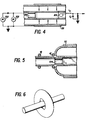
- Figure 4 shows another and simpler electrode configuration.
- the ionizing radiation (vertical arrows) occurs between an outside ground electrode 201 and a cylindrical electrode 204 when an AC generator 202 is operating.
- a DC generator 203 applies a positive potential to the electrode 204, positive ions are repelled to a wire electrode 209 where they are collected and measured by an electrometer (not shown) after the AC signal has been filtered away by a coil Lll and a capacitor Cll.
- ion-collection electrodes Several variations are possible in the size, shape, and positioning of the ion-collection electrodes. These variations can be employed to facilitate manufacture or assembly, to reduce photoelectron currents from the electrodes, to optimize the discharge in the light source, to minimize interference of the AC potential in the measuring of the ion currents, or to optimize the extraction and/or focusing of ions from the ionization region.
- Figure 5 shows a configuration in which electrodes (47 and 110) causing the discharge in the hollow torus are physically different from the electrodes (204, 209 or 41, 25 and 43) used for collection or extraction of ions from the region illuminated by the light source.
- the electrode 47 can be used with another. electrode (not shown) at the other end of the lamp enclosure to cause the discharge in the hollow torus.
- Electrode 47 in conjunction with one of the other electrodes, if it is grounded, can be used to cause a discharge inside the sample gas so as to create free molecules for cleaning deposits from surfaces. Additionally, a discharge can be generated between the electrodes 47 and 48.
- Figure 6 illustrates one of the many configurations which the hollow torus may assume. This can be formed easily in the process of making the device, and any particular configuration may be obtained from a practical standpoint.
- a getter in the hollow torus such as processed barium azide, barium metal or certain sintered metals.
- this species can be generated by thermal decomposition of, for example, UrH 3 , UrD 3 , KMnO 4 , LiNg, ZnCO 3 , CuS0 4 .nH 2 0, AuCl 3 , AuI 3 , AuBr 3 and paladilic potassium salts of Cl, I or Br, or in the other ways disclosed in the referenced U.S. patents.
- the heater 900 can take many configurations and is schematically illustrated as a simple electrical resistive heater, However, it would preferably be a metal-film- on plastic or ceramic resistor with a heat conducting material held in place by means such as teflon shrunk-on sleeve and/or an outer-inner insulating layer held in place by a second teflon shrunk-on sle.eve. Any means which accomplishes the thermal decomposition is satisfactory, but selection of the actual means chosen would be governed primarily by size and weight.
- any type of structural support may be used for retaining the device of the present invention in position, so long as it does not affect the electrical characteristics or block the gas or the discharge in the torus.
- Means may be provided for cleaning material in contact with the sample gas by reaction with a free radical.
- the free radicals can be 0 or 0 3 .
- the free radicals may be produced by photoionization or by an electrical discharge.
Landscapes
- Physics & Mathematics (AREA)
- Engineering & Computer Science (AREA)
- Plasma & Fusion (AREA)
- Chemical & Material Sciences (AREA)
- Analytical Chemistry (AREA)
- Other Investigation Or Analysis Of Materials By Electrical Means (AREA)
Applications Claiming Priority (2)
| Application Number | Priority Date | Filing Date | Title |
|---|---|---|---|
| US238275 | 1981-02-25 | ||
| US06/238,275 US4377749A (en) | 1981-02-25 | 1981-02-25 | Photoionizer |
Publications (2)
| Publication Number | Publication Date |
|---|---|
| EP0059111A2 true EP0059111A2 (fr) | 1982-09-01 |
| EP0059111A3 EP0059111A3 (fr) | 1984-05-30 |
Family
ID=22897209
Family Applications (1)
| Application Number | Title | Priority Date | Filing Date |
|---|---|---|---|
| EP82300939A Withdrawn EP0059111A3 (fr) | 1981-02-25 | 1982-02-24 | Photoioniseur |
Country Status (4)
| Country | Link |
|---|---|
| US (1) | US4377749A (fr) |
| EP (1) | EP0059111A3 (fr) |
| JP (1) | JPS57157153A (fr) |
| CA (1) | CA1177976A (fr) |
Families Citing this family (12)
| Publication number | Priority date | Publication date | Assignee | Title |
|---|---|---|---|---|
| CH649231A5 (de) * | 1980-10-28 | 1985-05-15 | Hans Christoph Siegmann Prof D | Verfahren zum elektrischen aufladen von schwebeteilchen in gasen. |
| US4476392A (en) * | 1981-12-28 | 1984-10-09 | Young Robert A | Photoelectron source for use in a gas chromatograph detector and mass spectrometer ion source |
| DE3330509C1 (de) * | 1983-08-24 | 1985-05-23 | Fa. Matter-Siegmann, Wohlen | Verfahren zur Regelung von Verbrennungsprozessen |
| GB8431663D0 (en) * | 1984-12-14 | 1985-01-30 | Perkin Elmer Corp | Ionization detector |
| DE3515258A1 (de) * | 1985-04-27 | 1986-11-06 | Gossen Gmbh, 8520 Erlangen | Vorrichtung zur erzeugung von photoionisation an partikeln, insbesondere an einem aerosol |
| DE4305704B4 (de) * | 1993-02-25 | 2006-02-16 | Matter + Siegmann Ag | Verfahren und Vorrichtung zur Untersuchung von in einem Gas befindlichen Partikeln |
| US6646256B2 (en) | 2001-12-18 | 2003-11-11 | Agilent Technologies, Inc. | Atmospheric pressure photoionization source in mass spectrometry |
| US8922219B2 (en) | 2010-11-30 | 2014-12-30 | General Electric Company | Photo-ionization detectors and associated methods thereof |
| US10090143B2 (en) * | 2016-12-13 | 2018-10-02 | R.J. Reynolds Tobacco Company | Real time measurement techniques combining light sources and mass spectrometer |
| CN109884165B (zh) * | 2019-03-11 | 2024-05-28 | 重庆邮电大学 | 光离子化检测器电离室及光电离检测器 |
| CN109884167B (zh) * | 2019-03-26 | 2024-05-24 | 重庆邮电大学 | 电离室及螺旋路微型光离子化检测装置 |
| CN113189258B (zh) * | 2021-06-08 | 2025-01-21 | 上海雷密传感技术有限公司 | 光离子化测量装置和方法 |
Family Cites Families (8)
| Publication number | Priority date | Publication date | Assignee | Title |
|---|---|---|---|---|
| US2922911A (en) * | 1956-08-31 | 1960-01-26 | Friedman Herbert | Apparatus for gas analysis |
| NL266283A (fr) * | 1960-06-27 | |||
| US3478204A (en) * | 1964-08-24 | 1969-11-11 | Jean R Berry | Mass spectrometer ion source having a laser to cause autoionization of gas |
| US3478205A (en) * | 1965-07-29 | 1969-11-11 | Owens Illinois Inc | Ionization detector electrode assembly and method of analyzing gas and vapor substances |
| US3476968A (en) * | 1966-12-19 | 1969-11-04 | Hitachi Ltd | Microwave ion source |
| US4000420A (en) * | 1974-06-11 | 1976-12-28 | The Board Of Trustees Of Leland Stanford Junior University | Method and apparatus for separating isotopes |
| US3984727A (en) * | 1975-03-10 | 1976-10-05 | Young Robert A | Resonance lamp having a triatomic gas source |
| US4013913A (en) * | 1976-01-19 | 1977-03-22 | Hnu Systems Inc. | Ion detection electrode arrangement |
-
1981
- 1981-02-25 US US06/238,275 patent/US4377749A/en not_active Expired - Fee Related
-
1982
- 1982-02-23 CA CA000396793A patent/CA1177976A/fr not_active Expired
- 1982-02-24 EP EP82300939A patent/EP0059111A3/fr not_active Withdrawn
- 1982-02-25 JP JP57031635A patent/JPS57157153A/ja active Pending
Also Published As
| Publication number | Publication date |
|---|---|
| US4377749A (en) | 1983-03-22 |
| CA1177976A (fr) | 1984-11-13 |
| JPS57157153A (en) | 1982-09-28 |
| EP0059111A3 (fr) | 1984-05-30 |
Similar Documents
| Publication | Publication Date | Title |
|---|---|---|
| US4377749A (en) | Photoionizer | |
| US6646256B2 (en) | Atmospheric pressure photoionization source in mass spectrometry | |
| GB2219432A (en) | Mass spectrometer | |
| US4398152A (en) | Photoionization detector | |
| CA2156072C (fr) | Spectrometre de masse cycloidal et generateur d'ions concu pour utilisation dans ledit spectrometre | |
| CA1158891A (fr) | Systeme de detection a chromatographe gazeux a photo-ionisation selective | |
| CN107068532A (zh) | 一种电子轰击电离源 | |
| US3134898A (en) | Gas chromatography with means to flow ionization particles into the ionization chamber | |
| US4454425A (en) | Photoionizer | |
| Bouclier et al. | Ageing studies with microstrip gas chambers | |
| EP0029758B1 (fr) | Détecteur à ionisation gazeuse et tomodensitomètre utilisant un tel détecteur | |
| NL8004817A (nl) | Werkwijze en inrichting voor het detecteren van geioniseerde stoffen in een draaggas. | |
| EP0026683B1 (fr) | Détecteur de mobilité ionique | |
| RU2095790C1 (ru) | Устройство для эмиссионного спектрального анализа | |
| US3535576A (en) | Photoionization device with electrodes attached to exterior of envelope | |
| Baksht et al. | Volume-plasma generation of a high H− concentration in low-voltage cesium–hydrogen discharge | |
| Bearden et al. | Design of a Mercury Vapor Target X‐Ray Tube | |
| RU2291469C1 (ru) | Газовый пропорционально-сцинтилляционный детектор | |
| AU699755B2 (en) | Cycloidal mass spectrometer and ionizer for use therein | |
| Roberts | 3. Glow Discharges and Wall Stabilized Arcs | |
| CN119908023A (zh) | 质量分析装置 | |
| Kusch | DEVELOPMENT OF METHODS FOR QUANTITATIVE SPECTROSCOPIC TEMPERATURE DETERMINATION OF PLASMAS | |
| Gray | Use of an inductively coupled plasma as an ion source for atomic mass spectometry | |
| Robinson | The construction of a low-pressure flash tube and the measurement of some of its properites | |
| Swinburne | The Use of Langmuir Probes in Inductively Coupled Plasmas |
Legal Events
| Date | Code | Title | Description |
|---|---|---|---|
| PUAI | Public reference made under article 153(3) epc to a published international application that has entered the european phase |
Free format text: ORIGINAL CODE: 0009012 |
|
| AK | Designated contracting states |
Designated state(s): AT BE CH DE FR GB IT LU NL SE |
|
| PUAL | Search report despatched |
Free format text: ORIGINAL CODE: 0009013 |
|
| AK | Designated contracting states |
Designated state(s): AT BE CH DE FR GB IT LI LU NL SE |
|
| STAA | Information on the status of an ep patent application or granted ep patent |
Free format text: STATUS: THE APPLICATION IS DEEMED TO BE WITHDRAWN |
|
| 18D | Application deemed to be withdrawn |
Effective date: 19850131 |