EP0059634A1 - Procédé pour la réparation de pneumatiques - Google Patents
Procédé pour la réparation de pneumatiques Download PDFInfo
- Publication number
- EP0059634A1 EP0059634A1 EP82301030A EP82301030A EP0059634A1 EP 0059634 A1 EP0059634 A1 EP 0059634A1 EP 82301030 A EP82301030 A EP 82301030A EP 82301030 A EP82301030 A EP 82301030A EP 0059634 A1 EP0059634 A1 EP 0059634A1
- Authority
- EP
- European Patent Office
- Prior art keywords
- tire
- patch
- plug
- area
- damaged portion
- Prior art date
- Legal status (The legal status is an assumption and is not a legal conclusion. Google has not performed a legal analysis and makes no representation as to the accuracy of the status listed.)
- Ceased
Links
Images



Classifications
-
- B—PERFORMING OPERATIONS; TRANSPORTING
- B29—WORKING OF PLASTICS; WORKING OF SUBSTANCES IN A PLASTIC STATE IN GENERAL
- B29C—SHAPING OR JOINING OF PLASTICS; SHAPING OF MATERIAL IN A PLASTIC STATE, NOT OTHERWISE PROVIDED FOR; AFTER-TREATMENT OF THE SHAPED PRODUCTS, e.g. REPAIRING
- B29C73/00—Repairing of articles made from plastics or substances in a plastic state, e.g. of articles shaped or produced by using techniques covered by this subclass or subclass B29D
- B29C73/04—Repairing of articles made from plastics or substances in a plastic state, e.g. of articles shaped or produced by using techniques covered by this subclass or subclass B29D using preformed elements
- B29C73/06—Repairing of articles made from plastics or substances in a plastic state, e.g. of articles shaped or produced by using techniques covered by this subclass or subclass B29D using preformed elements using plugs sealing in the hole
-
- B—PERFORMING OPERATIONS; TRANSPORTING
- B29—WORKING OF PLASTICS; WORKING OF SUBSTANCES IN A PLASTIC STATE IN GENERAL
- B29C—SHAPING OR JOINING OF PLASTICS; SHAPING OF MATERIAL IN A PLASTIC STATE, NOT OTHERWISE PROVIDED FOR; AFTER-TREATMENT OF THE SHAPED PRODUCTS, e.g. REPAIRING
- B29C73/00—Repairing of articles made from plastics or substances in a plastic state, e.g. of articles shaped or produced by using techniques covered by this subclass or subclass B29D
- B29C73/04—Repairing of articles made from plastics or substances in a plastic state, e.g. of articles shaped or produced by using techniques covered by this subclass or subclass B29D using preformed elements
- B29C73/10—Repairing of articles made from plastics or substances in a plastic state, e.g. of articles shaped or produced by using techniques covered by this subclass or subclass B29D using preformed elements using patches sealing on the surface of the article
-
- B—PERFORMING OPERATIONS; TRANSPORTING
- B29—WORKING OF PLASTICS; WORKING OF SUBSTANCES IN A PLASTIC STATE IN GENERAL
- B29C—SHAPING OR JOINING OF PLASTICS; SHAPING OF MATERIAL IN A PLASTIC STATE, NOT OTHERWISE PROVIDED FOR; AFTER-TREATMENT OF THE SHAPED PRODUCTS, e.g. REPAIRING
- B29C73/00—Repairing of articles made from plastics or substances in a plastic state, e.g. of articles shaped or produced by using techniques covered by this subclass or subclass B29D
- B29C73/24—Apparatus or accessories not otherwise provided for
- B29C73/26—Apparatus or accessories not otherwise provided for for mechanical pretreatment
-
- B—PERFORMING OPERATIONS; TRANSPORTING
- B29—WORKING OF PLASTICS; WORKING OF SUBSTANCES IN A PLASTIC STATE IN GENERAL
- B29C—SHAPING OR JOINING OF PLASTICS; SHAPING OF MATERIAL IN A PLASTIC STATE, NOT OTHERWISE PROVIDED FOR; AFTER-TREATMENT OF THE SHAPED PRODUCTS, e.g. REPAIRING
- B29C73/00—Repairing of articles made from plastics or substances in a plastic state, e.g. of articles shaped or produced by using techniques covered by this subclass or subclass B29D
- B29C73/24—Apparatus or accessories not otherwise provided for
- B29C73/30—Apparatus or accessories not otherwise provided for for local pressing or local heating
- B29C73/305—Apparatus or accessories not otherwise provided for for local pressing or local heating specially adapted for toroidal articles, e.g. tyres
-
- B—PERFORMING OPERATIONS; TRANSPORTING
- B29—WORKING OF PLASTICS; WORKING OF SUBSTANCES IN A PLASTIC STATE IN GENERAL
- B29L—INDEXING SCHEME ASSOCIATED WITH SUBCLASS B29C, RELATING TO PARTICULAR ARTICLES
- B29L2030/00—Pneumatic or solid tyres or parts thereof
-
- Y—GENERAL TAGGING OF NEW TECHNOLOGICAL DEVELOPMENTS; GENERAL TAGGING OF CROSS-SECTIONAL TECHNOLOGIES SPANNING OVER SEVERAL SECTIONS OF THE IPC; TECHNICAL SUBJECTS COVERED BY FORMER USPC CROSS-REFERENCE ART COLLECTIONS [XRACs] AND DIGESTS
- Y10—TECHNICAL SUBJECTS COVERED BY FORMER USPC
- Y10T—TECHNICAL SUBJECTS COVERED BY FORMER US CLASSIFICATION
- Y10T152/00—Resilient tires and wheels
- Y10T152/10—Tires, resilient
- Y10T152/10882—Patches
- Y10T152/10909—Patches with plugs
Definitions
- This invention relates to a repair construction and a method of repairing a damaged portion in the wall of a tire, particularly the sidewall of a radial tire.
- Radial tires are constructed with radial wire cords which bear or absorb the loop tension from bead to bead due to internal air pressure when the tire is inflated. When one or more of the radial cords are broken due to tire damage, the loop strength must be restored in that local area in order to restore the proper load carrying capability of the tire.
- One method of repairing such damaged areas in the walls of tires is to cut a section of the wall around the damaged portion to form a plug area, placing a patch over the plug area on the inside of the tire, and filling the remainder of the plug area with a plug material, such as uncured rubber. The plug material and patch then are cured to complete the repair except for final dressing.
- the principal problem with repairs of the character described resides in the fact that such repairs result in a bulge in the repaired tire when its internal inflated pressure reaches road running conditions, for example, in truck tires a pressure of as much as 100 p.s.i.
- the bulge is mainly restricted to the plug area and might extend from the normal plane of the tire sidewall as much as one quarter inch or more under pressure. While such a bulge condition may not necessarily create or cause a functional or operational problem, it is totally unacceptable to many tire retailers, truckers and other end-users because the bulge is misconceived as a ply separation and because bulged tires may not pass many local and state inspections.
- the present invention is directed to a new and improved repair construction and method of repairing a damaged portion in the wall of a tire, and particularly the sidewall of a radial tire, to eliminate the exterior bulge in the repaired area when the tire is subsequently pressurized under normal road running conditions.
- the present invention avoids the unacceptable dimple appearance when the tire is uninflated. This is accomplished primarily by positioning the patch used in the repair in a preselected orientation relative to the injury and maintaining that position or orientation while applying the plug material to the exterior of the injury and during curing of the repair.
- An object, therefore, of the present invention is to provide a new and improved method of repairing a damaged portion in the wall of a tire, such as a sidewall injury in a radial tire.
- Another object of the invention is to provide a repair construction and a method of repairing a defective tire, of the character described, without causing a bulge at the repaired area after the repair is completed and when the repaired tire is subjected to normal pressurized road running conditions.
- the method of repair includes the following operational sequence. First, a section ot the wall of the tire around the damaged portion is removed to form a plug area. A patch is then installed over the plug area on the inside of the tire in an unstressed state substantially contiguous with the interior surface of the tire. The patch is then positioned at least partially within the plug area of the tire wall by the application of force on its internal surface, preferably by pressurizing the tire. The remainder of the plug area is then filled on the outside of the patch with a suitable plug material, such as uncured rubber, and the plug material and patch are cured while the patch is maintained in its prepositioned orientation within the plug area. With this method and repair construction, the tire is cured with internal air pressure applied while the patch is still oriented or positioned at least partially within the plug area.
- a suitable plug material such as uncured rubber
- the interior surface of the tire around the plug area is recessed, by buffing the tire's inner liner, and the patch is installed in substantially smooth and continuous contact with the interior surface of the tire in an unstressed state.
- the patch is then positioned at least partially within the plug area, that is, outwardly beyond the plane of the inside surface of the tire wall, by pre-pressurizing the inside of the tire to approximately 60% to 100% of full tire pressure under normal operation conditions.
- Uncured plug material is then applied to the exterior of the patch in the plug area and about its periphery generally to a depth equal to the outside profile of the tire.
- the curing step is then carried out either with substantially equal pressure on the inside and outside of the tire around the plug area, or preferably with internal pressure slightly greater than external pressure.
- the outside of the repaired area is dressed after curing so as to form a continuation of the outside profile of the tire across the plug area.
- the dressing step is carried out with the tire inflated.
- the repair construction of the present invention comprises a tire wall having a damaged portion defined by a plug area and in which a patch is prepositioned so as to locate at least a portion of the patch, including its inner cords, within the plug area.
- the repair construction also includes a plug material which fills the remainder of the plug area outside the patch, with the patch and plug material being cured into the tire wall in this placement.
- a new and improved repair construction and method for repairing a damaged portion in the wall of a tire, such as the sidewall of a radial tire, without effecting an outward bulge at the repair on the exterior of the tire after the repair is completed and under normal road running conditions and without a dimple in the repair area when the tire is uninflated.
- the present invention is shown in the drawings as a repair construction and a method of repairing a damaged portion in the wall of a tire, particularly the sidewall of a radial tire constructed with radial cords which absorb the loop tension from bead to bead due to internal air pressure when the tire is inflated.
- the loop strength must be restored in that local area in order that the tire retain its required load carrying capability.
- Figures 1 and 2 show respective tires repaired in accordance with the prior art ( Figure 1) and the present invention ( Figure 2).
- Each tire includes sidewalls 20 extending between beads 22 and a tread portion 24 of the tire. Through beads 22, the tire is mounted on a rim 26, and an air valve stem 28 extends through the rim tor inflating the tire.
- Figures 1 and 3 a conventional prior art method of repairing damaged areas in the walls of tires first will be described.
- Figure 3 shows tire wall 20 with a section of the wall, including the damaged portion, cut out to form a plug area 30. This is a common procedure normally referred to as "skiving" the tire injury.
- a patch 32 is placed over the plug area on the inside of the tire, and the remainder of the plug area is filled with a plug material 34.
- the patch cord 32' runs generally parallel to the tire cord 20'.
- the plug material and patch are then cured to complete the repair construction except for final dressing.
- the patch is installed on the inside of the tire over the plug area and the plug material is applied to the plug area with the tire in an uninflatcd condition.
- the patch is positioned eitner flat across the plug area or possibly with an inward or convex bulge as shown by full lines in Figure 3.
- patch 32 assumes a bulge condition generally as shown by the dotted lines 40.
- the bulge condition is also shown in Figure 1.
- a typical patch construction in accordance with the present invention is shown at the same location on a tire sidewall in Figure 2, with no resulting outward bulge even when the internal tire pressure reaches approximately 100 p.s.i., i.e. similar to road running conditions.
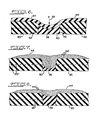
- FIGS 4-7 show the method of tire repair and repair construction as practiced in accordance with the present invention. More particularly, a section of the tire wall including the damaged portion, is preferably removed to form a plug area 42. An application of conventional rubber cement may then be made over the plug area and the inside of the tire around the plug area. A patch 44 is installed over plug area 42 on the inside 46 of the tire in an unstressed state and substantially contiguous with the interior surface of the tire. Again, the patch cord 44' extends generally parallel to the tire cord 20'. To this end, and as illustrated in Figure 4, the interior surface 46 of the tire around plug area 42 may be skived or recessed, for example by buffing, at 47. Although a variety of patches have been found useful in the present invention, uncured rubber patches having nylon cord have been found most satisfactory.
- the next step of the method of the present invention comprises positioning the patch 44 at least partially within plug area 42.
- the patch is also shaped during this step of the process to assume a generally concave orientation within the plug area as shown in Figure 5, in a condition to more readily accommodate tension loads.
- This preselected orientation of the patch that is the appropriate positioning and shaping of the patch, has been achieved with internal pressun P " ithin the tire on the order of 60% to 100% of the tire's normal operating pressure.
- the actual pressure employed with a given tire size and/or patch may vary to some extent, but has been found to fall generally in the noted range.
- the specific pressure for a given tire size and patch can be determined with little difficulty by routine evaluation.
- the required pressure is that which forces the patch outwardly beyond the plane of the tire wall inside surface and into the plug area.
- the patch will extend into the plug area to the point where a substantial quantity of cord is actually positioned in the plug area as shown for example in Figure 7.
- the apex 38 of the patch should not extend so far as to reach the plane of the exterior surface of the tire wall, and is preferably recessed at least one-eigth inch below the tire's exterior to provide adequate plug material for a long-lasting repair.
- the patch positioning pressure be as close to operating pressure without forcing the patch too far into the plug area as just described.
- an internal tire pressure of about 65-75 p.s.i. has been found suitable when using an uncured rubber patch with nylon cord, and a pressure of about 100 p.s.i. is satisfactory when using a cured rubber patch also with nylon cord.
- the length of time required for the pre-positioning step may also vary and again can be easily determined for a given tire and patch material. Generally, 10-20 minutes is sufficient to properly position the patch in the plug area. However, where possible, such as when using chemically-cured patches, it is recommended and may be necessary in some cases to maintain the pre-positioning internal pressure without interruption until the curing step is completed.
- the next step in the process of the present invention is illustrated in Figure 6 and comprises filling the remainder of plug area 42 on the outside of patch 44 with a suitable uncured plug material 50, such as uncured rubber.
- a suitable uncured plug material 50 such as uncured rubber.
- the plug material is preferably applied beyond the plug area 42 to an area 52 which has been lightly buffed and recessed as shown.
- the next step comprises curing plug material 50 and patch 44 while the patch and plug material are maintained in proper position.
- the parameters of the curing procedure are the same as those used in conventional tire repair and are all well known to those skilled in the art.
- the actual curing process employed will depend upon the nature of the patch used since either uncured, semi-cured or cured patches can be used in practicing the invention. It should be note, therefore, that the term "curing the patch” as used herein is intended to include all of the conventional processes tor curing and/or bonding patches of all types onto the wall of a tire.
- the patch position and shape may be retained during curing by applying pressure to the inside of the tire as illustrated by arrow 54.
- the internal pressure should be at least about 10% greater than the external pressure and is preferably between about 10% and 35% greater than the external pressure. It has proven in practice that a pressure differential of 65 p.s.i. inside versus 55 p.s.i. outside is quite effective for a 10.00 x 20 truck tire.
- a final and optional step of the method of the present invention comprises the step of dressing the outer surface of the repair atter curing to form a continuation, as at 56, of the outside profile of the tire wall across the plug area.
- a new and improved tire repair construction is provided as shown in Figures 7 and 8 without effecting an outward bulge on the exterior of the tire under normal pressurized road running conditions and without causing a dimple under no-pressure conditions. It is believed that the bulge/dimple problem is eliminated because the patch has been positioned and shaped before application of the plug material and before and during curing so that any deformation of the patch which occurs due to internal pressure is accomodated before the repair is molded in place.
- the patch cords particularly with uncured patches, migrate into the injury and provide a repair construction with enhanced rigidity and resistance to movement relative to the tire wall.
- the patch 44 will, after completion of the repair, accept loads without bulging or dimpling as do prior art patches and repair constructions.
- a damaged tire and patch 44 are illustrated in conjunction with an apparatus for pressurizing the interior of the tire to pre-position the patch in plug area 42.
- an apparatus for pressurizing the interior of the tire to pre-position the patch in plug area 42 is mounted on a road rim fixture, generally designated 58.
- An inner tube 60 is disposed within the tire and is inflated through an air valve stem 62 to a desired pressure, such as 75 p.s.i. This forces the patch into the plug area as exemplified in Figure 5.
- the step of curing patch 44 and uncured plug material 50 is shown in conjunction with apparatus tor carrying out this step. More particularly, again the road rim fixture 5H is utilized with inner tube 60 and air valve stem 62. However, an inner heating pad 64 and an outer heating pad 66 arc placed on the inside and outside of tne tire, respectively. Inner heating pad 64 is disposed between patch 44 and inner tubc 60. Air bags 68 are disposed about the exterior of the tire surrounding outer heating pad 66.
- This apparatus is employed in carrying out the step of the present invention described in conjunction with Figure 6, wherein a pressure differential between the inside and outside of the tire and patch is maintained during curing of the patch and the plug material.
- inner tube 60 can be inflated to a first pressure while air bags 68 are inflated to a second pressure.
- a pressure differential of 10 p.s.i. can be effected by inflating inner tube 60 on the order of 65 p.s.i. and inflating air bags 68 on the order of 55 p.s.i. This pressure differential has proven eftective with the method of the present invention described above when repairing 10.00 x 20 truck tires with an uncured rubber-nylon cord patch.
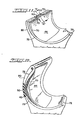
- FIGs 11 and 12 these views illustrate the completed repair construction in accordance with the present invention and show the orientation of the cords in patch 44 and the cords in the sidewalls 20 of the repaired tire. It should be noted that proper cross-hatching of the rubber tire and patch materials is omitted to better facilitate the illustration. It can be seen that cords 70 in patch 44 are oriented or extend in the same radial direction or parallel to cords 72 of the tire.
- Figure 11 shows a section through the repaired tire generally along the line 11-11 of Figure 2
- Figure 12 shows a radial section through the repaired tire generally along line 12-12 of Figure 11.
- the position and concave orientation of patch 44 in plug area 42 also is shown and illustrates that the cords, themselves, of the patch are also in a generally concave configuration at the repair area.
- a synopsis of the repair construction and method of the present invention will now be described using a 10.00 x 20 radial cord truck tire by way of example.
- the damaged tire will first be inspected, and, upon locating the injury, the damaged portion of the tire is skived to remove a section of the wall of the tire around the damaged portion to form a plug area 4l.
- the plug area and the surrounding inside and outside surfaces to be covered by the patch and plug material are then buffed and coated with a conventional rubber cement.
- An uncured patch 44 such as a six-ply nylon cord patch, is installed over the plug area on the inside of the tire in an unstressed state ( Figure 4).
- An inner tube is installed within the tire, over the installed patch, and the tire is mounted on a road rim fixture (Figure 8).
- the tube is inflated, on the order of 65-75 p.s.i., to position the patch at least partially within the plug area and in preferably a generally concave orientation (Figure 5).
- the remainder of plug area 42 then is filled with a suitable uncured plug material, such as uncured rubber ( Figure 6).
- the inner tube is deflated and the heating pads and air bags are installed as illustrated in Figure 9.
- the inside heating pad can be inserted with the inner tube before the pre-positioning of the patch, in which case a higher pressure will be required, on the order of 100 p.s.i., to position the patch within the plug area.
- a new and improved repair construction and method has been provided ror repairing a damaged portion in the wall of a tire, such as the sidewall of a radial tire, without effecting an outward bulge at the repair on the exterior of the tire after the repair is completed and under normal road running conditions. It has been found that injuries a various dimensions ranging from circumferential slashes of 1.5 x 0.25 inches to radial slashes of 6.00 x 0.38 inches may' be repaired. Indeed, a typically troublesome sidewall injury of 2.5 inches (radially) by 0.75 inches (circumferentially) can be effectively repaired by the practice of the present invention.
Landscapes
- Engineering & Computer Science (AREA)
- Mechanical Engineering (AREA)
Applications Claiming Priority (2)
| Application Number | Priority Date | Filing Date | Title |
|---|---|---|---|
| US239333 | 1981-03-02 | ||
| US06/239,333 US4375231A (en) | 1981-03-02 | 1981-03-02 | Tire repair construction and method |
Publications (1)
| Publication Number | Publication Date |
|---|---|
| EP0059634A1 true EP0059634A1 (fr) | 1982-09-08 |
Family
ID=22901706
Family Applications (1)
| Application Number | Title | Priority Date | Filing Date |
|---|---|---|---|
| EP82301030A Ceased EP0059634A1 (fr) | 1981-03-02 | 1982-03-01 | Procédé pour la réparation de pneumatiques |
Country Status (3)
| Country | Link |
|---|---|
| US (1) | US4375231A (fr) |
| EP (1) | EP0059634A1 (fr) |
| CA (1) | CA1181672A (fr) |
Cited By (2)
| Publication number | Priority date | Publication date | Assignee | Title |
|---|---|---|---|---|
| GB2240520A (en) * | 1990-02-02 | 1991-08-07 | Abrasion Resistant Linings Ltd | Repairing tyres |
| KR20250130026A (ko) * | 2024-02-23 | 2025-09-01 | 김영길 | 타이어 수리 도구 |
Families Citing this family (11)
| Publication number | Priority date | Publication date | Assignee | Title |
|---|---|---|---|---|
| US5160394A (en) * | 1991-01-07 | 1992-11-03 | Olson John C | Method for tire sidewall repair |
| US5296173A (en) * | 1991-12-04 | 1994-03-22 | Vulcan Vulcap Industries, Inc. | Tire section repair unit and method |
| AU3150195A (en) * | 1995-07-26 | 1997-02-26 | Minnesota Mining And Manufacturing Company | Pressure sensitive adhesive patch |
| CA2375070C (fr) * | 2002-03-28 | 2004-03-02 | 4254563 Manitoba Ltd. | Rustine |
| US20100258237A1 (en) * | 2007-11-09 | 2010-10-14 | Bailey Rodney R | Repair patch for radial tires |
| BRPI0722230A8 (pt) * | 2007-11-29 | 2017-12-26 | Soc Tech Michelin | Método para aplicar um remendo de reparo em uma porção danificada de um pneu, e, remendo de reparo de pneu |
| WO2009157944A2 (fr) * | 2008-06-27 | 2009-12-30 | Michelin Recherche Et Technique S.A. | Rustine présentant des renforts avec extrémités en quinconce |
| US8784588B2 (en) * | 2008-06-27 | 2014-07-22 | Michelin Recherche Et Technique S.A. | Damaged reinforcement ending preparation for tire repairs |
| BRPI0822861A8 (pt) * | 2008-06-27 | 2016-01-05 | Michelin Rech Tech | Método para reparar uma porção danificada de um pneu, e, pneu reparado |
| EP2307212A4 (fr) * | 2008-06-30 | 2013-05-29 | Michelin Rech Tech | Rustine ayant un contact discontinu avec le pneu |
| BRPI0823067B1 (pt) * | 2008-09-10 | 2018-10-16 | Michelin & Cie | método para reparar uma parte avariada de um pneumático, e, remendo de reparo de pneumático prémontado |
Citations (10)
| Publication number | Priority date | Publication date | Assignee | Title |
|---|---|---|---|---|
| GB169334A (en) * | 1920-07-19 | 1921-09-29 | Sydney Charles Caddy | Improvements in and connected with the repairing of vehicle pneumatic tyres or tyre covers |
| US2004037A (en) * | 1934-05-14 | 1935-06-04 | Walter H Criswell | Method of repairing tire casings |
| GB487864A (en) * | 1936-11-26 | 1938-06-27 | Thomas Westmoreland Mullen | Improvements in or relating to repair devices for tire covers or casings |
| US2802506A (en) * | 1954-12-14 | 1957-08-13 | Firestone Tire & Rubber Co | Ledge method for securing repair patches in tire |
| FR1342202A (fr) * | 1962-09-15 | 1963-11-08 | Michelin & Cie | Perfectionnements à la réparation des enveloppes de pneumatiques |
| US3190338A (en) * | 1962-10-15 | 1965-06-22 | Goodyear Tire & Rubber | Repaired tire and making same |
| US3369586A (en) * | 1964-10-13 | 1968-02-20 | Stahlgruber Gruber & Co Otto | Tire repair patch |
| DE1505881A1 (de) * | 1965-03-29 | 1970-07-02 | Gen Tire & Rubber Co | Flickstueck und Verfahren zum Ausbessern beschaedigter Luftreifen |
| US3919021A (en) * | 1969-01-10 | 1975-11-11 | Benjamin Whittle | Method of repairing tire casings |
| US4109697A (en) * | 1977-03-28 | 1978-08-29 | The Goodyear Tire & Rubber Company | Method and patch used in the repair of a pneumatic tire |
Family Cites Families (6)
| Publication number | Priority date | Publication date | Assignee | Title |
|---|---|---|---|---|
| US1591817A (en) * | 1924-08-15 | 1926-07-06 | Ke Hawke Mfg Co | Process of repairing pneumatic-tire casings |
| US2421096A (en) * | 1943-10-28 | 1947-05-27 | Clarence W Vogt | Process and apparatus for repairing tires |
| US2483010A (en) * | 1946-08-29 | 1949-09-27 | Goodrich Co B F | Tire casing and method of repairing same |
| BE630576A (fr) * | 1962-04-09 | |||
| US3251721A (en) * | 1962-04-27 | 1966-05-17 | Robert M Johnson | Tire repair process |
| US3996085A (en) * | 1975-05-05 | 1976-12-07 | Caterpillar Tractor Co. | Tube-tire patch and method and apparatus for applying same |
-
1981
- 1981-03-02 US US06/239,333 patent/US4375231A/en not_active Expired - Fee Related
-
1982
- 1982-02-25 CA CA000397071A patent/CA1181672A/fr not_active Expired
- 1982-03-01 EP EP82301030A patent/EP0059634A1/fr not_active Ceased
Patent Citations (10)
| Publication number | Priority date | Publication date | Assignee | Title |
|---|---|---|---|---|
| GB169334A (en) * | 1920-07-19 | 1921-09-29 | Sydney Charles Caddy | Improvements in and connected with the repairing of vehicle pneumatic tyres or tyre covers |
| US2004037A (en) * | 1934-05-14 | 1935-06-04 | Walter H Criswell | Method of repairing tire casings |
| GB487864A (en) * | 1936-11-26 | 1938-06-27 | Thomas Westmoreland Mullen | Improvements in or relating to repair devices for tire covers or casings |
| US2802506A (en) * | 1954-12-14 | 1957-08-13 | Firestone Tire & Rubber Co | Ledge method for securing repair patches in tire |
| FR1342202A (fr) * | 1962-09-15 | 1963-11-08 | Michelin & Cie | Perfectionnements à la réparation des enveloppes de pneumatiques |
| US3190338A (en) * | 1962-10-15 | 1965-06-22 | Goodyear Tire & Rubber | Repaired tire and making same |
| US3369586A (en) * | 1964-10-13 | 1968-02-20 | Stahlgruber Gruber & Co Otto | Tire repair patch |
| DE1505881A1 (de) * | 1965-03-29 | 1970-07-02 | Gen Tire & Rubber Co | Flickstueck und Verfahren zum Ausbessern beschaedigter Luftreifen |
| US3919021A (en) * | 1969-01-10 | 1975-11-11 | Benjamin Whittle | Method of repairing tire casings |
| US4109697A (en) * | 1977-03-28 | 1978-08-29 | The Goodyear Tire & Rubber Company | Method and patch used in the repair of a pneumatic tire |
Cited By (3)
| Publication number | Priority date | Publication date | Assignee | Title |
|---|---|---|---|---|
| GB2240520A (en) * | 1990-02-02 | 1991-08-07 | Abrasion Resistant Linings Ltd | Repairing tyres |
| GB2240520B (en) * | 1990-02-02 | 1993-11-24 | Abrasion Resistant Linings Ltd | Improvements relating to the repair of tyres |
| KR20250130026A (ko) * | 2024-02-23 | 2025-09-01 | 김영길 | 타이어 수리 도구 |
Also Published As
| Publication number | Publication date |
|---|---|
| US4375231A (en) | 1983-03-01 |
| CA1181672A (fr) | 1985-01-29 |
Similar Documents
| Publication | Publication Date | Title |
|---|---|---|
| EP0750984B1 (fr) | Bandage pneumatique pour camions avec une bande de roulement améliorée prévulcanisée et son procédé de fabrication | |
| US4375231A (en) | Tire repair construction and method | |
| US6368439B1 (en) | Retreaded tires and method for making the same without spray cement | |
| CA1165216A (fr) | Piece pour reparation de pneumatiques | |
| US2292286A (en) | Method of treading tire casings | |
| US6264779B1 (en) | Precurred tire tread for a truck tire and the method of assembly | |
| US4836930A (en) | Method of repairing vehicular tires | |
| US3306332A (en) | Repairing of radial cord tires | |
| US3964949A (en) | Method of treading tires | |
| US11254165B2 (en) | Precured tire tread with fabric reinforcing layer | |
| US3464873A (en) | Method of treading pneumatic tire casings | |
| EP0053997B1 (fr) | Bandage pneumatique et procédé de fabrication | |
| AU639120B2 (en) | A tread for truck tires | |
| US4474633A (en) | Method of manufacturing radial tires | |
| US3613762A (en) | Fabric inserts for filament wound aircraft tires | |
| US6290810B1 (en) | Mold for curing precured treads to tire casings | |
| US3326261A (en) | Tires | |
| US3750733A (en) | Quick change-replaceable tread pneumatic tire | |
| US3802977A (en) | Method of retreading tires | |
| CA1060614A (fr) | Methode de pose de chapes de pneus | |
| WO1992008603A1 (fr) | Procede de rechapage de pneus | |
| EP0709237A2 (fr) | Bande de roulement pour pneumatiques de camions | |
| EP0228793B1 (fr) | Procédé de rechapage | |
| CA2145789C (fr) | Pneumatique et carcasse non vulcanisee utilisee a une etape intermediaire de la fabrication du pneumatique | |
| EP1028859B1 (fr) | Trajectoire de plis regulee au moyen d'un bourrage sur tringle precuit |
Legal Events
| Date | Code | Title | Description |
|---|---|---|---|
| PUAI | Public reference made under article 153(3) epc to a published international application that has entered the european phase |
Free format text: ORIGINAL CODE: 0009012 |
|
| AK | Designated contracting states |
Designated state(s): AT BE CH DE FR GB IT LU NL SE |
|
| 17P | Request for examination filed |
Effective date: 19830301 |
|
| STAA | Information on the status of an ep patent application or granted ep patent |
Free format text: STATUS: THE APPLICATION HAS BEEN REFUSED |
|
| 18R | Application refused |
Effective date: 19850913 |
|
| RIN1 | Information on inventor provided before grant (corrected) |
Inventor name: D'SOUZA, STANLEY Inventor name: BUBIK, LESLIE |