EP0060104B1 - Trocknung von Holzpulpe - Google Patents
Trocknung von Holzpulpe Download PDFInfo
- Publication number
- EP0060104B1 EP0060104B1 EP82301131A EP82301131A EP0060104B1 EP 0060104 B1 EP0060104 B1 EP 0060104B1 EP 82301131 A EP82301131 A EP 82301131A EP 82301131 A EP82301131 A EP 82301131A EP 0060104 B1 EP0060104 B1 EP 0060104B1
- Authority
- EP
- European Patent Office
- Prior art keywords
- pulp
- sulphite
- bleached
- wood
- drier
- Prior art date
- Legal status (The legal status is an assumption and is not a legal conclusion. Google has not performed a legal analysis and makes no representation as to the accuracy of the status listed.)
- Expired
Links
Images

Classifications
-
- D—TEXTILES; PAPER
- D21—PAPER-MAKING; PRODUCTION OF CELLULOSE
- D21C—PRODUCTION OF CELLULOSE BY REMOVING NON-CELLULOSE SUBSTANCES FROM CELLULOSE-CONTAINING MATERIALS; REGENERATION OF PULPING LIQUORS; APPARATUS THEREFOR
- D21C9/00—After-treatment of cellulose pulp, e.g. of wood pulp, or cotton linters ; Treatment of dilute or dewatered pulp or process improvement taking place after obtaining the raw cellulosic material and not provided for elsewhere
- D21C9/001—Modification of pulp properties
- D21C9/002—Modification of pulp properties by chemical means; preparation of dewatered pulp, e.g. in sheet or bulk form, containing special additives
- D21C9/004—Modification of pulp properties by chemical means; preparation of dewatered pulp, e.g. in sheet or bulk form, containing special additives inorganic compounds
Definitions
- This invention relates to drying wood pulp.
- the most important use for wood pulp is in making paper. If the wood pulp is to be transported from its place of manufacture to the paper mill it must be dry.
- the least expensive drying method is flash drying with hot air, for example at 200 to 600°C.
- This drying method has the disadvantage that nodules of agglomerated wood pulp fibres may be formed in the dried pulp, particularly in short fibre pulp from hardwoods such as birch and eucalyptus. These nodules may remain when the pulp is made into paper and mar-the quality of the paper.
- short fibre pulp for paper has generally had to be dried in sheet form on apparatus similar to that used for paper making.
- US--A-4,183,146 discloses a process for simultaneously drying mechanical wood pulp and improving the mechanical strength and brightness of the wood pulp by mixing it with an aqueous solution of at least one sulphonating compound and drying the resulting mixture by contact with a heating gas at a temperature above 100°C.
- US-A-3,414,469 describes a method of reducing nodule formation in flash dried pulp wherein the pH of alkaline digested pulp slurry is adjusted to between 5 and 8 and a bisulphite or dithionite is added to the pulp slurry before drying.
- the present invention seeks to provide a process for reducing nodule formation which is effective on pulp consisting at least partly of short fibres derived from a hardwood such as birch or eucalyptus, which has been bleached at an acid pH, for example by treatment with chlorine dioxide, as this is the pulp which tends to suffer most from nodule formation on flash drying.
- a process for producing dried bleached wood pulp from a wood pulp consisting at least partly of short fibres derived from hard wood which has been bleached at an acid pH is characterised by treating the bleached pulp, which is at an acid pH due to residual acid remaining on the pulp from the bleaching process, with an alkali metal sulphite, and drying the treated pulp in a flash drier in the presence of the alkali metal sulphite, the alkali metal sulphite being present in an amount sufficient to reduce the formation of nodules of agglomerated wood pulp fibres in the dried pulp.
- a process for producing dried bleached wood pulp from a wood pulp consisting at least partly of short fibres derived from hard wood which has been bleached at an acid pH is characterised by treating the bleached pulp, which is at an acid pH due to residual acid remaining on the pulp from the bleaching process, with an alkali, and drying the treated pulp in a flash drier, sulphur dioxide being introduced in the drying gas used in the flash drier to convert the alkali to a sulphite in situ on the pulp in an amount sufficient to reduce the formation of nodules of agglomerated wood pulp fibres in the dried pulp.
- the sulphite treatment reduces the tendency of the pulp to form nodules on flash drying and enables a short fibre pulp to be flash dried and still be suitable for paper making.
- the wood pulp can be a chemical pulp, produced using an acid, alkaline or neutral pulping process, for example kraft sulphate or sulphite pulping, or a mechanical pulp produced by mechanical or thermo-mechanical pulping.
- the bleached pulp is preferably compressed in a dewatering press to increase its solids content to 35 to 60 per cent by weight, preferably 40 to 50 per cent by weight.
- the dewatering press generally presses the pulp against a screen which retains the pulp fibres but allows the water to be forced through the screen, optionally with the air of suction.
- the dewatering press can be in the form of a pair of perforated hollow rollers arranged to compress the pulp between them so that the water squeezed from the pulp passes through the perforated surface to the interior of the rollers.
- the dewatering press can comprise a conveyor screw rotating within a screen.
- the sulphite is preferably added in the form of an alkali metal sulphite, most preferably sodium sulphite but potassium and ammonium sulphites are alternatives. It is preferably added to the pulp before the solids content of the pulp is increased in the dewatering or during the dewatering treatment.
- water is added to the bleached pulp to form it into a slurry for feeding the dewatering press.
- the pulp may be discharged from the bleaching process at a solids content of 8 to 15 per cent by weight and may be diluted to 2 to 6 per cent before being fed to the dewatering press.
- the sodium sulphite is preferably added to the water used to dilute the pulp.
- a solution of sodium sulphite can be sprayed on the pulp after bleaching and before, during or after dewatering.
- Sodium sulphite can be included in the final washing water used to wash the pulp after bleaching.
- the sulphite solution can be recycled to dilute incoming bleached pulp.
- the sulphite solution can alternatively be recycled to the dewatering press.
- the concentration of sulphite in the water in contact with the pulp is preferably 0.4 to 5 per cent by weight, most preferably 1 to 2 per cent.
- sodium sulphite in solid or concentrated form can be added to the sulphite solution which is recovered from the dewatering press at a rate sufficient to maintain a substantially constant concentration of sulphite in the pulp slurry fed to the dewatering press.
- the amount of sulphite used is also preferably about 0.4 to 5 per cent by weight based on wood pulp solids in the pulp fed to the drier; since the pulp issuing from the dewatering press usually has a solids content close to 50 per cent by weight the concentration of sulphite based on water is similar to the concentration based on wood pulp solids at this stage in the process.
- the pulp is treated with an alkali, preferably an aqueous alkali metal or ammonium hydroxide, after bleaching and before drying and the alkali is converted to a sulphite in situ on the pulp by introducing sulphur dioxide in the drying gas.
- an alkali preferably an aqueous alkali metal or ammonium hydroxide
- sodium hydroxide can be added to the pulp using any of the procedures described above for adding sodium sulphite.
- Sulphur dioxide can be introduced in the drying gas by injecting liquid or gaseous sulphur dioxide or by burning sulphur to produce sulphur dioxide.
- a fuel having a high sulphur content can be burnt in the heater for the drier. This fuel can be oil or can be producer gas derived from coal of high sulphur content.
- Drying can be carried out in any type of flash drier known for drying pulp by hot gas, usually air, at a temperature in the range 200 to 600°C.
- the drier can be in the form of one or more towers up which the pulp and hot gas pass or a conduit but the preferred form of drier is that described in GB-A-888,845, which is a high turbulence mixer through which the pulp and hot gas are fed and which has relatively movable mechanical members which exert a shearing action on the pulp.
- the preferred temperature of the hot air at the inlet of such a drier where it contacts the wood pulp is 400 to 500°C and the temperature at the outlet of the drier is preferably 90 to 150°C.
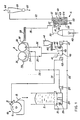
- Figure 1 is a diagrammatic side elevation partly in section of an apparatus for drying bleached wood pulp by the process according to the invention.
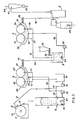
- Figure 2 is a diagrammatic side elevation of an alternative apparatus for drying bleached wood pulp by the process according to the invention.
- the apparatus of Figure 1 generally receives pulp from the final stage of the bleaching process and comprises a stock tower 2 for holding bleached pulp, a dewatering press 3 and a drier 4.
- the final stage of the bleaching process is generally a washer 10.
- the washer 10 comprises a perforated drum 11 which receives bleached pulp. Suction is applied from the interior of the drum to aid in removal of water. The pulp on the drum 11 is washed with water from sprays 12 and is then removed from the pulp by a doctor blade 13.
- the final stage of the bleaching process can alternatively be a thickening step in which the pulp solids content is increased on a perforated drum.
- the moist, washed, bleached pulp from the washer 10 passes to the stock tower 2, which acts as a reservoir for bleached pulp.
- the bottom of the stock tower 2 has a series of inlets, such as 21, for water supplied by a pipe 22.
- the water continuously forms a slurry with the material at the bottom of the column of pulp.
- This slurry is stirred by a paddle 23 in the lower part 24 of the stock tower 2 to aid mixing of the pulp and water in the base of the tower 2 and the slurry is pumped from the tower 2 by a pump 25 through a pipe 26 to the dewatering press 3.
- the dewatering press 3 comprises a pair of hollow perforated rollers 31, 32 rotating in a tank 33 having at least one inlet 34 near its base for the pulp slurry.
- the slurry is constrained to pass between the rollers 31, 32 which press water from the pulp through the perforated roller surfaces to their interiors.
- Pulp of increased solids content is removed from the rollers 31, 32 by a doctor blade 37 and passes through a breaker conveyor 38 to a duct 39 which feeds the drier 4.
- the dewatering press 3 has a control device (not shown) to control the flow of pulp in the system to give a substantially constant load to the drier 4.
- the waste water which passes through the perforated surface to the interior of the rollers 31, 32 is removed by pipes 35, 36 to a waste water tank 40.
- This tank is divided into two compartments 41, 42 by a baffle 43.
- the waste water from the dewatering press 3 enters one compartment 41 but the baffle 43 is of such a size that the water can spill over into the other compartment 42.
- Sodium sulphite is fed to the latter compartment 42 of the tank 40 from a hopper 44 via a meter 45 and the waste water and sulphite are agitated in the tank 40 by a stirrer 46.
- Sulphite solution is pumped from the second compartment 42 of the tank 40 by a pump 47 to the pipe 22 whereby it is recycled to the stock tower 2 to form a slurry with the bleached pulp. Some of the sulphite added is thus returned to the tank 40 via the pipes 35, 36 but some is removed in the moisture associated with the pulp passing to the duct 39.
- the meter 45 controls the rate of addition of sodium sulphite to maintain a substantially constant sulphite concentration in the water contacting the pulp.
- the sulphite solution from the tank 40 can provide all or some of the water used in the washer 12.
- Some of the waste water entering the compartment 41 is withdrawn by a pump 48 through a pipe 14 to the sprays 12 of the washer 10.
- the water thus withdrawn from the compartment 41 has a lower sulphite concentration than the water withdrawn from the compartment 42 by the pump 47 for recycle to the stock tower 2.
- the waste water withdrawn from compartment 41 can be recycled to washers in the dewatering press 3 situated below the level of the pulp slurry in the press 3.
- the washers are positioned to impinge on the pulp just before it passes through the nip between rollers 31, 32.
- the drier 4 is of the type generally described in GB-A-888,845. Hot air, for example at a temperature of 400 to 500°C, is produced in a heater 49 and is supplied to the drier through a pipe 50. The hot air contacts pulp fed to the drier 4 through the duct 39 at the inlet chute 51 of the drier.
- the drier 4 is a high turbulence mixer in which the hot air and wood pulp are rapidly mixed and subjected to a shearing action and the dried wood pulp fibres formed are carried away in a stream of the hot air.
- the drier 4 comprises a rotary disc 52, a stationary disc 53 and an extractor fan 54.
- the rotary disc 52 carries on one side hammers 55 which work against the wall of the drier and on the other side pegs 56 which intermesh with pegs 57 mounted on the stationary disc 53.
- the wood pulp and hot air entering the drier 4 have to pass the hammers 55 which serve to break up fibre bundles and then between the pegs 56, 57 which evenly disperse the fibres in the flow of air.
- the air and fibres then pass through an opening 58 at the centre of stationary disc 53, which opening is controlled by rejector arms 59. Thence they are forced by the extractor fan 54, which is mounted on the same shaft 60 as disc 52, to the exit 61 of the drier 4.
- a stream of air carrying dry wood fibres emerges from drier 4 through a pipe 62 which conveys it to a cyclone separator 63 which is a conical rotary separator discharging moisture laden air through a top outlet 64 and flash dried pulp through a bottom outlet 65.
- a cyclone separator 63 which is a conical rotary separator discharging moisture laden air through a top outlet 64 and flash dried pulp through a bottom outlet 65.
- Part of the moisture laden air discharged at 64 is preferably recycled to the burner 49 of the drier 4 as described and claimed in GB-A-2,005,394A.
- the apparatus shown in Figure 2 comprises generally a washer 10 which is the final stage of the bleaching process, a stock tower 2, a first dewatering press 6, a repulper 8, a second dewatering press 9, a drier 4 and a cyclone separator 63.
- the washer 10, stock tower 2, drier 4 and cyclone separator 63 operate in the same way as in the apparatus of Figure 1 and are numbered in the same way.
- Pulp slurry is pumped from the tower 2 by a pump 25 through a pipe 26 to the first dewatering press 6.
- This comprises hollow perforated nip rollers 66, 67 rotating in a tank 68 having an inlet 69 for the pulp slurry.
- Pulp of increased solids content which has passed the nip, is removed from roller 67 by a doctor blade 72 and passes through a breaker conveyor 73 to a duct 74 which feeds the repulper 8.
- the waste water which passes to the interior of the rollers 66, 67 is removed by pipes 70, 71 to a waste water tank 75. Thence it is withdrawn by a pump 76 through a pipe 77 which feeds the pipe 22 leading to the inlets 21 of the stock tower 2 and the pipe 14 leading to the sprays 12 of the washer 10.
- the repulper 8 is fed with dewatered pulp by the duct 74, with waste water from the dewatering press 9 by a pipe 81 and with sodium sulphite from a hopper 82 via a meter 83.
- the repulper 8 has an agitator 84 which disperses the pulp in the water and dissolves the sodium sulphite to maintain the sulphite concentration in the system.
- Pulp slurry is pumped from the repulper 8 by a pump 85 through a pipe 86 to the second dewatering press 9.
- the second press 9 comprises hollow perforated nip rollers 91, 92 rotating in a tank 93 having an inlet 94 for the pulp slurry. Pulp of increased solids which has passed the nip is removed from roller 92 by a doctor blade 97 and passes through a breaker conveyor 98 to a duct 99 which feeds the drier 4. The pulp from the duct 99 contacts hot air from the burner 49 at the inlet chute 51 of the drier 4. The waste water which passes to the interior of the rollers 91, 92 is removed by pipes 95, 96 which feed the pipe 81 leading to the repulper 8.
- the apparatus shown in Figure 2 has a reduced consumption of sodium sulphite compared to that shown in Figure 1 although it uses more energy in repulping and repressing the pulp.
- Bleached Swedish birch pulp was diluted with sodium sulphite solution to provide a slurry containing 4 per cent wood pulp solids.
- the slurry was fed to a dewatering press and a flash drier both of the type shown in Figure 1.
- the solids content of the pulp leaving the dewatering press was 49.6 per cent.
- the moisture content of the dry wood pulp discharged by the drier was 8.2 per cent and the temperature of the air leaving the drier was 127°C.
- the initial concentration of sulphite in the water used to slurry the pulp was 1.3 per cent.
- a 25 gram sample of dry pulp is placed in a plastic bag and the neck tied. The bag is then placed in a sealed container and incubated in an oven for 24 hours at 80°C. It is then transferred into a T.A.P.P.I. disintegrator (T.A.P.P.I. T205) and 2 litres of water are added. 70 ml samples of slurry are taken from the disintegrator at the following revolutions as shown on the disintegrator counter (the revolutions shown on the disintegrator counter are actual stirrer revolutions divided by 25).
- Each sample of slurry is made into hand sheets of paper and for each sample the nodules in the paper are counted and the sheet is weighed. From this the number N of nodules per gram of pulp is determined.
- a graph is then completed as shown in Figure 3 of the accompanying drawings of the logarithm of the number of nodules per gram against revolutions shown on the disintegrator counter.
- the graph is found to be a substantially straight line as shown in Figure 3.
- the point at which the line crosses the X-axis is called "Revolutions To Zero Nodules (RTZN)" and is a measure of the work required to remove nodules from the pulp.
- Bleached Swedish birch pulp was diluted with sodium sulphite solution to provide a slurry containing 4.5 per cent wood pulp solids.
- the slurry was fed to a dewatering press and a flash drier both of the type shown in Figure 1.
- the solids content of the pulp leaving the dewatering press was 50.0 per cent.
- the moisture content of the wood pulp discharged by the drier was 8.7 per cent and the temperature of the air leaving the drier was 120°C.
- the initial concentration of sulphite in the water used to slurry the pulp was 1.5 per cent and the sulphite concentration at the end of the trial was 1.1 per cent.
- the dry pulp produced contained 0.4 per cent sulphite.
Landscapes
- Chemical & Material Sciences (AREA)
- Inorganic Chemistry (AREA)
- Chemical Kinetics & Catalysis (AREA)
- General Chemical & Material Sciences (AREA)
- Life Sciences & Earth Sciences (AREA)
- Engineering & Computer Science (AREA)
- Wood Science & Technology (AREA)
- Paper (AREA)
- Drying Of Solid Materials (AREA)
- Prostheses (AREA)
Claims (9)
Applications Claiming Priority (2)
| Application Number | Priority Date | Filing Date | Title |
|---|---|---|---|
| GB8107175 | 1981-03-06 | ||
| GB8107175 | 1981-03-06 |
Publications (2)
| Publication Number | Publication Date |
|---|---|
| EP0060104A1 EP0060104A1 (de) | 1982-09-15 |
| EP0060104B1 true EP0060104B1 (de) | 1985-07-03 |
Family
ID=10520212
Family Applications (1)
| Application Number | Title | Priority Date | Filing Date |
|---|---|---|---|
| EP82301131A Expired EP0060104B1 (de) | 1981-03-06 | 1982-03-05 | Trocknung von Holzpulpe |
Country Status (8)
| Country | Link |
|---|---|
| US (1) | US4426258A (de) |
| EP (1) | EP0060104B1 (de) |
| BR (1) | BR8201167A (de) |
| CA (1) | CA1192353A (de) |
| DE (1) | DE3264488D1 (de) |
| FI (1) | FI820779L (de) |
| NO (1) | NO820702L (de) |
| ZA (1) | ZA821268B (de) |
Cited By (1)
| Publication number | Priority date | Publication date | Assignee | Title |
|---|---|---|---|---|
| US9365460B2 (en) | 2006-11-09 | 2016-06-14 | Akzo Nobel N.V. | Pigment dispersion |
Families Citing this family (21)
| Publication number | Priority date | Publication date | Assignee | Title |
|---|---|---|---|---|
| SE441107C (sv) * | 1982-05-07 | 1991-03-18 | Modo Chemetics Ab | Foerfarande foer framstaellning av billig hoegutbytesmassa med goda pappersegenskaper |
| US4697479A (en) * | 1985-01-19 | 1987-10-06 | Aisin-Warner Limited | Engine throttle opening dependent hydraulic vehicular transmission system |
| US6485667B1 (en) | 1997-01-17 | 2002-11-26 | Rayonier Products And Financial Services Company | Process for making a soft, strong, absorbent material for use in absorbent articles |
| US20030234468A1 (en) * | 1997-01-17 | 2003-12-25 | Krishnakumar Rangachari | Soft, absorbent material for use in absorbent articles and process for making the material |
| US20010031358A1 (en) * | 1997-01-17 | 2001-10-18 | Erol Tan | Soft, strong, absorbent material for use in absorbent articles |
| US5916670A (en) * | 1997-01-17 | 1999-06-29 | Rayonier Inc. | Absorbent material for use in absorbent articles |
| US6500215B1 (en) | 2000-07-11 | 2002-12-31 | Sybron Chemicals, Inc. | Utility of selected amine oxides in textile technology |
| AU2003200035B2 (en) * | 2001-10-30 | 2008-02-14 | Weyerhaeuser Company | System for making dried singulated crosslinked cellulose pulp fibers |
| US6782637B2 (en) * | 2001-10-30 | 2004-08-31 | Weyerhaeuser Company | System for making dried singulated crosslinked cellulose pulp fibers |
| US6748671B1 (en) | 2001-10-30 | 2004-06-15 | Weyerhaeuser Company | Process to produce dried singulated cellulose pulp fibers |
| US7021414B2 (en) * | 2003-03-25 | 2006-04-04 | Wayne Campbell | Birdcage bearing assembly and suspension connection for a high performance vehicle |
| CA2664088C (en) * | 2006-09-22 | 2015-02-24 | Akzo Nobel N.V. | Treatment of pulp |
| US8728274B2 (en) | 2006-09-22 | 2014-05-20 | Akzo Nobel N.V. | Treatment of pulp |
| SI2236545T1 (sl) | 2009-03-30 | 2014-12-31 | Omya International Ag | Postopek za proizvodnjo gelov iz nanofibrilirane celuloze |
| PL3617400T3 (pl) | 2009-03-30 | 2023-01-02 | Fiberlean Technologies Limited | Zastosowanie zawiesin nanofibrylarnej celulozy |
| US8980051B2 (en) * | 2009-04-24 | 2015-03-17 | International Paper Company | Sulfonation of pulp produced by alkali pulping process |
| DK2386683T3 (da) | 2010-04-27 | 2014-06-23 | Omya Int Ag | Fremgangsmåde til fremstilling af gel-baserede kompositmaterialer |
| EP2386682B1 (de) | 2010-04-27 | 2014-03-19 | Omya International AG | Verfahren zur Herstellung von Verbundstoffmaterialien auf Gelbasis |
| DK3362508T3 (da) | 2015-10-14 | 2019-07-29 | Fiberlean Tech Ltd | 3d-formbart plademateriale |
| CA3003848C (en) * | 2015-11-17 | 2023-09-19 | Stora Enso Oyj | Process for producing fiber-polymer composites |
| JP2020165057A (ja) * | 2019-03-29 | 2020-10-08 | 日本製紙株式会社 | 機能性を付与した植物繊維材料 |
Family Cites Families (10)
| Publication number | Priority date | Publication date | Assignee | Title |
|---|---|---|---|---|
| US2071304A (en) * | 1934-12-04 | 1937-02-16 | Great Western Electro Chemical Co | Process of manufacture of products of ground wood pulp |
| US3069784A (en) | 1958-05-19 | 1962-12-25 | Courtaulds Ltd | Preparation of wood pulp |
| SE303088B (de) | 1963-05-31 | 1968-08-12 | Defibrator Ab | |
| GB1122400A (en) * | 1964-10-02 | 1968-08-07 | Usutu Pulp Company Ltd | Wood pulp preparation |
| US3414469A (en) * | 1965-08-19 | 1968-12-03 | West Virginia Pulp & Paper Co | Treatment of flash dried pulp to reduce nodules therein |
| SE432118B (sv) | 1975-02-26 | 1984-03-19 | Moelnlycke Ab | Mekanisk fluffmassa och sett for framstellning derav |
| US4145246A (en) | 1976-07-19 | 1979-03-20 | Crown Zellerbach Corporation | Process for making high-strength, high-yield sulfite-modified thermomechanical pulp and a linerboard composition produced therefrom |
| JPS5423701A (en) * | 1977-07-19 | 1979-02-22 | Oji Paper Co | Improving of quality of mechanical pulp |
| SE420329C (sv) | 1978-02-16 | 1984-10-15 | Mo Och Domsjoe Ab | Forfarande for framstellning av slipmassa vid overtryck |
| SE422818B (sv) | 1978-03-31 | 1982-03-29 | Modo Chemetrics Ab | Forfarande for foredling av allulosamassa genom blekning eller extrahering |
-
1982
- 1982-02-25 ZA ZA821268A patent/ZA821268B/xx unknown
- 1982-03-02 US US06/353,814 patent/US4426258A/en not_active Expired - Fee Related
- 1982-03-03 CA CA000397494A patent/CA1192353A/en not_active Expired
- 1982-03-05 BR BR8201167A patent/BR8201167A/pt unknown
- 1982-03-05 DE DE8282301131T patent/DE3264488D1/de not_active Expired
- 1982-03-05 NO NO820702A patent/NO820702L/no unknown
- 1982-03-05 EP EP82301131A patent/EP0060104B1/de not_active Expired
- 1982-03-05 FI FI820779A patent/FI820779L/fi not_active Application Discontinuation
Cited By (1)
| Publication number | Priority date | Publication date | Assignee | Title |
|---|---|---|---|---|
| US9365460B2 (en) | 2006-11-09 | 2016-06-14 | Akzo Nobel N.V. | Pigment dispersion |
Also Published As
| Publication number | Publication date |
|---|---|
| CA1192353A (en) | 1985-08-27 |
| US4426258A (en) | 1984-01-17 |
| DE3264488D1 (en) | 1985-08-08 |
| FI820779A7 (fi) | 1982-09-07 |
| EP0060104A1 (de) | 1982-09-15 |
| FI820779L (fi) | 1982-09-07 |
| ZA821268B (en) | 1983-03-30 |
| BR8201167A (pt) | 1983-01-11 |
| NO820702L (no) | 1982-09-07 |
Similar Documents
| Publication | Publication Date | Title |
|---|---|---|
| US4426258A (en) | Drying wood pulp in the presence of an alkali metal sulphite | |
| US3725193A (en) | Process and apparatus for the chemical reaction between a gas and a wood pulp | |
| US4298426A (en) | Method and apparatus for treating pulp with oxygen in a multi-stage bleaching sequence | |
| US4838995A (en) | Process for bleaching cellulose pulp, a plant for preforming said process, and a screw press for use with said process and plant | |
| US6641699B2 (en) | Chemical wood pulping process with reduced pitch and VOC emissions | |
| US3630828A (en) | Bleaching of a low-density, substantially uncompacted, porous fluffed cellulosic pulp | |
| EP0014713B1 (de) | Verfahren zum raffinieren von cellulose-pulpe | |
| US4303470A (en) | Method and apparatus for mixing gases with a wood pulp slurry | |
| JPS6231110B2 (de) | ||
| US5989388A (en) | Method for ozone bleaching of high consistency pulp in two stages | |
| EP0281273B1 (de) | Zellstoff | |
| US4295926A (en) | Method and apparatus for treating pulp with oxygen | |
| US4298427A (en) | Method and apparatus for intimately mixing oxygen and pulp while using an alkali to extract bleaching by-products | |
| CA2821871A1 (en) | Method and apparatus for the splitting of cellulosic fibers, methods for the treatment of fibrous pulps for a papermaking process, methods for paper drying and paper products withsplit fibers | |
| US4324612A (en) | Process for the preparation of groundwood pulp | |
| EP0056263B1 (de) | Verfahren zur Verbesserung des Waschens von Cellulosepulpen, hergestellt aus Lignocellulosematerial | |
| US4259148A (en) | Process for making refiner mechanical pulp | |
| US4295927A (en) | Method and apparatus for treating pulp with oxygen and storing the treated pulp | |
| US4030969A (en) | Method of dispersing a bleaching agent into a stream of fibrous cellulosic pulp material in a throttling nozzle | |
| US4190490A (en) | Impregnation and digestion of wood chips | |
| US5500084A (en) | Method and apparatus for pulping cellulosic material using a vessel with an impergnation zone and an attrition zone | |
| CA1176408A (en) | Process for the oxygen delignification of pulp | |
| CA1057007A (en) | Impregnation of wood particles | |
| JPH0114357B2 (de) | ||
| CA1186106A (en) | Process and apparatus for the oxygen delignification of pulp |
Legal Events
| Date | Code | Title | Description |
|---|---|---|---|
| PUAI | Public reference made under article 153(3) epc to a published international application that has entered the european phase |
Free format text: ORIGINAL CODE: 0009012 |
|
| AK | Designated contracting states |
Designated state(s): DE FR GB IT SE |
|
| 17P | Request for examination filed |
Effective date: 19830111 |
|
| ITF | It: translation for a ep patent filed | ||
| GRAA | (expected) grant |
Free format text: ORIGINAL CODE: 0009210 |
|
| AK | Designated contracting states |
Designated state(s): DE FR GB IT SE |
|
| REF | Corresponds to: |
Ref document number: 3264488 Country of ref document: DE Date of ref document: 19850808 |
|
| ET | Fr: translation filed | ||
| PG25 | Lapsed in a contracting state [announced via postgrant information from national office to epo] |
Ref country code: SE Effective date: 19860306 |
|
| PLBE | No opposition filed within time limit |
Free format text: ORIGINAL CODE: 0009261 |
|
| STAA | Information on the status of an ep patent application or granted ep patent |
Free format text: STATUS: NO OPPOSITION FILED WITHIN TIME LIMIT |
|
| 26N | No opposition filed | ||
| GBPC | Gb: european patent ceased through non-payment of renewal fee | ||
| PG25 | Lapsed in a contracting state [announced via postgrant information from national office to epo] |
Ref country code: FR Free format text: LAPSE BECAUSE OF NON-PAYMENT OF DUE FEES Effective date: 19861128 |
|
| PG25 | Lapsed in a contracting state [announced via postgrant information from national office to epo] |
Ref country code: DE Effective date: 19861202 |
|
| REG | Reference to a national code |
Ref country code: FR Ref legal event code: ST |
|
| PG25 | Lapsed in a contracting state [announced via postgrant information from national office to epo] |
Ref country code: GB Effective date: 19881121 |
|
| EUG | Se: european patent has lapsed |
Ref document number: 82301131.7 Effective date: 19870224 |