EP0060186B1 - Foret muni d'un mécanisme d'avance ajustable et positive - Google Patents
Foret muni d'un mécanisme d'avance ajustable et positive Download PDFInfo
- Publication number
- EP0060186B1 EP0060186B1 EP82400355A EP82400355A EP0060186B1 EP 0060186 B1 EP0060186 B1 EP 0060186B1 EP 82400355 A EP82400355 A EP 82400355A EP 82400355 A EP82400355 A EP 82400355A EP 0060186 B1 EP0060186 B1 EP 0060186B1
- Authority
- EP
- European Patent Office
- Prior art keywords
- gear
- spindle
- coupling
- shaft
- teeth
- Prior art date
- Legal status (The legal status is an assumption and is not a legal conclusion. Google has not performed a legal analysis and makes no representation as to the accuracy of the status listed.)
- Expired
Links
- 230000008878 coupling Effects 0.000 claims abstract description 66
- 238000010168 coupling process Methods 0.000 claims abstract description 66
- 238000005859 coupling reaction Methods 0.000 claims abstract description 66
- 230000008859 change Effects 0.000 claims description 8
- 230000000284 resting effect Effects 0.000 claims 2
- 239000012530 fluid Substances 0.000 claims 1
- 230000003247 decreasing effect Effects 0.000 abstract description 5
- 125000006850 spacer group Chemical group 0.000 description 3
- 238000005553 drilling Methods 0.000 description 1
- 230000007246 mechanism Effects 0.000 description 1
- 230000009467 reduction Effects 0.000 description 1
- 230000004044 response Effects 0.000 description 1
- 238000007493 shaping process Methods 0.000 description 1
Images


Classifications
-
- B—PERFORMING OPERATIONS; TRANSPORTING
- B23—MACHINE TOOLS; METAL-WORKING NOT OTHERWISE PROVIDED FOR
- B23Q—DETAILS, COMPONENTS, OR ACCESSORIES FOR MACHINE TOOLS, e.g. ARRANGEMENTS FOR COPYING OR CONTROLLING; MACHINE TOOLS IN GENERAL CHARACTERISED BY THE CONSTRUCTION OF PARTICULAR DETAILS OR COMPONENTS; COMBINATIONS OR ASSOCIATIONS OF METAL-WORKING MACHINES, NOT DIRECTED TO A PARTICULAR RESULT
- B23Q5/00—Driving or feeding mechanisms; Control arrangements therefor
- B23Q5/02—Driving main working members
- B23Q5/04—Driving main working members rotary shafts, e.g. working-spindles
- B23Q5/12—Mechanical drives with means for varying the speed ratio
- B23Q5/14—Mechanical drives with means for varying the speed ratio step-by-step
-
- B—PERFORMING OPERATIONS; TRANSPORTING
- B23—MACHINE TOOLS; METAL-WORKING NOT OTHERWISE PROVIDED FOR
- B23Q—DETAILS, COMPONENTS, OR ACCESSORIES FOR MACHINE TOOLS, e.g. ARRANGEMENTS FOR COPYING OR CONTROLLING; MACHINE TOOLS IN GENERAL CHARACTERISED BY THE CONSTRUCTION OF PARTICULAR DETAILS OR COMPONENTS; COMBINATIONS OR ASSOCIATIONS OF METAL-WORKING MACHINES, NOT DIRECTED TO A PARTICULAR RESULT
- B23Q5/00—Driving or feeding mechanisms; Control arrangements therefor
- B23Q5/22—Feeding members carrying tools or work
- B23Q5/32—Feeding working-spindles
- B23Q5/326—Feeding working-spindles screw-operated
-
- B—PERFORMING OPERATIONS; TRANSPORTING
- B23—MACHINE TOOLS; METAL-WORKING NOT OTHERWISE PROVIDED FOR
- B23Q—DETAILS, COMPONENTS, OR ACCESSORIES FOR MACHINE TOOLS, e.g. ARRANGEMENTS FOR COPYING OR CONTROLLING; MACHINE TOOLS IN GENERAL CHARACTERISED BY THE CONSTRUCTION OF PARTICULAR DETAILS OR COMPONENTS; COMBINATIONS OR ASSOCIATIONS OF METAL-WORKING MACHINES, NOT DIRECTED TO A PARTICULAR RESULT
- B23Q5/00—Driving or feeding mechanisms; Control arrangements therefor
- B23Q5/22—Feeding members carrying tools or work
- B23Q5/34—Feeding other members supporting tools or work, e.g. saddles, tool-slides, through mechanical transmission
- B23Q5/38—Feeding other members supporting tools or work, e.g. saddles, tool-slides, through mechanical transmission feeding continuously
- B23Q5/46—Feeding other members supporting tools or work, e.g. saddles, tool-slides, through mechanical transmission feeding continuously with variable speed ratio
- B23Q5/48—Feeding other members supporting tools or work, e.g. saddles, tool-slides, through mechanical transmission feeding continuously with variable speed ratio by use of toothed gears
Definitions
- This invention relates to positive feed power drills and more particularly to a power drill with a spindle drive gear train and a spindle feed gear train arranged for easily modifying the feed rate relative to the turning rate of the spindle.
- Positive feed power drills e.g. US-A-3512434 have a motor for turning a spindle through a drive gear train.
- a drill bit is attached to the spindle by an adapter.
- the spindle is threaded into a feed gear that turns at a predetermined rate faster than the turning rate of the drill bit.
- the feed gear is driven by a gear train from the same motor as the drive gear train.
- the gear ratio of the drive gear train is selected to be slightly greater than the gear ratio of the feed gear train so the feed gear will turn a fraction of an rpm faster than the drive gear. In that way the drill bit is advanced a predetermined amount for each turn of the drill bit.
- feed power drills having a conventional selectable feed gear ratio, as defined in the preamble of claim 1, are known from document US-A-3 679 320.
- the present invention is embodied in a positive drive power drill having a threaded spindle passing through an internally threaded feed gear, a drive gear slidably locked onto the spindle, a drive gear train extending from a drive motor to the spindle drive gear to turn the spindle at a rate set by the motor through this train of idlers, and a spindle feed gear train extending from the motor to the spindle feed gear.
- the gear trains include a spindle drive coupling gear and a spindle feed coupling gear releasably locked to the spindle drive coupling gear for turning the spindle feed gear as the spindle drive gear is turned.
- the gear ratios for the two trains are selected to drive the spindle feed gear at a faster rate than the spindle drive gear.
- the feed and drive coupling gears are mounted on a common shaft in the main housing of the drill with a removable cap on the housing over the shaft at one end thereof for removing at least the coupling gear nearest the cap and replacing it with a gear having a different number of teeth, thereby to change the differential between the drive gear train ratio and the feed gear train ratio.
- the coupling gear nearest the cap is the one replaced in order to modify the feed gear train ratio relative to a predetermined drive gear train ratio, but either or both may be changed by simply removing the coupling gear shaft from the housing, replacing one or two coupling gears with gears having the same diameter, but a different number of teeth, and reinserting the shaft in the housing with both coupling gears engaging adjacent gears in their respective gear trains, without changing any of the adjacent gears.
- the gear that is changed must have the same outside diameter as the gear it replaces, but a different number of teeth, meshing of the teeth with adjacent gears is assured by changing the profile of each of the teeth in the replacement gear to reduce the tooth width for an increase in the number of teeth, and increase the tooth width for a decrease in the number of teeth. In that manner, the number of teeth in a replacement gear may be increased or decreased without changing the adjacent gears.
- a positive feed drill is shown on a work piece 12 through which a hole 14 is to be made by a drill bit on the end of a spindle 16 inside a spacer 18.
- the spacer is attached to a main housing 20 of the drill, and the entire assembly is either clamped or hand held on the work piece.
- the main housing 20 encloses a spindle actuator section 28 and a gear train section 30.
- a cap 29 on the section 28 provides access to the spindle actuator and a cap 31 provides access to coupling gears in the gear train section 30 without requiring total disassembly of the drill for field adjustment of the spindle feed rate. Only access to the gear housing section through the cap 31 is pertinent to the present invention.
- a tube 26 couples air under pressure to the main housing where it is utilized primarily to disengage a spindle feed coupling gear to cause the spindle to be rapidly retracted, once means (not shown) determines that the spindle has been advanced a predetermined distance.
- FIG 2 shows a vertical cross section of the main housing attached to the motor 22, the general arrangement for driving and feeding the spindle 16 will first be described. The present invention will then be described in detail.
- a beveled gear 32 keyed, on the motor shaft 33 meshes with a beveled gear 34 on a vertical shaft 35.
- a gear 36 Integral with the bevel gear is a gear 36 which meshes with a coupling gear 37 on a vertical shaft 38 for the spindle drive train comprised of idlers 39 and 40 on respective vertical shafts 41 and 42, and a gear 43 slidably keyed to the spindle 16.
- Mounted on the shaft 38 is a second coupling gear 44 for the spindle feed gear train comprised of idlers 45 and 46 on shafts 41 and 42, and a spindle feed gear 47 threaded on the spindle 16.
- the gear 43 turns, thus turning the spindle.
- the feed coupling gear 44 is normally locked onto the drive coupling gear 37 so that it too is driven by the motor through the bevel gears 32 and 34, and the gear 36 locked with the bevel gear 34.
- the coupling gear 44 turns the spindle feed gear 47 through the idlers 45 and 46 while the drive coupling gear 37 turns the spindle drive gear 43 through the idlers 39 and 40. If the gear ratios of both trains were the same, the spindle feed gear 47 would turn with the spindle drive gear 43, and the spindle 16 would not be advanced toward the work piece.
- the gear ratio is made slightly higher for the feed gear 47 so that, as it turns faster than the spindle drive gear 43, its threads engaging the threaded spindle will feed the spindle toward the work piece at a rate proportional to the difference in speed of rotation of the gears 43 and 47.
- All of the gears are suitably mounted on ball bearings and needle bearings for rotation without axial motion, as in the prior art. This is also true about the drive and feed gears 43 and 47.
- valve stem (not shown) in the section 28 of the main housing.
- This valve stem connects air under pressure from the tube 26 through passages (not shown) in the main housing to space between a piston 50 and a cylinder 51.
- the upper (open) end of the cylinder is threaded into the cap 31 which is in turn secured to the main housing on top of the gear train section 30. Air pressure thus forces the piston 50 upwardly in the cylinder 51.
- the space in the cylinder above the piston is vented through a small hole in the cap 31 so that the piston moves up quickly, moving the shaft 38 axially in a sleeve 52.
- a flange 53 machined as an integral part of the shaft lifts the feed coupling gear 44 (through its ball bearing support 61) until teeth on its upper side butt up against the end wall of the cylinder 51.
- There teeth on the bottom of the end wall of the cylinder 51 engage teeth on the upper side of the gear 44 to stop rotation of the gear 44, and to disengage teeth on the upper side of the drive coupling gear 37 from opposing teeth on the underside of the coupling gear 44. (These teeth are better shown in the exploded views of Figures 4 and 5).
- valve stem (which admits air under pressure between the piston 50 and the cylinder 51) is reset to its original position, thus allowing the coupling gear 44 to be forced down by a spring 67 to again seat on the coupling gear 37.
- power is removed from the motor operator by releasing the control lever 24. That completes a drilling cycle.
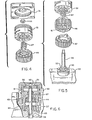
- FIGS 3 through 6 show the way in which the coupling gears may be removed from the main housing without disturbing the rest of the gear assembly.
- four screws (not shown) are removed from the cap 31. These screws pass through holes 60 in the cap and thread into the housing. Note that the cap 31 screws onto the cylinder 51 so that in lifting the cap 31, the shaft 38 and the feed coupling gear assembly are lifted out of the housing. That assembly consists of the piston 50 and cylinder 51, the coupling gear 44 and its support bearing 61. The drive coupling gear 37, its support bearing 62, and the sleeve 52 remain in the housing.
- the cap 31 is unscrewed from the cylinder 51 to gain access to a nut 66 that is removed from the end of the shaft 38, thereby releasing the cylinder 51 from the shaft.
- Return spring 67 is then removed, followed by the coupling gear 44.
- a retainer ring 68 locks the bearing 61 in the gear 44 just as a retainer ring 69 locks the bearing 62 in the gear 37.
- the coupling gear 37 for the spindle drive gear train may also be removed by simply removing the retainer ring 64 from the bottom of the sleeve on the outside of the housing. The sleeve, gear and bearing will then slide out of the housing.
- the purpose for removing the coupling gear44, and also the coupling gear 37, if desired, is to replace one or both of them with gears having different numbers of teeth to change the gear ratios in one or both gear trains, thereby to alter the spindle feed for each turn of the spindle. If the gear ratios are the same for both gear trains, the gears 43 and 47 on the spindle 16 will turn in unison, and the spindle will not advance into the work piece. Therefore, the gear ratios are chosen to drive the feed gear 47 a small fraction faster. That is basically set by the number of teeth in the spindle drive gear 43 and the spindle feed gear 47.
- the feed coupling gear 44 may be changed to one having forty one teeth, or the drive coupling gear 37 to one having thirty nine teeth, or both may be changed.
- the feed can be increased or decreased for different applications (i.e. for different materials being drilled) by simply changing one or both coupling gears.
- the task can be carried out quickly in the field by the machine operator without changing adjacent gears.
- the drive gear train may be designed for a coupling gear having forty teeth, and a drive gear ratio of 40/40, while the spindle feed train may be designed for a coupling gear having forty one teeth and a feed gear ratio of 41/40 for a differential of 1/40.
- gear differentials may be selected for six different drive and spindle feed rate combinations, as follows:
- the replacement gears have the same outer diameter, pitch and teeth height; only the number of teeth is changed. Smooth meshing of the alternate coupling gears with adjacent gears can be readily accomplished by properly shaping the profile of the teeth in the alternate coupling gears since the difference will only be plus or minus one or two, out of a relatively large number, such as forty.
- the change in tooth profile is in proportion to the increase or decrease in the number of teeth. For example, if the increase is from 40 to 41, the profile is reduced by 1/40, a change of only about 1.25 to 2.5% on each side of a tooth for a change in the number of teeth of 1 to 2 out of 40.
- the reduction may be tapered from slightly less than is required at the tip to slightly more than is required at the base of each tooth, with a gradual change in the increase, or decrease, as shown in the Figures.
Landscapes
- Engineering & Computer Science (AREA)
- Mechanical Engineering (AREA)
- Drilling And Boring (AREA)
- Perforating, Stamping-Out Or Severing By Means Other Than Cutting (AREA)
- Earth Drilling (AREA)
Claims (7)
Priority Applications (1)
| Application Number | Priority Date | Filing Date | Title |
|---|---|---|---|
| AT82400355T ATE16774T1 (de) | 1981-03-05 | 1982-03-02 | Bohrer mit einem verstellbaren und formschluessigen vorschubantrieb. |
Applications Claiming Priority (2)
| Application Number | Priority Date | Filing Date | Title |
|---|---|---|---|
| US24078581A | 1981-03-05 | 1981-03-05 | |
| US240785 | 1981-03-05 |
Publications (3)
| Publication Number | Publication Date |
|---|---|
| EP0060186A2 EP0060186A2 (fr) | 1982-09-15 |
| EP0060186A3 EP0060186A3 (en) | 1983-10-19 |
| EP0060186B1 true EP0060186B1 (fr) | 1985-12-04 |
Family
ID=22907934
Family Applications (1)
| Application Number | Title | Priority Date | Filing Date |
|---|---|---|---|
| EP82400355A Expired EP0060186B1 (fr) | 1981-03-05 | 1982-03-02 | Foret muni d'un mécanisme d'avance ajustable et positive |
Country Status (3)
| Country | Link |
|---|---|
| EP (1) | EP0060186B1 (fr) |
| AT (1) | ATE16774T1 (fr) |
| DE (1) | DE3267739D1 (fr) |
Cited By (1)
| Publication number | Priority date | Publication date | Assignee | Title |
|---|---|---|---|---|
| CN107073666A (zh) * | 2014-08-20 | 2017-08-18 | 艾沛克斯品牌公司 | 具有改进的由前进转换至缩回的强制进给工具 |
Families Citing this family (5)
| Publication number | Priority date | Publication date | Assignee | Title |
|---|---|---|---|---|
| US4592681A (en) * | 1983-10-31 | 1986-06-03 | Dresser Industries, Inc. | Retraction apparatus for automatic feed drills or the like |
| GB2209009B (en) * | 1987-08-27 | 1991-11-13 | Silk Engineering | Power feed drills with clutch operated feed |
| US5143161A (en) * | 1991-09-20 | 1992-09-01 | P.V. Tool, Inc. | Right angle positive feed tapper |
| SE0802340A1 (sv) * | 2008-11-04 | 2010-04-13 | Atlas Copco Tools Ab | Borrenhet med automatisk borrspindelmatning och förfarande och medel för detta |
| US9827641B2 (en) | 2013-02-26 | 2017-11-28 | Apex Brands, Inc. | Low pressure shut off for a pneumatic tool |
Family Cites Families (4)
| Publication number | Priority date | Publication date | Assignee | Title |
|---|---|---|---|---|
| AT181145B (de) * | 1952-03-24 | 1955-02-25 | Haniel & Lueg Gmbh | Verzahnung mit zwei Plus-Profilverschiebungen |
| US3512434A (en) * | 1967-11-29 | 1970-05-19 | Zephyr Mfg Co | Drill with automatic feed and quick retraction |
| US3679320A (en) * | 1970-10-28 | 1972-07-25 | Zephyr Mfg Co | Portable right angle drill |
| US4182588A (en) * | 1976-10-07 | 1980-01-08 | Burkart Robert C | Positive feed drill |
-
1982
- 1982-03-02 DE DE8282400355T patent/DE3267739D1/de not_active Expired
- 1982-03-02 EP EP82400355A patent/EP0060186B1/fr not_active Expired
- 1982-03-02 AT AT82400355T patent/ATE16774T1/de active
Cited By (2)
| Publication number | Priority date | Publication date | Assignee | Title |
|---|---|---|---|---|
| CN107073666A (zh) * | 2014-08-20 | 2017-08-18 | 艾沛克斯品牌公司 | 具有改进的由前进转换至缩回的强制进给工具 |
| CN107073666B (zh) * | 2014-08-20 | 2019-12-20 | 艾沛克斯品牌公司 | 具有改进的由前进转换至缩回的强制进给工具 |
Also Published As
| Publication number | Publication date |
|---|---|
| DE3267739D1 (en) | 1986-01-16 |
| ATE16774T1 (de) | 1985-12-15 |
| EP0060186A2 (fr) | 1982-09-15 |
| EP0060186A3 (en) | 1983-10-19 |
Similar Documents
| Publication | Publication Date | Title |
|---|---|---|
| EP0353376B1 (fr) | Outil de brunissage | |
| DE19605156B4 (de) | Werkzeugkopf für den Einsatz in Werkzeugmaschinen sowie Werkzeugmaschine mit einem derartigen Werkzeugkopf | |
| EP0977644B1 (fr) | Outil et methode d'usinage de forures | |
| DE3808989A1 (de) | Fuehrungsbaugruppe zur fuehrung zusammengesetzter bewegungen sowie fuehrungsvorrichtung unter verwendung einer derartigen fuehrungsbaugruppe | |
| EP0060186B1 (fr) | Foret muni d'un mécanisme d'avance ajustable et positive | |
| DE3511933A1 (de) | Werkzeugmaschine zur fraes- und drehbearbeitung | |
| DE1169253B (de) | Mehrspindelbohrmaschine, insbesondere zum Gewindeschneiden | |
| US4418767A (en) | Interchangeable valve system for hydraulic reversal of positive feed drill | |
| DE3625655C1 (de) | Exzentertellerschleifer | |
| US4538942A (en) | Positive feed drill with stop control | |
| US3702740A (en) | Drill press with coolant means | |
| US3513730A (en) | Indexing means for machine tool | |
| DE69529882T2 (de) | Elektro-hydromechanische Gewindebohrmaschine | |
| EP0146149B1 (fr) | Dispositif auxiliaire pour l'usinage de précision d'une surface cylindrique et d'un épaulement in curvé d'une pièce à usiner | |
| EP0047871B1 (fr) | Entraînement d'ajustement pour une pointe d'un outil de coupe | |
| EP0993552B1 (fr) | Pompe a anneau liquide | |
| US4473937A (en) | System for automatic fine adjustment of tools | |
| DE3128228C2 (fr) | ||
| EP0545006B1 (fr) | Porte-outil revolver | |
| DE1477162A1 (de) | Verbesserungen an Werkzeugmaschinen | |
| EP0569775B1 (fr) | Entraînement des broches avec débrayage rapide de la broche d'entraînement | |
| DE2709448C3 (de) | Bohrspindeleinheit | |
| EP0053826A1 (fr) | Dispositif d'entraînement pour l'ajustement radial d'un outil de forage | |
| DE3814595A1 (de) | Werkzeugtraegerrevolveraufsatz | |
| DE927547C (de) | Gewindeschneideinrichtung |
Legal Events
| Date | Code | Title | Description |
|---|---|---|---|
| PUAI | Public reference made under article 153(3) epc to a published international application that has entered the european phase |
Free format text: ORIGINAL CODE: 0009012 |
|
| AK | Designated contracting states |
Designated state(s): AT BE CH DE FR GB IT LU NL SE |
|
| PUAL | Search report despatched |
Free format text: ORIGINAL CODE: 0009013 |
|
| AK | Designated contracting states |
Designated state(s): AT BE CH DE FR GB IT LI LU NL SE |
|
| 17P | Request for examination filed |
Effective date: 19840315 |
|
| GRAA | (expected) grant |
Free format text: ORIGINAL CODE: 0009210 |
|
| AK | Designated contracting states |
Designated state(s): AT BE CH DE FR GB IT LI LU NL SE |
|
| PG25 | Lapsed in a contracting state [announced via postgrant information from national office to epo] |
Ref country code: NL Effective date: 19851204 Ref country code: LI Effective date: 19851204 Ref country code: IT Free format text: LAPSE BECAUSE OF FAILURE TO SUBMIT A TRANSLATION OF THE DESCRIPTION OR TO PAY THE FEE WITHIN THE PRESCRIBED TIME-LIMIT;WARNING: LAPSES OF ITALIAN PATENTS WITH EFFECTIVE DATE BEFORE 2007 MAY HAVE OCCURRED AT ANY TIME BEFORE 2007. THE CORRECT EFFECTIVE DATE MAY BE DIFFERENT FROM THE ONE RECORDED. Effective date: 19851204 Ref country code: CH Effective date: 19851204 Ref country code: BE Effective date: 19851204 Ref country code: AT Effective date: 19851204 |
|
| REF | Corresponds to: |
Ref document number: 16774 Country of ref document: AT Date of ref document: 19851215 Kind code of ref document: T |
|
| REF | Corresponds to: |
Ref document number: 3267739 Country of ref document: DE Date of ref document: 19860116 |
|
| PG25 | Lapsed in a contracting state [announced via postgrant information from national office to epo] |
Ref country code: SE Effective date: 19860131 |
|
| ET | Fr: translation filed | ||
| REG | Reference to a national code |
Ref country code: CH Ref legal event code: PL |
|
| PG25 | Lapsed in a contracting state [announced via postgrant information from national office to epo] |
Ref country code: LU Free format text: LAPSE BECAUSE OF NON-PAYMENT OF DUE FEES Effective date: 19860331 |
|
| NLV1 | Nl: lapsed or annulled due to failure to fulfill the requirements of art. 29p and 29m of the patents act | ||
| PLBE | No opposition filed within time limit |
Free format text: ORIGINAL CODE: 0009261 |
|
| STAA | Information on the status of an ep patent application or granted ep patent |
Free format text: STATUS: NO OPPOSITION FILED WITHIN TIME LIMIT |
|
| 26N | No opposition filed | ||
| PGFP | Annual fee paid to national office [announced via postgrant information from national office to epo] |
Ref country code: FR Payment date: 19940131 Year of fee payment: 13 |
|
| PGFP | Annual fee paid to national office [announced via postgrant information from national office to epo] |
Ref country code: GB Payment date: 19940222 Year of fee payment: 13 |
|
| PGFP | Annual fee paid to national office [announced via postgrant information from national office to epo] |
Ref country code: DE Payment date: 19940224 Year of fee payment: 13 |
|
| PG25 | Lapsed in a contracting state [announced via postgrant information from national office to epo] |
Ref country code: GB Effective date: 19950302 |
|
| GBPC | Gb: european patent ceased through non-payment of renewal fee |
Effective date: 19950302 |
|
| PG25 | Lapsed in a contracting state [announced via postgrant information from national office to epo] |
Ref country code: FR Free format text: LAPSE BECAUSE OF NON-PAYMENT OF DUE FEES Effective date: 19951130 |
|
| PG25 | Lapsed in a contracting state [announced via postgrant information from national office to epo] |
Ref country code: DE Effective date: 19951201 |
|
| REG | Reference to a national code |
Ref country code: FR Ref legal event code: ST |