EP0060356A1 - Panneau de construction composite - Google Patents
Panneau de construction composite Download PDFInfo
- Publication number
- EP0060356A1 EP0060356A1 EP81301136A EP81301136A EP0060356A1 EP 0060356 A1 EP0060356 A1 EP 0060356A1 EP 81301136 A EP81301136 A EP 81301136A EP 81301136 A EP81301136 A EP 81301136A EP 0060356 A1 EP0060356 A1 EP 0060356A1
- Authority
- EP
- European Patent Office
- Prior art keywords
- layer
- building panel
- glass
- glass fibre
- polyester
- Prior art date
- Legal status (The legal status is an assumption and is not a legal conclusion. Google has not performed a legal analysis and makes no representation as to the accuracy of the status listed.)
- Withdrawn
Links
- 239000002131 composite material Substances 0.000 title claims description 15
- 239000003365 glass fiber Substances 0.000 claims abstract description 48
- 230000003014 reinforcing effect Effects 0.000 claims abstract description 25
- 229920001225 polyester resin Polymers 0.000 claims abstract description 23
- 239000004645 polyester resin Substances 0.000 claims abstract description 23
- 229910052751 metal Inorganic materials 0.000 claims abstract description 20
- 239000002184 metal Substances 0.000 claims abstract description 20
- 229920000728 polyester Polymers 0.000 claims description 25
- 239000011521 glass Substances 0.000 claims description 21
- 239000000463 material Substances 0.000 claims description 15
- 239000000945 filler Substances 0.000 claims description 13
- 239000003054 catalyst Substances 0.000 claims description 11
- 239000003822 epoxy resin Substances 0.000 claims description 11
- 229920000647 polyepoxide Polymers 0.000 claims description 11
- 229920006305 unsaturated polyester Polymers 0.000 claims description 10
- 239000000178 monomer Substances 0.000 claims description 9
- 150000002978 peroxides Chemical class 0.000 claims description 9
- 239000004568 cement Substances 0.000 claims description 8
- 229920006337 unsaturated polyester resin Polymers 0.000 claims description 8
- WFUGQJXVXHBTEM-UHFFFAOYSA-N 2-hydroperoxy-2-(2-hydroperoxybutan-2-ylperoxy)butane Chemical group CCC(C)(OO)OOC(C)(CC)OO WFUGQJXVXHBTEM-UHFFFAOYSA-N 0.000 claims description 6
- 238000011065 in-situ storage Methods 0.000 claims description 5
- 150000001451 organic peroxides Chemical class 0.000 claims description 4
- 125000000391 vinyl group Chemical group [H]C([*])=C([H])[H] 0.000 claims description 2
- 229920002554 vinyl polymer Polymers 0.000 claims description 2
- PPBRXRYQALVLMV-UHFFFAOYSA-N Styrene Natural products C=CC1=CC=CC=C1 PPBRXRYQALVLMV-UHFFFAOYSA-N 0.000 description 15
- 238000000034 method Methods 0.000 description 13
- 239000000203 mixture Substances 0.000 description 13
- 229920005989 resin Polymers 0.000 description 7
- 239000011347 resin Substances 0.000 description 7
- 239000000835 fiber Substances 0.000 description 6
- LNEPOXFFQSENCJ-UHFFFAOYSA-N haloperidol Chemical compound C1CC(O)(C=2C=CC(Cl)=CC=2)CCN1CCCC(=O)C1=CC=C(F)C=C1 LNEPOXFFQSENCJ-UHFFFAOYSA-N 0.000 description 6
- 229920000642 polymer Polymers 0.000 description 6
- GYZLOYUZLJXAJU-UHFFFAOYSA-N diglycidyl ether Chemical class C1OC1COCC1CO1 GYZLOYUZLJXAJU-UHFFFAOYSA-N 0.000 description 5
- 239000000376 reactant Substances 0.000 description 5
- -1 accelerators Substances 0.000 description 4
- IISBACLAFKSPIT-UHFFFAOYSA-N bisphenol A Chemical compound C=1C=C(O)C=CC=1C(C)(C)C1=CC=C(O)C=C1 IISBACLAFKSPIT-UHFFFAOYSA-N 0.000 description 4
- 150000001875 compounds Chemical class 0.000 description 4
- 150000002118 epoxides Chemical class 0.000 description 4
- 239000000126 substance Substances 0.000 description 4
- PEDCQBHIVMGVHV-UHFFFAOYSA-N Glycerine Chemical compound OCC(O)CO PEDCQBHIVMGVHV-UHFFFAOYSA-N 0.000 description 3
- VYPSYNLAJGMNEJ-UHFFFAOYSA-N Silicium dioxide Chemical compound O=[Si]=O VYPSYNLAJGMNEJ-UHFFFAOYSA-N 0.000 description 3
- 230000001413 cellular effect Effects 0.000 description 3
- 239000004567 concrete Substances 0.000 description 3
- 239000004033 plastic Substances 0.000 description 3
- 229920003023 plastic Polymers 0.000 description 3
- KAKZBPTYRLMSJV-UHFFFAOYSA-N Butadiene Chemical compound C=CC=C KAKZBPTYRLMSJV-UHFFFAOYSA-N 0.000 description 2
- XEEYBQQBJWHFJM-UHFFFAOYSA-N Iron Chemical compound [Fe] XEEYBQQBJWHFJM-UHFFFAOYSA-N 0.000 description 2
- 229920004552 POLYLITE® Polymers 0.000 description 2
- 125000000217 alkyl group Chemical group 0.000 description 2
- PXKLMJQFEQBVLD-UHFFFAOYSA-N bisphenol F Chemical compound C1=CC(O)=CC=C1CC1=CC=C(O)C=C1 PXKLMJQFEQBVLD-UHFFFAOYSA-N 0.000 description 2
- WTEOIRVLGSZEPR-UHFFFAOYSA-N boron trifluoride Chemical compound FB(F)F WTEOIRVLGSZEPR-UHFFFAOYSA-N 0.000 description 2
- 125000004432 carbon atom Chemical group C* 0.000 description 2
- 238000005516 engineering process Methods 0.000 description 2
- 239000006260 foam Substances 0.000 description 2
- 229910052739 hydrogen Inorganic materials 0.000 description 2
- 239000001257 hydrogen Substances 0.000 description 2
- 125000004435 hydrogen atom Chemical group [H]* 0.000 description 2
- 239000003999 initiator Substances 0.000 description 2
- 239000007788 liquid Substances 0.000 description 2
- 238000004519 manufacturing process Methods 0.000 description 2
- 150000002739 metals Chemical class 0.000 description 2
- 239000002245 particle Substances 0.000 description 2
- 238000006116 polymerization reaction Methods 0.000 description 2
- 238000002360 preparation method Methods 0.000 description 2
- 238000005507 spraying Methods 0.000 description 2
- JIAARYAFYJHUJI-UHFFFAOYSA-L zinc dichloride Chemical compound [Cl-].[Cl-].[Zn+2] JIAARYAFYJHUJI-UHFFFAOYSA-L 0.000 description 2
- OIXUJRCCNNHWFI-UHFFFAOYSA-N 1,2-dioxane Chemical compound C1CCOOC1 OIXUJRCCNNHWFI-UHFFFAOYSA-N 0.000 description 1
- PAOHAQSLJSMLAT-UHFFFAOYSA-N 1-butylperoxybutane Chemical compound CCCCOOCCCC PAOHAQSLJSMLAT-UHFFFAOYSA-N 0.000 description 1
- LGJCFVYMIJLQJO-UHFFFAOYSA-N 1-dodecylperoxydodecane Chemical compound CCCCCCCCCCCCOOCCCCCCCCCCCC LGJCFVYMIJLQJO-UHFFFAOYSA-N 0.000 description 1
- XMNIXWIUMCBBBL-UHFFFAOYSA-N 2-(2-phenylpropan-2-ylperoxy)propan-2-ylbenzene Chemical compound C=1C=CC=CC=1C(C)(C)OOC(C)(C)C1=CC=CC=C1 XMNIXWIUMCBBBL-UHFFFAOYSA-N 0.000 description 1
- LMVLMHGTZULBRX-UHFFFAOYSA-N 2-[2,2,2-tris(2-hydroxyphenyl)ethyl]phenol Chemical compound OC1=CC=CC=C1CC(C=1C(=CC=CC=1)O)(C=1C(=CC=CC=1)O)C1=CC=CC=C1O LMVLMHGTZULBRX-UHFFFAOYSA-N 0.000 description 1
- UVTIZRNEWKAOEM-UHFFFAOYSA-N 2-tert-butylperoxy-2-methylbutane Chemical compound CCC(C)(C)OOC(C)(C)C UVTIZRNEWKAOEM-UHFFFAOYSA-N 0.000 description 1
- 229910015900 BF3 Inorganic materials 0.000 description 1
- OMPJBNCRMGITSC-UHFFFAOYSA-N Benzoylperoxide Chemical compound C=1C=CC=CC=1C(=O)OOC(=O)C1=CC=CC=C1 OMPJBNCRMGITSC-UHFFFAOYSA-N 0.000 description 1
- 229910001369 Brass Inorganic materials 0.000 description 1
- 229910000906 Bronze Inorganic materials 0.000 description 1
- ZAMOUSCENKQFHK-UHFFFAOYSA-N Chlorine atom Chemical compound [Cl] ZAMOUSCENKQFHK-UHFFFAOYSA-N 0.000 description 1
- VYZAMTAEIAYCRO-UHFFFAOYSA-N Chromium Chemical compound [Cr] VYZAMTAEIAYCRO-UHFFFAOYSA-N 0.000 description 1
- RYGMFSIKBFXOCR-UHFFFAOYSA-N Copper Chemical compound [Cu] RYGMFSIKBFXOCR-UHFFFAOYSA-N 0.000 description 1
- BRLQWZUYTZBJKN-UHFFFAOYSA-N Epichlorohydrin Chemical compound ClCC1CO1 BRLQWZUYTZBJKN-UHFFFAOYSA-N 0.000 description 1
- 239000004593 Epoxy Substances 0.000 description 1
- 238000005727 Friedel-Crafts reaction Methods 0.000 description 1
- VEXZGXHMUGYJMC-UHFFFAOYSA-N Hydrochloric acid Chemical compound Cl VEXZGXHMUGYJMC-UHFFFAOYSA-N 0.000 description 1
- UIHCLUNTQKBZGK-UHFFFAOYSA-N Methyl isobutyl ketone Natural products CCC(C)C(C)=O UIHCLUNTQKBZGK-UHFFFAOYSA-N 0.000 description 1
- BPQQTUXANYXVAA-UHFFFAOYSA-N Orthosilicate Chemical compound [O-][Si]([O-])([O-])[O-] BPQQTUXANYXVAA-UHFFFAOYSA-N 0.000 description 1
- FQYUMYWMJTYZTK-UHFFFAOYSA-N Phenyl glycidyl ether Chemical class C1OC1COC1=CC=CC=C1 FQYUMYWMJTYZTK-UHFFFAOYSA-N 0.000 description 1
- 229920005830 Polyurethane Foam Polymers 0.000 description 1
- 229910000831 Steel Inorganic materials 0.000 description 1
- YVRWATFLIJFFHK-UHFFFAOYSA-N [tert-butylperoxy(phenyl)methyl]benzene Chemical compound C=1C=CC=CC=1C(OOC(C)(C)C)C1=CC=CC=C1 YVRWATFLIJFFHK-UHFFFAOYSA-N 0.000 description 1
- 239000002253 acid Substances 0.000 description 1
- 150000007513 acids Chemical class 0.000 description 1
- 239000002318 adhesion promoter Substances 0.000 description 1
- 230000002411 adverse Effects 0.000 description 1
- 150000001298 alcohols Chemical class 0.000 description 1
- 239000003513 alkali Substances 0.000 description 1
- 239000000956 alloy Substances 0.000 description 1
- 229910045601 alloy Inorganic materials 0.000 description 1
- 150000004645 aluminates Chemical class 0.000 description 1
- 239000004411 aluminium Substances 0.000 description 1
- 229910052782 aluminium Inorganic materials 0.000 description 1
- XAGFODPZIPBFFR-UHFFFAOYSA-N aluminium Chemical compound [Al] XAGFODPZIPBFFR-UHFFFAOYSA-N 0.000 description 1
- 239000004599 antimicrobial Substances 0.000 description 1
- 239000003963 antioxidant agent Substances 0.000 description 1
- 239000002216 antistatic agent Substances 0.000 description 1
- 239000012736 aqueous medium Substances 0.000 description 1
- 235000019400 benzoyl peroxide Nutrition 0.000 description 1
- KQNZLOUWXSAZGD-UHFFFAOYSA-N benzylperoxymethylbenzene Chemical compound C=1C=CC=CC=1COOCC1=CC=CC=C1 KQNZLOUWXSAZGD-UHFFFAOYSA-N 0.000 description 1
- 230000001588 bifunctional effect Effects 0.000 description 1
- 239000011230 binding agent Substances 0.000 description 1
- 239000010951 brass Substances 0.000 description 1
- 239000011449 brick Substances 0.000 description 1
- 239000010974 bronze Substances 0.000 description 1
- 210000003850 cellular structure Anatomy 0.000 description 1
- 238000006243 chemical reaction Methods 0.000 description 1
- 239000003795 chemical substances by application Substances 0.000 description 1
- 229910052801 chlorine Inorganic materials 0.000 description 1
- 239000000460 chlorine Substances 0.000 description 1
- 229910052804 chromium Inorganic materials 0.000 description 1
- 239000011651 chromium Substances 0.000 description 1
- 229920006026 co-polymeric resin Polymers 0.000 description 1
- 239000000805 composite resin Substances 0.000 description 1
- 238000009833 condensation Methods 0.000 description 1
- 230000005494 condensation Effects 0.000 description 1
- 238000010276 construction Methods 0.000 description 1
- 229910052802 copper Inorganic materials 0.000 description 1
- 239000010949 copper Substances 0.000 description 1
- KUNSUQLRTQLHQQ-UHFFFAOYSA-N copper tin Chemical compound [Cu].[Sn] KUNSUQLRTQLHQQ-UHFFFAOYSA-N 0.000 description 1
- 238000004132 cross linking Methods 0.000 description 1
- 238000006704 dehydrohalogenation reaction Methods 0.000 description 1
- SRXOCFMDUSFFAK-UHFFFAOYSA-N dimethyl peroxide Chemical compound COOC SRXOCFMDUSFFAK-UHFFFAOYSA-N 0.000 description 1
- 230000000694 effects Effects 0.000 description 1
- 239000006261 foam material Substances 0.000 description 1
- 239000010440 gypsum Substances 0.000 description 1
- 229910052602 gypsum Inorganic materials 0.000 description 1
- 229910052736 halogen Inorganic materials 0.000 description 1
- 150000002367 halogens Chemical class 0.000 description 1
- 239000012760 heat stabilizer Substances 0.000 description 1
- 238000010438 heat treatment Methods 0.000 description 1
- 229910000041 hydrogen chloride Inorganic materials 0.000 description 1
- IXCSERBJSXMMFS-UHFFFAOYSA-N hydrogen chloride Substances Cl.Cl IXCSERBJSXMMFS-UHFFFAOYSA-N 0.000 description 1
- 229910010272 inorganic material Inorganic materials 0.000 description 1
- 239000011147 inorganic material Substances 0.000 description 1
- 229910052742 iron Inorganic materials 0.000 description 1
- 239000011133 lead Substances 0.000 description 1
- 239000004611 light stabiliser Substances 0.000 description 1
- 238000012986 modification Methods 0.000 description 1
- 230000004048 modification Effects 0.000 description 1
- 239000003607 modifier Substances 0.000 description 1
- 231100000989 no adverse effect Toxicity 0.000 description 1
- 229920003986 novolac Polymers 0.000 description 1
- 239000011368 organic material Substances 0.000 description 1
- 239000006069 physical mixture Substances 0.000 description 1
- 229920000570 polyether Polymers 0.000 description 1
- 229920000151 polyglycol Polymers 0.000 description 1
- 239000010695 polyglycol Substances 0.000 description 1
- 229920006327 polystyrene foam Polymers 0.000 description 1
- 239000011496 polyurethane foam Substances 0.000 description 1
- 239000012744 reinforcing agent Substances 0.000 description 1
- 239000004576 sand Substances 0.000 description 1
- 229920006395 saturated elastomer Polymers 0.000 description 1
- 239000000377 silicon dioxide Substances 0.000 description 1
- 239000007787 solid Substances 0.000 description 1
- 239000010959 steel Substances 0.000 description 1
- 125000003011 styrenyl group Chemical group [H]\C(*)=C(/[H])C1=C([H])C([H])=C([H])C([H])=C1[H] 0.000 description 1
- 229920003002 synthetic resin Polymers 0.000 description 1
- 239000000057 synthetic resin Substances 0.000 description 1
- 229920001187 thermosetting polymer Polymers 0.000 description 1
- 238000003466 welding Methods 0.000 description 1
- 235000005074 zinc chloride Nutrition 0.000 description 1
- 239000011592 zinc chloride Substances 0.000 description 1
- NWONKYPBYAMBJT-UHFFFAOYSA-L zinc sulfate Chemical compound [Zn+2].[O-]S([O-])(=O)=O NWONKYPBYAMBJT-UHFFFAOYSA-L 0.000 description 1
Images

Classifications
-
- E—FIXED CONSTRUCTIONS
- E04—BUILDING
- E04C—STRUCTURAL ELEMENTS; BUILDING MATERIALS
- E04C2/00—Building elements of relatively thin form for the construction of parts of buildings, e.g. sheet materials, slabs, or panels
- E04C2/30—Building elements of relatively thin form for the construction of parts of buildings, e.g. sheet materials, slabs, or panels characterised by the shape or structure
- E04C2/38—Building elements of relatively thin form for the construction of parts of buildings, e.g. sheet materials, slabs, or panels characterised by the shape or structure with attached ribs, flanges, or the like, e.g. framed panels
- E04C2/384—Building elements of relatively thin form for the construction of parts of buildings, e.g. sheet materials, slabs, or panels characterised by the shape or structure with attached ribs, flanges, or the like, e.g. framed panels with a metal frame
-
- E—FIXED CONSTRUCTIONS
- E04—BUILDING
- E04C—STRUCTURAL ELEMENTS; BUILDING MATERIALS
- E04C2/00—Building elements of relatively thin form for the construction of parts of buildings, e.g. sheet materials, slabs, or panels
- E04C2/02—Building elements of relatively thin form for the construction of parts of buildings, e.g. sheet materials, slabs, or panels characterised by specified materials
- E04C2/10—Building elements of relatively thin form for the construction of parts of buildings, e.g. sheet materials, slabs, or panels characterised by specified materials of wood, fibres, chips, vegetable stems, or the like; of plastics; of foamed products
- E04C2/24—Building elements of relatively thin form for the construction of parts of buildings, e.g. sheet materials, slabs, or panels characterised by specified materials of wood, fibres, chips, vegetable stems, or the like; of plastics; of foamed products laminated and composed of materials covered by two or more of groups E04C2/12, E04C2/16, E04C2/20
- E04C2/246—Building elements of relatively thin form for the construction of parts of buildings, e.g. sheet materials, slabs, or panels characterised by specified materials of wood, fibres, chips, vegetable stems, or the like; of plastics; of foamed products laminated and composed of materials covered by two or more of groups E04C2/12, E04C2/16, E04C2/20 combinations of materials fully covered by E04C2/16 and E04C2/20
Definitions
- This invention relates to a lightweight, composite building panel.
- a composite building panel which comprises at least one metal reinforcing member; a layer comprising glass fibre fastened to the metal reinforcing member(s); and a three-dimensionally cross-linked polyester resin layer which abuts said glass fibre-comprising layer.
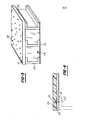
- composite building panel 10 is comprised of at least one metal reinforcing member 12, a layer 14 comprising glass fibre which is fastened to the metal reinforcing member(s) 12, and a three-dimensionally cross-linked polyester resin layer 16 which lies on the glass fibre layer 14.
- Fastening means such as screw 18 (see Figure 4), may be used to secure the glass fibre layer 14 to the metal reinforcing member 12.
- the screw 18, as shown is a double headed screw which is used to penetrate and fix the fibre layer to the member 12.
- By employing a double headed screw a portion thereof extends above the fibre layer.
- the resin is cast on the fibre layer, it encapsulates the extension or second head portion 19.
- a double headed screw both a mechanical bond and a chemical bonding is achieved.
- other mechanical fasteners may be used, if desired.
- Aggregate particles may be embedded in the polyester layer to impart an aesthetic appearance to the composite.
- Figures 1 and 4 show a first form of composite building panel embodying this invention, in which there are included metal reinforcing member(s) 12, a glass fibre layer 14, a three-dimensionally cross-linked polyester resin layer 16, and, optionally, (and not shown) other layer(s) of material (s) known to those in the art to be useful in laminated building panels such as strone aggregate, or a mould finish.
- layers of for example epoxy resin, polyester resin, concrete, synthetic concrete, butadiene copolymer resin, polyethers and glass fibres may be used in constructing a composite building panel of this invention in addition to the aforementioned essential glass fibre and polyester layers.
- a building panel of this invention preferably contains from 2 to 20 composite layers.
- Figure 3 shows an alternative form of composite building panel embodying this invention which is comprised of at least two metal channel-sectioned reinforcing members 112.
- a glass fibre layer 114 is attached to these metal reinforcing members, in the manner heretofore described with respect to Figures 1 and 4, and the spaces 117 between the metal reinforcing members are filled with cellular cement or other lightweight, usually cellular, material, for example polyurethane foam, polystyrene foam, gypsum, or other light-weight organic or inorganic material.
- cellular cement or other lightweight, usually cellular, material for example polyurethane foam, polystyrene foam, gypsum, or other light-weight organic or inorganic material.
- the cellular material adds heat qualities or thermal insulative characteristics as well as fire retardency to the composite of the invention.
- the composite further includes a lath 116 secured to the opposite side of the reinforcing members 112 from that of the glass fibre layer 114.
- the lath surface thus, defines an interior wall structure which may be plastic covered or otherwise finished to form an interior wall.
- the lath may be secured to the frame or channel members by any suitable means including fasteners, welding or the like.
- a polyester resin is cast upon the glass fibre layer 114 to form a layer 118 which defines an exterior wall.
- the layer 118 may be impregnated with aggregate particles or further coated.
- the lath, channel members, foam, glass fibres and resin composite all cooperate to define a building panel structure which includes both interior and exterior finished walls.
- this.form of building panel a plurality of reinforcing members are arrayed and interconnected into a suitable network. Then, a lath is secured to one end of the members. Next, a formable material is placed in the spaces 117 betweenthe reinforcing members and foamed in situ. Next, the glass fibre-filled layer is deposited onto the opposite end of the reinforcing members. This can be done by affixing a fibre pan thereto or, alternatively, spraying the fibre layer thereonto. In this regard it must be noted that the surface 119 defined by the channel or frame members and the foam which fills the spaces therebetween constitutes a mould for the spraying of the glass fibre.
- glass fibre layer 14 is bonded to a three-dimensionally cross-linked polyester resin layer 16 or 118.
- the bond may be mechanical in nature and may be created by the use of.fastening means well known to the art. In such instances the resin is cast independently and away from the fibre layer 14 or 114. It is preferred, however, that the bond be created by forming layer 16 (or 118) in situ in place on glass fibre layer 14 (or 114).
- to layer 14 is charged the reactants required to prepare the three-dimensionally cross-linked polyester resin layer 16.
- Layer 16- is formed right on top of layer 14.
- a double headed fastener 18, as shown in Figure 4 is enclosed by the resin and serves as an auxiliary fastener or bonding member.
- a three-dimensionally cross-linked polyester resin is used to prepare the building panel of this invention.
- the polymerization reaction is conducted with two monomers in which the functionality of one monomer is at least two and the functionality of the other monomer is more than two.
- a linear, unsaturated polyester is reacted with a vinyl-type monomer to produce an unsaturated polyester resin. It is preferred to use a three-dimensionally cross-linked unsaturated, polyester resin to prepare the structures of this invention.
- the unsaturated polyester resins preferably used to prepare the panel of this invention are well known to those skilled in the art. They may be produced by reacting a linear, unsaturated polyester with an unsaturated, vinyl-type monomer.
- Linear, saturated polyesters may be prepared from dibasic acids and dihydric alcohols. If either or both of the bifunctional reactants contains unsaturation, linear unsaturated polyesters are formed; when they are cured with the vinyl-type monomer, cross-linking occurs among the individual linear polymer chains and the unsaturated polyester resin is formed.
- Unsaturated polyester resins known to the art may be used in the panel of this invention; and they may be prepared by methods well known to the art. Thus, for example, they may be prepared by the procedures described in B. Golding, Polymers and Resins, pp. 303-314 (Van Nostrand Company, Inc., New Jersey, 1959); J. Stille, Introduction to Polymer Chemistry, pp. 90-93 (John Wiley and Sons, Inc., New York, 1962); R.S.Morrell (ed.), Synthetic Resins and Allied Plastics (Oxford University Press, London, 1951); Bjorksten Research Laboratories, Inc., Polyesters and Their Applications (Reinhold Publishing Co., New York, 1956); and the like.
- the various unsaturated polyester resins described in these publications may be used in the structures of the present invention.
- the processes, initiators, linear unsaturated polyesters, and unsaturated vinyl-type compounds described in these publications may be used to prepare unsaturated polyester resins which are useful in the panel of this invention.
- the crosslinked polyester resin used in the panel of this invention contain a filler. It is preferred to use from 10 to 50 percent (by combined weight of filler and polyester resin) of filler. It is more preferred to use from 15 to 30 percent (by weight) of filler. In the most preferred embodiment, from 20 to 25 percent of filler is employed.
- any of the fillers well known to those skilled in the art may be used in the crosslinked polyester resin.
- Such materials include, without limitation, adhesion promoters; antioxidants; antistatic agents; antimicrobial agents; colourants; heat stabilizers; light stabilizers; fillers; reinforcing agents; and other materials well known to those skilled in the art which have been or could be used with polymer compositions and which are described, e.g., in Modern Plastics Encyclopedia, Vol. 52, No.lOA, McGraw-Hill, Inc., New York, New York (1975).
- the above described materials which may be used in the crosslinked polyester resins can be employed in any amounts which will not substantially adversely affect the properties of these compositions.
- the amount used can be zero (0) per cent, based on the total weight of the composition, up to that percent at which the composition can still be classified as a resin. In general, such amount will be from 0 percent to 80 percent.
- the filler used be a silica sand.
- the filler may be incorporated into the polyester resin by means well known to those in the art.
- it may be mixed with the linear, unsaturated polyester and/or the unsaturated, vinyl-type compound prior to the time these components are reacted together to form the unsaturated polyester resin.
- Other methods of incorporating the filler into the resin which are known to the art also may be used.
- the aforementioned vinyl-type monomer is of the formula: wherein R is selected from hydrogen, lower alkyl of from 1 to 6 carbon atoms, and halogen; Z is selected from vinyl, hydrogen , chlorine, and lower alkyl of from 1 to 6 carbon atoms; and p is 0 or a whole number of from 1 to 5.
- the most preferred vinyl-type monomer is styrene. When it is used, it is preferred to use from 30 to 70 percent (by combined weight) of styrene. In an even more preferred embodiment, from 40 to 60 percent (by combined weight) of styrene is used. In the most preferred embodiment, from 45 to 55 percent (by combined weight) of styrene is utilized.
- glass-filled layer 14 or 114 In one procedure for producing a building panel embodying this invention, after glass-filled layer 14 or 114 is formed, wooden slats are placed around the sides of glass-filled layer 14 or 114 to form a boundary; the reactants required to form three-dimensionally cross- linked polyester resin layer 16 or 118 are poured on top of layer 14 or 114 and the slats prevent these reactants from flowing off over the top of glass-filled layer 14 or 114. After polyester resin 16 or 118 has hardened, the wooden slats are removed. In another procedure which can be appreciated best by reference to Figure 2, glass fibre layer 14 is formed with sides 20 which act as boundaries and restrain the reactants from flowing off of the top of glass fibre layer 14 after they have been charged.
- Glass fibre layer 14 is preferably comprised of from 25 to 100 percent (by weight) of glass fibre. It is particularly preferred that glass fibre layer 14 be comprised of from 30 to 80 percent (by weight) of glass fibre. In a more preferred embodiment, glass fibre layer 14 is comprised of from 33 to 60 percent of glass fibre.
- any material which may be filled with glass fibre may be used in glass fibre layer 14.
- glass-filled epoxy resin or glass-filled polyester in glass fibre layer 14.
- the epoxy resin used may be as described in the Encyclopedia of Polymer Science Technology, Vol. 6. pp. 209-270 (Interscience, New York, 1967).
- the epoxy resins that may be employed in the practice of the present invention may be those which are known in the art, although it is preferred to use DGEBA (diglycidyl ethers of bisphenol A).
- DGEBA diglycidyl ethers of bisphenol A
- suitable epoxy resins, modifiers, curing agents, accelerators, fillers, glass cloths, manufacturing conditions, etc. may be found in the Encyclopedia of Polymer Science and Technology, Vol. 6, pp. 209-270 (Interscience Publishers, New York, 1967) and in the Handbook of Epoxy Resins, by Henry Lee and Kris Neville (McGraw-Hill, New York, 1967).
- the preferred epoxy resins are made by the reaction of bisphenol A with excess epichlorohydrin in an inert atmosphere under alkaline conditions to neutralize the hydrogen chloride resulting from the condensation.
- Friedel-Crafts catalysts may be employed, such as zinc chloride or boron trifluoride, followed by dehydrohalogenation with a compound such as an aluminate, silicate or zincate . in a substantially non-aqueous medium.
- the epoxide equivalents of such compounds are generally in the range of 150 to 1,000 and usually are from 200 to 600.
- the average molecular weights are from 340 to 1,500, preferably 340 to 1,200.
- DGEBA epoxides
- glycidyl ethers of glycerol glycidyl ethers of bisphenol F
- polyglycol glycidyl ethers glycidyl ethers of tetrakis (hydroxyphenyl) ethane
- phenyl glycidyl ethers and epoxylated novolacs may be used.
- various mixtures of epoxy resins may be employed, either as physical mixtures of different types of .epoxides or as chemical combinations, having different resin-forming portions reacted into one epoxide molecule.
- the epoxy resins may be utilized with other types or resins so as to obtain desired modifications of physical and chemical properties.
- the glass fibre layer 14 is glass-filled polyester. It is preferred that this glass-filled polyester be glass-filled linear unsaturated polyester. The preparation of these linear, unsaturated polyesters has been described hereinabove and is well known to those skilled in the art.
- the preferred unsaturated polyesters are those thermosetting materials which, when properly catalyzed, convert from a liquid state to infusible solids.
- This polymerization reaction usually termed “curing” may be initiated through the addition of a catalyst (polymerisation initiator) such as an organic peroxide catalyst.
- the-layer comprising glass fibre consists essentially of glass-filled polyester with which has been admixed from 0.5 to 5.0 percent (by combined weight of glass-filled polyester and peroxide catalyst) of peroxide catalyst.
- Useful organic peroxide catalysts include, for example, methyl ethyl ketone peroxide, benzyl peroxide, dimethyl peroxide, butyl peroxide, cumylmethyl peroxide, t-butyl-t-pentyl peroxide, t-butyl diphenylmethyl peroxide, dicumyl peroxide, 1,2-dioxane, triphenylmethane peroxide, dilauryl peroxide, dibenzoyl peroxide, methyl isobutyl ketone peroxide and methyl amyl ketone peroxide, as well as mixtures thereof.
- the preferred catalyst is methylethyl ketone peroxide.
- the glass-filled polyester be cured under ambient conditions.
- the three-dimensionally cross- linked polyester resin layer is formed by admixing methyl ethyl ketone peroxide with the linear, unsaturated polyester, and styrene and thereafter allowing this layer to cure under ambient conditions.
- the metal reinforcing member may be constructed of any metal commonly used in the building trades art.
- steel, iron, brass, aluminium, copper, lead, chromium, bronze, and the like are metals which may be used in the reinforcing member.
- the metal reinforcing member is preferably comprised of at least about 50 percent by weight of one or more of these metals.
- the metal reinforcing member may be in any shape which will lend structural integrity to the building panel of this invention.
- the three-dimensionally cross-linked polyester is cast in situ, some portion thereof will invade interstices of the glass fibre layer. Because the peroxide catalyst used in the polyester layer is preferably, the same as the peroxide used with the glass fibre, no adverse effect occurs because of this commingling.
- One hundred parts of chopped glass fibre were mixed with two hundred parts of Polylite® 32-131 polyester (an unsaturated, liquid polyester with a viscosity of 1300-1800 cps and a density of 1.14-1.16 kilograms per litre which was purchased from the Reichhold Chemicals, Inc. of White Plains, New York). To this mixture were added two parts of methyl ethyl ketone peroxide and the mixture was allowed to cure at room temperature for from thirty to forty-five minutes. The chopped glass fibre mixture thus produced was sprayed onto a bed of spaced apart channels having the spaces therebetween filled with a 400 kg / m 3 density cement. After the glass fibre composite had set, it was attached to the channel members using suitable mechanical fasteners.
Landscapes
- Engineering & Computer Science (AREA)
- Architecture (AREA)
- Civil Engineering (AREA)
- Structural Engineering (AREA)
- Life Sciences & Earth Sciences (AREA)
- Wood Science & Technology (AREA)
- Laminated Bodies (AREA)
Priority Applications (1)
| Application Number | Priority Date | Filing Date | Title |
|---|---|---|---|
| EP81301136A EP0060356A1 (fr) | 1981-03-18 | 1981-03-18 | Panneau de construction composite |
Applications Claiming Priority (1)
| Application Number | Priority Date | Filing Date | Title |
|---|---|---|---|
| EP81301136A EP0060356A1 (fr) | 1981-03-18 | 1981-03-18 | Panneau de construction composite |
Publications (1)
| Publication Number | Publication Date |
|---|---|
| EP0060356A1 true EP0060356A1 (fr) | 1982-09-22 |
Family
ID=8188241
Family Applications (1)
| Application Number | Title | Priority Date | Filing Date |
|---|---|---|---|
| EP81301136A Withdrawn EP0060356A1 (fr) | 1981-03-18 | 1981-03-18 | Panneau de construction composite |
Country Status (1)
| Country | Link |
|---|---|
| EP (1) | EP0060356A1 (fr) |
Citations (4)
| Publication number | Priority date | Publication date | Assignee | Title |
|---|---|---|---|---|
| US3194708A (en) * | 1959-11-07 | 1965-07-13 | Houilleres Bassin Du Nord | Production of light structural members |
| GB1117811A (en) * | 1965-01-05 | 1968-06-26 | William Old Resiform Ltd | Improved units for building and like structures |
| GB1224028A (en) * | 1967-03-22 | 1971-03-03 | Saint Gobain | Process for the manufacture of panels in particular for buildings |
| BE769018A (fr) * | 1971-06-24 | 1971-11-03 | Demortier Louise | Procede de fabrication d'elements de construction, |
-
1981
- 1981-03-18 EP EP81301136A patent/EP0060356A1/fr not_active Withdrawn
Patent Citations (4)
| Publication number | Priority date | Publication date | Assignee | Title |
|---|---|---|---|---|
| US3194708A (en) * | 1959-11-07 | 1965-07-13 | Houilleres Bassin Du Nord | Production of light structural members |
| GB1117811A (en) * | 1965-01-05 | 1968-06-26 | William Old Resiform Ltd | Improved units for building and like structures |
| GB1224028A (en) * | 1967-03-22 | 1971-03-03 | Saint Gobain | Process for the manufacture of panels in particular for buildings |
| BE769018A (fr) * | 1971-06-24 | 1971-11-03 | Demortier Louise | Procede de fabrication d'elements de construction, |
Similar Documents
| Publication | Publication Date | Title |
|---|---|---|
| US3232017A (en) | Insulated structural panel with synthetic foam core and ornamental facing of visiblediscrete particulate material | |
| US4327536A (en) | Composite building panel | |
| US4361616A (en) | Laminated board | |
| US4252767A (en) | Composite building module | |
| US6092343A (en) | Compression molded door assembly | |
| US3271917A (en) | Reinforced plastic constructions | |
| US20130318908A1 (en) | Composite face panels for structural insulated panels | |
| US3510392A (en) | Glass nodules in cellular polyurethane | |
| US2460309A (en) | Panel structural unit | |
| AU2002365843B2 (en) | Method of making a finished product | |
| US5872168A (en) | Polymer additives for forming objects | |
| DE2623738C3 (de) | Verfahren zur Herstellung von Bauteilen | |
| US20070257391A1 (en) | Method for Manufacturing a Light Article of Conglomerate Material and Associated Composite Panel | |
| JPS58110443A (ja) | 天然ガラス質発泡体複合板および製造法 | |
| US5143670A (en) | Slab shaped building components and method of forming same | |
| KR100513243B1 (ko) | 페놀수지를 적용한 샌드위치형 패널 및 그 제조방법 | |
| US5883164A (en) | Polymer additives for forming objects | |
| EP0632793A1 (fr) | Composition de ciment ameliore et construction pour panneaux et autres elements de construction | |
| CA2231836A1 (fr) | Nouveaux additifs pour des polymeres, utilises pour former des objets | |
| JP3163372B2 (ja) | 耐火複合板 | |
| KR20000036095A (ko) | 사물 형성을 위한 신규한 중합체 첨가제 | |
| JPH08197642A (ja) | 耐火パネルの製造装置 | |
| JPH0128695B2 (fr) | ||
| AU2003203706B2 (en) | Entry Way Door Members | |
| JP4346917B2 (ja) | 成形体パネルの製造方法 |
Legal Events
| Date | Code | Title | Description |
|---|---|---|---|
| PUAI | Public reference made under article 153(3) epc to a published international application that has entered the european phase |
Free format text: ORIGINAL CODE: 0009012 |
|
| AK | Designated contracting states |
Designated state(s): AT BE CH DE FR GB IT LU NL SE |
|
| STAA | Information on the status of an ep patent application or granted ep patent |
Free format text: STATUS: THE APPLICATION IS DEEMED TO BE WITHDRAWN |
|
| 18D | Application deemed to be withdrawn |
Effective date: 19830827 |
|
| RIN1 | Information on inventor provided before grant (corrected) |
Inventor name: ASCHER, RAYMOND R. |