EP0060376A1 - Procédé de récupération et de recyclage du molybdène à partir de residus de la liquéfaction du charbon - Google Patents
Procédé de récupération et de recyclage du molybdène à partir de residus de la liquéfaction du charbon Download PDFInfo
- Publication number
- EP0060376A1 EP0060376A1 EP19820100093 EP82100093A EP0060376A1 EP 0060376 A1 EP0060376 A1 EP 0060376A1 EP 19820100093 EP19820100093 EP 19820100093 EP 82100093 A EP82100093 A EP 82100093A EP 0060376 A1 EP0060376 A1 EP 0060376A1
- Authority
- EP
- European Patent Office
- Prior art keywords
- liquor
- molybdenum
- precipitate
- residue
- leach liquor
- Prior art date
- Legal status (The legal status is an assumption and is not a legal conclusion. Google has not performed a legal analysis and makes no representation as to the accuracy of the status listed.)
- Granted
Links
- 239000003245 coal Substances 0.000 title claims abstract description 59
- 229910052750 molybdenum Inorganic materials 0.000 title claims description 100
- ZOKXTWBITQBERF-UHFFFAOYSA-N Molybdenum Chemical compound [Mo] ZOKXTWBITQBERF-UHFFFAOYSA-N 0.000 title claims description 95
- 239000011733 molybdenum Substances 0.000 title claims description 95
- 238000011084 recovery Methods 0.000 title description 19
- 239000002244 precipitate Substances 0.000 claims abstract description 44
- 238000000034 method Methods 0.000 claims abstract description 35
- 239000000203 mixture Substances 0.000 claims abstract description 13
- 239000000047 product Substances 0.000 claims abstract description 13
- VHUUQVKOLVNVRT-UHFFFAOYSA-N Ammonium hydroxide Chemical compound [NH4+].[OH-] VHUUQVKOLVNVRT-UHFFFAOYSA-N 0.000 claims abstract description 12
- 239000003513 alkali Substances 0.000 claims abstract description 12
- 239000000908 ammonium hydroxide Substances 0.000 claims abstract description 12
- MEFBJEMVZONFCJ-UHFFFAOYSA-N molybdate Chemical compound [O-][Mo]([O-])(=O)=O MEFBJEMVZONFCJ-UHFFFAOYSA-N 0.000 claims abstract description 11
- XLYOFNOQVPJJNP-UHFFFAOYSA-N water Substances O XLYOFNOQVPJJNP-UHFFFAOYSA-N 0.000 claims abstract description 11
- 238000002386 leaching Methods 0.000 claims abstract description 5
- 238000002156 mixing Methods 0.000 claims abstract description 5
- 230000001590 oxidative effect Effects 0.000 claims abstract description 4
- QGZKDVFQNNGYKY-UHFFFAOYSA-N Ammonia Chemical compound N QGZKDVFQNNGYKY-UHFFFAOYSA-N 0.000 claims description 19
- 239000007787 solid Substances 0.000 claims description 18
- QAOWNCQODCNURD-UHFFFAOYSA-N Sulfuric acid Chemical compound OS(O)(=O)=O QAOWNCQODCNURD-UHFFFAOYSA-N 0.000 claims description 17
- 239000012535 impurity Substances 0.000 claims description 14
- 229910000069 nitrogen hydride Inorganic materials 0.000 claims description 12
- GRYLNZFGIOXLOG-UHFFFAOYSA-N Nitric acid Chemical compound O[N+]([O-])=O GRYLNZFGIOXLOG-UHFFFAOYSA-N 0.000 claims description 11
- 229910017604 nitric acid Inorganic materials 0.000 claims description 11
- 238000006243 chemical reaction Methods 0.000 claims description 7
- 238000001914 filtration Methods 0.000 claims description 5
- 238000004090 dissolution Methods 0.000 claims description 4
- 229910021529 ammonia Inorganic materials 0.000 claims description 3
- 239000003054 catalyst Substances 0.000 abstract description 24
- 230000015572 biosynthetic process Effects 0.000 abstract 1
- 239000000243 solution Substances 0.000 description 19
- HEMHJVSKTPXQMS-UHFFFAOYSA-M Sodium hydroxide Chemical compound [OH-].[Na+] HEMHJVSKTPXQMS-UHFFFAOYSA-M 0.000 description 9
- 239000002956 ash Substances 0.000 description 9
- 230000020477 pH reduction Effects 0.000 description 9
- 238000005984 hydrogenation reaction Methods 0.000 description 8
- 239000000463 material Substances 0.000 description 8
- 239000007789 gas Substances 0.000 description 7
- 239000004215 Carbon black (E152) Substances 0.000 description 6
- 229910017974 NH40H Inorganic materials 0.000 description 6
- CDBYLPFSWZWCQE-UHFFFAOYSA-L Sodium Carbonate Chemical compound [Na+].[Na+].[O-]C([O-])=O CDBYLPFSWZWCQE-UHFFFAOYSA-L 0.000 description 6
- 238000007792 addition Methods 0.000 description 6
- 239000007864 aqueous solution Substances 0.000 description 6
- 239000003153 chemical reaction reagent Substances 0.000 description 6
- 239000000446 fuel Substances 0.000 description 6
- 229930195733 hydrocarbon Natural products 0.000 description 6
- 150000002430 hydrocarbons Chemical class 0.000 description 6
- 239000002253 acid Substances 0.000 description 5
- 239000007788 liquid Substances 0.000 description 5
- 239000011734 sodium Substances 0.000 description 5
- XEEYBQQBJWHFJM-UHFFFAOYSA-N Iron Chemical compound [Fe] XEEYBQQBJWHFJM-UHFFFAOYSA-N 0.000 description 4
- 229910052739 hydrogen Inorganic materials 0.000 description 4
- 239000001257 hydrogen Substances 0.000 description 4
- 229910052751 metal Inorganic materials 0.000 description 4
- 239000002184 metal Substances 0.000 description 4
- JKQOBWVOAYFWKG-UHFFFAOYSA-N molybdenum trioxide Inorganic materials O=[Mo](=O)=O JKQOBWVOAYFWKG-UHFFFAOYSA-N 0.000 description 4
- 239000002002 slurry Substances 0.000 description 4
- QGZKDVFQNNGYKY-UHFFFAOYSA-O Ammonium Chemical compound [NH4+] QGZKDVFQNNGYKY-UHFFFAOYSA-O 0.000 description 3
- UFHFLCQGNIYNRP-UHFFFAOYSA-N Hydrogen Chemical compound [H][H] UFHFLCQGNIYNRP-UHFFFAOYSA-N 0.000 description 3
- KWYUFKZDYYNOTN-UHFFFAOYSA-M Potassium hydroxide Chemical compound [OH-].[K+] KWYUFKZDYYNOTN-UHFFFAOYSA-M 0.000 description 3
- XUFUCDNVOXXQQC-UHFFFAOYSA-L azane;hydroxy-(hydroxy(dioxo)molybdenio)oxy-dioxomolybdenum Chemical compound N.N.O[Mo](=O)(=O)O[Mo](O)(=O)=O XUFUCDNVOXXQQC-UHFFFAOYSA-L 0.000 description 3
- 238000009835 boiling Methods 0.000 description 3
- 238000006477 desulfuration reaction Methods 0.000 description 3
- -1 e.g. Substances 0.000 description 3
- 239000005078 molybdenum compound Substances 0.000 description 3
- 239000002245 particle Substances 0.000 description 3
- 239000003208 petroleum Substances 0.000 description 3
- 239000000843 powder Substances 0.000 description 3
- 238000002360 preparation method Methods 0.000 description 3
- 229910000029 sodium carbonate Inorganic materials 0.000 description 3
- 229910052720 vanadium Inorganic materials 0.000 description 3
- GPPXJZIENCGNKB-UHFFFAOYSA-N vanadium Chemical compound [V]#[V] GPPXJZIENCGNKB-UHFFFAOYSA-N 0.000 description 3
- OKTJSMMVPCPJKN-UHFFFAOYSA-N Carbon Chemical compound [C] OKTJSMMVPCPJKN-UHFFFAOYSA-N 0.000 description 2
- VEXZGXHMUGYJMC-UHFFFAOYSA-N Hydrochloric acid Chemical compound Cl VEXZGXHMUGYJMC-UHFFFAOYSA-N 0.000 description 2
- DGAQECJNVWCQMB-PUAWFVPOSA-M Ilexoside XXIX Chemical compound C[C@@H]1CC[C@@]2(CC[C@@]3(C(=CC[C@H]4[C@]3(CC[C@@H]5[C@@]4(CC[C@@H](C5(C)C)OS(=O)(=O)[O-])C)C)[C@@H]2[C@]1(C)O)C)C(=O)O[C@H]6[C@@H]([C@H]([C@@H]([C@H](O6)CO)O)O)O.[Na+] DGAQECJNVWCQMB-PUAWFVPOSA-M 0.000 description 2
- ZLMJMSJWJFRBEC-UHFFFAOYSA-N Potassium Chemical compound [K] ZLMJMSJWJFRBEC-UHFFFAOYSA-N 0.000 description 2
- QVGXLLKOCUKJST-UHFFFAOYSA-N atomic oxygen Chemical compound [O] QVGXLLKOCUKJST-UHFFFAOYSA-N 0.000 description 2
- 229910052799 carbon Inorganic materials 0.000 description 2
- 230000003197 catalytic effect Effects 0.000 description 2
- 239000007795 chemical reaction product Substances 0.000 description 2
- 239000003795 chemical substances by application Substances 0.000 description 2
- 239000010883 coal ash Substances 0.000 description 2
- 150000001875 compounds Chemical class 0.000 description 2
- 238000000354 decomposition reaction Methods 0.000 description 2
- 238000007865 diluting Methods 0.000 description 2
- 230000000694 effects Effects 0.000 description 2
- 238000000605 extraction Methods 0.000 description 2
- 229910052742 iron Inorganic materials 0.000 description 2
- 239000012263 liquid product Substances 0.000 description 2
- TWNQGVIAIRXVLR-UHFFFAOYSA-N oxo(oxoalumanyloxy)alumane Chemical compound O=[Al]O[Al]=O TWNQGVIAIRXVLR-UHFFFAOYSA-N 0.000 description 2
- 229910052760 oxygen Inorganic materials 0.000 description 2
- 239000001301 oxygen Substances 0.000 description 2
- 229910052700 potassium Inorganic materials 0.000 description 2
- 239000011591 potassium Substances 0.000 description 2
- 238000001556 precipitation Methods 0.000 description 2
- 238000004064 recycling Methods 0.000 description 2
- 229910052708 sodium Inorganic materials 0.000 description 2
- 229910052717 sulfur Inorganic materials 0.000 description 2
- 239000011593 sulfur Substances 0.000 description 2
- OYPRJOBELJOOCE-UHFFFAOYSA-N Calcium Chemical compound [Ca] OYPRJOBELJOOCE-UHFFFAOYSA-N 0.000 description 1
- UGFAIRIUMAVXCW-UHFFFAOYSA-N Carbon monoxide Chemical compound [O+]#[C-] UGFAIRIUMAVXCW-UHFFFAOYSA-N 0.000 description 1
- BVKZGUZCCUSVTD-UHFFFAOYSA-L Carbonate Chemical compound [O-]C([O-])=O BVKZGUZCCUSVTD-UHFFFAOYSA-L 0.000 description 1
- RWSOTUBLDIXVET-UHFFFAOYSA-N Dihydrogen sulfide Chemical compound S RWSOTUBLDIXVET-UHFFFAOYSA-N 0.000 description 1
- NINIDFKCEFEMDL-UHFFFAOYSA-N Sulfur Chemical compound [S] NINIDFKCEFEMDL-UHFFFAOYSA-N 0.000 description 1
- RTAQQCXQSZGOHL-UHFFFAOYSA-N Titanium Chemical compound [Ti] RTAQQCXQSZGOHL-UHFFFAOYSA-N 0.000 description 1
- 150000007513 acids Chemical class 0.000 description 1
- 229910052783 alkali metal Inorganic materials 0.000 description 1
- 229910000288 alkali metal carbonate Inorganic materials 0.000 description 1
- 150000008041 alkali metal carbonates Chemical class 0.000 description 1
- 150000001340 alkali metals Chemical class 0.000 description 1
- 229910052782 aluminium Inorganic materials 0.000 description 1
- PNEYBMLMFCGWSK-UHFFFAOYSA-N aluminium oxide Inorganic materials [O-2].[O-2].[O-2].[Al+3].[Al+3] PNEYBMLMFCGWSK-UHFFFAOYSA-N 0.000 description 1
- APUPEJJSWDHEBO-UHFFFAOYSA-P ammonium molybdate Chemical class [NH4+].[NH4+].[O-][Mo]([O-])(=O)=O APUPEJJSWDHEBO-UHFFFAOYSA-P 0.000 description 1
- 150000003863 ammonium salts Chemical class 0.000 description 1
- XMYHHSMIUHHPEW-UHFFFAOYSA-N azane;molybdenum Chemical compound N.[Mo] XMYHHSMIUHHPEW-UHFFFAOYSA-N 0.000 description 1
- 239000006227 byproduct Substances 0.000 description 1
- 239000011575 calcium Substances 0.000 description 1
- 229910052791 calcium Inorganic materials 0.000 description 1
- 150000001722 carbon compounds Chemical class 0.000 description 1
- 229910002091 carbon monoxide Inorganic materials 0.000 description 1
- 229910017052 cobalt Inorganic materials 0.000 description 1
- 239000010941 cobalt Substances 0.000 description 1
- GUTLYIVDDKVIGB-UHFFFAOYSA-N cobalt atom Chemical compound [Co] GUTLYIVDDKVIGB-UHFFFAOYSA-N 0.000 description 1
- 238000010924 continuous production Methods 0.000 description 1
- 238000001816 cooling Methods 0.000 description 1
- 238000002425 crystallisation Methods 0.000 description 1
- 230000008025 crystallization Effects 0.000 description 1
- 230000001419 dependent effect Effects 0.000 description 1
- 239000002283 diesel fuel Substances 0.000 description 1
- 239000000839 emulsion Substances 0.000 description 1
- 238000006735 epoxidation reaction Methods 0.000 description 1
- 238000001704 evaporation Methods 0.000 description 1
- 230000008020 evaporation Effects 0.000 description 1
- 239000000706 filtrate Substances 0.000 description 1
- 238000002309 gasification Methods 0.000 description 1
- 239000003502 gasoline Substances 0.000 description 1
- 150000002431 hydrogen Chemical class 0.000 description 1
- 229910000037 hydrogen sulfide Inorganic materials 0.000 description 1
- XLYOFNOQVPJJNP-UHFFFAOYSA-M hydroxide Chemical compound [OH-] XLYOFNOQVPJJNP-UHFFFAOYSA-M 0.000 description 1
- 238000005470 impregnation Methods 0.000 description 1
- 238000011835 investigation Methods 0.000 description 1
- 239000011159 matrix material Substances 0.000 description 1
- 150000002739 metals Chemical class 0.000 description 1
- 238000003801 milling Methods 0.000 description 1
- 238000012986 modification Methods 0.000 description 1
- 230000004048 modification Effects 0.000 description 1
- 150000002752 molybdenum compounds Chemical class 0.000 description 1
- CWQXQMHSOZUFJS-UHFFFAOYSA-N molybdenum disulfide Chemical compound S=[Mo]=S CWQXQMHSOZUFJS-UHFFFAOYSA-N 0.000 description 1
- 229910052982 molybdenum disulfide Inorganic materials 0.000 description 1
- VLAPMBHFAWRUQP-UHFFFAOYSA-L molybdic acid Chemical compound O[Mo](O)(=O)=O VLAPMBHFAWRUQP-UHFFFAOYSA-L 0.000 description 1
- 239000005416 organic matter Substances 0.000 description 1
- 230000003647 oxidation Effects 0.000 description 1
- 238000007254 oxidation reaction Methods 0.000 description 1
- 238000012545 processing Methods 0.000 description 1
- 230000002035 prolonged effect Effects 0.000 description 1
- 150000003839 salts Chemical class 0.000 description 1
- 238000001878 scanning electron micrograph Methods 0.000 description 1
- 239000011684 sodium molybdate Substances 0.000 description 1
- 235000015393 sodium molybdate Nutrition 0.000 description 1
- TVXXNOYZHKPKGW-UHFFFAOYSA-N sodium molybdate (anhydrous) Chemical compound [Na+].[Na+].[O-][Mo]([O-])(=O)=O TVXXNOYZHKPKGW-UHFFFAOYSA-N 0.000 description 1
- KKCBUQHMOMHUOY-UHFFFAOYSA-N sodium oxide Chemical compound [O-2].[Na+].[Na+] KKCBUQHMOMHUOY-UHFFFAOYSA-N 0.000 description 1
- 229910001948 sodium oxide Inorganic materials 0.000 description 1
- 239000011343 solid material Substances 0.000 description 1
- 238000005507 spraying Methods 0.000 description 1
- VRRFSFYSLSPWQY-UHFFFAOYSA-N sulfanylidenecobalt Chemical class [Co]=S VRRFSFYSLSPWQY-UHFFFAOYSA-N 0.000 description 1
- 239000000725 suspension Substances 0.000 description 1
- 238000012360 testing method Methods 0.000 description 1
- 229910052719 titanium Inorganic materials 0.000 description 1
- 239000010936 titanium Substances 0.000 description 1
Images

Classifications
-
- C—CHEMISTRY; METALLURGY
- C22—METALLURGY; FERROUS OR NON-FERROUS ALLOYS; TREATMENT OF ALLOYS OR NON-FERROUS METALS
- C22B—PRODUCTION AND REFINING OF METALS; PRETREATMENT OF RAW MATERIALS
- C22B34/00—Obtaining refractory metals
- C22B34/30—Obtaining chromium, molybdenum or tungsten
- C22B34/34—Obtaining molybdenum
-
- B—PERFORMING OPERATIONS; TRANSPORTING
- B01—PHYSICAL OR CHEMICAL PROCESSES OR APPARATUS IN GENERAL
- B01J—CHEMICAL OR PHYSICAL PROCESSES, e.g. CATALYSIS OR COLLOID CHEMISTRY; THEIR RELEVANT APPARATUS
- B01J23/00—Catalysts comprising metals or metal oxides or hydroxides, not provided for in group B01J21/00
- B01J23/90—Regeneration or reactivation
- B01J23/92—Regeneration or reactivation of catalysts comprising metals, oxides or hydroxides provided for in groups B01J23/02 - B01J23/36
-
- C—CHEMISTRY; METALLURGY
- C10—PETROLEUM, GAS OR COKE INDUSTRIES; TECHNICAL GASES CONTAINING CARBON MONOXIDE; FUELS; LUBRICANTS; PEAT
- C10G—CRACKING HYDROCARBON OILS; PRODUCTION OF LIQUID HYDROCARBON MIXTURES, e.g. BY DESTRUCTIVE HYDROGENATION, OLIGOMERISATION, POLYMERISATION; RECOVERY OF HYDROCARBON OILS FROM OIL-SHALE, OIL-SAND, OR GASES; REFINING MIXTURES MAINLY CONSISTING OF HYDROCARBONS; REFORMING OF NAPHTHA; MINERAL WAXES
- C10G1/00—Production of liquid hydrocarbon mixtures from oil-shale, oil-sand, or non-melting solid carbonaceous or similar materials, e.g. wood, coal
- C10G1/08—Production of liquid hydrocarbon mixtures from oil-shale, oil-sand, or non-melting solid carbonaceous or similar materials, e.g. wood, coal with moving catalysts
- C10G1/086—Characterised by the catalyst used
-
- C—CHEMISTRY; METALLURGY
- C22—METALLURGY; FERROUS OR NON-FERROUS ALLOYS; TREATMENT OF ALLOYS OR NON-FERROUS METALS
- C22B—PRODUCTION AND REFINING OF METALS; PRETREATMENT OF RAW MATERIALS
- C22B34/00—Obtaining refractory metals
- C22B34/30—Obtaining chromium, molybdenum or tungsten
- C22B34/34—Obtaining molybdenum
- C22B34/345—Obtaining molybdenum from spent catalysts
-
- C—CHEMISTRY; METALLURGY
- C22—METALLURGY; FERROUS OR NON-FERROUS ALLOYS; TREATMENT OF ALLOYS OR NON-FERROUS METALS
- C22B—PRODUCTION AND REFINING OF METALS; PRETREATMENT OF RAW MATERIALS
- C22B7/00—Working up raw materials other than ores, e.g. scrap, to produce non-ferrous metals and compounds thereof; Methods of a general interest or applied to the winning of more than two metals
- C22B7/009—General processes for recovering metals or metallic compounds from spent catalysts
-
- Y—GENERAL TAGGING OF NEW TECHNOLOGICAL DEVELOPMENTS; GENERAL TAGGING OF CROSS-SECTIONAL TECHNOLOGIES SPANNING OVER SEVERAL SECTIONS OF THE IPC; TECHNICAL SUBJECTS COVERED BY FORMER USPC CROSS-REFERENCE ART COLLECTIONS [XRACs] AND DIGESTS
- Y02—TECHNOLOGIES OR APPLICATIONS FOR MITIGATION OR ADAPTATION AGAINST CLIMATE CHANGE
- Y02P—CLIMATE CHANGE MITIGATION TECHNOLOGIES IN THE PRODUCTION OR PROCESSING OF GOODS
- Y02P10/00—Technologies related to metal processing
- Y02P10/20—Recycling
Definitions
- This invention relates to molybdenum-catalyzed coal liquefaction processes, and in particular to the recovery of molybdenum from coal liquefaction residues to permit reuse of the molybdenum to catalyze additional coal liquefaction.
- coal liquefaction In coal liquefaction, coal is typically pulverized and treated with one or more catalysts, typically by spraying an aqueous solution, emulsion, or suspension of the catalytic agent onto the coal. The thus, prepared coal is then reacted with hydrogen at temperatures of about 1000°F. and pressures of about 1000 psi to produce a mixture of hydrocarbon liquids and gases and a tarry carbonaceous residue containing the metallic component of the catalyst.
- the tarry residue is then gasified, that is, treated at elevated temperature and pressure to generate H 2 and CO and to recover additional BTU value from the tar as a gas stream, leaving an ash residue.
- the H 2 is then used in the coal hydrogenation reactor for liquefaction.
- molybdenum-based catalyst in coal liquefaction because, generally speaking, catalyzing the coal liquefaction reaction with molybdenum improves the quantity and quality of liquid fuel products recovered. That is, more of the liquid products of molybdenum-catalyzed coal hydrogenation can be used as transportation fuels, e.g., gasoline, jet fuel, or Diesel fuel, whereas most of the liquid products of coal hydrogenation carried out without molybdenum catalysts are generally limited to use as fuel for power plants.
- the economic value of the molybdenum in such catalysts makes recovery of the molybdenum from the coal liquefaction residue highly desirable, so that the molybdenum is not discarded with the residue.
- the molybdenum should advantageously be recovered in a form which makes the valuable properties of the molybdenum readily available; more advantageously, the molybdenum should be recovered in a form which can be applied to coal to catalyze coal liquefaction in a continuous process.
- U.S. Patent No. 4,087,510 discloses a process for recovering molybdenum and vanadium from a spent petroleum hydro-desulfurization catalyst.
- Hydro-desulfurization converts sulfur in high-sulfur petroleum fractions to hydrogen sulfide.
- the conversion is catalyzed by a catalyst typically comprising compounds of molybdenum and cobalt deposited on an aluminum oxide support.
- the spent catalyst comprises molybdenum disulfide deposited on the surfaces of the aluminum oxide support, which is also contaminated with vanadium and cobalt sulfides, hydrocarbon oil, and carbon.
- the spent hydro-desulfurization catalyst is mixed with solid alkali metal carbonate, and the mixture is heated in the presence of air to a temperature between about 650°C. and about 850°C. for one to two hours.
- the heated product is then leached with water to dissolve vanadium and molybdenum compounds.
- molybdate can be precipitated as ammonium tetramolybdate "by using hydrochloric acid at a pH of about 2.5", but there is no disclosure of processing steps to prepare the molybdenum for reuse in any catalytically effective form.
- U.S. Patent No. 4,075,277 and U.S. Patent No. 4,075,278 relate to the recovery of molybdenum from spent catalysts comprising molybdenum and other metals on an alumina support.
- the spent catalyst is impregnated with an aqueous solution of sodium carbonate containing a stoichiometric excess of sodium carbonate of up to about 10%, and then roasted at 600°C. to 800°C.
- the roasted material is cooled and then leached in water to dissolve sodium molybdate.
- the leach liquor is treated with successive additions of nitric acid to precipitate molybdic acid.
- the latter patent concerns a modification of the process in which the spent catalyst is treated with C0 2 gas to prevent deposit from building up in the system.
- U.S. Patent No. 3,763,303 discloses a process for extracting molybdenum values from spent catalysts, such as spent epoxidation catalysts, involving a series of extraction steps with e.g. potassium hydroxide or ammonium hydroxide, followed by acidification to precipitate "ammonium molybdenum compounds".
- Others namely U.S. Patent No. 3,829,550, U.S. Patent No. 3,848,049 and U.S. Patent No.
- the present invention comprises a process for treating a solid, molybdenum-bearing coal liquefaction residue to recover molybdenum values therefrom, comprising
- Catalytically effective preparations useful in coal liquefaction can be prepared by dissolving the ammonium-polymolybdate complex recovered in step (h) in aqueous ammonium hydroxide, and by contacting the pre- ; cipitate recovered in step (f) with an effective amount of aqueous ammonium hydroxide to dissolve molybdenum values from said precipitate, while minimizing dissolution of impurities from said precipitate, and then filtering undissolved solids from the resultant solution.
- the two molybdenum-bearing solutions thus formed can readily be applied to coal to provide an effective amount of molybdenum to act as a catalyst in the liquefaction of said coal.
- the process of the present invention is useful for recovering molybdenum from the residue of coal liquefaction, in a form which permits ready reuse of the molybdenum as a catalyst in the coal liquefaction process.
- a stream 1 of residue from gasifier stage 10 (containing the spent molybdenum catalyst) is fed to catalyst recovery stage 2, along with ammonia and water for the purposes set forth more fully below.
- the molybdenum is recovered in stage 2 as stream 3, which comprises an aqueous solution of a complex ammonium-polymolybdate.
- a makeup source of molybdenum for instance ammonium dimolybdate (ADM) is also fed to stream 3 if needed to make up losses of molybdenum in the overall process.
- ADM ammonium dimolybdate
- an aqueous solution of ammonium dimolybdate can be used as stream 3.
- Coal is impregnated with stream 3 in stage 4, resulting in a stream 5 of catalyst-impregnated coal.
- Stream 5 is fed to stage 7, a coal hydrogenation reactor.
- stage 7 the catalyst-impregnated coal is . reacted with hydrogen at temperatures of about 900°F. to about 1000°F. and at pressures of about 1000 psi to about 2000 psi to form a mixture of hydrocarbon gases and liquids as the desired products.
- the products of stage 7 include hydrocarbon gases, liquid fuels, and a solid, tarry, carbonaceous molybdenum-containing residue which constitutes stream 9.
- An aqueous by-product stream may be returned to the catalyst recovery stage as stream 8 to minimize the water requirements.
- Stream 9 is conveyed to gasifier stage 10, in which the tarry carbonaceous residues are gasified at high temperatures (e.g. about 2500°F.) and pressures (e.g.
- the resultant gas stream 6 (after clean-up and CO shift conversion) is typically recycled to coal hydrogenation stage 7, although part or all of this stream may be diverted to other uses. Fresh coal can also be fed to stage 10 to maintain the energy and material balance of the system. Gasifier stage 10 also produces stream 1, comprising ash residue containing entrapped, finely divided, fully or partially reduced molybdenum, and traces of other impurities. Stream 1 is recycled to catalyst recovery stage 2 for recovery of the molybdenum in useful form from the residue.
- the coal liquefaction residue that is treated in accordance with the process of the present invention thus comprises the molybdenum-impregnated solid residue that remains following hydrogenation of the coal and gasification of the solids produced in the hydrogenation stage.
- the molybdenum can be derived from decomposition of the catalytic preparation prepared in accordance with this invention, or from decomposition of other catalysts or reagents introduced in the coal liquefaction process.
- the coal liquefaction residue typically comprises a major proportion of aluminum silicates, carbon and high molecular weight carbon compounds, small amounts of impurities such as iron, calcium, titanium, sodium, and potassium, and about 0.1% to about 10% molybdenum by weight of the residue.
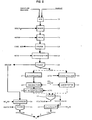
- the residue is treated in the present invention in a series of steps which are depicted in Figure 2.
- the solid molybdenum-impregnated residue is intimately mixed with solid alkali in stage 11.
- alkali is meant an oxide, hydroxide, or carbonate of an alkali metal and advantageously of sodium or potassium.
- Most preferred reagents are sodium oxide, sodium hydroxide, and sodium carbonate, as these reagents are relatively plentiful and inexpensive.
- the residue and the alkali should be brought to a particle size, e.g. 100 mesh or finer, that permits intimate reactive contact between the reagents in the subsequent roasting step.
- the solid reagents are advantageously mixed by feeding the residue and the alkali to a mill such as a hammer mill, where the materials can be simultaneously pulverized and commingled.
- the residue can be milled and then slurried in an aqueous solution of the alkali reagent; this alternative provides satisfactory contact between the alkali and the residue, but requires increased energy input into the roasting step to evaporate water.
- the residue is fed to this stage as an aqueous slurry, it is advantageous to centrifuge the slurry to lower its water content prior to feeding the residue to the hammer mill, to improve the efficiency of mixing and milling.
- the amount of alkali mixed with the residue should be equivalent to about 6 to about 10 times, the stoichiometric amount required for conversion of the Mo in the residue to water-soluble molybdate form, such as Na 2 Moo 4 .
- the mixture of resiude and alkali is next subjected in stage 12 to a roast under conditions that are oxidizing as to the molybdenum, to convert the molybdenum in the residue to water-soluble molybdate.
- Roasting is advantageously carried out in the presence of air or oxygen, at a high enough temperature and for sufficient time to achieve essentially complete oxidation of the molybdenum.
- the roasting temperature and time should not; be so high or prolonged that volatilization losses of molybdenum (e.g. as Mo03) occur.
- Roasting temperatures of about 600°C. to about 800°C. and roasting times of up to about one hour, are generally advantageous.
- About 75% to about 95% or more of the Mo in the residue is converted to water-soluble molybdate.
- the roasted material is cooled and then leached in water, in stage 13, to form a leach liquor having dissolved therein molybdenum values together with small amounts of impurities. Insoluble components of the roasted material are filtered from the leach liquor at stage 14 and discarded.
- the leach liquor contains at least about 75%; and advantageously at least about 95%, of the Mo that had been entrapped in the residue.
- the pH of the leach liquor is above about 10.5.
- the molybdenum-bearing liquor is boiled to increase the concentration of molybdenum in the liquor.
- Concentrating the molybdenum increases the recovery of molybdenum in the final precipitation step (stages 19 or 21 described below); the residual concentration of molybdenum remaining in solution after that step is essentially independent of the concentration of molybdenum in the liquor, so the amount of molybdenum which is not recovered in the precipitated product increases as the volume of the liquor increases. Accordingly, the amount of molybdenum that is precipitated from the liquor increases with increasing concentration of molybdenum in the liquor.
- the leach liquor is next treated, in stage 15, to lower the pH of the liquor sufficiently to form a precipitate which contains impurities and a minor portion of the molybdenum values.
- This precipitate is filtered from the leach liquor, in stage 16, and saved. It can be treated to separate impurities from the molybdenum values and thereby upgrade the molybdenum values, for instance in stages 24 and 25 discussed below.
- the pH of the leach liquor is lowered by adding acid to the liquor.
- the value to which the pH of the liquor is lowered varies with the composition of the residue and with the acid used to form the precipitate.
- the pH of the liquor is adjusted to a value of about 6 to about 10.5, dependent upon the acid which is used.
- Acidification can typically be carried out by adding sufficient sulfuric acid to adjust the pH of the liquor to a value between about 9 and about 10.5.
- Nitric acid can be used instead, in which case the pH of the liquor is typically brought to a value between about 6 and about 7.
- the precipitate contains considerable impurities, and a minor portion of the molybdenum values from the leach liquor.
- the liquor is then filtered in stage 16 to separate the precipitate and recover a purified leach liquor.
- the filtered purified leach liquor from stage 16 is next acidified and ammoniated to precipitate therefrom a solid ammonium polymolybdate complex which can be filtered from the liquor and then redissolved in fresh aqueous ammonium hydroxide.
- a solution can thereby be provided that can be readily applied to coal to supply catalytically effective amounts of molybdenum.
- FIG. 2 Two embodiments of the treatment of the filtered purified leach liquor are depicted in Figure 2 and described herein.
- the liquor from stage 16 is acidified in stage 17 with sufficient acid so that, on subsequent ammoniation of the liquor, a molar ratio of NH 3 :Mo of about 1:1 to about 2.5:1 can be established in solution in the liquor.
- the pH value of the leach liquor should be lowered enough to permit the desired quantity of ammonia to be dissolved in the liquor.
- the pH value should be below about 4, but a pH value of about 1 to about 2.5 is generally satisfactory.
- Acidification can be carried out by the addition of a suitable amount of sulfuric acid or nitric acid.
- the leach liquor is ammoniated in stage 18 to establish in solution in the leach liquor a molar ratio of NH 3 :Mo of about 1:1 to about 2.5:1, and advantageously about 2:1.
- the leach liquor can be ammoniated by suitable additions of NH 3 or NH 4 0H.
- the leach liquor is re-acidified in stage 19, to precipitate an ammonium-polymolybdate complex.
- sulfuric acid or nitric acid can be used.
- the precipitation occurs more rapidly and with higher yield at temperatures above room temperature, i.e. at about 60°C. up to the boiling point of the liquor.
- the pH of the liquor reaches a pH value of about 0.5 to about 3.0.
- the filtered purified leach liquor from stage 16 can be acidified in stage 20 to a pH lower than that reached in acidification stage 17.
- the pH value of the liquor is lowered to a point such that on subsequent ammoniation of the liquor in stage 21 an ammonium-polymolybdate complex precipitates as the ammoniating agent is added and without further acidification of the liquor.
- the liquor should be acidified to lower the pH value to about 1, or lower. Sulfuric acid or nitric acid can be used for the acidification.
- the acidified liquor from stage 20 is then ammoniated, in stage 21, by suitable additions of NH 3 or NH 4 0H. Ammoniation causes the desired ammonium-polymolybdate complex to precipitate without need for re-acidification of the liquor.
- the ammonium-polymolybdate complex which precipitates from the liquor in step 19 or step 21 is recovered by filtration from the liquor in stage 22.
- the precipitate is believed to comprise a complex of one or more condensed ammonium polymolybdates. It contains at least about 75% and advantageously at least about 95% of the Mo fed in the untreated residue to stage 11.
- the precipitate can be treated by a variety of known methods (such as reduction or roasting) to recover the molybdenum as Mo metal or as Mo03.
- the filtrate will typically contain less than about 1 gpl Mo.
- the ammonium-polymolybdate complex is characterized in that it can be rapidly and easily precipitated from the leach liquor as described heretofore, yet goes readily and completely into solution in fresh excess aqueous ammonium hydroxide.
- the ammonium-polymolybdate complex contains at most only relatively insignificant amounts of impurities.
- a catalyst preparation suitable for use in coal liquefaction can be prepared from the precipitated ammonium - polymolybdate complex recovered from stage 22 as described herein, by dissolving the complex in aqueous ammonium hydroxide in stage 23.
- the relative amounts of NH 4 0H and the ammonium-polymolybdate complex are chosen to provide a solution containing molybdenum in a concentration such that the solution can be easily applied to coal, providing a catalytically effective amount of molybdenum, while avoiding the application of excess amounts of liquid or of molybdenum to the coal.
- the solution should thus contain about 5% to about 15% Mo by weight, and have a molar ratio of NH 3 :Mo dissolved therein of about 1:1 to about 3:1.
- the overall recovery of molybdenum in the process of the present invention is further enhanced by recovering and recycling molybdenum from the solid precipitate that is recovered at stage 16.
- the precipitate from stage 16 is contacted at stage 24 with an effective amount of aqueous ammonium hydroxide to dissolve the molybdenum values from the precipitate.
- the amount of ammonium hydroxide is chosen to maximize dissolution of molybdenum values while minimizing dissolution of the associated impurities.
- the resultant solution should contain about 5% to about 15% Mo by weight, and should have a molar ratio of NH 3 :Mo of about 1:1 to about 3:1.
- This solution is filtered at stage 25 to remove undissolved solids.
- the solution can be treated by known techniques (e.g. crystallization, evaporation, or roasting) to recover the molybdenum values contained therein, as for example MoO 3 or Mo metal.
- the solutions recovered in stages 23 and 25 can advantageously be conveyed, separately or mixed together, as stream 3 to coal impregnation stage 4 (see Figure 1).
- stage 4 the molybdate solutions can be diluted, if necessary, and sprayed or otherwise applied to coal in catalytically effective amounts before the coal is fed to the hydrogenation reactor.
- the molybdenum catalyzes the coal liquefaction in the sense that the hydrocarbon reaction products are higher in grade than the reaction products that are produced by liquefaction of coal in the absence of catalytically effective amounts of molybdenum.
- a simulated Mo-impregnated coal liquefaction residue was prepared by physically mixing Mo metal powder with coal ash from the gasifier stage of an actual coal liquefaction plant.
- the Mo was a -325 mesh powder, and the coal ash had been hammer milled to a fine powder.
- the mixture was placed in an iron boat and then heated in a furnace under hydrogen to 1300°C. The mixture softened, and the ash particles fused together and encapsulated the Mo particles in a dense mass. Scanning electron micrographs of this mass showed that the Mo was uniformly distributed in the ash.
- the ash contained 7.75% Mo by weight.
- the Mo-ash mixture was then ground and screened to -325 mesh, and mixed with sufficient NaOH (-100 mesh) to provide 10 times the stoichiometric amount of NaOH required to convert the Mo to Na 2 Mo0 4 .
- This mixture was then roasted at 700°C. under oxygen for one hour.
- the roasted product was leached in boiling water for one hour. Unleached solids were filtered from the leach liquor and washed; the wash liquor was then added to the leach liquor.
- the combined solutions were boiled down to produce a 100- ll0 gpl Mo solution. In duplicate tests the extraction of Mo from the Mo-ash mixture into the leach liquor was 92% and 96% respectively.
- the liquor was further acidified with the 1:1 nitric acid to a pH of about 1.0, at which point enough : NH 4 0H was added to provide a NH 3 :Mo molar ratio of 2:1 in solution in the liquor.
- the liquor was then acidified with the 1:1 nitric acid until a precipitate ("Precipitate B") formed, at a pH of about 1.0.
- the slurry of Precipitate B in the liquor was stirred for 60 minutes, following which Precipitate B was filtered, dried at 70°C. and analyzed.
- the Mo in Precipitate B corresponded to a Mo recovery from the aqueous leach liquor of 90.6%, so that the total recovery of Mo from the leach liquor in Precipitates A and B was 98%.
- the liquor was furthur acidified with the 20% sulfuric acid to a pH of about 1.0, at which point enough NH 4 0H was added to provide a NH 3 :Mo molar ratio of 2:1 in solution in the liquor.
- the liquor was then acidified with the 20% sulfuric acid until a precipitate ("Precipitate B") formed, at a pH of about 2.0.
- the slurry of Precipitate B in the liquor was stirred for 120 minutes, following which Precipitate B was filtered, dried at 70°C. and analyzed.
- the Mo in Precipitate B corresponded to a Mo recovery from the aqueous leach liquor of 48.3%.
- the overall Mo recovery from the leach liquor in Precipitates A and B was 78%.
Landscapes
- Chemical & Material Sciences (AREA)
- Engineering & Computer Science (AREA)
- Organic Chemistry (AREA)
- Materials Engineering (AREA)
- Chemical Kinetics & Catalysis (AREA)
- Manufacturing & Machinery (AREA)
- Mechanical Engineering (AREA)
- Metallurgy (AREA)
- Life Sciences & Earth Sciences (AREA)
- Oil, Petroleum & Natural Gas (AREA)
- Environmental & Geological Engineering (AREA)
- General Life Sciences & Earth Sciences (AREA)
- Geology (AREA)
- Wood Science & Technology (AREA)
- General Chemical & Material Sciences (AREA)
- Manufacture And Refinement Of Metals (AREA)
- Catalysts (AREA)
Applications Claiming Priority (2)
| Application Number | Priority Date | Filing Date | Title |
|---|---|---|---|
| US24315781A | 1981-03-18 | 1981-03-18 | |
| US243157 | 1981-03-18 |
Publications (2)
| Publication Number | Publication Date |
|---|---|
| EP0060376A1 true EP0060376A1 (fr) | 1982-09-22 |
| EP0060376B1 EP0060376B1 (fr) | 1984-10-10 |
Family
ID=22917566
Family Applications (1)
| Application Number | Title | Priority Date | Filing Date |
|---|---|---|---|
| EP19820100093 Expired EP0060376B1 (fr) | 1981-03-18 | 1982-01-08 | Procédé de récupération et de recyclage du molybdène à partir de residus de la liquéfaction du charbon |
Country Status (2)
| Country | Link |
|---|---|
| EP (1) | EP0060376B1 (fr) |
| DE (1) | DE3260911D1 (fr) |
Cited By (4)
| Publication number | Priority date | Publication date | Assignee | Title |
|---|---|---|---|---|
| EP0515116A3 (en) * | 1991-05-20 | 1993-03-31 | Texaco Chemical Company | Molybdenum recovery |
| CN108018422A (zh) * | 2017-11-30 | 2018-05-11 | 煤炭科学技术研究院有限公司 | 一种悬浮床或浆态床加氢裂化残渣中金属的回收和应用 |
| CN114427028A (zh) * | 2020-10-29 | 2022-05-03 | 中国石油化工股份有限公司 | 一种金属回收的重油利用方法 |
| CN119735237A (zh) * | 2025-03-05 | 2025-04-01 | 陕西恒昌钼业有限公司 | 一种四钼酸铵及其制备方法 |
Families Citing this family (1)
| Publication number | Priority date | Publication date | Assignee | Title |
|---|---|---|---|---|
| CN106521161A (zh) * | 2016-11-02 | 2017-03-22 | 神华集团有限责任公司 | 一种煤液化萃取残渣中回收钼的方法 |
Citations (12)
| Publication number | Priority date | Publication date | Assignee | Title |
|---|---|---|---|---|
| FR701426A (fr) * | 1929-09-27 | 1931-03-16 | Ig Farbenindustrie Ag | Procédé pour extraire le molybdène de mélanges du molybdène ou de ses composésavec d'autres métaux ou composés métalliques |
| DE660298C (de) * | 1935-04-11 | 1938-05-25 | I G Farbenindustrie Akt Ges | Verfahren zum Aufarbeiten von Kohlenstoff und Molybdaen oder Wolfram enthaltenden Rueckstaenden |
| DE679371C (de) * | 1937-01-12 | 1939-08-03 | I G Farbenindustrie Akt Ges | Verfahren zur Vorbereitung von Druckhydrierungsrueckstaenden fuer die Verhuettung auf Eisen |
| US2191794A (en) * | 1936-06-27 | 1940-02-27 | Ig Farbenindustrie Ag | Recovery of molybdenum |
| US3622301A (en) * | 1970-01-09 | 1971-11-23 | Sherritt Gordon Mines Ltd | Treatment of nickel containing material to remove molybdenum |
| US3763303A (en) * | 1971-12-13 | 1973-10-02 | American Metal Climax Inc | Recovery of molybdenum from spent catalyst |
| US3829550A (en) * | 1972-09-25 | 1974-08-13 | American Metal Climax Inc | Process for making high purity molybdenum oxide and ammonium molybdate |
| US3848049A (en) * | 1972-01-27 | 1974-11-12 | American Metal Climax Inc | Process for producing high purity molybdenum oxide and ammonium molybdate |
| US4075278A (en) * | 1977-11-22 | 1978-02-21 | Metaux Speciaux S.A. | Process for recovering molybdenum values from spent catalysts |
| US4075277A (en) * | 1976-02-05 | 1978-02-21 | Metaux Speciaux S.A. | Process for recovering molybdenum values from spent catalysts |
| US4079116A (en) * | 1976-12-27 | 1978-03-14 | Amax Inc. | Process for producing ammonium heptamolybdate and/or ammonium dimolybdate |
| US4087510A (en) * | 1974-12-19 | 1978-05-02 | Akzona Incorporated | Process for extracting metals from spent desulphurization catalysts |
-
1982
- 1982-01-08 EP EP19820100093 patent/EP0060376B1/fr not_active Expired
- 1982-01-08 DE DE8282100093T patent/DE3260911D1/de not_active Expired
Patent Citations (12)
| Publication number | Priority date | Publication date | Assignee | Title |
|---|---|---|---|---|
| FR701426A (fr) * | 1929-09-27 | 1931-03-16 | Ig Farbenindustrie Ag | Procédé pour extraire le molybdène de mélanges du molybdène ou de ses composésavec d'autres métaux ou composés métalliques |
| DE660298C (de) * | 1935-04-11 | 1938-05-25 | I G Farbenindustrie Akt Ges | Verfahren zum Aufarbeiten von Kohlenstoff und Molybdaen oder Wolfram enthaltenden Rueckstaenden |
| US2191794A (en) * | 1936-06-27 | 1940-02-27 | Ig Farbenindustrie Ag | Recovery of molybdenum |
| DE679371C (de) * | 1937-01-12 | 1939-08-03 | I G Farbenindustrie Akt Ges | Verfahren zur Vorbereitung von Druckhydrierungsrueckstaenden fuer die Verhuettung auf Eisen |
| US3622301A (en) * | 1970-01-09 | 1971-11-23 | Sherritt Gordon Mines Ltd | Treatment of nickel containing material to remove molybdenum |
| US3763303A (en) * | 1971-12-13 | 1973-10-02 | American Metal Climax Inc | Recovery of molybdenum from spent catalyst |
| US3848049A (en) * | 1972-01-27 | 1974-11-12 | American Metal Climax Inc | Process for producing high purity molybdenum oxide and ammonium molybdate |
| US3829550A (en) * | 1972-09-25 | 1974-08-13 | American Metal Climax Inc | Process for making high purity molybdenum oxide and ammonium molybdate |
| US4087510A (en) * | 1974-12-19 | 1978-05-02 | Akzona Incorporated | Process for extracting metals from spent desulphurization catalysts |
| US4075277A (en) * | 1976-02-05 | 1978-02-21 | Metaux Speciaux S.A. | Process for recovering molybdenum values from spent catalysts |
| US4079116A (en) * | 1976-12-27 | 1978-03-14 | Amax Inc. | Process for producing ammonium heptamolybdate and/or ammonium dimolybdate |
| US4075278A (en) * | 1977-11-22 | 1978-02-21 | Metaux Speciaux S.A. | Process for recovering molybdenum values from spent catalysts |
Cited By (5)
| Publication number | Priority date | Publication date | Assignee | Title |
|---|---|---|---|---|
| EP0515116A3 (en) * | 1991-05-20 | 1993-03-31 | Texaco Chemical Company | Molybdenum recovery |
| CN108018422A (zh) * | 2017-11-30 | 2018-05-11 | 煤炭科学技术研究院有限公司 | 一种悬浮床或浆态床加氢裂化残渣中金属的回收和应用 |
| CN108018422B (zh) * | 2017-11-30 | 2019-07-23 | 煤炭科学技术研究院有限公司 | 一种悬浮床或浆态床加氢裂化残渣中金属的回收和应用 |
| CN114427028A (zh) * | 2020-10-29 | 2022-05-03 | 中国石油化工股份有限公司 | 一种金属回收的重油利用方法 |
| CN119735237A (zh) * | 2025-03-05 | 2025-04-01 | 陕西恒昌钼业有限公司 | 一种四钼酸铵及其制备方法 |
Also Published As
| Publication number | Publication date |
|---|---|
| EP0060376B1 (fr) | 1984-10-10 |
| DE3260911D1 (en) | 1984-11-15 |
Similar Documents
| Publication | Publication Date | Title |
|---|---|---|
| US4374100A (en) | Recovery and recycle of molybdenum values from coal liquefaction residue | |
| US9273377B2 (en) | Method of metals recovery from refinery residues | |
| US4443415A (en) | Recovery of V2 O5 and nickel values from petroleum coke | |
| EP0241149B1 (fr) | Récupération des constituants de catalyseurs usés à base d'alumine | |
| KR100615773B1 (ko) | 소모된 촉매로부터 알칼리 침출에 의한 몰리브덴 및바나듐 금속의 회수방법 | |
| US4670229A (en) | Cyclic process for recovering metal values and alumina from spent catalysts | |
| US5094991A (en) | Slurry catalyst for hydroprocessing heavy and refractory oils | |
| US4927794A (en) | Leaching cobalt, molybdenum, nickel, and vanadium from spent hydroprocessing catalysts | |
| US20100199807A1 (en) | Recovering metals from complex metal sulfides | |
| US4786323A (en) | Process for the recovery of noble metals from ore-concentrates | |
| EP0658215A4 (fr) | Extraction ou recuperation de metaux presentant une valeur marchande. | |
| US4029498A (en) | Process for treating manganese nodules | |
| US4437974A (en) | Coal liquefaction process | |
| US4420464A (en) | Recovery of vanadium from carbonaceous materials | |
| US4524049A (en) | Process for concurrent steam generation and metal recovery | |
| EP0060376B1 (fr) | Procédé de récupération et de recyclage du molybdène à partir de residus de la liquéfaction du charbon | |
| US4474735A (en) | Process for the recovery of valuable metals from spent crude-oil sulfur-extraction catalysts | |
| US4384885A (en) | Process for the recovery of metals from catalysts | |
| US5814292A (en) | Comprehensive energy producing methods for aqueous phase oxidation | |
| GB2161465A (en) | Obtaining aqueous solution from insoluble metal oxide | |
| US4061711A (en) | Recovery of vanadium values | |
| DE2802825A1 (de) | Verfahren zur rueckgewinnung von alkalimetallverbindungen zur wiederverwendung in katalytischen kohleumwandlungsprozessen | |
| US4080421A (en) | Process for preparing ammonium tungstates | |
| US3000696A (en) | Process for recovery of uranium from fossil fuels | |
| US4255397A (en) | Process for removing tungsten from cemented tungsten carbide |
Legal Events
| Date | Code | Title | Description |
|---|---|---|---|
| PUAI | Public reference made under article 153(3) epc to a published international application that has entered the european phase |
Free format text: ORIGINAL CODE: 0009012 |
|
| AK | Designated contracting states |
Designated state(s): DE FR GB NL |
|
| 17P | Request for examination filed |
Effective date: 19821029 |
|
| GRAA | (expected) grant |
Free format text: ORIGINAL CODE: 0009210 |
|
| AK | Designated contracting states |
Designated state(s): DE FR GB NL |
|
| REF | Corresponds to: |
Ref document number: 3260911 Country of ref document: DE Date of ref document: 19841115 |
|
| PGFP | Annual fee paid to national office [announced via postgrant information from national office to epo] |
Ref country code: DE Payment date: 19850109 Year of fee payment: 4 |
|
| PGFP | Annual fee paid to national office [announced via postgrant information from national office to epo] |
Ref country code: NL Payment date: 19850131 Year of fee payment: 4 |
|
| PLBE | No opposition filed within time limit |
Free format text: ORIGINAL CODE: 0009261 |
|
| STAA | Information on the status of an ep patent application or granted ep patent |
Free format text: STATUS: NO OPPOSITION FILED WITHIN TIME LIMIT |
|
| EN | Fr: translation not filed | ||
| 26N | No opposition filed | ||
| PG25 | Lapsed in a contracting state [announced via postgrant information from national office to epo] |
Ref country code: NL Effective date: 19860801 |
|
| GBPC | Gb: european patent ceased through non-payment of renewal fee | ||
| NLV4 | Nl: lapsed or anulled due to non-payment of the annual fee | ||
| PG25 | Lapsed in a contracting state [announced via postgrant information from national office to epo] |
Ref country code: DE Effective date: 19861001 |
|
| ET | Fr: translation filed | ||
| REG | Reference to a national code |
Ref country code: FR Ref legal event code: BR |
|
| PG25 | Lapsed in a contracting state [announced via postgrant information from national office to epo] |
Ref country code: FR Free format text: LAPSE BECAUSE OF NON-PAYMENT OF DUE FEES Effective date: 19870731 |
|
| REG | Reference to a national code |
Ref country code: FR Ref legal event code: ST |
|
| PG25 | Lapsed in a contracting state [announced via postgrant information from national office to epo] |
Ref country code: GB Effective date: 19881121 |