EP0060671A2 - Verfahren zur Herstellung eines Mehrschichtkunststoffbandes mit mehreren eingebetteten Metalldrähten - Google Patents
Verfahren zur Herstellung eines Mehrschichtkunststoffbandes mit mehreren eingebetteten Metalldrähten Download PDFInfo
- Publication number
- EP0060671A2 EP0060671A2 EP82301198A EP82301198A EP0060671A2 EP 0060671 A2 EP0060671 A2 EP 0060671A2 EP 82301198 A EP82301198 A EP 82301198A EP 82301198 A EP82301198 A EP 82301198A EP 0060671 A2 EP0060671 A2 EP 0060671A2
- Authority
- EP
- European Patent Office
- Prior art keywords
- laminate tape
- metal wires
- precursory
- heated
- heat
- Prior art date
- Legal status (The legal status is an assumption and is not a legal conclusion. Google has not performed a legal analysis and makes no representation as to the accuracy of the status listed.)
- Withdrawn
Links
Images

Classifications
-
- B—PERFORMING OPERATIONS; TRANSPORTING
- B32—LAYERED PRODUCTS
- B32B—LAYERED PRODUCTS, i.e. PRODUCTS BUILT-UP OF STRATA OF FLAT OR NON-FLAT, e.g. CELLULAR OR HONEYCOMB, FORM
- B32B15/00—Layered products comprising a layer of metal
- B32B15/04—Layered products comprising a layer of metal comprising metal as the main or only constituent of a layer, which is next to another layer of the same or of a different material
- B32B15/08—Layered products comprising a layer of metal comprising metal as the main or only constituent of a layer, which is next to another layer of the same or of a different material of synthetic resin
-
- B—PERFORMING OPERATIONS; TRANSPORTING
- B29—WORKING OF PLASTICS; WORKING OF SUBSTANCES IN A PLASTIC STATE IN GENERAL
- B29C—SHAPING OR JOINING OF PLASTICS; SHAPING OF MATERIAL IN A PLASTIC STATE, NOT OTHERWISE PROVIDED FOR; AFTER-TREATMENT OF THE SHAPED PRODUCTS, e.g. REPAIRING
- B29C70/00—Shaping composites, i.e. plastics material comprising reinforcements, fillers or preformed parts, e.g. inserts
- B29C70/68—Shaping composites, i.e. plastics material comprising reinforcements, fillers or preformed parts, e.g. inserts by incorporating or moulding on preformed parts, e.g. inserts or layers, e.g. foam blocks
- B29C70/685—Shaping composites, i.e. plastics material comprising reinforcements, fillers or preformed parts, e.g. inserts by incorporating or moulding on preformed parts, e.g. inserts or layers, e.g. foam blocks by laminating inserts between two plastic films or plates
- B29C70/687—Shaping composites, i.e. plastics material comprising reinforcements, fillers or preformed parts, e.g. inserts by incorporating or moulding on preformed parts, e.g. inserts or layers, e.g. foam blocks by laminating inserts between two plastic films or plates the inserts being oriented, e.g. nets or meshes
-
- B—PERFORMING OPERATIONS; TRANSPORTING
- B32—LAYERED PRODUCTS
- B32B—LAYERED PRODUCTS, i.e. PRODUCTS BUILT-UP OF STRATA OF FLAT OR NON-FLAT, e.g. CELLULAR OR HONEYCOMB, FORM
- B32B15/00—Layered products comprising a layer of metal
- B32B15/02—Layer formed of wires, e.g. mesh
-
- B—PERFORMING OPERATIONS; TRANSPORTING
- B32—LAYERED PRODUCTS
- B32B—LAYERED PRODUCTS, i.e. PRODUCTS BUILT-UP OF STRATA OF FLAT OR NON-FLAT, e.g. CELLULAR OR HONEYCOMB, FORM
- B32B3/00—Layered products comprising a layer with external or internal discontinuities or unevennesses, or a layer of non-planar shape; Layered products comprising a layer having particular features of form
- B32B3/10—Layered products comprising a layer with external or internal discontinuities or unevennesses, or a layer of non-planar shape; Layered products comprising a layer having particular features of form characterised by a discontinuous layer, i.e. formed of separate pieces of material
- B32B3/18—Layered products comprising a layer with external or internal discontinuities or unevennesses, or a layer of non-planar shape; Layered products comprising a layer having particular features of form characterised by a discontinuous layer, i.e. formed of separate pieces of material characterised by an internal layer formed of separate pieces of material which are juxtaposed side-by-side
-
- B—PERFORMING OPERATIONS; TRANSPORTING
- B32—LAYERED PRODUCTS
- B32B—LAYERED PRODUCTS, i.e. PRODUCTS BUILT-UP OF STRATA OF FLAT OR NON-FLAT, e.g. CELLULAR OR HONEYCOMB, FORM
- B32B37/00—Methods or apparatus for laminating, e.g. by curing or by ultrasonic bonding
- B32B37/14—Methods or apparatus for laminating, e.g. by curing or by ultrasonic bonding characterised by the properties of the layers
- B32B37/16—Methods or apparatus for laminating, e.g. by curing or by ultrasonic bonding characterised by the properties of the layers with all layers existing as coherent layers before laminating
- B32B37/20—Methods or apparatus for laminating, e.g. by curing or by ultrasonic bonding characterised by the properties of the layers with all layers existing as coherent layers before laminating involving the assembly of continuous webs only
- B32B37/203—One or more of the layers being plastic
-
- B—PERFORMING OPERATIONS; TRANSPORTING
- B32—LAYERED PRODUCTS
- B32B—LAYERED PRODUCTS, i.e. PRODUCTS BUILT-UP OF STRATA OF FLAT OR NON-FLAT, e.g. CELLULAR OR HONEYCOMB, FORM
- B32B38/00—Ancillary operations in connection with laminating processes
- B32B38/0036—Heat treatment
-
- H—ELECTRICITY
- H01—ELECTRIC ELEMENTS
- H01B—CABLES; CONDUCTORS; INSULATORS; SELECTION OF MATERIALS FOR THEIR CONDUCTIVE, INSULATING OR DIELECTRIC PROPERTIES
- H01B7/00—Insulated conductors or cables characterised by their form
- H01B7/08—Flat or ribbon cables
- H01B7/0838—Parallel wires, sandwiched between two insulating layers
-
- H—ELECTRICITY
- H05—ELECTRIC TECHNIQUES NOT OTHERWISE PROVIDED FOR
- H05B—ELECTRIC HEATING; ELECTRIC LIGHT SOURCES NOT OTHERWISE PROVIDED FOR; CIRCUIT ARRANGEMENTS FOR ELECTRIC LIGHT SOURCES, IN GENERAL
- H05B3/00—Ohmic-resistance heating
- H05B3/40—Heating elements having the shape of rods or tubes
- H05B3/54—Heating elements having the shape of rods or tubes flexible
- H05B3/56—Heating cables
-
- B—PERFORMING OPERATIONS; TRANSPORTING
- B32—LAYERED PRODUCTS
- B32B—LAYERED PRODUCTS, i.e. PRODUCTS BUILT-UP OF STRATA OF FLAT OR NON-FLAT, e.g. CELLULAR OR HONEYCOMB, FORM
- B32B2305/00—Condition, form or state of the layers or laminate
- B32B2305/08—Reinforcements
-
- B—PERFORMING OPERATIONS; TRANSPORTING
- B32—LAYERED PRODUCTS
- B32B—LAYERED PRODUCTS, i.e. PRODUCTS BUILT-UP OF STRATA OF FLAT OR NON-FLAT, e.g. CELLULAR OR HONEYCOMB, FORM
- B32B2305/00—Condition, form or state of the layers or laminate
- B32B2305/72—Cured, e.g. vulcanised, cross-linked
-
- B—PERFORMING OPERATIONS; TRANSPORTING
- B32—LAYERED PRODUCTS
- B32B—LAYERED PRODUCTS, i.e. PRODUCTS BUILT-UP OF STRATA OF FLAT OR NON-FLAT, e.g. CELLULAR OR HONEYCOMB, FORM
- B32B2307/00—Properties of the layers or laminate
- B32B2307/30—Properties of the layers or laminate having particular thermal properties
- B32B2307/31—Heat sealable
-
- Y—GENERAL TAGGING OF NEW TECHNOLOGICAL DEVELOPMENTS; GENERAL TAGGING OF CROSS-SECTIONAL TECHNOLOGIES SPANNING OVER SEVERAL SECTIONS OF THE IPC; TECHNICAL SUBJECTS COVERED BY FORMER USPC CROSS-REFERENCE ART COLLECTIONS [XRACs] AND DIGESTS
- Y10—TECHNICAL SUBJECTS COVERED BY FORMER USPC
- Y10T—TECHNICAL SUBJECTS COVERED BY FORMER US CLASSIFICATION
- Y10T156/00—Adhesive bonding and miscellaneous chemical manufacture
- Y10T156/17—Surface bonding means and/or assemblymeans with work feeding or handling means
- Y10T156/1702—For plural parts or plural areas of single part
- Y10T156/1712—Indefinite or running length work
- Y10T156/1741—Progressive continuous bonding press [e.g., roll couples]
Definitions
- the present invention relates to a process for continuously producing a polymeric laminate tape having a plurality of metal wires embedded therein. More particularly, the present invention relates to a process for continuously producing a polymeric laminate'tape in which a pair of primary polymeric tapes are bonded face to face and a plurality of metal wires are inserted between the primary polymeric tapes and extend in parallel to each other along the longitudinal axes of the primary tapes.
- thermoplastic electro-insulating polymeric matrix and a plurality of metal wires, which are capable of generating heat when an electric current is applied thereto and which are embedded within the matrix, is useful as a heating element.
- This type of heating element is useful for forming a large area of heat source and, therefore, is beneficially built in a heating device having a large surface area, such as a heating board or a heating carpet.
- thermoplastic electro-insulating polymer is melted in an extruder and is extruded through a crosshead die of the extruder to form'a tape-shaped stream of the melted polymer, while a plurality of the metal wires are fed through the crosshead die into the tape-shaped stream of the melted polymer to provide a composite stream, and the composite stream is cooled to form a solidified composite tape.
- the crosslinking procedure is carried out by applying electron beams to the polymer matrix under a high voltage. This procedure is extremely dangerous for workers due to the high electroconductivity of the metal wires. Also, the crosslinking effect cannot be attained at portions of the polymer matrix which are obstructed by the metal wires from the electron beams. And since the non-cross- linked portions of the polymer matrix exhibit a poor heat resistance, the resultant products are sometimes useless.
- An object of the present invention is to provide a process for continuously producing a polymeric laminate tape having a plurality of metal wires embedded therewithin,. it being unnecessary for the resultant laminate tape to be subjected to a crosslinking procedure for the polymer matrix thereof.
- Another object of the present invention is to provide a process for continuously producing a polymeric laminate tape having a plurality of metal wires embedded therewithin, in which process a polymer matrix for containing the metal wires is formed from two primary polymer tapes without difficulty.
- Still another object of the present invention is to provide a process for continuously producing a polymeric laminate tape having a plurality of metal wires embedded therewithin, in which process air bubbles formed around the metal wires can be easily removed.
- a further object of the present invention is to provide a process for continuously producing a polymeric laminate tape having a plurality of metal wires embedded therewithin, in which process the metal wires can be located in accordance with a predetermined arrangement exactly in the middle layer portion of the polymer matrix of the laminate tape.
- the pressing procedure is followed by a cooling procedure for the resultant laminate tape.
- the process of the-present invention is effective for continuously producing a polymeric laminate tape having a plurality of metal wires embedded therewithin.
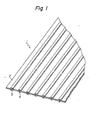
- a polymeric laminate tape 1 is composed of a polymeric matrix 2 and a plurality of metal wires 3 embedded within the polymeric matrix 2.
- the metal wires 3 extend in parallel to each other along the longitudinal axis of the polymeric matrix 2 in the form of a tape at predetermined intervals which are usually equal to each other.
- the polymeric laminate tape of the present invention is free from air bubbles formed within the polymeric matrix..Also, the metal wires are located in accordance with the predetermined arrangement within the polymeric matrix.
- the polymeric matrix in the laminate tape is formed by heat-bonding two primary tapes, comprising an electro-insulating thermoplastic polymer which has been previously cross-linked, to each other.
- the primary tapes have an excellent heat--resistance and do not exhibit fluidity at the temperature at which the primary tapes are softened and heat-bonded to each other. Therefore, the change in thickness of the primary tapes is small when the primary tapes are heated to the heat-bonding temperature and are pressed together with the metal wires.
- the thicknesses of the polymeric matrix layers 4 surrounding the metal wires 3 ⁇ are substantially equal to each other. Also, the metal wires are located just between the primary tapes heat-bonded together and are never exposed to the outside of the polymeric matrix 2.
- the primary tapes usable for the process of the present invention may comprise at least one thermoplastic polymer selected from the group consisting of polyethylene, pol- propylene, ethylene-vinyl acetate copolymers, polyvinyl chloride, polyamides, for example, nylon 6, nylon 66, and nylon 12, and polyesters, for example, polyethylene terephthalate, the polymer-having been cross-linked previously by means of actinic rays, for example, electron beams, or by means of a chemical cross-linking agent, for example, peroxide compounds.
- the cross-linking procedure for the thermoplastic polymer is carried out preferably to the extent that,the resultant cross-linked thermoplastic polymer contains 20 to 90%, more preferably 30 to 80%, of a gel fraction thereof.
- the percent gel fraction is determined in the following manner. A cross-linked polymer in an amount of 0.15 g is extracted in 30 ml of xylene at a temperature of 120°C for 24 hours and the extraction residue is dried at a temperature of 80°C for 16 hours and then weighed. The percent gel fraction is represented by a ratio in % of the weight of the dried extraction residue to the original weight of the cross-linked polymer used.
- the cross-linked polymer exhibits an enhanced heat resistance. Therefore, the primary tapes usable for the process of the present invention do not melt and exhibit an excellent dimensional stability at the heat-bonding temperature.
- Preferable primary tapes for the present invention comprise a polyolefin type polymer such as polyethylene, polypropylene, or an ethylene-vinyl acetate copolymer cross-linked by means of electron beams and containing 30 to 80, more preferably 35 to 70%, of a gel fraction thereof and have a thickness of from 30 to 300 microns.
- a polyolefin type polymer such as polyethylene, polypropylene, or an ethylene-vinyl acetate copolymer cross-linked by means of electron beams and containing 30 to 80, more preferably 35 to 70%, of a gel fraction thereof and have a thickness of from 30 to 300 microns.
- the metal wires usable for the process of the present invention may be selected from electro-conductive metal wires which are flexible and capable of generating heat when an electric current is applied thereto.
- the metal wires may consist of copper, a copper-based alloy, or a nickel-chromium alloy and be composed of a single thin thread or two or more threads twisted together.
- the shape of the cross-sectional profile and the thickness of the metal wires are not limited to the above-mentioned shape and thickness.
- the metal wires preferably have a round, elliptical, or flat cross-sectional profile with the largest axis being from 0.01 to 1.0 mm, more preferably from 0.05 to 0.6 mm.
- the metal wires are regulated to a predetermined arrangement.
- a pair of wire--regulating rolls may be used. Either one of or both of the rolls have a plurality of grooves formed on the peripheral surfaces thereof and spaced from each other at predetermined intervals.
- the metal wires When introduced into the grooves, the metal wires are regulated under tension so as to be spaced from each other at predetermined intervals.
- the regulated metal wires are fed in parallel to each other between the primary tapes to be superimposed.
- the arrangement of the metal wires may be effected by using a comb-shaped regulating device having a plurality of gaps spaced from each other at predetermined intervals.
- the metal wires are regulated to the predetermined arrangement while passing through the gaps in the comb-shaped regulating device.
- the metal wires are arranged in parallel to each other at intervals of from 0.3 to 5 cm, preferably from 0.5 to 2 cm.
- the precursory laminate tape is composed of the primary tapes superimposed side by side along the longitudinal axes thereof and the metal wires embedded between the primary tapes along the longitudinal axes thereof.
- the heating procedure is not limited to a special heating method as long as the heating operation can be carried out continuously.
- the heating procedure may be carried out in such a manner that a surface of the precursory laminate tape is brought into contact with at least one heating drum rotating at the same peripheral speed as the feeding speed of the precursory laminate tape so as to heat the precursory laminate tape to'a predetermined temperature, and heat is irradiated from a heat radiator facing the other surface of the precursory laminate tape toward the other surface.
- the heat radiator may be replaced by a hot-air blower.
- the precursory laminate tape is conveyed on the peripheral surface of the heating drum. This procedure is effective for preventing undesirable movement of the metal wires interposed between the primary tapes.
- the heating procedure can be completed by using only one heating drum and heat radiator.
- the above-mentioned heating procedure may be repeated two or more times in such a manner that the surface of the precursory laminate tape which has been heated by the heat radiator in the previous heating procedure is heated by the heating drum and the other surface of the precursory laminate tape which has been heated by the heating drum is heated by the heat radiator.
- the heating drum preferably has a peripheral surface layer thereof which is capable of easily separating the heated precursory laminate tape therefrom.
- the surface layer is preferably coated with a separating agent, for example, a silicone rubber, or polytetrafluoroethylene.
- the heating drum may be heated by flowing a heating medium through the inside space thereof or by heat-radiating or hot-air blowing the peripheral surface of the heating drum.
- the heated primary tapes in the precursory laminate tape exhibit a high plasticity sufficient for bonding together at the above-specified temperature under pressure.
- the heated precursory laminate tape is subjected to a pressing procedure by using a pair of pressing rolls so as to heat-bond the primary tapes together and to provide a polymeric matrix in which the metal wires are embedded, while eliminating air bubbles formed around the metal wires.
- the pressing rolls have peripheral surface layers thereof which are elastic, particularly rubber-like elastic. That is, it is preferable that the peripheral surface layers of the pressing rolls have a Shore A hardness of from 20 to 70, more preferably from 40 to 60, determined in accordance with ASTM D 1525.
- the peripheral surface layers are made from an elastic rubber material preferably having a high heat-resistance, for example, a silicone rubber.
- the precursory laminate tape is pressed usually at a pressure of from 0.5 to. 15 kg/cm, more preferably from 2 to 10 kg/cm.
- the pressing rolls may serve as cooling rolls for the resultant laminate tape.
- the pressing rolls may be cooled by flowing a cooling medium through the inside spaces of the rolls.
- the cooling effect of the pressing rolls may be small as long as the cooled laminate tape can be easily separated from the peripheral surfaces of the pressing rolls.
- the resultant laminate tape is, optionally, subjected to a cooling precedure.
- the cooling procedure can be carried out by means of any conventional method as long as the laminate tape can be cooled to a desired temperature, usually to room temperature (about 25"C).
- the cooling procedure may be carried out, for example, by bringing the laminate-tape into contact with one or more cooling drums which are cooled by flowing a cooling medium, such as water, through the inside spaces thereof.
- a cooling medium such as water
- the laminate tape is brought into direct contact with cooling water.
- cooling air is blown toward the laminate tape.
- the cooled laminate tape is usually wound on a core to form a roll. If necessary, the laminate tape may be cut along the longitudinal axis thereof to form two or more narrow tapes. The narrow tapes may be wound separately on a core.
- the primary tapes are pre-heated to approximately the above-mentioned specific temperature.
- the pre-heated primary tapes are superimposed on each other along the longitudinal axes thereof by using a pair of heat-pressing rolls while a plurality of metal wires are interposed between the heated primary tapes.
- the superimposed primary tapes and the interposed metal wires are pressed together at the above--mentioned specific temperature so as to heat bond the primary tapes to each other and to the metal wires, while eliminating air bubbles formed around the metal wires.
- the resultant laminate tape may be cooled to a desired temperature by any conventional cooling method.
- the process of the present invention can be carried out, for example, by using an apparatus as indicated in Fig. 2.
- an upper primary tape 11 comprising an electro-insulating thermoplastic polymer which has been previously cross-linked is fed, under tension, from a roll lla to a superimposing roll 13 through guide rolls 14, 15, and 16.
- a lower primary tape 12 comprising the same polymer as that of the upper primary tape 11 is fed, under tension, from a roll 12a to the superimposing roll 13.
- a plurality.of metal wires 17 are withdrawn from reels -18 and regulated-to a predetermined arrangement thereof by a pair of rolls 19a and 19b.
- the regulated metal wires 17 are fed under tension to the superimposing roll 13 so that they are inserted between the upper primary tape 11 and the lower primary tape 12 and so as to form a precursory laminate tape 20.
- the precursory laminate tape 20 is introduced into a heating apparatus 21.
- the heating apparatus 21 comprises: a first heating drum 22, the peripheral surface of the first heating drum 22 being located close to or contacting the peripheral surface of the superimposing roll 13; a second heating drum 23 located downstream from the first heating drum 22; heat-radiators 24a and 24b each facing the peripheral surface of the first heating drum 22; and heat-radiators 25a and 25b each facing the peripheral surface of the second heating drum 23.
- the first and second heating drums 22 and 23 rotate at the same peripheral speed as the feeding speed of the precursory laminate tape 20.
- the precursory laminate tape 20 is passed in such a manner that the upper surface of the precursory laminate tape 20 is brought into direct contact with the peripheral surface of the first heating drum 22 so as to be heated up to the predetermined temperature, and the slower surface of the precursory laminate tape 20 is heated by a heat radiating from the lower heat-radiator 24a. Thereafter, the precursory laminate tape 20 is withdrawn from the first heating drum 22 and is then introduced o.nto the second heating drum 23. The lower surface of the precursory laminate tape 20 is brought into direct contact with the peripheral surface of the second heating drum 23 so as to be heated up to the predetermined temperature, while the upper surface of the precursory laminate tape 20 is heated to the predetermined temperature by the upper heat--radiator 25a.
- the upper heat-radiator 24b is used to heat the peripheral surface of 'the first heating drum 22 to a desired temperature.
- the lower heat-radiator 25b is used to heat the peripheral surface of the second heating drum 23 to a desired temperature.
- the heated precursory laminate tape 20 is introduced into a pair of pressing rolls 26a and 26b so as to be pressed. During the pressing procedure, the heated upper and lower primary tapes in the precursory laminate tape 20 are heat-bonded to each other so as to form a body of polymer matrix within which the metal wires are embedded. The polymer matrix is firmly bonded to the embedded metal wires, and a polymeric laminate tape 27 is obtained.
- the laminate tape 27 is cooled to a desired temperature, for example, room temperature while contacting the peripheral surfaces of the cooling drums 28 and 29. The cooled laminate tape 27 is wound to form a roll 30.
- the process of the present invention is highly effective for continuously producing, at a high speed, a metal wire-containing polymeric laminate tape which is substantially free from air bubbles formed around the metal wires.
- the metal wires are located in accordance with the predetermined arrangement exactly in the middle layer portion thereof. Therefore, it is unnecessary to subject the resultant laminate tape to a cross-linking procedure which is dangerous for workers due to the electroconductive metal wires embedded therein.
Landscapes
- Chemical & Material Sciences (AREA)
- Engineering & Computer Science (AREA)
- Composite Materials (AREA)
- Mechanical Engineering (AREA)
- Physics & Mathematics (AREA)
- Thermal Sciences (AREA)
- Laminated Bodies (AREA)
- Lining Or Joining Of Plastics Or The Like (AREA)
Applications Claiming Priority (2)
| Application Number | Priority Date | Filing Date | Title |
|---|---|---|---|
| JP34566/81 | 1981-03-12 | ||
| JP56034566A JPS57148621A (en) | 1981-03-12 | 1981-03-12 | Manufacture of metal wire stored tape |
Publications (2)
| Publication Number | Publication Date |
|---|---|
| EP0060671A2 true EP0060671A2 (de) | 1982-09-22 |
| EP0060671A3 EP0060671A3 (de) | 1983-03-16 |
Family
ID=12417861
Family Applications (1)
| Application Number | Title | Priority Date | Filing Date |
|---|---|---|---|
| EP82301198A Withdrawn EP0060671A3 (de) | 1981-03-12 | 1982-03-09 | Verfahren zur Herstellung eines Mehrschichtkunststoffbandes mit mehreren eingebetteten Metalldrähten |
Country Status (4)
| Country | Link |
|---|---|
| US (1) | US4444709A (de) |
| EP (1) | EP0060671A3 (de) |
| JP (1) | JPS57148621A (de) |
| CA (1) | CA1188606A (de) |
Cited By (2)
| Publication number | Priority date | Publication date | Assignee | Title |
|---|---|---|---|---|
| EP0311292A3 (de) * | 1987-09-29 | 1990-04-11 | Su "Kliment Ohridski" | Verfahren zum Schweissen von Amidbindungen enthaltenden polymeren Strukturen |
| EP0675576A1 (de) * | 1994-03-30 | 1995-10-04 | Valeo Electronique | Elektrisches Bandkabel für drehenden Verbinder, insbesondere für Automobil-Fahrzeuge |
Families Citing this family (17)
| Publication number | Priority date | Publication date | Assignee | Title |
|---|---|---|---|---|
| US4538024A (en) * | 1983-07-01 | 1985-08-27 | Amp Incorporated | Flat multiconductor cable extruded on a wheel |
| JP2820346B2 (ja) * | 1992-02-24 | 1998-11-05 | 昭和電線電纜株式会社 | テープ状電線の製造装置 |
| US5653923A (en) * | 1996-02-29 | 1997-08-05 | Owens-Corning Fiberglas Technology, Inc. | Method for making shaped members using a foam froth |
| US5705104A (en) * | 1996-05-10 | 1998-01-06 | Ford Motor Company | Method for embedding conductors in a structure |
| DE60139516D1 (de) * | 2000-10-25 | 2009-09-17 | Velcro Ind | Verfahren zur kontinuierlichen Herstellung eines elektrischen Kabels |
| TWI230658B (en) * | 2002-03-06 | 2005-04-11 | Allied Supreme Corp | Method for manufacturing a fluoropolymer |
| US8052820B2 (en) * | 2005-09-13 | 2011-11-08 | Otis Elevator Company | Method of making a load bearing member for an elevator system |
| US20080023871A1 (en) * | 2006-07-28 | 2008-01-31 | Gm Global Technology Operations, Inc. | Methods of forming polymeric articles having continuous support structures |
| ATE476346T1 (de) * | 2007-10-12 | 2010-08-15 | Delphi Tech Inc | Beheizbares lenkrad mit einem mit polyamid beschichteten heizleiter |
| ITPC20080004A1 (it) * | 2008-01-30 | 2009-07-31 | Nordmeccanica Spa | Macchina per accoppiare film di diversi materiali, in piu strati e relativo metodo |
| US8061886B1 (en) | 2008-04-30 | 2011-11-22 | Velcro Industries B.V. | Securing electrical devices |
| KR101229038B1 (ko) | 2010-06-25 | 2013-02-01 | 김은아 | 고강력 작물보호 및 베일러 결속용 끈의 제조장치 및 제조방법 |
| KR20160088949A (ko) * | 2011-12-14 | 2016-07-26 | 게이츠 코포레이션 | 개방-단부형 열가소성 벨트 장치를 제조하기 위한 시스템 및 방법 |
| US20200115847A1 (en) * | 2014-08-08 | 2020-04-16 | WEAV3D, Inc. | Interlaced composites integrated with transmission material and method for fabricating the same |
| US12227883B2 (en) | 2016-05-16 | 2025-02-18 | WEAV3D, Inc. | Systems and methods for continuous fabrication of woven composite materials |
| DK3548688T3 (da) * | 2016-11-30 | 2022-02-07 | Raxit Seals Aps | Forstærket fleksibel struktur eller tætningsliste |
| DK181261B1 (en) * | 2021-03-25 | 2023-06-12 | Hcf Byg Aps | A seal combination with a lower seal part holding a brush or fibre material releasably secured to an upper seal part |
Family Cites Families (12)
| Publication number | Priority date | Publication date | Assignee | Title |
|---|---|---|---|---|
| US3082292A (en) * | 1957-09-30 | 1963-03-19 | Gore & Ass | Multiconductor wiring strip |
| GB1104990A (en) * | 1964-05-06 | 1968-03-06 | Thomas & Betts Corp | Improvements in or relating to multiconductor cable and methods and apparatus for making same |
| US3459609A (en) * | 1965-07-02 | 1969-08-05 | Ibm | Cable fabricating method and apparatus |
| GB1154027A (en) * | 1965-10-08 | 1969-06-04 | Gore & Ass | Positioning of Electrically Conductive Articles in Electrically Insulating Material |
| NO120045B (de) * | 1968-10-07 | 1970-08-17 | P Heibye | |
| US3544665A (en) * | 1969-01-24 | 1970-12-01 | Schlumberger Technology Corp | Method and apparatus for manufacturing electrical conductors |
| GB1411943A (en) * | 1971-10-12 | 1975-10-29 | Raychem Ltd | Covering methods |
| DE2513362C3 (de) * | 1974-03-29 | 1981-06-04 | Shin Misato Saitama Kiyokawa | Verfahren zur Herstellung eines flachen Heizelementes |
| US3965226A (en) * | 1974-11-25 | 1976-06-22 | Kabel-Und Metallwerke Gutehoffnungshutte Aktiengesellschaft | Method of providing a thick concentric envelope on an electrical conductor |
| US3971883A (en) * | 1975-09-12 | 1976-07-27 | National Distillers And Chemical Corporation | Silicone rubber-ethylene vinyl acetate adhesive laminates and preparation thereof |
| US3971884A (en) * | 1975-09-12 | 1976-07-27 | National Distillers And Chemical Corporation | Ethylene-vinyl acetate silicone rubber adherent laminates and method of production |
| US4096216A (en) * | 1975-10-16 | 1978-06-20 | Izon Corporation | Method of making microfiche laminate having apertures with doublet lenses |
-
1981
- 1981-03-12 JP JP56034566A patent/JPS57148621A/ja active Pending
-
1982
- 1982-03-04 US US06/354,543 patent/US4444709A/en not_active Expired - Fee Related
- 1982-03-09 EP EP82301198A patent/EP0060671A3/de not_active Withdrawn
- 1982-03-09 CA CA000397923A patent/CA1188606A/en not_active Expired
Cited By (3)
| Publication number | Priority date | Publication date | Assignee | Title |
|---|---|---|---|---|
| EP0311292A3 (de) * | 1987-09-29 | 1990-04-11 | Su "Kliment Ohridski" | Verfahren zum Schweissen von Amidbindungen enthaltenden polymeren Strukturen |
| EP0675576A1 (de) * | 1994-03-30 | 1995-10-04 | Valeo Electronique | Elektrisches Bandkabel für drehenden Verbinder, insbesondere für Automobil-Fahrzeuge |
| FR2718296A1 (fr) * | 1994-03-30 | 1995-10-06 | Valeo Electronique | Ruban de liaison électrique pour contacteur tournant, en particulier pour véhicules automobiles. |
Also Published As
| Publication number | Publication date |
|---|---|
| US4444709A (en) | 1984-04-24 |
| CA1188606A (en) | 1985-06-11 |
| EP0060671A3 (de) | 1983-03-16 |
| JPS57148621A (en) | 1982-09-14 |
Similar Documents
| Publication | Publication Date | Title |
|---|---|---|
| US4444709A (en) | Process for continuously producing a polymeric laminate tape having a plurality of metal wires embedded therewithin | |
| US3582457A (en) | Heat shrinkable components with meltable insert liner | |
| US3669824A (en) | Recoverable article | |
| US4370548A (en) | Electrical heating element | |
| PL314966A1 (en) | Electrically conductive ribbons and method of making them | |
| US4318220A (en) | Process for recovering heat recoverable sheet material | |
| US4022648A (en) | Bonding of organic thermoplastic materials | |
| US4366201A (en) | Heat shrinkable wraparound closures | |
| EP0007814B1 (de) | Herstellung von extrudierten Produkten | |
| EP0052476B1 (de) | Umhüllungsverfahren | |
| AU607065B2 (en) | Method of bonding thermoplastic material using radio frequency energy | |
| US4425174A (en) | Method of making heat shrinkable articles | |
| JPS6013277B2 (ja) | 一対の電極と層状部材を備える加熱要素と、その製造方法 | |
| GB2084505A (en) | Producing heat recoverable articles | |
| US4471215A (en) | Self-regulating heating cable having radiation grafted jacket | |
| EP0046027A1 (de) | Verfahren zur Herstellung eines wärmeschrumpfbaren Artikels | |
| EP0319401A3 (de) | Verfahren zum Herstellen einer schrumpfbaren Folie | |
| JP2999427B2 (ja) | ラップアラウンド熱回復性物品 | |
| US5474819A (en) | Bonded article | |
| US4220615A (en) | Method for the manufacture of a power cable | |
| JPH07141944A (ja) | ゴム被覆電線の製造装置 | |
| JP3381869B2 (ja) | フラットケーブル | |
| JPS5950494B2 (ja) | 積層シ−トの製造法 | |
| JPS60130085A (ja) | Ptc素子を含む電気装置 | |
| EP0085561A2 (de) | Polymere Gegenstände mit Verbindungsstellen |
Legal Events
| Date | Code | Title | Description |
|---|---|---|---|
| PUAI | Public reference made under article 153(3) epc to a published international application that has entered the european phase |
Free format text: ORIGINAL CODE: 0009012 |
|
| AK | Designated contracting states |
Designated state(s): BE DE FR GB |
|
| PUAL | Search report despatched |
Free format text: ORIGINAL CODE: 0009013 |
|
| AK | Designated contracting states |
Designated state(s): BE DE FR GB |
|
| 17P | Request for examination filed |
Effective date: 19830906 |
|
| STAA | Information on the status of an ep patent application or granted ep patent |
Free format text: STATUS: THE APPLICATION IS DEEMED TO BE WITHDRAWN |
|
| 18D | Application deemed to be withdrawn |
Effective date: 19850109 |
|
| RIN1 | Information on inventor provided before grant (corrected) |
Inventor name: KIMURA, KATSUMIC/O UBE INDUSTRIES LTD. Inventor name: BANDAI, SATOSHIC/O UBE INDUSTRIES LTD. Inventor name: HAYASHI, MASUMIC/O UBE INDUSTRIES LTD. Inventor name: OGAWA, KAZUOC/O UBE INDUSTRIES LTD. Inventor name: ISHII, HIROSHIC/O UBE INDUSTRIES LTD. |