EP0060926B1 - Für Lebensmittel, insbesondere Wurstwaren, geeignete faserverstärkte Schlauchhülle und Verfahren zu ihrer Herstellung - Google Patents
Für Lebensmittel, insbesondere Wurstwaren, geeignete faserverstärkte Schlauchhülle und Verfahren zu ihrer Herstellung Download PDFInfo
- Publication number
- EP0060926B1 EP0060926B1 EP81109118A EP81109118A EP0060926B1 EP 0060926 B1 EP0060926 B1 EP 0060926B1 EP 81109118 A EP81109118 A EP 81109118A EP 81109118 A EP81109118 A EP 81109118A EP 0060926 B1 EP0060926 B1 EP 0060926B1
- Authority
- EP
- European Patent Office
- Prior art keywords
- fiber
- layer
- casing
- thermoplastic
- tube
- Prior art date
- Legal status (The legal status is an assumption and is not a legal conclusion. Google has not performed a legal analysis and makes no representation as to the accuracy of the status listed.)
- Expired
Links
Images


Classifications
-
- A—HUMAN NECESSITIES
- A22—BUTCHERING; MEAT TREATMENT; PROCESSING POULTRY OR FISH
- A22C—PROCESSING MEAT, POULTRY, OR FISH
- A22C13/00—Sausage casings
- A22C13/0013—Chemical composition of synthetic sausage casings
-
- B—PERFORMING OPERATIONS; TRANSPORTING
- B29—WORKING OF PLASTICS; WORKING OF SUBSTANCES IN A PLASTIC STATE IN GENERAL
- B29C—SHAPING OR JOINING OF PLASTICS; SHAPING OF MATERIAL IN A PLASTIC STATE, NOT OTHERWISE PROVIDED FOR; AFTER-TREATMENT OF THE SHAPED PRODUCTS, e.g. REPAIRING
- B29C53/00—Shaping by bending, folding, twisting, straightening or flattening; Apparatus therefor
- B29C53/36—Bending and joining, e.g. for making hollow articles
- B29C53/38—Bending and joining, e.g. for making hollow articles by bending sheets or strips at right angles to the longitudinal axis of the article being formed and joining the edges
- B29C53/48—Bending and joining, e.g. for making hollow articles by bending sheets or strips at right angles to the longitudinal axis of the article being formed and joining the edges for articles of indefinite length, i.e. bending a strip progressively
-
- B—PERFORMING OPERATIONS; TRANSPORTING
- B29—WORKING OF PLASTICS; WORKING OF SUBSTANCES IN A PLASTIC STATE IN GENERAL
- B29C—SHAPING OR JOINING OF PLASTICS; SHAPING OF MATERIAL IN A PLASTIC STATE, NOT OTHERWISE PROVIDED FOR; AFTER-TREATMENT OF THE SHAPED PRODUCTS, e.g. REPAIRING
- B29C65/00—Joining or sealing of preformed parts, e.g. welding of plastics materials; Apparatus therefor
- B29C65/02—Joining or sealing of preformed parts, e.g. welding of plastics materials; Apparatus therefor by heating, with or without pressure
- B29C65/08—Joining or sealing of preformed parts, e.g. welding of plastics materials; Apparatus therefor by heating, with or without pressure using ultrasonic vibrations
-
- B—PERFORMING OPERATIONS; TRANSPORTING
- B29—WORKING OF PLASTICS; WORKING OF SUBSTANCES IN A PLASTIC STATE IN GENERAL
- B29C—SHAPING OR JOINING OF PLASTICS; SHAPING OF MATERIAL IN A PLASTIC STATE, NOT OTHERWISE PROVIDED FOR; AFTER-TREATMENT OF THE SHAPED PRODUCTS, e.g. REPAIRING
- B29C66/00—General aspects of processes or apparatus for joining preformed parts
- B29C66/01—General aspects dealing with the joint area or with the area to be joined
- B29C66/05—Particular design of joint configurations
- B29C66/10—Particular design of joint configurations particular design of the joint cross-sections
- B29C66/11—Joint cross-sections comprising a single joint-segment, i.e. one of the parts to be joined comprising a single joint-segment in the joint cross-section
- B29C66/112—Single lapped joints
- B29C66/1122—Single lap to lap joints, i.e. overlap joints
-
- B—PERFORMING OPERATIONS; TRANSPORTING
- B29—WORKING OF PLASTICS; WORKING OF SUBSTANCES IN A PLASTIC STATE IN GENERAL
- B29C—SHAPING OR JOINING OF PLASTICS; SHAPING OF MATERIAL IN A PLASTIC STATE, NOT OTHERWISE PROVIDED FOR; AFTER-TREATMENT OF THE SHAPED PRODUCTS, e.g. REPAIRING
- B29C66/00—General aspects of processes or apparatus for joining preformed parts
- B29C66/40—General aspects of joining substantially flat articles, e.g. plates, sheets or web-like materials; Making flat seams in tubular or hollow articles; Joining single elements to substantially flat surfaces
- B29C66/41—Joining substantially flat articles ; Making flat seams in tubular or hollow articles
- B29C66/43—Joining a relatively small portion of the surface of said articles
- B29C66/432—Joining a relatively small portion of the surface of said articles for making tubular articles or closed loops, e.g. by joining several sheets ; for making hollow articles or hollow preforms
- B29C66/4322—Joining a relatively small portion of the surface of said articles for making tubular articles or closed loops, e.g. by joining several sheets ; for making hollow articles or hollow preforms by joining a single sheet to itself
-
- B—PERFORMING OPERATIONS; TRANSPORTING
- B29—WORKING OF PLASTICS; WORKING OF SUBSTANCES IN A PLASTIC STATE IN GENERAL
- B29C—SHAPING OR JOINING OF PLASTICS; SHAPING OF MATERIAL IN A PLASTIC STATE, NOT OTHERWISE PROVIDED FOR; AFTER-TREATMENT OF THE SHAPED PRODUCTS, e.g. REPAIRING
- B29C66/00—General aspects of processes or apparatus for joining preformed parts
- B29C66/40—General aspects of joining substantially flat articles, e.g. plates, sheets or web-like materials; Making flat seams in tubular or hollow articles; Joining single elements to substantially flat surfaces
- B29C66/49—Internally supporting the, e.g. tubular, article during joining
-
- B—PERFORMING OPERATIONS; TRANSPORTING
- B29—WORKING OF PLASTICS; WORKING OF SUBSTANCES IN A PLASTIC STATE IN GENERAL
- B29C—SHAPING OR JOINING OF PLASTICS; SHAPING OF MATERIAL IN A PLASTIC STATE, NOT OTHERWISE PROVIDED FOR; AFTER-TREATMENT OF THE SHAPED PRODUCTS, e.g. REPAIRING
- B29C66/00—General aspects of processes or apparatus for joining preformed parts
- B29C66/40—General aspects of joining substantially flat articles, e.g. plates, sheets or web-like materials; Making flat seams in tubular or hollow articles; Joining single elements to substantially flat surfaces
- B29C66/49—Internally supporting the, e.g. tubular, article during joining
- B29C66/494—Internally supporting the, e.g. tubular, article during joining using an inflatable core
-
- B—PERFORMING OPERATIONS; TRANSPORTING
- B29—WORKING OF PLASTICS; WORKING OF SUBSTANCES IN A PLASTIC STATE IN GENERAL
- B29C—SHAPING OR JOINING OF PLASTICS; SHAPING OF MATERIAL IN A PLASTIC STATE, NOT OTHERWISE PROVIDED FOR; AFTER-TREATMENT OF THE SHAPED PRODUCTS, e.g. REPAIRING
- B29C66/00—General aspects of processes or apparatus for joining preformed parts
- B29C66/70—General aspects of processes or apparatus for joining preformed parts characterised by the composition, physical properties or the structure of the material of the parts to be joined; Joining with non-plastics material
- B29C66/72—General aspects of processes or apparatus for joining preformed parts characterised by the composition, physical properties or the structure of the material of the parts to be joined; Joining with non-plastics material characterised by the structure of the material of the parts to be joined
- B29C66/721—Fibre-reinforced materials
-
- B—PERFORMING OPERATIONS; TRANSPORTING
- B29—WORKING OF PLASTICS; WORKING OF SUBSTANCES IN A PLASTIC STATE IN GENERAL
- B29C—SHAPING OR JOINING OF PLASTICS; SHAPING OF MATERIAL IN A PLASTIC STATE, NOT OTHERWISE PROVIDED FOR; AFTER-TREATMENT OF THE SHAPED PRODUCTS, e.g. REPAIRING
- B29C66/00—General aspects of processes or apparatus for joining preformed parts
- B29C66/70—General aspects of processes or apparatus for joining preformed parts characterised by the composition, physical properties or the structure of the material of the parts to be joined; Joining with non-plastics material
- B29C66/72—General aspects of processes or apparatus for joining preformed parts characterised by the composition, physical properties or the structure of the material of the parts to be joined; Joining with non-plastics material characterised by the structure of the material of the parts to be joined
- B29C66/723—General aspects of processes or apparatus for joining preformed parts characterised by the composition, physical properties or the structure of the material of the parts to be joined; Joining with non-plastics material characterised by the structure of the material of the parts to be joined being multi-layered
-
- B—PERFORMING OPERATIONS; TRANSPORTING
- B29—WORKING OF PLASTICS; WORKING OF SUBSTANCES IN A PLASTIC STATE IN GENERAL
- B29C—SHAPING OR JOINING OF PLASTICS; SHAPING OF MATERIAL IN A PLASTIC STATE, NOT OTHERWISE PROVIDED FOR; AFTER-TREATMENT OF THE SHAPED PRODUCTS, e.g. REPAIRING
- B29C66/00—General aspects of processes or apparatus for joining preformed parts
- B29C66/80—General aspects of machine operations or constructions and parts thereof
- B29C66/82—Pressure application arrangements, e.g. transmission or actuating mechanisms for joining tools or clamps
- B29C66/826—Pressure application arrangements, e.g. transmission or actuating mechanisms for joining tools or clamps without using a separate pressure application tool, e.g. the own weight of the parts to be joined
- B29C66/8266—Pressure application arrangements, e.g. transmission or actuating mechanisms for joining tools or clamps without using a separate pressure application tool, e.g. the own weight of the parts to be joined using fluid pressure directly acting on the parts to be joined
-
- B—PERFORMING OPERATIONS; TRANSPORTING
- B29—WORKING OF PLASTICS; WORKING OF SUBSTANCES IN A PLASTIC STATE IN GENERAL
- B29C—SHAPING OR JOINING OF PLASTICS; SHAPING OF MATERIAL IN A PLASTIC STATE, NOT OTHERWISE PROVIDED FOR; AFTER-TREATMENT OF THE SHAPED PRODUCTS, e.g. REPAIRING
- B29C66/00—General aspects of processes or apparatus for joining preformed parts
- B29C66/80—General aspects of machine operations or constructions and parts thereof
- B29C66/82—Pressure application arrangements, e.g. transmission or actuating mechanisms for joining tools or clamps
- B29C66/826—Pressure application arrangements, e.g. transmission or actuating mechanisms for joining tools or clamps without using a separate pressure application tool, e.g. the own weight of the parts to be joined
- B29C66/8266—Pressure application arrangements, e.g. transmission or actuating mechanisms for joining tools or clamps without using a separate pressure application tool, e.g. the own weight of the parts to be joined using fluid pressure directly acting on the parts to be joined
- B29C66/82661—Pressure application arrangements, e.g. transmission or actuating mechanisms for joining tools or clamps without using a separate pressure application tool, e.g. the own weight of the parts to be joined using fluid pressure directly acting on the parts to be joined by means of vacuum
-
- B—PERFORMING OPERATIONS; TRANSPORTING
- B29—WORKING OF PLASTICS; WORKING OF SUBSTANCES IN A PLASTIC STATE IN GENERAL
- B29C—SHAPING OR JOINING OF PLASTICS; SHAPING OF MATERIAL IN A PLASTIC STATE, NOT OTHERWISE PROVIDED FOR; AFTER-TREATMENT OF THE SHAPED PRODUCTS, e.g. REPAIRING
- B29C66/00—General aspects of processes or apparatus for joining preformed parts
- B29C66/80—General aspects of machine operations or constructions and parts thereof
- B29C66/83—General aspects of machine operations or constructions and parts thereof characterised by the movement of the joining or pressing tools
- B29C66/836—Moving relative to and tangentially to the parts to be joined, e.g. transversely to the displacement of the parts to be joined, e.g. using a X-Y table
-
- A—HUMAN NECESSITIES
- A22—BUTCHERING; MEAT TREATMENT; PROCESSING POULTRY OR FISH
- A22C—PROCESSING MEAT, POULTRY, OR FISH
- A22C13/00—Sausage casings
- A22C2013/0046—Sausage casings suitable for impregnation with flavouring substances, e.g. caramel, liquid smoke, spices
-
- A—HUMAN NECESSITIES
- A22—BUTCHERING; MEAT TREATMENT; PROCESSING POULTRY OR FISH
- A22C—PROCESSING MEAT, POULTRY, OR FISH
- A22C13/00—Sausage casings
- A22C2013/0059—Sausage casings thermoplastic casings, casings with at least one layer of thermoplastic material
-
- A—HUMAN NECESSITIES
- A22—BUTCHERING; MEAT TREATMENT; PROCESSING POULTRY OR FISH
- A22C—PROCESSING MEAT, POULTRY, OR FISH
- A22C13/00—Sausage casings
- A22C2013/0066—Sausage casings casings according to the presence or absence of seams
- A22C2013/0069—Sausage casings casings according to the presence or absence of seams seamed casings, casings with at least one longitudinal seam
-
- B—PERFORMING OPERATIONS; TRANSPORTING
- B29—WORKING OF PLASTICS; WORKING OF SUBSTANCES IN A PLASTIC STATE IN GENERAL
- B29C—SHAPING OR JOINING OF PLASTICS; SHAPING OF MATERIAL IN A PLASTIC STATE, NOT OTHERWISE PROVIDED FOR; AFTER-TREATMENT OF THE SHAPED PRODUCTS, e.g. REPAIRING
- B29C65/00—Joining or sealing of preformed parts, e.g. welding of plastics materials; Apparatus therefor
- B29C65/48—Joining or sealing of preformed parts, e.g. welding of plastics materials; Apparatus therefor using adhesives, i.e. using supplementary joining material; solvent bonding
- B29C65/4805—Joining or sealing of preformed parts, e.g. welding of plastics materials; Apparatus therefor using adhesives, i.e. using supplementary joining material; solvent bonding characterised by the type of adhesives
- B29C65/481—Non-reactive adhesives, e.g. physically hardening adhesives
- B29C65/4815—Hot melt adhesives, e.g. thermoplastic adhesives
-
- B—PERFORMING OPERATIONS; TRANSPORTING
- B29—WORKING OF PLASTICS; WORKING OF SUBSTANCES IN A PLASTIC STATE IN GENERAL
- B29C—SHAPING OR JOINING OF PLASTICS; SHAPING OF MATERIAL IN A PLASTIC STATE, NOT OTHERWISE PROVIDED FOR; AFTER-TREATMENT OF THE SHAPED PRODUCTS, e.g. REPAIRING
- B29C66/00—General aspects of processes or apparatus for joining preformed parts
- B29C66/70—General aspects of processes or apparatus for joining preformed parts characterised by the composition, physical properties or the structure of the material of the parts to be joined; Joining with non-plastics material
- B29C66/71—General aspects of processes or apparatus for joining preformed parts characterised by the composition, physical properties or the structure of the material of the parts to be joined; Joining with non-plastics material characterised by the composition of the plastics material of the parts to be joined
-
- B—PERFORMING OPERATIONS; TRANSPORTING
- B29—WORKING OF PLASTICS; WORKING OF SUBSTANCES IN A PLASTIC STATE IN GENERAL
- B29C—SHAPING OR JOINING OF PLASTICS; SHAPING OF MATERIAL IN A PLASTIC STATE, NOT OTHERWISE PROVIDED FOR; AFTER-TREATMENT OF THE SHAPED PRODUCTS, e.g. REPAIRING
- B29C66/00—General aspects of processes or apparatus for joining preformed parts
- B29C66/70—General aspects of processes or apparatus for joining preformed parts characterised by the composition, physical properties or the structure of the material of the parts to be joined; Joining with non-plastics material
- B29C66/72—General aspects of processes or apparatus for joining preformed parts characterised by the composition, physical properties or the structure of the material of the parts to be joined; Joining with non-plastics material characterised by the structure of the material of the parts to be joined
- B29C66/721—Fibre-reinforced materials
- B29C66/7212—Fibre-reinforced materials characterised by the composition of the fibres
-
- B—PERFORMING OPERATIONS; TRANSPORTING
- B29—WORKING OF PLASTICS; WORKING OF SUBSTANCES IN A PLASTIC STATE IN GENERAL
- B29C—SHAPING OR JOINING OF PLASTICS; SHAPING OF MATERIAL IN A PLASTIC STATE, NOT OTHERWISE PROVIDED FOR; AFTER-TREATMENT OF THE SHAPED PRODUCTS, e.g. REPAIRING
- B29C66/00—General aspects of processes or apparatus for joining preformed parts
- B29C66/70—General aspects of processes or apparatus for joining preformed parts characterised by the composition, physical properties or the structure of the material of the parts to be joined; Joining with non-plastics material
- B29C66/72—General aspects of processes or apparatus for joining preformed parts characterised by the composition, physical properties or the structure of the material of the parts to be joined; Joining with non-plastics material characterised by the structure of the material of the parts to be joined
- B29C66/721—Fibre-reinforced materials
- B29C66/7214—Fibre-reinforced materials characterised by the length of the fibres
- B29C66/72141—Fibres of continuous length
-
- B—PERFORMING OPERATIONS; TRANSPORTING
- B29—WORKING OF PLASTICS; WORKING OF SUBSTANCES IN A PLASTIC STATE IN GENERAL
- B29C—SHAPING OR JOINING OF PLASTICS; SHAPING OF MATERIAL IN A PLASTIC STATE, NOT OTHERWISE PROVIDED FOR; AFTER-TREATMENT OF THE SHAPED PRODUCTS, e.g. REPAIRING
- B29C66/00—General aspects of processes or apparatus for joining preformed parts
- B29C66/70—General aspects of processes or apparatus for joining preformed parts characterised by the composition, physical properties or the structure of the material of the parts to be joined; Joining with non-plastics material
- B29C66/72—General aspects of processes or apparatus for joining preformed parts characterised by the composition, physical properties or the structure of the material of the parts to be joined; Joining with non-plastics material characterised by the structure of the material of the parts to be joined
- B29C66/721—Fibre-reinforced materials
- B29C66/7214—Fibre-reinforced materials characterised by the length of the fibres
- B29C66/72143—Fibres of discontinuous lengths
-
- B—PERFORMING OPERATIONS; TRANSPORTING
- B29—WORKING OF PLASTICS; WORKING OF SUBSTANCES IN A PLASTIC STATE IN GENERAL
- B29C—SHAPING OR JOINING OF PLASTICS; SHAPING OF MATERIAL IN A PLASTIC STATE, NOT OTHERWISE PROVIDED FOR; AFTER-TREATMENT OF THE SHAPED PRODUCTS, e.g. REPAIRING
- B29C66/00—General aspects of processes or apparatus for joining preformed parts
- B29C66/70—General aspects of processes or apparatus for joining preformed parts characterised by the composition, physical properties or the structure of the material of the parts to be joined; Joining with non-plastics material
- B29C66/72—General aspects of processes or apparatus for joining preformed parts characterised by the composition, physical properties or the structure of the material of the parts to be joined; Joining with non-plastics material characterised by the structure of the material of the parts to be joined
- B29C66/723—General aspects of processes or apparatus for joining preformed parts characterised by the composition, physical properties or the structure of the material of the parts to be joined; Joining with non-plastics material characterised by the structure of the material of the parts to be joined being multi-layered
- B29C66/7232—General aspects of processes or apparatus for joining preformed parts characterised by the composition, physical properties or the structure of the material of the parts to be joined; Joining with non-plastics material characterised by the structure of the material of the parts to be joined being multi-layered comprising a non-plastics layer
- B29C66/72327—General aspects of processes or apparatus for joining preformed parts characterised by the composition, physical properties or the structure of the material of the parts to be joined; Joining with non-plastics material characterised by the structure of the material of the parts to be joined being multi-layered comprising a non-plastics layer consisting of natural products or their composites, not provided for in B29C66/72321 - B29C66/72324
- B29C66/72328—Paper
-
- B—PERFORMING OPERATIONS; TRANSPORTING
- B29—WORKING OF PLASTICS; WORKING OF SUBSTANCES IN A PLASTIC STATE IN GENERAL
- B29C—SHAPING OR JOINING OF PLASTICS; SHAPING OF MATERIAL IN A PLASTIC STATE, NOT OTHERWISE PROVIDED FOR; AFTER-TREATMENT OF THE SHAPED PRODUCTS, e.g. REPAIRING
- B29C66/00—General aspects of processes or apparatus for joining preformed parts
- B29C66/70—General aspects of processes or apparatus for joining preformed parts characterised by the composition, physical properties or the structure of the material of the parts to be joined; Joining with non-plastics material
- B29C66/72—General aspects of processes or apparatus for joining preformed parts characterised by the composition, physical properties or the structure of the material of the parts to be joined; Joining with non-plastics material characterised by the structure of the material of the parts to be joined
- B29C66/723—General aspects of processes or apparatus for joining preformed parts characterised by the composition, physical properties or the structure of the material of the parts to be joined; Joining with non-plastics material characterised by the structure of the material of the parts to be joined being multi-layered
- B29C66/7234—General aspects of processes or apparatus for joining preformed parts characterised by the composition, physical properties or the structure of the material of the parts to be joined; Joining with non-plastics material characterised by the structure of the material of the parts to be joined being multi-layered comprising a barrier layer
- B29C66/72341—General aspects of processes or apparatus for joining preformed parts characterised by the composition, physical properties or the structure of the material of the parts to be joined; Joining with non-plastics material characterised by the structure of the material of the parts to be joined being multi-layered comprising a barrier layer for gases
-
- B—PERFORMING OPERATIONS; TRANSPORTING
- B29—WORKING OF PLASTICS; WORKING OF SUBSTANCES IN A PLASTIC STATE IN GENERAL
- B29C—SHAPING OR JOINING OF PLASTICS; SHAPING OF MATERIAL IN A PLASTIC STATE, NOT OTHERWISE PROVIDED FOR; AFTER-TREATMENT OF THE SHAPED PRODUCTS, e.g. REPAIRING
- B29C66/00—General aspects of processes or apparatus for joining preformed parts
- B29C66/70—General aspects of processes or apparatus for joining preformed parts characterised by the composition, physical properties or the structure of the material of the parts to be joined; Joining with non-plastics material
- B29C66/73—General aspects of processes or apparatus for joining preformed parts characterised by the composition, physical properties or the structure of the material of the parts to be joined; Joining with non-plastics material characterised by the intensive physical properties of the material of the parts to be joined, by the optical properties of the material of the parts to be joined, by the extensive physical properties of the parts to be joined, by the state of the material of the parts to be joined or by the material of the parts to be joined being a thermoplastic or a thermoset
- B29C66/739—General aspects of processes or apparatus for joining preformed parts characterised by the composition, physical properties or the structure of the material of the parts to be joined; Joining with non-plastics material characterised by the intensive physical properties of the material of the parts to be joined, by the optical properties of the material of the parts to be joined, by the extensive physical properties of the parts to be joined, by the state of the material of the parts to be joined or by the material of the parts to be joined being a thermoplastic or a thermoset characterised by the material of the parts to be joined being a thermoplastic or a thermoset
- B29C66/7392—General aspects of processes or apparatus for joining preformed parts characterised by the composition, physical properties or the structure of the material of the parts to be joined; Joining with non-plastics material characterised by the intensive physical properties of the material of the parts to be joined, by the optical properties of the material of the parts to be joined, by the extensive physical properties of the parts to be joined, by the state of the material of the parts to be joined or by the material of the parts to be joined being a thermoplastic or a thermoset characterised by the material of the parts to be joined being a thermoplastic or a thermoset characterised by the material of at least one of the parts being a thermoplastic
- B29C66/73921—General aspects of processes or apparatus for joining preformed parts characterised by the composition, physical properties or the structure of the material of the parts to be joined; Joining with non-plastics material characterised by the intensive physical properties of the material of the parts to be joined, by the optical properties of the material of the parts to be joined, by the extensive physical properties of the parts to be joined, by the state of the material of the parts to be joined or by the material of the parts to be joined being a thermoplastic or a thermoset characterised by the material of the parts to be joined being a thermoplastic or a thermoset characterised by the material of at least one of the parts being a thermoplastic characterised by the materials of both parts being thermoplastics
-
- B—PERFORMING OPERATIONS; TRANSPORTING
- B29—WORKING OF PLASTICS; WORKING OF SUBSTANCES IN A PLASTIC STATE IN GENERAL
- B29L—INDEXING SCHEME ASSOCIATED WITH SUBCLASS B29C, RELATING TO PARTICULAR ARTICLES
- B29L2023/00—Tubular articles
- B29L2023/001—Tubular films, sleeves
- B29L2023/002—Sausage casings
-
- Y—GENERAL TAGGING OF NEW TECHNOLOGICAL DEVELOPMENTS; GENERAL TAGGING OF CROSS-SECTIONAL TECHNOLOGIES SPANNING OVER SEVERAL SECTIONS OF THE IPC; TECHNICAL SUBJECTS COVERED BY FORMER USPC CROSS-REFERENCE ART COLLECTIONS [XRACs] AND DIGESTS
- Y10—TECHNICAL SUBJECTS COVERED BY FORMER USPC
- Y10T—TECHNICAL SUBJECTS COVERED BY FORMER US CLASSIFICATION
- Y10T428/00—Stock material or miscellaneous articles
- Y10T428/13—Hollow or container type article [e.g., tube, vase, etc.]
- Y10T428/1324—Flexible food casing [e.g., sausage type, etc.]
Definitions
- the invention relates to a tubular casing of the type mentioned in the preamble of claim 1 and to a method for its production of the type specified in the preamble of claim 10.
- Hoses of this kind of fiber-reinforced regenerated cellulose are usually (US-A-2,144,900, US - A-3,224,885, US-A-3,645,760 and US-A-4,195,054) produced by the following essential method steps.
- a nonwoven web is formed into a tube, the edges of which overlap and are glued with viscose.
- the viscose After coating the entire hose surface with viscose, e.g. B. from ring slot nozzles, the viscose is coagulated, regenerated to cellulose hydrate gel and dried.
- the tube is supported by the gas mixture formed during the coagulation and regeneration and during drying by an enclosed air volume and, if necessary, stretched in the longitudinal and transverse directions to improve the mechanical properties.
- Another major disadvantage of this method is the discontinuous production process, due to the accumulation of gases and liquids inside the hose during the regeneration stage, which have to be removed from the inside of the hose at certain intervals.
- the tube is cut open and the interfaces are removed after passing through the wet part.
- the hose ends formed by cutting are then connected again, for. B. with viscose and subsequent exposure to heat (DE-A-1 814 590), so that in the final drying stage an endless hose is again available.
- Another reason for the discontinuity is the introduction of coating liquid into the interior of the tube before and after the drying stage, the tube being cut open in the same way and then completely sealed again after filling.
- thermoplastic material u. a. Acrylic acid ester and polyvinylidene chloride described.
- This known tubular casing can also have a moisture-proof coating on the outside, in which case the overlapping edges are kept free of the coating and the remaining surface is kept free of thermoplastic material.
- the adhesive should therefore not be located directly on the fiber reinforcement, but rather on the web surface consisting of regenerated cellulose and is therefore not used for gluing the overlapping edge zones of the fiber reinforcement. Furthermore, the strength of an overlap seam formed by sealing the superimposed edge zones made of regenerated cellulose is comparatively low and also completely unsatisfactory for optical reasons.
- tubular casing made of regenerated cellulose, which does not have the disadvantages of the known tubular casings, but which rather has optimal mechanical properties.
- the tubular casing and in particular the bonded seam of the fiber reinforcement must have relatively high mechanical and thermal loads, e.g. B. withstand stretching and exposure to hot water, and do not affect the taste and appearance of the wrapped food.
- Another object of the invention is to provide a straight, essentially curvature-free and wrinkle-free casing with a seam in the fiber reinforcement, which, even under the influence of water and when shrinking, maintains its curvature-free and wrinkle-free shape even in the seam area, despite the relatively large casing thickness in this area.
- This casing according to the invention has the advantage that it can be produced on the one hand by a continuous process and on the other hand also maintains its straight, curvature-free shape and sufficient under the action of heat and water, such as occurs when brewing and then cooling sausage casings Seam strength shows. This is particularly surprising and unpredictable, because it is to be expected per se that the sheath is exposed to heat and water due to the different wall thicknesses in the seam area of the fiber tube on the other hand and in the rest of the area on the other hand and the different values to be expected from this for the strength, for the water absorption and for the water retention capacity are curved or unevenly expand or shrink and even have a tendency to burst.
- the fiber reinforcement is a sheet or web-shaped rectangular blank, in particular it is web-shaped, for. B. in the form of a paper web, and usually consists of fibers such as those used in the manufacture of paper or rice paper, or of native fibers such as hemp or flax fibers, or synthetic fibers such as polyamide, polyester or polyacrylonitrile fibers.
- the web-shaped fiber reinforcement is e.g. B. a textile structure such as an adhesive, mechanically or thermally bonded nonwoven fabric made of tangled or ordered laid down staple fibers, filaments or multiple filament yarns made of native or synthetic material, a fabric, network, grid, knitted fabric or the like.
- the fibrous web is preferably a paper fiber nonwoven, in particular with a weight per unit area of 17 to 27 g / m 2 .
- a weight per unit area 17 to 27 g / m 2 .
- a material system based on a thermoplastic plastic is used as the adhesive, which sets in the heat without chemical reaction.
- This also includes hot-melt adhesives that are solvent-free, as well as heat-seal adhesives, the solvents of which, however, are allowed to escape before the adhesive is bonded.
- An essential requirement is that this system of substances is physiologically harmless.
- layer and / or impregnation instead of “layer and / or impregnation" containing adhesive, only “layer” or “adhesive layer” is referred to below.
- the adhesive-containing layer is either directly in the form of an emulsion, dispersion or solution, e.g. B. in water, gasoline, boiling range 65 to 95 ° C, acetone, ethyl acetate, toluene, chlorinated hydrocarbons or in solvent mixtures, eg. B. acetone / gasoline, or in the melt with conventional extrusion devices applied to the entire surface of one of the two surfaces of the fiber web.
- the adhesive layer is present on the fiber web surface in an amount of less than 50 g / m 2 , preferably 5 to 50, in particular 5 to 20 g / m 2 , so that the fiber web is not completely penetrated by the adhesive. The opposite surface of the fiber web is therefore still fully absorbent.
- the dispersing agent or solvent that may be used is removed, e.g. B. by heating with hot air.
- Hot melt adhesives also called “hot melt adhesives” are non-curing, meltable thermoplastic resins that are solid at room temperature and that are temporarily melted during the bonding process, without undergoing any chemical change. After cooling and solidification, they adhere firmly to the surface of the fiber web.
- the primary polymer raw materials used are ethylene-vinyl acetate copolymers, in particular with a vinyl acetate content of 18 to 40% by weight, preferably about 30%, and a melt index of 4 to 500, in particular 40 to 400.
- these adhesives usually also contain resins such as balsam resins, rosin derivatives, hydrocarbon resins, waxes or paraffins, oxidation stabilizers, plasticizers, pigments and / or fillers.
- Hot melt adhesives are preferred which can be processed at a relatively low temperature, e.g. B. at 140 to 170 ° C. On the other hand, they must be boil-proof, insensitive to hydrolysis and sufficiently flexible.
- Heat seal adhesives are adhesives that - like hot melt adhesives - are thermally activated during bonding. They are usually applied to the surface of the fiber web in the form of solutions, dispersions or emulsions in water or organic solvents. The set, solvent-free layer should not be sticky, but only melt by applying heat during the sealing process and solidify again when it cools down.
- Copolymers of vinyl chloride or vinylidene chloride in solution or in dispersion with the addition of resins and other polymers are used as the raw material.
- copolymers of vinyl acetate and polymethacrylic acid esters, polyurethanes and polyesters, in particular ethylene-vinyl acetate copolymers, vinyl acetate-vinyl chloride copolymers, polyamides and polyethylene are used.
- a vinylidene resin which is usually 3 to 12 g / m 2
- the sealable thermoplastic material include film-forming resins which are obtained by copolymerizing monomers, at least one component containing a vinylidene group.
- film-forming vinylidene resins can be used which contain at least 5% by weight, but preferably at least 80% by weight, of vinylidene chloride in the polymerized molecule.
- vinyl derivatives such as vinyl chloride, alkyl acrylates or methacrylates, acrylonitrile, methacrylonitrile, styrene, unsaturated organic acid ren, such as itaconic acid, or mixtures of these compounds.
- the copolymer can contain one to three of these monomers.
- These adhesives can also be conventional waxes, e.g. B. based on esterified montanic acids, polyolefin waxes or based on oxazoline, and / or conventional fillers, for example kaolin, in particular hydrophobized kaolin, silica or calcium carbonate (chalk) with a preferred average grain size of 1 to 3 microns.
- conventional waxes e.g. B. based on esterified montanic acids, polyolefin waxes or based on oxazoline
- conventional fillers for example kaolin, in particular hydrophobized kaolin, silica or calcium carbonate (chalk) with a preferred average grain size of 1 to 3 microns.
- plasticizers e.g. B. esters of phthalic acid, such as dibutyl phthalate, esters of citric acid, such as acetyltributyl citrate, sebacic acid or tartaric acid, such as diisobutyl tartrate, are used.
- esters of phthalic acid such as dibutyl phthalate
- esters of citric acid such as acetyltributyl citrate
- sebacic acid or tartaric acid such as diisobutyl tartrate
- the adhesive layer is also anchored to the fiber web with an adhesion-promoting layer.
- the adhesion-promoting layer means substances or mixtures of substances that improve the adhesion between the coating and the substrate.
- the adhesion-promoting layer consists of an essentially water-insoluble resin, preferably of a hardened cationic thermosetting resin which is essentially water-soluble in the uncured state and can be converted into a water-insoluble state by the action of heat by means of a progressive condensation reaction (US Pat. No. 3,378,379). Polyurethane resins, nitrocellulose and other polymers known as water-insoluble anchoring agents can also be used.
- the adhesion-promoting layer is preferably applied over the entire web width to the fiber web, specifically directly to the web surface or to the adhesive layer, if a gas-impermeable layer is to be anchored. The application is preferably carried out in an aqueous dispersion which contains up to 25% by weight of the thermosetting resin.
- the coated web is heated to 65 to 125 ° C, whereby the resin is hardened to its water-insoluble form and forms a permanent bond with the surface of the fiber web.
- the resin layer has a weight per unit area of about 30 to 300 mg / m 2 , preferably 40 to 75 mg / m 2 .
- thermosetting resin Low aliphatic or aromatic hydrocarbons, low alcohols or esters or mixtures of these solvents are used as suitable solvents for the thermosetting resin.
- An aqueous solution or dispersion is advantageously used.
- an additional water-repellent resin such as paraffin, montan wax, carnauba wax and / or suitable thickening agents such as cellulose ether or starch are applied to the fiber web together with the thermosetting resin.
- the fibrous web can also be printed with lettering or decorative patterns before or after application of the thermosetting resin or the adhesive layer and before gluing to form a fiber tube.
- thermosetting resin coating may optionally contain pigments and / or organic colors or form a clear layer through which any printing or coloring of the fiber web remains clearly visible.
- a transparent organic dye can also be applied to the fiber web together with the resin in order to give the packaging envelope a corresponding color.
- thermosetting resin coating optionally contains a plasticizer for the thermosetting resin and / or a curing agent for the thermosetting resin.
- the thermosetting resin and the plasticizer are taken up in a suitable liquid solvent or dispersant, which can advantageously be evaporated at a temperature at which at least at the same time a pre-curing of the resin can occur.
- thermosetting resin examples include urea-formaldehyde (US-A-2616874), melamine-formaldehyde (US-A-2 796 362, US-A-2 345 543) and phenol-formaldehyde resins.
- the preferred plasticizers for these thermosetting resins are soft, non-curing resins of the alkyd type or else dibutyl phthalate, tricresyl phosphate or dibutyl sebacate.
- ammonium thiocyanate, toluenesulfonic acid, maleic acid or lactic acid can be used as the hardener for the thermosetting resin. These compounds behave like catalysts in the curing of the thermosetting resins.
- thermosetting resins are condensation products of polyamide polyamines or aliphatic polyamines or of polyamides with bifunctional halohydrins or their derivatives such as e.g. B. epichlorohydrin, as described for example in US-A-2 573 956 and US-A-2 926 154 or in GB-A-865 727 and GB-A-908 205.
- a particularly suitable resin is, for example, the reaction product of aliphatic 2,6-polyamide, diethylene triamine and epichlorohydrin.
- Suitable polyamines are simple alkylenediamines or polyalkylene polyamines such as, for example, diethylene triamine, triethylene tetramine, tetraethylene pentamine and the corresponding polypropylene polyamines, and polybutylene polyamines such as dibutylene triamine.
- the polyamines are reacted with more than one mole of epichlorohydrin per mole of polyamine.
- the poly amide polyamines are condensation products of a saturated, aliphatic, dibasic acid with one of the above-mentioned polyamines. Diglycolic acid, succinic acid, glutaric acid and adipic acid are preferably used as the dibasic acid.
- the fiber web provided with the adhesive is bent accordingly for the manufacture of the hose, the longitudinally axially extending edge regions overlapping.
- the surface of the fiber web provided with adhesive forms the inner surface of the hose.
- the fiber web is formed into a tube, for example, either over a sufficiently long distance so that there is no distortion and wrinkling, or by deflection via a shoulder-like molding tool.
- the overlapping edge zones of the fiber web are glued together in the heat, one edge zone of the fiber web being pressed against the adhesive layer on the other edge zone.
- the gluing takes place e.g. B. by pressing a preheated to a certain temperature jaw or roller.
- any other heat source can be considered for the bond, such as, for example, band-shaped IR radiators, high-frequency heating or hot air.
- the required contact pressure can also be achieved with an air stream or by vacuum.
- the temperatures and pressures used largely depend on the properties of the adhesive layers. Web movement and gluing can take place cyclically or continuously.
- the fiber tube obtained is now treated on its outer surface with a viscose solution, e.g. B. dipped in a viscose solution or coated with a viscose solution, e.g. B. with slot-shaped nozzles, rollers or by spraying devices, and then transferred to regenerated cellulose on its outer surface by introduction into spinning baths or by spraying or applying a film of regeneration liquid (DE-A-2 829102).
- a viscose solution e.g. B. dipped in a viscose solution or coated with a viscose solution, e.g. B. with slot-shaped nozzles, rollers or by spraying devices
- the viscose solution is an alkaline solution of sodium cellulose xanthate and is usually prepared by reacting the alkali cellulose obtained from cellulose with sodium hydroxide solution with carbon disulfide in an alkaline medium; it usually still contains 4 to 20% by weight of cellulose. After ripening, the viscose is applied to the fiber tube and spun, i.e. H. coagulates.
- the spinning bath contains, for example, sulfuric acid, also sodium sulfate and / or ammonium sulfate.
- the fiber-reinforced web-shaped product consisting of viscose gel is used in an acidic medium, e.g. B. in dilute (less than or equal to 5 wt .-%) sulfuric acid, regenerated to cellulose hydrate gel, washed with water to remove acid and salts, with z. B. desulphurized sodium sulfite solution, optionally by a bleaching bath and finally by a conventional plasticizer bath with z. B. 5 to 20 percent glycerol solution.
- an acidic medium e.g. B. in dilute (less than or equal to 5 wt .-%) sulfuric acid, regenerated to cellulose hydrate gel, washed with water to remove acid and salts, with z. B. desulphurized sodium sulfite solution, optionally by a bleaching bath and finally by a conventional plasticizer bath with z. B. 5 to 20 percent glycerol solution.
- the cellulose hydrate gel on the outer surface of the fiber tube is converted into regenerated cellulose by intensive drying at 90 to 140 ° C. and, if necessary, adjusted to a water content of about 5 to 15% by weight by rewetting. After drying, the fiber-reinforced cellulose hydrate tube has a thickness of 50 to 200 ⁇ m, corresponding to a weight per unit area of 50 to 250 g / m 2.
- gathered, seamless tubular casings are used for packaging meat products in the form of sausage mass, which are continuously unfolded when the sausage mass is pressed in.
- These shirred casings also referred to in technical terms as caterpillars or hollow bars, have so far been produced from long, seamless hoses which are conveyed in the direction of their longitudinal axis and gathered against a counterforce, the length of the shirred casing usually being only 1 to 3% of that Original length is.
- the hose cover according to the invention can also be gathered.
- tubular casing is gathered, for example, using the method known from US Pat. Nos. 3,988,804 and 4,185,358 or the device described therein.
- a gathering ratio of 1:70 to 1:80 can easily be achieved.
- Spiral twisting of the casing and consequently twisting of the relatively thick seam zone around the longitudinal axis of the casing is also possible, but not necessary. This is done, for example, with known gathering devices, such as those used for. Described in US-A-2 819 488, US-A-3 619 854, US-A-3 594 857 and US-A-3 766 603.
- the number of turns per 10 m hose length is expediently between 0.5 and 10 and is selected depending on the extent of the thickening in the seam zone.
- the tube has a diameter of about 63 to 64 mm, the overlap width is about 4 mm.
- the surface coated with polyethylene is located in the hollow space of the hose and in the overlap seam 6.
- the overlapping edge zones of the fiber web 1 are welded to one another with an ultrasound sealing device 7.
- the fiber tube 8 obtained is now coated on its outside according to the prior art with a viscose solution through an annular slot nozzle 9, a homogeneous, closed viscose film being formed.
- the coagulation and regeneration required precipitant which contains sulfuric acid, ammonium sulfate and sodium sulfate in the usual concentration, is applied according to the arrangement shown in DE-A-2 829 102 with a circular ring slot nozzle 10 in the form of a film on the viscous outer surface of the fiber tube 8 .
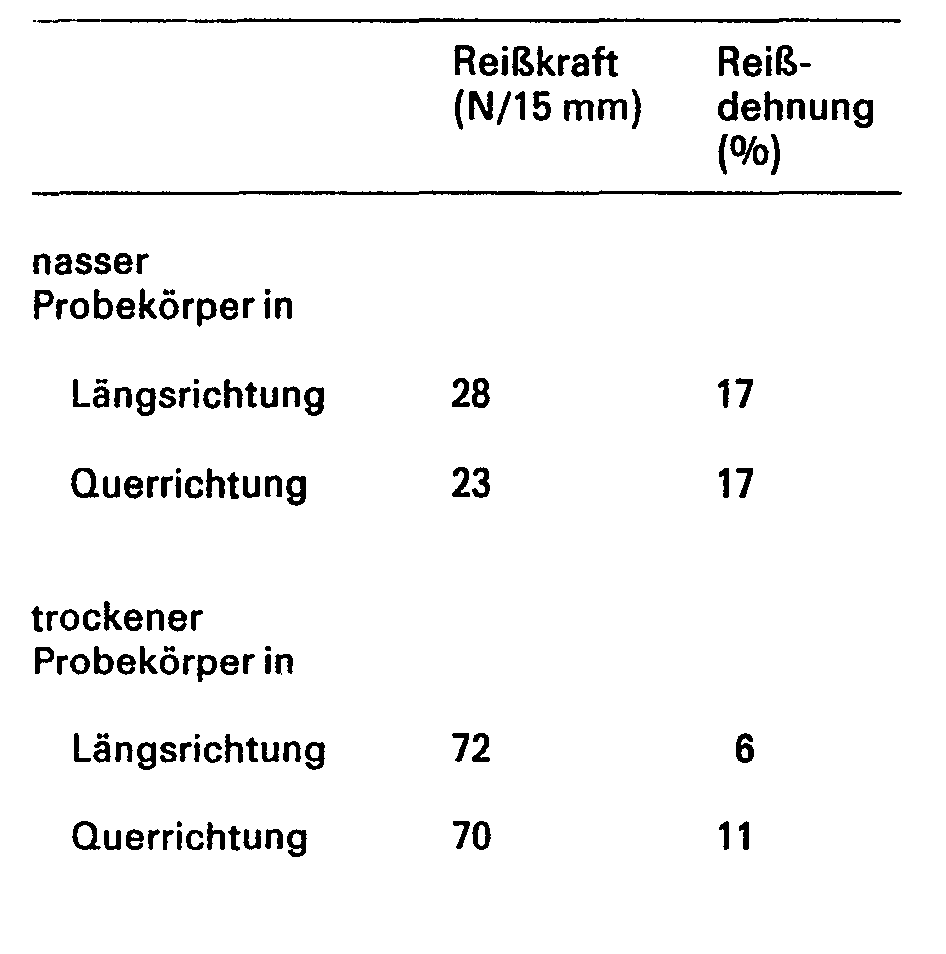
- the fiber-reinforced casing obtained from regenerated cellulose has a water vapor permeability of 10 g / m z - d (according to DIN 53122), the values for the tensile strength and elongation at break can be found in the following table:
- the finished, wet hose shows a burst pressure of 0.9 bar.
- the tensile strength and the elongation at break are measured with an electronic tensioning device in accordance with DIN 53455.
- the tensile strength is the resistance of the test specimen to the tensile stress at the moment of tearing. It is measured as tensile strength (N), based on the cross-section (mm 2 ).
- the elongation at break is the percentage elongation of the test specimen compared to the initial length under load at the moment of tearing and is given in percent.
- the test specimen has a length of 100 mm, a width of 15 mm and a thickness of 100 to 110 ⁇ m.
- the wet specimen was soaked in water at 40 ° C for 30 minutes, the dry specimen contains a residual moisture content of 8 to 10% by weight of water and 20 to 24% by weight of glycerin.
- the sheet-like nonwoven fabric with extrusion-coated polyethylene coating used in Example 1 is coated on this plastic layer with the water vapor and gas impermeable copolymer, known from DE-A-2 832 926, dissolved in tetrahydrofuran / toluene (7: 3) .
- the solution also contains 1 to 2% by weight of fillers (hydrophobized chalk) and waxes (esterified montan waxes) and 5 to 10% by weight of plasticizer (dibutyl phthalate and citric acid ester).
- the thickness of this coating corresponds to a weight per unit area of 5 g / m 2 .
- a conventional adhesion-promoting resin is applied to the polyethylene layer with anilox rollers before coating with the copolymer, e.g. B. a two-component adhesive based on polyurethane or a resin mixture based on polyester and isocyanate.
- the finished hose shows a burst pressure of 0.8 bar when wet, a water vapor permeability of 1 to 2 g / m 2.
- d (DIN 53 122) and a basis weight of 105 g / m 2 .
- the tensile strength and elongation at break are listed in the following table.
- the values for the tensile strength and elongation at break of a conventional fiber-reinforced tubular casing made of regenerated cellulose with a PVDC coating on the inside are given.
- the tubular casing is produced by gluing the fiber web formed into a tube with viscose, coating with regenerated cellulose and applying the PVDC layer to the inside.
Landscapes
- Engineering & Computer Science (AREA)
- Mechanical Engineering (AREA)
- Physics & Mathematics (AREA)
- Life Sciences & Earth Sciences (AREA)
- Fluid Mechanics (AREA)
- Wood Science & Technology (AREA)
- Food Science & Technology (AREA)
- Zoology (AREA)
- Processing Of Meat And Fish (AREA)
- Laminated Bodies (AREA)
- Artificial Filaments (AREA)
- Reinforced Plastic Materials (AREA)
- Heat Treatment Of Steel (AREA)
- Heat Treatment Of Sheet Steel (AREA)
- Liquid Developers In Electrophotography (AREA)
Description
- Die Erfindung bezieht sich auf eine Schlauchhülle von der im Oberbegriff des Anspruchs 1 genannten Art und auf ein Verfahren zu ihrer Herstellung von der im Oberbegriff des Anspruchs 10 angegebenen Gattung.
- Schläuche dieser Art aus faserverstärkter regenerierter Cellulose werden üblicherweise (US-A-2 144 900, US-A-3 224 885, US-A-3 645 760 und US-A-4195054) nach folgenden wesentlichen Verfahrensschritten hergestellt. Eine Faservliesbahn wird zu einem Schlauch geformt, wobei ihre Ränder sich überlappen und mit Viskose verklebt werden. Nach ein- oder beidseitiger Beschichtung der gesamten Schlauchoberfläche mit Viskose, z. B. aus Ringschlitzdüsen, wird die Viskose koaguliert, zu Cellulosehydrat-Gel regeneriert und getrocknet. Während dieses Prozesses wird der Schlauch durch das bei der Koagulation und Regenerierung entstehende Gasgemisch und während des Trocknens durch ein eingebrachtes eingeschlossenes Luftvolumen abgestützt und gegebenenfalls zur Verbesserung der mechanischen Eigenschaften in Längs- und Querrichtung gestreckt.
- Bei dieser Verfahrensweise müssen einige Nachteile akzeptiert werden, insbesondere ist dieses Verfahren sehr kostenintensiv. Ferner ist die Innenbeschichtung eines solchen Schlauches sehr kompliziert und aufwendig durchzuführen.
- Ein weiterer wesentlicher Nachteil dieses Verfahrens ist der diskontinuierliche Produktionsablauf, bedingt durch die Ansammlung von Gasen und Flüssigkeiten im Inneren des Schlauches während der Regenerierungsstufe, die in gewissen Zeitabständen aus dem Schlauchinneren entfernt werden müssen. Hierzu wird der Schlauch aufgeschnitten und die Schnittstellen nach Durchlaufen des Naßteils entfernt. Die durch das Aufschneiden gebildeten Schlauchenden werden dann wieder miteinander verbunden, z. B. mit Viskose und anschließender Wärmeeinwirkung (DE-A-1 814 590), so daß in der abschließenden Trockenstufe wieder ein endloser Schlauch vorhanden ist. Eine weitere Ursache für die Diskontinuität ist das Einbringen von Beschichtungsflüssigkeit in das Schlauchinnere vor und nach der Trockenstufe, wobei der Schlauch in gleicher Weise zunächst aufgeschnitten und nach dem Füllen wieder vollständig abgedichtet wird.
- Andererseits ist es auch bekannt (US-A-2 653 432) die überlappenden Ränder eines zu einem Schlauch gebogenen Films, der beispielsweise auch aus regenerierter Cellulose bestehen kann und gegebenenfalls eine Faserverstärkung aufweist, mit einem Streifen aus thermoplastischem Material, der zwischen den sich überlappenden Rändern angeordnet ist und der beim Erhitzen klebrig wird, miteinander zu verkleben. Als Beispiel für dieses thermoplastische Material wird u. a. Acrylsäureester und Polyvinylidenchlorid beschrieben. Diese bekannte Schlauchhülle kann auch einen feuchtigkeitsdichten Überzug auf der Außenseite aufweisen, wobei dann die überlappenden Ränder frei von dem Überzug und die restliche Oberfläche frei von thermoplastischem Material gehalten wird.
- Bei diesem Verfahren soll sich der Klebstoff somit nicht direkt auf der Faserverstärkung, sondern auf der aus regenerierter Cellulose bestehenden Bahnoberfläche befinden und wird deshalb nicht zur Verklebung der überlappenden Randzonen der Faserverstärkung verwendet. Ferner ist die Festigkeit einer Überlappungsnaht gebildet durch Versiegeln der übereinanderliegenden Randzonen aus regenerierter Cellulose vergleichsweise gering und auch aus optischen Gründen völlig unbefriedigend.
- Ausgehend von dem aufgezeigten Stand der Technik ist es deshalb Aufgabe der Erfindung, eine faserverstärkte Schlauchhülle aus regenerierter Cellulose vorzuschlagen, die die Nachteile der bekannten Schlauchhüllen nicht aufweist, die vielmehr optimale mechanische Eigenschaften besitzt. Die Schlauchhülle und insbesondere die Verklebungsnaht der Faserverstärkung muß relativ hohen mechanischen und thermischen Belastungen, z. B. Dehnungsbelastungen und der Einwirkung von heißem Wasser, standhalten und den Geschmack und das Aussehen des umhüllten Lebensmittels nicht beeinträchtigen.
- Eine weitere Aufgabe der Erfindung besteht darin, eine gerade, im wesentlichen krümmungsfreie und faltenfreie Hülle mit einer Naht in der Faserverstärkung zu schaffen, die auch unter Einwirkung von Wasser und beim Schrumpfen ihre krümmungsfreie und faltenfreie Form auch im Nahtbereich beibehält, trotz der relativ großen Hüllendicke in diesem Bereich. Schließlich ist es auch Aufgabe der Erfindung, eine Hülle zu finden, die sich in einem kontinuierlichen Prozeß herstellen und auf ihrer Innenseite beschichten läßt.
- Diese Aufgabe wird überraschenderweise gelöst mit der im Anspruch 1 genannten Schlauchhülle. Die Ansprüche 2 bis 9 geben weitere Ausführungsformen der Schlauchhülle an. Die Aufgabe wird ferner gelöst durch ein Verfahren zur Herstellung der Schlauchhülle mit den im Anspruch 10 genannten Merkmalen. Die Ansprüche 11 und 12 beschreiben weitere Ausbildungen des Verfahrens.
- Diese Hülle nach der Erfindung zeigt den Vorteil, daß sie einerseits nach einem kontinuierlichen Verfahren hergestellt werden kann und andererseits aber auch bei Einwirkung von Wärme und Wasser, wie dies beispielsweise beim Brühen und anschließendem Abkühlen von Wursthüllen geschieht, ihre gerade, krümmungsfreie Form beibehält und ausreichende Nahtfestigkeit zeigt. Dies ist besonders überraschend und nicht vorhersehbar, denn es ist an sich zu erwarten, daß sich die Hülle bei Einwirkung von Wärme und Wasser aufgrund der verschiedenen Wandstärken im Nahtbereich des Faserschlauchs einerseits und im übrigen Bereich andererseits und der daraus zu erwartenden unterschiedlichen Werte für die Festigkeit, für das Wasseraufnahme- und für das Wasserrückhaltevermögen krümmt oder ungleichmäßig ausdehnt oder schrumpft und sogar zum Platzen neigt.
- Die Faserverstärkung ist ein blatt- oder bahnförmiger rechteckiger Zuschnitt, insbesondere ist sie bahnförmig, z. B. in Form einer Papierbahn, und besteht gewöhnlich aus Fasern wie sie bei der Herstellung von Papier oder Reispapier verwendet werden, oder aus nativen Fasern wie Hanf- oder Flachsfasern, oder synthetischen Fasern, wie Polyamid-, Polyester- oder Polyacrylnitril-Fasern. Die bahnförmige Faserverstärkung ist z. B. ein textiles Gebilde wie ein adhäsiv, mechanisch oder thermisch verfestigter Faservliesstoff aus wirr oder geordnet abgelegten Spinnfasern, Filamenten oder multiplen Filamentgarnen aus nativem oder synthetischem Material, ein Gewebe, Netzwerk, Gitter, Gewirke oder dergleichen. Vorzugsweise ist die Faserbahn ein Papierfaservliesstoff, insbesondere mit einem Flächengewicht von 17 bis 27 g/m2. Der Einfachheit halber wird im folgenden anstelle von »blatt-oder bahnförmigen Zuschnitten« und »endlosen Bahnen« nur von Bahnen oder Faserbahnen gesprochen.
- Als Klebstoff wird ein Stoffsystem auf Basis eines thermoplastischen Kunststoffs verwendet, das in der Hitze ohne chemische Reaktion abbindet. Hierzu zählen auch Schmelzklebstoffe, die lösungsmittelfrei sind, ebenso wie Heißsiegelklebstoffe, deren Lösungsmittel man allerdings bereits vor der Klebung entweichen läßt. Eine wesentliche Voraussetzung ist, daß dieses Stoffsystem physiologisch unbedenklich ist. Der Einfachheit halber wird im folgenden anstelle von Klebstoff enthaltender »Schicht und/oder Imprägnierung« nur von »Schicht« oder »Klebstoffschicht« gesprochen.
- Die Klebstoff enthaltende Schicht wird entweder direkt in Form einer Emulsion, Dispersion oder Lösung, z. B. in Wasser, Benzin, Siedebereich 65 bis 95°C, Aceton, Essigester, Toluol, chlorierten Kohlenwasserstoffen oder in Lösungsmittelgemischen, z. B. Aceton/Benzin, oder in Schmelze mit üblichen Extrusionsvorrichtungen vollflächig auf die eine der beiden Oberflächen der Faserbahn aufgebracht. Die Klebstoffschicht ist in einer Menge von kleiner als 50 g/m2, vorzugsweise 5 bis 50, insbesondere 5 bis 20 g/m2 auf der Faserbahnoberfläche vorhanden, so daß die Faserbahn nicht vollständig von dem Klebstoff durchdrungen wird. Die gegenüberliegende Oberfläche der Faserbahn ist somit noch voll saugfähig.
- Nach dem Auftragen wird das eventuell verwendete Dispergier- bzw. Lösungsmittel entfernt, z. B. durch Erhitzen mit Heißluft.
- Schmelzklebstoffe, auch »Hot-melt-Klebstoffe« genannt, sind nicht härtende, schmelzbare thermoplastische Harze, die bei Raumtemperatur fest sind und die beim Verklebungsvorgang vorübergehend geschmolzen werden, wobei sie keine chemische Veränderung erleiden. Nach dem Erkalten und Erstarren haften sie fest an der Faserbahnoberfläche. Als Polymerrohstoff dienen in erster Linie Äthylen-Vinylacetat-Copolymere, insbesondere mit einem VinylacetatGehalt von 18 bis 40 Gew.-%, vorzugsweise etwa 30%, und einem Schmelzindex von 4 bis 500, insbesondere 40 bis 400. Auch niedermolekulare Polyäthylene, ataktische Polypropylene, Äthylen-Acrylester-Copolymere, carboxylgruppenhaltige Copolymere, Styrol-Butadien- und Styrol-Isopren-Blockcopolymere, schmelzbare aliphatische oder aromatische Polyester, z. B. schwach verzweigt und hydroxylgruppenhaltig, Polyurethane, Polyamidharze, insbesondere mit relativ niedrigem Schmelzpunkt und Schmelzviskosität, sowie Polyaminoamide sind als Basisharz für den Schmelzklebstoff geeignet. Neben diesen Harzen enthalten diese Klebstoffe gewöhnlich noch Harze, wie Balsamharze, Kolophoniumderivate, Kohlenwasserstoffharze, Wachse bzw. Paraffine, Oxidationsstabilisatoren, Weichmacher, Pig= mente und/oder Füllstoffe.
- Es werden Schmelzklebstoffe bevorzugt, die sich bei relativ niedriger Temperatur verarbeiten lassen, z. B. bei 140 bis 170°C. Sie müssen andererseits kochfest, hydrolysenunempfindlich und ausreichend flexibel sein.
- Heißsiegelklebstoffe sind Klebstoffe, die - wie die Schmelzklebstoffe - bei der Verklebung thermisch aktiviert werden. Sie werden gewöhnlich in Form von Lösungen, Dispersionen oder Emulsionen in Wasser oder organischen Lösungsmitteln auf die Oberfläche der Faserbahn aufgebracht. Die abgebundene, lösungsmittelfreie Schicht soll nicht klebrig sein, sondern erst durch Wärmezufuhr während der Siegelung aufschmelzen und sich beim Abkühlen wieder verfestigen.
- Als Rohstoff werden Copolymere des Vinylchlorids oder des Vinylidenchlorids in Lösung oder auch in Dispersion unter Zusatz von Harzen und anderen Polymeren benutzt. Daneben werden Copolymere des Vinylacetats sowie Polymethacrylsäureester, Polyurethane und Polyester, insbesondere Äthylen-Vinylacetat-Copolymere, Vinylacetat-Vinylchlorid-Copolymere, Polyamide und Polyäthylen, angewendet.
- Für die Herstellung von Schläuchen mit im wesentlichen gasundurchlässiger Innenbeschichtung wird als siegelfähiges thermoplastisches Material insbesondere ein Vinylidenharz, das mit einem Flächengewicht von gewöhnlich 3 bis 12 g/m2 vorhanden ist, eingesetzt. Hierzu gehören filmbildende Harze, die durch Mischpolymerisation von Monomeren erhalten werden, wobei wenigstens eine Komponente eine Vinylidengruppe enthält. Im allgemeinen können filmbildende Vinylidenharze verwendet werden, die im polymerisierten Molekül wenigstens 5 Gew.-%, vorzugsweise aber mindestens 80 Gew.-% Vinylidenchlorid enthalten. Als Comonomere seien genannt: Vinylderivate, wie Vinylchlorid, Alkylacrylate oder -methacrylate, Acrylnitril, Methacrylnitril, Styrol, ungesättigte organische Säuren, wie Itaconsäure, oder Mischungen von diesen Verbindungen. Das Copolymerisat kann neben Vinylidenchlorid eine bis drei dieser Monomeren enthalten.
- Auch diese Klebstoffe können übliche Wachse, z. B. auf Basis von veresterten Montansäuren, Polyolefinwachse oder auf Basis von Oxazolin, und/oder übliche Füllstoffe, beispielsweise Kaolin, insbesondere hydrophobiertes Kaolin, Kieselsäure oder Calciumcarbonat (Kreide) mit einer bevorzugten mittleren Korngröße von 1 bis 3 um enthalten.
- Ferner werden übliche Zusätze an Weichmachern, z. B. Ester der-Phthalsäure, wie Dibutylphthalat, Ester der Citronensäure, wie Acetyltributylcitrat, der Sebacinsäure oder Weinsäure, wie Diisobutyltartrat, verwendet.
- Es ist aber auch möglich und unter Umständen aus verfahrenstechnischen Gründen zweckmäßiger, eine gasundurchlässige Schicht aus einem Vinylidenchlorid-Einheiten aufweisenden Copolymerisat nicht direkt auf die Faserbahn, sondern auf die Schmelzklebstoffschicht aufzubringen, wobei gegebenenfalls zur Verankerung der gasundurchlässigen Schicht auf der Schmelzklebstoffschicht eine haftvermittelnde Schicht verwendet wird.
- Gegebenenfalls wird auch die Klebstoffschicht mit einer haftvermittelnden Schicht auf der Faserbahn verankert. Unter haftvermittelnder Schicht sind Stoffe oder Stoffgemische zu verstehen, die die Haftung zwischen Beschichtung und Substrat verbessern.
- Die haftvermittelnde Schicht besteht aus einem im wesentlichen wasserunlöslichen Harz, vorzugsweise aus einem gehärteten kationischen hitzehärtbaren Harz, das im ungehärteten Zustand im wesentlichen wasserlöslich ist und durch Wärmeeinwirkung durch fortschreitende Kondensationsreaktion in wasserunlöslichen Zustand überführbar ist (US-A-3 378 379). Polyurethanharze, Nitrocellulose und andere, als wasserunlösliche Verankerungsmittel bekannte Polymere können ebenfalls eingesetzt werden. Die haftvermittelnde Schicht wird vorzugsweise über die gesamte Bahnbreite auf die Faserbahn aufgebracht, und zwar direkt auf die Bahnoberfläche oder auf die Klebstoffschicht, falls eine gasundurchlässige Schicht verankert werden soll. Der Auftrag erfolgt bevorzugt in wäßriger Dispersion, die bis zu 25 Gew.-% des wärmehärtbaren Harzes enthält. Danach wird die überzogene Bahn auf 65 bis 125°C erhitzt, wodurch das Harz zu seiner wasserunlöslichen Form gehärtet wird und eine dauerhafte Bindung mit der Oberfläche der Faserbahn eingeht. Die Harzschicht hat ein Flächengewicht von etwa 30 bis 300 mg/m2, vorzugsweise 40 bis 75 mg/m2.
- Als geeignete Lösungsmittel für das hitzehärtbare Harz werden niedrige aliphatische oder aromatische Kohlenwasserstoffe, niedrige Alkohole oder Ester oder Mischungen dieser Lösungsmittel eingesetzt. Vorteilhaft wird eine wäßrige Lösung oder Dispersion verwendet.
- Falls für bestimmte Anwendungen gewünscht, wird zusammen mit dem hitzehärtbaren Harz ein zusätzliches wasserabstoßendes Harz wie Paraffin, Montanwachs, Carnaubawachs und/oder geeignete Verdickungsmittel, wie Celluloseäther oder Stärke, auf die Faserbahn aufgetragen.
- Die Faserbahn kann auch vor oder nach Aufbringen des hitzehärtbaren Harzes oder der Klebstoffschicht und vor dem Verkleben zu einem Faserschlauch mit Beschriftungen oder dekorativen Mustern bedruckt werden.
- Der Überzug aus hitzehärtbarem Harz kann gegebenenfalls Pigmente und/oder organische Farben enthalten oder bildet eine klare Schicht, durch die eine eventuelle Bedruckung oder Färbung der Faserbahn gut sichtbar bleibt. Ein transparenter organischer Farbstoff kann aber auch zusammen mit dem Harz auf die Faserbahn aufgebracht werden, um der Verpackungshülle eine entsprechende Farbe zu verleihen.
- Die Beschichtung aus dem hitzehärtbaren Harz enthält gegebenenfalls einen Weichmacher für das hitzehärtbare Harz und/oder ein Härtungsmittel für das hitzehärtbare Harz. Das hitzehärtbare Harz und der Weichmacher werden in einem geeigneten flüssigen Lösungs- bzw. Dispergiermittel aufgenommen, das vorteilhafterweise bei einer Temperatur verdampft werden kann, bei der gleichzeitig zumindest eine Vorhärtung des Harzes eintreten kann.
- Als Beispiele für das hitzehärtbare Harz sind zu nennen: Harnstoff-Formaldehyd- (US-A-2616874), Melamin-Formaldehyd- (US-A-2 796 362, US-A-2 345 543) und Phenol-Formaldehyd-Harze. Als bevorzugter Weichmacher für diese hitzehärtbaren Harze dienen weiche, nichthärtbare Harze vom Alkyd-Typ oder auch Dibutylphthalat, Trikresylphosphate oder Dibutylsebacat.
- Als Härter für das hitzehärtbare Harz kann beispielsweise Ammoniumthiocyanat, Toluolsulfonsäure, Maleinsäure oder Milchsäure eingesetzt werden. Diese Verbindungen verhalten sich wie Katalysatoren bei der Härtung der hitzehärtbaren Harze.
- Weitere Beispiele für hitzehärtbare Harze sind Kondensationsprodukte von Polyamidpolyaminen oder aliphatischen Polyaminen oder von Polyamiden mit bifunktionellen Halohydrinen oder deren Derivaten wie z. B. Epichlorhydrin, wie sie beispielsweise in den US-A-2 573 956 und US-A-2 926 154 oder in den GB-A-865 727 und GB-A-908 205 beschrieben sind. Ein besonders geeignetes Harz ist beispielsweise das Reaktionsprodukt aus aliphatischem 2,6-Polyamid, Diäthylentriamin und Epichlorhydrin.
- Als Polyamine kommen einfache Alkylendiamine in Betracht oder Polyalkylenpolyamine wie beispielsweise Diäthylentriamin, Triäthylentetramin, Tetraäthylenpentamin und die entsprechenden Polypropylqnpolyamine, und Polybutylenpolyamine wie Dibutylentriamin. Die Polyamine werden zur Herstellung der entsprechenden Chlorhydrinharze mit mehr als einem Mol Epichlorhydrin je Mol Polyamin umgesetzt. Die Polyamid-Polyamine sind Kondensationsprodukte einer gesättigten, aliphatischen, zweibasischen Säure mit einem der oben genannten Polyamine. Vorzugsweise werden Diglykolsäure, Bernsteinsäure, Glutarsäure und Adipinsäure als zweibasische Säure verwendet.
- Die mit dem Klebstoff versehene Faserbahn wird zur Schlauchherstellung entsprechend gebogen, wobei sich die längsaxial sich erstreckenden Randbereiche überlappen. Die mit Klebstoff versehene Oberfläche der Faserbahn bildet die innere Oberfläche des Schlauchs. Die Formung der Faserbahn zu einem Schlauch erfolgt beispielsweise entweder auf einer genügend langen Wegstrecke, so daß keine Verzerrung und Faltenbildung erfolgt, oder durch Umlenkung über ein schulterartiges Formwerkzeug.
- Die überlappenden Randzonen der Faserbahn werden miteinander in der Hitze verklebt, wobei die eine Randzone der Faserbahn gegen die Klebstoffschicht auf der anderen Randzone gedrückt wird.
- Die Verklebung erfolgt z. B. durch Anpressen einer auf eine bestimmte Temperatur vorgeheizten Backe oder Rolle. Für die Verklebung kann jedoch jede andere Wärmequelle in Frage kommen, wie beispielsweise bandförmige IR-Strahler, Hochfrequenz-Erwärmung oder Heißluft. Der erforderliche Anpreßdruck kann auch mit einem Luftstrom oder durch Vakuum erfolgen. Die angewandten Temperaturen und Drucke hängen weitgehend von den Stoffeigenschaften der Klebstoffschichten ab. Bahnbewegung und Verklebung kann taktweise oder kontinuierlich erfolgen.
- Der erhaltene Faserschlauch wird nun auf seiner äußeren Oberfläche mit einer Viskoselösung behandelt, z. B. in eine Viskoselösung getaucht oder mit einer Viskoselösung beschichtet, z. B. mit schlitzförmigen Düsen, Walzen oder durch Sprühvorrichtungen, und anschließend durch Einführen in Spinnbäder oder durch Ansprühen oder Antragen eines Films aus Regenerierflüssigkeit (DE-A-2 829102) auf seine äußere Oberfläche in regenerierte Cellulose übergeführt.
- Die Viskoselösung ist eine alkalische Lösung von Natrium-Cellulosexanthogenat und wird üblicherweise hergestellt durch Umsetzung der aus Cellulose mit Natriumhydroxidlösung erhaltenen Alkalicellulose mit Schwefelkohlenstoff im alkalischen Medium; sie enthält meist noch 4 bis 20 Gew.-% Cellulose. Nach der Reifung wird die Viskose auf den Faserschlauch aufgebracht und versponnen, d. h. koaguliert. Das Spinnbad enthält beispielsweise Schwefelsäure, ferner Natriumsulfat und/oder Ammoniumsulfat.
- Nach der Koagulation wird in weiteren Stufen das aus Viskose-Gel bestehende faserverstärkte bahnförmige Produkt in saurem Medium, z. B. in verdünnter (kleiner/gleich 5 Gew.-%) Schwefelsäure, zu Cellulosehydrat-Gel regeneriert, zur Entfernung von Säure und Salzen mit Wasser gewaschen, mit z. B. Natriumsulfitlösung entschwefelt, gegebenenfalls durch ein Bleichbad und schließlich durch ein übliches Weichmacherbad mit z. B. 5- bis 20prozentiger Glycerinlösung geführt.
- Das Cellulosehydrat-Gel auf der äußeren Oberfläche des Faserschlauches wird durch intensive Trocknung bei 90 bis 140° C in regenerierte Cellulose übergeführt und gegebenenfalls durch Wiederanfeuchten auf einen Wassergehalt von etwa 5 bis 15 Gew.-% eingestellt. Der faserverstärkte Cellulosehydratschlauch zeigt nach der Trocknung eine Dicke von 50 bis 200 µm entsprechend einem Flächengewicht von 50 bis 250 g/m2.
- Zur Verpackung von Fleischwaren in Form von Wurstmasse werden bekanntlich geraffte, nahtlose Schlauchhüllen verwendet, die beim Einpressen der Wurstmasse fortlaufend entfältelt werden. Diese gerafften Hüllen, in der Fachsprache auch als Raupen oder Hohlstäbe bezeichnet, werden bisher aus langen, nahtlosen Schläuchen hergestellt, die man in Richtung ihrer Längsachse fördert und gegen eine Gegenkraft rafft, wobei die Länge der gerafften Hülle gewöhnlich nur noch 1 bis 3% der Ursprungslänge beträgt.
- Auch die erfindungsgemäße Schlauchhülle kann gerafft werden.
- Dies ist besonders überraschend, da wegen der Verdickung im Bereich der Versiegelung der sich überlappenden Ränder eigentlich Schwierigkeiten beim Raffen zu erwarten sind. Die Schlauchhülle wird beispielsweise mit dem aus den US-A-3 988 804 und US-A-4 185 358 bekannten Verfahren bzw. der dort beschriebenen Vorrichtung gerafft.
- Ein Raffverhältnis von 1 : 70 bis 1 : 80 läßt sich ohne weiteres erreichen.
- Es ist auch eine spiralförmige Verdrehung der Hülle und folglich eine Verdrillung der relativ dikken Nahtzone um die Längsachse der Hülle beim Raffvorgang möglich, aber nicht erforderlich. Dies geschieht beispielsweise mit an sich bekannten Raffvorrichtungen, wie sie z. B. in US-A-2 819 488, US-A-3 619 854, US-A-3 594 857 und US-A-3 766 603 beschrieben sind. Die Anzahl der Windungen pro 10 m Schlauchlänge liegt zweckmäßigerweise zwischen 0,5 und 10 und wird je nach Ausmaß der Verdickung in der Nahtzone gewählt.
- Oie Erfindung wird anhand der Fig. 1 und 2 und den folgenden Beispielen näher erläutert.
- Fig. 1 zeigt die Herstellung der schlauchförmigen Hülle.
- Fig. 2 zeigt ausschnittsweise die Schlauchformung und das Bilden der Naht der Faserverstärkung.
- Ein bahnförmiger, langfaseriger Faservliesstoff 1 aus Hanfpapier mit einer Flachbreite von 204 mm und einem Flächengewicht von 22 g/m2, der auf der einen Oberfläche eine durch Extrusion (Extrusionstemperatur 290 bis 310° C) aufgebrachte Schicht 2 aus Hochdruckpolyäthylen (Dichte 0,918g/cm3, Schmelzindex 6-8, Schmelzpunkt 108°C) mit einem Flächengewicht von 25 g/m2 aufweist, wird kontinuierlich von einer Rolle 18 abgezogen und unter Verwendung eines Ringsegments 3, eines Stützelements 4 und einer Führungshülse 5 zu einem Schlauch geformt. Der Schlauch zeigt einen Durchmesser von etwa 63 bis 64 mm, die Überlappungsbreite ist etwa 4 mm. Die mit Polyäthylen beschichtete Oberfläche befindet sich im Hohlraum des Schlauches und in der Überlappungsnaht 6. Die sich überlappenden Randzonen der Faserbahn 1 werden mit einem Ultraschallsiegelgerät 7 miteinander verschweißt.
- Der erhaltene Faserschlauch 8 wird nun auf seiner Außenseite nach dem Stand der Technik mit einer Viskoselösung durch eine Ringschlitzdüse 9 beschichtet, wobei sich ein homogener geschlossener Viskosefilm ausbildet. Das zur Koagulation und Regeneration erforderliche Fällmittel, das Schwefelsäure, Ammoniumsulfat und Natriumsulfat in üblicher Konzentration enthält, wird nach der in der DE-A-2 829 102 gezeigten Anordnung mit einer kreisförmigen Ringschlitzdüse 10 in Form eines Films auf die viskosierte Außenoberfläche des Faserschlauchs 8 aufgebracht.
- Während des Viskoseauftrags und der anschließenden Koagulations- und Regenerierungsstufe wird in den Faserschlauch durch die Leitung 11 Stützluft mit geringem Überdruck eingeleitet, die das Schrumpfen und die Faltenbildung des Schlauchs 8 verhindert. Mit 12 ist der Stützluftauslaß bezeichnet. Nach Umlenken des Schlauchs mit der Rolle 13, die sich in der zur Aufnahme vom ablaufenden Fällmittel vorgesehenen Wanne 14 befindet, durchläuft der Schlauch übliche Waschbäder 15, Weichmacherbäder 16 und eine Trockenvorrichtung 17. Mit 19 und 20 sind weitere Rollen bezeichnet, die zum Umlenken der Faserbahn dienen.
- Die erhaltene faserverstärkte Hülle aus regenerierter Cellulose hat eine Wasserdampfdurchlässigkeit von 10 g/mz - d (nach DIN 53122), die Werte für die Reißfestigkeit und Reißdehnung können der folgenden Tabelle entnommen werden:

- Der fertige, nasse Schlauch zeigt einen Platzdruck von 0,9 bar.
- Die Messung der Reißfestigkeit und der Reißdehnung erfolgt mit einer elektronischen Spanneinrichtung nach DIN 53455. Unter Reißfestigkeit ist die Widerstandsfähigkeit des Probekörpers gegenüber der Zugbeanspruchung im Augenblick des Reißens zu verstehen. Sie wird gemessen als Reißkraft (N), bezogen auf den Querschnitt (mm2). Die Reißdehnung ist die prozentuale Verlängerung des Probekörpers gegenüber der Ausgangslänge bei Belastung im Augenblick des Reißens und wird in Prozent angegeben. Der Probekörper hat eine Länge von 100 mm, Breite von 15 mm und Dicke von 100 bis 110 um.
- Der nasse Probekörper wurde in Wasser von 40°C 30 Minuten lang gewässert, der trockene Probekörper enthält eine Restfeuchte von 8 bis 10 Gew.-% Wasser und 20 bis 24 Gew.-% Glycerin.
- Der im Beispiel 1 verwendete bahnförmige Faservliesstoff mit extrusionsbeschichtetem Poly- äthylenüberzug wird auf dieser Kunststoffschicht mit dem aus der DE-A-2 832 926 bekannten Vinylidenchlorid-Einheiten enthaltenden wasserdampf- und gasundurchlässigem Copolymerisat, gelöst in Tetrahydrofuran/Toluol (7 : 3), beschichtet. Die Lösung enthält ferner 1 bis 2 Gew.-% an Füllstoffen (hydrophobierte Kreide) und Wachsen (veresterte Montanwachse) sowie 5 bis 10 Gew.-% Weichmacher (Dibutylphthalat und Zitronensäureester). Die Dicke dieser Beschichtung entspricht einem Flächengewicht von 5 g/m2. Zur Verbesserung der Haftung zwischen den Schichten aus Polyäthylen und dem gasundurchlässigen Copolymerisat wird auf die Polyäthylenschicht vor der Beschichtung mit dem Copolymerisat ein übliches haftvermittelndes Harz mit Rasterwalzen aufgebracht, z. B. ein Zweikomponentenkleber auf Polyurethanbasis oder ein Harzgemisch auf Basis von Polyester und Isocyanat.
- Die Schlauchformung und Schlauchbildung sowie die Regenerierung erfolgt wie in Beispiel 1 beschrieben.
- Der fertige Schlauch zeigt in nassem Zustand einen Platzdruck von 0,8 bar, eine Wasserdampfdurchlässigkeit von 1 bis 2 g/m2 . d (DIN 53 122) und ein Flächengewicht von 105 g/m2. Die Reißfestigkeit und Reißdehnung sind in der folgenden Tabelle aufgeführt.

- Zum Vergleich werden die Werte für die Reißkraft und Reißdehnung einer üblichen faserverstärkten Schlauchhülle aus regenerierter Cellulose mit einer PVDC-Beschichtung auf der Innenseite angegeben. Die Schlauchhülle wird hergestellt durch Verkleben der zu einem Schlauch geformten Faserbahn mit Viskose, Beschichten mit regenerierter Cellulose und Aufbringen der PVDC-Schicht auf die Innenseite.
Claims (12)
Priority Applications (1)
| Application Number | Priority Date | Filing Date | Title |
|---|---|---|---|
| AT81109118T ATE13479T1 (de) | 1981-03-07 | 1981-10-28 | Fuer lebensmittel, insbesondere wurstwaren, geeignete faserverstaerkte schlauchhuelle und verfahren zu ihrer herstellung. |
Applications Claiming Priority (2)
| Application Number | Priority Date | Filing Date | Title |
|---|---|---|---|
| DE19813108795 DE3108795A1 (de) | 1981-03-07 | 1981-03-07 | Fuer lebensmittel, insbesondere wurstwaren, geeignete faserverstaerkte schlauchhuelle und verfahren zu ihrer herstellung |
| DE3108795 | 1981-03-07 |
Publications (2)
| Publication Number | Publication Date |
|---|---|
| EP0060926A1 EP0060926A1 (de) | 1982-09-29 |
| EP0060926B1 true EP0060926B1 (de) | 1985-05-29 |
Family
ID=6126665
Family Applications (1)
| Application Number | Title | Priority Date | Filing Date |
|---|---|---|---|
| EP81109118A Expired EP0060926B1 (de) | 1981-03-07 | 1981-10-28 | Für Lebensmittel, insbesondere Wurstwaren, geeignete faserverstärkte Schlauchhülle und Verfahren zu ihrer Herstellung |
Country Status (8)
| Country | Link |
|---|---|
| US (1) | US4397337A (de) |
| EP (1) | EP0060926B1 (de) |
| JP (1) | JPS57146537A (de) |
| AT (1) | ATE13479T1 (de) |
| CA (1) | CA1182332A (de) |
| DE (2) | DE3108795A1 (de) |
| DK (1) | DK526481A (de) |
| FI (1) | FI67474C (de) |
Families Citing this family (19)
| Publication number | Priority date | Publication date | Assignee | Title |
|---|---|---|---|---|
| DE3328947A1 (de) * | 1983-08-11 | 1985-02-28 | Hoechst Ag, 6230 Frankfurt | Schimmelresistentes huellenmaterial |
| US4610742A (en) * | 1984-11-15 | 1986-09-09 | Teepak, Inc. | Methods and materials for splicing tubular food casings |
| FR2590874B1 (fr) * | 1985-12-03 | 1988-05-27 | Participations Ste Charentaise | Nouvel emballage pour produits sensibles a l'humidite |
| US4752486A (en) * | 1985-12-16 | 1988-06-21 | Teepak, Inc. | Tubular food casings with improved end closures |
| US4759814A (en) * | 1986-06-03 | 1988-07-26 | Max Katz Bag Company, Inc. | Methods for coating and laminating flexible, tubular-shaped articles; coated flexible tubular-shaped articles and flexible multilayer articles of flat or tubular shape |
| FR2646590B1 (fr) * | 1989-05-03 | 1992-04-17 | Jonnard Pierre | Procede pour la preparation de boyaux naturels en charcuterie et le dispositif pour sa mise en oeuvre |
| GB2262322B (en) * | 1991-12-14 | 1995-04-12 | W E Rawson Limited | Flexible tubular structures |
| US5658414A (en) * | 1995-03-03 | 1997-08-19 | Kraft Foods, Inc. | Organometallic solvent seaming of cellulosic materials |
| US5690777A (en) * | 1995-03-03 | 1997-11-25 | Kraft Foods, Inc. | Seamed cellulosic materials using organometallic solvents |
| SK282683B6 (sk) * | 1996-08-09 | 2002-11-06 | Heinz Stemmler | Spôsob vytvárania povlaku na trvanlivých údeninách a na tvrdých syroch |
| US6083581A (en) * | 1997-11-12 | 2000-07-04 | Viskase Corporation | Cellulase resistant cellulose casing and process |
| EP0922390A1 (de) * | 1997-12-12 | 1999-06-16 | Devro-Teepak Belgium, NV | Biaxial gestreckte und geschweisste Nahrungsmittelhülle |
| JP3271752B2 (ja) * | 1998-09-21 | 2002-04-08 | 株式会社明治ゴム化成 | 超低膨張ブレーキゴムホースとその製造方法 |
| US6200613B1 (en) * | 1998-10-08 | 2001-03-13 | Sun Products Marketing Und Manufacturing Ag | Food casing |
| US6945279B2 (en) * | 2000-09-29 | 2005-09-20 | Yamashita Rubber Kabushiki Kaisha | Thin-walled rubber hose and method of producing the same |
| DE102005020965A1 (de) * | 2005-05-06 | 2006-11-09 | Kalle Gmbh | Transparente Nahrungsmittelhülle mit textilem Trägermaterial |
| DE102007009906A1 (de) * | 2007-02-28 | 2008-09-04 | Veritas Ag | Ladeluftschlauch |
| DE102010012633A1 (de) | 2010-03-25 | 2011-09-29 | Kalle Gmbh | Schlauchförmige Nahrungsmittelhülle beschichtet mit aufschmelzbaren, thermoplastischen Polymeren |
| CN204852660U (zh) * | 2015-07-23 | 2015-12-09 | 浙江鑫宙竹基复合材料科技有限公司 | 麻缠绕复合管 |
Family Cites Families (29)
| Publication number | Priority date | Publication date | Assignee | Title |
|---|---|---|---|---|
| US2144900A (en) * | 1935-06-08 | 1939-01-24 | Visking Corp | Method of producing reinforced seamless-matrix tubes |
| US2138462A (en) * | 1937-01-18 | 1938-11-29 | Frank W Trabold | Method of shaping food products |
| LU29095A1 (de) * | 1942-07-31 | |||
| US2653432A (en) * | 1949-05-19 | 1953-09-29 | American Viscose Corp | Sausage stuffing machine |
| US2573956A (en) * | 1949-06-28 | 1951-11-06 | American Cyanamid Co | Process for treating nonfibrous cellulosic film and resulting product |
| US2616874A (en) * | 1951-07-19 | 1952-11-04 | Rohm & Haas | Methylol derivatives of ureido-polyamines |
| NL198636A (de) * | 1954-07-07 | |||
| US2796362A (en) * | 1955-06-29 | 1957-06-18 | American Cyanamid Co | Surface treatment |
| US2926154A (en) * | 1957-09-05 | 1960-02-23 | Hercules Powder Co Ltd | Cationic thermosetting polyamide-epichlorohydrin resins and process of making same |
| NL110447C (de) | 1957-09-05 | |||
| GB908205A (en) | 1960-03-31 | 1962-10-17 | American Cyanamid Co | Regenerated cellulose film and process for producing same |
| DE1814590U (de) | 1960-04-20 | 1960-07-07 | August Rief | Einschlagmutter fuer holz aus kunststoff mit stahlgewindehulse. |
| US3224885A (en) * | 1961-10-10 | 1965-12-21 | Union Carbide Corp | Method of producing cellulosic sausage casings |
| US3378379A (en) * | 1963-05-21 | 1968-04-16 | Union Carbide Corp | Food casing and method of producing same |
| NL138341C (de) * | 1963-05-22 | |||
| US3766603A (en) * | 1964-12-15 | 1973-10-23 | Union Carbide Corp | Shirred tubing, method and apparatus for making same |
| DE1288943B (de) * | 1966-10-01 | 1969-02-06 | Kalle Ag | Verfahren zum Raffen von kuenstlichen Wursthuellen |
| FR96372E (de) * | 1967-12-27 | 1972-06-16 | ||
| US3645760A (en) * | 1970-01-05 | 1972-02-29 | Merril N O Brien | Dry sausage casing |
| US4185358A (en) * | 1971-09-23 | 1980-01-29 | Hoechst Aktiengesellschaft | Apparatus for shirring casings |
| BE789054A (fr) * | 1971-09-23 | 1973-03-20 | Kalle Ag | Procede et dispositif pour froncer des tubes d'emballage et notamment des boyaux pour la fabrication de saucisses |
| US3886979A (en) * | 1972-08-01 | 1975-06-03 | Union Carbide Corp | Shirred tubular food casings having a barrier coating |
| US3935320A (en) * | 1973-04-04 | 1976-01-27 | Union Carbide Corporation | Tubular cellulosic casing with cationic thermosetting resin coating |
| EP0001545B1 (de) * | 1977-08-05 | 1981-07-15 | Hoechst Aktiengesellschaft | Schlauchförmige Hülle, insbesondere Verpackungshülle, z.B. Wursthülle auf Basis von Cellulosehydrat und Verfahren zu ihrer Herstellung |
| US4195054A (en) * | 1978-04-21 | 1980-03-25 | Teepak, Inc. | Method and apparatus for the manufacture of fibrous casing |
| DE2829102C2 (de) | 1978-07-03 | 1982-11-18 | Hoechst Ag, 6000 Frankfurt | Verfahren zur kontinuierlichen Herstellung faserverstärkter Schlauchhüllen auf Basis von Cellulosehydrat sowie Vorrichtung zur Durchführung des Verfahrens |
| DE2832926A1 (de) | 1978-07-27 | 1980-02-07 | Hoechst Ag | Cellulosehydratschlauch mit alterungsbestaendiger sperrschicht aus synthetischem copolymerisat auf der aussenseite sowie verfahren zu seiner herstellung |
| DE3030036A1 (de) * | 1980-08-08 | 1982-05-06 | Hoechst Ag, 6000 Frankfurt | Schlauchfoermige verpackungshuelle aus cellulosehydrat mit wasserdampfungurchlaesigem filmueberzug aus synthetischem polymerisat auf der aussen- und haftvermittelnder, fuer wasser durchlaessiger schicht aus synthetischem, waermegehaertetem chemischem kondensationsprodukt auf der innenseite |
| DE3030035A1 (de) * | 1980-08-08 | 1982-03-11 | Hoechst Ag, 6000 Frankfurt | Schlauchfoermige verpackungshuelle aus cellulosehydrat mit niedrigem quellwert, bei der die schlauchwand waermegehaertetes wasserunloesliches synthetisches chemisches kondensationsprodukt umfasst, als kuenstliche wursthaut fuer dauerwurst |
-
1981
- 1981-03-07 DE DE19813108795 patent/DE3108795A1/de not_active Withdrawn
- 1981-10-28 EP EP81109118A patent/EP0060926B1/de not_active Expired
- 1981-10-28 DE DE8181109118T patent/DE3170757D1/de not_active Expired
- 1981-10-28 AT AT81109118T patent/ATE13479T1/de not_active IP Right Cessation
- 1981-11-24 FI FI813746A patent/FI67474C/fi not_active IP Right Cessation
- 1981-11-24 CA CA000390782A patent/CA1182332A/en not_active Expired
- 1981-11-25 US US06/324,967 patent/US4397337A/en not_active Expired - Fee Related
- 1981-11-27 DK DK526481A patent/DK526481A/da not_active Application Discontinuation
- 1981-11-30 JP JP56190967A patent/JPS57146537A/ja active Pending
Also Published As
| Publication number | Publication date |
|---|---|
| DE3108795A1 (de) | 1982-09-16 |
| FI67474C (fi) | 1985-04-10 |
| US4397337A (en) | 1983-08-09 |
| FI813746L (fi) | 1982-09-08 |
| DE3170757D1 (en) | 1985-07-04 |
| DK526481A (da) | 1982-09-08 |
| EP0060926A1 (de) | 1982-09-29 |
| JPS57146537A (en) | 1982-09-10 |
| FI67474B (fi) | 1984-12-31 |
| ATE13479T1 (de) | 1985-06-15 |
| CA1182332A (en) | 1985-02-12 |
Similar Documents
| Publication | Publication Date | Title |
|---|---|---|
| EP0054162B1 (de) | Schlauchhülle, insbesondere Wursthülle, mit wasserdampfundurchlässiger Schicht, Verfahren zu ihrer Herstellung und ihre Verwendung | |
| EP0058240B1 (de) | Für Lebensmittel, insbesondere Wurstwaren, geeignete rauchdurchlässige Schlauchhülle mit einer Klebenaht und Verfahren zu ihrer Herstellung | |
| EP0050702B1 (de) | Für Lebensmittel, insbesondere Wurstwaren geeignete Schlauchhülle mit einer Klebenaht, Verfahren zu ihrer Herstellung und ihre Verwendung zur Herstellung gekrümmter oder ringförmiger Würste | |
| EP0037543B1 (de) | Für Lebensmittel, insbesondere Wurstwaren geeignete Schlauchhülle mit einer Klebenaht und Verfahren zu ihrer Herstellung | |
| EP0076436B1 (de) | Für zu räuchernde Lebensmittel, insbesondere für zu räuchernde Wurstwaren geeignete Schlauchhülle, Verfahren zu ihrer Herstellung und ihre Verwendung | |
| EP0060926A1 (de) | Für Lebensmittel, insbesondere Wurstwaren, geeignete faserverstärkte Schlauchhülle und Verfahren zu ihrer Herstellung | |
| EP0139112A1 (de) | Rauchdurchlässige Folie aus faserverstärkter regenerierter Cellulose zur Herstellung von Schlauchhüllen, insbesondere Wursthüllen | |
| EP1703798B1 (de) | Proteinhaltige, schlauchförmige nahrungsmittelhülle mit innenverstärkung | |
| DE102004051298A1 (de) | Faservlies mit verbesserter Naß- und Alkalifestigkeit und damit hergestellte Nahrungsmittelhülle auf Basis von Cellulosehydrat | |
| EP1872662A1 (de) | Schlauchförmige Nahrungsmittelhülle mit rauchdurchlässiger Klebenaht | |
| DE3343635A1 (de) | Folie aus faserverstaerkter regenerierter cellulose mit gasundurchlaessiger schicht zur herstellung von schlauchhuellen | |
| DE3538702A1 (de) | Sauerstoff- und wasserdampfundurchlaessige folie zur herstellung geraffter schlauchhuellen, insbesondere wursthuellen | |
| EP1872661B1 (de) | Schlauchförmige nahrungsmittelhülle mit geklebter, dauerelastischer längsnaht | |
| DE3244372A1 (de) | Verfahren zur herstellung von gefuellten schlauchpackungen, insbesondere von wuersten | |
| DE2619498C3 (de) | Faserhüll- oder -packmaterial, Verfahren zu seiner Herstellung und seine Verwendung zur Herstellung röhrenförmiger Hüllen oder Verpackungen | |
| DE3216437A1 (de) | Geraffte wursthuelle und verfahren zu ihrer herstellung | |
| DE69320318T2 (de) | Verfahren und Material zum Verbinden von röhrenförmigen Nahrungsmittelhüllen | |
| DE1952464C3 (de) | Verwendung von faserverstärkten Polyvinylalkoholharzfolien zum Abpacken von Lebensmitteln | |
| DE4233883A1 (de) | Schlauchhuelle, mit einer organochlorfreien o(pfeil abwaerts)2(pfeil abwaerts)- und wasserdampfundurchlaessigen auflage, verfahren zu ihrer herstellung und sowie ihre verwendung | |
| DE1952464B2 (de) | Verwendung von faserverstaerkten polyvinyl-alkoholharzfolien zum abpacken von lebensmitteln |
Legal Events
| Date | Code | Title | Description |
|---|---|---|---|
| PUAI | Public reference made under article 153(3) epc to a published international application that has entered the european phase |
Free format text: ORIGINAL CODE: 0009012 |
|
| AK | Designated contracting states |
Designated state(s): AT BE CH DE FR GB IT LU NL SE |
|
| 17P | Request for examination filed |
Effective date: 19821207 |
|
| ITF | It: translation for a ep patent filed | ||
| GRAA | (expected) grant |
Free format text: ORIGINAL CODE: 0009210 |
|
| AK | Designated contracting states |
Designated state(s): AT BE CH DE FR GB IT LI LU NL SE |
|
| REF | Corresponds to: |
Ref document number: 13479 Country of ref document: AT Date of ref document: 19850615 Kind code of ref document: T |
|
| REF | Corresponds to: |
Ref document number: 3170757 Country of ref document: DE Date of ref document: 19850704 |
|
| ET | Fr: translation filed | ||
| PG25 | Lapsed in a contracting state [announced via postgrant information from national office to epo] |
Ref country code: LU Free format text: LAPSE BECAUSE OF NON-PAYMENT OF DUE FEES Effective date: 19851031 |
|
| PLBE | No opposition filed within time limit |
Free format text: ORIGINAL CODE: 0009261 |
|
| STAA | Information on the status of an ep patent application or granted ep patent |
Free format text: STATUS: NO OPPOSITION FILED WITHIN TIME LIMIT |
|
| 26N | No opposition filed | ||
| PGFP | Annual fee paid to national office [announced via postgrant information from national office to epo] |
Ref country code: AT Payment date: 19860922 Year of fee payment: 6 |
|
| PGFP | Annual fee paid to national office [announced via postgrant information from national office to epo] |
Ref country code: NL Payment date: 19871031 Year of fee payment: 7 |
|
| PG25 | Lapsed in a contracting state [announced via postgrant information from national office to epo] |
Ref country code: GB Effective date: 19881028 Ref country code: AT Effective date: 19881028 |
|
| PG25 | Lapsed in a contracting state [announced via postgrant information from national office to epo] |
Ref country code: SE Effective date: 19881029 |
|
| PG25 | Lapsed in a contracting state [announced via postgrant information from national office to epo] |
Ref country code: LI Effective date: 19881031 Ref country code: CH Effective date: 19881031 Ref country code: BE Effective date: 19881031 |
|
| BERE | Be: lapsed |
Owner name: HOECHST A.G. Effective date: 19881031 |
|
| PG25 | Lapsed in a contracting state [announced via postgrant information from national office to epo] |
Ref country code: NL Effective date: 19890501 |
|
| NLV4 | Nl: lapsed or anulled due to non-payment of the annual fee | ||
| PG25 | Lapsed in a contracting state [announced via postgrant information from national office to epo] |
Ref country code: FR Free format text: LAPSE BECAUSE OF NON-PAYMENT OF DUE FEES Effective date: 19890630 |
|
| REG | Reference to a national code |
Ref country code: CH Ref legal event code: PL |
|
| PG25 | Lapsed in a contracting state [announced via postgrant information from national office to epo] |
Ref country code: DE Effective date: 19890701 |
|
| GBPC | Gb: european patent ceased through non-payment of renewal fee | ||
| REG | Reference to a national code |
Ref country code: FR Ref legal event code: ST |
|
| EUG | Se: european patent has lapsed |
Ref document number: 81109118.0 Effective date: 19890614 |