EP0061143A2 - Shrinkable material coated with a fusible adhesive - Google Patents
Shrinkable material coated with a fusible adhesive Download PDFInfo
- Publication number
- EP0061143A2 EP0061143A2 EP82102168A EP82102168A EP0061143A2 EP 0061143 A2 EP0061143 A2 EP 0061143A2 EP 82102168 A EP82102168 A EP 82102168A EP 82102168 A EP82102168 A EP 82102168A EP 0061143 A2 EP0061143 A2 EP 0061143A2
- Authority
- EP
- European Patent Office
- Prior art keywords
- shrinkable material
- melt adhesive
- hot melt
- crosslinking
- coating
- Prior art date
- Legal status (The legal status is an assumption and is not a legal conclusion. Google has not performed a legal analysis and makes no representation as to the accuracy of the status listed.)
- Withdrawn
Links
Images
Classifications
-
- B—PERFORMING OPERATIONS; TRANSPORTING
- B29—WORKING OF PLASTICS; WORKING OF SUBSTANCES IN A PLASTIC STATE IN GENERAL
- B29C—SHAPING OR JOINING OF PLASTICS; SHAPING OF MATERIAL IN A PLASTIC STATE, NOT OTHERWISE PROVIDED FOR; AFTER-TREATMENT OF THE SHAPED PRODUCTS, e.g. REPAIRING
- B29C61/00—Shaping by liberation of internal stresses; Making preforms having internal stresses; Apparatus therefor
- B29C61/06—Making preforms having internal stresses, e.g. plastic memory
- B29C61/0608—Making preforms having internal stresses, e.g. plastic memory characterised by the configuration or structure of the preforms
- B29C61/0616—Making preforms having internal stresses, e.g. plastic memory characterised by the configuration or structure of the preforms layered or partially layered preforms, e.g. preforms with layers of adhesive or sealing compositions
-
- C—CHEMISTRY; METALLURGY
- C09—DYES; PAINTS; POLISHES; NATURAL RESINS; ADHESIVES; COMPOSITIONS NOT OTHERWISE PROVIDED FOR; APPLICATIONS OF MATERIALS NOT OTHERWISE PROVIDED FOR
- C09J—ADHESIVES; NON-MECHANICAL ASPECTS OF ADHESIVE PROCESSES IN GENERAL; ADHESIVE PROCESSES NOT PROVIDED FOR ELSEWHERE; USE OF MATERIALS AS ADHESIVES
- C09J123/00—Adhesives based on homopolymers or copolymers of unsaturated aliphatic hydrocarbons having only one carbon-to-carbon double bond; Adhesives based on derivatives of such polymers
- C09J123/02—Adhesives based on homopolymers or copolymers of unsaturated aliphatic hydrocarbons having only one carbon-to-carbon double bond; Adhesives based on derivatives of such polymers not modified by chemical after-treatment
- C09J123/025—Copolymer of an unspecified olefine with a monomer other than an olefine
-
- C—CHEMISTRY; METALLURGY
- C09—DYES; PAINTS; POLISHES; NATURAL RESINS; ADHESIVES; COMPOSITIONS NOT OTHERWISE PROVIDED FOR; APPLICATIONS OF MATERIALS NOT OTHERWISE PROVIDED FOR
- C09J—ADHESIVES; NON-MECHANICAL ASPECTS OF ADHESIVE PROCESSES IN GENERAL; ADHESIVE PROCESSES NOT PROVIDED FOR ELSEWHERE; USE OF MATERIALS AS ADHESIVES
- C09J167/00—Adhesives based on polyesters obtained by reactions forming a carboxylic ester link in the main chain; Adhesives based on derivatives of such polymers
-
- C—CHEMISTRY; METALLURGY
- C09—DYES; PAINTS; POLISHES; NATURAL RESINS; ADHESIVES; COMPOSITIONS NOT OTHERWISE PROVIDED FOR; APPLICATIONS OF MATERIALS NOT OTHERWISE PROVIDED FOR
- C09J—ADHESIVES; NON-MECHANICAL ASPECTS OF ADHESIVE PROCESSES IN GENERAL; ADHESIVE PROCESSES NOT PROVIDED FOR ELSEWHERE; USE OF MATERIALS AS ADHESIVES
- C09J177/00—Adhesives based on polyamides obtained by reactions forming a carboxylic amide link in the main chain; Adhesives based on derivatives of such polymers
Definitions
- the invention relates to a shrinkable material with a coating of 'melt adhesive which is composed of functional groups and hydrocarbon sequences connecting them.
- the inherent ability of a shrinkable workpiece to shrink in the heat in one or more directions is due to its molecular structure and its pretreatment.
- the shrinkage forces that occur in this way require a certain adhesive fit of the shrink piece on its base after the shrinkage has ended.
- this adhesive fit resulting from the shrinkage cannot satisfy the users of this technology, for example when moisture-tight seals are required.
- an adhesive is preferably introduced into the shrink gap between the shrink piece and the object to be wrapped, by means of which the required adhesion and sealing is ensured.
- these adhesives are sensitive to radiation, as is often used for the shrinking material in the crosslinking process.
- shrinkable articles were only provided with an insert made of hot-melt adhesive after the crosslinking and expansion process, as described, for example, in DE-OS 14 79 624.
- this has manufacturing defects, since in this way it is not possible to continuously produce an extruded and coated shrink tube. It revealed the task for the present invention is to find a shrinkable material with a coating of hot-melt adhesive with which continuous, continuous production of heat-shrinkable tubing is made possible, wherein during the crosslinking process the hot-melt adhesive already applied must not suffer any damage with regard to its adhesiveness.
- the object is achieved according to the present invention with a shrinkable material and a coating of hot melt adhesive of the initially described type in that the co h lenwasser- fabric sequences of the applied before the required for the shrinkable material crosslinking process melt adhesive from partially or multi-branched, so afflicted with side chains Molecular building blocks are built.
- Hot-melt adhesives based on polyamide or polyester are particularly well established. They are reaction products from polybasic carboxylic acids and polyhydric alcohols or amines. Adhesives based on ethylene-vinyl acetate copolymers are also known. These substances all consist of functional groups that can be recognized by their class names, which are connected by hydrocarbon chains.
- the hydrocarbon sequences can reach considerable lengths and are responsible for the readiness to crosslink the materials.
- the frequency of the branches and the variation of the crosslinking conditions may also result in a considerable reduction in the number of side chains which prevent crosslinking.
- the same effect of radiation stability can also be achieved by incorporating aromatic ring systems into the adhesive molecule, the concentration of which also depends on the other adhesive formulation and the crosslinking conditions.
- the shrinkable material can be coated with this hot-melt adhesive before the crosslinking and expansion, since crosslinking and thus damage to the adhesive behavior can no longer occur due to the molecular structure.
- An extrusion process lends itself to this, in which both materials are co-extruded at the same time as concentrically running hoses which are immediately brought together to form a two-layer hose. The networking and expansion process can then follow immediately.
- This manufacturing method also offers to reel the "two-layer hose" as such and to manufacture such large lengths in one go. The assembly can ultimately Any working length can be cut off and shrunk without any additional processing.
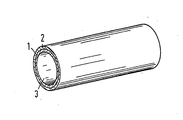
- a section of a shrink tube 2 with a coating of hot-melt adhesive 1 firmly applied in the interior 3 can be seen, which was extruded as a two-layer tube according to the method just described.
- the two-layer hose can also be produced in a successive extrusion process.
Landscapes
- Chemical & Material Sciences (AREA)
- Organic Chemistry (AREA)
- Chemical Kinetics & Catalysis (AREA)
- Adhesives Or Adhesive Processes (AREA)
- Lining Or Joining Of Plastics Or The Like (AREA)
- Extrusion Moulding Of Plastics Or The Like (AREA)
- Adhesive Tapes (AREA)
Abstract
Die Erfindung betrifft ein schrumpfbares Material (2) mit einer Beschichtung aus Schmelzkleber (1), wobei der Schmelzkleber (1) in seinem molekularen Aufbau vernetzungsresistent gestaltet ist. Dies erlaubt, daß die Kleberbeschichtung bereits vor dem für das schrumpfbare Material (2) notwendigen Vernetzungsprozeß aufgebracht werden kann, ohne daß Haftvermögen des Schmelzklebers (1) Schaden erleidet.The invention relates to a shrinkable material (2) with a coating of hot melt adhesive (1), the molecular structure of the hot melt adhesive (1) being resistant to crosslinking. This allows the adhesive coating to be applied before the crosslinking process necessary for the shrinkable material (2) without the adhesive of the hot melt adhesive (1) being damaged.
Description
Die Erfindung betrifft ein schrumpfbares Material mit einer Beschichtung aus'Schmelzkleber, der aus funktionellen Gruppen und diese verbindenden Kohlenwasserstoffsequenzen aufgebaut ist.The invention relates to a shrinkable material with a coating of 'melt adhesive which is composed of functional groups and hydrocarbon sequences connecting them.
Die einem schrumpfbaren Werkstück innewohnende Befähigung, in der Wärme in einfacher oder mehrfacher Richtung zu schrumpfen, ist in seinem Molekülbau und seiner Vorbehandlung begründet. Die solcher Art sich einstellenden Schrumpfkräfte bedingen nach beendeter Schrumpfung einen gewissen Haftfestsitz des Schrumpfstücks auf seiner Unterlage. Dieser sich durch die Schrumpfung einstellende Haftfestsitz kann in vielen Fällen die Anwender dieser Technik nicht zufriedenstellen, zum Beispiel wenn feuchtigkeitsdichte Abschlüsse gefordert werden. In derartigen Fällen wird vorzugsweise in den Schrumpfspalt zwischen dem Schrumpfstück und dem zu umhüllenden Gegenstand ein Kleber eingebracht, durch den die geforderte Haftung und Abdichtung sichergestellt wird. Doch sind im allgemeinen diese Kleber empfindlich gegen Bestrahlung, wie sie beim Vernetzungsprozeß für das Schrumpfmaterial häufig gebräuchlich ist. Deshalb wurden zum Beispiel schrumpfbare Artikel erst nach dem Vernetzungs- und Aufweitungsverfahren mit einer Einlage aus Schmelzkleber versehen, wie dies zum Beispiel in der DE-OS 14 79 624 beschrieben ist. Dies hat jedoch fertigungstechnische Mängel, da auf solche Weise keine fortlaufende Herstellung eines extrudierten und beschichteten Schrumpfschlauches möglich ist. Es ergab sich nun für vorliegende Erfindung die Aufgabe, ein -schrumpfbares Material mit einer Beschichtung aus Schmelzkleber zu finden, mit dem eine kontinuierliche Endlosfertigung von Schrumpfschläuchen ermöglicht wird, wobei während des Vernetzungsprozesses der bereits aufgebrachte Schmelzkleber keinen Schaden bezüglich seiner Klebefähigkeit erleiden darf. Die Aufgabe wird gemäß vorliegender Erfindung mit einem schrumpfbaren Material und einer Beschichtung aus Schmelzkleber der eingangs beschriebenen Art dadurch gelöst, daß die Kohlenwasser- stoffsequenzen des vor dem für das schrumpfbare Material notwendigen Vernetzungsprozeß aufgebrachten Schmelzklebers aus teil- oder mehrfachverzweigten, also mit Seitenketten behafteten Molekülbausteinen aufgebaut sind.The inherent ability of a shrinkable workpiece to shrink in the heat in one or more directions is due to its molecular structure and its pretreatment. The shrinkage forces that occur in this way require a certain adhesive fit of the shrink piece on its base after the shrinkage has ended. In many cases, this adhesive fit resulting from the shrinkage cannot satisfy the users of this technology, for example when moisture-tight seals are required. In such cases, an adhesive is preferably introduced into the shrink gap between the shrink piece and the object to be wrapped, by means of which the required adhesion and sealing is ensured. However, in general, these adhesives are sensitive to radiation, as is often used for the shrinking material in the crosslinking process. For this reason, for example, shrinkable articles were only provided with an insert made of hot-melt adhesive after the crosslinking and expansion process, as described, for example, in DE-OS 14 79 624. However, this has manufacturing defects, since in this way it is not possible to continuously produce an extruded and coated shrink tube. It revealed the task for the present invention is to find a shrinkable material with a coating of hot-melt adhesive with which continuous, continuous production of heat-shrinkable tubing is made possible, wherein during the crosslinking process the hot-melt adhesive already applied must not suffer any damage with regard to its adhesiveness. The object is achieved according to the present invention with a shrinkable material and a coating of hot melt adhesive of the initially described type in that the co h lenwasser- fabric sequences of the applied before the required for the shrinkable material crosslinking process melt adhesive from partially or multi-branched, so afflicted with side chains Molecular building blocks are built.
Die in der Schrumpftechnik anzuwendenden HeiBkleber entfalten ihre Klebereigenschaften über thermoplastisches Fließen. Diese Eigenschaft geht durch die Vernetzung verloren, so daß zum Beispiel bei co-extrudierten Zweischichtenschläuchen aus einer innen liegenden Kleberschicht und einer Schlauchwandung aus schrumpfbarem Material die Gefahr besteht, daß beim Vernetzungsprozeß der Kleber ebenfalls vernetzt wird und damit seine Klebefähigkeit verliert. Besonders gut eingeführt sind HeiBkleber auf Polyamid- oder Polyesterbasis. Sie sind Reaktionsprodukte aus mehrbasischen Karbonsäuren und mehrwertigen Alkoholen bzw. Aminen. Ferner sind Kleber auf der Basis von Äthylen-Vinylazetatcopolymeren bekannt. Diese Substanzen bestehen alle aus an ihren Klassenbezeichnungen erkennbaren funktionellen Gruppen, welche durch Kohlenwasserstoffketten verbunden sind. Die Kohlenwasserstoffsequenzen können erhebliche Längen erreichen und sind verantwortlich für die Vernetzungsbereitschaft der Materialien. Um den Kleber vor der Vernetzung zu bewahren und ihm seine Heißklebefähigkeit zu erhalten, wenn er zum Beispiel als Produkt eines Zweischichtengebildes bei gemeinsamer Extrusion durch eine Vernetzungsanlage geführt wird, wird gemäß der Erfindung vorgeschlagen, seine Kohlenwasserstoffsequenzen aus teil- oder mehrfachverzweigten, das heißt - mit Seitenketten behafteten Molekülbausteinen aufzubauen. Vorzugsweise kann dieses durch polymerisierte Propylenanteile oder durch Einbringung von Butylen geschehen, die an jedem zweiten Kohlenstoffatom eine Verzweigung aufweisen. Je nach funktionellen Gruppen ist durch die Häufigkeit der Verzweigungen und durch Variation der Vernetzungsbedingungen auch gegebenenfalls eine erhebliche Verminderung der Seitenkettenzahl möglich, die vernetzungshindernd wirken. Den gleichen Effekt der Strahlenstabilität kann man auch durch Einbau aromatischer Ringsysteme in das Klebermolekül erreichen, wobei auch deren Konzentration von der übrigen Kleberrezeptur und den Vernetzungsbedingungen abhängig ist.The hot glue used in shrinking technology unfolds its adhesive properties via thermoplastic flow. This property is lost through the crosslinking, so that, for example, in the case of co-extruded two-layer hoses made of an inner adhesive layer and a tube wall made of shrinkable material, there is a risk that the adhesive will also be crosslinked during the crosslinking process and thus lose its adhesiveness. Hot-melt adhesives based on polyamide or polyester are particularly well established. They are reaction products from polybasic carboxylic acids and polyhydric alcohols or amines. Adhesives based on ethylene-vinyl acetate copolymers are also known. These substances all consist of functional groups that can be recognized by their class names, which are connected by hydrocarbon chains. The hydrocarbon sequences can reach considerable lengths and are responsible for the readiness to crosslink the materials. In order to protect the adhesive from crosslinking and to keep it hot-adhesive, for example, as a product of a two-layer structure in the case of joint extrusion through a crosslinking plant, it is proposed according to the invention to build up its hydrocarbon sequences from partially or multiply branched, that is to say molecular units with side chains. This can preferably be done by polymerized propylene fractions or by introducing butylene which has a branch on every second carbon atom. Depending on the functional groups, the frequency of the branches and the variation of the crosslinking conditions may also result in a considerable reduction in the number of side chains which prevent crosslinking. The same effect of radiation stability can also be achieved by incorporating aromatic ring systems into the adhesive molecule, the concentration of which also depends on the other adhesive formulation and the crosslinking conditions.
Bei der Verwendung eines derartig aufgebauten Klebers kann die Beschichtung des schrumpfbaren Materials mit diesem Schmelzkleber bereits vor der Vernetzung und Aufweitung erfolgen, da aufgrund des molekularen Aufbaus eine Vernetzung und damit eine Schädigung des Klebeverhaltens nicht mehr auftreten kann. Damit ist es möglich, das Fertigungsverfahren eines mit Schmelzkleber beschichteten Schrumpfschlauches in einem einzigen kontinuierlich ablaufenden Vorgang herzustellen. Es bietet sich dabei ein Extrusionsverfahren an, bei dem gleichzeitig beide Materialien als konzentrisch verlaufende Schläuche co-extrudiert werden, die sofort zu einem Zweischichtenschlauch zusammengeführt werden. Im Anschluß daran kann sich sofort der Vernetzungs-und Aufweitungsvorgang anschließen. Diese Fertigungsweise bietet weiterhin an, den "Zweischichtenschlauch" als solchen aufzutrommeln und solcherart große Längen in einem Zuge zu fertigen. Bei der Montage kann letztendlich jede beliebige Arbeitslänge abgeschnitten und ohne weitere zusätzliche Bearbeitung geschrumpft werden. In der beigefügten Figur ist ein Abschnitt eines Schrumpfschlauches 2 mit einer im Inneren 3 fest aufgebrachten Beschichtung aus Schmelzkleber 1 ersichtlich, der nach dem soeben beschriebenen Verfahren als Zweischichtenschlauch extrudiert wurde. Der Zweischichtenschlauch kann auch in einem hintereinanderliegenden Extrudiervorgang hergestellt werden. ,If an adhesive constructed in this way is used, the shrinkable material can be coated with this hot-melt adhesive before the crosslinking and expansion, since crosslinking and thus damage to the adhesive behavior can no longer occur due to the molecular structure. This makes it possible to manufacture the manufacturing process of a shrink tube coated with hot-melt adhesive in a single continuous process. An extrusion process lends itself to this, in which both materials are co-extruded at the same time as concentrically running hoses which are immediately brought together to form a two-layer hose. The networking and expansion process can then follow immediately. This manufacturing method also offers to reel the "two-layer hose" as such and to manufacture such large lengths in one go. The assembly can ultimately Any working length can be cut off and shrunk without any additional processing. In the attached figure, a section of a
Claims (6)
Applications Claiming Priority (2)
| Application Number | Priority Date | Filing Date | Title |
|---|---|---|---|
| DE3111064 | 1981-03-20 | ||
| DE19813111064 DE3111064C2 (en) | 1981-03-20 | 1981-03-20 | Shrinkable material with a coating of hot melt adhesive |
Publications (2)
| Publication Number | Publication Date |
|---|---|
| EP0061143A2 true EP0061143A2 (en) | 1982-09-29 |
| EP0061143A3 EP0061143A3 (en) | 1983-11-30 |
Family
ID=6127891
Family Applications (1)
| Application Number | Title | Priority Date | Filing Date |
|---|---|---|---|
| EP82102168A Withdrawn EP0061143A3 (en) | 1981-03-20 | 1982-03-17 | Shrinkable material coated with a fusible adhesive |
Country Status (2)
| Country | Link |
|---|---|
| EP (1) | EP0061143A3 (en) |
| DE (1) | DE3111064C2 (en) |
Cited By (5)
| Publication number | Priority date | Publication date | Assignee | Title |
|---|---|---|---|---|
| FR2572996A1 (en) * | 1984-11-15 | 1986-05-16 | Kabelmetal Electro Gmbh | PROCESS FOR THE MANUFACTURE OF RETRACTABLE ARTICLES COATED WITH FUSE ADHESIVES |
| FR2572995A1 (en) * | 1984-11-15 | 1986-05-16 | Kabelmetal Electro Gmbh | RETRACTABLE ARTICLES COATED WITH FUSE GLUE |
| EP0200824A3 (en) * | 1985-05-07 | 1988-02-17 | Raychem Corporation | Process for manufacturing sealant coated articles |
| EP0368274A3 (en) * | 1988-11-11 | 1992-01-02 | Nippon Zeon Co., Ltd. | Structural material and its application |
| DE29612467U1 (en) * | 1996-07-18 | 1996-09-12 | Alcatel Kabel AG & Co., 30179 Hannover | Device for protecting the jacket of a cable |
Families Citing this family (5)
| Publication number | Priority date | Publication date | Assignee | Title |
|---|---|---|---|---|
| DE3528666A1 (en) * | 1985-08-02 | 1987-02-19 | Auch Folien Gmbh | SHRINK FILM AND METHOD FOR PRODUCING THIS FILM |
| US4818588A (en) * | 1985-11-20 | 1989-04-04 | Dai Nippon Insatsu Kabushiki Kaisha | Packaging materials |
| DE3723980A1 (en) * | 1987-07-20 | 1989-02-02 | Rxs Schrumpftech Garnituren | Plastic material for adhesive coatings on preferably shrinkable products and process for producing such a coated product |
| DE4126110C1 (en) * | 1991-08-07 | 1992-12-17 | Heinrich 5300 Bonn De Pannenbecker | Adhesive foil packaging system - is for rolls of plastics bags and shrink fits foil only over roll end for economy |
| DE4141924A1 (en) * | 1991-12-19 | 1993-06-24 | Ulrich Wackher | Foodstuff covering esp. for sausage meat prods. - has textile carrier with a screen of fusible adhesive points to bond a plastic film |
Family Cites Families (5)
| Publication number | Priority date | Publication date | Assignee | Title |
|---|---|---|---|---|
| BE635318A (en) * | 1962-07-23 | |||
| BE638274A (en) * | 1962-10-04 | 1900-01-01 | ||
| US3448182A (en) * | 1965-11-10 | 1969-06-03 | Raychem Corp | Method for making heat-shrinkable cap |
| FR1542084A (en) * | 1966-10-31 | 1968-10-11 | Raychem Corp | Products formed entirely or partially from crosslinked polymers |
| US3542077A (en) * | 1968-05-22 | 1970-11-24 | Raychem Corp | Differentially cross-linked article and process for making the same |
-
1981
- 1981-03-20 DE DE19813111064 patent/DE3111064C2/en not_active Expired
-
1982
- 1982-03-17 EP EP82102168A patent/EP0061143A3/en not_active Withdrawn
Cited By (6)
| Publication number | Priority date | Publication date | Assignee | Title |
|---|---|---|---|---|
| FR2572996A1 (en) * | 1984-11-15 | 1986-05-16 | Kabelmetal Electro Gmbh | PROCESS FOR THE MANUFACTURE OF RETRACTABLE ARTICLES COATED WITH FUSE ADHESIVES |
| FR2572995A1 (en) * | 1984-11-15 | 1986-05-16 | Kabelmetal Electro Gmbh | RETRACTABLE ARTICLES COATED WITH FUSE GLUE |
| GB2166978A (en) * | 1984-11-15 | 1986-05-21 | Kabelmetal Electro Gmbh | Preparation of shrink articles |
| EP0200824A3 (en) * | 1985-05-07 | 1988-02-17 | Raychem Corporation | Process for manufacturing sealant coated articles |
| EP0368274A3 (en) * | 1988-11-11 | 1992-01-02 | Nippon Zeon Co., Ltd. | Structural material and its application |
| DE29612467U1 (en) * | 1996-07-18 | 1996-09-12 | Alcatel Kabel AG & Co., 30179 Hannover | Device for protecting the jacket of a cable |
Also Published As
| Publication number | Publication date |
|---|---|
| DE3111064A1 (en) | 1982-09-30 |
| EP0061143A3 (en) | 1983-11-30 |
| DE3111064C2 (en) | 1986-07-10 |
Similar Documents
| Publication | Publication Date | Title |
|---|---|---|
| EP0332821B1 (en) | Process and device for the manufacture of longitudinally waterproofed multifilament cable bundles | |
| DE2139445A1 (en) | Changing cover | |
| DE3111064C2 (en) | Shrinkable material with a coating of hot melt adhesive | |
| DE2906450A1 (en) | METHOD OF STIFFNING AN OBJECT TENDING TO DEFORM | |
| DE69525415T2 (en) | Shrinkable tube, made of composite material, and method of sealing using this tube | |
| CH450510A (en) | Method of manufacturing a self-supporting cable | |
| DE2519046C3 (en) | Method of applying a layer of polyethylene to a steel pipe | |
| EP0257223A1 (en) | Process for wrapping elongated articles | |
| DE3806660C2 (en) | Heat-recoverable sleeve for wrapping a substrate | |
| EP0010579A1 (en) | Method of and apparatus for making high pressure flexible pipes | |
| DE102017105787B3 (en) | composite hose | |
| DE3737005A1 (en) | Heat-shrinkable article and process for the production thereof | |
| DD156730A5 (en) | DEVICE FOR COATING STEEL TUBES | |
| DE2338431A1 (en) | DRAWING PROCEDURE | |
| DE3934670A1 (en) | Agricultural plastic sheeting - obtd. by extruding from 2 different decomposable materials joined by an adhesive strip | |
| DE2320177C3 (en) | Conical screw connection of plastic pipes | |
| DE3441743C2 (en) | ||
| EP0314907B1 (en) | Heat shrinkable article | |
| DD202262A5 (en) | DEVICE FOR COATING STEEL TUBES WITH THERMOPLASTIC PLASTIC | |
| EP0521445B1 (en) | Heat protection element for cables at the entrance area of heatshrinkable cable sleeves | |
| DE3714592C3 (en) | Motor vehicle safety tube made of thermoplastic | |
| EP0437708A2 (en) | Method of making a heat-shrinkable sleeve | |
| DE9312731U1 (en) | Plastic strap | |
| DE3530164C2 (en) | ||
| EP0524542B1 (en) | Method for making a shrinkable tube with a melt adhesive layer |
Legal Events
| Date | Code | Title | Description |
|---|---|---|---|
| PUAI | Public reference made under article 153(3) epc to a published international application that has entered the european phase |
Free format text: ORIGINAL CODE: 0009012 |
|
| AK | Designated contracting states |
Designated state(s): AT BE CH FR GB IT LI NL SE |
|
| PUAL | Search report despatched |
Free format text: ORIGINAL CODE: 0009013 |
|
| AK | Designated contracting states |
Designated state(s): AT BE CH FR GB IT LI NL SE |
|
| STAA | Information on the status of an ep patent application or granted ep patent |
Free format text: STATUS: THE APPLICATION IS DEEMED TO BE WITHDRAWN |
|
| 18D | Application deemed to be withdrawn |
Effective date: 19840731 |
|
| RIN1 | Information on inventor provided before grant (corrected) |
Inventor name: NEY, ERNST, DR. PHIL. |