EP0061189B1 - Système de test d'une ligne d'abonné - Google Patents
Système de test d'une ligne d'abonné Download PDFInfo
- Publication number
- EP0061189B1 EP0061189B1 EP82102358A EP82102358A EP0061189B1 EP 0061189 B1 EP0061189 B1 EP 0061189B1 EP 82102358 A EP82102358 A EP 82102358A EP 82102358 A EP82102358 A EP 82102358A EP 0061189 B1 EP0061189 B1 EP 0061189B1
- Authority
- EP
- European Patent Office
- Prior art keywords
- test
- current
- circuit
- constant current
- switch
- Prior art date
- Legal status (The legal status is an assumption and is not a legal conclusion. Google has not performed a legal analysis and makes no representation as to the accuracy of the status listed.)
- Expired
Links
Images

Classifications
-
- H—ELECTRICITY
- H04—ELECTRIC COMMUNICATION TECHNIQUE
- H04M—TELEPHONIC COMMUNICATION
- H04M3/00—Automatic or semi-automatic exchanges
- H04M3/22—Arrangements for supervision, monitoring or testing
- H04M3/26—Arrangements for supervision, monitoring or testing with means for applying test signals or for measuring
- H04M3/28—Automatic routine testing ; Fault testing; Installation testing; Test methods, test equipment or test arrangements therefor
- H04M3/30—Automatic routine testing ; Fault testing; Installation testing; Test methods, test equipment or test arrangements therefor for subscriber's lines, for the local loop
Definitions
- the present invention relates to a testing system for a telephone exchange in which a subscriber line is coupled through a leading-in switch with a test equipment to test the subscriber line and a terminal equipment connected to the subscriber line. More particularly, the present invention relates to a testing system for a telephone exchange by using semiconductor switches of the constant current drive type as the leading-in switches.
- the switch is opened if the gate drive current is stopped.
- the gate drive current of the switch For holding the on-state of the switch when the current flowing into the switch is extremely small or the switch current is inverted in its direction of conduction, the gate drive current of the switch must be fed to the switch continuously after the switch is closed. Therefore the gate drive current after the switch is closed, flows into the speech path or the test loop. This creates a serious problem in the subscriber line test.
- a measuring circuit composed of a cell, a D.C. ampere meter and the like is connected to the connection terminals of the semiconductor switch to feed a current through the semiconductor switch to the subscriber line to be tested.
- the current available from the measuring terminals of semiconductor switches corresponds to the sum of the inherent measuring current providing a measure of the insulation resistance and the gate driving current introduced to the speech channel and hence to the test loop.
- the gate drive current is always constant independently of partial dispersion, it is easy to obtain a true value by correcting the measuring results. Actually, however, the gate drive current is not constant because there is necessarily a variation in constants of the parts. As a result, the measuring result possibly has a great error or the measurement is almost impossible.
- the gate drive current of the thyristor when the gate drive current of the thyristor is turned into a leakage resistance, the gate current is approximately 0.05 to 1 mA, although this depends on the gate sensitivity of the switch.
- an ammeter In measuring the external current, an ammeter is connected in series to the line, through the switch. The power line contact, the battery contact or the like is checked with an indication by the ammeter. Also in this case, the external current measurement is impossible since the gate drive current is not constant because of the presence of the constant variation of the parts, as in the measurement of the insulation resistance.
- the DE-A-26 40 805 discloses a subscriber circuit-test equipment for a space division multiplex-telephone exchange equipment including transposition point switches, such as thyristors, in which as shown in Fig. 2(a) of the reference each of switches 14a, 15a, 16a, 14b, 15b and 16b is maintained in the on-state by supplying a holding current from a constant current source 20 to the switch group. As each of the switches is maintained in the on-state by holding current from the constant current source 20 the gate current of each switch which may cause measurement errors is turned off and each switch is maintained in the on-state as it is. As the test is performed in such a way, there occurs no measurement error caused by a gate current of a thyristor and accordingly the measurement of an insulating resistance becomes possible.
- the DE-A-26 40 805 disclosed no means to draw the holding constant current component away from the measuring current.
- EP-A-49 471 which is published on April 14, 1982 and falls therefore under the terms of article 54 (3) EPC, a subscriber line testing system is known, in which only a measured current value increasing in proportion to voltages measured at two points can be obtained by calculation.
- the test system known from EP-A-49 471 tests a subscriber line by using a leading-in semiconductor switch of a constant current driven type, wherein a constant current component flowing through the switch is drawn- off by a circuit means (cf. 30 in Fig. 3 of the reference), so as to prevent this current from being added to the line current being measured by the test equipment.
- a circuit means cf. 30 in Fig. 3 of the reference
- an object of the present invention is to provide a subscriber line test system capable of producing a test at a high accuracy, a reduced measuring time and a high reliability, which is suited for reducing the size and cost, to lower power consumption and to increase package density of a telephone exchange system.
- a desired subscriber line to be tested is connected to the test equipment through a test line and a leading-in switch provided as a semiconductor switching element of the constant current drive type. Then, a constant current flowing through the test line is measured and only the measuring current component flowing through the subscriber line to be tested is fed to the test equipment by drawing the whole constant current which serves to drive the leading-in switch by means of a compensation circuit away from said test line.
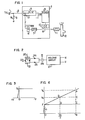
- reference numeral 1 designates a telephone set; 2 a subscriber line; 3 an insulation resistance of the subscriber line; 4 a telephone exchange; 5 a subscriber's circuit; 6 a test network; 7 a compensation circuit; 8 a test line; 9 a time division network; 10 a control unit; 11 a subscriber line test trunk; 12 a subscriber line test equipment; 13 a test leading-in switch.
- a specific test leading-in switch 13 and a switch in the test network 6, which are specifically related to a subscriber line to be tested, are selectively driven. Then a current corresponding to a gate current for driving the test leading-in switch 13 is drawn through the test line 8 by a constant current leading-in circuit in the compensation circuit 7. All of the undesirable characteristics of the test leading-in switch 13 are corrected by the compensation circuit 7, so that the subscriber line test equipment 12 can test the subscriber line through the line test trunk 11, as in the conventional test of the subscriber line in the telephone exchange. In other words, by using the compensation circuit 7, the subscriber line test in various types of telephone exchange systems may be performed by conventional test equipment.
- Fig. 2 shows an example of the test leading-in switch 13 shown in Fig. 1. Specifically, Fig. 2 shows a circuit diagram showing a crosspoint (of only one of the line pair) of a semiconductor switch of the bidirectional type.
- reference numerals 20 and 21 represent incoming and outgoing test lines, respectively; 22 and 23 crosspoint thyristors; 24 and 25 gate reverse blocking diodes for the thyristors 22 and 23; 26 a constant current circuit for supplying the gate current Ig necessary for driving the crosspoint thyristors 22 and 23; 27 a holding circuit for holding the constant current circuit 26 when the switch is closed by selecting the coordinates in an orthogonal coordinate system.
- Fig. 3 The relationship between the gate current Ig of the test leading-in switch 13 and the cathode potential V of each of the thyristors 22 and 23 is illustrated in Fig. 3. As shown in Fig. 3, the characteristic of the constant current circuit 26 is such that the gate current Ig reaches a constant current region when the cathode potential of each of crosspoint thyristors 22, 23 becomes OV.
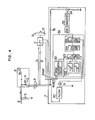
- FIG. 4 A circuit arrangement and an operation of a compensation circuit of the testing system according to the present invention will be described referring to Fig. 4.
- Fig. 4 to avoid the duplication of description, like symbols are used for designating like portions in Fig. 1. As in the case of the Fig. 1, only one of the subscriber line pair is tested.
- a reference numeral 30 denotes a filter
- 31 a comparator for checking whether or not the potential on the test line 8 reaches zero potential
- 32 a control circuit for controlling the drawn current until the potential of the test line 8 reaches the zero potential
- reference numerals 321 and 325 form the control circuit 32 of which a reference numeral 321 denotes a timing generator circuit; 322 a counter circuit, 323 a selector circuit; 324 an adder circuit; 325 a register circuit;
- 33 denotes a digital to analog (D/A) converter for converting a control signal from the control circuit 32 into an analog signal; 34 a constant current leading circuit for drawing or leading out the current from the test line 8 according to a signal from the D/A converter 33.
- Ig designates a gate current for driving the test leading-in switch 13 and I L a measuring current flowing through the insulation resistance.
- a control circuit selectively drives the leading-in switch 13 and the test network 6 so that a subscriber line 2 to be measured is coupled with the subscriber line test equipment 12 and the compensation circuit 7.
- a measuring current I L flows through a route including ground- insulation resistor 3-subscriber line 2-test leading-in switch 13-test network 6-test trunk 11-subscriber line test equipment 12 in this order.
- the gate current Ig flows out of the constant current circuit 26 of the test leading-in switch 13 into the test network 6 and the constant current leading circuit 34, but does not flow into the subscriber line test equipment 12.
- a relationship between the gate current Ig of the test leading-in switch 13 and the switch cathode potential V is such that when the cathode potential reaches OV, the gate current lg settles down to be constant.
- the potential on the test line 8 and zero potential are compared with each other by the comparator 31 through the noise damping filter 30.
- the control circuit 32 on the basis of the output signal of the comparator circuit 31, the digital signal is incremented so as to increase the drawing current of the constant current drawing circuit 34 when the potential on the test line 8 is positive and is decremented so as to decrease the drawing current when the potential on the test line 8 is negative.
- control circuit 32 Next, the operation of the control circuit 32 will be explained in detail hereinafter.
- a control circuit (not shown) selectively drives the leading-14 switch 13 and the test network 6 so that a subscriber line 2 to be tested is coupled with the compensation circuit 7 through the test line 8. As this time, the test equipment 12 is not coupled with the test line 8.
- a reset signal from the outer subscriber line test trunk 11 is received by the control circuit 32, and the counter circuit 322, the timing generator circuit 321 and the register circuit 325 are initially reset.
- the selected control signal is added to another control signal stored in the register circuit 325 at the former timing, and then the added value is stored in the register circuit 325.
- the signal of the register circuit 325 comes near to "1", and the drawing current is increased.
- the electric potential of the test line 8 is negative, the signal of the register circuit 325 comes near to "0", and the drawing current is decreased.
- the drawing current is set to be "zero”.
- the drawing current increases and decreases repeatedly as shown in the example of and consequently the electric potential of the test line 8 comes near to "zero" potential unlimitedly.
- a decrement ⁇ l L of the measuring current resulting from the reduction of the voltage across the resistance 3 is corrected in the control circuit 32 such that (lg ⁇ lL).
- the drawn current in the constant current drawing circuit 34 is (lg ⁇ l L ).
- FIG. 5 Another embodiment of a compensation circuit of the testing system according to the present invention will be described referring to Fig. 5.
- like reference numerals are used to designate like portions in Fig. 4.
- reference numerals 40 to 50 in the compensation circuit 7 designate relay switches; 50 and 60 power source circuits of two types, a V a /2 and a V B , for introducing a current from the subscriber line 2 into the compensation circuit; 70 a resistor for converting the current introduced from the subscriber line into a voltage; 71 and 72 a transistor and a resistor, which cooperatively constitute a constant current circuit for drawing a gate current Ig.
- Reference numeral 80 designates a filter for damping noise induced on a test line, and 81 an analog to digital (A/D) converter for converting a voltage produced across the resistor 70 into a digital signal.
- the output signal from the converter circuit 81 is stored in register circuits 82 and 83.
- These signals from the memory circuits are arithmetically processed by adder circuits 84 and 85, a doubling circuit 86, a register circuit 87, and a comparator 88.
- a control circuit 89 produces a signal for controlling the drawing current.
- the control signal is converted into an analog signal by a digital to analog (D/A) converter circuit 90 by which the base potential of a transistor 71 is controlled.
- reference numerals 51 and 61 are amplifiers, 52, 53, 62, 63 transistors 54, 55, 64 and 65 resistors, and 56 and 66 capacitors.
- Fig. 6 illustrates a graph describing a principle of the measurement.
- the gate current Ig of the leading-in switch 13 is drawn into the compensation circuit 7 to feed only the measuring current I L flowing through the insulation resistance 3 to the test equipment 12.
- the compensation circuit 7 for drawing the gate current Ig controls the relay switches to selectively connect to the test line 8 the V B /2 system power source circuit 50 or the V B system power source circuit 60, whose potential states are related in the ratio 1:2. With this connection, the currents Im1 and lm2 corresponding to the potentials of the power source are introduced into the compensation circuit 7.
- Input voltages V1 and V2 to the amplifiers 51 and 61, that is, voltages across the resistors 54 and 64, are given by the following equations: where resistances of the resistors 54 and 64 are R54 and R64.
- the amplifiers 51 and 61 function as voltage followers, and are coupled at the output with the combinations of the transistors 52 and 53, and 62 and 63, and the resistors 55 and 65, as shown.
- the current Im1 flowing through the resistor 54 and the current Im'1 flowing through the resistor 55, and the current lm2 flowing through the resistor 64 and the current Im'2 flowing through the resistor 64 are related in the following way:
- voltages V5 and V6 produced across the resistor 70 by the flow of the current values Im'1 and Im'2 are V5 and V6, respectively.
- the voltages V5 and V6 are converted into digital signals by the A/D converter circuit 81.
- the digital signals representative of the voltages V5 and V6 are temporarily stored in the registers 82 and 83.
- the measured values V5 and V6 read out from the registers 82 and 83 are subjected to a calculation to obtain a voltage caused by the current Ig of the switch 13 which is performed by the combination of the adders 84 and 85, and the doubling circuit 86. This operation is executed on the basis of the principle illustrated in Fig. 6.
- the voltage V7 caused by the gate current Ig of the switch 13 is It is seen from the foregoing that the insulating resistance 3 of the subscriber line 2 can be measured by an indication on the scale of the ammeter A of the test equipment 12 by leading the current corresponding to the voltage V7 obtained by the above equation from the test line 8 into the transistor 71 and the resistor 72 through the switches 40 and 44 when the subscriber line is tested.
- the circuit operation of Fig. 5 will be described.
- the relay switches 40 to 45 are set in a state as shown and the current Im1 is fed into the power source circuit 50 of the V B /2 system.
- the voltage V5 caused by the current Im1 is produced across the resistor 70.
- the voltage V5 is digitized and stored in the register 83, through the filter 80, the relay switch 45, and the A/D converter circuit 81.
- the relay switch 43 is switched to the transistor 71 side through the relay switch 44.
- the voltage corresponding to the current flowing into the transistor 71 and the resistor 72 through the resistor 70 is loaded into the register circuit 82 through the A/D converter 81.
- the comparator 88 compares the voltage stored in the register circuit 82 with the voltage V7 previously stored in the register 87 by the comparator 88.
- the control circuit controls the base potential of the transistor 71 until the value in the register 82 is equal to the base potential of the transistor 71.
- the filter 80 is separated from its related circuit chain by opening the relay switch 45 at its post stage.
- the base potential at the transistor 71 is controlled so that the values in the registers 82 and 87 are equal to each other, that is to say, the current corresponding to the gate current Ig flows into the transistor 71. Then, the relay switches 40 and 44 are switched to the opposite side. As a result, the current corresponding to the gate current Ig is shunted from the full current lm of the subscriber line 2 and is drawn into the compensation circuit, through the switches 40 and 44, the transistor 71, the resistor 72, and the battery, while only the current corresponding to the measuring current I L is fed into the test equipment 12. Therefore, the insulation resistance 3 of the subscriber line 2 can correctly be measured.
- the subscriber line test is possible free from the influence by the gate current lg. Accordingly, it is possible to test the subscriber line as in the case of the prior art test by using a metallic contact. Therefore, the subscriber's circuit including the test leading-in switch can be fabricated into an monolithic IC, with the result that the subscriber's circuit is reduced in size and cost, while at the same time a low power consumption and a high density package are realized.
- test equipment can test the subscriber lines in a centralized testing manner independently of the types of telephone exchanges used.
Landscapes
- Engineering & Computer Science (AREA)
- Signal Processing (AREA)
- Monitoring And Testing Of Exchanges (AREA)
Claims (5)
Applications Claiming Priority (2)
| Application Number | Priority Date | Filing Date | Title |
|---|---|---|---|
| JP40347/81 | 1981-03-23 | ||
| JP56040347A JPS57155869A (en) | 1981-03-23 | 1981-03-23 | Subscriber line test system |
Publications (2)
| Publication Number | Publication Date |
|---|---|
| EP0061189A1 EP0061189A1 (fr) | 1982-09-29 |
| EP0061189B1 true EP0061189B1 (fr) | 1985-07-31 |
Family
ID=12578096
Family Applications (1)
| Application Number | Title | Priority Date | Filing Date |
|---|---|---|---|
| EP82102358A Expired EP0061189B1 (fr) | 1981-03-23 | 1982-03-22 | Système de test d'une ligne d'abonné |
Country Status (3)
| Country | Link |
|---|---|
| US (1) | US4447679A (fr) |
| EP (1) | EP0061189B1 (fr) |
| JP (1) | JPS57155869A (fr) |
Families Citing this family (8)
| Publication number | Priority date | Publication date | Assignee | Title |
|---|---|---|---|---|
| JP2570289B2 (ja) * | 1986-05-20 | 1997-01-08 | 日本電気株式会社 | 監視方式 |
| CA1311570C (fr) * | 1989-06-28 | 1992-12-15 | Thomas Gray | Appareil d'essai des circuits des lignes de reserve d'un systeme de communication et methode connexe |
| US5960060A (en) * | 1997-08-19 | 1999-09-28 | J. V. Technologies, Inc. | Line tester for coin-operated telephones |
| FI106334B (fi) * | 1998-05-08 | 2001-01-15 | Ericsson Telefon Ab L M | Menetelmä ja järjestely testaukseen |
| US6895089B2 (en) | 2001-12-14 | 2005-05-17 | Adc Dsl Systems, Inc. | Pots splitter with line impedance matching |
| US6853724B2 (en) | 2001-12-14 | 2005-02-08 | Adc Dsl Systems, Inc. | Cascade low-pass filter to improve xDSL band attenuation for POTS splitter |
| US6618469B2 (en) * | 2002-02-05 | 2003-09-09 | Adc Dsl Systems, Inc. | Circuits and methods for testing POTS service |
| US20030198341A1 (en) * | 2002-04-23 | 2003-10-23 | Adc Dsl Systems, Inc. | Integrated POTS/MLT card |
Family Cites Families (2)
| Publication number | Priority date | Publication date | Assignee | Title |
|---|---|---|---|---|
| US4076971A (en) * | 1975-09-12 | 1978-02-28 | Hitachi, Ltd. | Subscriber line testing system |
| JPS5765053A (en) * | 1980-10-08 | 1982-04-20 | Hitachi Ltd | Test method for subscriber line |
-
1981
- 1981-03-23 JP JP56040347A patent/JPS57155869A/ja active Pending
-
1982
- 1982-03-22 EP EP82102358A patent/EP0061189B1/fr not_active Expired
- 1982-03-22 US US06/360,847 patent/US4447679A/en not_active Expired - Fee Related
Also Published As
| Publication number | Publication date |
|---|---|
| EP0061189A1 (fr) | 1982-09-29 |
| JPS57155869A (en) | 1982-09-27 |
| US4447679A (en) | 1984-05-08 |
Similar Documents
| Publication | Publication Date | Title |
|---|---|---|
| US6255839B1 (en) | Voltage applied type current measuring circuit in an IC testing apparatus | |
| GB1498719A (en) | Electrical test system | |
| KR20000005251A (ko) | 프로그램가능한 딜레이를 제공하는 장치 및 방법 | |
| US4447679A (en) | Subscriber line testing system | |
| US5608329A (en) | Circuit test device | |
| US20020093314A1 (en) | Electronic circuit for measuring series connected electrochemical cell voltages | |
| CA1162611A (fr) | Detecteur de defaillances dans les diodes | |
| US4743842A (en) | Tri-state circuit tester | |
| US6833722B2 (en) | Electronic circuit device with a short circuit switch using transistors and method of testing such a device | |
| US4438299A (en) | On-line telephone troubleshooting apparatus | |
| EP0476331B1 (fr) | Convertisseur analogique-numérique parallèle comportant un circuit de test | |
| EP0927885B1 (fr) | Appareil de mesure de la conductivité, de la teneur en oxygène dissous, et du pH | |
| CA1054275A (fr) | Systeme de verification de ligne d'abonne au moyen de dispositifs de commutation a semiconducteurs | |
| US4392026A (en) | Subscriber line testing system | |
| CA1056912A (fr) | Comparateur de phases et modes de fonctionnement | |
| US6194910B1 (en) | Relayless voltage measurement in automatic test equipment | |
| US20020149388A1 (en) | Method for the accurate electrical testing of semiconductor devices | |
| US3297833A (en) | Repeater fault location | |
| EP0085089B1 (fr) | Agencement de linearisation de points de croisement a semiconducteurs | |
| US3172038A (en) | Double bridge circuit for measuring resistance of energized alternating current apparatus | |
| US20250062684A1 (en) | Power conversion system and control method therefor | |
| SU1446658A1 (ru) | Устройство дл компенсации погрешности измерительного трансформатора тока | |
| US6194953B1 (en) | Circuit configuration for generating an internal supply voltage | |
| SU1285381A1 (ru) | Многоканальный коммутатор дл контрольно-измерительных устройств | |
| EP0709687A2 (fr) | Appareil pour tester la qualité des niveaux logiques des signals digitaux |
Legal Events
| Date | Code | Title | Description |
|---|---|---|---|
| PUAI | Public reference made under article 153(3) epc to a published international application that has entered the european phase |
Free format text: ORIGINAL CODE: 0009012 |
|
| AK | Designated contracting states |
Designated state(s): FR GB SE |
|
| 17P | Request for examination filed |
Effective date: 19830308 |
|
| GRAA | (expected) grant |
Free format text: ORIGINAL CODE: 0009210 |
|
| AK | Designated contracting states |
Designated state(s): FR GB SE |
|
| ET | Fr: translation filed | ||
| REG | Reference to a national code |
Ref country code: GB Ref legal event code: 732 |
|
| REG | Reference to a national code |
Ref country code: FR Ref legal event code: TP |
|
| PLBE | No opposition filed within time limit |
Free format text: ORIGINAL CODE: 0009261 |
|
| STAA | Information on the status of an ep patent application or granted ep patent |
Free format text: STATUS: NO OPPOSITION FILED WITHIN TIME LIMIT |
|
| 26N | No opposition filed | ||
| GBPC | Gb: european patent ceased through non-payment of renewal fee | ||
| PGFP | Annual fee paid to national office [announced via postgrant information from national office to epo] |
Ref country code: FR Payment date: 19901218 Year of fee payment: 10 |
|
| PGFP | Annual fee paid to national office [announced via postgrant information from national office to epo] |
Ref country code: GB Payment date: 19910122 Year of fee payment: 10 |
|
| PG25 | Lapsed in a contracting state [announced via postgrant information from national office to epo] |
Ref country code: GB Effective date: 19920322 |
|
| GBPC | Gb: european patent ceased through non-payment of renewal fee | ||
| PG25 | Lapsed in a contracting state [announced via postgrant information from national office to epo] |
Ref country code: FR Effective date: 19921130 |
|
| REG | Reference to a national code |
Ref country code: FR Ref legal event code: ST |
|
| PGFP | Annual fee paid to national office [announced via postgrant information from national office to epo] |
Ref country code: SE Payment date: 19930324 Year of fee payment: 12 |
|
| PG25 | Lapsed in a contracting state [announced via postgrant information from national office to epo] |
Ref country code: SE Free format text: LAPSE BECAUSE OF NON-PAYMENT OF DUE FEES Effective date: 19940323 |
|
| EUG | Se: european patent has lapsed |
Ref document number: 82102358.7 Effective date: 19941010 |